




Abstract
Cultural psychology is studying how human culture and psyche interact and mutually constitute each other. Diverse cultural models have been developed to describe cultural features or dimensions to explain differences and similarities between people’s behaviours, emotions, values and interactions across cultures. The present study takes an in-depth and outsider approach, by investigating migrants’ perspectives on German culture. Using go-along, semi-structured interviews and thematic analysis we investigate how migrants’ perceptions of elements of German culture interact with their sense of belonging. Five themes describe this experience (1) relying on German rigidity, (2) discovering authenticity in the reservedness of social minimalism, (3) living out freedom in a limited social space, (4) navigating subcultural collectivism within a culture of neoliberalism and (5) living between assimilative expectations and the integration of multiculturalism. Together, these themes show that migrants’ belonging is shaped not only by interpersonal dynamics but also by structural practices, implicit cultural scripts, and perceived contradictions within national identity discourse. The findings refine cultural-psychological theories by demonstrating how cultural meaning-making unfolds in migration contexts and point to practical implications, such as educating people on the importance of minimal bonding acts, supporting sub-cultures, and reflecting on implicit assimilation attitudes in policy messaging for fostering belonging in migrants in Germany.
Introduction
I feel on the whole people are a lot more honest and more open. They might say something mean but it is actually them being nice and friendly. (Alex, Berlin, from the USA)
One culture’s “open and direct” is another culture’s “harsh and mean,” and vice versa; that is the magic of the cultural shaping of our perception, behaviours, our thoughts, feelings, and interactions with the world (Kirmayer, 2007; Thomas, 2004). This shaping becomes especially evident in the context of migration, where individuals accustomed to one way of living move to another country and encounter a society where a different way of being is considered the norm. The process often involves navigating contrasting behaviours, perceptions, and cultural assumptions. The present article explores how migrants in Germany perceive and navigate elements of German culture, focusing on those aspects that either supported or hindered their sense of belonging. Certain cultural elements in Germany, such as directness, rule orientation, or social reservedness, may be familiar to readers through widely circulating cultural stereotypes, media portrayals, or intercultural trainings. However, far less is known about how migrants themselves identify, interpret, and emotionally engage with these cultural elements, and how such meaning-making processes shape their emerging sense of belonging. Rather than revisiting classic culture-shock patterns, this study shifts the focus to migrants’ firsthand interpretations of what “German culture” consists of – that is, the specific cultural scripts (Ryder et al., 2011) they perceive as salient, and to why these specificities matter for feeling in place or out of place. By foregrounding migrants’ experiential and reflective accounts, we offer a novel perspective on how individuals transform cultural norms into personally significant resources, constraints, or ambivalent conditions that shape their belonging in everyday life.
Defining and Delineating Culture
Many definitions of culture exist within the literature – in earlier usage the term culture was often used to mean “civilised,” a notion motivated by colonising attitudes of Western parts of the world (Kirmayer, 2007). Contemporary perspectives have moved beyond that and the notions of cultures as isolated, self-contained entities and instead view culture as encompassing all humanly constructed aspects of the social and material world, including institutions. From this perspective, culture functions as a shared and transmitted guide for individuals within a group (Thomas, 2004) and is understood as a dynamic system continually constructed and reconstructed through socialisation and interaction (Chiu et al., 2010; Kirmayer & Swartz, 2013). Cultural psychology adopts a similar stance, conceptualising culture as a system of shared meanings, practices, and normative expectations that emerges through these ongoing processes (e.g., Santamaría et al., 2019; Trommsdorff, 2009). Culture resides at many levels of social organisation (Chiu et al., 2010; Kirmayer, 2007) – in parts it is internalised and shows as individual level characteristics, but some parts are also external and tangible, constructing the landscape in which people live. The relationship between individuals and their cultural contexts is complex due to several reasons:
First, the cultural environment is not clearly delineated. In cultural psychology, countries are often used as proxies for specific cultural contexts, however many cultures exist in one country, and many cultures are not limited to one country – there are both, smaller and bigger cultural units than countries. Moreover, today’s nation states are a relatively recent level of identification, whereas communities and thus cultural units used to be smaller and more immediate for most of human history (Anderson, 1983/2016). Defining where one culture ends and the other starts is highly complex and maybe futile. Sometimes cultural units can be defined by a shared language (e.g. Kurds) across country borders, or within a bigger country (e.g. Québécois). Furthermore, boundaries between cultural groups are dynamic and porous, shaped by interaction rather than essential cultural properties (Barth, 1969). Thus, cultural and ethnic groups are not defined by immutable internal traits but by flexible, negotiated, and socially maintained boundaries (Barth, 1969). This perspective is particularly relevant for understanding migrants’ shifting experiences of “insider” and “outsider” status. In addition, subcultures may extend across countries and are often better characterised by shared access to resources, such as educational opportunities, or by social class and related structural conditions.
Second, individuals within a cultural context can be strongly heterogeneous and not every individual in a specific group is necessarily a typical representative of that group. People can consciously or unconsciously reject the cultural values around them. Besides, individuals can be part of several cultures, as is the case in “third culture kids” or second-generation migrants. Furthermore, specific aspects of a culture might impact specific individuals in different ways (Ryder & Chentsova-Dutton, 2012). Hence, each individual is situated in a unique cultural context (Lott, 2015). In intercultural psychology, the choice to use “culture” as a synonym for an individual’s nationality or ethnic group membership is often a pragmatic one, since statistics are available on a national level and this practice allows the clear identification of members of a “cultural” group (Duden & Sunohara, in press; Ryder & Chentsova-Dutton, 2012). However, this approach carries the risk of stereotyping, leading to wrong assumptions about fixed characteristics of a group (Ryder & Chentsova-Dutton, 2012; Ryder et al., 2011). Furthermore, “cultural differences” often become a “black box” that is used as an explanation instead of being explained themselves. As a result, cultural variables are sometimes invoked as catch-all constructs, obscuring deeper understanding.
Cultural psychologists have been aiming to render culture describable, measurable and quantifiable and proposed diverse models and dimensions for this purpose. The most prominent one is the distinction between individualism and collectivism (Hofstede, 1980; Oyserman et al., 2002; Triandis, 1988). Numerous studies have used dimensions and models like these to describe and analyse cultures. However, there is increasing acknowledgement that framing value systems and cultural dimensions as dichotomies is both conceptually and empirically restrictive (e.g., Kağıtçıbaşı, 1996; Rothbaum & Trommsdorff, 2007). As Minkov (2013, p. 135) observes, cultural dimensions are constructs created by researchers to interpret human behaviour; they exist solely in the minds of individuals, and no single set of cultural dimensions can be considered definitive. The challenge of rendering culture describable or measurable persists, as culture, with its multifaceted and dynamic nature, resists easy quantification, posing significant methodological hurdles (Duden & Sunohara, in press). In the present article, we report on a study in which we had “outsiders” to a culture report on their experiences of differences. While many introductory accounts of culture summarise broad cultural dimensions such as individualism–collectivism, our objective here is not to reproduce descriptive overviews but to establish the conceptual foundation for examining how migrants themselves experience, reinterpret, and negotiate these cultural patterns in ways that directly affect their sense of belonging. By examining cultural dynamics through the lens of those undergoing processes of acculturation, we are hoping to access firsthand experiences and perceptions, providing concrete insights into the tangible impact of culture on individuals’ lives. This approach underscores profound cultural influences on everyday behaviours, attitudes, and social interactions. Consequently, embracing the outsider-but-insider perspective of migrants offers a fruitful avenue for making culture more tangible and help to make the cultural scripts (Ryder et al., 2011), that are implicit for people native to the culture, explicit.
Sense of Belonging and Acculturation
Acculturation research conceptualises acculturation as an interactive and dynamic process rather than a one-sided adjustment by newcomers. From this perspective, cultural meanings, opportunities for participation, and feelings of belonging are co-constructed through mutual perceptions, everyday interactions, and institutional practices within the host society (Bourhis et al., 2010; Doucerain et al., 2013; Kunst, 2025; Rohmann et al., 2008). Accordingly, acculturation outcomes depend not only on migrants’ characteristics, but also on contextual conditions such as host-society attitudes, institutional accessibility, and the affordances of everyday environments (Doucerain, 2019; Piontkowski et al., 2002; Rohmann et al., 2008). Despite calls for more context-sensitive approaches, few studies have examined these interactional dynamics from migrants’ own perspectives as they unfold in daily life. The present study contributes to this emerging field by examining how migrants experience and make sense of acculturation processes in situ. Specifically, we asked migrants in Germany to identify elements of German culture that they became aware of and that either facilitated or hindered their sense of belonging (SoB).
SoB is defined as the subjective feeling of a deep connection with social groups, physical places, individual and collective experiences (Allen et al., 2021; Duden et al., 2025). Various elements can profoundly affect a person’s sense of belonging, including relationships, spaces, events, material possessions, and their complex interactions with cultural context, individual traits, perspectives, and self-concept (Allen et al., 2021; Duden et al., 2025). For instance, in a previous study (Duden et al., 2025) we found that multicultural environments where individuals engaged with fellow migrants (e.g., international schools, language exchange cafés) fostered a SoB in migrants through experiencing feelings of shared difference and providing a space for authenticity. These settings were perceived as culturally inclusive (e.g., allowing communication in English or one’s native tongue) and enabled participants to integrate while embracing and expressing their cultural identity. Prior work also shows that the mutual perceptions between migrants and majority members shape perceived inclusion and everyday experiences of fit within a host country’s social norms (Froehlich & Schulte, 2019; Schachner et al., 2017). Our present study contributes to this literature by highlighting which cultural scripts migrants identify as most consequential for belonging. Building on Barth’s (1969) understanding of cultural boundaries as flexible, interactionally produced, and context-dependent, we approach migrants’ accounts not as descriptions of fixed “German traits” but as insights into how boundaries of belonging are constructed, negotiated, and sometimes contested in everyday life. This perspective allows us to analyse how migrants actively interpret, reproduce, or challenge cultural scripts as they navigate positions of insider and outsider.
Migration to Germany
Since its reunification, Germany has become one of Europe’s major destinations for migrants, receiving both humanitarian arrivals and labour-related mobility (Bertoli et al., 2016; Glorius, 2018). These flows have been primarily concentrated in metropolitan areas and major cities, with occasional spikes triggered by international conflicts (Cilek et al., 2025). Over the past decades, however, both the countries of origin and the circumstances under which people migrate to Germany have shifted considerably.
Immigration increased and diversified, and new forms of migration, such as family reunification, supplemented and eventually replaced the guest worker recruitment that shaped immigration from the late 1950s until the early 1970s (Milewski & Swiaczny, 2012). In the late 1980s, and especially after reunification in 1990, immigration was dominated by ethnic German resettlers (“[Spät]Aussiedler”) and asylum seekers and refugees, including from the former Yugoslavia (Heider et al., 2020). Overall migration declined during the second half of the 1990s and remained relatively low until around 2010 (Cilek et al., 2025). At the same time, migration policy gradually shifted. Germany’s long-standing model of temporary labour recruitment gave way only slowly to the recognition of long-term settlement. In the 2000s, the country moved away from its general restrictive stance on migration toward a more selective, neoliberal labour migration strategy, often described as a focus on attracting “the best and the brightest” (Doomernik et al., 2009), motivated by demographic pressures and EU governance developments. Reflecting this approach, Germany postponed full labour market access for EU citizens from the 2004 enlargement until 2011, and for Bulgarians and Romanians until 2014, subjecting them in the interim to rules similar to those for third-country nationals (Glorius, 2018). By the early 2010s, freedom of movement within the enlarged EU had become a major driver of immigration, with growing numbers arriving from Poland, Romania, Bulgaria, and Southern Europe in search of employment, training, and educational opportunities (Glorius, 2018). Germany has also attracted increasing numbers of international students to its university cities. Meanwhile, humanitarian migration surged: in 2015, net migration reached 1.1 million people, largely due to refugees from Syria and Afghanistan, and during the initial phase of the Russian invasion of Ukraine between February 2022 and March 2023, more than 1 million refugees from Ukraine were registered (Sauer et al., 2023).
These developments highlight Germany’s long-standing role as a country of immigration, shaped by diverse origin regions and migration motives. Yet the policy framework regulating arrival and settlement remains marked by tensions. Today’s system combines strict administrative procedures, a strong emphasis on language acquisition, and complex residency regulations with state-sponsored integration courses, civic education, and pathways to citizenship. Public discourse oscillates between multicultural ideals and expectations of conformity to culturally embedded norms (Zick et al., 2001), producing a mixed landscape in which opportunities for participation coexist with demanding bureaucracies and implicit pressures to adapt (Glorius, 2018). These tensions have historical roots. For decades, foreigners were expected either to assimilate if they remained long-term or, particularly in the case of guest workers, to stay socially separate and ultimately return to their countries of origin. Minority groups were implicitly categorised as either assimilable or expected to remain segregated for ease of repatriation (Zick et al., 2001). Although policy has evolved, traces of these assumptions continue to shape debates about integration, social cohesion, and cultural boundaries (Brubaker, 2001; Fischer & Mohrman, 2021).
At the same time, everyday life in Germany is shaped by cultural features such as direct communication, clear rules and procedures, punctuality, individual responsibility, and strong institutional structure (Hall & Hall, 2003; House, 2006). While these elements can foster predictability and trust, they may also pose challenges for newcomers accustomed to more flexible norms or high-context, relational communication. As a result, migrants’ opportunities for social contact and their encounters with Germany’s cultural landscape are shaped not only by their migration motives and legal status but also by the cultural context in which they settle.
The Present Study
The present study goes beyond describing cultural differences familiar from intercultural trainings or German-as-a-foreign-language curricula. By situating migrants’ cultural perceptions within their evolving sense of belonging, we illuminate how cultural scripts are emotionally and socially inhabited, how they shape possibilities for connection, and how they can limit or enable authentic self-expression. This relational and experiential focus provides a more nuanced understanding of what it means to be a cultural outsider in Germany, and how belonging is co-constructed at the intersection of the self and the cultural environment. Certainly, experiences of belonging are shaped by participants’ own cultural backgrounds, countries of origin, family situations, length of residence, visible minority status, and migration trajectories. This study does not aim to generalise to “all migrants” or “all Germans.” Rather, it seeks to synthesise how individuals – who share the commonality of having migrated to Germany – interpret cultural specificities and how these interpretations intersect with their own histories of belonging.
Most studies that involve migrants and culture focus on migrants’ processes of acculturation, integration or their psychological adaptation (e.g., Crocetti et al., 2024; De Lucena et al., 2020; Deslandes et al., 2024), or how specific individual characteristics (country of origin, openness to other cultures, bicultural orientation, language proficiency etc.) influence these processes (e.g., Uskul et al., 2024; Valenti & Faraci, 2024). In contrast to this, we are asking the questions: What is the cultural content immigrants are asked to acculturate/ assimilate/ integrate to? What are the perceived cultural aspects in Germany that migrants experience as relevant to their sense of belonging?
Methods
The current study used qualitative research methods to explore how perceived cultural attributes facilitate or hinder migrants’ SoB in Germany, considering their unique experiences. We adopted a contextualist perspective, acknowledging the partial accessibility of truth through language (Madill et al., 2000). Ethical approval was obtained for this study by the University of Hagen (FernUniversitaet in Hagen) ethics committee, and participants provided informed written consent.
Procedure
The study was part of a larger mixed-method research project investigating SoB in migrants in Germany and Canada. The portion reported here employed a qualitative research design, primarily using semi-structured go-along interviews (Carpiano, 2009). In this method, the researcher accompanies participants on a walk through their familiar surroundings, such as neighbourhoods, workplaces, or community spaces, while engaging them in conversational interviews. The go-along approach is particularly suitable for examining SoB because it situates participants in the actual environments where belonging is experienced or challenged, allowing for contextualised, in-situ insights that traditional interviews often miss (Bartlett et al., 2023; Duden et al., 2025; J. Evans & Jones, 2011). It enables researchers to observe and discuss both the physical and social elements of spaces, capturing how environmental cues, social interactions, and cultural practices influence feelings of inclusion, comfort, and attachment (Dixon et al., 2022).
Compared to conventional sit-down interviews, go-along interviews add significant value by linking narratives to specific locations, facilitating more vivid recollections and reflections. Participants can point out landmarks, specific spaces, or areas where they feel welcomed or marginalised, providing richer, spatially grounded data. Furthermore, in a go-along interview, the surrounding environment can influence the discussion, easing some of the perceived pressure on both the participant and the interview script, and enabling a more fluid and dynamic conversation (Brown & Durrheim, 2009; Garcia et al., 2012). In practice, the method was implemented with careful attention to participants’ comfort and autonomy: the walks ranged from 38 to 125 min (average 72 min), and took place in settings chosen by participants as meaningful or routine in their daily lives. The researcher adopted a supportive and non-intrusive role, prompting discussion with open-ended questions, but allowing participants to guide the route and focus of the conversation. In addition to the go-along interviews, one-setting and virtual interviews were conducted when mobility or scheduling constraints prevented walking interviews. Across all interviews, questions were designed to explore migrants’ experiences of cultural elements, culture-specific behaviours, and interpersonal as well as macro-level interactions, with a focus on understanding how these factors either hindered or facilitated participants’ sense of belonging (Bartlett et al., 2023).
Setting
Interviews were conducted between September 2022 and April 2023 in four German cities (Berlin, Bremen, Leipzig, Stuttgart). These cities were selected to represent diverse migration contexts and patterns and population compositions across different regions. For instance, the experience of being a migrant in Leipzig (with 16% of the population having a migration background) might differ from that in Bremen (38% with a migration background; BPB, 2022; Stadt Leipzig, 2020). The sample thus spans a range of urban contexts, from medium-sized cities to a multicultural metropolis (Kratke, 2001).
Sample and Recruitment
The participants in the study were 36 external migrants between the ages of 25 and 65 who had relocated to one of the four cities (see Table 1). We only included migrants who had been living in Germany for at least 4 months. We did not place restrictions on the maximum duration of their stay or their country of origin. However, we did require fluency in English, French, German, Portuguese, or Spanish to conduct interviews in these languages. Thirty two of the participants had an intention to stay in Germany, one participant had already made plans to leave the country, and three participants were unsure about where to live in the future.
Comprehensive Overview of Socio-Demographic Characteristics of Participants.
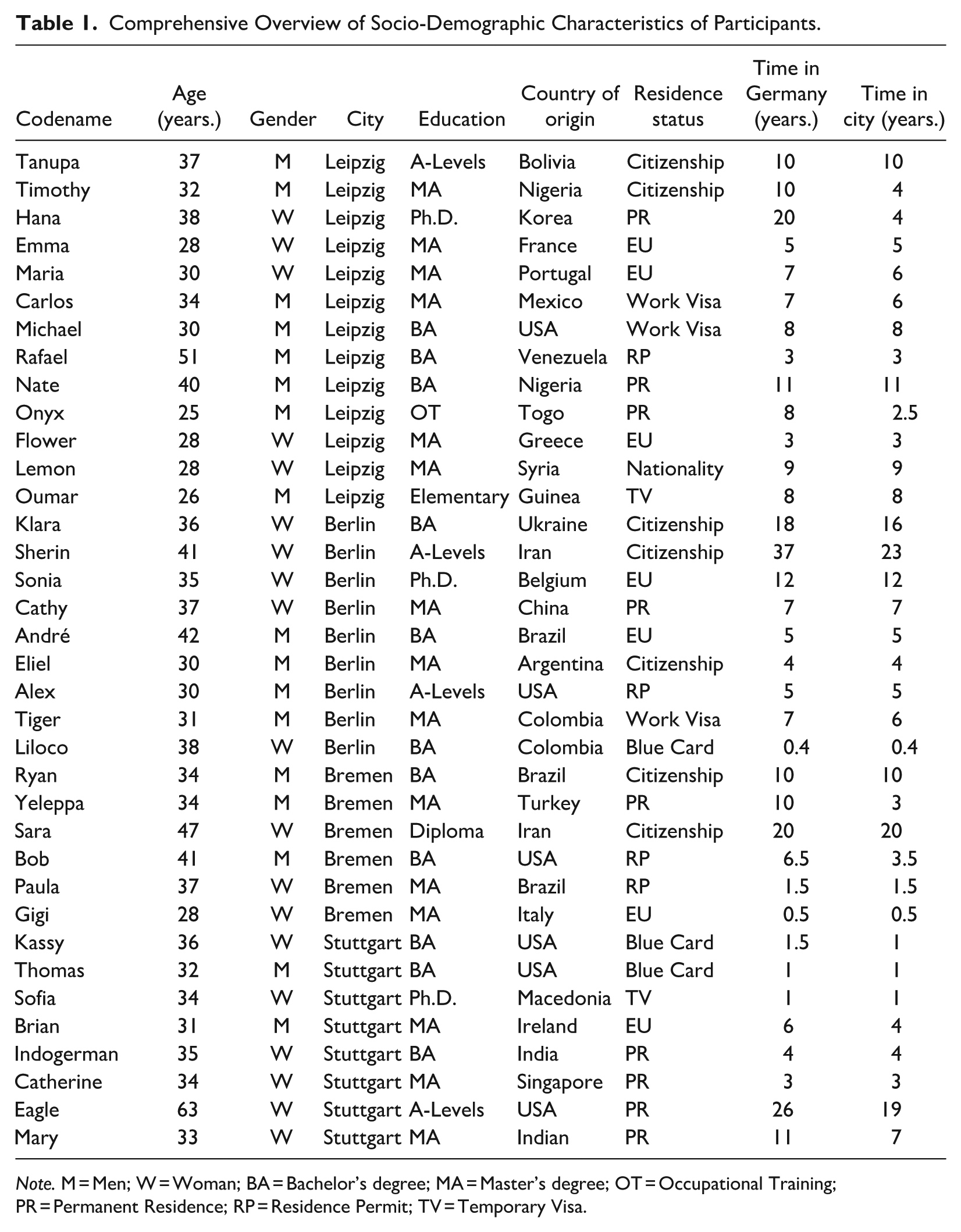
Note. M = Men; W = Woman; BA = Bachelor’s degree; MA = Master’s degree; OT = Occupational Training; PR = Permanent Residence; RP = Residence Permit; TV = Temporary Visa.
Participants were recruited through migration-themed social media groups and snowball sampling (Parker et al., 2019), with a maximum of 15 participants per city to ensure a manageable sample size for analysis. During recruitment we prioritised variation rather than representativeness, because our aim was to surface diverse cultural experiences rather than estimate prevalence. We acknowledge that fluency requirements (English, French, German, Portuguese, Spanish) and snowball recruitment introduced biases (see Limitations), but the sampling strategy did purposefully include participants from European, North American, Latin American, African, Middle Eastern, and East Asian origins. The sampling approach incorporated elements of theoretical sampling, specifically emphasising maximal and minimal contrasts. For maximal contrasts, participants were sequentially recruited to identify the next participant who significantly differed from the preceding one in dimensions like country of origin, profession, or family structure. This strategy sought to introduce greater conceptually relevant diversity, avoid treating migrants as a homogeneous group, and stimulate the construction of themes in the ongoing data analysis. Additionally, minimal contrasts, involving the selection of structurally similar cases, were employed to refine and specify themes (Conlon et al., 2020).
Materials
We developed an interview guide with conversational stimuli such as: “Could you tell me a little bit about the way that people here interact?” “Sometimes people’s behaviours or attitudes don’t make us feel like we belong. Have you experienced this here? In which ways?” The English interview guide was translated and back-translated (Brislin, 1970) into French, German, Portuguese, and Spanish with the assistance of native speakers in each language. Given the dynamic nature of go-along interviews, the semi-structured questions were enriched with spontaneous comments and stories. Throughout the interviews, a field journal was kept documenting the researcher’s assumptions and impressions before, during, and after the conversations. Furthermore, a brief demographic questionnaire was administered.
Reflexivity and Establishing Trustworthiness
The interviews were conducted by the first author who is of German origin and several trained research assistants with German-Polish, Brazilian and Portuguese backgrounds. A group of four researchers originating from German, German-Polish, and Austrian backgrounds, analysed the data. All identified as white women. We acknowledge the potential influence of our backgrounds on participants’ willingness to share their perspectives. However, the first author has extensive international experience and is well-versed in intercultural interaction. Born in Germany she spent several years of her life in different countries including Ireland, Brazil and Canada. Listening to participants’ experiences with German culture, analysing the data and reflecting on the results when writing the discussion of the article, she reflected on her own reverse cultural shocks when visiting Germany and being confronted with staff’s directness, friends’ expectations of reliable plans, and people taking everything at face value. These aspects were also evident in our participants’ experiences, as well as in those of our team members, who have all international experiences themselves. Thematic Analysis (TA) does not view researchers’ subjectivity as a problematic issue requiring control. Instead, it emphasises the significance of the researcher’s subjectivity as an analytical resource and their reflexive engagement with theory, data, and interpretation (Braun & Clarke, 2021). In our case, we made ourselves aware of our assumption that we would hear about cultural differences and repeatedly revised the interview guide and our analysis to not simply confirm this assumption but leave space for participants to report on cultural similarities.
In the current study, we employed reflexive journaling during both data collection and analysis phases. This methodology encourages researchers to continually question their expectations and practices during the whole process (Clarke & Braun, 2021). Furthermore, we sought to enhance the trustworthiness of our study through the implementation of the following strategies:
Triangulation: By using multiple sources of data, we aimed to corroborate our findings. In addition to go-along interviews, we conducted face-to-face and virtual interviews and maintained observational notes.
Member checking: By presenting both the transcripts and our findings to the participants for validation or correction, we ensured that our interpretations faithfully capture the perspectives and experiences of the participants (Nowell et al., 2017).
Peer debriefing: Our work involved collaborative efforts within our team for data collection, analysis, and the production of the final report. This approach aimed to highlight the subjectivity of researchers throughout the analysis process (Braun & Clarke, 2021).
Thorough documentation: All the decisions made throughout data collection and further analysis were documented (Nowell et al., 2017).
Analysis
We analysed the data using a largely inductive and reflexive TA approach, following Braun and Clarke’s framework from 2021. TA is a qualitative research method focused on identifying, analysing, and reporting patterns (themes) within the data. This approach allowed us to generate key themes related to our research questions. We chose TA because it aligns with the contextualist perspective in our study (Braun & Clarke, 2021; Madill et al., 2000). Additionally, TA is well-suited for addressing our research questions, which focused on the exploration of individual experiences (Clarke & Braun, 2021).
All interviews were manually transcribed in their original language. To begin the analysis process, researchers read the transcripts thoroughly. Data were coded using the qualitative analytical software MAXQDA (VERBI-Software, 2021). Although transcripts were analysed in their original language, codes were formulated in English. Capturing the meaning of each code was ensured by back-translation (Brislin, 1970).
While not required for reflexive TA (Braun & Clarke, 2021), our research process utilised collaborative teamwork. Four researchers worked together to engage in the analytical process, meeting regularly to manage the data volume and enhance interpretative depth. Open coding was employed, without predetermined codes, while focusing only on the data segments relevant to our research questions. Within this context, codes represented the most basic units of meaningful data (Clarke & Braun, 2021). Codes were then organised into subthemes and overarching themes. Formulating codes and themes involved comparing and contrasting them across participants and identifying common or unique patterns found in specific interviews.
Attending to Heterogeneity and Intersectionality
In line with our contextualist approach we treated participants’ social locations as analytically relevant rather than background descriptors. After initial inductive coding we created participant attribute variables (region/country of origin, migration motive, legal status, gender, time in Germany, and reported socioeconomic indicators) and used these attributes to cross-tabulate codes and themes. Specifically, we: (1) added attributes to each transcript in MAXQDA as document variables; (2) performed matrix queries (Code Matrix Browser / Crosstab) to examine which codes clustered among participants with similar attributes; (3) produced analytic memos when contrasts or consistent patterns were observed; and (4) iteratively re-read transcripts to verify whether apparent patterns reflected robust experiential differences or were idiosyncratic. This procedure allowed us to identify patterns (e.g., recurring concerns or emphases among participants with particular regional origins or migration reasons) while preserving the idiographic richness of each account. Where clear cross-group differences are reported in the results, we indicate them cautiously using language such as “participants from X region described. . ..”
Results
Before presenting themes, it is important to note that participants did not experience German culture uniformly. While the thematic structure below captures shared meanings, certain emphases varied across groups. For example, participants from neighbouring European countries and those with EU mobility rights often emphasised differences in small-talk norms and punctuality, but described few experiences of explicit racialisation or discrimination, except for accent-based dismissal. In contrast, participants from African, Middle Eastern, and some South Asian backgrounds described experiences of racialised exclusion, and concerns about safety in certain contexts. Participants who arrived as refugees or on temporary humanitarian pathways highlighted bureaucratic obstacles and felt strong pressure to demonstrate German-language competence for survival and institutional access. These observations are based on our attribute-informed coding and iterative memoing process. The themes that follow therefore reflect both shared and group-specific experiences of belonging; where a theme was generated that was more strongly present within a subgroup, we indicate this in the theme description.
We generated five themes represented in Figure 1: (1) relying on German rigidity, (2) discovering authenticity in the reservedness of social minimalism, (3) living out freedom in a limited social space, (4) navigating subcultural collectivism within a culture of neoliberalism and (5) living between assimilative expectations and integration of multiculturalism.
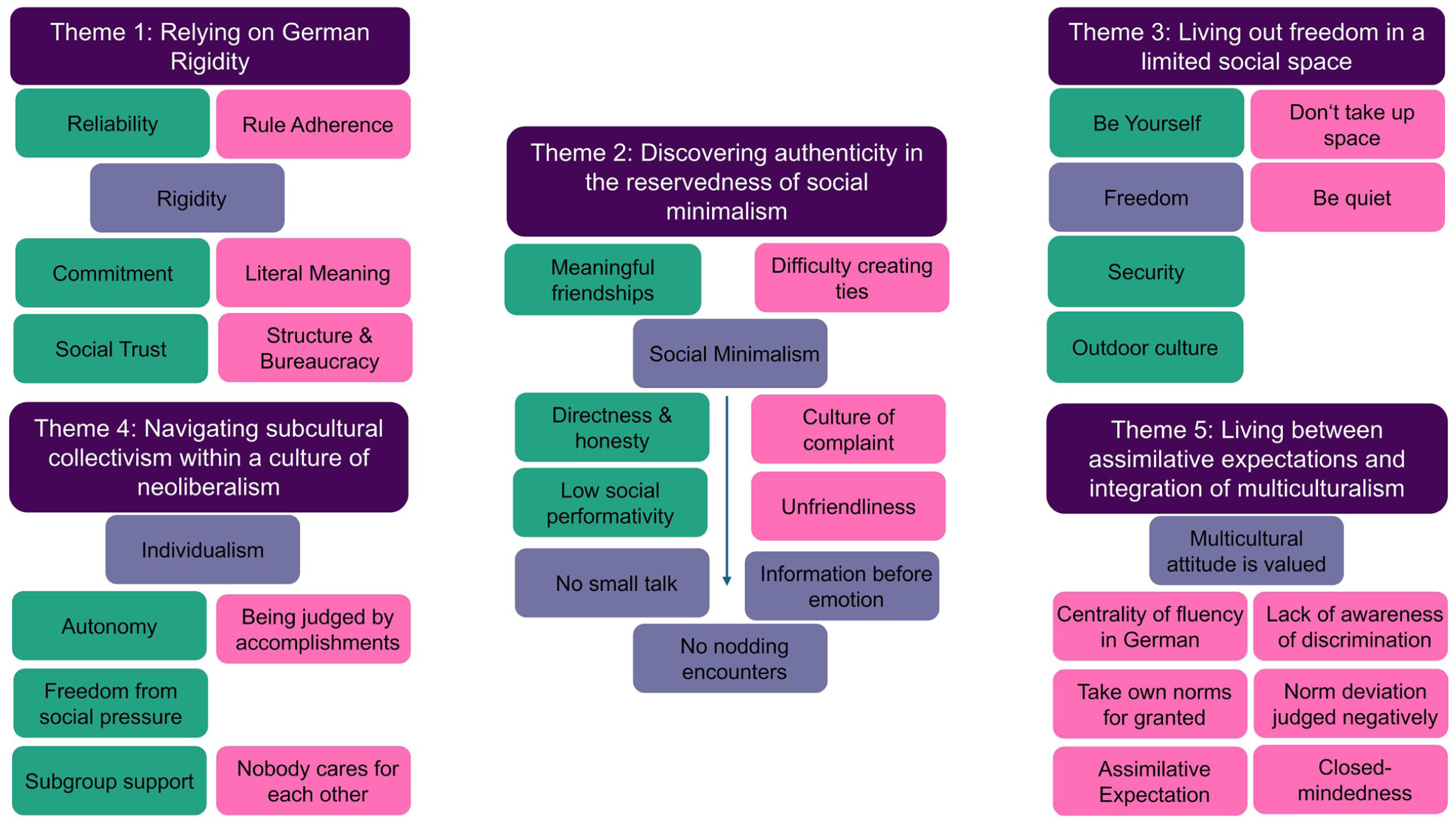
Themes and Subthemes developed in the Thematic Analysis. Green indicates predominantly positive subthemes, pink indicates predominantly negative subthemes, and violet represents neutral or ambivalent subthemes.
Theme 1: Relying on German Rigidity
This first theme speaks to participants’ experience of Germans as showing a high level of rigidity and rule adherence, and at the same time reliability and social trust. The latter helped participants to experience SoB over time, but the rigidity would often estrange people and make them feel judged for having a different way of committing to and communicating about plans and of conceptualising time. Participants perceived the Germans they encountered as committed, but not very flexible. They would talk about plans, commit to what they said and get upset when plans had to change:
When things don’t go exactly to plan here, I have noticed that people tend to get a little bit flustered, which is absolutely understandable in my opinion, but when it’s not Plan A then it starts to get difficult and coming up with Plan B on short notice can get quite difficult. (Mary, Stuttgart, from India)
Participants also experienced Germans to take the meaning of words completely literally, and not understand that other people were communicating intentions rather than concrete plans:
When I moved here, people said hey, you’re not reliable. WHAT? I’m reliable, if you somehow have a body in the car (laughs), I’m definitely there. I’ll help you dig. But they meant time or something. So yeah, we’re doing the next one in three weeks, and I was like “ah, yeah cool, I’ll be there,” meaning I’m interested. I have no idea what I’ll be doing in three weeks (laughs). Will I even be in the city? I don’t know. So that’s how it was for me and saying yes means showing interest. (Michel, Leipzig, from the USA)
The most stereotypical aspect of this theme concerned participants’ experience of time understanding in Germany. They stressed how punctuality was a cultural value that people would reiterate consistently. Participants generally perceived this as something positive but also wanted Germans to be aware that this was just one way of understanding time, and that there is a diversity of perspectives in the world on what punctuality actually means. Furthermore, participants experienced their German environment to be law-abiding. One example was jaywalking, which was seen as socially frowned-upon:
It was a public holiday,
Even though the social scolding was not understandable for most, participants stressed the positive side of the law abidance and the many rules that they perceived to be in place. Some felt that these rules helped to protect them. Hand in hand with law abidance came a high focus on bureaucracy in participants’ experiences, which often hindered their SoB. While participants felt that organisation and structure were important aspects of German culture, they experienced that an overbearing degree of structuring came with inefficiency, particularly in various public sectors such as the healthcare system. They felt that there was a form to fill in for every small thing, many bureaucratic steps were too complex to be understood and clear understandable information was missing. Notably, experiences of bureaucratic rigidity were emphasised particularly by participants with temporary residence statuses and those who arrived as refugees, for whom administrative hurdles had immediate material consequences (e.g., access to healthcare, housing), whereas participants with EU mobility rights described rigidity in cultural interaction (e.g., punctuality) rather than institutional exclusion. Participants also perceived that it was part of German culture to complain about the bureaucracy, particularly about tax declarations, and in some instances to use the shared experience of complaining about these things as a form of social bonding.
Theme 2: Discovering Authenticity in the Reservedness of Social Minimalism
This theme speaks to participants’ experience of perceived social minimalism in interaction with Germans. Social minimalism consisted of a perceived reservedness in the way Germans would interact, such as not engaging in small talk and avoiding eye contact, talking to strangers, or nodding encounters – that is, minimising social interactions to the bare minimum of fulfilling the function of information transfer, but not extending to social and emotional functions in many cases:
I feel like a stranger because people are just not - I don’t know the people, and they’re not friendly to strangers. You know you feel at home you’re if you’re walking the dog around your block where you live and people like “hello.” The people in Germany, for the most part, don’t typically do that. Even if I saw the same people all the time, or they’re my neighbour three doors down, you give them like “Moin” and then sometimes they just walk by and say nothing. It’s . . . ok, give me my morning back. You don’t get my morning. So, in that way, sometimes I do feel like a stranger, not just in this city, but in this country. (Bob, Bremen, from the USA)
In participants’ accounts, the perceived reservedness often led to a difficulty in connecting with Germans and creating ties. Participants felt that it took a lot of time and effort to become friends with a German:
I think that the reserved nature that I spoke about, that definitely hinders, when people are reserved then as a non-local you think a lot more when it comes to approaching local people to form friendships, to form relationships. (Gigi, Bremen, from Italy)
Even if they knew people, the level of connection they perceived with these people was often lower or at least very different from what they were used to from their country of origin, making it harder to develop a SoB:
I feel like I belong where I feel seen. Sometimes you are in a group, and you can talk to everyone, sure, but if you weren’t there, nobody would notice. And yeah, that’s not it. For example, I think the first friends I created here, at least the majority of them, were there because they were there. So, if for a while I didn’t show up, nothing would happen. But in Greece, if I didn’t show up for one or two days, they would come to my place to check. Like, have you been down? Like, what happened? And yeah, for me, that’s the thing. (Flower, Leipzig, from Greece)
More than simply reserved, some participants described Germans as unfriendly and rude. Others initially shared this perception, but transformed this interpretation over time:
For me Germans do communicate in a different way than Americans yeah, so I have learned to disregard my feelings and beliefs that happen here in the head that: “oh they are being unfriendly! That person is being unfriendly by talking to me that way!” It is like: “no they are just being German.” [Laughs] So kind of curt and abgehackt [choppy]. And maybe not so friendly you know, but I have learned that Germans are quite friendly but in their own way yeah, they just have a different way of doing it. (Eagle, Stuttgart, from the USA)
These observations were common across all countries of origin and not limited to certain geographical regions. However, there was a visible difference in perception, depending on the time people had spent in Germany already. As participants spent more time in Germany, their interpretation often changed: what initially felt like rudeness came to be understood as straightforward communication and a form of unapologetic honesty. Actual friendliness in Germans would then not be artificial, but authentic:
I feel on the whole people are a lot more honest and more open. They might say something mean but it is actually them being nice and friendly which I find really charming. Yeah, so yeah in certain way it makes people feel more open, and ironically more friendly as well because there is not this superficial layer that you have to sort of navigate to find out what they really mean because they are pretty much saying what they mean. (Alex, Berlin, from the USA)
In parallel to that, participants found that once you had managed to become friends with a German, the friendship would be deep and meaningful. Low social performativity was another interpretation of the perceived directness and honesty, and this made some people feel as if they could authentically be themselves, as they did not feel like they had to perform in their interactions with others. This experienced low performativity in Germany also included participants’ accounts on people not caring about clothes, make-up or physical appearance to the extent people did in their countries of origin:
And the very first thing I would say is make-up, because in France women just wear make-up and there’s this pressure that you feel so much more that you’re somehow only pretty when you’re completely made up and that you shouldn’t leave the house without make-up on. (Emma, Leipzig, from France)
A particularly striking account on the lower social performativity in German culture compared to US American culture, was that of Kassy, who is blind and compared people’s way of dealing with encountering her in the two countries:
But there [in the US] is also a bit more of a performative element to being a good person. Especially in the more liberal cities. So, then the person with a disability becomes an opportunity to demonstrate one’s goodness, whether the person with disability
Participants also felt like everyone could honestly state their opinion in Germany. As a negative side of this, they felt that this sometimes turned into a sense of entitlement, arrogance and a culture of complaint:
The expectations the people have it’s sort of a very, almost negative mindset in the sense that they’re complaining about things and so busy complaining that they. . . because they haven’t, they’re not grateful for what they have. (Brian, Stuttgart, from Ireland)
While social minimalism was noted across origin groups, participants from neighbouring European countries tended to frame it as a style difference, whereas participants who had experienced racialisation described it as additional social distancing that compounded feelings of non-belonging.
Theme 3: Living Out Freedom in a Limited Social Space
This theme outlines a SoB that arose from people feeling free and as if they could be themselves. At the same time, the theme describes how developing a SoB was hindered by participants experiencing certain restrictive norms in the social space. Participants experienced a great sense of security, particularly in public spaces, and consequently felt freedom to use these spaces. They described the use of public spaces as something very strong in German culture allowing the creation of an outdoor culture:
Riding my bike everywhere, I really love that here too, I miss it every time I’m back in Lyon. It’s now also a sign that I’m back home in Leipzig, because I’m so ah yes cool! Now I’m back on the road with my bike, I’m just so looking forward to it. [Laughs] In the rain, in the snow, it’s just normal, you don’t really question it, so yes, that’s my means of transport. (Emma, Leipzig, from France)
Particularly women, and people from Latin American countries stressed the high sense of security they felt in public spaces that allowed them to move around and freely use these spaces (see Figure 2). The freedom participants felt in Germany also related to religious and political freedom:
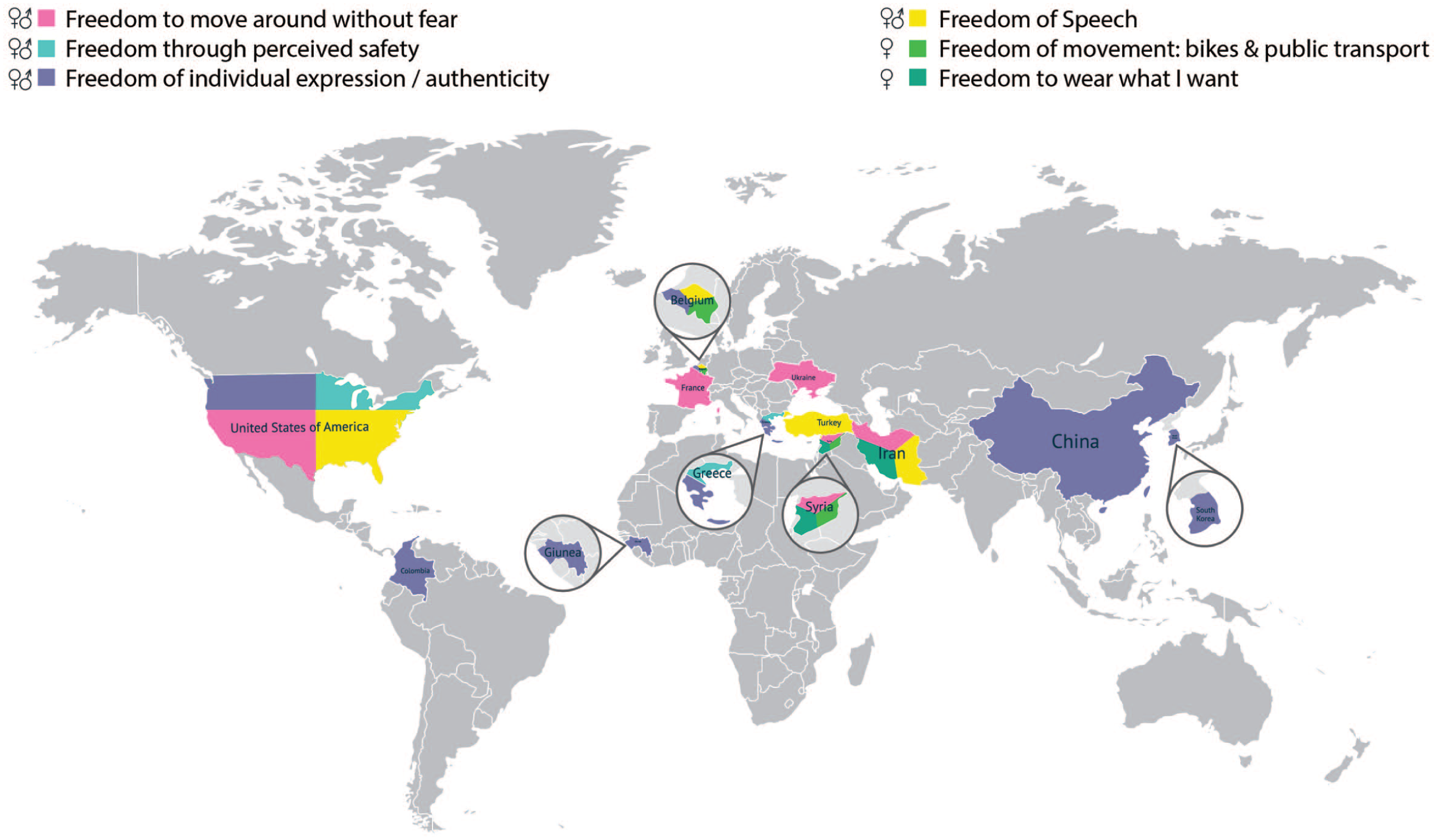
References to freedom across participants’ countries of origin.
These political things, so that you somehow end up in prison because of politics or statements. Or being murdered or beaten or raped. You’ll never experience that in Bremen. Or in Germany. And that’s a very important factor for me, actually the most important thing. (Sara, Bremen, from Iran)
Participants also remarked on the great value given to actively shape your own life and let your children shape theirs in Germany:
I think also, also in Berlin. I just feel that I have the power of control here, I am in control in this city, compared to China at home, because I am always told what to do. And I need to meet up with certain social expectations, so whereas here I can really decide however I want to do, whatever I want to be. (Cathy, Berlin, from China)
This feeling of freedom and people not interfering too much with one’s personal choices in life transcended diverse areas in life. Participants commented on freedom in relationship models, freedom in career choices or gender role expectations (see Figure 2).
However, participants also felt that there were certain implicit norms in public spaces. These norms limited the extent to which participants felt that they could be and express themselves. The most important norm participants mentioned was an expectation that nobody should take up too much social space. Participants from high social-engagement cultures (e.g., Greece, Latin America) reported feeling restricted by a “quietness norms.” This was related to participants feeling that they had to hold back or hide their outgoingness because it was not appreciated among Germans. The perception pertained in particular to noise and volume: Participants felt that Germans valued quietness very much, and that you were expected to conform to this:
Or sometimes even at some bars, it’s very quiet and chill. If you scream, then you stand out. In general, I feel like I have to lower down a bit the. . . I can’t be that spontaneous in that I can’t have this energy that I would have and the excitement that I would have back in Greece talking to strangers. (Flower, Leipzig, from Greece)
Theme 4: Navigating Subcultural Collectivism Within a Culture of Neoliberalism
Participants experienced a strong divide between what they perceived as a German mainstream culture and the cultures that exist in subcultural groups. They perceived the mainstream culture as placing a high value on autonomy and individualism. The participant who is blind stated:
There is a higher value on privacy, personal space and autonomy. So even when I ask people for help, they’re more likely to give me information than to try and do things for me or try to physically move me or physically interact with me without my permission. Even in the instances where somebody wants to touch me for something they ask permission first 9 times out of 10. In a lot of cases, they will use sound or information to interact with me in a place where somebody in a different culture would have grabbed me. People talk to me instead of to someone I’m with. Which is why I say autonomy. So that has made it much easier. This is a large part of why I feel like I belong here as compared to the US. (Kassy, Stuttgart, from the USA)
Due to the high value of autonomy, and linking to the themes of authenticity and freedom, participants expressed feeling a certain freedom from social pressures – for instance, from drinking alcohol in groups, as people would respect one’s individual choice to drink non-alcoholic beverages. Similarly, people were accepting of one’s food choices, restrictions or diets, and would accommodate accordingly without trying to convince one to change them.
However, participants also reported how the high value of individualism was embedded in a neoliberal spirit, in which people would judge you and your right to belong based on your accomplishments. The focus on autonomy also created a feeling for participants that nobody really cared about the other, particularly in the public sphere: “So it’s such an individualism that people really only care about their own lives here” (Maria, Leipzig, from Portugal).
This was different in subgroups – participants felt that Germans behave very differently once you gained access to smaller groups. These groups would often form around a common link such as a shared hobby (e.g., sport) or political stance (e.g., activist groups), and in this context particularly “Vereine,” a common German type of association or club with certain legal features, were mentioned. In these groups, Germans would show a greater communal interest, be helpful and support each other:
I got in [the sailing association] pretty quickly. It was thanks to them that I began to see a different side to the Germans, really. Before them I only had two Germans who I trust. And since then, I’ve discovered friendships a lot more. They have this idea of helping each other and. . . If you help someone, obviously you’ll have a friendship. I was always very confused about Germans, they made it very difficult for you to make friends, but in the end it’s just that, from the start, they’re open, you’re here, so you’re in the circle. It’s quite interesting, because I even heard this from a friend of mine, one of the German’s friends, you can have a friendship, they totally help. It’s a closed group, but it’s a group that, once you’re in, you’ll feel really good, because it really is true. In these groups they’re much more open, there’s much more receptivity. (Ryan, Bremen, from Brazil)
Some participants were very aware of the different types of subcultures that exist within their city and mentioned in particular a leftist subculture that would actively reject anything slightly neoliberal. Participants with stronger German proficiency or middle-class professional backgrounds found subcultures easier to access; others, especially those with lower language proficiency, struggled more or were not aware of the existence of these groups.
Theme 5: Living Between Assimilative Expectations and Integration of Multiculturalism
This last theme could be considered a meta-theme as it transcends all the other themes. Common to all the themes was that participants described positive and negative sides of cultural elements in Germany. Yet, the factor that recurred consistently in the descriptions and was reported to highly impact a SoB, was the perception that Germans would often take their own way of being and living for granted and judge people according to their own cultural standards without having much consciousness of it. For instance, Germans would perceive and label someone as unreliable when this person would not take words (e.g., a movie invitation) literally, or as taking up too much space when being louder than the German standard. For some participants this perception was quite paradoxical, since they also experienced a high level of cultural diversity within Germany and perceived societal value being placed on a multicultural attitude:
I met grandmas who really wanted to know about all the cultures and travelling and you know they learn English, and English is the simplest language in the world but still it is there. You even see like those outliers in the older generation but more for our generation and younger ones right, they are more open and see the world more as a global village. Of course they were brought up the German way, so that whole you know follow the rules, work ethics, that is there, but at the same time they have opportunities to be rebellious and free thinking. (Nate, Leipzig, from Nigeria)
Despite multicultural attitudes and diversity in the cities, many participants suffered from experiencing a lack of acceptance and a high level of close-mindedness, which did not align with the attitudes the Germans presented overtly, and which was hence perceived as hypocritical:
People want to say that they are open, but when the opportunity presents to them to interact with a person that is different to you, you close, and you just turn around? It’s just the abstract, it just like to say I am open to new experiences to your own close group of friends. So, you can have a higher status within your group of friends, but you actually you don’t mean what you’re saying. I’ve seen that so many times. “I am open and we are progressive” and then when we comes to interact with a refugee and trying to understand the human experience of the person then they are “yeah I think it’s better if I just go back saying I will support refugees to my own white group of German friends” and that’s something that pisses me and amazes me at the same time here in Germany. (Carlos, Leipzig, from Mexico)
A large factor in hindering participants’ SoB was the apparent centrality of speaking German fluently in order to belong. Although many reported having encountered people fluent in English and people showing consideration for non-fluency in German, participants reported on language barriers to a great extent, as well as on the cultural importance of speaking German. Language as gatekeeping disproportionately impacted migrants from linguistic “outsider” backgrounds (Arabic, Farsi, African languages). Encounters with Germans were often marked by this – conversations would be avoided or kept short if Germans felt that there was not enough language fluency. Even going out with colleagues or friends, Germans would try to make an effort in the beginning to include the non-German speaker, but eventually switch back to German leaving the non-German speaker feeling excluded. Some participants even experienced being ridiculed because of their accent:
People will make fun of me because of my accent. Just talking on the phone for instance, like if I am not as fast as they want me to respond or if I have to take a second to think about how to phrase something in German, they might hang up the phone. This happened multiple times. Or like people talking down to me just because I speak with an accent at certain locations like dealing with visa issues. I feel like definitely before I could speak German at a moderate level, I definitely got this aggressiveness and sort of like this feeling that I am not supposed to be here because I cannot speak German yet. (Alex, Berlin, from the USA)
Particularly people working in public institutions, like the foreigner’s registration office, but also in doctor’s offices etc. insisted on speaking German with participants which made some of them uncomfortable. Pressure to learn German was a cross-cutting theme, yet it was experienced differently: for some (e.g., economic migrants) it was described as practical and instrumental, while for others (e.g., asylum seekers and racialised migrants) it became a gatekeeping mechanism attached to symbolic exclusion. In part, participants explained the language dimension by a high assimilative expectation they felt Germans held – foreigners were expected to become Germans even though a high value was placed on being multicultural. This was also visible in participants’ reports on Germans insisting on own cultural values and traditions, taking these for granted and not showing much openness or flexibility for alternative ways of being:
Of course, if I exclude and marginalise everything, I’m very fixated on my own customs, my own language, my own habits and traditions. That actually leads to alienation for me. More and more. So, the more I see people around me insisting on what they are and what they have, in terms of these customs and habits and traditions, customs and traditions and so on, the more alienated I actually feel. Because there’s no room for what I bring with me. Because only what is there is seen and accepted. And I don’t like this stubbornness. When people are so stubborn in what they do and have been doing it that way for years and want to continue doing it that way for the next 30 years and don’t allow themselves to be inspired by anything new. (Sherin, Berlin, from Iran)
Many participants had experienced discrimination, prejudice, xenophobic attitudes or racism. Participants stressed that many Germans were not aware of showing these behaviours, but that they would treat people differently for having an accent, looking different from the majority, or having an unusual name for Germany.
You always have the feeling in the background that you don’t belong. A little bit, the way people look at you, simply because you’re not blonde, then you immediately get these stickers saying that you’re simply not German. And then you feel different from the very first moment. (Sara, Bremen, from Iran) And if you are living here, you got to be strong, you know, as a people like us, you know, as a Black, you know, as an African, you have to be strong because, yeah, sometimes the society doesn’t like you, but you have to figure out that one way and to be strong enough and know what you want. (Ossi, Leipzig, Guinea)
For participants it was particularly exhausting to see the lack of awareness among Germans regarding implicit racism, prejudice and xenophobia, but also regarding their own cultural assumptions through which they evaluated everyone. When asked what they needed from Germans to develop a greater SoB, participants often mentioned an open mindset in the people they encountered, but also more warmth and friendliness:
Warmth. More love, warmth, cordiality. Much more friendliness. Less aggression. Less aggressive behaviour. More consideration. Genuine interest in, in the person, in the origin, in, exactly. An honest open-mindedness. (Sherin, Berlin, from Iran)
Discussion
This study investigated how migrants in Germany experience German culture and how this perception relates to their sense of belonging (SoB) in Germany. We developed five themes concerning different cultural aspects which we will relate to the literature in what follows. Although characteristics such as German directness, rigidity, or predictability are widely described in media portrayals and intercultural guides, our findings show that migrants do not merely notice these traits – they actively interpret them as resources, constraints, or ambivalent conditions that shape their belonging. This shift from describing cultural differences to examining their belonging-related consequences provides an expanded understanding of how cultural outsiders navigate and emotionally inhabit German culture in everyday life.
Belonging Through Predictability and Structure: Secure yet Restrictive
Participants in our study perceived a certain rigidity in everyday life in Germany which they initially seemed to encounter as a barrier to their SoB but gradually appreciated the reliability and social trust it fostered. While public administration in Germany is often experienced as highly regulated, participants’ accounts primarily referred to everyday interactional norms rather than administrative procedures per se. The positive role of predictability for migrants’ belonging in Germany has also been documented by others (e.g., Frisch et al., 2025). Various cultural models (universalism/particularism, uncertainty avoidance, trust in institutions) help contextualise participants’ perceptions of rigidity. Germany is often characterised as a universalistic culture where rules and procedures guide social life more than personal relationships (Nawojczyk, 2006; Trompenaars & Hampden-Turner, 1997). This tendency aligns with Germany’s high score on Hofstede’s uncertainty-avoidance dimension, reflecting a preference for structure and predictability and discomfort with ambiguity (Hofstede, 2001; Wallenburg et al., 2011).
High adherence to rules in everyday social life may also be embedded in broader societal conditions. In well-functioning welfare states with stable institutions, citizens may be more inclined to follow formal rules and procedures in public life, while similar expectations of order and reliability can spill over into everyday interactions. High institutional trust further reinforces this pattern at the societal level: surveys indicate that many Germans express considerable confidence in public institutions, such as the justice system, which may indirectly shape broader expectations of order, reliability, and rule-following beyond administrative contexts (Fukuyama, 1996; Haerpfer et al., 2022; Jäckle et al., 2023).
At the same time, it may also be the case that there are culture-specific norms within the majority population regarding how and where rules can be bent or informally negotiated – norms that are not readily accessible to migrants who are not part of the cultural ingroup. Migrants in Germany might perceive a stricter adherence to rules simply because they are excluded from informal, culturally embedded knowledge about when and how bending the rules is socially tolerated.
Participants valued the commitment conveyed by Germans, while also criticising a lack of flexibility. They felt that the focus on certainty fostered strong commitment to tasks and long-term goals but turned adaptation to unexpected changes more challenging and came at the expense of spontaneity or short-term adjustments. Participants also described Germans as taking statements very literally, often struggling to distinguish between intentions and firm commitments. This aligns with previous research (e.g., House, 2006), reflecting communication norms that value efficiency and directness, where people are expected to “say what they mean and mean what they say.” In such contexts, saying “yes, I’ll be there” signals a definite commitment rather than a possibility. This contrasts with cultures that rely more on indirect communication and contextual cues (Gudykunst et al., 1996; Park et al., 2012). Even within Western societies, differences exist – for instance, German speakers tend to communicate more directly than English speakers (House, 2006). These contrasts can lead to misunderstandings in intercultural encounters: a non-German speaker may say, “I’ll try to make it,” intending goodwill, while a German listener may interpret it as a concrete plan and feel offended if the person does not attend. Such mismatched interpretations were experienced not simply as misunderstandings by our participants but as moments that undermined a sense of being understood and included and thus our participants’ ability to build a stable sense of belonging.
Yet the same societal preference for order and clear norms that could feel restrictive in communication also contributed to positive experiences elsewhere. Participants in our study valued the high sense of security in Germany and the strong outdoor culture that thrives because of it. References to “freedom” were common, from moving around without fear to expressing oneself without restraint. Female participants, in particular, emphasised the freedom that came from feeling safe in public spaces. These impressions align with Germany’s global reputation as a safe country, reflected in low crime rates (United Nations Office on Drugs and Crime, 2023), its high ranking in the Global Peace Index (Institute for Economics & Peace, 2024), and OECD data showing that people in Germany feel safer walking alone at night than the OECD average (OECD, 2020). Participants’ subjective sense of security was likely reinforced by orderly infrastructure, accessible public spaces, and cultural norms favouring predictability. Importantly, this felt safety was not only about comfort but about recognition and acceptance: it provided a foundation for feeling at ease in everyday life and to develop a deeper sense of belonging.
Belonging Through Social Connection: Socially Minimal yet Authentic
Participants also described how their sense of belonging was shaped by what we term social minimalism – a style of social interaction in Germany marked by reservedness and the absence of minimal bonding acts such as small talk. Research confirms that Germans seem to be generally less likely and less willing to engage in small talk (House, 2006). However, studies show the importance of small talk and other minimal bonding acts, such as eye contact and nodding encounters, for the experience of belonging, social connectedness and life satisfaction (Ascigil et al., 2023; Blokland, 2017; Duden et al., 2025; Felder, 2020).
Different cultures signal friendliness and politeness in different ways. Germans, for example, are often perceived as “unfriendly” by English-speakers because routine verbal displays of consideration (such as “How are you?”) are less common (House, 2006). Communicative studies suggest that this might stem from the long-standing emphasis in the German education system on the transmission of knowledge (“Bildung”) rather than on cultivating interpersonal or communal skills (House, 2006). For participants in our study, these differences were not merely abstract cultural contrasts: moments of perceived “unfriendliness” shaped how welcome, acknowledged, and socially connected they felt. In this way, communication norms directly influenced their ability to form relationships and develop a stable sense of belonging.
On the other hand, some participants also interpreted social minimalism as a possibility for authenticity, respect for personal boundaries and directness. They saw two sides of the same coin: They perceived social minimalism in Germans as hindering their SoB when experienced as coldness and unfriendliness, leading to difficulties in creating ties with Germans. At the same time, they experienced it as evoking a sense of authenticity when they focused on the honesty and low social performativity that it entailed. They felt that once they achieved a deeper level of connection with a German, meaningful and performance-free friendships would develop.
The finding that negative experiences of social minimalism hindered belonging is notable, given that research on inter-ethnic integration typically emphasises migrants’ own factors, such as group identification or friendship preferences, while overlooking host-culture interaction styles (e.g., Boda & Néray, 2015; Leszczensky et al., 2019; Wimmer & Lewis, 2010). Our study suggests that German cultural norms such as the absence of small talk, minimal nodding encounters, and limited conventionalised expressions of concern can be perceived as unwelcoming and obstruct the formation of intercultural ties, particularly for newly arrived migrants. These patterns may create environments where SoB is harder to develop, not because migrants lack openness, but because everyday social cues feel sparse or distancing. In this context, directness may be experienced as harsh by those unfamiliar with the culture, undermining their sense of belonging.
Belonging Through Individual Autonomy and Collective Niches: Supportive yet Limited
Participants perceived a high level of autonomy and individualism to be part of German culture. The positive side they saw in this was a freedom from social pressures. The negative side was a feeling that nobody cared for each other. They also perceived a neoliberal tendency to judge individuals by their achievements. However, participants also pointed to the difference subgroups made in Germany. In such small collectives, including “Vereine” (associations), they perceived mutual support and the development of more meaningful or intense social connections. This finding is consistent with a study showing the importance of smaller groups for belonging in young refugees in Germany (Frisch et al., 2025). The apparent contrast between prevailing neoliberal, individualistic values at the national level in Germany and the existence of more collectivist attitudes within subcultures and associations might be explained by social identity theory (Tajfel & Turner, 1979). In the context of Germany, individuals may adopt neoliberal, individualistic values as part of their national identity, reflecting broader societal norms and values. However, within subcultures people may identify more strongly with their local community or interest group, leading to the expression of more collectivist attitudes and behaviours. Indeed, in other individualistic cultures like the USA, smaller units such as sports teams can promote more collectivistic, relational objectives (M. B. Evans et al., 2012; Uleman et al., 2000). Furthermore, associations might also activate overlapping identity content associated with social roles (Galliher et al., 2017). These patterns mattered for belonging because participants felt more socially anchored within supportive subcultures than within broader societal contexts, suggesting that belonging was facilitated in smaller collectivistic niches even when it remained fragile in the wider public sphere.
Belonging Through Recognition and Inclusion: Possible yet Conditional
Participants described navigating a paradox between Germany’s public celebration of diversity and everyday expectations for assimilation. Many reported close-mindedness, xenophobia, and racism, noting that some Germans treated their own ways of living as the default. While they observed a public discourse that emphasises multiculturalism, they simultaneously sensed an expectation to be quiet, not take up space, and conform. This aligns with analyses showing that multicultural integration in Germany is often framed through an assimilationist lens that implicitly defines Germanness as white and differences as negative (Brubaker, 2001; Fischer & Mohrman, 2021).
Language was a central domain where this tension was felt. Participants described strong pressure to learn German, particularly in public institutions such as the foreigner’s registration office. Prior research shows that linguistic non-assimilation often fuels concerns about threats to national culture (Newman et al., 2012), and similar patterns of perceived linguistic threat have been documented in places such as Québec (Sioufi & Bourhis, 2018). Yet linguistic proficiency does not necessarily reduce prejudice: in Germany, Muslim immigrants experience similar levels of discrimination regardless of language skills (Choi et al., 2021). In our study, participants recognised that learning German was necessary yet insufficient for being accepted as full members of society. Participants’ experiences highlight that belonging was not only shaped by participants’ cultural or linguistic adaptation but to a great extent by how German society conceptualised national identity and difference. A meaningful SoB required not only individual effort but structural and cultural shifts toward more inclusive social norms.
The present findings move beyond traditional culture-shock or early adaptation models. They reflect the long-term, identity-relevant work migrants undertake as they continually negotiate cultural expectations. Migrants were not passive recipients of German cultural scripts; they actively reinterpreted and navigated them, sometimes finding supportive openings and at other times encountering pressures that undermined their sense of belonging.
Intersectionality and Heterogeneity in Migrants’ Sense of Belonging
Our findings show that cultural encounters shape belonging in layered ways that intersect with social position. Aligning with intersectional theorising (Crenshaw, 1989) and scholarship emphasising belonging as stratified (Yuval-Davis, 2006), we observed that race/ethnicity, legal status, gender, and migration motive shaped the way cultural elements were experienced. For instance, language-related exclusion (e.g., switching to German in mixed groups) undermined belonging across groups, but it had particularly exclusionary feelings for participants who also faced racialisation or precarious legal status. Similarly, experiences of “social minimalism” sometimes translated into relief for those fleeing high social scrutiny, but into isolation for participants whose migration from high social-engagement cultures. These contrasts suggest that cultural features (e.g., directness, punctuality) are interpreted through intersectional lenses and that belonging is consequentially stratified: the same cultural feature can be protective for some and alienating for others depending on their social location. Future work should examine these processes in samples purposively stratified by migration pathway and racialisation to unpack mechanisms more comprehensively.
Strengths, Limitations, and Future Research
One of the key strengths of this study lies in its method of eliciting outsider perspectives on German culture. By capturing the experiences and accounts of migrants, we gain valuable and unique insights into how German cultural attributes are perceived by those not native to the culture and how these perceptions relate to their SoB. This outsider viewpoint can reveal aspects of German culture that might be invisible to insiders and highlight what newcomers need to feel included. Importantly, our analysis remained focused on how these cultural perceptions became meaningful specifically in relation to belonging, rather than attempting to offer an account of German cultural traits.
There are several limitations to this approach. The participants’ experiences might be anecdotal, and they may generalise from the limited interactions they have had. Their interpretations are highly personal and subjective, meaning the results cannot be considered an objective representation of German culture. At the same time, the differences listed have psychological reality for the participants and constitute major factors in their experience of belongingness. Additionally, participants might have been hesitant to fully express their views due to talking to Germans or fearing they might reinforce stereotypes. At the same time, one may ask if an objective representation of culture is ever possible or if culture is, at least partially, a synthesis of the subjective lenses through which people experience the world and interact with it.
Our sampling strategy sought maximal variation, but the study does not aim to represent all migrant experiences. The language inclusion criteria and snowball recruitment likely skewed the sample toward migrants with higher education, stronger social networks, or better language access. Consequently, perspectives of extremely marginalised groups (e.g., non-literate refugees, people with insecure housing, migrants who speak only non-European languages) are not represented. We therefore caution against generalising subgroup patterns beyond the qualitative, context-specific evidence presented here and call for targeted research with stratified samples to examine how intersectional positions shape belonging more systematically.
Finally, we should not forget that culture is flexible and dynamic, in constant changing processes and that there is much heterogeneity within cultural groups. Indeed, many of our participants reflected on these aspects and were very careful not to generalise from their experiences to all people in Germany. In that sense, our participants themselves showed a high level of cultural sensitivity.
Future research should explore whether migrants’ experiences are similar in other countries and cultures to determine if the findings are more reflective of the migrant experience in general rather than of specific host cultures. It would also be beneficial to conduct similar research where migrants interview one another or have people from the same culture conduct the interviews, which could increase the comfort level of participants. Furthermore, building on these findings, we suggest conducting a quantitative study – for example, using Experience Sampling Methodology – to examine the dynamic interplay between migrants’ perceptions of Germans and the impact on their integration processes and their SoB. This would align with the view that acculturation is a reciprocal and dynamic process, requiring attention to both migrant and host society perspectives (Kunst, 2025; Rohmann et al., 2008).
Implications
In terms of practical implications, strengthening migrants’ sense of belonging in Germany and thereby supporting their well-being and integration requires action at multiple levels. On a policy level, reducing administrative complexity, offering clearer guidance, and ensuring greater linguistic diversity among staff in public institutions are crucial. Cultural-competence training for frontline services (e.g., Ausländerbehörde, Jobcenter, health services) should include awareness of German communication norms such as directness, literalness, and low use of small talk, and how these habits may unintentionally signal distance or exclusion to newcomers. Similarly, public-facing communication of policy decisions should be critically examined for implicit messaging related to assimilation expectations. Placing an overly rigid emphasis on assimilation in discourse with and about immigrants may feel exclusionary and signal non-belonging.
On a cultural and educational level, newly arriving migrants may benefit from information on associations (“Vereine”) and other community spaces that foster low-threshold social contact and provide supportive environments for building relationships – an important counterbalance to the perceived cultural emphasis on autonomy and social minimalism. Access to language courses remains essential, yet our findings show that linguistic proficiency alone does not guarantee inclusion, and integration must be seen as a two-way process. Germans can contribute by reflecting on implicit biases, especially those related to accents, directness, or expectations of strict conformity, and by recognising that their own behavioural norms are not universal. Relaxing unwritten rules around quietness or reservedness, and tolerating different expressions of spontaneity or sociability, can create a more inclusive social climate.
Societal openness can be further supported through intercultural training in schools and public campaigns addressing unconscious biases and everyday expressions of exclusion. Finally, emphasising the importance of small gestures, such as nodding encounters, friendliness in public spaces, or openness to multilingual interactions, can help residents understand how seemingly minor acts can significantly enhance migrants’ sense of welcome and belonging.
Conclusion
This study advances cultural psychology and migration research by offering a bottom-up, outsider-insider perspective on how everyday cultural features in Germany shape migrants’ sense of belonging. By centering belonging as the analytic anchor, it shows how cultural perceptions become socially and emotionally meaningful – how migrants interpret, negotiate, and respond to specific cultural scripts, and how these encounters can both enable and restrict feelings of inclusion. In doing so, the study moves beyond abstract cultural dimensions and early adaptation models, highlighting the ongoing meaning-making work migrants undertake long after arrival.
The findings do not suggest that migrants can or should simply adjust to German norms. Instead, they reveal how structural, institutional, and cultural features, including administrative rigidity, social minimalism, and implicit expectations become consequential through their interpretation. These elements are not inherently positive or negative; they matter when they influence whether newcomers feel recognised, welcomed, or socially visible. Belonging thus emerges as a relational and contextual process shaped jointly by migrants’ interpretations and by the accessibility of public institutions, the inclusivity of social norms, and the openness of the host society.
At the same time, migrants demonstrated considerable agency in reworking these cultural patterns. Many reframed perceived barriers as sources of authenticity, predictability, or personal freedom, appreciating elements such as low social performativity, public safety, and opportunities for self-expression while simultaneously grappling with social minimalism, restrictive social expectations, and implicit biases. These ambivalent experiences show that belonging is not about becoming more like the host society but about navigating tensions between one’s own history and the demands and affordances of the new environment.
By integrating migrants’ cultural meaning-making with the structural and social landscapes they encounter, this study provides a nuanced account of how belonging is cultivated or constrained. These insights offer a foundation for future work across diverse national contexts, helping clarify how different sociocultural environments present distinct opportunities and challenges for those building a life as cultural outsiders.
Footnotes
Acknowledgements
We gratefully acknowledge the valuable contributions of our student assistants, whose dedication and support were essential to the completion of this project. We also extend our sincere thanks to all participants for generously sharing their time and experiences, without which this research would not have been possible.
Declaration of Conflicting Interests
The authors declared no potential conflicts of interest with respect to the research, authorship, and/or publication of this article.
Funding
The authors disclosed receipt of the following financial support for the research, authorship, and/or publication of this article: This research was supported by a grant from the FernUniversität in Hagen to the first author.
Ethical Considerations
This study was approved by the Ethics Committee of the Faculty of Psychology at FernUniversität in Hagen (EA_523_2022) on September 6, 2022.
Consent to Participate
All participants provided informed consent prior to their participation.

Data Availability Statement
The data that support the findings of this study are available from the corresponding author upon reasonable request.