



Abstract

This study aimed to adapt the Sense of School Belonging Scale and Social Contact Scale that can be utilized in studies conducted with Syrian refugee children. The study data were collected from 182 Syrian refugee children for the Turkish versions and from 658 for the Arabic versions. 42% of the refugee children were females and 58% were males. The children’s age range was 11–18. Statistical analysis involved tests of confirmatory factor analysis, convergent validity, discriminant validity, and reliability (Cronbach’s alpha). Like the original scales, CFA revealed a one-factor structure for the Sense of School Belonging Scale and a two-factor structure for the Revised Social Contact Scale for both Turkish and Arabic versions. The analyses determined that the Turkish version (α = .76) and Arabic version (α = .72) of the Sense of School Belonging Scale and the Turkish version (the quantity of social contact α = .79, the quality of social contact α = .77) and the Arabic version (the quantity of social contact α =.85, the quality of social contact α =.71) of the Revised Social Contact Scale had adequate reliability. Consequently, the Turkish and Arabic versions of the Sense of School Belonging Scale and the Revised Social Contact Scale had adequate psychometric qualities to be used in determining the sense of school belonging levels and social contact features of the Syrian refugees, respectively.
Introduction
Schools are places where the primary and the most effective services are provided for refugee children (Crooks et al., 2020; Tyrer & Fazel, 2014). They have a significant role to play in the socialization of refugee children and increasing support services. Through schools, refugee children gain linguistic competence, become acculturated, and experience psychosocial development (Kia-Keating & Ellis, 2007; Sekhon, 2008). School and education are considered as key to the adjustment and social integration of refugee children (Guo et al., 2019; Özel & Erdur-Baker, 2018; Schachner et al., 2018). However, if no measures are taken, the school could also become spaces where refugee children experience depression, alienation, exclusion (Çelik & İçduygu, 2019), bullying, racism, cultural conflict, acculturation stress (Trickett & Birman, 2005), and other similar problems.
Religious, ethnic, linguistic, and cultural identities of refugee children may cause explicit and implicit conflict in school (Şeker & Aslan, 2015). Explicit conflict is observed directly, whereas implicit conflict is observed at behavioral, mental, and perceptual levels. Discriminatory attitudes of teachers and peers in school, usually a product of lack of accurate information and cultural prejudices, may lead to the social isolation of refugee children (McBrien, 2005). Refugee children are likely to experience difficulty in interacting with their peers due to mental problems, social deterioration, racism, social-linguistic challenges, and exclusion (Hadfield et al., 2017). Such problems could be overcome by making refugee children have positive school experiences (Due et al., 2016; Hadfield et al., 2017; Trentacosta et al., 2016).
Establishing positive interaction and relationships with teachers and other children fosters refugee children’s positive beliefs and prevents racism (Schachner et al., 2018). Flug and Hussein (2019) concluded in their study that low-intensity interaction between the local community and refugees may result in cases of racism and discrimination. Similarly, Dandy and Pe-Pua (2015) found that positive interaction between refugees and the local community may lead to mutual acceptance, while no or low interaction may cause social isolation and the breakdown of the social fabric. Therefore, it is vital for social integration that refugee children establish positive contact with their peers and teachers at school. As teachers gain more information about children, their opinions of children tend to change. Teachers whose perspectives undergo a positive change may nurture children’s willingness to learn, their goals, and their sense of belonging (Doll et al., 2011). According to Hones (2014), as teachers learn more about refugee children’s backgrounds, they develop more empathy and become willing to work with the children. Therefore, teacher education and awareness of refugee children’s traumatic past along with school context play a significant role in teachers’ interaction and experience with these children. Likewise, refugee children’s positive interactions with their peers produce many positive outcomes, particularly a sense of school belonging.
Sense of school belonging
Sense of school belonging is typically treated as a multifaceted concept encompassing students’ sense of belonging to, and interest and faith in school (Allen et al., 2018). More specifically, it refers to students’ emotions regarding being accepted as an individual, respected, included, and supported by others in the school environment (Goodenow, 1993). Arslan and Duru (2017) defines school belonging as students’ feeling an important and valuable member of the school. According to Osterman (2000), when students communicate with their friends and teachers, they are accepted and supported by others in the social environment of the school and thus they develop a sense of school belonging.
Social contact
Social contact refers to face-to-face interaction between members of different groups (Christ & Kauff, 2019). No social contact is established unless there is real face-to-face interaction in an environment where members of different ethnic groups occupy (Dovidio et al., 2003). The concept of social contact emerged in the 1950s as a hypothesis to stop the spread of social distance and thereby prevent prejudice. The hypothesis claimed that if segregation and lack of interaction between people from different groups feed prejudice, then the opposite, in other words, ensuring social contact between people in groups that have a negative perception of each other may reduce prejudice (De Coninck et al., 2020). Social contact requires the existence of face-to-face interaction among members of different groups. For instance, face-to-face interaction between refugee children and children of the host society is considered as social contact while face-to-face interaction amongst refugee children or amongst children of the host society is not.
The importance of sense of school belonging and social contact for refugee children
It is essential for refugee children’s wellbeing that they develop a sense of belonging to their families, communities, and the host society (Arslan et al., 2020). At this point, schools make important contributions to the development of a sense of belonging. Many children struggle to adjust to school, but refugee children face more serious belonging problems owing to linguistic and cultural differences, discrimination, and other similar challenges (Osman et al., 2020). Generally, even in supportive schools, certain students are excluded on account of their ethnic status and feel socially marginalized and ostracized (Goodenow, 1993). Students faced with negative behaviors of their peers develop negative attitudes towards school, believe the school is undesirable, unsafe and boring, become gradually distanced from school, do not feel an attachment to school, and do not want to go to school (Ladd et al., 1997). These have the potential to expose refugee children to serious psychosocial risk factors. Refugee children particularly develop a sense of belonging to school thanks to interactions with their teachers and peers (Due et al., 2016). In this regard, social contact emerges as one of the factors that drives refugee children’s interaction with their environment and contribute to the development of a sense of school belonging.
The impact of social contact varies from advantaged to disadvantaged groups in society (White et al., 2020). Disadvantaged groups fight to gain equal rights as dominant groups that shape societal values and possess material resources or important societal symbols (Sidanius & Pratto, 1999). Refugees are also considered as one of the disadvantaged groups in society. The increase in cultural diversity with migration may push different groups in the society to compete with each other and lead to a rise in conflicts. The way to prevent this is believed to be increasing positive social contact and tolerance among groups. The majority of studies concerning social contact were conducted within the context of discrimination and prejudice. However, ensuring that refugee children have positive social contact with members of the dominant group is believed to contribute to their mental wellbeing. In fact, refugees’ access to social networks is one of the significant factors affecting mental health and access to social networks is possible through social contact (Ager et al., 2002). Social contact between refugee children and children in the host society enables refugee children to adjust to the host society swiftly and easily (Anderson, 2001). According to Cameron et al. (2006), extended contact along with direct contact also reduces negative attitudes of children in the host society towards refugee children. Schools occupy a central spot in ensuring refugee children’s access to social networks and establishing social contacts to this end (Anderson, 2001). Schools provide crucial services in the healthy development of relations between groups, prevention of discrimination and racism, and reduction of uncertainty and tension (Şeker & Aslan, 2015). Developing positive interactions and relationships with teachers and other children significantly contributes to refugee children (Schachner et al., 2018).
As the statements above make it clear, a sense of school belonging and social contact are among essential subjects related to refugee children that need to be discussed. In this regard, there is a need for psychometric tools to measure the sense of school belonging and social contact in refugee children. Turkey has been hosting a sizable population of refugees from Syria in recent years. Thus, psychosocial studies on refugee children, in particular, should be increased.
Purpose of the current study
In recent years, Turkey has been exposed to a large population of migrants because of the internal conflict in Syria and has become one of the countries with the highest number of refugees (United Nations High Commissioner for Refugees [UNHCR], 2020). Children constitute a significant number of Syrian refugees in Turkey. They form 47% (1,691,929) of the total Syrian refugee population (3.616.574) (Directorate General of Migration Management [DGMM], 2020). Studies investigating integration processes and psychosocial development of refugee children are needed. There is a shortage of psychometric instruments that could be utilized in studies on the sense of school belonging and social contact. The current study, moving to fill this gap, aims to adapt the Sense of School Belonging Scale (Cemalcılar, 2010) and Social Contact Scale (Akbas, 2010; Islam & Hewstone, 1993) to Turkish and Arabic so that they could be used in studies conducted on refugee children.
Method
Participants
The study group was composed of 957 Turkey-based Syrian refugees. The convenience sampling method was used to determine the study group. In convenience sampling, groups available for research are selected (Fraenkel et al., 2011). Data were collected from refugee children attending middle school and high school through their schools in accordance with the aim of the study. The data of 71 refugee children, out of 957, were not included in the study due to incomplete forms. The study included 886 datasets in total, 46 for the pilot study and 840 for the actual analyses. The Arab sample consisted of 658 and the Turkish one 182 refugee children. Females constituted 42% of the participants and males 58%. The age range was 11–18.72.4% have lived in Turkey between 1 and 5 years and 22.1% between 6 and 10 years, and all of them have attended the same school for at least 6 months. As for the type of schooling, 75.8% of them go to temporary education centers and 24.2% attend public schools.
Measures
The Sense of School Belonging (SSBS) and Social Contact Scale (SCS) were administered to collect the study data. Details about the scales are provided below.
Sense of School Belonging Scale
The SSBS is one of the subscales of the School Atmosphere Scale that was developed by Cemalcılar (2010) using data from 799 7th and 8th graders. To test the construct validity of the scale, factor analysis was conducted for each subscale, and reliability coefficients were calculated. Therefore, subscales could be used independently. Cronbach’s alpha coefficient for the SSBS was .79. Additionally, the findings indicated that both satisfaction with the social relations in the school (student–teacher relations, student–administrator relations, and student–student relations) and satisfaction with the general school environment (physical features, supporting resources, and perceived violence) were predictive of sense of school belonging. The scale has six items that are rated on a five-point Likert scale ranging from strongly disagree (1) to strongly agree (5). The 2nd and 3rd items are reverse coded and scored. The lowest possible score is five and the highest is 30. A high score indicates a high sense of school belonging.
Social Contact Scale
The SCS was developed by Islam and Hewstone (1993) and adapted to Turkish by Akbas (2010). Akbas (2010) conducted the adaptation of the scale with two categories of social contact and with 10 items by using data collected from 329 Alevi and Sunni adults with an average age of 36.94.
Drawing on research findings indicating positive effects of social contact in children (e.g., Schroeder & Risen, 2016; Vezzali et al., 2015), the current study aimed to adapt the SCS for the 11–18 age range so the scale can be used in social contact studies with children. To this end, the items of the scale were reviewed by five members of the dissertation committee for their suitability to children. Following the review process, the adapted SCS was used with the target population in a pilot study, and children’s reaction was observed by the researcher. The adaption study was resumed considering the children easily comprehended and responded to the items.
The SCS consists of two subscales measuring the quantity of social contact and the quality of social contact. The quantity of social contact subscale aims to measure the frequency of social contact between two groups, whereas the quality of social contact subscale contains questions regarding the quality of social contact between two groups. Each subscale contains five questions. The 6th item in the scale is reverse coded. In the quantity of social contact subscale, each item is evaluated with a Likert-type five-point rating ranging from never (1) to always (5). The lowest possible score is five and the highest is 25. A high score indicates more frequent social contact with the other group. In the quality of social contact subscale, on the other hand, each item is evaluated according to the question with a Likert-type five-point rating (e.g., absolutely not equal (1) and absolutely equal (5)). The lowest possible score is five and the highest is 25. A high score obtained from the subscale indicates more quality social contact. The total variance explained by the SCS was 62.2%, and the Cronbach’s alpha coefficient was calculated as .83 for each subscale. Additionally, in various studies using the social contact scale, it was determined that quantity of social contact and quality of social contact were negatively correlated to xenophobia (e.g., Bozdağ, 2020; Padır, 2019), general threat, and cultural threat (e.g., Padır, 2019).
Procedure
First, in order to conduct this study and administer the data collection tools to the study group, the “Ethical Approval Statement” was obtained from Hacettepe University Ethics Commission (approval number: 35853172–100). Meetings were held with the administrators of the schools to arrange days and hours when data would be collected from refugee children. The approval was sought from the children’s parents by sending them informed consent forms through school administrators and teachers. The scale was administered to the children in person on the set date. An informed consent form was placed at the beginning of the scales, and the students completed the scales after they read and approved the informed consent form.
The current study firstly revised the SCS that Akbas (2010) adapted to the Turkish language. The adaptation performed by Akbas (2010) contained statements related to measuring social contact between Alevis and Sunnis, while the present study adapted the statements in order to measure Syrian refugee children’s social interactions with the Turkish people. In order to ensure that the Arabic form of SCS was identical to the Turkish form, the Turkish form was translated into Arabic instead of the original form developed by Islam and Hewstone (1993). While the original form contains items measuring social contact between Hindus and Muslims, the revised Turkish form includes items on measuring social contact between Syrian refugee children and Turks. The Arabic form was also adapted accordingly.
The Turkish versions of the Revised SCS (SCS-R) and the SSBS were translated into Arabic in accordance with the steps for the scale adaptation process recommended by Hambleton and Patsula (1999). Two experts from the fields of Theology and Arab Language and Literature translated the “SCS-R” and the “SSBS” from Turkish into Arabic separately. The two translations were examined by a Syrian psychological counselor and they were combined in a single version. The combined Arabic version was translated back to Turkish by a different Syrian psychological counselor and the final version was compared with the original text. The resulting translation was determined to be acceptable.
The Arabic translations of the SCS-R and the SSBS were administered to a four-member group of Syrian university students majoring in Psychological Counseling and Guidance and the group was asked to discuss whether the scale items were comprehensible and appropriate for children. The pilot study was conducted with 46 Syrian refugee students attending high school after the group determined the items appropriate for children. A number of typos that were noticed during the pilot study were corrected and the scale was given its final form. The final form was administered to the target population and the validity and reliability analyses were conducted.
Data analysis
The data for the current study were analyzed using SPSS-22 (Statistical Package for the Social Sciences-22) and AMOS-24 (Analysis of Moment Structures-24). Confirmatory factor analysis (CFA) was performed to test the construct validity of the scales and convergent and discriminant validity were also examined. To test reliability, Cronbach’s alpha coefficient was calculated using the internal consistency method.
For CFA, first, the basic assumptions suggested by Kline (2011) (missing values, outliers, sample size, normality, collinearity, and multicollinearity) were tested. Standardized z scores were reviewed to determine univariate outliers and Mahalanobis distance values for multivariate outliers. According to Tabachnick and Fidell (2012), the values with a z score outside the range of -3.29 to +3.29 are considered univariate outliers. Child (2006) argued that a sample size five times the number of items or observed variables is appropriate for using the factor analysis technique. Therefore, the sample size was appropriate for the analyses. Kurtosis and skewness coefficients were examined to test the univariate normality assumption. The assumption was met since the kurtosis and skewness coefficients were between -3 and +3 (Kline, 2011). Mardia test was performed to test the multivariate normality assumption (Kline, 2011). The bootstrapping procedure was conducted as the multivariate normality assumption was not met.
Bootstrapping procedure is defined as explaining model fit values by assigning confidence interval through resampling in order to increase the representation power of the sample (MacKinnon et al., 2004; Preacher & Hayes, 2008). Violation of the normality assumption can be offset by bootstrapping. This procedure can produce reliable results in cases where the normality assumption is not met as the procedure does not require such an assumption (Finney & DiStefano, 2006).
The scatter diagram was examined to check the linearity hypothesis (Tabachnick & Fidell, 2012). To test multicollinearity assumption, correlation coefficients between variables, variance inflation factors (VIF), and tolerance values (TV) were reviewed. Intervariable correlation coefficients below .90 (Field, 2009; Tabachnick & Fidell, 2012), VIF values smaller than 10, and TVs larger than .10 indicate that the multicollinearity assumption is met (Hair et al., 2014). All the assumptions were tested for each scale used in the study and the dataset was finalized for CFA.
The univariate normality test revealed skewness coefficients were between -.10 and +1.90 in the Turkish version of SBSS and -.09 and -.83 in the Arabic version of SBSS; kurtosis coefficients were between -1.71 and -.19 in the Turkish version of the SBSS and -2.61 and -.70 in the Arabic version of the SSBS. The multivariate normality tests for both scales showed the data were not normally distributed (the Turkish version: skewness z = 385.57, p < .001; kurtosis z = 7.99, p > .05; the Arabic version: skewness z = 1410.82, p < .001; kurtosis z = 22.50, p > .001). The scatter diagrams review showed the linearity assumption of both scales were met. The multicollinearity assumptions were also met as intervariable correlation coefficients were below .58 in both scales, VIF values between 1.46 and 1.80, and TVs between .56 and .69 in the Turkish version; VIF values between 1.14 and 1.74, and TVs between .56 and .87 in the Arabic version.
The univariate normality test revealed skewness coefficients were between -1.41 and +0.11 in the Turkish version of SCS and -1.37 and +0.52 in the Arabic version of the SCS; kurtosis coefficients were between -1.04 and +0.28 for the Turkish version of SCS and -1.18 and +1.04 in the Arabic version of the SCS. The multivariate normality tests for both versions showed that there was a meaningful deviance from normality in the Turkish version (skewness z = 633.36, p < .001; kurtosis z = 4.83, p > .05), but there was not normally distributed in the Arabic version (kurtosis z = 686.38, p < .001; skewness z = 6.15, p > .05). The scatter diagram review showed the linearity assumption of both scales were met. The multicollinearity assumptions of both scales were also met as intervariable correlation coefficients were below .62 in the Turkish version and .69 in the Arabic version, VIF values between 1.15 and 2.57 and TVs between .39 and .87 in the Turkish version, VIF values between 1.12 and 2.38, and TVs between .42 and .89 in the Arabic version.
The maximum likelihood estimation method was employed for CFA and different indices were used for model fit. According to Byrne (2010), as each criterion has certain limitations, different indices need to be used for the model fit of the scale. The fit indices used in this study were chi-square degree of freedom ratio (x2/df), GFI [Goodness-of-Fit Index], CFI [Comparative Fit Index], SRMR [Standardized Root-Mean-Square Residual], and RMSEA [Root-Mean-Square Error of Approximation]. Criterion values for fit indices by model x2/df < 5 (Wheaton et al., 1977), .90 ≤ CFI ≤.95, .90 ≤ GFI ≤.95, .05 ≤ SRMR ≤.10, .05 ≤ RMSEA ≤.10 (Schermelleh-Engel & Moosbrugger, 2003) were considered adequate fit; 0 ≤ x2/sf ≤ 2, .95 ≤ CFI ≤1.00, .95 ≤ GFI ≤1.00, 0 ≤ SRMR ≤.05, 0 ≤ RMSEA ≤.05 (Schermelleh-Engel and Moosbrugger, 2003) were considered perfect fit.
Results
Validity and reliability of the Turkish version of the SSBS
CFA results for the Turkish version of the SSBS
Goodness-of-Fit Indices for One-Factor Model of Turkish Version of SSBS.

Note. x2 = chi squared; df = degrees of freedom; RMSEA = root-mean-square error of approximation; SRMR = standardized root-mean-square residual; GFI = goodness-of-fit index; CFI = comparative fit index.
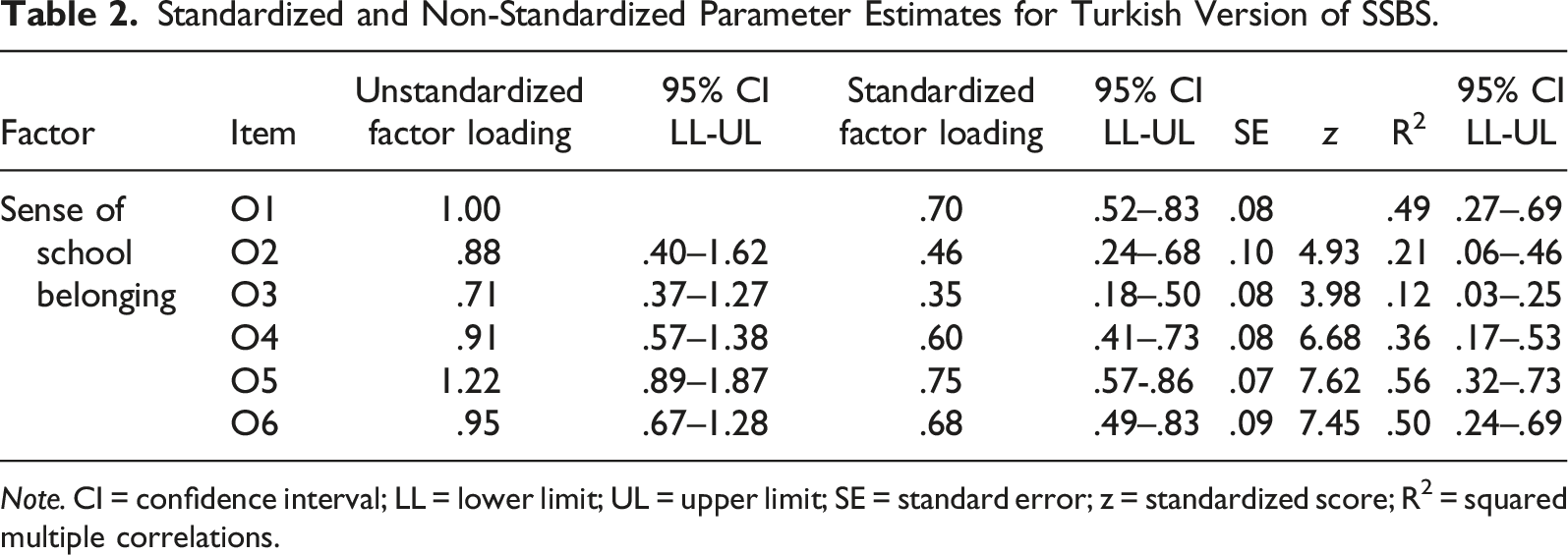
Standardized and Non-Standardized Parameter Estimates for Turkish Version of SSBS.
Note. CI = confidence interval; LL = lower limit; UL = upper limit; SE = standard error; z = standardized score; R2 = squared multiple correlations.
Standardized factor loads were between .35 and .75 for the Turkish version of the SSBS. R2 values were examined to see how much each item explained variances in each factor. R2 values ranged from .12 to .56. Z scores for the items ranged from 3.98 to 7.62 (p < .001).
Convergent validity of the Turkish version of the SSBS
The average variance extracted (AVE) and composite reliability (CR) values were examined to check for convergent validity of the Turkish version of the SSBS. The AVE values should be lower than .50, the CR value higher than .70, and the AVE value higher than CR value (Fornell & Larcker, 1981). The results showed the AVE value was .37 and the CR value .77. The CR value was above .70 and the AVE value was smaller than the CR value. Therefore, convergent validity was partially established.
Reliability of the Turkish version of the SSBS
Cronbach’s alpha coefficient was calculated for the reliability of the Turkish version of the SSBS. Cronbach’s alpha coefficient was .76.
Validity and Reliability of the Arabic Version of the SSBS
CFA results for the Arabic version of the SSBS
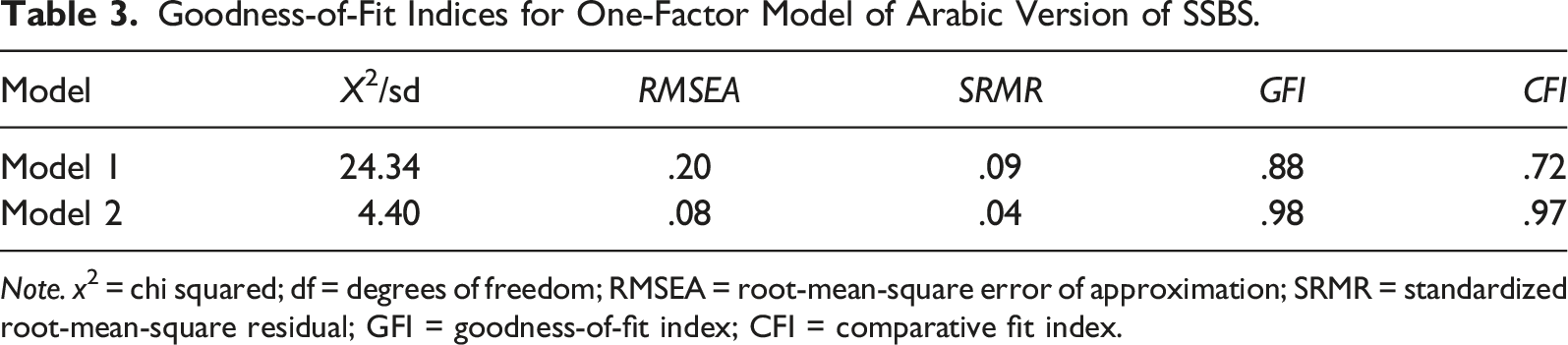
Goodness-of-Fit Indices for One-Factor Model of Arabic Version of SSBS.
Note. x2 = chi squared; df = degrees of freedom; RMSEA = root-mean-square error of approximation; SRMR = standardized root-mean-square residual; GFI = goodness-of-fit index; CFI = comparative fit index.
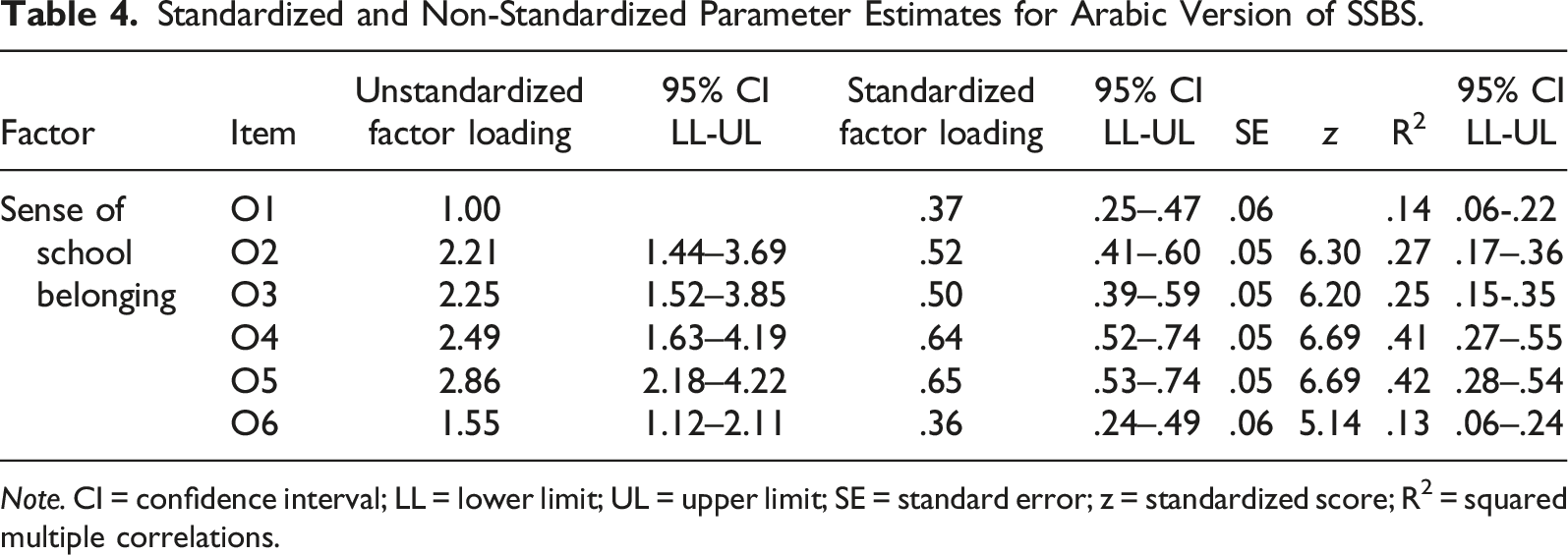
Standardized and Non-Standardized Parameter Estimates for Arabic Version of SSBS.
Note. CI = confidence interval; LL = lower limit; UL = upper limit; SE = standard error; z = standardized score; R2 = squared multiple correlations.
Standardized factor loadings for the Arabic version of the SSBS were found to be between .36 and .65. R2 value was used to examine to what extent the items explained the variances in the related factor. R2 values range between .13 and .42. As for z scores, they were between 5.14 and 6.69 (p < .001).
Convergent validity of the Arabic version of the SSBS
The analyses for convergent validity check found the AVE value was .27 while CR value was .68. AVE value was smaller than the CR value. A CR value >.60 is considered adequate (Tseng et al., 2006). Therefore, the results obtained indicated that convergent validity was partially established.
Reliability of the Arabic version of the SSBS
Cronbach’s alpha coefficient was calculated for the Arabic version of the SBSS to check reliability. Cronbach’s alpha coefficient was .72.
Validity and reliability of the Turkish version of the SCS-R
CFA results for the Turkish version of the SCS-R
Goodness-of-fit Indices for Two-Factor Model of Turkish Version of SCS-R.

Note. x2 = chi squared; df = degrees of freedom; RMSEA = root-mean-square error of approximation; SRMR = standardized root-mean-square residual; GFI = goodness-of-fit index; CFI = comparative fit index.
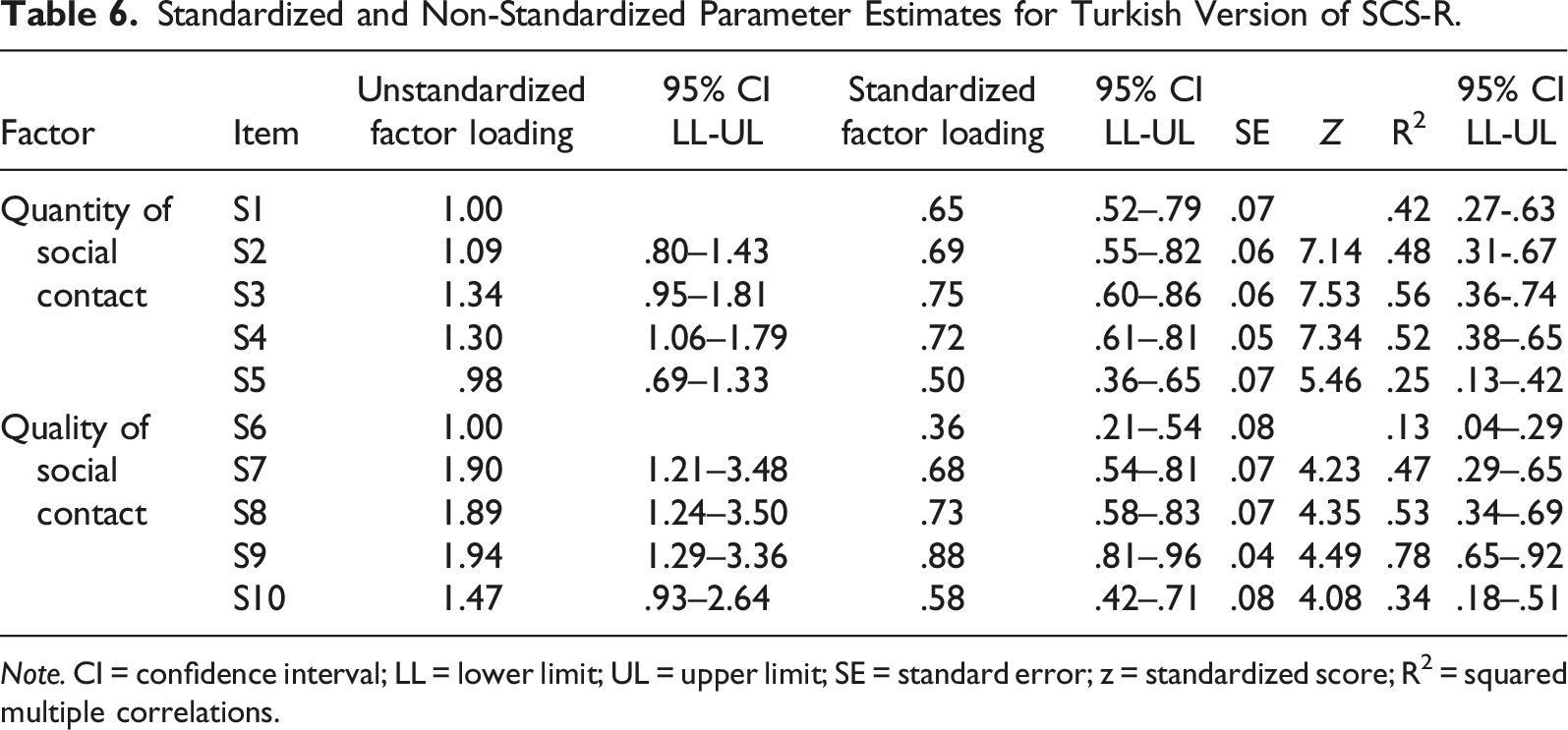
Standardized and Non-Standardized Parameter Estimates for Turkish Version of SCS-R.
Note. CI = confidence interval; LL = lower limit; UL = upper limit; SE = standard error; z = standardized score; R2 = squared multiple correlations.
Standardized factor loads for the Turkish version of the SCS-R were between .50 and .72 for the quantity of social contact subscale and .36 and .88 for the quality of social contact subscale. R2 values ranged from .25 to .56 for the quantity of social contact subscale and from .13 to .78 for the quality of social contact subscale. Z scores for the items were determined to be between 5.46 and 7.53 for the quantity of social contact and between 4.08 and 4.49 for the quality of social contact (p < .001). The correlation coefficient between latent variables (the quantity of social contact and the quality of social contact) was determined as .45. This shows that there is a moderate positive relationship between the two variables.
Convergent validity of the Turkish version of SCS-R
For convergent validity, the calculated AVE value was .45 for the quantity of social contact subscale and for the quality of social contact subscale. The CR value was .80 for the quantity of social contact subscale and .79 for the quality of social contact subscale. Both CR values were above .70 and higher than AVE values. Thus, the values indicate that convergent validity was partially established.
Discriminant validity of the Turkish version of the SCS-R
To check for the discriminant validity of the Turkish version of the SCS-R, the shared variance (SV) value was first examined. The AVE values have to be bigger than SV values (Hair et al., 2014). On the other hand, Fornell & Larcker (1981) argued that to establish discriminant validity, square roots of AVE should be bigger than correlation coefficients of latent variables. The results showed that the AVE values for the two subscales were higher than the SV value (.20). Furthermore, square roots of AVE values (.67 for the quantity of social contact subscale and for the quality of the social contact subscale) were higher than the relationship between the latent variables (.45). Therefore, the discriminant validity of the scale was established.
Reliability of the Turkish version of the SCS-R
Cronbach’s alpha coefficient was calculated to check for the reliability of the Turkish version of the SCS-R. Cronbach’s alpha coefficient was .79 for the quantity of social contact subscale and .77 for the quality of social contact subscale.
Validity and reliability of the Arabic version of the SCS-R
CFA results for the Arabic version of the SCS-R
Goodness-of-Fit Indices for Two-Factor Model of Arabic Version of SCS-R.

Note. x2 = chi squared; df = degrees of freedom; RMSEA = root-mean-square error of approximation; SRMR = standardized root-mean-square residual; GFI = goodness-of-fit index; CFI = comparative fit index.
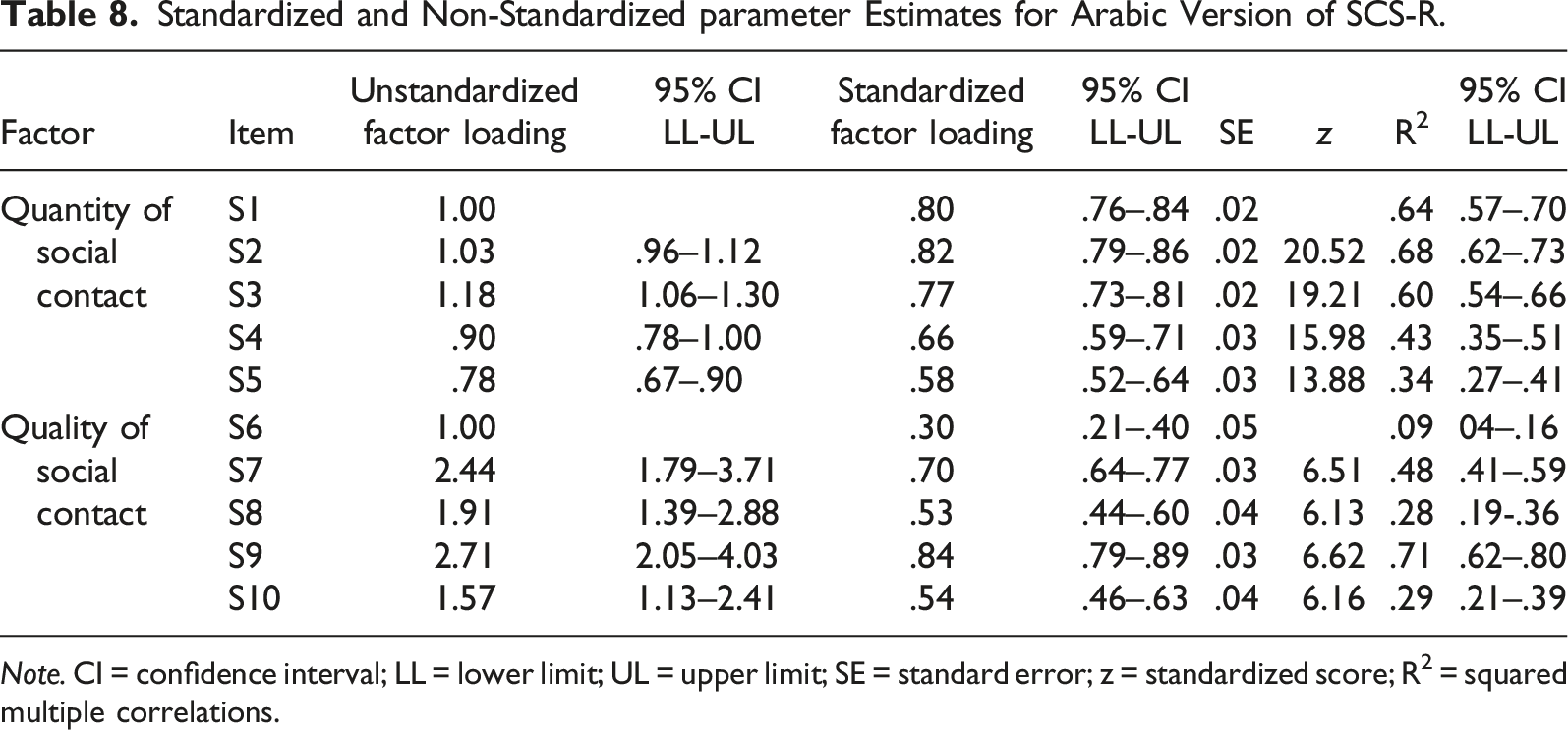
Standardized and Non-Standardized parameter Estimates for Arabic Version of SCS-R.
Note. CI = confidence interval; LL = lower limit; UL = upper limit; SE = standard error; z = standardized score; R2 = squared multiple correlations.
Standardized factor loads for the Arabic version of the SCS-R were between .58 and .82 for the quantity of social contact subscale and .30 and .84 for the quality of social contact subscale. R2 values ranged from .34 to .68 for the quantity of social contact subscale and from .09 to .71 for the quality of social contact subscale. Z scores for the items were between 13.88 and 20.52 for the quantity of social contact and between 6.13 and 6.62 for the quality of social contact (p < .001). The correlation coefficient between the latent variables (the quantity of social contact and the quality of social contact) was .45. This showed that there was a moderate positive relationship between the two variables.
Convergent validity of the Arabic version of the SCS-R
Analysis results showed that the AVE value was .54 for the quantity of social contact subscale and .37 for the quality of social contact subscale. The CR value was .85 for the quantity of social contact subscale and .73 for the quality of social contact subscale. Both CR values were above .70 and higher than AVE values. The AVE value was also higher than .50 for the quantity of social contact subscale. Thus, the values indicated that convergent validity was partially established.
Discriminant validity of the Arabic version of the SCS-R
According to the analysis results for discriminant validity, the AVE values for the two subscales were higher than the SV value (.20). Furthermore, square roots of AVE values (.73 for the quantity of social contact subscale and .61 for the quality of the social contact subscale) were higher than the relationship between the latent variables (.45). Therefore, the discriminant validity of the scale was established.
Reliability of Arabic version of SCS-R
The Cronbach’s alpha coefficient was calculated for the reliability of the Arabic version of the SCS-R. Cronbach’s alpha coefficient was .85 for the quantity of social contact subscale and .71 for the quality of social contact subscale.
Discussion
An important social context for refugee children, schools have the potential to contribute to these children’s development and cultural activities (Vedder & Motti-Stefanidi, 2016) or turn into stressful places (Osman et al., 2020). One of the important factors that impact the school’s role is school belonging. Sense of school belonging influences the social, psychological, and academic orientations of students (Sari, 2015). The quantity and quality of social contact with peers and teachers at school may also affect refugee children’s psychosocial development and adaption. Cultural orientations of refugee children, who are faced with cultural problems, vary depending on their social contact with members of the host society. Social contact is argued to help increase policies directed at the support and adjustment of refugee children. The quality of social contact in particular significantly impacts harmony among individuals with different cultural backgrounds (Giovannini & Vezzali, 2011). In this regard, it can be argued that a sense of school belonging and social contact are among crucial subjects that need to be examined. The current study, moving from the need for psychometric instruments to measure the sense of school belonging and social contact, adapted the related scales.
In the current study, the Turkish and Arabic versions of the SSBS consist of six items with a single factor, as the original version does. CFA for the Turkish and Arabic versions of the SSBS revealed that the models had an adequate fit. Moreover, convergent validity was partially established for the Turkish and Arabic versions of the SSBS. Cronbach’s alpha coefficient was calculated as .76 for the Turkish version and as .72 for the Arabic version.
The Turkish and Arabic versions of the SCS-R, like the original scale, are composed of 10 items with a two-factor structure. CFA showed that the two-factor structure of the Turkish version of the SCS-R had a perfect model fit, while the Arabic version had an adequate model fit. Furthermore, convergent validity was partially established for the Turkish and Arabic versions. Discriminant validity was also established for the Turkish and Arabic versions. Cronbach’s alpha coefficient was calculated as .79 for the quantity of social contact subscale of the SCS-R and .77 for the quality of social contact subscale. For the Arabic version, Cronbach’s alpha coefficient was calculated as .85 and .71 respectively. As a result, both the Turkish and Arabic versions of the SSBS and SCS-R have adequate validity and reliability to be used in theoretical and applied studies.
The SSBS has six Likert-type items. The second and third items are reverse coded and scored. The lowest possible score that can be obtained on the scale is 6 and the highest is 30. A high score indicated a high sense of school belonging. The SCS-R consists of two subscales, each with five items. The 6th item of the scale is reverse coded and scored. The lowest score in the subscales is 5 and the highest is 25. A high score in the quantity of social contact subscale indicate a high level of social contact and in the quality of social contact subscale high quality of social contact.
Limitations and Directions for Future Research
The fact that the study selected participants through convenience sampling can be considered a limitation. This fact limits the generalizability of the results. Future studies can determine participants through random sampling, which has higher representability. For this study, data were collected only from Syrian refugee children. Additional evidence can be gathered to support the validity and reliability of the scales by collecting data from different migrant groups that speak Turkish and Arabic.
AVE and CR values were used to test convergent validity and AVE and SV values to test discriminant validity. Future studies could investigate relationships among different variables (prejudice, discrimination, motivation and student engagement, internalizing and externalizing problems, etc.) to provide further evidence for convergent and discriminant validity of the scales. Correlation studies could also look at the relationship between sense of school belonging and social contact levels of refugee children, and their integration process.
Practical Applications
The findings of the study indicate that researchers and practitioners can use the Turkish and Arabic versions of the SSBS and the SCS-R for various purposes. Studies investigating psychosocial conditions and adjustment processes of Syrian refugee children in Turkey can make use of these scales. Particularly, the Arabic version of the scale can help facilitate the execution of different studies with Syrian refugee children who speak little or no Turkish. School psychological counselors could assess through these scales their intervention activities to strengthen school belonging level and social contact involving refugee children in their schools. Findings obtained through these scales may guide studies conducted in order to improve intervention activities. Mental health professionals and educators who work with refugee children can focus on the sense of school belonging and social contact along with many other variables to assess the academic, social, and psychological development of refugee children. They can utilize these adapted scales to this end.
Conclusion
This study showed that the adapted Turkish and Arabic versions of the SSBS and the SCS-R have adequate psychometric qualities to be used in determining the school belonging levels and social contact features of Syrian refugees, respectively. It can be stated that school and social contact have important effects on the integration processes of refugee children with the host society. Therefore, it is considered that the scales adapted in this study can be used effectively in studies on the integration of refugee children.
Footnotes
Declaration of conflicting interests
The author(s) declared no potential conflicts of interest with respect to the research, authorship, and/or publication of this article.
Funding
The author(s) received no financial support for the research, authorship, and/or publication of this article.
Authors’ Note
This study was produced from a doctoral dissertation accepted by Division of Psychological Counseling and Guidance, Graduate School of Educational Sciences, Hacettepe University in 2020 and was presented in the 21st International Psychological Counseling and Guidance Congress.
