



Abstract
This research explores the experience of 81 elementary pre-service teachers who transcribed their microteaching lessons during a university mathematical methods course. Pre-service teachers were required to plan and teach mathematics lessons. They audio-recorded their teaching, transcribed the recordings, wrote guided reflections, and conversed with the professor to identify areas of strength and growth in their teaching. The following themes were identified: transcription as noticing events, transcription as noticing presentation, benefits of transcription, transcription as a reflective practice, and audio-recording and transcription recommendations. Transcriptions may be effective tools for reflecting about teaching.
Keywords
“Being a primary school teacher today means to be able to manage the complexity of the current cultural and social reality” while providing all students “the knowledge and expertise needed to successfully become citizens in their local context and the global as well” (Rossi & Fedeli, 2017, p. 27). Many pre-service teacher programs include field experiences as an appropriate method to expose pre-service teachers to the complexity and diversity of the classroom (Santagata et al., 2007). Through field experiences, pre-service teachers have opportunities to meld “theory into practice” (Santagata et al., 2007, p. 124) by both observing the teaching methods of other teachers and conducting their own teaching in a supported environment. To gain the most from their own field experiences, pre-service teachers need time and strategies to reflect upon these experiences.
Reflection of teaching for pre-service teachers generally happens within the context of written reflections (Bergman, 2015) and video recordings (Wiens & Gromlich, 2018). Although reflection is viewed as important within teacher education programs, many pre-service teachers have “experienced few models of reflection that they came to understand as useful for teaching” (Stevenson & Cain, 2013, p. 80); furthermore, reflection does not incite profound understanding to improve instruction (Wopereis et al., 2010). The use of transcription gives a concrete way for pre-service teachers to be able to reflect.
Microteaching that includes transcription of the lesson as presented can scaffold pre-service teachers as they plan, teach, transcribe, and then reflect “as members of teaching and research partnerships” (Moran, 2007, p. 418). The use of audio-recording and transcription as a reflective practice in teacher education has received scant attention (Bergman, 2015). Occasionally, audio-recordings and transcripts have been used in established classrooms to promote teachers’ professional development. As part of a dissertation study, Buskist (2005) asked veteran teachers to audio-record and transcribe discussions with students in reading. She reported teachers valued the transcript analysis as a means for improving their instruction and increasing student achievement.
Kucan (2007) reported on teachers in a master’s program who audio-recorded and transcribed the first 15 min of two separate discussions about texts to reflect on questions and responses during discussion. The teachers were overwhelmingly positive about the experiences and what they learned about their instruction.
Two studies focused on pre-service teachers using audio-recordings of their instruction to reflect on their teaching practices. In Israel, Orland-Barak and Yinon (2007) asked foreign language pre-service teachers to record and transcribe one full lesson for analysis. Guided questions enabled teachers to critically examine the gaps between their theory-driven lesson plans and their in-the-moment teaching practices. In the United States, pre-service teachers in a general methods course self-recorded their instruction (10 min minimum) with either video or audio (Bergman, 2015). The participants then transcribed their recordings and, guided by professor-provided questions, completed written reflections. Bergman found no significant differences in the written reflections produced by the audio and video groups, except in the areas of nonverbal behaviors and movement around the classroom, which were more prevalent in video-based reflections.
Transcription is a reflexive document or representation of an event that includes speech/dialog, time, invisible actions, “speaker/hearer relationships, physical orientation, multiple languages, translations; who is representing whom, in what ways, for what purpose, and with what outcome; and how analysts position themselves and their participants in their representations of form, content, and action” (Green et al., 1997, p. 173). However, it is impossible to represent all features of talk or speech and interactions from recordings in transcription text (Davidson, 2009). As a result, selectivity of what to record and how to transcribe it should be counted as an important analytical component in the process of transcription rather than considering it as an unremarkable element (Davidson, 2009).
For pre-service teachers participating in the study of this article, selectivity about what to record and transcribe was guided by the purpose of the transcription: to reflect on mathematics instruction. Because the pre-service teachers had no previous experience with the practice of reflection on instruction, the professor provided specific focus questions for the written reflections. It is essential to specify the objectives of transcribing records before the transcribing begins to predict how these transcriptions contribute to addressing the research questions of specific research (Davidson, 2009). For example, throughout this study, the professor reinforced the objective of the reflective transcription process by reminding students the purpose was to confirm their strengths and areas of growth in the microteaching experience.
Pre-service teacher involvement in a microteaching activity (Alger, 2006) and then in transcribing the event meets two objectives. First, when pre-service teachers are active participants in conducting and transcribing their microteaching lessons, the experiences influence the teaching field from “inside-out.” Influencing the field from “inside-out” acknowledges pre-service teachers to be “theory builders and knowledge producers” (Moran, 2007, p. 419). This is preferable to “outside-in” influences where educators or experts transmit their experiences, knowledge, and perspectives to pre-service teachers with the hope that hearing about teaching can be as effective as learning through teaching (Moran, 2007).
Second, transcribing one’s own teaching engages pre-service teachers in reflective practice, an indispensable trait in contemporary teacher education and development programs (Conway & Clark, 2003). Reflective practice “when shared and made public through the analysis of classroom records” (Moran, 2007, p. 420) enables the experience to be diffused and reinforces the knowledge gained. Pre-service teachers learn how to teach when they share their knowledge with others because sharing and discussing their thoughts with well-educated members allows them to be scaffolded so they “begin to assume a level of competency” (Moran, 2007, p. 420) generated by experts. Through reflective practice, pre-service teachers become “potential generators of the new knowledge about teaching” (Zeichner, 1996, p. 226) “appropriating the position of holders of knowledge, resituating the authority of knowledge away” from their educator mentors to “within themselves and their own experience” (Moran, 2007, p. 421). Pre-service teachers participating in this study gained knowledge of how to teach with, reflect on, and utilize multicultural math picturebooks (MMPs) to make decisions regarding teaching mathematics to children with different abilities, interests, cultures, and needs (Harding, 2017; Harding-DeKam, 2014).
Transcription works as a magnifying glass to identify pre-service teachers’ areas of strength and growth. Transcribing lessons slows down the teaching and learning happening in real time to allow pre-service teachers the opportunity to focus on the teaching and learning interactions taking place between students and teacher or students and students.
This study investigated the importance of transcriptions for pre-service teachers to reflect upon their teaching strengths and areas of growth. Given there is no significant difference between audio and video self-recording on pre-service teachers’ written reflections (Bergman, 2015), the benefits of audio-recorders, which are less intrusive, more affordable, and easier to use and transcribe than video, make self-recording with audio an attractive option for pre-service methods classes. Audio-recordings are also more conducive for protecting students’ privacy rights than video (Fantin, 2016). An additional benefit of using audio transcription as a reflective tool with pre-service teachers includes the ability to distance oneself from the teaching moment. Slowing down the audio enough to transcribe it changes the voice so you no longer sound like “you.” Audio transcription also creates distance between the emotionally charged event of the classroom lesson and the present (Orland-Barak & Yinon, 2007), which allows the pre-service teacher to focus on the teaching/learning happening during the lesson. Pre-service teachers can then be more objective about evaluating their microteaching because they can focus on the conversations happening during instruction to evaluate effectiveness. The metacognitive focus makes transcription a powerful tool for reflection honoring the teacher/student and student/student transactions.
Learning to Notice Theoretical Framework
Mathematic education calls on teachers to ground their instruction by paying attention to the ideas students express while they learn (National Council of Teachers of Mathematics, 2000). Teachers need to notice and interpret what is happening in their classrooms while they are teaching. Noticing allows teachers to make appropriate on the fly decisions about next steps in instruction. Using artifacts such as transcriptions of audio-recorded lessons can assist pre-service teachers to analyze in-class interactions and develop the skill of noticing.
Van Es and Sherin (2002) developed the Learning to Notice Framework for their work with teacher video clubs. They proposed the skill of noticing for teaching had three elements: (a) determining what events are important in a teaching situation, (b) using teacher knowledge about the context to reason about the events, and (c) connecting specific events to broader principles of teaching and learning (Van Es and Sherin, 2002). The Learning to Notice Framework (Van Es and Sherin, 2002) provided a lens for researching the effectiveness of using audio transcription as a tool for promoting pre-service teachers’ reflections on their initial microteaching experience as reported in this article.
Many events happen during teaching, and it is difficult for pre-service teachers to remember and then reflect upon the salient details that created the teaching experience. While transcribing their audio-recorded lessons, pre-service teachers can be more thoughtful about the conversations and events during the teaching episode, including events they may have missed in real time. The act of transcribing enables the pre-service teacher to take a large abstract transaction and focus on the discreet, individual pieces of that event. They can highlight or identify events that deserve further attention (trait of noticing). This will help them to construct what Leinhardt et al. (1991) referred to as “check points” to assess the pace and the progress of future lessons.
During teaching events, teachers also use their knowledge of the context—the students, the classroom environment, the lesson content, and other factors—to reason about what is happening in the classroom. In the context of this study, pre-service teachers had limited time, 10 hr a week, to learn about the context of the classroom. However, their preparation for teaching included support from their cooperating teachers, who provided contextual information about the students and math progress, and the professor, who contributed feedback on their lesson plans, and knowledge of mathematics teaching methods. As pre-service teachers transcribed the audio from their lessons, they used their knowledge of the contextual information about the classroom, mathematics instruction, and multicultural picturebooks to reason about the significant mathematics or cultural events that occurred during their instruction.
Teachers who have developed the skill of noticing also connect specific situations to the general principles of teaching and learning. While planning, teaching, transcribing, and reflecting on audio-recorded lessons, pre-service teachers melded the theories and abstract topics they learned in their academic classes and applied them in real situations (Santagata et al., 2007). When pre-service teachers listened to and transcribed their microteaching lessons, they connected specific segments of the lessons to specific principles of instruction. For example, an audio-recording may reveal student chatter during teacher talk time. In this case, the pre-service teacher may connect the student inattention to the general principle of classroom management. Similarly, a pre-service teacher may connect a specific event during a lesson to a mathematics instructional method of activating students’ background knowledge. Transcribing slows the transactions to allow time for such insights. Pre-service teachers can “look at a situation and recognize it as an instance of something, a principle of teaching and learning, rather than to see each instance as an isolated event” (Van Es, & Sherin, 2008, p. 246). In our study, we investigated how mathematics lesson audio-recording and transcription artifacts of practice were productive for scaffolding pre-service teachers as they learned to notice.
Using a single holistic case study design (Yin, 2009), this study did not focus on the type of texts researchers visualize a transcript should be. Instead, transcription was used to enhance pre-services teachers’ skills in noticing the significant events of a single mathematics microteaching episode within the context of an elementary classroom and connecting the events to teaching principles. The research question addressed in this study was as follows:
Method
Participants
Eighty-one pre-service elementary teachers were purposefully sampled while they were enrolled in a mathematics methods course taught by the first author. The course included a mathematics practicum in an elementary classroom (kindergarten through sixth grade) of 10 hr a week for a 16-week semester. During the practicum, students were required to teach a mathematics lesson. Students’ practicums were served in urban, suburban, or rural public schools.
All the students were in graduate or undergraduate programs at a university in the Midwestern region of the United States with the goal of earning initial teaching licensure. The graduate students had earned bachelor’s degrees in areas outside of education and had returned to school to earn a master of arts in teaching in conjunction with their teaching license. Pre-service teacher participation in this institutional review board (IRB)-approved research was optional.
Data Collection Procedures
Data were collected in Fall 2015 and Fall 2016 and was a regular assignment in the methods course. Pre-service teachers were directed to (1) with professor and cooperating teacher feedback, complete a classroom diversity math lesson plan detailing about 30 min of instruction for children in the practicum classroom; (2) teach the approved lesson in the practicum classroom, audio-record the lesson as a digital file, and transcribe the audio-recording; (3) using guided questions from the professor, write a reflection paper about the lesson; (4) participate in a face-to-face semistructured interview with the professor and two additional researchers to reflect on the teaching and transcribing experiences. For the purposes of this research report, data sources included the pre-service teachers’ written reflections (3) and transcriptions of the audio-recordings of the oral interviews (4). Lesson plans (1), raw audio, and transcriptions of the pre-service teachers’ actual microteaching (2) were not the focus of this article and have been published previously (Authors, 2017). The focus for this research was analyzing transcription as a reflective teaching tool for pre-service teachers.
Pre-service teachers were required to listen to their audio-recorded microteaching episode, transcribe it, and reflect upon their microteaching lesson experience. The professor provided specific questions for reflecting on, thinking about, and evaluating the microteaching episode (Table 1). Finally, pre-service teachers participated in individual semistructured interviews (Table 2) in lieu of a final exam.
Guided Questions for Pre-Service Teacher Reflections.
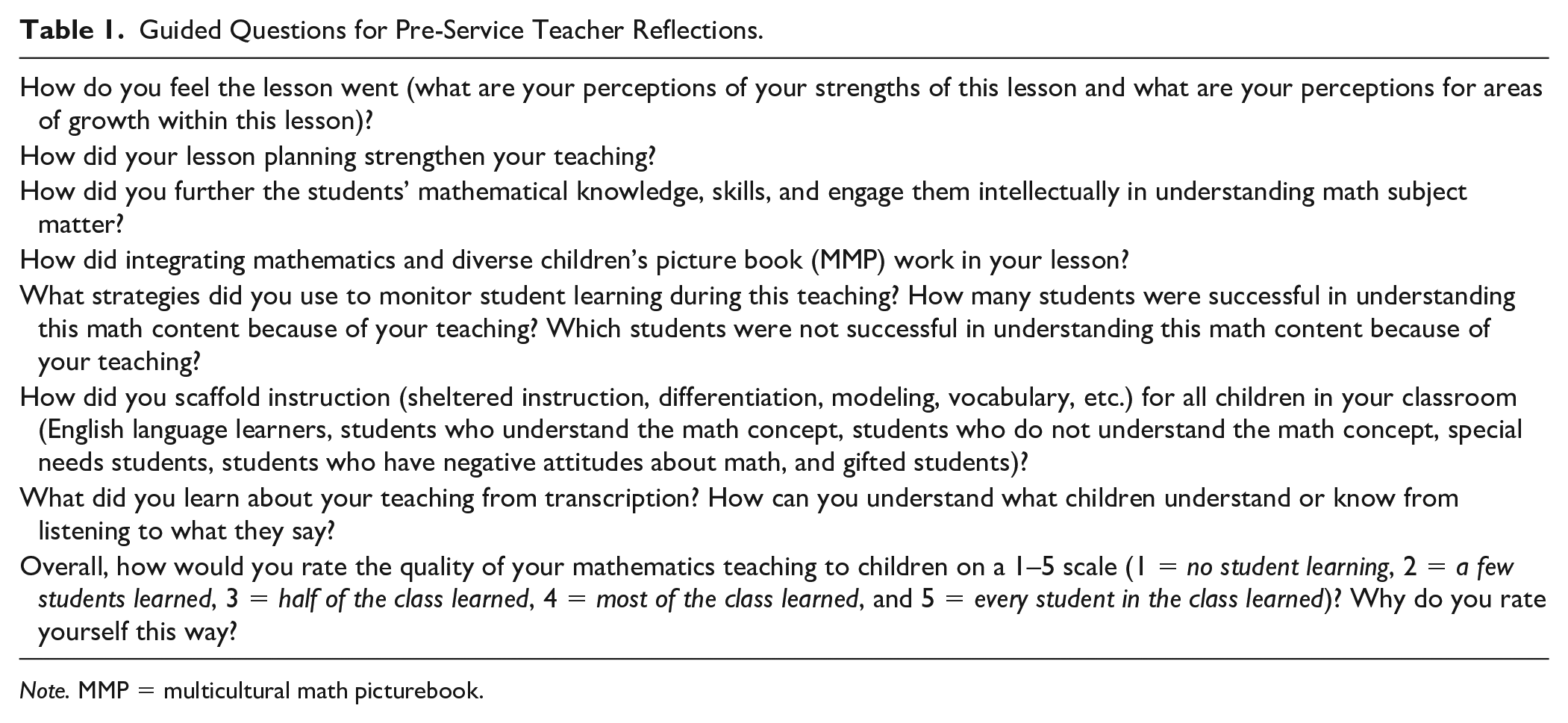
Note. MMP = multicultural math picturebook.
Semistructured Interview Questions.

Data Analysis Procedures
Using a single case study design wherein holistic portrayals of pre-service teachers’ mathematics instruction were researched (Yin, 2009), the abovementioned data were collected, organized, read, reread, coded, and analyzed qualitatively for patterns and themes to answer the research question. Analysis steps included the following:
preliminary exploration of the data by reading and rereading the written reflections and interview data of pre-service teachers,
first cycle coding of data with attribute coding and holistic coding (Saldaña, 2016),
second cycle coding of data with pattern coding (Saldaña, 2016),
development of within-case and across-case themes based on the codes (Yin, 2009), and
creation of a case study narrative composed of descriptions and themes.
The process of obtaining themes from raw data is demonstrated in Table 3.
Examples of Attribute, Holistic, and Pattern Coding Processes.

Credibility was addressed through the use of a second coder, expert/peer checks (Merriam, 1998), triangulation, and member checks (Yin, 2009).
Findings
In previous studies (Loyd, 2015; Harding, 2017), the authors have reported on what pre-service teachers gained from their microteaching experiences. What is new from this study is the effect of using transcription as a reflection technique. Transcriptions enabled pre-service teachers to think not only about their own teaching strengths and areas of growth but also about the factors that influenced them while teaching. Transcription is considered a “mundane, time-consuming chore” (Tilley, 2003, p. 751). According to pre-service teachers in this research study, transcribing was a tedious task and required time, effort, and time management skills. In the views of pre-service teachers and their professor, the advantages pre-service teachers gained transcribing their lessons far outweighed the disadvantages.
The two sources of data analyzed for this research were pre-service teachers’ written reflections and interviews. Findings of the study identified the following themes: transcription as noticing events, transcription as noticing presentation, benefits of transcription, transcription as a reflective practice, and recommendations for audio-recording and transcription.
Transcription as Noticing Teaching and Learning Events
The experiences of graduate and undergraduate pre-service teachers in transcribing their lessons assisted them in learning more about their teaching and their students (Authors, 2017). It was important to guide pre-service teacher reflections before, during, and after they transcribed their lessons (Santagata et al., 2007) to help them notice what occurred in the classroom. Because pre-service teachers were able to concentrate on what they heard in the audio without being distracted by their own needs to respond to students, they became aware of teaching moments they may have missed in real life. Some of the insights confirmed positive moments in their teaching. Following are samples of pre-service teachers’ quotes demonstrating student learning through the transcription as noticing teaching and learning events: It allowed me to listen to how the students were answering in a more in-depth way than I was able to during the lesson and so I felt like I knew more about how the students were learning. (reflection; PT 28) Through the transcription I learned that I try to call on a variety of students and even if a student doesn’t get the question quite right I will still provide positive feedback and ask other students if anyone can elaborate. (reflection; PT 68) I loved listening to students make comments that showed they were making genuine [math] connections. I could really tell that they were grasping the concepts and not just idly listening. (reflection; PT 7) I noticed a lot from listening to my transcript . . . When we had conversations about the book I was able to distinguish the parts of the book that really stuck out to them and which parts needed more clarification. (reflection; PT 64)
Transcription as Noticing Presentation
Several pre-service teachers identified learning opportunities based on the conversations happening during instruction (Authors, 2017). Transcribing made teachers aware of personal speech idiosyncrasies that might distract students such as phrasing that could be changed, vocabulary that needed to be used differently, the need to be more specific in their teaching in the future, and missed opportunities for learning in their management of the lessons. When pre-service teachers shared or discussed some of their successful and unsuccessful teaching attempts with well-educated members, “their perceived failures began to be viewed more as opportunities” to reflect, revise, and gain new ways to expand and provoke children’s learning (Moran, 2007, p. 423); hence, they became more creative by pushing their own teaching skills boundaries rather than repeating what already happened as it was (Kurtoglu-Hooton, 2016). The following excerpts illustrate transcription as noticing presentation features: I always hate listening to my Droopy Dog voice, but in this case, I don’t think it was too droopy. (reflection; PT 60) It was interesting to listen to the recording of my lesson over and over again and hear all of my little nervous “ticks.” Turns out I use the word “so” at the beginning of almost every sentence to collect my thoughts. This is my “ummm” in my sentence. (reflection; PT 42) I had to replay parts of the audio file a few times, especially when the students spoke. I discovered that I probably do not afford them enough time to develop deeper thoughts about what was being read due to time constraints. (reflection; PT 4) I noticed that my directions and answers where [sic] not always as clear and concise as I believe they are. I use short phrases like “uh huh” and “ya” too often as actual answers to students’ questions. I should be providing students with better feedback and communication. (reflection; PT 46) I learned a LOT from my transcription. I say “Okay” every, almost every time I talk, and I did not even notice it until I listened to it. This could be very distracting! I really need better planning and transitions because I noticed the children had a lot of side conversations and distractions. Especially when they were done with the activity and waiting to graph, there was too much wait time I needed to fill. (reflection; PT 27) By having the opportunity to look back and listen to the transcription and write it in detail made me think about what I am missing and what I was doing during instruction that I can focus on the future, so I liked it. (reflection; PT 64) I discovered while listening to myself teach, is my tone of voice. There were sometimes I felt my tone could come off annoyed or mean. During the lesson, I did not feel any stress and in my head my tone of voice was just a little serious. Now that I have heard myself, I would like to work on changing that tone I have with some words and replace with a different tone of voice: A more soft or calmer tone. (PT 65)
Benefits of Transcription
Although all pre-service teachers participating in the study thought the process of actually completing a transcription was a tedious task to do, they described it as beneficial, applicable, valuable, effective, useful, fun, very interesting, appreciable experience, not too bad, and worth the time doing it. When pre-service teachers were asked how transcribing their lessons contribute to or detract from evaluating their microteaching experience, they thought pairing transcription with reflection was beneficial and worth the time. They believed transcription with reflection was more effective than only reflection because it allowed them to hear exactly what happened with the audio-recording during instruction instead of trying to remember everything that was happening while they were teaching. Pre-service teachers believed writing the conversations down allowed them to stop, rewind, relisten, and understand more than just listening to the recording. The following are examples illustrating the benefits of transcription: Actually, having to sit down and type it out made me actually understand what was going on because when you just listen through it or think about your teaching, you do not get all of the conversations that you did, so I think it helps me understand what my kids were getting a little bit more. (interview; PT 57) It [transcription] was worth it because you did notice things that you would not have noticed otherwise. (interview; PT 75) There is a lot of stuff that I picked up on that I did not notice during teaching. (interview; PT 81) When you are in the classroom and you are not necessary aware of everything happening but by transcribing it and listening to it over and over you hear what happened. (interview; PT 55)
Transcription as a Reflective Practice
Transcription as a reflective practice allows pre-service teachers the ability to observe themselves teaching while establishing a rich data source of what happened during instruction. Transcribing as a reflecting method assists pre-service teachers on noticing how children were grasping the mathematics concept(s) and what parts of their lessons need to be tweaked or replaced in the future. However, a few of the participating pre-service teachers thought writing the transcription may not have been helpful, but listening to an audio-recording was definitely helpful. The following are examples to illustrate how noticing the transcription as a reflective process influenced pre-service teachers’ understanding of the students’ thinking and learning taking place during their instruction: I noticed which kids I was asking, which kids were talking, and so I noticed I was actually asking the kids who I went in this lesson knowing the material more than I was asking the ones that I thought were going to struggle and I think it was because they were probably had their hands up and I was asking the kids with their hands up. Um . . . so it was good for me to kind of notice those kinds of things. (interview; PT 23) I think for us being like first time teaching lessons we wrote, it was good for us to hear it. Like how our students responded to us and like you catch conversations that you did not catch the first time and you can like go back and re-listen to it multiple times. You really understand like what your students were saying and where their thought processing goes. (PT 11) It was really interesting to hear not only from my point of view and the questions that I was asking, but then also from how good the students were responding. The quality or sort of what they were responding and . . . umm, things that I wouldn’t be so mindful about while I am doing it but then going back and like, oh. like kind of isolating certain students. (interview; PT 67) By having the opportunity to look back and listen to the transcription and write it in detail made me think about what I am missing and what I was doing during instruction that I can focus on the future, so I liked it. (reflection; PT 17)
Audio-Recording and Transcription Recommendations
All pre-service teachers suggested the strategy of play, pause, write, and rewind to confirm for their transcriptions. Some suggested using transcribing editors (application or software) that provided support such as timers, automatically saving the transcription, adding folders, and the like. Some suggested to not focus on the format of the transcriptions or on typing it word for word. Instead, they recommended focusing on and making sense of the critical parts of the mathematical conversations, for example, when students were talking about math and different cultures. They believed side conversations should not be transcribed, especially if the number of children is large or there is a lot of background noise. To overcome having lots of background noise, pre-service teachers recommended listening to the lesson recording multiple times before just diving in to write it down as it enables the transcriber to pinpoint and understand those harder aspects in the lesson. Even though transcription is a tedious process, pre-service teachers recommended it as a tool to critically analyze their teaching practice.
Based on their first experience of transcribing their microteaching experiences, pre-service teachers provided recommendations to their peers to make the transcription process easier. These recommendation themes are organized into before recording, while recording, while transcribing, and while reflecting.
Before recording
Pre-service teachers advised informing students in their classrooms about the purpose of recording of the lesson before starting to teach so students’ learning will not be distracted. This could also reduce the background noise while recording. The following is an example: To get the best recording I wish I would have told the students before I started that I was gonna record them because when half way through they were asking me about it. Like what does your phone do in here, and I was like ohhhh, that way I had just to stop and explain but it could have been an easy thing that we explained before the lesson started. (interview; PT 64)
While recording
Pre-service teachers asserted it is important to pay attention to the process of recording such as using a real recorder, using backup equipment such as phones or iPads, locating a good spot in the class to place recorder, and determining the best way to carry the recorder to hear the mathematics conversations happening during instruction. For instance, they suggested doing a practice recording during a random lesson before the actual lesson that will be transcribed. The following is a demonstration from a participated pre-service teacher’s interviews: Remember to turn your cellphone on. (PT 72) That is the most important one. (The professor) Because I forgot at the first making it but I had another iPad going in the background but it was far away from where I was. (PT 72)
While transcribing
Pre-service teachers highlighted the necessity of planning the time to transcribe and to break it down into short periods to produce understandable and meaningful conversations. They suggested transcribing immediately after conducting the lesson because it is easier to remember what was going on, hence, making the process of writing the conversations faster. In addition, to ease the process of transcribing, pre-service teachers suggested using an app or transcription editor that will pause the recording and not start back at the beginning or crop critical parts as some common media players do. The following is an example: I just made myself like I think you can not do it with any other distractions. You need to have just like your headphones and sit somewhere quiet where you can only focus what is being in the recording because that is the only way you can pick up the little things. (interview; PT 17) I thought for me I sort of write after I did it and that was because it was still fresh in my mind and I had the recording, so it was easier to like to remember. (interview; PT 65)
While reflecting
Pre-service teachers also advised reflecting shortly after transcribing the lesson. It is beneficial to read all the reflection questions and then analyze transcriptions to know what needs to be focused on: Read the reflection questions before transcribing your lesson, so you know the kinds of things to look for. (interview; PT 21)
In summary, the themes of transcription as noticing events, transcription as noticing presentation, benefits of transcription, transcription as a reflective practice, and recommendations for audio-recording and transcription emerged from analyzing pre-service teachers’ reflections and interviews. Transcription was a rich source of data encapsulating events pre-service teachers noticed and expressed in their written reflection and interviews. The audio-recordings gave them a resource for hearing exactly what happened during the lesson. The transcriptions provide a lens for reflecting upon the teaching/learning happening in the classroom. Transcription played an important role in assisting pre-service teachers to obtain the noticing skill. Overall, the pre-service teachers viewed the transcriptions worth the time and experience for a clearer lens with which to reflect upon their teaching practices and to discern the outcome of the implemented lesson.
Discussion
This study investigated how transcriptions assist pre-service teachers to reflect upon their teaching experience and how transcriptions can be an important tool for reflection. Pre-service teachers gained new insights by listening to and transcribing audio-recordings of what children said during instruction. While teaching, teachers pay attention to many facets in addition to the planned lesson, such as classroom and time management, student responses, content understanding, differentiation, and unexpected interruptions. Pre-service teachers with no previous teaching experience are often unable to attend to everything at once. Transcribing their lessons slowed down the complex classroom transactions to allow the pre-service teachers to conduct an objective evaluation of the overall quality of the mathematics lesson.
Pre-service teachers revealed that this experience informed them about what needs to be improved or kept the same in their future teaching. This information was filtered through their transcriptions, which were not full records of their experiences, but influenced by their decisions about how to represent the complexities of classroom interactions (Davidson, 2009).
As a holistic approach, pre-service teachers’ use of audio-recordings and transcribing to reflect on a mathematics microteaching lesson meets the following goals:
creates a framework of noticing for pre-service teachers to analyze their teaching in terms of highlighting importance, having knowledge to reason about a situation, and linking specific instructional events to broader principles of teaching and learning (Van Es & Sherin, 2002);
allows pre-service teachers to analyze and effectively reflect upon their own teaching based on a documentation of real actions happening while they were teaching, rather than trusting only memory;
allows educators and cooperating teachers to be on the same page with pre-service teachers when having the same reflective audio transcription to mentor, guide, and facilitate teaching;
allows pre-service teachers to focus retroactively on the content being taught through student/teacher and student/student conversations; and
avoids “practice shock” (Stokking et al., 2003, p. 331) by developing a personalized learning opportunity for pre-service teachers to become aware of the diversity and complexity in classrooms.
Audio-recording their teaching provided pre-service teachers with opportunities to observe their own teaching styles instead of other teachers’ styles. This led to an individualized support structure where pre-service teachers learned what they did well and what they needed to improve for their next mathematics lesson. This is a rule of thumb as demonstrated in the literature where teachers who observe their own teaching are able to activate contextualized knowledge as related to the class observed, noticing critical situations and drawing their own conclusion and practices about these situations (Goldman et al., 2014). The audio-recordings gave pre-service teachers the opportunity to slow down the pace of the actual teaching process and discern the act of teaching, which is impossible to catch through real-time observations. Overall, this research supports the viability of the reflection technique of transcribing a lesson as taught in the elementary classroom to better analyze teaching practices through guided reflection and self-reflection.
Implications
Although teacher education programs promote reflectivity, engaging in reflection does not happen naturally for all pre-service teachers (Jaeger, 2013; Nolan, 2008). The skills of reflection should be explicitly modeled and taught (Russell, 2005). The use of transcriptions as tools for guided reflection allowed pre-service teachers to recall events more accurately as well as notice events that had been overlooked during instruction.
As effective as the use of transcriptions was for prodding pre-service teachers to reflect on their teaching after the fact, not all pre-service teachers engaged in thoughtful examinations of teaching and learning. Many pre-service teachers described what had happened, including surprises they encountered when they transcribed, but failed to critically reflect on their instructional practices to determine how the lesson could have been more effective. Such superficial reflection is not uncommon for pre-service teachers, even when reflective practices are guided through questions (Ostorga, 2006). In this study, where pre-service teachers were experiencing their first teaching responsibilities, they may not have been cognitively prepared for the load of teaching, transcribing, and reflecting critically.
After engaging in their own critical reflection, the authors acknowledge this microteaching experience coupled with transcription could be enhanced with some adjustments. For instance, students might engage in deeper reflection if they had opportunities to share their transcripts with peers or supervisors such as the cooperating teacher to discuss what they noticed and what they wondered about. One of the in-class assignments could be reading, analyzing, and critiquing selective transcription passages, and then participating in mathematical discourse to identify the specific learning taking place as well as what the teacher might do next to continue classroom learning. In this study, because of the compactness of a semester and the complexities of arranging to teach, planning a lesson, implementing the plan, and then transcribing the event, some pre-service teachers could not have completed the assignment in time to share with peers.
The guided reflection questions could also be altered to focus pre-service teachers’ attention more precisely on student learning and highlight the importance of giving specific examples. In this study, the guided reflection was intended to cover many aspects of the teaching assignment, and so the focus on student learning may be diluted. For instance, one purpose of the microteaching experience was to increase pre-service teachers’ capacity to blend cultural awareness with the teaching of mathematics. Another purpose was to instill the value of good lesson planning. The guided questions covered the multiple purposes of the assignment.
Higher education is successful in supporting pre-service teachers to plan their lessons, teach the lessons, and give feedback to the lessons; however, we fall short in demonstrating how pre-service teachers may specifically reflect upon their own teaching. Transcription gives layers of accountability for answering reflection questions. Anyone can observe what went well and what needs to improve because the act of teaching is not just a perceived memory, but what actually happened in the classroom. Using transcription as a reflective tool allows pre-service teachers to not only be the teacher but also be the observer of the lesson. This creates a dual lens where authentic reflection is achieved.
Conclusion
This study investigated pre-service teachers’ experience of transcribing their own microteaching. The findings demonstrate transcription was an effective reflection tool from the participating pre-service teachers’ perspectives. Rather than relying on memory, the pre-service teachers had physical artifacts, transcripts, to review and learn from. The more we offer an opportunity for these perspective teachers to analyze their teaching before leaving their teacher education programs, the more we prepare them to become reflective practitioners. The more reflective they become, the better they can understand how to effectively teach the diverse population of students in their classrooms.
Footnotes
Declaration of Conflicting Interests
The author(s) declared no potential conflicts of interest with respect to the research, authorship, and/or publication of this article.
Funding
The author(s) received no financial support for the research, authorship, and/or publication of this article.
