




Abstract
Over the years, three common theoretical perspectives dominated the practices of learner-centered pedagogy (LCP) across the world. These perspectives include constructivism, humanism, and transformative theoretical traditions. This article critically examines the contributions and weaknesses of these theoretical traditions as ways of conceptualizing how learning occurs. Then, the researcher revisited the idea of “learner-centered pedagogy” in a new theoretical strand that strives to engage learners in discerning critical aspects of the object of learning. Therefore, it is argued that the new theoretical strand, the variation theory, makes a powerful contribution to LCP practices in bringing about student learning.
Introduction
There have been variations in understanding, focus, and implementation of learner-centered pedagogy (LCP) across the world. Some studies conceived LCP in terms of methodological orientation (Lea et al., 2003), while others treated it as a way of according students an opportunity to meet their learning needs (Jeffrey et al., 2009). Similarly, some scholars experienced LCP as a way of shifting power and responsibility from the teacher to students (O’Neill et al., 2005). These ways of conceptualizing LCP provide us with three aspects/orientations, namely methodological, curriculum-based, and student–teacher relationship. The three orientations are grounded in constructivism, humanism, and transformative theoretical perspectives and have not helped teachers to facilitate the student to learn what is taught (Msonde, 2009). As such, there is a compelling need to have new ways of conceiving and practicing LCP to enable the student to learn what is taught. This article describes the prevailing challenges in practicing LCP from various theoretical perspectives, and how the variation theory provides a breakthrough for practicing LCP in a meaningful way.
The genesis of LCP is grounded in pragmatic theories of constructivism, transformative, and humanism. Such theoretical linkage implies that the LCP is a multiplicity of theories (Mushi, 2004) rather than a single theory. Learning theories in the pragmatic paradigm emphasize participatory teaching methods to improve student learning. In other words, learning theories play a critical role in helping teachers determine an effective pedagogical strategy that would enhance student learning (Shah, 2019). Therefore, understanding how three theoretical perspectives promoted the practices of LCP to bring about meaningful learning is equally important, as explained in subsequent sections.
Constructivism Theoretical Perspective
Constructivism is the term used to describe the process of students creating their own understanding, rather than imposing knowledge on them (Kauchak & Eggen, 2007). Although many constructivists disagree on some aspects of the knowledge-construction process, all agree on the following characteristics: (a) learners construct their own understanding; (b) new learning depends on current understanding; (c) learning is facilitated by social interactions; and (d) meaningful learning occurs within real-world learning tasks. As such, developmental constructivists Jean Piaget and Lev Vygotsky argue that individuals construct knowledge in different ways. For example, Piaget, a cognitive constructivist, believed that every person has an innate capacity to construct his or her own knowledge. This person may do so through the process of accommodation and assimilation (Marton & Booth, 1997). The term accommodation can be explained as a situation that occurs when we restructure or modify what we already know so that new information can fit in better. Similarly, assimilation refers to a situation when we modify or change new information to fit into our schemas (what we already know). In contrast, Vygotsky believed that individuals learn through social interactions with others in the environment (Kauchak & Eggen, 2007). Like Piaget, Vygotsky acknowledged a learner’s prior existing knowledge as significant in knowledge construction. However, Vygotsky pointed out the existence of learner’s knowledge gap (the zone of proximal development) that needs to be bridged through interactions with others (Kauchak & Eggen, 2007). This is a learning area in which a student cannot solve a problem or perform a skill alone without help from peers and the teacher.
Pedagogically, from social constructivism perspective, learners are regarded as active meaning-makers, building on their current knowledge (Shah, 2019). This has changed the way we view teaching and learning. To achieve student active learning, a teacher needs to design engaging, authentic tasks on which a learner can work with others in a meaningful way. Teachers thus become facilitators of the learning process rather than transmitters of knowledge and engage students through “participatory methods” (e.g., group discussion, role-play, games, and simulation). These participatory methods create an interactive and collaborative learning environment that helps students to construct knowledge themselves. This development has given way to the recommendation that participatory methods should be adopted solely as a means to make student learning possible (Msonde, 2009). Many curricular reforms across the world have been influenced by this shift in attitude toward what constitutes the learning process (Elen et al., 2007).
The practices of LCP to help students learn what is taught do not fit into constructivist perspectives. First, some studies criticized the constructivism methodological orientation. For example, Eggen and Kauchak (2006) summarized the outcome of the studies by Anderson (1959) on authoritarian versus democratic techniques; Shulman and Keislar (1966) on discovery versus expository approaches; Dunkin and Biddle (1974) on teacher- versus student-centeredness; and Peterson and Walberg (1979) on direct versus indirect approaches to teaching. In their summary, they concluded that there is no single best method or approach to adopt in the classroom for enabling student learning: Thousands of studies have been conducted in an attempt to answer the question in its various forms. The most valid conclusion derived from these researches is that there is no single best way to teach. Some learning objectives are better understood using teacher centered approaches, for example, whereas students are more likely to understand others with learner centered approaches (Eggen & Kauchak, 2006, p. 16).
Second, even though constructivists acknowledge the fact that learners may have different experiences on a certain phenomenon, they failed to provide concrete explanations on how individuals differ in experiencing the same object of learning (a phenomenon) nor how a student learning of a particular phenomenon comes about (Tiilikainen et al., 2019) through collaborative or participatory learning in an LCP lesson. The constructivists’ notion is that everything a person sees is somehow dependent upon an individual’s interpretative framework of the world (Pang, 2002). Naturally, this view sets a demarcation between a learner and the world he or she lives in. Ontologically, this argument shows that constructivists regard the world and the learners in a dualistic way. It is difficult to validate the way learners engage in social interactions with a world, from which they are also separated.
Third, constructivists seem to assume that students learn better by themselves than when guided by a teacher in an LCP lesson. They believe in a pedagogical principle that “the more learners themselves take charge of their own learning, the better that learning will be” (Bransford et al., 2000). This is the major weakness in the constructivists’ attempt in accounting for student learning. Bransford et al. (2000, p. 11) called this contention a “misconception of the pedagogy of teaching”: A common misconception regarding “constructivist” theories of knowing (that existing knowledge is used to build new knowledge) is that teachers should never tell students anything directly but, instead, should always allow them to construct knowledge for themselves. This perspective confuses a theory of pedagogy (teaching) with a theory of knowing . . . teachers still need to pay attention to students’ interpretations and provide guidance when necessary.
To test this hypothesis, Pang and Marton (2007) studied the learning process of students in two groups. The first group was exposed to experience learning by themselves, and the second one was guided by a teacher who helped to set the learning conditions of what was taught and involve learners to experience those conditions. The students assisted by the teacher experienced the object of learning and demonstrated a better understanding than their counterparts without a teacher in both the post and delayed tests. The researchers concluded that guiding students on experiencing the learning conditions of the object of learning is crucial in boosting student capabilities of what is being taught. Lo and Pong (2005) further argue “[T]eaching should be a conscious structuring act, as the responsibility falls on the teacher in designing learning experiences that can bring about the discernment needed” (p. 21). As such, attention should be paid to how the intended object of learning is enacted by the teacher (Marton & Lo, 2007).
Humanistic Theoretical Perspective
Scholars such as Abraham Maslow and Carl Rogers contended that individual learning is a function of satisfaction of human needs and interests. This notion is the cornerstone of the humanistic paradigm of learning theories. Edwords (qtd in Huitt, 2009, p. 1) defines humanism as “a school of thought that believes human beings are different from other species and possess capacities not found in animals.” The genesis of modern or naturalistic humanism traces its lineage to Aristotle and Socrates (Gogineni, 2000). Abraham Maslow and Carl Rogers are among proponents of humanism theorists who give primacy to the study of human needs and interests. In creating conditions for student effective learning, Maslow developed five hierarchical needs, namely biological and physiological, safety, love and belonging, self-esteem, as well as self-actualization (Huitt, 2009). The focus was primarily on what drives or motivates a human being to learn. Such a focus can be applied to LCP to motivate students become active learners.
Similarly, Carl Rogers believed that learners cater for their future life needs through experiential learning. According to Rogers, learning is facilitated when a student participates in the learning process (Huitt, 2009). The learning transactions based on direct confrontation with practical, social, personal, or research problems, and self-learner’s evaluation is imperative for successful learning (Huitt, 2009). A central assumption of humanism is that human beings behave out of intentionality and values. This is contrary to behaviorists’ belief that human behaviors are influenced by the act of conditioning and reinforcement. It also differs from the cognitive psychologists who hold that discovery or meaning-making is the primary factor in human learning (Huitt, 2009).
The purpose of humanistic education is to provide a foundation for personal growth and development (Frostenson & Englund, 2020) so that learning will continue throughout one’s life span in a self-directed manner. As described by Gage and Berliner (1991) cited in Huitt (2009), the basic objectives of the humanistic view of education include: promoting positive self-direction and independence; developing the ability to take responsibility for what is learned; and developing creativity, curiosity, and an interest in the arts. They delineated five basic principles in the humanistic approach in education. These are (a) students will learn best what they want and need to know; (b) knowing how to learn is more important than acquiring a lot of knowledge; (c) self-evaluation is the only meaningful evaluation of a student’s work; (d) feelings are as important as facts; and (e) students learn best in a nonthreatening environment.
In LCP, humanists insist that teachers should (a) allow students to have a choice in the selection of tasks and activities; (b) help students learn to set realistic goals; (c) ensure that students participate in group work (collaborative learning); (d) act as facilitators for students’ learning groups; and (e) serve as role models for the attitudes, beliefs, and habits they wish to foster (Huitt, 2009). Thus, LCP from a humanistic perspective is based on the learner’s needs and interests, active participation, and self-evaluation (Huitt, 2009). Similarly, O’Neill et al. (2005) demonstrated that curriculum development and teaching should be based on student learning needs as well as get involved in designing learning, implementation, and setting evaluation criteria.
Although the humanist learning theory stresses individual needs and interests in the LCP learning process (Frostenson & Englund, 2020), the theory fails to explain how one acquires the knowledge of the world once the required needs have been fulfilled. Also, it is not clear from the theory how individuals develop different levels of understanding of the same phenomenon despite being given all their required needs. Actually, the theory does not describe, thus far, how students get knowledge of the world in an LCP and instead dwells on explaining the conditions and suitable environment for student learning. Pedagogically, the humanistic theories are concerned with not only learning needs but also addressing learners’ multiple interests during instruction (Edwards, 2001). These shortfalls pave the way for other learning theories to make the student learning process more meaningful.
Transformative Theoretical Perspective
Transformative learning can be defined as intentional learning in which individuals interrogate their own assumptions, beliefs, feelings, and perceptions to grow personally and intellectually. This learning occurs when individuals change their frames by making reflections and consciously creates plans that bring about new ways of experiencing the world (Mezirow, 1997). The most important aspect of transformative learning theory is establishing and clarifying the learners’ prior assumptions (Johnson & Olanoff, 2020). In this perspective, a teacher can develop some pedagogical innovations to boost the quality of teaching (Msonde & Msonde, 2019) and help learners transform their previous assumptions through critical reflections (Johnson & Olanoff, 2020). Such practices help learners acquire sufficient evidence to accept the validity of the new concept and improve their schemas. In these developmental processes, the learners can free themselves from their previous assumptions and become autonomous and critical thinkers.
In transformative learning, there are three domains of learning, namely instrumental, communicative, and emancipatory. These domains help the students in the acquisition of technical, practical, and emancipatory knowledge, respectively (Lo, 2000). The process of transformative learning involves reflection on the contents, processes, and premises. In other words, transformative learning requires learners to reflect on the problem, strategies to solve it, as well as assumptions underlying the problem (Taylor, 1998). This perspective involves participatory methods for learners’ acquisition of technical, practical, and emancipatory knowledge. The teacher’s role in transformative learning is to establish an environment that builds trust (Johnson & Olanoff, 2020), care, and facilitating the learners’ ability to develop rational and extrarational decisions (Taylor, 1998). This method is satisfactory for adult learners who are largely autonomous and are capable of taking responsibility during the learning process. Nevertheless, such teacher–student power relationship is susceptible to sociocultural orientations. Thus, in societies where a teacher is regarded as a parent and model for students to emulate, the practicality of this theory is uncertain. This is especially in the area of student autonomy and learning responsibility as the role played by the teacher in their learning is undermined.
Despite being impressive, transformative learning theory fails to explain how teachers manage to set common strategies that could engage learners in critical reflections through LCP. In addition, the process of identifying learners’ prior assumptions on what they expect to learn and how teachers practice the LCP meaningfully is not clear. Taylor (1998) found Mezirow’s transformative stages are mechanical in nature and not realistic. The notion that LCP should allow students to have full freedom, power, and responsibility for their learning (Arends et al., 2001) by minimizing the teacher’s autonomy (Huitt, 2009) is somewhat misleading. As such, Brandes and Ginnis (1996) argued that providing students with much freedom would turn practices of the LCP into laissez-faire orientated teaching method. The outcome of such laissez-faire orientated teaching would not guarantee student learning. Therefore, these scholars proposed the sharing of power between the teacher and the learners in a win–win rather than either a win–loss or loss–win teaching situation as illustrated in Figure 1.
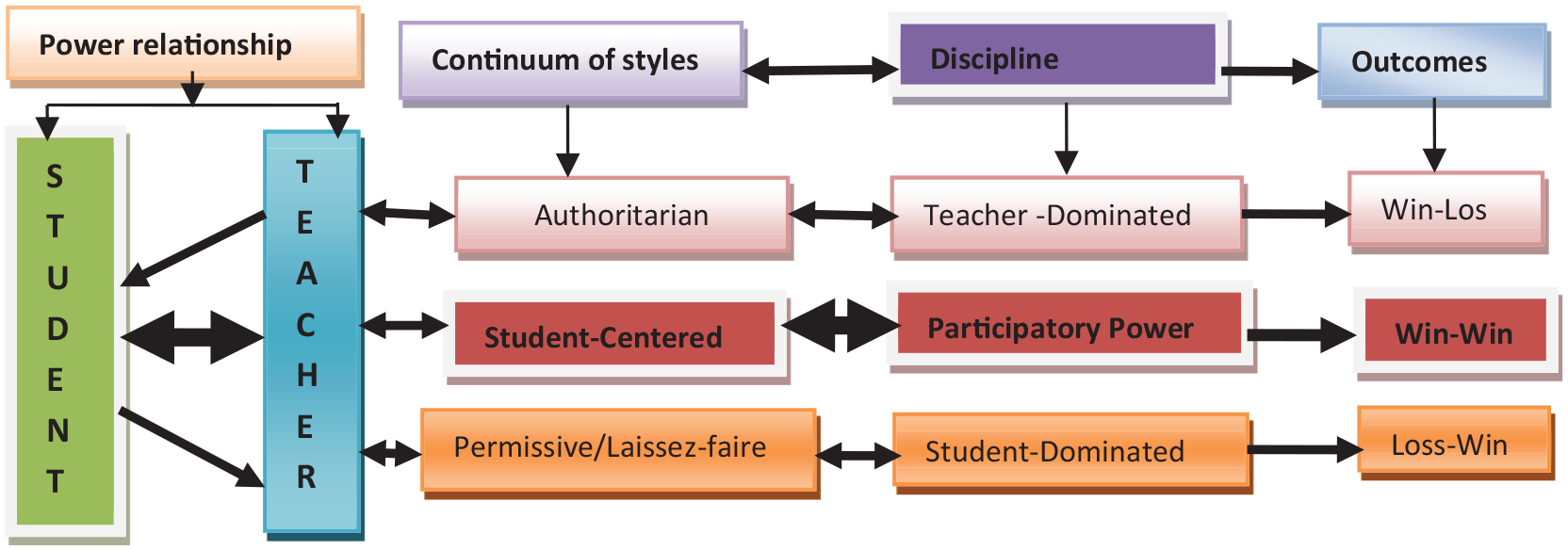
Power relationships in learner-centered teaching.
Pang and Marton (2007, p. 1) elucidate that for power division to be meaningful, it should be considered in relation to the students’ understanding of what they are learning: Any questions about pedagogy and learner autonomy for that matter- should be framed in more precise terms than is usually the case. We should not only say whether the teacher or the learner is doing most, but we should also make it clear who is doing what and the effect that it has.
As Marton and Morris (2002) and Msonde & Msonde (2017) argue what matters in a classroom is how the object of learning is experienced by pupils. And the question is not so much that who should be active and who should be passive, but rather of what teachers should do, create the necessary conditions for learning, and what learners should do, make use of the necessary conditions for learning (Pang & Marton, 2007, p. 27).
On the whole, implementation of participatory methods stressed in these theories is meant to improve collaborative learning (constructivism), accord students with an opportunity to learn their needy curriculum (humanism), and shift teacher’s responsibilities to students (transformative) in classroom transactions. These theories fail to adequately address the primary question of how individual student learning comes about (getting the knowledge) in an LCP. Moreover, most of these theories provide conditions and principles for learning rather than explicitly account for how a person gets to know a particular phenomenon or situation in question (object of learning). They also have failed to explain disparities in the understanding of learners subjected to the same principles or conditions. Such weaknesses pave the way for rethinking new theoretical perspectives that would effectively use the LCP to engage students to learn what is taught.
The Paradox of Implementing LCP
Although traditional teaching has been discouraged from classroom practices as prescribed in many curricular reforms, it nevertheless dominates classroom transactions in many countries (Alexander et al., 2010; Watts & Becker, 2008). Teachers maintain traditional teaching practices despite the pedagogical curricular reform as evidenced in the United States: Although the tenets of child-centered pedagogy were widely embraced by the educational establishment of the day, including most teacher educators in colleges and Universities. . . most teachers did not adopt child-centered practices and continued in the didactic, teacher-centered mode prevalent at the turn of the century. (Arends et al., 2001, p. 118)
In Hong Kong, the targeted-oriented curriculum (TOC) adopted in 1995 stresses four main strands in shifting teachers’ practices, that is from (a) teacher-centered didactic teaching to pupil-centered activity-interacted learning; (b) whole-class teaching to small group learning; (c) textbook-bound to using various resources and tasks for integrative learning; and (d) norm-referenced to criterion-referenced assessments (Kwan et al., 2002, p. 41). However, the TOC evaluation study in Hong Kong demonstrated that teachers explained their unwillingness to begin to try to use less traditional methods (Marton & Morris, 2002, p. 15). In South Africa, Alexander and Colleagues (2010) ascertained the extent to which teachers were implementing teaching styles prescribed in the outcome-based education (OBE) curriculum. They established that “the majority of educators’ are not engaging learners via OBE-centered teaching styles and that they are still advocating traditional/rote learning” (Alexander et al., 2010, p. 15).
Indeed, changing an instruction culture that had dominated for centuries cannot be achieved in few years. As Lo (2000) points out, teachers and other education stakeholders initially digest the merits of new teaching approaches before they embrace them as reliable. The traditional direct instruction has been favored because of its flexibility in accommodating larger classes and its ability to lead to mastery of well-structured knowledge and skills (Arends et al., 2001). New innovation in classroom instruction is good, but it should be contextualized because of the existing global diversities in social, cultural, technological, and economical aspects.
The practicing of LCP in terms of methodological, curriculum, and power/autonomy orientations leave much to be desired. In our view, we believe that these perspectives have not explicitly described how a student actually develops capabilities of what is being taught in LCP. To explain how students, learn during LCP instruction, one needs to answer the intentional questions: What to learn? How to learn? Why to learn? Answers to these questions, according to Di Napoli (2004), may explain better what and how students learn in an LCP lesson. The implication is that simply relying on simple rhetorical labels such as adopting a certain method, needy curriculum, and/or empowered students is rather inadequate. This is because learning is always about learning something (Marton & Tsui, 2004). In classroom practice, there is a teacher, students, and what students are expected to learn (object of learning). It is also impossible to have any learning without there being something to be learned. Thus, to enable students to learn, a teacher should be aware of what the students are expected to learn (object of learning), and then accordingly think of how the students will experience it appropriately. And in strengthening student capabilities, a teacher needs to make the case of why it is important for students to learn the object of learning in question. Thus, to make LCP produce the desired results of enhancing student capabilities, much attention should be focused on how students appropriate the object of learning during instruction (Msonde & Msonde, 2017). Such a situation prompts for the need to have a new perspective of experiencing and implementing LCP. This perspective is described in detail in the subsequent sections.
The Variation Theoretical Perspective
The variation theory is a learning theory that distinguishes itself from other theories such as the behaviorist, observational learning, cognitive, constructivist, transformative, and humanist theories on the crucial notion of how learning comes about. While the other theories regarded a person and the world as separate entities (dualism), Marton and Booth (1997) argue that humans and the world are not separate entities (nondualistic). Phenomenography views individual learning as a consequence of developing new ways of seeing a particular phenomenon that amounts to the discernment of its critical features simultaneously (Marton & Pang, 2008). Traditionally, phenomenography explored qualitative different ways of experiencing a particular phenomenon. Under the new theoretical perspective, phenomenography studies how people discern critical features of a particular phenomenon in experiencing the same phenomenon (Pang, 2002). This new focus amounts to the birth of a new learning theory, in this case, the variation theory.
Variation Theory and Student Learning
We experience events, instances, aspects, parts, and wholes because they are present to us. Through our senses, we can experience them. Experiencing these aspects makes one aware of a particular phenomenon or situation. Marton et al. (2004, p. 19) define awareness as a “totality of a person’s experiences of the world at each point in time.” One’s previous experiences on a phenomenon raise the awareness of a person to discern instances or aspects of the phenomenon in question. In fact, an individual’s consciousness changes dynamically all the time, and each phenomenon is experienced against the background of one’s previous experiences (Marton & Tsui, 2004). Since different people may have varied experiences with the same phenomenon, they may also have different levels of awareness of the phenomenon in question. Consequently, they may focus on different aspects of the same phenomenon and thus experience it differently (Marton & Booth, 1997).
Initially, when learners are exposed to the object of learning in the class, they experience it through their diverse prior knowledge. The characteristics of human awareness make only a limited number of critical aspects of the object of learning attractive to individual student’s attention, while other aspects remain in the background. This is what is called figure–ground structure relationship (Marton & Booth, 1997). For one to learn about a situation or the object of learning has to develop a consciousness of significant critical features of that object of learning. Thus, discernment of the critical aspects of the object of learning makes one know of the instances, aspects, phenomenon, or the world, for that matter. By the same token, Lo et al. (2005) argue that learning is a discernment of something that has not been discerned before and keeping it in one’s focal awareness. This is the point of departure of the variation theory that learning is characterized in terms of the learner’s dynamic structure of awareness. Learning in this view is also related to discernment, variation, and simultaneity (Ingerman et al., 2009), to know a particular phenomenon is to discern its critical features simultaneously.
Discernment, variation, and simultaneity describe how the variation theory demonstrates the way student learning comes about. They are intertwined together in explaining how learning or getting to know a phenomenon is envisaged. As pointed out earlier, to know a particular thing, one has to discern its critical features simultaneously. Discernment thus is a significant attribute of learning. Lo and Colleagues (2005) assert that learning is discerning something that has not been noticed by the learner so that it becomes the figure rather than the background. However, “unless variation is created, students cannot discern the learning content” (Kwan & Chan, 2004, p. 306). This is because “we can only experience simultaneously that which we can discern; we can only discern what we experience to vary; and we can only experience variation if we have experienced different instances previously and are holding them in our awareness simultaneously” (Marton & Tsui, 2004, p. 20).
As Bowden and Marton (1998, p. 35) put When some aspect of the phenomenon or an event varies while another aspect or other aspects remain invariant, the varying aspects will be discerned. In order for this to happen, variation must be experienced by someone as variation. A necessary condition is that the person in question experiences at the same time the different “values” in this aspect or in dimension that varies.
One can discern different instances simultaneously one has experienced at different times, something that Marton and Tsui (2004) call diachronic simultaneity. On the other hand, one may attend to different aspects simultaneously of the same instance at a particular point of time, which is known as synchronic simultaneity. For example, for students to have a good understanding of the impact of weathering on the earth’s surface, one has to discern the critical features of weathering simultaneously such as the process of carbonation, oxidation, hydrolysis, hydration, exfoliation, pressure release, frost action, and crystallization. This is a synchronic simultaneity in which discernment of critical aspects at the same time develops an understanding of an instance or a phenomenon, “weathering” in this case.
However, there are many instances or forces that affect the earth’s surface. These include not only weathering, but also mass wasting, wind and water action, as well as glaciations. A student comes across them at different points of time while learning about forces affecting the earth’s surface. For the students to realize that the earth’s surface is being affected by intertwined forces, they are required to discern all incidents (forces) simultaneously. This is the diachronic simultaneity. Marton and Tsui (2004, p. 18) explain this process thus: What we have experienced before must be or must have been discerned in order for us to experience it. In this respect, not only synchronic but also diachronic simultaneity is a function of discernment. Furthermore, there can be no experience of synchronic simultaneity without the experience of diachronic simultaneity, because in order to experience two aspects (instances) of the same thing together we must discern both separately.
In this sense, both synchronic and diachronic simultaneities are functions of discernments, and they complement each other.
Variation Theory and the LCP
Traditionally, as pointed out earlier, some scholars view the concept of LCP innovation in terms of teachers’ deployment of participatory methods (methodological orientation). Others relate LCP with students’ involvement in curriculum design and assessment, hence according to them opportunity to have choice in education (curriculum orientation). There are also those who describe it as a shift of power and responsibility from the teacher to the students (power relationship orientation) in classroom practices. The scope of these perspectives generally fails to focus on what is expected of LCP application. These orientations do not show explicitly how the LCP may enhance student capabilities of what is taught in classroom practices. Consequently, many teachers have re-inverted the wheel, and reverted to traditional teaching practices in their day-to-day teaching contrary to what is stipulated in the curriculum (Arends et al., 2001; Watts & Becker, 2008).
The new perspective of understanding LCP we propose in this article is to focus on what students are expected to develop during the course of instruction. By so doing, questions such as what, how, and why students learn proposed by Di Napoli (2004) will be answered. Msonde (2009) argues that understanding of LCP should focus on how students are engaged in what is being taught (the object of learning). As Marton and Pang (2008, p. 552) contend, “[T]he way in which the object of learning is dealt with may or may not provide students with necessary conditions for appropriating that specific object of learning.” The implication is that what matters in developing students’ learning is how teachers pedagogically engage learners in dealing with the object of learning (Msonde & Msonde, 2017, 2018), in terms of what varies and what is kept invariant. This view reaffirms what Lo and Pong (2005) also established: students’ different learning outcomes are due to differences in how the object of learning has been dealt with in classroom practices. Thus, neither the methods used nor does the question of who had power in the process of instruction make these differences. A good example is a study by Msonde (2017) who explored the impact of learning study on teachers’ appropriation of the conditions for learning in SCL lessons. These scholars found that teachers were able to identify critical aspects and create conditions for engaging learners in experiencing those aspects sequentially and simultaneously. There was strong evidence that the theory of variation helped teachers to learn effective ways of creating conditions for students to appropriate features of the objects of learning.
The traditional understanding of LCP tends to ignore what the students are expected to learn—the object of learning. As elaborated earlier, the essence of learning theories is to determine different ways of enhancing student learning and their pedagogical implications. Learning theories facilitate the devising of suitable classroom instruction practices. The primary goal is how students can be assisted to attain what they are expected to learn (object of learning) during instruction. In this line, Msonde (2009) defines LCP as pedagogical activities that enable both the teacher and the learner to engage mutually in the object of learning in a manner that enhances student capabilities. In other words, it is the act that engages students in discerning critical aspects of the object of learning.
In fact, the object of learning is a capability that students are expected to develop during instruction. There are both direct and indirect objects of learning (Marton & Pang, 2008). The direct object of learning refers to the content such as electricity in Physics, trigonometry in Mathematics, democracy in Civics, and weather in Geography. The indirect object of learning, on the other hand, is merely a capability, which students are expected to develop when they gain knowledge, skills, and attitude from the content in question. The focus on the object of learning in LCP entails capitalizing on both the content being studied and the capability that students are expected to develop when learning that content. Focusing on the object of learning also implies that teachers create dimensions of variation for students to appropriate the critical aspects of what is being taught directly (Msonde, 2009; Msonde & Msonde, 2018). Thus, it is important to delineate what is critical for the object of learning to be understood in LCP. As such, a teacher has to identify critical aspects of each object of learning before teaching a lesson.
We have seen so far that to understand a particular object of learning one has to discern the critical features of that object of learning. But the critical features discerned vary. Marton and Tsui (2004) identified four patterns of variations that become significant in building a good understanding of a particular phenomenon. These are contrast, generalization, separation, and fusion. These patterns—in the view of Marton and Pang (2006)—are necessary conditions for learning. To enable learners to develop capabilities in a particular object of learning, teachers should utilize the identified critical features of the object of learning in a manner that develops contrast, separation, generalization, and fusion.
These patterns of variation are important conditions that facilitate student discernment of critical aspects of the object of learning. The patterns of variation assist the teacher to widen the space of learning of what is being taught. It is thus a necessary condition for a learner to experience those patterns of variation in a real classroom practice. As the enacted object of learning is in the hands and control of the teacher, widening the space of learning increases the possibilities of enhancing student learning of what is being taught. The space of learning dictates what is possible for students to learn in a certain situation. As Kwan and Chan (2004, p. 318) argue “the opening of the students’ learning space by the provision of different variations has created opportunities to bring about a higher level of learning among students.”
Characteristically, the space of learning is elastic and can be widened if the teacher affords learners opportunities to explore the object of learning in a variety of ways. Thus, in an LCP, the teachers should capitalize on maximizing the spaces of learning in their practices by designing and employing what Marton and Pang (2006, 2008) called “appropriate conditions of learning” (patterns of variation). They should also ensure that those conditions are experienced by the students. It is their role to identify varying critical features and those that should remain invariable and use the language to fuel interactions among students, which enable the teacher to bring critical aspects of the object of learning into the focal awareness of the students. As Marton and Tsui (2004, p. 32) argue “a space of learning that is semantically rich allows students to come to grips with the critical features of the object of learning much more effectively than one that is semantically impoverished.” Excellence in learner-centered teaching seems thus to have to do with the nature of the space of learning constituted regardless of the particular method of instruction used, regardless of a particular way in which educational resources are organized (Marton & Pang, 2006).
Hence, in planning the LCP lesson, the teacher should identify the critical aspects of the object of learning and structure dimensions of variation of those aspects in the intended object of learning as illustrated in Figure 2. Failure to identify critical aspects of the object of learning would culminate into an inadequate intended, enacted, and lived object of learning. Lo and Pong (2005, p. 16) point out “in order for students to understand the subject matter under study in the way intended, teachers must be clear about what critical aspects needed to be discerned.”
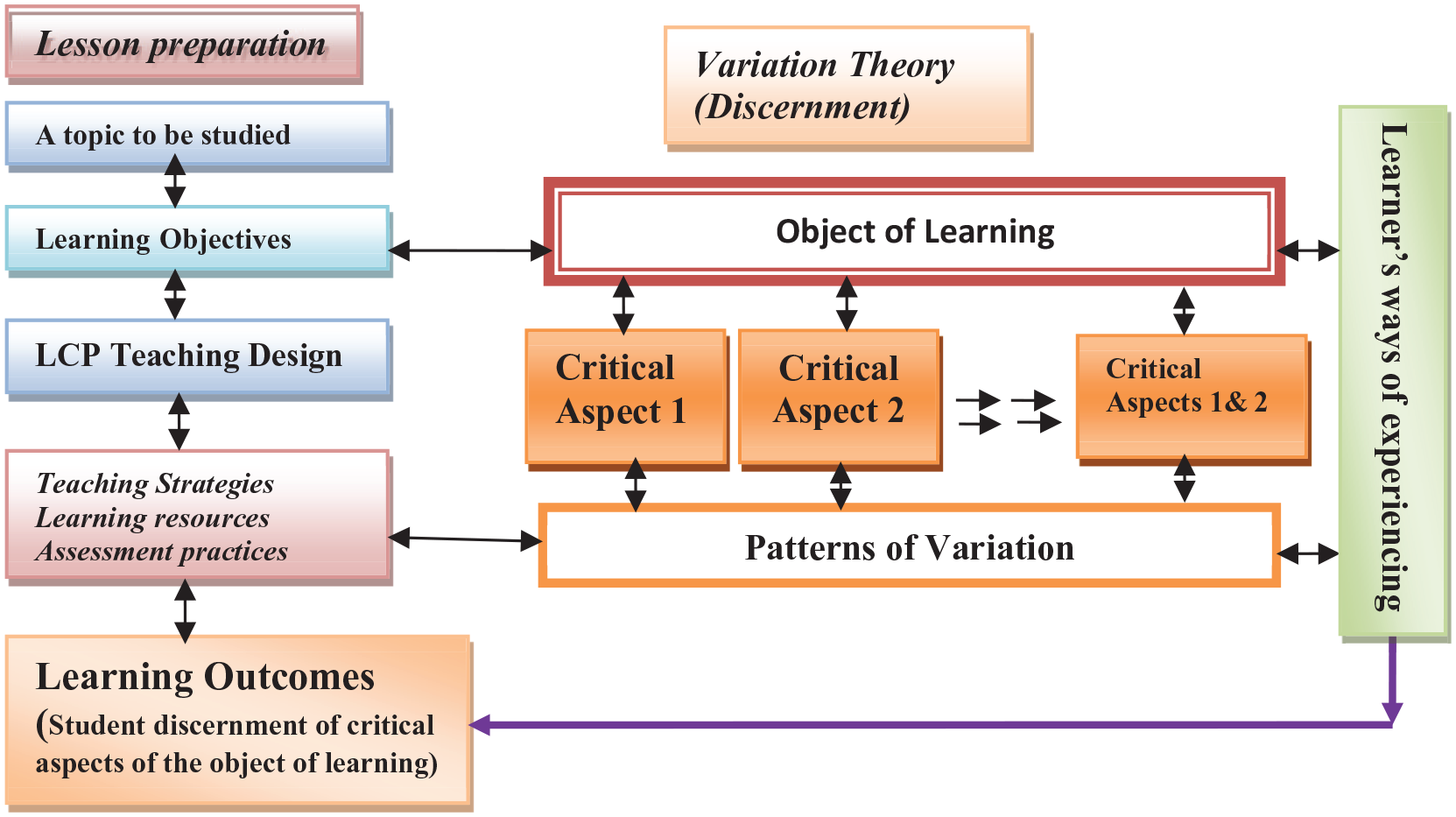
Using the variation theory in lesson preparation.
As shown in Figure 2, a teacher needs first to select a topic to be studied from the school syllabus. Then, the teacher selects the object of learning in that topic to focus on. In this way, the teacher translates the learning objectives in terms of the object of learning. Later, the teacher identifies the critical aspects of the object of learning from students’ perspectives. S/he figures out how the methods, assessment practices, and teaching resources could help involve the learners in discerning those critical aspects. As such, the teacher focuses on creating dimensions of variation that would enable the learners to attend to the identified critical aspects of the object of learning. In the learner-centered lesson, thus, teachers use those conditions of learning to engage learners in experiencing the critical aspects of the object of learning both sequentially and simultaneously. Lo and Colleagues (2005, p. 18) put To help the student learn, teachers must first identify the critical aspects and then help their students focus on these critical aspects at the same time, in order to bring about an intended way of understanding.
Thus, the variation theory guides a teacher to devise a way that involves learners in what is taught thereby increasing the possibilities for the students to discern the critical aspects of the object of learning in a learner-centered lesson. Msonde (2009) outlines three stages of designing and enacting the LCP lesson. The teachers should first identify critical aspects of the object of learning and structure dimensions of variation of those aspects. That is, setting up patterns of variation that enables learners to contrast, separate, generalize, and fuse important aspects of the object of learning. These are essential conditions that increase the possibilities for the learners to discern critical features of what is being taught (Msonde & Msonde, 2018). Second, teachers should involve learners in attending to critical aspects separately. In this way, the teacher should be able to vary one aspect while keeping the rest of the aspects invariant. Third, teachers should engage learners in discerning all critical aspects of a particular object of learning simultaneously. This entails making all critical aspects vary at the same time.
Revisiting the Idea of LCP for Student Learning
In this article, we come up with a new conceptual framework in experiencing and practicing LCP using the variation theory perspective (Msonde & Msonde, 2019), as shown in Figure 3. Based on previous empirical studies (Eggen & Kauchak, 2006), it was apparent that all teaching and learning methods, whether labeled as teacher-centered or as learner-centered, are of great value if applied in involving the students in the object of learning. As such, the selection of instructional method(s) depends on what is being taught (Marton & Lo, 2007). Thus, the choice of instructional methods will depend on which is most effective in facilitating the students to experience the critical aspects of the object of learning.
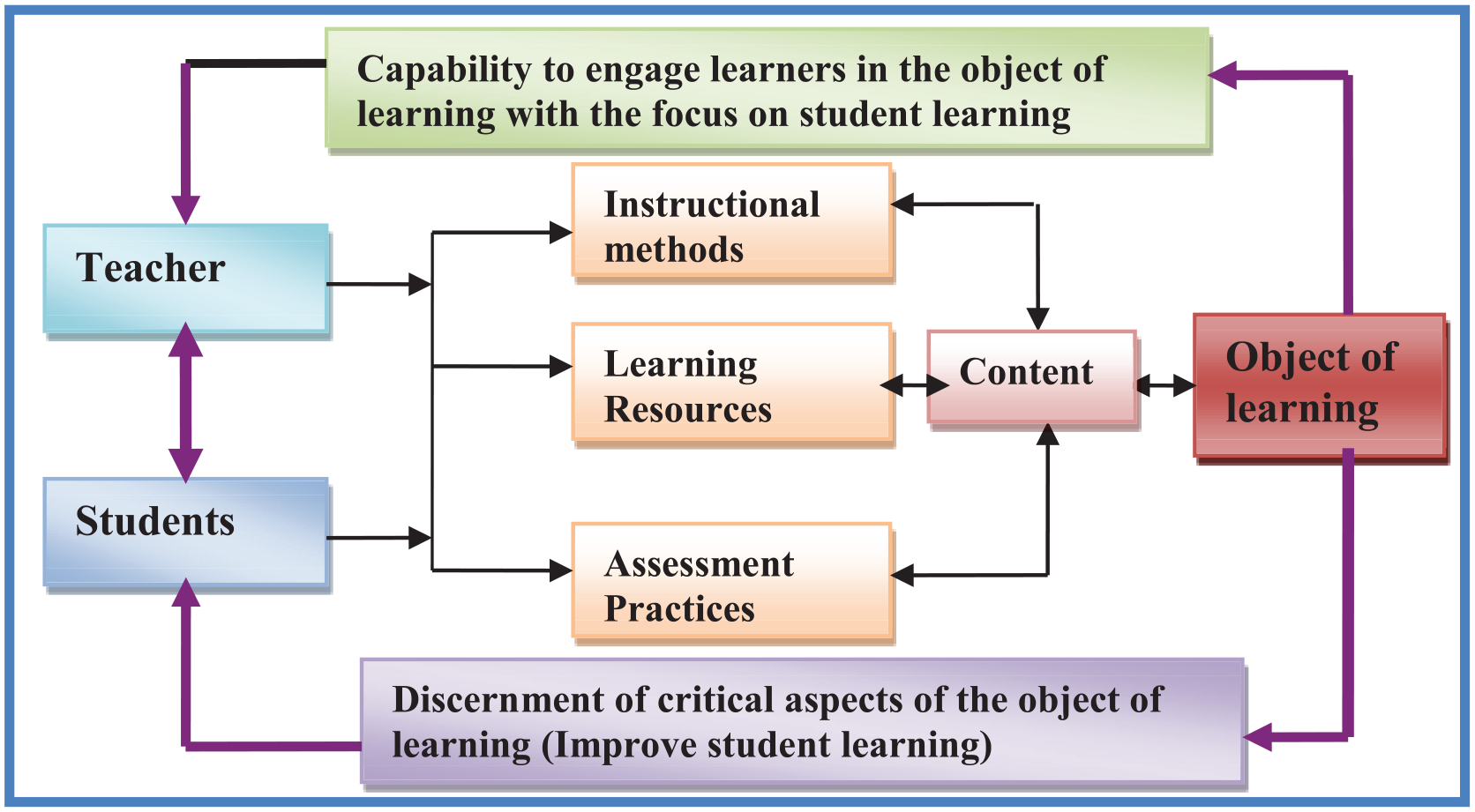
Conceptual framework for understanding and implementing learner-centered pedagogy.
Similarly, Kitta (2004) contends that the more the learning resources are used, the more the students are involved in what is being taught (object of learning) in a leaner-centered teaching. In areas where teachers and students face a severe scarcity of teaching resources, the teacher’s improvisation of knowledge is essential. Improvisation knowledge refers to the capability of the teachers to prepare learning resources within their environments with limited resources at their disposal. In-depth teacher’s knowledge of the subject content is also crucial to enable the teacher to utilize what is available in the school environments in improvising appropriate learning resources. The teachers may involve students in the preparation and use of the learning resources, which serve as a starting point of the students’ engagement with the object of learning.
Furthermore, assessment practices, as O’Neill et al. (2005) have pointed out, play a significant role in providing immediate feedback on student learning. Through activities, assigned tasks, or questioning, the patterns of variation and invariance of critical aspects of the object of learning are made available for the student to discern. Such assessment does not only make a student even more involved in what is taught but it also gives the teachers immediate feedback on the nature of instruction he or she is exposing the students to (Kauchak & Eggen, 2007). In fact, Tsui et al. (2004, p. 114) maintain Questions asked at crucial stage of a lesson can focus students’ attention on the critical aspects of the object of learning, create the context that will make students to make sense of the object of learning, and open up the space for exploration of an answer.
Thus, this conceptual framework provides us with a new way of understanding and implementing LCP with the focus on the students’ discernment of the critical aspects of the object of learning. In this way, features such as the method(s), the content, assessment practices, and learning resources facilitate student involvement in the object of learning.
Conclusion
To account for student learning of what is taught in LCP lesson transactions, we urge teachers to focus on engaging learners in the object of learning. As such, a teacher identifies the critical aspects of the object of learning, structure dimensions (patterns) of variation of those aspects, and involves learners in those patterns, and hence, enabling learners to discern critical aspects of the object of learning simultaneously. This is a shift from the traditional LCP approach as a methodological, curriculum-based, or student–teacher responsibility oriented to object of learning orientation.
Recommendations
Over the years, three common theoretical perspectives—constructivism, humanism, and transformative dominated the practices of LCP across the world. These theoretical perspectives have not helped teachers to facilitate the student learn what is taught. As such, there is a compelling need to have new ways of conceiving and practicing LCP to enable the student learn what is taught. This article argues teachers to experience and practice LCP using the variation theory perspective to engage learners in dealing with the object of learning in terms of what varies and what is kept invariant and makes learning possible.
Footnotes
Declaration of Conflicting Interests
The author(s) declared no potential conflicts of interest with respect to the research, authorship, and/or publication of this article.
Funding
The author received no financial support for the research, authorship, and/or publication of this article.
