



Abstract
This study reviews the emerging studies on the topic of Chinese immersion programs in the U.S. The effectiveness of Chinese immersion programs has been proved to have positive impacts on students’ language proficiency, academic performance, and cognitive development. However, challenges in curriculum and instructions, behavior management, and cross-cultural communication have been limiting the performance of Chinese language immersion programs. To address these challenges, Chinese immersion teachers should be provided with preparations and training on the knowledge of designing multi-subject curriculum in the Chinese language, utilizing instructional strategies in immersion settings, and developing cross-cultural competency.
Keywords
Introduction
Mandarin Chinese is the most widely spoken first language in the world (Stewart & Livaccari, 2010; Wang & Ruan, 2016). China’s accelerated role in international relations and globalized economy in the 21st century increased the growth of Chinese language education (Chen, 2019; Stewart & Livaccari, 2010; Tsung & Cruickshank, 2010; Wang & Ruan, 2016). In the United States, the demand for learning Chinese as a Foreign Language (CFL) was increasing in the K-12 system (Kong & Shang, 2020). According to the National K-12 Foreign Language Enrollment Survey Report (American Councils for International Education, 2017), in the formal U.S K-12 education system, a certain amount of language programs (i.e., traditional classroom, dual language (two-way) immersion, immersion, online, both online and face to face) and classes have been provided in Chinese.
Among these language programs, Chinese immersion education provided Chinese language learners an alternative choice to learn Mandarin Chinese (Fortune & Ju, 2017). According to Tedick et al. (2011), in order to ensure the language program qualifies as an immersion approach, at least 50% of the subject matter intrusions should be conducted in the target language. Chinese language immersion programs could be categorized into full/total immersion, partial immersion, or two-way/dual immersion based on their portion of the target language used and the make-up of the students’ population (Peng, 2016). In a full (one-way/total) immersion program, all the subject matter was taught in the target language. For example, in the Chinese one-way total immersion program, students learned all their subject matter, math, science, and social studies, in the target language and they did not receive any English instruction until 2nd grade (Fortune, 2012; Stewart & Livaccari, 2010). Two-way/dual immersion program involved equal numbers of language majority students (predominantly English speakers) and minority students (students who speak the target language as their native dialect) in a classroom and used these two languages equally for intrusions (de Jong, 2016; Stewart & Livaccari, 2010). For the United States, the majority of Chinese immersion programs adopted the 50-50 model as described by Met and Livaccari (2012) while other Chinese immersion programs initially adopted the 80–100% Chinese instructional model before switching over to the 50-50 model.
According to the Mandarin Immersion Parents Council (MIPC), the first total Chinese immersion program in the U.S. was built in San Francisco in 1981. The U.S. Chinese immersion programs gradually gained their reputation and grew rapidly in the past 40 years. As of September 2021, there were 343 programs in the U.S. Figure 1 provides the number of Chinese immersion programs by states in 2021. The top states that provided Chinese immersion programs were distributed as follows: California (26%), Utah (20%), New York (4%), and North Carolina (4%). The Distribution of Chinese Immersion Programs by States in the U.S. During the Year 2021. Note. Data extracted from Mandarin immersion school list in U.S. Schools, by Mandarin Immersion Parents Council, Retrieved December 2021, from https://miparentscouncil.org/full-mandarin-immersion-school-list/.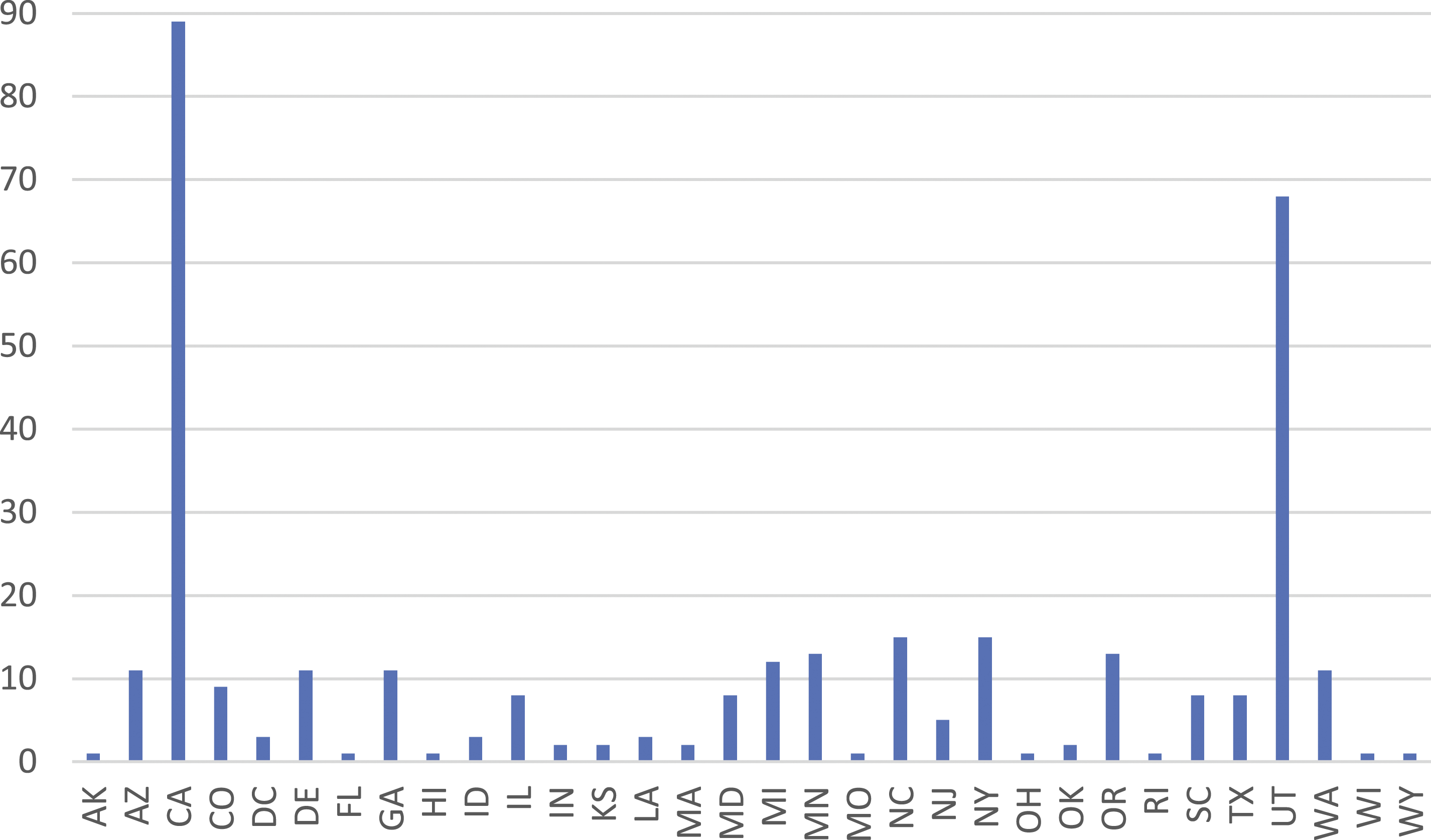
Figure 2 showed the number of Chinese immersion programs at each level (pre-school, elementary, middle, and high school) in the U.S. According to the categorization method of the Center for Applied Linguistics (2011), this study categorized these Chinese immersion programs by identifying the terminology of the programs’ names. This research also included programs that had more than one level in all relevant categories. Among those Chinese immersion programs shown in Figure 2, 62% (253) are elementary level, 30% (122) are middle school level, 8% (33) are at high school level, and the remaining are pre-school level. When compared with middle or high school Chinese immersion programs, Chinese immersion programs were mostly laid in elementary levels (Lü, 2019). In this case, more understanding of immersion programs, in which the learners start to learn Chinese at a much younger age, needs to be gained (Wang & Ruan, 2016). Distribution of Chinese Language Immersion Programs by Grade Levels in the U.S. During the Year 2021. Note. Data extracted from Mandarin immersion school list in U.S. Schools, by Mandarin Immersion Parents Council, Retrieved December 2021, from https://miparentscouncil.org/full-mandarin-immersion-school-list/.
The Effectiveness of Chinese Immersion Programs
Language immersion programs engaged students in acquiring a second language through learning the curriculum content in the target language (De Courcy, 2002). The benefits of language immersion programs include developing students’ language proficiency in two or more languages, achieving grade-appropriate academic scope, and acquiring cognitive skills (Fortune, 2012). The following subsections discuss various research findings with a focus on the effectiveness of the Chinese immersion programs following the above-mentioned three beneficial dimensions.
Language Development
The studies in immersion programs have shown that immersion students can gain higher levels of target language proficiency while maintaining their native language development progress (Met, 2012a). Until recently, there has been a paucity of research on learners’ performance in Chinese immersion programs in the U.S. Emerging research studies revealed that Chinese immersion students achieved the intermediate low level across the language skills (reading, writing, listening, and speaking) in 5th grade (Watzinger-Tharp et al., 2018). The research findings also provided some examples to explain immersion students’ language achievement in different language skills.
Overall, Chinese immersion students obtained higher scores in listening and reading compared with their speaking and writing skills, which were less differentiable. (Burkhauser et al., 2016; Padilla et al., 2013; Watzinger-Tharp et al., 2018; Xu et al., 2015). For example, in all four skills (reading, writing, listening, and speaking), Chinese immersion students (5th grade) performed highest in listening and more than half of them achieved Intermediate High level (Padilla et al., 2013; Watzinger-Tharp et al., 2018; Xu et al., 2015). Some of the 5th grade students’ reading proficiency, according to Padilla et al. (2013) and Xu et al. (2015), could achieve the Intermediate High level. This level was not achieved by the high school students who were learning Chinese in their 5th year (Xu et al., 2015). The same study also revealed that most of the students’ speaking and writing proficiency in 5th grade attained Intermediate Low. The above-mentioned linguistic levels in Mandarin were achievable as the immersion students substantially developed their Chinese language oral and written proficiency in kindergarten or first grade (Met & Livaccari, 2012).
Academic Achievement
A substantial amount of research has pointed out the increase of immersion students’ academic learning slope and their higher achievement scores compared to the students in regular school programs in the U.S. (Fortune & Tedick, 2003; Lindholm-Leary & Howard, 2008). The study in the Chinese immersion programs revealed that although the standardized tests of core subjects (English Language Arts, Mathematics, and Science) were administrated in English, the academic performances of Chinese immersion students were similar or sometimes higher when compared to their non-immersion peers (Padilla et al., 2013). For example, Watzinger-Tharp et al. (2018) studied students’ math achievement in both immersion and non-immersion programs. The result indicated that the students in immersion programs, who received most of their math instructions in the target language, performed at the grade level in 3rd grade, and their math scores grew more in 4th grade. The Chinese immersion students in 4th through 7th grade performed above the grade level and state’s median score in reading and math (Lindholm-Leary, 2011). Seitz (2019) also conducted similar research and the findings reported that Chinese immersion students’ language arts and math scores were slightly higher than their non-immersion peers. Note that Chinese immersion students received less instructional time in English as compared to the non-immersion students.
Cognitive Development
A certain amount of research indicated that bilingual education contributes to students’ cognitive development, which includes divergent thinking, pattern recognition, and problem-solving (Bialystok, 2001; Fortune, 2012). For instance, the immersion students’ nonverbal problem-solving proved to be grown remarkably (Fortune & Tedick, 2003). Research also revealed that the bilingual students enhanced their working memory and attention control from cognitive psychologists’ point of view (Bialystok et al., 2008; Craik et al., 2010; Steele et al., 2017). Sparse literature has reported the cognitive development of Chinese immersion students in the U.S.
Challenges Faced by the Current Chinese Immersion Programs
According to Met (2012b), there were two sets of curricula in the Chinese immersion setting in the U.S: (1) subject matter (content) curriculum; (2) Chinese language and literacy curriculum. These two sets of curricula were not developed by individual teachers (Ni & Na, 2016). Most of the schools and school districts in the U.S. developed their immersion curriculum based on national standards, state standards, or “common core” content to ensure the consistency of immersion programs across the states and insure immersion students’ comparable academic achievements with other non-immersion students (Met, 2012b). The Chinese immersion programs in the U.S. followed the district and school level curricula and the existing English thematic topics but conducted content teaching in the Chinese language (Chen et al., 2017; Zhou & Li, 2015b). In this case, the Chinese immersion programs need to develop (adapt or translate) the subject-area content curricula to Chinese and develop a curriculum for Chinese language and literacy (Met, 2012b).
Curriculum and Development
Due to the special characteristics of the Chinese language and the short history of Chinese immersion, Chinese immersion programs in the U.S. confronted some challenges different from other language immersion programs (Met & Livaccari, 2012). Beyond setting and aligning the curriculum for Chinese immersion, one of the challenges of Chinese immersion programs was the shortage of engaging and high-quality materials, especially the deficit of teachers’ guides and teaching assistant materials, as well as the appropriate and systematic learning materials designed for content-based learning (Chen et al., 2017; Met & Livaccari, 2012; Zhou & Li, 2015b). According to Zhou and Li (2015b), compared to the schools in China that had well-designed curriculum materials provided by the Chinese Ministry of Education, the Chinese immersion programs in the U.S. lacked materials for Chinese immersion instruction. For example, Chinese immersion programs needed authentic materials for the native speakers that had been created by the native speakers, as the content and topics were based on students’ readiness, interests, and learning styles (Lin, 2012; Ni & Na, 2016).
Staffing
A considerable challenge for many language immersion programs was finding the teacher candidates prepared specifically for the immersion settings (Met & Lorenz, 1997; Veilleux & Bournot-Trites, 2005). There have been constant struggles faced by immersion programs aimed at recruiting qualified teacher candidates due to the uniqueness of immersion education, inadequate immersion preparation programs, and the lack of understanding by the school districts about the teacher’s preparedness for immersion education (Freeman-Nepay, 2017; Met & Lorenz, 1997; Veilleux & Bournot-Trites, 2005).
Chinese immersion programs shared this common obstacle with other language immersion programs as well. Following the rapid development of Chinese immersion programs in the U.S., there has been an increase in demand for qualified Chinese immersion teachers (Freeman et al., 2014). The shortage of qualified and certified Chinese immersion teachers challenged Chinese immersion programs as well (Chen, 2019). Chinese immersion programs recruited a certain amount of Chinese Foreign Language (CFL) teacher candidates to teach in the immersion setting. Note that the CFL teachers in the U.S. might include (1) Native English speakers of CFL (Graduates of American university preparation programs for teachers); (2) Heritage teachers (Educated Chinese native speakers who had been residing in the U.S. and had or might have received teaching credentials); (3) Guest teachers (Chinese nationals who visited the school districts on a short-term visa through exchange educational arrangements) (Bissell & Chang, 2012; Peng, 2016). According to Bissell and Chang (2012), the teacher pool of commonly taught languages (French and Spanish) involved native and heritage language speakers, as well as the non-native speakers who were certified to teach. However, there were limited English-dominant teachers for the less commonly taught languages (Chinese and Japanese) due to the high linguistic and language proficiency prerequisites for teaching in the immersion setting (Bissell & Chang, 2012). In this case, Chinese immersion programs mainly recruited heritage and guest CFL teachers, as Chinese immersion programs struggled with recruiting teachers who are proficient in the Chinese language and have obtained teaching certificates even though they had less restrictive regulations (Chen et al., 2017). As these teacher candidates were not prepared specifically for teaching in the immersion setting, they confronted different issues and challenges in their immersion teaching.
Challenges Faced by the Chinese Immersion Teachers
Summary of the Studies on Chinese Immersion Teachers.

Curriculum Design and Instruction
Curriculum planning and content teaching challenged Chinese immersion teachers in general. In Chinese immersion programs in the U.S, Chinese immersion teachers needed to develop students’ language and literacy proficiencies, and their abilities to use the Chinese language as a medium to access the academic content (Bissell & Chang, 2012). The following two challenges happened in the process of theme-based curriculum planning and content teaching. First, according to Chen et al. (2017), Chinese immersion teachers struggled in integrating the theme content into Chinese language teaching. Since the curriculum of the Chinese immersion programs followed the existing English thematic topics, teaching the subject content in the Chinese language was difficult for children to understand (Chen et al., 2017). Second, there was a mismatch between Chinese immersion teachers’ backgrounds and their teaching duties in the United States. Due to the inadequate instructional knowledge of math, social studies, and science, the Chinese immersion teachers who did not receive training on the skills to teach these subjects struggled with the subject-area instructions (Liao et al., 2017; Zhou & Li, 2015b).
Chinese immersion teachers who were native Chinese speakers and educated in Chinese-speaking countries lacked the foreign language pedagogy. Their traditional teacher-centered philosophies did not match the popular notion of the student-centered classroom in the U.S. (Chen et al., 2017). For example, a certain number of Chinese immersion teachers emphasized rote and mechanical memorizations instead of conducting student-centered learning (Romig, 2009; Zhou & Li, 2016). However, the schools in the U.S. emphasized student-centered activities, in which students learned social skills and communicative languages through real-life tasks (Fortune, 2012; Hall Haley & Ferro, 2011). In this case, the Chinese immersion teachers encountered cross-cultural challenges due to the mismatch between the student-centered learning approach and their experience and expectations in the traditional Chinese teacher-centered instructional approach (Chen, 2019; Zhao, 2007). As a Chinese immersion teacher, the author of this study had noticed that many Chinese immersion teachers still conduct teacher-centered instructions, as they believed that teachers could transfer knowledge to the students and students would not learn much in the student-centered classroom. To address this concern, Zhang (2016) clarified that real student-centered classrooms created meaningful practice opportunities and tasks, which will help the students transfer their declarative knowledge to autonomous knowledge in the language acquisition process.
Behavior Management
Chinese immersion teachers in the U.S. had the tendency to experience difficulties in managing classroom disciplines and guiding the student-centered environment as they were not familiar with the U.S. culture and had high participant expectations (e.g., respectful) more than the teachers who were not from Confucius culture countries (Chen et al., 2017; Zhou & Li, 2016). In general, Chinese language teachers valued the strength of the traditional teacher-centered relationships between teachers and students, which believed that teachers have absolute authority and that respecting teachers was a classroom norm (Kang & Chang, 2016; Xu, 2012). In this case, classroom/misbehavior management was a major concern/challenge for Chinese language teachers in student-centered classrooms (Chen, 2019; Liao et al., 2017; Liu, 2012). As Chinese immersion teachers had the same Chinese cultural expectations (e.g. respecting the teacher) for students, they were more likely to use the same strategies that worked well with Chinese students’ classroom behaviors, such as being vocally strict in Chinese terms or using nonverbal interventions (e.g., giving a glance) (Chen, 2019; Romig, 2009; Zhou, 2013; Zhou & Li, 2015a). However, these strategies were ineffective in changing students’ actions as (1) Chinese immersion teachers and students have different cultural understandings; (2) students did not understand the language in an immersion setting (Romig, 2009). The author also indicated these two situations might happen simultaneously. In this case, the behavior management strategies that Chinese teachers used cannot be transferred and work effectively on American students, as the latter demanded distinct and unsubtle management approaches, such as the positive discipline methods (Chen, 2019; Jin & Cortazzi, 2012; Zhou & Li, 2016).
It was essential and necessary to encourage Chinese immersion teachers to understand the cultural differences in developing classroom management strategies (Bissell & Chang, 2012). Specifically, American culture inspired students to choose their learning styles without regulating how they should behave and learn, whereas Chinese culture has rigorous requirements for conducting appropriate learnings (Chen, 2019; Zhao, 2007) In this case, to help the Chinese immersion teachers gradually adapt to the western approaches to discipline, Chinese immersion teachers have to change the classroom management approaches used in the Chinese culture to an approach that integrate the local culture for implementing disciplinary measure (Romig, 2009; Zhou & Li, 2016).
Cross-Cultural Communication Issues
Many Chinese immersion teachers reported their obstacles in communicating with parents and American colleagues (Liao et al., 2017; Zhou & Li, 2015b). Chen (2019) illustrated that Chinese immersion teachers consumed a certain amount of time to communicate with the American parents and help the parents understand teachers’ curriculum perspectives as Chinese immersion teachers and American parents had different expectations on learning. For example, American parents valued the self-promotion, creativity, and critical thinking of the students, so they gave students more freedom (Hue & Li, 2008; Young, 1996). On the contrary, Chinese teachers promoted students’ academic achievements, so they had the tendency to challenge students (Pan et al., 2019). Ren (2017)’s study also found that due to the shortage of teacher training on preparing the teachers for the culture shock and cross-cultural working, the parents of Chinese immersion programs had shown their concerns on parent-teachers cross-cultural communication issues.
According to Zhou and Li (2015b), Chinese immersion teachers also reported that misconceptions and complications occurred during their communication with American colleagues due to cultural differences. Note that cultural differences existed between the indirect expressions in the Chinese culture and active expressions in the American culture (Bissell & Chang, 2012). Therefore, teachers’ competencies in adapting culture shock and achieving acculturation were influenced by the school’s cultural knowledge, which was being modified and adjusted to suit the mainstream classrooms in the U.S. (Romig, 2009). Thus, Bissell and Chang (2012) found that it was essential to help both English and Chinese faculties avoid misunderstandings by engaging them in recognizing each other’s culture.
Challenges for Chinese Immersion Teacher Preparation Programs
Emerging research revealed that Chinese teachers experienced insufficient preparation programs and also revealed a lack of mechanisms for teacher certification in general within the U.S. (Peng, 2016). Therefore, Chinese immersion teachers’ preparation and training were being viewed as one of the significant challenges in the Chinese Foreign Language (CFL) teaching area (Wang, 2010). Other than the traditional Chinese language teacher preparation approaches, Everson (2016) reported that American education required different preparation and development for immersion teachers to sustain immersion programs’ development. In addition, Fortune (2012) reported that immersion teachers also demanded specialized professional development opportunities to support them in simultaneously addressing the content, language, and literacy developments of their students. Beyond these curriculum and instruction training, Bissell and Chang (2012) stated that the immersion teacher professional development programs should also include classroom management, social-emotional development, and communication and technology in order to meet the needs of immersion teaching. Owing to the limitation of scholarly research on Chinese immersion teachers’ preparation and training needs, this study only found several research studies that were relevant to this topic. The findings are as follows:
Curriculum and Instruction
The college and universities could build effective teacher preparation programs that provide teacher candidates with preparations on the topic of immersion and early language instructional approaches, which included the use of technology in language teaching and addressed the pedagogical differences in immersion language teaching settings (Stewart & Livaccari, 2010; Zhou & Li, 2015b). In particular, Chinese immersion teachers needed training related to Chinese language curriculum design and teaching methods. Although Chinese immersion programs provided professional learning communities and/or professional development opportunities for the Chinese immersion teachers, they still believed the Chinese immersion programs provided insufficient training for teaching the Chinese language, such as how to teach Pinyin or utilize project approaches in the Chinese immersion setting (Chen et al., 2017). In this case, the professional development could also provide relevant training on fostering Chinese immersion students’ language and literacy development (Bissell & Chang, 2012).
Cross-Cultural Competence
The preparation/training programs were crucial to foster the Chinese immersion teachers’ cross-cultural competence for them to have the insider’s understanding of students’ home culture and the culture embedded in the target language (Chen, 2019; De Courcy, 1997; Zhou & Li, 2015b). This cross-cultural competence training could help Chinese immersion teachers in threefold:
First, Chinese immersion teachers need to acquire cultural awareness in different cultures for them to effectively adapt their classroom management strategies to the U.S. culture. Chinese immersion teachers’ cultural competency has a direct impact on their interaction within/across two different cultures; thus, the teachers’ ability to develop cultural competency affected their classroom management skills (Romig, 2009; Zhou & Li, 2015a).
Second, immersion teachers represented their own culture and integrated it into their language teaching curriculum. In this case, immersion teachers could help students adapt to the culture reflected in the target language and interpret the cultural meaning of the language (De Courcy, 1997).
Third, the knowledge of cultural differences can help Chinese immersion teachers communicate with their American colleagues and parents more confidently and balance the differences in communication and cultural understanding (Bissell & Chang, 2012; Zhou & Li, 2015b).
Conclusions and Recommendations
Owing to the rapid development of different types of Chinese immersion programs in the U.S., Chinese immersion programs gained their reputation and successfully improved students’ Chinese language proficiency while maintaining their first language development by providing students with an immersive language learning environment. Chinese immersion students further attained the same or even higher academic achievement scopes than their non-immersion peers. The immersion students also achieved cognitive development while learning another language.
The growing numbers of Chinese immersion programs demanded more qualified teachers who were trained and certified specifically for immersion teaching; thus, Chinese immersion teacher recruitment challenged Chinese immersion programs the most. In this case, the higher institutions could develop more immersion teacher preparation programs or bilingual teacher certification programs to specifically prepare immersion teachers. In addition, based on the information obtained on the cross-cultural issues encountered by Chinese immersion teachers, our finding showed that curriculum and instruction, classroom management, and communication were implicated to be the major challenges experienced by the Chinese immersion teachers. Inspired by the research findings, Chinese Immersion programs could provide professional development opportunities, or inter-program collaborations to address the above-mentioned issues faced specifically by the Chinese immersion teachers. By doing so, Chinese immersion teachers could gain a better understanding of teaching language and content in immersion settings. Also, more targeted professional development training options, such as social-emotional learning and classroom management skills, could better support Chinese immersion teachers in teaching in the U.S. teaching context.
Research also revealed that the insufficient immersion teachers’ preparation and training could explain the reason why some of the Chinese immersion teachers were under-prepared for their immersion teaching assignments. Although similar research provided some recommendations for the preparation and training of Chinese immersion teachers, there are still limited studies on Chinese immersion teachers’ preparation and training needs. Future research could investigate Chinese immersion teachers’ perceptions of their preparation and training needs quantitatively to provide further data and support for Chinese immersion teachers. In addition, to gain a better understanding of Chinese immersion teachers’ preparedness for their jobs, more investigation could focus on Chinese immersion teachers’ pre-service teacher preparation background and the in-service training they received.
Footnotes
Acknowledgment
I would like to acknowledge Prof. John Eller for his advisory.
Declaration of Conflicting Interests
The author(s) declared no potential conflicts of interest with respect to the research, authorship, and/or publication of this article.
Funding
The author(s) received no financial support for the research, authorship, and/or publication of this article.
Data Availability
Data sharing not applicable to this article as no datasets were generated or analyzed during the current study.
