



Abstract
Using the 1957–2004 data from the Wisconsin Longitudinal Study, we explore the effect of job authority in 1993 (at age 54) on the change in depressive symptoms between 1993 and 2004 (age 65) among white men and women. Within-gender comparisons indicate that women with job authority (defined as control over others’ work) exhibit more depressive symptoms than women without job authority, whereas men in authority positions are overall less depressed than men without job authority. Between-gender comparisons reveal that although women have higher depression than men, women’s disadvantage in depression is significantly greater among individuals with job authority than without job authority. We argue that macro- and meso-processes of gender stratification create a workplace in which exercising job authority exposes women to interpersonal stressors that undermine health benefits of job authority. Our study highlights how the cultural meanings of masculinities and femininities attenuate or amplify health-promoting resources of socioeconomic advantage.
One of the most influential approaches to the study of the relationship between work and health is the demand-control model (Karasek and Theorell 1990). According to the model, low control combined with high demands create an enduring job strain, which is associated with an increased risk of health problems and psychological distress (Karasek and Theorell 1990; Vanroelen, Levecque, and Louckx 2009). The model postulates that low job control (defined as low skill discretion and low decision latitude) is a chronic stressor related to worse mental health, whereas high job control is a resource that improves psychological well-being (Karasek and Theorell 1990; Strazdins et al. 2011). Dominated by the demand-control model, existing research on work stress and mental health has devoted little attention to two important aspects: job authority and the gendered nature of control.
We expand the traditional definition of job control to include not only control over own work but also control over others’ work (Schieman and Reid 2009). The control over others’ work—or job authority—is defined in this study as the authority to hire and fire people and influence their pay. Job authority is typically considered a desirable workplace resource (Mirowsky and Ross 2003). Yet, following recent research documenting a complex relationship between job authority and health (Schieman and Reid 2009), we do not assume that high control at work is universally beneficial for psychological well-being. Rather, psychological benefits derived from job authority likely depend on the macro- and meso-level social context. An important component of this context reflects cultural ideals of masculinity and femininity that shape the enactment of job authority in specific workplace settings.
Karasek and Theorell (1990) show that of the two cornerstones of the demand-control model, job control is markedly lower among women than men, whereas job demands do not differ by gender. Thus, the positive health implications of employment may be less pronounced for women than men because of women’s lack of control over work environment and lower levels of discretion and flexibility (Evans and Steptoe 2002; Sekine et al. 2011). By this logic, as women achieve parity with men in terms of job control, the beneficial aspects of paid work will be similar for women and men. Yet, recent research suggests that high control over own and others’ work may be a source of distinctive stressors, to which women in authority positions are exposed with greater frequency and intensity than men and lower status women (McLaughlin, Uggen, and Blackstone 2012; Pudrovska et al. 2013). We argue that the same structural characteristics of job authority may have different cultural meanings for men and women and, thus, different consequences for mental health.
Job authority is consistent with the cultural ideals of masculinity emphasizing power, dominance, competitiveness, and ambition (Connell 1995; Courtenay 2000). In contrast, job authority is not compatible with the normative scripts of femininity prioritizing nurturance, empathy, and attachment (Eagly 2007; Ridgeway 2001). Women’s high control at work may become a source of strain because women’s authority contradicts the prevailing gender stereotypes and status beliefs about how women should behave (Ridgeway 2001). This suggests that even as structural characteristics of women’s employment approach men’s, women may not derive the same psychological benefits from authority positions. Therefore, it is important to uncover potential gender differences in the psychological costs and benefits of job authority.
Using the 1957–2004 data from the Wisconsin Longitudinal Study (WLS), we explore the effect of job authority in 1993 (at age 54) on the change in depressive symptoms between 1993 and 2004 (age 65) among white men and women who graduated from Wisconsin high schools in 1957. Because various factors can affect selection into jobs with specific characteristics (Warren 2009; Warren, Sheridan, and Hauser 2002), we take advantage of our longitudinal data and rich life course measures to improve causal inference. First, we predict depressive symptoms in 2004 controlling for a wide range of 1993 variables, including depressive symptoms and job characteristics. Second, using propensity score matching (PSM), we match individuals with and without job authority on multiple life course variables to approximate random assignment to authority positions. Finally, we address selection by adjusting for early-life characteristics that affect both status attainment and mental health over the life course (Quesnel-Vallée and Taylor 2012; Richards and Hatch 2011; Warren et al. 2002).
Background
The Contingent Psychological Costs and Benefits of Job Authority
Social inequality at the macro and meso levels gives rise to stressors that threaten health at the individual level (Pearlin et al. 2005; Thoits 2010). Differential exposure to stressors is a fundamental pathway to the social production of socioeconomic disparities in health (Thoits 2010). Social stress research has largely focused on detrimental effects of socioeconomic adversity on mental health (Pearlin et al. 2005). From this angle, job authority is not a stressor but a desirable resource that is closely linked to socioeconomic advantage (Pudrovska et al. 2013). Job authority is associated with tangible benefits that generally improve health, including higher earnings, decision latitude, nonroutine work, and flexible schedule (Mirowsky and Ross 2003; Schieman and Reid 2009). Yet, recent studies have also highlighted the stressful aspects of higher-status occupations and authority positions (Pudrovska et al. 2013; Schieman and Reid 2009). Consistent with the stress of higher status mechanism, authority positions entail higher levels of interpersonal conflict (Mirowsky and Ross 2003; Schieman and Reid 2008, 2009), which may reduce or cancel out positive psychological implications of job authority. Indeed, higher levels of interpersonal stress triggered by job authority suppress its potential mental health benefits (Schieman and Reid 2009).
Missing from this already complex picture is a more nuanced understanding of within- and between-gender differences. The interpersonal conflict associated with job authority may be more pronounced among women than men because of the gendered nature of higher status. According to gender relations theory, gender is an ongoing and negotiated process that is also institutionalized and widely recognized as a system of practices (Ferree 2010; Martin 2003). The system of gender inequality spans multiple levels, including cultural beliefs at the macro level, behaviors and situational contexts at the meso level of interaction, and individual outcomes at the micro level (Ridgeway and Correll 2000).
We argue that the effect of job authority on mental health should be considered through the prism of gender relations both at the macro and meso levels. At the macro level, the system of gender stratification shapes symbolic and material imbalances between men and women and creates unequal access to resources and opportunities (Acker 1990; Ferree 2010). Prevailing cultural beliefs suggest that women are less competent than men in socially valued domains (Eagly 2007; Ridgeway and Correll 2000). Hegemonic masculinity is the culturally dominant gender construction that represents power, authority, competitiveness, independence, and control (Connell 1995; Courtenay 2000). The cultural norms of femininity emphasize an orientation toward others and a focus on cooperation, nurturance, empathy, and carework (Pudrovska et al. 2013). These macro-level beliefs and constructions are deeply embedded in the workplace institutional practices and interactions at the meso level (Acker 1990; Martin 2003). Gender status beliefs prescribe that men are more competent and “status-worthy” than women (Ridgeway 2001). Good leadership is largely equated with stereotypically masculine qualities (Katila and Eriksson 2013). Men’s authority positions are consistent with the expected status hierarchy, and thus, male leadership is accepted as normative and legitimate (Ridgeway 2001). This legitimation increases men’s power and effectiveness as leaders and diminishes interpersonal conflict (Ridgeway 2001), which increases psychological benefits of self-enhancing resources associated with job authority (Trzcinski and Holst 2012).
In contrast, women with job authority face a “double bind” at the interactional level in the workplace (Eagly 2007). On the one hand, they are expected to be nurturant, caring, and agreeable, consistent with the normative cultural constructions of femininity. On the other hand, they are also expected to be assertive and authoritative, consistent with the expectations of the leadership role (Eagly 2007). Women in authority positions are viewed as lacking the assertiveness and confidence of strong leaders, but when women display the stereotypical leadership qualities, they are judged negatively for being unfeminine (Eagly 2007). Ridgeway (2001) invokes the expectations states theory and dominant gender stereotypes to argue that women’s efforts to assert authority in the workplace are undermined by the pervasive assumption that women are not as competent in leadership positions as men are. Leaders from lower-status social groups (including women) are often resisted and penalized because subordinates do not view their authority as legitimate and are reluctant to comply (Ridgeway 2001).
As a result of macro social beliefs and gendered interactional practices at the meso level, women in authority positions face socially structured interpersonal stressors, including prejudice, discrimination, unfavorable stereotypes, negative social interactions, lack of communication and support from superiors and coworkers, and pressure to perform better than men to prove competence (Korabik 1995; Lundberg and Frankenhaeuser 1999; Ridgeway 2001; Ridgeway and Correll 2000). These interpersonal stressors can undermine psychological benefits of job authority for women. Research shows that the detrimental health effects of psychosocial work demands are more pronounced among highly educated women compared to men and less educated women (Qiu, Bures, and Shehan 2012). Martin (2006) describes how high-status women develop mental health problems associated with chronic exposure to organizational stress. Whereas men in leadership positions report the highest level of life satisfaction, women leaders are similar in terms of life satisfaction to women in lower-status occupations and housewives (Trzcinski and Holst 2012). Pudrovska et al. (2013) document that job authority explains elevated breast cancer risk of women in managerial occupations. This evidence, albeit limited, suggests that higher-status women in positions of authority may not fully reap health benefits that would be predicted by their socioeconomic advantage.
In sum, we explore whether and how the effect of job authority on depressive symptoms differs by gender in a large sample of white middle-aged men and women. We hypothesize that men derive psychological benefits from positions of authority, whereas job authority may entail stress and, thus, pose a psychological risk for women.
Data and Methods
The Wisconsin Longitudinal Study is a long-term study of a random sample of 10,317 men and women who graduated from Wisconsin high schools in 1957. Participants were interviewed at ages 18 (in 1957), 36 (in 1975), 54 (in 1993), and 65 (in 2004). We use 1993 and 2004 waves because they included depressive symptoms measures. Job authority items were asked of a 50% random sample in the 1993 phone interview. Depressive symptoms questions were asked in the 1993 and 2004 mail questionnaires. Our analytic subsample is limited to individuals who were in the 50% job authority sample and participated in phone and mail interviews in 1993 and 2004: 1,302 men and 1,507 women.
Sample Attrition and Missing Data
The WLS sample retention is exceptionally high. Phone interviews in 1993 were completed with 8,493 participants, which constitute 82% of the original participants and 87% of the 9,741 surviving members of the original sample. Further, 6,875 participants completed mail questionnaires in 1993. A telephone survey was completed by 7,265 participants in 2004, which constitute 80.5% of the 9,025 living participants. In addition to phone interviews, mail questionnaires were returned by 6,378 participants.
We compared individuals who participated in 1993 and 2004 to those who dropped out after 1993 with respect to 1957 and 1993 characteristics. Job authority in 1993 was not significantly related to participation in 2004 or reasons for attrition. Participants with higher income in 1993 were less likely to die, and individuals with higher education were less likely to refuse to participate. Persons who were married in 1993 were less likely to die and more easy to locate for the follow-up than the unmarried. Finally, individuals who dropped out were similar to those who were retained in terms of family background characteristics in 1957, but people with higher cognitive ability in adolescence were more likely to be retained in the study. We created a selection instrument based on the propensity score approach to adjust for potential selection bias, as described in the Methodological Appendix. The selection instrument is included in all models.
Measures
Depressive symptoms in 1993 and 2004 were assessed with 16 items from the Center for Epidemiologic Studies Depression Scale (CESD-S). Participants were asked about the number of days in the past week during which they experienced depressive symptoms, such as feeling sad, feeling depressed, thinking one’s life has been a failure, and feeling that people were unfriendly. Because the modal category was zero days, each item was coded ‘0’ for 0 days and ‘1’ for 1 to 7 days. Then all binary variables were added up to obtain a count of depressive symptoms (0-16).
Job authority in 1993 is measured with the two items coded ‘1’ = yes and ‘0’ = no: “Do you have authority to hire and fire others?” and “Can you influence pay received by others?” We created four mutually exclusive categories: (1) no job authority, (2) authority to influence pay only, (3) authority to hire and fire only, and (4) authority to hire, fire, and influence pay. As shown in Table 1, men had significantly higher job authority than women: 76% of women and 53% of men had no job authority, whereas 14% of women and 30% of men had the authority to hire, fire, and influence others’ pay.
Summary Statistics by Gender: The Wisconsin Longitudinal Study (N = 2,809).

Note: Gender comparisons were conducted using one-way ANOVA for continuous variables and χ2 test for dummy variables. Asterisks denote statistically significant differences between men and women.
p < .05. **p < .01. ***p < .001.
Socioeconomic Characteristics in 1993
Education is assessed as the total completed years of schooling. Annual earnings are reflected by a natural log of the annual income from all jobs. Occupation in 1993 is represented with three mutually exclusive categories: professional/managerial; clerical, sales, service; crafts, operatives, laborers. Occupational education reflects the percentage of persons in the 1990 census in a given occupation who completed one year of college or more. Occupational income represents the percentage of persons in the 1990 census who earned ≥$14.30 per hour in 1989.
Job Characteristic in 1993
We control for job characteristics that were shown to be important influences on physical and mental health (Pudrovska et al. 2013; Sorensen and Verbrugge 1987): hours worked per week, how often a supervisor checks on the participant (from 0 = never to 10 = several times per hour), whether the participant decides when to come and leave work (coded ‘1’ if yes and ‘0’ if no), the frequency of working under the pressure of time (from 0 = never to 5 = always), hours per week do you do the same things over and over, hours per week dealing with people about work, and job satisfaction (1 = very dissatisfied, 2 = somewhat dissatisfied, 3 = fairly satisfied, 4 = very satisfied).
Employment Status in 1993 and 2004
All participants were employed in 1993 when job authority was measured. Depression affects the likelihood of exit from the labor force in midlife, and this effect is stronger for men than women (Doshi, Cen, and Polsky 2008). Therefore, it is important to take into account change and continuity in labor force participation between the baseline and the follow-up because individuals who continued to work in 2004 likely had lower levels of depression than people who exited labor force between 1993 and 2004. A binary indicator of employment in 2004 is coded ‘1’ for individuals who were employed in 2004 and ‘0’ for individuals who exited labor force between 1993 and 2004. We also create a variable coded ‘1’ for persons who were employed in the same job in 1993 and 2004 and coded ‘0’ for persons who changed jobs since the baseline. Finally, to capture continuity in job authority, we created a variable coded ‘1’ for individuals who had job authority (to influence pay and/or to hire and fire) both in 1993 and 2004.
Further, we include family statuses measured in 1993 that can affect both employment and mental health (Aisenbrey, Evertsson, and Grunow 2009; Pudrovska 2008; Pudrovska and Carr 2008): marital status (married, divorced, widowed, and never married) and parental status measured as the number of children. Finally, to account for early-life selection, we include characteristics in adolescence than can affect both status attainment and mental health (Quesnel-Vallée and Taylor 2012; Richards and Hatch 2011; Warren et al. 2002). Early-life variables measured in 1957 include mother’s and father’s education, family income (in $100s), father’s occupation (farmer, unskilled worker, skilled worker, white-collar worker, and professional/manager), whether a participant grew up with two biological parents, and cognitive ability assessed with the Henmon-Nelson test conducted during one’s senior year in high school.
Statistical Analysis
We obtained summary statistics for all study variables by gender using one-way ANOVA for continuous variables and χ2 test for dummy variables (Table 1). Second, we used Poisson regression models to estimate the effect of job authority in 1993 on depressive symptoms in 2004 controlling for depression in 1993 and a wide range of life course characteristics (Table 2). All variables have 2% to 3% of missing values on average. Multiple imputation analysis was carried out in Stata 12.1 using the multivariate normal imputation model that included all variables from Table 2. Five completed data sets were generated, a regression model was fitted separately with each data set, and five sets of results were pooled into a single multiple-imputation inference.
Poisson Models Estimating the Effect of Job Authority in 1993 on Change in Depressive Symptoms between 1993 and 2004: The Wisconsin Longitudinal Study (N = 2,809).

Note: Each cell contains incidence-rate ratios (exponentiated Poisson regression coefficients) and 95% confidence intervals (in parentheses). All models adjust for an attrition propensity score described in the Methodological Appendix.
Akaike Information Criterion.
Bayesian Information Criterion.
p < .05. **p < .01. ***p < .001 (two-tailed test).
To test for significant between-gender differences, the Poisson models include interaction terms between job authority and gender. To explore significant within-gender heterogeneity, we calculate the difference in depression between women with and without job authority and obtain standard errors and confidence intervals for this difference using the “lincom” command in Stata. The significant two-way interactions are shown in Model 1 of Table 2 and illustrated in Figure 1. The height of bars in Figure 1 corresponds to the predicted rate of depressive symptoms (μ) calculated from the Poisson model net of all covariates in Table 2 using the formula (μ) = exp(
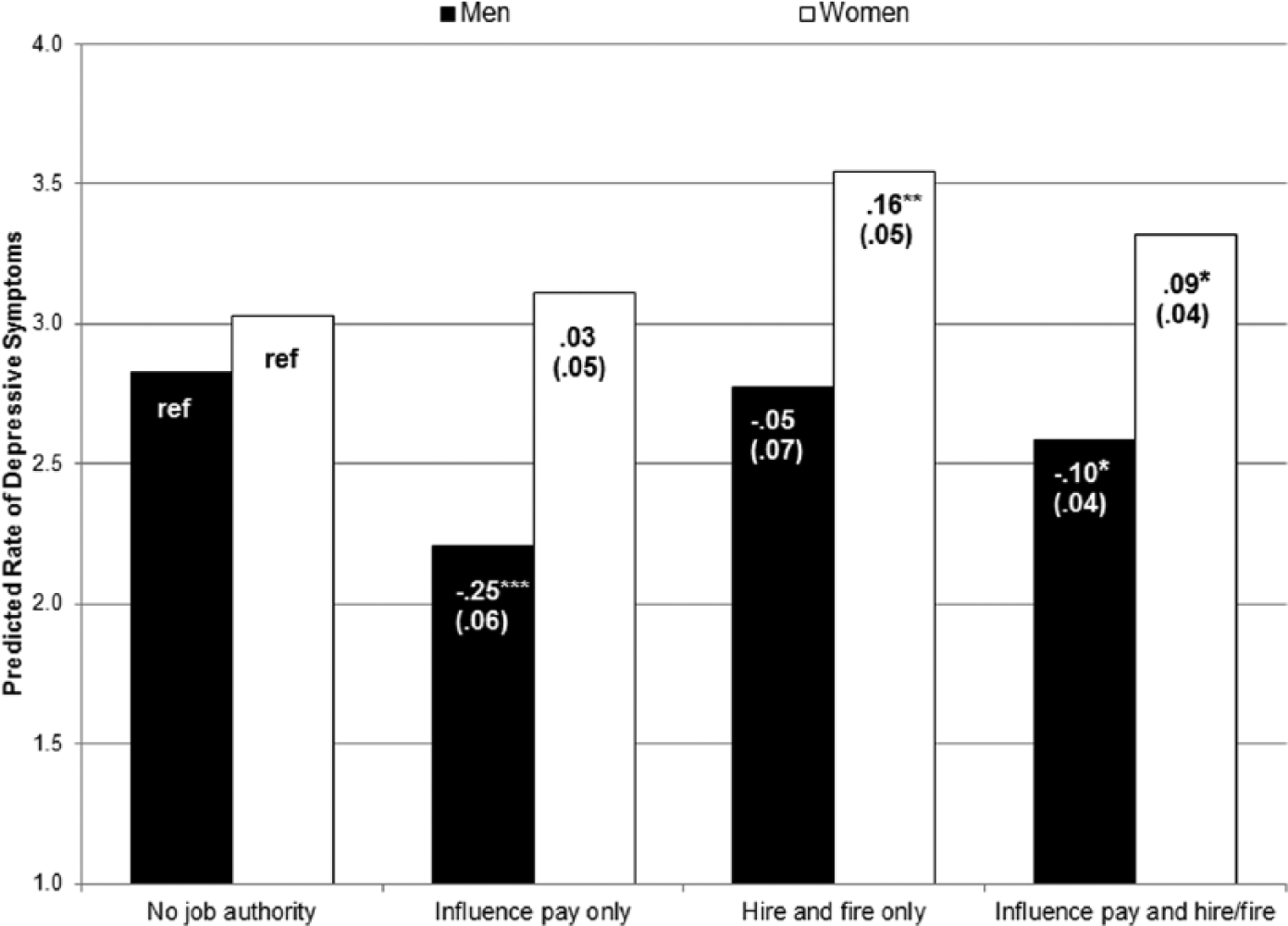
The Effect of Job Authority in 1993 on Depressive Symptoms in 2004 among Women and Men: the Wisconsin Longitudinal Study (N = 2,809).
Because job authority is not randomly distributed in the population, estimates from Poisson regression models may be biased by the existence of confounding factors that affect both job authority and depression. We apply propensity score matching to take into account this potential bias. PSM estimates the effect of job authority in 1993 on depressive symptoms in 2004 by comparing individuals with job authority (the “treatment group”) to individuals without job authority (the “control group”) who are as similar as possible with respect to baseline depression and a wide range of observed characteristics assessed prior to job authority. We conduct PSM separately by gender using a two-step procedure. The first step is to estimate a propensity score—each individual’s propensity to have job authority in 1993 based on observed characteristics. The second step involves matching the treatment group with job authority and the control group without job authority on their propensity scores. Matched individuals in the treatment and control groups are then compared in terms of their depressive symptoms to estimate the average treatment effect for the treated (ATT), namely, group differences in depression between persons with job authority and matched controls.
A hidden bias arising from unobserved variables is a potential weakness of propensity score matching estimators. We address this problem with a sensitivity analysis based on the bounding approach proposed by Rosenbaum (2002). The sensitivity analysis simulates how strongly an unmeasured variable must influence selection into treatment in order to undermine conclusions of propensity score matching. An unobserved binary confounder (U) is simulated in the data based on its joint distribution with the treatment variable. U is used as any other covariate and is included in the set of matching variables used to estimate the propensity score and the ATT (Ichino, Mealli, and Nannicini 2006). A comparison of the simulated ATT and the actual ATT indicates the degree of robustness of the latter (Ichino et al. 2006). To simulate the unobserved confounder U, we use the distributions of two variables that are strongly related both to job authority and depression: college education and professional/managerial occupation (Fan et al. 2012; Grosch and Murphy 1998; Quesnel-Vallée and Taylor 2012). The results from PSM models are given in Tables 3 and 4.
Propensity Score Matching (PSM) Estimates of the Effect of Job Authority on Depression: The Wisconsin Longitudinal Study, 1993–2004, Women.

Note: ATT is the effect of having job authority (the treatment group) compared to not having this authority (the control group). Treatment and control groups are matched on baseline depression, early-life characteristics (father’s education, mother’s education, family income in $100s, father’s occupation, cognitive ability, two-parent family), and the following variables assessed prior to the 1993 job authority: education, occupation, hours worked per week, annual earnings, occupational education, occupational income, marital status, and the number of children. The PSM estimates shown in the Table 3 are based on the kernel matching estimators. Results from nearest neighbor and radius matching estimators (available upon request) are very similar.
Average treatment effect for the treated.
Standard error.
Propensity Score Matching (PSM) Estimates of the Effect of Job Authority on Depression: The Wisconsin Longitudinal Study, 1993–2004, Men.

Note: ATT is the effect of having job authority (the treatment group) compared to not having this authority (the control group). Treatment and control groups are matched on baseline depression, early-life characteristics (father’s education, mother’s education, family income in $100s, father’s occupation, cognitive ability, two-parent family), and the following variables assessed prior to the 1993 job authority: education, occupation, hours worked per week, annual earnings, occupational education, occupational income, marital status, and the number of children. The PSM estimates shown in the Table 4 are based on the kernel matching estimators. Results from nearest neighbor and radius matching estimators (available upon request) are very similar.
Average treatment effect for the treated.
Standard error.
Results
Summary statistics by gender are shown in Table 1. With respect to the focal variables, women have higher levels of depressive symptoms and lower levels of job authority than men. Further, men have higher education and earnings and are more likely to work in professional/managerial occupations than women, whereas women are overrepresented in clerical and service occupations. Moreover, men are more likely than women to be continuously employed in 1993 and 2004 as well as to have job authority both in 1993 and 2004. With respect to job characteristics, men tend to work longer weekly hours than women. Yet, men are also more likely to decide when to start and end work and are less frequently monitored by their supervisors than women. In contrast, men and women are similar in terms of time pressure, hours doing the same task, hours dealing with people, and job satisfaction.
Table 2 shows the interactive effects of job authority and gender on depressive symptoms in 2004 controlling for depression in 1993 and a wide array of life course variables. From each model we can infer between- and within-gender comparisons illustrated in Figure 1 based on Model 1 in Table 2. We begin by describing within-gender comparisons—comparing white to white bars (women) and black to black bars (men) in the figure. Numbers on the bars indicate the difference in the predicted rate of depressive symptoms between a given job authority category and a group without job authority, with standard errors (in parentheses) and statistical significance (asterisks). Model 1 in Table 2 and white bars in Figure 1 indicate no significant difference in depressive symptoms between women without job authority and women with the authority to influence pay. In contrast, women with the authority to hire and fire only (+.16, p < .01) or the authority to hire, fire, and influence pay (+.09, p < .05) exhibit significantly elevated depressive symptoms compared to women without job authority. Model 1 in Table 2 and black bars in Figure 1 indicate that men with the authority to influence pay (–.25, p < .001) or men with the authority to hire, fire, and influence pay (–.10, p < .05) report significantly fewer depressive symptoms than men without job authority, whereas men who only have the authority to hire and fire are similar to men without job authority in terms of depressive symptoms.
Further, our model with interaction terms allows between-gender comparisons—a comparison between men and women with the same job authority status illustrated with a contrast between black and white bars in Figure 1. These comparisons reveal that although women have more depressive symptoms than men regardless of job authority, this gender gap is significantly greater among individuals with job authority than those without job authority. Among individuals without job authority, women have a slightly (albeit not significantly) higher level of depression than men. Yet, among individuals in each of the three job authority categories, women exhibit significantly more depressive symptoms than men with the same configuration of job authority.
Finally, the interactive effects of job authority and gender are shown net of many potential confounders, including other job characteristics. Being frequently checked on by a supervisor is associated with more depressive symptoms, whereas schedule flexibility is related to lower depression. These patterns suggest that control over own work and job authority are significant predictors of depression net of each other and have independent effects. Hours dealing with people and job satisfaction are associated negatively with depression, whereas time pressure and repetitive work are unrelated to distress.
Model 2 in Table 2 explores whether the interactive effects of job authority and gender depend on labor force participation in 2004. The three-way interaction terms of employed in 2004 × job authority × female are not significant for any type of job authority. In other words, the long-term effect of job authority on depression is similar regardless of whether individuals continued to work or retired/exited the labor force between the baseline and the follow-up. Model 3 in Table 2 provides a more stringent test of the extent to which the long-term effect of job authority on mental health is contingent on continuous employment. We compare the joint effect of gender and job authority on depression between individuals who remained in their 1993 job by 2004 and those who changed jobs or retired. The three-way interactions of employed in the same job in 1993 and 2004 × job authority × female are far from significance for any job authority category; thus, the long-term effect of job authority on depression and the gender differences in this effect are not affected by job change and continuity between 1993 and 2004.
In addition to Poisson models, we use PSM to take into account potential spuriousness and to improve causal inference. Individuals with and without job authority were matched separately by gender on variables observed prior to job authority, which are listed in the notes to Tables 3 and 4. Even after restricting the analysis of the balancing property to the region of common support, the treatment and control groups were well matched and the balancing property was satisfied. PSM estimates reflecting within-gender comparisons are shown in Table 3 (women) and Table 4 (men). Results in Table 3 indicate that women with the authority to influence pay report more depressive symptoms than matched women with no job authority, although this difference is only marginally significant (ATT = .288, SE = .260, p < .10). The average depressive symptoms for women with the authority to hire and fire are significantly higher compared to women without job authority (ATT = .556, SE = .253, t = 2.2, p < .05). This ATT corresponds to a .15 standard deviation increase in depression. Women who have the authority to hire, fire, and influence pay exhibit more depressive symptoms than women without job authority (ATT = .447, SE = .226, t = 1.98, p < .05). The size of this effect is equivalent to a .12 standard deviation higher level of depression. Importantly, the effect of hiring and firing people on women’s depression is greater in magnitude than the effect of influencing pay. Table 4 shows that men with the authority to influence pay (ATT = −.776, SE = .374, t = −2.08, p < .05) and with the authority to hire, fire, and influence pay (ATT = −.738, SE = .372, t = 1.9, p < .05) have lower levels of depressive symptoms than their matched counterparts without job authority. Both effect sizes are comparable to a one-fourth standard deviation decrease in depressive symptoms. Finally, men who have only the authority to hire and fire are similar to men without job authority in terms of depressive symptoms (ATT = −.101, SE = .379, t = −.27, p > .05).
A sensitivity analysis produces a simulated ATT under the assumption that there are unobserved covariates that affect selection into treatment and are distributed as college education and professional/managerial occupation. For example, for women with the authority both to hire/fire and to influence pay ATT simulated = .451 compared to ATT observed = .447. For men with the authority both to hire/fire and to influence pay ATT simulated = −.733 compared to ATT observed = −.738. Because the simulated estimates are very similar to the original ATT, even with unobserved covariates that are distributed as strong predictors of job authority—college education and higher-status occupation—net of education, occupation, and all other observed variables used for matching, we conclude that our PSM estimates are robust to bias from unobserved variables. Findings from PSM models are consistent with the Poisson estimates, further confirming the robustness of the pattern that job authority increases women’s depression yet decreases men’s depression.
Discussion
Using prospective cohort data with over 50 years of follow-up and a uniquely wide range of life course measures and job characteristics, we explore the extent to which job authority in 1993 at age 54 was related differentially to men’s and women’s depressive symptoms in 2004 at age 65. Drawing from the gender relations theory and the stress of higher status perspective, we emphasize the contingent mental health costs and benefits of job authority. Our main finding suggests that job authority decreases men’s depression but increases women’s depression. This pattern consistently emerged both in Poisson models and propensity score matching models in which individuals with and without job authority were matched on a wide array of life course variables. Within-gender comparisons indicate that women with the authority to hire and fire have significantly higher depression than women without job authority, whereas hiring and firing people does not elevate depression among men. Women with the authority to influence pay exhibit more depressive symptoms than women without job authority. In contrast, men who can influence pay have significantly lower depression than men without job authority. Moreover, women with the authority to both hire/fire and to influence pay are more depressed than women without job authority, whereas men with the authority to hire, fire, and influence pay are less depressed than their peers without job authority. Between-gender comparisons reveal that although women have higher average depression than men, women’s disadvantage in depression is significantly greater among individuals with job authority than without job authority. Specifically, among individuals without job authority, women have a slightly (but not significantly) higher depression than men. Yet, among individuals in each of the three job authority categories, women exhibit significantly more depressive symptoms than men with the same configuration of job authority.
Although Karasek’s job strain model has been the leading approach to the analysis of work stress, its lack of attention to control over others’ work do not fully reflect women’s complex experiences of workplace stressors and the potential health costs of higher status (Schieman and McMullen 2008; Schieman and Reid 2009). Similarly, existing research on the psychological consequences of “responsibility for others” at work—a construct akin to job authority—has largely overlooked the gender dimension. Previous research on “responsibility for others” reveals that among men, responsibility for others was either related to lower depression over time (Mayes, Barton, and Ganster 1991) or unrelated to distress (Axelrod and Gavin 1980). This evidence is consistent with our findings that job authority either improves men’s mental health or has no detrimental psychological effect. Yet, previous studies on responsibility for others and psychological distress overwhelmingly focused on men and did not incorporate women’s experiences. Our findings expand and enrich existing research by emphasizing how gender shapes psychological costs and rewards of job authority and how the story of workplace authority differs for men and women.
Sorensen and Verbrugge (1987) summarize two major approaches applied to the relationship between employment and health: the job stress model and the health benefits model. According to the job stress model, certain work experiences can be potent stressors that have detrimental short- and long-term consequences for physical and mental health. In contrast, the health benefits model focuses on advantages and resources associated with employment that can be potentially health enhancing and outweigh the detrimental effects of work-related stressors (Sorensen and Verbrugge 1987). We expand current models of employment and health by drawing attention to gender relations and cultural meanings of masculinity and femininity. Our study documents that both job stress and health benefits mechanisms operate concurrently and depend on gender. Women’s and men’s actual experiences of exercising job authority are different even though structural (formal) aspects of job authority may be similar. We argue that the effect of higher-status occupations on health should be considered through the prism of gender relations that are embedded in institutional practices (Acker 1990; Martin 2003, 2006). The gendered nature of higher status shapes the divergent effects of job authority on mental health of men and women. This argument is consistent with a recent call to understand how psychosocial job characteristics “originate from societal structures and social contexts” and have different meanings for different groups of workers (Rugulies 2012:620).
The Gendered Cultural Meanings of Job Authority
Women in authority positions in our study are advantaged in terms of most socioeconomic characteristics that are strong predictors of positive mental health (Pearlin et al. 2005). Women with job authority have more education, higher income, more prestigious occupations, and higher levels of job satisfaction and job autonomy than women without job authority. This social advantage implies that women with authority should exhibit significantly fewer depressive symptoms than their less advantaged peers, especially given that job authority itself is considered a desirable workplace resource (Mirowsky and Ross 2003). Yet, the gendered macro- and meso-level social contexts can limit the extent to which women in higher-status positions can derive psychological benefits from job authority.
We emphasize the importance of examining job authority and depression at the intersection of socioeconomic status (SES) and gender. To fully understand the contingent psychological costs and rewards of job authority, we need to adopt the intersectionality approach (Ferree 2010) and to elucidate both how social “class is constructed through gender” (Acker 1990:146) and how the meaning of higher status depends on gender relations. For example, it is possible that the ability to influence pay is associated with lower depressive symptoms among men because of the traditional emphasis on men’s control of economic resources.
Our study contributes to the growing body of evidence that the socially guided meanings that individuals attach to masculinities and femininities can attenuate or amplify the power of health-promoting resources of higher SES (Courtenay 2000; Pudrovska 2010; Springer and Mouzon 2011). Schnittker and McLeod (2005) argue that it is necessary to bridge fundamental causes of health disparities with the meso level of psychosocial and interactional processes directly generating and sustaining these disparities. The processes of identity, meaning, perception, and interpersonal dynamics are a pivotal route through which social inequalities at the macro level are translated into physiological underpinnings of disease (Schnittker and McLeod 2005). Consistent with this argument, we consider the enactment of job authority in the workplace as an important meso-level environment that bridges macro-level cultural gender scripts at one end, with depression as a mental health outcome at the other end.
Job Authority and Workplace Interpersonal Stress: A Possible Link to Depression?
Stress at work is a system of meanings that are socially constructed and produced through social interaction (Torkelson, Muhonen, and Peiró 2007). Women’s authority positions in the workplace “create a paradox of power” within a societal-level “gender system that continues to subordinate women” (McLaughlin et al. 2012:642). Macro-level processes of gender stratification shape a workplace environment in which exercising job authority exposes women to interpersonal stressors, including social isolation and negative social interactions (Kanter 1977; Korabik 1995; Ridgeway 2001). In turn, these stressful interpersonal experiences can undermine the mental health of women in authority positions.
Our results fit within the framework that integrates the stress process and life course perspectives to uncover how exposures earlier in the life course matter for mental health at later life stages (Pearlin et al. 2005). A life course perspective focuses on long-term trajectories of individual development and enduring influences of past experiences (Pearlin et al. 2005). Health outcomes at older ages reflect life course processes of accumulation of opportunities, constraints, resources, and adversities launched earlier in life (Pearlin et al. 2005). Therefore, mental health in later life cannot be explained solely by temporally proximate conditions because earlier conditions and characteristics have long-term implications for later well-being (Pearlin and Skaff 1996). This study is consistent with extensive body of evidence documenting that stressors at one life course stage have enduring effects on mental health at later life stages (Pudrovska et al. 2005, 2013; Quesnel-Vallée and Taylor 2012; Thoits 2010).
We show that the authority to hire and fire people had a significantly stronger effect on women’s depression than the authority to influence pay, which supports the interpersonal stress mechanism. Hiring and firing involves direct interactions with people and thus increases women’s exposure to conflict and hostility, whereas deciding someone’s pay is possible without a face-to-face contact. Exercising job authority often entails interpersonal stress (Mirowsky and Ross 2003; Schieman and Reid 2008, 2009). This stress is more pronounced for social groups whose authority is not perceived as legitimate and who may experience lack of support from superiors and resistance from subordinates (McLaughlin et al. 2012; Ridgeway 2001). Women in authority positions are evaluated more stringently and are more likely to be viewed as a disruptive force in workplace scenarios compared to women without job authority and male coworkers (Bielby 2000; Ridgeway 2001). Higher-status professional women often receive messages of their exclusion and unimportance and are exposed to overt and subtle gender discrimination (Martin 2001, 2003). Women with job authority experience more harassment from coworkers and subordinates than women in lower-status positions because women’s divergence from gender expectations is perceived as threatening and elicits hostile responses (McLaughlin et al. 2012). Moreover, research documents an elevated risk of social isolation and lack of support among women in authority positions (Lundberg and Frankenhaeuser 1999; McLaughlin et al. 2012). In turn, social strain and social isolation are related to elevated depression (Cacioppo, Hawkley, and Thisted 2010). Thus, interpersonal stress is a plausible mechanism linking job authority and depression among women.
Limitations and Future Research
This study is based on one cohort of women who were born in 1939; thus, our findings may be more applicable to women who came of age in the 1950s and 1960s than to women of recent cohorts who have expanded their presence across most occupations. The WLS cohort spearheaded women’s massive entry in the labor force. As the first cohort to increase their presence in authority positions, the WLS women were more likely than younger cohorts to encounter resistance and discrimination (Gee, Pavalko, and Long 2007). Yet, because of the tenacity of gender inequality and dominant gender beliefs, our findings are still likely to reflect experiences of younger women in current and future cohorts (England 2010; McLaughlin et al. 2012). Moreover, because the WLS contains only white non-Hispanic participants, the proposed mechanisms cannot be directly extrapolated to minority women. Conditions of minority women in authority positions may be even more stressful than those of white women due to the intersecting systems of race and gender discrimination.
Work-family stress is a potentially important mechanism that can undermine the health benefits of job authority (Lundberg and Frankenhaeuser 1999). Job authority increases work-to-home interference, which in turn is associated with worse physical and mental health (Schieman and Reid 2009). Women managers are more stressed than their male peers by balancing work and family responsibilities (Lundberg and Frankenhaeuser 1999). Because the WLS assessed depressive symptoms for the first time when participants were 54 years old, we do not emphasize the role of the work-family interface in the link between job authority and depression. Most women in our study have completed labor- and time-intensive childrearing responsibilities. An important direction for future research will be to examine the effect of job authority at different points in the life course and evaluate the extent to which work-family stress contributes to gender differences in the effects of job authority among younger adults with children at home.
Another important direction for future research is to compare psychological implications of job authority in industries with historically different representation of men and women. Due to variation in the gender composition and institutional norms, the meaning and experiences of women’s job authority may differ across sectors of the economy (Taylor 2010). Further, the WLS does not have direct measures of subjective interpersonal stress, such as perceptions of social strain and social isolation at work. Our support for this mechanism is indirect and based on the differences between the two aspects of job authority. Although prior research highlights the potential role of interpersonal strain, an important next step should be augmenting measures of “objective” structural job characteristics with measures of subjective work experiences. Moreover, we do not have information about the immediate context and actions involved in the process of exercising job authority. For example, the gender composition of the superior-subordinate set is consequential for men’s and women’s mental health (Schieman and McMullen 2008). Yet, in our study it is not known whether women in authority positions had women or men as subordinates and superiors. Understanding the enactment of job authority in workplace interactions will help further elucidate our findings.
Conclusion
Our study documents the differential effect of job authority on men’s and women’s mental health. Women with job authority exhibit more depressive symptoms than all men and women without job authority, whereas men in authority positions have the lowest levels of depression of any group. Despite the sweeping changes in women’s educational and occupational opportunities in recent decades, job authority may still constitute a psychological risk for women. Macro and meso processes of gender stratification create a workplace environment in which exercising job authority exposes women to chronic interpersonal stressors that undermine the health benefits of job authority. Although more women are entering higher-status occupations than in the past, women’s progress in the workplace has slowed recently (England 2010). Even in the new economy, organizations are still gendered and women continue to lag behind men with respect to authority and are less likely to be in positions of workplace power than men (Williams, Muller, and Kilanski 2012; Yaish and Stier 2009). Given women’s disadvantage in access to power, researchers suggest that policies promoting gender equality in the workplace, such as enhancing women’s control, can reduce gender differences in health (Sekine et al. 2011). Although undoubtedly an important direction, our study emphasizes that catching up with men in terms of structural aspects of workplace authority is not sufficient because the cultural meaning of exercising job authority is different for men and women. Women are still disadvantaged in more masculine workplace scenarios because the leadership role is incongruent with the prevailing gender stereotypes (England 2010; Ridgeway 2001). The gender gap in mental health implications of employment arises not only from differential distribution of job authority among men and women, but also from its differential psychological consequences. More attention is needed to the study of potential health risks among women in authority positions who are still overcoming resistance and enduring stereotypes as a result of gender stratification. Policies and workplace interventions should be aimed at minimizing psychological costs and increasing the nonpecuniary rewards of job authority among women (Trzcinski and Holst 2012).