




Abstract
Wuhua philosophy is rooted in Taoism. Zhuangzi described the practice of Wuhua as the “fasting of the heart mind” (心斋). Humanistic psychology and analytical psychology describe the “fasting of the heart mind” as a path leading to ZhiMian. The resolution of the boundary between conflicts is built on a dialogue between differences that is characterized by effort and an open attitude. The key to the Wuhua experience is Qi. In the experience of Qi, mankind humbly aims to understand the world from the heart mind position to explore how the self is related to the world and to define the self and the other interdependently and relatively. Wuhua therapy fosters experience in all dimensions, concentrating on the natural emergence and movement of Qi, and waits for it to lead to the dissolution of boundaries and to generate its creative healing nature. The method of Wuhua therapy involves noninterpretation, careful observation, and faithful reflection. This article describes a case that illustrates the method and discusses the resonance between Wuhua philosophy and humanistic psychology.
Wuhua(物化) in Chinese Taoist Philosophy
Wuhua philosophy is rooted in Taoism. In Chapter 37 of “Laozi” (571 BC), the notion of Wuhua was described as follows:
Tao does nothing yet nothing is undone. If empires can live in the Tao, then all creatures can reach the state of Wuhua by themselves.
Wuhua is considered the natural state of mind that follows the principle of Tao. In 369 BC, another Chinese Taoist philosopher, Zhuangzi (庄子), developed the notion of Wuhua by relating a story that remains relevant today. The story relates a dream of a butterfly. As described in the book titled Zhuangzi and the chapter called “The Unity of All Creatures (Qi Wu Lun齐物论),” this well-known story describes the dissolution of the boundary between Zhuangzi and a butterfly. The story cannot be identified as either Zhuangzi dreaming of the butterfly or the butterfly dreaming of Zhuangzi. This story became the classic illustration of the Wuhua state. Wuhua is a state that embodies “the dissolution of the boundary between self and object, and all creatures are unified into one” (Guying, 2009). As the leading functions of consciousness, differentiation, and categorization may help us understand and survive the world. But if we cling to the self-other differentiation, we may get ourselves trapped. By naming and differentiating the otherness, we project our feelings to the otherness and even repress our talent in the unconsciousness as if they belong to the otherness. Thus, we put ourselves in this contradiction situation and consume most of our energy in this struggling with the otherness. Feelings such as fear, anger, and sometimes even jealous may then overwhelm us and leave us unable to embrace the wholeness.
In the Wuhua state, the difference between the self and the other is blurred. The attitude of difference—or contradiction—is eliminated. When the self and the other fuse, nature and mankind are unified as one. In this manner, one can correspond with nature and reach the state of Tao. The energy that was consumed in the struggling with the otherness is reclaimed and can now be used to learn new things, to create, and to love. The talent that was projected to the otherness can now be called back and free to use.
Fasting the Mind as a Way to Wuhua and the Misguided Practice of Contemporary Chinese People
How can one reach the state of Wuhua and Tao? In a chapter titled “The Unity of All Creatures (Qi Wu Lun),” Zhuangzi described the method or preparation for achieving the state of Wuhua, namely, the “fasting of the mind (心斋)” (Young-Mason, 2011). This method asks people to stop clinging to things and their mind. And one can then discover the nature of their heart after it was polluted. However, when put into practice, the “fasting of the heart mind” method is problematic for contemporary people.
Many Taoist practices overemphasize emptiness and neglect the creative aspects of Tao. Some fail to understand the free-flowing, intangible, indefinable aspect of Tao that is at the center of its philosophy. Some schools of thought demand that practitioners follow a given image and a given pattern of Qi (气, an active principle forming part of any living thing) movement to reach a stage predetermined by the ancient masters. Others view the “fasting of the heart mind” as the withdrawal of the heart mind from ambitious and emotional material desires. Consequently, some people have lost hope in Taoism and have turned to materialism, Taoism’s polar opposite, because fasting of the heart mind does not dovetail with their life goals. For others who emphasize only the emptiness of Tao, practicing fasting of the heart mind becomes an escape from a true existential state rather than a ZhiMian (i.e., facing life directly) to the contradiction unified within the Tao (X. F. Wang, 2011).
We are left with questions, such as how a person living in a fast-paced contemporary and materialistic world can benefit from Wuhua philosophy, notwithstanding that it is a pillar of Chinese belief. How can one empty the critical ego that is used in critical thinking? Moreover, how can one practice the “fasting of the heart mind”?
Humanistic and analytical psychology provides a counterbalance to integrate the misguided practice of the Taoism today. Wuhua therapy attempts to embrace the tension of multiple differences and to unify Western psychology and Chinese culture by developing a method that is acceptable and effective for the contemporary Chinese psyche (Chen, 2005, 2012).
Re-Envisioning the “Fasting of the Heart Mind” as the Way to Wuhua
The practice of Wuhua therapy integrates Taoist philosophy, Jungian active imagination, and a post-Jungian method, the Embodied Imagination developed by Robert Bosnak (1996, 2003).
In an experiment with conversations with inner figures, C. G. Jung (1939; Chodorow, 1997) developed a method that he called active imagination. In this method, one consciously enters into a dialogue with spontaneous emergent images from the unconscious, which leads to a union of the conscious and unconscious minds. Active imagination requires the ego to actively encounter the reality of the unconscious rather than escaping from or passively receiving material from the unconscious.
Arguably, this attitude is very different from the attitude of those who currently practice the “fasting of the heart mind.” Today’s practitioners tend to understand the “fasting” literally as a quick and easy method of escape. The wisdom of active dialogue from Western psychology reminds us to reconsider the “way” to the “fasting of the heart mind.” This way does not involve withdrawal or neglect but instead is characterized by effort with an open attitude.
In Wuhua therapy, this Western wisdom is integrated with Taoist understanding. The resolution of the boundary between the self and the other is accomplished through dialogue. Through this dialogue, contradictions and differences can be resolved, and the complexity that possessed the heart mind and blocked the path to the fasting of the heart mind is released.
The essential endeavor and attitude for this dialogue was addressed in Laozi (老子), a Taoist classic book (also known as the Book of Tao and Te道德经), but this aspect of Laozi has been neglected by contemporary readers. Laozi described the states that should be checked in the practice of Qi:
Are the spirit and body unified? Is the Qi concentrated softly and is it as naïve as an infant? (Lin, 2009)
Here, the concentration of Qi should be understood as an endeavor. However, it is not an endeavor that involves withdrawing from experience; instead, it is the ZhiMian path to experience. This is the primary goal before reaching emptiness, which is the ultimate goal. Additionally, the soft and naive infant is a metaphor reflecting the open attitude that yields no immediate judgment, an attitude of careful observation and faithful reflection. Faithfulness to nature and the attempt to form an open-minded naive attitude toward those considered “others” should be revived in Chinese psychotherapy.
Dualism, Embodiment, and Wuhua
Another insight for Wuhua therapy from Western philosophy is the notion of “embodiment.” It is generally believed that this rationalism began with Descartes’s suspicions about existence, which eventually led to the separation of subjectivity and objectivity and later to mind–body separation. The contemporary philosophy of embodiment focuses on the interaction of the body and mind to illustrate inner experience and to represent the objective world to the subjective self. This philosophy has attempted to recover body–mind unity and to bring the body back into the understanding and healing of contemporary humanity’s suffering psyche.
The rationalist understanding of embodiment is dualistic with the separation of subjectivity and objectivity while Taoist and more contemporary understanding of embodiment rejects the dualism and emphasizes integration and unity By contrast, in the context of Taoism culture, Wuhua is a method of understanding the relationship of subjectivity and objectivity beyond the differences between them. Chinese culture offers different answers to Descartes’s questions. By dissolving the boundary between subjectivity and objectivity, Wuhua philosophy integrates duality. Thus, Descartes’s suspicions are answered by dissolving the question itself.
Embodied Imagination (Bosnak, 2003) developed from active imagination is enlightened by the philosophy of embodiment. As such, it extended the dialogue of the self and the other to the body. This method encourages one to identify with the other and to sense the body of the other in one’s imagination, thus reaching a state in which the bodily experience of the self and the other can combine and create a new state of embodiment. This method does not interpret but instead waits for the clients’ observations about the changes that were meaningful to them after the session.
Wuhua therapy borrows from Embodied Imagination and integrates experience in all dimensions. In Wuhua therapy, not only are body–mind and self–other in the subject’s imagination considered to be a unified being, but all levels of differences defined by the mind (e.g., the inner and outer world or subjectivity and objectivity) are also considered unified. Additionally, an open and intentional dialogue is encouraged in an attempt to reach a state in which boundaries are dissolved and creativity is generated.
This phenomenon occurs not only in the client’s inner world but also in the therapist’s experience in addition to occurring in their relationships. Therapists use the “naive and endeavoring heart” to represent the experience of difference with the client because the two are in the same field of Qi. The therapist must reach the state of the fasting of the heart mind. In this manner, the therapist contributes to—instead of leading or interpreting—the imagination. In Taoist terms, the therapist’s responsibility is to hold an attitude of “Wei Wu Wei (为无为)” (endeavoring to do nothing). The primary goals of the therapist are to engage in dialogue between the differences, to participate in the resolution of the boundary, and to use the noncritical ego to achieve noninterrupting involvement in the field. In this manner, the therapist addresses not only the client’s inner experience but also the therapist–client relationship.
Qi as an Essential Media in Wuhua Therapy
What is particular to Wuhua therapy is its focus on the media of Qi. Qi is considered the path through all difference that leads to the transformation of all types of beings (Guying, 2009). In this method, one observes the emergence, movement and transformation of Qi in all dimensions (as images, emotions, bodily experiences, etc.) as a spontaneous experience. Then, we wait for it to lead to the dissolution of boundaries and to generate creative healing nature.
In Wuhua philosophy, the media for the interactions and the fusion of all differences is found in Qi.
Qi can transcend all levels of existence. The immediate way to understand this phenomenon is to find the use of the term in Chinese daily life in various dimensions. Qi is used to define different types of existence. It is referred to in the natural environment (the Qi of ground and heaven) and in inner human vital energy (Jing Qi精气), social and personal life (Feng Qi风气), emotions such as anger (Nu Qi怒气), the physical body and its functioning (Li Qi力气; Liver Qi肝气), strength and will (Yi Gu Zuo Qi一鼓作气), and attention (Ning Shen Jing Qi宁神静气). Qi is also used to describe and convey both meaning and image (Qi in the belly is expelled, which is a metaphor for the release of anger).
In Chinese medicine, in the book of I Ching (Shen, 2006; Shen, Feng, & Bin, 2004), in many Taoist practices, and even in Confucian works (Tu, 1985), one can find the term Qi used to describe all the manifestations and interinfluences of the relationships between mankind and the world.
Thus, Qi is both an experience and a reality, both subjective and objective. In the philosophy of Qi, mankind stands humbly—not narcissistically—at the center of the world. According to Ding Li’s I Ching study on the “Chinese Fang (中国方)” (see Figure 1), mankind set out to understand the world from the heart mind position at the core of the Cube to explore how the self is related to the world, and to thus define both the self and the other interdependently and relative to each other (Li, 2009). Heaven is not only the objective sky overhead but also an experience of light Qi that is on the upper left side of the mankind who is standing at the center. The ground is not only where the subject stands but also an experience of a heavy Qi that is on the lower right side of the mankind who is standing at the center. The self is at the core position and is the focal point of all the interrelationships. Thus, the position of the self in this Qi philosophy can be characterized by humility with which mankind can reach its limits and observe and describe the relationships between observer and world rather than standing aloft to examine, categorize, or judge. Eastern Confucianism, like Chinese humanism, assumes the same position with regard to the other (Tu, 1985). Thus, the philosophy behind Wuhua therapy is a humble and practical humanistic perspective for understanding our existence from the perspective of Chinese culture.
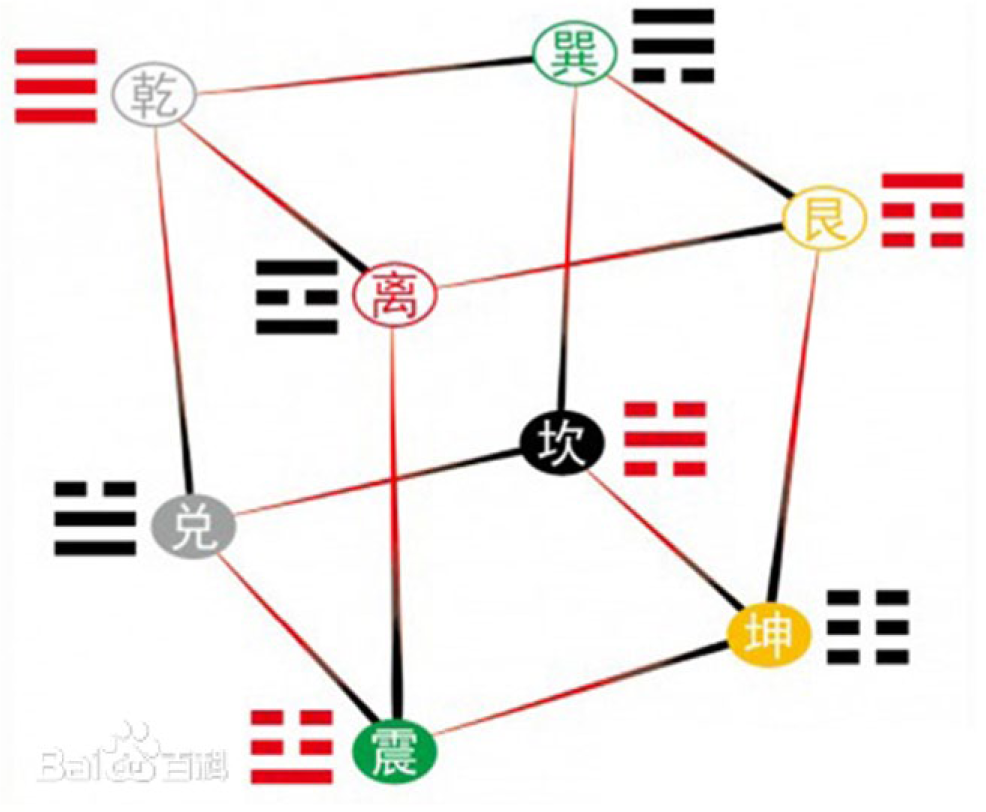
Chinese Fang (中国方), by Ding Li (2009).
The embodied aspect of Qi has not been thoroughly considered by contemporary psychologists. Qi is often understood as a subjective experience, objective reality, or objective spirit. For example, some writers have described Qi as imagination or a subjective experience. Others view Qi as a substitute with no form, like some objective spirit. Still others have concluded, based on reports from Chinese patients at psychiatric clinics, that the Chinese people have a somatization tendency because of their reaction to stigma (Kleinman, 1986, 1999). These conclusions derive from a dualism that separates the body from the entire integrated experience without considering that Chinese people have a Wuhua culture or, at least, an embodiment of Qi culture. This culture and background lead to the Chinese tendency to describe symptoms with metaphorical images and bodily experiences (Q. Wang, 2002). For example, anxiety is often described as fire in the heart (心里上火); fear is described as the shaking gallbladder (胆颤).
The Noninterfering Aspect of Wuhua Therapy: Observing Emergence and Creativity in Qi
The observation of the emergence and movement of Qi as a spontaneous experience that penetrates all the boundaries of differences is a unique aspect of Wuhua therapy.
From the Tang dynasty in Zhuangzi Shu, Cheng (2011) commented, “The body and mind with its perception and judgment is easy to disturb; Qi does not have such disturbance, as it is soft and empty and allows for new emergence . . .”
As it penetrates all boundaries, Qi has no fixed position. Wuhua therapy focuses on Qi to help both the therapist and the client sustain the tension of differences, to understand situations, and to hold reality humbly and sincerely as a unified totality.
The observation of the emergence of spontaneous Qi is also different from those practices that lead and direct the moving pattern of Qi for many Chinese Qigong (气功) practices. This noninterrupting but concentrated, humble, and sincere observation can lead to spontaneous self-healing. Zhuangzi quoted Confucius as he addressed the “fasting of the heart mind” to illustrate that Qi lies at the core of this practice (Zhang, 2012).
[Fasting the heart mind] is to focus your mind at one point at which you don’t listen with your ear, you listen with your heart; then, you don’t listen with your heart, you listen with your Qi . . . Qi is emptiness that anticipates new creatures. And only those creatures that correspond with Tao can be gathered with Qi (p. 11).
In Wuhua therapy, Qi itself is considered the creative seed. Concentration on its nature emerges, and movement can plant it in the body. Then one can harvest a new inner vitality.
Thus, the Wuhua therapist is focused on the spontaneous emergence of Qi and neither leads the experience nor offers interpretations. The attitude might best be described as the wisdom of the Guan Hexagram (观卦) from the I Ching (Ma, 2005): One washes one’s hands to fully prepare for a divine movement but is in no hurry to engage in ceremonial worship. The result is an attitude of sincerity, humility, and patience.
Another crucial aspect of this noninterrupting method is its attitude toward the unknown, which is clearly demonstrated in the chapter of the “fit for emperors and kings” in Zhuangzi. In one story, Hundun (混沌) had no sense organs. Shu (倏) and Hu (忽) discussed how they could repay his kindness. “All men,” they said, “have seven openings so they can see, hear, eat, and breathe. But Hundun alone doesn’t have any. Let’s trying boring him some!” Every day they bored another hole, and on the seventh day Hundun died (Watson, 2013).
The vital wisdom is found in the ability to Wuzhi (无知; keeping an attitude of not knowing) and Wuwei (无为; keeping a stance of not doing). In Wuhua therapy, experiences are not interpreted in the context of any theory. The only objective is to observe without judgment.
Wuhua therapy in the context of Taoism is similar to practices in humanist psychology. As the experience of all dimensions is permitted without judgment and is engaged in with an attitude of sincerity and humility, one can “face life directly” and have the courage to examine existential issues with no pretenses and to reach the level of ZhiMian (X. F. Wang, 2011).
Case Study of Wuhua Therapy: Mr. Well’s Story
Background Information
Mr. Well participated in a large survey on chronic fatigue syndrome (CFS) in China involving 5,000 youths 18 to 28 years of age. He was diagnosed with CFS and shown signs of depression. We met for 12 weekly hour-long sessions to work on his dreams, imagination, and bodily experiences. In addition to the hourly session, we met for 15 minutes during the week to follow up, record his experiences, and encourage him to keep a record of his experiences.
Mr. Well came from a poor rural area. As is typical of many Chinese families with similar backgrounds, his family had attempted to keep pace with the rapid economic changes in China. Their dream was to migrate from their poor rural area to a city (i.e., to a rich and urban area). Their only hope was their oldest son, Mr. Well. He worked hard to earn his university degree as a means to fulfill the family dream. The entire family spent every penny on his schooling as an investment. Thus, since childhood, academic achievement was his only goal in life. He recalled, without complaint, that he had never played like a child and had received no acknowledgement from his parents for his personal choices and values. He felt guilty for even thinking about making choices for his own benefit. At the same time, he felt that he had sacrificed his personal dreams and meaningful experiences in his life for his family. Mr. Well’s experience is typical in traditional and contemporary China. The Confucianist values of filial piety and collective responsibility, control of emotional expression, and an emphasis on education and achievement, remain dominant today. However, in contemporary China, Chinese youth are also beginning to challenge these core Confucianist social values, to question their attendant beliefs, and to engage in and address the conflict between traditional and modern social values.
Understanding the Client–Therapist Relationship in Wuhua Therapy: Using the Heart as a Mirror
Mr. Well recalled that his fatigue began in middle school. He reported that he often felt tired and had pain in his neck and back. He described feeling like someone was always pushing and urging him on from behind.
Mr. Well shared his feelings of pain and guilt with great difficulty. Thus, he’d fall asleep every time when sharing such feelings. However, as his therapist, I felt the pain as he fell asleep. I experienced the field of his Qi. His experience and mine became unified, which led to panic when turning the experience into both his and mine. However, this “countertransference,” as psychoanalysis refers to it, is addressed differently in the context of Wuhua therapy.
I was “supervised” by the Taoist “heart mirror” philosophy found in the section “Fit for Emperors and Kings” in the Taoists classic book Zhuangzi:
The heart should be used as a mirror; it neither resists nor caters. It feels and responds, but without persistence; in this way, it heals without trauma.
Here, the mirror heart is another metaphor employed in Wuhua philosophy. The therapist takes the experience as the mirror takes the image. The experience is neither taken as positive or negative, nor as his or mine. All experience is allowed as part of nature. When suffering is allowed as a natural process without resistance with value unto itself, then a state of temporality can be reached in which all experience will pass and can be explored.
Exploring Experience Using Body, Image, and Qi
With the cultivation of the mirror heart, experiences are accorded equal value. Thus, it is much easier for the therapist and the client to ZhiMian the experience. With the therapist’s encouragement, Mr. Well was able focus on his bodily experiences. However, the only experience that he could feel and describe initially was the main suffering of his emptiness, an experience of no experience, a sense of hollowness in his heart, a feeling of weightlessness in his body and weakness in his legs.
In the context of Wuhua therapy, bodily experiences are not regarded as purely physical but also symbolic phenomenon.
For Mr. Well, they were images, a metaphor of body and mind, meaning and image, inner reality and the environment related to his situation. Ye Haosheng (2010) emphasized this form of imagery as the Chinese method of figuring things out. Thus, Mr. Well used images such as a hole in his heart, his weightless body floating, his legs filled with cotton to describe his feelings.
We then began to explore his sense of hollowness. He began to feel and imagine Qi in his belly spontaneously. He wanted to exhale it out, but he could not. This was a clear Chinese metaphor for unexpressed anger (Qi pressed in the belly), which frequently represents depression caused by hidden anger. (Notably, the therapist did not reach this understanding at the time, nor offer this interpretation. Instead, the subsequent reflection on the process illustrates the experience at the Wuhua level in which Qi is applied to describe the unity of body, emotion, image, and meaning.)
Expression of Deep Emotion Generated by the Work of Qi: A Forbidden Feeling of Anger
As we worked on the emptiness experience in the next session, the client reported that the only situation in which he could connect to his vitality was when he saw unfair things happening, the dark side of society, such as when poor people were treated badly. At that moment, he would become angry and feel eager to help others. These angry experiences with injustice were his sole connection to a sense of vitality and meaning in life. In this session, as he imagined unfair issues occurring in his life, he was able to experience some anger, which involved a certain amount of power and arm strength.
Dream Image Generated by the Work of the Qi of Anger
Mr. Well experienced this Qi of anger in the body every day over the next week. In addition, he came back to therapy with a dream.
I’m at home with my father. Suddenly, my uncle came with his children with guns in their hands. They seemed to be here to fight us. We began to wrestle. I tried to push the barrels of their guns into the sky so that no one on either side of the family would get hurt. I became very angry and shouted in the dream that we should not hurt each other.
We turned to the experience of the dream. Mr. Well was able to feel his body in the dream as he pointed the guns to the sky and shouted. He felt the anger in his belly burst out (Qi breaks out as suppressed anger). His entire body contorted as if he was wringing every drop from the angry Qi inside. This became a dynamic pattern of Qi in his body in which the angry Qi arose and twisted out. He could feel the strength of his fighting in his arms, neck, and waist (filling his otherwise empty body).
The client experienced no difficulty when he used Qi to describe his experiences. It was a Wuhua description of the entire experience. This experience generated by the dream arose spontaneously; we did not interpret the dream based on any theory. However, the meaning of the dream experience came to us as a new pattern of Qi that was observed, experienced, and understood. It revealed how the weakness and fatigue in his body related to his anger and how his repressed anger was allowed to be expressed as an image through the experience and image involving Qi that changed the experience in the body. In Wuhua therapy, understanding as a natural human experience is acknowledged in the context of interrelated phenomena. This understanding is not a solid conclusion but a constantly changing experience of how things relate to one another.
At this stage, the experience of no experience (emptiness), or alexithymia, is able to be intensely experienced in the context of Wuhua.
The ZhiMian Trauma: Wuhua Experience of “Self” and the “Well” Other
In the following session, Mr. Well recalled a life event from the past week: He kept losing his keys. Without giving any interpretation to the synchronicity of this event, as would have been done in Jungian analysis, we turned to the experience of losing the keys. He then connected this experience of losing his keys to traumatic memories from childhood.
At the time, I was pulling water out of a well as my father was beating me. He did this because I had gone out to play with friends in the river. However, my father wanted me to either study or do household chores. I was punished and forced to do the hard work of drawing water out from the well.
As we attempted to turn to the experience, he immediately turned his back to the experience of the subject who was drawing water.
In Wuhua therapy, we take both the self and the other as equal experiences and attempt to resolve the boundary between the two. Thus, instead of working on the difficult experiences of the subject defined by the client, we first turned to the experience of the water well. Mr. Well had no difficulty in experiencing the well. He did not flee. Here, he could feel the coldness of the well in his body. As he plunged deeper into these experiences, he was able to experience the water being pulled out of the well in his body. Later, he was able to experience the person drawing water from the well simultaneously. He felt the coldness in his hand, the fatigue and pain in his neck and back where he was beaten by his father (connecting to the symptoms of his pain as a CFS patient), and the water pouring out through his feet and legs (replacing the weakness and cotton-like feelings in his legs). In according with Zhuangzi’s dream of himself and the butterfly, it was impossible to determine whether Mr. Well was dreaming of pulling water out of the well or whether the well was dreaming that Mr. Well was pulling water from it. All of these experiences emerged from the same body. The boundary of the self and the other was resolved, and the experience could emerge. He reached the level of Wuhua. This experience was identical to the experience of Zhuangzi, in which it was impossible to tell whether Zhuangzi was dreaming of the butterfly or the butterfly was dreaming of Zhuangzi. In that Wuhua experience, the unallowable experience is absolved by means of the melting boundary of the subjective self and the objective other. Thus, the habitual fleeing from the traumatic memory is resolved.
Creativity Generated by the Wuhua Experience: The Playing Child Is Awakened
When guilt-covered anger was allowed to seep in through the work of Qi and with the help of the Wuhua experience with the well in that traumatic image, Mr. Well slowly acquired the ability to reach the level of fasting of the heart mind and to anticipate the creativity inherent in this wisdom.
He then brought a dream to the final session:
It is snowing in the city I’m living in now. I see very thick ice. However, it never really snowed in the city in my waking life. The snow and ice are similar to the snow that was common in my hometown.
We turned our experience to the ice in the dream. He could feel that the ice was cold. This suddenly triggered a memory of playing during his childhood; he recalled that memory with great surprise and happiness. He said with great energy, “It turns out I did play during my childhood.” Then he described the revived memory:
I’m playing with my friends on the ice. We are skating. I’m stepping on the ice . . . And I skate with them. They push me from behind . . . I’m moving very fast.
We turned to that experience during childhood. He could feel the happiness and excitement of his readiness to skate.
Now I’m going to play!
He sounded very different; he was more playful and more relaxed than usual. He could feel the happiness in his feet as he stepped onto the ice. He could feel the wind blowing in his face as he moved fast, and his fast-moving body had the strength to keep his balance. He felt the ice under his feet while he stepped, which led to a dynamic feeling of Qi. The Qi came from the bottom of the feet, moving up the leg until it reached and filled his heart. The Qi might replace emptiness in the long term.
Resonance Between Wuhua Philosophy and Humanist Psychology
As demonstrated in Mr. Well’s case, the practice and theory of Wuhua therapy resonate with humanistic wisdom.
The method of Wuhua that focuses on the spontaneous emergence of the Qi and results in no interpretation—encouraging clients to attain their own understanding—requires great humility as well as the courage to encounter the unknown. Schneider (2003) thus proposed the concept of the “fluid center.”
The fluid center is an “awe-based” consciousness exemplified by playful constraint, humble daring, and reverent adventurousness . . . that represents the opportunity for personal and interpersonal revitalization (e.g., openness and dialogue). (p. 133)
This is an example of the resonance between the humanistic view and Wuhua therapy.
Through the example of Mr. Well’s, a typical Chinese case, we find that the primary suffering is one of emptiness, the loss of self, and/or the experience of longing for authenticity. However, contemporary people cannot relieve this pain through withdrawal—the sacrifice of the consciousness that is obtained only with difficulty—and return to the vanishing of the self. The way to relieve this pain, as proposed in Wuhua therapy, is to begin a daring dialogue between the conflicted self and the other and to thus obtain a new consciousness that can sustain the conflict and live with nameless pain. This is the wisdom of ZhiMian. Here an existential approach to truth is valued. Mr. Well’s inner experience is no longer denied but is taken as the sufficient proof of his reality. This also resonates with Heidegger’s (1927/1996) idea that we seek authenticity but must accept that we cannot always be authentic. As in Mr. Well’s case, after accepting the reality that life is not always authentic, authentic experience begins to emerge. It is then that he is filled with the dynamic of Qi that is both playful and creative.
Footnotes
Acknowledgements
The author acknowledges all the psychologists who share their comments and question . The author also acknowledges Dr. Robert Bosnak and Dr. Heyong Shen for their supervision on the case described in this article, and Dr. Mark Yang for his advice on the revision of this article.
Author’s Note
This article was first presented at the Second International Conference of Humanistic Psychology: Zhimian Hold in Shanghai China.
Declaration of Conflicting Interests
The author(s) declared no potential conflicts of interest with respect to the research, authorship, and/or publication of this article.
Funding
The author(s) disclosed receipt of the following financial support for the research, authorship, and/or publication of this article: The author received general support from the research fund of the School of Social Development and Public Policy at Fudan University.