



Abstract
A strong meaning or purpose in life, as a key indicator for psychological well-being, has been found to enhance health and longevity in a large amount of empirical research. In this study, we focus on gender differences in purpose in life. Using a large nationally representative sample, we found that women enjoyed higher levels of purpose in life. We further examined the role of altruism in accounting for much of the gender differences in life purpose. Women were more likely to have altruistic behaviors and attitudes, which in turn facilitated a stronger purpose in life. Our study suggests that men could plausibly attain a similar level of purpose in life if social norms encouraged men to nurture the growth of others through altruistic acts to the same extent as women.
Keywords
Introduction
Health literature has documented that a strong purpose in life helps individuals endure afflictions in life and survive in difficult life circumstances such as war camps and concentration camps (Nardini, 1952). Recent studies have found strong empirical evidence that even under normal conditions, a strong meaning orientation is not only a “life-prolonging” agent but also “a life-preserving agent” (Frankl 1966, p. 103). A person who has a clearer purpose or meaning in life lives longer and healthier than those who do not (Boyle, Barnes, Buchman, & Benneett, 2009; Steptoe, Deaton, & Stone, 2014). A strong meaning or purpose in life not only enhances health and longevity but also is a key indicator for psychological well-being (Ryff, 2014). With a strong sense of purpose, we avoid the “existential vacuum” (Frankl, 1966, p. 103), transcend the immediate environment, and we can live an authentic flourishing life.
Altruistic behavior and orientation have been found to be important for enhancing purpose in life (Greenfield & Marks, 2004). Since women are more likely to be helpers and value caring for others at a higher level than men (Wilson & Musick, 1997), do they as a group have stronger purpose in life than men? Is there a gender difference in purpose in life in the United States? Although there are a lot of studies that have evaluated gender differences in physical and mental health status, there is not much knowledge on gender differences in purpose in life. This study focuses on such gender differences and the mechanisms that might explain them.
Purpose in Life
Being free of mental disorder does not equate to good mental health (Keyes, 2005; Payton, 2009). Recent developments in the mental health literature have highlighted the theoretical importance of psychological well-being as positive aspects of mental health. Focusing on factors such as life purpose, realization of personal potentials, enlightened self-awareness, and harmonized relationships between self and social environment, the conceptual domain of psychological well-being highlights the positive functioning of mental health. With more and more evidence indicating that these positive variables also link to biological risk factors and contribute to better physical health, studies on psychological well-being have brought new excitement to the health and psychological literature (Leontiev, 2014; Ryff, 2014; Schnell, 2012).
Purpose in life—the extent to which individuals feel that their lives have meaning, purpose or direction—has been considered a key existential dimension of psychological well-being (Ryff, 2014). Frankl (1966) considered an individual’s primary concern as his or her will to meaning, which relates to striving to find and fulfill meaning and purpose in life. Purpose in life links an individuals’ sense of existence to the broader world and helps us find our place and role in the myriad contexts of our life (Leontiev, 2014). It allows people to behave beyond the urges and demands of their immediate surroundings (Baumeister, 2005). As such, meaning in life helps us deal with anxiety when we confront adversities in life and helps us survive and flourish even in face of illness and death. It is not surprising that those who have more purpose in life live longer and healthier as documented in the health literature. Other psychological outcomes such as happiness, satisfaction, and self-actualization may be understood as effects of the fulfillment of meaning in life (Frankl, 1966).
The health effects of purpose in life has drawn a lot of research attention recently in the health literature. Longitudinal studies have reported that greater baseline purpose in life predicts a reduced likelihood of stroke (Kim, Sun, Park, & Peterson, 2013), lower odds of having a myocardial infarction (Kim, Sun, Park, Kubzansky, & Peterson, 2013) and sleeping disorder (Kim, Hershner, and Strecher, 2015), and a reduced risk for incidents of Alzheimer’s disease and mild cognitive impairment (Boyle, Buchman, & Barnnett, 2010), after adjusting for numerous covariates. High purpose in life also predicted reduced rates of mortality (Boyle et al., 2009) and buffered the effects of chronic disease burden on interleukin-6 and C-reactive protein (Friedman & Ryff, 2013). It is associated with many other biomarkers such as Cortisol output (Heller et al., 2013) and insular cortex volume (Lewis, Kanai, Rees, & Bates, 2013). Other studies have documented purpose in life as a protective factor against a broad range of health risk behaviors and symptoms of mental illness such as drug abuse (Lamis et al., 2014), suicidal ideation (Taliaferro, Rienzo, Pigg, Miller, & Dodd, 2009), eating disorders (Fox & Leung, 2009; Watkins Christie, & Chally, 2006), and depression (Y. Lee, 2014; Mela et al., 2008), to name just a few. It has also been found to be associated with self-esteem (Yakushko, 2005), life satisfaction (Yakushko, 2005), physical activity (Dreyer & Dreyer, 2012; George Dalmida, Holstad, Dilorio, & Laderman, 2011), social functioning (Reinhoudt 2005), and prolonged life expectancy (Steptoe et al., 2014).
If purpose in life is an important life-prolonging and life-preserving agent, who, then, experiences it in greater abundance? Literature has documented age and education as factors that differentiate levels of purpose in life. As people proceed from young adulthood to old age, their sense of purpose in life declines (Karasawa et al., 2011; Ryff & Keyes, 1995) possibly due to the losses of social roles and erosions on physical health and mobility. Socioeconomic status plays a role too. Those who are more educated experience higher purpose in life (Ryff & Singer, 2008). However, the health and mental health literature provides us little discussion on gender differences in purpose in life. Other factors that have been found to affect purpose in life include helping, volunteering, and altruism. Those who help others report greater purpose in life (Xi et al., 2017). Religiosity or spirituality is also strongly linked to purpose in life. In this study, we ask the question: Do men and women have different levels of purpose in life? If so, do gender differences in altruistic attitudes and behaviors explain their different levels of purpose in life?
Altruism, Purpose in Life, and Gender
Purpose or meaning in life answers the fundamental question “What makes my life worth living?” As such, it is directly linked to meaning-generating mechanisms. One factor that enhances meaning generation is altruistic behavior and orientation (Xi et al., 2017). In the literature, diverse definitions of values, behaviors, and traits have been considered altruistic (Batson & Powell, 2003; Oord, 2008, 2010; Unger, 1991). Behaviors range from the more mundane acts of everyday compassion, such as giving a small amount of money to charity, to a life thoroughly devoted to service to others. In this study, we define altruism as values, beliefs, and behaviors of helping others.
In empirical studies, altruistic behavior and orientation has been found to contribute to a higher purpose in life. Older persons who occupied few roles but who also engaged in formal volunteering had higher levels of purpose in life than those lacking both major roles and volunteer experiences (Greenfield & Marks, 2004). Another study based on a national representative sample reported a strong positive relationship between altruism and purpose in life (Xi et al., 2017). Longitudinal studies have also established that volunteer work and donating to charity enhances a strong purpose in life over time (Choi & Kim, 2011; Son & Wilson, 2012).
In investigating the relationship between altruism and purpose in life, a previous study has elaborated altruism into different extensities: from altruism directed toward family, friends, and community to altruism toward the whole world (Xi et al., 2017). This is important because altruism at different extensities may be associated with different meaning-generating processes. This study found that altruism at the two ends of extensity (i.e., altruism toward family and the whole world) brought about the strongest benefit to psychological well-being. Helping family may involve highly intensive caregiving work such as caring for sick elder parents or caring for young kids and other family members in daily life. Being altruistic toward our family means we have to be willing to sacrifice our time and other resources for their sake. In the process, we may transcend concerns of our narrowest self-interests, but our focus remains on the needs of the “near and dear,” which is still largely self-interested in a slightly broader sense of the word.
When it comes to helping strangers on the other side of the planet, this might involve deeper meaning-making processes for otherwise self-centered human beings. Literature has documented that the sense of an unbreakable bond shared by all humanity enables individuals to sacrifice themselves for the benefit of others (Monroe, 1996), promotes concern for human rights, and fosters an interest in meeting humanitarian needs (McFarland, Webb, & Brown, 2012). When a stranger is perceived as a fellow human being—a viewpoint that reduces perceived social distance (Vela-McConnell, 1999)—helping that person even at the cost of personal interests is justified by the inherent relatedness of all humanity. This sense of deep interconnectedness helps us locate our limited life in a broader context with interrelated lives, which bestows greater purpose and meaning (Ai, Hopp, Tice, & Koenig, 2012). Put differently, the sense of a shared humanity, which enables individuals to transcend a life focused on pursuing self-interest, leads to higher meaning (Xi et al., 2017). Empirical studies have found evidence that helping others provides individuals with a way to find greater meaning in their lives (M. T. Lee, Poloma, & Post, 2013). It has been suggested that engaging in helping behaviors should be used as an intervention to enhance purpose in life and general psychological well-being (Kahana, Bhatta, Lovegreen, Kahana, & Midlarsky, 2013; Xi et al., 2017).
Empirical research in the United States has also established that women are more altruistic than men (Gerstel & Gallagher, 1994; Greeno & Maccoby, 1993; Wilson & Musick, 1997). They are more likely to volunteer and donate money and time to charity (Bureau of Labor Statistics, 2003; Eckel & Grossman, 2008; Einolf, 2011). Although the observed gender differences are often small, it has been argued that if women and men had the same level of human/economic capital needed for volunteering and donating, such as income and education, we would see a larger gender gap in altruistic behaviors (Wilson, 2000). These gender differences in volunteering have been explained in many studies by differences in gender roles, values, and beliefs. Our culture allocates to women the role of caregivers in the household, community, and the wider society. They are not only the default caregivers to young kids, sick family members, and elderly in the household (Gerstel & Gallagher, 1994) but also are considered to be responsible for maintaining the “public household” (Daniels, 1988). They tend to those in need in the community. Jobs that focus on providing care to others, such as nursing and childcare, are mainly considered female jobs and have a predominant female workforce (Gerstel & Gallagher, 1994).
Gender roles emphasizing caregiving might foster values and beliefs focusing on empathy and may help women to develop altruistic attitudes and take on altruistic behaviors. An empirical study has found that many women see their volunteer work as an extension of their roles as wives and mothers (Negrey, 1993). As we have noted, women are rated by others as more empathic and altruistic than men and they also rate themselves in this way as well (Greeno & Maccoby, 1993; Wilson & Musick, 1997). Females have been found to attach more value to helping others (Wilson & Musick, 1997), believe that they are expected to care for the needs of others in both emotional and personal domains (Daniels, 1988; L. Lee, Piliavin, & Call, 1999), and feel more guilt when they have not been compassionate (Flanagan, Bowes, Jonsson, Csapo, & Sheblanova, 1998; L. Lee et al., 1999; Nock, Kingston, & Holian, 2008). Data from the World Value Survey shows that, across cultures, women are more likely to believe that helping others is important and to support the provision of basic human needs (Themudo, 2009).
If women are more likely to take on altruistic behaviors and attitudes, does their higher level of altruism translate into a higher level of purpose in life? Unfortunately, only a limited number of previous studies have investigated predictors for purpose in life. Fewer studies examined gender differences in purpose. As a result, we do not have a convincing answer to this question. We suspect that women should have more purpose in life because of their stronger tendency of caring about the needs of others and providing help to meet these needs (Daniels, 1988; L. Lee et al., 1999; Wilson & Musick, 1997). Much of the literature does not include multivariate analysis, which would permit the assessment of the effect of gender independent of other factors, but one bivariate analysis of 235 South African college students did find that girls reported more purpose in life compared with boys (Patel, Ramgoon, & Paruk, 2009). Another bivariate study on 300 U.S. adults of different age groups also found women with a higher level of purpose than men (Reker, Peacock, & Wong, 1987). Finally, a study focusing on 78 adolescents with a diagnosis of cancer found that girls reported more purpose in life compared with boys when only age is controlled (Hendricks-Ferguson, 2006).
There are a few studies focusing on gender effects on purpose in life while controlling for other factors, such as spirituality (Greenfield, Vaillant, & Marks, 2009) or socioeconomic status and perceived discrimination (Ryff, Keyes, & Hughes, 2003). This research generally finds no overall gender differences. However, because there are gender differences in altruistic behaviors, spirituality, and socioeconomic status (Einolf, 2011; M. T. Lee et al., 2013; Stark, 2002; Xi et al., 2017), it is plausible that these factors should affect purpose in life, and possibly mediate the effect of gender. This has not been directly tested with altruism as a mediator, although one multivariate study did find the absence of a gender effect on a broader measure of well-being that included life purpose (Xi et al., 2017). More important, observing whether or not a residual gender difference exists simply begs the deeper question, “What are the mechanisms by which gender affects life purpose?” In this article, we focus on altruism as a mechanism that helps women gain more life purpose and we offer a more nuanced operationalization of this important variable than previous studies. We also use a random sample from a recent national survey, which represents a significant improvement over previous studies, most of which use nonrepresentative samples or, in one case, a national sample that is now more than two decades old and skewed toward middle age (Ryff et al., 2003). Based on our synthesis of the literature, we hypothesize that there is a gender difference in purpose in life and that altruism mediates the effect of gender on this outcome.
Method
Data
Data used for this study came from a national telephone survey conducted in the fall of 2009 in the United States. Data were collected from a random sample of 1,207 adults with a response rate of 36% (more details can be found in M. T. Lee et al., 2013). Previous studies on purpose in life have often relied on special samples focused on a small segment of a general population, such as the elderly, patients going through major surgeries, or patients with specific disorders or conditions. Purpose in life and altruism should be relevant to all people rather than a subset of them. Our data provide us with a great opportunity to examine these concepts among the general adult population of the United States.
Our sample is 48% men and 80% White. The sample mean age is 49 years with a range of 18 to 92 years. Twenty-five percent of the sample are younger than 40 years and 22% are 65 years or older. Seventy-eight percent of the respondents identify themselves as Christian. The typical respondents have some college education and make $36,000 to $53,999 annually. Our sample profile is similar to those of Pew studies on similar topics of U.S. adult population (Pew Forum on Religion & Public Life, 2008).
Although the response rate for the survey was low (36%), it is higher than a typical Pew Research Center survey conducted in the same year (15% in 2009; Dillman, Smyth, & Christian, 2014). Without a 100% rate of completion of the survey, there is always a possibility of selection bias. Those who answered the phone and completed the survey may be different from those who did not answer the phone or refused to take the survey. To get a sense of possible selection bias, we compared our sample weighted to reflect the population it represented with the U.S. census data. Major demographic characteristics of the weighted sample data were very similar to those of the U.S. adult population. There were only slight differences. Specifically, our respondents were slightly older, a little bit more likely to have some college experience, and less likely to have kids at home compared with the U.S. adult population assessed by the census. Although there is no way we can evaluate possible selection bias on unobserved variables, the similarity of our sample and census statistics on demographic variables did give us some confidence in the generalizability of our findings.
Measures
Purpose in life was measured by a question asking respondents whether or not they have a strong sense of purpose that directs their life. Response choices ranged from 1 (strongly disagree) to 4 (strongly agree). Because it was a single-item measure, we were not able to assess its psychometric properties extensively. However, the wording of it indicated high face validity as it directly measured exactly what it asked using the same words as the intended construct. A previous study has suggested high construct validity in that the measure behaved as theory would predict (M. T. Lee et al., 2013).
Altruism measures consisted of four mini-scales corresponding to the four levels of extensity from family, friends, the local community, and the entire world (M. T. Lee et al., 2013). We also included two questions asking about time and monetary donation to charity, and a question about the belief of shared humanity, which serves as the foundation of altruistic behaviors and attitudes. A total of 12 items were used to measure altruism (see the appendix for the wording of all 12 items) which covered a wide range of altruistic behaviors and orientation with obvious face validity and content validity.
To further assess the reliability and validity of our measures, we conducted confirmatory factor analyses (CFAs). In the CFA model, we treated altruism toward family, friends, the local community, and the entire world as four latent factors and items in the corresponding mini-scale as their indicators. Items of mini-scales displayed acceptable internal consistency. The scale reliability (Acock, 2013) calculated from the factor loadings and the error variances were reported in Table 1 (details of the calculation are not reported but are available on request). Altruism toward family, friends, and the world constructs all had a scale reliability greater than .7. The internal reliability was a bit lower among items for the altruism toward community mini-scale (scale reliability = .63). The two items in this scale might have more measurement errors. With the CFA, we further checked the convergent and discriminant validity of the four altruism constructs. All loadings were substantial. The normalized residuals and the modification indices did not suggest split loadings. These indicated convergent validity. The standardized covariances (correlations) among the factors ranged from .39 to .69. Altruism toward family and toward friends were the two constructs that had the highest correlation. We further ran another CFA in which the standardized covariance between altruism toward family and toward friends was set at 1. Using a likelihood ratio test comparing the original CFA and the constrained CFA, we found that the original CFA fitted the data better. We concluded that the four altruism mini-scales had discriminant validity.
Sample Descriptive Statistics (N = 1,207).

Time and money donation had a low correlation (r = .21, not in the tables). Their correlations with other altruism items were also very weak. We treated them as stand-alone measures. Although literature suggested multiple items for the shared humanity construct (McFarland et al., 2012), there was only a single item available in the survey. Construct validity for this item, and its usage as a single indicator of the belief in shared humanity, has been demonstrated in previous studies (M. T. Lee et al., 2013; Xi et al., 2017).
The 12 items formed four mini-scales and three stand-alone variables used in our analysis as manifest mediators. We were not able to evaluate possible measurement errors for single-item measures. Simulation studies had suggested that when there are measurement errors in mediators, the indirect effects are often underestimated (Cole & Maxwell, 2003, Hoyle & Kenny, 1999). Given this information, the mediation effects reported in the “Results” section could be considered as conservative estimates.
To eliminate possible confounding effects, we included controls for demographic variables. All descriptive statistics for control variables are presented in Table 1. The demographic variables included age at time of survey and three dichotomized variables, including current marital status (married coded as 1), race (Whites coded as 1), and children younger than 18 years living at home (children present coded as 1). Controls also included annual income measured in categories (<$18,000, $18,000-35,999, $36,000-53,999, $54,000-71,999, and >$72,000) and educational attainment (grade school, some high school, high school graduate, some college, college graduate, postgraduate). The literature has documented a positive association between spirituality and purpose in life, as well as a strong gender difference in spirituality. Thus, we controlled for importance of spirituality, which was measured on a 5-point Likert-type scale. Respondents were asked, “How important is spirituality in your life?” with response choices ranging from 1 (not at all important) to 5 (extremely important).
Analytic Strategy
Because the dependent variable, purpose in life, is measured at ordinal level, we used ordered logit models to estimate gender difference in purpose in life, along with the effects of altruism and other covariates. To establish mediation effects of altruism, we estimated two sets of ordered logit models, one set without mediators and the other set with mediators. We compared the gender effects in the two sets of models to evaluate the mediation effects. We also estimated a regression model for each of the mediators to evaluate the gender difference on each of them. Missing values are not severe in our data. In the worst situation, listwise deletion caused the deleting of 16% of all cases. We used listwise deletion to deal with missing data rather than using multiple imputations which assumes an untestable assumption of missing at random. This is consistent with the recommendation of methodologists in the discipline for a relatively low level of missing data (Allison, 2002).
Results
Table 1 reports sample statistics on variables used in the analysis. On average, the sample mean purpose in life is 3.26, which indicated “agreement” with a “strong sense of purpose” rather than “strong agreement” on our ordinal scale. Respondents in our sample reported relatively high levels of altruistic behavior and attitudes at all extensities. Comparing the four levels of extensity of altruism, respondents scored highest on the family scale, but lowest on the community scale. About one quarter of respondents did not donate any money in the past 12 months, and half of the respondents donated money ranging from a few dollars to 500 dollars. A little less than a quarter of respondents did not give any time to help people in need in the past 12 months. But about 60% of respondents have given time to help others at least once a month.
We compared males and females with regard to purpose in life and altruistic behavior and attitudes in Table 2. As expected, in bivariate analysis, female respondents reported higher levels of purpose in life. Also consistent with our expectation, they scored higher on most altruism measures. They were more likely to help family members, friends, and people around the world, but not community members. Females were more likely to donate money even though their donation was smaller than males. They are also more likely to hold the belief that all humans share an unbreakable bond, which is central to altruism according to many scholars (Monroe, 1996; Xi et al. 2017). There is no gender difference in time given to help people in need.
Gender Difference in Purpose in Life and Altruism Measures (N = 1,207).
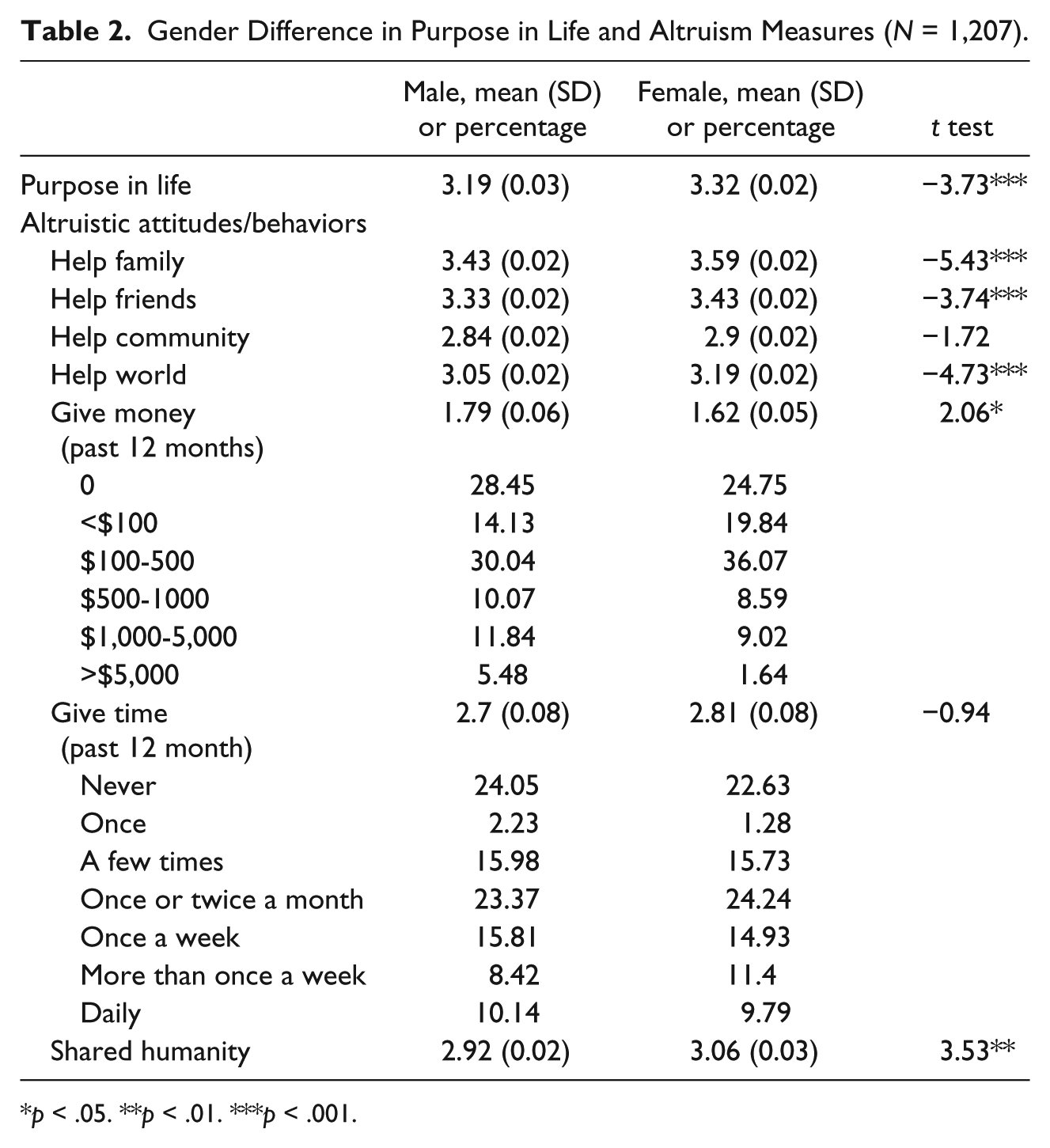
p < .05. **p < .01. ***p < .001.
In Table 3, we report results from the ordered logit models. In Model 1, gender was the only predictor for purpose in life. Because the dependent variable had multiple ordered categories, the ordered logit model made above and below comparisons at each category and assumes the effects of independent variables do not change when the cutoff points for above and below comparison changes. This is the so-called proportional odds assumption. We checked the proportional odds assumption for our model and it held for the gender effect. Without considering any other variables, being a male decreased the odds of being in the higher purpose categories by 34% (100 × [0.66 − 1]) = −34% decrease in odds).
Ordered Logit Regression Analysis on Purpose in Life.

p < .05. **p < .01. ***p< .001.
In Model 2, we controlled for sociodemographic variables to see if the observed gender difference in purpose in life was due to the uneven distribution of age and race between the two gender groups, was explained by marital status and having kids or not, or was suppressed due to female disadvantages in socioeconomic characteristics such as income and education. Controlling for these sociodemographic variables, male respondents’ odds of being in a higher purpose in life category is still only about two thirds of that for female respondents (odds ratio = 0.64). There seemed to be a small suppression effect when comparing gender coefficients in Models 1 and 2.
Model 3 included altruism at four different extensities. Gender differences in purpose in life reduced drastically and became statistically insignificant. Comparing gender coefficients in the two models (−0.44 in Model 2 and −0.10 in Model 3), altruism at different extensities explained away much of the gender differences in log-odds of being in higher purpose categories. In other words, after considering altruism variables, there was no statistically significant residual gender difference left. All four altruism variables are statistically significant. Comparing the four extensity variables, altruism toward the whole world has the strongest effect followed by altruism toward family. For each one-level increase in altruism toward the world, the odds of being in the higher purpose categories increased by more than 200% (100 × [3.25 − 1] = 225% increase in odds). For each one-level increase in altruism toward family, the odds of being in the higher purpose categories increased by 150% (100 × [2.51 − 1] = 151% increase in odds). There were about 80% increases in odds of being in the higher purpose categories associated with a one-level increase in altruism toward friends (100 × [1.84 − 1] = 84%) and people in one’s community (100 × [1.81 − 1] = 81%). After considering altruism variables, we also observed a notable increase in the pseudo R2.
In Model 4, we added money and time donation variables and shared humanity to the model. Of these, only giving time to help others was statistically significant. Although the belief of a shared humanity of all people was linked to higher purpose in bivariate analysis (results not included in the tables, available on request), after considering other altruism measures, especially helping the world, it did not offer an additional contribution to purpose in life. The effect of helping at the world level was slightly diminished by including helping at the family, friend, and community levels. Now for each one-level increase in altruism toward the world, the odds of being in higher purpose categories increased by 186% (100 × [2.86 − 1] = 186% increase in odds).
To clarify whether or not the reported gender differences and effects of altruism variables were due to their link to spirituality, we included spirituality in Model 5 as a robust check. After controlling for spirituality, gender differences in purpose in life reduced to almost zero. It seemed that gender differences in altruism and spirituality completely accounted for gender differences in purpose. However, the consideration of spirituality only slightly changed the coefficients for altruism variables. Both altruism and spirituality had independent contributions to purpose in life.
In Table 4, we checked gender differences in altruism variables controlling for social demographic variables and spirituality. The same pattern held true for most altruism variables. Women were more likely to help family members, friends, and people around the world than men regardless of their levels of spirituality. They were more likely to believe in a shared bond of humanity. There was no gender difference in helping people in community and giving time to help others. Men gave more money than women even after controlling for income and education, but the effect was only marginally significant.
Ordinary Least Squares Regression Analysis on Different Measures of Altruism Focusing on Gender Differences.

p < .10. *p < .05. **p < .01. ***p < .001.
Our results are consistent with our theoretical expectations. Altruism served as a mechanism that women use to enhance their life purpose. We further ran additional analyses (available on request) for males and females separately to check into the possible gender differences in the effects of altruism variables on purpose. Comparing ordered logit regression coefficients for altruism variables across gender groups by a set of t tests, we found no statistically significant gender difference in the effects of altruism variables except for helping friends. Helping friends increased purpose for women but not for men. Although the coefficient for helping family was greater for women and the coefficient for helping the world was smaller for women, the differences were not statistically significant.
Discussion and Conclusions
Half a century ago, Frankl highlighted the importance of meaning in life. He commented that the prevailing “boredom and apathy,” as well as “the feeling of emptiness and meaninglessness” was pathological to society and to individuals (Frankl, 1966, p. 104). Recent developments in positive psychology and mental health have reinvigorated interest in Frankl’s concern with purpose in life as an important pathway to transcending this modern affliction. An increasing amount of evidence has established the link between life purpose and physical health. As embodied in Frankl’s own life experience (Frankl, 1963) and supported by empirical studies, purpose can emerge from the confrontation with life difficulties (Ryff et al., 2003; Ryff & Singer, 2003). Our study highlighted the importance of another factor—helping and caring, over which one has more control than over adverse life circumstances—as a way to enhance purpose in life.
Our study joined the discussion by focusing on gender differences in this important aspect of psychological well-being. Using a large nationally representative sample, we found that women enjoyed higher levels of purpose in life. We further examined the role of altruism in accounting for much of the gender difference in life purpose. Women were more likely to express altruistic behaviors and attitudes, which in turn facilitated more meaning in life. Our study also contributed to the literature by examining the effects of different aspects of altruism: altruism at four different extensities, donation of money and time, and the belief of shared humanity that is fundamental to altruism. We found stronger effects of helping around the world and the “near and dear” than helping friends and community. Women reported a stronger tendency in helping family and around the world. Although men donated more money, giving money did not exert an independent effect on life purpose. Previous research has also established that the women are more spiritual and religious than men (M. T. Lee et al., 2013) and we found that spirituality, like altruism, had an independent effect on purpose in life.
As we have noted, women’s culturally encouraged role as caregivers in households and in the broader community (Daniels, 1988; Gerstel & Gallagher, 1994) supports their empathetic and altruistic capacities. And altruism plays a central role in fostering meaning and well-being (Xi et al., 2017). In fact, serving others in a benevolent way has been described as a “spiritual virtue,” and when paired with other spiritual experiences its effects can be deeply transformative (M. T. Lee, Pagano, Johnson, & Post, 2016). A recent national survey also found that women are approximately 36% more likely than men to have powerful religious experiences that foster altruism (M. T. Lee et al., 2013). Our study found that women’s higher level of purpose is a function of their higher levels of altruism and spirituality. This suggests that men could plausibly attain a similar level of purpose in life if social norms encouraged men to nurture the growth of others through altruistic acts, and also prepared them to have other spiritual experiences, to the same extent as women. This of course invokes the age-old nature/nurture debate, which is beyond the scope of our analysis. But our results, when seen in light of previous findings, suggest that women’s advantage with regard to purpose in life is rooted in two experiences that should be equally available to men and women. After all, gender is not a consistent predictor of altruism once spiritual experiences are included in multivariate models (M. T. Lee et al., 2013; M. T. Lee, Veta, Johnson, & Pagano, 2014). Future research might use a longitudinal design to unravel how gender differences in spirituality later affect altruism, which in turn affects purpose in life.
Although this study provided insightful revelations about the relationship between altruism and purpose in life, it is not without limitations. First, we were not able to test causal relationships with our cross-sectional observational data. As a result, the relationships found in this study were associational. Future studies should collect longitudinal data with altruism being measured prior to purpose in life. Second, many concepts were measured by a single item making it difficult to evaluate the amount of measurement error. Even with the four altruism variables that were measured by a mini-scale, their internal reliabilities were borderline acceptable. For example, the average scale reliability for the four mini-scales was .71, indicating that about half of the total variance was due to error. Because our model did not have the capacity to account for measurement errors, but, instead, assumed perfect reliability of the measures, the findings of this study might be biased by the measurement errors. The existence of measurement errors would also lead to a reduction in statistical power for detecting relationships among variables (McDonald, Behson, & Seifert, 2005). As mentioned earlier, when there were measurement errors in mediators, the indirect effects were often underestimated and the direct effect could be overestimated (Cole & Maxwell, 2003; Hoyle & Kenny, 1999). This implied that the mediational effects of altruism detected in this study could be considered as conservative. Future studies should focus on developing measures with better psychometric properties and reexamine gender differences and mechanisms leading to purpose in life. Third, gender roles were different across cultures. This could explain why research conducted in Europe and other parts of the world have found inconsistent evidence in gender differences in helping, volunteering, and other altruistic behaviors (Gaskin & Smith, 1997). Therefore, findings of this study might not be applicable to other populations. Indeed, even within the U.S. population, there are different ethnic groups with somewhat different gender-related values and roles. It would be interesting to look into the relationship between gender, altruism, and purpose across these groups. However, our data contain only a small number of ethnic minorities. Future studies should examine data collected from other countries or collect sufficient data on ethnic minorities in the United States.
Footnotes
Appendix
Authors’ Note
Points of view expressed in this article do not necessarily reflect those of the John Templeton Foundation.
Declaration of Conflicting Interests
The author(s) declared no potential conflicts of interest with respect to the research, authorship, and/or publication of this article.
Funding
The author(s) disclosed receipt of the following financial support for the research, authorship, and/or publication of this article: The research for this article was funded by a grant awarded to Margaret M. Poloma, Stephen G. Post, and Matthew T. Lee from the John Templeton Foundation (Grant No. 12490).
