



Abstract
The enlargement of the European Union in 2004 increased the flows of workers across national borders within the unions, making action against social dumping an increased priority for unions. Which factors influence unions’ choices of strategies against wage dumping? Research has shown that in a cross-national perspective, unions with stronger institutional positions, defined as their influence on public policy and extent of collective bargaining coverage, have tended to be less interested in organising migrant workers than unions with weaker institutional positions. This article examines the choices made by three Swedish unions, all three with strong institutional positions, in responding to migrant workers: two have developed extensive organising responses, while the third relies on cooperation with employers and collective bargaining coverage to counteract social dumping. The article shows that intra-national variation can be explained by sectoral-based issues: that is, variation at both a country and sectoral level influences unions’ strategic choices towards migrant workers. The article further highlights the transference of the Anglo-Saxon union revitalisation model in some sectors of the Swedish trade union movement, which faces increasing pressure as a result of labour precariousness in the Swedish labour market.
Introduction
The enlargement of the European Union (EU) in 2004 to include eight Central and Eastern European post-communist countries poses challenges to trade unions in the 15 Western European countries that were already members of the union. 1 The wage differentials between the old and new member states were and remain significant – in 2004, Latvia and Lithuania’s minimum wages were about a tenth of the Netherlands’, and Poland’s was 17% of Britain’s (Eurostat, 2012). This, combined with a common labour market allowing free movement for labour and services, caused concerns about ‘social dumping’ and a ‘race to the bottom’ in terms of wages and employment conditions (cf. Alsos and Eldring, 2008; Cremers et al., 2007; Dølvik and Visser, 2009; Lalanne, 2011). The research focus in this article has been to understand how trade unions act to maintain wage levels and work standards, and avoid social dumping in the face of increased migration by EU workers to Sweden. 2
This article studies the strategic response by three Swedish unions. Sweden is a coordinated market economy that has one of the strongest labour movements in the world and tops the list of union density together with Nordic neighbours Denmark and Finland (Kjellberg, 2011; Korpi, 2006; Visser, 2011). The three unions studied are Byggnads (the construction sector), Transport (transport) and IF Metall (manufacturing). Byggnads and Transport are active in sectors with a long history of precarious employment, many small workplaces and a large degree of ‘bogus self-employment’ (cf. Cremers, 2004: 9; Eldring et al., 2012; Kahmann, 2006). On the other hand, IF Metall is active in a more organised sector with larger companies and workplaces.
The union revitalisation literature argues that variations in trade unions’ institutional position explains the strategic choices of unions in their organising efforts with previously unorganised groups of workers, such as migrant workers (Baccaro et al., 2003; Frege and Kelly, 2003; Krings, 2009a, 2009b; Penninx and Roosblad, 2000). Unions that have stronger (weaker) institutional positions are less (more) prone to revitalisation because the pressure to innovate is inversely related to the degree of institutional strength. However, the case studies described in this article highlight that national variation in institutional positions needs to be complemented as a structural explanation for union choice, with sectoral variation in the degree of precariousness of employment conditions facing workers covered by unions (cf. Bechter et al., 2011). That is, just as erosion of institutional positions on a national level motivates union strategic choice, the increased precariousness facing labour covered by a union is an additional factor motivating unions to innovate and organise previously unorganised groups. Thus, Byggnads and Transport have chosen to organise EU migrant workers because their coverage is in more precarious sectors, while the lack of the same degree of precariousness has motivated IF Metall not to organise migrant workers, but to pursue an alternative strategy The case study of Transport further signals the influence of the revitalisation model from the US as part of this union’s strategic choice. This is a sign of change in Swedish industrial relations and is again related to the issue of precariousness facing workers. That is, in the face of these changing labour market dynamics, strong unions such as Transport could once rely upon ‘passive recruitment’, as almost everyone joined the union anyway (cf. Lind, 2009); in contrast, precarious workers are less likely to join a union.
The article presents this argument by first discussing the strategic choices available to unions in responding to the challenge of social dumping in the context of how national and sectoral interests influence this response. This is followed by a discussion analysing the strategies adopted by Byggnads, Transport and IF Metall before concluding with comments about implications for the future.
Unions, EU migrant workers and strategic choices
Penninx and Roosblad’s (2000) typology describes the choices available to unions in responding to migrant workers. The first is whether to oppose labour immigration by stopping or imposing quotas; the second is to organise migrant workers; while the third is the inclusion of migrant workers into the union structure. The first choice is almost irrelevant in the EU context since free movement of labour is one of the ‘fundamental freedoms’ of the Union, notwithstanding the 2004 restrictions that limited access of workers for up to seven years following enlargement. However, while Sweden’s unions did not support these restrictions, the case studies illustrate that they have done little in terms of Penninx and Roosblad’s third choice, that is, creating special structures that include (EU) migrant workers in the union. Instead, Swedish union response has mostly been in regard to the second choice in the typology, that is, organising migrant workers.
Strategic choices by EU unions towards migrant labour
Research on unions and EU migrant labour has mainly focused on the construction sector, which is natural since this sector has seen the greatest inflows of migrant workers (Dølvik and Visser, 2009). Kahmann (2006) notes that the German construction sector union IG BAU initially pursued Penninx and Roosblad’s first element during the 1980s and 1990s to restrict flows of migrant workers from the poorer EU member states Portugal and Spain, and developed corporatist alliances with employers in countries with bilateral agreements with Germany against social dumping in their sector. This continued until the late 1990s, when large German construction companies began using subcontractors with lower wages and standards. These developments motivated a shift by IG BAU away from exclusion towards inclusion. Thus, during the 1990s, the union shifted strategy towards organising, initially with Portuguese posted workers and then workers from Eastern Europe, especially Poland, with the union supporting the establishment of a European Migrant Workers Union for workers moving across borders in 2004.
A similar trajectory can be noted in research about construction sector unions in Finland. While an earlier study by Lillie and Greer (2007) showed that the Finnish union strategy against social dumping focused on industrial action and political pressure (cf. Lillie, 2012), Alho (2012) more recently illustrates a shift in union strategy towards organising by, for instance, employing a Russian-speaking organiser and establishing a section for foreign workers in the union. Arnholtz and Andersen (2007); Andersen and Arnholtz (2008) noted similar trends in Danish construction unions, whereby these unions have gradually shifted their attention to organising migrant workers using strategies such as employing Polish-speaking consultants and a local union club for Polish workers (Eldring et al., 2012).
There are fewer studies of union strategic choice in other industry sectors. A study of the Trades Union Congress (TUC) and three of its member unions in food, transport and the retail sectors confirms the choice of an organising strategy by both the TUC and these unions (Fitzgerald and Hardy, 2010). While not a surprising finding, given the pioneering role British unions have played in developing the organising model (cf. Heery, 2002), Fitzgerald and Hardy further illustrate the community-based approach pursued by these unions, such as sponsoring social activities like Polish clubs (cf. Meardi, 2010: 11). This signals a trend towards Penninx and Roosblad’s third strategic choice of inclusion of migrant workers in the union. This difference between UK unions and those elsewhere in Europe, such as Austria and Germany, was noted by Krings (2009a, 2009b), who found that of the four, Austria’s unions have done the least to organise EU migrant workers: this includes the construction sector unions. Instead, Austrian unions use a political strategy to strengthen state supervision and control of wage and working conditions. Similarly, German manufacturing and service sector unions have done little to organise migrant workers. However, Irish and British unions have actively pursued organising strategies.
In explaining the bifurcation of strategy between Austrian and German unions on the one hand and British and Irish on the other, Krings (2009b: 61) puts emphasis on differences in unions’ institutional positions: collective bargaining coverage and political clout. Austrian unions enjoy a labour market with universal collective bargaining coverage and a corporatist political system with influence over policymaking, a marked difference to the situation facing British unions. Institutional position (or lack thereof) can have the same effect but in reverse. For instance, UK unions' limited ability to exert political pressure has instead motivated them to pursue an organising strategy, but without great success in counteracting social dumping (Fitzgerald and Hardy, 2010). Another approach is exemplified by Meardi and colleagues (2012), who argue that union ideology plays a role in unions’ strategic choices. In comparing union response in Spain to that in the UK, it is suggested that the Spanish construction workers’ union’s ideological internationalism limited their adoption of an exclusionary strategy towards migrant workers. However, the union’s institutional position is also a significant influence. Because Spanish unions were too weak to successfully organise migrant workers, the Spanish union movement has instead pursued pressure politics on the government as its main strategy (Meardi et al., 2012).
An analytical framework to understand unions’ strategic choice
The choice available to unions in organising migrant workers falls within two types of strategies: administrative and organising. 3 An administrative strategy refers to the union using political pressure, legal means and the extension of collective agreements to ensure that there is no social dumping or wage dumping in its sector. However, this is an exclusionary strategy and does not involve migrant workers themselves. An organising strategy, on the contrary, is an inclusionary strategy and refers to organising and involving migrant workers in the union. Nevertheless, it is sometimes unclear what an organising strategy is (Simms and Holgate, 2010). In this article, it is defined as a union strategy that involves workers in organising, especially those that tend to be less organised or with ‘atypical’ employment conditions, such as migrant workers. This strategy may also include a broadening of union methods to community-based unionism and social movement unionism to engage non-labour civil society actors, such as religious groups and activist groups, in collaborative activity.
The choice unions make, however, is related to their institutional positions, seen as varying between countries, and sectoral influence of precariousness of the labour markets in which they engage. ‘Institutional position’ refers to the influence a union has, almost regardless of its actual membership, due to the automatic extension of collective agreements, union representation in public decision-making, the legal framework and public funding (Baccaro et al., 2003: 120). ‘Precariousness’ refers to the prevalence of atypical employment conditions such as fixed-term contracts, temporary staffing agencies, dependent self-employment, as well as non-compliance with collective agreements and employee rights (Thörnqvist and Engstrand, 2011). Figure 1 summarises this framework.
Factors influencing union strategic choice towards migrant workers.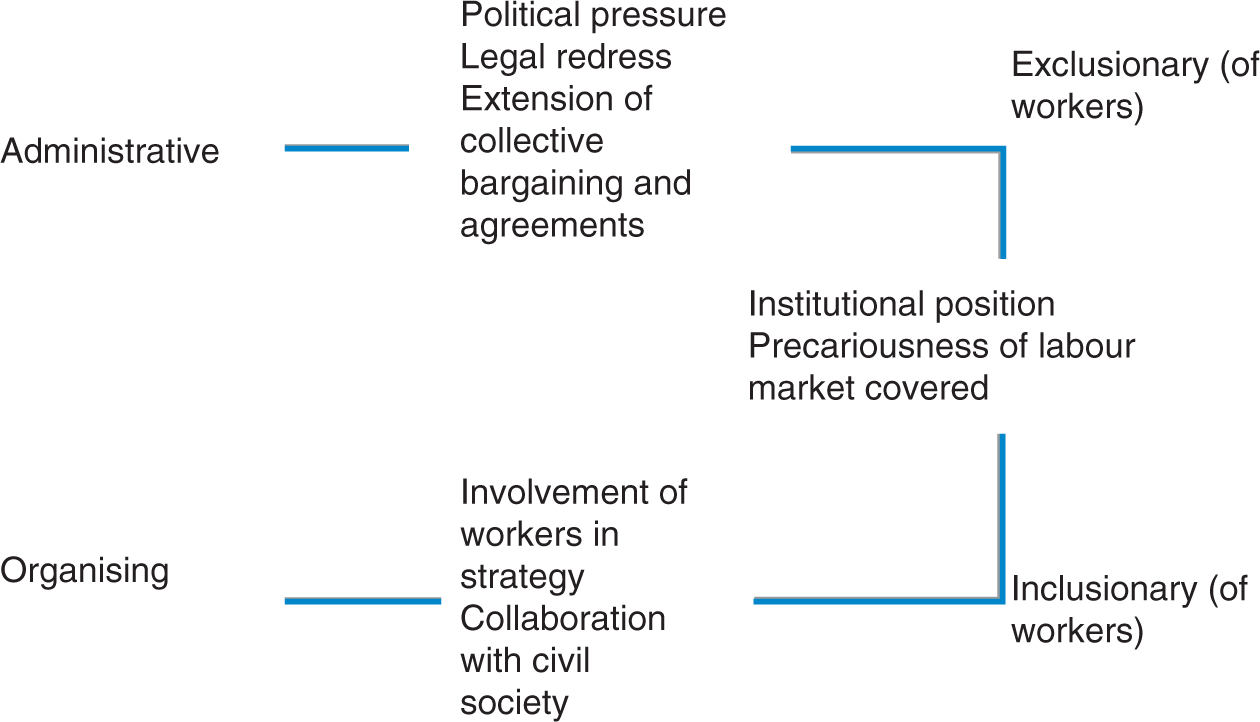
Thus, while significant, the degree of political influence and ‘institutional embeddedness’ will not vary much between sectors within countries, but the degree of precariousness will (Meardi, 2010: 11); that is, variation in organising strategies by unions is related to their institutional position, but is heavily influenced by the precarious nature of the labour market in their sector (cf. Hardy et al., 2010). It therefore follows that sectoral positions need to be considered when analysing unions’ strategic choices. For example, the steel industry tends to have high union density and collective bargaining coverage in all European countries, even in countries with otherwise weak unions and low bargaining coverage (Bechter et al., 2011). On the other hand, the telecommunications sector tends to have low union density and low collective bargaining coverage, even in countries with otherwise strong unions. Thus, the logic that unions with weaker institutional positions – so far, applied to cross-national differences – will be more likely to choose organising models also works when considered at the sectoral level. 4
Predictions for the Swedish case
When applied to the Swedish case, it could be argued that because Swedish unions appear to hold a strong institutional position, with union density of 68% in 2010 compared to an 18% average in the Organisation for Economic and Co-operative Development (OECD) countries (Visser, 2011), Swedish unions would adopt an administrative strategy in responding to EU migrant workers. However, there has been a weakening of union strength in Sweden: whereas in 2005 union density was 76%, this dropped eight percentage points in the five years to the 2010 position (Visser, 2011; cf. Kjellberg, 2011: 47). Furthermore, union density among blue-collar workers younger than 24 years has fallen from 75% in 1995 to 36% in 2010 (Larsson, 2010: 2). Thus, the weakening of the unions together with increasing precariousness (Thörnqvist and Engstrand, 2011), which has led to an emphasis on ‘renewal’ in some unions (Heery, 2009; Wills, 2009), suggests that when viewed from a sectoral perspective, a different prediction emerges: that is, unions in sectors with more (less) precarious conditions would be more (less) likely to choose organising strategies. The following analysis explores these predictions.
The Swedish case
Three Swedish unions were studied for this research: Byggnads, Transport and IF Metall. Interviews (see Appendix) were conducted with key officials at the three unions, holding the positions of ombudsmen and researchers, and at the confederation Landsorganisationen (LO). 5 Secondary material was also sourced from interviewees and their organisations, including a detailed review of union papers.
IF Metall is Sweden’s largest union in manufacturing, with 350,000 members. Byggnads is the major union in the construction sector, with about 100,000 members. Transport has 60,000 members in trucking, warehouses and other jobs in transport and communications. All three unions are members of LO, the Swedish Trade Union Confederation. Byggnads and Transport are active in sectors where complex subcontracting chains, bogus self-employment and temporary hiring contracts are prevalent (LO, 2010), while IF Metall’s sectors are less precarious. In recent years, union density has fallen more rapidly in Byggnads and Transport’s sectors than in that of IF Metall: from 2006 to 2009, the manufacturing sector saw a three-percentage-point decrease, and transport and construction a decrease of eight percentage points each (Kjellberg, 2011: 52).
Migration to Sweden from the 10 new EU member states increased fourfold from 2003, just prior to the enlargement, to 2006 (Wadensjö, 2007: 17). The inflow started from quite a low level, and was not as large as the flows to Norway, Britain or Germany (Galgoszi et al., 2009: 6). Sweden lacks a legislated minimum wage, so collective agreements are unions’ only way of combating wage undercutting and social dumping (cf. Alsos and Eldring, 2008). Unions traditionally are a strong force in regulating the labour market and in the political arena, the latter with its connections to the Social Democratic Party. This also means that unions are not very prone to renewal; in a recent article, Peterson et al. claim that they have not adopted so-called social movement unionism, even though unions in the face of new challenges are ‘slowly diversifying their action repertoires’ (Peterson et al., 2012: 24). Research on the situation with posted workers in Sweden after 2004 has focused on the famous Laval case. 6 Beyond Laval, unions’ responses have not been researched.
Not opposing the labour inflows
Penninx and Roosblad’s (2000) first strategic choice for unions vis-a-vis labour immigration is whether to resist the inflows. Bucken-Knapp (2007) argues that the Swedish labour movement has generally been sceptical towards labour immigration since the late 1960s; thus, the LO could have been expected to support restrictions to labour immigration in 2004 (Penninx and Roosblad, 2000). However, unlike the Social Democratic Party, the LO did not support this strategy (interview, T.P., November 2010; cf. LO, 2004a, 2004b), arguing that as posted and bogus self-employed workers operate under the EU rules of free movement of services, 7 in the union’s view, it was these groups of workers who were more likely to be victims of social dumping by employers (LO, 2004a). Therefore, unlike the Danish, German 8 and Austrian unions, restrictions on new member states were not considered an appropriate response to enlargement. The LO (2004a) instead demanded that government enact a legal framework that imposed responsibility on the main contractor for payment of taxes by subcontractors (cf. Houwerzijl and Peters, 2005), required authorisation for temporary staffing agencies, and increased regulation defining workers as self-employed to avoid bogus self-employment.
With hindsight, the LO’s position was prescient: posted workers, temporary staffing agencies and bogus self-employment, not regular labour migrants, have provided employers with possibilities for social dumping (Arnholtz and Andersen, 2008: 103; Greer, 2007; LO, 2010; Watts, 2002: 78). However, the labour market reforms demanded by the LO were not implemented. Neither the Social Democrat government (2004–2006) nor the centre-right government since then expressed interest in these measures. While the Social Democrat policy upon re-election in 2010 included several of LO’s proposed reforms in their labour market reform programme (Socialdemokraterna, 2010), it is doubtful whether the party will implement these given that they failed to do so in their earlier term (2004–2006). Nevertheless, research confirming social dumping in sectors including construction (LO, 2010; Thörnqvist and Woolfson, 2012) may be a factor that motivates a possible future Social Democrat government to more seriously consider these measures in the future.
IF Metall: An administrative strategy
The difference in strategic choice between IF Metall and Byggnads became clear in an interview with a union official: ‘Byggnads try to recruit members. In Metall we don’t go out and recruit foreign employees’ (interview, R.N., November 2010). Instead, IF Metall has developed a consensus-based agreement with employers’ organisations on how wages and employment conditions for EU migrant workers in the sectors they cover should be handled.
From the early 1990s to 2003, IF Metall’s predecessor, Metall, and its main employer counterpart, Verkstadsföretagen, reached an agreement that foreign employers active in Sweden should not join Verkstadsföretagen. A foreign company operating in Sweden had to pay the average wage that other workers in the region would receive. Thus, had foreign employers joined the employer organisation, their employees would have been considered newly employed, meaning that their work conditions would be tagged at the minimum level of the collective agreement. Given an average length of stay for only six months, workers would never benefit from wage increases. The possibility for this system to cause a downward pressure on wages was evident. IF Metall had countered this threat by reaching an agreement with employers.
This wage-setting system is similar to that found in the Finnish manufacturing sector. Lillie (2012) shows that since actual wages in Finland vary by region and are above the minimum level of the collective agreements, wage pressure can be brought into the sector with companies still following the collective agreement if they employ workers that will be paid the minimum wage instead of the customary higher wage (Lillie, 2012: 156, 159). The same wage pressure exists in Sweden. In 2003, a welding company in southern Sweden brought in a foreign contractor that applied for membership in Verkstadsföretagen, and the application was accepted. Four qualified Polish welders worked for the collective agreement’s minimum wage instead of its average wage. Since the company was a member of the employer organisation and applied the collective agreement, Metall were bound by a duty not to strike.
These events led Metall to develop a series of wage agreements with its employer organisation counterparts on how to handle the wages of foreign employees in foreign companies in Sweden to avoid the situation where downwards wage pressure is created by companies exploiting the gap between the minimum and average wage. Union officials claimed that as a result, ‘we [IF Metall] never would have had “a Laval” with our collective agreement model’ (interview, R.N., November 2010). Thus, all migrant workers covered by the union received similar entitlements. It was claimed that this differed from the status of migrant workers in their counterpart unions, where, for instance, Byggnads negotiated a piece rate wage-setting system that is benchmarked against the average wage in the area. The level is calculated by the union itself. Under IF Metall’s system, there were clearly defined wage levels with insurance clauses excluded.
The IF Metall interviewee described ‘the situation after Laval’ as ‘a big damn exclamation mark and a big damn question mark’ – referring to the uncertainty over which rules will apply in the Swedish labour market 9 – but, at the same time, claimed that IF Metall does not have a crisis regarding foreign labour in its sectors. IF Metall’s strategy against wage dumping is focused on collaboration with the employers. This is an administrative strategy, which corresponds with the fact that this is a union with a strong institutional position active in its sector. Its alliance with employers minimises the precarity of employment conditions and provides overall protection for otherwise marginalised foreign workers.
Byggnads and Transport: Organising strategies
Adapting to the changing EU labour market is a high priority for Byggnads, the major construction sector union in Sweden. In 2004, Byggnads commenced its Interpreter Project, in which Polish, Russian and Baltic interpreters have been employed to work jointly with Byggnads’ officials in organising migrant workers. The interpreters facilitate communication between migrant workers and union officials and minimise the potential for cultural misunderstanding to emerge between the workers and the officials. Byggnads recruited interpreters from within their own rank and file to ‘explain the role of the union in our society and that they have to consider that employees from former Eastern Europe have a historical inheritance on how a trade union works’ (interview, T.H., August 2010). The union suggests that this project has provided the union with insights into foreign construction workers, and improved their confidence in the union (internal memo from Byggnads).
However, in the first five years of the Interpreter Project, the union only managed to organise between 100 and 500 workers (interview, T.H., August 2010). A major reason was that migrant workers generally work for only a few months in Sweden, thus limiting both their contact with the union and opportunity for the union to develop a relationship with them (interview, T.H., August 2010; cf. Lillie and Sippola, 2011). In addition, employers are also highly resistant to union engagement with workers (interview, T.H., August 2010). The expense, coupled with lack of success in numbers, led to the project being downscaled in 2010 when an interpreter was laid off (Jacobsson, 2010), to his own public dismay (Kaplers, 2011).
Nonetheless, the project has now been imitated by the Danish construction workers’ union, and also stands as a role model for other LO unions (LO, 2008: 16). In addition, the model has proved successful elsewhere in the EU, such as Ireland, Great Britain and Norway (LO, 2008: 12). A key difference between these and Byggnads’ approach, however, is the use of a community-based approach as part of the strategy (Fitzgerald and Hardy, 2010). For instance, unlike unions in these places, Byggnads did not establish Polish clubs within the union or develop alliances with other social movements such as religious groups. For instance, union officials dismissed the alternative of separate clubs, such as for Polish workers, as being ‘segregating’ (LO, 2008). Thus, while pursuing an organising strategy, Byggnads has not changed its structure to be inclusive of migrant workers.
Transport uses an interpreter model similar to that of Byggnads, particularly offering Russian linguistic services because many Baltic migrant workers speak some Russian. However – and like Byggnads – this has not eventuated in significant numbers of workers being organised (interview, L.L., August 2010). A reason offered was that the mobility of workers between countries gave them little reason to join a Swedish union (interview, L.L., August 2010). Nonetheless, the high degree of precariousness facing workers, combined with the prevalence of small businesses in their sector, motivates the union to continue pursuing this strategy. As a senior Transport union official stated, ‘What we [at Transport] are facing today, the other unions will face 20 years from now’ (interview, M.P., January 2012).
In developing their strategy, it was also interesting to note that Transport’s approach to organising migrant workers has been heavily influenced by its US partner union, the Service Employees International Union (SEIU) (interview, M.P., January 2012; cf. Derland, 2011), which has been at the forefront of the union revitalisation movement in the US (Milkman, 2006). Like the SEIU, Transport has in fact employed six full-time ‘organisers’ (Transport also uses the US job title) and one administrator, to focus solely on organising and activating new members.
Nonetheless, and like Byggnads, Transport has not adopted community unionism or social movement unionism methods, such as alliances with other social movements, to any high degree; this is even though Transport was the most active union at the 2008 European Social Forum in Malmö, Sweden’s third-largest city (Peterson et al., 2012). However, this case illustrates that for the first time in Swedish unions, the influence of US ideas in a Swedish union’s strategic response to migrant workers can be noted. The union’s experience of increasing precariousness and social dumping (Lindkvist, 2010) is likely to motivate a greater attention to how similar strategies can be further transferred to the Swedish context (cf. Heery, 2002).
Conclusions
Two main conclusions emerge from the analysis presented here. The first is that unions vary in their strategic response to EU migrant workers on the basis of institutional and sectoral characteristics. Studies by Krings (2009a), Fitzgerald and Hardy (2010), Lillie and Greer (2007) and others confirm the significance of cross-national variation in unions’ institutional positions in partially explaining unions’ strategic choices vis-a-vis EU migrant workers (Baccaro et al., 2003; Frege and Kelly, 2003). However, this article illustrates that while all three unions studied have responded to the challenge of migrant workers, they have pursued different strategies in accordance with not only their institutional position, but also their sectoral position. The ‘stronger’ union – IF Metall – has chosen an administrative strategy that does not include organising migrant workers, but instead counteracts social dumping by means of agreements with the employers’ organisation and through the implementation of rules of collective agreements. Byggnads and Transport have instead chosen organising strategies, employing interpreters speaking Polish and Russian to facilitate their organising strategy with migrant workers. This choice was influenced by their sectoral position, not only their national context (Bechter et al., 2011) or institutional position (Meardi, 2010).
Second, the case study of Transport signals a new direction in Swedish unionism (Peterson et al., 2012), and that is the influence of ‘other ideas’, especially those from the US union movement. 10 Transport stresses that their model is critical in reaching precarious workers such as migrant workers (interview, M.P., January 2012). It is the first Swedish union to have explicitly embraced the organising model, but the model has now spread to other Swedish blue-collar unions, including Kommunal, a major union in the public sector. This union has recently employed the organiser responsible for the Transport model to implement the same approach in their union (Sjögren, 2012).
These conclusions lead to speculation about the future of Swedish unions’ strategic response. That is, as their membership and institutional power resources erode, will Swedish unions become more ‘French-like’ and militant in the future (Lindvall, 2012)? Will the organising model now embraced by Transport and adopted by other Swedish unions become more dominant in Swedish union responses to EU migrant workers in the future?
Footnotes
Acknowledgements
Thanks to the Guest Editor of this issue, Donella Caspersz, and to Peter Ackers, Mattias Bengtsson, Ian Fitzgerald and two anonymous referees for comments, criticism and suggestions. Special thanks to Rolle Alho for information about his recent Finnish-language research. All errors and misunderstandings are mine.
Funding
This research received no specific grant from any funding agency in the public, commercial or not-for-profit sectors.