



Abstract
This article explores the experiences of trade unions in Croatia and Poland with societal power resources as a source of trade union revitalisation in the post-2008 crisis period. In the context of limited structural, organisational and institutional power resources, Croatian and Polish trade unions attempted to build their societal power through the revitalisation strategies of coalition building and political action. The paper compares three similar, partially successful campaigns run in both countries, on pensions, Sunday trading and precarious work. Our findings show that gains in societal power alone cannot fully compensate for the erosion of conventional sources of trade union power. Such a configuration of power resources runs the danger of trade union demands being taken up by populist forces wanting to increase their own legitimacy, rather than furthering workers’ interests. Therefore, what starts as an attempt at union revitalisation based on the novel use of societal resources could easily end up as ‘captured innovation’ by populist forces.
Introduction
In applying the conventional quantitative measures for trade union power, the situation in Central and Eastern Europe (CEE) looks bleak. Unions are losing members, their members are getting older and they are suffering from the erosion of collective bargaining. While this tendency is shared by many Western unions (Gumbrell-McCormick and Hyman, 2018), it has advanced much faster in the ‘new’ EU Member States. Central and Eastern Europe unions have certainly not meekly accepted their fate. A variety of revitalisation strategies have been tested, including organising non-standard workers, increased focus on law enforcement, changing the forum for social dialogue, acquiring external financial grants and, last but not least, strengthening coalitions with non-union societal groups (Mrozowicki, 2014; Bernaciak and Kahancová, 2017). This article focuses on the latter, hitherto less studied strategy in two countries from the ‘New Europe’: Croatia and Poland.
Societal power resources are defined here in a broad sense. They can include not only formal and informal alliances with political parties and civil society associations but also union-led referendum campaigns, street protests and media campaigns aimed at improving their influence on the policy-making process. Studying these societal power resources is because they had been underappreciated in the past (Levesque and Murray, 2010). In Croatia and Poland, most of the strategies listed above that are rooted in organisational, structural and institutional power have hardly produced satisfactory results. Furthermore, since 2008 in both countries actions relying on societal power showed clear aspects of union revitalisation, defined by Kumar and Schenk (2013: 16) as ‘adaptations and change initiatives undertaken by unions to restore their strength and influence’.
The decision to conduct a comparative analysis of these two specific countries stems from the realisation that their trade unions underwent a similar trajectory of their involvement in the broadly understood social and political processes. This implies a diminishing extent of organisational, institutional and structural power resources. However, in addition to these similarities, there are also historical differences between the two countries which are important for a comparative analysis. Due to the delayed transition and integration into global economic and political structures, the organisational and institutional power of Croatian trade unions is still greater than that of its Polish counterparts (Bohle and Greskovits, 2012). The privatisation process in Croatia is less advanced than in Poland, leaving the country with a sizable public sector and a stronger trade union presence.
In this article, our main research question is what happens to union power when trade unions, in a situation of ongoing decline, reorient themselves towards political action and coalitions, by comparing three similar campaigns in two countries with different political landscapes. Starting from the view that weak institutional power resources stimulate unions to experiment with revitalisation strategies within the ambit of societal power resources (Weil, 2005; Eaton et al., 2017), our initial premise is that Polish trade unions should score better in this area, as in an earlier analysed case of trade union organising strategies (Mrozowicki, 2014).
The economic crisis in Croatia and the threat of a crisis in Poland acted as a catalyst for trade unions to build societal power by drawing on their societal power resources, primarily through the development of new alliances. In the Polish context, room for coalition-building with liberal forces was limited since these forces implemented neoliberal austerity policies in the post-crisis period. The situation was similar in Croatia. Nevertheless, since the political context in Croatia was more conventional, only in Poland were populist parties able to serve as serious potential union allies, given that they captured a significant part of the protest vote. A problem with such alliances is the risk of union agendas cupture by the populist parties, which may substitute union functions with illiberal policies. Furthermore, alliances between trade unions and populist parties frequently diminish the union capacities to influence key political actors (Gumbrell McCormick and Hyman 2018: 225). Ultimately, close alliances between unions and illiberal forces raise the question of union legitimacy in the long run.
We first review the literature on trade union revitalisation and power resources as sources of trade union power with a particular emphasis on societal power resources. Afterwards, we reflect on the developments within the structural, organisational and institutional union power resources in both Croatia and Poland. In the article’s central part, we analyse the societal power resources in both countries starting with an assessment of their historical backgrounds. Subsequently, we focus on three prominent union campaigns that strengthened societal power by addressing union opposition towards the increased retirement age, Sunday trading and working conditions of precarious workers. Arguably, these three campaigns in both countries were amongst the most visible, successfully addressing major issues that concern workers across the EU. The fact that all three campaigns were implemented in both countries allowed us to engage in an in-depth comparative analysis of these cases. The article’s conclusion reflects on the specific configuration of power resources and the subsequent revitalisation attempts deployed by the unions within the selected campaigns in the face of the inadequacy of traditional patterns to represent worker interests.
Conceptualising trade union power and revitalisation
The power resources approach (PRA), based on the theoretical considerations of Wright (2000) and Silver (2003) and further discussed by other scholars (Levesque and Murray, 2010; Schmalz et al., 2018), ‘is founded on the basic premise that organized labour can successfully defend its interests by collective mobilization of power resources’ (Schmalz et al., 2018: 113). Notably, there needs to be a distinction between trade union power and trade union power resources. Power concerns, according to Max Weber (1968: 53), ‘the probability that one actor within a social relationship will be in a position to carry out his own will despite resistance (…)’. Power resources, in turn, reflect ‘fixed or path-dependent assets that an actor can normally access and mobilize’ (Levesque and Murray, 2010: 335). Thus, power resources can be translated into power only by means of agency – or actors’ capacity to make use of them to influence the actions of other actors, such as employers and the state. Turning to novel forms of societal power is a response to the erosion of the conventional sources of workers’ (and trade unions’) power: structural, organisational and institutional. Structural power ‘results simply from the location of workers within the economic system’ (Wright, 2000: 962). Organisational power is directly related to what and whose interests the trade unions and other workers’ organisations represent (Ibid.). Last but not least, institutional power represents the result of ‘struggles and negotiation process based on structural and organizational power’ (Schmalz et al., 2018: 121).
Societal power seems to be of crucial importance when discussing recent union revitalisation strategies in Poland and Croatia. It is based on ‘societal power resources’, defined as ‘the latitudes for action arising from viable cooperation contexts with other social groups and organisations, and society’s support for trade union demands’ (Ibid. 122). Principally, there are two ways of using societal resources for the sake of union revitalisation. The first concerns coalition-building with other societal groups, such as political parties, NGOs, professional associations or employers. This can translate into societal power by extending the scope of interests and agendas that unions seek to represent, enabling them to ‘broaden their appeal to the poorly represented segments of the labour force’ (Frege and Kelly, 2003: 9). The second involves actions aimed at influencing policy-making, either directly or through shaping the public discourse for political ends. These could be mass protests, demonstrations, advocacy campaigns, referendum campaigns, innovative use of media and ICT, etc. This can be understood in terms of political action, as a special kind of revitalisation strategy providing ‘access to power resources, resulting in more favourable labour legislation or in corporatist labour market regulation’ (Ibid.).
Mobilising these resources could result in attaining two kinds of societal power: coalitional and discursive (Schmalz et al., 2018: 122). Coalitional power requires cooperative relationships with non-union organisations that share similar goals with unions, though differ from them structurally (Gumbrell-McCormick and Hyman, 2018: 31). There are several reasons why unions may seek such alliances: i) to gain financial and physical resources, ii) to access new constituencies, iii) to draw on specialist expertise, iv) to gain added legitimacy and v) to strengthen their mobilisation capacity (Frege et al., 2004: 140).
Discursive power, on the other hand, relies on the ability of trade unions to provide interpretation patterns and solutions to burning social problems (Schmalz et al., 2018: 123). The development of discursive or moral power requires the presence of a normative vision that needs to be communicated. The key issue here is the subversion of a dominant neoliberal narrative frame, which is based on the notion that money is the measure of all things (Gumbrell-McCormick and Hyman, 2018: 153). Therefore, the central purpose of trade union actions has to be presented as the pursuance of social justice, defence of workers’ rights against the imperatives of profit, the struggle for industrial democracy, etc. (Ibid.). It has to be based on ‘the existing stock of stories that frame understandings (…) and inform a sense of efficacy and legitimacy’ (Levesque and Murray, 2010: 336).
As indicated by Frege and Kelly (2003: 9), there are six major trade union revitalisation strategies: organising, organisational restructuring, coalition building, partnership with employers, political action and international links. Additionally, providing new services to employees was identified as a revitalisation strategy in its own right (Meardi, 2007). These revitalisation strategies, in particular coalition building, political action and international links, closely correspond with novel ways of using societal power resources. Moreover, the engagement of trade unions with different revitalisation strategies, which may strengthen or increase their power, requires the presence of particular power resources – or their lack thereof. For example, it was argued that reliance on organising is more likely in a context in which trade unions cannot rely on institutional power secured through (neo)corporatist arrangements (Baccaro et al., 2003). Similarly, political action and coalition building with social movements and civil society organisations can also be seen as the result of limited organisational and institutional power, which directs trade unions towards actions in the scope of societal power resources.
A comparison of union power resources in Poland and Croatia
Our study assesses the potential and pitfalls of strategies based on political action by looking at three similar campaigns (on pensions, Sunday trading and precarious employment), all at least partially successful, run by Polish and Croat trade unions, to ask if societal power resources, when effectively used, have the capacity to redress union decline. The fact that in both countries the campaigns resulted in successes provides a best case for investigating how far such strategies can help trade unions, also in contrast with previous ineffective organising strategies, while the different political landscape of the two countries (with a strong populist party in Poland but not in Croatia) allows to test if the outcomes are contingent on the party-political context.
The analysis is based on 37 semi-structured interviews (21 in Poland and 16 in Croatia) with experts, employers and trade union leaders collected in 2015–2016 in the following sectors: retail, steelworks, construction, health care and temporary work agencies. Furthermore, information from other research projects addressing industrial relations in CEE countries, contextual information such as secondary literature and statistics from official sources and opinion polls on the following 5 years was also used, including a number of follow-up interviews.
Trade union density in Croatia and Poland (in %), in 2008 and 2016.
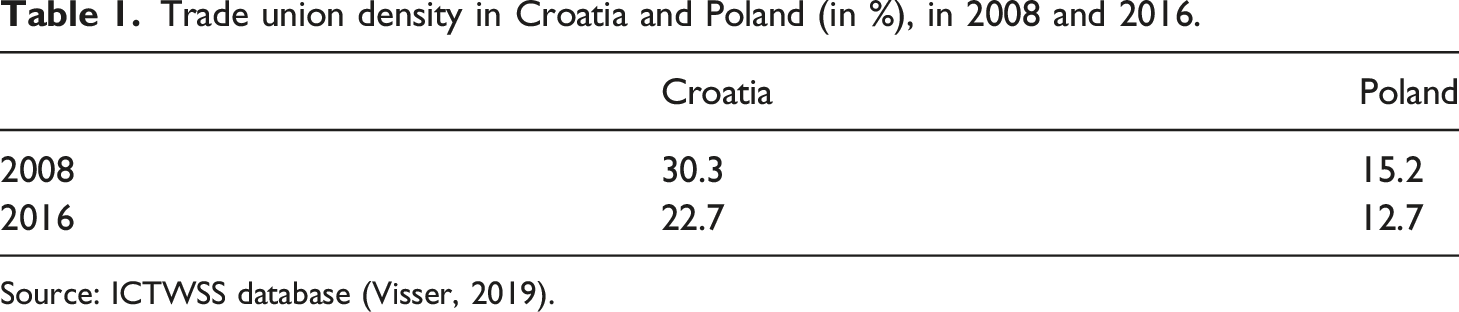
Source: ICTWSS database (Visser, 2019).
In both countries, the structural power of workers could generally be assessed as weak. This reflects a relatively fragmented structure of the workforce, including the key role of SMEs providing employment for approximately 70% of all workers in both countries as well as the dependent position of national companies and subsidiaries of multinational firms (Bernaciak and Kahancová, 2017). However, recent years have marked a certain increase in structural workers’ power. In Poland, GDP growth accelerated after 2013, resulting in a growing demand for labour and increasing pay pressure. Outward migration and demographic decline continued in the post-crisis period, and labour market shortages were only partially compensated by the inflow of an estimated one million Ukrainian migrant workers as of 2021. Along with significant pay increases in the private sector, the minimum wage grew by 73% between 2009 and 2019. The start of economic recovery in Croatia in 2015 coincided with the opening of Western European labour markets following EU accession in 2013. This led to unprecedented emigration of over 300,000 people in 2012–2021, or around 7.4% of the total population, while in the same period immigration amounted to only around 200,000 people, that is, around 4.8% of the total population (CBS, 2022). In response to this new situation, private and public sector employers started to increase wages, and the minimum wage was raised by 22% in the last decade (Samardžija et al., 2017). Notably, the increase in wages in both countries was mostly driven by politically determined minimum wage growth and labour market shortages rather than by collective bargaining.
Collective bargaining coverage in Croatia and Poland (in %), in 2008 and 2015.
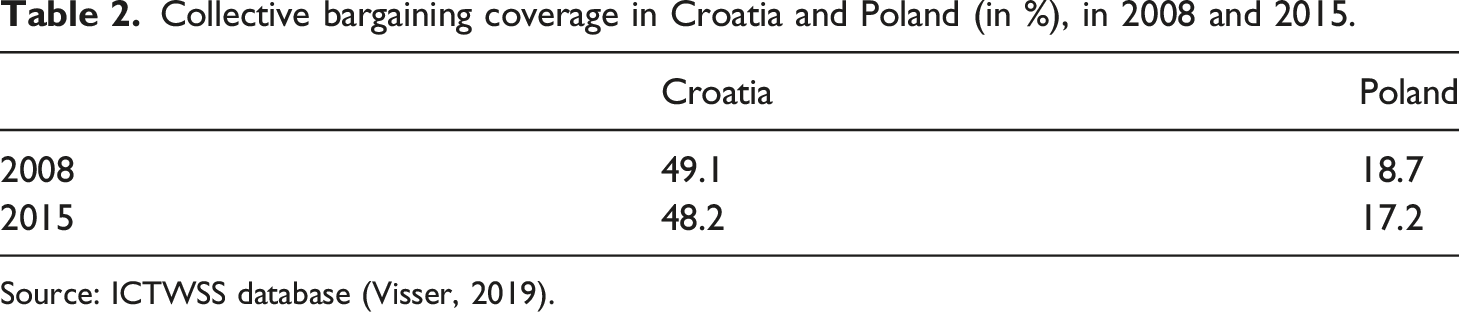
Source: ICTWSS database (Visser, 2019).
Societal power resources: A search for alliances
Historical background
Experiencing the decline of organisational, structural and institutional power resources, both Polish and Croatian trade unions turned to societal resources. This was not entirely surprising as they built on such resources in the past, mostly in the form of alliances between political parties and unions. In 1989, Solidarity was legalised and became not just a trade union but also the cradle of a wide spectrum of parties. Between 1997 and 2001, the union’s political representation, Solidarity Electoral Action (AWS), led the coalition government, which ended in a disastrous defeat at the end of its term. However, Solidarity alone could hardly be blamed for such an outcome, as AWS had already largely distanced itself from the union. Since 2005, the union has developed close ties to the Law and Justice (PiS) party, and in 2015, a number of union officers took government roles in the Ministry of Labour. A second large Polish confederation, OPZZ, remained close to post-communist Democratic Left Alliance (SLD) – as one of the founders of SLD as a coalition in 1993 – though these ties began to loosen towards the mid-2000s. However, not only were the union leaders ineffective in extracting political concession from the governments they supported, but they also often showed a surprising level of consent with neoliberal reforms (Avdagić, 2004: 24). The politicisation of these two large unions contributed to the emergence of a third national-level player, the Trade Unions Forum (FZZ), which since its creation in 2001 has accentuated its ‘apolitical’ profile.
The transition in Croatia started with the War for Independence, when in 1991, the unions signed the ‘War Agreement’ with which they promised to maintain social peace. The government for its part promised to consult with the unions on key social issues, though that promise was never kept. This agreement was terminated after the end of the most dramatic fighting in 1992 (Grdešić, 2008: 146). Subsequently in the 1990s, the unions acted within a conflictual pattern mainly due to disagreements with the government over the course of the privatisation process (Bagić, 2010; Grdešić, 2008). Unlike in Poland, there is no evidence that union confederations in Croatia consistently favoured one political party over another. Still, in the election campaign in 1999, two of five representative trade union confederations publicly supported the opposition led by the social democrats. This contributed to the change of government in 2000 and consequently led to more stable patterns of social dialogue. Nevertheless, the ‘Partnership for Development’ agreement that two trade union confederations signed in 1999 with the opposition led by the social democrats never produced concrete results. Already in 2002, both confederations abandoned this agreement because the new leftwing government failed to fulfil its obligations (Bagić, 2010).
In Poland, special links between the trade unions and political parties played an important role in the development of industrial relations, while in Croatia this practice was more contained. This could be explained by the differing legacies from the socialist past, whereby Croatia inherited the Yugoslav self-management system that permitted the formation of coalitions between workers and management directed against politicians (Grdešić, 2008: 138). Furthermore, the transformation process in Croatia was more gradual, leaving its trade unions with a greater degree of organisational and institutional power. Therefore, as argued before, Croatian trade unions were not as pressed to build their societal power. Nonetheless, in both countries, the post-1990s period witnessed a certain shift in union strategies away from the focus on political parties towards other strategies. Likewise, in the post-2008 period, both countries reaffirmed a re-politicisation trend, although to varying degrees. In continuation, this paper discusses that tendency in the context of attempts at strengthening union societal power resources as a source of revitalisation based on three case studies: unions’ struggle against an increase in the retirement age, their opposition to Sunday trading and their attempts to counteract the expansion of precarious employment.
Retirement age
In order to address the issue of sustainability of the pension system, governments have three main options: increasing contributions, lowering pension entitlements or raising the retirement age (Rabate and Rochut, 2019). The third path has prevailed among governments in Europe and has been generally supported by employers. However, the trade unions remained opposed and, in most cases, tried to slow or even prevent the implementation of such reforms that went against the interests of many of their members (Ebbinghaus, 2017).
In Poland, pension reforms have been on the agenda since 2008, when the possibility for early retirement was reduced by allowing a ‘bridging pension’ for up to 5 years only in particular occupations with health hazards. This reform was strongly opposed by the trade unions, but they were not successful. Subsequently, in 2011 shortly after re-election of the coalition government of Civic Platform (PO) and Polish People’s Party (PSL), the cabinet announced its determination to increase the retirement age to 67 for both men and women. The increase to 67 years was intended to happen gradually from 2013 to 2020 for men (from the previous retirement age of 65) and to 2040 for women (from the previous 60). Aware of the reform’s unpopularity, the trade unions called a protest against the proposal. Solidarity collected over two million signatures under a petition for a national referendum on the reform, but the proposal was rejected in the parliament. Furthermore, between March and May 2012, a series of union-led rallies took place in front of the government building, as the draft was being prepared. It is noteworthy that the union campaign relied not only on overturning the reform but also on coming up with alternative solutions, for example, making the right to pension dependent on the duration of employment, a stronger grip on social security contribution payments and labour law observance. Despite all the measures taken by the unions, the government concluded the reform in June 2012. However, 4 years later, this reform was reversed by the new government, fulfilling its promise made to Solidarity before the elections.
Following the examples of other EU Member States, including Poland, and the European Commission recommendations produced within the framework of the European Semester, the Croatian government launched comprehensive pension reforms in 2018. It prescribed that those born after 1965 would retire at the age of 67, up from the previous retirement age of 65. Additionally, the conditions for early retirement were made stricter. During Spring 2019, all three representative union confederations launched a campaign calling for a referendum to cancel or modify the controversial provisions of the pension reform. As in Poland, the campaign was built upon two sources of societal power – coalition and discursive. In terms of the former, the trade unions managed to attract support from other social actors, including the opposition parties and civil society organisations. Moreover, as in Poland, the campaign demonstrated a high level of discursive power since the organisers provided many substantive arguments against the proposed reform. The main argument was that people in Croatia live shorter than in Western Europe where retirement at 67 tends to prevail. Furthermore, they claimed that the contemporary labour market hardens the prospect for many workers to satisfy the conditions for the seniority pension. Ultimately, the Croatian trade unions managed to collect nearly 750,000 signatures in 15 days under a call for a referendum, which was submitted to the parliament. Assuming there would be no objections from the Constitutional Court on the posed question, the referendum was supposed to take place in late 2019 or early 2020. However, in September 2019 the government prevented it by cancelling all controversial parts of the pension reform, in light of the low probability of the Constitutional Court suspending the referendum and of the strong opposition campaign.
In many Western European counties, the increase of retirement age despite heavy trade union protest corroborates that these unions are on the defensive, especially since the outbreak of the financial crisis (Gumbrell-McCormick and Hyman, 2018). Yet, recent reversals of certain aspects of these controversial reforms have sent signs of encouragement throughout Europe. The cases of pension reforms in Croatia and Poland indicate that trade unions in both countries successfully used their societal power to stop these reforms. However, on that path, they relied on different strategies that could be classified in terms of Frege and Kelly’s (2003) typology. Due to their comparatively stronger organisational power, the Croatian trade unions primarily relied on coalition building. Their organisational power made them attractive partners for creating links with other organisations, both within and beyond the trade union movement. This strategy implied combining organisational power, that is, a strong capacity to collect signatures, with societal power, whereby the referendum was used as a tool. The same approach has been successfully applied on other occasions since 2010, when the country adopted a fairly liberal law for holding referendums. The Polish trade unions managed to collect four times fewer signatures in relation to the country population, possibly because of their comparatively weaker organisational power. Subsequently, they focused on political action to create more direct leverage upon the political process. This implied building their coalitional power through alliances at the political level, in particular between PiS and Solidarity, which proved somewhat successful after 2015.
Sunday trading
The last two decades witnessed a softening of legal restrictions on Sunday trading in most EU countries, although regulations still vary from country to country (Borowska-Stefanska et al., 2020). The proponents of Sunday trading deregulation argue that it has a positive impact on employment in the retail sector, particularly for part-time workers, and it increases turnover and ultimately wages. Positive effects on some complementary services, such as restaurants and financial services, have also been observed (Bossler and Oberfichtner, 2016). The opposition primarily comes from the ranks of the trade unions and Christian churches and associations close to their teachings. They argue that deregulation is economically unjustified because the time available for shopping has no impact on the total amount spent on purchases (Kovacs and Sikos, 2016). Furthermore, in their view this issue cannot be viewed from a profit-maximising perspective only, since the consequences of Sunday trading are detrimental to workers’ health and dignity, the work–life balance and to cohesion of the family and society (Šeba, 2019: 590). Less contested is the fact that Sunday trading generally seems to work better for the big retail companies than for smaller shops.
In Poland, the ‘Free Sunday Campaign’ was run by Solidarity for nearly 10 years (see: Czarzasty, 2010: 158–159) before it succeeded in 2017 with the adoption of laws restricting trading on Sundays. Back in 2008, a coalition of conservative non-governmental organisations and sectoral associations representing domestic capital emerged under the auspices of the union. The coalition signed the ‘Alliance for Free Sundays’ charter, in which they pledged to press for the introduction of legal regulations curbing Sunday trading. Until 2015, the prospects for the initiative to succeed remained thin with the PO-PSL liberal-conservative coalition government in power. However, with the PiS rise to power, the window of opportunity for more restrictive regulations opened. In 2015, Solidarity backed Andrzej Duda, the PiS presidential candidate, and had a number of their members elected to parliament with PiS’s endorsement. As a result, the union expressed their expectations for one of their flagship postulates to be enacted into law. While the government hoped to stretch the debate for as long as possible, Solidarity continued collecting signatures under the bill, drawing support of 500,000 citizens by the end of August 2016. As any civic initiative supported by at least 100,000 people must be accepted as a draft law, it was forwarded to parliament for debate. The main point of the proposal was to ban trading on Sundays, public holidays and certain other days. Faced with a strong opposition from both the businesses community and wide public opinion, the government offered a compromise: each month trading would be permitted on two Sundays, while on the remaining two Sundays, shopping outlets should stay closed. However, the union rejected this compromise and its hard stance ultimately paid off, as the final draft which passed into law in late 2017 set a path of incremental change to a full Sunday trading ban: in 2018, half the Sundays each month were to be free, in 2019 three and from 2020 all. The law makes one exception, allowing retail shops where the owner or immediate family members are directly in charge of sales to work on Sunday and public holidays.
In Croatia, the legislation prescribes that those workers who work on Sunday or public holidays must receive compensatory free days. However, these provisions are often not respected (Butković et al., 2018). In response to these irregularities, but also based on religious reasoning, in 2003 a petition against Sunday trading was co-initiated by the Franciscan Institute for the Culture of Peace and Croatian Caritas. Petition forms were distributed in over 1400 parishes throughout Croatia, with 300,000 citizens signing it in 30 days (Šeba, 2019: 581). The petition was supported by the trade union for commerce and the most important trade union confederations (Bagić, 2010: 188). The result of this action was the amendment to the Trading Act of 2004, which banned Sunday trading. However, several retail chain stores simultaneously filed a constitutional complaint which by mid-2004 resulted in repeal of the contested law by the Constitutional Court. In its reasoning, the Court argued that the law discriminates against large retail chains since it allowed small shops to remain open on Sunday (Šeba, 2019: 582). Over the next 3 years, campaigners broadened their arguments and proceeded mostly through direct lobbying of the government (Bagić, 2010: 188). These efforts bore fruit in early 2009 when a new Trading Act was adopted, prohibiting Sunday trading based on somewhat better specified argumentation. Nevertheless, another constitutional complaint was lodged arguing that the law violates the legitimate expectations of investors. Accepting this reasoning, the Constitutional Court abolished the Trading Act for the second time (Šeba, 2019: 583).
Calling upon the reasoning of this second decision in 2009, the government cancelled the provisions of the Retail Stores Act on working time (Butković et al., 2018: 71). Nevertheless, in 2017, campaigners against Sunday trading founded the ‘Croatian Sunday Alliance’ which was joined by Croatian trade unions and has been quite active over the past years. In May 2020, following the coronavirus crisis, two large Croatian retail chains (Pevex and Boso) employing thousands of workers publicly stated their support for a ban on Sunday trading. They noted that the crisis opened their eyes to the fact that Sunday trading is not crucial for the profitability of their business. At the same time, the government announced that it was working on a draft law that would limit Sunday trading to 14 Sundays per year.
Polish unions had a more leading role than their Croat counterparts, but in neither countries were they strong enough to singlehandedly mobilise public opposition against Sunday trading. Therefore, they strengthened their coalitional power by engaging in coalition building and political action, that is, alliances with ultra conservative associations and/or political parties. Within these coalitions, in order to bring their cause forward, they engaged in political actions that were novel to some organisations, such as signing petitions and civic initiatives. This so far has only succeeded in Poland, where the pre-election alliance between Solidarity and PiS secured direct access of the former to the government, including the temporary presence of several top Solidarity officials in subsequent PiS governments. In Croatia, the alliances that trade unions forged around this issue have always been focused on conservative associations. Still, it is remarkable how passive Croatian trade unions were within these coalitions, allowing the associations to take the initiative. This could perhaps be explained by the internal tensions within the trade union movement between supporters and opponents of such coalitions. Additionally, these associations also campaign against abortion and single-sex marriages, topics that are controversial within trade unions. Similar dilemmas also exist within the Polish trade union movement, expressing a long-standing tension between the union role as the defenders of worker rights and proponents of a broad, cultural identity-oriented agenda (cf. Ost, 2005).
Precarious contracts
With the advancement of new technologies, employers are increasingly demanding flexible forms of work that are often not contained within the Labour Code and therefore lack the related protection. Therefore, we are witnessing the spread of precarious employment forms, which bear relevant differences in comparison to a standard employment contract (Trif et al., 2016). The initial reaction of many unions to this polarisation of the labour force was its acceptance as a means of enhancing the security of their core members, which by large have standard employment contracts. However, over time they understood that in order to preserve their power resources, they need to recruit and organise workers with precarious contracts (Behrens et al., 2004; Gumbrell-McCormick and Hyman, 2018).
Temporary employees in Croatia and Poland as the percentage of the total number of employees aged 15–64, in 2013 and 2021.
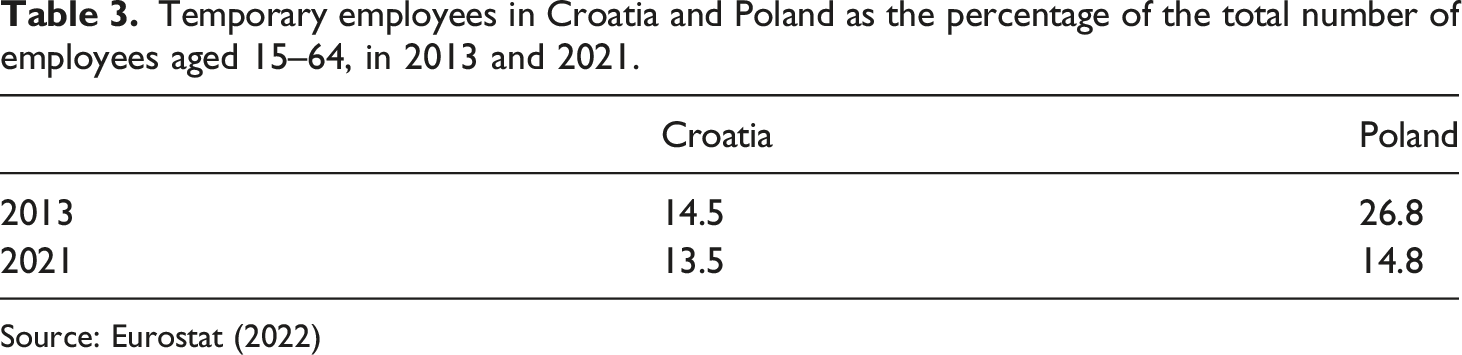
Source: Eurostat (2022)
Croatia is also a champion of temporary contracts (see Table 3). The vast majority of these contracts concern work on fixed-term contracts under the Labour Code, and civil law-based contracts are not as widespread. An attempt to reduce the size of the informal economy by introducing a new atypical type of contract was launched by the government in 2013, when the Ministry of Labour drafted new legislation that was to regulate causal and provisional work, such as assistance in the household, which is traditionally performed as a part of the informal economy. The role model for this legislation was the mini-jobs in Germany, as a new form of work that is generally characterised as low-wage and part-time. The reactions of trade unions to this proposal were very negative out of fear that jobs currently performed under fixed-term contracts could gradually be transferred into this novel form of work, which is less favourable for workers. Furthermore, they underlined that instead of increasing employment, this kind of work merely splits existing employment. For casual workers, the path towards regular employment is frequently blocked, as are their opportunities to engage in work-related training. The trade unions coordinated their efforts and increased their presence in the media to raise public awareness about the shortfalls of proposed legislation. Eventually, they managed a win over the employers, who rejected this proposal over concerns about its effects on established employers (Butković et al., 2018). Faced with such coordinated efforts and strong opposition, the proposed legislation was dropped.
The advocacy campaigns against precarious contracts in both countries relied on alliances within the trade union movement, which could be understood as revitalisation strategies to reinforce their organisational power. Nevertheless, they also relied upon making alliances with non-union societal groups, which strengthened their societal power (both coalitional and discursive). This case therefore demonstrates the complexities and variations within coalition building as a revitalisation strategy that assumes a type of societal power resource that Levesque and Murray (2010: 336) call ‘external solidarity’ or ‘horizontal and vertical links with other unions, community groups and social movements’. In the case of Croatia, a common position of both social partners forced the government to give up on its desire to introduce mini-jobs into the legislation. In the case of Poland, alliances were made with civil society associations and the political party. The former brought increased visibility to launched campaigns while the latter proved to be of crucial importance for making improvements in legislation and its implementation. However, representing the interests of precarious workers has so far not translated into their increased membership in trade unions, which remains fractional within this employee group. It seems that securing advancements on that front will require major transformations in the way the CEE trade unions work and operate.
Discussion
In this article, we examined trade union new responses to the problem of their diminishing structural, organisational and institutional power in Croatia and Poland, focusing on three comparable post-2008 campaigns. In the circumstances of blocked social dialogue and a slow but continuous decrease in membership, trade unions in both countries reached towards societal power resources in order to rebuild their otherwise challenged position. These union revitalisation attempts involved seeking tactic alliances with non-governmental organisations, citizens’ groups and political parties (re-politicisation), thus building on the unions’ broad social networks. As an instrument for obtaining societal power, trade unions in Croatia, though to a lesser degree in Poland, frequently relied upon referendums. In Croatia, such actions were encouraged by the liberal referendum law, while in Poland the conditions were less favourable. Furthermore, street protests and media and Internet-based campaigns were also used.
The three cases of prominent socio-political campaigns were nearly identical in terms of content: against the extension of the retirement age, Sunday trading and precarious contracts. A convergence of union agendas and tools in these two CEE countries with different legacies of unionism and pathways of transformation requires an explanation in the course of further research. On the one hand, it may indicate the role of external political pressure in the EU, which involves watering down tripartism (Ost, 2011), the spread of austerity policies during the late-2000 crisis (as in the case of retirement age) and pressures to liberalise labour regulations (Lehndorff et al., 2018). On the other hand, it might suggest the relevance of the diffusion of ‘narrative resources’ ideas (Levesque and Murray, 2013) among the CEE unions favoured by a similar cultural context, as in the case of Sunday trading campaigns, taking into account the influence of the Roman Catholic Church in both countries.
In the campaign against extension of the retirement age, the Croatian trade unions succeeded in blocking the proposed reform at its very beginning. To do so, they relied on strategic use of their organisational resources through the establishment of a cross-union alliance and the use of union members for organisational purposes. They further relied on the use of societal resources by using the referendum as a tool and forming coalitions with non-union groups. Polish unions were also successful but with some delay. On their path, they relied on a similar combination of power resources, but due to their weaker organisational power, greater emphasis was placed on building societal power, particularly through coalition-building with a political party. The Sunday trading campaigns in both countries relied heavily on the strategic use of societal resources. The only difference is that the emphasis in Croatia was placed on creating an alliance with civil society associations, while in Poland the focus was on building closer links between a union (Solidarity) and a political party (PiS). In both countries, the campaigns further relied on the strategic use of organisational resources through the creation of cross-union alliances. The fact that over the past 5 years Sunday trading has been brought to the forefront of public discourse in both countries speaks of the increase in the unions’ structural power, directly stemming from the outward labour migration and labour shortages. This represents the broader context in which the Polish trade unions managed to put a ban on Sunday trading, while Croatian unions came close to achieving that goal. Finally, the cases of the successful campaigns against precarious contracts also primarily relied on the strategic use of societal power resources, while cross-union alliances served as a prerequisite for further actions. Still, while the Croatian unions focused on building an alliance with the employers, the Polish unions again aimed at political lobbying.
In terms of revitalisation strategies (Frege and Kelly, 2003), both Croatian and Polish trade unions combined coalition-building with political action, though in different ways. The success of union campaigns in both countries relied on the capacity of labour organisations to build intra-union alliances and solidarity to overcome their organisational fragmentation. The dominant revitalisation strategy of the Croatian trade unions was coalition-building, both internally within the trade union movement and externally beyond it. In the Polish case, a prominent place was reserved for political action supplemented by the development of intra-union cooperation. This distinction could be explained by the different political context. Political action was never really an option in Croatia because the illiberal populist parties, which present themselves as opposing the neoliberal policies, always had only a marginal role in political life. In addition, the cooperation between Croatian trade unions and social democrats initiated at the end of the 90s had ended in failure, resulting in union disinclination to cooperate with any political parties. Instead, Croatian unions rather relied on other, non-party forms of political action such as referendum campaigns.
If the effectiveness of union strategies is measured by the level of citizens’ confidence in trade unions, their assessment would be rather critical, in particular in Croatia. The results of the European Values Study demonstrate that the share of those who expressed confidence in trade unions in Croatia declined from 25.8% in 1999 to 17.7% in 2008 and further to 13.2% in 2017 (GESIS, 2021, no data for 1990) despite relatively high – as per Eastern European standards – levels of unionisation and collective bargaining coverage in the country. In Poland, the level of confidence was higher and its decline was less pronounced, from 34.0% in 1999, to 31.1% in 2008 and 28.8% in 2017 (Ibid.). It seems that both Polish and Croatian citizens are not associating the activities of trade unions with improved working conditions, which would support our hypothesis on the hijacking of trade union agendas by other political and social actors. Yet, despite lower unionisation and collective bargaining coverage in Poland, Poles expressed visibly greater trust in labour organisations than Croats.
Conclusion
Despite the strong similarity between the strategies of trade unions in these two countries, the outcomes differed slightly. In both cases there were substantial successes, but more clear in Poland than in Croatia, especially on Sunday trading. The different importance of the Sunday work campaign in the two countries confirms the expectation that the organisationally and institutionally stronger Croatian trade unions would be less keen on experimenting with novel actions in the ambit of societal power resources.
The cases allow to draw lessons for the outcomes of political coalitions for trade union power. In neither case the positive outcomes on the specific grievances had positive effects on union membership and organisational strength. The somewhat more favourable material outcomes in Poland could mostly be explained by the different party landscape of the two countries. In Poland, this is dominated by the absence of any strong leftwing party since 2005, and the presence of a strong rightwing, illiberal populist party (PiS), with whom Solidarity formed an alliance: as a result PiS took over part of the union agenda. In Croatia, socialdemocratic and leftwing parties exist while there is little space for rightwing populist forces opposed to liberalism. As a result, the search of union societal power occurred in a more conventional political context, where trade unions relied on the liberal legislative framework for the implementation of referendum, including, in some cases, conservative civil society associations. Both of these strategies are problematic in terms of their sustainability. The current referendum legislation could be changed to a more conservative setting, while alliances with conservative illiberal forces produce a polarising effect on the trade union movement.
The slight difference in the outcomes in the two countries suggests the ambivalent nature of political coalition in today’s politics. Alliances with strong populist parties may result in more substantial immediate results (as they did in Poland after 2015), but also risk fostering the marginalisation of trade unions as independent actors more. If labour organisations are weak and their autonomy vis-à-vis political parties is questionable, their demands can easily be hijacked by political forces wanting to increase their legitimacy rather than to increase the power of organised labour. And the more unions weaken, the less interested the government will be in cooperating with trade unions (Culpepper and Regan, 2014).
Without significant organisational and institutional resources that secure unions’ ‘veto power’ in industrial relations (Traxler, 2010: 51), trade unions can easily become clients of their political patrons rather than renew themselves as autonomous interest organisations. In particular, political alliances with populist parties in power, as in Poland, while tempting for the visibility of specific campaigns, threaten to undermine unions’ institutional power (eg in tripartite bodies) as well as inter-confederation solidarity that can leave the way to deeper political divisions. The more hedged strategies of Croatian trade unions, forging multiple alliances without relying on one party specifically or endorsing rightwing populism, seem to provide fewer immediate results but safeguard other institutional and organisational power resources better. In the context of a current anti-democratic drift in Europe, turning into populist forces might be very tempting for unions, but for the rather weak Eastern European labour movements, this could prove to be a dead-end route.
Footnotes
Acknowledgements
The authors would like to thank the editors and the anonymous reviewers of the European Journal of Industrial Relations for their insightful and constructive feedback throughout the process of writing this paper.
Declaration of conflicting interests
The author(s) declared no potential conflicts of interest with respect to the research, authorship and/or publication of this article.
Funding
The author(s) disclosed receipt of the following financial support for the research, authorship and/or publication of this article: This work was supported by the study benefited from the following grants: PRECARIR – The Rise of the Dual Labour Market: Fighting Precarious Employment in the New Member States through Industrial Relations, European Commission grant VS/2014/0534, 2015–2016; Industrial Relations in Central and Eastern Europe: Challenges ahead of Economic Recovery, European Commission grant VS/2016/0101, 2016–2017 and Adaptation of Industrial Relations towards New Forms of Work, European Commission grant VS 2018/0039, 2018–2019.
