




Abstract
This article re-examines the main principle applied in the pursuit of gender equality in Australian wage-setting systems (equal remuneration for work of equal value) through the lens of a typology of contrasting approaches to gender (and overall) wage equality. It focuses on landmark legislative initiatives and cases over four epochs in Australian wage-setting history, from the first national equal pay case in 1969 to current provisions under the Fair Work Act. Our analysis indicates that there is no guarantee of a progressive trajectory, from narrowly conceived strategies that limit comparisons to the same work, through the revaluation of female-dominated work, to a more comprehensive approach capable of redressing systemic disadvantage. Rather, the Australian pattern has been one of advances, retreats and constantly changing barriers. We argue that although the principle of equal remuneration for work of equal value has potential to challenge the reproduction of gender inequalities within wage-setting systems, this is highly contingent on the strategies in place and ultimately requires recognition that wage disparities reflect the accumulation of structural inequalities and gendered practices.
Keywords
In this article, we examine the efficacy and sustainability of Australian strategies designed to deliver equal remuneration for work of equal value, as prescribed in the Equal Remuneration Convention of the International Labour Organisation (ILO), 1950 (hereafter ILO 100). This principle has to varying degrees informed the gender pay equality measures adopted in Australian wage-setting systems and our primary goal is to assess the extent to which its potential to fundamentally challenge gender bias in wage determination has been enabled by the strategies adopted. Applying the lens of a typology of contrasting approaches to equal remuneration for work of equal value and drawing on policy documents, legislative provisions and records of tribunal proceedings, we illustrate advances and retreats in the identification and redress of gender pay inequality across four epochs, each of which began with new legislative or tribunal interventions that shaped the possibilities for action.
Our analysis of these epochs is set against the nature of the state apparatus in Australia in dealing with industrial matters, including wages and equal remuneration claims. As part of Australia’s class settlement, capital’s capacity to price labour within the market economy was mediated by the creation of industrial tribunals, before which the claims of capital and collective labour were resolved (Smith, 2011a). Compulsory arbitration gave these industrial tribunals the power to settle disputes between capital and labour and make binding determinations (Barry and Wailes, 2004). Both federal (national) and state (provincial) tiers of government hold the capacity to legislate on industrial relations (and create industrial tribunals), although such rights for state governments were significantly weakened in 2006 and again in 2009 (Creighton and Stewart, 2010). A further feature of Australian industrial relations has been a centralised system of awards: industrial instruments that set minimum terms and conditions of employment, primarily at an industry level. While awards are a legacy of Australia’s compulsory arbitration and centralised wage determination, they have waned under an increasingly neoliberal state in favour of enterprise and at times individual wage-setting (Gahan and Pekarek, 2012). Even so, key features of the centralised wage-setting remain in place, and claims for equal pay have historically been made on a collective rather than an individual basis and through the system of wage fixation, involving the assessment of work value in industry-wide awards.
These wage-setting arrangements have both reflected and contributed to the reproduction of the Australian gender order. 1 Wage determinations in the early twentieth century institutionalised a ‘needs-based’ family wage that solidified male breadwinner/female carer divisions in line with prevailing gender norms. The deeply gendered assumptions about divisions of paid and unpaid labour manifest in the family wage were reflected in understandings of the value of work undertaken by women, producing interrelated constraints on women’s wages.
Within this context, deep-seated gender norms can be expected to impede the effective implementation of the principle of equal remuneration for work of equal value. However, there have also been countervailing pressures on women’s wages. The family wage and assumptions about the value of women’s work operated in parallel with a system that provided a level of protection to the low paid through the regulated award system, and required attention to ‘work value’ as a concept independent of market value to an employer. While lacking precise definition, work value in the Australian wage-setting system has been focused specifically on characteristics of the work and the context in which it is undertaken and thus provides a basis for the prosecution of equal value claims.
These contextual factors are reflected in the typology of strategies designed to deliver equal remuneration for work of equal value that we develop in the following section. The analysis then proceeds in four sections, addressing each of the epochs in turn. In conclusion, we draw together lessons from the gains and losses identified in the Australian case and reflect on the broader implications for advancing gender equality through the principle of equal remuneration for work of equal value.
Framing the analysis: Theorising and classifying approaches to equal remuneration for work of equal value
Feminist debates over the potential of equal remuneration for work of equal value 2 to redress gender wage inequality have consistently underlined the tension between those who view it as a ‘counter-hegemonic challenge to systemic discrimination’ (Fudge, 2000: 317) and those who argue that it reinforces male norms and ‘strengthens … occupational and wage hierarchies’ (Fudge, 2000). The principle’s ‘radical edge’ (Kainer, 1995: 460) lies in its capacity to expose the embedded norms that recreate structural inequalities in wage determination, with its extension beyond the basic principle of ‘equal pay for equal work’ consistent with a move from ‘formal’ to ‘substantive’ equality (Fredman, 2016; Fudge, 2000). However, early critics argued that the process would reinforce meritocratic wage hierarchies and the market principles that inform them (see e.g. Brenner, 1987). 3
For the purposes of analysis, we identify two intersecting sets of contingencies that shape the capacity to capture the radical potential of equal value measures. The first draws on feminist conceptualisations of gender equality that contrast liberal feminist notions of equality as ‘sameness’ with men (sought through equal opportunity measures) with radical feminist arguments for the recognition of women’s ‘difference’ from men (with redress sought through positive action) (see e.g. Squires, 1999). Limits to both these notions of equality echo Wollstonecraft’s (1792/2005) dilemma – that women are penalised whether they seek equality with men through ostensibly gender-neutral strategies that require them to conform to a male norm, or through recognition of gender difference in special provisions that risk reproducing sexism and the undervaluation of feminine attributes. Visions of a transition beyond this dilemma include a deconstructive approach that challenges and seeks to displace the sameness and difference binary (see e.g. Squires, 1999; Williams, 1991). Squires (1999, 2005) represents this as the third component of a trilogy of perspectives on gender equality in political theory: ‘inclusion’ (based on gender neutrality and ‘sameness’ with men), ‘reversal’ (based on recognition of female difference) and ‘displacement’ (seeking to ‘deconstruct those discursive regimes that engender the subject’ (Squires, 2005: 368)). 4
The history of equal remuneration strategies resonates with the first two components of this trilogy, with transition from a focus on equality as sameness in early ‘equal pay for equal work’ provisions to an explicit recognition of difference in ‘equal pay for work of equal value’ measures, as advocated in ILO 100. This suggestion of a trajectory from sameness to difference (and possibly beyond) can also be identified within equal remuneration for work of equal value strategies: measures designed to give effect to this principle range from requiring sameness with a male comparator to revaluing feminised work, and potentially to interrogating wage-setting and employment norms in ways that disrupt the structures underpinning the reproduction of gender inequality.
An earlier application of this typology to cross-national comparison of equal remuneration for work of equal value strategies (Smith et al., 2017) demonstrated its utility for analysing equal remuneration strategies, albeit illustrating a number of complexities including variation within categories and somewhat permeable divisions between them. Taking these lessons on board, we adopt the ‘inclusion-reversal-displacement’ distinction as the primary dimension of our framework for analysing the Australian system over time.
Table 1 (top panel) describes these approaches, separating equal pay for equal work from equal remuneration for work of equal value, with the latter divided into the three contrasting approaches, each of which may in turn encompass weaker and stronger versions and impinge on category boundaries (as argued in Smith et al., 2017). In this categorisation, ‘inclusion’ refers to strategies that seek a gender-neutral sameness, through either resisting comparisons across different forms of work or conducting them only through use of a male comparator. In its weakest manifestation, it may be close to the simpler principle of ‘equal pay for equal work’. The main risk of an inclusion approach is the uncritical acceptance of male rates as the standard for work value comparisons. ‘Reversal’ applies to strategies that acknowledge women’s difference, through according value to previously unrecognised or undervalued skills and conditions in female-dominated occupations, with weaker versions reliant on comparisons with male-dominated groups. It also involves risks – primarily, the reaffirmation of gender stereotypes and the attribution of lower value to newly recognised attributes. As Rubery and Hebson (2018) note, making gender visible is important but risks legitimising inequalities and essentialising difference (see also Fudge, 2000). ‘Displacement’ is used to describe strategies that are not limited by binary gender-based comparisons but that broaden the lens to include a wider range of factors that influence how work is (mis)valued. Our use of the term encompasses Squires’ (1999) conceptualisation of moving beyond strategies that engender the subject, but rather than Squires’ (1999) focus on intersectionality and overlapping social identities as displacement mechanisms, our conceptualisation also emphasises the need to displace the structural underpinnings of wage inequalities that are reproduced through wage-setting systems.
Wage-setting principles and practices with potential influence on gender and overall wage equality.
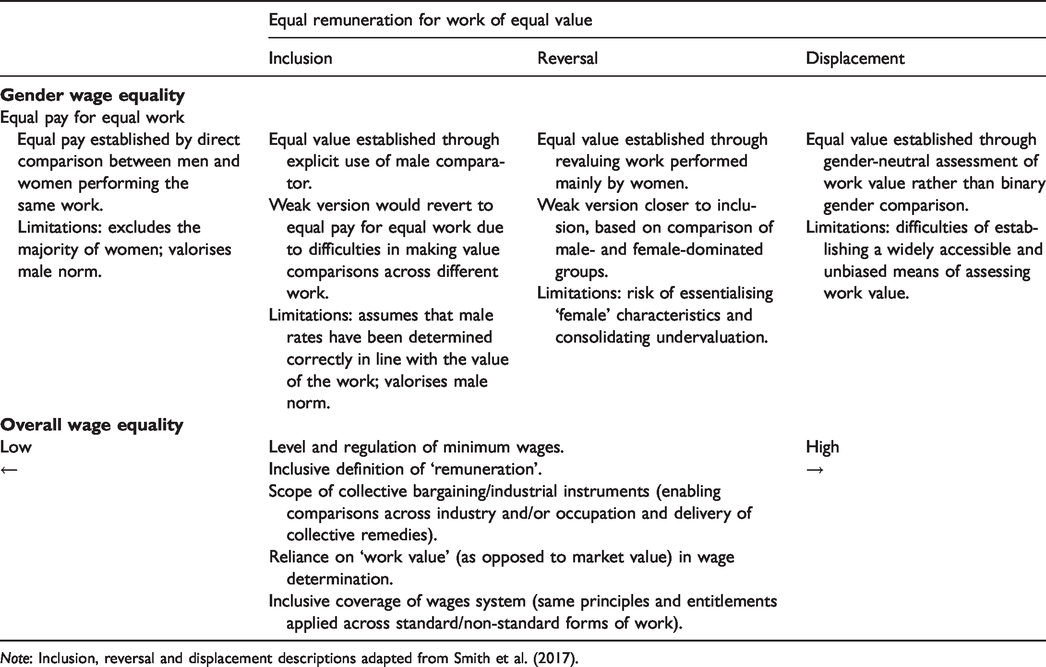
Note: Inclusion, reversal and displacement descriptions adapted from Smith et al. (2017).
This construction of ‘displacement’ (implicit also in Smith et al., 2017) is intimately linked with the potential of wage-setting practices to challenge established wage hierarchies and exert influence on overall wage equality. It echoes Rubery and Koukiadaki’s (2016) emphasis on the importance for gender pay equality of inclusive and transparent labour markets, relevant features of which include not only measures that restrict wage dispersion, 5 such as high minimum wages and constraints on high earnings, but also inclusive standards that cover all workers (p. 7). These are the conditions typically eroded under policy frameworks within which the scope of collective bargaining is narrowed and labour markets are increasingly segmented. Such trends are among the institutionally based ‘moving goalposts’ that continually recreate gender pay inequalities (Rubery and Grimshaw, 2015: 323). 6
Our second set of contingencies affecting application of the principle of equal remuneration for equal value is thus comprised of a spectrum of wage-setting principles and practices (see Table 1, lower panel). These include the viability of minimum wages, the scope for collective industry bargaining and the disposition of wage-setting policy to industry-wide living wage determination relative to enterprise and individual bargaining. Relevant also is how the value of work is established – a reliance on market value or assessment of the requirements and demands of the work and the context in which it is undertaken. In addition to measures that limit wage dispersion and are inclusive of all types of employment is the need for an inclusive definition of remuneration (as in ILO 100).
These provisions exert influence within each category of the gender equality categories in Table 1’s top panel, in particular supporting the potential of a displacement approach to recognise historic and current inequality and deliver appropriate remedies. For example, where these connections are strong, determinations of undervaluation will recognise the lack of inclusivity of past wage-setting measures and may include compensation for the erosion in value of remedies over time. Additionally, provisions for industry determination of wages provides the scope for collective (for example, across industries or occupations) rather than simply individual or enterprise-level comparisons and remedies in assessments of gender wage inequality.
In the next section of the article, we apply these criteria to each of our epochs, examining the extent to which the Australian regulatory framework has exhibited a trajectory towards a displacement approach to gender pay inequality, and how well this has been supported by broader wage-setting principles and practices. Through a specific focus on the principles guiding determinations, we seek to provide insights into optimal approaches to equal remuneration for work of equal value and the barriers that can derail them.
Australian approaches to equal remuneration for work of equal value across four epochs
In this section of the article, we apply our typology to key legislative and case initiatives over four epochs in Australian wage-setting. The features of each epoch, including wage-setting policy, are summarised in Table 2. Our focus is primarily on federal wage-setting. However, we also include key initiatives in two state jurisdictions, New South Wales (NSW) and Queensland (epoch 3), as these initiatives arose as a counterpoint to weaknesses in federal equal remuneration regulation.
Four epochs of equal remuneration strategy in Australia.

The 1969 and 1972 principles and 1986 comparable worth proceedings
The first epoch commenced with the introduction of equal pay principles into Australia’s federal system of wage fixation and includes their application in subsequent decades. The epoch, particularly prior to 1991, coincided with periods of compulsory arbitration, policy support for industry and occupational awards and centralised wage fixing. In 1969, the Commonwealth Conciliation and Arbitration Commission (CCAC) heard a claim lodged by unions and supported by women’s organisations for a flat-rate wage increase for women, designed to eliminate the ‘needs-based’ gender differences that had been embedded in wage-setting (Australasian Meat Industry Employees Union v Meat & Allied Trades Federation of Australia (Equal Pay Case 1969), at 1147). Employer organisations opposed the application both on the size of the wage increase sought but also on the basis that differences in wages should continue to reflect social relations (at 1150–1151). The Commission’s view was that equality of work must first be determined, and to this endit adopted a principle of equal pay for equal work that rested on a narrow interpretation of equal pay, in doing so agreeing with substantial elements of the submissions of the Commonwealth government 7 (at 1149–1150). The principle only applied where ‘work performed by men and women was of the same or a like nature’ (at 1158) and a specific exclusion applied to work predominantly undertaken by women (at 1159). This construction limited the available remedies to women who worked in identical jobs to men but received lower award wages than their male counterparts (Smith 2011b; Short, 1986).
The wider construction of equal pay for work of equal value was introduced by the Commission 8 only 3 years after its 1969 forerunner ( National Wage Case & Equal Pay Cases 1972 ). The decision followed a union application which included evidence that only 18% of women in paid work had received wage increases arising from the 1969 principle (at 177). Employer organisations opposed aspects of the application on the premise that it would be the basis for applications for wage increases to restore relativities in favour of men (at 178). This reasoning was rejected by the Commission, which acknowledged the narrow scope of the 1969 equal pay principle (at 178). As a result of the 1972 principle, the effective exclusion of female-dominated industries from the ambit of the 1969 principle was lifted. The decision provided the opportunity for the Commission to reassess the value of feminised work, utilising the concept of work value as historically applied by Australian tribunals. Although differentially applied, this concept took into account the skills and qualifications required for the work as well as the conditions under which it was performed. While in principle this could have involved comparisons of work value across awards, and the decision did nominally provide for this (at 180), the Commission thought that comparisons would be made mainly between classifications in the same industry or occupational award (Smith 2011b: 650).
The 1972 principle proved to have a less than straightforward application. There was a limited number of applications and those filed had been resolved by consent without arbitration and extended consideration, in the context of an application, of equal value. This context underpinned contested comparable worth proceedings in 1986 ( Private Hospitals & Doctors Nurses (ACT) Award 1972 ) when nursing unions, led by the Australian Council of Trade Unions, sought a series of in-principle rulings, including one that the Commission apply the 1972 principle via the concept of comparable worth. Comparable worth was not explicitly defined by the applicants other than to identify it as an alternative to work value as a potential means of assessing work equivalence, the implicit argument being that comparable worth would yield greater success in deploying the 1972 principle to address the undervaluation of feminised work. Women’s organisations supported the application and drew explicit attention to the requirement for a reassessment of the value of work. Employer organisations opposed the application, arguing that the 1972 principle applied through the concept of comparable worth would result in excessive applications for wage increases and would be inconsistent with the Commission’s approach to the determination of work value and the Commission’s wage-fixing principles (at 112). The Commonwealth government supported the ongoing implementation of the 1972 principle but also emphasised the importance of the wage-fixing principles and the control they exercised over wage increases (at 111).
Although the applicants did not define comparable worth specifically, the tribunals assessed comparable worth through its application internationally, based on material submitted by the Commonwealth government, concluding that it ‘refers to the value of the work in terms of its worth to the employer’ (at 113). The Commission rejected the application of comparable worth to Australian labour law and affirmed the concept of work value as the means of assessing whether the requirements of the 1972 principle were met (at 114).
The application of our typology to this particular epoch in Australian pay equity regulation carries some complexity. The claim that triggered the 1969 case sought increases for women that would eliminate the gender differences embedded in the family wage, and in this sense, it represented a challenge to the gender settlements that had characterised Australian wage fixing from the outset of compulsory conciliation and arbitration. However, the equal pay principle adopted by the Commission in 1969 was unequivocally an ‘inclusion’ approach – it was limited to ‘same work’ with its potential scope of reform excluding areas of highly feminised work, and effectively eschewing, albeit by exclusion, the specific and feminised identity consistent with the characterisation of a reversal approach.
The 1972 principle, which addressed the shortcomings of the 1969 principle through its recognition of feminised work, aligns with aspects of a reversal approach, ostensibly through its provision for equal rates where equivalence in work value could be demonstrated across different areas of work. Relevant also to this alignment was the absence in the principle of a requirement for a male comparator and the promotion of nominally gender-neutral work value criteria. Yet this promise provided by the 1972 principle posed new issues. In short, how should equivalence be assessed where work was different? The absence of cases following the 1972 principle highlighted how the tribunal, employer organisations and collective labour had failed to resolve the standard against which feminised work should be judged (Smith 2011a: e189). In practice, the application of the equal pay for equal value principle defaulted to an inclusion approach due to the unwillingness to extend comparisons beyond similar work. The comparable worth proceedings illustrated trade unions’ and women’s advocacy groups’ frustration with this default, but also the complexities in the prosecution of the reversal approach.
Through its decision in the comparable worth proceedings, the Commission determined that the 1972 principle privileged as a primary action comparisons of work within awards rather than across awards and occupational groupings. On this reasoning, and in the context of a nursing award, the gender pay equity position of nurses would be initially established by reference to other nurses. Yet the applicants’ approach in relying on comparable worth also had the effect of aligning the application of the principle to binary comparisons of feminised and masculinised work. The strategy proved antithetical to the applicant’s objective of utilising the 1972 principle to conduct the types of broad-based cross-award and cross-industry work value investigations that the applicants identified as necessary to redressing the valuation of feminised work ( Private Hospitals & Doctors Nurses (ACT) Award 1972 , at 113–114). The key question that would continue to characterise Australian pay equity regulation – namely, how should policy successfully elevate consideration of the undervaluation of feminised work (through a specific focus on gender) without recourse to comparisons with masculinised work – remained unaddressed. Coupled with the rarity of cases, this outcome underlined the difficulties of applying a reversal strategy in the Australian context. What eventuated was a weak form of reversal. For gender equality this was an opportunity lost. These weaknesses in the application of the 1972 principle occurred at a time when, if remedied, there was capacity for the widespread distribution of wage increases through the mechanism of industry awards.
A legislative right to equal remuneration, 1993–2008
The second epoch in equal pay for work of equal value initiatives began with the introduction of a legislative entitlement to equal remuneration for work of equal value in the federal jurisdiction in 1993–1994. This extension of equal pay provisions beyond the wage-setting tribunals was in part a response to the persistence of gender pay inequity in Australia, where a marked narrowing of the gender pay gap in average weekly total earnings in the 1970s had levelled off, leaving a relatively static gap of a little under 20% during the 1980s and into the 1990s (see e.g. Whitehouse, 2004: 218). The objective of equal remuneration for men and women for work of equal value was enshrined in amendments to the Industrial Relations Act 1988 (Cth) enacted as the Industrial Relations Reform Act 1993, with the provisions coming into force in 1994. The introduction of the legislative amendments coincided with a policy shift to more decentralised bargaining, inclusive of enterprise and at times individual bargaining. This shift included the dismantling of compulsory arbitration and the weakening of the system of industry awards.
The new measures provided the Australian Industrial Relations Commission (the successor to the CCAC) with the capacity to issue equal remuneration orders where the legislative entitlement to equal remuneration was found to be breached. The provisions explicitly referred to ILO 100, stating that rates of remuneration be established without discrimination based on sex. In line with the broad definition of ‘remuneration’ in ILO 100, they also widened the concept of ‘equal pay’ embedded in the 1972 principle to ‘equal remuneration’, which enabled consideration of payments over the minimum rate, or ‘overaward’ earnings (Layton et al., 2014: 143). The provisions would, in turn, be included largely unchanged in subsequent labour law legislation introduced in 1996, the Workplace Relations Act 1996 (Cth), but were amended by the Workplace Relations Amendment (Work Choices) Act 2005 (Cth) in a key area, one critical to the construction and assessment of equal remuneration regulation: applicants were required to cite explicit reference to a comparator group of employees, defined in the legislation as the ‘employees whom the applicant contends are performing work of equal value to the work performed by the employees to whom the application relates’ (s 622) (Smith and Stewart, 2017). However, these amended provisions were not ever tested by way of application.
The weaknesses in the legislative amendments introduced in 1993 were confirmed at one level by the low rate of applications and the absence of any equal remuneration orders made under those provisions (Layton et al., 2014: 138). More fundamentally, they were also illustrated in the complexities over what would be accepted as evidence of equal value and unequal pay. The one case that proceeded to extended arbitration followed a union application focusing on differences in the wage structures of female and male workers at HPM Industries: women employed as process workers and packers and engaged in repetitive, dextrous work and lacking consistent access to overaward payments; men employed in heavier general hands and stores work but enjoying access to significant overaward payments (Automotive,Food, Metals, Engineering, Printing and Kindred Industries Union v HPM Industries Pty Ltd). A key contest in the proceedings was the reliance by unions on competency standards to demonstrate that the work was of equal value (at 137–138). Employer organisations contested this reliance and with the Commonwealth government argued for a narrow interpretation of the legislative provisions; this concerned the Commission’s capacity to address overaward payments and assessment of whether differences in pay arose from sex discrimination (at 146–157).
The application was refused and a subsequent application settled without the need for final arbitration. The Commission’s ongoing interpretation of the legislative provisions was that applicants must demonstrate that the work was of equal value and that the disparities in earnings had a discriminatory cause (see also, Automotive, Food, Metals, Engineering, Printing and Kindred Industries Union v David Syme & Co., Ltd ; Hunter, 2000). The HPM proceedings demonstrated the complexity in demonstrating that earnings disparities arose from a discriminatory cause. Direct discrimination was not found because the work of the classifications cited in the application was sufficiently dissimilar, such that the remuneration differences between men and women were not found to exist in the same circumstances. Indirect discrimination was not determined because no requirement or condition was found to account for the remuneration differences between men and women workers (Smith, 2011a, 2011b; Automotive, Food, Metals, Engineering, Printing and Kindred Industries Union v HPM Industries Pty Ltd, at 165). In the small number of applications lodged under the provisions, the Commission confirmed that applicants should make their case on the basis of work value, but also indicated work value was a relative measure involving judgement by the Commission, where the choice of the method of demonstrating work value fell to the applicant (Automotive, Food, Metals, Engineering, Printing and Kindred Industries Union v David Syme & Co Ltd (2), at [20]; Automotive, Food, Metals, Engineering, Printing and Kindred Industries Union v HPM Industries (2) , at [17]–[18]).
Ostensibly this stage of equal pay reform held some promise for feminist advocacy and women in paid work, given the legislative foundation, its explicit reference to ILO 100 and the widening of the scope of those provisions to remuneration, rather than simply pay. These features broadened the scope of coverage and the potential for meaningful remedies and – through the promise of an increased capacity to assess ‘value’ across different types of work – opened possibilities for a stronger reversal approach. However, the direction to discrimination and its interpretation by the Commission favoured a narrow form of job comparison and constituted a weak form of the reversal approach. In practice, the equal remuneration provisions were limited by constraints imposed by the tribunal on the capacity of applicants to demonstrate that the objective of equal value was not met. These constraints included the requirement to ‘prove’ discrimination and the ‘individualisation’ that this imposed. The requirements of the sex discrimination test, as determined by the Commission, tightened the grounds upon which applications would be heard. It meant that it favoured resolution at the level of the individual worker, or of the workplace, such that an individual woman or a workplace group of women had to demonstrate discriminatory processes in the determination of their wages. Thus, equality could only be claimed where women demonstrated a ‘sameness’ to men, with ambivalent or overly restrictive conditions on how ‘difference’ from men should be assessed, measured and valued (Smith, 2011a: e191).
As was the case under the 1969 and 1972 principles, work value was the means through which parties were required to demonstrate equal value. The key question that remained was whether the conceptualisation and application of work value had been sufficiently inclusive of feminised work (Layton et al., 2014: 144). The inherent weakness in the discrimination test, joined to the Commission’s lack of openness to recognise past frailties on the application of work value, meant that in practice the 1993 legislative amendments constituted a very weak reversal approach. While the provisions nominally enabled the prosecution of claims for equal remuneration for work of equal value involving different areas of work, the interpretation of the provisions narrowed the scope of the provisions to areas of similar work. Buttressing these weaknesses was the broader fragmentation of wage-setting that had occurred with federal wage-setting policy, a fragmentation that highly constrained the capacity for award-based remedies to gender inequality.
Equal remuneration regulation initiatives in NSW and Queensland (1997–)
The third epoch was the phase during which equal remuneration initiatives in two state jurisdictions considerably broadened the scope for establishing and redressing the undervaluation of work typically performed by women. These initiatives arose in the context of stalled federal equal pay reforms, leading to renewed interest in state government jurisdictions over the potential for new directions in measures to advance pay equity. Two states, NSW and Queensland, led the way, initially through pay equity inquiries conducted through the respective state industrial tribunals (Fisher, 2001; Glynn, 1998). The nature of the inquiries provided discursive opportunities for an assessment of regulatory approaches to equal pay; in turn the inquiries preceded new equal remuneration principles in those jurisdictions (Equal Remuneration Principle (2000); Equal Remuneration Principle (2002)). The broader wage-setting context mirrored some aspects of that evident federally, namely the weakening of compulsory arbitration and support for decentralised forms of bargaining. Yet it remained possible for wage increases arising from an equal remuneration determination to be widely distributed through an industry award.
There are some important distinctions between the two state approaches, namely the equal remuneration principle in NSW is confined to minimum award rates of pay, whereas the Queensland principle is not (Layton et al., 2014: 164). Additionally, the Queensland Equal Remuneration Principle specifically directs industrial tribunals to consider whether there has been adequate weight placed on the typical work performed and the skills and responsibilities exercised by women, as well as the conditions under which the work is performed. It also notes that aspects of women’s labour market participation may have influenced the valuation of their work. These included the degree of occupational segregation, the disproportionate representation of women in part-time or casual work, women’s low rates of unionisation, and their low representation in workplaces covered by formal or informal work agreements. The differences in the principles reflected the nature of the equal remuneration proceedings in NSW; namely, that the state government had not implemented legislative amendments following the inquiry, and the strong interest of the Commission in unions and employer organisations reaching a largely agreed position on the principle (at [[6],143]).
These differences aside, equal remuneration principles in both NSW and Queensland place emphasis on gender-based undervaluation as the threshold to establishing whether there is the basis for an equal remuneration claim. A central feature is that the test of undervaluation does not revert routinely to a male standard, in fact comparisons within and between occupations and industries are not required in order to establish undervaluation of work. Male ‘comparators’ might be used for illustrative purposes but are not an evidentiary precondition. Applicants can use a range of comparisons, including other areas of feminised work, where the applicant can demonstrate the rates of pay have been set properly (see e.g. Smith and Stewart, 2010; Hall, 1999; Whitehouse and Rooney, 2007). This approach provided for assessments of gendered practice in the recognition of work (see Blackman et al., 2020).
In the terms of the typology we have outlined, the approaches in NSW and Queensland represented a strong reversal and at times displacement approach. In a number of cases, the Commission identified that comparative assessments were either not supportive of the resolution of the case or were not required; alternatively, evidence was drawn from a wide range of comparator positions when seeking to remedy confirmed undervaluation. Undervaluation could be demonstrated by showing that current rates of pay were not in accord with the tribunal’s assessment of the value of work, and the Commission was able to avail itself of a wide range of evidence in reaching this conclusion. Although the concept of gender-based undervaluation would be conducive to successful applications in both NSW and Queensland, the cases also illustrated an unevenness in application, as industrial tribunals addressed the lived experience of an approach to equal remuneration that did not rely on either mandatory comparators or the requirement for discrimination to be proven. This unevenness was evident in the ways in which the state Commissions determined findings of undervaluation and/or fixed a remedy for the undervaluation so found.
While in both jurisdictions there was evidence of the industrial tribunal eschewing the requirement for a masculinised comparator, different approaches to the establishment of undervaluation and its redress were adopted in the cases heard under the new principles. In a case involving childcare workers in NSW, the Commission found that there were ‘serious difficulties’ in drawing comparisons between the work of childcare workers and those employed in male-dominated industries, but found that comparisons could usefully be made between teachers and childcare workers in setting a new rate for childcare workers ( Miscellaneous Workers' Kindergartens and Child Care Centres etc (State) Award at [214]–[217]). The Queensland Industrial Relations Commission in LHMU v The Australian Dental Association (Queensland Branch) Union of Employers did not rely on the use of comparators to determine undervaluation. The Commission’s recognition of undervaluation was not based on the use of a male (or any) comparator, but rather on factors including the identification of gender bias in the award history. The absence of work value cases, poorly applied wage adjustment processes and a prevalence of consent awards were taken as indications that the work had never been appropriately valued, and that there was a need for work value assessments that identified under-recognised skills, qualifications, training and professional development, and the ‘disabilities’ associated with the conditions under which dental assistants worked (at [48], [51], [63], [162]). Having found that the work of dental assistants was undervalued, the Queensland Industrial Relations Commission (QIRC) based the remedy on a male comparator via the metal industry tradesperson (C10) classification in the Engineering Award – State. 9 This route to remedy was in line with the widespread and historical use of the C10 level in the federal Engineering Award (and its antecedents) as a benchmark for work value comparisons: the Commission’s reliance on it in this case was evidence of a weaker reversal model due to the central role it gave to masculinised benchmarks in assessments of work value. Yet this aspect of the decision was balanced by the acknowledgement that a simple variation of minimum (award) rates of pay would be insufficient to redress the undervaluation found, hence the comparison of C10 rates was extended through recognition also of state enterprise bargaining rates. Taking these into account increased the remedy delivered; moreover, the decision included an ‘equal remuneration component’ to help offset erosion of the decision’s relative value over time, recognising that dental assistants had limited access to enterprise bargaining and a structural inequity in wage determination (at [188], [192]–[197]). 10
In summary, the equal remuneration principles in NSW and Queensland allowed the identification and redress of gender-based undervaluation through approaches that ranged from weak to strong reversal and on occasions moved towards a displacement model. Cases taken under the principles explicitly valued ‘difference’ by recognising the skills and conditions of the work being performed, demonstrating that significant elements of work had previously not been taken into account or not accorded sufficient weight in assessments of work value. They did this in part through recognition of historically embedded gender bias in industrial instruments, exposing the ways in which earlier rates had been set incorrectly due to assumptions about the nature and value of work undertaken by women. Importantly, this was achieved without requiring the applicant parties to demonstrate that the rates had been set incorrectly because of sex discrimination. The process delivered benefits in spite of the risks of essentialising previously unrecognised skills as ‘female’ and potentially of lesser value than those that could be aligned with a male norm. In other ways, however, the strategies adopted moved beyond these ‘reversal’ benefits and risks to a recognition of structural disadvantage as a basis for undervaluation. This was most evident in Queensland where the equal remuneration principle includes explicit criteria consistent with structural disadvantage, such as high levels of casualisation and low levels of enterprise bargaining. These differences in approaches to the establishment of undervaluation were echoed in the remedies adopted. The Commission’s focus on ensuring that the value of the work was properly set ranged from defaulting to a weaker reversal model through an exclusive reliance on male comparators, to remedies that recognised structural disadvantage by aligning new rates of pay with bargained outcomes in relevant occupations.
Equal remuneration under the 2009 Fair Work Act
The fourth epoch concerns equal remuneration provisions in new federal labour legislation introduced in 2009: the Fair Work Act. The equal remuneration provisions in the new Act confer a discretion on the Commission 11 to issue an order to ensure that, for the employees to whom the order will apply, there will be ‘equal remuneration for men and women workers for work of equal or comparable value’ (s302(1)). The inclusion of the phrase ‘or comparable value’ significantly expands the power to make equal remuneration orders relative to previous legislation; moreover, unlike earlier legislation, the provisions do not specify a requirement to demonstrate sex discrimination or make reference to a comparator group of employees (Smith and Stewart, 2014). The introduction of new federal labour law retained a focus on enterprise but not individual bargaining, but did provide the basis for the review of industry awards through award modernisation. The importance of federal equal remuneration regulation had increased due to wider changes in Australian labour law (see Table 2). The current equal remuneration provisions have been tested by way of two cases, the outcomes of which demonstrate the uncertain nature of equal remuneration regulation in Australia.
The first case arose from an application by unions for equal remuneration orders in the social and community services sector. The applications were contested with employer organisations opposed to the unions’ reliance on gender-based undervaluation as the rationale for seeking equal remuneration orders. Fair Work Australia (the name of the tribunal at that time) handed down the first of the two major decisions in May 2011 (Equal Remuneration Case (2011)). The central features of this first decision were the tribunal’s finding that the work was undervalued on a gender basis, and its direction to the parties to make further submissions on remedy. The finding of gender-based undervaluation involved a set of linked conclusions. The tribunal found that much of the work is caring work; that such a characterisation can contribute to the undervaluation of work; that work in the sector was indeed undervalued; and, given that caring work has a female characterisation, that the undervaluation was gender based (at [253]). Fair Work Australia determined that it was not a prerequisite for applicants to rely on a male comparator, although applicants were required to demonstrate that the remuneration paid had been subject to gender-based undervaluation (at [233]). The parties were required to make further submissions on remedy, specifically the extent to which the undervaluation was gender based (at [286]).
The applicants’ submissions on remedy relied on identifying the proportion of caring work in each social and community services sector classification, relevant to the classification, as a proxy for gender-based undervaluation. In February 2012, a majority decision of the Fair Work Commission largely accepted the use of care work as a proxy for gender-based undervaluation and agreed that it should be remedied (Equal Remuneration Case (2012)), at [63]). The resultant equal remuneration order provided for increases of between 19% and 41% to the minimum award rates in addition to a 4% loading, to recognise ‘impediments to bargaining in the industry’ (at [68]).
The second test of the provisions arose from an application for equal remuneration orders in the early childhood education and care sector. The Commission deferred hearing the substantive application, and following submissions handed down a decision in November 2015 on legislative and conceptual issues (Equal Remuneration Decision (2015)). Unions argued that the Commission should continue to utilise gender-based undervaluation as the means of assessing whether the legislative requirement of equal remuneration for work equal value was met (Independent Education Union of Australia, 2014; United Voice and Australian Education Union, 2014). Employer organisations and the Commonwealth government argued that applicants must demonstrate that the objective of equal remuneration for work of equal or comparable value is not met through reference to a comparative assessment of equal value (Australian Chamber of Commerce and Industry, 2014; Australian Federation of Employers and Industries, 2014; Australian Industry Group, 2014; Commonwealth of Australia, 2014). In its decision the tribunal rejected gender-based undervaluation as a means of women claiming equal remuneration under the equal remuneration provisions of the Fair Work Act, thereby dismissing the reasoning that had been relied on in the preceding social and community services case. The Commission determined that for an equal remuneration order to be made in favour of a group of female employees, an applicant must identify a group of male employees, doing work of equal or comparable value, who were receiving higher remuneration (at [242]–[243]). In specifying the requirement for comparators, the Commission also identified the particularly narrow set of circumstances that this requirement would favour: It is likely that the task of determining whether s302(5) is satisfied will be easier with comparators that are small in terms of the number of employees in each, are capable of precise definition, and in which employees perform the same or similar work under the same or similar conditions, than with comparators that are large, diverse, and involve significantly different work under a range of different conditions (Equal Remuneration Decision, (2015), at [291]).
To assess the comparison of jobs, the Commission indicated that it would rely on concepts of work value, as it was understood in industrial proceedings, although other criteria may also be relevant (at [279]–[280]). On the question of remedy, the Commission found that if a lack of equal remuneration was established between the two (explicitly gendered) groups, there would be no warrant for ‘discounting’ any remedy to exclude pay differences that are not gender-related (Smith and Stewart, 2017).
In addressing its rejection of the concept of gender-based undervaluation as the basis of a claim for equal remuneration, the Commission determined that it is insufficient also for applicants to base their claim on the proposition that the current rates of remuneration did not reflect the intrinsic value of the work (at [290]), although it is open for applicants to file a work value claim seeking to vary the minimum rates of pay in a modern award on the basis that rates of pay undervalue the work for gender-related reasons [at 292]. Any claim of this nature would, however, be restricted to minimum rates of pay. 12
The Commission’s shift in reasoning from the social and community services case to the early childhood education and care case has continued the transitory and contested nature of Australian equal remuneration regulation. In the context of our typology, the regulation as practised represents a weak form of the reversal approach and in some areas a slippage back to the inclusion approach. The regulation requires binary comparisons, and while it extends to remuneration, rather than minimum wages, is not well suited to resolution of equal remuneration claims at an industry level. Previous stages of federal equal remuneration regulation arguably rested implicitly on or defaulted to a series of masculinised benchmarks. Yet the Commission’s recent insistence on a binary and gendered comparator has rendered this relation an explicit one and needs to be read alongside the Commission’s acknowledgement that applications for equal remuneration orders will be more straightforward when the workers, featured in the application, are performing similar work under similar conditions. Such a requirement favours an individual woman or a small group of women claiming equal pay for work of equal value on the basis of a comparison with a male worker or workers in a single workplace. This requirement and the narrowing of the basis upon which equal remuneration can be claimed highlights Australian federal regulation’s struggle to address the ‘complexities in how sameness and difference are conceptualised and reconciled, and how gender inequalities can be reproduced in such discourses’ (Smith and Stewart, 2017: 133–134). This shift in the interpretation, and the consequent narrowing of the scope of the provisions, sat awkwardly alongside a renewed albeit limited capacity at a federal level to prosecute award-based reform. In its rejection of gender-based undervaluation, the Commission has spurned the opportunity to both redress undervaluation and direct the focus of regulation to ensuring the value of work is properly set. Additionally, applicants cannot address historical bias in industrial instruments through equal remuneration applications, thus providing for a very limited recognition of structural disadvantage (see also Macdonald and Charlesworth, 2013).
Conclusion
Implicit in our characterisation of a continuum from inclusion, through reversal, to displacement is the presumption of progression towards more effective ways of redressing gender pay inequality. Our analysis shows that a linear progression of this nature has not been the experience in Australia – rather, the pathway has been indirect, sometimes circular and remains unclear in direction. The epochs (and the cases that constitute them) illustrate both the hybrid nature of the equal remuneration approaches adopted and oscillation between contrasting approaches. Consistent with Rubery’s (2019) observations, the unevenness and inconsistencies in approaches and outcomes reflect the highly politicised nature of pay equity reform. This is evident in the Australian epochs through the calibrated resistance by employer organisations and at times the state to those measures that would address structural disadvantage. What is evident is a nominal commitment to gender pay equity, but one that is narrowly cast–confined in effective terms to resolving wage differences between women and men engaged in similar work. Relevant too is the imprint of neoliberalism that has weakened the capacity for industry awards to be the agency for gender equity.
These complexities are evident in each of the epochs we examine, but they are also contextualised by wider wage-setting policies and practices. The potential for ‘reversal’ in the 1972 principle, with its explicit focus on equal value and lack of explicit need for a male comparator, was inadequately captured, in part due to the Commission’s unwillingness to extend comparisons beyond similar work, and in part due to the kinds of comparisons later sought by applicants. The extension to a legislated entitlement to equal remuneration for work of equal value in 1993 similarly promised a strong ‘reversal’ approach but was limited in practice by constraints on the capacity to demonstrate equal value, including the Commission’s interpretation of the requirement to ‘prove’ that disparate rates of pay arose from discrimination and the individualisation of comparison that this test imposed. The much stronger reversal model that emerged from NSW and Queensland pay equity inquiries in the late 1990s and early 2000s, embedded in pay equity principles for establishing gender-based undervaluation that did not require comparators or proof of discrimination, did enable more progressive decisions, including some that pushed the boundaries of reversal towards displacement through recognition of structural disadvantages. However, the subsequent expansion of the federal jurisdiction has precluded further application of these principles in the private sector, and – as analysis of our fourth epoch under the provisions of the Fair Work Act 2009 shows – the Australian trajectory has swung back towards an ‘inclusion’ or at the very least ‘weak reversal’ approach to equal remuneration. This is evident most recently in the requirement for a binary and gendered comparator, and is emphasised in the Commission’s acknowledgement that applications for equal remuneration orders will be more straightforward when the workers are performing similar work under similar conditions.
Examination of the epochs also highlights some of the tensions in reversal approaches. Reversal approaches are predicated on the specific identification of failings in the valuation of feminised work, such that the objective of equal remuneration is not being met. Yet the standard of evidence, or underpinning methodology, required to support the application–as too the required approaches to remedy–is often only legitimised by reference to masculinised comparators. This particular weakness illustrates the tension inherent in reversal approaches that can identify flaws in the historical assessment of work value but at the same time risk being grounded in essentialism. This not only limits the remedies that are available to women through reversal, it also occludes consideration of the conflation of gender with those factors that generate structural disadvantage in wage outcomes. Arguably, a requirement for comparators is not mandatory in the strongest forms of the reversal approach, nor in a displacement approach, although the cases that we have reviewed have also identified the nuances in the distinctions between the reversal and displacement approaches. This is apparent in the determination of undervaluation and also in its remedy; specifically, the recognition that wage disparities arise from a cumulative series of additive and gendered practices. If the object of equal remuneration for work of equal value is to be realised, remedies in the context of the Australian wage-fixing system would be required to address not only historical and gendered assessments of work value (and the processes that give rise to them), but also the inequities in remuneration outcomes that arise from women’s lack of access to bargained wage outcomes. Yet remedies of this type are best enabled by wage-setting policies and practices that provide for the assessment of undervaluation at an industry level, including the recognition of structural disadvantage in the prior regulation of the work.
Overall our analysis illustrates the absence of any clear trajectory in approaches to equal remuneration for work of equal value in Australia, and warns against assuming any smooth pathway from inclusion through reversal to transcendence of the sameness/difference binary in displacement. In drawing attention to the location of contrasting approaches in our typology, we underline the features of policy design needed to redress gender-based undervaluation of work. Australia’s trajectory to date underlines how vulnerable these features are and contributes to understandings of what is needed in order to enhance the sustainability and application of ‘equal pay for work of equal value’ strategies over time.
Footnotes
Declaration of conflicting interests
The author(s) declared no potential conflicts of interest with respect to the research, authorship and/or publication of this article.
Funding
The author(s) received no financial support for the research, authorship and/or publication of this article.
