




Abstract
We investigate gender-based wage undervaluation in light of Fair Work Australia’s major recent decision for social and community service workers. Using regression methods, we demonstrate that wages for employees in female-dominated occupations are significantly lower than for comparable employees in male-dominated and integrated occupations. This undervaluation is present for both male and female employees, and persists after controlling for industry of employment. We then estimate the undervaluation within industry and juxtapose the results with evidence on the industry distribution of award reliance, a proxy for Fair Work Australia’s equal remuneration powers. There is not a strong relationship within industries between the extent of gender-based undervaluation and award reliance. This suggests that ‘equal remuneration for work of equal or comparable value’ is unlikely to be achieved universally by Fair Work Australia without substantial spillovers between awards and non-award agreements.
Introduction
Progress towards gender pay equity in Australia has taken a remarkable new turn in Fair Work Australia’s (FWA’s) Equal Remuneration Case for social and community service (SACS) workers. 1 The decision ratifies at a national level an approach to pay equity founded on the ‘undervaluation’ principle developed by State industrial tribunals in the 1990s. The approach establishes undervaluation via indicators of feminisation associated with the work or workers, without requiring male comparators or explicit evidence of discrimination (Austen et al., 2013; Smith and Stewart, 2010; Whitehouse and Rooney, 2011).
While industrial tribunals have developed new approaches to pay equity, their direct involvement in wage determination has declined. In the past, Australia’s highly centralised wage system allowed rapid increases in female wages via extensive award reliance (Gregory, 1999; Pocock, 1999; Whitehouse and Rooney, 2011). Today, the award system is a ‘safety net’ that fewer employees rely on, as bargaining has become the dominant mode of wage-setting (Rozenbes, 2010). This shift away from award reliance may well reduce FWA’s capacity to advance pay equity since, historically, ‘outcomes for women have been most decisive where arbitrated decisions have enjoyed national or industry-wide application, in contrast to the uncertainty of enterprise and individual bargaining’ (Smith, 2011: 648).
This article weaves together these two threads in thinking about gender pay equity: the concept of gender-based undervaluation, and the shifting role and capacity of the national tribunal, FWA. It connects, in a new and useful way, two strands of the literature that are often treated separately. On the one hand, we draw on labour law scholarship for its rich understanding of the development and implications of the different approaches to pay equity in Australia’s industrial history. On the other hand, we employ the data and methods of empirical labour economics to determine where gender-based undervaluation exists in the Australian workforce. Focusing on this linkage inevitably means that our treatment of each approach is briefer than would be the case if either were dealt with in isolation. In particular, our comments about the development of the equal remuneration provisions in the Fair Work Act 2009 (FW Act), and the bases of FWA’s decision in the SACS Case, are more sparing than can be found elsewhere (Austen et al., 2013; Smith and Stewart, 2010; Whitehouse and Rooney, 2011). The consideration that we do give to these issues provides an essential motivation for the analysis and a context for our conclusions about FWA’s powers.
Our primary empirical aim is to determine the extent of gender-based undervaluation in the national context. We do this by estimating multivariate wage regression models founded in the economic literature on comparable worth. The results provide evidence of the relationship between occupational gender composition and wages. Our second aim is to consider how effective FWA is likely to be in improving wages for the occupations that are undervalued on the basis of their gender composition. We do this by juxtaposing our estimates of undervaluation at industry level with other estimates of award reliance which proxy for the influence of FWA. There does not appear to be a strong link between the extent of undervaluation and award reliance at the industry level. We argue that there may be difficulties in achieving the equal remuneration objectives of the FW Act in settings where undervaluation does not coincide with high award reliance.
The remainder of the article is structured as follows. The next section reviews developments in the pay equity principles of the industrial tribunals that preceded the current undervaluation concept. We then discuss the SACS Equal Remuneration Case. The following section reviews empirical studies of undervaluation, focusing on Australian evidence. We then describe the data and methods used in this analysis, before presenting our estimates of undervaluation. The conclusion restates some important limitations of the analysis and suggests directions for further research.
Australian equal pay principles
Industrial tribunals play an integral part in the Australian history of pay equity. Until the 1960s, the ‘male breadwinner’ ideology established in the Harvester Case justified a lower female basic wage and ‘entrenched discrimination’ against women (Pocock, 1999: 279). The Commonwealth Conciliation and Arbitration Commission adopted the ‘equal pay for equal work’ principle in 1969, beginning the first phase of national pay equity reform (Borland, 1999). As this principle applied only to similar types of work, remedies were unavailable for the many women employed in female-dominated occupations that lacked an obvious male counterpart; consequently, ‘only 18 percent of women received equal pay’ (Australian Services Union (ASU), 2011: 6; Short, 1986: 318). The Commission broadened the scope of pay equity to include the principle of ‘equal pay for work of equal value’ in 1972, and extended the male minimum wage to women in 1974, resulting in a rapid increase in the gender pay ratio (Gregory, 1999: 273–274).
The limitations of the 1972 equal value principle were exposed in 1986, when the Commission rejected an application from the nurses’ unions based on ‘the concept of comparable worth, which was then part of the equal pay debate in the United States’ (ASU, 2011: 8). The Commission’s reasons included the incompatibility of comparable worth with the established Australian principle of ‘work value’, and the lack of precedents for comparing dissimilar types of work, even where such comparisons were needed to overcome the occupational gender segregation that underpinned female wage disadvantage (ASU, 2011; Bennett, 1988; Short, 1986).
In 1993, the Keating government introduced a legislative right to equal remuneration for work of equal value that promised further progress towards pay equity. But the Commission’s interpretation of this right as an anti-discrimination remedy, which thus required proof of a discriminatory cause, sharply limited its practical utility. In the ‘HPM proceedings’, the Australian Manufacturing Workers Union sought an equal remuneration order for female process workers and packers earning less than men in the same firm employed as heavier general hands and storemen. Yet the Commission found no evidence of discrimination, as the comparisons were between men and women working in dissimilar jobs. This decision illustrates the principal weakness of rights-based approaches to pay equity, which ‘affirm equality where women can demonstrate a “sameness” to men, but are ambivalent or overly restrictive as to how “difference” from men should be assessed, measured and valued’ (Smith, 2011: 652).
The most recent phase of Australian pay equity reform has seen the gender-based undervaluation principle develop in several State jurisdictions (Whitehouse and Rooney, 2011). The State tribunals, most notably in New South Wales and Queensland, have sought to avoid the limitations of earlier approaches that failed to achieve pay equity. The concept of undervaluation does not require proof of discrimination against women; nor does it presume strict male–female comparability. Rather, undervaluation may be demonstrated to exist via feminisation indicators, including occupational gender segregation and low unionisation, or via a detailed award history showing how earlier decisions devalued (or failed to properly value) the work (ASU, 2011: 20–21; Whitehouse and Rooney, 2011: 113). An essential difference is that ‘indicators of possible undervaluation, rather than male comparators, [are] used to argue a case for pay equity' (Austen et al., 2013: 62).
In the national system, the FW Act (s. 300) now empowers FWA to ‘make orders to ensure that there will be equal remuneration for men and women workers for work of equal or comparable value’. In keeping with the important earlier State-level developments, the FW Act imposes no requirement for valid male comparators or for discrimination to be established as a basis of equal remuneration claims and rulings. Its provisions thus create ‘new possibilities for addressing undervaluation potentially closer to the State level approaches’, and for extending the benefits of this approach to the wider workforce via the national award system (Smith and Stewart, 2010; Whitehouse and Rooney, 2011: 112). The scope for FWA to define a new national basis for pay equity, via the undervaluation concept, was recently tested in an application for SACS workers.
The SACS Equal Remuneration Case
On 11 March 2010, five trade unions, led by the ASU, made the first application for an Equal Remuneration Order (ERO) under the FW Act. They sought large wage increases for workers in the SACS industry, who were said to be undervalued due ‘substantially or completely’ to the feminisation of the workforce (ASU, 2010: 25). 2 The applicants asked FWA to find that: (a) the SACS industry is female-dominated; (b) the work is undervalued; and (c) ‘there is a causal relationship between those two things – the undervaluation arises because it is a female dominated industry’ (FWA, 2011: 14). The application was supported by the Australian government, the Australian Council of Trade Unions and several social welfare and women’s organisations, but opposed by major employers’ associations, including the Australian Industry Group and the Australian Chamber of Commerce and Industry.
In an initial decision (May 2011), the Full Bench of FWA found that SACS workers were undervalued for reasons that included gender, but deferred a judgment on the appropriate remedy. FWA accepted that SACS workers were paid less than State and local government employees doing comparable work. It also accepted that their lower pay was likely due in part to gender-based undervaluation, as the ‘caring’ work in the SACS industry had a ‘female characterisation’ that led to misconceptions about its difficulty and skill. On this point, the Full Bench concluded that ‘to the extent that work in the industry is undervalued because it is caring work, the undervaluation is gender-based’ (FWA, 2011: 73–77). From the original submissions, however, FWA was unable to quantify the effect of gender in the undervaluation. It requested further submissions to clarify ‘the extent to which wage rates in the SACS industry are lower than they would otherwise be because of gender considerations’ (FWA, 2011: 87, emphasis added).
The ASU and Australian government responded jointly to this request (hereafter, ‘the Joint Submission’), contending that ‘undervaluation is not something that can be identified with precision’, but ‘a measure that can be isolated … is the degree to which the work performed is caring work’ (ASU and Australian Government, 2011: 11–15). The Joint Submission used an academic study, commissioned by the ASU, to determine the proportion of caring work carried out by workers at each classification level of the SACS Modern Award. The study estimated that SACS workers spend between 56% and 96% of their time performing care work, with higher proportions applying at the award’s lower classification levels (Briar and Junor, 2011). 3 The Joint Submission then applies these ‘caring percentages’ to the differences in pay between the SACS Modern Award and a series of public-sector comparator rates, ‘in order to put a monetary value on the gender-based undervaluation’ (FWA, 2012: 4). It concluded that wage increases of between 20% and 54% are needed to attain ‘gender-neutral’ outcomes for SACS workers (ASU and Australian Government, 2011: 19–20).
The Full Bench of FWA issued a split decision in relation to a remedy on 1 February 2012. The majority (four of its five members) raised concerns about the methodology adopted to estimate gender-based undervaluation in the Joint Submission, particularly the use of public-sector comparators, but concluded that the proposed wage increases were ‘appropriate’ (FWA, 2012: 14). The majority decision delivered wage increases of between 19% and 41% over an eight-year period across the classification levels of the SACS Modern Award (FWA, 2012: 14–15). The dissenting member of the Full Bench, Vice President Watson, opposed an ERO as ‘the applicants have failed to establish key ingredients of their claim’ (FWA, 2012: 18).
Although the FWA decision for SACS workers is a milestone in Australian pay equity initiatives, its utility as a precedent for future equal remuneration cases is subject to ongoing debate. One issue relates to the so-called ‘indicia approach’ used to establish the existence of gender-based wage undervaluation. Austen et al. (2013: 62) describe FWA’s conclusions about this approach as ‘qualified’ and they suggest that its ‘future use in equal remuneration cases remains an open question’. Another issue is whether the link between undervaluation and caring work in the SACS decision can be translated to work settings where caring is not involved. Clearly, criteria other than caring may also be relevant, given the variety of indicators that have been used to demonstrate undervaluation, but it remains unclear how these will be related to the caring criterion, or indeed if this criterion will retain any relevance beyond the SACS context.
Related empirical studies of undervaluation
An approach to gender-based undervaluation that is well established in the empirical economics literature, but received little attention in the Equal Remuneration Case, involves estimating the impact of occupational segregation on wages in a multivariate regression model. This approach considers whether female-dominated occupations are lower-paid than other occupations, after statistically controlling for worker attributes and work settings. To the extent that female-dominated occupations do have lower wages, the difference is attributable to gender and can meaningfully be interpreted as a measure of gender-based undervaluation. The strength of this alternative method is that it provides a general approach for estimating undervaluation.
Johnson and Solon (1986) were among the first to study wage differences using this method in the US. Their regression equation has the natural logarithm of hourly wages as the dependent variable and occupational gender composition as the key independent variable (measured as the proportion of female workers in each occupation). Their model also controls for many other ‘legitimate’ determinants of wage differences that are not related to gender-based undervaluation, such as level of schooling and labour force experience. The results suggest, ceteris paribus, that there is a wage penalty in ‘virtually all-female’ occupations, relative to ‘virtually all-male’ occupations, of 16% for men and 9% for women (Johnson and Solon, 1986: 1122–1123).
Many subsequent studies develop Johnson and Solon’s methodology and affirm their main findings. Blau and Beller (1988) use a non-linear formulation of occupational gender composition, on the grounds that ‘male occupations as a whole differ from female occupations as a whole’ (Blau and Beller, 1988: 518). Using US data for 1981, the authors find that wages in ‘female-dominated’ occupations are 16% to 27% lower for men and 9% to 16% lower for women. Kidd and Goninon (2000) report similar results using British data for 1991, but, unlike earlier studies, they do not find a larger wage penalty from occupational gender composition for men vis-a-vis women.
An early Australian study (Rimmer, 1991) reports a negative association between female occupational concentration and average full-time wages in 1978 and 1988, but includes no controls for individual human-capital differences. Miller (1994) estimates wage equations similar to those of Blau and Beller (1988) and finds that occupational gender composition explains approximately 40% of the overall Australian gender wage gap in 1989. This result is at ‘the upper end’ of the range of estimates found in similar studies for the US. He concludes that ‘comparable worth has not been fully implemented in Australia’ (Miller, 1994: 370).
Similarly, Wooden (1999) estimates male and female wage equations that include measures of occupational gender composition along with many controls. He utilises two samples: one with, and the other without, managerial employees. In an analysis of all employees (including managerial employees), he finds significantly higher wages for both genders in male-dominated occupations (those that are at least 60% male) and calculates that differences in occupational composition explain up to 4.9 percentage points of the total 11.5% gender wage gap. He then repeats the analysis after excluding managerial employees, whose wages ‘typically lie outside the purview of industrial awards’, and finds that differences in occupational composition explain up to 3.6 percentage points of the total 8.9% gender wage gap (Wooden, 1999: 167). Since both the gender wage gap and the proportion explained by occupational composition are lower in the analysis that excludes managerial employees, the implication is that much of the gap is beyond the reach of awards and industrial tribunals.
A similar conclusion emerges from other Australian studies that analyse the reasons for the gender wage gap at different points in the wage distribution. Miller (2005: 413–414) finds that the gap is larger at the top of the distribution, due mainly to higher returns to education among well-paid men and the ‘undervaluation of women’s skills’. Other studies (Barón and Cobb-Clark, 2010; Kee, 2006) reinforce the impression that wage increases for low-paid workers are unlikely to achieve significant improvements in aggregate pay equity, as gender wage differences are most pronounced in the top half of the wage distribution.
Wilkins and Wooden (2011) extend the analysis by estimating the gender pay gap separately for award-reliant workers and workers covered by bargaining agreements. They find that the gap in the award-reliant workforce is entirely due to differences in workers’ attributes, whereas in the case of bargaining, the gap is largely ‘unexplained’ (Wilkins and Wooden, 2011: 19–20). They argue, more forcefully than other authors to date, that FWA is thus limited in its ability to counter the remnants of gender wage inequity in Australia, as its awards do ‘not impact much on that part of the workforce where the inequity is most substantial’ (Wilkins and Wooden, 2011: 20).
Empirical method
Data sources
Our primary data source is the 2009 Australian Bureau of Statistics (ABS) ‘Survey of Education and Training’ (SET). The SET is a household survey, undertaken every four years, that includes detailed questions on socio-demographic characteristics, education and employment. 4 We analyse data for a sample of adult employees aged 21–64 years, with 11,151 observations (5399 male and 5752 female). 5
The SET meets four main requirements. First, it enables the construction of a measure of hourly wages derived from reported weekly earnings and working hours. Second, it provides occupational data at the ‘two-digit’ level, as defined in the Australian and New Zealand Standard Classification of Occupations (ABS, 2009a). This identifies 49 separate occupations that may be classified as male-dominated, female-dominated or integrated (according to the definitions given later). Third, it includes a rich set of employee attributes that enable controls for differences in pay that are not associated with gender-based undervaluation. Finally, the sample is sufficiently large to allow statisically robust estimation within an industry.
Although the SET is ideal for estimating gender-based undervaluation, it contains no information on award reliance, our proxy for the wage-setting powers of FWA. For this, we use the May 2010 ABS ‘Survey of Employee Earnings and Hours’ (EEH). The EEH is a biennial survey of Australian employers that includes information about pay determination. It allows us to derive estimates of the proportions of adult employees that are ‘award-reliant’ (not paid above minimum award rates), disaggregated by gender and industry.
We use the EEH as it provides the most representative picture of pay-setting methods and direct award reliance (Healy, 2011; Rozenbes, 2010; Wooden, 2010). In making this choice, we recognise that there are alternative sources of pay-setting information and that some of these identify substantial indirect award reliance. This occurs when agreements formalise wage payments of an amount above the award rate, and through informal ‘over-award’ arrangements. Buchanan and Considine (2008) contend that as many as 81% of Australian workers are covered by combined direct and indirect award reliance for wage-setting purposes, which implies a very large ‘spillover’ from award wages to other workers not counted as award-reliant in the EEH (ABS, 2009b). The ‘Australia at Work’ survey identifies spillovers, but to a lesser extent than suggested by Buchanan and Considine (2008). 6 The implication of these studies is that the ABS data we use will underestimate the role of awards in pay-setting. The greater the spillovers, the larger the potential impact of FWA beyond the award system. This constitutes an important limitation of our analysis, and means that our results may underestimate the true potential impact of FWA on gender pay equity.
Variables included in econometric specification
List of variables and weighted mean statistics.

Note: Population weights were used in the calculations.
Source: Based on ABS (2010b).
On average, men earn around AU$4.50 per hour more than women (Table 1). The ratio of female to male average hourly wages in our sample is 0.85. There are large gender differences in occupational composition: 40% of men, but only 5% of women, work in male-dominated occupations; 67% of women, but only 22% of men, work in female-dominated occupations.
The other independent variables in our analysis, which provide the statistical basis for identifying work of equal or comparable value, are listed in Table 1, along with their means. These variables attempt to control for a standard set of attributes related to individual productivity and thus wages. Our demographic controls are for first language spoken, work-limiting disability, marital status, number of dependent children, general self-assessed health and area of residence in Australia. Five dummy variables capture highest education, with less than Year 12 as the reference group. 10 We define a quadratic in potential labour force experience by using the so-called Mincer proxy, equal to: age minus years of education minus five (the assumed school starting age). 11 We also include a quadratic in current job tenure (measured in years) to capture returns to job-specific experience. Finally, we include dummies for part-time employment (less than 35 hours per week), casual employment (no paid leave entitlements), trade union membership, public sector and workplace size.
Estimation strategy
We estimate human capital-based wage equations that include variables capturing occupational gender segregation. Our approach involves examining wage differences between similar types of workers who do different types of jobs. It recognises that men and women have very different employment patterns, and that wage comparisons restricted to workers within exactly the same job are unlikely to benefit those in the most highly gender-segregated occupations (Smith, 2011: 652). Such an approach is essential for measuring undervaluation in a way that applies even when there is not a high degree of similarity between men’s and women’s jobs, as intended by the broad reference to ‘work of equal or comparable value’ in the FW Act (Austen et al., 2013).
There are several limitations of the analysis. First, we do not provide evidence of differences in pay between men and women within the same occupation. Instead, we investigate whether men and women with similar characteristics (qualifications, job tenure, etc.) receive different wages depending on whether their occupation is male-dominated, female-dominated or integrated. Second, we do not control for some potentially important differences between male and female employees that may affect their wages. These include differences in personality traits that are absent from our data set, and other differences in individual preferences and ability that require panel data (Booth and Wood, 2008; Cobb-Clark and Tan, 2010). Third, the degree to which we can differentiate between more and less gender-segregated occupations is limited by the relatively broad occupational coding in the SET data set. This is important in light of evidence that the level of occupational disaggregation influences the apparent degree of gender segregation (Austen et al., 2013; Preston and Whitehouse, 2004) and estimates of the gender pay gap (Kidd and Shannon, 1996). A data set with more detailed coding would enable useful checks to be made on our assignment of workers to the three occupational categories (male-dominated, female-dominated and integrated), and thus our findings relating to gender-based undervaluation.
In the US, comparable worth assessments are restricted to workers in the same firm (and hence in the same industry). In contrast, FWA may compare across industries where it is satisfied that the work is of equal or comparable value. While this is possible, FWA noted in the May 2011 SACS decision that inter-industry wage comparisons may be ‘even more tenuous’ than inter-firm comparisons, because of industry-specific factors (FWA, 2011: 84). Our analysis recognises the importance of industry in two ways. First, we compare models with and without industry controls to examine whether gender-based undervaluation occurs within or between industries. Second, we estimate the undervaluation separately for each of 18 industry divisions in the Australian and New Zealand Standard Industrial Classification (ABS, 2008), to explore the relationship with industry-level award reliance.
Results
Our results are outlined in three subsections. We begin with ‘whole-of-workforce’ estimations and compare results that exclude/include industry control variables. We then split the sample by gender, relaxing the implicit assumption that men and women receive the same ‘returns’ to their attributes (e.g. qualifications and work experience). Finally, we split the sample by industry and estimate separate specifications.
Whole-of-workforce estimations, with and without industry controls
Selected results from the whole-of-workforce estimations.

Note: Estimates derived from unweighted data.
Source: Based on ABS (2010b).
Results from the first estimation (without industry controls) show that the lowest-paid workers are in female-dominated occupations, ceteris paribus. For men, wages are approximately 14% higher in both male-dominated and integrated occupations compared to female-dominated occupations. For women, wages are approximately 12% higher in male-dominated occupations and 9% higher in integrated occupations, compared to female-dominated occupations. 12
Perhaps these wage differences reflect industry-specific factors that, as noted earlier, FWA may be reluctant to compare. We test this possibility by adding industry dummy variables to our model. As Table 2 shows, their inclusion reduces the magnitudes of some of the regression coefficients, but generally does not alter their sign or statistical significance. The main change is a reduction in the estimated size of the occupational composition effects. This implies that gender-based undervaluation is less pronounced when comparing workers within the same industry.
Gender-specific estimations
We next split the sample by gender and re-estimate the wage effects of occupational gender composition. We use the same specification, including the industry dummies, but allow the effects of these variables to differ between men and women. 13
Results from the gender-specific estimations.

Note: Estimates derived from unweighted data.
Source: Based on ABS (2010b).
Table 3 also shows other differences between the male and female results. Men receive larger pay-offs than women for all qualification types, relative to the reference group (less than Year 12). In contrast, women are rewarded for additional job tenure and public sector employment in ways that men are not. 16 Despite these differences, the results for our main measures of gender-based undervaluation in Tables 2 and 3 are similar. 17
The results in Table 3 may be used to carry out a standard decomposition of the mean hourly wage gap between men and women. This method of analysis divides the gap into ‘explained’ and ‘unexplained’ components, where the former is due to observed differences (including occupational gender composition) and the latter is suggestive of discrimination. 18 We estimate that the overall gender gap in log hourly wages is 0.147, implying that on average women earn approximately 85% of the average male wage. Of this overall gap, 0.059 (40%) is explained by the variables in Table 3 and 0.088 (60%) is unexplained. These results are consistent with the range of estimates from numerous prior Australian studies (Romeyn et al., 2011: 60–61). We estimate that differences in occupational gender composition increase the overall gender wage gap by 0.027 (18%). This implies that the undervaluation of female-dominated occupations is a significant contributor to gender pay inequality. We now turn to the question of what FWA, abstracting from spillovers, can do about this undervaluation.
Distribution of award reliance by industry
Distribution of award-reliant employment by industry in 2010.
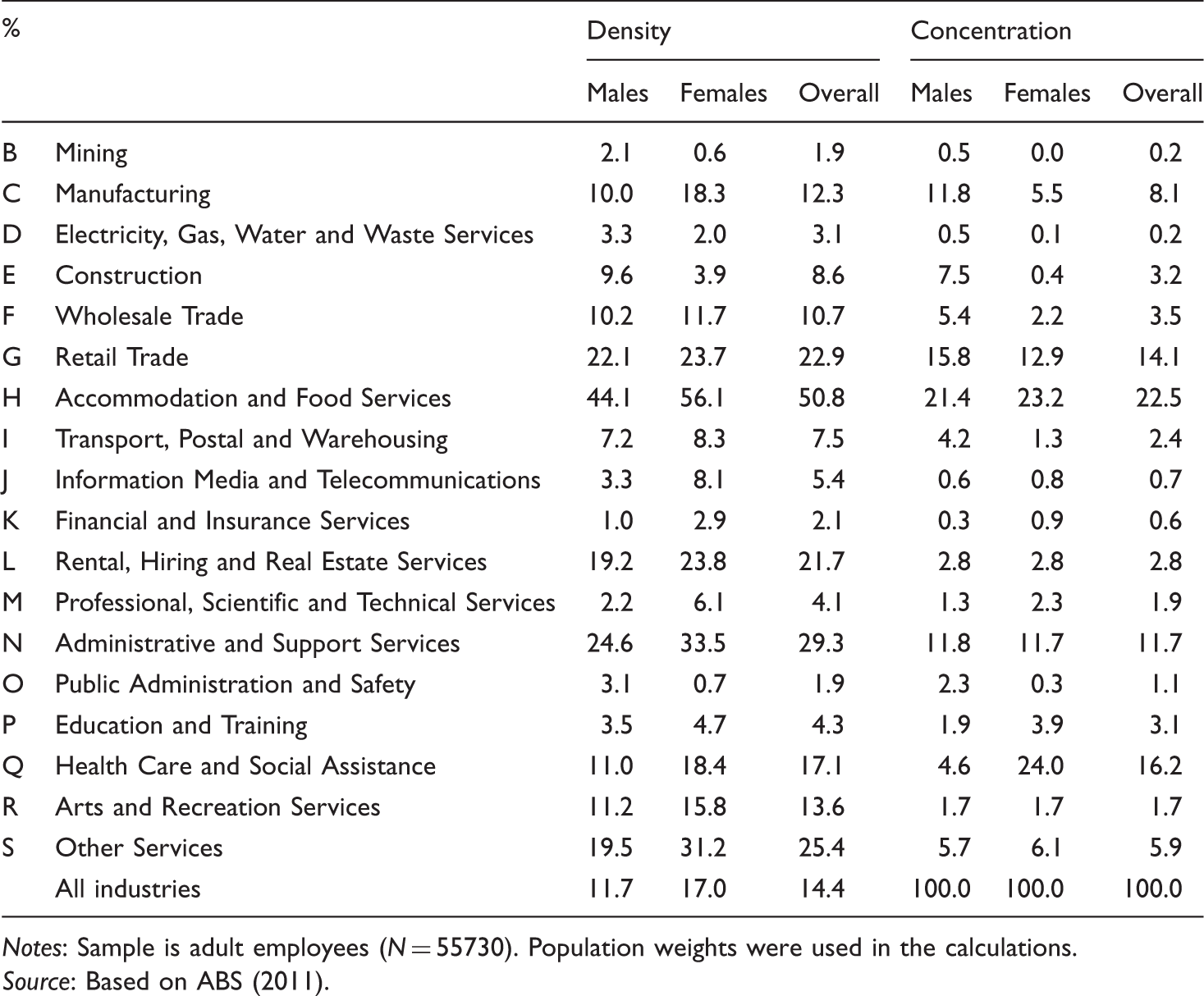
Notes: Sample is adult employees (N = 55730). Population weights were used in the calculations.
Source: Based on ABS (2011).
Award reliance is unevenly distributed throughout the workforce and is much more prevalent in some industries (Table 4). The standout is Accommodation, Cafés and Restaurants, where 50.8% of adult employees are award-reliant. In another four industries, between 20% and 30% of adult employees are award-reliant (Retail Trade; Rental, Hiring and Real Estate Services; Administrative and Support Services; Other Services). In general, women are more likely than men to be award-reliant within an industry, which reflects their higher average level of award reliance (17.0% versus 11.7%). Overall, however, the gender-specific patterns of award reliance mirror closely the pattern for all adult employees. The six industries in which award density exceeds the workforce average of 14.4% also typically have male/female densities that exceed the gender-specific averages. The concentration data show that these six industries account for 62.0% of male, 80.7% of female and 73.2% of all adult award-reliant employees.
Industry-specific estimations of gender undervaluation
The final step in our analysis is to estimate gender-based undervaluation separately for each of 18 industry divisions. This allows us to compare the industry patterns of undervaluation with the industry patterns of award reliance, which proxy for FWA’s influence in wage-setting. The degree of alignment between these patterns provides one indication of FWA’s efficacy in promoting equal remuneration for work of equal or comparable value. As noted earlier, our approach is likely to be a ‘lower bound’ on the impact of FWA: first, because it ignores potential spillovers to non-award wages; and second, because our 18 industry divisions aggregate across numerous awards.
Selected results from the industry-specific estimations.
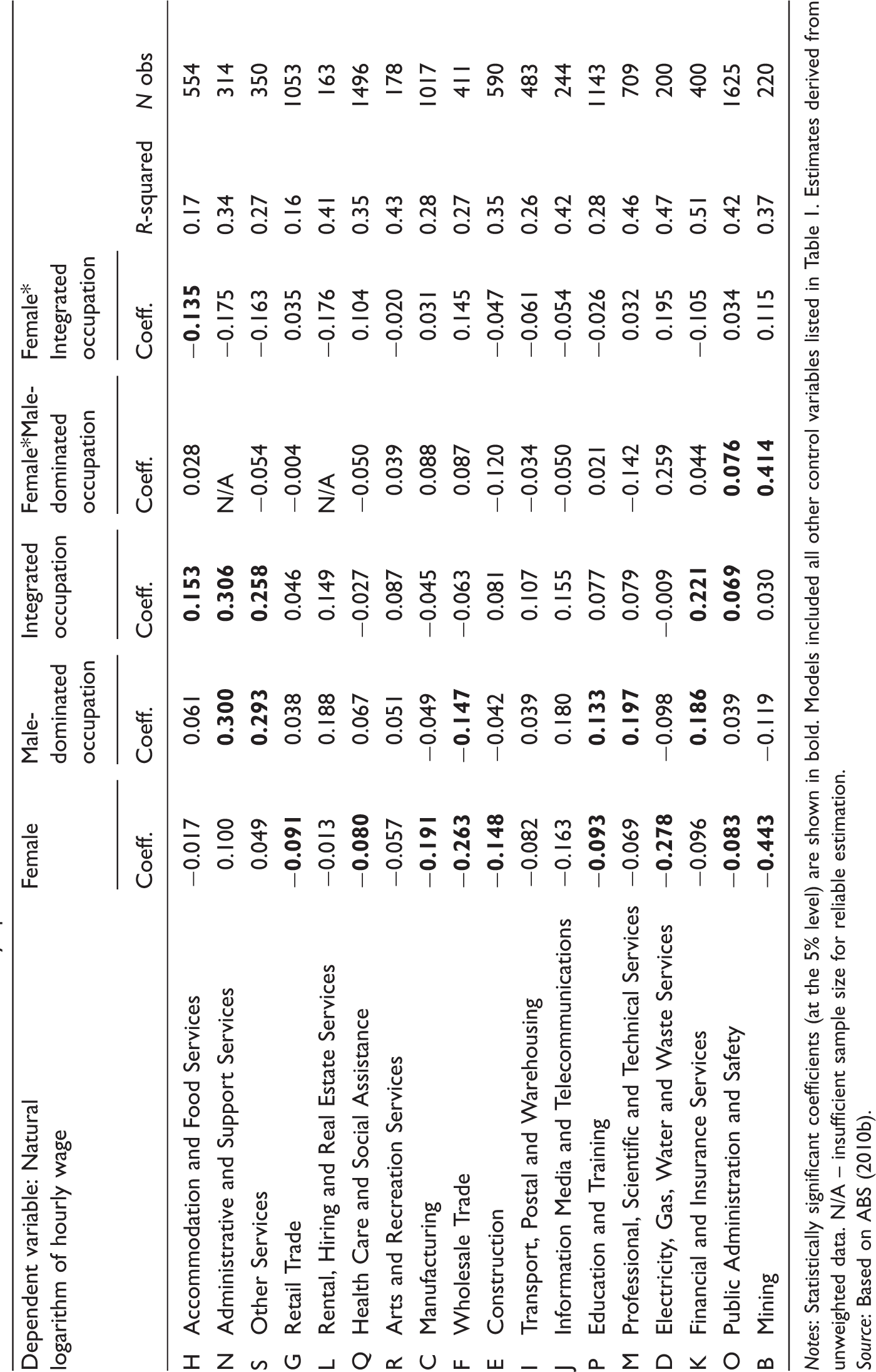
Notes: Statistically significant coefficients (at the 5% level) are shown in bold. Models included all other control variables listed in Table 1. Estimates derived from unweighted data. N/A – insufficient sample size for reliable estimation.
Source: Based on ABS (2010b).
The results are mixed, but they support several broad findings. First, as expected, the coefficients on the occupational composition variables generally have a positive sign where they are statistically significant. These results imply that, among men, wages in male-dominated and integrated occupations are either higher than, or not significantly different from, wages in female-dominated occupations. In three industries, male wages are higher in both male-dominated and integrated occupations, and two of these industries have high award density (Administrative and Support Services; Other Services). In another two industries, male wages are higher only in male-dominated occupations. In yet another two industries, male wages are higher only in integrated occupations. The Wholesale Trade industry is an exception, where men in male-dominated occupations appear to earn less than comparable men in female-dominated occupations.
Among women, the results in Table 5 are generally similar to those for men. In seven industries, women in male-dominated occupations earn a premium over comparable women in female-dominated occupations. Interestingly, five of these industries have low award density (Education and Training; Professional, Scientific and Technical Services; Financial and Insurance Services; Public Administration and Safety; Mining). Four industries also show evidence of higher wages for women in integrated occupations compared to female-dominated occupations; these are divided between two with high and two with low award density.
There is not a consistently strong association in Table 5 between occupational gender composition, wages and award reliance. Employees in female-dominated occupations earn significantly less than comparable workers in some, but not all, of the industries with high award density. The industries of Retail Trade and Health Care and Social Assistance are important exceptions, where award reliance is relatively high, but there is no evidence of wage undervaluation due to occupational gender composition. In addition, several industries with low award density exhibit evidence of gender-based undervaluation (Financial and Insurance Services; Public Administration and Safety).
It is also important to notice the estimates in the ‘Female’ column of Table 5, which show the effects of gender on wages, net of differences in occupational composition. The coefficient on the female dummy variable is negative whenever it is statistically significant, which is the case in nine of the 18 industry divisions. In these cases, even when there are no differences due to occupational composition, women still earn less than comparable men within the same occupational category. A key instance is Health Care and Social Assistance, where we find an 8% average female wage penalty, irrespective of occupational category (the female coefficient is –0.080).
Conclusion
We have used the recent SACS Equal Remuneration Case as the starting point for an assessment of gender-based undervaluation and its relationship to the wage-setting powers of FWA. We find that there are significant wage penalties for workers of both genders in female-dominated occupations, relative to male-dominated and integrated occupations. Within industries, however, there is not a clear correspondence between high award reliance (our proxy for FWA’s wage-setting powers) and lower wages in female-dominated occupations (our measure of gender-based undervaluation).
Our findings have two, somewhat conflicting, implications. First, they imply that undervaluation on the basis of gender remains substantial and widespread in the Australian workforce. In our analysis, this undervaluation accounts for 18% of the gender pay gap. We conclude that there is some distance still to go in realising the goal of ‘equal remuneration for work of equal or comparable value’ in Australia. Further applications to ‘revalue’ key areas of female employment are likely to play an important role.
At the same time, our evidence about award reliance patterns suggests that, subject to the caveats reiterated in the following, there are limits to FWA’s capacity to achieve equal remuneration for the whole workforce. This is because the tribunal has minimal direct involvement in wage-setting in several of the industries in which gender-based undervaluation persists. Our conclusions are in line with the observations of some previous authors who have noted the reduced influence that industrial tribunals now exert over pay equity in Australia.
We acknowledge two important limitations of our analysis. First, although we have analysed the extent of gender-based undervaluation separately for each major industry division, sample sizes prevent us from disaggregating the analysis further to more detailed industries. A related issue is that our 18 industry divisions do not match the coverage of the 122 Modern Awards that were operating by October 2012. Within our relatively broad industries, there are likely to be smaller sectors of the workforce that are female-dominated, undervalued and highly award-reliant. In these sectors, FWA may have its greatest impact on female wage disadvantage. New equal remuneration applications for sectors that exhibit these characteristics would further the cause of pay equity in Australia.
A second limitation is that our measure of award reliance (and proxy for FWA’s powers) takes no account of potential spillovers from awards to bargaining. If workers who are covered by over-award agreements receive wage increases as a result of FWA decisions, the tribunal’s full impact on gender pay equity is understated in our results. There is still relatively little research on this topic, although some evidence suggests that spillovers are common. Further research to uncover the extent of these spillovers, particularly in the industries that we have found to be undervalued on a gender basis, would help to ascertain the full reach of FWA’s powers in relation to equal pay.
Footnotes
Notes
Funding
This research received no specific grant from any funding agency in the public, commercial or not-for-profit sectors.