



Abstract
Dedication
We gratefully acknowledge the invaluable contributions to the research that we discuss here by our dear friend and colleague the late Dr Sandra Cockfield; we miss her greatly. We dedicate this article to her. For a tribute to her see www.monash.edu/vale/home/articles/vale-dr-sandra-cockfield.
The article discusses issues rarely addressed in research on Australian unions: the internal management policies and practices of unions, including human resource management, budgeting and strategy formulation. Management matters because it creates processes and systems that focus activity on whatever objectives a union or other organisation wishes to achieve. Our main research question is ‘how do Australian unions manage their employees, budgets, and strategies?’ Our study builds on earlier studies of US, UK and Canadian unions by adapting a survey instrument used in these countries. The Australian Council of Trade Unions (ACTU) asked national and branch unions to complete our online surveys. Of the unions surveyed, a majority of respondents use systematic human resource management policies and practices. They have also adopted strategic planning and budgeting practices. Echoing international findings, Australian unions have increasingly professionalised their administration. These findings are important since they have implications for how Australian unions deal with the challenges they face, including their revitalisation efforts and their responses to changing regulatory contexts.
Keywords
In the face of membership decline, Australian and international research on unions has largely focused on union efforts to revitalise themselves (Carneiro and Costa, 2022; Ellem et al., 2020; Murray, 2017). Research on revitalisation addresses issues such as corporate social responsibility (CSR) (Gold et al., 2020; Snell and Gekeara, 2020); the changing workforce (Pocock, 2011) and workplace restructuring (Fairbrother, 2015); increasing precariousness of employment in the gig economy (Bamber et al., 2021; Veen et al., 2020; Wood and Lehdonvirta, 2021); different approaches to recruiting and organising workers (Fiorito, 2004; Holgate, 2021), particularly young workers (Bailey et al., 2010; Bryson et al., 2005; Budd, 2010; Cregan, 2006); and membership activism and participation in workplace unionism (Hickey et al., 2010; Kerr and Waddington, 2013; Kumar and Schenk, 2006).
Research shows there are concerns about union democracy (Fairbrother, 2005; Greene et al., 2003; Voss, 2010); building coalitions with new worker organisations (Haiven, 2006), with social movement organisations (Ibsen and Tapia, 2017; Jerrard, 2020), and with community organisations (Cockfield et al., 2009; Tattersall, 2006, 2007), adapting new strategies in bargaining and political action (Wilson and Spies-Butcher, 2011; Yu, 2014); union mergers (Buchanan, 2003; Chaison, 2018); and the need for international or cross-border collaboration (Heinrich et al., 2020; Lévesque et al., 2013; McCallum, 2013; Tattersall, 2006, 2007; Thomas, 2020). While each of these concerns is important if unions are to advocate effectively for their members, unions can benefit from additional research on how their internal administrative policies and practices have changed in recent decades. Building on research by Clark and his colleagues (Clark et al., 1998; Clark et al., 2021) on administrative policies and practices of unions in the US, the UK and Canada, this article presents results of research on the internal management of national and branch-level unions in Australia. It focuses on unions’ human resource management (HRM) practices (Stratton, 1992), budgeting and financial mechanisms, and strategic planning processes, as recommended by Stratton and Reshef (1996), to gauge the extent to which unions have adopted formal administrative practices.
Australian unions have long been regulated by a combination of statutory provisions, common law and union rules which have become increasingly tougher (Forsyth, 2017). Since the passing of federal legislation including the Fair Work (Registered Organisations) Act, 2009 and two amendments (2012, 2016), Australian unions have experienced greater external regulation of their governance and financial practices. The first amendment targeted disclosure and transparency requirements around financial management. It imposed mandatory training for all officers of registered organisations involved in financial management. The second amendment, which responded to the Royal Commission into Trade Union Governance and Corruption (2015), imposed regulations similar to those governing enterprises under the Corporations Act, 2001 . This amendment increased sanctions for non-compliance in terms of governance, auditing and reporting to members and the public, and all aspects of financial management.
This article reviews literature on union administration and shows that there has been intermittent scholarly attention paid to this topic, despite Clark and colleagues beginning a longitudinal and comparative study in the early 1990s (Clark et al., 1998). It adapts methods from that research to the Australian union context of national offices and branch offices, rather than industry unions that are more typical in North America. It also considers examples of practitioner literature on union administration. It then presents empirical data and responses to open-ended questions from a 2014 survey, discussion and conclusions about the growing importance of administrative policies and practices for Australian unions.
The professionalisation of union administration
The first half of the 20th century was a period of membership growth for unions in developed market economies. As membership increased, unions faced new challenges. Webb and Webb (1920) documented how policy responsibilities of union officers expanded accordingly. It was a challenge for unions to balance the effectiveness of administration with the representation of members. The challenge included how to manage growing revenues and costs associated with running an increasingly complex organisation, while continuing to recruit and organise members. This duality of administrative effectiveness and representation was explored in US unions by Muste (1928) and subsequently in the US and the UK by scholars who also examined unions’ strategic planning, finances and budgeting, and related management practices. These included Belfer (1949, 1952), Berkowitz (1954), Roberts (1956), Barbash (1968), Bok and Dunlop (1970), Laffa (1972), Child et al. (1973), Warner (1975), Willman and Morris (1988), Dunlop (1990), Reshef and Stratton (1993), Willman et al. (1993), Lund and McLuckie (2007) and Lund (2009). Subsequently, Logan (2015) focused on US regulatory changes governing union financial reporting requirements while Bourguignon and Yon (2018) studied financial transparency and representation in French unions. Most of these publications have a focus on aspects of financial planning, management, transparency and accountability.
In the UK, Roberts (1956) found that unions lacked effective administrative practices, research, education and marketing, often as a consequence of offering low salaries. Dunlop (1990) identified that US unions were not always hiring the people most suitable for their needs. Few national union leaders had previous experience in managing large, complex organisations. The personal qualities, attributes and experience that helped these leaders to rise through their union's ranks (e.g. making speeches, lobbying and leading disputes) were different from the technical knowledge and background needed to serve, in effect, as the chief executive officer of a complex organisation. Bok and Dunlop (1970) also identified that US unions, with few exceptions, recruited staff from the union's membership and then, from that limited pool, tended to select people who had rendered the greatest political service to the leaders. They also reported an almost complete absence in unions of advanced data management, long-range planning and formal budgeting. They characterised the administrative efforts of the US labour movement as ‘primitive’ (1970: 149).
Turning to the issue of officer accountability, there has been increased scrutiny from the media in the 2000s in the UK (Ford, 2019), the US (Lund and McLuckie, 2007) and Australia (Forsyth, 2017). Union officers have a fiduciary obligation to members (Murray, 2018). Unlawful and ineffective management in unions limits their effectiveness in representing members’ interests and breaches fiduciary duty. In Australia, during periods of non-labour governments, political initiatives, including Royal Commissions, have contributed to unfavourable media and public perceptions of unions (Masters, 2016).
Since the early 1990s, Clark and colleagues have studied union administrative function, management and financial planning in the US and other countries. Their longitudinal research project has provided insight into union administrative practices. They published findings from their various surveys of unions conducted in the US, the UK and Canada on HRM, budgeting and strategic planning processes. Over this period, the researchers found an increase in the formalisation of unions’ HRM, budgeting and strategic planning processes (Clark, 1992; Clark et al., 1998; Clark et al., 2021). Clark and colleagues conclude that this research provides convincing evidence that unions have modernised and professionalised their internal administrative and management practices over time in response to the changing contexts and challenges they face.
Clark (1992) found that the number of professional staff employed in 20 of 22 major US national unions grew between 1961 and 1985, with an average increase of 174%. During that same period, the ratio of staff to members increased in all 22 unions. Clark attributed the growth in staff – relative to membership – to the increasingly complex context in which unions operated. To be effective, unions needed staff with technical expertise in areas such as economics, law and communications. This was essential if unions were to be able to recruit, organise and represent their members effectively in an era when they were becoming increasingly complex organisations, following many union amalgamations since the 1990s (Ashack, 2008; Blisset, 2019; Buchanan, 2003; Chaison, 2018).
In Australia, Wielgosz (1974) used unions’ annual financial reports and balance sheets submitted to the Commonwealth Industrial Registrar to argue that there was no means of systematic data collection and no verification process for the reported information. Riches (1984) found that unions’ finances were a ‘three-ringed circus’ with a high degree of regulatory complexity made worse by various union structures in dual federal and state industrial relations systems. Her research explored the impact of the 1974 Royal Commission into Alleged Payments to Maritime Unions and to unions more generally. Her findings confirmed those of Wielgosz (1974) and underpinned later research into union finances in the 1970s and 1980s (Griffin and De Rozairo, 1993). That research found a lack of financial planning and management skills which led to unions experiencing financial problems despite increasing membership in the 1970s. The finding was similar to findings on UK unions in the 1970s and early 1980s (Willman and Morris, 1988).
Matthews (1968) found that larger Australian unions were hiring research and specialist staff to assist with tribunal cases. Dufty (1980) undertook research on other internal practices of Australian unions. He found that the majority of union officers, executives and organisers had been shop stewards with long service before becoming an officer. A 1984 survey of union officers in New South Wales confirms this pattern, with limited appointments of higher education degree holders to organiser positions. White- collar unions were also more likely to recruit salaried experts from outside the union (Callus, 1986). Bramble (1995, 2001) notes that Australian unions came to rely more on university-educated staff in the 1990s as part of a growing trend towards professionalisation. These studies focused only on financial management and changing hiring practices, rather than on other administrative and management practices. Burchielli (2008) conducted qualitative studies of how four unions organised their administrative work. She found a distinction between administrative work and organising/industrial work; however, the former is usually seen as less important than the latter, which is characterised as ‘real’ union work.
There is also limited practitioner literature on the management of unions. Horne (1926) wrote about his time as a union official in a large cross-industry union in the UK and Ireland. He described ‘… trade union activities, wages negotiation, organisation and propaganda, political activities, benefit administration, finance and so on’ (1926: 343). He commented also on the variation in unions’ administrative practices. This century Morris (2002), in a study of the administration of Caribbean unions, identified how the Executive of a union is responsible for planning, staffing, organising, directing and controlling unions’ business. He found that unions could not adequately compete for specialist staff in the open market due to the limited salaries they paid to graduates and specialist employees. However, Morris added that such staff come from a variety of backgrounds, including research officers, accountants, economists, educators, lawyers, safety and health specialists, journalists, public relations and marketing professionals, negotiators and recruitment or organising specialists. Adding to the limited practitioner literature, Artur (2004) found that Mozambique unions lacked the skilled staff to address union issues and because of financial constraints, could only hire advisors on law and economics when funds were available. This has been a problem faced by unions across Africa. For example, Schillinger (2005) identified the poor financial position of unions in Africa that forced a reliance on global federations of unions for donations to retain the small numbers of staff employed.
The Evatt Foundation (1995) compared large Australian unions to big businesses in terms of having staffing and administrative functions necessary to make these complex organisations work effectively for their members. Queensland Maritime Union of Australia (MUA) Secretary Bob Carnegie took a different approach. He criticised the MUA's national office as highly bureaucratised while membership numbers continued to decline. He argued that his union should be leaner in staffing while retaining organising and representational functions and the ability to ‘sell’ the union to the public. He claimed that there were ‘probably 25–30 percent more union officials’ in spite of the union's membership declining (Carnegie, 2016: 14). Despite Carnegie's criticism, contemporary unions advertise for specialist staff in similar ways to other organisations, using websites such as Seek or ethicaljobs.com.
This literature review provides context for our research that aims to shine a light on Australian unions, in comparison with those in other countries. To focus our study, we consider a central research question: ‘how do Australian unions manage their employees, budgets, and strategies?’ Whereas much of the above literature on Australian unions was based on qualitative research, the present study uses surveys to answer this research question.
Research methods
In contemporary Australia, many unions trace their origins back to 19th-century colonies. As the country moved to a federal industrial relations system from 1904, these unions federated. While today some unions at the national level have centralised structures, other unions are decentralised, with decision-making and financial control retained at the branch level. Most contemporary Australian unions were created by amalgamations and are not industry specific. They may have a divisional structure such as the Construction Forestry Maritime Mining and Energy Union or retain a single identity but cover multiple industries such as the Australian Workers’ Union that covers more than 25 industries. Even the Transport Workers’ Union covers nine industries, leaving the Australasian Meat Industry Employees’ Union as the only single industry union (Jerrard, 2000), although there are also occupational unions such as the Australian Education Union and police associations. The structure and coverage of Australian unions make international comparisons challenging. We met challenges by adapting to the Australian context surveys developed in other countries and which included core items from earlier US and UK studies (Clark et al., 1998). Like those studies, our research focused on HRM, budgeting and strategic planning.
The ACTU advised on our 2014 survey adaptations and helped to pilot the surveys. It then emailed the online surveys and reminders to all of its national affiliates and to a subset of branches. Thirty-one of 47 national unions responded giving a response rate of 66%. Fifty-seven of 167 branches based in specific geographical regions responded, giving a response rate of 34%. The 167 branches represent the number of branches in direct contact with the ACTU, rather than the total of all union branches in Australia. We analysed the data using IBM's Statistical Product and Service Solutions (SPSS).
This article draws on the quantitative data generated from the surveys of unions’ answers to a choice of options. The surveys also offered opportunities for respondents to provide additional open-ended comments. Quotations exemplifying points of interest or concern mentioned by the respondents have been included to vivify the empirical data. We selected such quotations from the themes of HRM, financial and strategic planning, and the impact of legislative changes. Our rationale in considering the functions of HRM and financial planning before strategic planning is that we are following the structure of earlier studies by Clark et al. (1998) who placed their emphasis on operational issues before strategic planning.
The administrative and management practices in Australian unions
This section considers the question – ‘how do Australian unions manage their employees, budgets, and strategies?’ – and uses the order of these administrative practices found in earlier US, UK and Canadian research by Clark and colleagues. It presents data on three areas of union administration: HRM practices and policies, financial processes and strategies. It also explores union responses to legislative changes influencing their internal functioning.
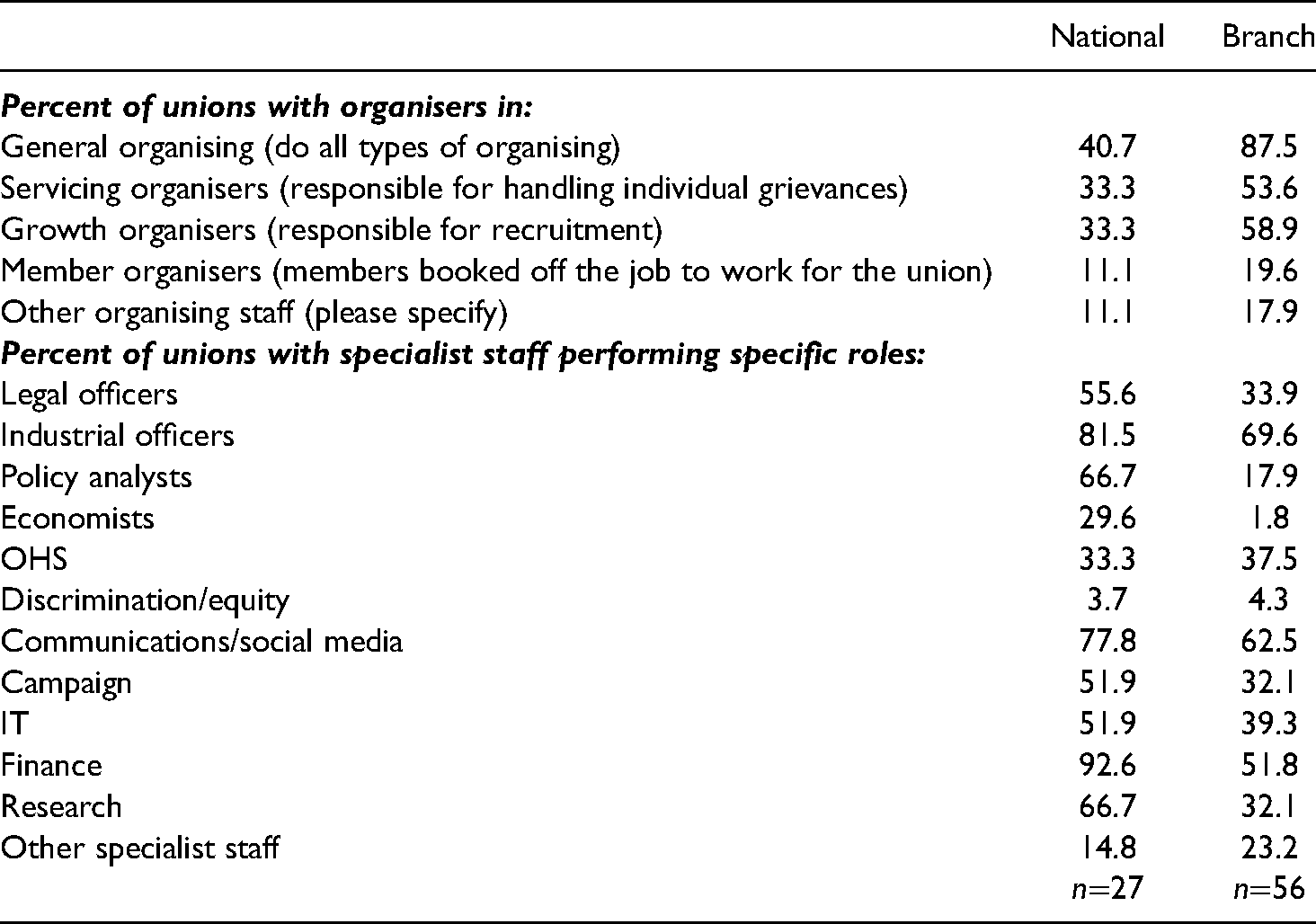
Employment profile of union national offices and branches.
Human resources (HR) practices and policies
Table 1 provides insight into the sample of unions analysed. It indicates the percentage of national unions and branches employing various categories of organisers and professional union staff. This table provides background for the subsequent tables and analysis.
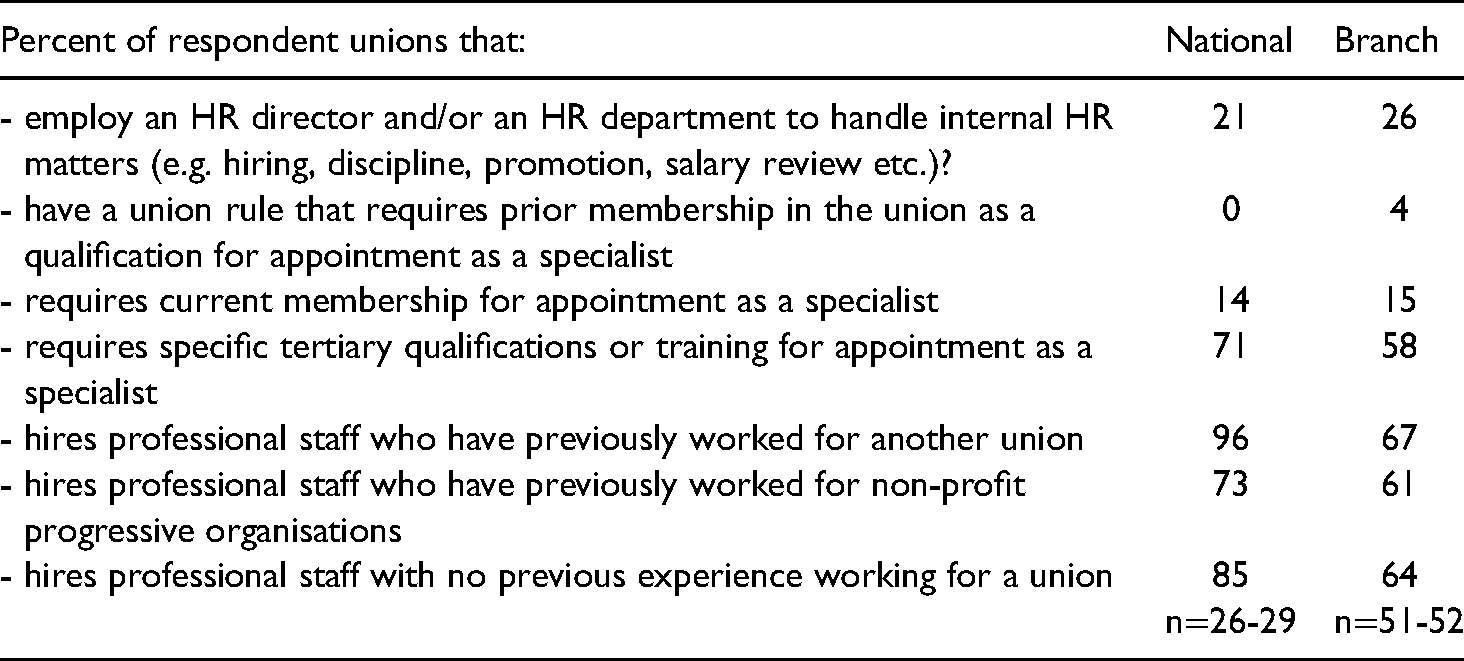
The first section of the survey focused on union HR practices and policies. One question on how Australian unions administer these practices and policies asks, ‘does your union employ a professional HR director and/or department to handle internal HR matters (e.g. hiring, discipline, promotion, pay review)?’ Twenty-one percent of national union offices and 26% of branches answered ‘yes’. The majority of unions employing an HR director reported that she or he had a formal qualification, though not always in HR or management. In most cases, the HR director had a university degree.
In the case of unions without a dedicated HR director or department, the typical response was that, in the absence of an HR director, the union's secretary or assistant secretary performed these duties. While a majority of unions indicated that they do not employ an HR director, our data suggest that most unions take a relatively formal approach to the recruitment and appointment of staff at the national and branch levels (see Table 2). A majority of respondents reported recruiting specialist administrative staff from outside the union and union movement. National union offices were more likely to recruit outsiders than branches and this is a consequence of their need for a greater number of specialist staff employed by national offices. Specific qualifications or training were the most important criteria for appointment to a technical position. Four respondents at the branch level (and none at the national level) reported their union's rules required membership for an appointment. Where they did, it was more likely to be for organisers than specialist staff.
HRM policies and practices.
The survey asked respondents how their hiring practices had changed over the previous 20 years. Approximately half indicated that their practices had changed. Many of those reporting changes indicated more willingness to hire employees from outside the labour movement, particularly from community organisations. These changes align with those respondents reporting they employed more specialist staff with specific skills. However, the increased number of union employees had a broader impact on hiring for some unions. One respondent commented: We traditionally hired [from] … our industries, particularly from experienced delegates. We had about half the number of organisers then and very few specialist staff, basically just industrial officers. Organisers tended to come and stay for life, so turnover was low. We [now] increasingly hire from university, or people who have had some campaigning experience in non-union campaigns. We have … more organisers and turnover is much higher – the work is a lot harder. We have always been willing to hire from other unions.
A few unions sought the best candidates regardless of whether they had a union background, although a commitment to union principles was required. An example is: We now look for more broad ranging skills and experience that align with the union’s values and strategic directions. While we encourage member applications it is no longer significant criteria; we now look for skills, knowledge and competency. In addition to union or member workplace experience, we are attracted to campaign activists and specialists who have worked in progressive and social justice fields.
Branch respondents also reported an increased formalisation in the hiring process, from the advertising of vacancies to the selection process. One stated they now require criminal history checks, while another added, ‘the hiring is done by a panel rather than one person. [Earlier] … the elected secretary would make the call.’
Hiring is not the only practice that has changed. At the national level, all unions except one reported that legislative changes affecting union governance had necessitated increased administrative effort. Eighty-nine percent of them asked existing staff to spend more time on compliance and less time on other duties. Legal changes required 19% to recruit additional staff to work on compliance, while 37% of unions said they had appointed compliance consultants.
Two respondents observed: [We’ve] employed a compliance officer and external staff to review all polices etc.
We have had to use staff to ensure we are complying and also ensuring our elected officers all have training sessions on compliance and governance.
Over the previous 20 years, 43% of national unions and 38% of branches had increased their use of external consultants, while 13% of national unions and 12% of branches had decreased their use. Others responded that their use of external consultants has stayed the same.
Two respondents observed: The Union has employed consultants to review all policies and amend as necessary in order that the policies comply with any legislated change or best practice.
There has been an increase in the amount of union governance requirements both at a State and Federal level. The frustration is where the burden of one does not satisfy certain elements of the other jurisdiction. The cost involved in seeking advice from consultants and auditors has increased as a result, which is most unfortunate, particularly for the members because ultimately, they are burdened with the cost
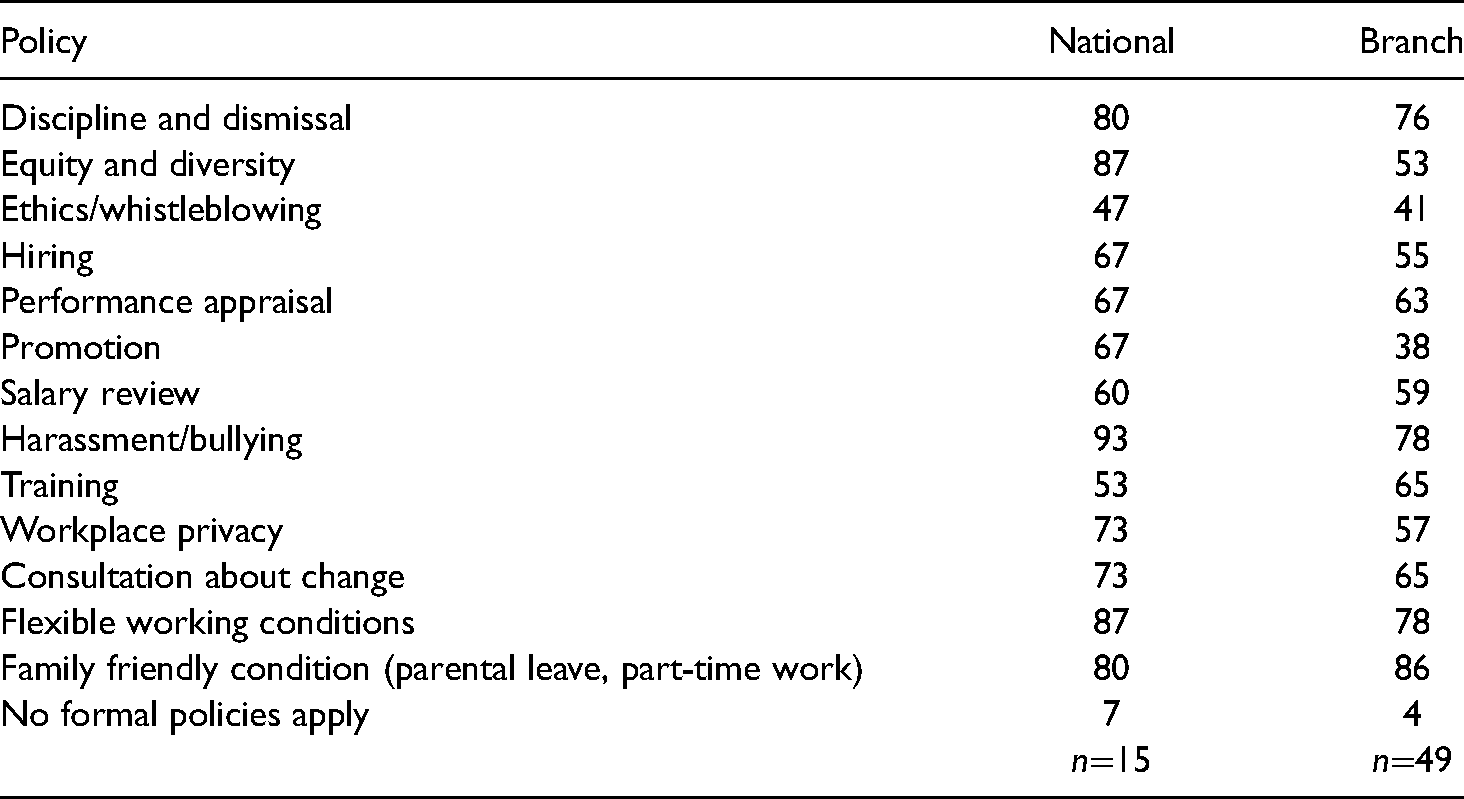
A majority of unions had written workplace policies indicating a more formal approach to HRM. Table 3 shows only a small proportion indicated they did not have formal written policies. The common areas where unions had written policies for national and branch offices were discipline and dismissal, harassment/bullying, flexible working conditions and family-friendly conditions. Table 3 compares written policies in national offices and the branches. There are differences in emphasis between centralised national unions and branches.
Percent of respondents with formal written HR policies for staff.
Financial and strategic planning
Respondents indicated a high level of formalisation with respect to budgeting and strategic planning. Table 4 shows an overwhelming majority of unions, 86% of national respondents and 83% of branch respondents, reporting they prepared an annual budget with planned expenditures by function or department. Responsibility for preparing the budget varied between unions, although invariably it fell to the finance officer (national: 38%; branch: 35%) or the secretary (national: 33%; branch: 49%). A similar percentage of union respondents, 82% at national level and 84% at branch level, used a formal strategic planning process.
Percent of unions engaged in financial and strategic planning.
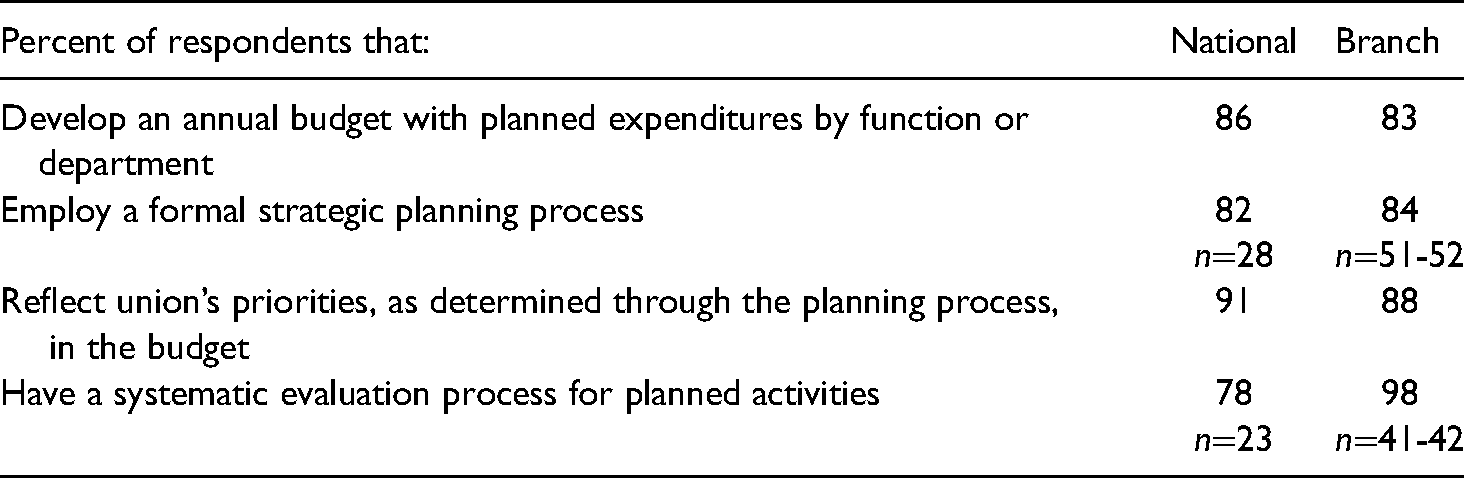
The detail of this planning is difficult to determine from survey data. When asked if they evaluated their planned activities, 78% of national unions and 98% of branch respondents said ‘yes’. The response rate for this question was lower and it is probable several respondents did not want to admit the absence of an evaluation process. The same problem arises with a lack of detail when assessing the relationship between budgeting and planning. Of those respondents to the question ‘are the union's priorities, as determined through the strategic planning process, reflected in the budget?’, 91% of national and 88% of branch respondents said ‘yes’. Again, it is probable that unions that do not link the budget to the planning process did not respond to this question.
A range of union officers were involved in planning with the most common participant the secretary, at 83% (national) and 88% (branch). At the national level, the National Executive is the second most frequent participant, identified by 74% of respondents. Just over half (56%) of the national unions indicated staff are involved in planning. In contrast, 72% of branch respondents identified staff as participants in planning, which was the second most common response.
In answer to an open-ended question, various unions reported a planning process involving officers and staff. Several unions reported that priorities were set by the governing body and then translated into a strategic plan by staff, overseen by national officers. In other cases, priorities are set by the Executive and translated into a strategic plan by staff. Certain union branches reported they had a three-year strategic plan from which they develop operational plans.
Various answers were provided to the question ‘where branches conduct planning, did they do this themselves, or did the national union do it?’ Some geographically based branches are relatively autonomous, retaining considerable financial and decision-making control. Other unions are more centralised. The distinction reflects the union's history and amalgamations. We infer that most of the relatively autonomous branches conduct a periodic planning process themselves, but usually within parameters supplied by their national union. More research would be necessary to answer this question fully.
Senior officers dominated the planning process. However, some unions reported surveying members to inform priorities while others reported having a formal planning day or employing a facilitator. A respondent described its planning process: We have a formal planning process. Board reviews the current plan. Each 3 years we undertake an extensive strategic planning process - review changes in our environment, assessing our strengths and weaknesses, we also look at trends with other membership-based organisations. We survey members’ satisfaction each year. We also do focus groups of potential members … the Board reviews our strategies … Divisions and state offices identify priorities and develop a plan. National office develops a plan. A plan for the union and draft budget is then developed … Board reviews and then holds a meeting with all presidents. [Then] the National Assembly debates the plan and budget.
For respondents who evaluated the results of planned activities, some performed an annual review of the strategic plan while others reported in writing their monitoring of the plan. Another respondent described its process: Quarterly review by department manager and ultimately by the CEO who then reports through to the national board and the peak governance committee … there is also a series of reviews conducted at department level that include statistical analysis of membership growth and penetration of work sites, financial implications of membership activity, progress against the plan, any successes and failures/delays are also highlighted and remedial action noted as required … there may be any number of financial analyses of business plans prepared by Finance in conjunction with State offices and other managers to update into the plan.
For other unions, the formal and systematic evaluation of plans maybe still in the development phase: Each Manager is responsible for the planning, implementation and review in their work area. Implementation is monitored and reviewed by Managers along with their staff … Prior to developing the next year's plan, each work group evaluates progress on the current plan. We are currently working on developing key data indicators for some of our work areas that will assist in evaluating outcomes.
Several unions identified a range of measures as assessment tools. These included monitoring and reporting of membership data and growth in activism/member involvement. A branch respondent provided the following list of measures that are typical: Assessment of outcomes against targets, e.g. membership growth, increase in activists, growth of workplace branches and their activity. Assessment of progress on policy development. Campaign impact or success. Focus group testing in addition to democratic feedback from branches.
Measures were subjective and objective, as the following union noted: It depends largely on the activity. Sometimes the evaluations can be subjective, for example, in the area of moving public interest/influence or political influence to achieve outcomes; these can sometimes be subjective; i.e. are we … influencing outcomes can be hard to measure … This is particularly true in political areas. Other activities such as vote campaigns, graduate recruitment, member engagement are easier to measure.
Influences of legislative changes
An important question for unions is ‘how have they responded to legislative changes?’ because a feature of the industrial relations system is the extensive regulation of unions (Forsyth, 2000, 2017). Since the 1996 election of the conservative Federal Government, regulation has increasingly mimicked company regulation, although regulation unique to unions has been retained. This trend continued during the years of Labor Government (2007–2013) and the post-2013 conservative governments. For example, the Fair Work (Registered Organisations [RO]) Act 2009 and two subsequent amendments (2012, 2016) added to financial accounting obligations imposed on unions. When asked if these regulatory changes had led to an increase in administrative time and effort, an overwhelming majority at national and branch level respondents (96% and 86%, respectively) said ‘yes’. Table 5 indicates how unions responded to regulatory changes. The results show that a majority of respondents at the national and branch levels (89% and 85%, respectively) have adapted to the changes by insisting staff spend more time on compliance and less on other duties.
Union responses to changes in legislation regulating unions.

In open-ended comments, many respondents reported the need to review policies and practices in order to assess compliance and train staff to ensure compliance. One respondent commented: The union has had a greater focus on ensuring policy and procedures are written and understood. For example, the union has comprehensive finance and governance policies, conflicts of interest and gifts register etc. Established an Audit and Compliance Committee. Established compliance monitoring matrix which provides traffic light compliance monitoring reports to the Audit and Compliance Committee. High levels of written accountability of all staff who use credit and fuel cards and multiple level of checking and sign off, including to the Branch Committee of Management.
Such comments suggest increased formalisation of policies related to financial expenditure. There was a move to formalise unwritten practices into a written policy. As one respondent commented: RO Act required so much written compliance policies that the union took a decision to completely revamp every policy …, write new ones where none had existed, actually document custom and practice so it was formalised, established registers for gifts, hospitality, conflicts of interest etc.
Many respondents were concerned about increased bureaucracy. The following comments are typical: We have tightened procedures and become very bureaucratic - like a public service in the forms, approvals and restrictions on activity. Whilst this ensures absolute accountability, it is time consuming and slows decision-making and implementation. No private sector or not-for-profit organisation … would stand for it.
And:
While there have been some changes to our accounting practices, they should not be characterised as a significant change. Considerable time has been spent in making our policies more explicit and in further documenting practices that were long held and well understood.
Some respondents claimed the changes increased the complexity of financial reports making them more difficult for members to understand: The model GPFR [General Purpose Financial Reporting] was a significant change in presentation of our financial report and I believe actually makes it more difficult for members to read and understand.
This exemplifies the regulatory burden that unions increasingly face.
How do Australian unions compare with their US and UK counterparts?
The results of our survey of Australian unions at national and branch levels suggest a high level of formalisation of administrative practices. Table 6 shows that across the three areas examined, HRM, financial planning and budgeting, and strategic planning, Australian unions showed a comparable degree of formalisation to their US and UK counterparts.
Comparisons between US, UK and Australian national unions.
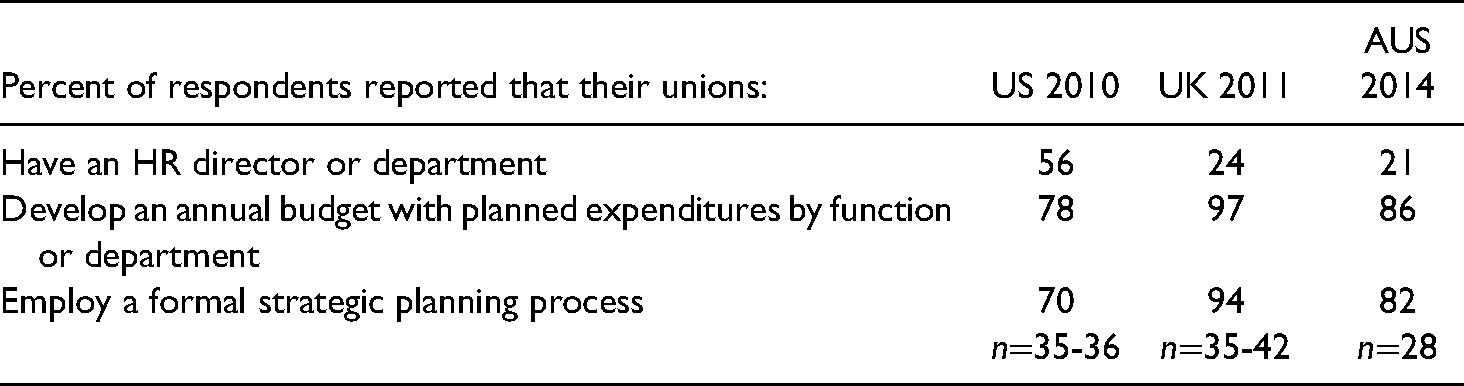
Unions in the US and UK have looked beyond their membership and outside the union movement in their recruitment of staff. A higher percentage of US unions employ a dedicated HR director (see Table 6). However, as the US has a much bigger population than either the UK or Australia, US national unions tend to have more members than Australian unions. The larger number of US unions with big memberships means that more US unions are likely to have a dedicated HR director.
Unions in all three countries show a high level of formalisation with respect to budgeting and planning. Clark et al. (2021) attribute the increasing formalisation of union administrative practices in the US and the UK to internal and external factors. This also applies to Australian unions. Internal factors include the size and complexity of the unions; increased education and awareness of management practices among union leaders; the presence of staff unions; and an increasing need to use limited, and in many cases, declining, financial resources efficiently. The external factors include increasingly aggressive attacks by employers (Jerrard, 2015) and more onerous and demanding government reporting requirements (Forsyth, 2017).
Clark et al.’s (2021) findings on the US and the UK are approximately replicated in Australia. Similar to these countries, legislative changes in Australia have forced unions to respond in a timely manner to ensure financial and governance compliance, thus increasing union professionalism and CSR (Gold et al., 2020). The majority of national and state branches agreed that legislative changes increased their financial reporting responsibilities and prompted improved budgeting. These developments are likely to assist with strategic planning around funding campaigns and member services. This could allow for greater expenditure on union revitalisation strategies by hiring and deploying appropriately skilled staff to particular campaigns such as targeted recruitment of particular categories of workers like youths (Bailey et al., 2010; Bryson et al., 2005; Budd, 2010; Cregan, 2006) or those in alternative forms of work such as gig jobs (Veen et al., 2020; Wood and Lehdonvirta, 2021).
The increased bureaucratisation of unions in Australia is illustrated by remarks from practitioners (e.g. Carnegie, 2016) and from unions themselves, as has been shown in this article; for example, the comments about tightening procedures and policies on financial matters, and bureaucracy in general. An analogy with the public service was mentioned in terms of ‘the forms, approvals and restrictions on activity [which is] time consuming and slows decision-making and implementation’. The bureaucratisation of unions can also result in concerns about union democracy (Fairbrother, 2005; Greene et al., 2003; Voss, 2010). One respondent commented that the increased burden of financial reporting made it more difficult for members to understand. This has the potential to alienate members from the financial reporting.
With regard to formal strategic planning, there were high levels of responses from national (82%) and branch levels (84%) that indicated this was important for them. For unions with a dominant national branch, strategy is formulated centrally and handed down for branches to adapt and implement. Stratton and Reshef (1996) warn that where this happens, the strategy may not be always implemented if the local branch feels it has not been included in the planning process. Strategies may also emerge from within lower levels of the union such as delegate conferences that feed into a strategic plan developed by unions’ officers and the Executive.
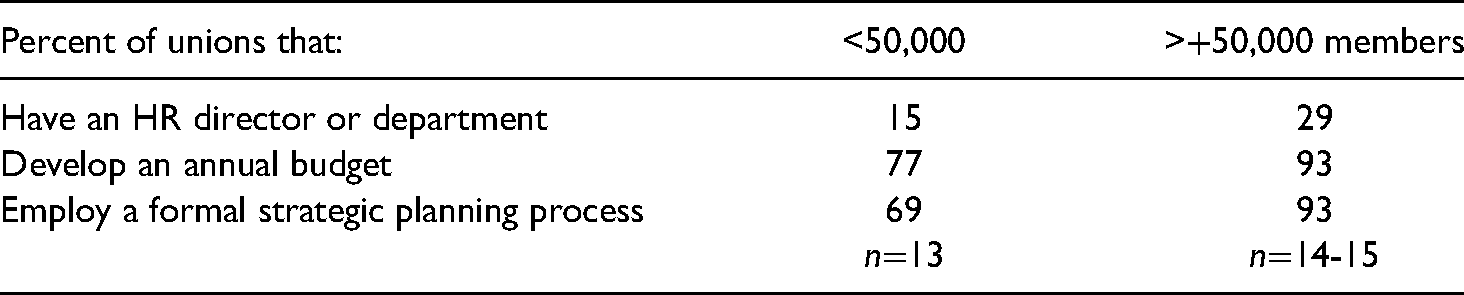
The extent of formalisation of HRM, budgets and strategic planning often reflects organisational size. In terms of unions, we differentiated between those with less than 50,000 members and those with at least 50,000 members. Table 7 shows that 15% of the smaller unions have an HR department and/or director in contrast with almost twice as many (29%) of the larger ones. There is also a size differentiation in terms of the categories of unions that develop an annual budget with planned expenditure by function and department (77% of smaller unions compared with 93% of larger ones) and strategic planning (69% of smaller unions compared with 93% of larger ones).
HR director and/or department, budgeting and strategic planning practices in national unions by membership size.
Limitations
Our discussion of Australian unions compares the findings from our 2014 online surveys with inferences from smaller-scale studies conducted earlier, before it was practicable to use online methods (Bramble, 2001; Callus, 1986; Dufty, 1980). Therefore, we propose to conduct further research including a follow-up survey in the 2020s using similar methods to those that we adopted in the survey discussed in this article. This should offer longitudinal insights into trends, and more insights, for example, on the influence of organisational size.
Conclusions
Using quantitative survey data and qualitative responses from open-ended questions, we have attempted to answer the research question ‘how do Australian unions manage their employees, budgets, and strategies?’ The research finds that unions in Australia have become increasingly professional in the way in which they manage themselves in all three domains. This finding aligns with similar findings of longitudinal research in other Anglophone countries. We have demonstrated that management of unions’ internal operations matters, because it creates processes and systems that give priority to a union's strategic objectives which the officers and members wish to achieve.
In conclusion, the professionalisation of unions as demonstrated in this study contrasts with earlier periods when union-management style could be characterised as ad-hoc enthusiasm for trying to improve peoples’ working lives. Professionalism of their administration provides unions with opportunities to make better use of scarce resources while complying with their legal obligations. A challenge for unions is to avoid bureaucracy becoming too cumbersome, while still being democratic and responding well to members’ interests with professional staff, appropriate budgets and efficient strategies.
Supplemental Material
sj-pdf-1-jir-10.1177_00221856221083715 - Supplemental material for How do trade unions manage themselves? A study of Australian unions’ administrative practices
Supplemental material, sj-pdf-1-jir-10.1177_00221856221083715 for How do trade unions manage themselves? A study of Australian unions’ administrative practices by Greg J Bamber, Marjorie A Jerrard and Paul F Clark in Journal of Industrial Relations
Footnotes
Acknowledgements
We thank Brian Cooper, Elvira Luca and the JIR's editors and reviewers for their astute advice. We acknowledge also the terrific help from Trevor Clarke and others at the ACTU as well as the union people who completed our surveys. We thank several other colleagues for helpful comments after earlier versions of this article were presented at conferences of the Association of Industrial Relations Academics of Australia and New Zealand, and of the British Universities Industrial Relations Association. We acknowledge support from and the research environment of the International Consortium for Research in Employment & Work, Centre for Global Business, Monash Business School, Monash University; and School of Labor and Employment Relations, Pennsylvania State University.
Declaration of conflicting interests
The authors declared no potential conflicts of interest with respect to the research, authorship and/or publication of this article.
Funding
The authors disclosed receipt of the following financial support for the research, authorship and/or publication of this article: This work was supported by the Economic and Social Research Council (grant no. L000660/1).

Biographical note
References
Supplementary Material
Please find the following supplemental material available below.
For Open Access articles published under a Creative Commons License, all supplemental material carries the same license as the article it is associated with.
For non-Open Access articles published, all supplemental material carries a non-exclusive license, and permission requests for re-use of supplemental material or any part of supplemental material shall be sent directly to the copyright owner as specified in the copyright notice associated with the article.
