



Abstract
Workforce planning is prevalent and recognized as a good strategic practice in many organizations. However, business students may have little experience with workforce planning or workforce analytics. The purpose of this article is to present a workforce planning exercise for use in a face-to-face or online classroom setting. In this exercise, students practice applying workforce planning concepts to calculate internal employment data, find and collect external employment data, and combine multiple, sometimes conflicting, data to make workforce predictions and recommendations for a hypothetical organization. This exercise is designed to help students develop career-relevant skills and is intended for use in human resource management, talent acquisition, talent management, staffing, and/or selection classes.
Keywords
Workforce Planning
The importance of using data analytics within the field of human resource management is increasingly undeniable. Although organizational interest in the ability to collect, analyze, interpret, and strategically use workforce data to make data-driven decisions has been growing for some time, it has been gaining more prominence since the early 2010s in the aftermath of the global economic crisis (Harvey, 2012; Hota & Ghosh, 2013). As its value in the workplace continues to grow, it seems prudent to help undergraduate students in human resource (HR) and business courses become familiar with collecting, analyzing, and using HR analytics and data to make business-driven decisions and recommendations.
Specifically, for many CEOs and Chief HR officers, the practice of strategic workforce planning is a top priority (Louch, 2014). Workforce planning is the process of analyzing data to forecast workforce supply and demand, anticipate gaps in workforce needs, and develop solutions to address the expected gaps so that organizations can meet their strategic goals (Anderson, 2004; National Institutes of Health, Office of Human Resources, n.d.). For example, imagine a call center tasked with addressing customer questions and concerns. If the call center does not have an adequate number of customer service representatives available during heavy call times, customers may experience long waits, which may decrease customer satisfaction and result in losses of future sales. If the call center has too many representatives available, then representatives may not have enough work to do, and thus the call center loses money as employees are being underutilized. Using workforce planning to forecast when, how many, and which skills employees need to meet an organization’s goals can help to improve organizational efficiency and effectiveness.
Strategic workforce planning is one of three HR tasks that yield the highest ROI for organizations (Ben-Gal, 2019). It improves company performance by identifying talent gaps, solving long-term labor issues, improving recruitment and talent management efforts, improving employee satisfaction and engagement, and reducing workforce costs (Etukudo, 2019). In a study by Rimita et al., (2020), strategic workforce planning emerged as one of five key themes identified for successful leadership in a volatile, uncertain, complex, and ambiguous business environment. Although workforce planning skills are important for leaders, as workforce planning activities are likely to happen at multiple levels within an orgaRinization (Le Fouler, 2017), it is important for HR professionals and managers to learn these skills as well.
As more human resource professionals are required to have HR analytics training (BasuMallick, 2019; Smith, 2018), and as workforce planning continues to grow in importance as a human resources task, workforce planning has been listed as an area of emphasis for curricula adhering to Society for Human Resource Management’s (SHRM) guidelines (Parks-Leduc et al., 2018). Thus, it would be helpful for current business students to practice these skills. However, when looking for workforce planning exercises for use in classrooms, there are very few options. Therefore, the current exercise was developed for use in late undergraduate human resource management, talent acquisition, talent management, staffing, and/or selection classes.
Learning Objectives
Using Krathwohl’s (2002) revision of Bloom’s Taxonomy, the exercise is designed to help students:
Understand concepts in using HR analytics and workforce planning.
Gain skills in using HR analytics and workforce planning.
Engage in critical thinking about workforce planning at the levels of application and creation.
To fulfill the learning objectives, this exercise asks students to apply workforce planning data to:
Compile internal employment data and use a transition probability matrix, which is a part of an analysis used to determine a firm’s internal labor markets and forecast its internal labor supply (Phillips, 2020) (application).
Collect and choose external employment data (e.g., via finding and becoming familiar with employment data via the U.S. Bureau of Labor Statistics (n.d.) site (application).
Integrate multiple, and sometimes conflicting, data to make workforce predictions and recommendations for O&S Corp., a fictional organization (creation).
Overall, the current exercise aims to provide students with an opportunity to gain and practice workforce planning skills.
The Exercise
Exercise Overview
Students begin the exercise by calculating and analyzing internal labor data for O&S Corp., a fictitious beachwear retailer in a seaside resort area. Students then calculate and integrate the internal data to forecast the internal labor supply. Then they collect external data about local market conditions from the BLS website and local reporting sources to determine the local labor conditions. Next, students integrate internal and external labor data to project labor surpluses and/or shortages. Finally, students reconvene in a plenary session to discuss their recommendations and engage in debriefing.
Exercise Logistics
Preparation
Before conducting this exercise, one 75–min class session introduces students to workforce planning (this exercise can also be done in a 50–min session or online modules). Concepts in this session include identifying the organization’s talent philosophy and strategic goals, forecasting internal and external labor demand and supply using various analytic techniques (e.g., transition matrix, employee surveys, external statistics, etc.), identifying labor surplus or shortage gaps and strategies to address forecasted talent gaps (e.g., using temporary or contingent workers for resolving temporary labor demand gaps; using early retirement and hiring freezes for persistent employee surpluses). Finally, students learn about the importance of monitoring, evaluating, and revising forecasts and action plans. For instructors newer to teaching workforce planning, Anderson (2004), Phillips (2020, pp. 166–203), and the SHRM (n.d.) website provide a good introduction to these concepts. For additional reading about using a transition matrix see Phillips (2020, the section titled “Transition Analysis,” pp. 179–182). A link to a lecture video that explains a sample transition matrix is provided in Appendix A. The slides for the video are available as supplemental material available online. A list of these materials is provided in Appendix A.
Materials Needed
Access to a computer. If conducting this class face-to-face, instructors may want to post the exercise online and ask students to bring their laptops/phones with them to class, as it will be easier for them to access the websites linked in the exercise.
Instructor’s notes are provided in Appendix B and include additional directions for navigating the BLS website and detailed instructions for completing the exercise’s transition matrix.
The student handout, Workforce Planning at O&S Corp. is provided in Appendix C and the supplemental material available online. Amendments to the handout can be made to reflect current local economic conditions (e.g., this year’s modifications will reflect COVID-19 information).
Setting and Variations
This exercise may be conducted in either face-to-face or online formats. If conducting the exercise online in synchronous classes, creating small break-out rooms in which groups can work, checking in with them periodically, then reconvening as a class to debrief the exercise works well. A variation for online learning in either synchronous or asynchronous classes includes asking students to work on the exercise virtually with their group and recording the meeting. The instructor can then review the student meetings before using a part of a synchronous class session to debrief the exercise. In an asynchronous class, the instructor can provide feedback to students via a forum or direct messaging. Another variation for asynchronous classes might include asking student teams to present their findings and recommendations via recorded presentation to a class forum and then asking classmates to respond in the forum to presentations and discussion questions (for a list of discussion questions, see Appendix D).
Participants
This exercise works best using small groups (2-4 students per group).
Timing
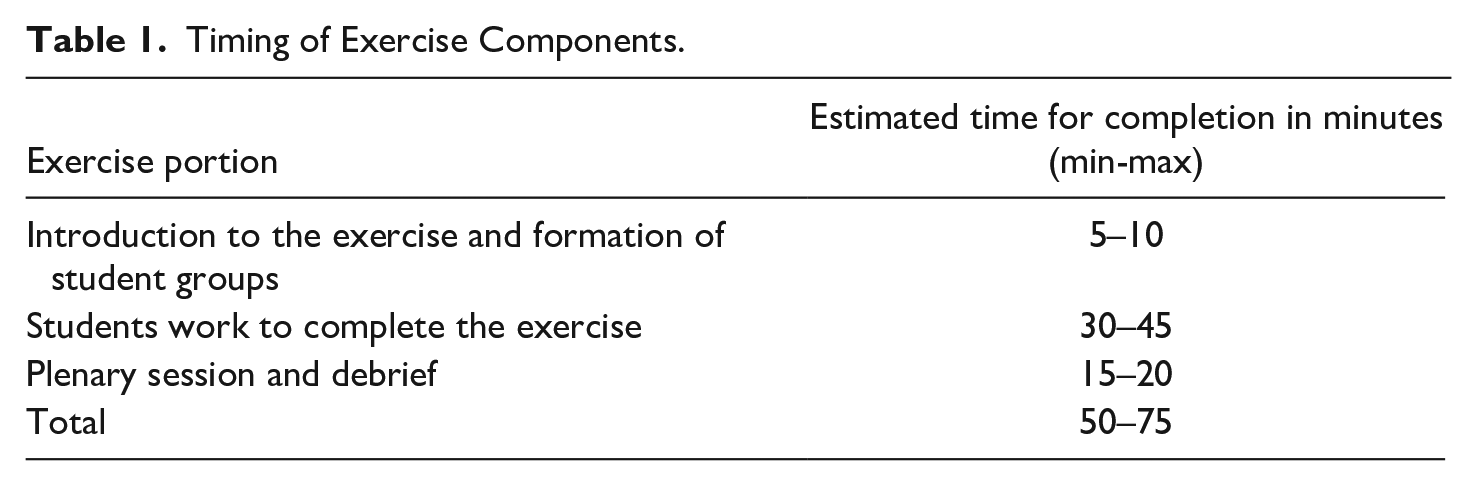
One 75-min class period is typically used for this exercise, although this exercise could also be conducted in a 50-min class. If conducting the exercise in a 50-min class, instructors may want to provide students with the handout and ask them to read it before class. A time frame for the exercise is presented in Table 1.
Timing of Exercise Components.
Debriefing the Exercise
Within the plenary session, student groups share their recommendations for O&S Corp. and engage in a facilitated discussion to frame and reflect on the exercise in terms of learning objectives (i.e., calculating, finding, compiling, and analyzing data and to make recommendations to O&S Corp. regarding workforce planning). One possible discussion question includes “What issues and information did you consider when working through this process?” Many groups will primarily focus on the transition matrix forecast and O&S’s budget constraints. However, they often forget about including other data, like strategic goals, employee survey data, local business trends, and local employment data. This discussion often leads students to consider how their forecasts may change depending on the information they prioritize and that combining more information can help to provide a better picture of the organization’s needs. Similarly, students also tend to have a narrow view about ways to add or decrease the number of employees in a particular job (i.e., hiring and downsizing, respectively). Asking students, “Are there any alternative ways to achieve your group’s recommended workforce projections?” often leads students to begin thinking of alternative ways to resolve gaps between labor supply and labor demand (e.g., employee overtime, reducing employee hours, retraining current employees for other jobs, etc.). For other discussion questions please see Appendix D. Appendix D also contains a more thorough review of the questions discussed above.
It should also be noted that student learning objectives for this exercise are typically assessed in multiple ways, for example, via discussions with student groups while walking around, and via discussion in the debriefing session.
Limitations and Suggested Extensions
There are a few challenges to running this exercise. In particular, some students are uncomfortable with the inherent ambiguity built into the exercise. Students often express wanting to know the “right” answer, and although there are certainly incorrect recommendations students could make, one “right” answer does not exist. However, these comments often lead to a discussion about the importance of collecting good data, making data-driven decisions, and that practitioners try to forecast and make recommendations with their best interpretation of the information, although it may be imperfect and/or incomplete. This discussion typically leads into a conversation about the importance of monitoring, evaluating, and revising forecasts and plans.
Another limitation of this exercise is that there is an infinite number, and type, of data that could be presented for use. To provide students with the opportunity to engage in workforce planning within a typical 75-min class period, not all relevant analytics are covered. For those instructors wishing to expand this exercise, students could find and work with additional data and analyses. In another extension, students could develop regression equations and run analyses using discipline-relevant software packages. In addition, this exercise could also serve as the starting point for a discussion about compensation topics as BLS also provides detailed local wage information.
Conclusion
Recent studies suggest HR analytics, specifically workforce planning, is becoming an important HR skill (BasuMallick, 2019; Parks-Leduc et al., 2018; Smith, 2018). However, business students may have little experience with workforce planning. This article presents a workforce planning exercise for use in undergraduate business courses (face-to-face or online). Within this exercise, students become familiar with using and applying workforce planning concepts. Thus, this exercise better prepares students for the job market by improving career-relevant skills.
Supplemental Material
sj-docx-1-mtr-10.1177_23792981211057227 – Supplemental material for Developing Workforce Planning Skills in Human Resource Management Courses: A Data-Driven Exercise
Supplemental material, sj-docx-1-mtr-10.1177_23792981211057227 for Developing Workforce Planning Skills in Human Resource Management Courses: A Data-Driven Exercise by Jessica L. Doll in Management Teaching Review
Supplemental Material
sj-pdf-1-mtr-10.1177_23792981211057227 – Supplemental material for Developing Workforce Planning Skills in Human Resource Management Courses: A Data-Driven Exercise
Supplemental material, sj-pdf-1-mtr-10.1177_23792981211057227 for Developing Workforce Planning Skills in Human Resource Management Courses: A Data-Driven Exercise by Jessica L. Doll in Management Teaching Review
Footnotes
Appendix A
Appendix B
Appendix C
Appendix D
Declaration of Conflicting Interests
The author declared no potential conflicts of interest with respect to the research, authorship, and/or publication of this article.
Funding
The author received no financial support for the research, authorship, and/or publication of this article.

References
Supplementary Material
Please find the following supplemental material available below.
For Open Access articles published under a Creative Commons License, all supplemental material carries the same license as the article it is associated with.
For non-Open Access articles published, all supplemental material carries a non-exclusive license, and permission requests for re-use of supplemental material or any part of supplemental material shall be sent directly to the copyright owner as specified in the copyright notice associated with the article.
