




Abstract

For most of his adult life, Ron Callus was an academic and a researcher. More accurately, he was a man of ideas – who collaborated generously with others for the creation and sharing of new ideas.
The man
Ronald Paul Callus was born in Sydney in 1953. He was the only son of Vera and Joseph Callus, a Hungarian Jewish couple who came to Australia after surviving The Holocaust. Despite initial economic hardships, the family prospered and was able to send Ron to Sydney Grammar School. Ron rarely spoke of his time there, referring to it more as an experience he ‘survived’ rather than as one he remembered fondly. As his lifelong friend Peter Ortner put it: Ron was not a star achiever at school: a very quirky guy, who was proud to dig ditches and do roadworks for the council during school holidays. He was no academic then, but he was always interested in many subjects. As he matured and went to university many of his ideas were formed and especially when he did his Masters … His intellectual insights, his ability to build bridges between unlikely political and ideological allies and his laconic humour were without equal. … Ron was one of the cleverest and most astute people I’ve ever had the honour to work with. Yet he was so humble and so kind and so utterly without ego. And that is an extraordinary thing to be able to say about someone – as those facets of personality rarely assemble to together into a whole person.
The qualities that made Ron a wonderful human being also underpinned his strengths as a researcher.
The researcher
Ron went to the University of Sydney where he completed a Bachelor of Economics in 1974 and a Master of Economics (by research) in 1978, with a focus on industrial relations. Over the next 40 years, Ron became a central figure in the development of the discipline of industrial relations in Australia through his research and teaching. A summary of his key achievements is provided in table 1 at the end of this paper.
Ron Callus – man of ideas and inclusive leader of their production and debate.
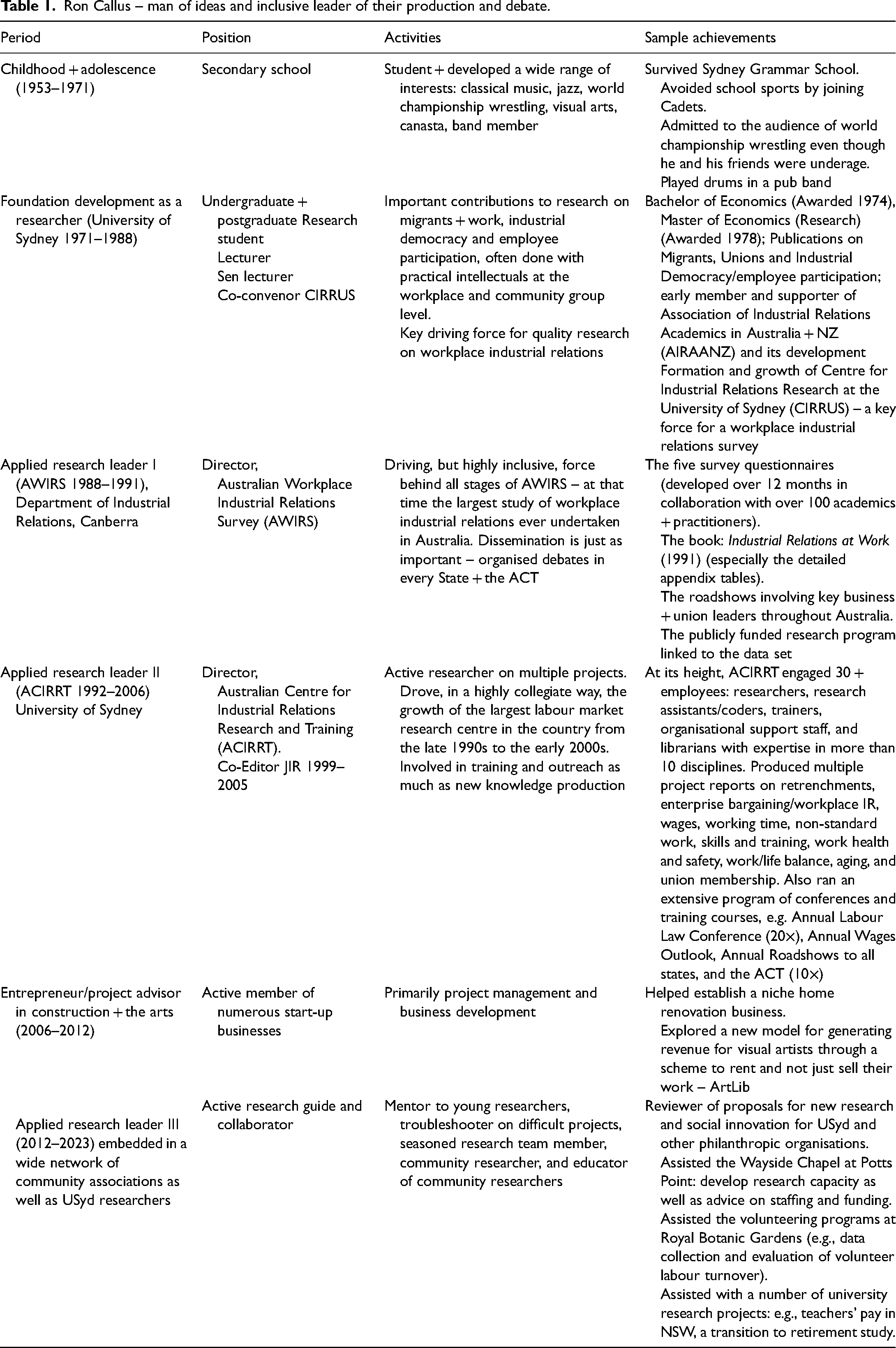
Ron became an associate professor and a founding full-time director of the Australian Centre for Industrial Relations Teaching (ACIRRT), a Key Centre of the Australian Research Council, from 1991 to his retirement in 2005. He continued to assist with research in the (then) Faculty of Economics and Business, including assisting early career academics in gaining competitive grants for their research. The Association of Industrial Relations Academics in Australia and New Zealand (AIRAANZ) awarded Ron the Vic Taylor Long Term Contribution Award to Industrial Relations in 2016.
Ron's initial research, which focused on migrants in the workplace, was doubtless influenced by the experience of his parents and other immigrant families who began their lives in Australia with few economic resources, working in jobs with low pay and poor conditions. His Master's thesis was entitled Migrant Workers: Their Employers and Unions: A Study of Management's Attempt to Promote Labour Stability in a Multi-ethnic Workforce.
Ron found that migrant workers had higher turnover rates than non-migrant workers, not because they were less loyal but because they were often trapped in undesirable jobs from which they wished to escape. Like all of his subsequent work, Ron's research on migrants was based not only on rigorous scholarship but also grounded on compassion for those who were the most disadvantaged in the labour market.
Between 1998 and 1991, Ron was the project director for the path-breaking Australian Workplace Industrial Relations Survey, working through the then Commonwealth Department of Industrial Relations. His endeavours resulted in the publication Industrial Relations at Work: The Australian Workplace Industrial Relations Survey by Ron and a team of researchers who later also became preeminent in the field of industrial relations. Their careers attest to the key role of Ron as a mentor during their formative period as researchers.
During his period as Director of ACIRRT (which later became the Workplace Research Centre) at the University of Sydney, Ron developed a strong culture of applied research. No research centre did more to gather and disseminate data on changes at work or to contribute to public debate about the regulation of work. The Centre also made significant contributions to public policy in Australia (Ellem and Lansbury 2007). Through his leadership, Ron created opportunities for many young researchers to learn and develop skills that enabled them to subsequently achieve successful careers in a wide range of organisations.
In the last decade of his life, Ron was embedded in a wide network of researchers in community associations as well as at the University of Sydney. For the Wayside Chapel at Potts Point in Sydney, he helped develop its research capacity and provided advice on staffing and funding arrangements. For the Royal Botanic Gardens, he assisted with reviewing its volunteering arrangements and labour flows. As a reviewer of proposals, Ron helped young researchers develop and assisted philanthropic organisation to make sound decisions on which initiatives to invest in with the aim of reducing social disadvantage.
One of Ron's greatest qualities as a researcher was his ability to listen – and on the basis of that reflection, generate deep, highly original insights about messy labour market issues. As his Master's supervisor and lifelong research companion, Malcolm Rimmer, put it: Ron had many fine qualities. One was that he had a great ear for what working people told him. Alfred Marshall, writing in the 1919 preface to his book Industry and Trade about his service on the 1891-5 Royal Commission on Labour, stated that “I received from working men and other witnesses…the most valuable education of my life”. That capacity to listen to what working people tell us is sadly missing in many. Ron had it in spades.
The practical intellectual entrepreneur
Ron's close friend Gary Lenczycki described Ron ‘as a soycheh, a chuchim (wise man/businessman)’. 1 This is a very rare quality in life in general and in the academy especially. For Ron, research was never just about the knowledge, it was about how you created it, with whom you undertook it, and how you shared the learning. It was never about his own CV. It was always about understanding problems better by listening sensitively and reflecting on findings jointly and collaboratively.
Ron was very strong on building connections – especially between the university and with practical intellectuals beyond campus. He was an organiser for new ideas – not just random ideas – but rather robust, evidence-based ideas. Most of all he loved myth-busting based on large research projects – not in a nihilist or smart-arse way – but as a prerequisite to better understand and engage with reality.
As noted above, underpinning all of this was Ron's powerful, intuitive intelligence. For nearly all who worked with him, Ron was the most powerful intuitive thinker we ever encountered. We would often slave away on an issue for days, weeks, and sometimes months – reading, writing, doing field work – often becoming more bewildered the more we toiled. But then we would talk with Ron. And invariably he would ask the most penetrating question or see the powerful story in all that we had found, unknotting the problem with us. This quality of Ron's shaped the two big ventures he undertook in his life: the Australian Workplace Industrial Relations Survey (Callus et al., 1991) and the creation and development of the Australian Centre for Industrial Relations Research and Training (ACIRRT – which subsequently evolved into the Workplace Research Centre).
So how are we to remember Ron? He defies easy categorisation:
Politically Ron sat somewhere between pluralistic liberalism and democratic, decentralised socialism. Organisationally while Ron was impatient with bureaucracy, he also appreciated the need for some formal arrangements, especially in managing finances and working conditions. While based around the university for most of his life, Ron also had a deep respect for, and engagement with, the world of practice. And in analytical temperament, Ron was equally comfortable with doubt and the pursuit of certainty.
Ron's most important quality was that he was never selfish – he always cared deeply for others. As a researcher, especially during fieldwork, people sensed this almost instantly. Consequently, many shared intimate information and deep insights with Ron. That is why his research was frequently novel, especially in the fields of migrant labour, workplace industrial relations, workplace change, and the aging workforce. But more importantly, this care and deep concern for others did not just make Ron a remarkable researcher, it made him a wonderful person. Ron may longer be with us but the spirit he shared with us all lives on.
John Buchanan and Russell Lansbury