



Abstract
Since regaining its independence in 1991, Lithuania has undergone a process of chaotic privatization in which labor was systematically disempowered, above all, by the targeted erosion of labor rights formally endorsed in the pre-existing Soviet labor code. In the newly legitimized and aggressive pro-business environment of the post-Soviet era, organized labor's residual power was seen as an anachronistic impediment to the power of capital in reshaping society and the economy. This article investigates the political dynamics of disembedded labor law reform in Lithuania, which enabled neoliberal reformers to legislate while disregarding broader societal interests and imposing unilateral changes in labor relations. A content analysis of 852 news media reports on labor law reforms published in 2014–2016 was used to demonstrate how discursive and institutional exclusion and sequencing were employed by the neoliberal government to circumvent the interests of major social and economic groups, resulting in the passage of pro-business legislation. The implications of resorting to disembedded politics in the labor reform process are discussed.
In response to the 2008–2009 economic crisis and the slow economic recovery in its aftermath, countries across Central and Eastern Europe undertook reforms to liberalize their labor markets. Although the reforms undertaken under the European Union (EU)-wide initiative were guided by ideologically dominant neoliberal labor flexibilization prescriptions, their outcomes varied across regions (Adascalitei and Morano, 2016; Eichhorst et al., 2017; Hermann, 2014; Koukiadaki et al., 2016; Schömann, 2014; Turrini et al., 2015). For analytical purposes, reform outcomes can be analyzed along a scale, with one end including countries such as Bulgaria and the Czech Republic, which carried out parametric reforms designed to modify the protective employment regimes inherited from the socialist era. The other end of scale includes countries such as Romania and Slovakia that implemented paradigmatic reforms in which labor laws inherited from socialist era were rewritten “by neoliberal governments in spurts of highly politicized radical liberalism” (Pula, 2020: 558; Sil, 2017).
This study investigates the dynamics of labor policy reforms in the second group of countries. For this purpose, it will focus on labor law reforms in Lithuania. It is argued that the most recent round of deeply unpopular labor law reforms in Lithuania represents an episode of highly politicized radical liberalism in the region. It was radical in two respects. First, in a sense of “CEE liberals <striving> to out-liberalize the EU in an effort to further low-wage, low-cost development strategy and attempt to exert leadership in the EU economic policy-making” (Orenstein, 2008: 899). Additionally, it represented a paradigmatic shift in labor relations designed to remove “the last vestiges” of the Soviet era labor code and institute “flexible” labor regulations in Lithuania (Davulis and Petrylaite, 2012; Juska and Lazutka, 2019; Petrylaite, 2017). Among the most significant changes in the new Labor Code were the introduction of five new types of contracts and five new types of working-time arrangements: new grounds for dismissal, simplification of termination procedures, reduction in employee compensation for dismissal, and restriction of trade union representational rights (Davulis, 2017; Seimas, 2016). Taken together, these changes fundamentally altered the basic conditions of ordinary employees and their right to representation. 1
This article addresses a guestion of how and why the deeply unpopular labor law liberalization drive failed to generate organized and effective opposition to such policies. For this purpose, the highly contentious process of labor liberalization reform is interpreted as an episode of disembedded politics. Lithuanian political elites, and especially ruling the Lithuanian Social Democratic Party (LSDP) and its coalition partners, instead of acting, in words of B. Pula (2020: 563), as “mediatory organizations” or “transmission belts” of broad societal interests, instigated and carried out unilateral radical liberalization policies reflecting ideological commitments of the LSDP leadership.
Specifically, this particular episode of disembedded politics began in the early 2010s, when the then ruling center-left coalition dominated by the LSDP changed its position on labor market reforms from against liberalization to pro-liberalization following the party's victory in the 2012 elections. Thus, a “neoliberal post-crisis consensus” in Lithuanian politics emerged as the center-left began to energetically pursue policies previously associated with radical austerity and the center-right that directly attacked workers’ rights (Juska and Lazutka, 2019; Bieler and Salyga, 2020).
The disembedding strategy that the Prime Minister (PM) and the leader of LSDP Algirdas Butkevičius pursued consisted of resolute and forceful exclusion and circumvention of influence and input of opposing groups and politicians. The exclusion strategies employed were of two types: discursive and institutional. Discursive exclusion was accomplished by launching a legislative initiative first, while delaying concertation with social partners in the Tripartite Council to a later time. This set the paradigmatic shift in debates on labor law reform and initiated negotiations not about “weather liberalization,” but on parametric aspects of the liberalization. Institutional exclusion deepened when the PM introduced the Labor Law reform bill in the Seimas (parliament), even before the Tripartite Council had finished its negotiations. Thus, the Seimas began debating the government's version of the liberalized labor law bill, while continuing negotiations in the Tripartite Council were relegated to a sideshow, leading to the eventual passage of the liberalized code in September 2016.
The remainder of this paper is organized as follows. First, the theoretical conceptualization of disembedded politics is discussed, and strategies that characterize this type of policymaking in Lithuania are described. Second, the methodology used to analyze disembedded politics in Lithuania is outlined. The succeeding sections then focus on the three stages of the disembedded reform process: legislative initiative, concertation, and legislative action. The study concludes with a discussion of the socio-political implications of resorting to disembedded policymaking in Lithuania.
Theoretical considerations: Conceptualizing disembedded politics
A disembedded political approach can be considered a particular reiteration of power-political theories used to explain labor market developments (Kolberg and Esping-Andersen, 1992; Korpi, 2006; Streeck, 2009). From a power-political perspective, differences in national labor market configurations and their changes over time reflect differences in the institutionalized power balance among major interest groups in society, especially between labor and domestic and transnational business interests. Thus, the preconditions for paradigmatic labor liberalization reforms could be either (a) an emerging broad pro-liberalization consensus reflecting changed socio-political conditions in the country or (b) a dramatic increase in business lobbying and mobilization overpowering the capacity of labor to resist unilateral rewriting of the laws (Pula, 2020: 562–563).
However, this is not what has happened in Lithuania. The reforms, instead of indicating the emerging broad pro-liberalization consensus, were deeply unpopular (see section on “Legislative action: deliberations on labor law reforms in Seimas” below). Throughout the labor law reform process, the power balance between business interests and the labor remained virtually unchanged while transnational corporate interests shied-away from direct involvement in the national labor politics. Neither did Lithuanian labor unions suddenly collapse, allowing business interests to unilaterally impose changes in labor laws. While domestic business interests did back the government's plans to rewrite labor laws, post-reform developments raise questions about their motives in seeking liberalization reforms. Contrary to expectations, in the first two post-reform years (2018–2019) the proportion of permanent contracts in the Lithuanian labor market continued to grow (albeit with the reduced protections that such contracts now provide), while contract work actually declined and the use of the new flexible forms of employment remained marginal (Juska and Navicke, 2022: 10–11). This suggests that business lobbying for flexibility provisions was (as of yet) mostly a competitive policy signaling campaign designed to convey a message about the favorable business climate in the country (Appel and Orenstein, 2018). Once signaling was accomplished, labor relations in Lithuania continued to be administered under institutional inertia inherited from previous decades.
To remedy this weakness of the power-political framework, the notion of disembedded politics was incorporated to account for the political dynamics of far-reaching but socially baseless reforms instigated and carried out by a small group of ideologically motivated elites (Pula, 2020: 563; also see Ban, 2016).
The origins of embeddedness paradigm can be traced to Karl Polanyi's institutional theory, especially to his differentiation between socially embedded and socially disembedded markets (Polanyi, 1944/2001). Polanyi's ideas proved influential in elite-oriented research concerning the growing disengagement and disconnection between citizens and their political representatives in mature democracies (Savage and Williams, 2008). Such studies largely focus on how elites become disembedded and how to re-embed them (Hann, 2021; Scheiring and Szombati, 2020). For example, Davis (2015) describes a number of “filters” that are used to disembed politicians and government officials from broader societal interests, such as the skewed and narrow structuring of potential pools of electoral candidates, socialization of politicians in the specialized language and norms of the political establishment that marginalize discourses of other social interests (see also Ruggie, 2020); and the use of ideologically and technocratically skewed information gathering, consultation, and communication with the electorate.
The other strand of this research conceptualizes disembedding as a process leading to what C. Wright Mills (1956) called the “circulation of elites.” Instead of elites arising from social interest groups to express their interests, disembedded elites are characterized by their relative isolation from broader society and circulation from and to high-ranking positions in national and transnational financial and political institutions, academia, corporations, think tanks, media organizations, political parties, the government, and the military. Multiple studies have traced the expansion of disembedded neoliberal policy making networks beginning with the establishment of Mont Pelerin Society in 1947, via growing influence of Austrian and Chicago schools of economics, expansion of corporate involvement and underwriting, think tanks, and lobbying leading to the emergence in the early 1990s of “the Washington consensus” and its subsequent export and expansion globally (Appelbaum, 2019; Ban, 2016; Slobodian, 2018).
The circulation of the elite framework emphasizes that the disembedding of political representatives from their constituencies proceeds simultaneously with their embedding in national and transnational formal and informal policy-making networks. This, in turn, tends to facilitate opportunities for accessing and circulating across decision-making positions in national and transnational organizations, business consulting, media, academia, think tanks, and nonprofit organizations. The more power, prestige, and remuneration become dependent on opportunities provided by the “circuit of elites,” the more disembedded political representatives can potentially become.
A disembedded in character “circulation of neoliberal elites” was typical to policy making in the Baltic countries. For example, Salyga (2023) traces how in the late 1980s pro-business transnational think tanks and academics in universities in North America and Western Europe recruited and trained Latvian, Lithuanian, and Estonian experts in various areas of neoliberal social and economic policies. Upon returning to their native countries, many became prominent experts involved in national politics. Those who gained access to strategic positions in government were able to pursue and enact neoliberal policies. Upon completion of their terms or due to changes in political leadership, ex-high-ranking officials continued to move via “revolving doors” from executive positions in the government to lucrative jobs in banks, investment agencies, transnational corporations, “free market” think tanks, and opinion-forming positions in the mass media. 2 As will be demonstrated later, this pattern of public policy reforms being carried out by a cadre of circulating elites that were administratively appointed, isolated from and unaccountable to the public, played a major role in the labor law liberalization process.
Disembedded politics: how is it done?
One of the shortcomings of embedding and disembedding filters, or the circulation of elite approaches, is that they assume that the process by which elites become disembedded explains disembedded politics. However, claims that politics is disembedded because it is carried out by disembedded elites are undue simplifications. Attempts at unilateral “ramming through” legislative changes tend to generate opposition, controversies, and fierce political infighting. In general, disembedded politics is a hard-ball, high stake, and high-risk politics that requires cunning, flexibility, ruthlessness, and capacity to keep relentless pressure on both supporters and opponents.
Therefore, what M. L. Cook called “government resolve” is crucial for the success of disembedded labor law reforms. She defined resolve as a “government's willingness to confront resistance to reform, which may involve political costs” (Cook, 2007: 8). Resolve is especially important when the center-left and leftist parties abandon their traditional redistributive economic policies and embrace neoliberal policies. This is a risky strategy that opens leftist politicians to criticism of hypocrisy and betrayal, generates splits and party factionalism, and alienates their core constituencies.
In addition, disembedded policy making also requires skillful deployment of strategies allowing for such political maneuvers. In this regard, two types of disembedding strategies can be differentiated. The first is the strategic deployment of labor reform implementation mechanisms. Comparative labor reform studies analyze a number of reform implementation mechanisms, such as government decrees, legislative initiatives, concertation via social-dialog mechanisms (most often via tripartite councils), legislative action, and dual-track reform implementation (see Cook, 2007:10–12; Lau et al., 2000). Some mechanisms, such as reform decrees, are unilateral, while others can be used with or without social-dialog mechanisms or can be deployed in a particular sequence to exclude and circumvent opponents by creating political space to act unilaterally (Etchemendy, 2004; Murillo, 2001). For example, concertation, the purpose of which is to embed reforms, can be effectively neutralized if it is launched after a legislative initiative. Similarly, legislative action can be initiated when the concertation has not yet been completed, relegating the dialog of social partners to a sideshow.
The second type of disembedding actions consists of communication-obfuscation strategies about the reform process and its outcomes (Elmelund-Præstekær et al., 2015). Impetus to systematic study of obfuscation strategies was given by P. Pierson's seminal work on welfare retrenchment when obfuscation became a part and parcel of the austerity reform making (Pierson, 1996; 2001).
Obfuscation studies focus on delineating when and under what conditions such strategies are employed and to what effect, such as communicating on transparent but obfuscating non-transparent aspects of reforms (Lindbom, 2007) or engaging in a variety of blame-avoidance maneuvers (Weaver, 1986). In the case of pension privatization reform in Lithuania, obfuscation was at play when its supporters engaged in relentless attempts to undermine trust in the public pension scheme as fiscally and demographically unsustainable and doomed to failure (Juska, 2021). In the Lithuanian labor law reforms, the PM used bundling as an obfuscation strategy, that is combining controversial liberalization of the labor law bill with other more popular bills, such as extending family and disability benefits, to blunt criticism and opposition to the labor law reform.
Contesting labor reform
The labor code reform process was driven by the PM Butkevičius’ unwavering commitment to the labor market liberalization. For him, rewriting the labor law transcended the usual “give-and-take” of policy making and became a moral and even millenarian undertaking in pursuit of two goals: more freedom and justice for society and emancipation of the new subject of history (in place of the fallen-from-grace proletariat) – the entrepreneurs. The strength of Butkevičius’ ideological commitment was expressed in his willingness to sacrifice the standing of his political party as well as his political career to see the labor reform through.
For a leader of the LSDP, a wholehearted embrace of the pro-business agenda has at least two dimensions that make it neither unique nor entirely eccentric. First, it is consistent with the overall trajectory of the post-independence transformation in Lithuania, when the country zealously pursued neoliberal doctrines in the creation of a new market economy with low controls on capital, open markets, and reduced provisions for social protection (Hirschhausen, 1998; Kolodko, 2002; Bohle and Greskovits, 2007). Characteristically, Lithuania responded to the severe 2008–2009 economic crisis by doubling down on neoliberal prescriptions and implementing the most drastic austerity programmes in the EU that favored the suppression of wages and massive cuts to public sector expenditures as a formula for resolving the crisis (Sommers and Woolfson, 2014; Usha, 2017). However, by the mid-2010s, the effectiveness of austerity prescriptions in stimulating the economy decreased, while labor costs began to rapidly outpace increases in productivity (Juska and Lazutka, 2019). It is within this context of the waning effectiveness of “internal devaluation” policies that Butkevičius’ embrace of neoliberal labor reforms occurred.
There is also a very important personal dimension of Butkevičius’ strong moral conviction in political choice-making that echoes the more grandiose example of support for the invasion of Iraq by Tony Blair who, even in his retirement, insisted that it was the right thing to do. 3 Consider that by October 2016 the LSDP had lost the elections, to a large degree because of the public backlash against the new labor law and Butkevičius had been ousted from the party leadership. By 2017, the LSDP had split, while Butkevičius and his supporters quit the party altogether.
In sum, the combination of the pro-liberalization stance embraced by the center-left governing party, and employment of the disembedding strategy of institutional and discursive exclusion by its leadership was instrumental in undermining the emergence of opposition to a widely unpopular liberalization drive. Instead, controversial labor reforms produced pro- and anti-liberalization divisions within the Lithuanian political class. The most important in this regard was the highly personalized conflict and contestation between the PM and President Dalia Grybauskaitė, who became one of the fiercest labor reform critics. It was her intervention that punctuated the reform process, first by bringing the new legislation to public attention, and then by criticizing and calling for selective changes in the bill at the start of legislative action, and finally by vetoing the law. In conflict with the PM, the President positioned herself as a populist defender of the Lithuanian people who, in her view, were being relegated by the reforms to humiliating, in some cases to “serfdom-like” employment conditions (Kupetytė, 2016).
Furthermore, the reform drive split both the ruling coalition and opposition parties into pro- and liberalization fractions. However, as will be discussed below, PM Butkevičius was able to skillfully deflect the President's critique, keep a significant number of his party representatives in line, and gain sufficient support from the opposition to pass the reformed labor code into law.
Methodology
In this study, the discourse analysis of news media coverage in Lithuania is used to analyze the political dynamics of the disembedded labor law reforms (see also Juska and Woolfson, 2017). Discourse can be understood as “a mass process of public persuasion … [by] … individuals and groups involved in the presentation, deliberation, and legitimation of political ideas to the public. …[D]iscourse serves not only to express one set of actors’ strategic interests or normative values, but also to persuade others of the necessity and/or appropriateness of a given course of actions” (Schmidt, 2008: 310–312).
In this study, 852 news media articles on labor law reform published from December 2014 to June 2016 by the five most popular national news media portals in Lithuania are examined. Figure 1 not only depicts the dynamics of news media publications on labor reform from December 2014 to September 2016, but also illustrates the sequential deployment of reform implementation mechanisms that was used by the PM to circumvent concertation in the Tripartite Council.

News Media Publications and implementation mechanisms of the New Labor Code (LC) in Lithuania (December 2014–September 2016; N = 852).
A comprehensive list of news reports and articles was compiled on the Labor Code reform published from December 2014, when the draft outline of the new code was made public, until September 2016, when Seimas overwrote the President's veto, making the new version of the Labor Code the law. For this purpose, five most visited Lithuanian national news portals such as Delfi.lt (1.2 ml visitors per month), 15 min.lt (1.03 ml), Alfa.lt (507 thousand) and online sites of two major daily national newspapers such as Lietuvos Rytas at lrytas.lt (“Lithuanian Morning” in Lith.; 884 thousand) and Verslo Žinios at vz.lt (“Business News” in Lith.; 507 thousand) were searched. Articles were searched for the term “Darbo kodeksas” (Labor Code in Lith.). These five portals account for more than 80% of the country's so-called timeshare-internet (see http://www.audience.lt). Therefore, while no claims can be made about the comprehensiveness of the coverage analyzed, it can be argued that it is sufficient for a representative analysis of the discourses on labor law reform in Lithuania's news media.
Articles retrieved varied from a paragraph in length such as reports on what proposals the Seimas was considering for discussions to a more extensive analysis of the new legislation by experts, government officials, labor union representatives, columnists, and editors. Bibliographic data on each article, such as title, author (journalist or corporate author, editorial board, newspaper staff, news agency, etc.), source (news portal or newspaper), and date of publication, were entered into the EndNote bibliographic reference management program.
The articles were coded, beginning with a list of approximately 20 themes or keywords that were identified. Keywords were constituted by the issues discussed in the media reports on provisions of the new Labor Code, such as severance pay, lay-off notification periods, temporary employment contracts, reduction of wages, liberalization of labor relations, competitiveness, business efficiency, claims of new jobs created via reform, lowering unemployment, reducing poverty, increasing motivation to work, political negotiations, modernization, more authority for employers, lack of transparency, flexicurity, disempowering workers, increasing employment precariousness, and gender (in)equality. One or more keywords could be used to code the contents of a single report.
Empirical clustering of keywords in coded articles was inductively aggregated to differentiate the distinct ways in which the new Labor Code was defined and described in news media. Seven discourses were identified (Figure 2).
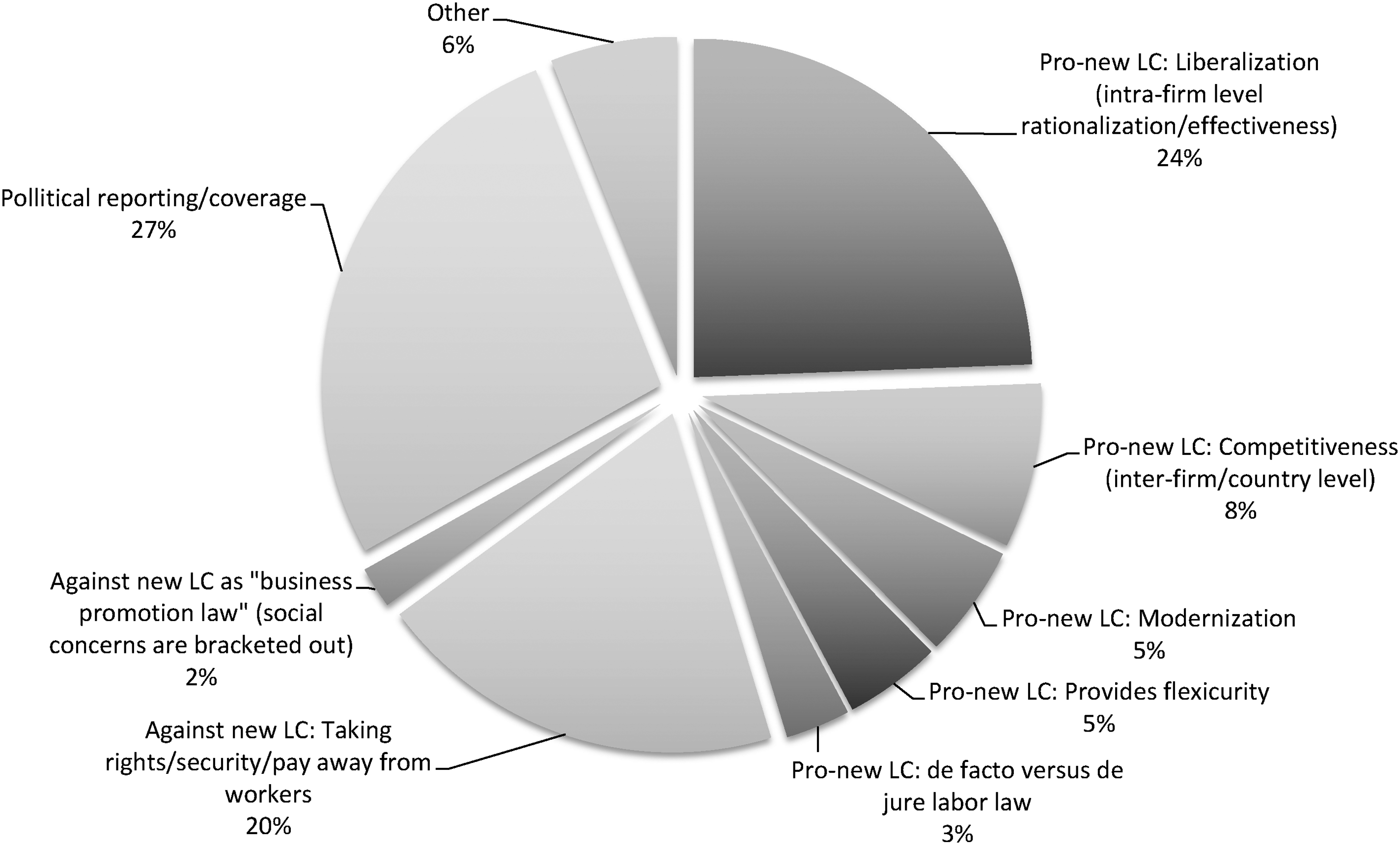
Discourses of the New Labor Code in the Lithuanian News Media (percentage of publications for December 2014–September 2016; N = 852).
Five supported Labor Code liberalization, and such support was evident in 45% of all news reports. Categorized as supportive were discourses arguing for increasing authority and discretion of employers, thereby benefiting businesses, and by extension, employees, and society at large. Two discourses opposed to liberalization reforms were evidenced in 22% of all news reports. These latter reports claimed that the proposed legislation will reduce employment security, protection, and benefits for employees, and will negatively affect the well-being of the broader society by privileging market forces before all other considerations. About 27% of reporting was coded in “political coverage” category, the majority being written in the genre of so-called “horse race journalism” that lacked policy analysis and instead focused on reporting the winner and loser, and on spats and infighting among politicians, state officials, lobbyists, labor activist, and experts.
The public debate
In the public debate over labor reforms, the most significant was the pro-liberalization discourse (24% of publications). This was based on a technocratic argument advocating reforms to increase firm efficiency, reduce business costs, and improve the business environment. It is a technocratic discourse because it strived to present liberalization as an attempt to make firms and labor markets more rational, efficient, and eschewed the political, social, or ethical dilemmas involved in labor market restructuring policies, that is, questions of who will pay for and who will benefit from this restructuring and how gains from increasing efficiency will be distributed between labor and capital.
While the liberalization discourse was deployed to argue for increasing effectiveness on an intra-firm level, “competitiveness” as a strategic discourse (8% of reports) adopted regional, national and transnational perspectives. In this iteration, claims were made that the new Labor Code will increase the efficiency of the national economy vis-à-vis global and regional competitors, again seeking to exclude any problematic political, social or ethical dimensions of domestic labor market restructuring.
“Modernization” as a strategic discourse (5% of reporting) attempted to cast political conflict over the new Labor Code as generational conflict between interests and ideals of the old and the young. From this perspective, the current Labor Code, characterized as a leftover from the Soviet era, corresponds to the interests and values of an older generation that grew up in Soviet times under the paternalistic system of a manufacturing-based economy. Therefore, the reforms were needed to advance the interests of the younger and more entrepreneurial generations to free them from “ossified institutions” inherited from the Soviet past. This discourse also dismissed labor unions, collective bargaining arrangements, and consultative tripartite forums as relics of a bygone factory-based industrial era.
Reporting on “flexicurity” (5% of all reports), a supposedly value-neutral neologism borrowed from the discourse on labor law modernization of the EU, was meant to signal the beneficial combination of flexibility in terms of employment, with security in terms of adequate provision for retraining and income support for those in transition between jobs (European Commission, 2006; Heyes, 2013). This discourse was favored by a group of experts who produced the liberalized version of the labor code advocated by the government (Petrylaite, 2017).
The last pro-liberalization discourse dismissed the current labor law as de facto ineffective (3% of reports). It claimed that current labor laws were widely disregarded by employers in their day-to-day conduct. Therefore, labor law reform was needed to introduce de jure provisions regulating labor relations that were enforceable in practice.
Social disenfranchisement/class conflict discourse dominated the critical coverage of labor law reforms (20% of all reports). It was used mostly by labor union activists as well as by a small group of prominent academics and intellectuals to frame negotiations over the new Labor Code in class conflict terms as an attempt by an alliance of government, big business, and employers to strong-arm employees to accept a social contract depriving them of their legal rights and reducing their wages and benefits.
Finally, substitution of society by the market-led discourse (2% of publications) argued against the narrow economic framing of the new labor law, which tended to treat all of society as if it were the market, and, by extension, the interests of employers as coincidental with the best interests of society itself. In other words, such labor reforms, instead of contributing to the development of a more just society, could potentially increase exclusion, decrease the quality of newly created jobs, and discourage social dialog.
In order to answer the question “who is speaking?,” publications were coded, beginning with a list of 18 social actors that were later consolidated into seven categories (Figure 3). Close to 22% of news publications covered deliberations in Seimas, 18% consisted of reports on government policies and statements, including those by the PM and cabinet ministers, high ranking government and ministerial officials, and advisors to the government. “Business lobby/Employers” include 17% of reports covering statements and positions of The Lithuanian Free Market Institute, the Lithuanian Business Confederation, the Lithuanian Business Employers Confederation, the Investors’ Forum and other business associations as well as business owners and managers. Fifteen percent of reporting was on views and opinions of the labor unions and employees, 10% were on the President's statements, 10% on deliberation in Tripartite Council, and 3% on deliberations by “the Commission on Social Model” that was created by the Government to develop the proposal for labor law reform.
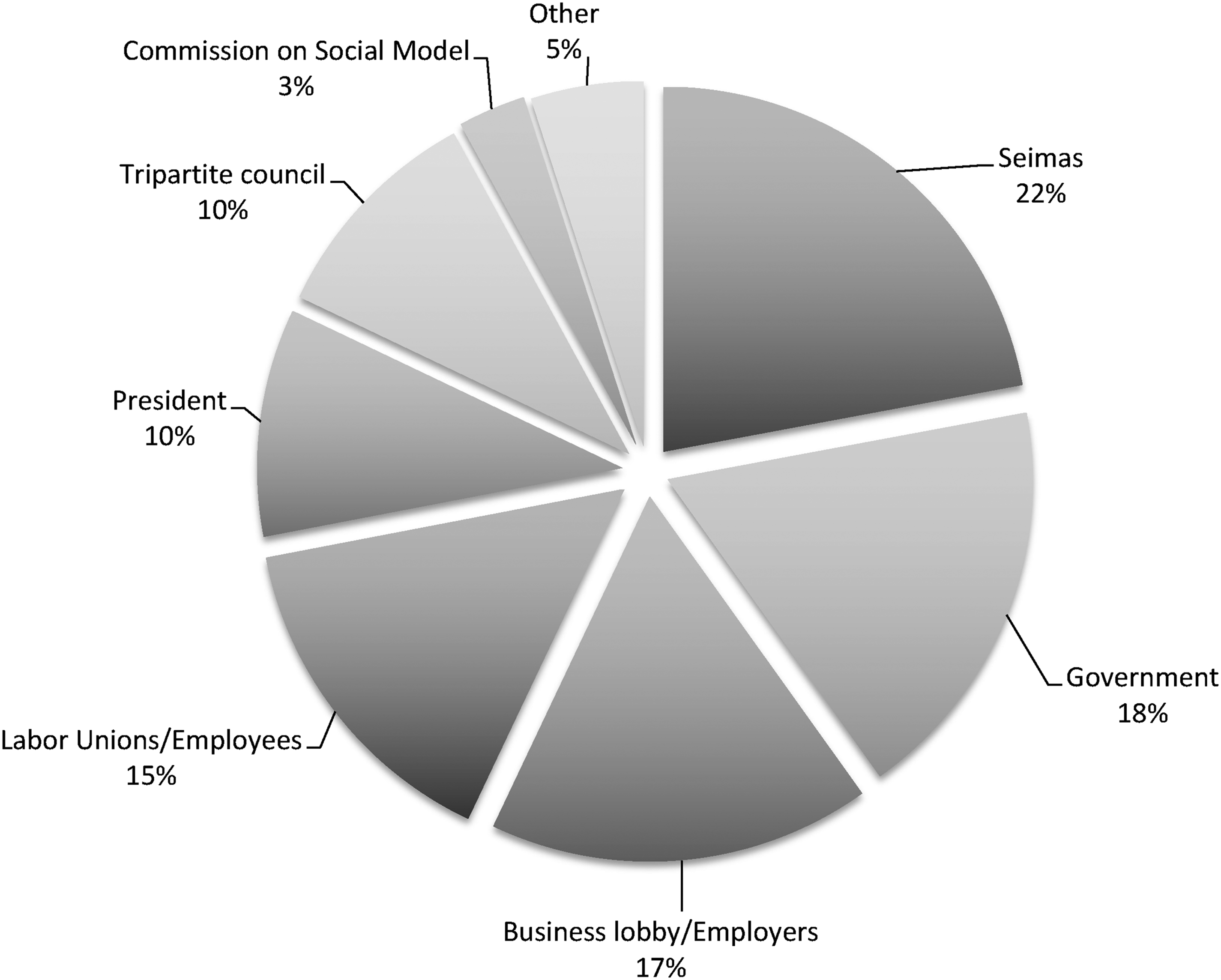
Social actors in the New Labor Code coverage in the Lithuanian News Media (percentage of publications for December 2014–September 2016; N = 852).
Legislative initiative (December 2014 through June 2015)
The center-left government, dominated by the LSDP, chose legislative initiative as its main strategy for introducing reforms to liberalize the labor code. For this purpose, a special Commission on the New Social Model was created under the auspices of the Ministry of Social Security and Labor. The EU provided funding for the Commission in support of its recommendations for Lithuania (European Commission, 2006).
The EU allocated 5 million Litas (€1.45 million) to fund the work of the Commission on the New Social Model. A small group appointed by the Ministry lawyers, technocrats and policy-making experts produced the draft of the new social model legislature. This was done to exclude and circumvent participation and input of broader constituencies especially those opposed to liberalization and to set paradigmatic terms of the debates, that is to preclude the debates about the pros and cons of liberalization. Instead, the unveiling of the draft of the new social model in December 2014 limited the debates to discussions of the degree, aspects, and the extent of the labor law liberalization.
In anticipation of widespread criticisms and opposition liberalization reforms were bundled in a package called “social model” that included not only liberalized labor code but also proposed changes in 40 other laws modified to enhance social insurance and promote employment such as the Bill on Sickness and Maternity Social Insurance, the Bill on the Social Insurance of Occupational Accidents and Diseases and others. The bundling strategy was reflected in the discourse on flexicurity promoted to reduce opposition to reforms by increasing their complexity.
How effective was the legislative initiative of bundling in introducing labor law reform in Lithuania? As Figure 4 demonstrates, the opening gambit of the PM Butkevičius was very effective in terms of setting the paradigmatic framework of the labor law reforms. From the very outset reforms were framed to exclude debates of “whether liberalization?” Instead, the debate was framed, primarily by focusing on various goals of liberalization such as increasing inter-firm efficiency (32% of publications), increasing international competitiveness of Lithuanian economy (7%), reducing inefficiency in the Labor Code enforcement (5%), and the need of the Labor Code “modernization” (4%). With some modifications, this discursive framework remained intact and defined the parameters of the debates throughout the reform process.

Implementations mechanisms and news media discourses on the Labor Code reforms in Lithuania (December 2014–September 2016; N = 852).
However, packaging controversial labor laws with other provisions to “sweeten the liberalization deal” fell short of its intended purpose. Attempts to frame and discuss labor law reforms in terms of flexicurity did not catch up, accounting for only 9% of publications during the initial period of the reforms and eventually fizzling out to only 3% of publications in the legislative stage of reform. Instead of debates on “social model,” the media was covering debates on the labor code liberalization up until it was passed by Seimas and became the new law. Furthermore, the legitimacy of the discourse on flexicurity was questioned as soon as the public became aware of the secretive process of selecting experts to draft labor law reforms without broader consultation and input from other constituencies. Specifically, in March 2015 the president gave a highly publicized speech criticizing the Ministry of Social Security and Labor for the poor quality of the proposed labor law that, in her opinion, constituted “a hodge-podge of a number of various proposals” (ELTA, 2015). Furthermore, she claimed that the Ministry grossly overpaid a small group of scientists and experts for such a “shoddy” job in preparing new laws. The speech had a tone of a public “scolding” of incompetent bureaucrats and was a stinging critique of the government for its failure to oversee preparation of the new legislation.
The President's criticism was bad publicity for the government. One and a half million euros paid to a small group of experts to produce pro-business legislation in a country where the average monthly salary was about €700 gave the impression of collusion of interests. Furthermore, the reporters soon found out that while no labor representatives and other stakeholders were included in the Commission, a subcommittee charged with drafting the new labor code had as its member a former president of a national association of temporary employment agencies, indicating a potential conflict of interests (Lukaitytė-Vnarauskienė, 2015).
The PM was taken aback by the President's criticism, and in order to diffuse criticism, chose a two-track strategy. In March 2015, he initiated a concertation of labor reforms in the Tripartite Council while simultaneously promoting the government's version of the new labor law that was submitted to Seimas while the Tripartite Council had not finished its work yet. The effect of this strategy was to circumvent concertation while forcefully pushing for the adoption of the government's reform plan through Seimas.
Concertation: labor law debates in tripartite council (march-September 2015)
The Tripartite Consultation was established in Lithuania in 1995 under EU guidelines following its application for EU membership. Although the Tripartite Consultation among the government and national organizations representing employers and trade unions was expanded to the Tripartite Council of the Republic of Lithuania in 2005, social dialog remained weak and was invoked mostly for administrative purposes, indicating Lithuania's formal compliance with EU mandates and regulations.
The onset of the severe 2008–2009 financial crisis increased the Tripartite Council's public visibility and role in industrial relations. In response to the rapidly developing budgetary crisis, Prime Minister V. Kubilius of the center-right coalition instituted overnight tax reforms and drastic cuts in public-sector outlays and social benefits. These measures generated a political backlash, including a large protest rally on January 16, 2009, that brought more than 7000 demonstrators in front of the Seimas. The demonstration ended in disorder and riots, with police using rubber bullets and tear gas to quell the demonstrators (Juska and Woolfson, 2012).
The threat of unrest forced Prime Minister Kubilius to seek accommodation with those opposing his anti-crisis plans. This was done via negotiations in the Tripartite Council, which led to the 2009 amendments to the Labor Code. Temporary changes in labor law (for 18 months only) allowed employers to reduce employees’ dismissal costs and unilaterally modify employment contracts. In return for the support of these amendments, the labor unions received assurances from the government that it would not submit any labor law changes to Seimas unless they were approved by the Tripartite Council, thus elevating the status of the institution (Davulis and Petrylaite, 2012: 11).
Use of concertation by the PM Butkevičius in his campaign to revamp labor laws was in many respects similar to Kubilius’ strategy in dealing with the onset of the 2008–2009 crisis. In both instances tripartite negotiations were initiated in post factum fashion, in the case of Butkevičius, four months following the unveiling of the outline of the new “social model” (see Figure 1). In other words, the Council was not used to reach some form of consensus among social partners before launching the labor law reform, but to manage the fallout from public backlash following the unveiling of bureaucratically conceived and far-reaching reforms.
One of the consequences of the sequencing legislative initiative before its concentration was that when the Tripartite Council met for the first time, it commenced discussing changes in labor laws via a discursive framework preset by the government in the legislative initiative phase. Therefore, unsurprisingly, the media coverage of deliberations in the Tripartite Council mirrored the topics discussed in the legislative initiative phase: 32% of the articles expressed pro-liberalization views, 7% advocated flexicurity, 6% were pro-modernization, and 17% claimed that the reforms would disenfranchise workers.
The legislative initiative and concertation periods differed in terms of the proportion of publications on political coverage, which increased from 16% to 31%. This was an indication of growing tensions and controversies in the Tripartite Council, leading to preoccupation of the media on coverage of tense and conflict-ridden negotiations, reporting on whose influence is up or down, the drama of increasingly personalized and heated exchanges, and the use of inflammatory rhetoric that made eye-catching headlines.
However, attempts to preempt concertation via legislative initiative was not without significant downsides to PM Butkevičius and his ruling coalition because it excluded and sidelined one of the main constituencies of the ruling Social Democratic Party – labor unions. In response, labor activists asserted that Butkevičius was using the Tripartite Council mostly for purposes of “deflating” public controversies and legitimizing liberalization of the new labor law, i.e., as a tactical maneuver and public relations measure rather than engaging in good-faith negotiations among social partners. This led to very awkward situations when the Social Democrat Prime Minister was picketed by the labor activists while simultaneously being praised by V. Kubilius, the ex-PM and the leader of conservative Homeland Union, for supporting the labor law liberalization initiatives that the LSDP was previously vehemently opposed to.
The legitimacy of tripartite negotiations was further undercut by the decision of the government to introduce its version of the new labor law for Seimas deliberations while social partners were still working on their proposal. This led to a situation where, for three months (July–September 2015), the news media reported on deliberations of two unequal versions of the labor law—one introduced in Seimas by the government and the other being negotiated by the Tripartite Council. The latter was completed by September 2015, when social partners reached agreement on 80% of the new Labor Code provisions. Assurances by the PM that the agreements produced in Tripartite Council would not be ignored rang insincere and hollow even as Butkevičius continued promising to the irked labor leaders that provisions of the new law agreed by Tripartite Council will be introduced as amendments in the labor law bill in Seimas. However, when the Tripartite Council provisions were introduced into the Bill in October 2015, they were drowned in 600 other amendments that were filled for deliberations by the Social Affairs and Labor Committee.
In the end, the government proved to be quite effective in sidelining the Tripartite Council via sequencing as well as by framing the debates in overwhelmingly pro-liberalization terms. However, the deliberate exclusion of broader societal interests had a downside in further politicizing the reform process. Therefore, instead of reaching (however imperfect) consensus, the end of negotiations at the Tripartite Council was marked by the largest (since 2009 riots) anti-labor law liberalization demonstration that proceeded under such banners as “We are not slaves,” “No to serfdom in the workplace,” “Hunger games – soon in your workplace,” and “50 shades of hunger” (Savickas and Fuks, 2015).
Legislative action: Deliberations on labor law reforms in Seimas
Seimas deliberations on labor law reforms began in June 2015 and lasted for more than a year until September 2016. As illustrated in Figure 4, the most significant change in media coverage was a marked decline in pro-liberalization publications from 32% in the first two reform stages to 22% in the legislative action period. Furthermore, as pro-liberalization coverage declined, pro-labor critiques of the new labor code increased from 17% to 21%. Indicative of these changes was growing reluctance of the labor law liberalization proponents to use terms of “liberalization” and “liberalism” altogether as they were increasingly perceived by the general public to be ideological “fig leaves” to cover promotion by employees and investors of their narrow interests at the expense of labor disenfranchisement (Savickas, 2015). This hardening of negative views of the Labor Code reform was also reflected in public opinion surveys. For example, in a representative public opinion survey conducted in July 2016 by the polling firm Vilmorus, 51% of Lithuanian respondents had a negative opinion concerning the new Labor Code, 14% had a more negative than positive view, 2.7% were more positive than negative, and only 1.4% were of a positive opinion about the new legislation (Samoškaitė, 2016d).
For the PM, the rising headwinds against his reform efforts were complicated by the forthcoming October 2016 Seimas elections. As parliamentarians began to position themselves in elections, many used controversies over labor law reforms to gain visibility and public support. This accelerated the pro- and anti-liberalization splits within the two major political parties in Seimas. The Social Democratic party had split into a pro-liberalization faction loyal and supportive of the PM and an opposing faction that accused the PM of capitulating to the political right by promoting labor laws designed to depress wages and keep labor costs low (Balčytis, 2015). The largest center-right opposition party—Homeland Union—in its turn, split into its pro-liberalization libertarian and anti-liberalization Christian Democrat fractions.
In response to deepening intra-party splits, the PM acted forcefully and skillfully by cajoling the majority in Seimas consisting of pro-liberalization Social Democrats and pro-liberalization conservatives, to pass legislation and override the president's veto. On one hand, Butkevičius was flexible enough to compromise with the wavering party and coalition members as well as to reach across the aisle to opposition parties for support. Among the most important compromises reached were the creation of a special fund to provide additional compensation based on seniority for laid-off employees and rescinding proposed cuts in maternity benefits.
At the same time, Butkevičius was relentless and unapologetic in using hardball tactics and wielding the legislation as “the battle axe” to get it passed by Seimas (Samoškaitė, 2016b). Such tactics produced a highly publicized break between the two highest ranking social democrats, when Butkevičius accused his colleague of “sabotaging” the new Labor Code. Another LSDP member publicly complained that the party leadership “twisted my arms, I am being intimidated not to speak my mind on the Labor Code” under the threat of being down- ranked in the list of party candidates in the forthcoming elections (Samoškaitė, 2016a) and that within the LSDP “there is virtually no discussion of the new labor law [while] Butkevičius is acting as [though as] convinced in his righteousness jihadi” (Samoškaitė, 2016c).
However, when the time came to count votes, Butkevičius, representing a cross-party coalition supporting increasing flexibility for employers, was able keep the majority of his party representatives in line, gain sufficient support from the opposition to reject the overwhelming majority of the amendments, to easily pass (by 68 votes to 12) the new Labor Code, and to override the president's veto by 74 to 39 (71 votes were needed to override the veto).
Conclusions
This study was designed to investigate the dynamics of disembedded law reform in Lithuania that enabled neoliberal reformers to impose paradigmatic changes in labor relations. Methodologically, it relied on content analysis of news media coverage that allowed to describe discursive framing used by reform supporters to sideline and circumvent opposition as well as broader public interests.
It was argued that crucial to enacting paradigmatic reforms in Lithuania was a change in the position of LSDP leadership from the against- to pro-liberalization stance after the victory in the 2012 elections. Arguably, if LSDP had not embraced “left neoliberalism” when it came to power in 2012, the labor law reform most likely would have followed the course of parametric reforms as it was the case in Bulgaria and Czech Republic. It was the emergence of ‘neoliberal post-crisis consensus’ in the Lithuanian politics that made possible, although did not determine, passage of a broadly unpopular new labor code.
Although the post-crisis consensus eliminated traditional “the center-left against liberalization” and “the center-right pro-liberalization” divide, the LSDP realignment proved to be highly controversial. To contain and circumvent opposition, the PM used a very effective discursive and institutional exclusion and sequencing strategy that allowed the government to sideline political question of “weather liberalization” and, by using raw political and administrative power, ram through the Seimas unilateral revision of the labor law.
The study also showed a jarring disconnect between the negative views of the majority of the population towards liberalization and the overwhelming dominance of pro-liberalization discourses in the mass media. This happened due to reformers’ domination in the reform coverage by a 2:1 ratio of pro-liberalization versus anti-liberalization publications. In addition, liberalization advocates deployed five pro-liberalization discourses compared to only two anti-liberalization discourses articulated by reform opponents. Finally, with the notable exception of labor unions, there was a virtual absence of publications covering the opinions and positions of other civic groups in society directly affected by proposed changes in labor laws, such as women's organizations, advocacy organizations for part-time workers, older employees, people with disabilities, and other nongovernmental organizations and professional associations. Instead, the government, together with business and financial lobbies, lawyers, economists, and other experts, overwhelmingly dominated labor law reform coverage in the Lithuanian news media. In other words, it was not only elite disembeddedness but also civic disembeddedness that colluded in the starkly undemocratic process of policymaking in Lithuania.
However, disembedded policy-making had its perils. It not only alienated PM Butkevičius’ core supporters—the labor unions—but also produced deep divisions within the governing coalition and within the opposition, and escalated conflict between two executive branches of the semi-presidential republic: the Prime Minister and the President.
The PM responded to an increasing intra-party volatility with a zeal of a neoliberal crusader who, in the words of the President, chose “the legislative bulldozer” to get the liberalized labor law passed. However, the legislative victory came at a high personal and societal price. Butkevičius achieved his goal, but instead of a legislative triumph, the victory contributed to the subsequent LSDP's electoral defeat and his personal undoing. There is an element of genuine personal tragedy in Butkevičius’ rapid downfall following LSDP's loss in November 2016 elections: the hubris of a charismatic and genuinely popular political leader falling out of grace and then being unceremoniously removed by his former supporters whom Butkevičius himself has turned into his forsworn enemies.
The societal costs of disembedded policy making were equally high. Radical liberalization reform was carried out with little regard for its potentially regressive redistributive effects and further undermined the already weak social dialog in the country (see also Pula, 2020: 563). As the Tripartite Council was sidelined, labor was publicly emaciated and left in a powerless observer role pleading for marginal pro-labor changes.
Furthermore, the disembedded legislating also contributed to a cycle of further politicization of the labor reforms when each new incoming government campaigned to reverse changes in labor relations introduced by its predecessors. Thus, the deeply unpopular new Labor Code provided an opening for the Lithuanian Farmers and Greens Union (LFGU) to mobilize popular discontent by attacking the LSDP leadership from the left, or to take what was before the 2012 elections typical of LSDP positions: opposition to liberalization of the labor market and a promise to revise the recently passed new Labor Code; an avowal to pursue more socially oriented policies in supporting families, regional development, and strengthening labor unions; and introducing progressive taxation.
This electoral program proved to be very effective, propelling the LFGU to an unexpected victory in the 2016 Seimas election. Once in power, however, the LFGU leadership took the same political U-turn on its electoral promises as the LSDP did under Butkevičius leadership: the LFGU's social-democratic electoral program soon morphed into the neoliberal agenda of their predecessors as its leadership became focused on the struggle for posts and portfolios in the new government and was distracted by various scandals of corruption and conflicts of interests. When, in its turn, the LFGU lost elections in 2020 and the Center-right Homeland Union formed the government, the diminished LSPD suddenly “rediscovered” its anti-liberalization agenda and began to actively lobby for expansion of workers’ rights.
Theoretically, this study incorporated the circulation of the elite approach into an analysis of disembedded politics. It was argued that both developments—disembeddedness and circulation—constitute two sides of the same political dynamics; that is, the higher the enclosure and circulation of elites, the more disembedded national politics can potentially become. In the case of Labor Code reform, this two-sided process was expressed in the leadership of the LSDP abandoning its traditional pro-labor position and pursuing liberalization reforms by circumventing and disregarding opposition and broader societal interests. Such a course of action, in turn, was reinforced by concomitant circulation of elites via creation of EU financed the Commission on Social Model with the goal of instituting “flexible” labor regulations in Lithuania. Members of the commission were administratively selected to include ideologically aligned “experts” (some with potential conflict of interests) while excluding other major stakeholders from deliberations on rewriting of the labor code.
In Lithuania, this self-reinforcing disembedded circulation of elites dynamic is facilitated by two sets of factors. First, the country is characterized by a weakly institutionalized party system that accounts for significant domestic political volatility (Kitschelt et al., 1999; Mair, 1996; Rovny, 2014). The labor law politization analyzed above is a good illustration of high electoral volatility typical to Lithuanian politics when each election cycle tends to produce newly formed parties and coalitions that are ascending to power only to be dissolved and replaced by the next “flavor” of coalitions and their leaders in the subsequent elections (Auers, 2018; Jastramskis, 2019).
Second, the transfer of large EU structural funds to Lithuania is also contributing to insulation of policy making elites via formation of a strata of bureaucrats and experts engaged in “permissioning” and distributing billions of euros received in EU grants and loans. A number of these sought-after positions are associated with prestigious perks such as business travel to various European capitals, extensive networking with EU officials, national and international business representatives, and representatives of transnational institutions such as the World Bank and the World Health Organization. Extensive administrative and personal connections, in turn, enable their disembeddedness, as well as are feeding continuous “circulation loops” through the highest echelons of power in the country (Juska and Woolfson, 2015: 242–243).
Footnotes
Declaration of conflicting interests
The author declared no potential conflicts of interest with respect to the research, authorship, and/or publication of this article.
Funding
The author received no financial support for the research, authorship, and/or publication of this article.
