




Abstract
The election of Labor Governments nationally and in New South Wales (NSW), after nine and twelve years in opposition respectively, have seen the rapid implementation of ‘interesting and critical developments in Australian industrial relations’ in both spheres. Leaving aside the usual hyperbole displayed by both supporters and opponents of industrial relations law reform generally, the changes that have been made by each of the Albanese and Minns Labor Governments have been, on any measure, highly significant. The rapid pace at which those changes have been made is also noteworthy. At the Federal level, they arguably constitute more significant changes to the industrial relations framework than the original enactment of the Fair Work Act 2009 (Cth) (‘FWA’). The reforms in NSW are, so far, more in the nature of a restoration of the model in the Industrial Relations Act 1996 (NSW) (‘the IRA’).
Keywords
Introduction
The election of Labor Governments nationally and in New South Wales (NSW), after nine and twelve years in opposition respectively, have seen the rapid implementation of ‘interesting and critical developments in Australian industrial relations’ (Taksa and Pyman, 2023: 377) in both spheres. Leaving aside the usual hyperbole displayed by both supporters and opponents of industrial relations law reform generally, the changes that have been made by each of the Albanese and Minns Labor Governments have been, on any measure, highly significant. The rapid pace at which those changes have been made is also noteworthy. At the Federal level, they arguably constitute more significant changes to the industrial relations framework than the original enactment of the Fair Work Act 2009 (Cth) (‘FWA’). The reforms in NSW are, so far, more in the nature of a restoration of the model in the Industrial Relations Act 1996 (NSW) (‘the IRA’).
Observations
The basic framework of the FWA, with bargaining and protected action mechanisms central to seeking and obtaining improvements in remuneration and other conditions of work, has been maintained and enhanced by the legislative changes. Changes have also focussed on increasing the role and avenues open to unions to engage in bargaining for and representing their members’ industrial rights. The rights of employees to minimum standards of pay, bargaining, collective agreements and rights against unfair termination have been extended to gig workers and contractors engaged in the road transport industry. There have also been significant systems improvements involving increases in penalties and enhancement of the capacity of the regulator to secure compliance through notices as well as enforcement. Supplementing this has been a range of new individual rights, including protections from sexual harassment, deceptive job advertisements and (for non-employees) unfair contracts, the creation of new rights relating to additional protected attributes, flexible work, conversion from casual to permanent employment, same job/same pay laws and the right to disconnect. The legal definitions of employer, employee and what constitutes casual employment have also been amended. These changes have also included politically iconic reforms, such as a wage theft offence and industrial manslaughter laws.
Rather than simple, facilitative provisions, the Commonwealth Parliament has continued to enact very lengthy and complicated provisions implementing these policy objectives. This provides a comprehensive guide to employers, employees, unions, courts and tribunals, but does give rise to considerable complexity in the law. The character of these changes reinforces the now essentially political nature of industrial relations in Australia. Their longevity will likely depend on the survival of the current government and the composition of the Senate.
The changes in NSW have been limited so far to restoring the (now Constitutionally limited) model created by the Industrial Relations Act 1996 (NSW), by removing the wage cap and re-establishing the Industrial Court, together with an industrial manslaughter law. There has been no sign so far of using the spaces left by the FWA to expand the NSW system in ways previously proposed by NSW Labor (Searle 2018) The lack of political and Parliamentary opposition to these changes compared to the federal reforms may well indicate broader support and a longer period before further and opposing change is proposed in NSW.
Background
Labor Governments in both State and Federal spheres have historically delivered frameworks that emphasise collective approaches to wage fixing, whether through awards or industrial agreements, encouraged collective institutions, including unions and employer associations, whose interactions were supervised by specialised tribunals and courts composed of persons with expertise in the field of employment. These arrangements were underpinned by a range of individual legal rights to protection from unfair dismissal, from unfair work contracts, and a range of other protections from unlawful discrimination. The linking theme was the objective of achieving greater balance between workers and those who engage and pay them, so that they can have if not an equal relationship, at least a less unequal one.
For the last forty years, the conservative Liberal and National parties (“the Coalition”) have, when in government, sought to dismantle or at least weaken these protective laws and the institutions that enforce them, not so much deregulating the labour market but creating a regulatory framework which emphasises and strengthens the existing, inherently greater economic and bargaining position of employers, limiting the scope of issues that can be brought by workers to courts and tribunals for decision, reducing the scope of what can be included in industrial arrangements, and other measures to limit the effectiveness of unions and collective action more generally.
The effect of these policies has been the loss of industrial arbitration for wages, the continued decline of union density across industries and the acceleration of casual, contract and other forms of insecure and impermanent work to the point where Australia now has a record rate of temporary or insecure work. This has, arguably, resulted in slow wages growth over a significant period of time.
Overview of IR changes since the 1980’s
Since the late 1980s, as Labor and the Coalition succeeded each other in government so too the approach to industrial relations (“IR”) laws changed, reflecting the contested field it had become after nearly a century of cross-party consensus. The first place to experience this was NSW, with the Greiner Government elected in 1988 embarking on controversial and far-reaching changes which were then imitated around the nation as other Coalition Governments took office. This culminated in the Howard Government's Workplace Relations Act 1996.
But just as NSW was the first to shift to the right on IR, it was also the first to step back to the centre. In the mid-1990's, NSW Attorney General and Minister for Industrial Relations, Jeff Shaw QC, developed a bold and distinctive model for IR in this State, focused on driving workplace productivity and ensuring fairness for working people, which acquired support from unions, employers and the wider community. These were implemented by the Carr Labor Government and used as a model for other Labor Governments around Australia. It was expressed in clear, modern language, was progressive and technically competent. In its time, it was regarded by many as the best legislative IR model. There is insufficient space here to make good this claim. One example will suffice: with one important exception, the law and architecture for pay equity matters in the 1996 NSW Act was, and until recently remained, superior to the Commonwealth system, whether your point of reference is the law, the procedures available for identifying any gender-based pay gap, or the practical outcomes. 1 The exception was that the NSW IRC can only address pay equity through its award-making functions and its point of reference has to be a gender-based undervaluation in an existing award. By contrast, the power of the FWC to make Equal Remuneration Orders is far broader and can be made on an individual or a collective basis. While in theory the FWA provision should have worked better, the requirement for a male-comparator (not required in NSW) created an important obstacle to successful cases. One of the key changes made by the Albanese Labor Government has been to, in substance, make the provisions of the FWA like those in NSW by no longer requiring a male comparator or requiring a finding of gender-based discrimination in order to establish gender-based undervaluation of wages.
This settlement lasted until the WorkChoices laws of 2006, which stripped the States of the majority of their IR systems and reduced a range of workers’ rights and protections. While the Rudd-Gillard Labor Government's FWA took away the worst excesses of WorkChoices, and restored many individual and union rights, it did not return to the States their lost jurisdiction. Nor did it remove prohibitions on the States effectively legislating in areas such as unfair contracts and equal remuneration laws in relation to private sector workers.
In NSW, changes brought about by the Coalition Government, in office 2011–2023, saw the power of the Industrial Relations Commission (“IRC”) to set fair wages and conditions circumscribed by a legislated cap on increases in wages and other employment conditions, reduced to only a handful of members, struggling to keep on top of their work and unable to put together appeal panels in a timely way. The Industrial Relations (Public Sector Conditions of Employment) Regulation 2011 made under the new s146C of the IRA required the IRC to give effect to the Government wages policy limiting increases in employee-related costs to 2.5% when making or varying awards or orders relating to the remuneration or other conditions of employment of public sector employees. This cap applied to far more than just wages. It meant that any and all matters included in a State award could not have the effect of increasing the overall costs of employment-related expenses by more than the set amount without equivalent savings being identified. The cap has acted as a disincentive for both management and workforce to engage in meaningful discussions about workplace changes. Work safety laws and their enforcement were watered down and moved into the regular court system, the Industrial Court was abolished 2 , and public sector employment rights seriously eroded. 3
Changes at the national level
The Albanese Government has engaged in three main rounds of IR law reform, each one embodying dramatic change to the legislative framework and increasing the rights of trade unions and working people. What follows is a thumbnail sketch, given the legislation discussed runs to some five hundred pages in electronic form alone. No doubt there are many omissions or aspects not properly discussed, given space constraints. How these new provisions will work in practice and how significant they will ultimately prove depends on how courts and tribunals interpret and apply them.
Fair work legislation (secure jobs, better pay act 2022)
In changes to Part 2–9, Division 4 of FWA, employees have gained statutory workplace rights to choose to share or not share information about their pay or other employment terms and conditions needed to determine pay, including hours of work. They also have rights to ask other employees (whether with the same or a different employer) about the same matters. Employers are prohibited from taking adverse action against existing or future employees because of these rights, or to prevent existing or future employees from exercising these rights. In amendments to ss153(1), 195(1), 351(1), 578(1), 772(1)(f), and new provisions in ss789HA, 789HB in new Part 6-4E FWA, the range of protected attributes in the FWA has been expanded to prohibit employers taking adverse action against current or future employees because of breastfeeding, gender identity or intersex status.
In s3, the objects of the FWA have also been changed to include gender equality and job security; the modern awards objective in s134(1) has been amended to include secure work and gender equality, and the minimum wages objective in s284(1) amended to include gender equality. These changes have been accompanied in ss617(6)-(9) and 620(1B) and (1D) FWA by the introduction of Expert Panels for both pay equity and the Care and Community Sector which are required when the FWC is considering changes to modern awards which relate to gender pay equity or the Care and Community Sector and when deciding whether to make an equal remuneration order (‘ERO’).
The FWA now has new equal remuneration principles in s302(3A), (3B) and (3C) to guide the FWC's consideration of equal remuneration and work value cases. These changes apply after 7 December 2022 where the FWC performs functions or exercises powers in proceedings already underway on this date, or in new proceedings or matters after this date. The FWC now must make the ERO if it is satisfied that there is not equal remuneration for work of equal of comparable value (current and future tense). In the decision of Sabbatini v Peter Rowland Group Pty Ltd [2023] FWCFB 127, the FWC Full Bench found it could not make the ERO sought because the worker was no longer employed at the time of application.
From 7 January 2023, job advertisements are prohibited from including pay rates that would breach the FWA, or a fair work instrument (such as an award or enterprise agreement) regardless of when the advertisement was placed. The Australian Building and Construction Commission was abolished and any matters on foot transferred to the Fair Work Ombudsman (FWO).
Under new Part 3-5A, the FWA now prohibits sexual harassment in connection with work, which includes in the workplace. This protection applies to workers including employees, contractors, work experience students and volunteers, future workers and anyone conducting a business or undertaking. A person or company is also liable for sexual harassment committed by an employee or agent in connection with work, unless they can prove that they took all reasonable steps to prevent the sexual harassment. A person may make an application for the FWC to deal with a sexual harassment dispute 4 if the application is made within two years. The FWC can deal with applications by making stop sexual harassment orders if it is satisfied that an aggrieved person has been sexually harassed and there is a risk this will continue. If the FWC has been unable to resolve a sexual harassment dispute by mediation or conciliation, or by making a recommendation or expressing an opinion, a sexual harassment court application can be made for a remedy if the application is made within sixty days of the FWC issuing a certificate that conciliation has failed or such other period as is allowed by the court on application. A sexual harassment dispute can be arbitrated only by the agreement of both parties. Alternatively, an aggrieved person can make application to a court for breach of the prohibition of sexual harassment or the vicarious liability provision pursuant to Part 4–1, Division 2 of the FWA. Also from 6 March 2023, the General Manager of the FWC absorbed the powers and functions of the Registered Organisations Commission.
Now when an employee makes a request to extend unpaid parental leave, the employer must reply in writing within 21 days. An employer can only refuse a request if (i) the employer has discussed and genuinely tried to reach an agreement with the employee about an extension but has not reached an agreement; (ii) the employer has considered the consequences of refusing the extension; or (iii) the refusal is on reasonable business grounds. The Commission also now has the power to deal with disputes about requests for extending unpaid parental leave, which include arbitration.
Also from 6 June 2023, significant changes concerning enterprise bargaining and agreement making commenced, including three kinds of multi-employer or multi-enterprise agreements, changes to protected action ballot orders (‘PABO’), eligible protected action ballot agents, what constitutes genuine agreement (see Kuiper Australia Pty Ltd v AWU [2024] FWCFB 378) and the better off overall test (‘BOOT’). In Part 2–5, Div 4, Div 5 FWA there are now broader powers for the FWC to intervene and make an ‘intractable bargaining workplace declaration’ or ‘IBWD’ where it is satisfied that there are no reasonable prospects of the bargaining parties reaching an agreement (providing prescribed minimum timeframes have been met ─ generally after at least nine months of bargaining). This may open the door to a broad arbitral function for the tribunal not seen since before the Workplace Relations legislation took effect in 1996. This function has been adjusted in the Fair Work Legislation Amendment (Closing the Loopholes No. 2) Act 2024 to ensure the FWC cannot include a term less favourable to employees or unions compared to a term of an existing agreement on the same matter. The mandatory inclusion in an IBWD of an ‘agreed matter’ as defined (meaning matters bargaining agents have agreed to include in a proposed agreement, presumably where no total agreement has been reached) has also been enhanced in new s270A and the amendment to s274(3) FWA to include matters which were agreed at the time any application is made. Parties who are subject to an intractable bargaining declaration will not be able to take protected industrial action from that point.
There is reduced scope for the termination of enterprise agreements, particularly during bargaining, to address the experience of workers and unions in the decisions of the Full Bench of the FWC in Re Aurizon Operations Limited (2015) 249 IR and the Full Federal Court in Communications, Electrical, Electronic, Energy, Information, Postal, Plumbing and Allied Services Union of Australia v Aurizon Ltd (2015) 233 FCR 301. The legislation also provides for the sunsetting of ‘zombie’ (pre-2010) agreements within 12 months of commencement, subject to an extension of up to 4 years being permitted.
Multi-employer enterprise agreements are now permitted. The limitations on protected industrial action in relation to multi-enterprise agreements have been removed. There is now an obligation on a bargaining agent to attend FWC mediation/conciliation before protected industrial action is taken. This has been subsequently amended in the Fair Work Legislation Amendment (Closing the Loophole) Act 2024 to change the requirement for all bargaining representatives to attend a compulsory conference so that only the bargaining representative that applied for a Protected Action Bargaining Order (‘PABO’) must attend the conference for subsequent employee action to be protected. The changes also clarified that an employer engaging in employer response action and their bargaining representative covered by the PABO must attend the conciliation conference for subsequent employer response action to be covered. As was raised in CEPU v Nilsen (NSW) Pty Ltd [2023] FWCFB 134, an unintended consequence of the original legislative provision was that non-attendance at a s448A conference could render subsequent industrial action unprotected for both those represented by the complying and non-complying bargaining representatives.
The right to request flexible working arrangements now also applies to employees, or a member of their immediate family or household, experiencing family and domestic violence and employees who are pregnant. Employers have new obligations before they can refuse a request from an employee for a flexible working arrangement. They must discuss the request with the employee; make a genuine effort to find alternative arrangements to accommodate the employee's circumstances; consider the consequences of refusal for the employee; and provide a written response that includes (i) an explanation of the reasonable business grounds for refusing the request and how these grounds apply to the request; (ii) other changes the employer is willing to make that would accommodate the employee's circumstances or that says there aren’t any changes; and (iii) information about referring a dispute to the FWC. If an employer and the employee have discussed the request and agreed to make changes to the employee's working arrangements that are different from what the employee requested, the employer now needs to confirm these agreed changes in writing within 21 days of the request. The FWC is empowered to hear and make orders about disputes about flexible working arrangement requests if the parties can’t resolve the dispute at the workplace level, including if an employer refuses an employee's request or fails to respond to a request within 21 days.
From 6 December 2023, subject to a number of specified exemptions, fixed term contracts cannot last for longer than two years, including any extensions or renewals. An employer will have engaged in adverse action if it: (i) ends employment or does not re-employ an employee for a period of time; (ii) does not re-engage an employee and employs someone else to do the same or substantially similar work instead, or (iii) changes the type of work or tasks that an employee does or changes the employment relationship: see 333F and 333H, FWA.
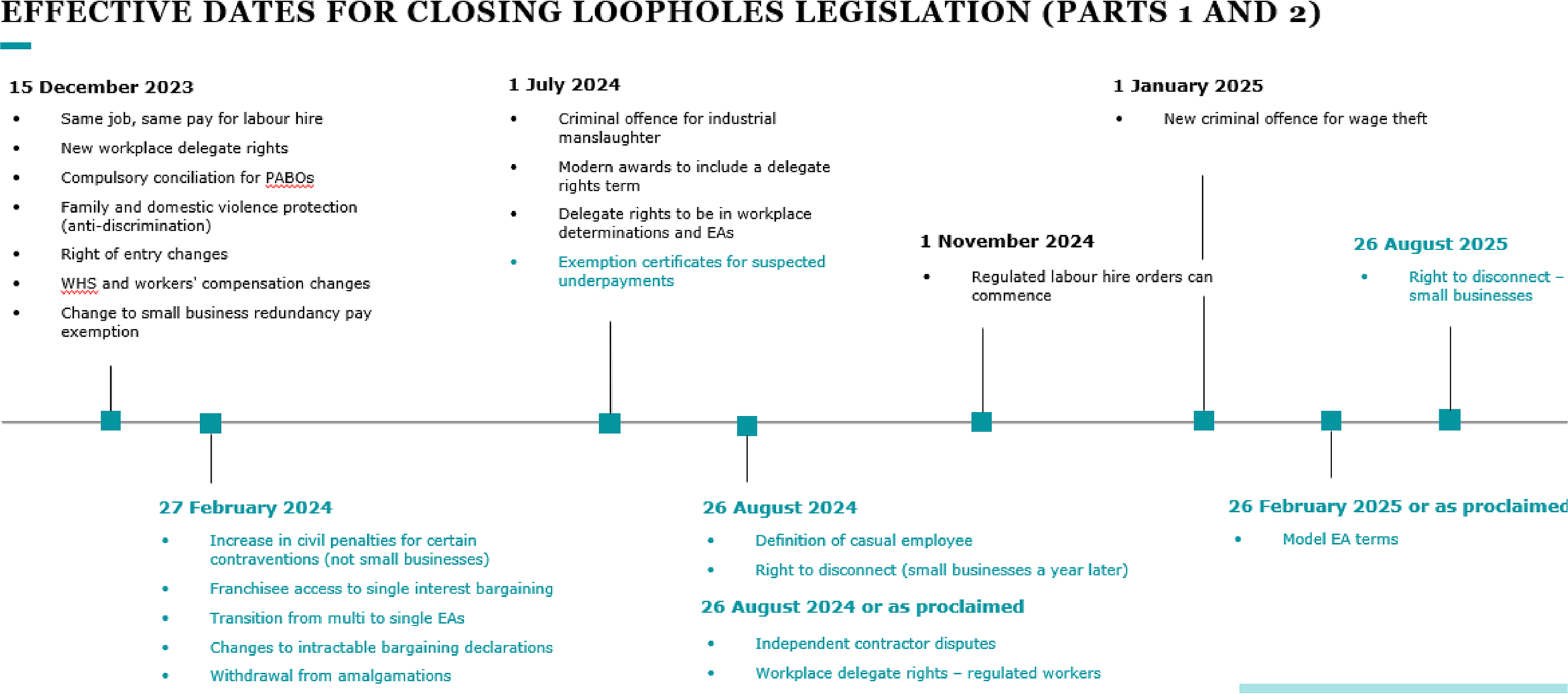
There have been 2 further sets of amendments to the FWA as part of the Australian Government's Closing Loopholes changes. The original Bill was split in two in the Senate. One chart, developed by law firm Lander and Rogers 5 , shows the timeframe for the implementation of the Closing Loophole changes, which gives some sense of the pace and scale of change.
Closing loopholes no. 1
Employees, unions and host employers can now apply to the FWC for orders to ensure labour hire employees are paid at least the same rate of pay they would be paid under the host employer's enterprise agreement or other workplace instrument: see new Part 7-2A FWA. A significant number of applications have been made by the Mining and Energy Union in relation to work arrangements in the coal mining industry, with at least three not being opposed as at early September 2024. On 1 July 2024, the Full Bench of the FWC laid down the principles regarding how it would approach applications under the new s306E of the FWA (see Application by the Mining and Energy Union [2024] FWCFB 299, at [7]-[18]). These principles were reinforced and applied in a subsequent Full Bench decision Applications by The Australasian Meat Industry Employees Union [2024] FWCFB 388 on 26 September 2024, awarding pay increases of up to twenty three percent for the affected workers.
As a result of Part 2, Schedule 1 to the legislation adding sub-clauses (4)-(7) to s121 FWA, employers that become a small business (those with less than 15 employees at a particular time) as a result of downsizing in the lead up to insolvency can still be required to pay their employees redundancy pay. Several provisions in the FWA, including ss153(1), 195(1), 351(1), 578(1), 772(1)(f) and related provisions in Division 2 to the new Part 6-4E, ss789HC, 789HD, have been amended to include stronger protections against discrimination for employees who are (or have been) experiencing family and domestic violence.
Changes to right of entry provisions in Part 3-4 FWA no longer require union officials to hold a FWA entry permit to enter a workplace if they are assisting a work health and safety representative on request under a State or Territory OHS law. New ss149E, 205A, 350A, 350B, 350C introduce workplace delegates’ rights and protections, including the right to represent the industrial interests of union members and potential members. From 1 July 2023 modern awards, enterprise agreements and workplace determinations must include a delegates’ rights term. These will provide specific rights and protections for delegates in representing and educating employees and will significantly strengthen the ability of workplace delegates to perform their role, including in relation to assisting employees with representation and compliance issues (remuneration and safety). A new industrial manslaughter (IM) provision commenced, increasing penalties and containing criminal responsibility provisions for the Commonwealth and Commonwealth public authorities. There is no intention to extend this to private sector corporations, which are covered by equivalent State and Territory legislation. The centrepiece IM offence occurs when:
30A Industrial manslaughter
A person commits an offence if:
the person is:
a person conducting a business or undertaking; or an officer of a person conducting a business or undertaking; and the person has a health and safety duty; and the person intentionally engages in conduct; and the conduct breaches the health and safety duty; and the conduct causes the death of an individual; and the person was reckless, or negligent, as to whether the conduct would cause the death of an individual.
In s327A and Part 14 FWA more generally, intentional underpayment of employee wages and other entitlements (including superannuation) is criminalised in a ‘wage theft’ provision carrying a maximum penalty of ten years’ goal and/or the maximum of three times the amount of the underpayment, if it can be determined, and a penalty of 5000 penalty units ($1,565,000) for an individual or 25,000 penalty units ($7,825,000) for a corporation. While absolute liability is applied to whether certain amounts are required to be paid by the employer, the fault element is clearly defined as ‘intention’ within the meaning of s5.2 of the Commonwealth Criminal Code.
Two measures are provided to encourage self-identification by possible offenders. Under s327B FWA, a Voluntary Small Business Wage Compliance Code will be developed by government with employer and employee input. Compliance with the Code will mean the FWO will not refer conduct for criminal prosecution. There will also be an option for the FWO to enter a co-operative agreement if an employer discloses they have engaged in conduct that may amount to the commission of the wage theft offence. The FWO may, after assessing the employer's conduct against a non-exhaustive list of factors, decide not to refer the employer for prosecution. Under ss717A-717G FWA, civil actions in relation to any contravention or issuing compliance notices requiring repayment of employees may still be taken by the FWO in relation to such conduct, however. While the FWO will investigate allegations it will be for the Federal Police or Commonwealth DPP to prosecute.
Closing loopholes no. 2
The civil penalty regime has been increased to the greater of 1500 penalty units ($469,000) or three times the amount of underpayment, if sought by an applicant. The serious contravention threshold is also changed from one done knowingly and systematically to one which is done knowingly or recklessly. Maximum penalties for non-small business corporations are the greater of 15,000 penalty units ($4,695,000) (from 3000 penalty units or $939,000) or three times the amount of any underpayment, if sought by an applicant. The capacity of the FWO to issue compliance notices has been enhanced as has the ability of courts to ensure employer compliance with such notices, together with increased penalties for non-compliance.
Amendments to s172(3) FWA and changes to the definition of ‘related employer’ now permits franchisees of a common franchisor to bargain for common terms and conditions in a single enterprise without an authorisation from the FWC. Right of entry provisions for union officials to enter workplaces or businesses to investigate suspected contraventions of the FWA and for discussion purposes are widened to provide for the dispensing with the twenty-four hour notice requirement, but only where the FWA is satisfied this is in relation to a member of the registered organisation (not potential members) and that advance notice would hinder an effective investigation into any suspected contravention.
In Chapter 3A Minimum Standards for regulated workers and Chapter 3B Minimum standards for persons in a road transport contractual chain, there is now a detailed framework of ‘employment-like’ rights and protections for workers who are otherwise contractors. This includes ‘gig’ workers. The legislation allows the FWC to set minimum standards, including pay and workplace delegates rights equivalent to those conferred on workplace delegates who are employees, among other specified conditions. Unions are able to make collective agreements with digital labour platforms or road transport businesses and unions covering the respective kinds of workers. There is a process for digital platform workers and road transport contractors to challenge their ‘deactivation’ or the termination of their contracts if they have performed relevant work for at least six months.
This will be supported by a Deactivation and a Termination Code, each to be made by the Minister following a public consultation process. In FWC proceedings, employee-like workers will be able to seek reactivation and lost pay, but not compensation, while regulated road transport contractors can seek reinstatement or up to twenty-six weeks’ compensation where their contract has been found to be unfairly terminated.
In language somewhat similar to the Contracts Review Act 1980 (NSW), there is a new mechanism for independent contractors who are paid below a ‘contractor high income threshold’ (set by regulation pursuant to s15C FWA; $175,000 for the year commencing 1 July 2024) to have their contract reviewed and the terms changed or set aside in whole or part 6 , if the contract is found to be relevantly unfair 7 having regard to set of indicators. 8 Pursuant to Chapter 3A - Minimum standards for regulated workers, Part 3A-5 Unfair Contract Terms of Service Contracts, FWA, the dispute must be about a term of the contract which would be a workplace relations matter (for example: remuneration, hours of work) if it was in an employment contract. If a person's income exceeds the ‘contractor high income threshold’ they may opt out of this new definition and may opt back in.
The legislation makes significant changes to definition of casual employment in s15A. The amended definition in s15A(2)(a) FWA now focuses on ‘the real substance, practical reality and true nature of the employment’. A range of indicators and some exceptions are set out in the new provision.
In new Division 4A FWA, employees who have worked for at least six months (or twelve months, for a small business) have access to a new process for converting casuals to permanent employment which will replace the former regime requiring employers to offer conversion to eligible employees. Under ss66 M and 66MA FWA, the FWC can deal with disputes about this process, including by arbitration. The small claims court procedure may be used to determine casual conversion disputes. There are anti-avoidance measures in s359B and 359C FWA prohibiting an employer from threatening to or dismissing an employee in order to engage them as a casual to do the same or substantially similar work or to make knowingly false statements to influence an employee to enter a casual employment contract to do the same or substantially similar work. New s66L (3) makes clear that the various steps in the casual conversion process are workplace rights for the purposes of adverse action protections.
A new definition of employment is included in s15AA to overcome the reasoning of the High Court in the decisions of CFMMEU v Personnel Contracting Pty Ltd (2022) 275 CLR 165 and ZG Operations Australia Pty Ltd v Jamsek (2022) 275 CLR 254 where the court held that, where parties had reduced their relationship to writing, the assessment of rights and obligations under the contract would be conducted according to what they wrote, although not necessarily in accordance with the description they gave to the relationship. This displaced the accepted so-called multi-factorial test which was set by the High Court in Stevens v Broadribb Sawmilling Co Pty Ltd (1986) 160 CLR 16. The new wording focuses on ‘the real substance, practical reality and true nature of the relationship between the individual and the person’. This requires an examination of the ‘totality of the relationship’ and ‘other factors relating to the totality of the relationship including, but not limited to, how the contract is performed in practice’. While the legislature has apparently intended to restore the previous, multi-factorial test, the question remains whether the language used achieves this or goes further. The language in which the new provision is expressed also appears to intend it to apply to contracts in existence at the time the provision commences.
In Part 2-9, Division 6 FWA, are new right to disconnect provisions. While this reform has been the subject of long term discussion both in Australia as well as in the European Union and other places, it gained significant momentum during the COVID shut down when working from home became the norm and was more like living at work for many, with hours of commuting replaced by significant intensification of work and extended and unpaid hours of work (Searle 2021). While it has attracted much attention and is said to be the cause of confusion for employers, the terms of the law are modest and balanced. Employees have the right to not monitor, read or respond to employer or work-related contact out of hours, unless this is unreasonable. A series of non-exhaustive factors are provided to assist in assessing reasonableness. The right is a workplace right for the purposes of adverse action protection. The FWC is also required to vary all modern awards to include right to disconnect terms, which will be developed through consultation with businesses and employers as well as workers and unions. Disputes not resolved at the workplace may be referred to the FWC for resolution by mediation, conciliation, recommendation or the expressing of an opinion. While arbitration may only occur by consent of both parties, the FWC has the power to make orders to stop employees from unreasonably refusing contact or to stop employers adversely treating an employee or requiring them to accept work-related contact when the refusal is not unreasonable. While there is no set criteria, which may dismay some employers, the test is flexible to meet the circumstances of individuals and their workplaces.
President’s statements
Given the complexity of these changes and the central role of the FWC, the President, the Hon Justice Adam Hatcher has issued a series of very informative and useful President's Statements on how the tribunal will implement the new jurisdiction, on each of 2 August and 20 December 2023 and 7 February 2024.
Australian human rights commission amendment (costs protection) bill 2023
This final instalment of the Respect@Work legislative amendments passed Federal Parliament on 19 September 2024 and provides a modified ‘equal access’ approach in proceedings in federal courts under the Sex Discrimination Act where the presumption is that applicants will get their legal costs if they win but will not have to pay the other side's legal costs if they lose, subject to some exceptions. This asymmetrical approach to costs is designed to level the playing field by removing the disincentive for applicants to bring forward sex discrimination and harassment cases. It is significantly different to the original recommendation to replicate s570 FWA, which provides that costs may only be ordered against a party if the court is satisfied that the party instituted the proceedings vexatiously or without cause, or if the court is satisfied that a party's unreasonable act or omission caused the other party to incur costs. While the public policy considerations in removing barriers to the bringing of these matters to court is distinct from the other workplace changes, there is sufficient commonality in the economic position of non-institutional applicants to wonder why these changes were not made to s570, at least in relation to the new, individual rights.
Recent changes in NSW
On 5 June 2023 the NSW Minns Labor Government announced an Industrial Relations Taskforce to review the scope and operation of the IRA and the State IR system. 9 It engaged a former President of the IRC and Industrial Court, the Hon. Roger Roland, and former Senior Deputy President of the Fair Work Commission, the Hon. Anna Booth, now the Fair Work Ombudsman, to comprise the taskforce. It is believed the Taskforce delivered a report to government proposing some forty-six recommendations for change; however, this report has not been published or otherwise made publicly available.
Since then, there have been two rounds of legislative change. In December 2022, the Industrial Relations Amendment Act 2023 was enacted. This legislation repealed s146C and the ability of government to place a legislated cap on wages and other employment conditions. It also provided for a new Chapter 2A in the IRA, creating a legal framework for good faith mutual gains bargaining. However, as the new s129K makes clear, it applies only if an industrial organisation of employees or employers and the relevant employer agree for it to do so. Given the stated opposition or disinterest expressed in mutual gains bargaining by public sector unions, it is likely these provisions will have little work to do.
In addition, the legislation re-created the Industrial Court of NSW, using the same language as had previously been in the IRA prior to the 2016 repeal legislation. Arguably, this discloses the intention of the legislature not only to re-establish an industrial court for NSW but to re-establish the same court which was abolished. The old jurisdiction, conferred upon the Supreme Court since 2016, was returned to it, including most of the prosecutions under the Work Health and Safety Act 2011 (although not ones requiring a jury. The new Court has only summary jurisdiction, like its predecessor).
Whereas the IRC was composed of a Chief Commissioner and Commissioners, the IRC as a tribunal has been re-established with a President, Vice-President, Deputy Presidents and Commissioners (with the former Chief Commissioner now the Senior Commissioner). The Presidential Members of the Commission are also the judicial members of the Commission in Court Session, to be known as the Industrial Court of NSW. Like the old Industrial Court, the new Court is a superior court of record equivalent to the Supreme Court and the Land and Environment Court of NSW.
The issues explored in the High Court decision in Kirk v Industrial Relations Commission (2010) 239 CLR 53 involving the former Industrial Court have been avoided by providing an appeal from the Full Court of the Industrial Court to the NSW Court of Criminal Appeal (in the Supreme Court) in WHS matters. The balance of the Court's pre-2016 jurisdiction has been restored, from which there is no Supreme Court appeal. Apart from WHS matters, the likely source of most of the new Court's work is likely to arise under the FWA.
Pursuant to the definition in s12 and s545(3) FWA, the Industrial Court is a designated eligible State court for the purposes of the FWA. There is a technical legal question about whether the Court referred to in the FWA is the same court that now exists. Most practitioners appear to think it is. The new Court forms suggest that the new Court thinks so as well. 10 Ultimately, this is a matter to be determined. While the Albanese Government appointments to the FWC have been persons significantly associated with the interests of organised labour, its appointments to the Federal Court and Federal Circuit Courts, to the extent they have included persons experienced in industrial or employment matters, have not been. Unions and other applicants may well perceive the new Industrial Court of NSW as a forum worth investigating.
The second important legislative change in the IR space has been the passage of the Work Health and Safety Amendment (Industrial Manslaughter) Act 2024 (NSW). This new offence will occur where a person conducting a business or undertaking (‘PCBU’) or an officer of a PCBU (i) owes a duty under the Work Health and Safety Act 2011 (NSW) to a second person, (ii) breaches that duty in an act or omission involving gross negligence and (iii) the second person dies or is injured and later dies of those injuries. The penalties are up to twenty-five years in gaol (as with manslaughter in the Crimes Act 1900) and (for corporations) fines of up to twenty million dollars. This regime provides the highest penalties for a statutory IM offence in Australia.
The use by the Commonwealth and NSW Parliaments of different descriptions of the criminal responsibility necessary to prove the offence (simple negligence vs gross negligence) raises the question of whether the courts will interpret the two approaches as embodying different standards or, alternatively, will construe the term negligence in a criminal statute as meaning criminal negligence, making both Commonwealth and NSW provisions the same in legal effect. Only court decisions will answer this.
Prosecutions against corporations will be heard in the Industrial Court. Prosecutions against natural persons will be heard in either the District or Supreme Court, with a jury. There are strong public policy grounds for ensuring that any natural person being prosecuted for an offence of this nature has access to a jury for the determination of guilt or innocence and is able to access the appellate supervision of the Supreme Court and, where appropriate and necessary, the High Court of Australia. There was no consideration of conferring jury trials on the new Industrial Court.
The recommendations of the IR Taskforce remain under consideration by the NSW Government. Unions NSW, the peak organisation of trade unions in the State, and its affiliates have been in discussions with the government regarding further legislative change. So far, there is no announced timeframe regarding any further proposed changes to the IR framework in NSW.
Conclusion
A number of conclusions can be drawn from this body of industrial relations change. First, the role of registered unions has been significantly enhanced within the overall framework of both the Federal and NSW systems of industrial relations; in the Federal system, by a series of specific reforms and in the NSW system by the removal of the legislated cap on growth in employee-related expenses which had the overall effect of limiting what unions could achieve through negotiation, industrial action or arbitration. Second, the individual rights of workers have been significantly enhanced, together with wider protection from adverse action. There are now so many new points of conversation available to workers and their employers, whether directly or through unions. Matters raised with employers now require proper responses within set timeframes and cannot be ignored. If matters are not resolved at the workplace, there are now more avenues for the FWC to become involved in resolving those disputes, including by being able to decide the matter itself. Third, in relation to collective labour relations, the powers of the FWC have also been significantly extended, particularly in relation to ‘intractable bargaining disputes’. Together, these changes have significantly widened the ability of the FWC to determine individual and collective disputes in the workplace. While not the restoration of its former arbitral power, the FWC is now more firmly at the centre of the Commonwealth industrial relations system than at any time since 1996. The changes in NSW have also restored the central role of the IRC in setting wages and conditions in the NSW public and local government sectors in a way not seen since 2011.
Footnotes
Declaration of conflicting interests
The author declared no potential conflicts of interest with respect to the research, authorship, and/or publication of this article.
Funding
The author received no financial support for the research, authorship, and/or publication of this article.