



Abstract
This study examined whether spelling tasks contribute to the prediction of the handwriting status of children with poor and good handwriting skills in a cross-sectional study with 276 Spanish children from Grades 1 and 3. The main hypothesis was that the spelling tasks would predict the handwriting status of the children, although this influence would decrease with age due to a gradual automatization of handwriting skills. The results confirmed this hypothesis. Another interesting result was that the pattern of pseudoword and irregular word spellings as predictors of handwriting status changed from Grade 1 to Grade 3. In Grade 1, the pseudoword spelling task made a significant contribution, whereas the irregular word spelling task did not. The opposite pattern was found in Grade 3. These results may be a consequence of progressive acquisition of orthographic representations. The orthographic role of the task of writing the alphabet in order from memory in the prediction model was also analyzed. The writing of the alphabet in order from memory task made a significant contribution to the prediction of handwriting status of the children beyond the orthographic influence of spelling tasks. The additional effect of this task on the prediction of handwriting status is presumably due to the fact that this measure is based on fluency.
Writing by hand is a skill that should be acquired in the first stages of education due to its influence on academic performance. However, this ability involves different processes (e.g., linguistic, visual-motor integration, perceptual, cognitive) working in parallel that make it complex to learn (Van Galen, 1991). The acquisition of handwriting skills depends on the development of two components, legibility and speed. Handwriting components follow different courses of development; indeed, different studies have found a low correlation between speed and legibility (e.g., Graham, Berninger, Weintraub, & Schafer, 1998; Volman, van Schendel, & Jongmans, 2006). Therefore, an appropriate measure of handwriting automaticity is to combine both measures into one: the number of legible letters per unit of time, which is handwriting fluency. Speed has been used often as a synonym of fluency. However, fluency involves speed and effortlessness as the two main characteristics of an automatic performance (Chambers, 1997). There is no general agreement on the stage at which handwriting skill is automatized. Current evidence suggests that handwriting becomes automatic relatively early, around 8 or 9 years of age (Medwell & Wray, 2007; Overvelde & Hulstijn, 2011), while other studies suggest that it continues to develop even in secondary school (Alamargot & Fayol, 2009; Berninger & Graham, 1998; Chartrel & Vinter, 2004; Graham et al., 1998).
According to the Capacity Theory of Writing (McCutchen, 1996, 2000), low-level writing processes must be automatized to free up cognitive resources that will be needed for high-level writing processes. In this sense, handwriting has an important role in written composition. Particularly, handwriting fluency appears to relate to the quality and length of essay writing, although this relationship decreases with age (e.g., Berninger, 1999; Connelly, Dockrell, & Barnett, 2005; Jones, 2004). The decline in the handwriting fluency–composition relationship fits with the Capacity Theory of Writing. In other words, once handwriting is automatized, high-level writing processes, for instance, reviewing or planning, work independently from low-level processes. Despite this bottom-up approach in the relationship between handwriting and writing composition, it is suggested that handwriting skills also interact with other low-level writing processes such as spelling (Abbott, Berninger, & Fayol, 2010). However, the relationship between spelling and handwriting is a complex issue that has yet to be resolved (e.g., Abbott et al., 2010; Berninger, Mizokawa, & Bragg, 1991; Puranik & Apel, 2010; Roux, McKeeff, Grosjacques, Afonso, & Kandel, 2013).
Handwriting and spelling are basic and essential skills for writing. In fact, they are the foundation for later acquisition of more complex writing skills. These two abilities are described by the Simple View of Writing model (Berninger et al., 2002) under the same component of writing called transcription, which is defined as “the integration of retrieval of orthographic symbols for representing language structures and the motor output requirements for producing those orthographic symbols” (Abbott & Berninger, 1993, p. 480). Therefore, spelling involves lexical or central processes, whereas handwriting supposes motor skills or processes peripheral to the writing act. Although both skills seem to work independently, Berninger et al. (2002) suggested that spelling and handwriting could constrain each other. Graham, Berninger, Abbott, Abbott, and Whitaker (1997), in studying a sample of children from Grades 1 through 6, found that spelling and handwriting factors covaried significantly, although this relationship decreased as grade level increased. These results suggest that handwriting and spelling processes overlap initially but later become more independent. Fayol and Miret (2005) found a significant relation between spelling and handwriting performances in French children from Grade 3. In this study, children with low performance in handwriting showed poorer achievement in a dictation task. Abbot et al. (2010) studied the longitudinal relationships among different writing measures in English children from Grades 1 through 7. One unexpected finding was that while handwriting did not show a longitudinal relationship with word spelling, the longitudinal prediction from spelling to handwriting was significant across Grades 1, 3, 4, and 5. The top-down relationships found between spelling and handwriting can be explained using the Cascade Model (Van Galen, 1991). According to this model, the writing processes work in parallel, and a process such as spelling can be engaged in in parallel with handwriting. In fact, other studies have shown that spelling processes cascade over peripheral process during handwriting (e.g., Delattre, Bonin, & Barry, 2006; Kandel & Valdois, 2005; Roux et al., 2013).
Roux et al. (2013) found that the same motor program is affected differently by central processing; in other words, movement duration differed if stimuli were processed by the sublexical or lexical route. Kandel and Valdois (2005) found that children from Grades 1 and 2 displayed longer duration with irregular words than with pseudowords. These findings suggest that handwriting fluency will be affected by spelling and that this influence will be moderated by lexicality (Kandel, Alvarez, & Vallée, 2006). This supposes that children with low fluency in handwriting could be more affected when they have to write an irregular word than a regular word, in comparison with children with a high level of fluency. In this sense, this research focuses on whether spelling skills can predict when a child will belong to a poor handwriting group or a good handwriting group. Evidence suggests that the handwriting-spelling relationship decreases with age; accordingly, more reliable prediction is expected in Grade 1 than in Grade 3. It has been hypothesized that the influence of irregular word spelling on handwriting status will increase from Grade 1 to Grade 3 due to orthographic irregularities that are progressively acquired. In fact, the interaction between phonological and lexical strategies produced by orthographic irregularity should have a more noticeable impact on handwriting processes when both strategies are acquired. The opposite pattern is expected with pseudoword spelling because knowledge of regularities is acquired very early in the Spanish language, so spelling pseudowords in Grade 3 should not constrain handwriting skills.
In the past decade, the tasks used to classify children according to handwriting level have presented difficulties. The alphabet-writing task (Berninger et al., 1997), in which children must write the alphabet in order from memory within 60 s (or 15 s), has been extensively used as a handwriting indicator. However, this task assesses not only graphomotor skills but also orthographic knowledge and memory (Abbott & Berninger, 1993; Pontart, Bidet-Ildei, Lambert, Morisset, Flouret, Alamargot, 2013; Puranik & Al Otaiba, 2012). Indeed, the orthographic motor integration skills measured in this task are a very good predictor of spelling and composition in primary graders (e.g., Berninger & Rutberg, 1992). In the current study this task was not used to classify the children as good or poor handwriters to avoid the orthographic influence on handwriting status. Instead alphabet and allograph selection tasks based on the factorial structure of the Early Grade Writing Assessment (EGWA; see Jiménez, 2016, in this issue) were used. Jiménez (2016) found that both the allograph selection task and the copying letter tasks loaded highly on a factor referred to by the author as “handwriting fluency or letter production,” which represents a more appropriate method for classification purposes. This research also studied whether writing the alphabet in order from memory within 60 s represents mainly an orthographic influence on the handwriting process; thus, this measure was analyzed as another predictor of handwriting fluency beyond the orthographic knowledge implicit in spelling processes. If this task contributes to handwriting skills through its orthographic or letter knowledge, then the influence of this task will not add to the prediction of handwriting status after the contribution of the spelling tasks.
Method
Participants
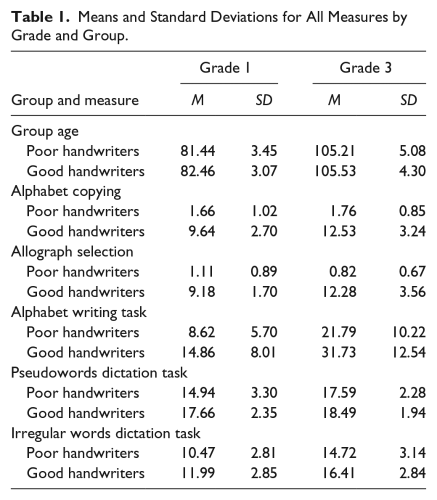
The study participants came from a large sample of children from Grades 1 and 3 selected from intact classes in 11 state and private schools in urban and suburban areas of Santa Cruz de Tenerife, Spain. Only those children who were either good handwriters or poor handwriters according to their performance on the different subtests of EGWA were included. Children who had a history of neurological, cognitive, or physical impairments that might cause handwriting problems were excluded. The participants were assigned to one of two groups: poor handwriters (N = 133 [Grade 1, n = 72: 41 boys, 31 girls; Grade 3, n = 61: 35 boys, 26 girls]) and good handwriters (N = 143 [Grade 1, n = 70: 33 boys, 37 girls; Grade 3, n = 73: 33 boys, 40 girls]). Poor handwriters were defined as those participants who performed at least 1 standard deviation below the mean of the normative sample (depending on grade) on both alphabet copying and allograph selection tasks. The cut-off criteria used to identify good handwriters was 1 standard deviation above the mean of each task. There were no statistically significant differences between the two groups with respect to age, F(1, 274) = .81, p = .37, and the distribution of sex by group and grade, χ2(1, n = 142) = .22, p = .64, and χ2(1, n = 134) = .52, p = .49 (for boys and girls, respectively). Both groups were also similar in terms of the distribution of left- and right-handed students by group and grade: χ2(1, n = 247) = 1.52, p = .22, and χ2(1, n = 26) = 1.47, p = .22, (for right- and left-handed students, respectively). Mean age per grade is presented in Table 1.
Means and Standard Deviations for All Measures by Grade and Group.
Measures
All the following measures were included in the standardized battery from EGWA. (For a more detailed description of this instrument, readers are referred to Jiménez, 2016).
Alphabet copying
Children were asked to correctly copy the letters of the alphabet printed on a lined sheet of paper in 1 min. Letters were considered correct when none of the following errors were committed: misalignment, reversals, added strokes, or missing strokes. Examiners had two types of answer sheets: one with the alphabet written in print and one with the alphabet written in cursive. The examiner selected the print or cursive letter template depending on the type of format that children were learning at school. Students had to fill in only one of the two answer sheets.
Allograph selection
Children were asked to change all the letters of the alphabet from capitals to lowercase in 1 min. The response was considered correct when letters were transformed accurately to lowercase and none of the following errors were committed: misalignment, reversals, added strokes, or missing strokes. The answer sheet contained all the letters of the alphabet printed in alphabetic order.
Writing the alphabet in order from memory
This task consisted of writing all the letters of the alphabet in lowercase and in order from memory in 1 min. In order to avoid the ceiling effect, a change in the instructions was included. Children who finished all 27 letters before the time limit continued the task by writing the alphabet again on a new sheet of paper for 1 min.
Writing dictated words with inconsistent spelling
This task required students to write down irregular words from dictation. The irregular word dictation task consisted of 20 irregular and high-frequency words with two and three syllables. Items were selected on the basis of a normative study of subjective familiarity conducted by Guzmán and Jiménez (2001). Subjective word familiarity was measured by asking children to rate each word (from a different subset of words) on a scale of 1 (least familiar) to 5 (most familiar). The stimuli in this task were selected from among those words that were rated between 3 and 5. Cronbach’s alpha reliability coefficients for accuracy were .60 and .66 for Grades 1 and 3, respectively.
Writing pseudowords from dictation
The pseudoword dictation task consisted of 20 pseudowords with two and three syllables. A pseudoword was considered written correctly when the student was able to transform each phoneme into its corresponding graphemes. Thus, all the words that sound the same, whether or not they conformed to spelling rules, were valid (e.g., if the item’s sound was /iefe/, the written words hiefe, iefe, and yefe were considered correct responses). Cronbach’s alpha reliability coefficients for accuracy were .74 and .65 for Grades 1 and 3, respectively.
Reliability
Two master’s degree psychology students were recruited as raters. After being trained to assess the handwriting tasks, raters scored 70 writing samples independently. All tasks were showed to have a very high interrater reliability. For the alphabet copying task, average interrater reliability across letters for the 70 children was r = .89; for the allograph selection task, r = .82; and for the writing the alphabet in order from memory task, r = .98.
Procedure
The tasks were administered individually in a quiet room. All tests were administered by trained university students from the Educational Psychology Department at the University of La Laguna.
Results
As expected, in all tasks there was an increase in mean performance across grades. With regard to the groups, good handwriters displayed better performance in all tasks than poor handwriters. A 2 × 2 MANOVA with Grade (Grade 1 vs. Grade 3) and Group (poor handwriters vs. good handwriters) as fixed factors was carried out to confirm that both groups differed significantly from each other in all the dependent variables across grades. The multivariate result was significant for group; Wilks’s lambda = .78, F(3, 266) = 24.34, p < .001, η2 = .21, indicating differences in all variables between poor and good handwriters. The univariate F tests showed there was a significant difference between groups for pseudoword spelling task, F(1, 268) = 35.14, p < .001, η2 = .12; irregular word spelling task, F(1, 268) = 20.58, p < .001, η2 = .07; and writing the alphabet in order from memory task, F(1, 268) = 49.06, p < .001, η2 = .15. There also was a significant multivariate main effect for grade: Wilks’s lambda = .52, F(3, 266) = 80.78, p < .001, η2 = .47. Significant univariate main effects for grade were obtained for the pseudoword spelling task, F(1, 268) = 32.59, p < .00, η2 = .111; irregular word spelling task, F(1, 268) = 150.81, p < .001, η2 = .36; and writing the alphabet in order from memory task, F(1, 268) = 169.13, p < .001, η2 = .38. Table 1 shows the means and standard deviations of all measures.
There was a significant interaction effect for Grade × Group at the multivariate level, Wilks’s lambda = .95, F(3, 266) = 4.01, p < .01, η2 = .05. The interaction at the univariate level was significant for the pseudoword spelling task, F(1, 268) = 8.81, p < .01, η2 = .03, but nonsignificant interaction effects were found on the irregular word spelling task, F(1, 268) = 0.61, p = .85, and the writing the alphabet in order from memory task, F(1, 268) = .2.56, p = .09. Pseudoword spelling performance was better for good handwriters than for poor handwriters in each grade; however, this effect was more pronounced in Grade 1 (14.94 vs. 17.66) than in Grade 3 (17.59 vs. 18.49). In other words, as expected, poor and good handwriters differed in their performance on the writing the alphabet in order from memory task independently of grade. They also differed at the spelling level, although the pseudoword spelling effect was moderated by grade. Hence, based on these results and taking into consideration the goal of this study, two hierarchical logistic regression analyses, one in each grade, were conducted. Spelling tasks were entered first; next, the writing the alphabet in order from memory task was entered into the equation to determine if the model improves the prediction of handwriting status beyond the phonological and orthographic skills that underlie spelling tasks. The Hosmer-Lemeshow method was used to determine goodness-of-fit of the logistic models. Tables 2 and 3 show the results of the hierarchical logistic regression analysis per grade.
Hierarchical Logistic Regression Results for Grade 1.
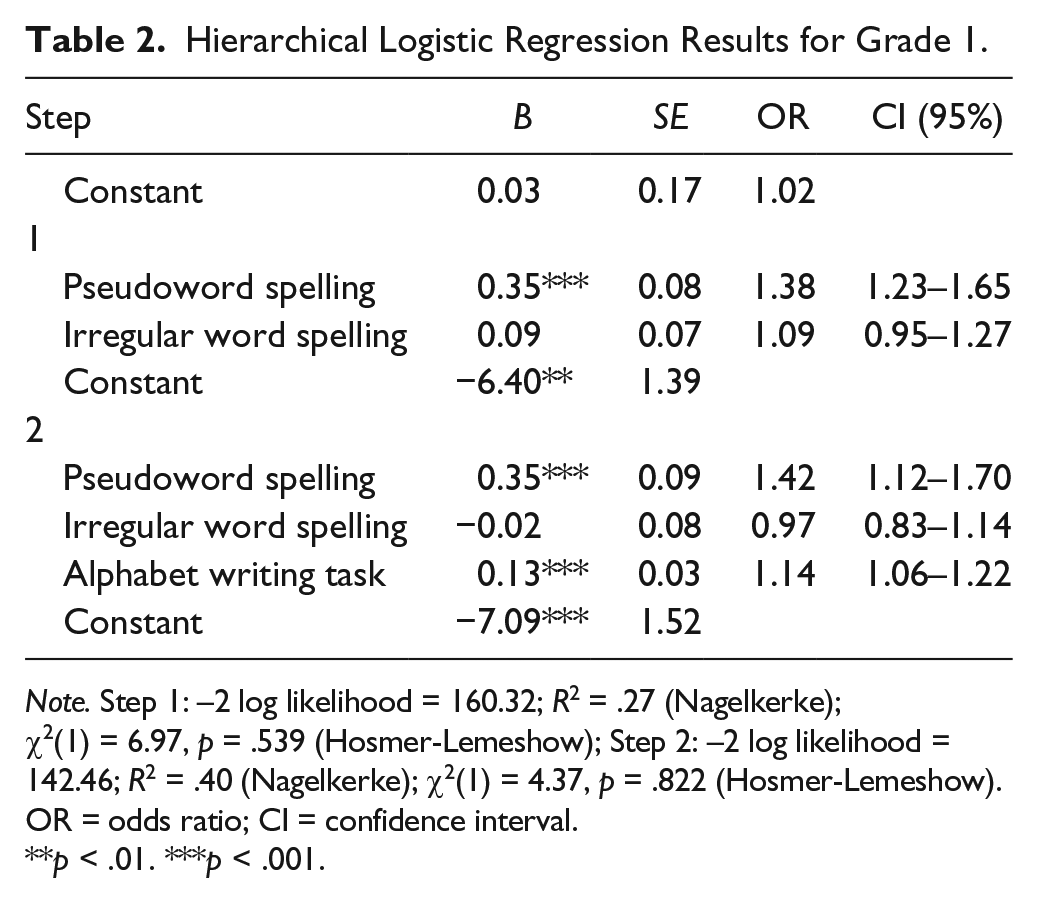
Note. Step 1: –2 log likelihood = 160.32; R2 = .27 (Nagelkerke); χ2(1) = 6.97, p = .539 (Hosmer-Lemeshow); Step 2: –2 log likelihood = 142.46; R2 = .40 (Nagelkerke); χ2(1) = 4.37, p = .822 (Hosmer-Lemeshow). OR = odds ratio; CI = confidence interval.
p < .01. ***p < .001.
Hierarchical Logistic Regression Results for Grade 3.
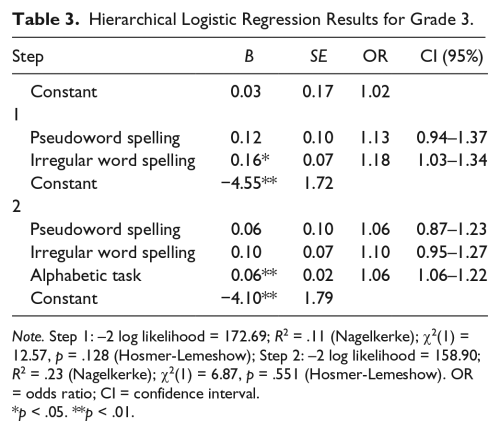
Note. Step 1: –2 log likelihood = 172.69; R2 = .11 (Nagelkerke); χ2(1) = 12.57, p = .128 (Hosmer-Lemeshow); Step 2: –2 log likelihood = 158.90; R2 = .23 (Nagelkerke); χ2(1) = 6.87, p = .551 (Hosmer-Lemeshow). OR = odds ratio; CI = confidence interval.
p < .05. **p < .01.
In Grade 1, the inclusion of spelling tasks made a significant contribution to predicting handwriting status, χ2(2) = 30.95, p < .001. The Wald criterion demonstrated that only pseudoword spelling made a significant contribution to prediction. Irregular word spelling was not a significant predictor (p = .19). When the writing the alphabet in order from memory task was added, prediction improved, χ2(3) = 48.81, p < .001, making a unique and statistically significant contribution independent of spelling tasks, χ2(1) = 17.86, p < .001. Overall prediction success was 71% for the first step (68% for poor handwriters and 76% for good handwriters) and 73% for the second step (72% for poor handwriters and 74% for good handwriters).
Similarly, in Grade 3 the addition of spelling tasks made a significant contribution to predicting handwriting status, χ2(2) = 12.00, p < .01. However, contrary to Grade 1, the Wald criterion demonstrated that only irregular word spelling made a significant contribution to prediction. Pseudoword spelling was not a significant predictor (p = .20). When the alphabet writing task was added, prediction improved, χ2(3) = 25.80, p < .001, making a unique and statistically significant contribution independent of spelling tasks, χ2(1) = 13.80, p < .001. Overall prediction success was 59% for the first step (42% for poor handwriters and 72% for good handwriters) and 63% for the second step (56% for poor handwriters and 70% for good handwriters).
All together, these data suggest that all three predictors made a more important contribution to determining handwriting status in Grade 1 than in Grade 3. In Grade 3, prediction success was better for the good handwriting group than for the poor handwriting group. A different pattern was found with respect to each variable entered in the model in the first step. In Grade 1, pseudowords spelling made a significant contribution to the prediction of handwriting status, but this influence became nonsignificant in Grade 3. The opposite pattern was found with irregular word spelling. Finally, the contribution of the writing the alphabet in order from memory task in both grades was significant once the influence of phonological and orthographic skills was controlled.
Discussion
The current study had two purposes; one was to explore whether handwriting status could be predicted by spelling tasks. Beginning (Grade 1) and advanced (Grade 3) writers were included in order to describe this prediction from a developmental perspective. The second purpose was to determine how the writing the alphabet in order from memory task would predict handwriting status once the influence of spelling tasks was controlled.
Generally, the studies on the relationship between spelling and handwriting can be summarized into three types: (a) those focused on the structural relationships between different components of the writing process (e.g., Abbott et al., 2010; Berninger et al., 1991), (b) those on the correlational relationship between spelling and handwriting (e.g., Fayol & Miret, 2005), and finally (c) those that use graphonomic measures to analyze the role of central process during the handwriting process under Van Galen’s (1991) cascading model (e.g., Delattre et al., 2006; Roux et al., 2013). All of these studies seem to agree with the fact that these two skills are related and the findings are consistent in showing that spelling processes contribute to handwriting processes (Abbott et al., 2010; Berninger et al., 1991; Puranik & Apel, 2010; Roux et al., 2013). Accordingly, it was expected that spelling tasks would predict handwriting status, and this is exactly what was found. The spelling tasks (writing to dictation pseudowords and irregular words) made a significant contribution to the prediction of handwriting status. However, the contribution was stronger in Grade 1 than in Grade 3. This result fits perfectly with previous findings in which the relationships between spelling and handwriting decreased progressively from Grade 1 onward (Abbot et al., 2010; Graham et al., 1997). Handwriting and spelling skills have not yet been automatized in Grade 1, which in accordance with the Capacity Theory of Writing, demands a high level of cognitive resources that will not be available for the two processes working in parallel, in turn creating a strong interdependence between them. However, these two skills improve gradually with experience and instruction and probably in Grade 3 reach the level that allows the freeing up of cognitive processes, thereby making it possible to work simultaneously and in a more balanced manner.
Another relevant finding was the contribution of each spelling task as a function of grade. In Grade 1, the pseudoword dictation task contributed significantly to the model, unlike the irregular word dictation task that was not significant. A different pattern was found in Grade 3, where the pseudoword dictation task did not contribute to the prediction of handwriting status, while the irregular word dictation task did contribute significantly before the alphabet-writing task was included. These findings suggest that children in Grade 3 require additional cognitive resources, especially to process irregular words, which affects the handwriting performance mainly if children show handwriting problems. Nevertheless, children in Grade 1 are still learning some Spanish irregularities, and therefore perhaps it is too early to detect the influence of this variable in handwriting processes. From a developmental perspective, different Spanish studies have shown that the most significant increase in orthographic skills takes place after Grade 2 (e.g., Abchi, Diuk, Borzone, & Ferroni, 2009; Defior, Jiménez-Fernández, & Serrano, 2009), which also supports the present findings.
Second, this study examined the unique contribution of the writing the alphabet in order from memory task to the prediction of handwriting status once spelling task influence was controlled. Writing letters from memory demands knowledge of the alphabet (such as letter order, letter names, letter shape, and the relation between letter name and shape) and motor skills. Abbott and Berninger (1993) concluded that poor letter-writing fluency is more an indicator of weak letter knowledge than of motor difficulties. The authors also suggested that the low performance of beginning writers in this task reflects poor orthographic knowledge. The results of the present study are partly in accordance with this suggestion. When this task was included in the second step, the contribution of irregular word spelling decreased in both grades, and it became nonsignificant in Grade 3. As expected, the writing the alphabet in order from memory task involves orthographic skills, and its influence is stronger than the irregular word–spelling task. As opposed to the spelling tasks, the contribution of this task is quite stable across grades. It is suggested that the contribution of the alphabet-writing task beyond the contribution of the spelling tasks might be related not only to orthographic knowledge but also to other factors such as the working memory demand and the fluency conditions of this task.
Despite the fact that the findings of this study are consistent with the results of other studies that included graphonomic variables (e.g., Delattre et al., 2006; Kandel &Valdois, 2005; Roux et al., 2013), future research should involve additional measures (duration and latency time) to clarify the role of each spelling variable in the classification of handwriting groups. Furthermore, these types of measures will provide the opportunity to properly prove the reverse pattern suggested from the results of the correlational design used in this study.
Conclusion
The contribution of the current study is twofold. First, it was demonstrated that spelling processes accurately classify handwriting status, especially in Grade 1. In Grade 3, overall prediction was poorer than in Grade 1, although specificity was acceptable due to the fact that the children with good handwriting skills were better classified than the children with poor handwriting skills. Second, it was found that the writing the alphabet in order from memory task contributes to the prediction of handwriting status through orthographic skills; however, other factors involved in this task also contribute to prediction. All of these findings suggest that handwriting and spelling should be instructed together mainly in first grade. In fact, it is highly probable that first graders who show low performance in spelling will present handwriting problems, so they should be provided not only additional spelling intervention but also handwriting practice.
Footnotes
Declaration of Conflicting Interests
The author(s) declared no potential conflicts of interest with respect to the research, authorship, and/or publication of this article.
Funding
The author(s) disclosed receipt of the following financial support for the research, authorship, and/or publication of this article: This research was supported by Agencia Canaria de Investigación, Innovación y Sociedad de la Información, ref. ProID20100030 from the Government of the Canary Islands.