




Abstract
Claims of the importance of having positive perceptions and expectations of students with learning disabilities (LD) have been repeatedly made over recent years. This article aims to raise awareness of the importance of attributional beliefs in relation to the educational outcomes of students with LD in Australia and China. Australian and Chinese trainee teachers (N = 240) who were at the end of their training were surveyed with vignettes and Likert-scale questions to ascertain their responses to students with and without LD. Overall, the findings suggest that Chinese trainee teachers’ attributional pattern is more positive than that of their Australian counterparts. Implications and recommendations for research and practice are also presented.
Students with learning disabilities (LD) have drawn great concerns from teachers and schools over recent years (Crockett, Filippi, & Morgan, 2012; Raymond, 2004). Despite an ongoing debate of a universal definition of LD, it is commonly believed that students with LD manifest deficits in psychological processes, such as listening, speaking, reading, writing, reasoning, and/or arithmetic abilities, despite the absence of conditions primarily caused by other disabilities, such as intellectual disability or disadvantaged environments (e.g., low economic status; Kirk, 1963; Raymond, 2004; Skues & Cunningham, 2011). Due to disparities in sampling and diagnostic tools and criteria adopted, prevalence rates of children with LD can range from 5% to >30% (Blumberg, 2012; Bradley, Danielson, & Hallahan, 2002; L. Liu, 2000; Schieve et al., 2012).
The inclusion of LD in the educational field started in the United States, dating back to the 1970s (Raymond, 2004). Since then, LD have become a major category of special educational needs and services in schools and other educational contexts. Current policies in the United States mandate that inclusive education schools provide children with LD with high-quality and research-based instruction and interventions, in collaboration with professionals and experts (Hardy & Woodcock, 2014). To date, students with LD form a large group of students in inclusive classrooms (U.S. Department of Education, 2011).
The movement of including students with LD in inclusive education in the United States has been influential in Australia over the years. Unlike the United States, Australia has yet to develop a nationwide definition of LD or a nationwide supportive program for students with LD. All states and territories have established their own categorical approaches and programs. Only the Northern Territory has categorized LD as requiring specific support programs. Other states, such as Queensland, Tasmania, and South Australia, may acknowledge the term learning disability but categorize LD as only a general learning difficulty and so provide the students with basic support. Furthermore, some states (e.g., New South Wales) do not make a distinction between LD and other learning difficulties (Hardy & Woodcock, 2014). The term learning difficulties is a broad concept that refers to students who have experienced academic or learning difficulties for varied causes, including low intelligence and environmental disadvantages (L. Graham & Bailey, 2007; Westwood, 2004). As a result, teachers’ and schools’ understandings about LD may be misguided, and student needs may be overlooked (Skues & Cunningham, 2011).
On the mainland of China, the term learning disability has been in use for more than two decades (Han & Zhang, 2010; Xin & Yu, 1999). The current special education context has not identified LD as a specific disability category but does include it in the category of “other disability” (Ministry of Education of the People’s Republic of China, 2013). Consequently, the nationwide definition of LD and an educational program for students with LD have not yet been universally established. Currently, with the exception of some schools in a number of developed urban areas that provide supportive programs for students with LD (e.g., Shanghai; C.-L. Liu, Du, & Yao, 2000; Yao, 2012), most schools cannot cater for such needs. Under such circumstances, students with LD simply remain in the general classroom and are viewed as students with learning difficulties or underachievers (Xing, 2013).
Perceptions and expectations of students with LD have caused concerns among teachers over the years (Clark, 1997; McMullen, Shippen, & Dangel, 2007; Sideridis, Antoniou, & Padeliadu, 2008; Whitley, 2010; Xing, 2013). One of the greatest difficulties has been the search for how best to understand the students in the classroom (Hornstra, Denessen, Bakker, van den Bergh, & Voeten, 2010; Paterson, 2007). Often, teachers are puzzled by the symptoms of LD, as the students seemingly possess normal abilities but may have achieved poorly academically (Cohen & Spenciner, 2009; Crockett et al., 2012). Teachers’ understandings about the issues vary among cultures. Studies have shown that Chinese teachers are likely to associate LD with poor learning strategies, low motivation, or inadequate classroom behaviors (e.g., Guo, 2005; Huang, Liu, & Fan, 2008). In such cases, Chinese teachers may view the lack of achievement of students with LD to an unstable and controllable cause. Western teachers, in contrast, often view the lack of achievement to a more stable cause, such as low ability, meaning that they perceive LD as something beyond the students’ control (Clark, 1997).
Weiner’s (1979) attribution theory explains two kinds of attributional motivation: intrapersonal and interpersonal. The intrapersonal ascription is the psychological process that an actor explains regarding his or her own success or failure, whereas the interpersonal ascription is the process where an observer explains the actor’s success or failure. The latter process links with an observer’s reactions in helping, evaluating, and liking. Weiner (2001) emphasized that the emotional and behavioral cues conveyed by the observer may affect the actor’s attribution and emotions. In this sense, teachers’ attributional beliefs of students with LD may play an important role in relation to these students’ motivations, behavior, and outcome in learning.
Research has also shown that teachers’ beliefs are formed while they are still at the trainee stage (Hoy & Spero, 2005). Moreover, the beliefs influence teachers’ practices in class (Gwernan-Jones & Burden, 2010), and, eventually, students’ academic outcomes. Thus, it is essential that trainee teachers hold positive beliefs about students with LD. This study examined Australian and Chinese trainee teachers’ attributional responses to students with and without LD, drawing from Weiner’s (1979, 1986) attribution theory. A comparison of the two cohorts is expected to yield important implications for teacher education.
Attribution Theory
It is believed an individual seeks to understand attributions (or causes) that explain why an event occurred (Schuster, Forsterlung, & Weiner, 1989), such as “Why I failed a test” or “Why I gained a promotion.” Heider (1958) proposed that when people ascribe an event, they follow two kinds of attributions: personal (internal) and environmental (external). For instance, an office worker ascribes her recent promotion mainly to hard work (a personal attribution), whereas her colleagues believe it is due to luck (an environmental cause). Inspired by Heider’s attribution theory, attributional theorists have extended the research into varied disciplines. In the educational arena, Weiner’s (1979, 1985, 1986) attribution theory of motivation has made a significant influence, particularly with regard to individuals’ perceptions and behaviors in academic-related events (Linnenbrink & Pintrich, 2002; Tollefson, 2000; G.-Y. Zhou, 2006).
Weiner (1979, 1985, 1986) proposed that attributions imposed by an individual to explain academic success and failure have three dimensions—locus of causality, stability, and controllability. Locus of causality differentiates a cause internal or external to the individual. The four most responsive causes for academic success and failure are ability, effort, task difficulty, and luck. Ability and effort are internal, whereas task difficulty and luck are external. Stability distinguishes whether a cause is stable or not. Ability is commonly believed as a stable cause, as a person’s ability is maintained over time. In contrast, effort and luck are unstable. Controllability determines whether a cause can be controlled or not. Effort is considered to be under one’s control, whereas the other three causes are often perceived as uncontrollable. Based on this three-dimensional analysis, a cause can be located into one of eight traits—that is, two kinds of locus of causality (internal or external) by two kinds of stability (stable or unstable) by two kinds of controllability (controllable or uncontrollable). For example, a student who passed a reading test may ascribe the success to the aptitude in comprehension (ability) that is an internal, stable, and uncontrollable cause.
Weiner’s theory (1979, 1986; Weiner, Russell, & Lerman, 1978) further demonstrates that the three-dimensional attributional analysis plays a key role in an individual’s emotional consequences, which in turn, guides his or her behavioral consequences. Specifically, stability is linked to feelings of helpfulness or helplessness and adjusts expectancy of future outcomes. Locus of causality relates to self-esteem. Ascribing academic success to internal causes is more likely to increase feelings of competence, confidence, and pride than ascribing success to external causes. However, ascribing failure to internal causes can result in lower self-esteem and concerns with affects such as shame. These affects then determine whether this student will elicit actions to attain or withdraw a goal. Finally, controllability determines social emotions. Failure due to controllable causes by the student would generate guilt or shame. In regard to behavioral consequences, according to Weiner (1986), the student who believes in controllable causes (e.g., low effort) is less likely to give up than one who ascribes the consequences to uncontrollable causes (e.g., low ability). However, if a teacher attributes the failure to a controllable cause, he or she may feel anger and blame the student, as the causes are subject to the student’s volitional control. Alternatively, if the behavior is perceived as an uncontrollable cause, the teacher may feel pity and offer extra help to the student.
Teachers’ Attributions in Western and Chinese Cultures
Teachers regularly seek to understand why their students encounter academic failures (Georgiou, Christou, Stavrinides, & Panaoura, 2002; Tollefson & Chen, 1988). Weiner’s theory thus addresses how a teacher interprets academic outcomes and predicts future success (Tollefson, 2000). Teachers can often base these interpretations on their prior knowledge and experiences, or from cues obtained from the student, such as previous performances, to pursue the reasons explaining the outcomes. Moreover, they are prone to ascribe to internal (students’ personal) causes (mostly ability and effort) rather than external causes (S. Graham, 1991; Major, Kaiser, & McCoy, 2003). By doing so, teachers do not blame themselves to account for the failure so that their self-esteem-related affects (e.g., pride, confidence) are protected.
Although ability and effort are both internal causes, the former is often perceived as uncontrollable and stable, whereas the latter is controllable and unstable. Thus, according to Weiner’s theory (1979, 1986; Weiner et al., 1978), if a student’s failure is ascribed to low ability, teachers may generate the feelings of sympathy and respond to that student with comfort or help. At the same time, the teacher may reduce the expectation of that student. If the failure is believed to be due to a lack of effort, teachers tend to feel frustrated and respond to the student with punitive actions but still hold the belief that the same student could succeed in the future.
Teachers’ behaviors following a student’s failure are important cues to a student’s perception of the cause (Droe, 2013; S. Graham, 1991; J. Zhou & Urhahne, 2013). A student who receives sympathy and additional assistance from the teacher may perceive himself or herself as having low ability. This, in turn, may reduce the student’s self-esteem and goals for learning. Alternatively, a student blamed by the teacher may attribute the failure to laziness or interpret such an affect as high expectation from the teacher. In that case, the student’s motivation will not be harmed. Thus, attributional theorists (e.g., Droe, 2013; S. Graham & Barker, 1990; Weiner, 2001) stress the impact of teachers’ attributions on students. In particular, Weiner (2001) reminds teachers to be cautious when they ascribe academic failure to low ability, as it evokes “low personal regard, low expectancy of future success, and give rise to the aversive emotions of shame of humiliation” (p. 22).
An individual’s attribution is not stand-alone but is influenced by social variables such as culture, values, and religion (Weiner, 2001; Yan & Gaier, 1994). A few studies have examined the exploration of teachers’ attributional patterns to academic failures in different cultures or nations. For example, a cross-national study undertaken by Clark and Artiles (2000) compared American teachers’ and Guatemalan teachers’ responses to failed students. The results showed that students’ effort expenditure had a greater impact on the affects and behaviors of American teachers, whereas ability had more influence on Guatemalan teachers. Clark and Artiles pointed out that Guatemalan teachers’ attributional style is influenced by Latin American culture, which stresses individual ability. American teachers, in contrast, are influenced by a culture that encourages individual effort. Similar to American teachers, Australian and British trainee teachers also tended to follow effort attribution when responding to failed students without LD (Woodcock & Vialle, 2010, 2011, 2016). Such an attributional pattern is termed by Jacobson, Lowery, and DuCette as “normal self-esteem attribution” (1986), which means that failures are ascribed to an external uncontrollable cause (e.g., bad luck) or an internal controllable cause (e.g., low effort). According to Weiner’s theory (1979), such an attributional pattern may have a positive influence on the students because teachers provide positive evaluative feedback to the failed students, which conveys the message that the failure is not a matter of inability and these students’ achievements can improve in the future.
Zhao, Wang, and Shen (2006) adapted Clark’s instrument and compared Chinese teachers and American teachers. Despite the finding that both groups resulted in an effort attributional pattern, ability was more influential in American teachers than Chinese teachers. In particular, ability did not influence Chinese teachers’ expectations of students’ future success, whereas low ability did affect American teachers’ expectations. This indicates that Chinese teachers are more effort driven. Zhao et al. state that such a difference is due to the concept of effort, which is highly valued by Chinese teachers. Indeed, Chinese culture views effort as the most important factor influencing academic achievements (Crittenden, 1996; Stevenson & Lee, 1996). Proverbs such as Bèn niǎo xiān fēi (A slow sparrow should make an early start) and Qīn nén bǔ zhuó (Practice makes perfect) are worship to people who put forth effort. Furthermore, as noted by Hong (2001), Chinese people believe that effort enhances ability to some extent. Thus, ability may be viewed as less stable and more controllable by Chinese teachers than by Western teachers.
Teachers’ Attribution to Students With LD
Western teachers often see LD as an internal, stable, and uncontrollable status (Clark, 1997). Holding such a belief may lead teachers to have low expectations and thus be sympathetic to students with LD. Clark (1997) developed an instrument that has eight vignettes about hypothetical boys who failed a typical exam. Clark then investigated general elementary teachers in America and found that teachers expected future failure from students with LD. Moreover, teachers showed less frustration, expressed more sympathy, and provided more rewards to students with LD compared with students without LD. Building on Clark’s study, Woodcock and Vialle investigated Australian elementary school (2011) and secondary school (2010) trainee teachers’ responses to students with LD and found similar conclusions. Trainee teachers in Australia are influenced by LD status when they consider the cause of academic failure. Moreover, they respond differently to students with LD than without. Similar findings are yielded from studies by Tollefson and Chen (1988) on K–12 teachers in America; Georgiou et al. (2002) on elementary teachers in Cyprus; and Vlachou, Eleftheriadou, and Metallidou (2014) on Greek general and special education teachers. Their responses to students with LD, as described by Weiner (1986), is the “norm to be kind,” meaning more sympathy, kinder feedback, and lower expectations are assigned to these students than those without LD. Such an attributional pattern can be perceived as negative because it may cause the “Golem effect,” meaning that teachers’ low expectation can lower students’ expectations for themselves (Eccles & Wigfield, 1985).
These findings point to the conclusion that Western in-service teachers and trainee teachers can often hold a negative attributional pattern to students with LD. Students with LD, from their perspective, may then have less chance to achieve academically than students without LD. Therefore, students with LD deserve more sympathy and help from others. Again, as stressed by Weiner (2001), such a belief can be harmful to a student’s motivation and future performances.
Compared with Western teachers, Chinese teachers are less affected by the status of LD. In a study that examined Chinese teachers’ beliefs to students with LD, Zhao, Zhang, Geng, and Shen (2005) adapted Clark’s instrument and investigated 333 elementary and secondary teachers from Hebei province (located in northern China; it surrounds the capital city, Beijing). Their findings indicate that LD had only a limited effect on Chinese teachers’ attributions and expectations. Furthermore, it does not have an impact on Chinese teachers’ behaviors. Chinese teachers, particularly elementary teachers, are easily influenced by students’ effort expenditure. In addition, the researchers pointed out that Chinese teachers may not view LD as stable but as having a developable status. A previous study by Woodcock and Jiang (2013) investigated 103 elementary and secondary teachers from Jiangsu province (located in eastern coastal China; it is the most developed area in mainland China) and yielded similar findings. Teachers show the least frustration and the most sympathy, give the most positive feedback, and have the highest expectation for those students who expend high effort. For students who expend low effort, teachers experience the greatest frustration, express the least sympathy, give less positive feedback, and have the lowest expectation of these students achieving success.
In another study, Woodcock and Jiang (2012) surveyed 101 trainee teachers from the same province as the above study. The findings support the above-mentioned studies that LD have limited influence on (trainee) teachers’ judgments. By analogy, Chinese trainee teachers follow the effort attributional pattern. In particular, their frustration is primarily governed by students’ effort expenditure. This implies that Chinese trainee teachers believe that future failure can be avoided if students work hard enough. To sum up, Chinese in-service teachers and trainee teachers may perceive LD as an internal and unstable status. Students with LD, from their perspective, are not too different from their non-LD counterparts.
Although the review of literature suggests that Chinese trainee teachers adopt a distinct attributional pattern different from that of Australian trainee teachers, little research has been done to compare the groups in detail or to develop an insightful understanding of the differences. The purpose of the present study was to examine the extent to which Chinese trainee teachers differ from Australian trainee teachers in terms of their attributional patterns to students with and without LD. Specifically, the study investigated the feedback, frustration, sympathy, and future expectations elicited from both groups of trainee teachers when they respond to students with and without LD.
Research Questions
Based on the previously proposed causal properties of LD, three interrelated research questions frame this paper:
Research Question 1: What are the main interpersonal attributional causes that Australian elementary trainee teachers perceive toward students with and without LD when it comes to test failure?
Research Question 2: What are the main interpersonal attributional causes that Chinese elementary trainee teachers perceive toward students with and without LD when it comes to test failure?
Research Question 3: Is there a difference in interpersonal attributional causes perceived toward students with and without LD between Australian and Chinese trainee teachers?
Method
This study examined to what extent Chinese and Australian trainee teachers’ knowledge of the presence or absence of LD would influence (a) the feedback given to a hypothetical boy based on his ability and the effort expended, (b) the frustration and sympathy felt toward each boy, and (c) the expectations held for each student’s future. Trainee teachers from China and Australia were surveyed regarding their self-reported attributional responses to students with and without LD.
Contextual Information
Participants included 101 Chinese trainee teachers from Suzhou, Jiangsu (China’s most densely populated province), who were either at the end of their final year of the diploma of elementary teaching in a local vocational university or in a short-term preservice training program (2 months) that was organized by the local educational bureau. The local vocational university was randomly selected for this study. The 3-year diploma program prepared university students to teach in elementary schools. The structure of the program sought to engage students in professional aspects of teaching, including educational theories and instructional strategies for classroom practices. However, the program was developed on the basis of general education and did not involve subjects on special education or inclusion. As the students were in their final year, they had passed two practicums (2 weeks each) in local elementary schools. The participants who were in the training program all held baccalaureate degrees that exclude an elementary or secondary teaching degree. All the students passed their exams and attended an interview, both requirements of the Teachers Law of the People’s Republic of China to be awarded their teaching licenses (Ministry of Education of the People’s Republic of China, 2009).
The Australian cohort (n = 139) in this study was drawn from a randomly selected university in New South Wales and was near the end of a 1-year program that prepares candidates to teach in elementary schools in New South Wales. In the course, trainee teachers spend an initial 2 weeks in schools at the beginning of their training and then a 5-week block at the end of the two semesters.
The program seeks to engage students in professional aspects of teaching, including curriculum methods and inclusive classroom practice. Of the 10 subjects offered to trainee teachers, all must pass one titled “learners with exceptional needs,” which focuses on the psychology of learners with special educational needs. This subject sits within a developmental framework with an emphasis on effective teaching and classroom management strategies catering for all students.
Participants
Participants included a total of 240 trainee elementary teachers close to qualifying as new early career teachers. In China, 18% of participants were male, while 82% were female, reflecting a similar ratio of male and female elementary teachers in large cities in China (Institute of Teacher Education of Beijing Normal University, 2012). Twenty-nine percent of Australian participants were male, compared with 71% female, reflecting a similar ratio of male and female teachers in Australia (Australian Bureau of Statistics, 2012). Furthermore, the age of trainee teachers was similar between China and Australia. The most common age of trainee teachers was <25 years, followed by 26 to 35 years (81% of Chinese trainee teachers were ≤35 years vs. 78% of their Australian counterparts).
Instrument
The instrument that was used for this study was adapted from Woodcock and Vialle’s (2010, 2011) study that used a modified version from Clark’s (1997) original study investigating elementary teachers’ perception of the achievement of U.S. students with and without LD. Eight vignettes were created that described hypothetical boys who had just failed a class test. The vignettes did not identify the cause of the hypothetical boys’ failures in order to stimulate causal explanations by the participants. For each vignette, teachers responded to three types of information: the student’s ability, the effort that a student expends, and the information on the student’s academic performance. Of the eight vignettes, four of the students were presented as having LD, and four were not; half were of a high ability, and the other half were of a low ability; and four expended high amounts of effort, whereas the other four expended low amounts of effort. In addition, the terms learning disability, effort, and ability were not used. The boys were matched on ability (high/low), typical effort (high/low), and the presence/absence of LD (LD/NLD). Thus, there were eight vignettes creating a 2 × 2 × 2 matrix (Ability × Effort × LD/NLD). An example of a vignette (high ability, low effort, NLD) is as follows:
Phillip is a student in your class. He has greater aptitude for academic tasks than most children in the class. Although he occasionally does excellent work, he is usually off task and does not participate in class often. He rarely completes class assignments and does not do much of his homework.
After the trainee teachers participating in the study read the vignettes, they were asked four questions: (a) feedback that they would give to the child (very positive to very negative, +5 to −5), (b) the frustration that they would feel toward the child (very little to very much, 0–6), (c) the sympathy that they would feel toward the child (very little to very much, 0–6), and (d) their expectation for the boy’s future failure (very unlikely to very likely, 0–6). Each question was presented as a Likert scale item. Participants were asked to respond to all eight vignettes. The vignettes were presented randomly, which aimed to eliminate any bias or order effect toward responses (for further detail of the instrument, see Woodcock & Vialle, 2011). All 240 participants responded to all of the vignettes. We retained the instrument’s sole use of boys to eliminate the potential confounding variable of the child’s gender on the participants’ attributions.
The instrument was originally reviewed and pilot tested in two phases prior to the third phase of translation, to socially validate the vignettes and refine the instrument. Initially, the vignettes that were originally validated by Clark (1997) were reviewed by academics in Australia in the field of attribution theory and special education. Second, a pilot study of 40 trainee teachers was carried out, and participants were asked to comment on the clarity of the vignettes and questions. Minor revisions were made to the instrument in response to the pilot participants’ comments.
The instrument for Chinese trainee teachers was also revised in the following ways from the English version presented to the Australian trainee teachers, based on Wild and colleagues’ (2005) 10-step framework:
1—Preparation
2—Forward translation
3—Reconciliation
4—Back translation
5—Back translation review
6—Harmonization
7—Cognitive debriefing
8—Review of cognitive debriefing results and finalization
9—Proofreading
10—Final report
This 10-step framework resulted in a robust accurate translation of the instrument. Internal consistency for this scale was high for both Australian and Chinese samples (Cronbach α = .83 and .81, respectively).
Procedure
After approval was provided by the relevant university ethics committees, potential participants were invited to complete the survey at the end of their training (same stage for both cohorts). Both cohorts were in the final few weeks of their courses. Participants were approached at the end of a lecture, and the surveys were distributed by our colleagues. Participants were given an information sheet outlining the aims and objectives of the survey and were informed that they could withdraw from the study at any point.
Results
A 2 × 2 (Ability × Effort) multivariate analysis of variance with repeated measures was conducted for the four dependent measures (feedback, frustration, sympathy, and expectation of future failure) for students with and without LD. Of particular interest were the differences of responses between the Chinese and Australian trainee teachers toward students with and without LD on each dependent measure. Thus, a post hoc analysis based on an independent samples t test was also executed. This was to examine the differences between Chinese and Australian trainee teachers’ differences with t values and a Bonferroni-adjusted significance of .002.
The following sections report the results of the repeated measures for feedback, frustration, sympathy, and expectation of future failure. Each section reports the results of the repeated measures analysis by discussing the main effects of each variable (ability level and effort expended) and combined two-way interactions. The effect sizes used and measured here reflect Cohen’s suggested small, medium, and large effect sizes, where ηp2 sizes are equal to 0.10, 0.25, and 0.40, respectively (Cohen, 1969, cited in Richardson, 2011).
Overall, from the multivariate repeated measures analysis of variance, significant main effects were found for LD students’ ability and effort, F(1, 1240) = 24.16, p < .05, ηp2 = .42, and, F(1, 240) = 100.44, p < .05, ηp2 = .75, respectively. Furthermore, significant main effects were found for Australian and Chinese trainee teachers in regard to ability and effort, F(1, 139) = 25.07, p < .05, ηp2 = .51, and, F(1, 101) = 31.01, p < .05, ηp2 = .57, respectively.
In particular, a two-way interaction of ability and effort was significant and produced a small main effect for Australian and Chinese trainee teachers, F(1, 139) = 3.47, p < .05, ηp2 = .10, and, F(1, 101) = 10.64, p < .05, ηp2 = .31, respectively.
Feedback
Students with LD
There was no significant main effect for ability found for feedback in the Australian trainee teacher cohort (p >.05). However, a significant large main effect for effort expended was found for feedback, F(1, 139) = 145.68, p < .05, ηp2 = .52. For the Australian trainee teachers, there was no significant two-way interaction between a boy’s level of ability and his effort expended when given feedback (p >.05). As for Chinese trainee teachers, a significant medium main effect for ability was found for feedback, F(1, 101) = 38.90, p < .05, ηp2 = .28. Furthermore, a large significant main effect for effort was found for feedback, F(1, 101) = 83.10, p < .05, ηp2 = .46. The level of effort expended was the most highly significant main effect found for feedback. For the Chinese trainee teachers, there was no significant two-way interaction between a boy’s level of ability and his effort expended when given feedback (p >.05).
Students without LD
For Australian trainee teachers, a significant small main effect for ability was found for feedback, F(1, 139) = 18.53, p < .05, ηp2 = .13. Furthermore, a significant large main effect for effort expended was found for feedback, F(1, 139) = 206.92, p < .05, ηp2 = .61. For the Australian trainee teachers, there was no significant two-way interaction between a boy’s level of ability and his effort expended when given feedback (p >.05). As for Chinese trainee teachers, there was no significant main effect for ability found for feedback (p > .05). However, a large significant main effect for effort was found for feedback, F(1, 101) = 118.01, p < .05, ηp2 = .54. For the Chinese trainee teachers, there was no significant two-way interaction between a boy’s level of ability and his effort expended when given feedback (p >.05).
Frustration
Students with LD
There was no significant main effect for ability found for frustration in the Australian trainee teacher cohort (p > .05). However, a significant large main effect for effort expended was found for frustration, F(1, 139) = 332.43, p < .05, ηp2 = .71. For the Australian trainee teachers, there was no significant two-way interaction between a boy’s level of ability and his effort expended when frustrated (p >.05). As for Chinese trainee teachers, a significant small to medium main effect for ability was found for frustration, F(1, 101) = 19.26, p < .05, ηp2 = .16. Furthermore, a large significant main effect for effort was found for frustration felt, F(1, 101) = 67.94, p < .05, ηp2 = .41. The level of effort expended was the most highly significant main effect found for frustration. For the Chinese trainee teachers, there was no significant two-way interaction between a boy’s level of ability and his effort expended regarding frustration (p >.05).
Students without LD
No significant main effect for ability was found for frustration in the Australian trainee teacher cohort (p >.05). However, a significant large main effect for effort expended was found for frustration, F(1, 139) = 726.73, p < .05, ηp2 = .85. Australian trainee teachers did demonstrate a small to medium two-way interaction between a boy’s level of ability and his effort when frustrated, F(1, 139) = 25.39, p < .05, ηp2 = .16. Furthermore, there was no significant main effect for ability found for frustration in the Chinese trainee teacher cohort (p >.05). However, a large significant main effect for effort was found for frustration, F(1, 101) = 60.73, p < .05, ηp2 = .38. For the Chinese trainee teachers, there was no significant two-way interaction between a boy’s level of ability and his effort expended regarding frustration (p >.05).
Sympathy
Students with LD
For Australian trainee teachers, a small significant main effect for ability was found for sympathy, F(1, 139) = 12.71, p < .05, ηp2 = .09. Moreover, a significant small main effect for effort expended was also found for sympathy, F(1, 139) = 15.03, p < .05, ηp2 = .10. For the Australian trainee teachers, there was no significant two-way interaction regarding sympathy between a boy’s level of ability and his effort expended (p >.05). Furthermore, the Chinese trainee teacher cohort demonstrated no significant main effect for sympathy in regard to ability (p > .05), effort (p > .05), or a two-way interaction (p > .05).
Students without LD
For Australian trainee teachers, a medium significant main effect for ability was found for sympathy, F(1, 139) = 45.49, p < .05, ηp2 = .26. Furthermore, a significant medium to large main effect for effort expended was found for sympathy, F(1, 139) = 57.36, p < .05, ηp2 = .31. For the Australian trainee teachers, there was no significant two-way interaction between a boy’s level of ability and his effort expended with regard to sympathy (p >.05). Moreover, the Chinese trainee teacher cohort reflected no significant main effect for sympathy in regard to ability (p > .05), effort (p > .05), or a two-way interaction (p > .05).
Expectation of Future Failure
Students with LD
Australian trainee teachers held a possible expectation of future failure for students with LD due to ability. A large significant main effect for ability was found for expectation of future failure toward students with LD, F(1, 139) = 93.56, p < .05, ηp2 = .41. Moreover, a significant medium to large main effect for effort expended was also found for expectation of future failure, F(1, 139) = 62.19, p < .05, ηp2 = .32. Australian trainee teachers demonstrated no significant two-way interaction between a boy’s level of ability and his effort expended in regard to the possibility of future failure (p >.05). As for Chinese trainee teachers, there was an expectation of the possibility of future failure for students with LD due to ability. A medium to large significant main effect for ability was found for expectation of future failure toward students with LD, F(1, 101) = 55.33, p < .05, ηp2 = .35. Moreover, a significant large main effect for effort expended was also found for expectation of future failure, F(1, 101) = 76.50, p < .05, ηp2 = .45. Chinese trainee teachers did have a small main effect for a two-way interaction between a boy’s level of ability and his effort expended in regard to the possibility of future failure, F(1, 101) = 12.94, p < .05, ηp2 = .10.
Students without LD
Australian trainee teachers held an expectation of the possibility of future failure for students without LD due to ability. A large significant main effect for ability was found for expectation of future failure toward students without LD, F(1, 139) = 155.01, p < .05, ηp2 = .48. Moreover, a significant large main effect for effort expended was also found for expectation of future failure, F(1, 139) = 224.84, p < .05, ηp2 = .63. The Australian trainee teachers reflected no significant two-way interaction between a boy’s level of ability and his effort expended in regard to the possibility of future failure (p >.05). As for Chinese trainee teachers, they reflected an expectation of the possibility of future failure for students without LD due to ability. A small significant main effect for ability was found for expectation of future failure toward students without LD, F(1, 101) = 12.55, p < .05, ηp2 = .11. Moreover, a significant large main effect for effort expended was also found for expectation of future failure, F(1, 101) = 102.83, p < .05, ηp2 = .51. Chinese trainee teachers did have a small main effect for a two-way interaction between a boy’s level of ability and his effort expended in regard to the possibility of future failure, F(1, 101) = 14.60, p < .05, ηp2 = .13.
Comparison of Australian and Chinese Trainee Teachers
Feedback
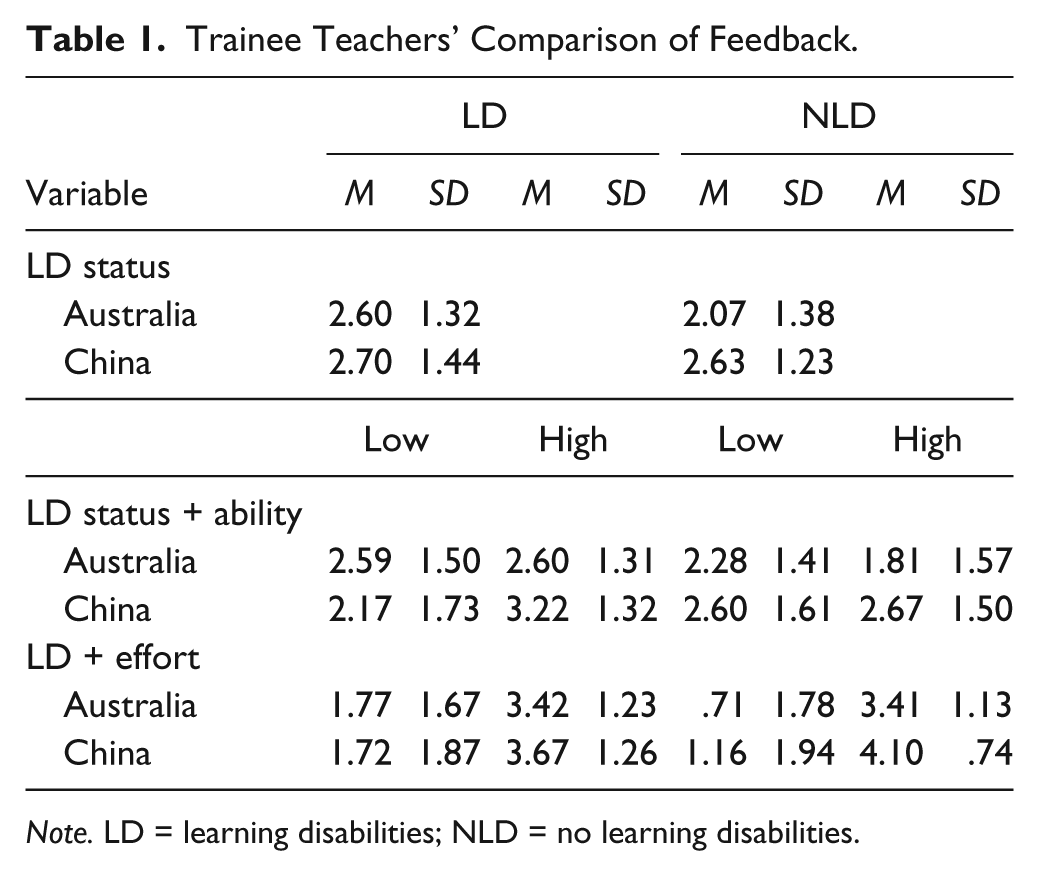
As can be seen in Table 1, the independent samples t test results show no significant differences in feedback given to students with or without LD between Australian and Chinese trainee teachers (p >.002). Furthermore, there were no significant differences in feedback on ability or effort expended between Chinese and Australian trainee teachers (p >.002). Thus, Chinese and Australian trainee teachers do not differ in the feedback given to students with and without LD, of high and low ability, and with expenditure of high and low effort.
Trainee Teachers’ Comparison of Feedback.
Note. LD = learning disabilities; NLD = no learning disabilities.
Frustration
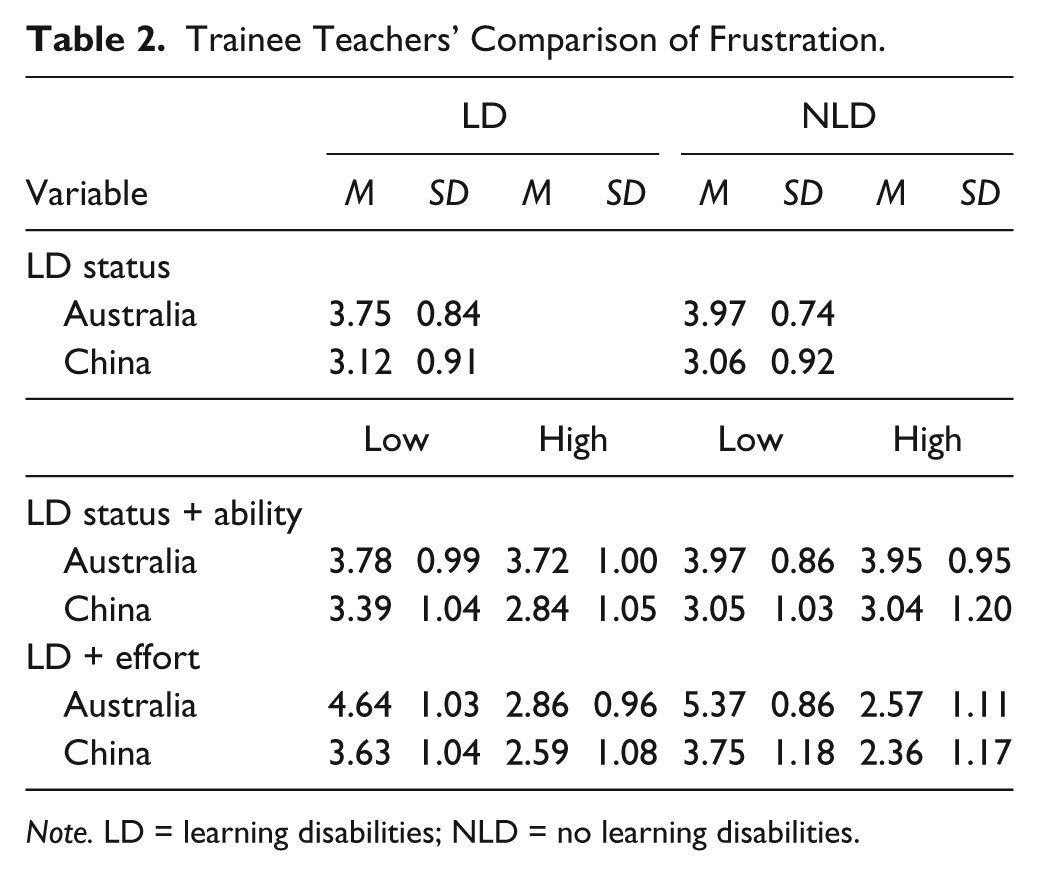
Overall, as shown in Table 2, Australian trainee teachers were more frustrated toward students with LD than their Chinese counterparts, t(240) = 5.54, p < .002. Australian trainee teachers were also more frustrated toward students without LD than Chinese trainee teachers were, t(240) = 8.53, p < .002. Furthermore, there was a greater difference in frustration between Australian and Chinese trainee teachers for students with LD at high ability levels than there was for students with LD at low ability levels, t(240) = 6.57, p < .002, and t(240) = 3.79, p < .002, respectively. As the ability level increases for students with LD, Australian frustration levels remain the same, whereas Chinese frustration levels decrease. Frustration levels felt toward students without LD differed similarly between students with high and low ability levels, t(240) = 7.49, p < .002, and t(240) = 6.58, p < .002, respectively. Both levels of frustration toward students of low and high ability levels remain constant (Australian frustration levels remain constantly higher than Chinese).
Trainee Teachers’ Comparison of Frustration.
Note. LD = learning disabilities; NLD = no learning disabilities.
As students with LD increased in amount of effort expended, the difference in levels of frustration between Australian and Chinese teachers decreased. Thus, there was a greater difference in frustration between Australian and Chinese trainee teachers for students with LD who expend low effort than there was for students with LD who expend high effort, t(240) = 7.14, p < .002, p >.002, respectively. As effort levels increase for students with LD, both Australian and Chinese levels of frustration decrease. Differences in frustration levels felt toward students without LD also decreased between Australian and Chinese trainee teachers. Thus, there was a greater difference in frustration between Australian and Chinese trainee teachers for students without LD who expend low effort than there was for students who expend high amounts of effort, t(240) = 11.16, p < .002, p >.002, respectively. As effort levels increase for students without LD, both Australian and Chinese levels of frustration decrease.
Sympathy
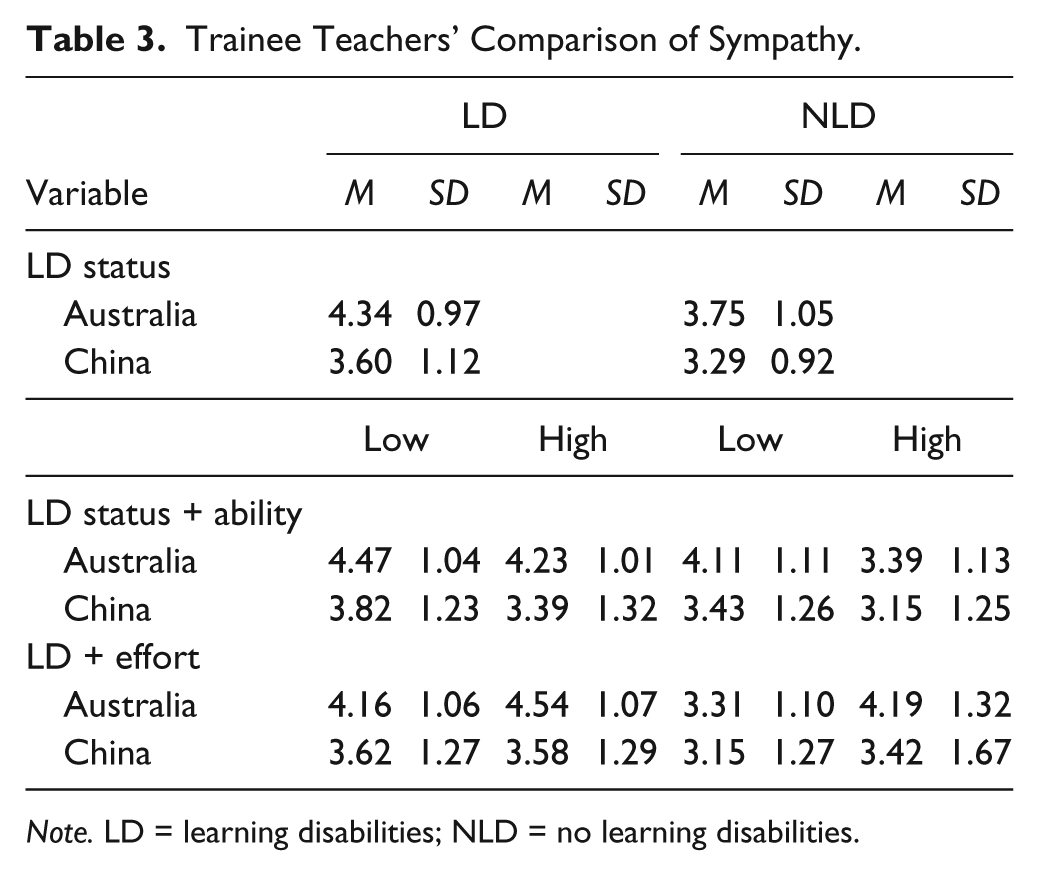
Overall, Australian trainee teachers were more sympathetic toward students with LD than their Chinese counterparts, t(240) = 5.26, p < .002, as shown in Table 3. Australian trainee teachers were also more sympathetic toward students without LD than Chinese trainee teachers were, t(240) = 4.35, p < .002. Furthermore, there was a greater difference in sympathy between Australian and Chinese trainee teachers for students with LD at high ability levels than there was for students with LD at low ability levels, t(240) = 5.29, p < .002, t(240) = 4.19, p < .002, respectively. As ability levels increase for students with LD, Australian sympathy levels remain the same, whereas Chinese sympathy levels decrease. Sympathy felt toward students without LD differed for students of low ability; however, it did not differ toward students without LD who had high ability levels, t(240) = 4.07, p < .002, p >.002, respectively. Thus, Australian sympathy levels decrease more toward the levels of Chinese trainee teachers as the ability levels increased.
Trainee Teachers’ Comparison of Sympathy.
Note. LD = learning disabilities; NLD = no learning disabilities.
As students with LD increased in amount of effort expended, the difference in level of sympathy between Australian and Chinese teachers increased. Thus, there was a greater difference in sympathy between Australian and Chinese trainee teachers for students with LD who expend high effort than there was for students with LD who expend low effort, t(240) = 5.93, p < .002, p >.002, respectively. As effort levels increase for students with LD, Australian trainee teachers’ sympathy increases, whereas Chinese sympathy remains constant. Differences in sympathy levels felt toward students without LD also increased between Australian and Chinese trainee teachers. Thus, there was a greater difference in sympathy between Australian and Chinese trainee teachers for students without LD who expend high effort than there was for students who expend low amounts of effort, t(240) = 5.03, p < .002, p >.002, respectively. As effort levels increase for students without LD, both Australian and Chinese levels of sympathy increase.
Expectation of Future Failure
Table 4 shows that Australian trainee teachers had significantly higher expectations of future failure for students with LD than their Chinese counterparts, t(240) = 12.70, p < .002. Australian trainee teachers also held higher expectations for future failure toward students without LD than Chinese trainee teachers, t(240) = 10.98, p < .002. Furthermore, there was a greater difference in expectation of future failure between Australian and Chinese trainee teachers of students with high ability than of students with low ability levels, t(240) = 13.19, p < .002, and t(240) = 8.19, p < .002, respectively. As ability level increases for students with LD, Australian and Chinese expectations of future failure decline. Expectations of future failure toward students without LD differed to a greater extent for students of low ability compared with students with high ability, t(240) = 12.00, p < .002, and t(240) = 5.50, p < .002, respectively. Thus, although Chinese expectations of future failure decrease as students’ ability levels increase, Australian trainee teachers’ expectations decrease considerably more.
Trainee Teachers’ Comparison of Expectation of Future Failure.

Note. LD = learning disabilities; NLD = no learning disabilities.
When students with LD expend more effort, the expectation of future failure also decreases among Australian and Chinese trainee teachers. Nevertheless, Australian trainee teachers had significantly higher expectations of future failure for students with LD who expend low and high amounts of effort, t(240) = 9.37, p < .002, and t(240) = 11.70, p < .002, respectively. As the amount of effort is expended, the difference slightly widened. Differences in expectations of future failure of students without LD also differed between Australian and Chinese trainee teachers. Australian trainee teachers held significantly higher expectations of future failure toward students without LD who expend low and high amounts of effort, t(240) = 7.42, p < .002, and t(240) = 9.21, p < .002, respectively. Thus, although Australian and Chinese expectations of future failure both decrease as the effort increases, Chinese trainee teachers’ expectations decrease slightly more.
Discussion
In this study, attributions of the academic failure of students with and without LD between Australian and Chinese trainee teachers were compared by investigating their feedback, frustration, sympathy, and expectation of future failure. Overall, the two cohorts perceive ability and effort as significant factors that contribute to academic failure for students with and without LD. This finding supports previous research on trainee teacher attribution (e.g., Woodcock & Jiang, 2012; Woodcock & Vialle, 2010, 2011, 2016), as well as research on in-service teacher attribution (e.g., S. Graham, 1991; Major et al., 2003).
Moreover, effort was found to be the major determinant of the two cohorts’ feedback and frustration levels for students with and without LD, compared with ability. As the trainee teachers perceived an increase in student effort, their frustration reduced, and feedback became more positive. The finding suggests that the Australian and Chinese trainee teachers in this study relate to student effort exertion more than their aptitude. When students encounter failure, the trainee teachers tend to attribute the cause to effort. By doing so, student motivation can be protected, as effort is seen as a controllable cause (Weiner, 1985). In this case, students who expend high effort are likely to maintain its level, and those who do not work hard may exert more effort. Hence, it could be considered that providing greater positive feedback to students who expend higher effort is a positive instructional strategy used by the Australian and Chinese trainee teachers in this study. Another reason for praising high effort, as proposed by Weiner (1977, 1985), is that effort is associated with strong moral feelings, which are valued by some societies, such as Chinese.
In spite of the similarities, the current study found that the expectancy of future failure of the two cohorts was distinct. Australian trainee teachers in this study expected further failure more than their Chinese counterparts for students with and without LD. According to Weiner’s theory (1985), ascribing outcomes to stable causes increases the expectancy of repeated outcomes. Thus, Australian trainee teachers’ expectations are more likely to be influenced by stable causes such as student ability and task difficulty than unstable causes such as effort and luck. Similar to previous studies (Woodcock & Vialle, 2010, 2011, 2016), the Australian trainee teachers in this study view academic failure as something that is difficult to overcome, which may have the effect of lowering students’ academic goals.
In addition, Australian trainee teachers have developed differentiated expectancy patterns of future failure between students with and without LD. The data demonstrate that teacher expectations for students without LD are more likely to relate to effort, whereas for students with LD, expectations are more likely to relate to ability. As a consequence of the expectations for students with LD, the Australian trainee teachers in this study are likely to establish even lower academic goals. These behavioral consequences may convey a message to the students that it is difficult for them to succeed. In contrast, the Chinese trainee teacher cohort’s expectations for students with and without LD are not different, as both relate to effort. This suggests that the Chinese trainee teachers in this study are more positive about student futures, because they ascribe their learning abilities to unstable causes that can be corrected and then can likely increase the expectancy of future success (Weiner, 1985).
Furthermore, as for students without LD, although effort was more significant than ability for the Australian trainee teachers’ expectations of future failure, ability was still largely significant. This indicates that the Australian trainee teachers in this study may expect repeated failures from students with low ability. In contrast, effort was much more significant than ability on the Chinese trainee teachers’ expectations, meaning that the psychological process of expectancy is predominantly effort driven. Thus, when the cause of failure is linked to low ability, Chinese trainee teachers have lower expectations of future failure than their Australian counterparts.
Another major distinction was found in regard to the sympathy felt toward students between the two cohorts. Australian trainee teachers were generally more sympathetic than Chinese trainee teachers to students with and without LD. As sympathy is associated with uncontrollable causes (Weiner, 1979; Weiner et al., 1978), the higher level of sympathy felt by Australian trainee teachers suggests that they tend to ascribe the failure to an uncontrollable cause (e.g., ability). This suggests that the Australian trainee teachers in this study perceive the failure as the result of more uncontrollable causes on students. In contrast, less sympathy was felt toward students by the Chinese trainee teachers, which indicates that they consider the failure as being somewhat controllable (e.g., effort).
Academic failure is generally seen by the Chinese trainee teachers as the result of low effort. This is congruent with the “normal self-esteem attribution” (Jacobson et al., 1986) that in turn protects students’ expectations and motivation toward learning. In comparison, Australian trainee teachers’ attributional patterns ascribe to ability and effort. Moreover, they tend to ascribe the failure of students with LD to low ability more so than effort. Such an ascription can be seen as a “negative attribution” pattern (Tabassam & Grainger, 2002) whereby failure is ascribed to an internal and uncontrollable cause. Thus, the above-mentioned discrepancies suggest that the attributional pattern held by the Chinese trainee teachers in this study is more positive than the pattern held by their Australian counterparts.
In terms of Australian trainee teachers’ attributional patterns, it is possible that they face a dilemma in dealing with students who are failing. On one hand, they are kinder to students who exert high effort than those who exert low effort. They believe that praising high effort can maintain student motivation and expectancy for learning and eventually change or maintain their behavior. On the other, they believe that low ability or other stable and uncontrollable factors cause the failure. This is particularly true when they respond to the failure of students with LD. As a psychological consequence, they are likely to expect repeated failure from these students. Eventually, they may lower academic requirements to suit the perceived ability level.
In contrast, Chinese trainee teachers’ attribution patterns are primarily effort driven. Given a failure case, the student with high effort deserves more praise, and future outcomes can be changed if the effort exertion is maintained. If the failed student did not work hard, Chinese trainee teachers would offer less praise, but the student could still have success in the future if he or she exerted more effort. In both cases, academic goals would not need to be lowered. This finding is also in agreement with Hong’s (2001) findings showing that Chinese teachers were less likely to use instructional strategies such as lowering requirements and offering easier tasks for their low-achieving students.
This current research also found that the Chinese trainee teachers have developed somewhat different views between students with and without LD. This can be seen from their feedback and frustration with students with LD, whereby moderate effects of ability were found. As ability levels increased, the cohort’s positive feedback increased, and frustration decreased. The results were not found from their responses to students without LD. Such a discrepancy preliminarily suggests that the cohort has perceived differences between students with and without LD. Furthermore, it suggests that LD is viewed by Chinese trainee teachers as being possible to overcome by high ability. At the same time, ability may be viewed as somewhat unstable. Thus, positive feedback is provided to stimulate (e.g., by exerting effort) the performance, which is in line with the ability level. As mentioned, such a belief is common among Chinese cultures (e.g., Hong, 2001; Hong, Chiu, Lin, Wan, & Dweck, 1999).
Implication
The above-mentioned findings have implications for trainee teacher education. The attributional view that trainee teachers hold about LD is important for student development (i.e., self-fulfilling prophecy). Positive teacher attribution reinforces students forming their own attributions and expectancy positively. In turn, students who have developed a positive attribution style are likely to motivate and exert positive behavior. In other cases, if teachers have an overemphasis on uncontrollable and stable causes in regard to student failure (e.g., student ability), they are likely to hold lower expectations or behave negatively toward students. This may cause the Golem effect (Eccles & Wigfield, 1985) on the students and bring about more failures. Consequently, this can result in students holding lowered self-esteem (Burden, 2008) and lower expectations of future success (Firth, Frydenberg, Steeg, & Bond, 2013), as students’ attributions of their own success and failures (intrapersonal attribution) can be influenced by teachers’ attribution of their success and failures (interpersonal attribution; S. Graham, 1991; Weiner, 2001).
It is vital for preservice teacher education to direct future teachers to foster positive attitudes toward students with LD. Positive impacts of teacher education on trainee teachers’ beliefs and attitudes toward inclusive education has been demonstrated in the research of trainee teacher preparation (Harvey, Yssel, Bauserman, & Merbler, 2010; McCollow, Shurr, & Jasper, 2015). Moreover, earlier studies (e.g., Avramidis, Bayless, & Burden, 2000; Brady & Woolfson, 2008) indicated that it was mainly teacher education rather than teaching experience that exerted teachers’ optimism and enthusiasm in teaching students with special educational needs. Indeed, Brady and Woolfson (2008) found that long-serving teachers tended to interpret failure of students with LD negatively, including attributing to internal and stable causes and exerting strong feelings of sympathy. In comparison, novice teachers who received inclusive training and teachers with long experience of learning supports were more optimistic to students with special educational needs and tended to attribute the failure externally (e.g., teacher or school factors). According to Weiner’s theory (1986), when the teachers attribute failure to a student’s internal cause, they do not feel responsible for the outcomes. In contrast, when they attribute failure to external causes, they may modify instruction or assign extra effort to reverse the outcomes in the future.
Thus, teacher education institutions need to ensure that trainee teachers are well prepared to meet the challenges of teaching students with LD within diverse inclusive classrooms. The present study supports previous studies (e.g., Vlachou et al., 2014; Woodcock & Vialle, 2010, 2011) in that “normal self-esteem attribution” (Jacobsen et al., 1986) is adaptive for understanding the learning of students with LD. It is worthwhile for preservice teacher education to develop programs that facilitate adoption of this attribution in the training. According to the findings of this study, this suggestion is particularly useful for Australian preservice teacher education. This may lead to attitudinal changes in trainee teachers to think and react positively toward students with LD.
Concurrently, preservice teacher education needs to train trainee teachers in the necessary strategies and techniques for teaching students with LD in an inclusive classroom. As suggested by the present study, Chinese trainee teachers are likely to hold positive attributional beliefs toward students with LD. Nevertheless, an adaptive belief needs to be aided by effective strategies for action; otherwise, overemphasizing students’ volitional control (e.g., low effort) over the outcome may restrain teachers’ motivation in modifying instruction and then lead to teacher-student conflict (Major et al., 2003; Tollefson, 2000). If trainee teachers believe that students with LD are capable of succeeding and they themselves are capable of helping their students to succeed, they may be more responsive and positive to inclusive education (Harvey et al., 2010).
In addition, social supports further facilitate trainee teachers’ preparation for teaching students with LD. Policy makers, governments, and educational departments need to promulgate legislation for ensuring proper identification and education of students with LD or refine the current educational supportive program to distinguish LD from other categories (e.g., general learning difficulties rather than LD). These reforms may enhance social understanding of LD, address the real needs of students with LD, and thus establish an adaptive and broader environment for students with LD to learn.
The findings from this study have highlighted a number of issues that warrant further examination. Future research could consider a range of data collection methods and the groups investigated in such studies. First, other methods of data collection could be considered, such as mixed method approaches or qualitative methods, using the same vignettes but with girls to determine whether attributional responses differ due to gender. Second, the participants selected in Jiangsu and New South Wales may not be representative of other provinces and states in China and Australia, respectively. Thus, looking more broadly within Eastern and Western countries would be worth considering.
There are several limitations to the study, namely involving the use of vignette scenarios with trainee teachers and self-reported data sets, due to factors around social desirability. Responses to vignette scenarios may produce different reactions—from what trainee teachers think that they may use in the classroom to what they would actually use (Lee, Hallahan, & Herzog, 1996), —and this may result in their responding the way that they think they should respond. Second, the reliance on self-reported data is queried by some researchers due to factors around social desirability and reliability (e.g., Cook & Campbell, 1979). However, some researchers (Chan, 2009; Clunies-Ross, Little, & Kienhuis, 2008) have contended that self-reported data can be validated in similar ways to observational data and can be less problematic in studies such as this one than in experimental studies. Nonetheless, future research might look at observations and qualitative methods that allow exploration of teacher attributions of students with LD with insightful and follow-up findings. Third, participants in the study were approached from only one university and one education department in each country, and so results need to be viewed with some caution. Also, some demographic factors (e.g., differences in training programs) that may influence trainee teachers’ attributional beliefs toward students with LD were not measured in this study. Future studies might also examine the influences of these variables on teachers’ attributional beliefs toward students with LD.
Overall, the current study suggests that Chinese trainee teachers’ attributional pattern of student failure is more positive than that of their Australian counterparts. As for students without LD, the Chinese trainee teachers demonstrated a greater effort attribution style, or so-called normal self-esteem attribution. In contrast, the attributional pattern of Australian trainee teachers is partially positive and negative, as they perceived effort and ability as both important. As for students with LD, the Chinese cohort maintained the same attributional pattern as they did for students without LD. In addition, they may view LD and ability as unstable and controllable to some extent. These findings support Woodcock and Jiang’s (2012) previous study in that LD had limited significance on Chinese trainee teachers’ attribution. In contrast, the Australian cohort developed a more negative attribution pattern for students with LD. It expected repeated failures from the students and felt greater sympathy toward them. This supports previous studies by Woodcock and Vialle (2010, 2011), who found that LD had a more negative significance on Australian trainee teachers’ attribution.
Footnotes
Authors’ Note
Han Jiang is now at Hangzhou College of Pre-school Teacher Education, Zhejiang Normal University, China.
Declaration of Conflicting Interests
The author(s) declared no potential conflicts of interest with respect to the research, authorship, and/or publication of this article.
Funding
The author(s) received no financial support for the research, authorship, and/or publication of this article.