



Abstract
To better identify the distinctive characteristics of space representation in the radial dimension, we have proposed a new paradigm: the landmarks alignment task where two parallel aluminum bars were radially presented. Children had to move a landmark along one bar and place it at the same location as the reference landmark placed by the examiner on the parallel bar. The major interest of this task was its capacity to assess space representation in the radial dimension when considering a spatial landmark that oriented the subject’s attention toward the orthogonal dimension. The most important result showed that in the radial dimension children with dyslexia exhibited a forward bias on the left bar, meaning a mental underrepresentation of the leftward peripersonal space and/or a mental overrepresentation of the rightward peripersonal space. Furthermore, reading discrepancies were correlated with radial forward bias on the left bar. The experiment was also conducted in the lateral axis, showing a pseudoneglect behavior in children without dyslexia. Our landmarks alignment task had the advantage of being able to assess space representation in a complex environment. The forward radial representational bias in children with dyslexia could have implications for spatial orientation in peripersonal workspace in school situations.
Overview of Dyslexia
Developmental dyslexia is a severe and persistent reading disability where children do not acquire efficient fluent reading despite adequate schooling and normal intellectual function (for a review, see Shaywitz, 1998). A large body of evidence has supported difficulties with language processing (Bishop & Snowling, 2004) and more specifically with phonological processing of oral language as the core deficit in dyslexia (Ramus, 2003; Vellutino, Fletcher, Snowling, & Scanlon, 2004). Indeed, children with dyslexia have a specific impairment in the representation, storage, and/or retrieval of speech sounds (Ramus et al., 2003). Dyslexia is known to co-occur with other developmental disorders (e.g., Snowling, 2012) as sensory and/or motor symptoms (Nicolson & Fawcett, 1990; Quercia, Demougeot, Dos Santos, & Bonnetblanc, 2011; Stein & Walsh, 1997; Vieira, Quercia, Michel, Pozzo, & Bonnetblanc, 2009). It has been proposed that reading disability could be partly explained by auditory processing deficits (via the phonological deficit) (e.g., Cantiani, Lorusso, Valnegri, & Molteni, 2010), visual dysfunction (Lovegrove, Heddle, & Slaghuis, 1980), and/or cerebellar dysfunction (Nicolson & Fawcett, 2011; Nicolson, Fawcett, & Dean, 2001).
Spatial Attention in Dyslexia
Visuospatial disturbances, which take different forms as difficulties in target distinction among distractive stimuli or difficulties in focally orienting visual attention, have also been proposed to contribute to reading disorders in dyslexia (Buchholz & Aimola Davies, 2007; Casco, Tressoldi, & Dellantonio, 1998; Facoetti, Paganoni, & Lorusso, 2000; Hari, Valta, & Uutela, 1999; Iles, Walsh, & Richardson, 2000; Visser, Boden, & Giaschi, 2004; Wright, Conlon, & Dyck, 2012). It has also been shown that the visual attention span, which corresponds to the amount of distinct visual elements that can be processed in parallel in a multi-element array, is reduced in children with dyslexia (Bosse, Tainturier, & Valdois, 2007). That could be regarded as another factor in the origin of dyslexia (Peyrin et al., 2012; Valdois, Bosse, & Tainturier, 2004).
Asymmetrical Space Representation in Lateral Axis in Children With Dyslexia
In addition, studies of the distribution of spatial attention (left versus right parts of space) in dyslexia have shown leftward impairments in the left part of the space compared to the right part of the space (e.g., Facoetti & Molteni, 2001; Facoetti & Turatto, 2000; Facoetti, Turatto, Lorusso, & Mascetti, 2001; Hari, Renvall, & Tanskanen, 2001). Spatial attention is known to influence space representation (e.g., Milner, Brechmann, & Pagliarini, 1992) that is the mental representation of the environment topographically structured and mapped across the brain (Bisiach, Luzzatti, & Perani, 1979). The classical task used to assess space representation is the line bisection where individuals have to estimate the center of horizontal lines (e.g., Jewell & McCourt, 2000). In line bisection protocols, horizontal black lines are presented on A4 sheets and children are asked to set a mark on the center of the line with a pen. Children with dyslexia exhibit a rightward bias compared with children without dyslexia (Michel, Bidot, Bonnetblanc, & Quercia, 2011; Sireteanu, Goertz, Bachert, & Wandert, 2005; Waldie & Hausmann, 2010).
Asymmetrical Space Representation in Radial Axis in Children With Dyslexia
It is worth underlining that space representation has been mainly studied along a single axis of space (as a left-right dichotomized phenomenon) in children with dyslexia, whereas space representation on the radial axis (as a front-near dichotomized phenomenon) has been poorly investigated. However, if we take into account the space representation in the horizontal axis (while ignoring the radial axis), it means that we consider only half of the spatial difficulties in dyslexia. Therefore, the identification of specific features of the space representation in radial axis is fundamental to have an exhaustive understanding of the spatial difficulties in dyslexia in order to propose adapted organization of space. One study has investigated this representation using a circle-centering task, where children had to indicate the center of a circle with a pen after having covered its circumference (Vieira, Quercia, Bonnetblanc, & Michel, 2013). On each trial, the pen was placed by the experimenter in the circumference groove at one of two points: left or right with respect to the children. The children were then asked to make one full (clockwise or counterclockwise) exploration of the circumference groove and then to indicate with the pen the center of the circle. The task was first performed with vision (visuo-proprioceptive condition) and then without vision (proprioceptive condition). Children with dyslexia showed a forward bias for clockwise exploration from the left starting position compared to children without dyslexia, suggesting a representational bias in radial dimension when the movement took its origin on the left part of the space.
Objective of the Present Study
The important result showed by Vieira and collaborators (2013) in sagittal radial axis raises the question of the modulation of the amplitude of the forward radial bias when radial space representation is assessed in the left (laterally underrepresented) or right (laterally overrepresented) space and when spatial attention is laterally oriented. Therefore, a new experimental paradigm was needed to explore the representational forward bias in left space and right space when spatial attention is laterally oriented. Then, we have proposed a new approach: the landmarks alignment task. In this task, two parallel aluminum bars were radially presented. Children had to move a landmark along one bar to place it at the same location as the reference landmark placed by the examiner in the parallel bar. The major theoretical interest of this task was to investigate the peripersonal representation of space in the radial dimension when orienting simultaneously the spatial attention toward the lateral dimension more particularly in the direction of the reference landmark placed by the examiner. Beyond the theoretical implication, this innovative task assessed space representation in a complex spatial environment similar to the workspace found in school. Indeed, space representation is often used in everyday life when children draw, write, or read. For example, children use their space representation in radial axis, whereas they orient laterally their attention when they have to write or to draw something horizontally on a white sheet of paper or when they draw shapes at the same level on a sheet. The space representation in radial axis with lateral orientation of attention is also used when they have to find the beginning of the following line when reading or when they want to resume the reading after a break and they have to locate the beginning of the following sentence to read. The radial representational bias may be responsible for forward errors in these situations. If the amplitude of the forward bias is different in the left space compared to the right space, then the difficulties to estimate the radial position of two elements (one on the left part of the sheet and the other one on the right part of the sheet) could increase the spatial errors. This asymmetry in radial forward bias could increase the difficulty to write horizontally, to draw a line laterally, and to find the beginning of the following line when reading for examples. Therefore, the identification of the specific representational features in children with dyslexia could allow us to propose an adapted organization of space to reduce the representational bias. A secondary objective was to investigate space representation in the lateral axis by using lateral bars.
Methods
Participants
Twenty-four children participated in the present experiment. A group of 14 children with dyslexia (four females; 10.86 ± 0.44 years) was age-matched with a group of 10 children without dyslexia (four females; 11.90 ± 0.18 years) (t test, p > .05). All children had normal or corrected-to-normal vision. They were right-handed except for two children with dyslexia and one child without dyslexia. All children were French nationals, and they gave their informed consent prior to their inclusion in the study, which was carried out in agreement with legal requirements and international norms (Declaration of Helsinki 1964). All the children of the present study showed no attention deficit/hyperactivity disorder (ADHD), no dyspraxia, no dysgraphia, no delayed psychomotor development, no neurological past history, and no psychiatric past history. They did not undergo psychotropic or antiepileptic drug therapy.
The diagnosis of dyslexia was given by a speech therapist. The inclusion criteria for the present study included at least 18 months of school retardation for literacy impairment (mean: 34.71 ± 3.88 months) with a normal IQ. Due to ethical considerations, speech therapists refused to communicate IQ but confirmed that IQ values were normal. In complement to the diagnosis, all children in our experiment were given one test of reading abilities (leximetric global validated test ‘de l’Alouette’) (Lefavrais, 2005). This test made it possible to determine speed and accuracy indexes based on the time required to read a 265-word test and the number of errors. The group of children with dyslexia had significantly lower reading speed scores and lower reading accuracy scores than control children without dyslexia (t tests; ps < .001). Furthermore, this test allowed us to express reading discrepancies (real score minus mean score of the age-matched population without dyslexia) in standard deviations of the age-matched population without dyslexia. The reading discrepancies for the speed reading (children with dyslexia: −1.29 ± 0.23; children without dyslexia: −0.09 ± 0.22) and for the accuracy reading (children with dyslexia: −1.60 ± 0.37; children without dyslexia: 0.15 ± 0.21) were different between children with dyslexia and children without dyslexia (t tests; ps < 0.01).
Material and Experimental Procedure
All the children had to perform a task that we proposed to name the landmarks alignment task. The objective of this task was to assess space representation in one direction when the attention was simultaneously oriented toward the orthogonal direction. The experimental device was horizontally presented to participants on a table top (Figure 1). It was composed of a wooden board (60 cm / 80 cm) where two removable parallel bars were fixed (64 cm) (Figure 1). The distance between the bars was either 20 cm (small distance) (Figure 1 b and d) or 50 cm (large distance) (Figure 1 a and c). The bars could be oriented either radially (radial orientation, Figure 1 c and d) or laterally (lateral orientation, Figure 1 a and b) according to the condition. On each bar, there was a graduated ruler that was not visible by the children (who saw the display from a top view) but that was only visible by the examiner. A landmark with a black line in its center could be moved along each bar. The examiner placed the reference landmark at a predetermined location on one bar and the children moved the landmark on the parallel bar to place it in the same location. When both bars were radially oriented (Figure 1 c and d), the examiner placed the reference landmark at the center of the bar (center location), either near the participant (near location, 15 cm from the center) or far from the participant (far location, 15 cm from the center). These locations correspond to an intermediate distance between the center of the bar and the extremities. When the examiner placed the reference landmark on the right bar, the children had to place the landmark on the left bar at the same location (response on the left bar). When the examiner placed the reference landmark on the left bar, the children had to place the landmark on the right bar at the same location (response on right bar). When the bars were laterally oriented (lateral orientation, Figure 1 a and b), the examiner placed the landmark on the center of the bar (center location), either to the right (right location, 15 cm from the center) or to the left (left location, 15 cm from the center) of the center. When the examiner placed the reference landmark on the near bar, the children had to place the landmark on the far bar at the same location (response on the far bar). When the examiner placed the reference landmark on the far bar, the children had to place the landmark on the near bar at the same location (response on the near bar). The landmarks alignment task did not become easy for participants over repeated trials because the children were not informed by the examiner about their estimation bias (distance between the reference landmark placed by the examiner and the moved landmark placed by the children). The different experimental conditions are shown in Table 1. In summary, there were two orientations (radial and lateral) in the experimental protocol. The children randomly began the landmarks alignment task either by the radial orientation or by the lateral orientation. For the radial orientation, there were two distances between the bars (small and large), three locations for the landmark (near, center, and far), and two sides for the bar where the children moved the landmark (response on the left bar and on the right bar). In total, there were 12 possible presentations for radial orientation. The children performed four trials for each presentation presented at random. For the lateral orientation, there were two distances between the bars (small and large), three locations for the landmark (left, center, and right), and two sides for the bar where the children moved the landmark (response on the near bar and on the far bar). In total, there were 12 possible presentations for lateral orientation. The children performed four trials for each presentation presented at random. Children were free to move their head and their trunk during the experiment. They performed the task with their dominant hand. Before beginning the experiment, they were given a few trials to familiarize them with the experimental device.

Experimental device.
Experimental Conditions.
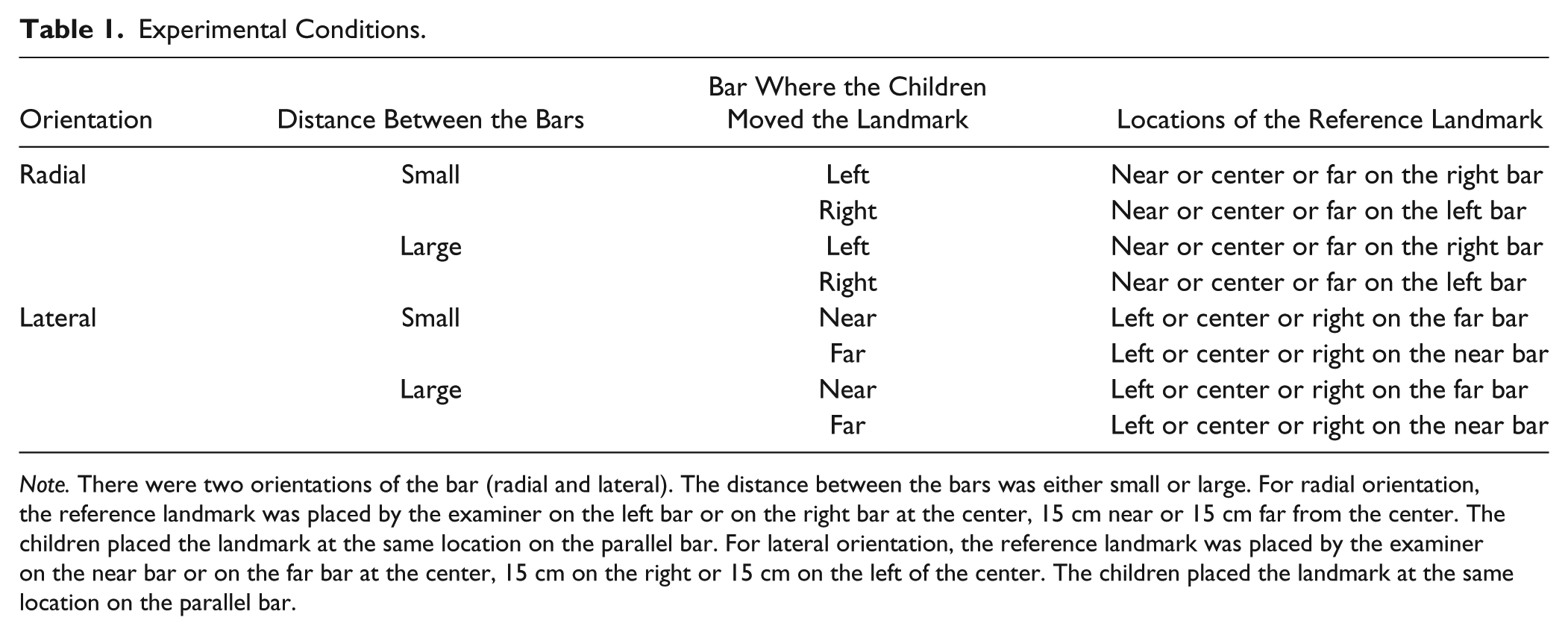
Note. There were two orientations of the bar (radial and lateral). The distance between the bars was either small or large. For radial orientation, the reference landmark was placed by the examiner on the left bar or on the right bar at the center, 15 cm near or 15 cm far from the center. The children placed the landmark at the same location on the parallel bar. For lateral orientation, the reference landmark was placed by the examiner on the near bar or on the far bar at the center, 15 cm on the right or 15 cm on the left of the center. The children placed the landmark at the same location on the parallel bar.
The children also performed the line bisection task to assess the space representation in the most classical situation when only lateral orientation was considered (e.g., Jewell & McCourt, 2000). The line bisection was added as a reference task to show how these groups of children perform on a typical measure that is used to help situate the results of the landmark task since it is new. They were asked to set a mark on the center of the lines with a pen. They used their dominant hand. Ten lines (250 mm long and 1 mm wide) were presented in front of the body midline. The lines were printed individually, and they were centered on a white A4 landscape card. During the visual exploration, both hands were positioned so as not to hide any part of the line. The line bisection was performed before the landmarks alignment task. The sensitivity of the line bisection could have been reduced if the alignment landmarks task was performed prior to line bisection. Indeed, the enlargement of the space of work by the experimental device of the landmarks alignment task could have been responsible for an underestimation of the line and therefore a reduced representational bias (Marshall, Lazar, Krakauer, & Sharma, 1998; Vieira et al., 2013; Werth & Pöppel, 1988).
Data Analysis
We measured the estimation bias—that is, the distance (to the nearest 0.5 mm) between the landmark placed by the children (the “moved landmark”) and the exact location indicated by the landmark placed by the examiner (the “reference landmark”) on the parallel bar. The examiner read the measure on a graduated ruler that was not visible to the children. For the radial orientation, the forward biases were given a positive value, and the backward biases were given a negative value. For the lateral orientation, the rightward biases were given a positive value and the leftward biases were given a negative value.
We performed two independent ANOVAs on the biases. One ANOVA was performed for the radial orientation. The distance between the bars (small and large), the bar where the children moved the landmark (left and right), and the locations indicated by the reference landmark placed by the examiner (near, center, and far) were analyzed as within-subject factors, whereas the group (children without dyslexia and children with dyslexia) was analyzed as a between-participants factor. One ANOVA was performed for the lateral orientation. The distance between the bars (small and large), the bar where the children moved the landmark (near and far), and the locations of the landmark placed by the examiner (left, center, and right) were analyzed as within-subject factors, whereas the group (children without dyslexia and children with dyslexia) was analyzed as a between-participants factor. Post hoc analysis was performed by means LSD (Least Significant Difference) tests. The performance of all children was considered for correlation analysis (Spearman’s rho) that was performed between parameters of the reading test (reading discrepancies for speed reading and for accuracy reading expressed in standard deviation of the age-matched population without dyslexia) and the representational biases for both tasks (landmarks alignment task and line bisection task). All statistics were performed by the STATISTICA software package (release 10). An alpha level of 0.05 was used to determine statistical significance. In the manuscript, mean and standard errors are presented in parentheses.
Results
Radial Orientation
Repeated-measures ANOVA (described in the data analysis section) showed a significant main effect of the distance between the bars (small and large), F(1, 22) = 20.98, p < .001, statistical power: 0.99. The forward bias was greater for the large distance (9.92 ± 1.72 mm) than for the small distance between the bars (3.06 ± 0.44 mm). There was also a significant interaction between the distance between the bars (small and large) and the group (children with dyslexia and children without dyslexia), F(1, 22) = 5.16, p < 0.05, statistical power: 0.58. Post hoc analysis showed that the forward bias was greater for large distance (12.77 ± 2.21 mm) than for small distance (2.52 ± 0.57 mm) in children with dyslexia (p < .001) (Figure 2).

Bias in the radial orientation for children with dyslexia and children without dyslexia when the distance between the bars was small and large
ANOVA also showed a significant main effect of the bar where the children moved the landmark (left and right), F(1, 22) = 4.32, p < 0.05, statistical power: 0.51. The bias was larger when the children moved the landmark on the left bar (8.07 ± 1.22 mm) than when they moved the landmark on the right bar (4.91 ± 1.29 mm). An important result was a significant interaction between the bar where the children moved the landmark (left and right) and the group (children with dyslexia and children without dyslexia), F(1, 22) = 8.73, p < 0.01, statistical power: 0.81. Post hoc analysis showed that the forward bias was greater for the left bar (11.47 ± 1.59 mm) than for the right bar in children with dyslexia (3.83 ± 1.67 mm) (p < .001) (Figure 3). In children with dyslexia, the forward bias was significantly different from zero when the children moved the landmark on the left bar for the small distance between the bars for near location (9.03 ± 1.47 mm) and center location (2.52 ± 1.14 mm). For the large distance between the bars, the forward bias was significantly different from zero for near location (18.07 ± 3.26 mm), center location (21.14 ± 3.20 mm), and far location (16.23 ± 3.46 mm) (ps < .05). In children without dyslexia, the forward bias was significantly different from zero when the children moved the landmark on the leftward bar for the small distance between the bars for the near location (4.72 ± 1.34 mm). For the large distance between the bars, the forward bias was significantly different from zero for the center location (9.80 ± 3.63 mm) and far location (7.80 ± 2.97 mm) (ps < .05).

Bias in the radial orientation for children with dyslexia and children without dyslexia when they moved the landmark on the left bar and on the right bar.
Additionally, ANOVA showed a significant interaction between the distance between the bars (small and large) and the locations of the landmark (near, center, far), F(2, 44) = 6.19, p < .01, statistical power: 0.87.
When correlation analysis was performed for all children between the reading discrepancies (for speed reading and for accuracy reading expressed in standard deviation of the age-matched population without dyslexia) and the bias in the left bar, Spearman’s rho values ranged from −0.47 to −0.79 (ps < .05). When the distance between the bars was small, the correlations for both reading scores were significant when the children moved the landmark on the left bar for near and center locations. When the distance between the bars was large, the correlations for both reading scores were also significant when the children moved the landmark on the left bar for near, center, and far locations.
Lateral Orientation
Repeated-measures ANOVA (described in the Data Analysis section) showed a significant main effect of group (children with dyslexia and children without dyslexia), F(1, 22) = 8.02, p < .01, statistical power: 0.77. The rightward bias was greater for children without dyslexia (2.31 ± 0.50 mm) than for children with dyslexia (0.46 ± 0.42 mm). There was also a main effect of the bar where the children moved the landmark (near and far), F(1, 22) = 4.69, p < .05, statistical power: 0.54. The rightward bias was greater when children moved the landmark on the far bar (2.65 ± 0.75 mm) than when they moved the landmark on the near bar (0.12 ± 0.57 mm). There was also a significant interaction between the bar where the children moved the landmark (near and far) and the distance between the bars (small and large), F(1, 22) = 13.61, p < .01, statistical power: 0.94.
When correlation analysis was performed for all children between the reading discrepancies (for speed reading and for accuracy reading expressed in standard deviation of the age-matched population without dyslexia) and the estimation bias, Spearman’s rho values ranged from 0.47 to 0.60 (ps < .05).
Line Bisection Task
ANOVA showed a significant main effect of group (children with dyslexia and children without dyslexia), F(1, 22) = 5.50, p < .05, statistical power: 0.61. The bisection mark of the children with dyslexia was placed on the right of the bisection mark of the children without dyslexia. Children with dyslexia showed quite an accurate estimation (0.41 ± 1.09 mm), whereas children without dyslexia showed a leftward estimation (−2.83 ± 0.58 mm). The bisection bias was significantly different from zero only in children without dyslexia (ps < .001). There was a significant correlation between the reading discrepancies (for speed reading expressed in standard deviation of the age-matched population without dyslexia) and the bias in line bisection (Spearman’s rho value: −0.51; ps < .05).
Discussion
Forward Bias for the Left Bar in Children With Dyslexia
A particularity of our protocol was to assess space representation in one dimension when the task also needed the orientation of spatial attention in the orthogonal dimension. One of the most important results of the present study was the greater forward bias when children with dyslexia moved the landmark on the left bar than when they moved the landmark on the right bar. This difference was not observed in children without dyslexia. The position of the moved landmark gives information about the perceived location of the reference landmark relative to the extremities of the bars. If we consider the near extremities, the forward bias of the moved landmark on the left bar means that children with dyslexia mentally underrepresented the distance between the near extremity of the left bar and the moved landmark and/or overrepresented the distance between the near extremity of the right bar and the reference landmark (Figure 4). Our result is in accordance with the fact that the part of the space where we focus our attention is overrepresented (e.g., Milner et al., 1992). Because the task compelled the children to orient their attention between the reference landmark placed by the examiner and the near extremity, this distance was mentally overrepresented relative to the distance between the moved landmark and the near extremity.

Interpretation of the forward bias on the left radial bar in children with dyslexia.
When we consider the left–right dichotomy of the space, it has been shown that children with dyslexia mildly neglect the left part of the space (Michel et al., 2011; Sireteanu et al., 2005; Waldie & Hausmann, 2010). Indeed, they have attention flexibility deficit toward the left space. For example, when they have to explore the space, they have more difficulty orienting their attention to the left when they first orient it to the right (Facoetti et al., 2001). In our protocol, when children had to move the landmark on the left bar, they continually focused their attention on the reference landmark placed by the examiner on the right bar and then they intermittently oriented their attention on the left landmark. Therefore, the present study showed that the forward bias increased when the attention of the children with dyslexia was intermittently driven to the left space. The present result highlights the necessity to consider simultaneously both radial and lateral dimensions when we investigate the space representation of children with dyslexia. It is worth underlying that in our study reading discrepancies were mainly correlated with radial forward bias on the left bar. The more the reading discrepancies were important, the greater the amplitude of the forward bias was.
Forward Bias in Radial Orientation Increased With the Difficulty of the Task in Children With Dyslexia
It has been shown that when we are in a difficult perceptive situation soliciting more attention (with low-contrast stimuli for example), the corresponding space is overrepresented (Bradshaw, Nathan, Nettleton, Wilson, & Pierson, 1987; McCourt & Jewell, 1999). The present results showed that when the distance between the bars increased, the forward bias increased. This means that the forward bias depended on the difficulty of the task. The forward bias was greater for the large distance between the bars than for the small distance between the bars in children with dyslexia. This indicates that not only the processing of the spatial context was preserved in dyslexia as shown previously (Michel et al., 2011) but also that children with dyslexia were particularly sensitive to the difficulty of the task. It is also worth noting that in children with dyslexia the representational radial bias appeared from near to far space when the distance between the bars increased. When the distance was small between the bars (low difficulty), the forward bias on the left bar concerned the near and center locations that seem to be the most sensitive parts of the space concerned with the representational bias. When the distance between the bars was large (high difficulty), the bias on the left bar also concerned the far location.
Space representation in the lateral axis
In the present line bisection task, children with dyslexia exhibited a significant rightward estimation of the line center compared to children without dyslexia who showed a leftward bias that was significantly different from zero. This result is in accordance with previous results (e.g., Michel et al., 2011) and means that children without dyslexia overrepresented the left part of the line. This behavior is well known and named pseudoneglect (e.g., Jewell & McCourt, 2000). Contrary to previous studies showing a rightward bias (mentally overrepresenting the right part of space) in children with dyslexia (e.g., Michel et al., 2011), the children of the present experiment showed only a trend to rightward overestimation. It is possible that in the children with dyslexia who took part in the present experiment, the representational lateral bias was not strong enough to be revealed. Nevertheless, the correlation analysis showed that the reading discrepancies were correlated to the rightward bias in line bisection as previously shown (Michel et al., 2011).
The landmarks alignment task assesses space representation in the lateral axis while orienting the attention in the orthogonal radial axis. The position of the moved landmark gives information about the perceived location of the reference landmark relative to the extremities of the bars. If we consider the left extremities, the rightward bias of the moved landmark means that children without dyslexia mentally underrepresented the distance between the left extremity of the bar and the moved landmark and/or overrepresented the distance between the left extremity of the bar and the reference landmark. This result is in accordance with the overrepresentation of the left part of the line (pseudoneglect) in the present line bisection task in children without dyslexia. Concerning children with dyslexia, their performance was quite accurate in the landmarks alignment task as well as in the present line bisection task. Furthermore, for both tasks, correlation analyses showed that reading discrepancies were correlated with the representational biases.
Conclusion and Perspectives
The protocol that we have proposed for the first time in the present study, the landmarks alignment task, investigates space representation in one axis while orienting the attention in the orthogonal axis. The most important result was shown in the radial axis. The main advantage of this new task was to investigate the modulation of the amplitude of the forward radial bias when radial space representation is assessed in the left space or in right space and when spatial attention is laterally oriented. Children with dyslexia exhibited a mental underrepresentation of the left radial peripersonal space and/or a mental overrepresentation of the right radial peripersonal space. Furthermore, the present study showed significant correlations between the reading discrepancies and the forward bias in the left bar. Even if the connection between this forward bias in space representation and reading discrepancies seems not direct, this asymmetry in radial forward bias between the left part and the right part of the space could have strong implications in the spatial behavior of the children. This asymmetry in forward representational bias could be responsible for difficulty to write horizontally, to draw a line laterally, to find the beginning of the following line when reading, or to locate the beginning of the following sentence to read after a break for examples. Because our experimental device does not allow us to assess the space representation in authentic school situations, future investigations will investigate the consequence of the representational bias in the school situations mentioned above. It will be also interesting to record eye movements during these tasks because the space representation bias could be responsible for forward ocular errors in the left part of space. Future investigations could assess also the space representation in children with different reading habits because space representation could be modulated by reading habits (Chokron & De Agostini, 1995). Even if we could expect that the same characteristics of space representation could be found in children with dyslexia of different nationalities provided that they have the same reading habits (left-to-right readers), we could raise the question of the asymmetry of the radial bias between the left space and the right space in children with different reading habits (right-to-left readers). Furthermore, the identification of the bias in space representation in dyslexia shown in our study could allow us to propose an adapted organization of space to reduce spatial errors. For example, the horizontal lines of exercise books could be printed using different colors to provide a better spatial frame of reference. Books could be also better adapted to children with dyslexia by using the same symbols or the same colored dots to identify the end of a reading line (on the right part of the page) and the beginning of the following line (on the left part of the page).
Footnotes
Acknowledgements
We wish to thank Léonard Feiss, MD, for his thoughtful comments and help with the English version.
Declaration of Conflicting Interests
The author(s) declared no potential conflicts of interest with respect to the research, authorship, and/or publication of this article.
Funding
The author(s) received no financial support for the research, authorship, and/or publication of this article.