




Abstract
Many marketing transactions between buyers and suppliers involve short-term collaborations or so-called temporary organizations. Such organizations have considerable value-creation potential but also face challenges, as evidenced by their mixed performance records. One particular challenge involves relationship governance, and in this respect, temporary organizations represent a conundrum: On the one hand, they pose significant governance problems due to the need to manage numerous independent specialists under time constraints. On the other hand, temporary organizations lack the inherent governance properties of other organizational forms such as permanent organizations. The authors conduct an empirical study of 429 business-to-business construction projects designed to answer two specific questions: First, how are particular selection and pricing strategies deployed in response to monitoring and coordination problems? Second, does the joint alignment between the two mechanisms and their respective attributes help mitigate cost overruns? The authors follow a formal hypothesis test with a series of in-depth interviews to explore and to gain insight into the validity of the key constructs, explanatory mechanisms, and outcomes. Managerially, the authors answer the long-standing question of how to mobilize a temporary organization. Theoretically, they develop an augmented “discriminating alignment” heuristic for relationship management involving multiple governance mechanisms and attributes.
Keywords
It is commonly accepted that marketing performance, or value creation more broadly, depends on how the buyer–supplier interface is organized or governed. A large body of research shows how both formal organizational structures (Lee, Kozlenkova, and Palmatier 2015; Moorman and Day 2016) and long-term relationships (Dwyer, Schurr, and Oh 1987; Ghosh and John 2005) play important governance roles.
Recent research shows, however, that much marketing activity takes place outside of formal organizations and long-term relationships through so-called temporary organizations (Bakker et al. 2016; Hadida, Heide, and Bell 2019), namely a “temporally bounded group of interdependent actors” (Burke and Morley 2016, p.1237) assembled for the purpose of performing a particular task (Goodman and Goodman 1976). Temporary organizations have existed since antiquity, and they have been used for a variety of purposes, including the deployment of military campaigns such as those of Alexander the Great, the construction of iconic structures such as the Great Wall of China and the Sydney Opera House, the execution of the Manhattan Project and the Apollo Moon landing, and the development of well-known advertising campaigns and new products (Flyvbjerg 2014; Grabher 2002; Lundin et al. 2015). Spending on temporary organizations is substantial—a McKinsey study (Garemo, Hjerpe, and Mischke 2015) estimates a worldwide expenditure of $57 trillion from 2015 to 2030 on infrastructure projects alone.
Surprisingly, despite their versatility and prominence, temporary organizations have been subject to limited systematic theorizing. In particular, their specific governance practices are poorly understood. Researchers (e.g., Bechky 2006) have noted how past accounts of temporary organizations (e.g., Kanter 1995; Powell 1990) are limited to stating their general impetus, such as knowledge sharing, cost containment, and flexibility, but they are silent on the specific mechanisms by which such outcomes come about. Consequently, the question originally raised by Goodman and Goodman (1972, p. 108) about “how to mobilize a temporary organization” remains largely unanswered.
Temporary organizations represent a governance conundrum. First, they must coordinate and monitor the efforts of multiple specialist suppliers without the benefit of the mechanisms that are available to other organizational forms, such as hierarchical structures, rules, and long-term compensation (Williamson 1975). In addition, they must manage the relevant relationships under time pressure (Lundin and Söderholm 1995). These challenges have led some researchers to describe temporary organizations as inherently ephemeral and unstable (Bechky 2006; Kanter 1995), using descriptors such as “one-night stands” (Meyerson, Weick, and Kramer 1996, p. 167). There is industry evidence to support this position: studies of major construction projects show that nine out of ten have significant cost overruns (Flyvbjerg 2014; Flyvbjerg, Holm, and Buhl 2003).
Other researchers, however, have challenged the instability thesis and suggested that temporary organizations may draw on unique sources of support, such as prior ties between their members (Eccles 1981). This line of work, however, has stopped short of specifying these mechanisms’ specific effects and performance implications.
Our main contribution is to shed light on the governance conundrum of temporary organizations. In doing so, we build on recent work by Hadida, Heide, and Bell (2019), which examined such organizations through a governance lens. Our specific focus is on so-called “hybrid” temporary organizations that exist outside of the boundaries of a permanent firm (unlike “fully embedded” organizations) yet may exhibit prior ties among their members (unlike “stand-alone” organizations, which are assembled from scratch). We develop and empirically test a novel two-stage model of hybrid governance. The first stage, the deployment stage, considers (1) the monitoring and coordination problems that follow from a temporary organization’s size (the number of involved suppliers or subcontractors) and (2) how these problems drive governance choices in terms of selection and pricing. These effects, in turn, are contingent on a hybrid’s particular features, namely (1) the availability of prior ties among its members at different levels, including buyer, general contractor, and subcontractor, and (2) its particular time horizon or contracted duration.
The second stage in our framework, the performance stage, captures whether the mechanisms of selection and pricing, when jointly aligned with their respective attributes (called plural discriminating alignment), help minimize cost overruns. In general, our model captures the unique logic of temporary organizations, which involves solving multiple governance problems under time constraints. This logic has been succinctly expressed by Lundin and Söderholm (1995, p. 437) as “the need to make things happen.”
Beyond the general goal of developing and testing a novel model of temporary organizations, we make the following three contributions: First, our conceptualization advances the theoretical notions of plural governance and alignment. Since the publication of Bradach and Eccles’s (1989) seminal article, researchers (e.g., Cao and Lumineau 2015; Heide 2003) have embraced the idea that buyer–supplier interfaces comprise multiple governance mechanisms. Previous research, however, has focused on the observed relationships between the mechanisms themselves (Poppo and Zenger 2002). We advance the plural-forms thesis by showing that performance is not necessarily a function of multiple governance mechanisms per se but of whether the different mechanisms are simultaneously aligned with their theoretically specified antecedents. Practically, as noted by one of our interviewees, this question addresses “how we can get things right.” Theoretically, it adds precision to the plural forms thesis and to the alignment thesis in governance theory (Williamson 1991) more generally.
Second, we generate fine-grained insights into two fundamentally different approaches to governance: partner selection and incentives. These two mechanisms work in quite different ways, by either (1) identifying the “right” party in the first place or (2) inducing action through financial rewards (Ouchi 1980; Wathne et al. 2018). Our particular analyses enable us to undertake a precise comparison of the two approaches and to examine whether aligned selection has a more significant performance effect than aligned incentives. Because projects can fail spectacularly (Matta and Askenas 2003), taking a significant financial as well as human toll, understanding performance is a key concern.
Third, and building on the previous point, the two mechanisms that we study, selection and pricing, are managerially relevant and can be readily deployed within the time frame of a temporary organization. Their quick deployment has intrinsic benefits. Bechky’s (2006) study of movie projects shows the challenge of achieving coordination under time constraints, as vividly illustrated by a comment from one of her subjects during a movie shoot: “We have two days to do it—we need to get things done right away.” Despite their quick deployment, we show that these mechanisms have significant long-term performance implications in the form of ex post costs that manifest themselves after project completion. 1
This article is organized as follows: The next section provides a general discussion of governance in a temporary organization context. This is followed by a presentation of our conceptual framework and research hypotheses. Next, we describe the research method used to test the hypotheses, including a unique data set of 429 construction projects spanning the time period from 2001 through 2015. We follow our formal hypothesis tests with a set of in-depth interviews with construction managers to gain insights into the validity of our hypothesized constructs, explanatory mechanisms, and outcomes. Collectively, the projects we study are worth $33 billion, yet they suffered from $4 billion in cost overruns. We conclude by discussing the study’s contributions and limitations and create an agenda for future research on temporary organizations.
The Governance Properties of Temporary Organizations
Temporary organizations raise complex questions that are not addressed by standard theory. In particular, they raise questions regarding the properties that its governance mechanisms must possess, compared with permanent firms and long-term relationships.
First, a temporary organization’s discrete time horizon requires mechanisms that possess a deployment property, namely short-term marketing tools (Jackson 1985) that can (1) be rapidly implemented at the organization’s initiation stage (Heide 1994) and (2) take effect “swiftly” (Meyerson, Weick, and Kramer 1996, p. 175). The mechanisms of selection and pricing, which we focus on, possess such properties. Parenthetically, a deployment property contrasts sharply with other, more commonly studied, governance mechanisms that require time-consuming design efforts, such as permanent organizational structures (Williamson 1975) and relational norms (Macneil 1980).
Second, the emphasis on governance deployment has implications for mechanism content—namely, a need for mechanisms that are formal, rather than informal, in nature (Poppo and Zenger 2002). For instance, pricing provisions in business-to-business settings are typically built into formal contracts (Mooi and Ghosh 2010) that can be crafted and brought to bear on an organization quickly. In contrast, informal governance mechanisms such as norms and expectations possess a distinct social component (Jones, Hesterly, and Borgatti 1997), and their availability requires prolonged interaction between parties.
The third property that we identify has to do with the level at which a given governance mechanism originates. Building on and extending the “discriminating alignment” principle of transaction cost economics (Williamson 1991), we posit that temporary organizations require mechanisms that are organization-specific in nature, in the sense that they match the focal organization’s particular attributes. That said, prior research suggests that some temporary organizations, sometimes described as “hybrids” (Schwab and Miner 2008), can also draw on preexisting, more general properties that can be “activated” or brought to bear on the organization in question. For instance, Eccles (1981), in his analysis of so-called “quasi-firms,” shows how construction projects often exhibit recurring ties between its members. Similar patterns have been shown in movie production, where repeated interactions between actors and producers (Faulkner and Anderson 1987) serve governance purposes through the role structures and social bonds that emerge over time. Indeed, some researchers (e.g., Jones, Hesterly, and Borgatti 1997; Kanter 1995) have described temporary organizations as exemplars of social forms of governance. Despite the intuitive appeal of such arguments, important questions remain regarding (1) the specific form that prior ties can take and (2) the juxtaposition between prior ties and organization-specific governance mechanisms. We turn to these questions next.
Conceptual Framework
Our main theoretical anchoring is twofold: First, we rely on the extant literature on temporary organizations (e.g., Hadida, Heide, and Bell 2019; Jacobsson, Burström, and Wilson 2013) to identify relevant antecedents or attributes such as the focal organization’s size (Holloway and Parmigiani 2016; Knoben and Gössling 2009). Second, we draw on the “new institutional economics” (e.g., Williamson 1985) literature to link the relevant attributes with governance mechanisms and performance outcomes.
Figure 1 presents our conceptual framework. Its key attribute or driver is organizational size, captured by the number of suppliers or subcontractors that are involved (Holloway and Parmigiani 2016). For instance, Boston’s “Big Dig”—a highway tunnel under the central part of Boston—involved more than 200 subcontractors (Hollmer 2002). Similarly, developing the Boeing 737 required the involvement of hundreds of individual suppliers (Linn 2010).

Conceptual framework.
Organizational size gives rise to different kinds of governance problems. Some of them have to do with controlling the actions of the individual suppliers or agents, as per established governance theory (Williamson 1985). For instance, the larger the temporary organization, the greater the difficulty of monitoring individual members’ contributions. Oxley (1997, p. 395) argues that as the number of involved partners increases, monitoring problems are exacerbated because of the cost of assigning accountability for individual actions (Alchian and Demsetz 1972).
Importantly, however, the governance challenges of temporary organizations go beyond managing individual actions per se; they also include ensuring consistency between the different parties’ actions (Gulati, Wohlgezogen, and Zhelyazkov 2012). Conceptually, the latter represents a particular form of governance problem, namely coordination (Thompson 1967). While researchers (e.g., Oliveira and Lumineau 2017) have noted that coordination problems have received limited attention in the governance literature, they are ubiquitous in temporary organizations, in part because of interdependencies between the different agents’ tasks (Mathieu et al. 2008). To use an obvious example, plumbing cannot begin until a building’s foundation work has been completed.
As Figure 1 shows, the monitoring and coordination challenges that follow from organizational size require the deployment of governance mechanisms with particular properties. We draw on Hadida, Heide, and Bell’s (2019) framework to focus on the particular selection criteria and pricing provisions used. Both of these mechanisms possess the properties discussed previously, namely being readily deployable, formal, and organization-specific. With regard to selection, we distinguish between (1) ex ante assessments focused on supplier ability (Ireland, Hitt, and Vaidyanath 2002) and (2) evaluations that emphasize the price charged (Dekker 2008). With regard to the actual pricing provisions, we compare (1) variable pricing contracts, which reimburse the supplier for costs plus a margin, and (2) fixed pricing, which offers the supplier a prespecified price. These two formats possess different governance properties, in that the latter focuses strictly on the final output, while the former contains a built-in price adjustment mechanism (Bajari and Tadelis 2001; Corts and Singh 2004).
The first part of our framework, which captures the governance deployment decision, specifies the relationship between organizational size and the two governance mechanisms. As Figure 1 shows, we also identify two different contingent influences, namely, (1) the temporary organization’s time horizon, as indicated by the construction project’s contracted duration, and (2) the presence of preexisting ties between the organization’s members (Eccles 1981; Schwab and Miner 2008). The second part of the framework pertains to the performance implications of the governance choices made. Next, we consider each part of the framework in turn.
Governance Deployment: Size, Mechanisms, and Contingent Effects
We argue that the main effect of organizational size, as measured by the number of suppliers involved, is to increase the likelihood of ability-based selection, because such a selection process proactively addresses monitoring and coordination problems. Consider first the problem of monitoring. As an example, the larger the number of individual suppliers involved in a building project, the greater the difficulty of monitoring their individual contributions (Li et al. 2012; Mishra, Das, and Murray 2016). Extant governance research suggests that such problems can be managed through purposeful ex ante supplier selection on criteria such as skills, competencies, past performance, and reputation (e.g., Wuyts and Geyskens 2005). In practice, such ability-based selection reduces the need for ongoing supplier handholding and follow-up. Essentially, having identified the “right” supplier in the first place economizes on ongoing monitoring efforts. 2
Next, consider how organizational size gives rise to coordination problems. The larger the temporary organization, the greater the number of intraorganizational linkages that exist, and the greater the difficulty of coordinating the focal tasks (Puranam and Raveendran 2013). Kremer (1993) discusses this issue in terms of the “O-ring property,” where the organization’s overall output requires that each input perform up to a certain level—if anything fails, the value of the project as a whole may be severely diminished. As an example, the size of the aforementioned “Big Dig” gave rise to extraordinary coordination problems between the different suppliers.
We draw on Gulati, Wohlgezogen, and Zhelyazkov (2012) to posit that the coordination needs that follow from organizational size can be addressed proactively through ability-based supplier selection. The more stringent the ex ante assessment of supplier ability, the greater the likelihood of identifying suppliers whose actions are unlikely to cause ongoing coordination problems. As noted by Dekker (2008), the selection of such suppliers is an important way to curb potential supplier opportunism and facilitate coordination. Importantly, such information would not be revealed by a selection process that focused on the price charged.
As we have discussed, our baseline (main effect) expectation is that organizational size will increase the likelihood of an ability-based (as opposed to a price-based) supplier selection process. We posit, however, that the specific nature of this relationship is contingent on (1) a given organization’s time horizon, as reflected in its contracted duration, and (2) the number of past collaborations between its key parties.
Consider first how contracted duration modifies the expected positive relationship between organizational size and ability-based selection. We expect the governance benefits of ability-based supplier selection to be the greatest for organizations that have a short contracted duration, where the parties have limited time to overcome size-related monitoring and coordination problems. In such situations, selection that emphasizes ability increases the likelihood that a given supplier will possess attributes that ensure frictionless interaction.
For longer-lasting collaborations, the ongoing interactions between the parties serve socialization purposes that (1) reduce the need for monitoring and (2) allow mutual learning that facilitates coordination. In turn, this reduces the need to explicitly select on ability. Instead, the relevant actions are induced through the organization’s time horizon. Thus, although ability-based selection serves governance purposes for large temporary organizations in general, we expect the actual effect of size to be contingent on the contracted duration.
Consider next the effect of an organization’s past, as reflected in the number of prior collaborations between its key parties: the buyer, the general contractor, and the subcontractors. Many temporary organizations, due to their “one-off” nature, have idiosyncratic requirements and require that an organization be assembled from scratch. To the extent that the focal suppliers have not worked together before, they are, for all practical purposes, “interdependent strangers” (Meyerson, Weick, and Kramer 1996, p. 169). If so, the monitoring and coordination problems that follow from size will be significant; the parties will lack firsthand information about each other, and they cannot rely on established routines to manage their ongoing interactions. This, in turn, places a premium on ability-based selection to proactively mitigate the relevant governance problems.
Research suggests, however, that temporary organizations may involve repeated collaborations between its members (e.g., Faulkner and Anderson 1987). Eccles (1981) specifically discusses the “persistent inter-firm relationships” (Holloway and Parmigiani 2016, p. 465) that sometimes exist in the construction industry. Importantly, however, prior ties may occur at different levels, namely between (1) the buyer and a general contractor, (2) the general contractor and a subcontractor, and (3) a buyer–general contractor–subcontractor. If prior collaborations have taken place between a fully matched set or “triad” of ties, it mitigates monitoring and coordination problems and reduces the need for costly and time-consuming ability-based selection. Essentially, firsthand observation and direct interaction on prior collaborations represent exogenous governance benefits (Gulati and Singh 1998; Oxley 1997), which reduce the need for organization-specific governance efforts in the form of purposeful selection. Previous research on teams suggests that prior collaborations create knowledge about “who is good at what,” which helps promote partner-specific coordination routines (Kellogg 2011; Schwab and Miner 2008). As one of our industry contacts stated, prior ties simply provide a “high level of certainty,” as it “takes time to understand beliefs, how they [subcontractors] operate, how they like you to behave.” Absent prior ties, however, the inherent monitoring and coordination challenges of large organizations will prevail, and ability-based selection will play a key role.
We stress that our arguments are based on a specific configuration of prior ties, namely a fully matched triad of parties. While Eccles’s (1981) original thesis focused on the repetition of individual (dyadic) ties, we expect such a partial reconstruction (DeFillippi and Sydow 2016) of a temporary organization to produce more limited governance benefits than a more comprehensive one. Stated differently, we expect that the specific form of prior ties matters. We propose the following hypothesis:
Next, we introduce the main effect of organizational size on pricing and consider how size-related monitoring and coordination problems can be alleviated through the choice of pricing format. Similar to selection, pricing represents a “short-term marketing tool” (Jackson 1985, p. 102) that can be readily deployed in a temporary organization context. However, as noted previously, there are important differences between the available pricing contracts, namely a fixed versus a variable format.
Consider first the pricing decision against the backdrop of an organization’s monitoring problem. As we have discussed, for large organizations it is difficult to measure individual parties’ contributions. We posit that variable pricing under such conditions provides inherent monitoring benefits because of the particular incentive structure it generates, which discourages shirking (Williamson 1991). Conceptually, variable pricing represents low-powered incentives because the supplier’s actions are unrelated to their outcomes (Gilliland and Kim 2014). In contrast, a fixed-pricing contract represents high-powered incentives because the supplier benefits directly and immediately from shirking. In essence, the incentive structure that is induced through variable pricing alleviates the need for ongoing monitoring in the first place (Oxley 1997).
Consider next pricing and the coordination problem. The greater the number of suppliers, the more interdependencies that must be managed, and the higher the likelihood that unilateral actions on the part of one supplier will impact others. Gulati, Lawrence, and Puranam (2005) suggest that such coordination challenges can be managed through governance mechanisms that generate feedback and keep the parties informed of each other’s actions on an ongoing basis. This can be achieved more readily through variable than fixed pricing, because a variable format by design involves regular checks on suppliers’ costs and actions. Calvo, Cui, and Serpa (2019, p.7) describe this in terms of “progress reports” that hold individual contractors accountable.
Importantly, variable pricing involves coordination benefits per se, but it also controls costs by preventing sizable and unexpected renegotiations (Bajari and Tadelis 2001; Corts and Singh 2004). From a governance standpoint, variable pricing represents a built-in adjustment mechanism that provides flexibility when the organization’s attributes (i.e., size) require it. As one of our industry contacts stated, “Variable pricing releases funds that are required to proceed with construction,” which involves intensive and regular communication. In contrast, under fixed pricing, the focal point is the final output, and there is no built-in mechanism for managing the underlying process. Thus, all else being equal, we expect organizational size to promote the use of variable pricing.
As with selection, however, we expect the specific nature of this effect to be contingent on the organization’s contracted duration. Conceptually, crafting a variable pricing contract means infusing a market relationship with hierarchical elements. In effect, variable pricing provisions generate communications that “will be taken as authoritative” (Stinchcombe 1985 p. 165), thereby facilitating coordination. At the same time, a variable pricing scheme is costly, time-consuming, and administratively burdensome, with regard to both its initial setup and ongoing communication requirements. Consequently, variable pricing is more easily justifiable when the contracted duration is long. Conversely, shorter duration makes it more difficult to justify hierarchical mechanisms, which may slow down communication and decision making. Thus, while organizational size motivates the use of variable pricing, as per the previous discussion, we expect this effect to be contingent on duration. We propose:
Finally, consider the moderating effect of prior collaborations on pricing. As discussed in H2, given preexisting ties between all of the relevant parties (i.e., the buyer, the general contractor, and the subcontractors), certain monitoring and coordination benefits are supplied to the temporary organization exogenously. In turn, this reduces the need to specifically craft administratively burdensome monitoring and coordination mechanisms in large projects through variable pricing. Thus, we expect the general tendency of organizational size to promote variable pricing, as per our previous discussion, to be weaker the higher the number of prior collaborations between the relevant parties.
The Performance Consequences of Selection and Pricing: Plural Discriminating Alignment
The second part of our conceptual framework describes a temporary organization’s performance implications, as reflected in its cost overruns. Cost overruns represent a measure of supplier (non)performance, as expressed by the deviation between the project’s actual and contracted cost.
Drawing on Bradach and Eccles’s (1989, p. 98) “plural forms” thesis about governance mechanisms as “building blocks,” a nascent body of literature (e.g., Heide 2003; Weber, Mayer, and Macher 2011) shows how firms rely on combinations of governance mechanisms. While Bradach and Eccles’s (1989) original work failed to specify the exact nature of such combinations, subsequent research has operationalized the plural forms thesis by formally testing interactions between individual mechanisms (Cannon, Achrol, and Gundlach 2000; Poppo and Zenger 2002). This body of research has significantly enhanced our understanding of plural governance, but extant studies have also limited their focus to the relationships among the mechanisms themselves, without accounting for the underlying attributes that motivate their deployment in the first place. This represents a limitation, especially when considered against the backdrop of transaction cost economics’ principle of “discriminating alignment,” which deals specifically with the relationships between governance mechanisms and their corresponding attributes.
Although prior studies (e.g., Ghosh and John 2005) have examined the performance implications of discriminating alignment, they have limited their focus to single mechanism–attribute combinations. Extending the logic of discriminating alignment to the context of plural governance poses certain conceptual and (as we subsequently discuss) empirical challenges. Regarding the former, the specific challenges involve (1) articulating each mechanism’s unique properties and (2) considering how a larger constellation of mechanisms and their respective attributes impacts performance.
With regard to selection, its main purpose is to identify suppliers who possess the right abilities or characteristics to complete a particular task. Although it seems intuitive that buyers should always select the most skilled and experienced suppliers (i.e., use ability-based selection), that may be neither necessary nor efficient for a relatively simple project. In fact, suppliers who are selected on the basis of such a process may be naturally inclined to conduct tasks or pursue project features that were not requested (or strictly required). In the project management literature, this phenomenon is referred to as “gold-plating” (Kautz, 2009). In practice, it involves “overprovision” of quality (Rubin 1990), and it may be systematically induced by the particular supplier selection practices that were used in the first place. As such, we argue that only aligned selection, that is, the use of the particular selection strategy that is predicted by the focal organization’s attributes, will enhance performance. Conversely, a failure to align will compromise performance.
In contrast to selection, the goal of pricing is to impact a supplier’s motivation; the assumption being that a lack of motivation (or insufficient incentives) may compromise performance. As we have discussed, however, different types of pricing contracts (fixed vs. variable) impact motivation differently and must therefore be considered in the context of the focal organization’s attributes.
While, in principle, transactional outcomes follow from the joint presence of motivation and ability (Merton 1957), a full-fledged test of performance must account for the relevant drivers of each. In our framework, when the strategies used for selection and pricing are simultaneously aligned with their respective attributes, the necessary levels of supplier ability and motivation are both brought to bear on the temporary organization. This argument is logically consistent with both Bradach and Eccles’s (1989) “plural forms” thesis and Williamson’s (1985) notion of discriminating alignment, but we expand on them by jointly accounting for multiple mechanisms and attributes.
In practice, because we study two governance mechanisms, we must account for 2 × 2 or four different scenarios. In principle, for a given temporary organization, all of the governance mechanisms can be properly aligned with their respective attributes (hereinafter called “joint alignment”), all can be misaligned (hereinafter called “joint misalignment”), or some combination of alignment and misalignment may occur. As a hypothetical example, for a large project with many suppliers, ability-based selection may be chosen (consistent with our predictions), and a fixed pricing format may be used (contrary to our predictions).
3
In general, when both selection and pricing are aligned with their respective attributes, the appropriate levels of supplier ability and motivation are both brought to bear on the focal project. Conceptually, the relevant “gaps” (Lazzarini, Miller, and Zenger 2004) have been filled, which should produce higher performance, as reflected in the smallest cost overruns. In summary,
H5 specifies how an appropriate joint deployment of selection strategy and pricing format will promote performance in the form of minimizing cost overruns. It does not, however, address the separate effects of selection and pricing on performance. For instance, does matched (or aligned) selection have a greater effect on performance than matched (or aligned) pricing? Stated differently, is there a greater payoff from having identified the “right” supplier than from administering the “right” incentive structure? From a resource allocation standpoint, this question has obvious practical implications: should a temporary organization prioritize selection over incentive design? In addition, this question is of considerable theoretical importance, since the two mechanisms represent fundamentally different approaches to relationship governance (Bradach and Eccles 1989; Heide 1994; Ouchi 1980). Indeed, research suggests that selection and pricing reflect two different decision logics (March 1981). As Heide and Wathne (2006) note, selection efforts are inherently associated with a logic of appropriateness and the identification (or creation) of a “friend.” Pricing, in contrast, is based on a “logic of consequences” and on inducing a “businessperson’s” action through appropriately crafted incentives (Montgomery 1998).
Consider the likely performance difference of aligned selection versus aligned incentives. Our specific expectation is that the beneficial effects that follow from ability (correct selection) will exceed those that follow from motivation (correct pricing). This is because finding the right party (and inducing a logic of appropriateness) represents a governance baseline or a performance prerequisite. In contrast, getting the incentives right (and inducing a logic of consequences) will contribute to performance, but its individual effect may be limited in the absence of the right partner abilities.
Beyond representing a performance baseline, we expect aligned selection to have a relatively greater performance effect because of its broader scope of influence. Heide and Wathne (2006) note how selection, in addition to helping identify the “right” suppliers, may also serve a socialization purpose due to the interactions that take place during the process. As such, proper selection may impact supplier ability as well as motivation. In contrast, pricing is likely to have a narrower effect, involving only supplier motivation. In summary, with regard to the individual effects of the two mechanisms, we expect selection to have stronger governance properties than pricing. Drawing on the preceding arguments, we posit:
Method and Results
Empirical Context
We test our research hypotheses using data on construction projects. These are complex from both a technical and a governance perspective, featuring a supplier (typically called a general contractor) who contracts tasks to other suppliers or subcontractors. Our data source is the Design-Build Institute of America (DBIA), whose stated purpose is the promotion of design-build project delivery in the United States. Given what the DBIA and its members deem the “critical ingredients” to delivering such projects, its members are asked to continuously submit structured information on completed projects—information that is then subject to verification. The DBIA database contains 429 completed projects spanning from 2001 through 2015 and represents contracted budgets ranging from $687,520 to $999,000,000 (https://www.dbia.org/resource-center/Pages/Project-Database.aspx, accessed June 2017).
Prior research points to the significant obstacles involved in obtaining data on construction projects. One particular constraint is that much of the relevant data are proprietary (Mooi, Sarstedt, and Mooi-Reçi 2017), which, as noted by Flyvbjerg, Holm, and Buhl (2003, p. 73), tends to “keep [project] data from the hands of scholars.” As a specific example, this obstacle required Flyvbjerg, Holm, and Buhl to spend four years collecting data on 258 transport infrastructure projects. Using the DBIA data enables us to conduct large-scale quantitative analyses using a rich variety of infrastructure, commercial, and industrial projects. We augment the rich DBIA data with data from the U.S. Census Bureau, the Construct Connect database, and metrics from Google. The unit of analysis is an individual construction project.
Measurement and Descriptive Statistics
Table 1 summarizes the measures and data sources for all the study variables, and Table 2 presents the correlation matrix and descriptive statistics. We discuss each of the variables next.
Variables and Data Sources.

Correlations and Descriptive Statistics.

a The correlations in these columns are with binary or categorical variables and are therefore indicative only.
Notes: n = 328. Correlations with an absolute value greater than .10 are significant at p < .05 (two-tailed).
“Ex post cost overruns” is defined as a project’s level of (non)performance relative to the agreed-on project cost, as per the formal contract. It is measured in terms of the percentage deviation between the actual cost of the project and the contracted cost. Descriptive evidence suggests that 76.03% of projects experience cost deviations, of which overruns are the most common. The mean cost overrun is 21.79%, while the mean cost underrun is −4.91%.
“Selection” is defined as a buyer’s ex ante efforts to screen or verify a supplier prior to entering a relationship (Heide and John 1990). Our specific measure indicates whether buyers in their supplier selection emphasize (1) capabilities, skills, and past performance (ability-based selection) or (2) the price they offer on the project (price-based selection). Importantly, ability- and price-based selection are not mutually exclusive; the DBIA database reports on what criterion was the most important in a given situation. In our database, 71.09% of projects emphasize price-based selection, while 28.91% emphasize ability-based selection.
“Pricing” reflects the payment arrangement for the delivery of the project (Ghosh and John 2009; John 2008). Specifically, it captures whether the project relies on a fixed or a variable pricing contract. Fixed and variable pricing are grounded measures of contract design and incompleteness (Banerjee and Duflo 2000; Crocker and Reynolds 1993; Ghosh and John 2005) and show whether the contract is subject to adjustments and renegotiations. Fixed pricing makes no allowance for adjusting the initial prices, while variable pricing allows for some mutually acceptable adjustment, either ex ante using adjustment formulas or ex post through negotiated adjustment (Ghosh and John 2005). We captured fixed versus variable pricing using a single direct measure collected by the DBIA. Fixed prices were used for 54.55% of projects, while 45.45% of projects used variable pricing.
“Project size” captures the size of the project organization. The actual measure is a count of the number of suppliers involved in the project. The size of the project ranges from 1 to 142.
Our conceptual framework includes two moderators that describe different aspects of a project’s time dimension. The first of these describes prior ties between the project’s members (Eccles 1981). Specifically, we control for prior ties at three different levels: (1) “buyer–general contractor prior ties” is a count variable indicating the number of times a buyer has done business previously with the same general contractor, (2) “general contractor–subcontractor prior ties” is a count variable indicating the number of times a specific pair of general contractor–subcontractor share a prior tie, and (3) “buyer–general contractor–subcontractor prior ties”, also as a count variable, indicates the number of times a specific combination of buyer–general contractor–subcontractors share a prior tie.
Second, we capture time through a project’s “contracted duration.” Conceptually, duration refers to a given project’s degree of time compression. Our specific measure is the number of days between the project’s contracted start and end dates. Shorter projects involve greater time compression, ceteris paribus, which has governance implications.
We include an extensive set of control variables. We account for the “project category” to absorb unobserved heterogeneity across different types of projects (including commercial/institutional, industrial process facility, civil infrastructure, and others). “Environmental uncertainty” describes the unpredictability of the project’s environment. Following previous work in marketing (e.g., Raassens, Wuyts, and Geyskens 2012), we use fluctuations of spending in the construction industry as a measure of “uncertainty” by (1) regressing total construction spending on the related years and (2) using the standard errors of the regression slope coefficient as a measure. The “number of regulations” refers to the number of building regulations in the project’s state and may have different effects on cost overruns. For example, regulations may guide the conduct of the project and reduce cost overruns but may also complicate on-cost completion. In addition, we control for whether projects are purchased by “municipalities,” which may favor local contractors. We also control for projects that are purchased by “nonprofit corporations” as these do not have shareholders and thus buyer value (and overruns) may not be their primary concern. We also control for whether the projects were purchased by “developers.” A developer may not be a project’s final owner but, rather, builds in anticipation of prospective buyers. This has potential implications for the governance mechanisms deployed and cost overruns incurred. “Buyer–project distance” is measured as the number of miles between the buyer and the project location (Brickley and Dark 1987). Using Google Maps, we extracted the geographical distance between a buyer and a project using the exact address of the buyers and the focal projects, as made available by the DBIA.
Hypothesis Tests
To test our hypotheses, our model specification must meet four different requirements. The first of these is the potential endogeneity of selection and pricing. 4 Second, our database consists of 429 projects across 291 buyers. Therefore, we need to account for clustering (Wooldridge 2003). Third, the drivers of the pricing, selection, and ex post cost equations are likely correlated due to unobserved factors. Fourth, selection and pricing are binary variables, and the ex post cost variable is a continuous metric.
We accommodate all of these requirements by employing Roodman’s (2011) conditional (recursive) mixed-process (CMP) regression procedure, which uses a simulated maximum likelihood algorithm to estimate multiple equations simultaneously. To address concerns of endogeneity, we leverage CMP’s ability to act as a control function estimator (Kashyap, Antia, and Frazier 2012). This involves the use of instruments to explain selection and pricing, and the residuals of both equations are used subsequently as controls in the outcome equation. Our specification is consistent with prior use in governance research (e.g., Mooi and Ghosh 2010). The instruments used are government and defense projects. Per federal rules, such projects must feature fixed pricing and price-based selection, regardless of the project’s attributes (Wang and San Miguel 2013). This potentially makes them good instruments if they satisfy the relevance and orthogonality conditions. It is noteworthy that they are two distinct instruments, both theoretically and empirically (r = −.36). For instance, a government project such as the construction of a new library can attract a large set of potential bidders and is subject to federal (specifically, Federal Acquisition Rules, Chapter 1, Title 48), state, and potentially local rules. Defense projects, such as the construction of a new naval base, are also subject to federal rules, but a larger set of federal codes is involved (Code of Federal Regulations 10), and they may draw on fewer suppliers (Garner 2009). We provide empirical evidence regarding the orthogonality and appropriateness of these instruments as part of our analyses.
Plural Discriminating Alignment
Critical to our research is an empirical formulation of plural discriminating alignment. Williamson’s (1985) classic alignment argument involves a single governance mechanism–attribute combination and suggests that appropriate matches have positive performance implications. Expanding on this argument, we argue that when firms deploy multiple governance mechanisms, each individual mechanism must be aligned with its particular attributes (i.e., the entire spectrum of variables included in the first stage [as per Equations 2 and 3]) for superior performance. When two governance mechanisms are jointly aligned with their hypothesized attributes, we refer to the resulting mechanisms–attributes constellation as plural discriminating alignment.
We previously identified the possibility of four different scenarios; one scenario in which both selection and pricing are aligned (predicted) by project attributes, a second in which both selection and pricing are misaligned, and two “off-diagonal” scenarios in which pricing or selection is misaligned but the counterpart is aligned. Thus, we construct a binary variable, joint alignment, for the empirical test. Following Leiblein, Reuer, and Dalsace (2002) and Mooi and Gilliland (2013), we use a two-step procedure where, in the first step, we use a bivariate probit model to predict selection and pricing, using project attributes and instruments while mean-centering the key variables of interest and their lower-order terms for interpretation purposes, as follows:

where Φ is the cumulative bivariate standard normal distribution, β1 and β2 are the vector of estimated coefficients for project attributes, and ρ is the correlation coefficient between the residuals. Using the predictions from Equation 1, we construct a joint alignment variable that takes a value of 1 when the observed choices of selection and pricing are both identical to the predicted choices, and 0 otherwise. We observe 179 cases of joint alignment.
To test the hypotheses, we insert the joint alignment, aligned pricing, and aligned selection variables in the outcome equation of the CMP model. We use cluster-robust standard errors to allow for possible heteroskedasticity and clustering, which deals with potential correlations when the same buyer is observed more than once (Wooldridge 2003). Overall, the CMP model accounts for potential endogeneity of selection and pricing, as well as clustered observations, and simultaneously estimates pricing, selection, and ex post cost overruns (that are measured on different scales). We specify our model as follows:

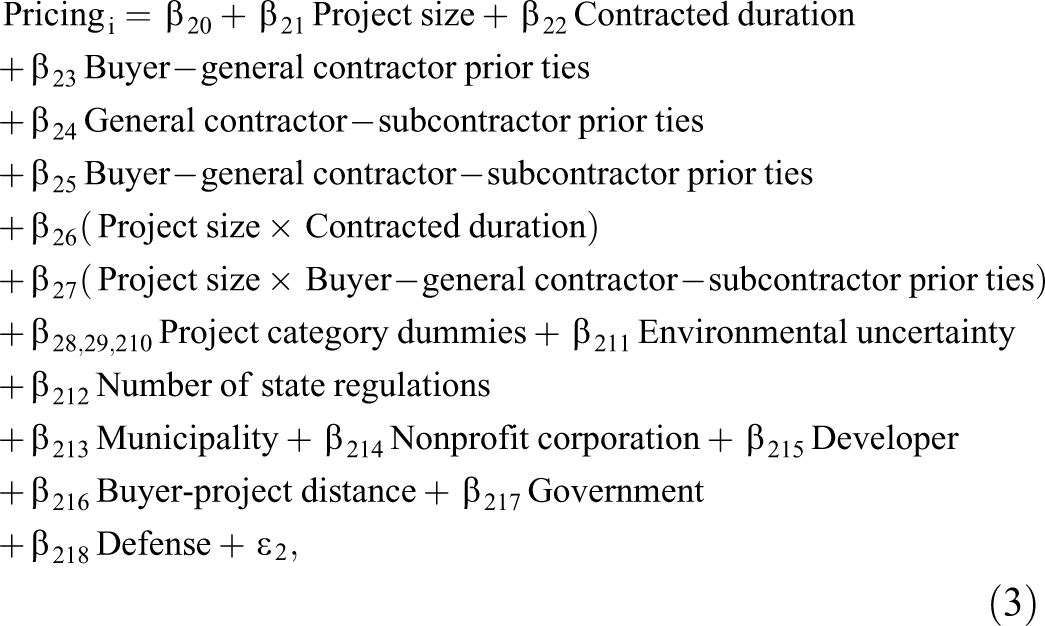

Results
Hypothesis testing
Table 3 contains the results of our CMP estimates. The results provide support for most of our key hypotheses. The significant Wald chi-square statistic of 198.28 (p < .01) demonstrates that the CMP model is significant. With regard to the deployment stage of our model, we find that the interaction between project size and contracted duration on selection is significant and negative (p < .05), consistent with H1. Heeding Aiken and West’s (1991) recommendations, we conduct a simple slope analysis to gain a better understanding of the nature of this interaction. For this purpose, we tested the simple slopes at their minimum, low (−1 SD), mean, high (+1 SD), and maximum values of project contracted duration. Given the scaling of contracted duration, we thus cover the range and typical (minimum, −1 SD, mean, and +1 SD, maximum) values (Spiller et al. 2013). Figure 2, Panel A, presents the moderating effect of contracted duration on the relationship between project size and selection. As the plot indicates, the effect is nonmonotonic over the range of project contracted duration. Specifically, the effect is positive at the minimum (p < .05) and −1 SD levels (p < .05), where time compression is the greatest, turning negative as time compression decreases or contracted duration is at its observed maximum (p < .05).
CMP Regression Estimates.

*p < .10.
**p < .05.
***p < .01.
a This variable is scaled as a percentage.
Notes: Number of observations = 336. One-tailed significance if hypothesized. Robust standard errors are reported in parentheses.

Illustrations of the contingency effects of project size.
H2 is also supported, as indicated by the negative and significant (p < .01) coefficient. We again rely on Aiken and West’s (1991) approach. As shown in Figure 2, Panel B, we find that when buyer–general contractor–subcontractor prior ties are absent (p < .01) and at −1 SD (p < .01), the effect is positive. From +1 SD (p < .05) to the highest (p < .01) observed values of buyer–general contractor–subcontractor prior ties, this effect becomes negative and stronger.
Turning to H3, as we hypothesized we obtain a positive and significant (p < .05) interaction between project size and contracted duration on pricing. To understand if this effect is nonmonotonic, we again rely on Aiken and West (1991). Figure 2, Panel C, shows a negative and significant coefficient at the lowest (p < .1) values where time compression is strongest, in support of H3. From +1 SD (p < .01) to the highest (p < .01) values, this effect becomes positive.
As Table 3 shows, we do not find support for H4 (p > .1), which involved the expectation that the positive relationship between project size on variable pricing is weakened as the number of prior collaborations among all the involved parties increases.
To understand the managerial impact of the three significant results, we calculated the marginal effects when the contracted duration increases from one year to five years. These results show that the probability of choosing ability-based selection decreases by 6.39% (p < .1), while the probability of choosing variable pricing increases by 8.89% (p < .05). Similarly, we calculated the marginal effect for prior ties when these increase from zero (no prior ties) to five. The calculated impact shows that the probability of choosing ability-based selection decreases by 12.87% (p < .01).
Turning to our performance stage hypotheses, H5 is supported (β = −19.057; p < .05), which shows that the joint alignment of selection and pricing significantly decreases ex post cost overruns. We also find support for H6 (β = −2.686; p < .01), which shows that aligned selection (alone) decreases ex post cost overruns more than aligned pricing (alone).
We probe all scenarios that are raised by alignment of selection and pricing in more detail by considering (1) joint alignment, (2) aligned pricing and misaligned selection, (3) misaligned pricing and aligned selection, and (4) joint misalignment. Specifically, we calculated the mean predicted cost overrun for each scenario and carried out pairwise comparisons using Tukey’s testing procedure. The results, as illustrated in Figure 3, indicate that the mean cost overrun of projects characterized by joint misalignment is 39.55%, which is significantly higher than the mean cost overrun of all other scenarios. Interestingly, no differences appear between the two scenarios that involve alignment on one mechanism (selection or pricing) and misalignment on the other (selection or pricing) (p > .10). We return to this finding in the “Discussion” section.

The costs of misalignment.
In addition, we find the correlation coefficient between the residuals of selection and cost overrun equations to be significant (p < .01), suggesting the appropriateness of applying an endogeneity-correcting procedure. However, the correlation coefficient of the residuals between the selection and pricing equations as well as the correlation coefficient associated with pricing and cost overrun equations are insignificant (p > .1).
Post Hoc Analyses
The relevance of the instrumental variables
Both government and defense projects significantly relate to selection and pricing, which suggests instrument relevance. To understand instrument relevance further, we consider instrument strength using the approach of Danaher et al. (2015). For nonlinear models, such as those used to estimate selection and pricing, traditional indicators of instrument strength such as those developed by Stock and Yogo (2002) are not applicable. Danaher et al. suggest comparing nonlinear models through the use of Akaike information criterion (AIC) and Bayesian information criterion (BIC) fit indices, where a “marked” increase in fit indicates good instrument strength. Heeding this approach, we estimated a model explaining pricing with and without these two instruments. Subsequently, we calculated the AIC and BIC fit statistics for both models and assessed whether fit had increased markedly (i.e., the ▵AIC and ▵BIC > 10). This was the case for both the selection and pricing estimates, which suggests that they are strong instruments. To assess the orthogonality of the instruments, we also estimated a separate model where we added government and defense projects to Equation 4. In this alternative model, the coefficients of government and defense are insignificant, suggesting that the instruments are orthogonal and thus satisfy an important criterion.
Interactive effects of selection and pricing
Hypothetically, a simple interaction between pricing and selection may explain ex post costs. We considered this possibility by adding the multiplicative interaction of selection and pricing to Equation 4. The parameter estimate was not significant (p > .1), suggesting that simple interactions cannot explain the more complex and nuanced effects our plural discriminating alignment thesis suggests. We return to the question of plural discriminating alignment in the “Discussion” section.
Exploration of constructs, mechanisms, and outcomes
To complement our formal hypothesis tests, we conducted three in-depth interviews with senior managers in the construction industry. We selected these managers using an industry contact to ensure (1) manager experience, (2) willingness to engage, and (3) variation across project types (i.e., residential, government, large infrastructure, and commercial construction). As summarized in the Web Appendix, the three had significant experience with managing construction projects generally, as well as with the governance of subcontractor relationships. These managers’ seniority allowed them to consider our questions against the backdrop of a wide range of construction projects, and to comment on the key aspects of our model. The interviews started with a brief introduction that outlined general aims, followed by a semistructured interview that took about 50 minutes and which focused on the four constructs of selection, pricing, prior ties, and cost overruns. Notes were taken, and from these we extracted salient aspects and representative quotes. We present our findings from these interviews in the Web Appendix and summarize the key insights next.
First, with regard to selection, the managers expressed views that support our contention that ability-based selection reduces subsequent coordination problems. Moreover, we learned that the benefits of ex ante assessments of ability go beyond pure screening; the selection process itself, including the interviews with the focal suppliers, serves a relationship-building (socialization) purpose. One interviewee specifically described selection in terms of “this is where the relationship resides.” Thus, ability-based selection, while focusing on a set of tangible (ability-based) partner attributes, also establishes and promotes partner motivation.
Second, with regard to pricing, our interview data clearly show the managers’ beliefs that variable pricing involves more ongoing communication than fixed pricing. One interviewer specifically noted the “back and forth” involved in this type of pricing contract.
Third, with regard to the role of prior ties, we learned that previous interactions help reduce ambiguity and, as noted by one manager, ensure that “parties are of the same mind.” This, in turn, has governance implications for a new project, because prior ties reduce the need for mechanisms that “protect one’s position.”
Finally, the interviews suggested that the impact of cost overruns is both significant and multifaceted. Specifically, cost overruns have a significant impact on a contractor’s reputation and ability to secure future work. Cost overruns also raise the possibility of subsequent conflict and costly litigation. Cost overruns may also, as a future safeguard, cause rigid and formalized relationships.
Discussion
Marketing decisions and their outcomes depend crucially on the organizational context within which the focal decisions are made (Ghosh and John 2005; Lee, Kozlenkova, and Palmatier 2015; Moorman and Day 2016). Stated differently, organizational form matters. To date, however, marketing’s focus has been limited to two forms: permanent organizations and long-term relationships. With some exceptions (Hadida, Heide, and Bell 2019), very little attention has been given to a third, quite common form: temporary organizations. Recent reviews (e.g., Lundin et al. 2015) note how fields such as strategy, operations, management, and engineering have started to build a literature on temporary organizations. To date, however, marketing has contributed little to our understanding of this important organizational form.
The importance of temporary organizations stems from their ability to (1) solicit inputs from a team of specialist suppliers, (2) deploy these inputs within a particular time frame, and ultimately (3) deliver outputs that would be unattainable for a single firm. In many respects, temporary organizations are uniquely suited to deliver customer value. At the same time, they pose significant challenges, as evidenced by their mixed performance record. For instance, Facebook and Apple’s MobileMe initiative is widely considered to be a significant failure, despite the very significant investments made by both firms (Fortt 2011).
Our particular focus was on hybrid temporary organizations. Theoretically, such organizations raise interesting questions because of their particular constellation of governance problems and solutions. On the one hand, hybrids do not possess the extended time horizon of fully embedded temporary organizations that exist within a permanent firm and therefore must deploy governance mechanisms subject to time compression. However, unlike stand-alone temporary organizations that are assembled from scratch, hybrids may benefit from prior ties among its members.
We aimed to capture the unique features of hybrids through a two-stage conceptual framework that comprised (1) the governance deployment decision and (2) the resulting performance implications. An empirical test of the framework in the context of construction projects provided good support for our hypotheses. In the following subsection, we highlight our key empirical findings and their managerial implications. Next, we discuss theoretical implications and limitations and suggest future research topics.
Theoretical Implications
Our primary goal with this study was to gain insight into temporary organizations’ governance practices. This question was posed originally by Goodman and Goodman (1972) and framed in terms of how to “mobilize” a temporary organization. Since that time, however, this question has gone largely unanswered. Some researchers have asserted, largely without formal evidence, that temporary organizations are inherently unstable. Our findings cast doubt on this assertion. We show that temporary organizations have particular governance mechanisms at their disposal, and these mechanisms have significant and predictable effects on performance.
Importantly, however, given a temporary organization’s unique time dimension, its governance mechanisms must possess particular properties. We focused on two broad categories of mechanisms: First, drawing on the “new institutional economics” literature, we considered organization-specific mechanisms that match a given organization’s attributes (Williamson 1991). These mechanisms, however, must be capable of being deployed and of taking effect quickly. Our specific focus was on supplier selection strategy and pricing provisions. Our second category consisted of exogenous or preexisting mechanisms that could be activated and brought to bear on a new organization. Our specific focus was on the role of prior ties between the temporary organization’s members.
Our conceptual framework was based in part on the juxtaposition between the two categories of mechanisms, including the possibility that the deployment of organization-specific mechanisms is contingent on the presence of prior ties. Our empirical findings provided good support for our framework, and in doing so refuted the idea that temporary organizations lack structure. They do show, however, that temporary organization governance is more complex than frequently assumed, and that it involves complex interactions between mechanisms at different levels.
Consider the governance mechanisms that we studied in more detail. As we have discussed, prior ties serve useful governance purposes due to the partner knowledge and social fabric that is retained from prior collaborations. This makes prior ties valuable, consistent with Granovetter’s (1985) “embeddedness” thesis. We show, however, that the specific form of prior ties matters crucially. Specifically, our results suggest that only a fully matched triad of existing ties—rather than a dyadic tie between an individual buyer and general contractor—provides discernible benefits. This finding also highlights the importance of broadening the focus beyond individual dyads (Kumar, Heide, and Wathne 2011; Wathne and Heide 2004).
Beyond shedding light on individual governance mechanisms and their properties, an important conclusion from this study is the importance of jointly accounting for combinations of mechanisms and their theoretically specific attributes—what we referred to as “plural discriminating alignment.” Specifically, we show that selection and pricing, when jointly matched with their theoretically specified attributes, impact cost overruns. A simple, model-free analysis of our data, involving an analysis of variance test for fixed/variable pricing and price/ability-based selection on cost overruns, suggests no clear effects (F(4, 360) = .91, p > .10). Yet our more advanced analyses, built on an operationalization of plural alignment, revealed a nuanced pattern of performance implications, where cost overruns followed from complex constellations of governance mechanisms and organizational attributes. From a theoretical standpoint, this both advances transaction cost economics’ general discriminating alignment (Williamson 1985) argument and takes the “plural forms” thesis (Bradach and Eccles 1989; Cao and Lumineau 2015) to its logical conclusion.
Managerial Implications
From a managerial standpoint, the governance mechanisms that we studied (selection and pricing) represent decision variables that firms can readily deploy. However, their deployment is not straightforward. Our results show that controlling cost overruns is not simply a function of deploying multiple governance mechanisms per se. Rather, performance requires that all the governance mechanisms be aligned with their corresponding attributes. We consider the specific implications of selection and pricing in turn.
First, with regard to pricing, previous research in marketing has established the importance of pricing as a decision variable. However, the focus of past research has been on how pricing impacts supplier profit, not necessarily on specific aspects of buyer value such as cost overruns. Further, we show that it is not necessarily the pricing level that matters in creating buyer value, but the specific pricing format used. Interestingly, this suggests that the same price level can actually produce entirely different buyer outcomes. From the perspective of a supplier, managing overruns through appropriate choices on pricing format is equally important, because cost overruns impact supplier reputation and thus the likelihood of attracting future business.
The marketing implications of selection are significant. To buyers, managing cost overruns does not follow from selecting suppliers on ability or price per se, but by appropriately aligning selection with key organizational attributes. For instance, we show that less stringent selection, involving price only, can actually be beneficial, but only when matched to (1) particular attributes and (2) other governance mechanisms. This adds nuance to prior work that has recommended strict selection as a strategy (Dekker 2004, 2008). This finding helps explain why firms may choose less stringent selection for reasons other than economizing on search costs (Mooi and Ghosh 2010).
In general, our current research helps expand the toolkit available to business-to-business marketers. From a practical standpoint, selection and pricing have attractive decision-making properties, because they can be deployed under time compression. At the same time, firms’ choices with regard to selection and pricing have long-term effects. In our study, performance outcomes were effectuated months and even years after the initial governance deployment. As such, these governance choices are both durable and important. Conversely, we found that making the (theoretically) wrong governance choices given the prevailing attributes resulted in greater cost overruns. Importantly, the implications of overruns go beyond narrow financial metrics. Our interviews pointed to potential reputational damage, litigation, and future (over)reliance on rigid and formalized relationship features.
To generate fine-grained insights into the managerial importance of selection and pricing, we considered four specific performance scenarios: (1) joint alignment, (2) misaligned selection and aligned pricing, (3) aligned selection and misaligned pricing, and (4) joint misalignment. Although we established that scenario 1 is preferable from the perspective of minimizing cost overruns, our current research also demonstrates which mechanism (selection or pricing) matters more, through a “what-if” analysis involving counterfactual computations. These shed light on the performance implications of two scenarios 2 and 3 by comparing a chosen alternative with the outcomes obtained had a different selection or pricing choice been made.
As an observation of scenario 2, the construction of a power transmission line was governed by capability-based selection and variable pricing. In this project, selection was misaligned with our model-predicted choice while pricing was aligned. Per our model, had the project instead been governed by aligned selection and aligned pricing, the cost overrun would have been 37.57% lower. Conversely, in the renovation project of San Francisco International Airport (Terminal 2), as a manifestation of scenario 3, the observed choice of selection was aligned with our model-predicted choice, while the observed choice of pricing was misaligned. Again, we calculated the counterfactual cost overrun, which showed that if this project had used aligned selection and aligned pricing, the cost overrun would have been 14.93% lower.
These two examples show the explanatory power of selection and pricing as individual governance mechanisms, as reflected in the substantial reductions in cost overruns (37.57% and 14.93%, respectively) that potentially were available. Further, they show that selection (only) decreases ex post cost overruns more than alignment of pricing (only). Because the benefits from getting selection “right” outweigh those that result from getting pricing “right,” it suggests that selection should be a higher strategic priority for a firm.
Limitations and Future Research
We close with a discussion of some research limitations and possible extensions. First, certain exogenous governance benefits may be afforded by national culture. Specifically, cultural variables may facilitate both coordination and monitoring, but our U.S.-centric database prevented us from examining this. Relatedly, Bechky (2006) show how a temporary organization may benefit from industry roles that facilitate member coordination. General industry codes and professional certifications may serve similar purposes. It is noteworthy, however, that some researchers (e.g., Grabher 2002) have questioned such mechanisms’ properties. While roles and codes may be capable of solving governance problems that involve coordination, they may possess constraints relative to more fundamental problems of cooperation (Gulati, Wohlgezogen, and Zhelyazkov 2012).
Second, unanswered questions pertain to the effect of prior ties. While such ties may be beneficial, existing ties may come under strain, depending on the nature of an organization’s task. If a temporary organization’s task involves a meaningful degree of repetition relative to an earlier one (DeFillippi and Sydow 2016), existing ties may indeed continue to serve governance purposes. In fact, our interviews revealed that prior ties help parties “read contracts correctly.” However, radically new tasks may require a recalibration of past rules, and could, potentially, even be reflected in the selection deployed. If so, existing ties are associated with boundary conditions that diminish their value, and a new temporary organization may need to fall back on organization-specific (and short-term) mechanisms such as selection and pricing.
Third, the degree to which selection induces specific roles and behaviors among project members is difficult to discern using secondary data. Although we attempted to ascertain this through interviews, an experiment might generate more nuanced insights.
Fourth, future research could go beyond our current focus on cost overruns to examine additional performance outcomes—for instance, in the form of time delays, innovation, and financial returns. Similarly, future studies of temporary organization would also benefit from comparing the choice of governance and the resultant performance outcomes of stand-alone or fully embedded temporary organizations against hybrid ones.
Fifth, the focus of this study was on the ex ante resolution of ex post costs. However, such costs could be managed formally, for example through court ordering, or informally through renegotiation or private enforcement. Future work could usefully focus on such ex post resolution mechanisms and show the conditions under which they are effective.
Finally, given our anchoring in marketing, our main focus was on the buyer. However, projects feature multiple parties, including first- and second-tier suppliers. The impact of project governance on these particular parties is likely a fruitful avenue for further research.
Supplemental Material
Supplemental Material, sj-pdf-1-jmx-10.1177_0022242920982545 - Mobilizing the Temporary Organization: The Governance Roles of Selection and Pricing
Supplemental Material, sj-pdf-1-jmx-10.1177_0022242920982545 for Mobilizing the Temporary Organization: The Governance Roles of Selection and Pricing by Elham Ghazimatin, Erik A. Mooi and Jan B. Heide in Journal of Marketing
Footnotes
Acknowledgments
The authors would like to thank Robert Palmatier, Mark Houston, and the three anonymous reviewers for their helpful comments. They also acknowledge the valuable input from Gary Lilien, Raji Srinivasan, and Christophe Van den Bulte, as well as the constructive suggestions from seminar participants at BI Norwegian Business School, Deakin University, Monash University, and NHH Norwegian School of Economics.
Associate Editor
Mark Houston
Declaration of Conflicting Interests
The author(s) declared no potential conflicts of interest with respect to the research, authorship, and/or publication of this article.
Funding
The author(s) received no financial support for the research, authorship, and/or publication of this article.

Notes
References
Supplementary Material
Please find the following supplemental material available below.
For Open Access articles published under a Creative Commons License, all supplemental material carries the same license as the article it is associated with.
For non-Open Access articles published, all supplemental material carries a non-exclusive license, and permission requests for re-use of supplemental material or any part of supplemental material shall be sent directly to the copyright owner as specified in the copyright notice associated with the article.
