



Abstract
A prominent hallmark of competitive interaction is the desire to differentiate from rivals. In this article, the authors examine under what conditions firms will differentiate through product quality versus advertising intensity. Firms select quality in a first stage, advertising in a second stage, and price in the last stage. The probability that a consumer is informed of a firm’s offering depends on its advertising expenditure. The authors find that when advertising is not cost effective, both firms choose a light ad spending. This allows them to minimally differentiate in quality without concern of intense price competition, as each firm has a segment of “captive” consumers. When advertising is moderately cost effective, one firm spends heavily on advertising. The rival advertises lightly, while choosing the same maximal quality level. This strategy softens price competition by inducing the heavy advertiser to price high more often to capitalize on its large captive segment. When advertising is very cost effective, both firms advertise heavily and differentiate in quality. Three extensions are examined: upfront fixed quality costs, continuous advertising levels, and simultaneous advertising and pricing decisions. This research reveals that letting market awareness be determined endogenously suggests less product differentiation than previously suspected and regions of advertising differentiation.
In most markets, firms must figure out how to contend with competitors. The presence of rivals means that consumers have multiple offerings to choose from, and thus, demand for each player is by no means guaranteed. As they navigate this challenge, firms typically consider ways to set themselves apart from the competition to avoid a “race to the bottom” in prices that would erode profits. A common approach to softening such detrimental competitive intensity is through product positioning. In particular, vertical product differentiation may help avoid the dreaded “head-to-head” battle with rivals and allow each firm to carve out its own demand in the marketplace. Several examples of such a strategy come to mind. In the hybrid-electric vehicle market between 2003–2013, for instance, Toyota's Prius had several performance advantages over other hybrids, such as the Honda Civic hybrid (e.g., in miles per gallon, battery life, and handling; see Reynolds 2006). And, as assessed by Consumer Reports, a host of categories such as vacuum cleaners, oven ranges, laptops, and fitness trackers exhibit a substantial degree of quality variation between high- and low-end brands (see Table 1, Panel A).
Quality and Price Dispersion for Select Categories (per Consumer Reports).

Notes: Quality rated on a 0–100 scale. Data compiled from Consumer Reports Buying Guides (2014, 2017).
However, causal empiricism suggests that there are also industry contexts in which firms’ products are similar in quality yet are able to achieve positive profits. Cordless drills intended for “tougher jobs” are one such example in which several brands (e.g., Makita, DeWalt, Milwaukee) offer products with similar specs and overall quality, along with categories such as lawn mowers, snow blowers, washers, and dryers, which also seem to exhibit a relatively small degree of quality dispersion across models (see Table 1, Panel B). Thus, it is likely that these firms are withstanding competitive pressures by “differentiating” through other strategic choices, despite having the option of selecting dissimilar quality levels.
One prominent action, aside from product, that firms have at their disposal is advertising, which is intended to help firms communicate their offerings. Yet as with product, here too one observes a range of behaviors. Specifically, some markets are characterized by firms selecting similar levels of advertising, whereas other markets exhibit asymmetric levels across firms. For example, home improvement retailers Home Depot and Lowe's spent similar amounts on advertising in 2019, whereas major wireless carriers (AT&T, Verizon, T-Mobile) spent different amounts (Ad Age 2020). 1 Complicating matters, there is sometimes an interaction between product quality and ad levels, with several studies finding that higher-quality firms advertise more extensively than lower-quality rivals (e.g., Archibald, Haulman, and Moody 1983; Tellis and Fornell 1988), though other research has found no such systematic empirical relationship (e.g., Caves and Greene 1996; Kash and Miller 2009).
It is not obvious why such heterogeneity in firm behavior exists or how to reconcile the variety of strategies along the key decision variables of product quality and advertising, as well as the implications for pricing—three of the so-called marketing 4 Ps. The objective of this article is to shed light on these issues by addressing the following research questions.
When should we expect firms to differentiate in product quality levels and when in advertising levels, assuming both strategies are available to them? Would firms ever choose to minimally differentiate in quality as well as in advertising? What pricing approach is needed to allow for this outcome? If quality entails a fixed up-front cost, or if advertising is chosen from a continuous set or simultaneously with prices, how does that impact firms’ incentives to differentiate?
To address these questions, we develop a duopoly model where consumers are heterogeneous with respect to their valuation for quality. Yet, for consumers to consider the purchase of a product, they must first be aware of its existence and informed about its characteristics through advertising.
2
In the main setup we analyze, firms choose product quality in a first stage, select advertising levels in a second stage, and set prices in the last stage.
On a given purchase occasion, consumers evaluate the various products they are informed about and choose the one that delivers maximum utility. Consequently, the return on advertising for a firm will critically depend on how its offering compares with the other alternatives in the marketplace and on how aggressively those products are advertised. In this context, the decisions of what quality product to offer and then how heavily to promote it through advertising become intertwined and further depend on the resulting pricing the firms will pursue. This structure enables us to examine our research questions, thereby shedding light on which strategic lever(s) a firm should pull to differentiate from a rival.
Our analysis focuses on advertising commonly used to inform consumers about products (for empirical support on advertising's informative role see, e.g., Ackerberg [2001], Caves and Greene [1996], and Bagwell [2007]). In the main model, firms choose between two levels of advertising reach, which correspond to the probability that a consumer becomes informed about the firm's product, and each level is associated with a cost. Specifically, a heavy ad spend results in a relatively large fraction of consumers receiving the firm's message and considering its product, while a light ad spend results in a relatively small fraction of consumers receiving the message. We find that three equilibria can emerge depending on the relative costs and reach of advertising—in particular, on how the extra spend a firm incurs when shifting from the light to heavy ad level compares with the bump in reach it achieves from this shift. When advertising is not cost effective (i.e., the heavy ad level entails a large extra cost and results in a small gain in reach), firms are minimally differentiated: they choose the same product quality, the same advertising level, and the same pricing strategy. Price competition is softened because firms’ advertising choices create informational disparities in the market by limiting the number of consumers who will consider both products. Thus, the firms earn healthy profits while selecting the same high-quality position. We further show that, in a part of this equilibrium region, by choosing to colocate in quality a firm “prevents” its rival from shifting to the greater ad reach level, even though a monopolist would already find it profitable to do so in order to benefit from greater consumer awareness.
When advertising is moderately cost effective (i.e., the heavy ad level entails a small extra cost and results in an intermediate gain in reach), asymmetric advertising choices with no product differentiation occurs. Specifically, one firm has an incentive to choose a high-quality product and advertise heavily. Interestingly, the rival still finds it optimal to select the same high quality level, but in order to soften price competition, it must advertise lightly (otherwise, if both advertise heavily and are undifferentiated in quality, price competition intensifies and profits will be negatively impacted). In doing so, the light advertiser concedes a large segment of consumers to the heavy advertising firm yet benefits from the higher average equilibrium prices that ensue. Finally, when advertising is very cost effective (i.e., the heavy ad level entails a small extra cost and results in a large gain in reach), quality differentiation with no advertising differentiation is the equilibrium outcome. In this case, a firm cannot afford to advertise lightly because it will then be relinquishing a very large segment of consumers who will be informed of only its rival's product. Instead, both firms advertise heavily, with one firm choosing maximal quality and a high price while the rival differentiates with a lower-quality product and a cheaper price.
Thus, our findings suggest that firms tend to use at most one of the actions at their disposal to soften competition: (1) advertising differentiation: selecting the same product strategy yet using distinct advertising levels to endogenously segment the market in terms of awareness (i.e., consumer informedness), or (2) product differentiation: choosing dissimilar product positions, thereby leveraging customer heterogeneity in willingness to pay for quality, while both firms advertise heavily. In these instances, pricing strategies are also distinct. In particular, in Case 1, the heavy advertiser on average selects higher prices than the light advertiser, and in Case 2, the high-quality firm prices higher than its low-quality rival. Minimal differentiation in product quality and advertising is feasible as well, as long as the advertising levels chosen are light, in which case the resulting prices are in similar mixed strategies. We further characterize equilibrium profits and uncover a nonmonotonic pattern: a firm's profits can increase and then decrease as a function of advertising reach when it advertises lightly. In other words, a firm can be better or worse off if the advertising medium it uses is able to impact a greater fraction of consumers.
We also analyze three modeling extensions. First, because in some research-and-development contexts greater product improvements can entail more substantial outlays, we explore the sensitivity of our findings to incorporating a fixed up-front cost of choosing quality. We find that when firms are expected to be differentiated in their advertising strategies, they may also differentiate in product quality. This is because a firm that advertises lightly facing a rival that advertises heavily will not be able to recoup the costs associated with maximal quality if these costs are too high, and thus it would select a lower quality level than its rival. Second, we relax the assumption of discrete ad levels and allow advertising choices to be continuous, with an associated convex cost function. We find that, directionally, the results from this setup correspond to those from the main model. Specifically, equilibria where firms are undifferentiated in discrete quality levels can be sustained; in that case, as advertising becomes more cost effective, the firms tend to exhibit greater differentiation in their advertising choices. In addition, when advertising is very cost effective, equilibria where firms differentiate in discrete quality levels can be sustained, while advertising choices become similar. Third, we examine an alternative setup whereby advertising and pricing are chosen simultaneously rather than sequentially. For some advertisers, particularly those using digital platforms extensively, the ability to bid for ad placements in near real time suggests that such a model formulation may be more appropriate. We are still able to characterize regions where firms colocate in the quality space and then “suppress” intense price competition by selecting light advertising levels. Interestingly, when advertising is moderately cost effective, we find that firms will revert to mixed advertising strategies while still colocating in quality.
Collectively, the results uncover when and how firms strategically use product quality and advertising to effectively compete: in some cases differentiating in their advertising approach while choosing similar quality levels, and in others differentiating through quality divergence while choosing similar advertising levels. There are also scenarios where both actions are similar across firms. The range of patterns that can arise in equilibrium may thus help explain the variation observed in practice with respect to these decision variables and the seemingly inconsistent empirical research findings on the link between product quality and advertising intensities.
The rest of the article is organized as follows. The next section relates our work to the relevant literature and summarizes our contribution. This is followed by a description of the main model setup and its analysis. The ensuing section presents three model extensions. We conclude by offering managerial and empirical implications, discussing model limitations, and outlining future research opportunities. All proofs are presented in the Web Appendix.
Related Literature
Our work is primarily related to two streams of literature, the first pertaining to quality differentiation and the second to the relationship between advertising and product quality.
Within the stream of literature on vertical product differentiation, Shaked and Sutton’s (1982) widely known model examines price competition between firms that first choose product quality. Because consumers are assumed to be fully informed about all products in their model, in equilibrium firms choose different quality levels to reduce price competition. Moorthy (1988) relaxes Shaked and Sutton's zero-production-cost assumption by introducing a quadratic cost function for quality. While this can result in an equilibrium where the firm choosing the lower quality is better off, it is still the case that firms always differentiate in quality. Choi and Shin (1992) establish conditions such that the low-quality firm always chooses a quality level that is a fixed proportion of the high-quality firm's choice. Choudhary et al. (2005) allow personalized pricing, which can intensify competition to the detriment of the high-quality firm, and Jing (2006) identifies the conditions on the cost structure under which producing the low-quality good can be more profitable. These studies all show that quality differentiation is a robust equilibrium outcome.
However, in reality similar-quality products are often observed in the marketplace. Rhee (1996) cites evidence for this and offers an explanation that incorporates consumer heterogeneity along unobservable attributes into the vertical differentiation model. If consumers are sufficiently heterogeneous on these extra dimensions, in equilibrium firms offer products that are identical on the observed quality dimension yet differentiated on the unobserved dimensions. Such work is linked to the broader research on multidimensional product positioning (e.g., Ansari, Economides, and Steckel 1988; Ecomomides 1989; Vandenbosch and Weinberg 1995; Lauga and Ofek 2011). This literature, which assumes that all products and dimensions are known to consumers, shows that when marginal production costs are relatively low the robust outcome is for firms to maximally differentiate on only one dimension and minimally differentiate on the other dimension (the so-called max-min equilibrium). In our model, there is only a single product dimension (“quality”) and advertising as a strategic action introduces different considerations than a second product dimension. In particular, the advertising level chosen impacts which products are in consumers’ consideration set. We characterize when this structure results in minimal differentiation in quality coupled with minimal or maximal differentiation in advertising, as well as when it leads to partial differentiation in quality and minimal differentiation in advertising.
Notably, the papers in this stream analyze firms’ quality choices under various price and cost assumptions but presume that all consumers consider all products. Thus, these works ignore the fact that, in many markets, consumers are ex ante uninformed about the various offerings, with advertising serving as an additional lever firms can use to differentiate and soften competition.
The second literature stream related to our work studies the connection between advertising choices and product positions. It is theoretically well-established in economics and marketing that advertising levels can signal product quality (Milgrom and Roberts 1986), though scant empirical evidence exists to conclusively support this idea (see Bagwell [2007] and references therein). Such works ignore advertising's role in informing consumers about which products exist (Butters 1977; Nelson 1974) and thus its effect on market size. Grossman and Shapiro (1984) model advertising as a continuous variable in a Salop (1979) horizontal setup with fixed product locations, whereby receiving ads increases the probability that a consumer finds a product that better matches their tastes (i.e., advertising is informative). The authors find that as the ad technology becomes less efficient, in the sense that it becomes more costly to increase advertising reach, two effects on profits arise: a direct negative effect due to the higher costs associated with advertising and an indirect positive strategic effect due to the reduced level of price competition (because firms are induced to choose lower advertising intensities in equilibrium). In our main model, advertising levels are discrete, and firms endogenously select product quality levels in the first stage. Consequently, quality choices impact firms’ advertising selections—a driving force that is absent in Grossman and Shapiro and an aspect that we subsequently show holds up even if advertising is continuous (but quality is discrete). At the same time, anticipating the implications of advertising is shown to affect firms’ quality decisions. We examine how the cost versus reach trade-off associated with choosing the heavy rather than light ad level affects equilibrium outcomes and also look at the impact on profits.
Iyer, Soberman, and Villas-Boas (2005) investigate targeted advertising when consumers have horizontal tastes and find that firms advertise more often to consumers with a strong preference for their product, as a way to soften price competition and eliminate wasted advertising. Other research (e.g., Chen, Narasimhan, and Zhang 2001; Zhang and Katona 2012) shows that imperfect targetability can reduce competition. While some of these forces will be relevant in our context, much of the literature studying targeting aspects of advertising treats quality as given. By contrast, we show that endogenizing both product quality and advertising critically affects equilibrium outcomes. 3
Our article also contributes to the debate of whether higher-quality products should be associated with higher levels of advertising and prices, with the empirical literature finding mixed evidence for such a relationship (Archibald, Haulman, and Moody 1983; Caves and Greene 1996; Erdem, Keane, and Sun 2008; Kash and Miller 2009; Song, Jang, and Cai 2016; Tellis and Fornell 1988). Our analysis can help reconcile these seemingly inconsistent observations by delineating conditions for when a positive relationship should hold between these actions and when it should not in equilibrium.
Lastly, we mention research on quantity commitment—as the notion that firms restrict output to soften price competition resembles some intuitions we present with respect to advertising choices. In particular, work by Nasser and Turcic (2016) finds that firms’ quantity commitments depend on the degree of exogenous horizontal differentiation. Our approach differs, as we focus on vertical preferences with multiple decision variables (quality and advertising). Moreover, advertising in our model is stochastic and creates informational disparities among consumers. The combination of these factors yields divergent implications. For example, we find that firms can minimally differentiate in quality and select asymmetric advertising levels, while in Nasser and Turcic a high degree of product differentiation is needed to sustain asymmetric quantity commitments. We also characterize an outcome in which both firms advertise heavily; an analogous result where neither firm commits to quantity does not exist in Nasser and Turcic.
In summary, our contribution lies in extending the first stream of literature by exploring the strategic role of advertising as another action, in addition to product quality, that firms can take to withstand competitive pressures. Relative to the second stream, we endogenize product quality and analyze how this decision is impacted by foreseeing the need to advertise to inform consumers and by the ensuing pricing equilibrium. In a sense, we combine the two sources of differentiation appearing in these literature streams into a single model and characterize when and how firms will use each of the two actions (quality and advertising) to differentiate, thereby uncovering important interactions between these variables.
Main Model Setup
We consider two competing firms that seek to sell a product in a given market. We index the firms by the numbers 1 and 2 or the letters i and j, always assuming that
Firm Actions
Firms choose quality levels, advertising levels, and prices. Quality levels,
Timing of Moves
The timing of the game is as follows. First, firms choose their quality. Second, firms decide whether to advertise lightly or heavily. Third, firms set prices. Finally, consumers make purchase decisions. This timing reflects the notion that the quality position choice tends to be a long-term decision, whereas prices can be easily altered. The time-scope of advertising decisions is somewhere in between. It is further common for advertising allocation decisions to come after product positioning has been determined but before prices are set (this timing assumption is consistent with several prior works; e.g., McAfee 1994; Roy 2000). In practice, whereas prices can be adjusted on a weekly, daily or even hourly basis, advertising budgets and media planning are typically set on a quarterly or annual basis. Such a sequence is also consistent with papers that assume that consumers can costlessly obtain information on price after observing an ad (see, e.g., Mayzlin and Shin 2011). That said, given that there are contexts where advertising intensity can be changed relatively quickly (e.g., on digital platforms), in the “Model Extensions” section we discuss an alternative timeline where advertising and prices are chosen simultaneously in the second stage.
Costs, Profits, and Equilibrium
We assume no fixed entry costs; thus, both firms participate in the market. Furthermore, we assume that variable production costs are constant and normalize them to zero.
6
We examine the implications of fixed costs associated with quality in the “Model Extensions” section. Advertising costs
We solve for the subgame perfect equilibria of the game. In the main model analysis, we focus on pure strategies for quality and advertising decisions yet allow mixed strategies for prices (reflecting the fact that in several markets firms tend to run occasional price promotions).
Main Model Analysis
Solving the game backwards, we first need to characterize the demand for each firm conditional on the product, advertising, and pricing decisions. We note that once firms have advertised their products, consumers may not all have the same consideration set. Some consumers will be informed of both products, and they constitute what we call the “competitive segment.” We also refer to these consumers as “comparison shoppers” because they are able to compare both products (on quality and price) before making their purchase decision. The size of the competitive segment is endogenous and can be as small as
Expected Size of Captive Segments as a Function of Advertising Choices.

A firm generally has the option of focusing on its captive segment and not competing for comparison shoppers (except in the extreme case of
A consumer who receives an ad for the monopolist's product buys it if and only if
Let us now turn to the duopoly case. We want to understand under what conditions a firm will decide to use product quality versus advertising level to soften competition with its rival, while also allowing for the possibility of minimal differentiation in these decision variables. We start by analyzing the profits in the pricing subgame conditional on the advertising levels chosen, assuming that firms have decided to colocate on quality in the first stage. Subsequently, we analyze the endogenous choices of advertising and quality. We introduce the following notation: let (L, L), (L, H), (H, L), and (H, H) denote the possible advertising strategies, whereby the first argument is the advertising level chosen by Firm 1 and the second is the level chosen by Firm 2.
Under no product differentiation If Firm i advertises heavily while Firm j advertises lightly ( If Firm i advertises lightly ( If both firms advertise heavily (

To understand the intuition for the various profit levels in Lemma 1, first note that the pricing equilibrium when firms colocate in quality has to be in mixed strategies. If Firm i were to choose a given price with probability one, two scenarios could unfold: (1) when Firm i's price is high, its rival is prompted to undercut it slightly to sell to all the comparison shoppers, but then Firm i would want to deviate and undercut its rival's price, or (2) when Firm i's price is low, its rival would concede the comparison shoppers and focus on its own captive segment. But then Firm i would have an incentive to deviate and sell at a higher price (just below Firm j's price). In either case, Firm i cannot choose a single price in equilibrium and thus plays a mixed pricing strategy. For the same reasons, Firm j's best response is to also play a mixed pricing strategy.
Now consider the scenario where Firm i advertises heavily but its rival advertises lightly (H, L). The size of Firm i's captive segment is, per Table 2,
Next, consider the scenario where Firm i advertises lightly (
The last scenario to discuss is when both firms advertise heavily (H, H). In this case, a substantial proportion of consumers are informed of both products. Thus, the captive segments are relatively small in size, and more intense price competition is triggered. Consequently, firms select lower prices and do so more often than in the other two cases. As before, and as long as
One conclusion worth highlighting from Lemma 1 is that when a firm advertises lightly, it earns the same profit of
Another conclusion arising from Lemma 1 is that firms with undifferentiated quality levels can still sustain positive revenues. Notably, by selecting a light as opposed to a heavy advertising level, a firm strategically lets its rival have a larger captive segment, which softens the ensuing price competition because fewer consumers will be informed of both products.
With these insights in hand, we can discuss the implications of Lemma 1 for the best response advertising choices when product quality levels are undifferentiated. If the rival advertises heavily, by matching this ad level Firm i creates a large competitive segment that, as explained previously, triggers intense price competition and negatively impacts profits; yet both firms still incur the cost of advertising heavily. Thus, Firm i can be better off advertising lightly if it expects its rival to advertise heavily. However, if its rival advertises lightly, Firm i needs to compare the profits from advertising heavily and broadening the set of consumers aware of its product versus advertising lightly and limiting the overlapping number of consumers aware of both products (i.e., shrinking the size of the competitive segment). Lemma 1 reveals that when
We now turn to characterizing the equilibrium of the entire game by solving for the subgame perfect ad levels chosen in the second stage and the quality positions chosen in the first stage. Formal details of the cutoff values in each region of the proposition are given in the Web Appendix.
The following differentiation regions arise in equilibrium:
When advertising is not cost effective ( When advertising is moderately cost effective ( When advertising is very cost effective (
The proposition uncovers an interesting general finding: firms never elect to concurrently differentiate both in product quality and advertising levels. It is optimal to either only differentiate in advertising levels or in product quality levels, or not to differentiate in these decision variables. Figure 1 schematically illustrates the type of differentiation (in “Product,” “Advertising,” or “None”), along with pricing strategies and the consumer information structure, as a function of how cost effective it is to shift from the light to heavy advertising level.
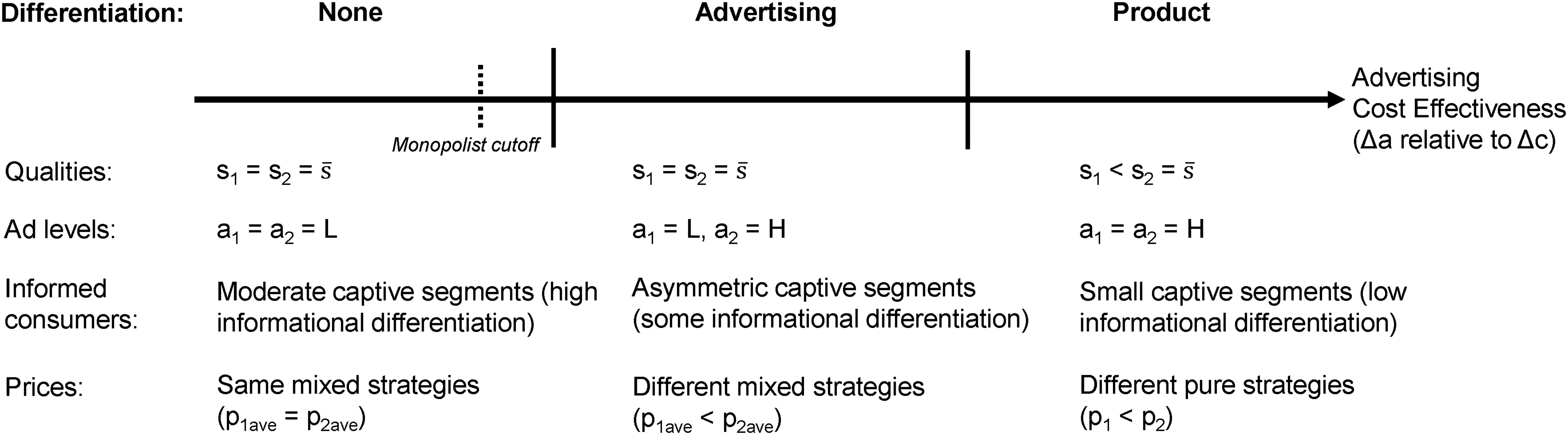
Equilibrium strategies and differentiation as advertising cost effectiveness varies.
Next, we discuss the intuition behind the results in Proposition 1, starting from the non-cost-effective case (i.e., part 1 of the proposition [the region marked “None” in Figure 1]). When selecting maximal product quality in this region, firms anticipate that a light ad spend by both will lead to informational differentiation among consumers via the emergence of sizable captive segments. Light advertising levels can thus mitigate price competition by, in essence, creating segments that possess distinct information sets. The mixed pricing strategies played result in each firm primarily catering to its endogenous captive segment and earning monopoly rents from these consumers. Alternatively, conditional on Firm 2 selecting the highest quality level and advertising lightly, Firm 1 could decide to differentiate in quality. This strategy is less profitable because it entails selling a product of lower quality at a lower price and not realizing the full amount of profits from the captive segment. Conversely, Firm 2 might like to advertise heavily. Yet by selecting minimal product differentiation in the first stage, and given that advertising heavily is relatively costly in this region, Firm 1 prevents this from occurring by making it an unprofitable move, inducing Firm 2 to advertise lightly. Thus, throughout this region where advertising is not cost effective, the firms’ actions are minimally differentiated—they select the exact same quality and advertising levels and play the same mixed pricing strategy.
Recall that when the advertising cost differential is greater than
As advertising becomes more cost effective (Proposition 1, part 2, the region marked “Advertising” in Figure 1), one firm has an incentive to advertise heavily, thereby generating broad awareness for its offering. If Firm 1 expects its rival to select the top quality (
The last case to analyze is when advertising is very cost effective (Proposition 1, part 3; the region marked “Product” in Figure 1). If Firm 2 advertises heavily, a very substantial portion of the market is informed of its product (as
We further highlight that the equilibrium product quality
Clearly, firms’ profits are negatively impacted by greater advertising costs in the respective equilibrium regions. We next discuss how profits change as advertising achieves greater reach. The next corollary shows that the relationship is not always monotonic, as one might have conjectured.
Holding constant advertising costs When a firm advertises lightly, its profits vary nonmonotonically, first increasing and then decreasing, as its advertising reach expands ( When a firm advertises heavily, its profits will either increase or decrease as its advertising reach expands (
The parameter
When advertising is moderately cost effective, firms play (L, H). The heavy advertiser sees its profits decrease in
Lastly, when advertising is very cost effective, both firms advertise heavily (H, H). In this case, there is an interesting interaction between advertising reach (
To conclude the analysis in this section, we note that two ex ante identical firms choose to differentiate in either advertising or product quality or not at all. When firms are minimally differentiated in quality, they avoid intense price competition by choosing a reduced level of consumer awareness (with at least one firm electing to advertise lightly). This leads to the endogenous creation of segments whereby not all consumers are informed about both products and some consumers are captive. This, in turn, softens price competition and allows the firms to derive positive profits. When firms differentiate, they choose either different advertising levels or different quality levels coupled with different pricing. The findings reveal that by endogenizing all three decisions (quality, advertising, and price), we can characterize a much richer set of outcomes.
The specific equilibrium predicted was shown to depend in large part on the degree of advertising cost effectiveness—how costly it would be to shift from a light to a heavy advertising level relative to the gain in reach. In practice, several measures show considerable variance across markets in terms of how cost effective advertising is at informing consumers. For instance, advertising reach per ad placement on some digital platforms tends to differ by category (e.g., social media ads for apparel are noticed and clicked over twice more often than ads for financial services and insurance; see Irvine 2020). Similarly, traditional media exhibit variance in the costs of reaching a given number of prospects (O’Guinn, Allen, and Semenik 2000). Such disparities might help explain why some categories exhibit minimal differentiation across firms in the quality of products offered, while others exhibit considerable differentiation in advertising levels or product quality levels. Furthermore, the results may help explain why some studies fail to find a significant positive correlation between quality and advertising (Caves and Greene 1996; Kash and Miller 2009). Specifically, if advertising plays an informative role as modeled here: when one firm advertises heavily while its rival advertises lightly, both may offer similar quality products (a scenario common when national brands compete with virtually identical private labels; Kane 2014); when the firms choose different quality levels, they are both expected to choose a heavy advertising level. Such behaviors, when aggregated, would in fact yield minimal observed correlation between these decision variables.
Model Extensions
We now present findings from three model extensions: (1) incorporating up-front fixed costs of selecting quality, (2) allowing continuous advertising choices, and (3) letting advertising and pricing decisions be made simultaneously. The analysis suggests that most of the results from the main model are robust (at least directionally) to these alternative setups, yet several new or nuanced findings do emerge. Proofs for these extensions appear in the Web Appendix.
Incurring Up-Front Quality Costs
To concentrate on firms’ strategic incentives to choose quality when having to take into account the subsequent need to engage in advertising, we assumed in the main model that there were no costs associated with the quality decision. This further allowed comparison to prior literature. Notwithstanding, in practice, one might expect that higher-quality products are increasingly more difficult to develop and thus entail a greater up-front fixed cost. To understand how incorporating this possibility would affect firms’ equilibrium strategies, we extended our model, focusing the analysis on scenarios where including such a cost could most impact the findings.
Assume that offering a product entails an up-front fixed cost that is increasing and convex in quality. Specifically, let this cost take the form
When advertising is moderately cost effective ( For any For any
Thus, Proposition 2 reveals that when up-front quality costs are low (
Continuous Advertising and Discrete Quality Levels
In the main setup, quality and price were modeled as continuous decision variables (consistent with prior literature), whereas advertising levels were discrete. This allowed us to keep the analysis tractable while still capturing relevant intuitions. The fact that firms often decide on the scale of their ad campaigns (e.g., an aggressive vs. a small-scale effort) conforms to our “heavy” versus “light” designations. Yet in reality, the exact budget allocated to advertising can be more granular.
To understand whether our findings would hold up qualitatively if advertising were a continuous variable, we analyzed the following setup.
8
Let firms choose advertising from a continuous set
There exist For For
It is easy to see that these findings are consistent (at least directionally) with those from the main model. In particular, Proposition 1 reveals that when advertising was not cost effective, firms colocated in quality and selected the same ad levels, yet when advertising became moderately cost effective, firms differentiated in advertising. In the alternative setup, this corresponds to the region where
Proposition 1 also reveals that when advertising is very cost effective, firms opt for distinct quality levels with no advertising differentiation. Here too, when
Simultaneous Advertising and Pricing Decisions
In the main model, we assumed that advertising and pricing decisions were made sequentially. As such, a firm observed the ad level of the rival prior to determining its pricing strategy. While this timing makes sense when media buys need to be executed well in advance or ad budgets are set only periodically, there can be contexts or media (e.g., digital platforms) where advertising decisions are made more flexibly. Thus, we want to understand how an alternative timeline, in which advertising and pricing decisions are made simultaneously, affects the findings. For ease of exposition, we solve for the case of
Under no product differentiation When advertising is not cost effective ( When advertising is sufficiently cost effective (
Lemma 2 reveals that if firms colocate in quality, the advertising–pricing subgame entails one of two outcomes: when advertising is not cost effective, both firms advertise lightly, yet when advertising is sufficiently cost effective, both mix between the heavy and light levels. The intuition for the former scenario is similar to that in the main model: shifting to the heavy ad level is costly, and because the products are colocated, the ability to reap rewards from this shift is limited. The latter scenario reveals a somewhat different eventuality compared with the main model, stemming from the simultaneity of advertising and pricing decisions. Specifically, if advertising is cost effective, neither firm can select the heavy level deterministically. To understand why, attempt to sustain an equilibrium with one firm choosing the light ad level and the rival selecting the heavy ad level. 10 If the light advertiser deviates to the heavy ad level, it can improve its profits because the deviation is not observable, and it benefits from the greater awareness and from undercutting its rival's price. Next, we characterize the equilibrium of the entire game.
The following differentiation regions arise in equilibrium:
When advertising is not cost effective ( When advertising is moderately cost effective ( When advertising is very cost effective (
Proposition 4 reveals that equilibrium outcomes in the simultaneous setting bear close similarity to those in the main model (per Proposition 1). In particular, when advertising is not cost effective, firms elect minimal differentiation in their actions. As advertising becomes more cost effective, firms find it beneficial to continue selecting maximal quality. In doing so, each firm prevents its rival from selecting the heavy ad level with certainty. The equilibrium that emerges is in mixed advertising strategies, per Lemma 2, implying that firms play (L, H) or (H, L) with a positive probability. Thus, while in the intermediate region for
Conclusion
Summary and Managerial Implications
In this research, our goal has been to characterize the type of differentiation strategies firms are expected to pursue to best withstand competitive pressures, with a particular emphasis on the interaction between endogenous quality and advertising choices.
In general, we find that the equilibrium strategies depend on how cost effective advertising is (i.e., how expensive it is to shift from a light to a heavy advertising level relative to the increase in customer reach arising from such a shift). When advertising is not cost effective, firms minimally differentiate on all fronts (quality, advertising, and pricing). Even though product quality levels are the same, price competition is not intense due to the endogenous presence of captive segments (in a sense, the market is “differentiated” in the informedness of consumers). When advertising is moderately cost effective, firms still minimally differentiate in product quality but switch to advertising differentiation: one firm chooses to advertise heavily while the other advertises lightly. The light advertiser is at a disadvantage given its smaller captive segment and thus mainly competes for comparison shoppers (who are aware of both products) by occasionally undercutting its rival's price. This undercutting does not, however, need to be aggressive because the heavy advertiser has a relatively large captive segment and tries to extract monopoly rents from these customers much of the time, thus keeping overall prices higher on average. Committing in the first stage to being undifferentiated in quality, coupled with one firm strategically choosing a light ad level, is what enables this equilibrium outcome. Finally, there is a scenario where both firms choose the heavy advertising spend, and thus, the only way to avoid intense price competition is to select dissimilar quality levels. This product differentiation result, which corresponds to the classic finding in the literature, holds only when advertising is very cost effective. Otherwise, firms prefer to create sizable captive customer segments by at least one of them advertising lightly. Minimal product differentiation serves a strategic purpose in achieving this outcome.
These findings have several important managerial and empirical implications as they bear on three of the so-called 4 Ps of marketing—product, promotion, and pricing—in a single framework. Foremost, they suggest that the conventional wisdom whereby a firm should seek a high degree of product differentiation from its rival to avoid intense price competition is qualified and depends on whether there is a role for informative advertising that generates awareness of the offerings. Furthermore, the type of differentiation strategy depends on how cost effective advertising is. Many managerial treatments of advertising classify media based on their impact on consumers and their cost (see, e.g., Gotter 2018; O’Guinn, Allen, and Semenik 2000). Our results thus tell managers how the characteristics of communication vehicles pertaining to their market should affect the quality of products to offer and the level of advertising to select relative to rivals. The findings also bear on the pricing strategies that should be implemented. When product differentiation is minimal, firms should engage in “flexible” pricing (i.e., a mixed strategy where they price promote often), and if they advertise at different levels, the heavy advertiser should stick to the higher list price more frequently than its rival. Under product differentiation, however, firms should set distinct yet stable prices. From an empirical standpoint, a testable implication of our theory is that as the cost effectiveness of advertising rises we should observe less fluctuation in pricing.
Our analysis also suggests that when setting innovation strategy, which is often aimed at improving quality (e.g., performance on key attributes), it is crucial for firms to consider how the new products will be advertised. In their seminal work surveying managers on appropriating returns from research and development, Levin et al. (1987) found that marketing and sales were cited as the primary vehicle. This suggests that managers need to understand the strategic implications of communication actions on the products they elect to develop, compared with rivals, and that differentiation is achievable through various means. For instance, learning that a rival is developing an equally advanced product may not spell disaster if the firms can refrain from both advertising heavily.
Limitations and Future Research
Although our study encompasses several important aspects of the quality–advertising–pricing set of decisions in a competitive context, and we have justified many of our assumptions as well as examined three alternative modeling setups (up-front quality costs, continuous advertising choices, and simultaneous advertising–pricing decisions), we acknowledge several limitations.
First, advertising in our model is informative; yet one can imagine situations where advertising plays a persuasive role by influencing product quality perceptions. In an extension presented in the Web Appendix, we show how our modeling framework can incorporate this form of advertising. Our main finding is that firms may differentiate less in objective quality, but the divergence between their persuasive advertising levels results in the same degree of perceived quality differentiation as when consumers fully know objective quality levels.
Second, advertising in our model was indiscriminate or “blanket”: each firm communicated to the entire market with the likelihood of its ad reaching any consumer affected by the level chosen. However, firms are sometimes able to target their ads to specific segments. In the Web Appendix, we solve an extension that explores this possibility. Our findings suggest that minimal differentiation in quality can work in this case, provided that firms are able to “stay out of each other's turf” by differentiating their advertising strategies, with each firm focusing on a distinct segment. We further show that a firm need not lower its price so as to serve all the consumers who have been targeted with ads; it may wish to ignore consumers with moderate willingness to pay.
Third, we assumed that advertising reach levels were the same across firms for given costs. In the Web Appendix, we show why relaxing this assumption does not alter our main conclusions.
Fourth, we assumed that consumers become informed about products solely through advertising. In reality, consumers have other ways to learn about offerings (through, e.g., word of mouth or search) and may decide to do so after seeing an ad (as in Mayzlin and Shin [2011]). Assuming that consumers have some positive probability of being informed about the firm's product even without receiving an ad for it would not change our model findings. In this case, we could interpret advertising in our model as increasing this base probability. 11 Our results also hold if consumer search costs are sufficiently high. However, if these costs are moderate, uninformed consumers may have an incentive to search, which could impact our findings. We leave for future research the investigation of how consumer search affects endogenous quality positions and advertising levels. The model could also be extended to incorporate spillover effects; that is, when consumers receive an ad from one firm, there is some likelihood that they will become aware of the other firm's product. This could capture a “category expansion” effect for advertising beyond the “brand-specific” effect modeled in this article. In that case, the competitive segment would be larger than in our analysis, which could create a disincentive to advertise. The existence conditions for the different equilibria would likely change, but our key results should remain valid.
Fifth, although we extended the model to incorporate fixed quality costs, we employed stylized assumptions on marginal production costs. This allowed us to focus on the strategic forces that drive quality and advertising differentiation. The assumption is also reasonable in categories where variable costs are either negligible (e.g., digital goods, pharmaceutical drugs) or only weakly related to quality positions (e.g., some beverages and clothing). Future research could examine the implications of including variable costs that are a function of quality.
Lastly, we modeled heterogeneity in willingness to pay for quality to study how vertical differentiation is impacted by the need to inform consumers about products. In some settings, consumers may exhibit heterogeneity in horizontal tastes. It is possible that firms’ choice of product positioning along a horizontal continuum is impacted by the need to engage in informative advertising. It would be interesting to see if an equilibrium can be sustained where firms colocate in the horizontal product space as in the vertical setup. The interaction between endogenous product location and advertising in a horizontal setting could be fruitful ground for future research.
Supplemental Material
sj-pdf-1-mrj-10.1177_00222437221082076 - Supplemental material for When and How Should Firms Differentiate? Quality and Advertising Decisions in a Duopoly
Supplemental material, sj-pdf-1-mrj-10.1177_00222437221082076 for When and How Should Firms Differentiate? Quality and Advertising Decisions in a Duopoly by Dominique Olié Lauga, Elie Ofek and Zsolt Katona in Journal of Marketing Research
Footnotes
Acknowledgments
The authors are thankful for valuable suggestions from Miklos Sarvary; David Soberman; Timothy Van-Zandt; participants of the marketing track at the INFORMS Annual Meeting, CJBS marketing camp, the 8th Workshop on the Economics of Advertising and Marketing; and seminar participants at UT Dallas and London Business School.
Associate Editor
Wilfred Amaldoss
Declaration of Conflicting Interests
The author(s) declared no potential conflicts of interest with respect to the research, authorship, and/or publication of this article.
Funding
The author(s) received no financial support for the research, authorship, and/or publication of this article.

Notes
References
Supplementary Material
Please find the following supplemental material available below.
For Open Access articles published under a Creative Commons License, all supplemental material carries the same license as the article it is associated with.
For non-Open Access articles published, all supplemental material carries a non-exclusive license, and permission requests for re-use of supplemental material or any part of supplemental material shall be sent directly to the copyright owner as specified in the copyright notice associated with the article.
