




Abstract
Although hedonic principles of emotion regulation suggest that people wish to feel good, the current research demonstrates that sometimes feeling good just seems wrong. Specifically, the authors argue that, immediately after viewing moralized content such as human suffering, consumers believe that it is morally appropriate to sustain negative emotions (Study 1). Thus, after exposure to content related to human suffering (vs. other negative content), consumers view subsequent mood-sustaining consumption as morally appropriate and hedonic consumption as morally inappropriate (Study 2). Consequently, they avoid repairing their emotions through hedonic consumption because of their preference to engage in morally appropriate behavior (Studies 3 through 4b); this is particularly true for individuals who view themselves as more moral (Study 4b). These effects are mitigated when the hedonic consumption is morally relevant (Study 4a), rather than prototypically frivolous. This research offers clear prescriptions to marketers about when and when not to offer hedonic consumption as mood repair. By allowing people to pay respect to suffering victims, marketers can give consumers needed space to feel their compassionate emotions.
Imagine that you are viewing a fictional romantic tearjerker on YouTube. Afterward, based on your recent browsing history, the autoplay feature queues up a video clip from your favorite stand-up comic. Feeling sad, you welcome the change of pace that will allow you to forget about what you were just watching and help you improve your mood. Now imagine that, instead of this fictional film, you were watching a news clip about a recent school shooting involving innocent victims. Would you still welcome the comedic clip to help lift your spirits? We suggest that in response to a film about others’ suffering, moving on to mood-repairing consumption would feel morally wrong.
Whether watching the nightly news or browsing social media, consumers are often exposed to moralized content such as others’ suffering. How should practitioners take this content into consideration in their marketing behavior? Intuition and traditional accounts of hedonic emotion regulation suggest that people wish to engage in pleasurable activities to try to repair negative emotions (Gross and Thompson 2007; Zillmann 1988). Indeed, previous research shows that consumers prefer to engage in hedonic, mood-repairing consumption when feeling negative affect if they believe that such content would be effective at raising their spirits (Tice, Bratslavsky, and Baumeister 2001). This research would suggest that consumers may particularly enjoy seeing comedic content after tragic news stories regarding human suffering. However, we suggest that, because of the moralized nature of human suffering—that is, its relevance to the welfare of others and society at large (Haidt 2003)—consumers believe it is morally appropriate to prolong negative emotions. Consequently, we argue that, after exposure to negatively valenced moralized content—in particular, content related to human suffering—consumers consider it to be relatively immoral to engage in positive, mood-repairing activities, leading them to avoid such prototypical hedonic consumption.
Theoretical Background
Hedonic Emotion Regulation and Consumption
Traditional literature on emotion regulation has focused on hedonic goals, which aim to increase positive affect and decrease negative affect (Gross and Thompson 2007). Many models of emotion regulation assume that, when feeling negatively, people are motivated to repair their moods (Labroo and Mukhopadhyay 2009; Larsen 2000). One way consumers engage in hedonic emotion regulation is through hedonic consumption, which we define as enjoyable consumption that results in positive affect (Batra and Ahtola 1991; Kemp and Kopp 2011; Voss, Spangenberg, and Grohmann 2003), such as eating indulgent food and watching comedies on TV (Kemp and Kopp 2011; Tice, Bratslavsky, and Baumeister 2001; Zillmann 1988). Consumers feel especially justified in engaging in such hedonic consumption if they have recently experienced negative affect, feeling that they “deserve a treat” (Taylor, Webb, and Sheeran 2013). Furthermore, consumers generally prefer sequences of experiences that improve over time (Loewenstein and Prelec 1993; Ross and Simonson 1991), opting to leave the most positive activity for last. Generally, therefore, research to date suggests that people find it appropriate to repair negative mood using enjoyable, mood-repairing consumption.
However, hedonic consumption is not always viewed as appropriate. Consumers often judge excessive hedonic consumption negatively (Stein and Nemeroff 1995) and feel guilty about engaging in it when it violates personal self-control goals (Dahl, Honea, and Manchanda 2003; Kivetz and Zheng 2006). Even when enjoyable consumption is not overindulgent or excessive, it may seem inappropriate due to the situation or context, as when people feel it is inappropriate to spend money linked to negative affect on hedonic purchases (Levav and McGraw 2009). Our research highlights another way in which engaging in hedonic consumption can feel wrong: when it reflects immoral mood regulation goals, that is, in response to moralized content, such as exposure to suffering victims. We contend that people believe that sustaining their negative feelings in these circumstances is the appropriate action to take, and that they therefore avoid repairing their moods through hedonic consumption.
Nonhedonic Emotion Regulation Motivations
Research has challenged the idea that people are solely motivated to experience positive affect (Allport 1954; Andrade and Cohen 2007; Tamir 2015; Wu 2010). Some people enjoy feeling certain negative emotions, like anger or sadness (Harmon-Jones et al. 2011). People recognize various personal benefits that can result at times from feeling less positive or more negative affect, including enhancing their own group and derogating out-groups (Allport 1954), performing better on instrumental tasks (Tamir, Mitchell, and Gross 2008), helping attain their goals (Cohen and Andrade 2004), and seeking empathy and comfort after relationship failure (Lee, Andrade, and Palmer 2013). Aside from these instrumental motivations for nonhedonic emotion regulation, previous research suggests two types of motivations relevant to the current research: normative and self-concept-based motivations.
People choose what to feel based in part on normative influences, or notions of what they have learned it would be appropriate to feel (Wu 2010). Social rules can dictate what types of emotions people should both express outwardly and feel inwardly (Goffman 1956; Hochschild 1979, 1983; Thoits 1989; Wu 2010). For instance, emotion goals differ across cultures, with Eastern cultures striving for positive affect in the form of calm and peacefulness, and Western cultures striving for higher-arousal feelings such as enthusiasm and excitement (Tsai 2007). Also, in following clear prescriptive norms about how to behave in interpersonal situations (Heise and Calhan 1995), people regulate their moods to be appropriate for social interactions with others (Erber and Erber 2000). For instance, sociological research finds that people follow “feeling rules” in interpersonal contexts, such as showing sympathy toward others (Clark 1987; Thoits 1989), joy at weddings, and sadness at funerals (Goffman 1956; Hochschild 1979, 1983; Thoits 1989). Thus, people seek not only pleasant and useful emotional responses, but appropriate ones in the context of the broader situation and social context as well.
People may also wish for their emotions to verify their self-concepts (Tamir 2015), aiming to feel emotions that are consistent with their personalities. For instance, extraverted people prefer higher-arousal emotions (Augustine et al. 2010), and those with low self-esteem are not motivated to repair their moods in part because they believe that they do not deserve to feel good (Wood et al. 2009). In the same vein, when people feel ashamed, they believe it is normatively appropriate to feel negative emotions. Believing that they do not deserve to feel positively about themselves, they seek more negative emotions and avoid positive emotions relevant to the self (Wu 2010).
Together, these results suggest that consumers do not always strive for positive emotions, because of their motivation to adhere to norms and to be consistent with their identity. Merging these two motivations, we identify one highly normative expectation—the expectation to be a moral, appropriate person (Aquino and Reed 2002; Hardy and Carlo 2005; Schwartz 1977; Sherman and Cohen 2006; Tetlock et al. 2000)—and examine its unique emotion regulation goals (e.g., feeling rules; Clark 1987; Hochschild 1979; Thoits 1989). We argue that consumers wish for their actions to reflect good moral character (Khan and Dhar 2006; Lin and Miller 2021; Lin and Reich 2018; Lin, Schaumberg, and Reich 2016; Liu and Lin 2018), which centrally includes a concern for the welfare of others (Haidt 2003). We suggest that one way consumers do this is by experiencing negative emotions in response to negative moralized content.
Morality and Emotions
Emotions play a central role in moral judgment and signaling. Morality researchers argue that automatic affective reactions are a primary driver of moral judgments, even above and beyond moral reasoning (Haidt 2001). For instance, people feel moral emotions such as anger about moral violations (Rozin 1999), or empathic arousal for others (Pizarro 2000). These emotions are part of the reason people judge those situations as moral in the first place.
Furthermore, emotions play a major role in social signaling of morality to others. In general, people believe that a person's emotions genuinely reflect that person's true character (Newman, Bloom, and Knobe 2014), perhaps because they believe emotions arise automatically rather than under deliberate control (Barrett, Ochsner, and Gross 2007). Other research directly examines moral judgment of a person on the basis of their displayed emotions. People judge others more positively when they display positive emotions in response to moral actions (e.g., pride when helping others) and negative emotions in response to immoral actions (e.g., guilt when hurting others; Ames and Johar 2009; Barasch et al. 2014; Heise 1989; Robinson and Smith-Lovin 1999; Smith-Lovin 1990). When people facially display an inappropriate response to moralized content, either in valence of emotion (e.g., happy when they should be sad) or intensity (e.g., not disgusted enough), they suffer negative moral judgment from others (Szczurek 2014; Szczurek, Monin, and Gross 2012). In short, observers use emotional responses to moralized situations to make inferences about others’ moral character. Given that people recognize the leading role emotions play in moral motivation and judgment, and that being moral is an important aspect of people's identities, we argue that people wish to interpret their own emotions in the face of moralized content as positive self-signals of morality. In response to moralized content (e.g., content related to human suffering), we predict they would therefore be motivated to experience negative emotions—which would reflect their concern for others and society as a whole—rather than attempting to immediately repair their negative emotions.
People may also believe that a sustained negative emotional response in the face of negatively valenced moralized content not only signals good moral character on its own but also is morally appropriate because it brings about morally good thoughts and actions. Negative emotions such as sadness can lead to cognitive dwelling on the situation (e.g., ruminating; Curci et al. 2013). Because people believe that having good moral character involves having not only correct behaviors but correct thoughts in response to moralized content (Critcher, Inbar, and Pizarro 2013), consumers may believe that sustaining their negative feelings facilitates a morally appropriate degree of reflection on moralized content. Sustained emotional responses can also prepare a person for prosocial action (e.g., helping innocent victims or punishing the perpetrator of harm; Haidt 2003). People may thus desire to feel negative moral emotions in response to negative moralized content because doing so can make them more likely to act to restore the moral order that was violated (Haidt 2003). In all, because negative emotional responses after exposure to negative moralized content (1) signal that one is adequately concerned about others (i.e., one is moral), (2) allow for an appropriate amount of reflection, and (3) may lead to prosocial action, we expect that people will be motivated to sustain (rather than repair) those emotions, as doing so is the morally appropriate response.
Moralized Content and Human Suffering
What constitutes moralized content? Moralized content is that which concerns welfare of others and society at large (Haidt 2003). Although there are differing models of what people consider morally relevant, moral foundations theory is a well-established framework that suggests that foundational domains relevant to moral judgments include harm/care, fairness/reciprocity, in-group/loyalty, authority/respect, and purity/sanctity (Graham et al. 2013; Graham and Haidt 2012). We suggest that people wish to sustain their emotions in response to negative content with content related to these moral domains, such as human suffering, inequality, disloyalty, disrespect, or impurity (see Figure 1 for model). For instance, people may prefer to feel sadness and empathy when they watch a news clip about an innocent school shooting victim (harm) or anger at a documentary about a person betraying their country (disloyalty) (see Green et al. [2017] for initial work on reactions to injustice).

Theoretical Model.
We further focus on the domain of harm and care because prior research suggests that harm and human suffering is one of the most universal foundations of intuitive moral judgment (Graham et al. 2013; Gray and Wegner 2010). That is, across political and cultural differences, people believe that human suffering is inherently a moral issue (Graham et al. 2011, 2013; Graham and Haidt 2012). Indeed, some researchers suggest that harm is the prototype of moral content, and other domains (e.g., fairness) are judged as moral to the extent to which they resemble a prototypical harm event (e.g., stealing from the poor is categorized as a fairness violation, but also clearly harms an innocent victim; Gray and Keeney 2015; Gray, Waytz, and Young 2012; Schein and Gray 2015, 2018). As evidence of this perspective, harm-based offenses are most cognitively accessible in unaided recall of morally wrong offenses, and harm is viewed as the most important predictor of judgments of moral wrongness (Schein and Gray 2015). Our purpose is not to take a stance on theories regarding the foundations of morality, but instead to highlight that people being harmed is a prototypical and universal moral issue that people on average highly moralize, and thus we focus on this domain in most of our investigation. Notably, we investigate content of moral relevance, which is not limited to explicit moral violations committed by specific perpetrators. For instance, a natural disaster may not be considered an “immoral” action on anyone's part (except God's; Gray and Wegner 2010); however, the related constructs and evoked concerns (e.g., others being harmed and in need of help) are certainly morally relevant (Graham and Haidt 2012), and these events of human suffering are considered moral events even without a clear perpetrator (Gray and Wegner 2010).
Which emotional responses should consumers prefer to sustain in response to human suffering? Prior research emphasizes the centrality of emotional responses in general to human harm and identifies multiple discrete negative emotions that could arise, including distress, empathy for the victim, and anger toward the perpetrator (Graham et al. 2013; Haidt 2003). Depending on the situation, any of these emotions could serve the purpose of reflecting one's concern for others and the welfare of society, allowing one to further reflect on and process the suffering one witnessed, and preparing oneself for prosocial action (e.g., to help those in need or to punish the perpetrator). Rather than focusing on any particular discrete emotions, we suggest that people's preference is to extend their negative emotional responses—whatever those are—to negative moralized content (we discuss the possible role of discrete emotions in the “General Discussion” section). Formally, we predict:
Consequences for Consumer Judgment and Consumption
If people believe that sustaining their emotion is the appropriate response to human suffering, then they should also sequence their consumption accordingly. We would expect consumers to view mood-sustaining content, such as listening to sad music, as particularly appropriate after exposure to human suffering content relative to other negative content. For other negative content that is not about human suffering, sustaining negative emotion may serve little moral purpose. We further suggest that positive, mood-repairing content (i.e., hedonic content) should feel less appropriate after exposure to content related to human suffering than after exposure to other negative content, as it particularly opposes consumers’ desire to feel a morally appropriate negative response.
We next predict that these judgments of appropriateness should influence actual consumption behavior. Specifically:
Boundary Conditions of Hedonic Avoidance
Do consumers deem all forms of hedonic consumption inappropriate after exposure to human suffering? Thus far, we have focused mostly on hedonic consumption that is fun, exciting, and enjoyable (Khan, Dhar, and Wertenbroch 2005), such as eating ice cream, reading tabloid magazines, and watching comedies (Batra and Ahtola 1991; Khan and Dhar 2010). These hedonic consumption activities typically deliver fun and sensual pleasure but lack deeper meaning or value; in other words, they are frivolous (Strahilevitz and Myers 1998). Yet, some hedonic consumption activities (i.e., enjoyable activities leading to positive affect) may have deeper meaning or value, such as content relating to others’ kindness and helping behavior. Indeed, engaging in positive moral behaviors oneself, such as prosocial helping behavior, is a well-established mood repair strategy, alleviating one's own guilt (Carlsmith and Gross 1969; Regan, Williams, and Sparling 1972) and sad moods in general (Manucia, Baumann, and Cialdini 1984). Relatedly, we suggest that consumers may use positive and morally relevant content to repair their moods, and that they view this as a more appropriate means of mood repair (leading to moral emotions such as awe, elevation, or gratitude; Haidt 2003) than consuming frivolous hedonic content after exposure to content about human suffering. We argue that this is the case because morally relevant content gives rise to moral emotions, which prototypically reflect a desire for prosocial behavior and people's concern for welfare and society as a whole (Haidt 2003). For instance, viewing an upbeat and uplifting movie about people helping one another should seem more appropriate than watching a slapstick comedy with no moral meaning or value. We reason that, when engaging with positive, morally relevant content, one is still experiencing moral emotions in response to the harm/care domain,
1
rather than merely repairing one's mood with unrelated frivolity. Unlike engaging in frivolous hedonic consumption, which signals an attempt to repair one's mood with a cheap laugh that distracts from the gravity of others’ suffering, experiencing moral emotions in response to others’ kindness still reflects one's good moral character by reflecting one's concern for the welfare of others and society as a whole. Formally:
Finally, we address which people may have more distaste than others for frivolous hedonic consumption after exposure to content about human suffering. People vary in the degree to which they see themselves as moral, and those who perceive themselves as more moral are more likely to engage in moral behaviors such as caring about and helping others (Cohen et al. 2014; Reed and Aquino 2003; Winterich, Mittal, and Ross 2009). Because we assert that consumers see sustaining their mood as a moral imperative in response to content about human suffering, consumers who see themselves as highly moral should do so more than other consumers, just as they are more likely to do other moral behaviors. Thus:
The Present Research
We tested our hypotheses in five experiments (see Table 1). First, addressing our theoretical framework, Study 1 examined whether consumers believe it is more morally appropriate to sustain negative emotion in response to moralized content (vs. other negative content), and it also explored whether people have a stronger response to content related to human suffering (H1). As participants found it especially appropriate to sustain negative emotion when the negative content portrayed human suffering (harm/care moral foundation), we focused on responses to human suffering in our remaining four studies. Study 2 examined judgments of neutral consumption behavior, mood-sustaining behavior (which we expected would seem relatively appropriate: H2a), and mood-repairing behavior (which we expected would seem relatively inappropriate: H2b), following real (vs. fictional) human suffering. Next, Studies 3, 4a, and 4b all examined consumers’ real consumption choices after exposure to content about human suffering. Study 3 tested whether consumers would avoid a clip from a hedonic TV show after reading about real (vs. fictionalized) human suffering. Studies 4a and 4b tested whether consumers would be more likely to avoid a hedonic ad following a film clip about human suffering (vs. non-human-suffering control), and whether this was moderated by the moral relevance of the hedonic ad (Study 4a, H4) and self-perceived moral character (Study 4b, H5). All materials, data, and preregistrations are available on ResearchBox (https://researchbox.org/448).
Summary of Studies.

Studies 1, 2, 3, and 4a were preregistered (see https://researchbox.org/448).
Notes: We aimed for a minimum of 100 participants per cell in all studies.
Study 1: Sustaining Emotions After Exposure to Human Suffering and Other Moralized Content
Our first study tested H1, which suggests that people believe it is morally appropriate to sustain negative emotions after engaging with moralized content. Participants imagined viewing films containing negative content across all different moral foundations, as well as negative control films without moralized content. We hypothesized that participants would find it more morally appropriate to sustain emotions after viewing movies with moralized content than after viewing the nonmoralized control films (H1). Furthermore, the domain of suffering or harm is an essential and universal moral foundation (Graham et al. 2013), and some theorists believe it is the one foundation from which all other moral judgments stem (Gray and Keeney 2015; Schein and Gray 2015, 2018). Thus, we also explored whether participants would find it especially morally appropriate to sustain emotions after viewing films in the harm/care domain, that is, those about human suffering, compared with other moral foundation domains. Finally, we also measured the perceived moral relevance of each film and expected this measure to mediate the effects of content on appropriateness of mood maintenance.
Method
Participants and design
We preregistered this study and opened it to 400 participants on Prolific (N = 400; Mage = 41.17 years; 186 male, 209 female, and 2 nonbinary participants; 3 participants did not indicate gender). This study had six moral foundation conditions: harm/care, fairness/reciprocity, in-group/loyalty, authority/respect, purity/sanctity, and negative nonmoralized control, with a stimulus sample of two movies per condition. To reduce participant fatigue, we limited the number of stimuli participants would view to 3 randomly selected films from this set of 12. This led most participants to view three different moral foundation conditions, but some were assigned two from one condition and a third from another condition, due to random assignment of stimuli.
Procedure
Participants read that they would imagine watching a movie and answer questions about their feelings after watching, then do the same for two more movies. Then, participants read, “You just finished watching a …” followed by a randomly selected film description (see Table 2). We adapted these stimuli from previous research that presents standardized stimuli representing the different moral foundations (Clifford et al. 2015). Participants then answered four items about the moral appropriateness of continuing to feel the emotions the film made them feel: how morally appropriate it would be (1 = “Extremely inappropriate,” and 7 = “Extremely appropriate”), how wrong or right it would be (1 = “Extremely wrong,” and 7 = “Extremely right”), how disrespectful or respectful it would be (1 = “Extremely disrespectful,” and 7 = “Extremely respectful”), and how it would reflect on their moral character (1 = “Extremely poorly,” and 7 = “Extremely well”; α = .91). We allowed participants to interpret the time horizon themselves, and we assume they interpreted it as a relatively short-term time scale (e.g., directly following the film; see the “General Discussion” section for further discussion regarding the potential time horizon of our effect). Next, as a potential mediator, they answered two questions about the film's moral relevance (r = .69): the extent to which the film reflected violations 2 of their personally held moral values and beliefs, and the extent to which the film had to do with moral issues (1 = “Not at all,” and 5 = “Extremely”). Finally, as a control measure of affect, they indicated how watching this film would make them feel (1 = “Extremely negative,” and 5 = “Extremely positive”). They then answered these questions for two other randomly selected films.
Film Descriptions for Study 1.
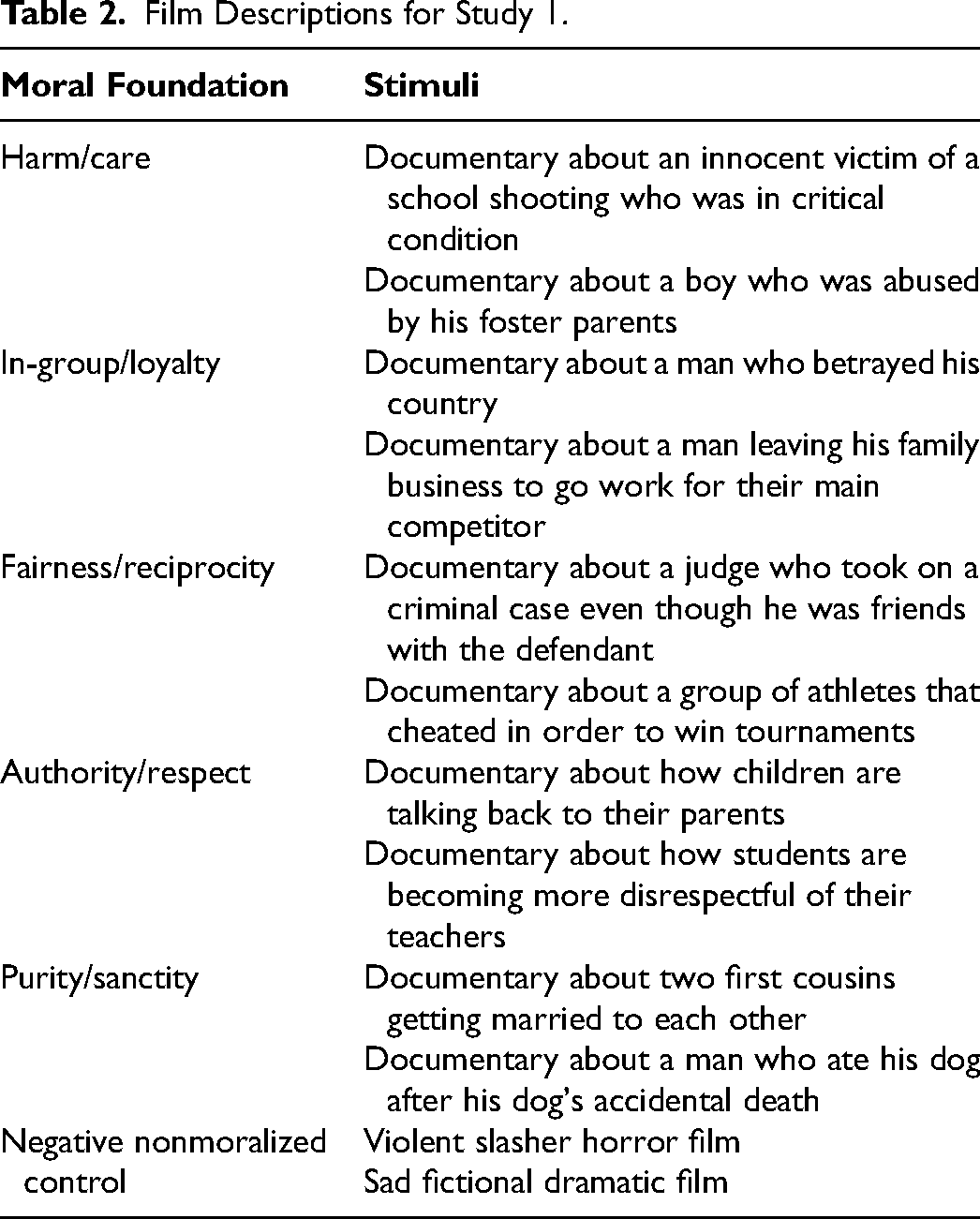
Finally, as an exploratory measure, participants responded to Part 1 of the Moral Foundations Questionnaire, which measures the extent to which people base their moral judgment on the five different foundations (Graham et al. 2011; analyses in the Web Appendix).
Results
Moral foundations versus control (H1)
As preregistered, we used linear mixed models (with package lmerTest in R statistical software; Kuznetsova, Brockhoff, and Christensen 2014) controlling for by-participant intercepts to examine the effect of condition on moral appropriateness of mood maintenance. See Table 3 for descriptive and test statistics (note that mixed models often yield noninteger degrees of freedom). We first compared each moral foundation condition with the control condition using dummy coding (with the control condition coded as the reference group). Participants believed it would be significantly more appropriate to maintain their moods after viewing the harm/care, authority/respect, and fairness/reciprocity films, and marginally more inappropriate after viewing in-group/loyalty films (p = .055), relative to the control films. Purity/sanctity films did not differ from the control films.
Appropriateness of Sustaining Mood, by Moral Foundation Condition.

Harm/care versus other moral foundations
We then compared all conditions with the harm/care condition using dummy coding (with the harm/care condition coded as the reference group). Participants indicated that it would be significantly more morally appropriate to sustain their moods in the harm/care condition than in all other conditions (see Table 3). This suggests that moral foundations outside of harm/care may elicit a preference to sustain a negative response that is between that of harm/care and nonmoral content, with the exception of purity/sanctity, which received similar ratings to the negative nonmoralized control. These differences all remained significant when controlling for affect (see the Web Appendix).
Mediation by moral relevance
We then conducted exploratory analyses in which we tested whether moral relevance of the moral films explained why people believed it to be more morally appropriate to sustain their negative emotion after the moral films relative to negative nonmoralized control films. 3 Bootstrapped mediation analysis indicated that moral relevance mediated the effect between the control condition and the moral films on moral appropriateness (95% confidence interval [CI]: [.02, .11]). A similar analysis comparing harm/care films with all other films revealed that the moral relevance of the harm/care films explained why people believed it to be more morally appropriate to sustain negative emotion after viewing the harm/care movie than in the other film conditions (95% CI: [−.14, −.03]).
Controlling for affect
Next, we turned to ruling out the possibility that the effect was explained by morally relevant films eliciting stronger affect. Affect and moral relevance were negatively correlated, such that the more morally relevant something was, the more negative (i.e., less positive) people believed they would feel (r = −.50). We then tested whether moral relevance and moral foundations continued to predict appropriateness of sustaining mood, this time including affect as a covariate. The effects of moral relevance and moral foundations remained significant, and in this regression, affect predicted moral appropriateness in the opposite direction as moral relevance. The less negative (i.e., more positive) the participant's affect, the more appropriate they thought it was to maintain their mood (t(1,118.33) = 2.57, p = .010). This suggested a suppression pattern (Rucker et al. 2011), or a competitive mediation (Fernandes and Mandel 2014; Zhao, Lynch, and Chen 2010), indicating that moral foundations affected moral appropriateness of sustaining emotions via two simultaneous but opposing paths. First, moral foundations had a positive indirect effect on mood maintenance via moral relevance, such that people viewing moral content recognized the moral relevance and thus wanted to maintain their mood. Second, moral foundations had a negative indirect effect on mood maintenance via affect, such that people viewing moral content felt more negative affect and thus had a stronger motivation to repair that affect. Overall, though, moral relevance was the stronger mediator, resulting in an overall positive total effect of moral foundations on appropriateness of sustaining emotions. Consistent with this suppression pattern, the effect of moral relevance predicting moral appropriateness was stronger in this model (t(1,059.96) = 3.97, p < .001) than in the original model without controlling for affect (t(1,040.81) = 3.12, p = .002; see the Web Appendix for regression tables). Thus, we conducted exploratory analyses to test whether affect suppressed (Rucker et al. 2011) the direct effect of moral foundations on appropriateness of mood maintenance. Indeed, indirect effects of moral foundations on mood maintenance through affect were significant both when we coded the control as the reference group (comparing all films with negative nonmoralized control; 95% CI: [.02, .15]) and when we coded harm/care as the reference group (comparing all other films with the harm/care film; 95% CI: [.01, .11]). This indicates that controlling for affect significantly strengthened the direct effect of moral foundations on appropriateness.
Discussion
This study provides evidence for H1: people believe it is more morally appropriate (i.e., less morally inappropriate) to sustain emotions in response to negative moralized content relative to other (nonmoralized) negative content. This was true for all moral foundations (at significance levels of p < .06) except for purity/sanctity, which we return to in the “General Discussion” section. We further found that people have a stronger preference to maintain emotions after exposure to content related to harm/care than after exposure to content related to other moral domains. These patterns were statistically explained by the greater average moral relevance of moral content (vs. control) and harm/care content (vs. other moral foundations). Of note, it is difficult to manipulate the severity of this moralized content without simultaneously manipulating human suffering, as harm may be central to judgments of the morality of those domains (Gray and Keeney 2015; Gray and Wegner 2010; Gray, Waytz, and Young 2012; Schein and Gray 2015, 2018). Common manipulations of fairness, for instance, involve clear harm as well (e.g., stealing from the poor). In this study, we tried our best to isolate the effects of each moral foundation (e.g., fairness violations that did not involve harm). In our remaining studies, we focused only on content pertaining to human suffering.
We further found that the affect people associate with each moral domain significantly suppressed our effect. Thus, our effect cannot be explained by the fact that more moralized content was also seen as more negative, and in fact, controlling for that negativity significantly strengthened our effect. This suggests two opposing effects: a preference for mood repair, in which people want to repair their mood after viewing moralized content (due to the content's negativity), and a morally based preference for mood maintenance, in which moral relevance leads people to believe that sustaining one's mood is more appropriate. Importantly, the effect via moral appropriateness was stronger, leading to our predicted main effects (H1).
Study 2: Morally Appropriate Behavior After Viewing Human Suffering
In Study 2, we asked participants to imagine watching a film with either real or fictional human suffering, and then measured how appropriate they believed mood-repairing, neutral, and mood-sustaining activities would be. Study 2 employed a stronger control condition than Study 1: participants imagined viewing either a war documentary featuring real human suffering or a fictional war film. This control condition also provided a conservative test of our theory because a fictional war film could still be viewed as possibly being based on real events or providing commentary on real human suffering. We hypothesized that after viewing real (vs. fictional) human suffering, people would find it both more morally appropriate (i.e., less inappropriate) to engage in mood-sustaining consumption (H2a) and more morally inappropriate to engage in hedonic consumption (H2b). We predicted two possible outcomes for neutral consumption (preregistered): either neutral consumption would seem more inappropriate after viewing real human suffering than after viewing the fictional human suffering (because it interrupts one's current state), but with a smaller difference compared with hedonic consumption; or neutral consumption would seem equally appropriate after both activities.
Method
Participants and design
We preregistered this study and recruited participants (N = 300; 68 male, 228 female, and 4 nonbinary participants; Mage = 41.62 years) from Prolific. The study had a 2 (film type: real vs. fictional suffering, between-participants) × 3 (subsequent activity type: hedonic, neutral, or mood-maintaining, within-participant) mixed design.
Procedure
In the real [fictional] conditions, participants read, “Imagine that you are watching a documentary [movie] about a [fictional] war between two countries that resulted in over 300,000 civilian deaths. The movie reflects real life [is not based on any real events] and all footage was taken during the time of the war [filming was done on a movie set]. The movie is very intense and makes you extremely sad.” They then considered six activities that we designed to represent three categories: two hedonic (watching a slapstick comedy; listening to upbeat pop music); two neutral (watching a math tutorial; going grocery shopping); and two mood-maintaining (listening to slow, melancholic music; sitting in silence).
For each activity, participants responded to four items adapted from Study 1 to measure how morally inappropriate it would be to engage in that activity (α = .90): how morally appropriate it would be, how wrong or right it would be, how disrespectful or respectful it would be, and how it would reflect on their moral character. Participants responded to all six activities (in a matrix table) for each item before moving onto the next one; the four items were presented in random order. In this study (and our subsequent studies, when relevant), for ease of interpretation, items were reverse-coded to create a measure of moral inappropriateness.
As a control measure of affect, participants then indicated how they would feel after watching this film (1 = “Extremely negative,” and 7 = “Extremely positive”). Finally, we wished to address the possibility that participants may view mood-repairing activities as less efficacious in repairing their moods after viewing a film regarding real (vs. fictional) human suffering, leading them to view these activities as more inappropriate. Participants indicated the extent to which each of the activities would sustain their current mood versus repair their mood (1 = “Sustain current mood,” and 7 = “Repair current mood”).
Results
Main findings (H2a and H2b)
We ran a linear mixed model in which we regressed moral inappropriateness of each of the six activities on film type, subsequent activity type (maintenance/neutral/hedonic), and their interaction, while controlling for by-participant intercepts. We found a significant overall interaction (F(2, 1,496) = 21.52, p < .001; see Figure 2).

Moral Inappropriateness of Activity as a Function of Content of Film and Subsequent Activity Type.
Supporting H2a, mood-maintaining activities were viewed as less inappropriate (i.e., more appropriate) after the war documentary than after the fictional war film (M = 2.92, SD = .94 vs. M = 3.13, SD = 1.04; t(786.49) = −2.43, p = .015, d = .21). Hedonic mood repair activities, in contrast, were viewed as more inappropriate after the war documentary than after the fictional war film (M = 4.71, SD = 1.08 vs. M = 4.28, SD = 1.07; t(786.49) = 4.84, p < .001, d = .39). Neutral activities appeared marginally more inappropriate after the war documentary than after the fictional war film (M = 4.10, SD = .69 vs. M = 3.95, SD = .87; t(786.49) = 1.72, p = .086, d = .19). The sizes of these differences all differed from each other, as reflected in significant two-way interactions (2 (film type: real vs. fictional suffering) × 2 (subsequent activity type: neutral vs. hedonic): t(1,496) = 2.80, p = .005; 2 (film type: real vs. fictional human suffering) × 2 (subsequent activity type: neutral vs. mood-maintaining): t(1,496) = −3.73, p < .001). Thus, after participants imagined witnessing real (vs. fictional) human suffering, they believed it was slightly more inappropriate to engage in distracting everyday activities like watching a math tutorial or going grocery shopping, but it was much more inappropriate to engage in activities that are also hedonic, and more appropriate instead to maintain one's negative mood.
Looked at differently, participants believed that after viewing a war documentary reflecting real human suffering, it would be more morally inappropriate to engage in hedonic mood repair than to engage in neutral activities (t(1,496) = 8.75, p < .001, d = .87) or mood-maintaining activities (t(1,496) = 25.90, p < .001, d = 1.66). They also thought it would be more morally inappropriate to engage in neutral activities than to engage in mood-maintaining activities (t(1,496) = 17.15, p < .001, d = 1.43). The pattern was similar but attenuated for fictional human suffering: hedonic mood repair versus neutral activities (t(1,496) = 4.87, p < .001, d = .38), hedonic mood repair versus mood-maintaining activities (t(1,496) = 16.94, p < .001, d = 1.08), and neutral versus mood-maintaining activities (t(1,496) = 12.06, p < .001, d = .86).
Control variables
We regressed mood repair expectations of each of the six activities on film type (real vs. fictional suffering), subsequent activity type (maintenance vs. neutral vs. hedonic), and their interaction, which did not yield a significant interaction (F(2, 1,496) = 2.07, p = .127). We found a main effect of valence (F(2, 1,496) = 589.97, p < .001) and no main effect of condition (F(1, 298) = .47, p = .492). As intended, people expected the neutral activities to be more mood repairing than the mood-maintaining activities (t(1,498) = 17.54, p < .001) and the mood-repairing activities to be more mood-repairing than the neutral activities (t(1,498) = 16.80, p < .001). 4
We also ran our main analyses while controlling for affect and its interaction with subsequent activity type (maintenance/neutral/hedonic). Our main interaction remained significant (F(2, 1,494) = 13.42, p < .001) with a similar pattern of simple effects (see the Web Appendix).
Discussion
In this study, we found that people believed it was especially morally appropriate to sustain their negative emotions after viewing content reflecting real (vs. fictional) human suffering (H2a). Furthermore, it was more morally inappropriate to distract themselves with hedonic, mood repairing content (H2b). People also found it marginally more inappropriate to distract themselves with neutral content; however, this effect was significantly smaller than for mood-repairing content. In addition, after viewing real human suffering, participants believed it would be most morally inappropriate to engage in hedonic consumption, followed by neutral consumption, with the most morally appropriate behavior being to engage in mood-sustaining consumption. This pattern was also present for fictional human suffering, but attenuated. This makes sense given that the fictional human suffering condition should still be anticipated to reflect human suffering, only to a lower degree than the real human suffering condition. Finally, we did not find that people believed that hedonic content would be less effective at repairing their moods in response to real (vs. fictional) suffering, and our central effects remained when controlling for affect and mood repair expectation.
Studies 1 and 2 are limited by the fact that participants were prompted with moral judgment, rather than allowing moral judgment to spontaneously influence choice. In the remaining studies, we measure real consumption choices before any judgment measures.
Study 3: Consumer Choice
Our final three studies examined actual consumption choices, pitting people's motivation to do their perceived moral duty (i.e., maintain a negative emotion in response to others’ suffering) against the competing motivation to avoid negative feelings (e.g., Zaki 2014). Study 3 tested whether, after reading a real (vs. fictional) story of others’ suffering, people would choose to sustain rather than improve their moods (H3). Participants read a passage about a real genocide (the Rwandan genocide) or a fictionalized version of the passage. They then chose between two subsequent activities, one mood-sustaining (sitting in silence for 30 seconds) and one hedonic (watching a clip from America's Funniest Home Videos). We predicted that participants who had read about real human suffering would be more likely to choose the mood-sustaining activity and avoid the hedonic one. Using the same passage with the exception of its framing as fictional or real gave us a high degree of experimental control in manipulating the relevance of real human suffering.
Method
Participants and design
We preregistered this study and recruited 601 participants on Prolific (Mage = 42.34 years; 183 male, 412 female, and 4 nonbinary participants; 2 participants did not indicate gender). This was a two-condition (real vs. fictional human suffering) design. Given the large-sized effect we found in a prior pilot version of this study (odds ratio [OR] = .48 at N = 1,000), we decreased the target sample size to 600 while still adhering to our goal to recruit at least 100 participants per condition.
Procedure
Participants read that they would be pretesting materials for future research and that they would read a passage and respond to a few questions about it. They were told to read the passage and imagine the scenes as vividly as they could. In the real condition, participants read: “The following is an excerpt from a real testimony by a man who survived the Rwandan Genocide, a mass slaughter of the Tutsi ethnic group committed by the Hutu ethnic group.” In the fictional condition, participants read, “The following is an excerpt from a fictional Fantasy novel about a man who survived the Dragonwell genocide, a mass slaughter of the Shadowthorne clan committed by the Bloodforge clan.” They then read a short passage in which a man described the genocide (see the Web Appendix for full text, adapted from Survivors Fund [2009]); in the fictional condition, the words “Bushenge,” “Rwanda,” “Zaire,” “Tutsi,” and “Hutu” were replaced by “Eastbourne,” “Dragonwell,” “Winterrock,” “Shadowthorn,” and “Bloodforge,” respectively. To adhere to the cover story that participants were pretesting materials for future studies, participants answered two filler questions (whether the passage referred to real or fictional events, and whether it was narrated by a real or fictional person).
After reading these questions, they read: “For protocol reasons, we are required to offer you options given the material you read. We are offering you a choice between watching a 30 second clip from ‘America's Funniest Home Videos,’ so you can forget about what you just read, or sitting in silence for 30 seconds so you can fully experience your emotions with regard to the passage.” Participants then chose between the two options. The choices were clearly described to be either mood repairing or mood sustaining, thereby ensuring that participants interpreted the options as such, without explicitly stating either choice was more moral. That is, the cover story reflects real Institutional Review Board protocols that do require mood repair options after viewing upsetting content; believing that these options were necessary for protocol reasons may justify participants’ choice of the hedonic option, thereby establishing a strong test of our hypothesis. Finally, any potential demand effects driven by one choice being viewed as more moral at a baseline should be equal across both conditions.
Then, participants indicated how they felt right then (1 = “Extremely negative,” and 7 = “Extremely positive”), as a measure of how they felt in response to the passage they were assigned, thus allowing us to control for affective differences between the two conditions. They also rated how they would feel if they were to watch an America's Funniest Home Videos clip at that moment (1 = “Extremely negative,” and 7 = “Extremely positive”), thus allowing us to control for perceived efficacy in repairing mood across the two conditions. We followed preregistered plans to calculate efficacy as participants’ anticipated feelings upon watching America's Funniest Home Videos minus participants’ current feelings. As a conservative test, we placed these measures before our mediator measures of interest, in case participants felt an experimental demand to respond in a more differentiated way to the first mechanism items they saw. We expected that any such differences would not explain our effects on inappropriateness.
Next, participants responded to a four-item mediator measure (α = .90) capturing the moral inappropriateness of watching the hedonic clip, adapted from Studies 1 and 2: they indicated which activity would be more appropriate, right, moral, and respectful on seven-point scales (e.g., 1 = “Watch [America’s Funniest Home Videos] much more appropriate,” and 7 = “Sitting in silence much more appropriate”). Finally, they viewed a clip from America's Funniest Home Videos or sat in silence for 30 seconds, depending on their choice.
Results
Main findings (H3)
A smaller proportion of participants chose the hedonic activity in the real suffering condition than in the fictional suffering condition (16% vs. 31%; logistic regression B = −.85, SE = .20, p < .001, OR = .43). This effect remained when controlling for current affect (B = −.85, SE = .21, p < .001).
Efficacy of mood repair
Participants did not think that America's Funniest Home Videos would be significantly more or less able to repair their mood in the real condition (M = .68, SD = 1.42) than in the fictional condition (M = .58, SD = 1.50; t(598) = −.79, p = .430). Paired sample t-tests revealed that participants in both conditions believed that if they viewed America's Funniest Home Videos they would feel significantly better than they currently felt (treal(298) = 8.27, p < .001; tfiction(300) = 6.77, p < .001).
Mediation by inappropriateness (H2)
Participants who read the real suffering passage believed that it would be more morally inappropriate to view the hedonic clip (M = 6.19, SD = .93) than those who read the fictional version (M = 5.41, SD = 1.16; t(598) = −9.02, p < .001). We next tested moral inappropriateness as a mediator of the effect on choice. In a regression with both moral inappropriateness and condition, moral inappropriateness significantly predicted choice (B = .40, SE = .09, p < .001), and the condition effect was reduced (B = −.55, SE = .21 p = .011). Bootstrapped mediation analyses indicated that moral inappropriateness mediated the effect of condition on choice (95% CI: [−.08, −.03]), consistent with moral inappropriateness serving as a mediator. All effects remained when controlling for perceived efficacy, current affect, and anticipated affect upon watching America's Funniest Home Videos (see the Web Appendix).
Discussion
In Study 3, we turned our attention to real consumer choice. Consumers who read about real human suffering chose to sustain their negative mood more than those who read identical content framed as fictional (H3). This effect was mediated by moral inappropriateness of choosing hedonic consumption. Furthermore, all effects remained significant when we controlled for participants’ affect, as well as their expectations that the mood-repairing video would actually improve their mood. Thus, it is not simply that people have more tolerance for negative or neutral experiences when experiencing negative affect than positive affect, as a hedonic contingency perspective would suggest (Wegener and Petty 1994), nor is it that people who have viewed human suffering content expect that a funny video could not make them feel better anyway. Rather, our results suggest that people chose on the basis of a metacognitive judgment that they should sustain their affect when the content they viewed pertains to real (rather than fictional) human suffering.
Study 4a: Real Choice Moderated by Moral Relevance of Hedonic Activity
Our next study again examined a real consumer choice, and again allowed us to test the mediating effect of judgments of inappropriateness, as well as the moderating effect of the moral relevance of the hedonic activity. Rather than comparing real human suffering with a fictionalized version of the same content (as in Studies 2 and 3), our central manipulation compared others’ suffering more broadly with negative fictional content (as in Study 1). This reflects our original theory, which contrasts people's desire to maintain a negative mood after exposure to content related to human suffering, versus other negative content (i.e., nonmoralized content unrelated to human suffering). Thus participants viewed a video clip related to others’ suffering or one with negative fictional content, and then chose whether to consume an upbeat, positive advertisement or to sit in silence for 30 seconds. Orthogonally, we manipulated whether the positive advertisement was frivolous (advertising a snack food) or morally relevant (advertising a social movement to encourage compassion). We predicted that people who viewed a video about others’ suffering would avoid the frivolous ad (H3), believing that watching it would be morally inappropriate (H2). However, we expected this effect to be attenuated when the ad was morally relevant (H4).
Method
Participants and design
We preregistered this study and collected 608 participants on Amazon Mechanical Turk (MTurk; Mage = 41.71 years; 294 male participants, 297 female participants, and 8 nonbinary participants; 9 participants did not indicate gender). This study was a 2 (film type: real suffering vs. negative fictional content) × 2 (ad type: frivolous vs. morally relevant) between-subjects design. We aimed for 600 participants based on an initial prior version of the study with different ad stimuli (reported in the Web Appendix).
Procedure
After agreeing to watch a video that could have emotionally disturbing content, participants read that they would watch a video clip from either E.T. (negative fictional content) or Bully (real suffering) and that they might be asked whether they would like to view an ad after the clip. The E.T. clip featured a tearful goodbye between two characters, and the Bully clip documented the true story of harmful bullying that ultimately led to a young boy's suicide (see https://researchbox.org/448 for links to videos). After watching their assigned clip, participants were given the opportunity to view an ad or watch a blank screen. In the frivolous condition, the ad was described as a “30 second upbeat advertisement for Cheetos,” whereas in the morally relevant condition, the ad was described as a “30 second upbeat advertisement by the ‘Kindness Movement’ whose mission is to make kindness the norm.” Thus, both advertisements were described as positive, but one had frivolous content whereas the other had content related to the moral values of kindness. Participants chose whether to watch the ad (clicking on an option with an image of the respective product's logo; see the Web Appendix) or watch a blank screen.
Next, participants viewed the ad or the blank screen, according to their choice. They then indicated, in a free-response format, why they had made the choice that they did. Afterward, they responded to our four-item mediator measure to assess which option—viewing the ad or sitting in silence—they felt would be more morally appropriate. We used the same four-item measure as in Study 3 (ɑ = .90), with scale points referring to watching the ad or sitting in silence. As a control measure of affect, participants indicated how the film clip had made them feel (1 = “Extremely negative,” and 7 = “Extremely positive”).
Results
Main findings (H3 and H4)
Following our preregistered analysis plan, we ran a binomial logistic regression regressing choice on film type (real human suffering vs. negative fictional scene), ad type (positive frivolous vs. positive morally relevant), and their interaction, which yielded a significant interaction (B = −.71, SE = .34, p = .038, OR = .49; see Figure 3). In support of H3, participants were less likely to choose to view the frivolous Cheetos ad (rather than sitting in silence) after viewing the human suffering clip than after viewing the negative fictional scene (49% vs. 64%; B = .59, SE = .23, p = .011, OR = .56). In support of H4, however, participants were almost equally likely to choose to view the morally relevant Kindness Movement ad after viewing the human suffering clip compared with the negative fictional scene (71% vs. 68%; B = −.13, SE = .25, p = .61, OR = .88). In other words, participants who had viewed the clip depicting real human suffering were much less likely to choose a frivolous ad than a morally relevant ad (B = –.91, SE = .24, p < .001, OR = .40), but those who had viewed the fictional scene did not show this effect (B = −.20, SE = .24, p = .422, OR = .82).

Percentage Choosing to View Ad Predicted by Content of Film Clip and Content of Ad.
Mediation by inappropriateness (H2)
In line with our planned secondary analyses, we first tested for, and found, an interaction between film type and ad type in predicting moral inappropriateness of watching the ad (t(596) = 3.27, p = .001). Consistent with H2, participants found it more morally inappropriate to view the frivolous Cheetos ad after viewing the real suffering clip than after viewing the fictional scene (M = 5.57, SD = 1.25 vs. M = 4.42, SD = 1.30; t(596) = 6.98, p < .001, d = .91), but this difference was reduced for the morally relevant Kindness Movement ad (Mhuman suffering = 3.89, SD = 1.64 vs. Mfictional = 3.51, SD = 1.57; t(596) = 2.27, p = .024, d = .24). We then conducted a mediated moderation analysis (5,000 simulations; Baron and Kenny 1986) and found that the effect of the negative content × ad content interaction on choice was mediated by moral inappropriateness (95% CI: [−.13, −.04]). See the Web Appendix for full regression information, and for all analyses controlling for affect (effects remained significant).
Discussion
Study 4a supported several of our predictions. First, participants were less likely to engage in frivolous mood-repairing consumption when they had first viewed content related to human suffering, compared with negative fictional content (H3); however, this did not occur when the upbeat consumption experience pertained to moral values (H4), specifically moral values of kindness. Second, people perceived engaging in frivolous hedonic consumption as more morally inappropriate after viewing negative content related to human suffering than after viewing other negative content (H2), but this was less so when the hedonic ad was morally relevant (H4). A mediated moderation analysis suggested that these perceptions of moral inappropriateness drove participants’ actual choice behavior. In this study, our morally relevant stimulus was specific to moral values of kindness, which was also directly related to the human suffering content. Future research may examine the extent to which other morally relevant stimuli would lead to similar effects. We discuss this further in the “General Discussion” section.
Notably, even a morally relevant positive ad was seen as slightly more inappropriate when it came after human suffering content compared with other negative content, although this difference was much smaller than for the frivolous ad. Along with the results from Study 2, this finding further supports our contention that people see sustaining their mood as a particularly appropriate response to moral suffering (H2a), and they see frivolous mood repair as a particularly inappropriate response (H2b). The morally relevant Kindness Movement ad did not have the issue of being frivolous, but it could still interrupt the negative emotional response participants experienced in response to the film clip they had watched. If even this ad seemed more inappropriate after the human suffering clip (which is matched in moral relevance) than after the fictional clip, then that suggests that participants believed human suffering increased the appropriateness of mood maintenance compared with even a relatively appropriate form of mood repair. As evidence of robustness, we conducted a replication of this study using the same dependent measure as used in Study 4b (see the Web Appendix).
Study 4b: Real Choice Moderated by Self-Perceived Moral Character
Our final study again examined actual consumer choice, this time testing the moderating effect of self-perceived moral character (H5). We expected that participants who saw themselves as more moral would find it especially morally inappropriate to view a hedonic ad after witnessing human suffering (vs. negative fictional content), leading them to be less likely to choose to view the ad.
Method
Participants and design
We collected 400 participants on MTurk (Mage = 35.30 years; 251 male participants, 148 female participants, and 1 nonbinary participant). This study had two conditions (real suffering vs. negative fictional content), as well as a measured, continuous individual difference moderator of self-perceived moral character.
Procedure
The procedure was similar to Study 4a, with the following modifications. First, because we were interested in the moderating effect of self-perceived moral character rather than moral relevance of hedonic consumption in this study, all participants chose between a hedonic, frivolous ad (in this study, for Bud Light beer) and a mood-sustaining option of sitting in silence (see the Web Appendix). After they made their selection, and before they gave their free-response answers, they indicated to what extent they preferred the option they had chosen (1 = “Extremely prefer to view the Bud Light ad,” and 7 = “Extremely prefer to view blank screen”). Rather than completing the moral inappropriateness mediator items (ɑ = .95) right away, 5 participants did so after they had watched the ad or a blank screen and then watched a 30-second continuation of the film clip they had watched earlier. In this study, these items were worded to focus on the appropriateness of watching the ad and did not include sitting in silence on the opposite pole. Also, for the control measure of affect, participants indicated how sad the first film made them feel (1 = “Not at all,” and 5 = “Extremely”) rather than the general valence of affect they felt.
At the end of the study, participants indicated how moral they perceived themselves to be on an 11-item scale (α = .88; not significantly affected by condition, t(398) = .28, p = .781). This scale asked participants to rate themselves on nine adjectives that people think of as reflecting moral character (caring, compassionate, fair, friendly, generous, hardworking, helpful, honest, kind; Aquino and Reed 2002) and two negative items that were reverse-coded (selfish and mean), which we added to encourage attention to the scale (e.g., so participants would not mark “5” for every item). We used this self-perceived moral character scale, rather than a self-importance of moral identity scale, because we were interested specifically in how moral people perceived themselves to be, rather than how important it was to them to be moral (Lin, Zlatev, and Miller 2017). Finally, they responded to the self-presentation subscale of the self-monitoring scale (Lennox and Wolfe 1984) as an exploratory measure of their desire to present themselves positively to others (results in the Web Appendix).
Results
Overall choice and preference (H3)
A binomial logistic regression indicated that participants who viewed the Bully clip (human suffering) were less likely to choose to view the hedonic Bud Light ad than those who viewed the E.T. clip (negative fictional content) (43% vs. 62%; B = −.79, SE = .20, p < .001, OR = .45). Results for the continuous preference measure mirrored this pattern (Msuffering = 4.95, SD = 1.92 vs. Mfictional = 4.47, SD = 2.16; t(398) = 2.39, p = .017, d = .24).
Mediation by inappropriateness (H2)
Participants who viewed the human suffering clip felt that watching the hedonic ad would be more inappropriate, compared with those who viewed the fictional clip (M = 4.16, SD = 1.38 vs. M = 3.71, SD = 1.24; t(398) = −3.45, p < .001, d = .34). Bootstrapped mediation analysis (5,000 simulations) revealed that inappropriateness mediated the effect of the suffering condition on choice for both binary choice (95% CI: [−.10, −.02]) and continuous preference (95% CI: [−.20, −.02]) (see the Web Appendix for details).
Affect
As in previous studies, we found no evidence for affect (here, sadness) as an alternative mechanism. When we controlled for sadness, moral inappropriateness remained a significant mediator in predicting choice (95% CI: [−.11, −.03]) and continuous preference (95% CI: [−.25, −.04]). If sadness had been able to explain the overall effect of condition on choice, then the effect of condition would be reduced when controlling for sadness; instead, the effect of condition became stronger (B = −.98, SE = .22, p < .001), suggesting a suppression effect (Rucker et al. 2011), as in Study 1. When controlling for moral inappropriateness, sadness indeed showed a significant indirect effect in the opposite direction: participants were sadder after viewing the clip about human suffering (vs. the fictional clip), but being sadder made them more likely to choose the hedonic ad (95% CI: [.008, .08]). 6 Thus, our predicted effect via moral inappropriateness was large enough to overcome the opposing effect of sadness, such that overall considerations of moral inappropriateness won out over participants’ desire to repair their sad moods. 7
Moderation by self-perceived moral character (H5)
As predicted, we observed a condition by moral character interaction in predicting moral inappropriateness (t(396) = 2.06, p = .040; see Figure 4). Those who viewed themselves as highly moral (+1 SD) believed that watching the hedonic ad was more inappropriate after viewing the human suffering clip than after viewing the negative fictional clip (t(396) = 3.99, p < .001). However, those who viewed themselves as less moral (−1 SD) did not give different ratings by condition (t(396) = 1.07, p = .28).

Ratings of Moral Inappropriateness of Viewing the Bud Light Ad Predicted by Moral Character and Content of Film Clip.
We found suggestive evidence that this pattern translated to behavior. We found a marginal interaction on the continuous preference item (t(396) = −1.94, p = .053), such that participants with high self-perceived moral character (+1 SD) preferred the ad less in the human suffering condition (t(396) = −3.06, p = .002), but this was not true for participants with low self-perceived moral character (−1 SD) (t(396) = −.31, p = .76). We did not observe a significant interaction on the choice measure (B = −.24, SE = .23, p = .31), although the direction and overall pattern were similar. 8 Furthermore, as indirect effects can occur without direct effects (Rucker et al. 2011), we conducted bootstrapped mediated moderation analyses (5,000 simulations) and found indirect effects of condition × moral character via moral inappropriateness on preference (95% CI: [.002, .160]) and binary choice (95% CI: [.001, .080]).
Discussion
Study 4b replicated the effects in the frivolous hedonic ad condition of Study 4a and provided evidence for the moderating role of self-perceived moral character. Participants again thought that watching a hedonic ad after witnessing human suffering would be morally inappropriate (H2), and thus they were less likely to choose to watch the ad (H3). These effects were strongest among individuals who perceived themselves as highly moral (H5). Together, these results provide further evidence that people's perceptions of what would be appropriate after witnessing content about human suffering are strong enough to influence their actual consumption choices. These results also further support the specific moral reasons underlying these effects.
Conceptually replicating the suppression found in Study 1 in real choice behavior, we also observed that, all else being equal, the sadder participants were, the more they wanted to repair their moods by watching the cheerful ad. However, this motivation was overpowered by the desire for a morally appropriate response, leading to our overall predicted effect whereby participants in the human suffering condition chose not to view the ad.
General Discussion
We conducted five experiments to examine people's beliefs about hedonic—that is, enjoyable and positive—consumption after they have been exposed to content about human suffering. We found that, after engaging with negative moralized content—especially content about human suffering—consumers find it more morally appropriate to sustain their negative emotions than they do after engaging with other negative content (Study 1). They believe that maintaining their negative emotions is especially morally appropriate, and hedonic consumption is especially morally inappropriate, after exposure to content about human suffering (vs. other negative content; Study 2). Consequently, after being exposed to human suffering (vs. other negative content), consumers avoid engaging in hedonic consumption in real time (Studies 3 through 4b).
Both mediation and moderation results provided evidence of our hypothesized mechanism, a desire to engage in morally appropriate behavior. Mediation analyses suggested that the reason consumers avoid hedonic consumption after exposure to content about human suffering is that they view hedonic consumption as morally inappropriate under these circumstances (Studies 3 through 4b). We also found evidence for one situational moderator and one individual difference moderator derived from our theoretical predictions. First, consumers do not find hedonic consumption to be as inappropriate following content about human suffering if the hedonic content is morally relevant (rather than frivolous; Study 4a). Second, consumers who saw themselves as more moral felt especially strongly that hedonic consumption would be inappropriate, and thus showed a stronger preference to avoid hedonic consumption (Study 4b). Together, these mediation and moderation results provide especially strong evidence that consumers avoid hedonic consumption following content about human suffering, specifically because of what they see as their moral duties in this situation.
Theoretical Implications
Although it is clear that people want to see themselves as good and moral (Khan and Dhar 2006; Lin and Miller 2021; Lin and Reich 2018; Lin, Schaumberg, and Reich 2016; Lin, Zlatev, and Miller 2017), the literature to date has not clarified how people might regulate their own emotions to serve their moral motivations. Many scholars have argued that emotional responses automatically give rise to moral judgments (Haidt 2001). Our results raise the possibility that there may also be a reverse causal effect: once people moralize a situation, they may regulate their emotions to reflect an appropriate response. In other words, the strong emotions people experience in response to moralized situations may sometimes be motivated, not just automatic.
Our findings also add to the emotion regulation literature, which has traditionally focused on people's desire to feel positive affect (Gross and Thompson 2007). We contribute to a growing recent literature on motivations to feel negative emotions (Andrade and Cohen 2007; Tamir, Mitchell, and Gross 2008; Wu 2010) and research on emotion norms and rules (Clark 1987; Hochschild 1979; Thoits 1989). We examine a particular situation—seeing or learning about others’ suffering—in which people's internalized striving to be good and moral may dictate a negative emotional response. This stands in contrast to research that suggests that feeling empathy for others’ suffering is unpleasant and is avoided or downregulated (Cameron and Payne 2011; Shaw, Batson, and Todd 1994; Zaki 2014). We suggest that those previous findings do not show the whole picture, and that people may sometimes be motivated to maintain their empathy instead of downregulating it. Although we did find evidence of mood repair motivations (e.g., Studies 1 and 4b), in our studies these were outweighed by the belief that it would be inappropriate to turn toward frivolous pleasures and away from emotions that pay respect to victims’ suffering. In the balance, we find, people avoid immediate hedonic mood repair after witnessing human suffering, especially contrasted with what they would choose after a negative experience unrelated to suffering.
Previous research suggests that consumers prefer sequences of negative content followed by positive content because of hedonic emotion regulation motivations (Olsen and Pracejus 2004). However, in those studies the positive content was about caring for those who are suffering (i.e., helping treat diabetes). Our research suggests that the morally relevant nature of the stimuli may have limited the generalizability of those findings, and that consumers might not have responded so favorably to this sequencing if the positive content had instead been hedonic and frivolous.
Limitations and Future Directions
Our research provides one piece of evidence for a broader hypothesis: that people desire to sustain their emotions after exposure to moralized content. Taken together, all of our studies show that this is the case for content relevant to harm and care, which is a highly and universally moralized domain (Graham, Haidt, and Nosek 2009; Gray, Waytz, and Young 2012; Schein and Gray 2015). In addition, our first study suggests that people may also have this motivation for content relevant to other moral domains, such as injustice or disloyalty, although possibly to a lesser extent than for human suffering; some perspectives suggest that these domains may cause our effect only to the extent that they involve human suffering (Gray and Wegner 2009; Gray, Waytz, and Young 2012; Schein and Gray 2015, 2018). Future research should fully investigate whether other moral domains show the same behavioral consequences as the harm/care domain, and whether those effects can be disentangled from harm elicited by those situations.
Intriguingly, the one moral foundation for which we did not find that people desire to sustain negative emotions was purity/sanctity. Although more research is needed to clarify how to interpret this finding, it may relate to which discrete emotions people feel upon exposure to morally relevant content. Different moral foundations tend to elicit different discrete emotions: for example, unfairness tends to evoke anger, and purity violations tend to evoke disgust (Rozin et al. 1999). People may not find it equally morally appropriate to sustain each of these different discrete emotions. For example, disgust motivates avoidance or moving away from the offender (Haidt 2003). Thus, although people may still desire a strong initial reaction (e.g., to reflect that their emotional response is appropriately calibrated), a morally appropriate response may also involve immediately avoiding the offending entity (e.g., by repairing one's mood); this would reflect the correct amount of revulsion. That is, people may feel that they should sustain an emotion to the extent that it can help them take action in response: whereas compassion and anger may lead one to help a victim or to take action against a perpetrator of harm (Haidt 2003), the action tendency for disgust (i.e., avoidance) can be fulfilled immediately after viewing the purity/sanctity violation.
In Study 4a, we tested whether, following human suffering, positive moralized content that was in the same moral domain (i.e., harm/care) was more acceptable than positive frivolous content. Future research may investigate how other positive moralized content compares to content that is matched in domain. We have suggested that, after exposure to content related to human suffering, people are motivated to feel emotions that (1) reflect good moral character, (2) foster reflection on that suffering, and (3) support taking prosocial action. Viewing content related to harm and care may more successfully satisfy these three requirements than viewing other positive moralized content. For instance, in our Study 4b, seeing an ad for kindness may have assured people that those who are bullied may receive help, allowing them to resolve their thoughts and desire for prosocial action regarding the content. Thus, after viewing the Bully documentary about human suffering, people may still prefer reading about a plaintiff winning justice in a court case over a more frivolous hedonic topic—because reading about justice allows for moral emotions that may reflect good moral character—but they may even more strongly prefer an article about helping people or resolving suffering, which is in a domain closer to the initial moralized content. Future research can more systematically investigate these possibilities.
From a discrete emotions perspective, we also suggest that after witnessing human suffering, people may find it more appropriate to feel precisely those positive emotions that are considered “moral,” which reflect their concern for welfare and society as a whole and that drive a desire to engage in prosocial action (Haidt 2003). However, there are emotions in between moral emotions with prosocial action tendencies and self-interested emotions, such as amusement. For instance, going out to a fine meal or viewing a natural wonder may constitute a meaningful experience that elicits awe (Keltner and Haidt 2003); going to a baseball game with one's child may facilitate meaningful social bonding, leading to other-focused emotions such as love. Although these are not moral emotions, they may be more welcome than those caused by unambiguously frivolous content (e.g., amusement, enjoyment). Thus, whereas we framed our hypotheses around the type of content consumers prefer to avoid after exposure to human suffering content, it is possible that an equivalent set of hypotheses could be made about the emotions consumers prefer to avoid, with frivolous positive content typically eliciting positive nonmoral emotions. Future research could focus on developing theory and empirical tests around the sequencing of moral and nonmoral discrete emotions, which would help build an integrated and comprehensive view of the moral consumer.
Our research shows that people avoid hedonic mood repair due to a belief that it is morally appropriate to feel negatively in response to human suffering. Are people avoiding hedonic consumption to avoid looking bad to others (i.e., self-presentation), or just to themselves? Our results suggest that the motivation is at least partially due to self-consistency motivations, rather than purely a concern about bad optics. We observed our effects in contexts with little external judgment—where all answers were anonymous and only the experimenters would be aware of participants’ choices—and where participants’ choices determined their real experiences in real time. Furthermore, we found that after witnessing human suffering, those who see themselves as more moral are more likely to avoid hedonic consumption (Study 4b). This suggests that our effects are most driven by those who truly desire to care for others. Although exploratory analyses in Study 4b (see the Web Appendix) suggested that trait-level self-presentational concern also drove people to avoid hedonic consumption after witnessing human suffering, participants high in this trait (unlike those high in self-perceived moral character) did not tend to see this avoidance as more inappropriate. In other words, the mechanism we focused on in our theory and studies does not appear to operate primarily at a self-presentational level. Further research could continue to disentangle private from self-presentational concerns that lead consumers to avoid hedonic consumption.
Finally, another important avenue for future research concerns the temporal frame of our effect: when, exactly, it is inappropriate to engage in frivolous hedonic consumption relative to engaging with content about human suffering. We studied hedonic content that immediately followed content about human suffering, but future research could test whether these effects also hold for concurrent consumption or for consumption with a greater separation in time. For example, if hedonic mood repair is viewed as morally inappropriate, concurrently engaging in hedonic consumption while watching content about human suffering (e.g., eating candy while watching a Holocaust documentary) could be considered an inappropriate mix of emotions. It is also unclear how long people strive to feel negative emotions after exposure to human suffering. Our research only tests whether this effect exists in the immediate aftermath of the exposure and in the short term (e.g., 30 seconds of silence). Might people desire hours or even days of sustained negative emotion following human suffering? The ideal duration may depend on the characteristics of the setting and the content itself, such as the intensity of the suffering witnessed. Perhaps, in response to a tweet that only briefly describes suffering, people may feel comfortable moving on after a few moments of private emotion; but after a full-day visit to a Holocaust museum, one may feel the need to plan appropriate activities that allow for emotional sustenance for hours afterward.
Marketing Implications
News and social media outlets play a key role in disseminating stories of enormous human suffering, such as mass shootings and natural disasters. At the same time, digital media is becoming increasingly automated. Thus, our findings sound a note of caution to marketing organizations whose content is highly automated. On news and video streaming websites, targeted advertisements and recommended content are frequently based on consumers’ past search behavior stored in cookies, rather than being chosen to match content on the page. Consumers may feel uncomfortable being reminded of their frivolous interests, such as shoes they recently browsed, on the same page as an article about a mass shooting, and this may discourage them from buying those shoes.
Our findings are relevant also for video content on traditional media (e.g., TV) and digital media (e.g., YouTube). Consumers might be more likely to stay on the channel to watch Friends after a sad dramatic film than after a newscast about a recent mass shooting. When content does include human suffering, consumption experiences that allow pensive mood maintenance and sustained focus may seem more appropriate than pleasurable mood-repairing experiences. On video streaming websites, although a slapstick video may be welcome after a fictionalized sad clip—especially to consumers who ordinarily take pleasure in such videos, and to whom those videos are therefore likely to be targeted—autoplaying such a video after a tragic news report or somber documentary may backfire. During devastating world events, media should consider taking more control over advertising and autosuggested content so as not to disrupt consumers’ experiences. Interrupting morally relevant and negative content with advertising about frivolous hedonic products could be jarring and could even potentially spill over to negative perceptions of the brand or of the service that inappropriately sequenced the content.
Concluding Remarks
Although hedonic principles of emotion regulation suggest that people wish to feel good, we suggest that sometimes feeling good just feels wrong. We show that people avoid hedonic mood repair after witnessing human suffering, believing such repair would be inappropriate. We thus integrate and extend the literature on emotion regulation and morality, while providing insight into when consumers may avoid hedonic consumption. Finally, our findings have implications for practitioners to help create a more compassionate society. After experiencing human suffering in media, consumers prefer neutral or mood-consistent products, while rejecting frivolously hedonic ones, even if pleasurable products and consumption experiences would make them feel better. In essence, consumers may need to feel bad for a little while, in order to feel they have done the morally right thing.
Supplemental Material
sj-pdf-1-mrj-10.1177_00222437221126917 - Supplemental material for Feeling Good or Feeling Right: Sustaining Negative Emotion After Exposure to Human Suffering
Supplemental material, sj-pdf-1-mrj-10.1177_00222437221126917 for Feeling Good or Feeling Right: Sustaining Negative Emotion After Exposure to Human Suffering by Stephanie C. Lin, Taly Reich and Tamar A. Kreps in Journal of Marketing Research
Footnotes
Acknowledgment
The authors thank S. Christian Wheeler for valuable feedback.
Associate Editor
Eileen Fischer
Declaration of Conflicting Interests
The author(s) declared no potential conflicts of interest with respect to the research, authorship, and/or publication of this article.
Funding
The author(s) disclosed receipt of the following financial support for the research, authorship, and/or publication of this article: This work was supported by the Ministry of Education, Singapore (grant number 18-C207-SMU-008).

Notes
References
Supplementary Material
Please find the following supplemental material available below.
For Open Access articles published under a Creative Commons License, all supplemental material carries the same license as the article it is associated with.
For non-Open Access articles published, all supplemental material carries a non-exclusive license, and permission requests for re-use of supplemental material or any part of supplemental material shall be sent directly to the copyright owner as specified in the copyright notice associated with the article.
