




Abstract
Many marketing communications, from verbal conversations to messaging and content sharing via apps such as Snapchat, limit the number of times people can view content. How do such restrictions affect consumers’ information processing? Building on the proposition that people strategically allocate cognitive resources, the authors hypothesize that consumers of content that cannot be viewed repeatedly consider the risk of failing to process it sufficiently and, consequently, allocate more cognitive resources to its processing (e.g., by increasing viewing time). The authors test this hypothesis in ten preregistered online studies (total N = 17,620), an exploratory analysis of eye-tracking data, and a field study on Facebook's advertising platform. Across the studies, they find that making content ephemeral elevates consumers’ perceived risk of missing information; consequently, it increases attention allocation, prolongs voluntary viewing time, and magnifies focus on relevant information. These effects have important downstream consequences, including improved content comprehension and recall, enhanced positive attitudes, and increased efficiency of sponsored content placement on social media. Taken together, the findings indicate that marketers can communicate information more effectively by restricting consumers from viewing it again.
Digitization makes it easier for consumers to record information and access it multiple times. Whereas permanence of content can benefit consumers, recent years have witnessed a rapid growth of ephemeral communication platforms such as Snapchat and Telegram that limit recipients’ freedom to access content repeatedly. Furthermore, leading social media platforms, including Instagram, Facebook Messenger, and WhatsApp, have also introduced features that allow users to share content that cannot be accessed multiple times (see examples in Web Appendix A). Advertisers are not indifferent to this trend, as evidenced by the significant increase in ad-generated revenue of the typically ephemeral app Snapchat in recent years (Williams 2021). Marketers may also leverage ephemerality on more traditional platforms. For example, in 2015 the British musician Adele promoted her album 25 by revealing a segment from its first single, “Hello,” during a commercial break of the TV show The X Factor. The video was broadcasted only once, which allegedly helped generate significant buzz (Trounce 2018).
Marketers’ choice to restrict access to content is not trivial, considering the common wisdom that repetition of a message improves marketing outcomes (Campbell and Keller 2003; Machleit and Wilson 1988; Pechmann and Stewart 1988). It suggests that content available for a single viewing may leave a greater impact on consumers than content that is permanently posted and available for multiple views. In this research we ask, how does restricting repeated access to content affect consumers’ processing of it?
Despite the growing popularity of ephemeral platforms, the answer to this question is largely unknown. Prior work on content ephemerality has focused on the sender, investigating what types of content consumers choose to share on ephemeral channels and how they feel while doing so. For example, social media users report more enjoyable interactions (Bayer et al. 2016; He and Kivetz 2016) and are more willing to share uninhibited pictures of themselves on ephemeral channels (Hofstetter, Rüppell, and John 2017). Indeed, with Snapchat one can post pictures from a wild holiday road trip without worrying that they might be viewed years later by a future employer. However, no research to date has investigated how content ephemerality affects what is of most relevance to marketers: the depth and breadth with which consumers attend to, process, and evaluate it. We address this gap here.
Drawing on prior work on information processing under constraints, we hypothesize that consumers of ephemeral content (i.e., content that can be accessed only once) face a risk of underprocessing it. As a consequence, they invest more cognitive resources in its processing relative to perpetual content (that is, content that is available for repeated viewing). We test our theory in a set of online experiments using a variety of attitudinal and behavioral measures, a lab-based eye-tracking study, and a field study on Facebook. We find support for the hypothesis that people perceive increased risk of missing information when viewing ephemeral content, and convergent evidence that restricting repeated viewing affects processing depth, measured via various indicators, from self-reported attention to voluntary viewing time, recall, comprehension, and eye-fixation patterns. Furthermore, we find that ephemerality has important downstream consequences; viewers of information that cannot be accessed repeatedly are more likely to choose the option with the highest utility from a set of displayed products, and tend to generate more favorable attitudes toward content.
Our research makes both theoretical and managerial contributions. Theoretically, we expand the research stream on consumers’ coping mechanisms with restrictions (Botti et al. 2008) by showing how a fundamental and prevalent, yet previously understudied, feature of communication affects information processing. In doing so, we also extend the sparse literature on the effects of scarcity on consumption of information goods (Brock and Brannon 1992; O’Dwyer 2020). Managerially, we demonstrate how ephemerality—a rapidly growing feature of social media and direct communication platforms—affects consumers’ attitudes and behaviors. Thus, we present for marketers the opportunities that this new communication feature holds.
The Psychology of Ephemerality
Previous research on scarcity and strategic allocation of cognitive resources provides a basis for the formation of hypotheses on how restricting repeated access to content affects its processing. We review these two lines of work in turn.
Scarcity
Scarcity, the limited availability of resources and products (Brock 1968), has been studied extensively in the economics, psychology, and marketing literature. Within that large body of work, one stream of research has focused on the implications of experiencing resource deprivation on people's judgments and choices. Such work has found that the experience of scarcity (e.g., thinking about financial hardship) is cognitively demanding (Shah, Shafir, and Mullainathan 2015; Zhao and Tomm 2018), and can lead people to make shallow, heuristic-based evaluations (Cannon, Goldsmith, and Roux 2019). In turn, this effect can have meaningful implications as far-reaching as increased stereotypical thinking (Krosch and Amodio 2014; Rodeheffer, Hill, and Lord 2012) and reduced altruistic behavior (Roux, Goldsmith, and Bonezzi 2015). If content ephemerality makes consumers adopt a “scarcity state of mind,” this stream of research suggests that consumers’ processing of such content will be diminished.
However, whereas the previously mentioned research examines how scarcity of the consumer's resources (e.g., due to financial hardship) undermines information processing, other work on scarcity of goods (e.g., the number of products in stock) suggests it may enhance processing (Hamilton et al. 2019). Products and goods are often perceived as more valuable when they are scarce, which marketers leverage to affect their customers’ behavior (Cialdini 2007). For example, consumers are willing to pay more for products that are marketed as part of a “limited edition” (Balachander and Stock 2009; Jang et al. 2015), prefer brands for which the seller says there are few units left (Parker and Lehmann 2011; Van Herpen, Pieters, and Zeelenberg 2009; Zhu and Ratner 2015), and are more likely to purchase products when told that many others have expressed interest in them (Teubner and Graul 2020).
While work on scarcity-based value judgments has mainly focused on physical products (Lynn 1991), some have argued that the effects extend to consumption of informational goods (Brock and Brannon 1992). For example, Bozzolo and Brock (1992) find that consumers pay more attention to information when told that it is available to only a few others, and Brannon and Brock (2001) show that consumers process persuasive messages more carefully when their senders are restricted (e.g., a service provider who is less available to chat). These effects presumably arise from intuitive notions about how supply and demand drive valuation (e.g., Kristofferson et al. 2017). Accordingly, when consumers observe that supply of a good is low, its subjective value increases, not because it has become better per se, but because more consumers will be competing for its limited supply. Nonetheless, digital content is not bound by physical constraints, such as the number of seats available on a flight; because the marginal cost of providing digital content to another consumer is minimal, its availability is typically independent of the number of other users who consume it. 1 Thus, while ephemerality reduces the content's permanence, it does not render it a scarce good in the traditional economic sense. Therefore, if ephemerality indeed increases engagement with digital goods, a mechanism other than inferences based on market principles of supply and demand would seem needed to explain it.
The Risk of Underprocessing
Ample research has shown that people can be forward-looking and consider the options they will have and the choices they will make in the future, when making choices in the present (Liberman and Trope 1998; Phillips 1996). For example, they may prioritize more urgent tasks (i.e., have a relatively proximate deadline) over tasks that can produce higher rewards (Zhu, Yang, and Hsee 2018), and evaluate differently decisions that cannot (vs. can) be reversed in the future (Bullens et al. 2014; Bullens, Van Harreveld, and Förster 2011). Likewise, consumers’ aversion to a future regret (Zeelenberg 1999) affects their decisions in the present (Jiang, Narasimhan, and Turut 2017; Syam, Krishnamurthy, and Hess 2008), potentially increasing their willingness to purchase products and engage in social activities (i.e., FOMO; Hodkinson 2019; Przybylski et al. 2013). Thus, when consumers are about to view ephemeral content, they may consider its future (un)availability, even if their present ability to process it is unaffected by such constraints (Botti et al. 2008).
Research in the field of information processing has shown that people have the capacity to allocate and manage their (limited) cognitive resources, such as the amount of attention they devote to different stimuli in the environment (Kahneman 1973; Payne, Bettman, and Johnson 1993). For example, consumers often reserve resources for subsequent tasks by exerting sufficient, rather than maximal, mental effort (Kurzban et al. 2013). Since the content of ephemeral messages is unknown prior to its processing, recipients who want to conserve cognitive resources must allocate attention under uncertainty about the actual informational value of the message. Thus, ephemerality poses a risk to its recipients: whereas viewers of perpetual, unrestricted content can freely watch it again later to collect additional information or verify their comprehension, viewers of ephemeral content must sufficiently process it the first time around. For the case at hand, we draw on this line of reasoning to hypothesize that consumers of ephemeral content mitigate the risk of underprocessing by allocating more cognitive resources to its consumption.
However, whether this is the case is far from a foregone conclusion; previous research on the effects of a related restriction (i.e., limitation of the time people have to process stimuli) has produced mixed results: whereas some work has found that people cope with time pressure by allocating additional cognitive resources and adopting more efficient processing strategies (Donkin, Little, and Houpt 2014; Payne, Bettman, and Johnson 1993; Pieters and Warlop 1999), other studies have suggested that it might interrupt processing (De Dreu 2003; Svenson and Maule 1993) by adding emotional, psychological, and physiological stress-related costs to already cognitively demanding tasks (Eysenck et al. 2007; Margittai et al. 2016; Sanbonmatsu and Kardes 1988). Similarly, although some research has shown that limiting the time consumers have to make a purchase (i.e., an “exploding offer”) increases sales (Aggarwal and Vaidyanathan 2003), other work has argued that such tactics can backfire (Hmurovic, Goldsmith, and Lamberton 2016) or simply have no observable effect (Hmurovic, Lamberton, and Goldsmith 2022).
Nonetheless, we highlight that ephemerality, construed and operationalized here as a restriction on repeated access to content, is discerned from restricting the time one has to process information before it disappears for several reasons. First, these constructs are inherently independent of one another. For example, one can have a single opportunity to access content, but once access is granted, they may still view it for as long as they wish. Indeed, this is the case in many real-world applications of ephemeral messaging, including in popular communication platforms such as Snapchat, Facebook Messenger, and WhatsApp (see examples in Web Appendix A). Second, whereas restricting exposure time interferes with one's actual capacity to process stimuli, limiting repeated exposure keeps the conditions of the initial viewing constant. Thus, any difference in processing can only arise from consumers’ consideration of their prospective future viewing.
We extend the work reviewed previously by investigating a basic, yet understudied, feature of communication: restricting recipients’ ability to access information multiple times.
Research Overview
We conducted 12 studies (10 preregistered) to investigate the effects of content ephemerality (i.e., a restriction on repeated exposure to stimuli) on processing, and its downstream consequences for consumers and marketers. We report eight studies in the main text and four in the Web Appendix. Study 1 showed that consumers are aware of the restrictions of repeated access that real ephemeral platforms impose, and that the risk of missing important information affects consumption on such apps above and beyond other app characteristics. Studies 2–4 tested the ephemerality effect in controlled laboratory settings, showing that it increases consumers’ allocation of cognitive resources during actual content consumption. Specifically, participants who viewed ephemeral (vs. perpetual) content reported paying more attention, demonstrated higher content recall rates, and viewed the content for longer when given the opportunity. Study 3 further demonstrated that ephemerality's effect holds under both high and low time pressure, and Study 4 showed that it is attenuated when the stimulus consists of a small amount of information. Study 5 substantiated these findings via analysis of eye-fixation patterns, showing that ephemerality facilitates more efficient attention allocation to content. Finally, Studies 6–8 tested whether ephemerality has meaningful downstream consequences for consumers and marketers, demonstrating that it facilitates better product choice (Study 6), fosters positive attitudes toward content (Study 7), and improves the effectiveness of sponsored content placement on Facebook (Study 8).
For brevity, information about the samples’ demographics and compensation is summarized in Table 1. The stimuli and measures used in the studies and additional analyses, including analysis of the full sample in studies where some participants were excluded, are provided in the Web Appendix. Data, preregistrations, and additional materials are available at https://osf.io/vnqbr/?view_only=c36ccc071dc5480296f2aec1f6d22ac7. All studies were approved by an institutional review board.
Study Sample Information.
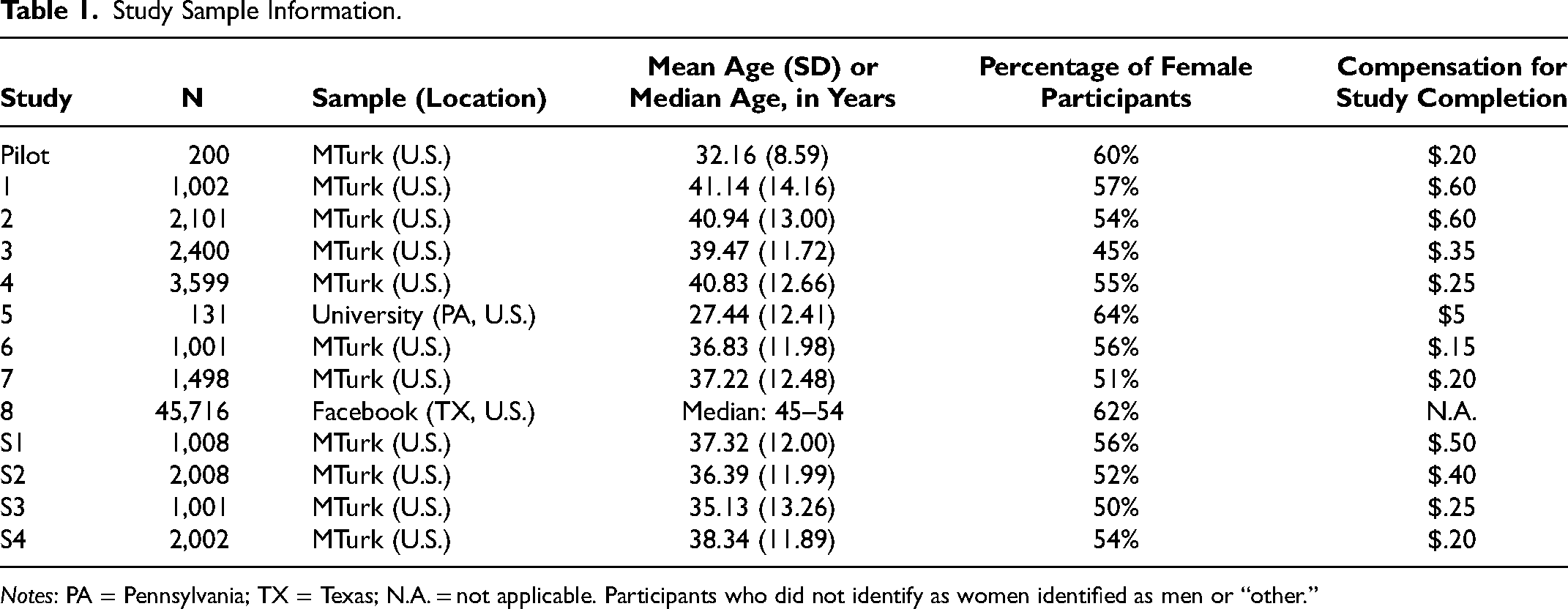
Notes: PA = Pennsylvania; TX = Texas; N.A. = not applicable. Participants who did not identify as women identified as men or “other.”
Study 1: Perceived Risk of Insufficient Processing
As a primary step, we sought to better understand consumers’ beliefs about consumption of content via real-world ephemeral and perpetual communication apps (Snapchat and Facebook Messenger, respectively). Pilot data suggested that the restriction on repeated access is a main reason for consumers to pay more attention when using ephemeral platforms. Study 1 built on this finding to investigate in greater detail consumers’ expectations regarding their own ephemeral content consumption—namely, their concerns about failing to process it sufficiently well and the cognitive resources they assume to invest in it.
Pilot Study
Method
We prescreened 200 participants who described themselves as regular users of both Facebook Messenger and Snapchat's direct messaging apps. We asked participants to imagine they received a message from a friend on these two different apps. Our instructions did not explicitly mention the fundamental difference between the apps: by default, Facebook Messenger keeps messages recorded and the recipient can access them as many times as they wish, whereas direct messages on Snapchat disappear immediately after viewing. We asked participants to indicate which of the apps they would pay more attention to and to write down at least one explanation for their choice.
Results
Exactly half of the participants chose each app as the one they would pay more attention to. A research assistant unaware of the research goals coded participants’ explanations for paying more attention to one app over the other (see Web Appendix B). Compared with Facebook Messenger, participants who provided reasons to pay more attention to messages sent on Snapchat were more likely to mention the restriction on repeated access as a reason (48% vs. 6%; χ2(1, N = 200) = 44.75, p < .001). Naturally, participants reported other reasons to pay attention to either app (e.g., typical content, user interface). Although the two platforms differed in the frequency of some of these explanations (see Web Appendix B), ephemerality predicted higher attention to Snapchat when controlling for other reasons (b = 2.38, 95% confidence interval [CI] = [1.51, 3.84], Wald = 23.15, d.f. = 1, p < .001).
Study 1
Following the pilot, we designed a controlled experiment to directly investigate whether ephemerality elevates consumers’ perceived risk of insufficiently processing content, and whether they cope with that risk by allocating more cognitive resources to its processing. To better identify ephemerality's effect on risk and processing, and to explore some of its other implications, we also measured how ephemerality affects consumers’ expectations to feel time pressure and competition with others, and their valuation of the content.
Method
In Study 1, 1,002 participants imagined that they received a photo from a friend on Facebook Messenger. We randomly assigned participants to one of three conditions that varied in what we told them about the ephemerality of the photo: (1) perpetual, where the photo could be stored and viewed repeatedly; (2) ephemeral, where the photo could be viewed only once (this is a real feature that users can activate on the app; see example in Web Appendix A); and (3) control, where we did not mention whether the photo could be viewed again.
Participants then reported (on five-point scales) how much cognitive effort they would devote to the photo (two items), and their expectations regarding various aspects of the viewing experience, including the risk of missing information (three items), how valuable the picture would be to them (three items), how much looking at the picture would make them feel under time pressure (two items), and how much it would make them feel as if they were competing with others.
Results
After exclusion of participants based on preregistered criteria, 691 remained. 2 Results held for the full sample (see Web Appendix B). The three measures of perceived risk of missing information correlated (α = .93) and were averaged into one scale. Participants’ risk levels differed by condition (F(2, 688) = 173.50, p < .001, η2 = .335); specifically, risk was greater in the ephemeral condition (M = 3.54, SD = 1.07) than in the perpetual condition (M = 1.56, SD = .85; t(430) = 18.41, p < .001, d = 1.94, 95% CI = [1.70, 2.19]) and the control condition (M = 1.83, SD = .94; t(384) = 14.25, p < .001, d = 1.54, 95% CI = [1.31, 1.78]). Risk was lower in the perpetual condition than in the control condition (t(562) = 3.66, p < .001, d = .31, 95% CI = [.14, .48]), although the difference was substantially smaller than the difference between the ephemeral and control conditions.
Similar to the risk measures, the two cognitive effort measures correlated (r = .72, p < .001, 95% CI = [.68, .75]) and were averaged into one scale. Cognitive effort also differed by condition (F(2, 688) = 43.13, p < .001, η2 = .111); participants expected to invest more cognitive effort in the ephemeral condition (M = 3.82, SD = .82) than in the perpetual condition (M = 2.95, SD = .89; t(430) = 9.42, p < .001, d = 1.00, 95% CI = [.78, 1.21]) and the control condition (M = 3.13, SD = .92; t(384) = 7.16, p < .001, d = .78, 95% CI = [.56, .99]). The effect relative to control was again substantially greater for the ephemeral compared with the perpetual condition (t(562) = 2.33, p = .020, d = .20, 95% CI = [.03, .36]). Mediation analysis using Model 4 of the PROCESS macro (Hayes 2017) suggested that ephemerality's effect on intended cognitive effort was mediated by the perceived risk of missing information (indirect effect = .53, 95% CI = [.35, .72]; see Web Appendix B).
Finally, ephemerality also increased participants’ expectations to experience time pressure (M = 3.24, SD = 1.17; vs. the perpetual condition: M = 1.30, SD = .66; t(430) = 21.69, p < .001, d = 2.29, 95% CI = [2.03, 2.55]; vs. the control condition: M = 1.57, SD = .87; t(384) = 15.79, p < .001, d = 1.71, 95% CI = [1.47, 1.95]) and to feel that they are competing with others (M = 1.82, SD = 1.10; vs. the perpetual condition: M = 1.25, SD = .63; t(430) = 6.71, p < .001, d = .71, 95% CI = [.50, .92]; vs. the control condition: M = 1.45, SD = .87; t(384) = 3.56, p < .001, d = .39, 95% CI = [.17, .60]), but it decreased or had a statistically indiscernible effect on their expected valuation of the photo (M = 3.31, SD = .78; vs. the perpetual condition: M = 3.50, SD = .75; t(430) = 2.36, p = .019, d = .25, 95% CI = [.04, .46]; vs. the control condition: M = 3.40, SD = .73; t(384) = 1.19, p = .233, d = .13, 95% CI = [−.08, .34]). Importantly, analysis of covariance (ANCOVA) showed that ephemerality's effects on risk and cognitive effort held when controlling for the other measures (ps < .001).
Discussion
Study 1 demonstrated that users of social media apps are aware of the risk of underprocessing imposed by ephemeral apps and consequently expect to devote more cognitive resources to content shared on such channels. Consumers of ephemeral messages also expect to have a greater sense of time pressure and adopt a more competitive mindset, but they do not expect ephemeral content to be more valuable than perpetual content. The study also included a control condition, where the nature of the platform was not mentioned. Results showed a bidirectional effect, whereby consumers perceived ephemeral (perpetual) communication as more (less) risky, but the effect was substantially stronger for the ephemeral mode.
Studies 2–4: Cognitive Effort, Viewing Time, and Recall
Whereas Study 1 explored consumers’ beliefs about how ephemerality affects their content consumption, Studies 2–4 examined how ephemerality affects actual content processing. Study 2 demonstrated that ephemerality facilitates increased allocation of cognitive resources to content. Study 3 investigated the relationship between ephemerality and another restriction that communication platforms impose on consumers, time pressure. Study 4 explored the moderating role of the amount of information presented on ephemerality's effect. To avoid bias due to self-selection of participants to view the stimulus again, our studies compared measures obtained after or during the first stimulus viewing. In the discussion, we elaborate on this design choice and briefly report a follow-up study in which participants could view content again before answering questions. The discussion also reports two studies demonstrating the effect's generalizability across stimulus types and to a context where both ephemeral and perpetual content are processed sequentially.
Study 2
Study 2 investigated how ephemerality affects content consumption and consumers’ perceived risk of failing to process it adequately. It further explored whether the effect was driven by enhanced processing when repeated access to content is restricted, as opposed to diminished processing when no such restriction is imposed.
Method
In this study, 2,101 participants viewed a series of nine images taken from a video recipe (see Web Appendix B) and answered questions about them. We displayed each image on a separate page, and participants could view it for as long as they wished before continuing. We randomly assigned participants to one of three conditions: perpetual, in which we told them they would be able to see the images again; ephemeral, in which we told them they would not be able to see the images again; and a baseline condition, in which they had the option to see the images again, but we did not mention this possibility in advance. To verify comprehension, we asked participants at the end of the survey how many times and for how long they could view the pictures, and used their answers as (preregistered) exclusion criteria.
The main outcome of interest was viewing time, recorded via Qualtrics. Since response time distributions are typically right-skewed (and as preregistered), we log-transformed viewing times before analysis (a Kolmogorov–Smirnov test rejected the normal distribution: D(1, 602) = .141, p < .001). After viewing the images, participants reported how much cognitive effort (two items) they invested in viewing the images, and listed all ingredients they could remember appearing in them (“free recall”). Akin to Study 1, participants self-reported (on seven-point scales) their perceived risk of missing or forgetting information in the images (two items), subjective valuation of the images (three items), and feelings of being under time pressure (two items) or in a competition with others (one item). The respective measures of these constructs correlated (rs > .55, ps < .001) and were averaged into scales.
Results
After exclusions based on preregistered criteria, 1,602 participants remained. 3 Ephemerality increased time spent viewing the images (F(2, 1,599) = 6.90, p = .001, η2 = .01, 95% CI = [.00, .02]; see Figure 1), which was longer in the ephemeral condition (M = 3.43, SD = .61) than in the baseline condition (M = 3.35, SD = .63; t(1,050) = 2.09, p = .037, d = .13, 95% CI = [.01, .25]) and perpetual condition (M = 3.30, SD = .64; t(1,160) = 3.69, p < .001, d = .22, 95% CI = [.10, .33]). The difference in viewing time between the ephemeral condition and the perpetual condition remained when we used raw viewing time (i.e., not log-transformed) and in the full sample (i.e., without exclusions); see Web Appendix B.

Study 2: Viewing Time and Perceived Risk of Underprocessing.
Participants in the ephemeral condition reported investing more cognitive effort (M = 5.71, SD = 1.27) in processing the images than participants in the baseline condition (M = 5.52, SD = 1.27; t(1,050) = 2.39, p = .017, d = .15, 95% CI = [.03, .27]) and perpetual condition (M = 5.58, SD = 1.25; t(1,160) = 1.75, p = .081, d = .10, 95% CI = [−.01, .22]), though we reject the null hypothesis only at the 10% level for the latter (Figure 2 summarizes ephemerality's effect on cognitive effort across our studies). These effects, too, were consistent in the full sample (see Web Appendix B). Although we found no statistically significant ephemerality effect on free recall (i.e., number of ingredients that appeared in the images and participants listed) in the subset of participants who passed the preregistered exclusion criteria (F(2, 1,599) = .743, p = .476, η2 = .001, 95% CI = [.00, .01]), the effect was significant in the full sample (F(2, 2,098) = 4.41, p = .012, η2 = .004, 95% CI = [.00, .01]) for the comparisons with both the baseline condition (t(1,398) = 2.49, p = .013, d = .13, 95% CI = [.03, .24]) and the perpetual condition (t(1,404) = 2.69, p = .007, d = .15, 95% CI = [.04, .25]). Furthermore, a preregistered replication that included only the focal ephemeral and perpetual conditions showed a similar significant positive effect of ephemerality on recall accuracy (see Study S1 in Web Appendix C).
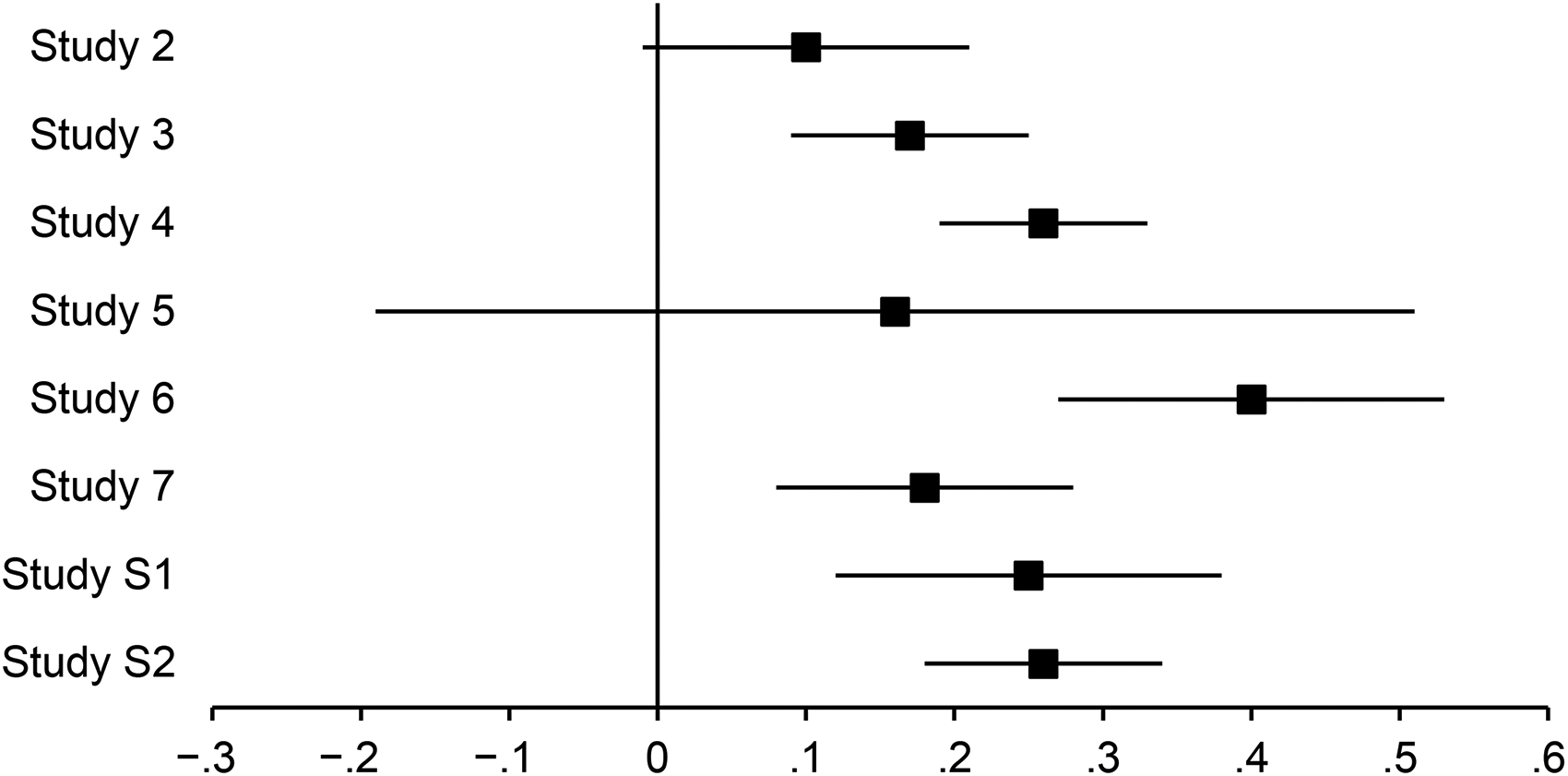
Cognitive Effort (Self-Reported Attention and Effort Remembering Stimuli).
As our theory proposes, ephemerality increased the perceived risk of missing or forgetting information (M = 5.50, SD = 1.58) relative to the perpetual condition (M = 5.21, SD = 1.70; t(1,160) = 3.02, p = .003, d = .15, 95% CI = [.03, .26]) and baseline condition (M = 5.05, SD = 1.76; t(1,050) = 4.29, p < .001, d = .23, 95% CI = [.10, .35]). Further, mediation analysis (PROCESS Model 4; see Web Appendix B) indicated that perceived risk mediated ephemerality's effect on viewing time (indirect effect = .02, 95% CI = [.01, .03]) and cognitive effort (indirect effect = .07, 95% CI = [.02, .13]).
Ephemerality also increased the sense of time pressure (M = 2.56, SD = 1.66) compared with the perpetual condition (M = 2.26, SD = 1.47; t(1,160) = 3.24, p = .001, d = .19, 95% CI = [.08, .31]) and baseline condition (M = 2.26, SD = 1.58; t(1,050) = 2.96, p = .003, d = .19, 95% CI = [.06, .31]). However, ephemerality did not significantly affect participants’ sense of competition with others or their valuation of the picture compared with either condition (ps > .10). Importantly, ANCOVA showed that the effects on perceived risk and viewing time remained significant when controlling for these measures (ps < .009). Finally, in contrast to the ephemeral condition, none of the comparisons between the perpetual and baseline conditions yielded statistically significant effects (ps > .162).
Study 3
This work focuses on the effects of restricting the number of times consumers can access content. Nonetheless, users of digital communication apps often encounter a different type of restriction: restraint of the time that a message appears on the screen while being viewed. For example, on Instagram Stories, the content changes automatically after about five seconds of viewing, and on Snapchat users can send pictures that disappear after a few seconds. Such a restriction poses a similar risk of insufficient processing on recipients and might trigger metacognitive effects on attention similar to the effects of ephemerality (Pieters and Warlop 1999). To tease apart and contrast the effects of ephemerality and time pressure, Study 3 systematically manipulated both, in a 2 × 2 between-subjects design.
Method
We randomly assigned 2,400 participants to one of four conditions in a 2 × 2 between-subjects design. We manipulated ephemerality by telling participants they would be able to view a picture once (ephemeral conditions) or more than once (perpetual conditions). Orthogonally, we also manipulated time pressure by telling participants that the picture would disappear after five seconds (high-pressure conditions) or that they could view it for as long as they wished (low-pressure conditions). Respectively, participants were able to view a living room picture from IKEA's online catalog only once (or more than once if they wanted to), for five seconds (or as long as they wanted). Participants answered a set of questions akin to Study 2 (see Web Appendix B). Measures of the same construct correlated (rs > .41, ps < .001) and were averaged into single scales. We also measured cued recall using eight multiple-choice questions and recorded viewing time. We verified understanding of the instructions via comprehension questions following the task.
Results
Participants in the ephemeral conditions invested more cognitive effort than those in the perpetual conditions (Mephemeral = 9.47, SDephemeral = 1.64 vs. Mperpetual = 9.18, SDperpetual = 1.81; t(2,398) = 4.07, p < .001, d = .17, 95% CI = [.09, .25]) and recalled details of the picture more accurately (Mephemeral = 4.28, SDephemeral = 2.11 vs. Mperpetual = 4.08, SDperpetual = 1.97; t(2,398) = 2.45, p = .015, d = .10, 95% CI = [.02, .18]). Furthermore, in the conditions where participants could view the pictures for as long as they wished, ephemerality increased their viewing time (log-transformed seconds: Mephemeral = 2.57, SDephemeral = 1.19 vs. Mperpetual = 2.25, SDperpetual = 1.13; t(1,216) = 4.70, p < .001, d = .27, 95% CI = [.16, .38]; seconds: Mephemeral = 30.24, SDephemeral = 77.81 vs. Mperpetual = 21.13, SDperpetual = 53.64; t(1,216) = 2.37, p = .018, d = .14, 95% CI = [.02, .25]).
Ephemerality also increased participants’ perceived risk of missing information (Mephemeral = 8.03, SDephemeral = 2.91 vs. Mperpetual = 7.73, SDperpetual = 2.99; t(2,398) = 2.56, p = .010, d = .11, 95% CI = [.03, .19]), which mediated (PROCESS Model 4; see Web Appendix B) its effect on cognitive effort (indirect effect = .05, 95% CI = [.01, .08]). In contrast, we found no evidence for ephemerality's effects on perceived time pressure, sense of competition with others, or valuation of the picture (ps > .182). Moreover, ephemerality's effects on perceived risk, cognitive effort, recall, and viewing time (in the low-pressure conditions) held in ANCOVA controlling for the other measures (ps < .027).
Time pressure had qualitatively similar effects on perceived risk (Mhigh_pressure = 8.11, SDhigh_pressure = 2.90 vs. Mlow_pressure = 7.66, SDlow_pressure = 2.99; t(2,398) = 3.78, p < .001, d = .15, 95% CI = [.07, .24]) and cognitive effort (Mhigh_pressure = 9.63, SDhigh_pressure = 1.55 vs. Mlow_pressure = 9.02, SDlow_pressure = 1.85; t(2,398) = 8.77, p < .001, d = .36, 95% CI = [.28, .44]) but did not affect valuation (p = .578). However, we observed notable differences between the effects of time pressure and ephemerality. As expected, limiting viewing time to five seconds had a substantially greater effect than ephemerality on participants’ sense of time pressure (Mhigh_pressure = 9.01, SDhigh_pressure = 2.40 vs. Mlow_pressure = 4.88, SDlow_pressure = 3.44; t(2,398) = 33.99, p < .001, d = 1.39, 95% CI = [1.30, 1.48]) as well as their sense of competition with others (Mhigh_pressure = 6.05, SDhigh_pressure = 3.78 vs. Mlow_pressure = 5.53, SDlow_pressure = 3.77; t(2,398) = 3.36, p < .001, d = .14, 95% CI = [.06, .22]). Furthermore, time pressure had the opposite effect on memory; participants under high time pressure recalled less information (Mhigh_pressure = 3.90, SDhigh_pressure = 1.95 vs. Mlow_pressure = 4.45, SDlow_pressure = 2.10; t(2,398) = 6.59, p < .001, d = .27, 95% CI = [.19, .35]). There was no evidence of interaction between the treatments for any of these outcomes (two-way analysis of variance; ps > .477), suggesting that ephemerality and time pressure affect consumers independently (see Figure 3).
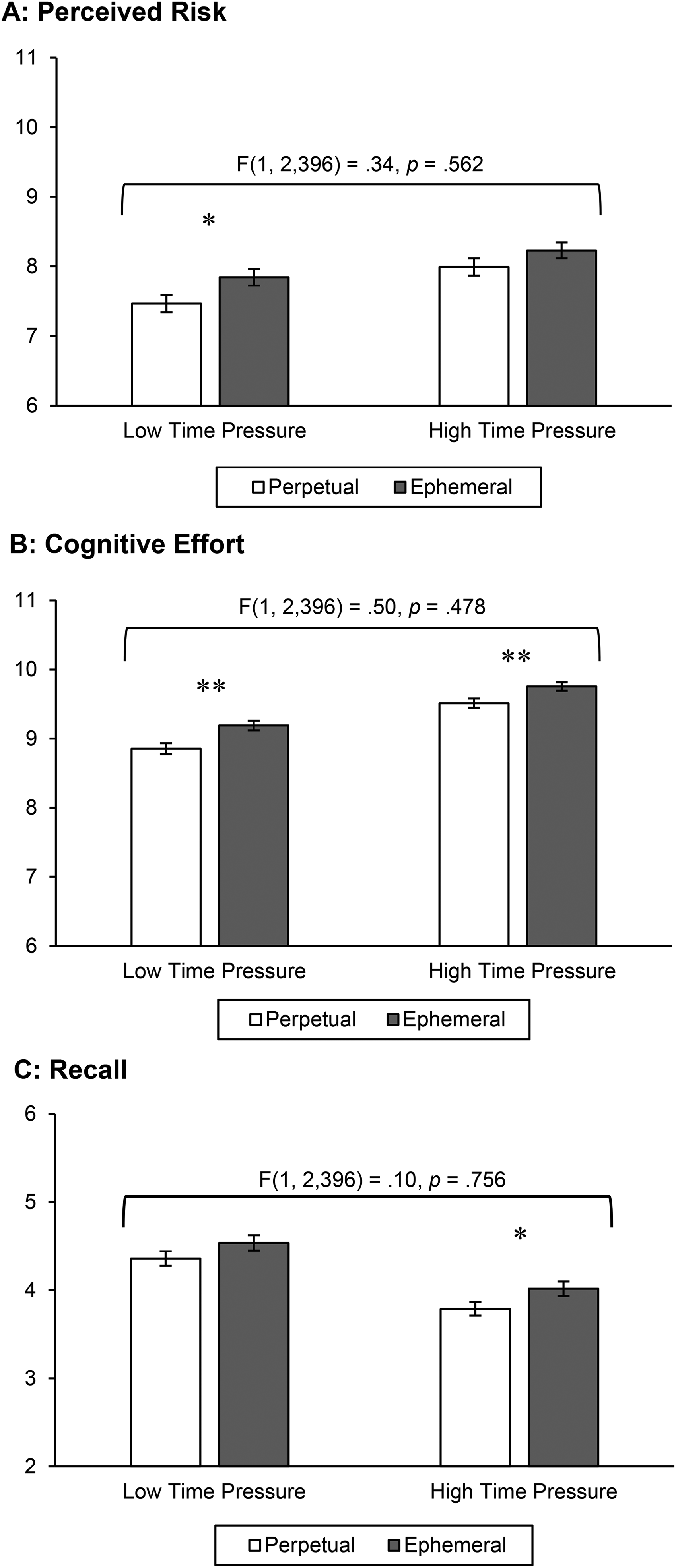
Study 3: Perceived Risk of Underprocessing, Cognitive Effort, and Recall.
Study 4
We propose that ephemerality's effects are driven by consumers’ realization that they must sufficiently process the content, as it will not be available in the future. But what if fully processing the stimulus is easy? In such cases, the risk of failing to process information sufficiently the first time around is fairly small. Respectively, as our theory dictates, consumers should be less motivated to invest increased resources in such content to mitigate that risk, implying that ephemerality's effects would be weaker. Study 4 tested this proposition empirically by studying whether ephemerality's effects are moderated by the amount of information presented.
Method
We randomly assigned 3,599 participants to one of four conditions in a 2 × 2 between-subjects design. We manipulated ephemerality as in the previous studies by telling participants that they would be able to see an image once (ephemeral conditions) or multiple times (perpetual conditions). We also manipulated the amount of information presented by varying whether the image displayed nine objects (nine-object conditions) or two randomly chosen objects from that set (two-object conditions). Respectively, participants were able to view only once (or more than once if they wanted to) an image with nine (or two) objects. Participants answered a set of questions akin to those in Studies 2 and 3 (see Web Appendix B). Measures of the same construct correlated (rs > .47, ps < .001) and were averaged into single scales. We also measured free recall by asking participants to list which objects appeared in the image, and we recorded their viewing time. 4 We verified participants’ understanding of the instructions via comprehension questions.
Results
After exclusion of participants based on preregistered criteria, 3,517 remained. Confirming our reasoning that including fewer objects allowed participants to sufficiently process the image (and thus mitigate the risk of underprocessing), participants in the two-object conditions correctly recalled on average 98% (1.96/2) of the objects compared with 63% (5.70/9) in the nine-object conditions. Consistent with that, participants who saw nine objects reported higher risk of failing to notice or remember information from the image (M9-objects = 5.19, SD9-objects = 1.71 vs. M2-objects = 3.83, SD2-objects = 2.13; t(3,515) = 20.67, p < .001, d = .70, 95% CI = [.63, .77]). Participants in the nine-object conditions also viewed the image for longer, felt increased time pressure and competition with others, and valued the image more (ts > 11.75, ps < .001), but did not report investing different levels of cognitive effort (t(3,515) = .77, p = .443).
Replicating our previous findings, participants in the ephemeral conditions reported investing more cognitive effort (Mephemeral = 5.87, SDephemeral = 1.24 vs. Mperpetual = 5.52, SDperpetual = 1.40; t(3,515) = 7.72, p < .001, d = .26, 95% CI = [.19, .33]), viewed the image for longer (Mephemeral = 16.01, SDephemeral = 14.20 vs. Mperpetual = 12.22, SDperpetual = 11.84; t(3,515) = 8.59, p < .001, d = .29, 95% CI = [.22, .36]), and recalled more objects (Mephemeral = 3.99, SDephemeral = 2.63 vs. Mperpetual = 3.55, SDperpetual = 2.38; t(3,515) = 5.22, p < .001, d = .18, 95% CI = [.11, .24]). Ephemerality also increased participants’ perceived risk of missing information (Mephemeral = 4.73, SDephemeral = 2.05 vs. Mperpetual = 4.24, SDperpetual = 2.03; t(3,515) = 7.11, p < .001, d = .24, 95% CI = [.17, .31]), which mediated (PROCESS Model 4; see Web Appendix B) ephemerality's effect on viewing time (indirect effect = .91, 95% CI = [.65, 1.18]), cognitive effort (indirect effect = .07, 95% CI = [.05, .09]), and recall (indirect effect = .16, 95% CI = [.12, .21]). In contrast, ephemerality did not significantly affect participants’ perceived time pressure, sense of competition, or valuation of the stimulus (ts < .91, ps > .364).
Importantly, the amount of information moderated ephemerality's effects on processing (see Figure 4). Decreasing the number of displayed objects attenuated ephemerality's effect on self-reported cognitive effort (F(1, 3,513) = 5.89, p = .015,

Study 4: Cognitive Effort, Viewing Time, and Recall.
The amount of information also moderated ephemerality's effect on viewing time (F(1, 3,515) = 13.80, p < .001,
Discussion
Taken together, Studies 2–4 showed that consumers invest more time and cognitive effort in ephemeral content. The effect appears to be driven by the restriction imposed by ephemeral platforms, rather than by the freedom to view content again on perpetual platforms (Study 2); is robust to consumption under low and high time pressure (Study 3); and is attenuated when there is little information to process, which mitigates the risk of underprocessing (Study 4). Three additional preregistered studies, reported in Web Appendix C, provided more evidence for the robustness and generality of this effect. In Study S2, participants viewed a video for a fixed duration instead of static images for as long as they wanted; they reported investing more cognitive effort in the video and were better able to recall information from it. In Study S3, participants sequentially viewed product images in both ephemeral and perpetual modes, akin to how they might switch between ephemeral and perpetual apps; they recalled products displayed ephemerally more accurately. Finally, since in real-world consumption people can typically watch perpetual content multiple times without being interrupted to be asked about it, in Study S4 participants in the perpetual condition could review the stimulus again before answering any questions; viewing time in the ephemeral condition was longer than the cumulative viewing time in the perpetual condition.
We propose that consumers allocate more cognitive resources to ephemeral content because of the risk this restriction poses; if they fail to sufficiently process the stimulus, they will not be able to do so in the future. Studies 2–4 supported this theory; in all three studies participants in the ephemeral condition reported a higher risk of missing or not remembering information, and these effects mediated ephemerality's effect on processing measures. The studies also measured additional psychological processes that ephemerality might trigger. In contrast to perceived risk, ephemerality did not affect participants’ self-reported valuation of the content or the extent to which they felt they were competing with others, suggesting that although ephemerality is a form of scarcity, it does not necessarily increase the perceived value of digital content, as is often the case for products subjected to supply and demand forces. Although in Study 2 ephemerality increased participants’ perceived time pressure, Studies 3 and 4 did not reveal a similar effect. Furthermore, Study 3 manipulated both ephemerality and time pressure and showed that ephemerality's effect on cognitive processing in the absence of time pressure is similar to its effect when content disappears after only a few seconds.
Study 5: Spatial Attention Allocation
Studies 2–4 demonstrated that consumers allocate more time and attention to processing ephemeral content. Study 5 used eye tracking to explore how ephemerality affects where viewers direct their attention. Eye fixations are a common measure of spatial attention allocation (Holmqvist et al. 2011; Wedel and Pieters 2008), whereby more fixations on a specific area of interest (AOI) within a stimulus reflect enhanced processing of that area (Jacob and Karn 2003). Accordingly, people fixate more on information that is relatively relevant (Hickman et al. 2010), is harder to process (Goldberg and Kotval 1999), and holds greater utility (Kim, Seligman, and Kable 2012; Krajbich, Armel, and Rangel 2010). Furthermore, as eye fixations are recorded implicitly during natural viewing, they are not susceptible to reporting bias and can reveal aspects of processing that retrospective explicit measures, such as recall, might not capture (Atalay, Bodur, and Rasolofoarison 2012; Chandon et al. 2009).
Method
In this study, 131 participants viewed, for 15 seconds, a table comparing the ratings of three cellular phones across six dimensions (e.g., design, performance), akin to comparison tables used by online retailers and product review websites. The ratings ranged from 4 to 7 (a higher score implied a better rating). One (randomly positioned) phone weakly dominated the two alternatives, such that its rating was at least as high as the ratings of the other phones in any given dimension. As in our previous studies, we randomly assigned participants to conditions where they either knew that they could see the ratings table only once (ephemeral) or knew that they could see it multiple times if they wished (perpetual). We verified participants’ understanding of the instructions but did not tell them that we would ask questions about the table.
After viewing, participants indicated which of the phones was overall best. Then, they reported on seven-point scales how confident they were in their answer, how good each of the three phones was, and how much cognitive effort they invested in viewing the table (two items). As our study had low statistical power to detect ephemerality's effects on these measures, we also conducted a well-powered replication to test these effects without the logistically complicated eye-tracking procedure (see Study 6).
We recorded participants’ eye fixations with SMI (SensoMotoric Instruments) Red-m eye-tracking equipment. Although AOIs of any visual stimulus can be defined in many ways (Orquin, Ashby, and Clarke 2016), dividing the table into 18 equally sized AOIs—one for each cell that contained a rating—was straightforward for the case at hand. Importantly, we did not make a priori hypotheses for the effects on eye fixations in this study, nor did we statistically correct for alternative analyses one could perform on rich eye-tracking data (Von Der Malsburg and Angele 2017). We thus consider this study exploratory and call for future research to further replicate our results.
Results
Participants in the ephemeral condition were more likely to identify the dominant phone as the overall best alternative than participants in the perpetual condition (Mephemeral = 66.67% vs. Mperpetual = 49.23%; χ2(1, N = 131) = 4.09, p = .043).
We excluded from the eye-tracking analyses 11 participants whose eye fixations were not recorded due to a technical issue. Across conditions, participants who correctly picked the dominant phone fixated more often on the 18 AOIs (Mcorrect = 33.49, SDcorrect = 18.10 vs. Mincorrect = 23.84, SDincorrect = 10.04; t(118) = 3.44, p < .001, d = .63, 95% CI = [.26, 1.00]). More importantly, participants in the ephemeral condition fixated more often on the AOIs than participants in the perpetual condition (Mephemeral = 32.32, SDephemeral = 18.00 vs. Mperpetual = 26.56, SDperpetual = 13.07; t(118) = 2.01, p = .046, d = .37, 95% CI = [.01, .73]). Furthermore, participants in the ephemeral condition fixated on AOIs that they already observed (i.e., revisited them) more frequently (Mephemeral = 14.76, SDephemeral = 10.19 vs. Mperpetual = 11.21, SDperpetual = 6.83; t(118) = 2.25, p = .026, d = .41, 95% CI = [.05, .77]).
Finally, mediation analysis (PROCESS Model 4) suggested that the number of fixations on the AOIs mediated ephemerality's effect on correct identification of the dominant option (indirect effect = .28, 95% CI = [.01, .76]; see the full model in Web Appendix B).
Discussion
Using eye-tracking analysis, Study 5 substantiated Studies 2–4 with evidence that ephemerality drives consumers to direct attention within a visual stimulus to relatively important information. Thus, ephemerality not only facilitates more emphatic resource allocation but also improves the efficiency of cognitive resource distribution.
Studies 6 and 7: Choice and Attitudes
So far, we have shown that consumers are aware of the risk of missing important information that ephemeral channels impose, and in response they enhance allocation of cognitive resources when processing ephemeral content. Studies 6 and 7 investigated the downstream implications of these effects by exploring how ephemerality affects the likelihood that consumers optimize their choices (Study 6) and their attitudes toward content (Study 7).
Study 6
Method
In this study, 1,001 participants saw, akin to Study 5, a table comparing the ratings of three cellular phones across seven dimensions, with one of the phones weakly dominating the others. We randomized participants to conditions where they could see the table either only once (ephemeral) or multiple times if they wished (perpetual). Participants indicated which of the phones was overall best (on the basis of their ratings), and reported (on seven-point scales) how confident they felt about their choice, how good they thought each phone was, and how much cognitive effort (two items) they invested when viewing the table. We verified participants’ understanding of the instructions by asking them whether they would be able to see the information again or not.
Results
After exclusion of participants based on preregistered criteria, 998 participants remained. Participants in the ephemeral condition reported investing more cognitive effort when reading the product ratings, compared with participants in the perpetual condition (Mephemeral = 6.16, SDephemeral = .96 vs. Mperpetual = 5.73, SDperpetual = 1.17; t(996) = 6.26, p < .001, d = .40, 95% CI = [.27, .53]). They were also more likely to correctly identify the dominant phone (Mephemeral = 73.60% vs. Mperpetual = 68.07%; χ2(1, N = 998) = 3.69, p = .055) and evaluated it as having greater quality (Mephemeral = 5.48, SDephemeral = 1.02 vs. Mperpetual = 5.33, SDperpetual = 1.06; t(996) = 2.20, p = .028, d = .14, 95% CI = [.02, .26]). Furthermore, cognitive effort mediated ephemerality's effect on correct identification of the dominant phone (indirect effect = .16, 95% CI = [.10, .24]; see the full model in Web Appendix B).
Participants who correctly identified the best phone expressed greater confidence in their choice (Mcorrect = 5.22, SDcorrect = 1.53 vs. Mincorrect = 3.97, SDincorrect = 1.53; t(996) = 11.80, p < .001, d = .82, 95% CI = [.69, .95]). In addition, participants in the ephemeral condition felt more confident about their choice than participants in the perpetual condition (Mephemeral = 5.02, SDephemeral = 1.55 vs. Mperpetual = 4.69, SDperpetual = 1.70; t(996) = 3.28, p = .001, d = .21, 95% CI = [.08, .33]).
Study 7
People naturally direct attention to stimuli that they like (Pieters, Warlop, and Wedel 2002; Van Hooff, Crawford, and Van Vugt 2011). Nonetheless, research has also shown the reverse effect, whereby allocating more cognitive resources to a stimulus amplifies people's attitudes toward it (Armel, Beaumel, and Rangel 2008; Brock and Brannon 1992; Milosavljevic et al. 2012; Smith and Krajbich 2019).
Study 7 investigated whether the increased amount of cognitive resources allocated under ephemerality affects viewers’ attitudes toward the content they watch, and specifically whether it increases their liking and desire to view more of the content.
Method
In this study, 1,498 participants watched a 15-second excerpt from a stop-motion music video and answered questions about it. A pretest (Amazon Mechanical Turk [MTurk], N = 401) indicated that the video was perceived positively: compared with the midpoint of a seven-point scale (1 = “Definitely no,” and 7 = “Definitely yes”), participants rated the video as “Interesting,” “Not boring,” and overall “Good” (Ms > 5.06, ts(400) > 11.92, ps < .001).
We randomly assigned participants to different conditions akin to our previous studies; participants knew they could watch the video clip either once (ephemeral) or multiple times if they wished (perpetual). As before, we verified participants’ understanding of these instructions but did not tell them we would ask questions about the video.
After watching, participants reported how much they liked the video and how much cognitive effort they invested in it (11-point scales). In addition, we asked them to what extent they would like to watch the full video (seven-point scale) and gave them the option to do so.
Results
After exclusion of participants based on preregistered criteria, 1,496 participants remained. As in the previous studies, participants in the ephemeral condition reported investing more cognitive effort in the video than participants in the perpetual condition (Mephemeral = 9.70, SDephemeral = 1.55 vs. Mperpetual = 9.41, SDperpetual = 1.58; t(1,494) = 3.50, p < .001, d = .18, 95% CI = [.08, .28]). Participants in the ephemeral condition also liked the video more (Mephemeral = 8.22, SDephemeral = 2.67 vs. Mperpetual = 7.90, SDperpetual = 2.71; t(1,494) = 2.35, p = .019, d = .12, 95% CI = [.02, .22]), expressed greater interest in viewing the full video (Mephemeral = 4.87, SDephemeral = 2.00 vs. Mperpetual = 4.62, SDperpetual = 2.08; t(1,494) = 2.37, p = .018, d = .12, 95% CI = [.02, .22]; see Figure 5), and were more likely to watch the full video, though we could reject the null hypothesis only at the 10% level for this outcome (37.70% vs. 33.56%; χ2(1, N = 1,496) = 2.80, p = .094). Finally, serial mediation analysis (PROCESS Model 6) suggested that the increased cognitive effort allocated under ephemerality facilitated increased liking, which then led to higher interest in viewing the full video (indirect effect = .04, 95% CI = [.02, .07]; see the full model in Web Appendix B). In contrast, separate serial mediation analysis did not provide statistical evidence that ephemerality increased liking and consequently led to higher cognitive effort and interest in viewing the full video.

Study 7: Cognitive Effort and Attitudes Toward a Video.
Participants in the perpetual condition who self-selected to view the video again naturally reported liking it more after seeing it once (M = 8.89, SD = 2.25) than participants who refrained from watching it again (M = 7.78, SD = 2.74; t(746) = 3.41, p < .001, d = .41, 95% CI = [.17, .65]) and participants in the ephemeral condition, who could not choose whether to rewatch it or not (M = 8.22, SD = 2.67; t(822) = 2.12, p = .034, d = .26, 95% CI = [.02, .49]). Importantly, although participants in the perpetual condition who chose to view the video again evaluated it even more positively after rewatching it (M = 9.24, SD = 2.27; t(75) = 2.06, p = .043, d = .24, 95% CI = [.01, .46]), ephemerality's effect on attitudes held when we compared the response of participants in the ephemeral condition with the last response recorded by participants in the perpetual condition (M = 7.93, SD = 2.73; t(1,494) = 2.09, p = .037, d = .11, 95% CI = [.01, .21]).
Discussion
Studies 6 and 7 explored ephemerality's effects on meaningful marketing-relevant outcomes. In Study 6, enhanced processing of ephemeral content facilitated better choices. This finding complements Study 5, where we found that ephemerality increases fixations on AOIs holding information about the quality of products, and that such fixations facilitate identification of the high-utility option in a choice set. In Study 7, ephemerality's effects on processing further influenced consumer attitudes: viewers of an engaging video liked it more and expressed more interest in continuing to watch it when it was ephemeral. This effect held even when considering the evaluations that participants in the perpetual condition made after watching the video again (if they chose to do so). Although this finding does not contradict the well-established phenomenon that repeated exposure facilitates favorable attitudes (Janiszewski, Kuo, and Tavassoli 2013; Zajonc 1968), and does not imply that advertisers should necessarily refrain from displaying information to consumers repeatedly (Campbell and Keller 2003; Pechmann and Stewart 1988), it suggests that ephemerality may have an overall positive effect on attitudes even when accounting for the potentially positive effects of repeated exposure in people who choose to view the content again.
Study 8: Time Viewing a Social Media Post
The preceding studies allowed us to precisely estimate ephemerality's causal effects on information processing under controlled settings. Study 8 was a split test on Facebook evaluating ephemerality's effects in a real-world advertising campaign context. To this end, we employed Facebook's A/B testing tool, commonly used by practitioners contrasting advertising strategies and researchers studying behavior amid natural settings (Gordon et al. 2019; Kupor and Laurin 2020; Matz et al. 2017; Orazi and Johnston 2020).
Method
Our target audience was English-speaking adults who were located in a large U.S. city and were interested in pets and/or cats. Using Facebook's A/B testing tool, we exposed users to two versions of a video post showing two cats playfully fighting for 15 seconds, with Bob Marley and the Wailers’ “Get Up, Stand Up” in the background. In the perpetual version, the video started with five seconds of a black screen with the text “you will be able to see this video again later.” The ephemeral version was identical, except that the text said “you will not be able to see this video again later.” In both versions, the post also included a caption disclosing that it was sponsored.
Facebook's A/B testing tool created two exposure groups of roughly equal size (N = 45,716; Nephemeral = 22,879, Nperpetual = 22,837). It ran two campaigns simultaneously: one with the perpetual post and another with the ephemeral post. To reduce the potential impact of Facebook's optimization algorithms (Braun and Schwartz 2022), we did not allow the campaigns to personalize creative elements or perform budget optimization, and we restricted the post's placement to Facebook news feed and Facebook video feed.
Results
Facebook provides various aggregate measures evaluating video campaigns’ effectiveness, including impressions (number of times the video was displayed on screen long enough to assume users noticed it); number of viewings of at least 25%, 50%, 75%, and 100% of the video's full length (in this case, the 5th, 10th, 15th, and 20th seconds); average viewing time; and the cost per viewing.
On average, users exposed to the ephemeral campaign viewed the video longer (four vs. five seconds). Exposed users in the ephemeral condition were also more likely to view the video for longer than five seconds (i.e., continue to watch after the initial text; 26.70% vs. 24.22%; χ2(1, N = 45,716) = 37.10, p < .001) and to view it past each of the time brackets quantified (ps < .001; see Web Appendix B). Facebook also estimates the costs to produce a certain outcome. Although the cost to get users to view the video for 2 seconds (i.e., view the text) was identical in the ephemeral and perpetual conditions ($.008), the cost of a viewing of at least 15 seconds (Facebook terms this metric “ThruPlay”) was lower in the ephemeral condition ($.05 vs. $.07).
Discussion
Study 8 explored how ephemerality affects advertising efficiency amid real-world settings. Although the study's data did not allow us to estimate the causal treatment effect on an average user (Braun and Schwartz 2022), the study did demonstrate that ephemerality improves meaningful aggregate campaign metrics. Specifically, framing a sponsored video as ephemeral facilitated longer viewing time, which can reduce the costs of achieving a given amount of exposure.
General Discussion
Many forms of communication, from verbal conversations to messaging and content sharing on social media, give consumers only a single opportunity to view content. In a series of lab experiments and a field study, we find that imposing this restriction of ephemerality increases consumers’ allocation of attention and time to content. Subsequently, it improves information recall, enhances favorable attitudes toward likable content, and facilitates identification of high-quality alternatives in a choice set.
Access Restrictions in the Digital Age
The digitization of media platforms has made it much easier to provide consumers repeated access to information. Despite the benefit of allowing consumers to view content as many times as they want, whenever they want, leading communication apps have introduced features that limit these freedoms. Here, we study the restriction on the number of times content can be viewed, but two additional restriction types have gained popularity in recent years. First, some apps let users decide for how long content is displayed before it disappears, even if it can be viewed multiple times. The psychological ramifications of this restriction type, namely time pressure, have been studied extensively over the past few decades (e.g., Svenson and Maule 1993). Intriguingly, some of our studies showed that ephemerality induces a subjective experience of time pressure even though ephemerality does not impose time pressure in an objective sense. Nonetheless, this effect was substantially smaller than that of actual time pressure. Moreover, ephemerality's effect on consumers’ allocation of cognitive resources held when controlling for subjective time pressure, and whether time pressure was objectively present or not (Study 3).
Second, some social media apps allow users to restrict the amount of time that content remains available for other users (e.g., users may view Instagram Stories as many times as they wish, but only during the 24 hours after they were posted). Although recent work has shown that such a restriction can improve advertising outcomes (Belanche, Cenjor, and Pérez-Rueda 2019), no studies have investigated its effects on information processing quality. Since content that remains available for an entire day allows consumers to comfortably and repeatedly view it, we reason that such restriction does not affect consumers’ allocation of cognitive resources relative to content that remains available indefinitely. Nonetheless, continuous exploration of the independent and combined effects of these restrictions on consumers is worthwhile and presents ample opportunities for future research.
Implicit Versus Deliberate Resource Allocation
We argue that consumers enhance resource allocation to ephemeral content to mitigate the risk associated with not being able to see it again. Although participants in our studies reported feeling enhanced risk of failing to sufficiently process ephemeral (vs. perpetual) content, previous research suggests that consumers need not be fully cognizant of that risk for the effect to occur. For example, work on the affect heuristic has shown that people can react automatically to risk based on implicit affective evaluation (Denes-Raj and Epstein 1994; Slovic and Peters 2006). Furthermore, ephemerality is a form of informational scarcity, in the sense that it limits the availability to consume content repeatedly. Although in our studies ephemerality did not consistently increase participants’ self-reported valuation of the content they viewed, it is still possible that its scarcity triggered them to implicitly perceive it as more valuable and consequently allocate more attention to it (Brock and Brannon 1992). Future work should further explore the role played by implicit (vs. conscious) risk perceptions evoked by ephemerality, and their downstream effects.
Similarly, future research may build on our work to illuminate the cognitive mechanism underlying the effect, and the extent to which it is driven by top-down versus bottom-up processing. As participants in our studies viewed identical content across conditions but allocated more cognitive resources to it because of their a priori knowledge about its future availability, this work highlights the role of volitional, top-down resource allocation (Srna, Schrift, and Zauberman 2018). Nevertheless, perception involves both top-down directed attention allocation and bottom-up responses to stimuli (Connor, Egeth, and Yantis 2004). This was evident in our studies; in Study 4, ephemerality's effect attenuated when the amount of information in the stimulus was smaller.
Informational Goods
The current research focuses on digital content, a product category that is rapidly growing and is becoming an increasingly central part of consumers’ lives (Atasoy and Morewedge 2018). Furthermore, digital media platforms provide marketers and consumers readily available apps to communicate ephemerally. Although testing ephemerality's effect on consumption of nondigital experiential goods is beyond the scope of the current research, we speculate, on the basis of our theory, that our findings would generalize to consumption of other experiences that can (or cannot) be repeated, such as watching one's favorite band perform live.
We limited our investigation to visual stimuli. Since increased attention to auditory stimuli was shown to have similar effects on processing as for visual stimuli (Fritz et al. 2007), we believe that ephemerality affects processing of audio content similarly. However, a related open question is how ephemerality affects simultaneous processing of visual and auditory information. Previous research has highlighted the complexity of the relationship between the two modalities and has explored circumstances where paying attention to visual and auditory information at the same time improves or diminishes processing quality (Calvert 2001; Payzan-LeNestour et al. 2021). For example, recent research has shown that making people focus on visual aspects of stimuli by letting them take photos of it improves recall of visual information but impairs recall of auditory information processed simultaneously (Barasch et al. 2017). Future work may investigate whether ephemerality differentially affects processing of visual, auditory, and audiovisual stimuli, as well as consumption of content via different modalities at the same time (e.g., observing pictures while listening to music).
Finally, we found ephemerality effects for various content types, from entertaining videos to personal messages and instructional information. Another promising avenue for future research is studying how ephemerality impacts the effectiveness of persuasive messages. As increased attention facilitates deeper and more critical processing (Petty and Cacioppo 1986), it is important to understand how ephemerality affects people's reactions to persuasive messages, and whether it interacts with other drivers of persuasion such as message style (Petty, Cacioppo, and Heesacker 1981), the appearance of the persuasion agent (Chaiken 1979), and the congruency between the message and the target's attitudes (Clark, Wegener, and Fabrigar 2008).
Conclusion
Capturing consumers’ attention is essential for achieving many goals marketers set, including increasing brand recall (Mehta and Purvis 2006), improving comprehension of marketing communications (Celsi and Olson 1988), and influencing product choice (Reutskaja et al. 2011), particularly in the era of an “attention economy,” where consumers are inundated by a constant flux of information (Caplin and Dean 2015). Accordingly, the insight that one can increase audience engagement by making content ephemeral is important: it informs campaign managers deliberating on which platform to display their ads, social media users reflecting on whether to share their thoughts and feelings via perpetual or ephemeral channels, and online educators deciding whether to record their lectures. Since communicators often have both ephemeral and perpetual channels readily available to use, this decision is already of practical relevance for the implementation of actionable communication strategies.
While communicators typically want to capture more of their audience's attention, ephemeral communication might sometimes backfire. A central advantage of sharing content ephemerally is the reduced risk that it would negatively affect its sender in the future. Indeed, users perceive ephemeral platforms as safer and tend to use them for sharing content that might portray them negatively (Hofstetter, Rüppell, and John 2017). Ironically, our studies show that when doing so, they also increase their audience's attention and recall, potentially contributing to formation of a negative image of themselves in others’ minds.
Supplemental Material
sj-pdf-1-mrj-10.1177_00222437221131047 - Supplemental material for The Effects of Content Ephemerality on Information Processing
Supplemental material, sj-pdf-1-mrj-10.1177_00222437221131047 for The Effects of Content Ephemerality on Information Processing by Uri Barnea, Robert J. Meyer and Gideon Nave in Journal of Marketing Research
Footnotes
Acknowledgments
The authors thank J. Wesley Hutchinson, Shiri Melumad, Jackie Silverman, Lynn Selhat, and Yael R. Kaplan for their insightful comments and support. They also thank the Wharton Risk Center, the Mack Institute for Innovation Management, and the Wharton Behavioral Lab for their resources, as well as Robert Botto and Shawn Zamechek for assisting in technical aspects of the studies.
Associate Editor
Shailendra P. Jain
Declaration of Conflicting Interests
The author(s) declared no potential conflicts of interest with respect to the research, authorship, and/or publication of this article.
Funding
The author(s) received no financial support for the research, authorship, and/or publication of this article.

Notes
References
Supplementary Material
Please find the following supplemental material available below.
For Open Access articles published under a Creative Commons License, all supplemental material carries the same license as the article it is associated with.
For non-Open Access articles published, all supplemental material carries a non-exclusive license, and permission requests for re-use of supplemental material or any part of supplemental material shall be sent directly to the copyright owner as specified in the copyright notice associated with the article.
