




Abstract
Noting the proliferation of product recalls and extensive use of lobbying in some critical product markets (e.g., automobiles, medical equipment), the authors examine the relationship between lobbying and product recalls. Lobbying does not alter product quality, so an efficiency perspective would suggest no relationship. However, a legitimacy-based institutional theory perspective and associated regulation models suggest that lobbying reduces voluntary firm-initiated and mandatory regulator-initiated recalls. To provide insights into these questions, the current study explores nine years of multisource data from the automotive industry, related to recalls and lobbying. The results, obtained with an instrumental variable approach, support dual impacts of lobbying for reducing both voluntary and mandatory recalls. Defect severity and media coverage moderate the effects, and the data support full indirect moderation, such that the interaction between media coverage and lobbying mediates the interaction between defect severity and lobbying. In terms of effect sizes, approximately $404,367 ($1.66 million) more in lobbying expenditures is associated with one fewer voluntary (mandatory) recall, assuming a typical average recall of 235,638 vehicles. This study highlights lobbying as an important (marketing) tool that automotive companies use to manage their regulatory environment, with deep implications for policy making, research, and practice.
Keywords
A 2010 U.S. Congressional report, examining the slow response of Toyota to hundreds of vehicle accidents due to sudden acceleration in 2009–2010, alleged lobbying influences by automotive firms (Kirchhoff and Peterman 2010). It cited an internal Toyota document (dated July 6, 2009), in which the chief operating officer highlighted several “wins,” such as delaying final safety rules by National Highway Traffic Safety Administration (NHTSA), persuading NHTSA officials to impose smaller sanctions, and realizing monetary savings (e.g., negotiating the equipment recall on its Camry model saved Toyota $100 million). 1 In the U.S. consumer products industry, similar news reports detail how lobbying firms (e.g., Bracewell LLP) work to limit Consumer Product Safety Commission (CPSC) sanctions on defective product producers (Levin 2019). In one case, legislators even asked the CPSC chairperson to disclose her contacts with business groups and testify as to whether she directed employees to delay corrective actions (U.S. Congress 2019). Table 1 contains other examples of lobbying activities across industries.
Examples of Lobbying Influences Across Industries.

The automotive industry, which accounts for almost 3% of U.S. annual gross domestic product, 2 features an especially worrisome number of recalls. The yearly recall rate increased starting in 1990 and peaked in 2014 with 63 million vehicles (Borah and Tellis 2016); in 2016, recalls involved 50.5 million vehicles and cost firms almost $22.1 billion in direct costs (Jibrell 2018) as well as incalculable indirect costs (e.g., reputation loss). The regulatory scrutiny the automotive industry thus attracts creates notable space for lobbying efforts. 3 In this highly relevant context, we accordingly investigate how product recalls and lobbying interact, in an effort to address several important research questions. Does lobbying influence product (vehicle) recalls? Are there significant differences in voluntary recalls initiated by firms themselves, based on their lobbying expenditure levels? Does lobbying influence mandatory recalls by public agencies and regulators such as the NHSTA? Which underlying mechanisms affect recall decisions? The answers to these questions are not obvious. Objective product quality should be the only determinant of product recalls, and lobbying should have no impact, because it does not alter product quality. Yet anecdotal evidence suggests otherwise. Uncovering a relationship between lobbying and product recalls thus can offer critical strategic marketing and public policy insights.
In the U.S. passenger car market, we gather recall and lobbying expenditure data from major automotive firms. They reveal a negative association between lobbying expenditures and recalls (voluntary and mandatory). Fewer voluntary recalls arguably should offer regulators more opportunities for mandatory recalls, but our data indicate that regulators do not compensate for changes in firms’ recall behaviors. Instead, their tendency to recommend mandatory recalls decreases with rising lobbying expenditures. Thus, when they increase their lobbying expenditures, automotive firms gain dual benefits, in the form of reduced voluntary and mandatory recalls. These findings emerge from our application of instrumental variable, which enables us to address the empirical challenges related to the potential influence of omitted variables on firms’ decisions to lobby and to recall. In an analysis of contextually grounded moderators, we find that defect severity and media coverage moderate (i.e., weaken) the effects of lobbying on recall decisions. The interaction of media coverage and lobbying also mediates the moderating effect of defect severity on the link between lobbying and recall decisions.
With these detailed findings, our study makes several contributions to marketing. First, we empirically establish the validity of societal concerns pertaining to how lobbying affects recalls in the auto industry, where defects can have severe consequences for consumers. More broadly, we present regulatory dimensions and thus extend beyond existing recall literature, which mainly adopts a business orientation. The interface of marketing and politics is a critical but underdeveloped research domain (cf. Han et al. 2019; Jung and Mittal 2020; Martin et al. 2018), especially in relation to regulatory oversight in industries in which such mandates have powerful influences on firms’ operations (KPMG 2015). By combining considerations of both recalls and lobbying, we demonstrate how firms manage political risks in practice. Second, our findings reveal an instrument (i.e., the media) that stakeholders (e.g., consumers, safety advocacy groups) can use to counterbalance the negative impact of lobbying. Thus, in addition to identifying an external influence, we present an actionable solution. Third, we integrate legitimacy-based institutional theory with the regulatory iron triangle perspective to clarify firm recall behaviors.
Institutional Background
We detail critical institutional features for automotive recalls and corporate lobbying activities, as well as the mechanisms by which lobbying can influence regulatory agencies.
Automotive Recalls
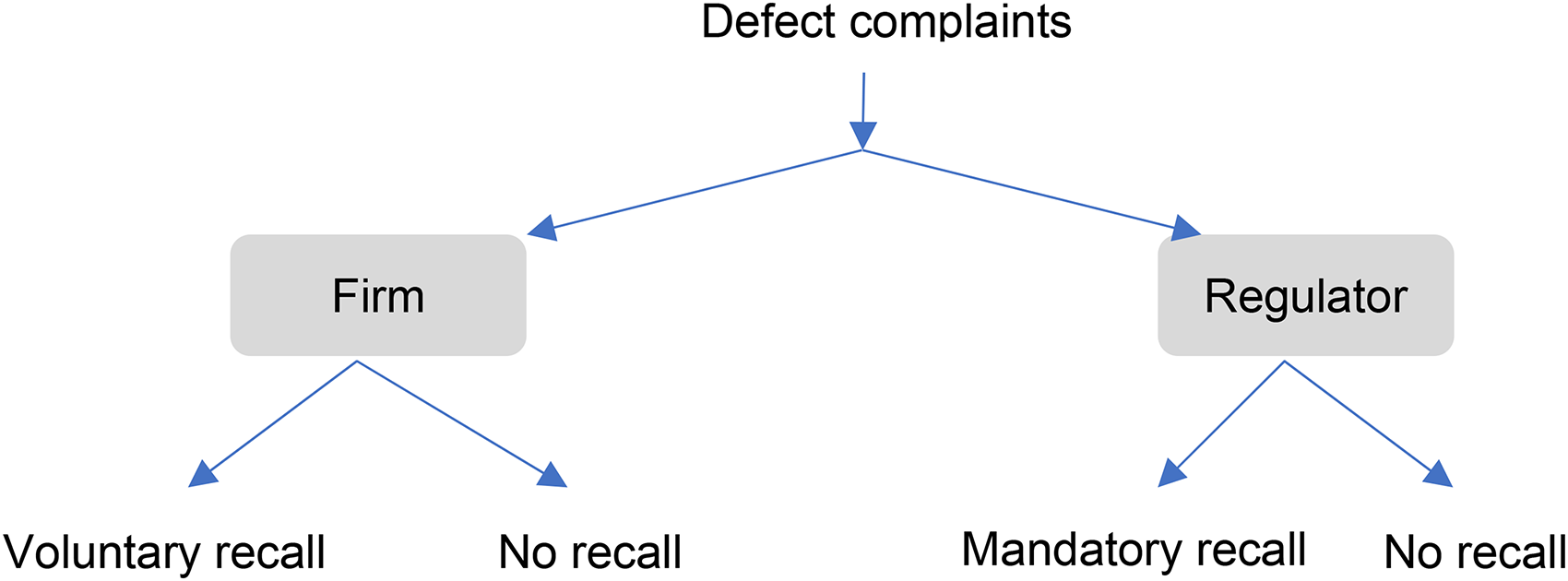
The NHTSA is responsible for oversight of vehicle safety in the United States: It initiates recalls, monitors the effectiveness of ongoing recalls, and maintains multiple channels for consumers to submit complaints (e.g., phone, email, website), through which it receives nearly 4,000 complaints every month (NHTSA 2006). Depending on the type of complaint, the NHTSA assigns it to one of 37 categories (e.g., power train, suspension). The NHTSA also tracks automotive-related injuries and deaths and makes these data available to manufacturers, which are expected to combine the information with their own private information (e.g., the firm's financial health) to decide whether to recall (voluntary). Simultaneously, the NHTSA retains the authority to recommend a mandatory recall, based on the available information.
We present a schematic for the recall process in Figure 1, such that we conceptualize the process as occurring at every decision interval (usually a calendar quarter, reflecting quarterly reporting of firms’ lobbying expenditures). A typical recall process starts with consumer complaints about vehicle defects, though a firm's own tests might reveal defects as well. As noted, the firm analyzes complaints and its private information to decide whether to initiate a voluntary recall, and the NHTSA may recommend a mandatory recall if the firm does not initiate one voluntarily.
Recall Process.
Furthermore, as a government agency, the NHTSA functions in a politically active environment. The U.S. president nominates its chief, and its oversight committees consist of senators and representatives. Figure 2 highlights the jurisdiction structure of NHTSA provided on the U.S. Department of Transportation website. 4 Within this structure, political actors interact with the NHTSA, so channels exist for automotive firms to use lobbying to build connections with powerful actors and exert influence, such as encouraging the agency to make choices that favor the lobbying firm (e.g., limiting investigations into complaints, not recommending mandatory recalls) (see, e.g., dlevinthal 2018; Ramonas 2014). The firms then can adopt a passive response to defect reports. We investigate this dimension of political influence in firms’ recall decisions.

U.S. Congressional Committee of Jurisdiction.
Corporate Lobbying
Lobbying Disclosure Act (LDA)
The 1995 LDA governs lobbying activities in the United States and requires firms to disclose their lobbying expenses. It defines “lobbying activities” as contacts and efforts in support of such contacts, including preparation and planning activities, research and other background work, and coordination with others’ lobbying activities. 5 Lobbying firms must file separate reports for each client, containing information about their activities, such as the revenue generated and the issues for which the firm lobbied on that client's behalf during that period. The only exceptions are if a client spends less than $3,000 in a quarter for lobbying. If lobbying income exceeds $5,000, a lobbying firm must provide a good-faith estimate of the actual amount, rounded to the nearest $10,000. Firms with in-house lobbyists report lobbying when these activities exceed $14,000 in a quarter. 6 The Honest Leadership and Open Government Act of 2007 required firms to start reporting lobbying expenditures quarterly as of 2008; previously, they filed semiannual reports to the Senate's Office of Public Records.
Lobbying functions
Firms might use internal (in-house) or external (professional firms) lobbyists to interact with politicians and their appointees to further their interests. Many lobbyists previously held positions in government agencies, which increases their political connections and effectiveness (Ridge, Ingram, and Hill 2017). Lobbyists help firms support or contest proposed legislative bills. Because the resulting legislation determines their macroenvironment, lobbying helps these firms shape this environment. Thus, lobbying investments build political capital.
Lobbyists serve two primary functions (Bertrand, Bombardini, and Trebbi 2014). First, they provide expertise on policy issues. They conduct research and provide information to stakeholders (e.g., legislators, regulators) to further their clients’ interests (e.g., changes to enforcement; introduce, modify, or kill legislative bills). Lobbyists’ expertise can be particularly valuable if legislators lack the technical background or resources to conduct in-depth analyses of a proposed bill on their own. Some lobbyists even create draft versions of the bills for lawmakers (Chang 2013), so the firms that hire them exert substantial influence on the resulting policy.
Second, lobbyists build connections to provide clients with access to politicians. Many lobbyists are former government employees, with access to government agencies (Ridge, Ingram, and Hill 2017). Hedge fund managers thus seek lobbyists with access to inside information about financial markets, for example (Mullins and Scannell 2006). Blanes i Vidal, Draca, and Fons-Rosen (2012) define the U.S. lobbying industry as a market for political connections that facilitates rent seeking (Alexander, Mazza, and Scholz 2009). These political connections can produce valuable outcomes (Fidrmuc, Roosenboom, and Zhang 2018; Igan, Mishra, and Tressel 2012; Richter, Samphantharak, and Timmons 2009), such as lower corporate taxes, bailouts, or reduced regulatory oversight. During the COVID-19 pandemic, lobbyists reportedly managed to secure billions of dollars in U.S. federal aid for their clients (Slodysko 2020).
Lobbying as political activity
We investigate lobbying, instead of other forms of political activities such as campaign contributions, for three key reasons. First, legal limits constrain political contributions, whereas lobbying expenditures are not subject to any limits. In monetary terms, they are the largest form of corporate political activity in the United States (Milyo, Primo, and Groseclose 2000). In 2012, lobbying expenditures reached $3.5 billion, substantially more than the $750 million spent on campaign contributions (De Figueiredo and Richter 2014). Second, lobbying can take place throughout the year, and firms can hire as many lobbyists as they want. In contrast, campaign contributions usually go to a particular candidate during election seasons. Third, laws limit the support corporations may provide to political candidates, so firms usually establish political action committees to raise money from third-party sources (e.g., employees, shareholders), such that most campaign contributions formally come from individuals, not corporations (e.g., Adelino and Dinc 2014; Chen, Parsley, and Yang 2015).
Conceptual Background
Product Recalls
As Table 2 reveals, marketing studies of product recalls take multiple perspectives. First, some studies focus on tangible performance aspects and establish how recalls negatively affect firm performance and market value (Chen, Ganesan, and Liu 2009; Cleeren, Dekimpe, and Helsen 2008; Liu and Shankar 2015). Second, studies that explore strategic aspects consider the effectiveness of marketing-mix variables following a recall (Van Heerde, Helsen, and Dekimpe 2007). Third, research investigates intangible outcomes, such as impacts on brand image and loyalty (Souiden and Pons 2009), along with spillover effects for products produced by the same manufacturer or competitors (Bala, Bhardwaj, and Chintagunta 2017; Borah and Tellis 2016; Freedman, Kearney, and Lederman 2012). Fourth, some studies explore which factors (e.g., product scope, supply chain proximity, political spending, financial conditions) affect product quality and subsequent recalls (Bray, Serpa, and Colak 2019; Rayfield and Unsal 2019).
Overview of Recall Literature.

Corporate Lobbying
Firms can use corporate lobbying as a strategic tool to create political connections and gain benefits (Richter, Samphantharak, and Timmons 2009) as well as to gain private information, tips, and predictions. Alexander, Mazza, and Scholz (2009) find that firms that lobbied for the American Jobs Creation Act of 2004 earned returns in excess of $220 for every $1 spent. In the mortgage industry, Igan, Mishra, and Tressel (2012) determine that lenders engaging in lobbying enact riskier lending practices ex ante, then benefit more from bailout programs. Blanes i Vidal, Draca, and Fons-Rosen (2012) specify that lobbyists formerly employed by the federal government generate the most lobbying revenues. As Gao and Huang (2016) show, hedge fund managers connected to lobbyists trade more heavily in politically sensitive stocks and outperform managers of unconnected funds. Firms can obtain nonfinancial returns too; among those subject to class-action lawsuits, firms that lobby more achieve longer class-action periods, and lobbying appears to delay fraud detection (Yu and Yu 2011). Politically connected firms are less likely to be subject to enforcement actions (Correia 2014), and Kroszner and Stratmann (1998) uncover relaxed regulatory oversight due to political connections. Such findings underlie our prediction that lobbying is associated with regulatory agencies’ favorable treatment of firms in recall contexts.
Lobbying and Product Recalls
Our conceptual foundation resonates with efficiency and legitimacy perspectives from organizational sociology literature (Meyer and Rowan 1977; Zucker 1987) and its marketing offshoots (e.g., Ertimur and Coskuner-Balli 2015; Grewal and Dharwadkar 2002). Lobbying does not change product quality, so an efficiency perspective implies that it should not influence recalls. But organizational sociology theories from a legitimacy perspective (DiMaggio and Powell 1983) would predict a potential relationship between lobbying and recalls. In turn, a combination of efficiency (economic fitness) and legitimacy (social fitness) perspectives might explain how firms cope with institutional demands (Oliver 1991). For example, donors to social service agencies want those agencies to be economically accountable for their uses of donated funds, consistent with an efficiency perspective (Oliver 1991).
In recall contexts, an efficiency perspective emphasizes economic accountability and the potential for short- and long-term economic gains from a decision (recall/no recall), whereas a legitimacy perspective focuses on whether firms are legitimate in the social context, such as whether they take voluntary steps to ensure the safety of their vehicles or to reduce their carbon footprint. Suchman (1995, p. 574) defines legitimacy as “a generalized perception or assumption that the actions of an entity are desirable, proper, or appropriate within some socially constructed system of norms, values, beliefs, and definitions.” Because firms risk illegitimacy penalties if they fail to gain recognition as legitimate (Zuckerman 1999), they often incorporate societally legitimated elements to enhance their survival likelihood (Meyer and Rowan 1977). Such elements arise, indirectly, from concerns about social fitness that prompt influential institutions (e.g., Environmental Protection Agency) or mechanisms (e.g., emission laws) to implement features that require organizations to make trade-offs. This duality of efficiency (economic fitness) and legitimacy (social fitness) thus provides a more holistic perspective on organizations’ reactions to institutional pressures (e.g., recalls).
Most prior recall literature adopts an efficiency perspective and predicts that product quality and consumer well-being (i.e., efficiency goals) drive recall decisions. If entities (firms, regulators) only care about efficiency goals, then lobbying that does not change product quality or directly influence consumer well-being should not influence recall decisions. However, this view ignores the relevance of social fitness. For example, because the NHTSA has discretion, and uncertainty exists surrounding recalls, political capital might affect its decisions. Related to corporate charitable contributions, Galaskiewicz (1997, p. 445) notes that “expenditures fall to the discretion of managers who can only use their good judgment in deciding whether to give and at what level. The uncertainty surrounding these decisions frees them from strict efficiency norms and makes them susceptible to outside influences, including the larger business culture, public policies, and community institutions.” Accordingly, we adopt a social fitness perspective to predict how political influence may work in recall contexts.
External influence and automotive recalls
Laffont and Tirole (1991) outline several mechanisms (e.g., bribes, lobbying, personal relationships, campaign contributions, public criticism) that interested parties can use to exert influence. Lobbying is prominent as a means to establish political influence (Bertrand, Bombardini, and Trebbi 2014; Blanes i Vidal, Draca, and Fons-Rosen 2012), which in turn can evoke preferential treatment, manifested in enforcement decisions by the Securities and Exchange Commission (Correia 2014), supervisory decisions in the banking industry (Lambert 2018), or fraud detection cases (Yu and Yu 2011). For recalls, this preferential treatment might take the form of fewer mandatory recalls or lax regulatory supervision that reduces firms’ motivation to initiate voluntary recalls. Because recalls lead to direct costs (e.g., defect remedy, repair) and indirect costs (e.g., loss of reputation, lawsuits), any strategy that promises preferential treatment and lowers the probability of a costly recall represents a potentially appealing strategy for the firm.
Research on regulation models supports this argument (Peltzman 1976; Stigler 1971). Laffont and Tirole (1991) present a “regulation capture” view that suggests that firms engage in rent seeking for preferential treatment, which leads regulators to make decisions that benefit the firms they are supposed to regulate (Stigler 1971). Figure 3 depicts this “iron triangle” interaction (Adams 1981; Freeman 1965), which includes a broad set of incentive exchanges among government (legislators), regulators, and industry actors. Exchanges between the regulated industry and legislators (left side of the triangle) involve firms that leverage their economic power to gain influence, such as directing resources toward politicians’ election campaigns. In return, politicians may take actions to promote the firms’ interests (Stigler 1971). For example, if a firm has a significant presence in the legislator's region (e.g., large employer), the economic success of constituents in that area should depend on firm success, so policies favorable to the firm could extend the legislator's political life.

Interactions Among Different Actors.
Incentive exchanges between legislators and the regulator, whose decisions might be a function of legislators’ interests, appear on the right side of the triangle. In the auto industry, legislators determine the NHTSA's financial resources. Due to their political control over bureaucracies (Weingast and Moran 1983; Wood and Waterman 1991), legislators can use various means (e.g., budgets, committee oversight) to reward or punish regulatory agencies. Thus, the regulator may be motivated to take enforcement actions (e.g., leniency toward selected firms) favored by the legislator and constituents (Correia 2014), or else risk punishment. 7
Finally, firms interact with the regulator by leveraging political connections to influence enforcement decisions (bottom right, Figure 3). That is, firms exert political influences on legislators, who can use diverse means (e.g., budgets) to sway the decisions of the regulators and encourage them to provide preferable treatment (e.g., lax regulations) to those particular firms. A rational regulator seeks an outcome that optimizes the political support provided by groups interested in the regulation (Peltzman 1976). Thus, regulators may act in accordance with the industry's interests (e.g., fewer mandatory recalls, lax oversight of customer complaints).
This discussion suggests that firms deploy strategies to curry favors from regulators and, in the process, define what constitutes social fitness, in a way that matches their organizational preferences. In a recall context, the quest for social fitness may involve lobbying to build relationships with regulators. Regulatory capture theory further suggests that firms that lobby more are less likely to be subject to a formal enforcement action. Thus, if lobbying facilitates preferential treatment, we should observe a negative association between firm lobbying and mandatory recall actions. This regulatory capture also may motivate automotive firms to act less proactively, leading to fewer voluntary recalls, so we also anticipate a negative association between firm lobbying and voluntary recall actions.
Moderating Effects
The intensity of the effect of lobbying on product recalls might vary with the recall context, so we explore some contextual variables that might influence firms’ and/or regulators’ decisions. In their pursuit of social fitness, firms take actions to increase their legitimacy (Oliver 1991), which also depends on consumers’ perceptions (Ahluwalia, Burnkrant, and Unnava 2000; Suchman 1995; Van Heerde, Helsen, and Dekimpe 2007). Therefore, we explore variables that likely determine consumer reactions, which in turn can inform recall decisions and organizational legitimacy. We categorize these variables as related to (1) information that determines the recall and (2) attention the information receives.
The most critical information for recalls is defect severity (Eilert et al. 2017; Hoffer, Pruitt, and Reilly 1988; Thomsen and McKenzie 2001), measured by the number of deaths reported. Negative consumer reactions increase with the severity of the potential consequences of a defect (Hoffer, Pruitt, and Reilly 1988; Liu and Shankar 2015), which could have several detrimental consequences for firms (e.g., sales and reputation losses, lawsuits). Defect severity also increases the complexity of recall decisions. On the one hand, defects with severe consequences incur greater financial and nonfinancial losses (Hoffer, Pruitt, and Reilly 1988), so firms might seek to delay recalls as reports of deaths increase, to gain time and opportunities to investigate the cause. If such an investigation shows that the problem does not warrant action, the firm may avoid the recall altogether (Chen, Ganesan, and Liu 2009). On the other hand, avoiding a recall of defective products creates the risk of damage to the brand and lawsuits; General Motors (GM) had to pay a $900 million settlement for its failure to act on faulty ignition switches, for example (BBC News 2015). We aim to examine if and how defect severity moderates the influence of lobbying on recall decisions. Because the firm's costs go up substantially as defect severity increases, the role of lobbying in recall decisions should be contingent on defect severity, such that if firms tend to initiate recalls to avoid financial and nonfinancial risks (e.g., brand damage, lawsuits, sales losses) when defect severity increases (more death reports), the effects of lobbying on recall decisions should decrease.
As an attention measure, we consider news salience, or the amount of media coverage that the defects receive. Recall events attract varying amounts of media coverage, which establishes public awareness of the defect, in line with the key functions of media with respect to firms (Pollock and Rindova 2003). Bednar, Boivie, and Prince (2013) describe three major roles of media: provide a platform for external stakeholders (e.g., dissident shareholders) to broadcast their views, report on the firm and industry events (e.g., earnings), and conduct independent investigations of firm decisions. Information provision helps reduce information asymmetry between external and internal stakeholders and influences public perceptions, which guide firm behaviors. Bednar, Boivie, and Prince (2013) also assert that such influences on firm behaviors are consistent with an attention-based view (Ocasio 1997), according to which managers’ decisions depend on which issues grab their attention. Media reports thus can influence firm legitimacy in the eyes of multiple stakeholders (Bansal and Clelland 2004).
In line with the attention-based view, media coverage should be especially influential during adverse events such as product recalls, when negative media attention threatens the firm’s reputation. Firms subject to negative media attention likely act to appease the media and demonstrate how they intend to rectify the problems; previous research has established the influence of media coverage during a product recall (Liu and Shankar 2015; Van Heerde, Helsen, and Dekimpe 2007). As psychology research acknowledges, adverse events and information often dominate impression formation and decision making (Baumeister et al. 2001). Therefore, media attention makes recalls more visible (Ahluwalia, Burnkrant, and Unnava 2000) and leads to more negative consumer reactions (Liu and Shankar 2015). Similarly, political influence literature predicts that media coverage determines outcomes in lobbying contexts (Klüver 2012). For example, Stevens and De Bruycker (2020) argue that economic resources facilitate lobbying influences, contingent on media salience, such that when issues gain more media attention, decision-making entities (i.e., policy makers) rely less on public support and more on technical, legal, and economic expertise to make decisions. Accordingly, media coverage should alter the relationship between recalls and lobbying. If media coverage increases, the recalling firm may be more hesitant to reject a voluntary recall. Such hesitancy then would diminish the potential effect of lobbying. We hypothesize similar diminished effects for mandatory recalls.
Indirect Moderation
During a product crisis, media help disseminate risk-related information to the public (Bednar, Boivie, and Prince 2013). If consumer complaints or fatalities arise due to defective products, the media can publicize relevant information to enhance its reach and visibility (King 2008). In the absence of media coverage, product risk information would spread less widely. Media also uncover data related to defects, and the dissemination of such detailed information should affect public perceptions and shape markets. Through this influence, media coverage in combination with lobbying should mediate the moderating effect of death reports, as a measure of defect severity, on the lobbying–recall decision link. That is, when media publicize death reports, we predict that it mediates the influence of defect severity on recall decisions.
We depict these complex potential links among lobbying, recall decisions, death reports, and media coverage in Figure 4. Model B is similar to the indirect moderation model that Van Kollenburg and Croon (2021) propose as a missing link in discussions of mediation and moderation effects. A key difference between Models A and B is that the former predicts that the moderating effect of Deaths on the relationship between lobbying and recalls decreases in magnitude but remains statistically significant in the presence of an interaction of Media with lobbying, but in the latter, the moderating effect of Deaths becomes statistically nonsignificant in the presence of a Media × Lobbying interaction term. In the absence of media, which disseminate defect severity information and make the defect report salient, the effect of defect severity on the lobbying and recall relationship may not be statistically significant.

Moderation Models A and B.
Data
We collect data from multiple sources. First, we gather recalls and consumer complaint information from the NTHSA database. To identify firms’ lobbying expenditures and the corresponding lobbied issues, we refer to the U.S. Senate database. 8 We use Compustat to obtain financial indicators (e.g., capital expenditures, liability), then turn to Automotive News for sales, LexisNexis for the media coverage measure, and Consumer Reports for vehicle quality ratings (Web Appendix Table W1 provides definitions of these variables).
Recall Data
The NHTSA maintains records of recall data. Its website provides detailed information about both consumer complaints and vehicle recalls, including the name of the firm, make, and model; the number of affected units; and a brief description of the defect. A balanced panel over a nine-year period (2008–2016; starting year determined by when quarterly lobbying expenditure data are available) features data related to 16 automotive firms (BMW, Daimler, Ford, GM, Honda, Hyundai, Jaguar, Kia, Mazda, Mitsubishi, Nissan, Porsche, Subaru, Tesla, Toyota, and Volkswagen). Consistent with previous recall research (e.g., Kalaignanam, Kushwaha, and Eilert 2013), we select a representative sample of firms, which account for approximately 95% of total automotive industry sales of passenger cars in the United States. The firms were involved in 678 vehicle recalls over the nine-year period; 9 GM faced the highest number of total recalls (113) during this period. The data identify consumer complaints received by the NHTSA, according to the automobile firm's name; the make, model, and model year; and a brief description of the complaint. We also obtain death data from this database. The descriptive statistics are in Table 3, Panel A.
Recall Data.

Notes: In the correlation table, p-values < .01 are in bold.
In this data set, the number of quarterly voluntary recalls ranges from 0 to 15 per firm; the number of quarterly mandatory recalls ranges from 0 to 5 per firm. The mean quarterly number of complaints is 390 per firm. We observe 591 voluntary recalls and 87 mandatory recalls during the nine-year period. In Figure 5, we highlight some notable data distributions. The bar graphs of the frequency distribution of voluntary and mandatory recalls (Panels A and B) indicate that, on an aggregate firm level, voluntary recalls span 51.38% of the total data points, whereas mandatory recall events are sparse, accounting for only 11.97% of the total data points. The line graphs (Panels C and D) also indicate variation in lobbying expenditures and voluntary recalls, aggregated over firms for 36 quarters (nine-year period).

Distributions of Key Variables.
The complaint data set further reveals 37 complaint categories, 10 which we classify into issues that should be attributed to the original equipment manufacturer (OEM; e.g., powertrain) or not (e.g., air bags), according to automotive industry experts (not associated with this study). Each third-party-supplied part (i.e., non-OEM group) could be present in several car makes, so a defect in a non-OEM part would likely trigger recalls for multiple firms, thereby creating an indirect correlation. We instead focus on the OEM group, which represents 43% of the total recalls, to avoid such codependency. Specifically, we consider seven OEM complaint categories, each of which represents at least 2% of all OEM recalls in our data set (electrical system, fuel system [gasoline], powertrain, engine [engine cooling], suspension, exterior lighting, and structure). These seven categories account for more than 94% of all OEM recalls.
The number of complaints and deaths are primary determinants of recalls; they indicate defect severity and the seriousness of the consequences for consumer safety. Severe recalls attract more negative responses from stakeholders (Hoffer, Pruitt, and Reilly 1988; Liu and Shankar 2015; Ni, Flynn, and Jacobs 2014). Therefore, the number of complaints and deaths are key covariates. More complaints indicate a widespread vehicle defect (Eilert et al. 2017); the number of complaints also proxies for the potential reach of the recall. Deaths represent personal losses to consumers.
Lobbying Data
We collect corporate lobbying expenditures from the U.S. Senate website, including spending by firms and their subsidiaries through internal (in-house) lobbyists and external, professional lobbying firms. As we noted previously, the Lobbying Disclosure Act offers definitions and requirements for lobbyists and lobbying activities; it mandates that each lobbyist indicate for which issues it lobbied in any period. The resulting reports reveal that firms invest in lobbying to address diverse issues (e.g., accounting, aerospace, automotive industry, energy/nuclear, homeland security, immigration, tobacco, transportation); Web Appendix Table W2 contains a complete list. Figure W1 in the Web Appendix presents an excerpt from the lobbying report submitted by BMW for its lobbying expenditures for October–December 2016. Senate records contain lobbying expenditures at the parent firm or holding company level, so we only observe firm-level lobbying expenditures. We use aggregated expenditure value, which is a sum of external and internal lobbying spending by the firm.
Since 2008, cumulative U.S. lobbying expenditures have exceeded $3 billion, with a peak of $3.51 billion in 2009. In our study, the 16 focal automotive firms spent $338.56 million over nine years (2008–2016). GM ranked highest during this period, with $99.95 million in total spending, and 2008 marked the year the automotive firms spent the most ($44.90 million). The median value of quarterly lobbying spending was $212,900; Ford Motors accounts for the highest quarterly expenditure, in the fourth quarter of 2013 ($7.86 million). In the 36 quarters we study, Subaru did not make any lobbying expenditures, and for Mitsubishi, we observe only one nonzero observation. The lobbying issue category that attracted the most investments, 11.5% of spending, is the broad “automotive industry,” followed by “taxation” (10.4%). We exclude Chrysler, which underwent multiple different mergers (Daimler, Fiat); management changes and corresponding regulatory exposure make it a potentially unstable data point for our study.
Lobbying expenditures below some reasonable threshold appear as zero values in the Senate data, but we expect this data limitation to have minimal impact. Firms primarily employ external lobbying firms, for which the reporting threshold is low ($3,000). In our data, the mean and median values of quarterly lobbying expenditures are $587,789 and $212,882, respectively, and approximately 99% of firm-quarter observations with positive lobbying expenditures include amounts greater than $20,000. We do not observe any clustering around the threshold. Therefore, the potential for measurement error due to reporting requirements should be minimal.
Control Variables
We include several factors that might affect a firm's recall decisions and lobbying activity. For example, we consider the geographical dispersion of the defect complaints by counting the unique number of U.S. states where consumers registered complaints. This variable can account for how widespread the potential defect is, beyond sheer magnitude indicators (i.e., number of complaints and deaths). We account for a firm's size, using total assets (Ridge, Ingram, and Hill 2017), because larger firms usually feature a more diversified, complex product base, which could lead to more recalls (Steven, Dong, and Corsi 2014). Firm size may determine lobbying and political power too (Kerr, Lincoln, and Mishra 2014), in that politics tends to be more important to larger, more visible firms. We consider the number of vehicle units sold because more vehicles on the road suggest more potentially defective vehicles.
To control for the firm's capital intensity, we use capital expenditures (CAPEX), normalized by firm assets (Steven, Dong, and Corsi 2014); CAPEX includes investments for purchases, improvements, or maintenance of long-term assets to enhance the firm's efficiency or capacity. For example, investing in fixed assets should enhance the firm's product quality and thus reduce the number of defective products and recalls. However, high capital expenditures may limit the resources it has available for recalls and lobbying. We account for the firm's research and development (R&D) intensity, or R&D expenditures divided by assets (Kashmiri and Mahajan 2017); firms that invest more in R&D likely develop more products, which may affect recall likelihood. Our model also includes a domestic dummy variable, which indicates whether the firm is listed on a U.S. stock market index (NYSE/NASDAQ). We gauge the firm's age as well (natural log of the difference between observation year and firm's incorporation year). The model controls for the presidential ruling party (Democratic/Republican) using fixed effects.
Next, we address potential agency issues. For example, each firm aims to maximize its market value, a goal that might not align with managers’ preferences to maximize their personal interests. Self-interest could drive a top manager to pursue political action for private gain. We cannot observe all lobbying activity and its outcomes (Richter, Samphantharak, and Timmons 2009), so to account for potential agency issues, we use a measure of the agency costs of free cash flows (FCF). If a firm has excess cash flows to finance projects efficiently, managers should be more likely to invest in projects that enhance their personal utility (Jensen 1986). Such concerns may be more prevalent in low-growth firms, which generally have substantial FCF for managers to invest. Therefore, following Jensen (1986) and Doukas, Kim, and Pantzalis (2000), we proxy for agency costs with the interaction of a poor growth opportunities indicator and FCF, standardized by total assets; we measure FCF as operating income before depreciation minus the sum of taxes, interest expense, and dividends paid (Lehn and Poulsen 1989). Finally, a growth indicator equals 1 if the Tobin's q is less than 1 (poorly managed firm or poor growth opportunities), and 0 otherwise.
We incorporate the quarterly advertising expenditures of each firm, which we gather from Kantar media data (Ozturk, Chintagunta, and Venkataraman 2019). Because media coverage of a recall likely influences firm decisions, we determine the number of news articles that report defects, consistent with previous research (e.g., Tirunillai and Tellis 2012). LexisNexis is a popular source of such information (Borah and Tellis 2016). We also source vehicle quality information from Consumer Reports at the model level (e.g., Accord), then use an average to aggregate these values to the firm level (consistent with the lobbying data). Because vehicle quality likely correlates with the number of recalls, this variable enables us to account for the potential impact of quality on recalls. Defects may take some time to appear, so we use ratings lagged by one quarter in the analysis.
Model Specifications
Model-Free Evidence
We begin by presenting model-free evidence for the relationship between lobbying expenditures and recalls. We split the sample into low- and high-intensity lobbying groups, based on the mean value of the entire sample's lobbying expenditures, namely, US$.59 million. The high-intensity group, with values above the overall mean, includes 177 observations and exhibits mean lobbying expenditures of US$1.61 million. The low-intensity group instead encompasses 399 observations, and its mean lobbying expenditures are US$.13 million. Because more complaints likely lead to recall action, we standardize the number of recalls for each group, by dividing by the corresponding number of complaints. The pattern in Figure 6 suggests a relationship between recalls and lobbying expenditures. A t-test (Mhighintensity = .002, Mlowintensity = .023, p < .01) suggests that the number of standardized voluntary recalls is lower in the high-intensity lobbying group than the low-intensity group, which represents model-free evidence of a negative relationship between recalls and lobbying. Figure 6 also suggests fewer standardized mandatory recalls for the high-intensity lobbying group (Mhighintensity = .0003, Mlowintensity = .0008, p < .01). We repeat this analysis using the median value of expenditures (US$.21 million) and uncover a similar pattern (see Figure 6).

Model-Free Evidence of Relationship Between Recalls and Lobbying.
Model Setup
We estimate the recall process (Figure 1) with an instrumental variable (IV) model and simultaneous equation system. Additional specifications, including a nonlinear model, help ensure the robustness of the results.
Instrumental Variable Model
We could use ordinary least squares and exploit between- and within-data dimensions to establish the link of recall decisions and lobbying (Wooldridge 2010), but such a model might suffer from an endogeneity bias, because the firm-level, time-varying variables correlate with both lobbying and product recalls, and fixed effects cannot account for them. A failure to address endogeneity can lead to statistically inconsistent parameter estimates. Solutions to address endogeneity include field experiments (Johnson, Lewis, and Reiley 2017), natural experiments (Shapiro 2018), and IVs (Pattabhiramaiah, Sriram, and Sridhar 2018); we choose the latter. With a two-stage least squares model (2SLS; Wooldridge 2010), we attempt to identify a valid instrument that meets relevance and exclusion restrictions (with conceptual justification).
Time-varying omitted variable bias
Lobbying activities are strategic decisions for firms, which invest because they anticipate potential benefits. An omitted variable bias, or endogeneity, might arise if a time-varying omitted variable influences the decisions to lobby and to recall, such as a firm's strategic philosophy toward regulatory risk management. The prominence and dynamism of regulations across markets creates a situation in which the regulatory environment constitutes a primary risk for business (Ernst & Young 2011; Ross 2005), and consulting agencies offer regulatory risk management products (Dannemiller, DeWitt, and Gajjaria 2017). In the automotive industry, dynamic factors such as product safety disputes (e.g., orders for unrepaired recalls; Federal Trade Commission 2017), societal developments (e.g., reducing greenhouse gas emissions; The White House 2012), or politically induced scenarios (e.g., appointment of new administrators; Laing 2019) all drive regulatory changes. In turn, a link likely exists between a firm's regulatory risk management strategy and its lobbying. For example, in anticipation of future recalls, firms might invest proactively in lobbying to influence key stakeholders and create safeguards. More than 30 lobbyists worked for Toyota in 2009 (a year before its unintended acceleration recall) to represent its interests before Congress and federal agencies (Krumholz and Levinthal 2010). In 2014 (during an ongoing ignition switch recall debate), GM hired two new lobbying firms to assist with “product and safety recall issues” (Tau 2014). Other industries also exhibit ramped-up lobbying when regulatory scrutiny increases (Tracy 2019). Such a strategy, flowing from an organizational mindset that is embedded throughout the organization and based in managerial experience and business knowledge, is difficult to quantify. The absence of a measure of regulatory risk management, which correlates with both recalls and lobbying, thus creates an omitted variable bias that raises endogeneity concerns (Wooldridge 2010). With 2SLS, we aim to identify an IV that meets the relevance and exclusion restrictions to address this concern.
Instrumental variable
The quarterly aggregated political contributions of residents living in counties where a firm has its headquarters or production facilities provide a potential IV. In the United States, individual contributors may donate to any political candidate or committee; the Federal Election Commission (FEC) maintains a database of all contributions. For example, Toyota has a presence in seven counties (headquarters in Los Angeles County, California; plants in Madison County, Alabama; Gibson County, Indiana; Scott County, Kentucky; Union County, Mississippi; Bexar County, Texas; and Putnam County, West Virginia). 11 We sum the individual contributions from these counties. With the prediction that a firm with a larger geographical footprint is more likely to be active in lobbying at both its headquarters and plant locations, we gather headquarters and plant information for each firm from various sources (e.g., company websites, annual reports). Then we search websites maintained by the Office of Policy Development and Research and Department of Agriculture to find county codes and corresponding zip codes for each county. We enter these zip codes into the FEC website to identify individual contribution data over the nine-year study period.
Instrument relevance
To satisfy the relevance criterion, the IV should correlate with the endogenous regressor, which is lobbying expenditures. We anticipate that they correlate negatively: if residents who live in counties where a firm has its headquarters or production facilities increase (decrease) their contributions, firms’ lobbying expenditures should decrease (increase). In general, a person might make political donations to signal political engagement or share views on issues related to local policies, jobs, infrastructure development, and so on; those issues might also be relevant to firms with a presence in those local counties. When political donations increase, firms may be motivated to dedicate less money to lobbying activities, because they know their interests already are being represented by contributions in the political system. Donations also fund the political ambitions of elected officials, so those officials likely account for the signaled interests of contributors in their legislative decisions. As Hill et al. (2013) determine, if more politicians already represent the interests of the citizens of a state in which a firm is present, the firm's need to hire lobbyists decreases. If, instead, individual donations decrease, firms may be motivated to allocate more money to lobbying to ensure adequate representation of their interests. Conceptually, this instrument appears to meet the instrument relevance criterion. 12
Exclusion restriction
The proposed instrument should not correlate with the omitted variable absorbed by the error term (Wooldridge 2010). Individual political contributions seem unlikely to exhibit any association with omitted variables (e.g., vehicle quality) that determine the recall decisions by a firm or regulator; rather, reasons to donate likely vary substantially across individual contributors (Powell 2012). Citizens usually make political contributions to express a personal political orientation or ideology (Ansolabehere, De Figueiredo, and Snyder 2003) or out of a sense of civic duty; an environmentally conscious voter might contribute to a committee that is raising support for an environmental bill. Others might donate to align with the norms of their networks of friends or professional relationships. In all these cases, individual contributions are unlikely to be directly associated with omitted variables that determine automotive recalls, so conceptually, it also meets the exclusion restriction criterion.
Empirical validity
We assess the empirical validity of the IV by examining its strength and exogeneity, using different tests. Before doing so, we remove contributions from individuals associated with any automotive firm, according to employer information included in FEC data. We consider many variations of firms’ names (e.g., General Motor, General Motor Co., General Motors Corp., General Motors; see Web Appendix Table W4) to identify employees. Significant heterogeneity appears in individual contributions across firm locations. The county-level median and maximum values of quarterly contributions are $81,912 and $74.90 million, respectively. Over the nine-year study period (2008–2016), the sum of all individual contributions is $2.73 billion. California's contribution, aggregated across its all locations, is the largest (48.9% of the total amount). West Virginia records the lowest aggregated contributions. Los Angeles County is the biggest contributor among all counties ($845.77 million).
In Table 4, we report the first-stage results of the two-stage estimator, which show that our IVs are significant predictors of firm lobbying. For both set of equations, the IV coefficients are significant and empirically support the proposed relationship with the endogenous variable. A negative sign indicates that a greater (lower) degree of individual contributions lowers (increases) firms’ need to hire lobbyists. For voluntary recalls, the F-test rejects the null hypothesis of weak instruments (statistic = 6.23 (d.f. = 2, 535), p < .05). The first-stage equation also controls for other exogenous variables, such as firm-, year-, and quarter-level fixed effects. A Wu–Hausman test suggests the presence of endogeneity in the system, in that it rejects the null hypothesis (statistic = 7.26 (d.f. = 1, 535), p < .05). Furthermore, a Sargan–Hansen test ensures the validity of the instruments; it does not reject the null hypothesis that the instruments are exogenous and thus valid (statistic = .11 (d.f. = 1), n.s.). We find similar statistics for mandatory recalls. An F-test rejects the null hypothesis of weak instruments (statistic = 6.75 (d.f. = 2, 539), p < .05); the Wu–Hausman test suggests the presence of endogeneity (statistic = 5.29 (d.f. = 1, 539) p < .05); and a Sargan–Hansen test does not reject the null hypothesis that the instruments are exogenous (statistic = .93 (d.f. = 1), n.s.).
Two-Stage Least Squares Regression Results.

*p < .10. **p < .05. ***p < .01.
Notes: Lobbying amount is the dependent variable in the first-stage equation. Total number of observations is 576. Contribution_hq and Contribution_plant are the instrumental variables and represent aggregated individual contributions at the firm's headquarters and plant locations, respectively. Second-stage errors are clustered at the firm level, and they appear in parentheses.
Two-stage least squares
After identifying a valid instrument that meets the relevance and exclusion restrictions, we apply the 2SLS estimator. We first estimate lobbying expenditures as a function of the instrument (individual contributions) and the other exogenous variables, then use the estimated value of lobbying expenditures in the second-stage regression for recalls. The 2SLS includes the following specification for the firm:

The 2SLS specification for the regulator is as follows:

Moderation Setup
We can represent our moderation discussion with a set of equations (for ease of presentation, we do not include control variables): Deaths functions as a moderator when Media is not considered (i.e., β13 ≠ 0). Deaths influences Media (i.e., β31 ≠ 0). Media moderates the effect of Lobbying on Recalls (i.e., β45 ≠ 0). The β43 coefficient (Equation 5) indicates empirical support for either partial indirect moderation (Model A) or full indirect moderation (Model B), such that
β43 = 0 indicates a statistically nonsignificant direct moderating effect of Deaths in Model A (dotted arrow) and empirical support for full indirect moderation (Model B). β43 ≠ 0 and β43 < β13 indicate a significant partial direct moderating effect of Deaths in Model A (dotted arrow) and empirical support for Model A.


Empirical Results
Table 4 contains the results for IV 2SLS model, with the number of recalls (voluntary and mandatory) as the dependent variable. We predicted that automotive firms with more lobbying expenditures are less likely to initiate voluntary recalls. In Panel A, we provide the second-stage results for the IV model. In the voluntary recall equation, consistent with H1, the coefficient for the predicted value of lobbying expenditures is negative and significant (βlobbying = −2.473, p < .05). The firm, year, and quarter fixed effects control for unobserved heterogeneity. Defect severity (number of death reports) has a significant and positive coefficient (βdeaths = .072, p < .01), indicating that more reported deaths due to defective vehicles increase the number of voluntary recalls. The complaints variable (number of consumer complaints) has a positive coefficient. Capital expenditures displays a significant and negative relationship with voluntary recalls (β = −5.273, p < .10); a firm with more capital expenditures is less likely to initiate a voluntary recall. Furthermore, older firms (β = −1.806, p < .05) and nondomestic firms (β = 2.113, p < .10) are less likely to initiate a recall action.
In the mandatory recall specification (Table 4, Panel B), consistent with H1, the coefficient of the lobbying variable is significant and negative (βlobbying = −.600, p < .01), indicating that firms with higher lobbying expenditures are less likely to experience mandatory recalls. The coefficient for consumer complaints is positive and significant (βcomplaints = .0004, p < .01); logically, more complaints trigger more mandatory recalls. Nondomestic firms (β = .749, p < .10) are less likely to face mandatory recalls.
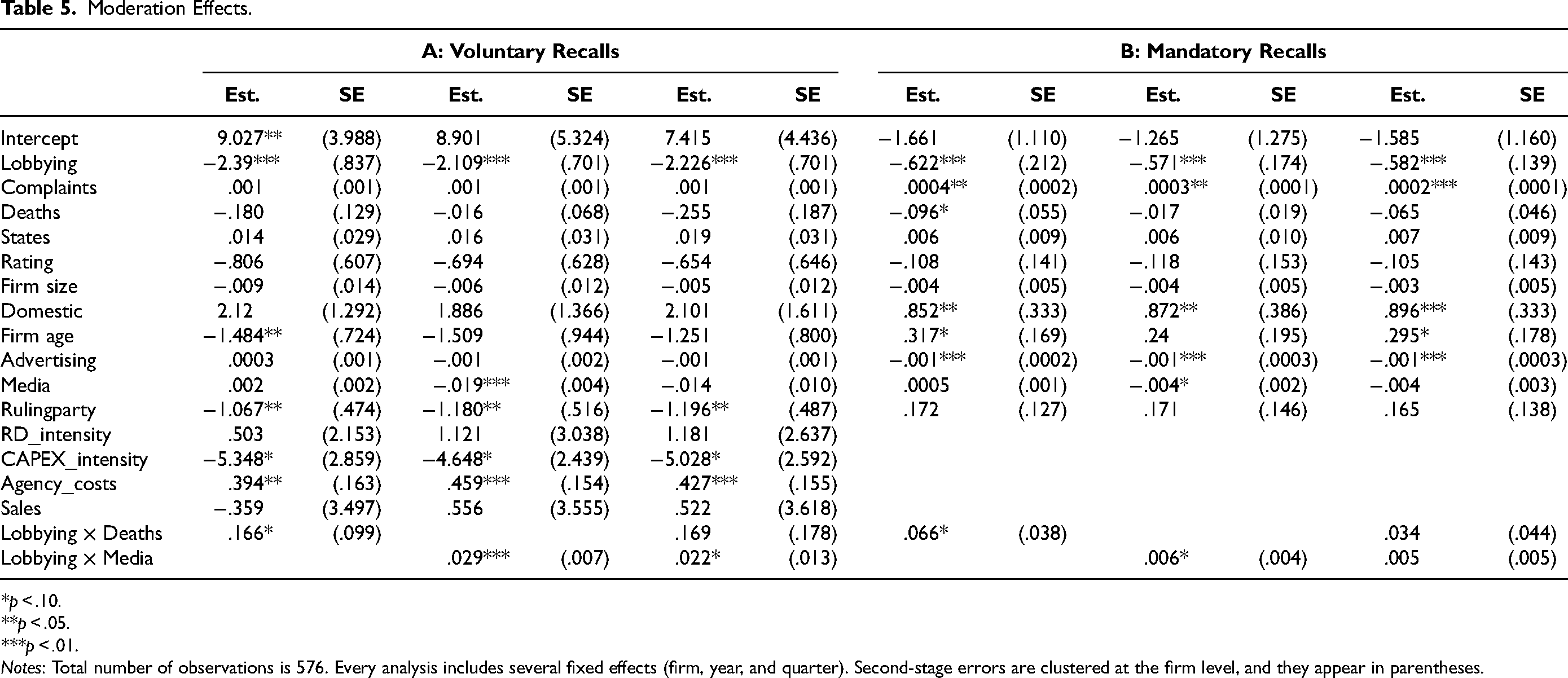
Table 5 presents the moderation effects. Column 1 highlights that defect severity (number of death reports) moderates the effect of lobbying on recall decisions (β = .166, p < .10); consistent with H2, more repeated deaths diminish the effect of lobbying on recall decisions. Media coverage also appears to moderate lobbying's role (β = .029, p < .01); consistent with H3, as media coverage increases, the recalling firm seems more hesitant to avoid a recall, which limits the influence of lobbying on the decision. We find empirical evidence of a full indirect moderation effect too (β = .022, p < .10). Consistent with H4, the interaction between media and lobbying mediates the moderating effect of defect severity. In the mandatory recall specification (Panel B), we find similar results for the moderating effects of both defect severity (H2: β = .066, p < .10) and media coverage (H3: β = .006, p < .10). We do not find a statistically significant indirect moderation effect in mandatory recalls. All models account for unobserved heterogeneity with time-invariant fixed effects.
Moderation Effects.
*p < .10. **p < .05. ***p < .01.
Notes: Total number of observations is 576. Every analysis includes several fixed effects (firm, year, and quarter). Second-stage errors are clustered at the firm level, and they appear in parentheses.
Robustness Assessments
To test the robustness of the empirical results that highlight a significant association between lobbying and automotive recalls, we use several alternative tests. For parsimony, we summarize the tests here; Web Appendix C contains more details.
Long-Term Effects
Beyond the contemporaneous effect (quarterly) of lobbying, we also consider long-term carryover effects (Web Appendix, Section C.1). Due to the carryover effects of advertising, its long-term effect equals the cumulative influence on some outcome variable (e.g., brand choice) over several time periods (Sethuraman, Tellis, and Briesch 2011). Similarly, we create a lobbying stock variable that accounts for the diminished impact of previous years’ lobbying over time. In a Koyck model (Bass and Clarke 1972), lobbying's impact decays geometrically with time, so we can construct a stock variable and rerun the analysis with it, as a tactic to assess the long-term effects of lobbying. Web Appendix Table W6 displays these results (voluntary βlobbying = −2.365, p < .05; mandatory βlobbying = −.569, p < .01).
Simultaneous Equation System
We have generally assumed that the recall decision-making process for each entity (firm, regulator) is independent (even if conditional on observed covariates and time-invariant factors), with no correlation among errors. To consider the possibility of a simultaneous equation system, we incorporate the potential correlation of the model errors for the firm and the regulator, while also correcting for endogeneity (Web Appendix, Section C.2). With a simultaneous equation model, we estimate firm and regulator models simultaneously, correlate their errors, and correct for the endogenous nature of lobbying. The generalized method of moments estimator extends the traditional 2SLS estimator by allowing for heteroskedasticity and autocorrelation-consistent standard errors (Wooldridge 2010). Web Appendix Table W7 contains the results (voluntary βlobbying = −.2.687, p < .01; mandatory βlobbying = −.598, p < .01).
Exogenous Event
In an exogenous event setting (Web Appendix, Section C.3), we seek an event that would affect a firm's lobbying activities but not be directly associated with its recalls. The exogenous variation in lobbying then could reveal the relationship between lobbying and recalls. To fulfill this objective, we explore the 2014 water crisis in Flint, Michigan, when tests showed that the city's water supply contained substantial amounts of lead. Despite residents’ complaints, no official action followed, and residents, including nearly 9,000 children, drank lead-contaminated water for almost 18 months. This health crisis caused a public outcry and sparked intense politics and lobbying activities; it also affected GM, which operates a factory in Flint. Accordingly, the water crisis influenced its lobbying activities in the area but not its recalls. When we check for variation in GM lobbying expenditures and recalls, as expected, we observe an increase in GM's lobbying. Consistent with our previous results, we also observe a drop in the mean values of GM recalls (voluntary and mandatory) during this period. The plot of the mean values for other firms, which were not affected by this crisis, provides a relative assessment. Using a difference-in-differences method, we analyze the dual differences for GM (lobbying and recalls) relative to other firms’ pre- and postcrisis values. The results of this relative assessment are consistent with our previous results.
Nonlinear Specification
Another assessment accounts for the discrete, ordered nature of our outcome variable, using an ordered probit model (Web Appendix, Section C.4). That is, we define our outcome variable (number of recalls) as an ordered categorical variable that represents the recall decision of firm i in period t (i.e., Recallit = 0 if there is no recall, Recallit = 1 if there is one recall, Recallit = 2 if there are two recalls, etc.). The probability that an outcome variable falls in one of the categories is a linear function of the key covariates and error. An additional (linear) model for the endogenous variable (lobbying) accompanies each nonlinear model. We adopt a conditional mixed process model for this analysis (Roodman 2009; see also Mallapragada, Chandukala, and Liu 2016, Malshe, Colicev, and Mittal 2020; Zheng et al. 2020). It uses a simulated maximum likelihood algorithm to estimate two or more equations, and it offers the flexibility to specify multiple simultaneous equations, each of which may use a different dependent variable with unique distribution properties, including noncontinuous forms (e.g., binary, ordered). In addition, conditional mixed process accounts for possible endogeneity in the system. The results are consistent with our key findings (Web Appendix Table W8; voluntary βlobbying = −1.271, p < .05; mandatory βlobbying = −.1.618, p < .01).
Finally, we ran several other analyses, for which we present the results in the Web Appendix C, including assessments of internal versus external lobbying, log specifications, campaign contributions, expanded complaints categories, additional covariates, lobbying issue-specific expenditures, and Congressional majority party fixed effects.
General Discussion
Firms use lobbying to build political connections and further their business interests (Bertrand, Bombardini, and Trebbi 2014), which may have meaningful, direct implications for automotive recalls. By combining research into lobbying and recalls, we uncover an interesting phenomenon: on average, an increase of $404,367 in lobbying expenditures is associated with one fewer voluntary recall. A back-of-the-envelope calculation indicates potential benefits to the firm. An average recall in our data set involves 235,638 vehicle units. If we assume an average, conservative cost of $50 per recalled vehicle (e.g., defect repair, revenue loss), one fewer recall implies nearly $12 million in savings. We also note that political influence might bias the regulatory agency's recall decisions. Firms that spend more on lobbying face fewer mandatory recalls; approximately $1.66 million more in lobbying expenditures is associated with one fewer mandatory recall. These results validate concerns raised in the Congressional Report (Kirchhoff and Peterman 2010). Our study also highlights an actionable lever, which stakeholders (e.g., consumers, advocacy groups) can use to counter the influence of lobbying in the crucial product defect decision process.
Market and Consumer Implications
These results have direct implications for the competitive market structures. Recalls affect firms’ marketing and financial efforts (Cleeren, Dekimpe, and Helsen 2008; Van Heerde, Helsen, and Dekimpe 2007) and can alter their market competitiveness. At an extreme, firms might go bankrupt due to a recall (e.g., Topps Meat Company; Belson and Fahim 2007). Any firm that aims to stay competitive does not want to face such adverse scenarios and may adopt strategies (including improvements to product quality) to avoid recalls. Our results identify lobbying as an instrument that firms use to manage their regulatory environment, affect recall decisions, and maintain their competitiveness in a product-market (recall) context, with significant financial implications.
Lobbying also can help create market entry barriers to new entrants (Gutiérrez and Philippon 2019), and in a recall context, it might limit fair competition, with possible ripple effects in the market, such that preferential treatment to a firm due to lobbying can motivate other firms to engage in similar practices. By drawing attention to this influence mechanism of lobbying for product recalls, our research could help promote an environment that encourages fair competition and lessens the likelihood of unwanted ripple effects on market structures.
Product defects can lead to severe economic and physical losses (e.g., medical costs, death) for consumers. The GM ignition switch defect recall was linked to 124 deaths (Isidore and Marsh 2014). Therefore, our study has important implications for consumer welfare; any possible distortion in the recall decision process can directly affect consumers. Our study also reveals an instrument that key stakeholders (e.g., consumers, safety advocacy groups) can use to diminish the negative impact of lobbying: media coverage of defects lessens its influence. Because media firms, which are independent of the recall decision-making process, can exert meaningful effects, they should increase their coverage of defect reports. Relevant entities such as consumer advocacy groups also should increase their media engagement. The enhanced information salience that would result can lessen the impact of lobbying on recall decisions. In this sense, our research provides a viable solution to an ongoing problem.
On the bright side, lobbying enables market stakeholders to raise concerns with policy makers, but on its dark side, lobbying can unduly influence recall decisions. In no way should our results be taken as a recommendation for firms to spend more money on lobbying to reduce recalls; managers should be mindful of the threat to consumer welfare ascribed to decision-making distortion. Not initiating a recall can lead to short-term benefits (e.g., avoiding recall costs) but also consumer harm (e.g., accidents, injuries) and long-term costs (e.g., reputational damage, consumer lawsuits). According to the triple-bottom-line perspective, the social impacts of business decisions must be just as important to firms as their financial impacts.
Marketing Literature and Policy Contributions
Our research advances efforts to understand firms’ product-market decisions, both theoretically and empirically. First, we apply a legitimacy perspective, whereas previous literature in marketing primarily has embraced an efficiency perspective. The social fitness rationale we use represents a theory-based generalization; it may apply to other industry settings (e.g., pharmaceutical) with similar institutional and recall features (e.g., regulatory supervision). We complement this legitimacy perspective with a political influence framework (iron triangle; Freeman 1965) to explain firms’ behavior. Second, our study contributes to regulatory capture literature by identifying an actionable lever that can help limit a firm's regulatory influence.
Lobbying has always been a controversial topic, but the U.S. lobbying industry continues to grow steadily; in 2021, it earned $3.7 billion in revenue (O’Connell and Narayanswamy 2022). The dark-side outcomes of such a massive and controversial industry have relevant implications for policy makers and regulators. The design and implementation of an effective policy require a deep understanding of various stakeholders’ behaviors and responses. Consistent with arguments presented in previous studies (e.g., Stigler 1971), we find that the recall decision-making process may be susceptible to political influence, suggesting the need for policy makers to take a greater role in fostering an environment that discourages the dominance of interest groups (e.g., lobbyists) and limits threats to consumer welfare. A recent example of such efforts is the inquiry by the Committee on Energy and Commerce about whether CPSC delayed corrective actions for defective products (U.S. Congress 2019). Our prior citations of news articles that report the dark side of lobbying in other contexts (e.g., insider financial market information, federal aid) reinforce the importance of our study's implications. We encourage more checks and greater transparency by regulators, to diminish the likelihood of external influences on critical product-related decisions. In a nutshell, our study highlights the complexity involved in firms’ recall decisions, beyond typical marketing and financial elements. We encourage researchers to continue exploring other marketing contexts with such vast societal implications.
Supplemental Material
sj-pdf-1-mrj-10.1177_00222437221131568 - Supplemental material for Lobbying and Product Recalls: A Study of the U.S. Automobile Industry
Supplemental material, sj-pdf-1-mrj-10.1177_00222437221131568 for Lobbying and Product Recalls: A Study of the U.S. Automobile Industry by Khimendra Singh and Rajdeep Grewal in Journal of Marketing Research
Footnotes
Associate Editor
Russell S. Winer
Declaration of Conflicting Interests
The author(s) declared no potential conflicts of interest with respect to the research, authorship, and/or publication of this article.
Funding
The author(s) received no financial support for the research, authorship, and/or publication of this article.

Notes
References
Supplementary Material
Please find the following supplemental material available below.
For Open Access articles published under a Creative Commons License, all supplemental material carries the same license as the article it is associated with.
For non-Open Access articles published, all supplemental material carries a non-exclusive license, and permission requests for re-use of supplemental material or any part of supplemental material shall be sent directly to the copyright owner as specified in the copyright notice associated with the article.
