



Abstract
Nonprofit organizations often position their charitable efforts as fulfilling the immediate needs of those who are disadvantaged (termed “immediate aid appeals”). This study explores an alternative positioning strategy focused on the use of autonomous aid appeals, which promote the use of donated funds to facilitate the eventual self-sufficiency of those in need. Seven studies show that people are more likely to donate to a charity that uses autonomous aid appeals than immediate aid appeals. The authors generalize this effect to various contexts and examine it with actual donation behavior. They find that managerially relevant boundary conditions support a serial mediation model first through perceptions of impact and then by feelings of hope for the recipient's future. To support the proposed framework, they conduct mediation analyses and two process-by-moderation studies. The findings have practical implications for charities and their promotional messaging.
When appealing to potential donors, charities frame their relief efforts in various ways. For example, the American Red Cross (2022) notes that it has provided over 4.5 million meals and overnight shelter for more than 400,000 people affected by Hurricane Harvey. Framing such efforts in this manner emphasizes how donations satisfy victims’ immediate needs, a strategy often used in charitable appeals (Zagefka and James 2015). However, the American Red Cross could also promote its charitable acts as contributing to the eventual self-sufficiency of those affected, such as efforts to rebuild the community and provide education and training to those in need. Other charities face similar decisions about how to promote themselves. The San Antonio Food Bank uses donation appeals focusing on programs that provide community members with the knowledge, skills, and abilities necessary for employment (Hagney 2014). These appeals emphasize the autonomy provided to recipients of aid. Yet the food bank could also promote other, more immediate relief programs, such as free meals for low-income community members. Furthermore, a charitable organization could frame the same activity, such as an after-school program for children, in donation appeals as either providing immediate assistance (by giving children a safe place to play) or contributing to their future autonomy (by offering tutoring and educational services).
The differences in these appeals highlight a fundamental decision that all charities face when deciding how best to communicate with donors. Charities may use immediate aid appeals that emphasize how donor contributions will provide immediate relief to needy populations. Alternatively, charities may use appeals that promote a recipient's self-sufficiency and future autonomy to donors, which is known as autonomous aid (Montal-Rosenberg and Moran 2022). Yet, many questions surround the use of immediate and autonomous aid appeals and their relative effectiveness in soliciting donations. For example, are charities more likely to position themselves as providing more immediate or autonomous aid? To answer this question, we asked two independent coders unfamiliar with our research objective to rate the mission statements of the 100 largest nonprofits in the United States according to the 2020 Forbes list of America's Top Charities (Barrett 2020). Coders rated the mission statements on two dimensions: the degree to which the charity promotes providing immediate aid to those in need and the degree to which it promotes providing autonomous aid to those in need. The results revealed that charities were more likely to position themselves as providing immediate rather than autonomous aid (p = .027; for complete details and results, see Web Appendix A).
While these findings suggest that nonprofits more frequently emphasize immediate aid for those in need, are there times when autonomous aid appeals elicit higher donations? We suggest there are, as autonomous aid appeals, which emphasize self-sufficiency, may lead donors to feel that they are making more of an impact on the lives of those in need and increasing feelings of hope for the recipient's future. However, research has yet to address several important issues associated with the use of autonomous aid appeals. If autonomous aid appeals can elicit more donations than immediate aid appeals, why would consumers donate more to charities using these types of appeals? Furthermore, what factors may enhance the effectiveness of autonomous aid appeals?
In this research, we address these questions by examining how autonomous aid appeals influence consumer donation behavior. Seven studies investigate whether, when, and why autonomous aid appeals elicit more consumer donations than immediate aid appeals. We initially show that autonomous aid appeals elicit more donations than immediate aid appeals. Specifically, the results from our field study indicate that the amount of money donated in response to autonomous aid appeals is 418% higher than donations to immediate aid appeals. Next, we explore managerially focused boundary conditions and find support for a serial mediation model. In doing so, we provide a new theoretical link between perceptions of donor impact and charitable giving to the donation literature. While some studies note that increasing donor perceptions of impact can increase charitable giving (e.g., Duncan 2004; Erlandsson, Björklund, and Bäckström 2015), other research finds that donor behavior is invariant to increases in overall impact (e.g., studies of scope insensitivity; Hsee and Rottenstreich 2004; Kahneman and Knetsch 1992; Smith, Faro, and Burson 2013). Here, we show that autonomous aid appeals increase perceptions of impact, which enhance feelings of hope for the recipient's future, which in turn lead to increased donations. Together, our findings extend research on charitable giving and provide managerial insights for nonprofits by highlighting how and when they can use autonomous aid appeals to enhance consumer donations.
Theoretical Background and Hypotheses
Autonomous Aid and Donations
A growing number of studies suggest that the way a charitable appeal is positioned has a significant influence on donation behavior (Bendapudi, Singh, and Bendapudi 1996; Chang and Lee 2009; Ein-Gar and Levontin 2013; White and Peloza 2009). Appeals may be positioned in various ways, including highlighting a single victim or person in need (Loewenstein and Small 2007; Small, Loewenstein, and Slovic 2007), motivating a donor's sense of self (Ein-Gar and Levontin 2013; Fajardo, Townsend, and Bolander 2018), or emphasizing the number of people helped by the cause (Desvouges et al. 1993). To build on these findings, we propose that an effective way to enhance donations is to emphasize that donations will be used to facilitate the eventual self-sufficiency of recipients.
When attempting to motivate donors, a charity's focus on the underlying issue may determine the success of a charitable appeal. Immediate aid appeals focus on how charities use donated funds to provide short-term, immediate benefits to the needy. Immediate aid appeals also describe how donated funds will be applied directly to the beneficiary, to help provide temporary relief from the underlying problem. However, these types of appeals emphasize the recipients’ dependency on aid along with the need for future reliance on others (Montal-Rosenberg and Moran 2022). For example, a food bank using an immediate aid appeal may emphasize that it distribute canned goods to those in need. The appeal indicates that the immediate hunger of the recipient will be addressed. However, the underlying issue of how to continue to feed the needy remains in question.
Autonomous aid appeals differ from immediate aid appeals in their explicit focus on promoting self-sufficiency. Vohs, Mead, and Goode (2006, p. 1154) define self-sufficiency as “an insulated state wherein people put forth effort to attain personal goals and prefer to be separate from others.” Other operational definitions characterize self-sufficiency in terms of people’s ability to meet their own basic physiological needs in which no or minimal financial assistance is required from private or public organizations (Hetling, Hoge, and Postmus 2016). A nonprofit that uses autonomous aid appeals is promoting its effort to help the needy become independent, separate from the aid of donors, and able to attain their goals without assistance (Bamberger and Levi 2009; Montal-Rosenberg and Moran 2022). For example, autonomous aid appeals may describe how donations are used to pay for classes that teach job skills, leading to eventual employment and a reduced or eliminated need for future support.
When making the decision to donate, consumers want to know that their donations are going to make a difference (Crutchfield, Kania, and Kramer 2011). In many instances, consumers choose not to donate because they view their contribution as having little effect on a permanent solution to the problem (Bartels and Burnett 2011; Unger 1996). Because immediate aid appeals promote a focus on the present, donors may also believe that their giving offers no hope to solve the underlying problem. Revisiting the example of a food bank that uses immediate aid appeals, the issue of feeding the hungry is temporarily resolved by giving meals to those in need. However, the underlying social problem of food shortages remains, potentially reducing perceptions of impact, which decrease feelings of hope for the recipient's future, which in turn reduce the willingness to donate.
We propose that autonomous aid appeals may counteract these issues and motivate donors by emphasizing how their resources will be invested to create enduring change. By promoting the self-sufficiency of those in need, autonomous aid appeals position the charity as providing a solution to the underlying problem. This should counteract donors’ concerns about whether their contribution is making a difference, which commonly deter them from giving (Bartels and Burnett 2011; Gneezy, Keenan, and Gneezy 2014). As a result, we expect charitable donations to increase with autonomous aid appeals. Thus:
The Role of Impact
Given that autonomous aid emphasizes a recipient's eventual self-sufficiency, we propose that this will affect donors in two meaningful ways. The self-sufficiency promoted in an autonomous aid appeal should first lead donors to believe that their giving is making a greater impact on addressing the underlying problem, which should then elicit feelings of hope for the recipient's future. Therefore, we propose a serial mediation model underlying the effectiveness of autonomous aid appeals.
We propose that autonomous aid appeals first influence the donor's perceived scope of impact. Previous research has characterized impact as making a difference, as perceived utility, and/or as perceived efficacy (Bullard and Penner 2017; Cryder, Loewenstein, and Seltman 2013; Erlandsson, Björklund, and Bäckström 2015). Our research builds on this definition by proposing that “making a difference” is long-lasting. Thus, we define the scope of impact as donors' self-assessment of how their giving will meaningfully address the underlying problem. We expect autonomous aid appeals to affect these self-assessments, as these appeals make donors feel that their contributions will be more helpful to those in need.
Having an impact on the lives of those in need is desirable to donors (e.g., Duncan 2004; Erlandsson, Björklund, and Bäckström 2015; Sargeant and Woodliffe 2007). Compared with immediate aid appeals, we propose that autonomous aid appeals will enhance the perceived impact of a donor's gift. Specifically, donors may feel that donations to appeals that promote self-sufficiency are more helpful because such donations help solve an underlying problem by reducing or even eliminating reliance on others. In other words, promoting self-sufficiency mitigates concerns that a donation will not make a difference, which prior research indicates is a powerful deterrent to charitable giving (Bartels and Burnett 2011; Unger 1996). Although a donation to a nonprofit using immediate aid may help the needy, the impact of any one effort should be maximized by nonprofits emphasizing self-sufficiency. For example, donations to a children's after-school program could provide additional tutoring and teach various life skills beyond merely providing safety, care, and food. Thus, a single donation has a greater impact on a child's growth and future independence. Considering this, the scope of a donation's impact should increase when donors are made aware of the recipient's potential self-sufficiency.
We then predict that impact is positively linked to feelings of hope for the recipient's future. Consistent with prior research, we categorize hope as a positively valanced, future-oriented emotion (Lazarus 1991; Winterich and Haws 2011). Hope emerges when a desired outcome seems uncertain but may be possible to achieve (MacInnis and De Mello 2005; Snyder et al. 1991).
Feelings of Hope and Charitable Giving
Emotional responses can trigger and coordinate effective responses (e.g., physiological, behavioral, experiential, communicative) that allow people to manage situations, problems, or opportunities (Frijda 1986; Oatley and Johnson-Laird 1996). In the context of prosocial behavior, research has found that feelings of hope play an important role in the decision to help others (e.g., Batson 1990; Cavanaugh, Bettman, and Luce 2015; Huber et al. 2011; Kogut and Ritov 2005, 2007). Here, we focus specifically on donors' hope for the recipient's future.
Hope theory suggests that when hope is enhanced, people are more likely to set and energetically pursue ambitious commitments (Snyder 2002), such that an expenditure of resources can result in achieving a valued outcome (Cavanaugh, Bettman, and Luce 2015). When beliefs about a future outcome become more certain, feelings of hope often emerge in response (Tversky and Fox 1995). In the context of charitable giving, promoting a recipient’s self-sufficiency may make donors believe that recovery is more likely to occur. With enhanced certainty surrounding the process of recovery, feelings of hope should be increased (MacInnis and De Mello 2005). We propose that feelings of hope specifically related to the recipient's future recovery will be elicited in response to donors’ heightened beliefs about their impact on the underlying issue. These feelings of hope for the recipient will subsequently enhance donations to the charity.
Generating feelings of hope through persuasive messaging can enhance consumer support for prosocial endeavors (Schneider, Zaval, and Markowitz 2021; Septianto, Kemper, and Chiew 2020). In charitable giving, feelings of hope can inspire donors to give (Homer 2021), particularly when matched with congruent message imagery (Choi et al. 2020; Pham and Septianto 2019). Extending these findings, we suggest that greater feelings of hope for the recipient's future will increase charitable giving because donors feel more certain about the future independence of those in need. Thus, we predict the following:
Overview of Studies
To examine the impact of autonomous aid appeals on donation behavior, we conducted seven studies. We generalize our findings across various types of nonprofit organizations to demonstrate the versatility of using autonomous aid appeals as a strategy to increase overall donations. Studies 1, 2, and 3 examine our main hypothesis that autonomous aid appeals increase consumer donations to a greater extent than immediate aid appeals. In Study 1, we examine real donation behavior toward actual nonprofit organizations through a controlled experiment using an online panel. Study 2 is a field experiment in which we partnered with a nonprofit organization to examine the real-world effectiveness of autonomous aid appeals to raise funds. Study 3 introduces a control condition in a lab experiment to further test our primary prediction. Study 4 examines differences in temporary and recurring care to further explore our main effect. Next, Study 5 tests the proposed underlying serial mediation model, in which we propose that autonomous aid influences perceptions of impact, which increase hope, which in turn increases donations. Studies 6a and 6b further examine the serial model of impact and hope through process by moderation. Figure 1 presents our conceptual framework, and Table 1 provides an overview of the seven studies and main findings.

Conceptual Framework.
Summary of Results by Study Condition.

Notes: Superscripts denote significant differences at p < .05. All comparisons are made only between table rows.
Study 1
The aim of Study 1 was to provide an initial test of our conceptual model by examining actual donations to a real nonprofit organization. Specifically, we tested whether an autonomous aid appeal would elicit more donations than an appeal emphasizing immediate aid.
Procedure, Manipulations, and Measures
We recruited 100 workers (55% female, 45% male) from Amazon Mechanical Turk (MTurk) and paid them to take part in this study. We randomly assigned the participants to read a donation appeal framed as either immediate or autonomous for the nonprofit organization Wounded Warrior Project. The autonomous aid appeal discussed how the nonprofit provides veterans with resources that will help them regain their self-sufficiency as they return from service. The autonomous aid appeal further emphasized self-sufficiency by discussing the specific programs offered, including mental wellness programs, such as combat stress recovery and career counseling. The immediate aid appeal focused on providing veterans with resources to meet their immediate needs. Specifically, the immediate aid appeal discussed providing financial assistance, such as aid in food, housing, and utility services. We took the information used in the appeals directly from the Wounded Warrior Project website. The complete donation appeals are available in Web Appendix B.
After they read the scenario, we informed the participants that, in addition to and separate from the amount they were being paid for their involvement in the study, they would receive a $2 bonus payment to use as they wished. Participants could choose to keep the entire amount of the bonus, donate the entire amount, or split the $2 between themselves and the Wounded Warrior Project. Participants then indicated the amount they would donate (if any) in $.25 increments. At the conclusion of the study, we gave the total amount donated to the nonprofit.
Participants then completed a manipulation check associated with the charitable appeal. They indicated their agreement (1 = “strongly disagree,” and 7 = “strongly agree”) with three statements assessing autonomous aid. Items asked the participants about their level of agreement that the Wounded Warrior Project “Will use my donations to promote self-sufficiency for those receiving the aid,” “Will use my donations to help those in need become more independent,” and “Promotes self-reliance for those in need” (α = .95).
Given that research has not previously explored the distinction between autonomous aid and immediate aid in the donation appeal literature, ensuring that these appeals are equivalent on the factors relevant to donation behavior is important. Thus, we tested differences in both perceptions of the charity and perceptions of the veterans receiving aid using several factors, including those measuring cause severity, charity competence, charity efficiency, and need perception (items adapted from Fiske et al. [2002], Lee, Winterich, and Ross [2014], and Michel and Rieunier [2012]). We observed no significant differences between these factors in our manipulations for this study or any of the subsequent studies. Complete results for all pre- and posttests are available in Web Appendix C; we do not discuss them further given space considerations.
Results
Regarding our manipulation of autonomous aid, participants in the autonomous aid condition (n = 50; M = 5.71, SD = 1.44) rated their appeal as more self-sufficient than those in the immediate aid condition (n = 50; M = 5.00, SD = 1.57; t(98) = 2.34, p = .02). This finding suggests that our manipulation of autonomous aid was effective. We then examined the donation behavior of participants. The amount of money participants were willing to donate was significantly higher for those in the autonomous aid condition (M = $1.01, SD = $.69) than those in the immediate aid condition (M = $.73, SD = $.68; t(98) = 2.10, p = .04). This result provides support for H1.
Discussion
Using a real nonprofit organization and examining actual donation behavior, Study 1 provides support for our conceptual model of autonomous aid. When we promoted a nonprofit using an autonomous aid appeal, average donations were higher than when we promoted the charity with an immediate aid appeal. Next, we conducted a field study to provide further evidence of our main effect.
Study 2
In Study 2, we tested our primary prediction by partnering with a real nonprofit organization and conducting a field experiment. We partnered with a regional nonprofit in the southeastern United States that specializes in providing resources for the homeless in rural areas.
Procedure, Manipulations, and Measures
The nonprofit purchased a list of 1,200 households that had never previously donated to it from a marketing agency. These households were screened by the marketing agency to live within the three counties the nonprofit operated in and to have a household income higher than $30,000. We randomly assigned these households to the immediate or autonomous aid appeal in which they were sent a mailer that was framed as such and asked for donations. The autonomous aid appeal discussed how the nonprofit provides the homeless with resources that help them become self-sufficient; it also included an altered version of the organization's mission statement highlighting its commitment to self-sufficiency. The immediate aid appeal focused on providing the homeless with resources that will meet their immediate needs as well as an altered version of the organization's mission statement highlighting its commitment to providing short-term relief. We tailored both appeals with the help of the nonprofit to portray information consistent with its values, mission, and work (for the appeals, see Web Appendix B).
Text at the end of the mailer informed the households that they were able to donate to the organization either by going to a provided URL or by sending a check in a preaddressed envelope that was included with the mailer. For tax-reporting purposes, all donors provided identifying information to the nonprofit; however, the nonprofit provided anonymized information to us that specified only the donors’ respective condition and amount donated. We preregistered this experiment (for the specific information about the nonprofit, see https://osf.io/db3fv). The preregistered procedure specified waiting one month after the mailers were sent out to receive all donations, but we also received donations after this time. For consistency and completeness, we report the results with both the preregistered one-month time frame and all donations received.
Pretest
To assess the effectiveness of the donation appeal manipulations, we conducted a pretest with a separate sample, recruiting 117 (46% female, 54% male) workers from MTurk. We randomly assigned participants to read either the autonomous or immediate aid appeal for the nonprofit organization. After viewing the manipulations, participants completed the same autonomous aid manipulation check (α = .90) as in Study 1. The analysis showed that participants in the autonomous aid condition (M = 5.52, SD = 1.12) rated their appeal as more self-sufficient than those in the immediate aid condition (M = 4.88, SD = 1.48; t(115) = 2.63 p = .01); thus, the manipulations worked as intended.
Results
Initial results
One month after the mailers were sent out, we received 28 donations (3 online and 25 envelope) totaling $3,430. Of these donations, 21 come from donors who received the autonomous aid appeal, and 7 came from those who received the immediate aid appeal. A high number of zeros were present in the data given the low response to the mailers (97.7% of households donated $.00). Therefore, we ran a zero-inflated Poisson regression with appeal type as the independent factor (Lambert 1992) to examine two independent equations simultaneously. The first equation examines differences between the two conditions in terms of how much was donated, taking into account the extreme level of skewness created by the high number of nondonations (i.e., zeros). We found a main effect (b = .55, SE = .05, Z = 11.78, p < .01), such that people who donated in the autonomous aid condition (M = $136.90, SD = 250.67) gave significantly more than those who donated in the immediate aid condition (M = $79.29, SD = 141.93). The second equation specifically examines the zeros in the data to determine which condition had more donors who did not donate at all to the charity. The results show that those who received the autonomous aid promotion were significantly less likely to belong to the group of people who did not give (b = −1.12, SE = .44, Z = −2.55, p = .01). Thus, people who received the autonomous aid appeal were more likely to donate, and when they did, they donated more money. Together, these results offer further support to H1.
Capped results
We received three donations in excess of $100 (two in the autonomous condition and one in the immediate condition). The preregistration stated that an upper limit may be applied as a cap to help prevent large amounts from having an undue influence on results. Thus, we undertook an additional examination of the data capping these excessive amounts at $100. Using this cap reduces the overall amount donated in the data set to $1,580.
The results of the likelihood to donate were unchanged with the capped data, as the number of zeros and nonzeros in the data does not change. Also consistent with the uncapped results, we again found that donors in the autonomous aid condition donated more (b = .55, SE = .07, Z = 8.03, p < .01) than those in the immediate aid condition. Specifically, with the means capped, we still find that those who donated in the autonomous aid condition (M = $63.10, SD = 34.77) gave significantly more than those who donated in the immediate aid condition (M = $36.43, SD = 30.51). These results again provide support for H1.
Over-time results
As noted previously, the nonprofit received donations after the one-month deadline specified during preregistration. In particular, it received seven donations after this deadline, for a total of 35 donations received: 26 in the autonomous aid condition and 9 in the immediate aid condition. Consistent with our preregistered results, households that received the autonomous aid appeal donated significantly more than those that received the immediate aid appeal (uncapped: Mautonomous = $125.58, SDautonomous = 228.79; Mimmediate = $70.00, SDimmediate = 124.45; b = .58, SE = .04, Z = 13.43, p < .01; capped: Mautonomous = $60.19, SDautonomous = 34.28; Mimmediate = $36.67, SDimmediate = 27.16; b = .50, SE = .06, Z = 8.18, p < .01). In addition, households that received the autonomous aid appeal were significantly less likely to give $0 (b = −1.09, SE = .39, Z = −2.79, p < .01) than those that received the immediate aid appeal; this result was also the same for the capped and uncapped data. Those that received the autonomous aid appeal were significantly more likely to donate money to the charity than those that received the immediate aid appeal. Thus, these additional donations do not alter our results and provide further support for H1.
Discussion
Using field data from a nonprofit organization and examining actual donation behavior, Study 2 further supports our primary prediction. Overall, the amount of money donated was 418% higher for the autonomous aid appeal than the immediate aid appeal. Moreover, households receiving the autonomous aid appeal were 189% more likely to donate and donated 79% more money on average. These findings highlight the impact of autonomous aid appeals in eliciting charitable donations. Next, Study 3 examines the main effect in a laboratory setting to explore both autonomous and immediate aid appeals against a control message condition.
Study 3
Whereas Studies 1 and 2 examined autonomous aid appeals using real-world donations, in Study 3 we test how a neutral appeal compares with both autonomous and immediate aid appeals. The neutral appeal serves as a control to help determine the baseline assumption of need type when it is not stated and how giving to this appeal compares with appeals emphasizing either autonomous or immediate aid.
Procedure, Manipulations, and Measures
We recruited 250 people from Prolific and paid them to participate in this study; however, we removed 16 of them for failing an attention check, which left a final sample of 234 (69% female, 31% male). We randomly assigned participants to read a donation appeal framed as autonomous, immediate, or neutral from a fictitious nonprofit organization called “Food Bank USA.” The autonomous aid appeal discussed how the nonprofit provides food to those in need to help them become self-sufficient. The immediate aid appeal discussed the provision of food to meet the immediate needs of those in need. The neutral appeal discussed the provision of food for those in need simply to help others. The complete donation appeals are available in Web Appendix B.
After reading one of the descriptions, participants completed a donation intention measure adapted from Winterich, Mittal, and Ross (2009). Specifically, we asked participants to imagine that they had $100 at their disposal and then to indicate how much of the $100 they would be willing to donate to Food Bank USA. Finally, participants completed the same autonomous aid manipulation check as in the previous studies (α = .94).
Results
To begin, we examined our manipulation of autonomous aid. The results of a one-way analysis of variance (ANOVA) revealed a significant difference between appeal types (F(2, 231) = 19.65, p < .01). Participants in the autonomous aid condition (n = 79; M = 5.51, SD = 1.35) rated their appeal as more self-sufficient than those in the immediate aid condition (n = 79; M = 4.43, SD = 1.41; t(156) = 4.89, p < .01) and the neutral condition (n = 76; M = 4.14, SD = 1.55; t(153) = 5.88, p < .01). There was no significant difference in perceptions of self-sufficiency between the immediate aid condition and the neutral condition (t(153) = 1.24, p = .22). This finding suggests that our manipulation of autonomous aid was effective.
We then examined the donation behavior of participants. The results of a one-way ANOVA revealed a significant difference in donations between appeal types (F(2, 231) = 3.63, p = .03). The amount of money participants were willing to donate was significantly higher for those in the autonomous aid condition (M = $37.29, SD = $29.89) than those in the immediate aid condition (M = $27.30, SD = $27.22; t(156) = 2.20, p = .03) and neutral condition (M = $26.93, SD = $24.46; t(153) = 2.36, p = .02). There was no significant difference in donations between the immediate aid condition and the neutral condition (t(153) = .09, p = .93). These results further confirm H1.
Discussion
Study 3 provides additional support for our conceptual model of autonomous aid. Again, we found that donations to a nonprofit promoting autonomous aid were higher than those to a nonprofit promoting immediate aid. Donations stemming from the autonomous aid appeal were also higher than those in the neutral appeal scenario. Together, these findings indicate that donations attributable to autonomous aid appeals are not simply higher than those attributed to immediate aid appeals because of a negative effect of the latter. Next, Study 4 tests our conceptualization of autonomous aid by examining differences in the extent of assistance to those in need.
Study 4
The conditions in the previous studies do not specify how long aid was provided to those in need. The extent of assistance is both managerially important and theoretically relevant to the concept of self-sufficiency. For example, charities may provide temporary support to those in need (e.g., one-time medical surgery, a weeks’ worth of meals). Alternatively, they may offer recurring assistance to those in need for an extended period, potentially even spanning the entirety of the recipient's lifetime (e.g., ongoing medical therapy, routine meal deliveries). For temporary assistance, we expect the effects found in the previous studies to replicate, as autonomous aid appeals promote recipients’ self-sufficiency and reduce the need for future assistance. However, recurring assistance maintains a connection between the charity and the recipient. Given that separation between the charity and the recipient is a fundamental aspect of self-sufficiency, we propose that appeals that emphasize recurring assistance will mitigate the effectiveness of autonomous aid appeals. That is, with an ongoing connection, donors will feel that their impact on solving the underlying issue is reduced, and the subsequent benefits of autonomous aid appeals on charitable giving will be mitigated.
Procedure, Manipulations, and Measures
We recruited 577 workers from MTurk; however, we removed 39 of them for failing an attention check, which left a final sample of 538 (45% female, 55% male). We randomly assigned participants to a 2 (appeal: autonomous aid vs. immediate aid) × 2 (extent of assistance: temporary vs. recurring) between-subjects design.
Study 4 took place in the domain of health care. We asked participants to read about a fictitious nonprofit called “Health Cares Center” that provides support to people suffering from rare and specialized medical conditions. The autonomous aid condition discussed how Health Cares Center provides assistance in various ways to help promote self-sufficiency and works with recipients so that they can eventually support themselves. The immediate aid scenario focused on how the nonprofit provides assistance to meet recipients’ immediate needs and ensures that assistance is provided to address the current issues facing them.
We also manipulated the extent of assistance. Participants read that their donation would provide recipients with either a one-time surgery (temporary) or ongoing medical therapy (recurring). A detailed description of these scenarios is available in Web Appendix B. After reading one of the descriptions, participants completed the same donation intention measure as in Study 3.
Pretest
Before data collection, we conducted a pretest to examine both the manipulation of appeal type and the extent of assistance. We recruited 349 workers from MTurk but removed 18 of them for failing an attention check, which left a final sample of 331 (47%female, 53% male). We used the same 2 × 2 between-subjects design as in the main study. After viewing the manipulations, participants completed the same autonomous aid manipulation check (α = .85) as in the previous studies and a two-item manipulation check for the extent of assistance (r = .77). The manipulation check for the extent of assistance asked participants to indicate their agreement (1 = “strongly disagree,” and 7 = “strongly agree”) that their donation would provide prolonged medical support.
First, for the manipulation of appeal type, an ANOVA with appeal type, extent of assistance, and their interaction predicting perceptions of self-sufficiency revealed a significant main effect of appeal type (F(1, 327) = 15.60, p < .01). Participants in the autonomous aid condition rated the charity as promoting greater self-sufficiency (M = 5.69, SD = 1.01) than those in the immediate aid condition (M = 5.19, SD = 1.28). The main effect of extent of assistance (F(1, 327) = .68, p = .41) and the interaction between appeal and extent of assistance (F(1, 327) < .01, p = .97) were not significant.
Second, for the manipulation of extent of assistance, an ANOVA with appeal type, extent of assistance, and their interaction revealed a significant main effect of extent of assistance (F(1, 327) = 11.59, p < .01). Participants in the recurring assistance condition (M = 5.11, SD = 1.45) believed that the care was more long-term than those in the temporary assistance condition (M = 4.49, SD = 1.79). Furthermore, the main effect of appeal type (F(1, 327) = 2.13, p = .15) and the interaction between extent of assistance and appeal type (F(1, 327) = .56, p = .46) were not significant. Together, these results suggest that our manipulations were effective.
Results
To assess the donation behavior of participants, an ANOVA with appeal type, extent of assistance, and their interaction predicting donation amount revealed a significant interaction (F(1, 534) = 5.15, p = .02). The main effect of appeal type (F(1, 534) = 3.34, p = .07) was marginally significant, while the main effect of extent of assistance (F(1, 534) = .02, p = .89) was not. Figure 2 presents the results by condition. Pairwise comparisons using PROCESS Model 1 (Hayes 2017) revealed that when the extent of assistance was temporary (one-time surgery), participants in the autonomous aid condition (M = $43.77, SD = $38.65) donated more than those in the immediate aid condition (M = $31.34, SD = $30.94, p = .01). Conversely, when the extent of assistance was recurring (ongoing medical therapy), there was no significant difference in donation amount between an autonomous aid appeal (M = $36.44, SD = $34.22) and an immediate aid appeal (M = $37.79, SD = $36.36, p = .75). Additional comparisons revealed that the difference between temporary and recurring aid was marginally significant for autonomous aid appeals (p = .10) but nonsignificant for immediate aid appeals (p = .12).
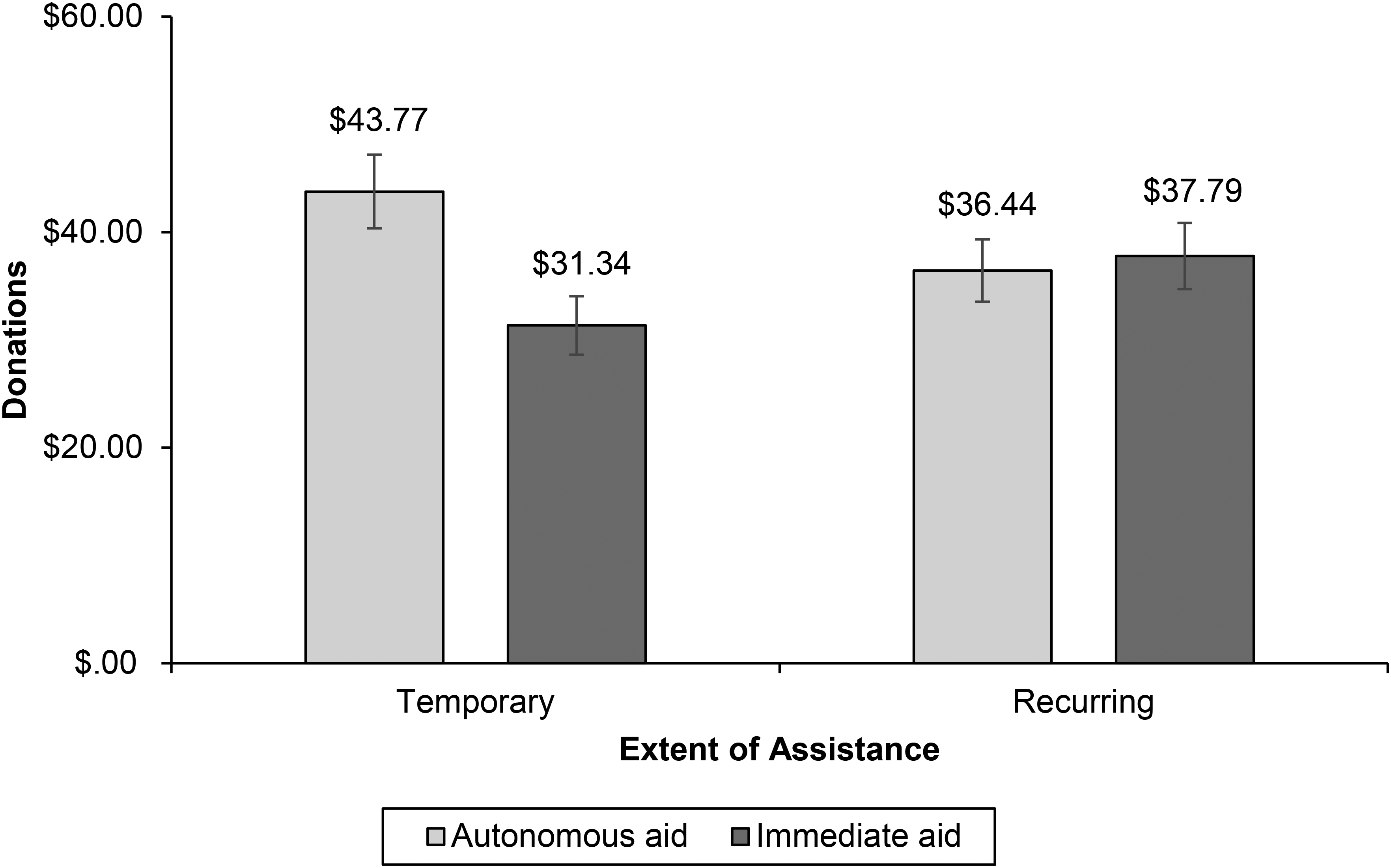
Study 4 Results.
Discussion
The results of Study 4 identify a boundary condition to the effect of the autonomous aid appeal. Recurring assistance suggests that self-sufficiency is unlikely, making such appeals less effective. In these instances, autonomous aid appeals do not outperform immediate aid appeals. In addition, the notion of self-sufficiency seems necessary for the success of autonomous aid appeals. Because the connection between a charity and recipient is maintained when aid is ongoing, we argue that donors feel that their giving makes less of an impact on solving the underlying problem. To further explore our theoretical explanation of autonomous aid effects, in Study 5 we test our proposed serial mediation process of the effect by measuring impact and hope.
Study 5
The goal of Study 5 was to assess the serial mediation of autonomous aid on donations through perceptions of scope of impact and hope for the recipient's future. We propose that people first assess the possible impact in response to donation appeals, which then influences their feelings of hope, which in turn influence how much to donate. However, the feelings of making a greater impact evoked through the promotion of self-sufficiency could potentially influence donors' sense of self. Thus, instead of impact influencing the more other-oriented construct of hope for the recipient’s future, impact could be influencing the more self-focused construct of warm glow. Warm glow refers to the positive feelings or moral satisfaction people feel from prosocial actions (i.e., charitable giving), resulting in the inference that they are a good and/or an unselfish person (Chang and Chu 2020; Winterich and Barone 2011). Prior research suggests a link between warm glow and impact. For example, research shows that the size of a donation is an important factor in evoking feelings of warm glow (Koschate-Fischer, Stefan, and Hoyer 2012; Müller, Fries, and Gedenk 2014). Thus, we also explore warm glow as a potential alternative mechanism to hope in our serial mediation model.
Procedure, Manipulations, and Measures
We recruited 204 people from Prolific to participate in a single-factor (aid: autonomous vs. immediate) between-subjects study. Of the 204 participants, we removed 7 for failing an attention check, which left a final sample of 197 (76% female). For this study, we created manipulations based on the nonprofit used in Study 2. The fictitious nonprofit used in this study was called “Help 4 Needy Center.” The autonomous and immediate aid manipulations are available in Web Appendix B.
After reading one of the descriptions, participants completed the same donation intention measure as in Study 3 and then answered questions about the perceived impact using five items on a seven-point Likert scale (1 = “strongly disagree,” and 7 = “strongly agree”; α = .98) adapted from prior research (Bullard and Penner 2017; Erlandsson, Björklund, and Bäckström 2015). We then collected perceptions of hope for the recipients’ futures using three items from Cox, Cox, and Zimet (2006; α = .92). Next, to capture warm glow we used a three-item seven-point scale (1 = “strongly disagree,” and 7 = “strongly agree”) adapted from Chang and Chu (2020; α = .97). The Appendix provides the measures. Finally, participants completed the autonomous aid manipulation check (α = .94).
Results
Regarding our manipulation of autonomous aid, participants in the autonomous aid condition (M = 5.83, SD = 1.01) rated the appeal as promoting greater self-sufficiency than those in the immediate aid condition (M = 4.43, SD = 1.52; t(195) = 7.58, p < .01). We then examined the donation behavior of participants. Participants in the autonomous aid condition (M = $30.23, SD = $29.64) were willing to donate more than those in the immediate aid condition (M = $21.24, SD = $25.37; t(195) = 2.29, p = .02). These results provide support for H1.
We used PROCESS Model 81 (Hayes 2017) to examine the proposed serial-parallel mediation model with autonomous aid leading to scope of impact, which then led to both hope and warm glow, which in turn influenced the amount donated. Recall that our prediction is that the effect of autonomous aid will increase the amount of donations by first enhancing the scope of impact, which heightens the feeling of hope. However, impact may instead lead to warm glow. Thus, we examine warm glow as a potential alternative explanation in the model. All regression coefficients are unstandardized, and we used 5,000 bias-corrected bootstrapped samples to estimate the indirect effects. We coded the immediate aid condition as 0 and the autonomous aid condition as 1.
The results of the analysis (see Figure 3) indicate that perceptions of impact (M = 4.24, SD = 1.58) were higher for participants in the autonomous aid condition than those in the immediate aid condition (a = 1.03, SE = .21, t = 4.81, p < .01). Specifically, perceptions of impact were significantly higher for participants who saw the autonomous aid appeal (M = 4.76, SD = 1.32) than those who saw the immediate aid appeal (M = 3.73, SD = 1.66).

Study 5 Serial Mediation Analysis.
Next, we explored the effects of impact to both hope (M = 4.59, SD = .38) and warm glow (M = 5.00, SD = 1.43). Feelings of hope were significantly greater for participants who saw the autonomous aid appeal (M = 4.81, SD = 1.15) than those who saw the immediate aid appeal (M = 4.37, SD = 1.55; t(195) = 2.25, p = .01), while feelings of warm glow were marginally greater for those who saw the autonomous aid appeal (M = 5.19, SD = 1.26) than those who saw the immediate aid appeal (M = 4.81, SD = 1.56; t(195) = 1.91, p = .06). Impact also positively influenced both hope (d1 = .70, SE = .04, t = 16.77, p < .01) and warm glow (d2 = .56, SE = .05, t = 10.38, p < .01). However, only hope significantly predicted the amount of donations (b = 5.33, SE = 2.29, t = 2.32, p = .02), while the effect of warm glow was not significant (b = 2.74, SE = 2.76, t = 1.55, p = .12).
The indirect effect of the predicted model (autonomous aid → impact → hope → increased donations) was significant (ad1b = 3.84, 95% confidence interval [CI]: [.736, 7.693]). The indirect effect of the alternative model (autonomous aid → impact → warm glow → increased donations) was not significant (ad2b = 1.59, 95% CI: [−.467, 4.017]). Finally, the direct effect of appeal type was not significant (c′ = 6.01, SE = 3.96, t = 1.52, p = .13). These results suggest that impact and hope mediate the effect of autonomous aid on the amount of donations, in support of H2; warm glow was not supported as an alternative explanation.
To further test our theoretical model, we also considered multiple alternatives. Although we theorize that autonomous aid first influences cognitions associated with impact and then increases feelings of hope, prior research suggests that emotions can precede cognitive responses to a stimulus (e.g., Ashby and Isen 1999; Duncan and Barrett 2007). Thus, as a robustness check of our theoretical model, we also conducted serial analysis using PROCESS Model 6, with hope preceding impact. Moreover, in addition to examining the reverse of the predicted serial model, we test for parallel mediation as an alternative to our theoretical model using PROCESS Model 4 with both impact and hope for the recipient's future included as mediators simultaneously. The results of these analyses show no support for and thus rule out the potential alternatives of both reverse causality and parallel mediation. Web Appendix D provides the results of these analyses.
Discussion
Study 5 supports our full conceptual model. We found that the relationship between autonomous aid appeals and increased donations is serially mediated by perceptions of impact, followed by hope. We also ruled out the alternative explanation of warm glow. In Studies 6a and 6b, we further test our conceptual model by manipulating impact and hope.
Studies 6a and 6b
In Studies 6a and 6b, we further explore the serial mechanism of impact, followed by hope, and test our conceptual model through process by moderation (Spencer, Zanna, and Fong 2005). To support our model, we first manipulate perceptions of impact to examine its effect on hope (Study 6a) and then manipulate perceptions of hope for the recipient to examine its causal impact on donations (Study 6b). Use of these two manipulations of our sequential mediators allows for a more nuanced examination of our theoretical model.
Study 6a
Procedure, manipulations, and measures
We recruited 378 participants from MTurk, 38 of whom failed an attention check, leaving a final sample of 340 (31% female, 69% male). We randomly assigned participants to a 2 (appeal: autonomous aid vs. immediate aid) × 2 (impact manipulation: impact vs. neutral) between-subjects design.
Participants read about a fictitious nonprofit called “Food Bank USA” that provides food to school-age children in need. The autonomous aid condition discussed how Food Bank USA provides food to help children become self-sufficient. The immediate aid scenario discussed how the nonprofit provides food to help children meet their immediate needs.
We also manipulated impact. The impact condition stated, “Make an Impact! Donate to Children” and also indicated that donations to the nonprofit would make an impact on children's lives. The neutral condition did not discuss making an impact; instead, it stated, “Give to Help Children!” and also thanked donors for giving to children. Web Appendix B provides a detailed description of the scenarios. After reading the description of one of the charities, participants completed the same hope measure as in Study 5 (α = .76).
Pretest
Before data collection, we conducted a pretest to examine both the manipulation of appeal type and impact. We recruited 297 workers from MTurk but removed 7 of them for failing an attention check, which left a final sample of 290 (62% male). We used the same 2 × 2 between-subjects design as in the main study. After viewing the manipulations, participants completed the same autonomous aid manipulation check (α = .90) as in the previous studies and the same impact scale as in Study 5 (α = .95).
First, for the manipulation of appeal type, an ANOVA with appeal type, impact, and their interaction predicting perceptions of self-sufficiency revealed a significant main effect of appeal type (F(1, 286) = 4.67, p = .03). Participants in the autonomous aid condition rated the charity as promoting greater self-sufficiency (M = 5.55, SD = 1.22) than those in the immediate aid condition (M = 5.20, SD = 1.56). The main effect of impact (F(1, 286) = 1.05, p = .31) and the interaction between appeal and impact (F(1, 286) = 1.05, p = .39) were not significant.
Second, for the manipulation of impact, an ANOVA with appeal type, impact, and their interaction revealed a significant main effect of impact (F(1, 286) = 5.45, p = .02) on perceptions of impact. That is, participants in the impact condition (M = 5.60, SD = 1.22) had higher perceptions of impact than participants in the neutral condition (M = 5.24, SD = 1.36). Furthermore, the main effect of appeal type (F(1, 286) = .79, p = .38) and the interaction between impact and appeal type (F(1, 286) = 2.27, p = .13) were not significant. We expected a nonsignificant interaction, as the impact condition should increase perceptions of impact in both the autonomous and immediate aid conditions beyond the baseline differences existing between appeals. These results suggest that our manipulations were effective.
Results
To examine participants’ feelings of hope, an ANOVA with appeal type, impact, and their interaction predicting hope revealed a significant interaction (F(1, 336) = 4.26, p = .04). The main effects of appeal type (F(1, 336) = 1.34, p = .25) and impact (F(1, 336) = 1.08, p = .30) were not significant. Figure 4 depicts the results by condition.

Study 6a Results.
We next conducted planned contrasts. When impact was not manipulated, participants’ feelings of hope were greater for the autonomous aid appeal (M = 5.74, SD = .81) than the immediate aid appeal (M = 5.35, SD = 1.05; t(336) = 2.43, p = .02). This result replicates our previous findings. However, when impact was manipulated, there was no significant difference in feelings of hope between an autonomous aid appeal (M = 5.62, SD = 1.22) and an immediate aid appeal (M = 5.70, SD = 1.00; t(336) = .47, p = .64). Compared with the immediate aid appeal with no impact manipulation, hope also significantly increased for the immediate aid appeals (t(336) = 2.20, p = .03) and marginally increased for autonomous aid appeals (t(336) = 1.73, p = .09) in the impact condition. Planned contrasts also tested whether, when pooled, these three groups’ feelings of hope exceeded those for the immediate aid appeal in the control condition, which they did (t(336) = 2.59, p = .01). These results indicate that autonomous aid appeals increase feelings of hope to the same extent as when impact is manipulated. Overall, these results further indicate the predicted influence of impact on hope for the recipient's future.
Study 6b
Procedure, manipulations, and measures
In this study, we recruited 222 undergraduate students to participate but removed 11 students for failing an attention check, which left a final sample of 211 (48% female, 52% male). We randomly assigned participants to a 2 (appeal: autonomous vs. immediate) × 2 (hope manipulation: hope vs. neutral) between-subjects design.
We manipulated autonomous and immediate aid in the same way as in Study 6a and then manipulated hope. The hope condition stated, “Give Hope! Donate to Children” and thanked donors for giving hope to children's futures. The neutral condition stated, “Give to Children!” and thanked donors for giving to children. Web Appendix B provides a detailed description of these scenarios. After reading one of the descriptions, participants completed the same donation measure as in the previous studies.
Pretest
Before data collection, we conducted a pretest to assess both the manipulation of appeal type and hope. We recruited 249 workers from MTurk but removed 7 for failing an attention check, which left a final sample of 242 (60% male). We used the same 2 × 2 between-subjects design as in the main study. After viewing the manipulations, participants completed the same autonomous aid manipulation check (α = .89) as in the previous studies and the same hope scale as in Study 5 (α = .85).
First, for the manipulation of appeal type, an ANOVA with appeal type, hope, and their interaction predicting perceptions of self-sufficiency revealed a significant main effect of appeal type (F(1, 238) = 8.31, p < .01). Participants in the autonomous aid condition rated the charity as promoting greater self-sufficiency (M = 5.89, SD = .76) than those in the immediate aid condition (M = 5.47, SD = 1.37). The main effect of hope (F(1, 238) = .23, p = .63) and the interaction between appeal and hope (F(1, 238) = .66, p = .42) were not significant.
Second, for the manipulation of hope, an ANOVA with appeal type, hope, and their interaction revealed a significant main effect of hope (F(1, 238) = 10.32, p < .01) on feelings of hope for those being helped. That is, participants in the hope condition (M = 6.02, SD = .83) felt more hopeful than participants in the neutral condition (M = 5.60, SD = 1.18). Furthermore, the main effect of appeal type (F(1, 238) = .03, p = .87) and the interaction between hope and appeal type (F(1, 238) = .71, p = .40) were not significant. We expected a nonsignificant interaction, as the hope condition should increase perceptions of hope in both the autonomous and immediate aid conditions beyond the baseline differences existing between appeals.
Results
To examine the donation behavior of participants, an ANOVA with appeal type, hope, and their interaction predicting donations revealed a significant interaction (F(1, 207) = 4.32, p = .04). The main effects of appeal type (F(1, 207) = 1.50, p = .22) and hope (F(1, 207) = 1.43, p = .23) were not significant. Figure 5 depicts the results by condition.

Study 6b Results.
We again conducted planned contrasts, as in Study 6a. When hope was not manipulated, participants who saw the autonomous aid appeal donated more (M = $31.73, SD = $25.42) than those who saw the immediate aid appeal (M = $21.80, SD = $12.89; t(207) = 2.30, p = .02), replicating previous findings of hope's effect on donating. When hope was manipulated, there was no significant difference in donation amount between the autonomous aid appeal (M = $29.07, SD = $23.01) and the immediate aid appeal (M = $31.64, SD = $23.31; t(207) = .61, p = .54). Compared with the immediate aid appeal with no hope manipulation, donations also increased with the immediate aid (t(207) = 2.31, p = .02) and autonomous aid (t(207) = 1.70, p = .09) appeals when hope was manipulated. Planned contrasts also tested whether, when pooled, these three groups’ donations exceeded those for the immediate aid appeal in the control condition, which they did (t(207) = 2.55, p = .01). This result indicates that autonomous aid appeals increase feelings of hope for the recipient's future in the same way as manipulating hope alone. Together with Study 6a, the results indicate that autonomous aid appeals increase perceptions of impact, which increase feelings of hope, which in turn increase donations.
Discussion
The results of Studies 6a and 6b provide further theoretical support for our serial model of impact followed by hope. When perceptions of impact increased, feelings of hope did not differ between the autonomous and immediate aid appeals (Study 6a). In the same vein, when feelings of hope increased, charitable donations did not differ between the autonomous and immediate aid appeals (Study 6b).
The results also revealed that when perceptions of impact did not increase, feelings of hope were greater in the autonomous aid condition (Study 6a) than in the immediate aid condition; when hope did not increase, donations were higher in the autonomous aid condition (Study 6b). Taken together, the results of these two studies indicate that autonomous aid appeals increase perceptions of impact, which then enhance feelings of hope, which in turn result in higher overall donations.
General Discussion
This research examines how autonomous aid appeals, which focus on promoting the self-sufficiency of those in need, affect consumer donations. Seven studies, including multiple examinations of actual donation behavior, revealed that autonomous aid appeals elicit larger donations than immediate aid appeals. We explored the extent of assistance as a boundary to this main effect and found that when donors perceive aid as temporary and not recurring, their donations increase with autonomous aid appeals compared with immediate aid appeals. We found that the increase in donations is serially mediated first by donors’ perceptions of scope of impact, followed by an enhanced hope for the recipient's future. Exploring the process by moderation provided further support for the underlying process of impact followed by hope in the recipient's future. When we manipulated impact, participants’ feelings of hope did not differ between appeal types. However, when we did not manipulate impact, their feelings of hope were greater for autonomous aid appeals. In the same vein, when we manipulated hope, donations between autonomous and immediate aid appeals did not differ. However, when we did not manipulate hope, autonomous aid appeals were more effective. Taken together, these findings offer several theoretical contributions and practical implications.
Theoretical Contributions
Our research builds on the donation appeal literature by exploring how nonprofits can frame their donation appeals as promoting self-sufficiency to increase donations. Research has examined the effectiveness of donation appeals (Loewenstein and Small 2007; Small, Loewenstein, and Slovic 2007; White and Peloza 2009) and how nonprofit organizations use donated funds (Bowman 2006; Caviola et al. 2014; Meer 2014; Varadarajan and Menon 1988) from a variety of perspectives. However, previous research has yet to adequately explore donation appeals that emphasize the eventual self-sufficiency of recipients.
We also add to the literature on how scope of impact influences overall donations. Prior research on scope of impact has produced mixed findings in terms of its effectiveness in increasing charitable donations. Some studies have found that scope of impact is an important psychological mechanism that promotes donations (Cryder, Loewenstein, and Seltman 2013; Duncan 2004; Erlandsson, Björklund, and Bäckström 2015), whereas others suggest that donors are not always influenced by the overall impact of their donation makes on the underlying problem supported by the charity (Hasford, Farmer, and Waites 2015; Hsee and Rottenstreich 2004; Kahneman and Knetsch 1992; Smith, Faro, and Burson 2013). For example, Desvouges et al. (1993) examine impact in terms of donations to help save 2,000, 20,000, and 200,000 birds and find no difference between participant donations despite the number of birds to be helped. In our studies, we find that autonomous aid appeals increase perceptions of impact, which ultimately work to increase overall donations through enhanced feelings of hope for the recipient's future. Thus, our research identifies a previously unexplored theoretical linkage between perceptions of impact and charitable giving.
Practical Implications
Our findings also have important practical implications for charitable organizations. Specifically, our findings offer decision makers of nonprofits important insights into how and when to increase donations using autonomous aid appeals. The use of these appeals helps promote self-sufficiency; however, when self-sufficiency seems unlikely to be achieved, these appeals are not as effective. We examined this issue by exploring differences in temporary and recurring aid (Study 4). When assistance was recurring, autonomous aid appeals no longer led to increased donations because self-sufficiency seems unlikely if care continues for an extended period. That is, donors sense that the eventual separation between the recipient and the charity, an essential component to achieve self-sufficiency, may not be possible. However, when assistance was temporary, autonomous aid appeals were successful at increasing donations because a recipient's eventual self-sufficiency seems more likely. These findings provide direction for decision makers on the specific application of autonomous aid appeals.
Currently, the managers of the nonprofit used in Study 2 are applying our findings. Since the conclusion of Study 2, this nonprofit has changed the positioning of it donation appeals to emphasize autonomous aid given the study results. Furthermore, this nonprofit has completely redesigned its website and blog and has shifted its approach to appeals promoted on social media. Moving forward, the nonprofit plans to continue shifting all remaining consumer touchpoints to focus on autonomous aid appeals.
Our findings were robust across different types of charitable organizations. Importantly, we propose that autonomous aid is a positioning strategy that virtually any nonprofit organization can use to increase consumer donations. Many nonprofits already have programs that could be characterized as autonomous in nature and touted in autonomous aid appeals, though they may not be highlighting these programs or benefits in their current campaigns. For example, a nonprofit focused on disaster relief could use immediate aid appeals (e.g., providing meals to reduce hunger for those affected) or autonomous aid appeals (e.g., providing meals to give those affected time to focus on long-term recovery planning). Likewise, a nonprofit focused on collecting secondhand clothes for the homeless could use immediate aid appeals by highlighting how donations provide warmth in the winter. Alternatively, it could use autonomous aid appeals to position a clothing drive as providing clothes that help the recipients interview for jobs to gain self-sufficiency.
Finally, our process-by-moderation studies (6a and 6b) provide insights into the type of language charities can use to emphasize immediate aid in their appeals. Specifically, describing the impact made or hope provided by giving can increase the effectiveness of immediate aid appeals. Thus, if a charity wants to emphasize immediate forms of aid to donors, we suggest that it incorporates this type of language to increase the effectiveness of the message.
Limitations and Future Research Directions
While our research provides insights into how charities can increase donations by using autonomous aid appeals, it has several limitations that offer opportunities for future research. First, across all studies, we used the terms “self-sufficiency” and “immediate needs” to cleanly manipulate our constructs of interest. However, exploring whether simply suggesting that the aid promotes self-sufficiency versus immediate needs without explicitly using those terms in the appeals is important. Therefore, to examine whether using this language is explicitly necessary to obtain the effect, we conducted an additional study in which the manipulations did not use the terms “self-sufficiency” or “immediate need” in the appeals to replicate our findings (see Web Appendix E for complete study details). We assigned participants to either the autonomous aid or the immediate aid condition regarding an after-school program designed to help children. The results replicated those of the previous studies, such that donations were higher in the autonomous aid than the immediate aid condition. These results further suggest that the effectiveness of autonomous aid appeals is not dependent on using these terms in the message.
A common strategy of charitable appeals is to feature a single identifiable victim in the message. We explored how featuring such a victim affected the effectiveness of autonomous aid appeals and found that autonomous aid appeals were less effective when featuring an identifiable victim (see Web Appendix F for complete results). We propose that this effect occurs because donors perceive more of an emotional connection with identifiable victims, which mitigates the influence of hopefulness normally induced by self-sufficiency appeals. Future research should explore this effect in more detail to better understand appeals featuring identifiable victims that promote their eventual self-sufficiency.
In addition, our mediation study (Study 5) considers the alternative explanation of warm glow. While we rule out that alternative and further buttress our serial model with process by moderation, additional psychological factors underlying the effectiveness of autonomous aid should be considered. For example, we propose that people make a self-assessment about their impact on the underlying issue in response to an autonomous aid appeal. Might people also assess their moral identity? Recent research has shown moral identity to be a powerful motivator of charitable giving (Shang et al. 2020), and such assessments could drive how people respond to messages that emphasize self-sufficiency over providing immediate assistance to those in need.
We also note that our manipulations of immediate aid scored above the midpoint of our manipulation check in each study. This suggests that people even perceive the provision of immediate, short-term need as contributing somewhat to the self-sufficiency of others. However, we argue that these efforts will not fully realize the benefits of a more focused, autonomous aid appeal, which emphasizes the long-term self-sufficiency of those in need.
Furthermore, future research could explore the simultaneous use of autonomous and immediate aid appeals within a single promotional message. While we would expect this to maximize charitable giving over either appeal individually, might people also believe that the charity is not clearly focused or does not have a single unifying theme, which would ultimately reduce giving? Indeed, prior research suggests that presenting donation appeal strategies simultaneously can lead to both information overload (Shenk 1997; Waddington 1997) and information complexity (Fajardo, Townsend, and Bolander 2018), which can negatively affect donations. However, identifying potential situations, characteristics of the charity, or aspects of the donor might be fruitful for future research to determine the impact of the use of multiple appeal types in the same message.
Autonomous aid appeals offer a unique way for nonprofits to generate more donations. Ultimately, the use of autonomous aid appeals can help nonprofits attract more donations for their various missions by enhancing donor perceptions of impact, followed by hope for the recipient's future.
Supplemental Material
sj-pdf-1-mrj-10.1177_00222437221140028 - Supplemental material for Teach a Man to Fish: The Use of Autonomous Aid in Eliciting Donations
Supplemental material, sj-pdf-1-mrj-10.1177_00222437221140028 for Teach a Man to Fish: The Use of Autonomous Aid in Eliciting Donations by Stacie F. Waites, Adam Farmer, Jonathan Hasford and Roman Welden in Journal of Marketing Research
Footnotes
Appendix: Study Measures
Associate Editor
Karen Winterich
Declaration of Conflicting Interests
The author(s) declared no potential conflicts of interest with respect to the research, authorship, and/or publication of this article.
Funding
The author(s) received no financial support for the research, authorship, and/or publication of this article.
References
Supplementary Material
Please find the following supplemental material available below.
For Open Access articles published under a Creative Commons License, all supplemental material carries the same license as the article it is associated with.
For non-Open Access articles published, all supplemental material carries a non-exclusive license, and permission requests for re-use of supplemental material or any part of supplemental material shall be sent directly to the copyright owner as specified in the copyright notice associated with the article.
