



Abstract
In realizing that consumers regularly straddle the work–life interface, some companies position their products according to their ability to address work and life needs together, then communicate this offering to consumers. Whether using a work–life positioning strategy is effective remains unclear , however. If this strategy signals work–life enrichment, it should increase consumers’ interest, but only if the product demands few resources from consumers. If the product instead demands substantial resources, a work–life positioning might inadvertently trigger perceptions of work–life conflict and lower consumers’ interest. To test these predictions, the authors partnered with three businesses to advertise their products, which impose varying resource demands, on social media using content that highlights the work–life interface or not. Analyses of ad click data support the predictions: Work–life ads are less effective than single-domain (work or life) ads if the advertising involves resource-demanding products, but they are more effective if it pertains to resource-undemanding products. Furthermore, the effects are stronger among consumer segments that experience more work–life conflict in general. With this initial application of work–life theory to a marketing context, this article offers relevant insights for both research and practice.
Keywords
Social and economic trends increase the professional and personal demands placed on individual consumers, such that the work–life interface has become a highly salient consideration. Particularly during the COVID-19 pandemic, people have had to take on additional job-related and caretaking roles, and boundaries between work and life have blurred, forcing the two domains to interact in ways they had not previously. In response, some companies have positioned their products as solutions for addressing consumers’ work and life needs together. For example, Lululemon promises that its athleisurewear can bridge the divide between work and life when it notes in its annual report that “our primary target customer is … increasingly tasked with the dual responsibilities of career and family and is constantly challenged to balance her work, life, and health” (Kao 2013). Similarly, Microsoft's “Live, work, and play with Surface” and Ann Taylor's “WORK/LIFE Reimagined. Everything you need to find your new balance” taglines highlight work and life in combination.
Such communications suggest a new, marketing-relevant iteration of the work–life interface. Various studies have investigated how employees and consumers manage their work–life interface, using insights based in sociology, psychology, organizational behavior, gender, and family studies (e.g., Leslie, King, and Clair 2019; McNall, Nicklin, and Masuda 2009; Nippert-Eng 1996; Sirgy and Lee 2018). We propose that adding marketing and advertising perspectives can provide further, nuanced insights.
In particular, prior research has established that work and life can compete for a person's finite resources. If demands increase in one domain, fewer resources remain to address demands in the other domain. As a result, people experience work–life conflict (Greenhaus and Beutell 1985; Grzywacz and Marks 2000), which is associated with negative outcomes such as lower productivity, job and life dissatisfaction, and health problems (for a review, see Allen et al. [2000]). Another stream of work–life research acknowledges the potential for synergies, such that resources generated in one domain might be used to enhance the other domain, leading to work–life enrichment (Greenhaus and Powell 2006; Hanson, Hammer, and Colton 2006). Despite their different predictions, both perspectives link resource levels to the nature of the work–life interface: If people's resources are depleted, either because they have fewer resources to begin with or because they face more demands, they are more likely to experience work–life conflict. If instead their resources are not depleted, or even are abundant, then the potential for work–life enrichment increases (Kossek and Lee 2017). People can experience both work–life conflict and work–life enrichment; the version that dominates at any particular point in time depends on individual, organizational, community, and societal factors (Hosany and Hamilton 2022; Leslie, King, and Clair 2019). Even brief events that trigger situational resource scarcity or abundance can determine the work–life interface (Hosany and Hamilton 2022).
In line with such reasoning, we predict that marketplace factors, including the types of products that consumers buy and use, affect people's perceptions of the availability of situational resources (Berry, Seiders, and Grewal 2002) and thus their perceptions of the work–life interface. Some products require more resources (e.g., money, time, effort) than others. Consider educational programs and cosmetic surgery versus eyeglasses and apparel. Each of these products can address both work and life needs. However, by demanding far more resources to buy and use, educational programs and cosmetic surgery leave fewer resources for consumers to invest elsewhere. Although they also might generate resources over time, such as job opportunities or self-confidence, consumers likely focus on the immediate resource scarcity they induce. In contrast, by not demanding many resources, eyeglasses and apparel should leave sufficient leeway for consumers to consider how the products can benefit their work and life.
These arguments assume that the work–life interface is salient when consumers evaluate products, as is likely if marketing communications highlight work–life considerations. When companies use work–life content to market products, as exemplified by Lululemon, Microsoft, and Ann Taylor, they likely anticipate that consumers will perceive the potential for work–life enrichment associated with using their products. But such outcomes might emerge only for certain products, whereas in other cases, marketing communications that feature work–life content may backfire. If the product demands substantial resources, for example, it naturally triggers perceptions of resource scarcity, so work–life advertising content may evoke a sense of work–life conflict that distracts consumers from the advertising. Furthermore, consumers who already experience a relatively high level of work–life conflict have more to lose if the product evokes even more such conflict, but also more to gain from products associated with work–life enrichment. Therefore, both conflict and enrichment effects should be stronger among people who exhibit a higher baseline level of work–life conflict.
We explore and then test these predictions in a series of studies, including exploratory qualitative in-depth interviews, a survey, secondary data analysis, and multiple field experiments. For the field experiments, we partnered with three businesses that agreed to advertise their products on social media using content that either highlights the work–life interface (which we refer to as work–life ads) or ignores it and mentions only work or life exclusively (i.e., single-domain ads). The advertised products are graduate degree programs (relatively resource-demanding product) and a teeth-whitening product (relatively resource-undemanding product). The social media ads were displayed to consumer segments that experience varying levels of work–life conflict, such that we targeted consumers on the basis of job title (executives vs. midlevel managers), political orientation (conservative vs. liberal working women), and parenthood (working women with vs. without children). Prior research suggests that executives, conservatives, and working women with children tend to experience higher baseline levels of work–life conflict (Geist 2005; Kasper, Meyer, and Schmidt 2005; Mills and Grotto 2017). Through analyses of ad clicks, we find that the work–life ads are less effective than the single-domain ads when they promote resource-demanding products; this result is even stronger among consumer segments who experience greater work–life conflict. Survey results suggest that by demanding substantial resources, the product triggers perceptions of resource scarcity, so work–life content may evoke a sense of work–life conflict. This evocation is unappealing to consumers, especially those for whom additional work–life conflict would be especially threatening. For resource-undemanding products, though, work–life ads are more effective than single-domain ads, especially among consumer segments who experience greater work–life conflict. Such products seemingly do not signal work–life conflict; they even might signal work–life enrichment, which prompts enhanced consumer interest.
This article thus represents a pioneering effort to apply work–life theory to a marketing context, resulting in both theoretical and practical contributions. First, we advance understanding of how product features affect evaluations. Prior research has established that a product's country of origin (Roy et al. 2019), firm of origin (Yang and Aggarwal 2019), anthropomorphism (Aggarwal and McGill 2007), and brand (Dodds, Monroe, and Grewal 1991) can determine its evaluations. Consistent with such findings, we show that the product's inherent resource demands also affect its evaluations, through the influence of evaluations of work–life ads pertaining to that product. Second, existing research examines the work–life interface from employees’ (Siegel et al. 2005) or individuals’ (e.g., mothers’; Jang and Zippay 2011) perspectives. Viewing work–life conflict from a consumer perspective provides new insights. Third, the findings generate advertising recommendations. We question the effectiveness of a commonly used but rarely tested advertising strategy. That is, marketers appear to assume that by promoting work–life content related to their products, they can increase consumers’ sense of work–life enrichment. Our findings refute some elements of this assumption and identify salient, specific contingencies that marketers should consider before they communicate a work–life positioning for their products.
Conceptual Development
Work–Life Theory
Initially, researchers contrasted work roles with family roles, often with the assumption that family issues would dominate a person's attention, involvement, and resources (Kahn et al. 1964). Later, researchers acknowledged that nonwork roles could extend beyond the family to include personal well-being and interests, community and friends, culture, and religion (Kossek and Lee 2017). Such combined nonwork roles, related to “life” in general, mostly have been contrasted with “work,” with the prediction that they interact negatively and result in work–life conflict. This notion stems from scarcity theory, as applied to human energy, which predicts that a person's time, energy, capital, and attention resources are finite (Goode 1960). Thus, devoting resources to one domain necessarily implies that fewer resources are available for the other. If demands in either the work domain or the life domain increase, people experience interrole conflict (Greenhaus and Beutell 1985), try to conserve their resources, and actively avoid resource-demanding situations (Grandey and Cropanzano 1999). Work–life conflict also has been linked to job dissatisfaction, declining productivity, family and life dissatisfaction, physical and mental harm, and other negative consequences (Allen et al. 2000).
Another perspective recognizes the potential for work and life to benefit each other, such that they result in work–life enrichment. This notion stems from role accumulation theory (Voydanoff 2001), which predicts that people benefit from participating in multiple roles in three main ways (Greenhaus and Powell 2006). First, investing in one domain generates resources, which can be used to benefit the other domain through a transfer of resources (McNall, Nicklin, and Masuda 2009). Second, work and life could have additive advantages (Rodríguez-Sánchez et al. 2020), so participating in both roles produces more benefits than investing the same total resources in only one role. Third, participating in both roles creates a buffer if something goes wrong in one domain (Sirgy and Lee 2018). Overall, greater work–life enrichment yields job and family satisfaction and better physical and mental health (McNall, Nicklin, and Masuda 2009).
Rather than operating as two ends of a continuum, though, work–life conflict and work–life enrichment can coexist (Greenhaus and Powell 2006), such that people experience both, and the dominant effect depends on their personal characteristics (income, education, gender, beliefs), family unit (marital status, number of children), organization (job demands, family benefits), or community (social norms, culture) (Kossek and Lee 2017). When resources are scarce, work–life conflict is more likely, and when resources are abundant, work-life enrichment is more likely, for two reasons. First, objective work–life conflict occurs if a person has fewer resources or experiences more demands on those same resources. Consider a family illustration. Holding everything else constant, the resources any individual child in a large family receives from the parents will be scarcer than those available to an only child (Shavit and Pierce 1991). In an organizational setting, a job loss makes it more difficult for a person to meet unchanged life demands, so it should increase work–life conflict, whereas if another worker receives a bonus or more generous family benefits, it becomes easier to meet those needs, increasing the potential for work–life enrichment. Second, subjective assessments of the work–life interface reflect people's perceptions of their own resource levels. If they feel pressured for time or financially insecure, people likely take a negative perspective of the work–life interface; if they feel secure and optimistic, it might be viewed less negatively or even positively. Furthermore, even temporary changes, such as a sudden monetary loss or gain, can alter perceptions of the interface (Van Steenbergen et al. 2008). Thus, the nature of the work–life interface is as much a perception as a reality (Leslie, King, and Clair 2019). Still, we do not make any distinction of actual versus perceived resource constraints or actual versus perceived work–life conflict in this article.
Extending these rationales to marketing exchanges, consumption situations likely influence perceptions of the work–life interface. Accordingly, various companies deliberately appeal to consumers’ work–life needs (see Figure 1) and position their products as bridges between work and life, in an attempt to evoke a sense of work–life enrichment among consumers. Because people prefer the synergy associated with work–life enrichment (cf. no synergy or dyssynergy), consumers seemingly should react positively to products promoted with work–life content.
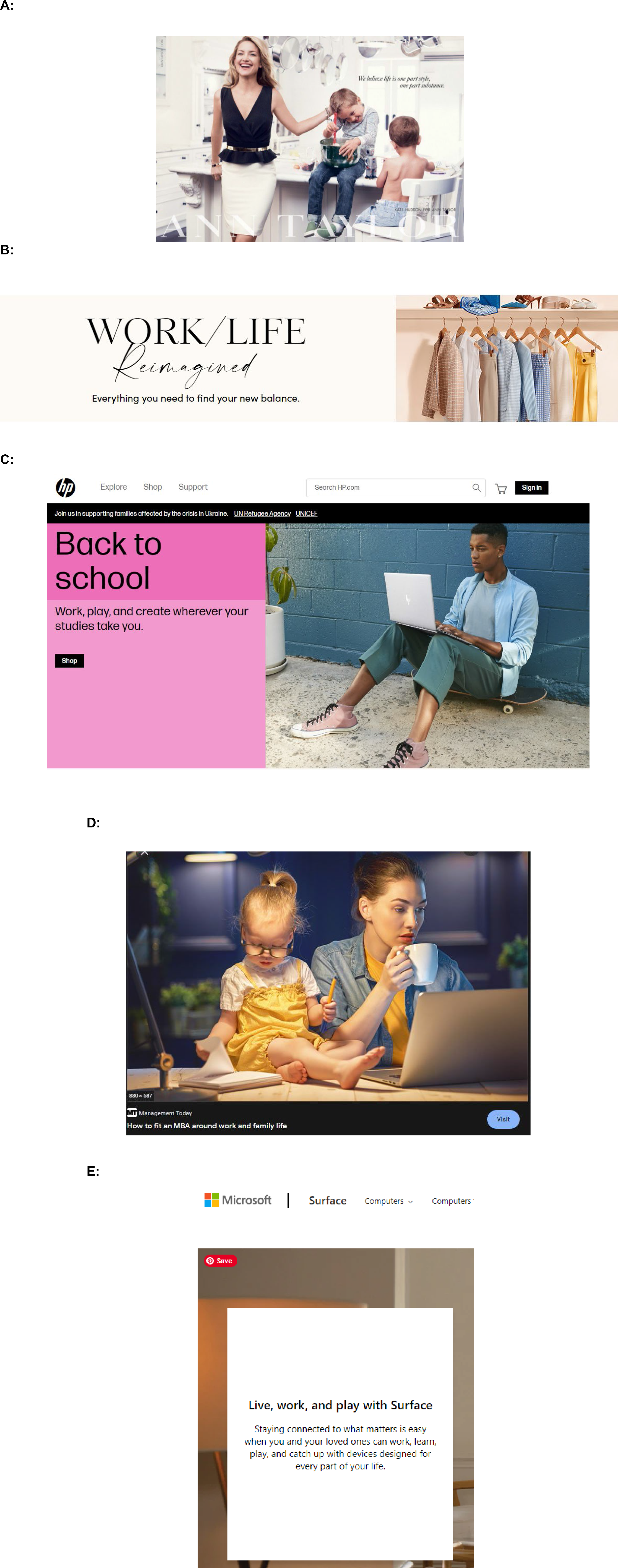
Real Ads That Highlight Work–Life Elements.
Whether consumers react this way is uncertain, though. The nature of the work–life interface depends on resource levels, so the effectiveness of work–life content may depend on consumers’ own (baseline) resource levels, as well as the extent to which the product might deplete resources. Relatively resource-demanding products, such as houses, multiday conferences, or multiyear education programs, require consumers to expend substantial resources to find, purchase, use, and dispose of them. In addition to monetary resources, some products require consumers to expend cognitive, physical, and emotional resources, while also imposing actual and perceived time costs (Berry, Seiders, and Grewal 2002). When they consume such resource-demanding products, consumers’ resources become relatively scarce, so work–life content might trigger negative perceptions of their work–life interface. Considering the lack of work–life theorizing pertaining specifically to marketing, this predicted link between work–life interfaces and consumption represents a conjecture. To buttress our hypotheses, we conducted two exploratory investigations, involving qualitative interviews with 14 working professionals (for similar approaches, see Zeithaml et al. 2020; Zhou et al. 2022) and a survey of 118 working professionals who responded to both open- and close-ended questions.
Exploratory Tests of Theoretical Predictions
The initial qualitative, in-depth interviews involved working women with school-aged children (see Web Appendix A). These interviews generated two relevant insights. First, reminders of life appear to be relatively less welcome in resource-demanding work-related settings and relatively more welcome in resource-undemanding work-related settings. Second, many of these respondents acknowledged that they are more likely to experience work–life conflict currently than before they had children.
Next, we executed a structured survey with a larger sample to further explore these findings (see the Appendix). When asked to describe a time when work interfered with their life or life interfered with their work, even with minimal prompting, most respondents offered profuse, detailed descriptions of work–life conflict. They described feeling conflicted, guilty, and stressed, and they often mentioned modifying their consumption. For example, I felt guilty about having to miss family activities. … Working out always goes first when working under strict deadlines, then family activities next, so double guilt.
I needed to decline a number of invitations to social events. From a health perspective, I found myself eating a significantly less healthy diet than usual, because I did not have the headspace to plan for healthy eating, nor did I have the time to cook.
However, respondents also noted enrichment moments: It was actually a really positive experience. My manager at the time was an incredibly understanding person and inspiring leader, and she let me know … that the work would still be there when I returned, and that I needed to take the time to attend to my own life.
To have a successful career, you have to sometimes take less time with friends and family. … Sometimes to put your family #1, you have to put them #2 to provide for them, requiring sacrifice. This is the balancing act necessary to build a great relationship with God, your family, and work.
Next, we asked the respondents to imagine they had been considering attending a professional conference (relatively resource-demanding product) and describe what came to mind when thinking about whether they should go and whether any roadblocks might prevent their attendance. Several respondents noted both professional and personal demands, suggesting a link between the resource demands of attending the conference and work–life conflict: I would feel excited and stressed. I’d like to build more connections, listen to interesting talks, and also travel. However, I would need to either (a) not pay back on my credit card in time, or (b) reach out to my family so that they could send me more money.
The first issue that would come to mind is the cost. If I had enough free time during the trip, I could justify the cost. If I did not, I probably would not go. I would see that money as taking away from a personal vacation.
As these quotes indicate, professional activities require both work and life resources—to plan, attend, and recoup—so even if these activities might generate resources (e.g., knowledge, social capital), the potential for resource scarcity can loom large in people's consumption decision. As is well established, consumers assign more weight to losses and what they must give up than to potential gains (Kahneman and Tversky 1984). If some prompt or frame encourages them to consider work and life together, such as if the invitation to the conference includes work–life content and themes (e.g., “leadership and wellness,” “business and life skills”), people's considerations of resource scarcity also become contextualized, potentially in the form of work–life conflict (Van Steenbergen et al. 2008), which may divert consumers’ interest in the offering. Yet if communications about the conference do not establish a link with the work–life interface, such as by focusing on a single domain (either work or life, but not both), notions of work–life conflict are less likely to surface, and consumers may exhibit relatively more interest in the offering. This reasoning leads us to expect that using work–life content to advertise resource-demanding products is relatively less effective.
In contrast, work–life content may signal the work–life enrichment that less resource-demanding products can facilitate. When we asked the survey respondents to imagine choosing a work–life daily planner (relatively resource-undemanding product), many of them mentioned the potential for work–life enrichment: If I thought this planner was going to improve my productivity and make my life easier, I wouldn't think much about it and would just buy it.
This would be a worthwhile investment if it would facilitate a better work/life balance.
Although daily planners cost money and require some effort to buy and use, they do not significantly deplete resources. Thus resource scarcity is unlikely, and an advertisement for these planners that includes work–life content should not evoke perceptions of work–life conflict. Because consumers have sufficient resources to consider the benefits of the product, they instead may focus on work–life enrichment (Van Steenbergen et al. 2008), which is more appealing in general, in that people instinctively avoid stressors (Grandey and Cropanzano 1999). Building on these exploratory and theoretical insights, and adopting a firm perspective, such that the goal is to determine ways to communicate effectively with consumers, we propose:
Although in these exploratory studies, we compared a resource-demanding product category (conference) with different, resource-undemanding one (daily planner), even within the same product category, products may differ in their resource demands. For example, an in-person conference is generally more demanding than a virtual one. Thus, we anticipate that product resource demands fall along a continuum (for more examples, see Web Appendix B).
Role of Consumers’ Work–Life Circumstances
We posit that consumers’ baseline resource demands and constraints affect their receptiveness to work–life content. People might experience more or less work–life conflict for several reasons. They might have fewer resources to start. If two people face similar work and life demands, the one with fewer resources experiences more work–life conflict (Kossek and Lee 2017) but also might benefit more from work–life enrichment. For example, people with conservative views generally subscribe to more traditional gender roles, in which men are breadwinners and leaders and women are caretakers and homemakers (Robinson et al. 2021). If conservative working women face the same work demands as socially liberal working women, but they have more constrained life-based resources because they shoulder more responsibility at home, they may experience more work–life conflict than their liberal counterparts (Geist 2005). As a result, conservative working women may find products marketed in a way that evokes work–life conflict (enrichment) less (more) appealing than liberal working women would.
In addition, some people confront higher demands but do not have more resources. If two people begin with the same resources, and then work or life demands increase for one of them, that person experiences greater work–life conflict (Leslie, King, and Clair 2019). For example, working women with young children typically experience more work–life conflict than working women without children (Gridiron 2017), because they must devote resources to addressing the life demands surrounding childcare. A more demanding job similarly tends to evoke more work–life conflict. A person in an executive or leadership role likely needs to devote more resources to completing their required job tasks than subordinates, which implies greater work–life conflict for them (Mills and Grotto 2017). As Kasper, Meyer, and Schmidt (2005, p. 441) propose, upper-level managers “are particularly affected by … changing role-images. … Generally, this group is said to invest particularly large proportions of their time budget in their profession … and devote specifically high emotional involvement to their jobs. This brings profession and family into competition.”
Regardless of whether greater work–life conflict results from fewer resources or higher demands, it should induce different reactions to products that vary in their resource demands. When resources already are strained, a resource-demanding product that induces additional work–life conflict appears especially costly, and ads for such a product that contain work–life content likely make the offering appear less attractive. A resource-undemanding product that promises work–life enrichment instead should be especially valuable (Hobfoll 2001), so advertising with work–life content may be effective in increasing the appeal of the product offering. Even if resource-undemanding products tend to entail less value, with minimal potential to be truly enriching (e.g., daily planners are unlikely to enrich a person's career to the same extent as conference attendance), they still can provide some cross-domain benefits. To explore these predictions, we return to our qualitative survey results; when considering whether to attend a professional conference, respondents mentioned more demanding work–life circumstances: I would be tempted to not attend. The childcare situation for three children would be beyond difficult, especially when your spouse also has a demanding career. To pay for extended childcare, coupled with the guilt away from the children, it would feel like it wouldn't make sense. Unfortunately, this comes at the cost of my career and upward movement in my role, I’m sure.
Thus, from a targeting standpoint, we expect the communication strategies outlined in H1 to be more impactful for consumers who experience more baseline work–life conflict, and we predict:
Testing the Conceptual Framework
To test our predictions, we partnered with the business schools of two large universities (one public and one private) and a small business, then developed social media advertisements for their products that feature either work–life or single-domain content. To assess the effectiveness of these ads, we measured the number of ad clicks they earned, which is an objective, behavioral measure of consumers’ product interest (Namin, Hamilton, and Rohm 2020) that also correlates with their purchase behavior (Zhang and Mao 2016). The business schools’ graduate programs represent a resource-demanding product; the small business's teeth-whitening products are a resource-undemanding product. 1
As with any academic–industry partnership, we needed to be mindful of what was realistic and beneficial for our partners. For example, using work–life and single-domain content to promote their products had to make sense for the product category, their brand identity, and their target consumers. Testing H2 requires variance in consumers’ work–life conflict, but capturing such variation requires that these differences already exist among actual consumers. For example, the work–life ads promoting the graduate programs had to align with the business schools’ brand identities, then target potential graduate school applicants who were likely to respond to a social media ad promoting an educational product and who also might differ in their baseline levels of work–life conflict. Thus, we worked with the partnering business schools, the small business entrepreneur, and digital consultants to identify consumer segments that (1) met the partners’ targeting criteria, (2) were employed, (3) likely experienced differing levels of work–life conflict, and (4) could be identified using the social media platforms’ targeting tools.
With these considerations in mind, we undertook five examinations. In Study 1, we content-analyzed secondary data gathered from the social media campaigns run by one of the partners to identify ads with work–life versus single-domain content and measure the effects on targeted consumers’ ad clicks. Then we conducted a series of field experiments. Studies 2 and 3 test whether work–life ads are relatively less effective for resource-demanding products; Study 3 also reveals whether the effects are stronger for executives (vs. midlevel managers). In Studies 4 and 5, we test whether work–life ads are relatively more effective for resource-undemanding products and whether the effects are stronger among conservatives (vs. liberals) and among working women with children (vs. without children). With these different segments, we can assess advertising effects for segments that likely experience higher (vs. lower) levels of baseline work–life conflict and thereby test all the predictions in H1 and H2.
Study 1: Secondary Data Content Analysis of Work–Life Ads for a Resource-Demanding Product
We obtained secondary data about social media ad campaigns run by the private university's business school from July 2018 to October 2019, which promoted six graduate programs (MBA, executive MBA, MS in analytics, MS in nonprofit administration [MNA], executive MS in nonprofit administration [EMNA], and MS in finance). Specifically, we received the number of ad impressions and ad clicks earned by each ad on any particular day, together with the exact text used in each ad. By design, the work–life content in these ads contains two elements: a work element and a life element. To ensure valid comparisons, the single-domain ad content also should have two elements: either two work elements or two life elements. Noting evidence from advertising-related research that examines the distinct influences of the spokesperson who endorses a product to achieve a goal (Kamins 1990; Kamins and Gupta 1994; Roy et al. 2019), we adopt this ad structure. 2 That is, the single-domain ads feature either a life influence, such as parent or friend (Beatty and Talpade 1994) who promotes a life goal, or else a work influence, such as a supervisor or coworker (Dumas, Phillips, and Rothbard 2013) who promotes a work goal.
Two research assistants, enrolled in a graduate program and familiar with advertising terminology, coded the text of each ad to reflect whether it mentioned an influence or a goal and, if so, whether that feature pertained to a work domain, a life domain, or neither. We used 250 observations to train these assistants. 3 Table 1 highlights some of the categorizations. The raters coded the ad copy consistently (Cohen's k intercoder reliability = .87); in cases of inconsistencies, they resolved them through discussion. After dropping observations unrelated to work or life content, we retained 23,101 daily observations, 36.6% of which pertained to work–life ads (either work influence–life goal or life influence–work goal combination), while the remaining 63.3% were single-domain ads (work influence–work goal or life influence–life goal combination). The independent variables were effect-coded as follows: influence (work = 1, life = −1), goal (work = 1, life = −1). Consequently, the single-domain (work–work or life–life) was coded as 1 and the work–life domain was coded as −1.
Examples of Work–Life Coding from Social Media Ads (Study 1).

Model Estimation
Estimating ad clicks requires a count model, and because the variable is overdispersed (M = 3.73, SD = 13.45), a negative binomial model is more appropriate than a Poisson model. We use a zero-inflated negative binomial model (ZINB; Greene 2003) to account for the excessive zeros in ad clicks (51% of the observations were 0). A ZINB model has two equations: an inflation equation for which the outcome is always 0 (i.e., the ad received no clicks that day) and a count equation that uses a negative binomial process (i.e., the ad was clicked one or more times that day). We specified the probability that ad i is clicked on day t as:


Results
By estimating the ZINB model components with and without control variables, we can isolate the impact of work–life content, beyond the impact of advertising elements that drive product interest (e.g., influencer who promotes the product, goal the product helps consumers achieve). For this analysis, we relied on the coding, in which a single-domain ad (work–work or life–life) takes a value of 1 and a work–life ad (whether work–life or life–work represented by the influencer and goal) equals −1. We provide the means by condition in Table 2. The results in Table 3, for the ad click model with control variables, indicate that after accounting for the effects of the influencer and goal, the effect of single-domain (vs. work–life) content on ad clicks is significant and positive (b = .04, p < .01). That is, single-domain ads are more likely to prompt clicks than work–life ads. This evidence that work–life ads are less effective for the resource-demanding product being advertised provides initial support for H1a.
Means of Ad Clicks from Work–Life Ads Across Studies.

Analysis of Secondary Data on Work–Life Ads for a Resource-Demanding Product (Study 1).

*p < .10. **p < .05. ***p < .01.
Notes: n = 23,301. Results feature parameter estimates with standard errors in parentheses.
As is generally the case for secondary data, though, we have limited ability to draw causal inferences. We measured work and life influences and goals on the basis of ad content, which is subject to measurement error. Furthermore, we can account for the content of the ads themselves but not for unobservable factors that also might drive ad clicks. Therefore, as a stronger test of H1a, we manipulate (instead of measure) work and life content in a field experiment, in partnership with the public university's business school.
Study 2: Field Experiment on Work–Life Ads for a Resource-Demanding Product
We worked with the public university's business school to design four work–life ads that promote its flagship MBA program. 4 All the ads contain the same neutral image but vary in their work and/or life content, such that they refer to either a work influence (“keep up with your coworkers—get an MBA”) or a life influence (“invest in your family's future—get an MBA”) and to either a work goal (“become an expert in your field and strengthen your work network”) or a life goal (“increase your confidence and invest in your personal development”). By varying the influence (work or life) and the goal (work goal or life goal) in the ads, we establish a 2 (influence: work vs. life) × 2 (goal: work vs. life) design, with four ads but two ad types. The work–life ads feature either a work influence–life goal or life influence–work goal combination. The single-domain ads combine either work influence–work goal or life influence–life goal (Figure 2).

Stimuli of Work–Life Social Media Ads for an MBA Program (Study 2).
We worked with an ad agency to format the four ads and run them on Facebook and LinkedIn for 19 weeks, using the same targeting criteria that this agency had used previously to run campaigns for the business school. The existing segmentation criteria aim to target people who have shown some interest in earning an MBA degree and who live in the catchment region for the business school. These working adults, employed in business-related industries, had at least an undergraduate degree. The ad agency also used the platforms’ A/B testing tools to divide ad exposure equally and randomly across the four ads, such that no person would see more than one of the ads, and each ad achieved the same level of exposure. At the end of the sample period, the agency provided us with data about all four ads’ daily number of impressions and clicks, resulting in 923 observations.
Similar to Study 1, we estimated a ZINB model of ad clicks (63.9% of observations had 0 clicks; M = .83, SD = 1.55) using the effect-coded variables (influence, goal, and single-domain vs. work–life) and the control variables (ad impressions, social media platform, and biweekly dummies) as predictors. The results in Table 4 show that even after accounting for the impact of influence, goal, and several control variables, single-domain ads reveal a higher probability of being clicked on than work–life ads (b = .10, p < .05). Thus, the work–life ads again appear less effective for this resource-demanding product, in support of H1a.
Analysis of Field Experiment Data on Work–Life Ads for a Resource-Demanding Product (Study 2).

*p < .10. **p < .05. ***p < .01.
Notes: n = 923. Results feature parameter estimates with standard errors in parentheses.
Because the ad text was mandated by the business school, there were minor inconsistencies between the work and life content. To confirm the robustness of the findings, we need to test whether these results can be replicated for a different graduate program that attracts applicants unlike those who might enter an MBA program, run by a different university, using ads that feature more consistent work and life content. In addition, to test H2a, we need to compare consumer segments with varying baseline levels of work–life conflict, which we achieved with a new field experiment.
Study 3: Field Experiment on Work–Life Ads for a Resource-Demanding Product, Segmented by Job Title
We partnered with the private business school partner university from Study 1 and its business school's chief marketing officer to design four ads promoting the school’s MNA and EMNA programs (the latter program targeted executives) and its MS in finance program. The ads featured the same watermarked image of the university's logo, but the influence, goal, and name of the program mentioned in the text varied. The ad text referred to either a work influence (“your coworkers support you”) or life influence (“your family supports you”) and either a work goal (“invest in your professional growth”) or a life goal (“invest in your personal growth”). We pretested the ads to ensure that they manipulated work and life content. A significant majority of participants correctly identified the work goal versus the life goal and the work influence versus the life influence (greater than 65% correct; tested vs. midpoint of 50%; p < .05; Web Appendix D). In each set of four ads, half were work–life ads, and the other half were single-domain ads (Figure 3).
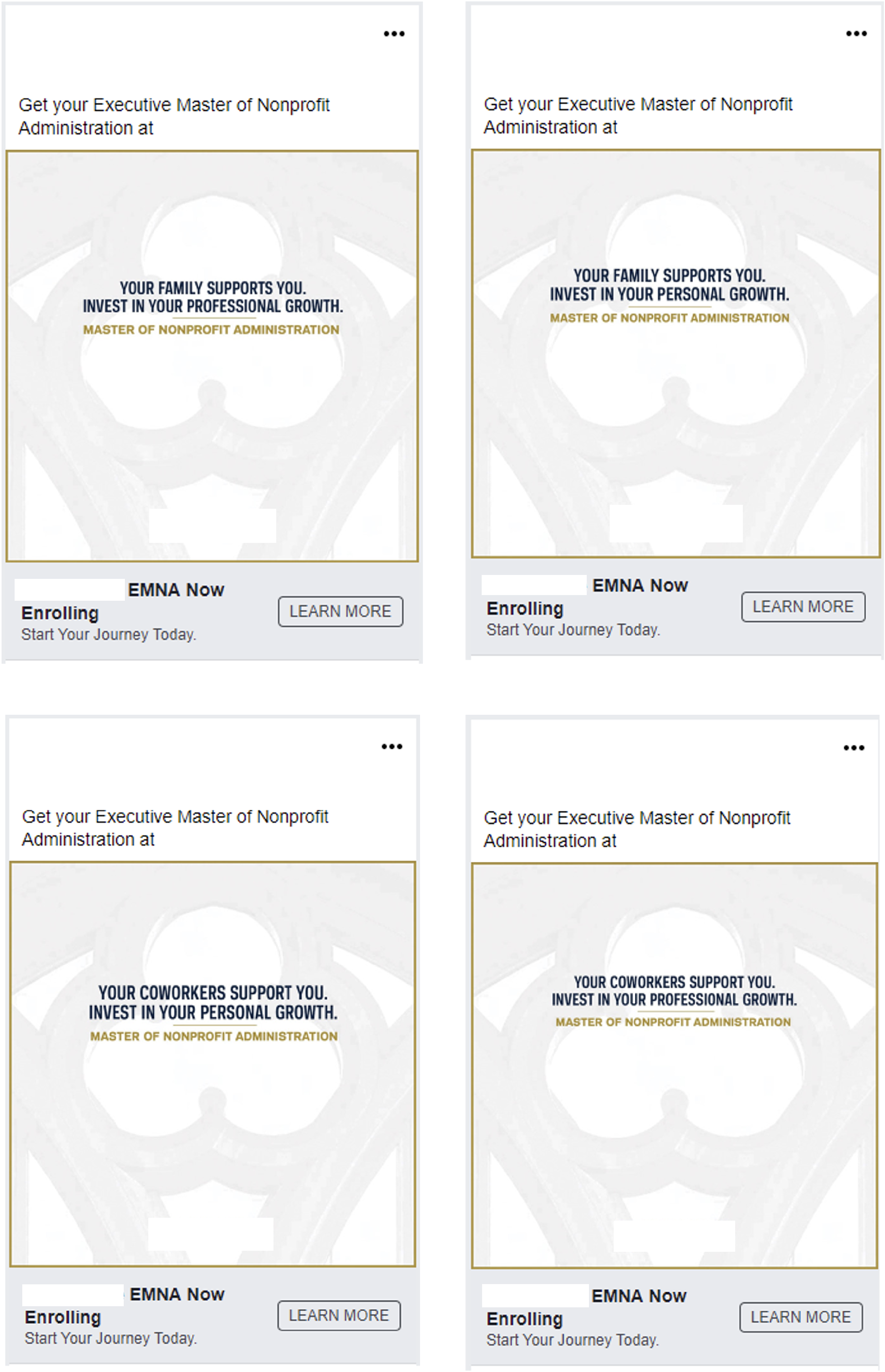
Stimuli of Work–Life Social Media Ads for an MS Program (Study 3).
The ads ran on LinkedIn and Facebook for 48 days. We targeted prospective applicants using the criteria adopted by the business school's ad agency. This agency provided us with daily data on ad clicks and impressions, the social media platform used, and the program name. In total, we obtained 695 observations.
We estimated a ZINB model of ad clicks (50.1% of observations had 0 clicks; M = 1.40, SD = 2.01) using the effect-coded variables (influence, goal, and single-domain vs. work–life) and the control variables (ad impressions, social media platform, and weekly dummies) as predictors. The results in Table 5 show that even after accounting for the impact of influence, goal, and several control variables, single-domain ads reveal a higher probability of being clicked on than work–life ads (b = .15, p < .01). Thus, the work–life ads again appear less effective for the resource-demanding product, in support of H1a. 5
Analysis of Field Experiment Data on Work–Life Ads for a Resource-Demanding Product, Segmented by Job Title (Study 3).

*p < .10. **p < .05. ***p < .01.
Notes: Results feature parameter estimates with standard errors in parentheses; N.A. = not applicable.
Next, we focused on a subset of the data, related to the two versions of the nonprofit administration program. The MNA and EMNA programs are similar, but the target students for each program likely differ in their baseline work–life conflict levels, such that executives generally experience more work–life conflict (Kasper, Meyer, and Schmidt 2005; Mills and Grotto 2017). Therefore, we test H2a with this subset of data, pertaining to 336 observations, with another ZINB model of ad clicks (58.3% of observations have 0 clicks; M = .96, SD = 1.47), containing the single-domain (vs. work–life) content variable, its interaction with the executive (vs. midlevel manager) consumer segment variable (executive = 1, midlevel manager = 0), and the control variables (only LinkedIn was used for these ads, so we do not control for social media platform). The results in Table 5 reveal a significant interaction effect (b = .27, p < .01). In effect, single-domain ads receive even more clicks (and work–life ads receive even fewer clicks) from executives than from midlevel managers, in support of H2a.
Taken together with the results from the first two studies, these findings indicate that work–life ads are less effective than single-domain (work or life) ads when the advertising involves resource-demanding products, in support of H1a. 6 The effect is particularly strong for a consumer segment that experiences more work–life conflict in general, in support of H2a. Next, we examine the case of products without strong resource demands, to test H1b and H2b.
Study 4: Field Experiment on Work–Life Ads for a Resource-Undemanding Product, Segmented by Political Identity
In response to the COVID-19 pandemic, meetings and social events were held virtually, using videoconferencing apps like Zoom. Demand for face-related cosmetic products, including teeth whiteners, accordingly increased. Against this backdrop, we designed four work–life ads to promote a small business's teeth-whitening product, referring to an upcoming Zoom meeting for which having whiter teeth would be desirable. The ad text referred to either a work goal (“Zoom meeting with coworkers?”) or a life goal (“Zoom party with friends?”), followed by the statement, “stand out with a bright smile.” Then the text cited either a work influence (“your coworkers”) or a life influence (“your friends”), followed by another statement: “recommend [the small business's name]'s all natural teeth-whitening products.”
The small business had only been in business for a year, so unlike the business schools we partnered with, we could not rely on its logo alone to provide relevant imagery in the ads. Instead, we included images that represented the product but also related to work or life content. Specifically, we hired two models to enact the four conditions and display the teeth-whitening product. One of the models portrayed a customer with a work goal (i.e., work event) or life goal (i.e., social event); the other model portrayed either a work influence (i.e., coworker) or life influence (i.e., friend). The models achieved variation in these aspects by changing their outfits, appearance, and poses. We pretested whether the four images effectively manipulated perceptions of work and life content. A majority of participants correctly identified which ads had a work goal, a life goal, a work influence, and a life influence (greater than 60% correct in all cases; tested vs. midpoint of 50%; p < .05; Web Appendix D). A professional photographer took photos of their enactments. Using the resulting text and images, an ad agency designed four ads (Figure 4) and ran the campaigns on Facebook and Instagram, using the platforms’ A/B testing tools. We chose these platforms because the small business had successfully run campaigns on them in the past.
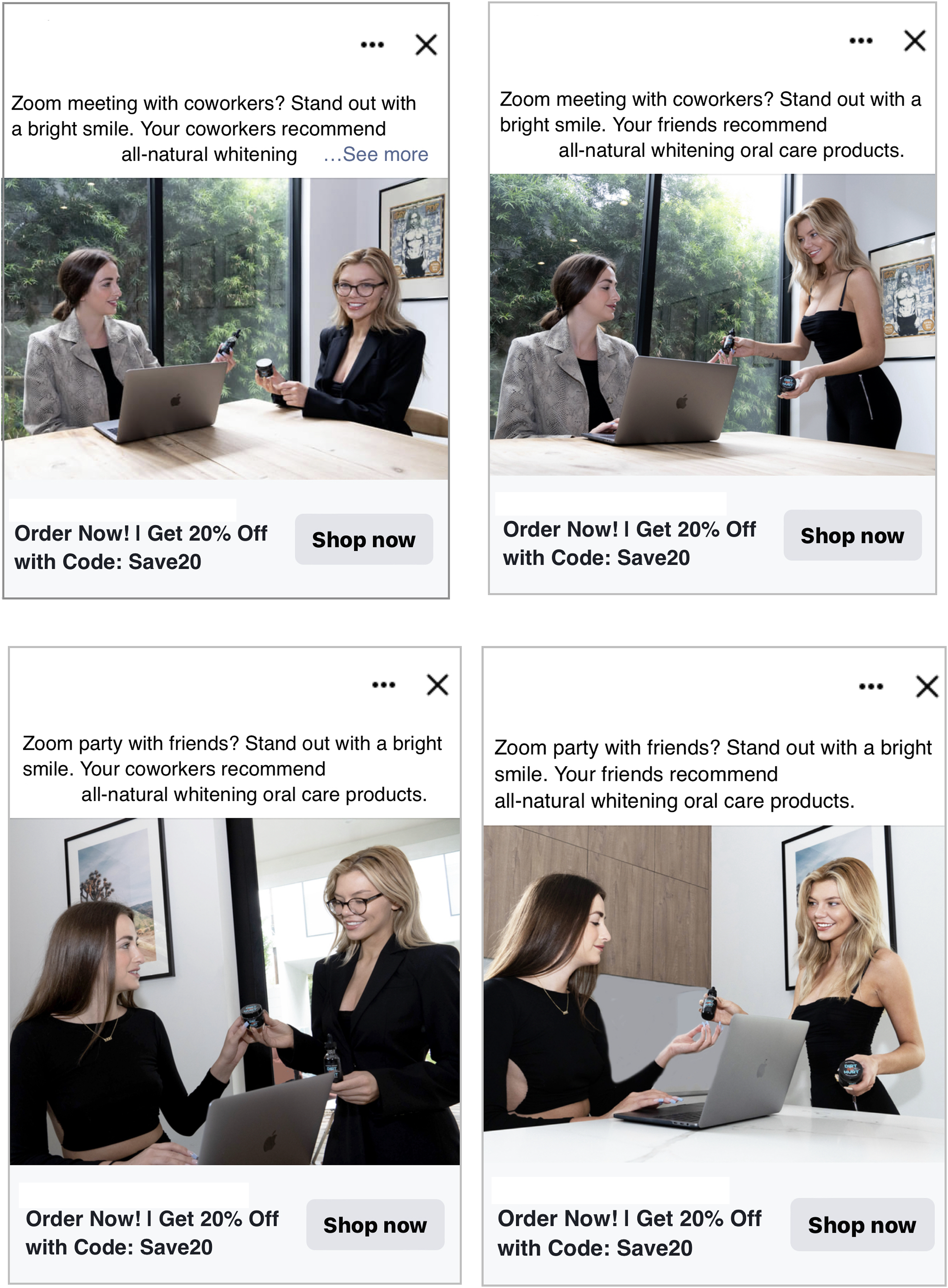
Stimuli of Work–Life Social Media Ads for a Teeth-Whitening Product (Studies 4 and 5).
With Facebook's A/B testing tool, we randomly sent the four ads to adult, working women in New York and Texas who could be identified as conservative or liberal, according to the platforms’ targeting tools. The ad campaign pushed the four ads on both platforms, targeting segments of both conservative working women and liberal working women for 12 days, resulting in 259 observations. Here, each observation involves a particular ad appearing on one of the platforms and targeting one of the segments.
To test H1b, we estimated a ZINB model of ad clicks (45.2% of observations are 0s; M = 5.74, SD = 12.71) using the effect-coded variables (social influence, goal, single-domain vs. work–life) and controls (ad impressions, social media platform, week dummy). The negative binomial model results in Table 6, after accounting for the impact of influence and goal and control variables, show that the effect of single-domain versus work–life content on ad clicks is (marginally) significant and negative (b = −.10, p = .07). The single-domain ads promoting the teeth-whitening product prompt fewer clicks than the work–life ads do, such that the work–life ads appear more effective in marketing this resource-undemanding product, in support of H1b.
Analysis of Field Experiment Data on Work–Life Ads for a Resource-Undemanding Product, Segmented by Political Orientation (Study 4).

*p < .10. **p < .05. ***p < .01.
Notes: n = 259. Results feature parameter estimates with standard errors in parentheses.
Next, we retained the single-domain (vs. work–life) content variable from this analysis and used it to estimate a new ZINB model of ad clicks that also included interactions with the conservative (vs. liberal) working women (consumer segment) variable (conservative = 1, liberal = 0) and the control variables. The results in Table 6 reveal a significant, negative interaction effect (b = −.53, p < .01), showing that work–life ads receive even more clicks from conservative working women, who likely have higher baseline levels of work–life conflict, than from liberal working women, in support of H2b. For robustness, we next attempt to replicate the results, using a different demographic variable as a proxy for differences in baseline levels of work–life conflict.
Study 5: Field Experiment on Work–Life Ads for a Resource-Undemanding Product, Segmented by Parenthood
With the ads from Study 4, the ad agency ran another ad campaign on Facebook and Instagram for 18 days. Using the platforms’ A/B testing and targeting tools, it shared these ads equally with working women with children and working women without children, living in New York and Florida. We obtained data about daily ad impressions and clicks for the four ads for 18 days, resulting in 706 observations.
When we checked whether single-domain ads perform worse than work–life ads among these new sets of consumers, the ZINB model of ad clicks (52.3% of observations are 0s; M = 3.59, SD = 12.06) shows a negative effect of single-domain (vs. work–life) content on ad clicks (b = −.11, p < .01; see Table 7). Work–life ads are more effective for marketing this resource-undemanding product than single-domain ads, as predicted in H1b.
Analysis of Field Experiment Data on Work–Life Ads for a Resource-Undemanding Product, Segmented by Parenthood (Study 5).

*p < .10. **p < .05. ***p < .01.
Notes: n = 706. Results feature parameter estimates with standard errors in parentheses.
Then, in a new estimation, we interacted single-domain (vs. work–life) content with the binary variable indicating whether the women had children or not, and we find a significant and negative relationship (b = −.16, p < .01; Table 7). This result suggests that work–life ads receive even more clicks from working mothers, who likely have higher baseline levels of work–life conflict, than from working women without children, consistent with H2b.
General Discussion
With this novel research, we apply themes from work–life literature to marketing questions and test the effectiveness of work–life themes communicated in social media ads. The results of in-depth interviews, a survey, secondary data analyses, and four field experiments reveal that both product type and consumers’ baseline work–life conflict levels jointly determine advertising effectiveness. That is, for a relatively resource-undemanding product, work–life ads (vs. single-domain ads) prompt relatively more clicks, and this outcome is stronger among consumers who tend to experience more work–life conflict. In contrast, for resource-demanding products, work–life ads (vs. single-domain ads) induce fewer clicks, especially among consumers who generally experience more work–life conflict. These effects appear to arise because products that demand substantial resources also can trigger perceptions of resource scarcity, so work–life content evokes a sense of work–life conflict, which is especially unappealing to consumers who already experience greater work–life conflict. For resource-undemanding products, though, resource scarcity perceptions are unlikely, so work–life content probably does not evoke a sense of conflict but instead signals the potential for work–life enrichment and leads to greater interest, especially among consumers who could benefit from such enriching products (i.e., those who experience more work–life conflict).
Our findings also rule out alternative explanations of the results. For example, Germelmann et al. (2020) predict that because congruent elements are easier to process, they prompt more favorable perceptions than incongruent elements. The single-domain, congruent ads then might have outperformed the work–life, incongruent ads, but because this outcome does not emerge when the product is resource-demanding, we can rule out a congruency explanation. Campbell and Goodstein (2001) argue that in high-risk situations, as might be evoked by resource-demanding products, consumers prefer congruent ads, but this argument does not hold among consumers who experience less work–life conflict. According to De Pelsmacker, Geuens, and Anckaert (2002), in low-involvement settings, congruent information is preferred. Yet we find that for resource-undemanding products, which likely induce low involvement, ads with incongruent, work–life information garner more interest. Finally, incongruent, work–life ads arguably might increase affective processing (Gao, Mittal, and Zhang 2020), which would lead to varying results across product types. But such theorizing cannot explain why the effect would be stronger among consumers who experience more work–life conflict.
Contributions to Theory
This article offers a pioneering application of themes from work–life literature to marketing settings. This contribution is relevant for two reasons. First, work–life issues are pressing topics for today's consumers. Second, some companies already use ads with work–life content (see Figure 1), yet no systematic research has predicted or tested which factors make work–life ads effective. With this research, we identify two factors that determine work–life advertising effectiveness: (1) the extent to which the advertised product is resource-demanding and (2) the extent to which consumer segments viewing the ad struggle with work–life conflict. Thus, we clarify the influence of a distinct product characteristic—beyond features such as country of origin, anthropomorphism, or brands—that affects consumers’ evaluations of ads. Specifically, the extent to which a product can be characterized as resource-demanding informs the effectiveness of ads promoting the product using work–life content.
We also contribute to the broader work–life literature in two ways. First, studies of work–life issues in sociology, psychology, and management domains (e.g., Leslie, King, and Clair 2019; McNall, Nicklin, and Masuda 2009; Nippert-Eng 1996; Sirgy and Lee 2018) tend to focus on distinctions between work and life, or else the issues, determinants, and outcomes of segmentation versus integration in relation to people's work–life balance and general happiness. In contrast, we take a novel perspective by adopting a marketing lens to investigate the effects of work–life issues on consumers’ advertising evaluations. Second, we specify how resource demands associated with a product context and baseline work–life concerns jointly inform such evaluations. These previously ignored considerations of work–life elements have important implications for customer segmentation practices and positioning strategies based on products with varied work and life benefits.
Finally, we establish that ad evaluations vary by consumer characteristics, including job title, parenthood, and political orientation. In so doing, we explicitly extend research into how political identity affects consumers’ evaluations (e.g., Han et al. 2019; Jung and Mittal 2020; Ordabayeva and Fernandes 2018). As we show, political identity can shift consumers’ evaluations by influencing how they react to work–life ads.
Contributions to Practice
Real-world examples reveal the prevalence of advertising that promotes products or services according to their ability to meet people's needs at work or in their personal lives. Dell even defines its product lines according to whether they address consumers’ work or life, such that its website describes the Latitude line as the “world's most intelligent business PC,” but for the Inspiron line, it promises “whether you’re editing photos or managing your home finances, Inspiron's copious options fit both screen-size and budget needs for most buyers” (Burek and Brant 2021). Another common marketing strategy promotes offerings according to their ability to bridge the divide between work and personal lives, such as Zoom's assertion that its services help people hold meetings and collaborate with colleagues, as well as socialize with friends and family (e.g., “While Zoom has become central to communicating with colleagues during this time, it also opens the door to staying in touch with loved ones over video”; Reed 2020). Yet we know of no work that explicitly examines the effectiveness of work–life ads, and by addressing this gap, we provide some guidance regarding the settings in which work–life ads (vs. single-domain ads) can be effective. We summarize these practical implications in Table 8, in terms of recommendations for communication strategies, targeting strategies, and level of engagement. Considering how effectively social media can target ads to specific demographic profiles, these insights should be meaningful for driving campaign designs that present each demographic type with a suitably crafted ad.
Practical Implications and Research Directions.

From a communications perspective, firms can leverage work–life content in their ads if the product they sell demands relatively few resources. If they are promoting resource-demanding products, they instead might want to develop single-domain ads. From a targeting perspective, each strategy is likely to work best among consumer segments who experience relatively more work–life conflict, a point that can be applied due to the fine targeting that is possible for social media ads. Finally, these insights are especially relevant for advertising campaigns that aim to attract more customer interest (e.g., via ad clicks).
Limitations and Directions for Further Research
In addition to practical guidelines, Table 8 proposes directions for research, which we elaborate on in this section.
Communication strategies
All the ads we examine feature a common structure, in which an influence (work or life) endorses a product to attain a specific goal. It would be useful to test our findings with other ad structures, such as those involving multiple goals. The ads we test also contrast work–life versus single-domain content. More granular examinations could be useful, such as explicit contrasts of work–work with life–life single-domain ads. In our findings, when single-domain ads were more effective, the outcomes varied; life–life ads were the most effective in Study 2, but work–work ads were the most effective in Study 3. Among the work–life ads, we note that work influence–life goal ads appear most effective in both Studies 4 and 5. Thus, learning which factors (e.g., product category, demographics) influence whether work–work ads are more or less effective than life–life ads, or when work–life ads are more or less effective than life–work ads, represents a pressing goal.
We investigate the effectiveness of social media ads on Facebook, LinkedIn, and Instagram. It is possible that the effects would vary on other social media platforms with different features, such as WeChat, TikTok, or Snapchat. Work–life content also can appear in other marketing channels, such as online, print, or point-of-sale advertisements or in-person sales pitches. The underlying process we identify might arise in other advertising media and channels too, but this prediction requires verification. Finally, we examine graduate programs and a teeth-whitening product. Extending the considerations to other product types would be useful, such as those that vary in their hedonic versus utilitarian classification or convey varying types and levels of status.
Targeting
To build on the evidence we provide regarding the moderating influences of demographic factors (e.g., job role, political orientation, children), we suggest research into other moderators, such as cultural factors (e.g., if a culture prioritizes work over life); resource slack (whether the customer has available time, money, and energy); or the consumer's involvement, engagement, and experience with the product category. Examining such moderators could establish the boundaries of work–life communication effects and thus provide additional insights.
Engagement
We primarily examined the impact of interest in an ad, as reflected in ad clicks. However, Study 3 also provides some preliminary evidence that the effects might extend downstream, to ad conversions. Extending the examination to other downstream variables, including actual purchases and beyond, would enhance the impact of this research.
Supplemental Material
sj-pdf-1-mrj-10.1177_00222437231152894 - Supplemental material for Testing Work–Life Theory in Marketing: Evidence from Field Experiments on Social Media
Supplemental material, sj-pdf-1-mrj-10.1177_00222437231152894 for Testing Work–Life Theory in Marketing: Evidence from Field Experiments on Social Media by Nita Umashankar, Dhruv Grewal, Abhijit Guha and Timothy R. Bohling in Journal of Marketing Research
Footnotes
Appendix: Survey Regarding Work–Life Interface and Consumption
We surveyed graduate student alumni of our private business school partner in exchange for a chance to win one of ten Amazon gift cards worth $35 each. To recruit a heterogeneous sample with varying work and life circumstances, we posted the survey on multiple email discussion lists, reaching cohorts of alumni from different programs across different years. The final sample included 118 working adults, all of whom were employed, with considerable differences in work experience (M = 13 years; range: 2 to 50 years), hours worked per week (M = 40 hours; range: 4 to 80 hours), work roles (fitness instructor, physical therapist, school principal, associate dean, managing director, CFO, CEO, company president), and salary (M = $156,000; range: $30,000 to $500,000). They also varied by gender (55% male, 42% female, 3% nonbinary), relationship status (55% married, 25% in a relationship, 20% single), number of children (M = 1 child; range: 0 to 4 children), and political orientation (47% liberal, 36% conservative, 17% moderate). We began by describing our research interest and defining terms like “work,” “life,” “work–life conflict,” and “work–life benefits,” and then we asked participants about their work and life backgrounds using an open-ended question. Next, we prompted them to describe a time when work interfered with life and a time when life interfered with work. We measured to extent to which they generally face work–life conflict by asking them to rate their agreement with the statements “I could use more resources to manage work and life,” “My personal life makes it hard to achieve what I want to at work and vice versa,” and “I experience work–life conflict” using five-point Likert scales adapted from previous research (e.g., Greenhaus and Beutell 1985; Grzywacz and Marks 2000). We averaged the items to create a measure of general work–life conflict (Cronbach's alpha = .70, M = 3.27, SD = .87).
Then we tested the extent to which two products, graduate business education and teeth-whitening strips, were associated with resource demands by measuring respondents’ agreement with four statements describing each product as (1) costly, (2) effortful to buy and use, (3) time-consuming to buy and use, and (4) requiring trade-offs to be made to buy and use. We averaged the scores for each product to create a measure of product resource demands. Finally, we measured the degree to which the product is associated with making work–life balance harder (1 = “easier,” and 5 = “harder”) and with work–life benefits or conflict (1 = “benefits,” and 5 = “conflict”). Relative to the teeth-whitening strips, the graduate program was perceived as more resource-demanding (M = 4.32 vs. 2.20; t = 22.29, p < .01), associated with work–life balance being harder to achieve (M = 3.90 vs. 1.49; t = 18.11, p < .01), and associated with more work–life conflict (M = 3.16 vs. 2.30; t = 5.96, p < .01). Thus, we used graduate programs (teeth-whitening products) as a proxy for a relatively resource-demanding (resource-undemanding) product.
Finally, to characterize the respondents, being female, politically conservative, a parent, and in a higher-tier job role all were significantly correlated with more general work–life conflict (all correlation values > .18, p < .01). This finding encouraged us to manipulate consumer segment work–life conflict in the field experiments using these characteristics.
Overall, the survey revealed that consumption affects perceptions of the work–life interface. The resource-demanding product is associated with more work–life conflict; the resource-undemanding product is linked to work–life enrichment. Respondents reported feeling stressed when asked to imagine combining work and life in resource-demanding circumstances, so seeing work–life content in an ad seemingly may trigger negative reactions. Finally, we verified that consumer demographics affect levels of general work–life conflict, which in turn may influence perceptions of work–life content.
Coeditor
Vikas Mittal
Associate Editor
Eileen Fischer
Author Contributions
The fourth author collected the field study data (Studies 1–5), and the first author handled the data analysis. The in-depth interviews were conducted by the third author.
Declaration of Conflicting Interests
The author(s) declared no potential conflicts of interest with respect to the research, authorship, and/or publication of this article.
Funding
The author(s) received no financial support for the research, authorship, and/or publication of this article.
Notes
References
Supplementary Material
Please find the following supplemental material available below.
For Open Access articles published under a Creative Commons License, all supplemental material carries the same license as the article it is associated with.
For non-Open Access articles published, all supplemental material carries a non-exclusive license, and permission requests for re-use of supplemental material or any part of supplemental material shall be sent directly to the copyright owner as specified in the copyright notice associated with the article.
