




Abstract
Marketers often assume that consumers comparing products (e.g., two TVs) will show a hedonic contrast. In other words, a product seems more appealing and consumers are willing to pay more for it when it is compared with an unappealing competitor than when it is compared with a highly appealing one. However, hedonic judgments (e.g., how appealing is this TV?) are confounded with underlying attribute judgments (e.g., how big is this TV?), and it is important to delineate their effects. This article presents six studies to disentangle them and shows evidence for two separate effects in opposite directions: while a product’s attribute judgments contrast with those of a competitor, its hedonic judgments assimilate. Thus, marketing tactics based on the assumption of the hedonic contrast hypothesis can potentially backfire, reducing willingness to pay. More generally, this research reveals the hidden complexity underlying product comparisons.
Marketers often try to boost their products’ appeal and willingness to pay for them by influencing how consumers compare them with competitors. For example, an interactive table on Toyota's website promotes comparison of Toyota's models with inferior competitors (Toyota 2022). The table highlights that the Toyota Camry XLE has more horsepower and gets more miles per gallon than the table's default competitor, the Honda Civic Si, but these attributes are removed from the highlights if the user switches to a superior competitor. A similar tactic was used in an advertising campaign comparing Prego spaghetti sauce with a competitor, Ragu (Pollack 1996). In one commercial, Ragu's sauce appears thin and unappetizing as it seeps into a bowl of pasta, making Prego's chunkier sauce appear “thicker, more delicious” in contrast. Comparative advertisements like this have been shown to increase the amount consumers are willing to pay for the target product (Kalra and Goodstein 1998).
The widely accepted explanation for these types of situations is that an unappealing (appealing) competitor makes the target appear more (less) enjoyable, known as the hedonic contrast hypothesis. Many studies appear to show hedonic contrast (Morewedge, Zhu, and Buechel 2019; Novemsky and Ratner 2003). Vacation destinations seem more enjoyable when compared with unpleasant destinations than when compared with pleasant ones (Raghunathan and Irwin 2001). Beverages taste worse when compared with a delicious one (Zellner et al. 2003). Yet, for all of the evidence in favor of the hedonic contrast hypothesis, there is much that suggests the opposite. Sometimes beverages taste better when compared with a delicious one (Ghoshal et al. 2014). And consumers spend more on products paired with appealing stimuli than on those paired with unappealing stimuli (Hasford, Hardesty, and Kidwell 2015). These inconsistencies suggest complexities in the way consumers compare products.
The present research proposes that product comparison occurs along both attribute and hedonic dimensions. Attribute judgments represent subjective assessment of a quantity's magnitude (i.e., how large, how heavy, how powerful) and often create contrast effects (Cunha and Shulman 2011; Parducci 1965). And because judgments of a product's enjoyment are inherently linked to judgments about its attributes, their effects are confounded (Meyer 1981). In practice, it is difficult to tease them apart, but the present research disentangles them and finds that in product comparisons, attribute and hedonic judgments play separate roles in opposite directions. There is a contrast effect on the attribute judgment: Prego's sauce appears thicker than Ragu's runny sauce. This has downstream hedonic consequences: because thicker sauce is more appealing, Prego seems more appealing. But at the same time, hedonic judgments assimilate: the unappealing judgment about Ragu actually makes Prego less appealing. In other words, this proposed model claims that a competitor simultaneously makes the target more appealing and less appealing, but because the attribute effect tends to be stronger, the total effect is one of contrast.
At first, this distinction may appear inconsequential, but the model shows how some policies that assume the hedonic contrast hypothesis can backfire, reducing consumers’ willingness to pay. Comparing a target with an unappealing competitor enhances its value when they share common attributes, but reduces its value for distinct attributes. The attribute–hedonic model suggests ways that managers can approach competitors to help avoid these issues and improve outcomes like product appeal and willingness to pay. Considering the number of marketing practices that involve product comparisons, the implications are widespread.
Theoretically, this research provides a deeper understanding of how consumers compare products. It goes beyond similar findings in the domain of ideal points that have shown that while attribute judgments contrast with the context, the peak of the inverted-U-shaped ideal-point curve assimilates toward the context (Riskey, Parducci, and Beauchamp 1979). However, the theories developed to explain these ideal-point situations face difficulties explaining the current set of results (Cooke et al. 2004; Wedell and Pettibone 1999).
Conceptual Development
The Hedonic Contrast Hypothesis
Before moving on, it is important to clarify the hedonic contrast hypothesis. Fechner (1898, p. 232) defines it as situations in which an object becomes more enjoyable the more it contrasts with less appealing or unappealing objects, and a corresponding proposition holds for that which is unappealing. Subsequent definitions emphasize other aspects, but retain the core idea that one object's enjoyment has a direct negative effect on enjoyment of another object (Cogan, Parker, and Zellner 2013; Novemsky and Ratner 2003). Although some findings indicate assimilation, they are often considered exceptions to a default hedonic contrast effect (Raghunathan and Irwin 2001; Zellner, Kern, and Parker 2002).
To illustrate the hedonic contrast hypothesis, consider a consumer browsing one particular laptop with a 50 gigabyte (GB) hard drive. Presumably they would find it less appealing (and consequently have a lower willingness to pay) if the other laptop on display had a 500 GB hard drive than if the other laptop had a 5 GB hard drive. The hedonic contrast hypothesis says that this is due to a direct negative effect of enjoyment of one laptop on enjoyment of the other. However, the subsequent sections outline a different interpretation.
The Attribute–Hedonic Model
The attribute–hedonic model proposes that comparing products involves separate indirect effects for hedonic and attribute judgments. Before discussing these judgments, we must first review key processes that lead to contrast and assimilation. Although many processes are known to create contrast and assimilation effects (Bless and Schwarz 2010; Martin, Seta, and Crelia 1990; Meyers-Levy and Sternthal 1993), the focus here is on two: norms and priming. Norm theory proposes that comparative judgments are based on mental representations of typical values of an attribute for a category (Kahneman and Miller 1986). For example, the statement “Jane owns a small dog” involves representations of both (1) the size of Jane's dog and (2) the typical size of dogs—the category norm. Norms are malleable and are created as needed, often by combining memory for past experiences with the current context (Kahneman and Miller 1986). The norm for the size of dogs will be much larger after seeing a 150-pound dog than after seeing a 5-pound one, making Jane's dog seem smaller or larger, respectively. Many models predict contrast effects using various norm-like operationalizations such as a category's geometric mean (Helson 1964), its range (Volkmann 1951), or other representations of its distribution (Parducci 1965).
On the other hand, priming is a well-established assimilation process. Knowledge activated by the context increases its likelihood of being incorporated into representations of a target, producing assimilation (Wedell, Hicklin, and Smarandescu 2007; Wilson et al. 1996). Priming helps explain the anchoring paradigm whereby estimates of absolute magnitudes assimilate (Wilson et al. 1996). For example, Oppenheimer, LeBoeuf, and Brewer (2008) asked participants to draw short or long lines and then asked them to provide an absolute estimate of the average temperature in Honolulu in July using an open-ended question. Drawing short (vs. long) lines primed small (vs. large) magnitudes, which led to lower temperature estimates (Oppenheimer, LeBoeuf, and Brewer 2008).
These processes are not mutually exclusive; both can occur simultaneously, although the norm-based contrast effect appears to be stronger, creating an overriding contrast effect (Mussweiler and Strack 2000). Therefore, the total effect can be either assimilation or contrast, largely depending on whether the judgments invoke a category norm. These two processes apply differently to attribute and hedonic judgments. The next section outlines that this is due to their different functions: while attribute judgments provide apples-to-apples comparisons, hedonic judgments provide apples-to-oranges comparison.
Attribute judgments
Attribute judgments reflect mental representations of magnitudes such as size, weight, duration, or some other quantity based on numerical (Drolet, Luce, and Simonson 2009) or sensory (Parducci 1965) information. Although they can influence hedonic judgments, attribute judgments themselves simply reflect subjective ratings of quantities (e.g., how large, how heavy). Attribute judgments are often based on the norm for its respective category. For example, the statement “The large fly climbed up the trunk of a small elephant” is rarely interpreted to mean that the fly is larger than the elephant; rather the fly is large compared with the norm for flies, and the elephant is small compared with the norm for elephants (Kahneman and Miller 1986, p. 141). In other words, attribute judgments are tuned toward apples-to-apples comparison. Although not all attribute judgments involve a norm—and those that do not involve a norm tend to show assimilation (Wilson et al. 1996)—norm-based attribute judgments are common when comparing options such as those in a consumer context (Adaval and Monroe 2002). Therefore, the predominant effect for attributes is a norm-based contrast effect.
Hedonic judgments
Hedonic judgments represent an expected feeling of enjoyment from a product, a sense of appeal that guides decision making (Hirschman and Holbrook 1982). Hedonic judgments are related to attribute judgments (Meyer 1981), but unlike attribute judgments they are characterized by bipolar feelings of unenjoyable/enjoyable, unappealing/appealing, or unpleasant/pleasant (Cabanac 1992). Also, unlike attribute judgments, hedonic judgments do not rely on category norms due to their function. To maximize their evolutionary fitness, individuals must choose between incommensurate options like mating, avoiding predators, foraging for food, and so forth (McNamara and Houston 1986). The hedonic system evolved as a “common currency” to allow such apples-to-oranges comparisons (Cabanac 1992). Neuroscience shows that a common neural system is used to evaluate the enjoyment of unrelated options like playing tennis and eating a blueberry muffin (Gross et al. 2014). Because of its functional role, the relevant standard for hedonic judgments is not a category norm, but the options themselves. In the absence of a norm-based process, priming-based assimilation should predominate for hedonic judgments. Various streams of research support priming-based hedonic assimilation (Hasford, Hardesty, and Kidwell 2015; Hofmann et al. 2010; Payne et al. 2005).
In sum, product comparisons involve hedonic assimilation and attribute contrast effects. Yet both have hedonic consequences. Because the appeal of a target is influenced by judgments of its attributes (Meyer 1981), the attribute contrast effect has downstream hedonic consequences. And this influences how much consumers are willing to pay. The monetary value of a product directly reflects affective responses like appeal (Kahneman et al. 1993) as well as a comparison with competing products (He, Anderson, and Rucker 2023).
Putting these effects together, the attribute–hedonic model suggests a different interpretation of hedonic contrast. To illustrate, reconsider the laptop example where a target (50 GB) laptop seems less enjoyable when compared with a 500 GB competitor than when compared with a 5 GB competitor. In the indirect attribute effect, shown at the bottom of Figure 1, the consideration of a 500 GB (vs. 5 GB) competitor increases the norm for storage capacity, making the target (50 GB) seem smaller. Because smaller capacity is undesirable, the target laptop will seem less enjoyable, and consumers will be willing to pay less for it. Simultaneously, there is an indirect hedonic effect, shown at the top of Figure 1. Because the 500 GB competitor is more appealing than the 5 GB one, positive hedonic expectations are primed, which are incorporated into the representation of the target. Consequently, the target will seem more enjoyable and consumers will be willing to pay more for it. If the indirect attribute contrast effect is stronger than the indirect hedonic assimilation effect (as empirical results suggest), the total effect on the target's enjoyment and willingness to pay for it is a contrast, which could be misinterpreted as hedonic contrast. However, certain situations can reverse this outcome.
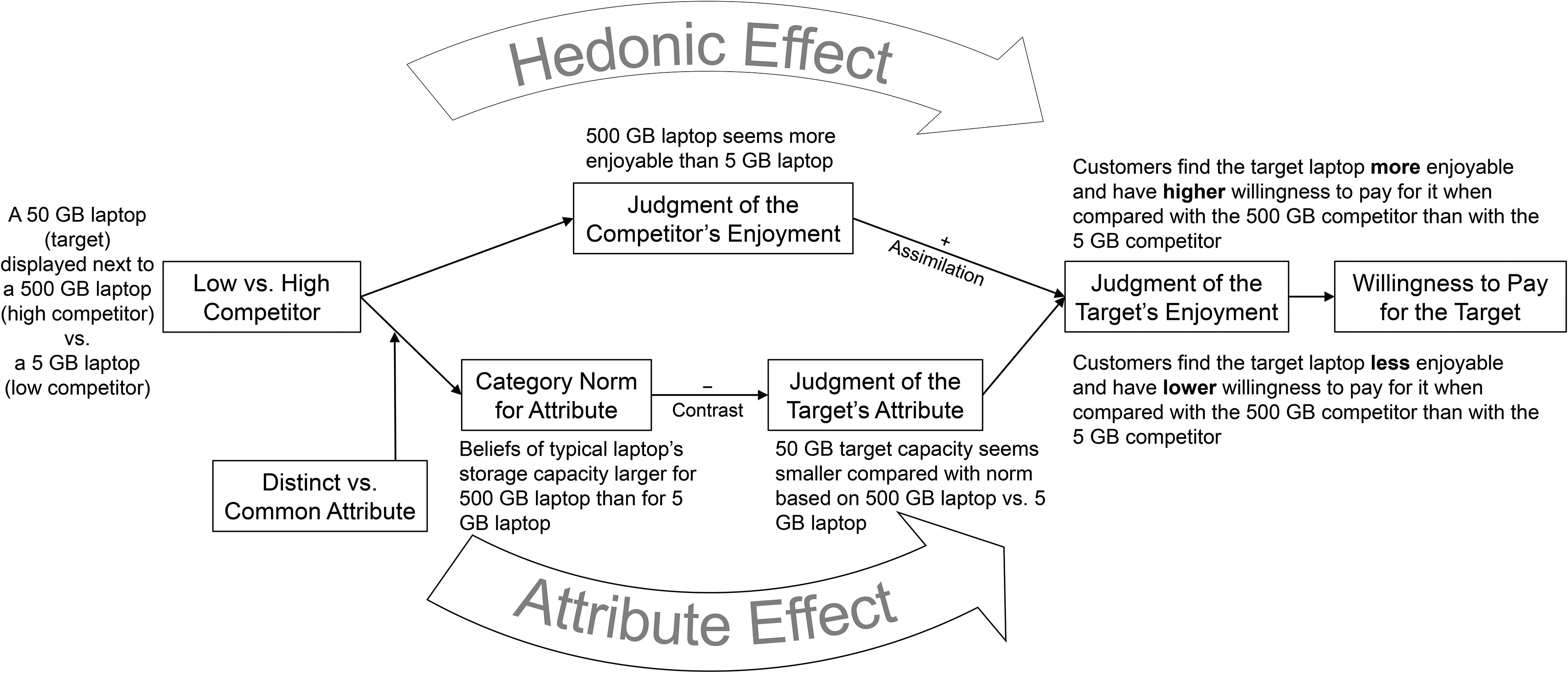
Attribute–Hedonic Conceptual Model.
Distinct attributes
The indirect attribute effect applies to comparisons of products in the same category with a common attribute. However, consumers often compare products with distinct attributes. Because norms are attribute specific, distinct attributes should eliminate attribute contrast effects (Helson 1964; Kahneman and Miller 1986). For example, Ethernet ports, used for wired internet connections, can be found on some laptops but not others. Consider a consumer comparing the target laptop without an Ethernet port to a competitor with an appealing 1,000 Mbps (vs. less appealing 100 Mbps) Ethernet port. Because this attribute is distinct, the indirect contrast effect will disappear, but the indirect hedonic assimilation effect will persist. Therefore, in this situation, the target will seem more valuable when compared with the appealing competitor (1,000 Mbps port) than when compared with the unappealing competitor (100 Mbps port). This situation is particularly likely for cross-category comparisons, as products from different categories are more likely to have distinct attributes (Rosch and Mervis 1975). Consumers often choose between options from different product categories (Ratneshwar and Shocker 1991), and in these situations hedonic assimilation should predominate the total effect.
Ideal-Point Theories
The attribute–hedonic model resembles work on ideal-point situations (Riskey, Parducci, and Beauchamp 1979). For instance, Wedell and Pettibone (1999) report judgments that they collected for a series of faces in which the width of features (e.g., nose width) varied, such that some participants saw predominantly wide noses and others predominantly narrow noses. Whereas judgments of nose size contrasted away from the predominant context, the peak of the pleasantness judgment curve assimilated toward it. Various theories, such as ideal-point updating (Wedell and Pettibone 1999) and a cost–benefit approach to ideal points (Cooke et al. 2004), have been proposed to explain this. Although similar to the current research, ideal-point theories face two key challenges explaining the current findings. First, previous theories are limited to nonmonotonic domains (Cooke et al. 2004); Wedell and Pettibone (1999) note that their model fails for cases with monotonic responses. Yet, the current research examines domains where enjoyment relates monotonically to the attribute: internet connection speed, battery life, and number of megapixels. Second, previous theories are limited to comparing objects with a common attribute (e.g., faces varying in nose width). On the other hand, the attribute–hedonic model predicts moderating effects for comparisons between products with distinct attributes (e.g., comparing laptops with and without an Ethernet port).
The Present Research
This research is organized into three parts. The first part shows that the familiar contrast effects found in product comparisons involve separate attribute and hedonic effects. Two studies, one using visual comparisons (Study 1) and another using numeric comparisons (Study 2), show that what appears as a hedonic contrast effect on the surface is actually two effects: an indirect attribute contrast effect and an indirect hedonic assimilation effect. Building on this, the second part demonstrates the marketing implications. Study 3 shows that assuming the hedonic contrast hypothesis can harm willingness to pay for a target. Study 4 illustrates that common and distinct attributes are key factors influencing willingness to pay for a target. And Study 5 shows that the findings have real-world consequences using field data from home sales. The final part, Study 6, helps explain why attribute and hedonic judgments operate differently, by examining the role of norms.
Study 1: Comparing Products Visually
The first study uses mediation to show that product comparisons involve separate attribute and hedonic effects. Participants were asked to imagine buying a TV and were shown images of two options: a target TV and a competitor that had either a smaller or larger screen size. Although the target TV should seem more enjoyable and more valuable when compared with a small (vs. large) competitor, mediation is expected to show that this outcome is not due to hedonic contrast, but rather due to separate attribute and hedonic effects. TVs were selected because TV size has a strong effect on willingness to pay for it, yet participants can evaluate these two dimensions separately.
Although traditionally the purpose of a first study is to establish the main effect, here the focus is on the underlying process because the main effect has already been established (Cogan, Parker, and Zellner 2013; Novemsky and Ratner 2003). It is widely accepted that a product will contrast with a competitor; a TV should seem better when compared with a small (vs. large) competitor. The purpose here is to establish the attribute–hedonic model's dual process for this outcome so that subsequent studies can introduce the moderator with marketing implications.
Finally, this study also addresses possible order effects. Schwarz, Strack, and Mai (1991) show that question order can influence judgments. Therefore, the order of the hedonic and attribute questions were randomly counterbalanced. The design and analysis were preregistered, available at https://aspredicted.org/5aw92.pdf.
Method
The study was completed by 300 participants on Prolific. Following the preregistered plan, outlying willingness-to-pay amounts more than three standard deviations from the mean were excluded, leaving a sample size of 294 (Mage = 38 years; 50% female, 48% male, 1% other). Including these cases has no effect on the conclusions.
Participants were asked to imagine that they were buying a TV. See Figure 2. The target (Brand B) was a moderately sized TV, identical across conditions. The competing option (Brand A) was either small (low competitor) or large (high competitor). For the hedonic dimension, participants judged both TVs on how enjoyable the TV would be to own (−100 = “Very unenjoyable,” 0 = “Neither enjoyable nor unenjoyable,” and 100 = “Very enjoyable”). This single measure is consistent with prior work on this topic (Morewedge, Zhu, and Buechel 2019; Novemsky and Ratner 2003; Raghunathan and Irwin 2001). For the attribute dimension, participants judged both TVs’ screen size (0 = “A very small screen,” and 100 = “A very large screen”).

Manipulations Used in Study 1.
The attribute and hedonic questions were randomly counterbalanced. Participants also provided the maximum amount (in dollars) that they would be willing to pay for the target (open-ended). Results show that question order had no interaction effect on the judgments about the competitor (ps > .112), the target (ps > .183), or the mediation model (ps > .217), and therefore question order is not part of the subsequent analysis.
Results
Competitor's judgments
Not surprisingly, the competitor (Brand A) was judged as smaller in the low condition (M = 22.32) than in the high condition (M = 81.52; t(292) = 32.74, p < .001; d = 3.82) and less enjoyable in the low condition (M = −4.67) than in the high condition (M = 71.53; t(249.93) = 15.38, p < .001; d = 1.81).
Target's judgments
As expected, the target (Brand B) appeared larger when compared with the low competitor (M = 68.01) than when compared with the high competitor (M = 39.99; t(292) = 12.63, p < .001; d = 1.47). The target also seemed more enjoyable when compared with the low competitor (M = 65.31) than when compared with the high competitor (M = 26.07; t(269.83) = 8.49, p < .001; d = .98). And participants were willing to pay significantly more for it when it was compared with the low competitor (M = $345.58) than when it was compared with the high competitor (M = $236.20; t(258.19) = 5.14, p < .001; d = .60). Although on the surface these findings appear to support the hedonic contrast hypothesis, a deeper examination suggests otherwise.
Mediation analysis
A parallel mediation analysis reveals the underlying effects. Figure 3 and Table 1 show the model used to test the effect of the competition (0 = low, 1 = high) on enjoyment of the target and willingness to pay for it, mediated by judged enjoyment of the competitor, and judgment of the target's attribute. Confidence intervals were estimated using 10,000 bias-corrected bootstrapped replications. Attribute and hedonic judgments showed separate effects in opposite directions. The indirect effect through attribute judgments was significantly negative (a2 × b2 = −32.68, 95% CI: [−41.24, −25.17]), indicating a contrast effect via judged size of the TV. However, the indirect effect through hedonic judgments was significantly positive (a1 × b1 = 7.29, 95% CI: [1.19, 14.02]), indicating an assimilation effect via expected enjoyment. These had downstream effects on willingness to pay for the target. The competitor created a significant contrast effect via the size of the TV (a2 × b2 × d = −42.80, 95% CI: [−60.30, −28.66]). But the competitor also created a significant assimilation effect via its expected enjoyment (a1 × b1 × d = 9.55, 95% CI: [1.93, 19.97]).

Attribute–Hedonic Parallel Mediation (Studies 1 and 2).
Judgments of the Target Products Compared with the Low Versus High Competitor.

For music, 0 = “A very small number of songs,” and 100 = “A very large number of songs.” For TVs, 0 = “A very small screen,” and 100 = “A very large screen.” For tablets, 0 = “A very short battery life,” and 100 = “A very long battery life.” For ISPs, 0 = “Very slow,” and 100 = “Very fast.”
Discussion
The value of a TV was influenced by the competitor via separate effects in opposite directions. There was a strong attribute contrast effect: the target TV seemed smaller (and consequently less enjoyable and worth less money) when compared with a large competitor than when compared with a small one. The hedonic judgments did not contrast. Quite the opposite, the target TV seemed more enjoyable and worth more money compared with a highly enjoyable competitor than when compared with an unenjoyable one. In short, a competitor simultaneously makes a target more appealing and less appealing. Question order does not appear to explain these findings.
One possible limitation of this study is the measurement of willingness to pay. Participants’ willingness to pay often reflects beliefs about typical market price in addition to expected enjoyment (Evangelidis, Jung, and Moon 2022). Therefore, the target TV valuations may reflect beliefs about the price of TVs.
This study supports the attribute–hedonic model for visually presented product information. But what about numeric product information? Does the attribute–hedonic model apply to such domains? The next study addresses this question.
Study 2: Comparing Products Numerically
The purpose of this study is to replicate the previous one using products compared numerically. The design was similar to the previous study, involving a choice between two options in four product categories: music subscription services, TVs, tablet computers, and internet service providers (ISPs).
Method
Two hundred participants completed this study for course credit as part of a research session at a large U.S. university (Mage = 21 years; 55% female, 44% male, 2% other). The study used a 2 (competitor: low vs. high) between-subjects design. Participants were presented with four choice scenarios, each involving a comparison between two products described with a key attribute: music subscription services (number of songs in millions), TVs (screen size in inches), tablet computers (battery life in hours), and ISPs (connection speed in megabits per second).
For example, the target TV (50-inch screen) was compared with either a low competitor (40-inch screen) or a high competitor (60-inch screen). The target's value was equidistant between the low and high competitor using a linear scale for the music subscription service and TV scenarios, and a logarithmic scale for the tablets and internet service scenarios. See Table 2.
Mediation Coefficients for Figure 3.

*p < .05.
**p < .01.
***p < .001.
Judgments of the Low and High Competing Products.

For music, 0 = “A very small number of songs,” and 100 = “A very large number of songs.” For TVs, 0 = “A very small screen,” and 100 = “A very large screen.” For tablets, 0 = “A very short battery life,” and 100 = “A very long battery life.” For ISPs, 0 = “Very slow,” and 100 = “Very fast.”
The hedonic judgment questions were the same as those used in the previous study, and willingness to pay was collected by asking if participants would pay 11 equally spaced amounts: music subscription ($0 to $50 per month), TV ($0 to $1,000), tablet ($0 to $500), and internet service ($0 to $100 per month). Willingness to pay was calculated as the average of the prices where participants switched from a no to a yes response. It was set to the maximum and minimum prices respectively for participants who indicated that they were willing (or unwilling) to pay all listed prices. Thirteen participants with missing or inconsistent willingness-to-pay amounts were excluded, leaving a sample of 187 participants. The attribute judgment questions were specific to each scenario; see Table 2. The order of the scenarios was randomized.
Results
Competitor's judgments
As shown in Table 2, the attributes were judged as greater for the high competitor than for the low competitor in all scenarios. And in all scenarios the competitor was more enjoyable in the high condition than in the low condition.
Target's judgments
The competitor impacted judgments of the target's attributes. See Table 3. For three of the scenarios, the target product was judged as having a smaller magnitude when it was compared with the high competitor than when it was compared with the low competitor, although for televisions, the effect did not reach significance (Mlow = 72.39 vs. Mhigh = 67.19; t(185) = 1.89, p = .06). Participants also rated the target as less enjoyable when it was compared with the high competitor than when it was compared with the low competitor.
They were also willing to pay less for it when it was compared with the high competitor than when it was compared with the low competitor in three of the scenarios; the result for target music subscription service was not significant (Mlow = 15.71 vs. Mhigh = 13.79; t(185) = 1.70, p = .09). Although these appear to support the hedonic contrast hypothesis, this conclusion is contradicted by disentangling the judgments using mediation.
Mediation analysis
The same model as in the previous study was used to investigate the underlying processes. See Figure 3 and Table 1. Consistent with predictions, the effect on the target's enjoyment involved separate attribute and hedonic effects. The indirect effect through attribute judgments (a2 × b2) was significantly negative for all scenarios (music = −10.18; TVs = −2.09; tablets = −11.84; ISPs = −14.69). However, the indirect effect through hedonic judgments (a1 × b1) was significantly positive (music = 8.19; TVs = 11.87; tablets = 7.81; ISPs = 7.72). In other words, there were simultaneous attribute contrast effects and hedonic assimilation effects. These had consequences for willingness to pay. The indirect effect on willingness to pay through attribute judgments (a2 × b2 × d) was significantly negative (music = −.37; TVs = −1.89; tablets = −9.72; ISPs = −1.97). However, the indirect effect through hedonic judgments (a1 × b1 × d) was significantly positive (music = .30; TVs = 10.73; tablets = 6.41; ISPs = 1.04).
Discussion
These findings replicate the results of the previous study using numerically compared options across various product categories. Consistently, an appealing (vs. unappealing) competitor simultaneously increases and decreases consumers’ willingness to pay for a target product. But an important question is why these findings matter for marketers. Is the particular underlying process relevant to practice? After all, if comparisons with an unappealing competitor boost willingness to pay for a target, does it matter what drives this effect? The next study demonstrates that it does matter, and how in some situations assuming the hedonic contrast hypothesis can backfire.
Study 3: Comparison Drawbacks
Study 3 turns to the second part of this research, examining implications. The focus is on situations in which assuming the hedonic contrast hypothesis can be detrimental. The hedonic contrast hypothesis predicts that marketers can boost consumers' willingness to pay for their products by encouraging comparisons with an unappealing competitor. However, the attribute–hedonic model suggests that under certain conditions this tactic will backfire. Specifically, if the competitor is less appealing due to a distinct attribute, hedonic assimilation should predominate, reducing willingness to pay for a target. Tablets were used because decision aids comparing tablet brands are typical for the marketplace, and they feature distinct attributes; some tablets provide cellular connections and others do not.
This study also helps rule out alternative explanations. One potential explanation comes from opinions about the product category. In other words, an appealing (vs. unappealing) competitor can improve opinions about tablets in general or the expected likelihood of using tablets, and the judgment of the target may be reflecting these product-category-level opinions. Another potential explanation is mood (Raghunathan and Irwin 2001). According to this view, participants might judge the target as more valuable because they were in a better mood from considering an appealing (vs. unappealing) competitor. This study follows a preregistered plan, available at https://aspredicted.org/9ks25.pdf.
Method
Data were collected from 250 participants through Prolific (Mage = 36 years; 52% female, 47% male, 1% other) who were assigned to one of two conditions (competitor: low vs. high). They were asked to imagine that they were purchasing a new tablet and were choosing between two options: a target and a competitor, both of which featured a 10.5-inch screen, 64 GB storage, and Wi-Fi. Additionally, the competitor featured a cellular connection that was either 5G (600 Mbps) in the high condition or 2G (.1 Mbps) in the low condition. For the target tablet, which lacked cellular capability, this attribute was listed as “not applicable.”
Participants judged how much they would enjoy both tablets using the same scale as in the previous studies. Willingness to pay was determined by asking if participants would pay 11 equally spaced prices ($0 to $1,000) for the target, following the same procedure as in Study 2. To address the alternative explanations, participants judged how they felt about tablets in general and how they felt about buying a new tablet using the enjoyment scale shown previously. They also indicated their frequency of tablet usage (1 = “Very infrequently,” and 7 = “Very frequently”) and their mood using Schwarz and Clore's (1983) two-item scale (α = .87).
Results
Competitor's judgment
The manipulation was successful. As expected, the low competitor with a 2G connection was rated as less enjoyable (M = 43.26) than the high competitor with a 5G connection (M = 70.68; t(235.09) = 5.00, p < .001; d = .63).
Target's judgment
Although the low competitor was less appealing, it did not improve willingness to pay for the target; it had the opposite effect. Participants were willing to pay significantly less for the target when it was compared with the low 2G competitor (M = $265.63) than when it was compared with the high 5G competitor (M = $323.36; t(236.02) = 2.59, p = .010; d = .33), suggesting an assimilation effect. The competitor did not have a significant effect on the hedonic judgment of the target (Mlow = 38.00 vs. Mhigh = 47.48; t(248) = 1.58, p = .116).
Alternative explanations
The manipulation had no significant effect on frequency of tablet usage (p = .317), feelings about tablets in general (p = .689), or feelings about buying a new tablet (p = .684). Nor did they mediate the effect on willingness to pay for the target: frequency of tablet usage (95% CI: [−7.85, 24.73]), feeling about tablets in general (95% CI: [−11.44, 16.54]), and feeling about buying a new tablet (95% CI: [−18.08, 10.05]). Mood was marginally better in the high 5G condition (M = 6.77) than in the low 2G condition (M = 6.30; t(248) = 1.81, p = .072). However, this does not fully explain the findings, as mood did not mediate the effect on willingness to pay for the target (95% CI: [−6.81, 10.25]). This conclusion is consistent with the findings of Hasford, Hardesty, and Kidwell (2015) that mood could not explain the effect of positive and negative images on judgments of products.
Discussion
The hedonic contrast hypothesis predicts that marketers can boost their product's value by promoting comparisons with an unappealing competitor. However, this study shows that, for distinct attributes, this tactic can reduce a product's value. These findings are consistent with the attribute–hedonic model, in which the representation of the target incorporates hedonic judgments primed by the competitor. This same priming process underlies other phenomena like anchoring (Chapman and Johnson 2002), although it should be acknowledged that anchoring could have impacted willingness to pay in other ways. The “General Discussion” section revisits this topic.
Although the willingness-to-pay judgments fit the predictions, enjoyment of the target failed to show a significant effect. This may be because willingness to pay and enjoyment reflect different aspects of value (He, Anderson, and Rucker 2023). For instance, an individual may find the prospect of new tablets highly enjoyable (creating a ceiling effect) yet be willing to pay relatively little for it, particularly if they already own a tablet, leading to different effects. A replicated version of this study in the Web Appendix finds a significant effect on the enjoyment measure and consistent findings for the other measures.
Opinions about the product category and mood do not fully explain the findings. Furthermore, two reasons suggest that the findings cannot be explained by ideal-point theories (Cooke et al. 2004; Wedell and Pettibone 1999). First, the ideal-point theories are limited to common attributes, rather than the distinct attributes examined here. Second, connection speed is monotonically related to expected enjoyment, putting this study outside the domain of ideal-point theories.
Study 4: Comparing Along Common and Distinct Attributes
Study 4 builds on the previous study by examining both common- and distinct-attribute situations. To do so, participants judged willingness to pay for a target (wired headphones) compared with a competitor (wireless headphones). The competitor's appeal was based on sound quality in the common-attribute condition, and battery life (irrelevant to wired target headphones) in the distinct-attribute condition. Importantly, the competitor's hedonic judgments were designed to be constant across attributes (i.e., enjoyment based on sound quality was the same as enjoyment based on battery life). Therefore any effect of the low or high competitor must be due to an attribute effect.
In the common-attribute condition, a competitor with high (vs. low) sound quality should increase the norm for sound quality, making the target's sound quality seem lower, reducing its value. However, in the distinct-attribute condition, a long (vs. short) battery life has no effect on judgments about the target's battery life (because it has no battery). This leaves only the hedonic assimilation effect, in which the appeal of the competitor due to a long (vs. short) battery life should activate the appeal of the target, increasing its value. In sum, there should be an interaction effect on willingness to pay for the target.
Method
Responses from 700 participants were collected through Prolific (Mage = 40 years; 51% female, 48% male, 1% other). The study used a 2 (competitor: low vs. high) × 2 (attribute type: common vs. distinct) design. Participants were asked to imagine choosing between two headphones: the target wired headphones with a sound quality score of 7.5, and competing wireless headphones. In the distinct-attribute condition, the competitor had sound quality identical to the target but had battery life of 5 hours (low) or 26 hours (high). In the common-attribute condition, the competitor had a sound quality score of 6.5 (low) or 7.6 (high); battery life was not mentioned. These particular values were selected based on pretests to ensure equivalent appeal. The pretest revealed that a 5-hour battery life (M = 47.97) was equivalently enjoyable to a sound quality score of 6.5 (M = 42.49; F(1, 353) = 1.98, p = .160). Pretesting also revealed that a 26-hour battery (M = 65.99) was equivalently enjoyable to a sound quality of 7.6 (M = 64.69; F(1, 199) = .05, p = .830). Participants rated how much they would enjoy these headphones and how much they would be willing to pay for the target with 11 equally spaced prices ($0 to $200) using the same procedure as in Study 2.
Results
Competitor's judgments
The competitor was less enjoyable in the low condition (M = 43.81) than in the high condition (M = 70.83; F(1, 696) = 131.31, p < .001,
Willingness to pay for the target
The competitor had a significant interaction effect on willingness to pay for the target headphones (F(1, 696) = 17.64, p < .001,
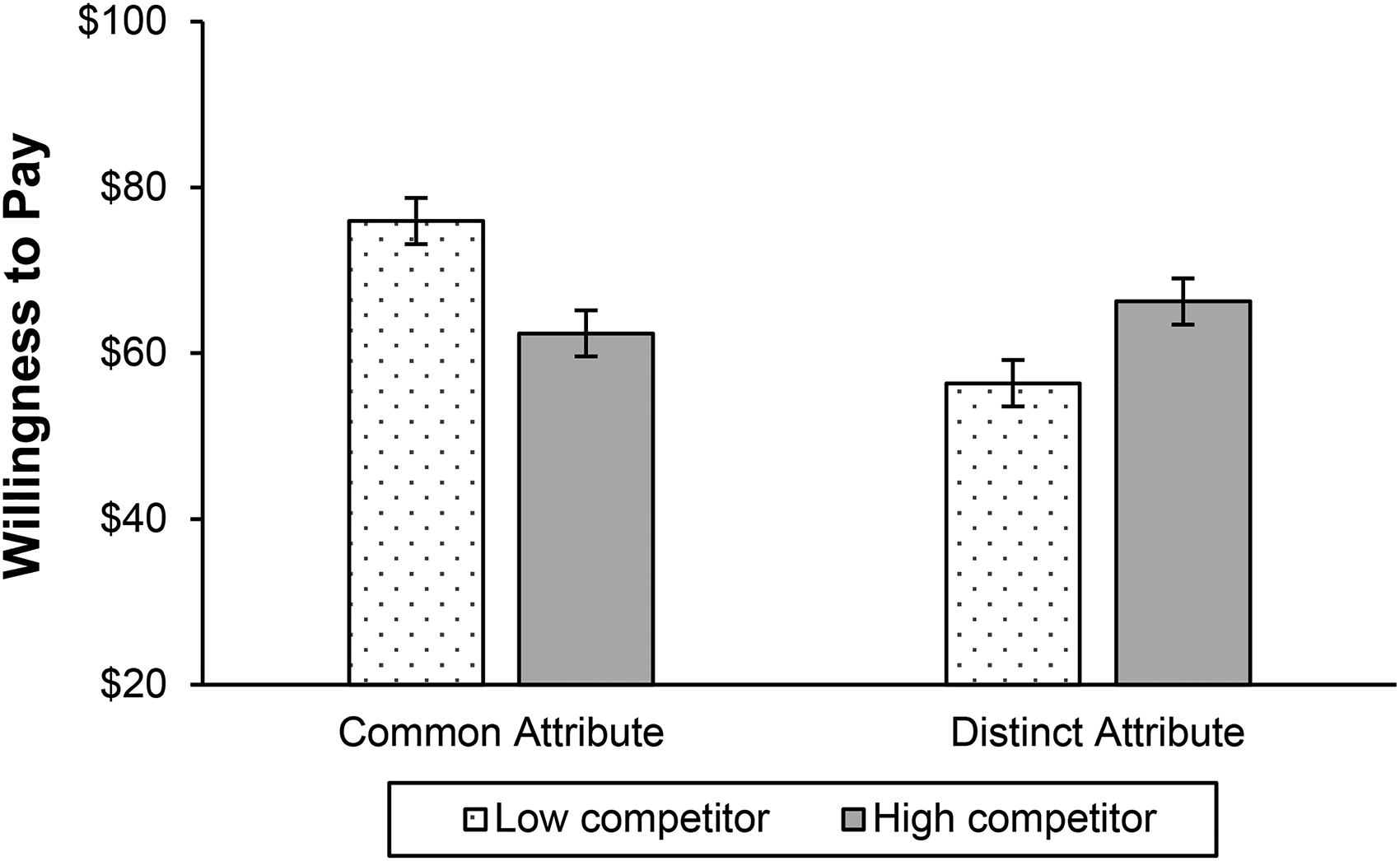
Willingness to Pay for the Target When the Low Versus High Competitor's Appeal Is Due to a Common or Distinct Attribute.
Discussion
Consistent with the attribute–hedonic model, a product can seem more or less valuable depending on whether the competitor's appeal is based on a common or distinct attribute. Marketers often promote comparisons with the competition through advertising, comparison tables, and other tactics, but they should carefully select the competitor and the attributes for comparison. For common attributes, such as headphone sound quality, marketers will benefit by promoting comparison with an unappealing competitor. In this situation, the attribute–hedonic model and the hedonic contrast hypothesis agree on recommendations. However, a different picture emerges when the competitor's appeal is based on a distinct attribute. Here, the current model clearly shows that marketers should promote comparison with an appealing rather than unappealing competitor.
This study also helps rule out ideal-point theories. Ideal-point theories, which are limited to common attributes with a nonmonotonic relationship to enjoyment, cannot explain these findings. Finally, while the previous studies demonstrate the effect on willingness to pay in an experimental setting, an important question is whether these results translate into real consequences. The next study addresses this.
Study 5: Field Study of Home Comparisons
Sales of single-family homes allow for a real-world demonstration of this topic's relevance. For many consumers, buying a home is a substantial purchase often involving careful comparison among competing options. Among real estate agents, there appears to be a widespread belief that the hedonic contrast hypothesis applies to home buyers, and many real estate agents try to boost the value of particular homes by strategically promoting comparisons with undesirable ones (Bhargava 2007; Cialdini 2007). However, as the current research shows, such an approach can be detrimental when distinct attributes are involved.
Although single-family homes tend to share many common attributes, some are distinct. This study focuses on basements. The current study uses field data of home sales to examine how the selling price of a target home is influenced by the basement size of a competing home for sale. The attribute–hedonic model predicts that the competitor's basement size will interact with the presence of a basement in the target home. When a basement is an attribute common to both homes, a strong indirect attribute effect should override an indirect hedonic effect, creating a total contrast effect: as the competitor's basement increases in size the norm for basements should also increase, making the target's basement appear smaller and reducing willingness to pay for the target. However, when a basement is distinct to the competitor, the attribute contrast effect should disappear, leaving hedonic assimilation. As the competitor's basement increases in size (and thus appeal) it will enhance the appeal of the target home, increasing willingness to pay for it.
This study also includes various steps to address limitations. First, a control function was used to help deal with potential endogeneity. Second, a Heckman correction model was used to address selection bias due to sales information being available only from homes that sold during the time frame. Third, multiple models examine how basements influence home valuations, and various criteria for pairing homes were included as robustness checks.
Data
Data represent sales of single-family homes in Boulder County, Colorado, from 2013 to 2018. The data set includes 22,161 sales of 19,888 homes. Although it is unknown exactly which homes acted as a competitor to a target, it is possible to infer this. Each target sale was paired with another that was a likely competitor: a nearby home in the same price range that was on the market at the same time. The competitors were limited to the 76% of homes that had basements since the predictions do not concern competitors without basements. Including competitors without a basement has no effect on the conclusion. The selected competitor was the home whose date of sale was the closest to the target's (cutoff of 60 days) from homes in the same community with a similar price (within ±15% of the price paid for the target). Variations of these criteria do not change the conclusion; see the Web Appendix. In the event of a tie among multiple competitors, one was selected randomly. On average homes sold 5.4 days apart; the competitor could be sold before or after the target. Eight hundred seven sales lacked a competitor, leaving 21,354 cases.
The key dependent measure was the price paid for the target home, which was log-transformed to reduce skewness (3.10) and multiplied by 100,000 to ease interpretation. The basement dummy indicates whether the target home had a basement (1 = yes, 0 = no). The size of the basement is measured in square feet (ft2; 0 if none), for both the target and the competing home.
Results
The results are shown in Table 4. The models confirm that home value increases with the size of basements. As predicted, Model 2 indicates a significant interaction effect between the size of the competitor's basement and whether the target home also had a basement (B = −21.75, SE = 1.65, p < .001). Model 3 includes covariates controlling for the year, community, square footage (excluding basement), and other aspects of the homes. See the Web Appendix for more covariate details. The main effect of the competitor's basement size was significantly positive (B = 1.44, SE = .27, p < .001), and the key interaction effect was significantly negative (B = −2.58, SE = .30, p < .001). These findings are consistent with a hedonic assimilation effect and an attribute contrast effect moderated by the attributes' distinctiveness.
Competitor's Basement Size and Price Paid for a Target Home.

*p < .05.
**p < .01.
***p < .001.
aIncludes community and year dummy variables.
Addressing endogeneity
Endogeneity is a concern for many of the terms in this model. In particular, target basement dummy, one of the key terms of interest, is particularly likely to share omitted variables with the price paid for the target home. To help address this concern, a control function approach was employed (Petrin and Train 2010). The property's soil type provides a useful instrumental variable. Although soil types are unlikely to influence home prices directly, they can affect basement characteristics, particularly in Colorado, where soils are prone to swelling and collapse, impacting basement construction (White 2008). The Web Appendix includes more details of the first-stage model. The residual term, included in Model 4 of Table 4, indicates endogeneity (B = −21.45, SE = 10.32, p = .038). Yet, the key findings are largely unchanged. As with Model 3, the competitor's basement size had a significantly positive effect (B = 1.34, SE = .28, p < .001), and the key interaction effect was significantly negative (B = −2.46, SE = .30, p < .001).
A second potential source of endogeneity is selection bias, since the sample only included homes that sold, which likely differ from unsold homes. A Heckman correction model on all homes in the county was used to predict the likelihood that it was selected (i.e., sold during the time frame) using various factors like year built and building permits (i.e., a new roof). Including the inverse Mills ratios does not change the conclusions. See the Web Appendix for more details.
Basement valuation
Other concerns come from the role of basements in the home valuation process. Although basements influence the selling price of homes, their square footage is typically not included in the gross square footage used to calculate the price per square foot. This can create biases, particularly if this valuation method is applied inconsistently, such as in partially below-grade basements (e.g., walkout style). A supplementary analysis in the Web Appendix examines price per square foot and basement style (partially vs. fully below grade), and indicates that these factors do not affect the conclusions.
Robustness checks
These findings are also robust to alternative specifications, detailed in the Web Appendix. The conclusions are unchanged when competitor eligibility criteria use different time frames (30-day cutoff) and price ranges (±5%, ±10%, ±20%, and ±25% of the target's price). The conclusions are also unchanged when controlling for market conditions—the average prices and square footage of all homes for sale in the community at the time.
Discussion
This study of home sales replicates the previous study and illustrates the consequences of the attribute–hedonic model. The findings indicate that the effect of a competing home depends on whether its attributes are distinct. A competing home with a large basement increases the norm for basement sizes, making the target's basement (when it exists) seem smaller, reducing the target's value. Simultaneously the results indicate that the appeal of the competitor's large basement assimilates with the target, enhancing its value. Although both effects occur when both homes have a basement, the size contrast effect disappears when the target lacks a basement. This can considerably impact real estate agents’ attempts to boost home values. In short, simply assuming a hedonic contrast hypothesis by promoting comparison with unappealing options may lead to poor marketing decisions.
As a cross-sectional field study, the conclusions here are subject to many limitations. Although various models help illustrate robustness and reduce the threat of endogeneity, other omitted factors influencing prices and property comparisons undoubtedly influence these results. Furthermore, this analysis was limited to a single competitor for the sake of simplicity, whereas most home buyers will consider multiple options. It is possible that a more complex comparison among multiple homes could play a role. Finally, home prices are influenced by multiple parties such as buyers, sellers, and real estate agents, each with a different valuation method. Although this does not refute the model, it does complicate the interpretation and should be acknowledged.
These studies highlight important marketing implications for product comparisons, but they also raise questions about the underlying process. The next study, the final part of this research, investigates why attribute and hedonic effects operate differently.
Study 6: Norm-Based Process
The final study focuses on the third part of this research: examining the underlying process. Unlike hedonic judgments, attribute judgments typically invoke a norm, and therefore common attributes produce a contrast effect. However, the norm will be unaffected by distinct attributes—in this case because it is from a different category.
Study 6 tested this using the megapixel norm for digital cameras. A consumer who recently considered a 50-megapixel camera should believe that the typical camera has more megapixels than a consumer who recently considered one with 2 megapixels. Compared with these norms, a target (10-megapixel) camera should seem to have lower or higher resolution, respectively. However, competitors from another category with distinct attributes, like tablets with a 50-hour (vs. 2-hour) battery life, should have no effect on the megapixel norm, eliminating the attribute contrast effect. On the other hand, hedonic judgments, unaffected by the category norm, should assimilate: the target camera should seem more enjoyable in the context of a highly enjoyable (vs. unenjoyable) tablet, as well as a highly enjoyable (vs. unenjoyable) camera. The combination of these indirect effects will produce an interaction effect.
Finally, this study addresses alternative explanations by collecting evaluations of the digital camera category including liking of the category, involvement with the category, and the importance of various attributes. The study also measured participants’ mood. Unlike the previous studies, Study 6 does not measure willingness to pay, instead focusing on the core processes.
Method
The study used a 2 (competitor: low vs. high) × 2 (attribute: common vs. distinct) design. Responses were collected from 401 Amazon Mechanical Turk participants (Mage = 41 years; 51% female, 49% male). Participants were asked to imagine they were buying something for themselves and judged two products. The target product was a compact digital camera with 10 megapixels. The competitor was either a digital camera with 2 megapixels (low-common), a digital camera with 50 megapixels (high-common), a tablet with 2 hours of battery life (low-distinct), or a tablet with 50 hours of battery life (high-distinct). These particular quantities (2/10/50) were used because they are equidistant on a logarithmic scale and plausible quantities for both megapixels and battery life.
Participants judged the attributes (0 = “Very low resolution,” and 100 = “Very high resolution”; 0 = “A very short battery life,” and 100 = “A very long battery life”; depending on the condition). Hedonic judgments were measured using the same items as the previous studies. To measure norms, participants were asked in an open-ended question for their best estimate of the number of megapixels found in typical cameras widely available in the marketplace.
Next, involvement with digital cameras was measured using the modified Zaichkowsky Personal Involvement Inventory (Mittal 1995) on a nine-point scale (α = .95). Liking for the category was measured by asking participants “In general, how do you feel about digital cameras?” using the hedonic scale. The importance of megapixels, price, and weight were measured on a nine-point scale (1 = “Not at all important,” and 9 = “Very important”). Finally, participants indicated their mood using Schwarz and Clore's (1983) scale (α = .92). For brevity, the results of the attribute judgments and alternative mediation models are available in the Web Appendix.
Results
Competitor's judgments
Participants felt that the high competitor (M = 72.31) would be significantly more enjoyable than the low competitor (M = −1.82; F(1, 397) = 304.49, p < .001,

Judged Enjoyment (Study 6).
Target's judgments
The competitor had the predicted effect on enjoyment of the target camera. The interaction between competitor and attribute distinctiveness was significant (F(1, 397) = 50.15, p < .001,
Norm
To reduce a substantial positive skew (3.32), the open-ended megapixel norm responses were log-transformed. As expected, there was a significant interaction effect on megapixel norms (F(1, 397) = 53.71, p < .001,
Moderated mediation
The model in Figure 6 was used to estimate the effects on the target using 10,000 bootstrapped replications. The bottom of the figure shows the attribute effect. As predicted, attribute distinctiveness moderated the indirect attribute effect (index = −15.90, 95% CI: [−23.80, −9.57]). For the common attributes, there was a significant indirect contrast effect via the megapixel norm and judgment of the target's megapixels (a2 × e × b2 = −14.31, 95% CI: [−20.67, −9.24]). In other words, participants had a higher megapixel norm when they considered a 50-megapixel (vs. 2-megapixel) competitor, making the 10-megapixel target seem smaller and less enjoyable. However, when the attributes were distinct, this indirect effect was not significant (a2 × e × b2 = 1.60, 95% CI: [−1.34, 5.06]); as expected, the competitor's battery life had no effect on the norm for megapixels, eliminating the attribute contrast effect.

The Role of Attribute Distinctiveness and Norms in Target's Enjoyment Judgment.
But the hedonic effect, shown in the top of Figure 6, shows a different pattern. As predicted, distinctiveness did not moderate the hedonic path (index = .65, 95% CI: [−1.58, 2.95]). There was a significant indirect hedonic assimilation effect for both common attributes (a1 × b1 = 10.05, 95% CI: [3.01, 16.98]) and distinct attributes (a1 × b1 = 9.40, 95% CI: [2.55, 17.44]). In other words, an appealing (vs. unappealing) competitor consistently enhances the target's appeal, regardless of attribute distinctiveness. In sum, a category norm creates a strong attribute contrast effect among common attributes, but disappears for distinct attributes. A weaker hedonic assimilation effect occurs regardless of attribute distinctiveness. Combined, these effects produced the pattern shown in Figure 5, Panel B.
Alternative explanations
There was no significant interaction effect on involvement with digital cameras (F(1, 397) = .00, p = .986), liking of digital cameras (F(1, 397) = .89, p = .346), megapixel importance (F(1, 396) = 1.85, p = .175), price importance (F(1, 396) = .33, p = .565), weight importance (F(1, 396) = .03, p = .870), and mood (F(1, 397) = .04, p = .843). And the key interaction effect on the target's enjoyment remained significant when these measures were included as covariates (F(1, 390) = 67.09, p < .001,
Discussion
These results replicate previous studies showing that a competitor has separate attribute and hedonic effects on a target, and attribute distinctiveness moderates the total effect. A determining factor in these processes is the category norm. When two products share a common attribute, the norm mediates the effect of one on the judgment of the other. But a distinct attribute has no effect on norms, turning off the attribute contrast effect. On the other hand, hedonic judgments are unrelated to norms and therefore uninfluenced by attribute distinctiveness. In sum, these effects combine to create the observed interaction effect.
A potential confound of this study is battery life, which was intended as a distinct attribute. However, because the target digital camera uses batteries, it is possible that this also influenced judgments of the target. Although digital cameras do use batteries, no information about the target’s battery life was provided. This raises important questions about what should be considered a distinct attribute, a topic revisited in the “General Discussion” section.
This study also provides more evidence against alternative explanations. Opinions about the product category, specifically digital camera involvement, digital camera liking, and the importance of attributes like megapixels, price, and weight, did not explain the results. Neither did mood. Moreover, ideal-point theories cannot account for this study, which employs attributes monotonically related to enjoyment and moderates the outcome with distinct attributes.
General Discussion
This research disentangles product comparisons, illustrating their separate attribute contrast and hedonic assimilation effects. Although many situations appear to be hedonic contrasts on the surface, the current research suggests another explanation. Although this research does not conclusively rule out the hedonic contrast hypothesis, it does raise questions about it and highlights the possible drawbacks of assuming it. Importantly, comparison with a competitor can either enhance or reduce how much consumers are willing to pay for a product. Until more work can fully reconcile this issue, claims of hedonic contrast in product comparisons should be treated skeptically.
A critical marketing question raised by these findings is what counts as a distinct attribute. For instance, suppose products share common attributes, but for one the information is missing. Is such a situation treated as distinct? Likewise, is a distinct attribute treated differently from an attribute with a quantity of zero? For instance, Study 3 listed the target tablet's cellular connection as “not applicable,” but technically it could be presented as “0 Mbps.” Evidence indicates that individuals give special treatment to missing information (Johnson and Levin 1985) and values of zero (Kahneman and Tversky 1979; Shampanier, Mazar, and Ariely 2007), which suggests that these situations may correspond with distinct attributes. But more work is needed.
Perhaps the clearest case of distinct attributes occurs when a competing product comes from a different category. In a cross-category situation, the attribute–hedonic model implies that marketers should promote comparison with an appealing competitor. This prediction aligns with previous findings (Ghoshal et al. 2014; Raghunathan and Irwin 2001; Zellner, Kern, and Parker 2002; Zellner et al. 2003). For instance, Raghunathan and Irwin (2001) argue that unappealing vacation destinations make other destinations more appealing (a hedonic contrast for products in the same category) but make cars less appealing (a different effect for products in different categories). Although the current research predicts the same outcome, it involves a different explanation.
Implications
Marketing tactics that are based on the hedonic contrast hypothesis should be reexamined. Although the specific tactics vary—comparative advertisements (Grewal et al. 1997), comparative matrices (Häubl and Trifts 2000), and sales presentations (Weitz 1978)—there are some basic principles marketers should consider. It is important to evaluate not just the competitor's appeal, but also the attributes determining its appeal. If the competitor's appeal is based on common attributes, marketers can enhance their product's value by promoting comparison with a less appealing competitor. In such cases, the attribute information should be clearly specified (Zhang, Kardes, and Cronley 2002). However, if the competitor's appeal is due to distinct attributes, marketers should promote comparison with an appealing competitor.
Another consideration is the marketer's control over attribute information. In some situations, substantial attribute information is available to customers; for example, many packaged foods require displays of calories and other nutrition information. In other situations, attribute information may be limited. For instance, some tablet brands provide information about battery life, whereas others do not, giving tablet marketers the opportunity to strategically promote such information. Marketers should consider their situation, as well as other factors like brand positioning and customer preferences, to develop a strategy for competitive comparisons.
Limitations and Future Research
The scope of the attribute–hedonic model is limited to products with quantitative attributes. More research is required to examine other scenarios like products with categorical attributes. This research focused on expected enjoyment; however, it is important to examine the attribute–hedonic model for judgments of experienced enjoyment too, as hedonic predictions differ from hedonic experiences (Novemsky and Ratner 2003). The findings also appear asymmetric. Studies 4 and 6 show stronger effects for a low competitor than for a high competitor. The potency of the low competitors on a moderate target could be psychophysical: the difference between low and moderate attributes is perceived as greater than the difference between moderate and high attributes (Fechner 1898; Kahneman and Tversky 1979). Moreover, the willingness-to-pay judgments could reflect factors unaccounted for in the studies, such as typical product prices and anchoring on other numeric information (Chapman and Johnson 2002). Although anchoring and the attribute–hedonic model both rest on priming processes (Wilson et al. 1996), it is possible that willingness-to-pay amounts reflect anchoring on attribute quantities. More work is needed to investigate these issues.
These findings also raise many questions for future research. The model suggests similar results for related concepts like attitudes and other evaluative judgments. Because attitudes reflect components like good/bad, pleasant/unpleasant, and likeable/unlikeable (Ajzen 2001), these components should exhibit priming-based assimilation. However, attitudes are arguably more complex, with functional roles and links to beliefs and behaviors (Albarracín and Johnson 2018). Therefore, more work is necessary before any definitive conclusions can be made. There is also a need to reconcile this research with findings in the ideal-point literature. Although the current research differs in terms of moderators, predictions, and methods, the similarities suggest commonalities. More research on this topic is warranted.
The hedonic contrast hypothesis has been studied for over a century. Perhaps one of the reasons for the abiding interest in this topic is that it intuitively rings true. However, this may be a case where we have been misled by our intuition. Hopefully the model presented here can help provide some clarity to improve future decisions.
Supplemental Material
sj-pdf-1-mrj-10.1177_00222437241230912 - Supplemental material for Disentangling Product Comparisons with the Attribute–Hedonic Model
Supplemental material, sj-pdf-1-mrj-10.1177_00222437241230912 for Disentangling Product Comparisons with the Attribute–Hedonic Model by Zachary G. Arens in Journal of Marketing Research
Footnotes
Coeditor
Karen Winterich
Associate Editor
James Bettman
Declaration of Conflicting Interests
The author declared no potential conflicts of interest with respect to the research, authorship, and/or publication of this article.
Funding
The author received no financial support for the research, authorship, and/or publication of this article.

References
Supplementary Material
Please find the following supplemental material available below.
For Open Access articles published under a Creative Commons License, all supplemental material carries the same license as the article it is associated with.
For non-Open Access articles published, all supplemental material carries a non-exclusive license, and permission requests for re-use of supplemental material or any part of supplemental material shall be sent directly to the copyright owner as specified in the copyright notice associated with the article.
