




Abstract
Marketers can display their products horizontally or vertically in both online and offline settings. This display orientation has been shown to influence consumers’ judgments about individual products. The present research extends the literature by investigating the moderating impact of display orientation on the attraction effect, one of the most well-established context effects in choice. A total of 11 studies, including 7 preregistered experiments, document a novel finding that the attraction effect is stronger when choice alternatives are displayed horizontally rather than vertically. This moderating influence is replicated in both consequential choices and hypothetical scenarios and shown to generalize over diverse product categories. The authors explain this influence by proposing that a horizontal (vs. vertical) display increases the ease of comparing choice alternatives, leading consumers to notice the asymmetric dominance relationship among them more easily. Consistent with this mechanism, the authors find that the moderating influence of display orientation attenuates when individuals are guided to recognize the asymmetric dominance relationship or when their ability to compare vertically displayed products is momentarily enhanced. The present research thus demonstrates a significant effect of spatial orientation on the comparison and evaluation of alternatives. Theoretical and managerial implications of findings are discussed.
Keywords
When managing their product assortments, marketers face the important decision about how to present their products. For example, marketers can display or show their products either horizontally or vertically, on in-store shelves, online store websites, and in ads and pamphlets. Research has documented various ways in which the display orientation (horizontal vs. vertical) of an assortment shapes consumers’ judgments and decisions about the assorted products (Deng et al. 2016; Kim et al. 2019). However, little is known about whether and how the display orientation influences context effects in choice. For example, it is well documented that when two products compete on different attributes, adding a third product (“decoy”) that is asymmetrically dominated by one of the existing products (“target”) can increase consumers’ choice of the target (e.g., Huber, Payne, and Puto 1982). This “attraction effect” suggests that marketers can strategically include a decoy in an assortment to promote their focal product. Importantly, the literature has not yet established (1) whether the display orientation of the assortment moderates the magnitude of the attraction effect; (2) if it does, which orientation induces a greater attraction effect; and (3) why this would be the case.
The present research intends to address these questions. Drawing on insights from visual processing literature in psychology and marketing, we propose that displaying choice alternatives in a horizontal (vs. vertical) layout increases the likelihood that consumers notice the existence of an asymmetric dominance (AD) relationship among the choice alternatives. Further, given the critical role of the AD relationship for an attraction effect to occur (Huber, Payne, and Puto 2014; Wu and Cosguner 2020), we predict and find that a horizontal (vs. vertical) display elevates the magnitude of the attraction effect.
The present research makes several important contributions to the literature. First, through a series of experiments, we demonstrate that the attraction effect is stronger when choice alternatives are displayed horizontally rather than vertically, particularly when product attributes are presented in pictorial form. This result has not previously been reported. Thus, our research identifies a new critical role of display orientation in consumer choice while documenting an additional moderator for the attraction effect. Second, we theorize and empirically show that the moderating impact of display orientation on the attraction effect is driven by the relative ease of comparing choice alternatives in a horizontal versus vertical arrangement; we also show that a numerical (vs. pictorial) representation of the attributes acts as a boundary condition of the display orientation effect. More broadly, our findings suggest that display orientation can significantly influence how consumers compare and evaluate choice alternatives. Finally, our results provide valuable insights for practitioners seeking to promote their products and services more effectively. For example, retail managers should present their assortment horizontally, rather than vertically, in in-store displays and in retail advertisements if they want to promote a focal product by including a decoy in their assortment.
Theoretical Considerations
Display Orientation of Products (Horizontal vs. Vertical)
When marketers present an assortment of products (on in-store shelves, pop displays, online shopping websites, in retail ads, etc.), they can display them either horizontally or vertically. This “display orientation” is one of the key strategic dimensions of display decisions for marketers (Rooderkerk and Lehmann 2021; Roose and Vermeir 2023).
Extant research has documented various ways in which display orientation influences consumers’ product judgments and choices. To illustrate, consumers pay disproportionately more attention to the top item in a vertically displayed assortment (Chandon et al. 2009) and the center item in a horizontal display (Atalay, Bodur, and Rasolofoarison 2012). Moreover, they perceive and evaluate individual items differently depending on their display orientation and spatial location (Roose and Vermeir 2023). For example, people tend to perceive the top item in a vertical display as the most expensive and highest in quality (Inman, McAlister, and Hoyer 1990; Raghubir and Valenzuela 2006; Valenzuela and Raghubir 2009, 2015; Valenzuela, Raghubir, and Mitakakis 2013). In a horizontal display, consumers perceive items positioned more to the left (vs. right) as lower in price and calories (Manippa, Giuliani, and Brancucci 2020; Romero and Biswas 2016; Valenzuela and Raghubir 2015), while sometimes viewing the center object as having a more important status (e.g., Bar-Hillel 2015; Christenfeld 1995; Shaw et al. 2000). In addition, people tend to perceive assortments as larger when products are displayed horizontally rather than vertically (Deng et al. 2016; Pizzi and Scarpi 2016). In sum, these findings suggest that display orientation can serve as a powerful tool for marketers to shape consumer perceptions of both individual products and entire assortments.
Another important aspect of display orientation is its potential moderating role on context effects in choice. Specifically, when new options are introduced into an assortment with two or more options, their presence and relative positioning can have a profound impact on consumers’ preference among existing options, a phenomenon known as context effects. While extensive research has documented various types of context effects (Evangelidis et al. 2024; Huber, Payne, and Puto 2014), little is known about whether and how display orientation affects their magnitude. Thus, the present research examines the moderating impact of display orientation on the attraction effect—one of the most well-established context effects. Before presenting our theoretical framework and specific predictions, we briefly review the current status of the attraction effect in the literature.
The Attraction Effect
The attraction effect refers to the phenomenon in which, when two options compete on different attributes, adding a third option (a “decoy”) that is asymmetrically dominated by one of the existing options (the “target”) increases the likelihood of choosing the target. First identified in the early 1980s by marketing researchers (Huber, Payne, and Puto 1982), this effect has been extensively replicated (for reviews, see Evangelidis et al. [2024], Heath and Chatterjee [1995], Huber, Payne, and Puto [2014], and Padamwar and Dawra [2024]). In addition, its real-world presence in product markets has been recently confirmed (Fridman, Amir, and Hansen 2024; Polman and Maglio 2024; Wu and Cosguner 2020). Beyond marketing, the attraction effect has been applied to various disciplines, including psychology (e.g., Wedell and Pettibone 1996), economics (e.g., Bordalo, Gennaioli, and Shleifer 2013), political science (e.g., Herne 1999), medical science (e.g., Schwartz and Chapman 1999), and even animal science (e.g., Scarpi 2011). While recognized as one of the most significant exports from marketing to other disciplines (Huber, Payne, and Puto 2014; Pham 2013; Simonson 2014), the attraction effect has also been challenged regarding its ecological validity (Frederick, Lee, and Baskin 2014; Yang and Lynn 2014). (We revisit this issue in the “General Discussion” section.)
The attraction effect is mostly conceptualized as resulting from the AD relationship among the target, competitor, and decoy option (Huber, Payne, and Puto 2014; Simonson 2014). First, recognizing that the decoy is objectively dominated by the target but not by the competitor can provide consumers with a justification for choosing the target over the competitor when these two options are in trade-off (Shafir, Simonson, and Tversky 1993; Simonson 1989; Simonson and Tversky 1992). Second, other, more “perceptual” mechanisms such as range and frequency effects may operate (Huber, Payne, and Puto 1982; Janiszewski and Lichtenstein 1999; Pan and Lehmann 1993). The latter, however, are only likely to operate in circumstances in which consumers form an overall impression of each alternative separately before making a choice (Park and Kim 2005).
This discussion suggests that in a typical choice-only setting, the presence of the AD relationship is a critical condition for the attraction effect to occur. Moreover, consumers must recognize this AD relationship during the choice process (He and Sternthal 2023; Huber, Payne, and Puto 2014; Simonson 2014). It follows that increasing the salience of the AD relationship is an important task for marketers who seek to leverage a decoy strategy to promote their focal product. A recent study by Wu and Cosguner (2020) reinforces this point. Analyzing data from a leading online jewelry retailer, the authors found that sales and gross profit significantly increased when consumers detected decoys. However, the likelihood of decoy detection at the market level was low (11%–25%), suggesting that consumers often failed to recognize decoys in real situations due to the complexity of attribute representations in choice alternatives. Consistent with this, researchers have not only emphasized the pivotal role of consumers’ awareness of the AD relationship in driving the attraction effect but also called for a systematic investigation into factors that enhance the awareness (Huber, Payne, and Puto 2014; Simonson 2014). In response to this, the present research identifies one such factor—one that is both theoretically important and managerially relevant, as explained next.
The Impact of Display Orientation on Consumers’ Awareness of the AD Relationship
Numerous factors can influence the noticeability of the AD relationship among choice alternatives. One such factor, which is the focus of the present research, is whether choice alternatives are displayed vertically or horizontally. This “display orientation” is one of the major decision variables marketers need to consider in retail settings (Deng et al. 2016; Dong and Salvendy 1999; Kahn 2017; Kim et al. 2019; Rooderkerk and Lehmann 2021) and thus, understanding of the moderating impact of display orientation on the attraction effect can provide important strategic implications. Specifically, as we elaborate next, the horizontal (vs. vertical) display of choice alternatives is likely to increase consumers’ awareness of the AD relationship, thereby elevating the chance for a decoy to exert an influence on choice.
Why would a horizontal (vs. vertical) display increase the likelihood that the AD relationship is recognized? We contend that it is because comparing choice alternatives is easier when they are displayed horizontally rather than vertically. Several findings from visual processing research suggest the possibility. First, horizontal (vs. vertical) perceptual processing is naturally more fluent, as a match exists between the human binocular vision field (which is horizontal in direction) and the direction of eye movements required for processing horizontally displayed options (Deng et al. 2016). Second, the perceptual and attentional span is wider in the horizontal (vs. vertical) direction, which means there is more information available to direct the eyes horizontally (Shi, Wedel, and Pieters 2013). In addition, the muscles controlling horizontal (vs. vertical) eye movement are stronger (Cogan 1956), leading horizontal (vs. vertical) eye movements to be more dominant in visual processing tasks (Gilchrist and Harvey 2006; Tatler and Vincent 2008; Van der Lans, Pieters, and Wedel 2008). Consequently, saccades (rapid eye movements to sample the visual environment) in the horizontal direction have shorter latencies than those in the vertical direction (Irving and Lillakas 2019), and performance in visual attention tasks tends to be better in the horizontal dimension than in the vertical dimension of the visual field (Al-Janabi and Greenberg 2016; Chen and Cave 2019; Collewijn, Erkelens, and Steinman 1988; Irving and Lillakas 2019; Kröse and Julesz 1989; Nazir 1992; Yeshurun and Carrasco 1999). Correspondingly, the diagnostic effects of horizontality tend to be robust, while for vertical displays they become attenuated when involvement reduces (Valenzuela and Raghubir 2015). In short, these findings in combination suggest that relationships between horizontally displayed objects are generally easier to recognize than those between vertically displayed objects.
The greater processing ease associated with horizontally displayed objects should lead to an increase in the amount of information people can absorb for a given, limited time. Direct evidence of this processing advantage of horizontal display is provided by Deng et al. (2016). In their Study 3, participants viewed an assortment of chocolates on a computer screen, which were displayed either horizontally or vertically. Participants did not have to scroll left–right or up–down to view all the items because in both cases the displays fit within the computer screen. After this, participants’ perceived fluency in viewing the assortment was assessed. Results showed that the processing of the horizontal assortment was significantly more fluent than the processing of the vertical assortment. Furthermore, Deng et al. (2016; Study 4) obtained more direct evidence of the processing advantage for a horizontal (vs. vertical) display with an eye-tracking method (which has been used for capturing the process of consumer information acquisition; Chandon et al. 2009; Wedel and Pieters 2008a, 2008b). They showed that participants fixated on more options per second of processing time (i.e., they processed more product alternatives per second of processing time), which suggested a significantly more fluent or efficient processing for horizontally displayed than for vertically displayed products.
To summarize, the literature shows that people generally have greater ease in processing choice alternatives when the alternatives are horizontally displayed than when they are vertically displayed. This suggests that displaying choice alternatives horizontally (vs. vertically) is likely to make the comparison process easier, thereby increasing the likelihood that consumers recognize the AD relationship among alternatives. As a result, the attraction effect is more likely to occur with a horizontal display. Three pilot studies to be presented subsequently will provide more direct evidence of greater comparison ease under horizontal display. Therefore, we state the following hypothesis.
Our H1 assumes greater processing ease for a horizontal display (vs. vertical display) and thus a greater chance to recognize the AD relationship among choice alternatives. If this mechanism is valid, a strong attraction effect should manifest also with a vertical display if the decision-maker is guided to recognize the AD relationship. With a horizontal display, however, the decision-maker can compare the alternatives easily and recognize the AD relationship without such aid. Thus, while in a horizontal display, the attraction effect will emerge by default, in a vertical display orientation, it will only exist when processing is facilitated, for example, by guiding consumers with specific instructions.
Suppose that participants in a vertical display condition are explicitly instructed to make pair-wise comparisons of the available choice alternatives first before they make their choice. Making such comparisons will increase the likelihood that people recognize the AD relationship. Consequently, the attraction effect should surface. In addition, research on priming suggests that using a particular cognitive procedure in performing a task facilitates the use of that procedure in a subsequent unrelated task (Xu and Wyer 2008). Thus, if participants are first primed with a vertical comparison process by an initial task prior to receiving a subsequent choice task with vertically arranged alternatives, it will facilitate comparisons among the alternatives during the choice process. This in turn will increase the chance that consumers become aware of the AD relationship. Thus, we state the following hypothesis:
In addition, we also explore a situation in which a strong attraction effect emerges more naturally in vertical displays—specifically, when choice stimuli are represented numerically (e.g., quality ratings) rather than perceptually (i.e., pictorial representations). If this holds true, numeric (vs. pictorial) representations would act as a boundary condition for the moderating impact of display orientation, allowing the attraction effect to occur robustly across display orientation conditions. We will present our hypothesis and theoretical rationale with the experiment to which they are relevant to ensure a smooth flow.
We conducted a total of 11 experiments (including 3 preliminary studies) to test our predictions. We first give an overview of all studies and then describe each study in detail.
Overview of Studies
Methodological Considerations
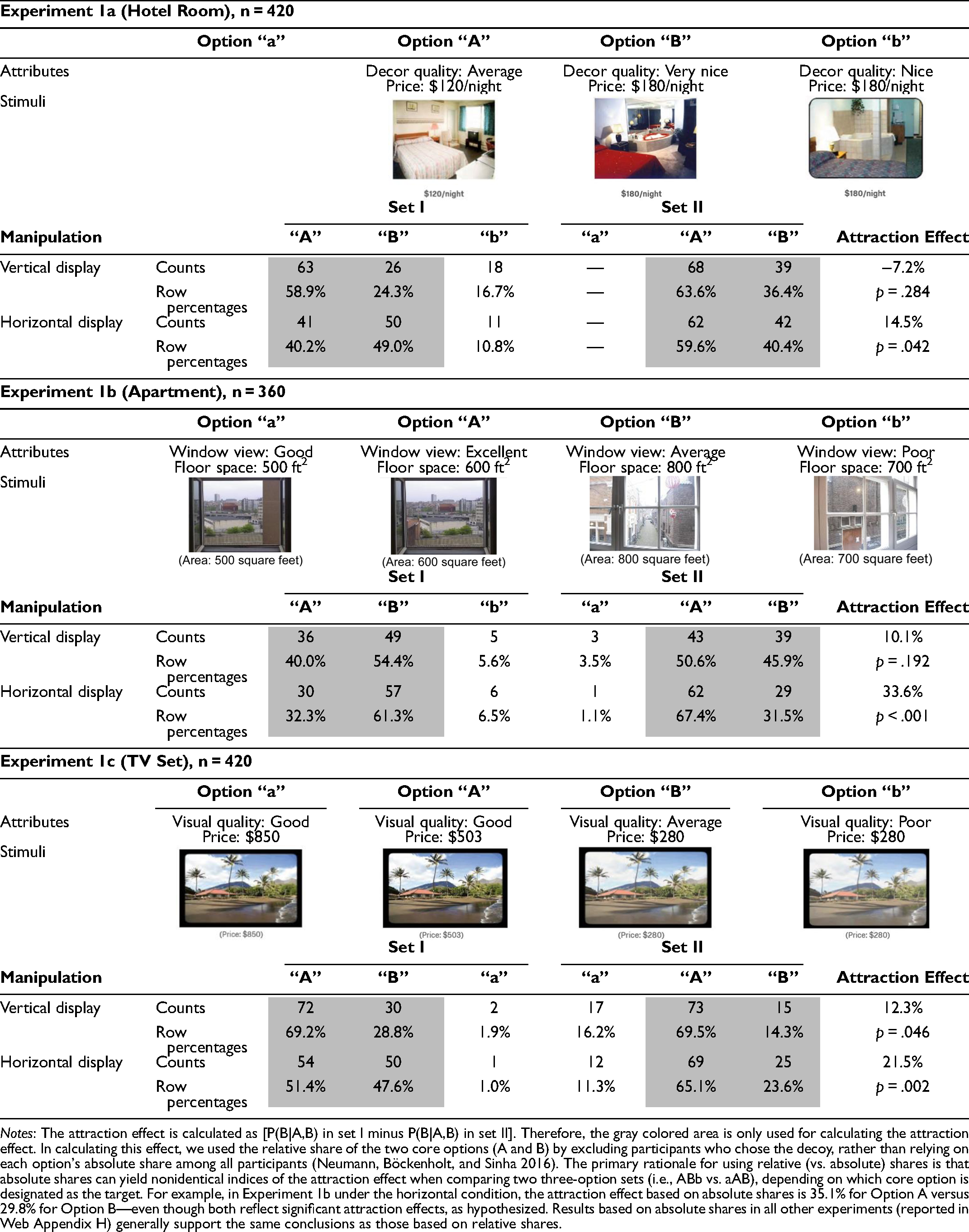
Following the tradition of attraction effect studies, all our experiments used a between-participants design with random assignment of participants to one of two conditions. In some experiments participants received either a two-option set that included two core options (“AB” set) or a three-option set that additionally included a decoy “b” for target “B” (“ABb” set). In other experiments, participants always received a three-option set, but a decoy was available for either option A (“aAB” set, including a decoy “a” for A) or option B (“ABb” set, including a decoy “b” for B). Tables 1–5 present the specific attribute values of the alternatives in all choice sets used in our experiments. The full stimuli are provided in Web Appendices A–G.
Stimulus and Summary of Results in Experiments 1a–1c.
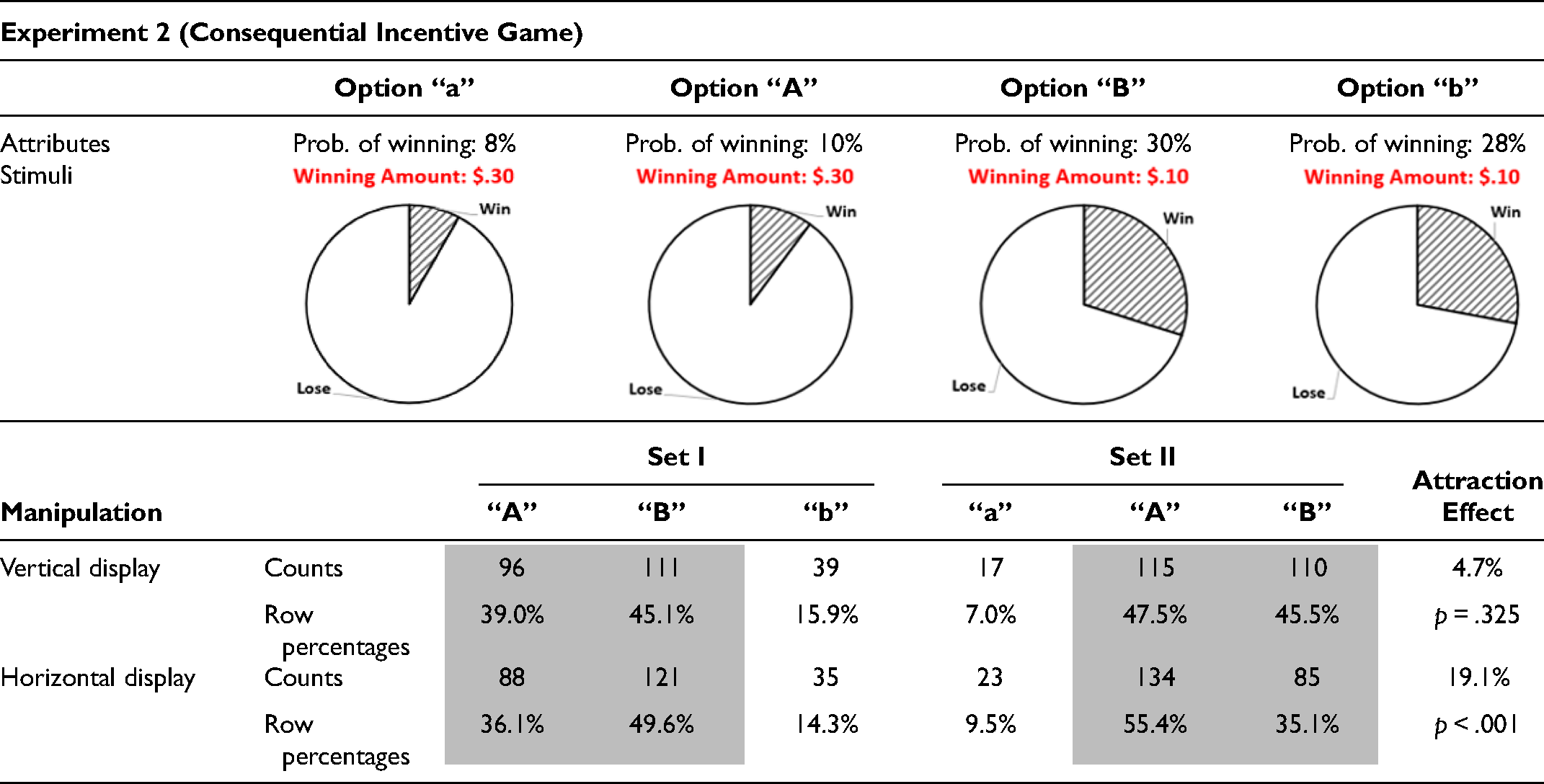
Stimulus and Summary of Results in Experiment 2.
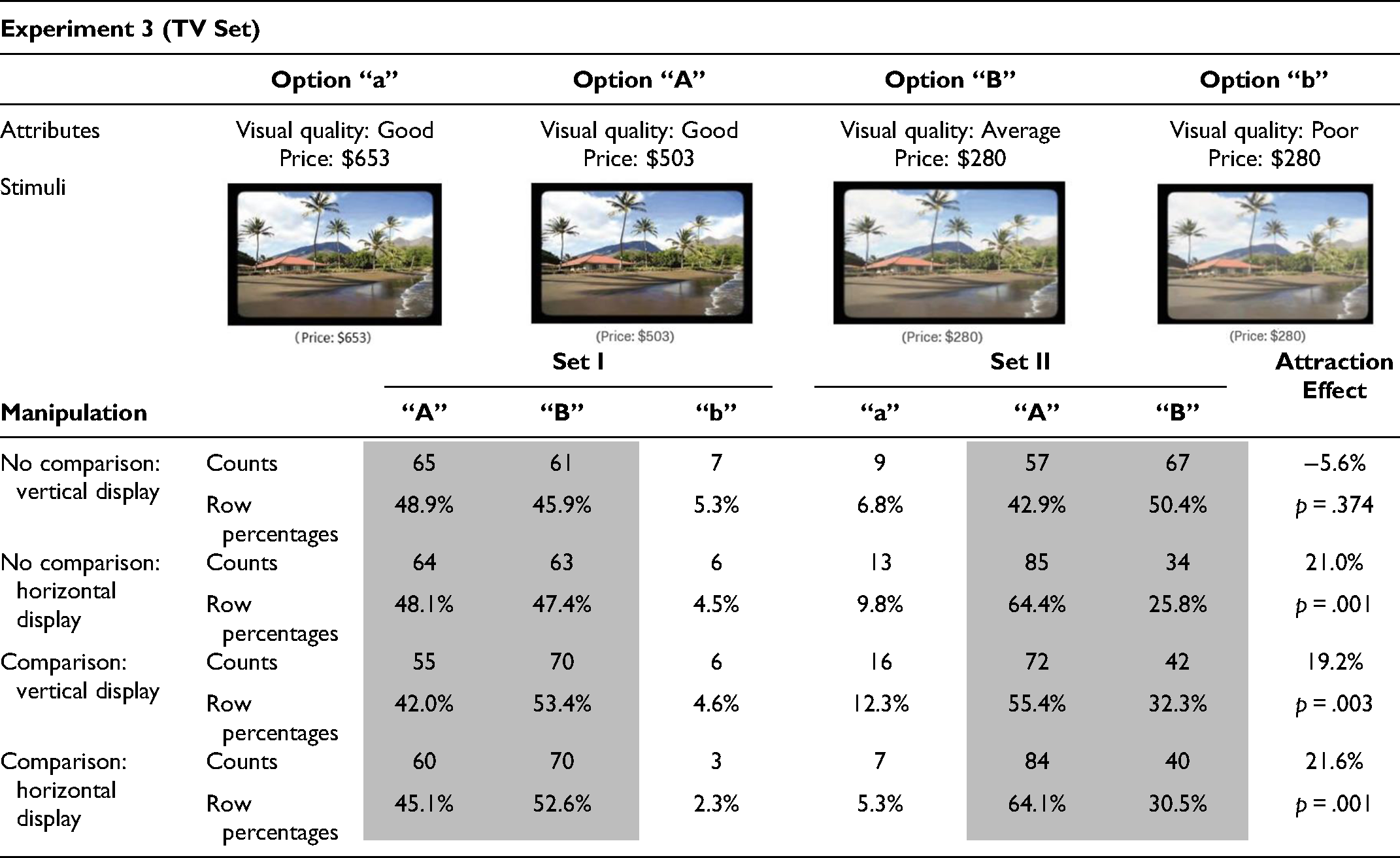
Stimulus and Summary of Results in Experiment 3.
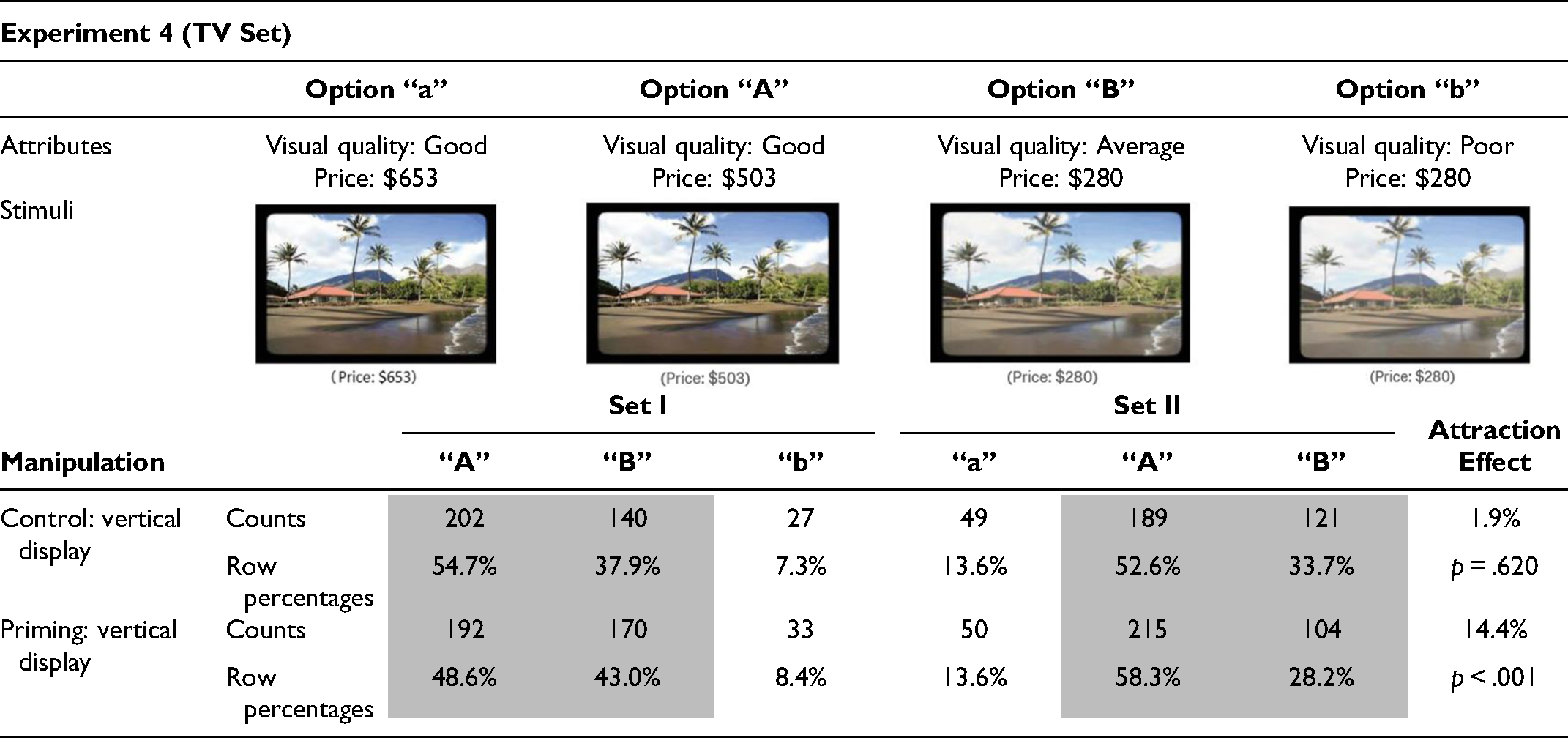
Stimulus and Summary of Results in Experiment 4.
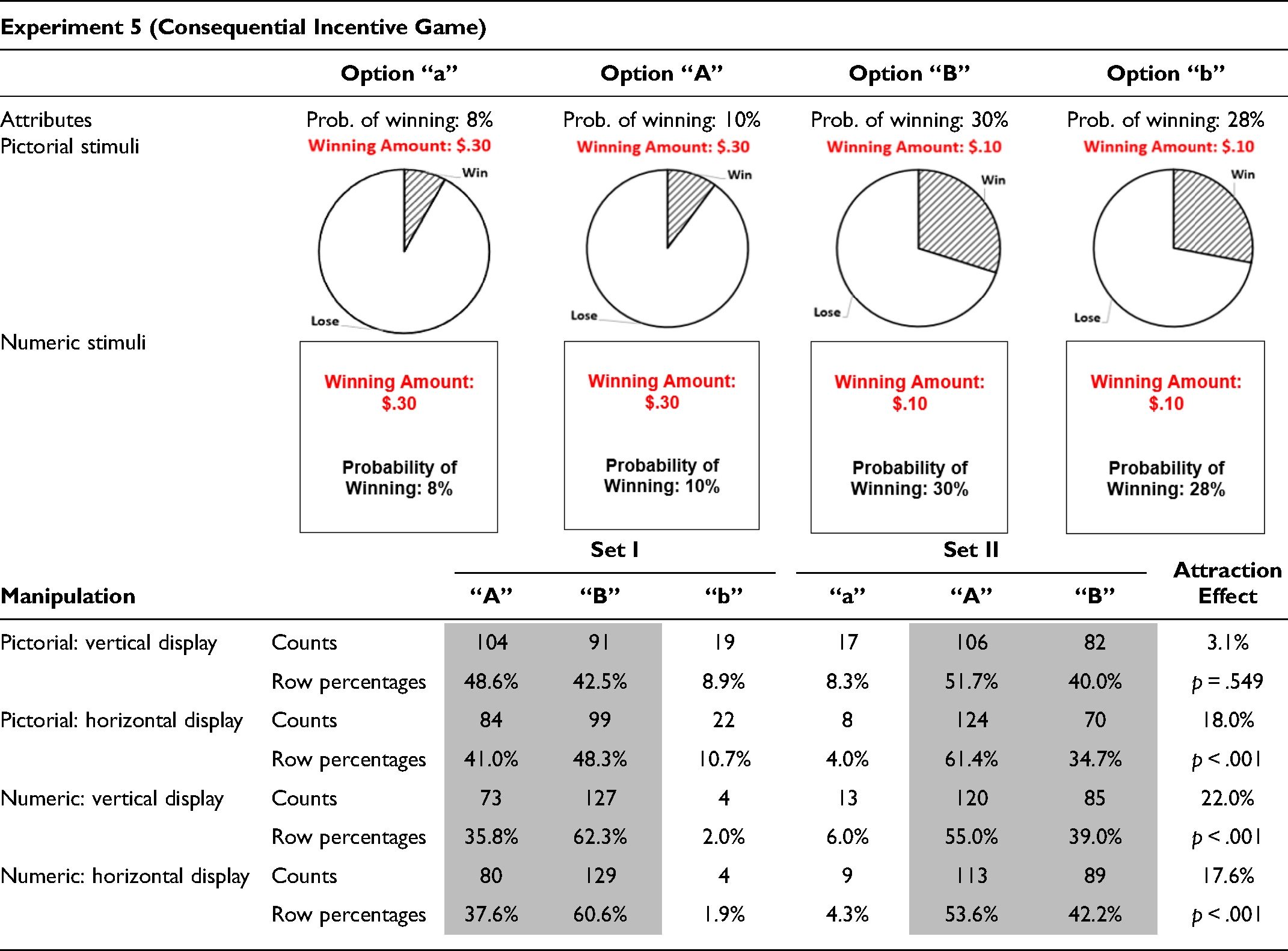
Stimulus and Summary of Results in Experiment 5.
We assessed the attraction effect using the procedure commonly employed in prior research (e.g., Khan, Zhu, and Kalra 2011; Neumann, Böckenholt, and Sinha 2016; Pocheptsova et al. 2009; Simonson and Tversky 1992; Trueblood et al. 2013), in which the effect is measured by the change in the target option's share relative to the competitor's when a decoy favoring the target is present (vs. absent). In the three-option choice set experiments, this effect was calculated as [PABb(B|A,B) − PaAB(B|A,B)]—the difference in the proportion of participants choosing option B among those choosing either A or B when a decoy favoring B was present (set ABb) versus absent (set aAB), with individuals who selected the decoy excluded from the calculation, consistent with prior research. A significant attraction effect occurs if [PABb(B|A,B) − PaAB(B|A,B)] is both positive and statistically significant. (See the notes in Table 1 regarding the rationale for using the relative rather than absolute choice shares; additional analyses using absolute shares, including decoy choosers, yielded generally consistent results and are reported in Web Appendix H.) We tested the hypothesized moderating impact of display orientation by examining whether the magnitude of the attraction effect differed significantly between horizontal and vertical display conditions.
We tried to ensure a rigorous test of our hypotheses in several ways. First, unlike many prior investigations that required participants to perform several choice tasks successively within a single study (e.g., Yang and Lynn 2014), each participant in all our experiments (except for the preliminary study) completed only one choice task. Second, to minimize the possibility that a decoy was mistakenly chosen, we operationalized the AD relationship between the target and the decoy by employing an “absolutely inferior” decoy, which is a decoy that is inferior to the target in an absolute sense, rather than using a “relatively inferior” decoy (Huber and Puto 1983).
In addition, prior research has typically examined and found support for the attraction effect using highly stylized numerical stimuli, such as ratings of taste and visual quality. However, perceptual representations of product attributes are generally considered to be more natural and meaningful (Frederick, Lee, and Baskin 2014; He and Sternthal 2023). Thus, except for Experiment 5, where we manipulated product attribute representations (pictorial vs. numeric), all our studies employed pictorial stimuli used by Frederick, Lee, and Baskin (2014), with an experimental manipulation of their display orientation (horizontal vs. vertical) to test our hypotheses.
Finally, in all our studies we made efforts to control confounding factors across the horizontal and vertical display conditions. Specifically, we ensured that in both conditions the displays fit within the computer screen, eliminating the need for participants to scroll left–right or up–down to view all options. Further, we required study participants to use a PC (desktop, notebook, or tablet PC); users of a mobile device were excluded, based on the survey tool's automatic recording of participants’ screen resolution. This precaution was necessary because the screen size of mobile phones cannot adequately display the pictorial choice stimuli on a single screen, whether arranged horizontally or vertically. Moreover, we held the physical size of the stimuli constant and consistently positioned the stimuli around the center of the screen, irrespective of the display conditions (preliminary studies, Experiments 3 and 5b).
Overview of Experiments
We conducted a total of 11 studies, including 7 preregistered and 3 preliminary studies. Participants were adults recruited from online survey platforms (Amazon Mechanical Turk [MTurk], Connect, and Prolific). Exclusion criteria included attention check failures, use of a mobile device (detected by the survey platform in Experiments 1a, 1c, 3, and 5, or by metadata in Experiments 2, 4, and 5b), and/or selection of the decoy option, as preregistered for Experiments 1a, 1c, 2, 3, 4, 5, and 5b; the same criteria were applied for Experiment 1b. In the three preliminary studies, participants were excluded if they did not follow the required instructions as explained further below. No other participants were excluded from analyses. The study sample sizes were determined prior to data collection to ensure adequate statistical power (see Web Appendix I for details). We calculated the size of the attraction effect for hypothesis testing, using the procedure explained earlier. All empirical study materials (QSF files), datasets, and institutional review board approval document are available at https://osf.io/pxrys.
The preliminary studies confirmed our assumption that displaying choice alternatives horizontally (vs. vertically) makes comparisons easier, thereby making the AD relationship among the alternatives more recognized. Then, Experiments 1a–1c tested H1 and showed that the attraction effect is significantly greater when the choice alternatives are displayed horizontally rather than vertically. Experiment 2 replicated this result using a consequential choice task. Experiments 3 and 4 tested the mechanism predicted in H2 via a process-by-`moderation approach. The studies showed that, consistent with our proposed mechanism, the attraction effect in the vertical display condition is strengthened when participants are helped to recognize the AD relationship among alternatives. Finally, Experiment 5 identified the boundary condition: When highly stylized numerical stimuli instead of pictorial stimuli are employed, the moderating impact of display orientation on the attraction effect diminishes. This, in turn, sheds further light on our proposed mechanism.
Preliminary Studies (Assumption Test)
To reiterate, the literature shows that perceiving and processing multiple objects is easier when they are displayed horizontally than vertically. Consequently, comparing choice alternatives should also be easier in a horizontal display. Based on this, we assume that an AD relationship among choice alternatives is more likely to be recognized when the alternatives are displayed horizontally versus vertically. Although the literature on visual processing described previously already supports this assumption, we conducted a preliminary study to obtain more direct evidence for it.
In the preliminary study, we showed participants three choice alternatives (target, competitor, and decoy) that were presented either vertically or horizontally. Then, we compared participants’ ability to correctly identify the decoy option between the two conditions. If our assumption is valid, participants in the horizontal display condition should have less difficulty in identifying the decoy option than those in the vertical display condition. In fact, this was the case, as we discuss next.
Method
Four hundred fifty-three U.S. adults were recruited through the Prolific online panel for the study. Participants were randomly assigned to one of two conditions of a 2 (display orientation: horizontal vs. vertical) between-participants design. To ensure optimal viewing, participants were specifically instructed to use only a PC (desktop, notebook, or tablet PC).
Thirty-two participants who did not follow the instructions above were excluded from the dataset, leaving 421 participants for analysis (58.4% female, 40.1% male, 1.4% other); average age = 43.65 years, SD = 15.33).
Participants were first given a brief definition of a decoy option—one that is absolutely inferior to one of the other two options in a choice set—along with an illustrative example (see Web Appendix A). They were then told that their task was to identify a decoy among three choice options they were to receive shortly and provided with a simple practice task to reinforce their understanding (see Web Appendix A for details). Next, participants were presented with two consecutive three-option sets: one for TVs and one for gambles. First, they were asked to imagine purchasing a second TV set and shown three alternatives (“bBA”), where “A” and “B” were core options and “b” was a decoy for “B.” Depending on the display-orientation condition, the options were displayed either horizontally or vertically. After identifying the decoy, participants were presented a gamble-choice set, with the decoy placed in a counterbalanced position (“ABb”), and asked to do the same. In all cases, the stimulus sizes were kept identical across display-orientation conditions (see Web Appendix A).
Results
According to our assumption, participants in the horizontal-display condition would have less difficulty comparing the choice alternatives than those in the vertical-display condition and thus should be more likely to correctly identify the decoy (“b”). This expectation was confirmed in both the TV choice task and the gamble choice task.
Specifically, we compared the percentages of participants who correctly identified the decoy between the two display-orientation conditions in each choice task. As expected, a greater percentage of participants chose the decoy correctly in the horizontal-display condition than in the vertical-display condition: 57.9% (128/221) for the horizontal vs. 46.0% (92/200) for the vertical condition in the TV choice task (χ2(1) = 5.98, p = .014) and 53.8% (119/221) versus 29.5% (59/200), respectively, in the gamble choice task (χ2(1) = 25.50, p < .001).
In summary, results from both choice sets consistently supported our assumption: Comparing alternatives is easier when they are displayed horizontally rather than vertically. Consequently, the decoy option is more correctly identified in a horizontal display, suggesting that the AD relationship among the options is more readily recognized in a horizontal display.
Two additional preliminary studies, which are reported in full in Web Appendix J, replicated these results with the TV stimulus used by Frederick, Lee, and Baskin (2014). These studies additionally showed that participants found it easier to identify the decoy option when the stimuli were displayed horizontally (vs. vertically), providing further support for our assumption.
Experiments 1a–1c (Attraction Effects in Horizontal vs. Vertical Displays)
Three experiments (1a–1c) aimed to test H1. We used pictorial stimuli employed in prior research (Frederick, Lee, and Baskin 2014) and experimentally manipulated their display orientation (horizontal vs. vertical). We expected that the attraction effect would be significantly greater when the choice options were displayed horizontally than vertically.
The experimental procedures were very similar across Experiments 1a–1c (see Tables 1–5 and Web Appendix B for the experimental material). Also, the results were virtually the same. Thus, we present all three experiments in parallel for simplicity. We preregistered Experiments 1a (https://aspredicted.org/nbz8-2qrd.pdf) and 1c (https://aspredicted.org/36jm-k8r9.pdf).
Method
Participants were U.S. Prolific workers (Experiment 1a) or members of the Connect panel (Experiments 1b and 1c). Experiment 1a involved 420 adults (51.7% female, 47.6 male, .7% other; average age = 43.30 years), while in Experiment 1b, 360 participated (47.2% female, 51.7% male, 1.1% other; average age = 38.4 years), and in Experiment 1c, 420 participated (45.2% female, 53.3% male, 1.4% other; average age = 38.7 years).
Participants were randomly assigned to one of four conditions of a 2 (display: horizontal vs. vertical) × 2 (choice set: “AB set” vs. “ABb set” in 1a; “aAB set” vs. “ABb set” in 1b and 1c) between-participants design. Specifically, participants in Experiment 1a received either two core options only (“AB set”) or a decoy option for B as well (“ABb set”), while those in Experiments 1b and 1c received a three-option set in which a decoy was added for either A (“aAB set”) or B (“ABb set”). Within each choice-set condition in each experiment, the choice options were displayed either horizontally or vertically. (See Table 1 for the specific attributes in the choice-set conditions of each experiment.)
In terms of stimuli, Experiment 1a used the original “hotel choice” stimuli from Frederick, Lee, and Baskin (2014) (see Web Appendix B-1), while Experiment 1b used their “apartment choice” stimuli, with the modifications to make the window view more realistic (see Web Appendix B-2). For Experiment 1c, we used the original “TV set choice” stimuli but slightly adjusted the price level to ensure that the decoy was absolutely inferior to the target. Specifically, the decoy had the same price as the target but a lower picture quality (see Web Appendix B-3). In the original stimuli, the decoy option was only “relatively” inferior to the target—it had much lower picture quality than the target but was also somewhat cheaper.
Results and Discussion
The results from all three experiments supported our hypotheses (see Table 1 for a summary). In every experiment the attraction effect was stronger in the horizontal (vs. vertical) display condition. Furthermore, while the attraction effect was statistically significant in the horizontal display condition, it was nonsignificant in the vertical display condition.
Specifically, in Experiment 1a (hotel choice study), the interaction between choice set and display orientation was significant (B = .91, SE = .42, p = .030), which is consistent with H1. Moreover, the attraction effect (i.e., the difference in the choice share of the target B between ABb-set and AB-set conditions) was significant when the display was horizontal (attraction effect = +14.5%; χ2(1) = 4.13, p = .042) but was nonsignificant and even negative in direction when the display was vertical (attraction effect = −7.2%; χ2(1) = 1.15 p = .284). Similarly, in Experiment 1b (apartment choice study), the hypothesized interaction between choice set and display orientation was significant (B = 1.00, SE = .45, p = .025). As in Experiment 1a, the attraction effect was significant in the horizontal display condition (attraction effect = +33.6%; χ2(1) = 22.17, p < .001) but was nonsignificant in the vertical display condition (attraction effect = +10.1%; χ2(1) = 1.73, p = .192). We also obtained a similar result in Experiment 1c (TV choice study). Although in this experiment the interaction between choice set and display orientation was not significant (B = .23, SE = .47, p = 622), separate analyses indicated that the attraction effect was strong and significant in the horizontal display condition (attraction effect = +21.5%; χ2(1) = 9.68, p = .002), but it was weaker (though still significant) in the vertical display condition (attraction effect = +12.4%; χ2(1) = 4.00, p = .046).
Pooled over the three experiments, the hypothesized interaction between choice set and display orientation was significant (B = .73, SE = .25, p = .003). Moreover, the attraction effect was significant when the choice options were displayed horizontally (attraction effect = +24.5%; χ2(1) = 29.17, p < .001) but was nonsignificant when they were displayed vertically (attraction effect = +4.4%; χ2(1) = 1.20, p = .273).
Experiment 2 (Consequential Choice Study)
Experiments 1a–1c consistently demonstrated that the attraction effect was stronger when the choice alternatives were displayed horizontally rather than vertically, thus confirming H1. The present experiment intended to replicate this result in a real choice setting. In addition, to control potential position effects, the study counterbalanced the decoy's location within each choice set by fully rotating the order of the three options.
Method
The study was preregistered (As Predicted: aspredicted.org/q89y-n8zw.pdf) including the hypothesis, initial sample size, and exclusion criteria (i.e., failure on the attention check and use of a mobile device). Participants were 1,008 U.S.-based MTurkers (53.1% female, 46.9% male; average age = 42.72 years). They were randomly assigned to one of 24 combinations of a 2 (display orientation: horizontal vs. vertical) × 2 (sets: “aAB” vs. “ABb”) × 6 (presentation order counterbalancing: 123 vs. 132 vs. 213 vs. 231 vs. 312 vs. 321) between-participants design. Before the analysis, 34 participants were excluded from the data based on the preregistered exclusion criteria, leaving 974 participants for analysis. Later, 114 participants who had chosen the decoy option were also excluded in calculating the attraction effect for hypothesis testing.
Participants first completed a filler task in which they evaluated various objects (e.g., evaluating the design of a Bluetooth speaker). This task was included to help construct a subsequent real-choice task intended to test our hypotheses. Specifically, after completing the filler task, participants were informed that as extra compensation for their participation, they would be given a chance to win a bonus by playing a gamble. Then, they were told that three different gambles were available and that they first needed to choose which gamble they wanted to play. This “gamble choice” was, in fact, the main choice task used to examine the attraction effect. Specifically, participants were presented with a choice set of three gamble options that varied in winning amount and probability. The winning probability was visually represented using a shaded probability wheel, following the stimuli format used in Frederick, Lee, and Baskin (2014; see Table 2 and Web Appendix C for the actual stimuli used).
The three gamble options included two core options and one decoy option, which varied by condition (“aAB” vs. “ABb”). Specifically, the two core options consisted of a risky gamble, “A” (10% chance of winning $.30) and a safer gamble, “B” (30% chance of winning $.10). The decoy option was either “a,” dominated by “A” (8% chance of winning $.30), or “b,” dominated by “B” (28% chance of winning $.10), depending on the choice set condition (“aAB” vs. “ABb”). Importantly, within each set, the display orientation of the three options was experimentally manipulated to be either horizontal or vertical (see Web Appendix C). This resulted in a 2 (set: “aAB” vs. “ABb”) × 2 (display orientation: horizontal vs. vertical) design, creating four experimental conditions. In addition, to control position effects, we fully rotated the order of the three options within each choice set (six counterbalancing orders), yielding a total of 24 sets of three gamble options.
Participants were randomly assigned to one of these 24 sets and chose the gamble they wished to play. After the study was completed, the winners were selected based on the winning probability with their chosen gamble, and they received the corresponding payout.
Results
A preliminary analysis indicated that the presentation order counterbalancing did not appreciably influence participants’ relative choice share of the target option (χ2(5, N = 860) = 4.55, p = .473), nor did it interact with the display orientation factor (horizontal display condition: χ2(5, N = 428) = 4.93, p = .424; vertical display condition: χ2(5, N = 432) = 3.99, p = .551). Therefore, the counterbalancing factor was excluded from further analyses.
The results confirmed our expectations (see Table 2). Specifically, the hypothesized interaction between choice set and display orientation was significant (B = .584, SE = .28, Wald = 4.48, p = .034). In addition, the attraction effect was large and significant in the horizontal display condition (attraction effect = +19.1%; χ2(1) = 15.60, p < .001) but was nonsignificant in the vertical display condition (attraction effect = +4.7%; χ2(1) = .97, p = .325). Thus, the results of our previous experiments were replicated in a real choice context.
Experiment 3 (Moderation by Comparison Instruction)
In Experiments 1 and 2, the hypothesized moderation by display orientation for the attraction effect (i.e., a stronger attraction effect under horizontal vs. vertical display) was consistently supported. Further, it was replicated in both real choice and imagined scenarios and generalized over different product categories. Theoretically, the moderating influence of display orientation is due to greater processing ease for horizontally (vs. vertically) arranged choice alternatives and, thus, a higher chance of recognizing the AD relationship among them. The preliminary studies described previously provided initial evidence of this mechanism. Experiment 3 aimed to bolster the mechanism via a process-by-moderation approach.
Specifically, if the weaker (and nonsignificant) attraction effect observed under vertical display in Experiments 1 and 2 is due to greater difficulty of comparing the alternatives and, thus, a reduced ability to recognize the AD relationship, then aiding decision-makers in identifying this relationship should strengthen the attraction effect in the vertical display condition, as predicted in H2. For example, if participants in the vertical display condition were explicitly instructed to compare each pair of options prior to making their final choice, they would be more likely to recognize the AD relationship, thereby increasing the magnitude of the attraction effect. In contrast, the impact of this pair-wise comparison instruction would be minimal in the horizontal display condition, where making comparisons among alternatives is already easy, allowing participants to naturally recognize the AD relationship without additional guidance.
In summary, we predicted that when participants receive pair-wise comparison instructions before making a choice, the attraction effect will emerge in both horizontal and vertical display conditions (as predicted in H2), alleviating the moderating impact of display orientation. Conversely, in the absence of such instructions (the control condition), the attraction effect will be stronger in the horizontal (vs. vertical) display condition (as predicted in H1). The study was preregistered (As Predicted: https://aspredicted.org/hxz3-jn3r.pdf).
Method
Participants were 1,056 U.S.-based Prolific workers (54.2% female, 44.9% male, .9% other; average age = 42.8 years). They were randomly assigned to one of eight combinations of a 2 (choice set: “aAB” vs. “ABb”) × 2 (display orientation: horizontal vs. vertical) × 2 (pairwise comparison instruction: present vs absent) of a between-participants design.
Participants were first asked to imagine buying a second TV set and then presented with three TV options (either “aAB” or “ABb”) displayed either vertically or horizontally. In the comparison instruction condition, displayed above the stimuli, participants received the instruction to perform three pairwise comparisons by explicitly evaluating each possible pair in terms of relative superiority (“Please compare each possible pair [for example, A vs. B; A vs. C; B vs. C] from the three options for the relative superiority”). In the control condition they received no such instruction (“Please examine the options below”; see Web Appendix D-1). This was intended to facilitate recognition of the AD relationship among the options. After completing these comparisons, they proceeded to make their choice. In contrast, participants in the no-instruction (control) condition did not receive such instruction; they were simply asked to choose one of the three options. The TV set attributes were identical to those of Experiment 1c, except for a slight adjustment to the price levels (see Table 3 and Web Appendix D-2).
Results
Participants’ choice data were analyzed as a function of choice set (aAB vs. ABb), display orientation (horizontal vs. vertical), and comparison instruction (present vs. absent). The overall three-way interaction was marginally significant (B = −1.01, SE = .52, p = .054), supporting our predictions.
Specifically, as shown in Table 3, the condition in which no pairwise comparison instruction was given replicated the results of Experiments 1a–1c and 2. That is, the attraction effect was significant and strong when the choice alternatives were displayed horizontally (attraction effect = +21.0%; χ2(1) = 11.38, p = .001) but was nonsignificant when the alternatives were displayed vertically (attraction effect = −5.6%; χ2(1) = .79, p = .374). Correspondingly, the choice set (aAB vs. ABb) × display orientation (horizontal vs. vertical) interaction was significant (B = 1.13, SE = .37, p = .002).
In contrast, in the comparison-instruction condition, the attraction effect was significant in both display orientation conditions. Specifically, the attraction effect was significant in the vertical display condition (attraction effect = +19.2%; χ2(1) = 8.79, p = .003), as well as in the horizontal display condition (attraction effect = +21.6%; χ2(1) = 12.05, p = .001). As expected, the interaction between choice set (aAB vs. ABb) and display orientation (horizontal vs. vertical) within the comparison-instruction condition was not significant (B = .12, SE = .37, p = .755).
Discussion
Experiment 3 confirmed H2 by showing that the attraction effect in the vertical display condition significantly increased when participants performed pair-wise comparisons prior to making their choice. This result is consistent with the proposed mechanism: vertical (vs. horizontal) display of choice alternatives impedes people's comparison process, reducing the likelihood of recognizing the AD relationship among options. As a result, the attraction effect weakens or even disappears. However, when participants in the vertical display condition were explicitly guided to compare the alternatives prior to making their choice, they became more aware of the AD relationship, exhibiting a stronger attraction effect. The next study aimed to corroborate this evidence using a different moderation procedure.
Experiment 4 (Moderation by Priming a Vertical Comparison Process)
The present experiment extended the findings of Experiment 3 by providing additional process-by-moderation evidence. Specifically, research suggests that priming a cognitive process can facilitate its use in a subsequent context (Xu and Wyer 2008). This implies that priming a vertical comparison process in a prior context would make it easier to apply the same process when participants later choose from vertically displayed alternatives. If our proposed mechanism holds, this priming should increase participants’ awareness of the AD relationship among options and, thus, the magnitude of the attraction effect, providing further support for H2.
Method
The study was preregistered (As Predicted: aspredicted.org/pfp6-pjmd.pdf) including the hypothesis, initial sample size, and exclusion criteria (i.e., failure on the attention check and use of a mobile device). Participants were 1,540 U.S.-based MTurkers (43.4% female, 56.6% male; average age = 36.83 years). They were randomly assigned to one of 8 combinations of a 2 (priming: vertical comparison process vs. control) × 2 (choice set: “aAB” vs. “ABb”) × 2 (counterbalancing of presentation order of three options: 123 vs. 321) between-participants experimental design. In all conditions the study presented the choice alternatives only in a vertical format. Forty-eight participants were excluded from the data based on the preregistered exclusion criteria explained previously, leaving 1,492 participants for analysis. Finally, 159 participants who chose the decoy option were also excluded from calculating the relative choice share of the target over the competitor.
Participants were asked to perform two ostensibly unrelated tasks. The first task was designed to manipulate the priming factor (i.e., vertical comparison priming vs. control). Specifically, participants in the priming condition completed four sets of magnitude comparison tasks. In each set, they were shown three geometrical shapes of different sizes (e.g., three triangles, three cylinders, three spheres) arranged vertically (see Web Appendix E). They were then asked to compare the shapes based on area or volume, depending on the shape type shown, and select the largest (or smallest). Since the correct answer was not immediately obvious, this task effectively primed participants with a vertical comparison process before they proceed to the second task. In contrast, the first task in the control condition completed a noncomparison task, where participants solved basic math problems (e.g., 2 + 5 = ?) and identified misspelled words in sentences. To ensure engagement in both conditions, an incentive was offered: The three highest-performing participants in each condition received a $5 award.
After completing the first task, all participants proceeded to the second, “product choice” task. The experimental materials and procedures were very similar to those of Experiment 3. Participants imagined purchasing a TV set and were presented with three options (either “aAB” or “ABb”), displayed vertically. The presentation order was counterbalanced (i.e., 123 vs. 321).
Results
To reiterate, we hypothesized that the attraction effect in a vertical display would be strengthened if decision-makers were guided to recognize the AD relationship among the choice options. Accordingly, we expected the attraction effect to be stronger in the priming condition than in the control condition, as stated in H2, given that the choice options were always presented in a vertical format in this study. This expectation would be supported by a significant two-way interaction between choice set (aAB vs. ABb) and priming (vertical comparison process vs. control).
A preliminary analysis including order counterbalancing (123 vs. 321) showed that order had no direct effect on choices (p = .118). Moreover, it did not influence the attraction effect in any way: It neither interacted with choice set (p = .200) nor moderated the hypothesized set × priming interaction (p = .988). There was, however, an unexpected interaction between order and priming (B = −.864, SE = .23, Wald = 14.051, p < .001). This simply indicated that the lower-listed option (whether A or B) was chosen more often in the priming condition than in the control condition, consistent with our reasoning that priming facilitates a vertical comparison process. Consequently, counterbalancing was excluded from further analyses.
A subsequent analysis of participants’ choices as a function of choice set and priming yielded a main effect of choice set (i.e., a significant attraction effect; B = .40, SE = .12, Wald = 11.81, p < .001). More importantly, the hypothesized choice set × priming interaction was significant (B = .53, SE = .23, Wald = 5.41, p = .020). As predicted, priming a vertical comparison process significantly amplified the attraction effect—from 1.9% to 14.4%. (This interaction was marginally significant when order was included in the analysis; B = .42, SE = .23, Wald = 3.36, p = .067.) Moreover, the attraction effect was nonsignificant in the control condition (+1.9%; χ2(1) = .25, p = .620) but significant in the vertical process priming condition (+14.4%; χ2(1) = 14.54, p < .001). See Table 4 for a summary of results.
Discussion
Our Experiments 1 and 2 showed that the attraction effect was significantly smaller when the choice alternatives were arranged vertically than horizontally. We posit that this moderating impact of display orientation is due to a greater chance of recognizing the AD relationship among horizontally arranged (vs. vertically arranged) choice alternatives. Experiments 3 and 4 provided process-by-moderation evidence for this mechanism by showing that the attraction effect in the vertical display condition was strengthened when participants were made to recognize the AD relationship more easily (as predicted in H2), thereby making the size of the effect comparable to the size observed in the horizontal display condition.
Our previous experiments exclusively used pictorial stimuli, as perceptual representations of product attributes are generally considered to be more natural and meaningful than numerical representations (Frederick, Lee, and Baskin 2014; He and Sternthal 2023). However, a substantial body of research on the attraction effect has relied on numerical stimuli characterized by stylized numerical values such as taste ratings and visual quality ratings. Therefore, it is desirable to determine whether the moderating impact of display orientation on the attraction effect also holds for numerical stimuli or diminishes in their presence. Experiment 5 addresses this issue.
Experiment 5 (Pictorial vs. Numerical Stimuli)
The present experiment examines the moderating impact of display orientation on the attraction effect when product attributes are represented numerically (e.g., quality ratings) versus when they are represented perceptually (i.e., pictorial representations). We predict that, unlike pictorial stimuli, numerical stimuli will produce a strong attraction effect regardless of display orientation, as numerical comparisons are inherently easier, even in a vertical format, making the AD relationship among options readily recognizable, as explained next.
Perceptual representations of product attributes are generally viewed as more natural and realistic than numerical stimuli (Frederick, Lee, and Baskin 2014; He and Sternthal 2023) but also as more content-rich and complex (He and Sternthal 2023). This complexity makes the pictorially represented choice alternatives more difficult to compare, reducing the likelihood of detecting the AD relationship, especially in vertical displays. Consequently, presenting pictorial stimuli horizontally (as in Experiments 1 and 2) or facilitating vertical comparisons for vertically displayed alternatives (as in Experiments 3 and 4) can significantly enhance the attraction effect.
Now, consider choice alternatives described by numeric values, such as product quality ratings (rather than pictorial representations). Numerical representations are relatively simple (Frederick, Lee, and Baskin 2014) and easy to compare (He and Sternthal 2023; Noguchi and Stewart 2014), enabling people to recognize the AD relationship more easily, regardless of display orientation. This suggests that with numerical stimuli, a strong attraction effect can emerge even in vertical displays. Consistent with this idea, Frederick, Lee, and Baskin (2014) found a robust attraction effect in numerous studies where numerical stimuli were presented vertically. These considerations raise a distinct possibility: Unlike pictorial stimuli, numerical stimuli may elicit a robust attraction effect regardless of display orientation. Therefore, we propose the following hypothesis. Confirming this hypothesis would not only establish a boundary condition for the moderating impact of display orientation on the attraction effect but also further illuminate our proposed mechanism, which is based on the ease of detecting the AD relationship.
Method
The study was preregistered (As Predicted: aspredicted.org/vwcz-nb3s.pdf) including the hypothesis, initial sample size, and exclusion criteria (i.e., failure on the attention check and use of a mobile device). Participants were 1,680 U.S.-based Connect online panel members (52.2% female, 46.6% male, 1.2% other; average age = 42.06 years). Eight participants were excluded from the analysis based on the preregistered exclusion criteria, leaving 1,672 participants for analysis.
Similar to Experiment 2, this study employed an incentive-compatible choice task with nearly identical materials and procedures, except for an additional manipulation of stimulus representation (pictorial vs. numeric). After completing a filler task, participants chose a gamble for a chance to earn a bonus as extra compensation. They selected one of three gamble options, which varied in winning amount and probability, from either set “aAB” or set “ABb.” The probability representation was experimentally manipulated as either pictorial (a shaded wheel, as in Experiment 2) or numeric (see Table 5 and Web Appendix F for the actual stimuli used). In addition, the options were presented either horizontally or vertically, with their order counterbalanced (123 vs. 321). Thus, the experiment involved a 2 (sets: “aAB” vs. “ABb”) × 2 (display orientation: horizontal vs. vertical) × 2 (representation type: pictorial vs. numeric) × 2 (presentation order counterbalancing: 123 vs. 321
Results
We predicted a stronger attraction effect for pictorial stimuli in the horizontal (vs. vertical) display condition but an equally strong attraction effect across both displays for numerical stimuli. This prediction was confirmed by an analysis of participants’ choices as a function of choice set (aAB vs. ABb), display orientation (horizontal vs. vertical), and stimulus representation (pictorial vs. numeric). The data pertaining to this analysis is as shown in Table 5.
For pictorial stimuli, the expected interaction between choice set and display orientation was significant (B = .61, SE = .29, p = .037), confirming our hypothesis that the attraction effect is stronger in the horizontal display condition (+18.0%) than in vertical display condition (+3.1%). Moreover, the attraction effect was significant in the horizontal display condition (χ2(1) = 12.36, p < .001) but nonsignificant in the vertical display condition (χ2(1) = .36, p = .549).
For numerical stimuli, however, display orientation did not moderate the attraction effect, as expected. This was evidenced by a nonsignificant interaction between choice set and display orientation (B = −.18, SE = .29, p = .525). Specifically, the attraction effect was equally strong across both orientations (horizontal: +17.7%, χ2(1) = 12.87, p < .001; vertical: +22.0%, χ2(1) = 19.71, p < .001).
The overall three-way interaction between choice set, display orientation, and stimulus representation was marginally significant (B = −.80, SE = .41, p = .053).
Discussion
In summary, display orientation significantly moderated the attraction effect for pictorial stimuli, with a stronger attraction effect in the horizontal display condition than in vertical display condition, replicating our previous findings. For numerical stimuli, however, the attraction effect was equally strong across both display orientations. This is because numerical values are easier to compare, even in vertical displays, allowing the AD relationship to be readily recognized. These findings not only establish a boundary condition for display orientation's moderating impact but also complement our earlier evidence for the proposed mechanism based on the ease of detecting the AD relationship.
A follow-up study (Study 5b), which used only numerical stimuli in a restaurant choice context, replicated this finding by demonstrating an equally strong attraction effect in both horizontal and vertical display conditions. Full details are provided in Web Appendices G and K.
General Discussion
Display orientation of assortments (i.e., horizontal vs. vertical display) is of great strategic importance for marketers (e.g., Rooderkerk and Lehmann 2021). The present research adds to the literature by documenting the important moderating influence of display orientation on the attraction effect, one of the most well-established context effects in choice. In 11 studies, including 7 preregistered and three preliminary studies, we demonstrate that the attraction effect is stronger when the choice options are displayed horizontally rather than vertically. This moderation by display orientation is consistently evident in both real and imagined choice scenarios and generalizes over diverse choice stimuli. However, such influence diminishes when numerical stimuli instead of more natural pictorial stimuli are employed. The contingency of the attraction effect on display orientation, with numerical representations as a limiting condition, has not been reported elsewhere.
Our research contributes to the attraction effect literature by not only identifying display orientation as an important moderator but also articulating the theoretical process underlying its influence. We theorize that horizontal displays (vs. vertical displays) enhance the attraction effect by facilitating comparisons, thereby increasing the likelihood of noticing the AD relationship among choice alternatives. Our three preliminary studies provide support for this theorization by showing that participants more easily identified the decoy option when choice options were arranged horizontally versus vertically. However, the decoy detection rate among participants in these studies was relatively low (i.e., less than 60%). One possible explanation is that the technical definition of the decoy provided to participants was difficult to understand. Alternatively, such results may reflect the inherent challenge of detecting decoys in real-world situations.
Our Experiments 3 and 4 provide additional evidence for the proposed mechanism using a process-by-moderation approach. Specifically, these studies show that the attraction effect with vertical displays was strengthened when the salience of the AD relationship was heightened. Moreover, Experiment 5 (and 5b, reported in the Web Appendix K) demonstrates that when easy-to-compare, numerical stimuli are employed, display orientation no longer moderates the attraction effect (i.e., an equally strong attraction effect occurred across horizontal and vertical displays). A similar result has also been found recently when numerical attribute values are presented alongside a generic product image (Liu et al. 2023). Altogether, these findings suggest that display orientation primarily influences the noticeability of the AD relationship when more natural, pictorial stimuli are used, thereby moderating the magnitude of the attraction effect. More broadly, our results highlight the significant impact of display orientation on how consumers compare and evaluate choice alternatives.
Beyond display orientation, our findings offer broader insights into the mechanisms underlying the attraction effect. Existing conceptualizations of the attraction effect have predominantly focused either on the consumer's justification of the choice based on the AD relationship among alternatives (He and Sternthal 2023; Huber, Payne, and Puto 2014; Shafir, Simonson, and Tversky 1993; Simonson 1989; 2014) or on perceptual mechanisms such as range and frequency effects (Huber, Payne, and Puto 1982; Janiszewski and Lichtenstein 1999; Pan and Lehmann 1993). Our finding that the attraction effect becomes stronger when decision-makers are more aware of the AD relationship lends support to explanations, such as the one based on justification, that argue that the recognition of the AD relationship is crucial for the attraction effect to be observed in both research (Huber, Payne, and Puto 2014; Simonson 1989; 2014) and real-world contexts (Wu and Cosguner 2020). Thus, our research advances understanding of the attraction effect within the context of display orientation but also the broader theoretical landscape of this phenomenon.
Our research also contributes to the literature on display orientation. Prior research has documented several important effects of display orientation. For example, horizontal versus vertical display of alternatives influences the perception of an individual item positioned within the assortment (“position effect”; e.g., Chandon et al. 2009; Raghubir and Valenzuela 2006). In addition, display orientation influences the perception of the variety of the assortment as a whole (e.g., Deng et al. 2016). Despite the sheer amount of research on display orientation, no research has examined how the display orientation of alternatives can moderate context effects in choice. Our research is the first to show the important role of display orientation on context effects.
Our findings have important implications for marketers. Our results highlight that the attraction effect is less applicable when choice alternatives are displayed vertically, particularly for physically displayed or perceptually represented products. This is especially relevant for shelf-based displays and many online presentations of products. This means that practitioners aiming to leverage a decoy strategy to promote their focal product should consider designing their assortment display to be as horizontally oriented as possible. There are nevertheless many situations in which marketers must display their products vertically. An important example is the growing prevalence of mobile-centric purchase decisions. Since handheld devices are typically used in portrait mode rather than landscape, marketers must present their product assortments vertically. Our research provides potential solutions for such situations. First, our Experiments 3 and 4 suggest that a strong attraction effect can still be achieved with a vertical display if consumers recognize the AD relationship. For example, overcoming the inhibition of the attraction effect in a vertical display setting is possible when consumers are primed with a vertical comparison process or prompted to make pair-wise comparisons prior to making the final choice. In addition, our Experiment 5 suggests that using a stylized numerical representation of products can enhance the ease of comparison, making the AD relationship more readily noticed, enhancing the attraction effect in a vertical orientation. Thus, marketers who must rely on vertical displays can explore practical ways to facilitate vertical comparisons, increasing consumers’ likelihood of recognizing the AD relationship.
In addition, although the attraction effect is considered one of the most significant exports from marketing to other disciplines (Huber, Payne, and Puto 2014; Pham 2013; Simonson 2014), the ecological relevance of the attraction effect has been challenged (Frederick, Lee, and Baskin 2014). Specifically, Frederick, Lee, and Baskin (2014; see also Yang and Lynn 2014) reported a series of studies consistently showing that the attraction effect manifested strongly with numerical stimuli but disappeared with pictorial representations of the same stimuli. Based on this, they questioned the ecological relevance of the attraction effect, contending that the phenomenon might not hold in real-world situations where more natural and realistic pictorial stimuli are prevalent. It is worth noting, however, that most of their studies used a vertical display format when presenting pictorial choice alternatives. In this regard, our research proposes an alternative perspective, suggesting that their null findings with pictorial stimuli may be due to the use of a vertical display format rather than indicating an inherent lack of ecological relevance for the attraction effect, as they claim.
Finally, we identify several promising avenues for future research that can extend our work. First, although our several sets of data provide support for our proposed theoretical mechanism, future research that seeks additional evidence, such as collecting eye-tracking data during the choice process, would be desirable (e.g., Cataldo and Cohen 2019; Deng et al. 2016). Second, while our studies (particularly Experiment 2) found no evidence that presentation order influences the magnitude of the attraction effect, future research could investigate whether this effect depends on the specific position of the decoy option (e.g., whether it is placed on the left, middle, or right, or at the top, middle, or bottom of the display; Valenzuela and Raghubir 2015). Third, additional factors may be evaluated as potential moderators of the display orientation effect we have found. For example, the need for justification is known to increase consumers’ motivation to deliberately process information (Simonson 1989), which may enable them to overcome the difficulty of comparing vertically displayed stimuli. Consequently, requiring a consumer to justify their decision could strengthen the attraction effect in the vertical display condition. Another possible moderator is the need to scroll—either horizontally or vertically—and its impact on the ease of comparison, which may, in turn, influence the strength of the attraction effect differently depending on the display orientation. Furthermore, the moderating role of display orientation may be less pronounced in cultures such as China, where people are more accustomed to reading vertically rather than horizontally (Dong and Salvendy 1999). In addition, future studies could extend our findings by examining whether display orientation moderates other types of context effects in choice, such as the compromise effect (Dhar and Gorlin 2003; Dhar and Simonson 2003; Khan, Zhu, and Kalra 2011; Kim et al. 2022; Kivetz, Netzer, and Srinivasan 2004; Pocheptsova et al. 2009; Simonson 1989). Examining these related phenomena would contribute to a more comprehensive understanding of how display orientation shapes various cognitive aspects of decision-making. Finally, future research aimed at identifying additional factors influencing the magnitude of the attraction effect would also be valuable. One such factor, suggested by the results of our Experiment 5 (numeric vs. pictorial stimuli), is the evaluability of attribute information (Hsee et al. 1999). Future studies could therefore explore how attribute evaluability moderates the attraction effect by examining differences between qualitative and quantitative attributes (Hsee and Zhang 2004), moral and nonmoral attributes (Park et al. 2025), or joint and separate evaluation modes (Hsee 1996; Park and Kim 2005).
Supplemental Material
sj-pdf-1-mrj-10.1177_00222437251404931 - Supplemental material for The Impact of a Horizontal Versus Vertical Product Display on the Attraction Effect
Supplemental material, sj-pdf-1-mrj-10.1177_00222437251404931 for The Impact of a Horizontal Versus Vertical Product Display on the Attraction Effect by Jungkeun Kim, Jongwon Park and Harmen Oppewal in Journal of Marketing Research
Footnotes
Acknowledgments
The authors gratefully acknowledge members of the Korea University B.E.S.T. Marketing Group for their valuable suggestions pertaining to the theoretical basis of the study and the interpretation of the results. They also thank the marketing seminar participants at Sabancı Business School, Sabancı Üniversitesi, and ESCP Business School–London for their helpful feedback. The authors also acknowledge the support of the Monash Business Behavioural Lab and the SHIFT group. Special thanks are expressed to the late Robert S. Wyer Jr. for his everlasting inspiration and unwavering, unconditional support for research. This article is dedicated to his memory.
Coeditor
Rebecca Hamilton
Associate Editor
Manoj Thomas
Declaration of Conflicting Interests
The author(s) declared no potential conflicts of interest with respect to the research, authorship, and/or publication of this article.
Funding
The author(s) received no financial support for the research, authorship, and/or publication of this article.

References
Supplementary Material
Please find the following supplemental material available below.
For Open Access articles published under a Creative Commons License, all supplemental material carries the same license as the article it is associated with.
For non-Open Access articles published, all supplemental material carries a non-exclusive license, and permission requests for re-use of supplemental material or any part of supplemental material shall be sent directly to the copyright owner as specified in the copyright notice associated with the article.
