




Abstract
Communication is a key aspect of the joint decision-making process, yet the field lacks an understanding of how people talk to each other while making joint decisions. In this article, the authors analyzed nearly 200 joint decision conversations from shop-along observations. They found that joint decision conversations are composed of four distinct communication patterns, which characterize how partners talk to each other: (1) coordination (including inquiry and disclosure), (2) contrast (including persuasion and devil's advocate), (3) build, and (4) one-sided. The authors then used these communication patterns as the building blocks of joint decision conversations to quantitatively model how they dynamically flow as partners shop together, finding that decision partners navigate the decision life cycle nonlinearly and communication pattern usage affects immediate satisfaction outcomes. The findings enable connections to be drawn across the splintered literatures on dyadic communication. The authors develop a taxonomy that reflects an integrated, cross-disciplinary phenomenological understanding of each communication pattern to facilitate interdisciplinary research. Theoretical advancements and practical implications are discussed, as are areas for future research.
In February 2020, Ikea launched an advertising campaign called “Fighting is Inevitable.” The concept was that couples often disagree while shopping, but Ikea products can help with the fallout (e.g., “at least you’ll spend the night on a comfy sofa”). Ikea was aware that joint decision-making conversations can be difficult to navigate and that joint decisions can affect satisfaction with both the purchase and interactions with one's partner during the decision process. What if, rather than using marketing communications to normalize joint decision fallout, companies like Ikea could intervene by encouraging more productive patterns of conversation? Before companies can do this, however, an understanding of how decision partners communicate during joint decisions is needed.
In this article, we take the perspective that conversation is a core aspect of the joint decision-making process: A joint decision cannot be reached without it (Jaccard, Brinberg, and Dittus 1989). We investigated the process of communication during joint decision-making by observing real joint decision conversations as partners shopped together in-store (Study 1) and online (Study 2). Inductive content analysis revealed that joint decisions are composed of distinct communication patterns (i.e., the structure of partners’ responses to each other) that are employed throughout the decision life cycle. Using this phenomenological understanding of each pattern, we used an abductive approach to bridge the splintered literatures on dyadic communication by developing a taxonomy of four primary communication patterns: coordination, contrast, build, and one-sided. Deductive content analysis of a second dataset affirmed these communication patterns. Then, using dyadic analysis, we modeled the natural flow of communication patterns during joint decision-making. We found that decision partners navigate the decision life cycle nonlinearly and that communication pattern usage affects immediate satisfaction for both the purchase and interactions with one's partner.
We make several important contributions. First, by focusing on joint decision conversations, we diverge from the traditional approach of inferring the process of joint decision-making retrospectively, after the decision is made (Corfman and Lehmann 1987; Fisher, Grégoire, and Murray 2011; Tu, Shaw, and Fishbach 2016). This enabled us to uncover more nuance in the process of how decision partners make a joint choice. In doing so, we answer calls for research about “joint journeys” through the decision life cycle (Hamilton et al. 2021), conversation during joint decision-making (Cross and Gilly 2014; Epp and Price 2008; Qualls 1987; Queen, Berg, and Lowrance 2015), and spoken language (Packard and Berger 2024; Yeomans et al. 2023). Second, we contribute to research on communication patterns (Bischoff 2008; Daire et al. 2012; Heavey et al. 1996). Namely, by focusing on the language that partners use, we developed a holistic description of the language (structure and content) of decision-making conversations. Our novel findings enabled us to draw connections across splintered literatures and develop a taxonomy that reflects an integrated, cross-disciplinary phenomenological understanding of each communication pattern. We further add to this prior work by modeling how these communication patterns flow together during conversation and how each manifests at different stages of the decision life cycle. Third, we contribute to the joint decision satisfaction literature (Brick et al. 2022; Lowe and Haws 2014) by identifying communication pattern usage as a novel antecedent to satisfaction.
From a practical perspective, understanding how decision partners communicate during joint decisions can facilitate more effective selling, negotiation, and personal communication. Indeed, this research was inspired by a roundtable of academics and marketing practitioners, wherein practitioners posed questions about how salespeople and store associates could understand and navigate their clients’ joint decision-making conversations. Thus, we developed a guide of prototypical language for each communication pattern at each stage of the decision life cycle so that practitioners (and researchers) can identify patterns of communication and decision life-cycle stage.
Theoretical Background
Joint decision partners move through the decision life cycle—need recognition, information search, evaluation of alternatives, choice, and postchoice satisfaction—together (Hamilton et al. 2021). As part of this process, decision partners talk to each other (Jaccard, Brinberg, and Dittus 1989). Thus, joint decision conversations may be key to understanding how decision partners jointly navigate the decision life cycle and, as such, may be predictive of decision satisfaction outcomes.
Despite the extensive literature on joint decision-making, there is a lack of research on the conversations core to these decisions. Foundational research on joint decision-making modeled decision partners as “muddling through” the decision process (Park 1982) based on the preexisting preferences of each partner (Corfman and Lehmann 1987; Davis 1976; Spiro 1983). This conceptualization, which was centered on the role of preexisting preferences, led to a body of research that relied on retrospective methods to examine the relative influence of each partner. Typically, such methods involve a mix of questionnaires or interviews administered after a focal decision has already been made in order to assess decision partners’ perceptions of relative influence (Munsinger, Weber, and Hansen 1975; Spiro 1983) or infer the relative influence of each partner based on their self-reported initial preferences and the attributes of the final choice (Aribarg, Arora, and Bodur 2002; Corfman and Lehmann 1987; Park 1982). While these retrospective methods are appropriate for the focal research questions of the prior work (i.e., assessing relative influence), they are not designed to capture how partners communicate as they navigate the decision life cycle together. Rather, this approach has led to a prevailing focus on persuasion within the joint decision-making literature. But is joint decision-making solely about persuasion? Like the proverbial man who looks for his keys at night only under the streetlamp, we suggest that there may be much more to discover about how decision partners navigate the decision life cycle together and how this process affects decision outcomes by shifting the research focus to communication during joint decision conversations.
Communication During Joint Decision Conversations
In its most basic form, a conversation between two people occurs when one partner initiates communication and the other communicates back in response, which may result in continued back-and-forth responses between the two (Yeomans et al. 2023). Key to the systematic study of conversation, the structure in which partners talk to each other follows identifiable patterns. For example, prior work in clinical psychology and family studies has found that conversations about addressing relationship problems are characterized by identifiable communication patterns, such as mutual blame and reciprocated emotional expression (Bischoff 2008; Daire et al. 2012; Heavey et al. 1996). In clinical settings, understanding these communication patterns can help couples navigate relational conflict and clinicians dissect couples’ conflict processes (Daire et al. 2012). Thus, identifying the communication patterns primarily used during joint decision-making may similarly help decision partners navigate decision-making and marketers understand that process.
From the literature, the most readily apparent communication pattern in joint decision-making is persuasion. Although it is typically examined via mathematical models of influence, persuasion is fundamentally a communication-based phenomenon. Indeed, in decision partners’ reports of past persuasion attempts, one can glimpse identifiable patterns in how people might communicate when trying to persuade, like claiming expertise or pouting to get their way (Falbo and Peplau 1980; Spiro 1983). Yet, this prior work does not examine how the other partner responds, giving an incomplete picture of the pattern of communication during persuasion attempts. Moreover, persuasion has largely been modeled at the evaluation of alternatives and choice stages of the decision life cycle, with partners having already established their preferred attributes or alternatives (Munsinger, Weber, and Hansen 1975; Spiro 1983). Likely as a function of the aforementioned retrospective methods to study persuasion, there is a relative lack of scholarship on the prevalence of persuasion at earlier life-cycle stages (e.g., need recognition or information search).
Additionally, a close reading of the joint decision literature hints at the possibility of other communication patterns. As one example, joint decisions are often conceptualized as ending when a final choice is made, suggesting that there may also be identifiable patterns of communication related to agreement. But does communication about agreement only occur at the end of joint decision conversations? As another example, it is an implicit assumption in prior work on persuasion that partners need to coordinate during decision-making to ensure they are on the same page and understand each other's preferences. Logically, to persuade one's partner away from their preference and toward one's own, it is a necessary condition that the persuadee first make their preferences known to the persuader. Such coordination may play an important role in joint decision conversations. Prior research has found that, even at early stages of the decision life cycle, partners perceive their own preferences to be more similar to their partner's preferences when there is greater overlap in their individual rejection-inducing dimensions (Park 1982), hinting that decision partners likely discuss these criteria early on in the decision-making process. However, how partners communicate such coordination has never been the focus of an investigation in the joint decision-making literature, leaving open questions about how it may be communicated and how it manifests across the decision life cycle. Finally, it is possible that other communication patterns exist beyond those implied in the decision-making literature. Thus, an examination of joint decision conversations seems warranted.
Communication and Conversation Outcomes
Importantly, not only do communication patterns characterize conversations, but their usage also shapes downstream outcomes of the conversation (Bischoff 2008; Daire et al. 2012; Heavey et al. 1996). A given conversation is made up of a mix of communication patterns. For example, while addressing relationship problems, partners might report using patterns of expressing emotions, discussing the problem, and blaming each other (Heavey et al. 1996). The usage of each pattern during the conversation is associated with differential relationship outcomes (Heavey et al. 1996). Extending this line of thinking to this article, we consider how the usage of communication patterns in joint decision conversations may affect two key outcomes: satisfaction with interactions with their partner and satisfaction with the choice.
Prior literature supports the notion that the joint decision conversation may affect decision satisfaction outcomes. First, in terms of partner-related satisfaction, people are generally more satisfied with their relationship after making a shared versus solo decision (Brick et al. 2022). However, the level of satisfaction may vary based on how the dyad communicates as they make the decision. For example, prior marketing literature suggests that certain conversational actions (e.g., failing to disclose one's preference) worsen the relationship between decision partners (Liu and Min 2020). Similarly, clinical psychology interventions show that couples who change the communication patterns used when discussing relationship problems report differences in love and feeling understood (Daire et al. 2012). Second, in terms of choice-related satisfaction, consumers are less satisfied with a joint decision if they believe they have made unreciprocated concessions to their decision partner's preferences (Aribarg, Arora, and Bodur 2002) or their partner has coerced them into the choice (Su, Fern, and Ye 2003). Additionally, people are less satisfied with joint decisions if their decision partner does not reveal their preferences (Kim et al. 2023).
Current Research
In its current state, the literature leaves several open questions about joint decision conversations. How, for example, might decision partners communicate with each other in ways beyond persuasion during joint decision-making? How do communication patterns manifest at different stages of the decision life cycle (e.g., need recognition vs. choice), and how do they flow together across the decision life cycle? Further, how might the way consumers communicate with each other during joint decision-making affect how they feel about both their purchase and their interactions with their partner? To formalize the objectives of this article, we pose two guiding research questions, which we sought to answer across two observational studies:
Study 1: Identifying Primary Communication Patterns in Joint Decision-Making
Study 1 aimed to use inductive content analysis of real joint decision conversations to identify the primary communication patterns in joint decision-making and how they manifest across the decision life-cycle stages (RQ1). Our inductive approach was in the style of grounded theory and, as such, involved an iterative process of identifying communication pattern themes in the data, using our developed phenomenological understanding of each pattern to consult the literature, and then returning to the data to deepen the findings abductively (Strauss and Corbin 1990). In this process, we discovered evidence of communication phenomena related to joint decision-making that was splintered across various disciplines such that different disciplines often studied the same phenomenon in a hyperspecific context (e.g., improvisation or speed dating) without considering potentially relevant work in other disciplines or contexts. This splintering is due, at least in part, to each discipline using different terminology for the same communication phenomenon. Thus, in the process of our iterative analysis, we developed a taxonomy to unify the literatures and discovered novel insights about communication patterns during joint decision-making.
Participants and Data Collection Method
To ensure the generalizability and validity of the inductive analysis, it was critical that we collected naturalistic observations of joint decision-making conversations. To this end, we partnered with a major U.S. home improvement store that permitted us to conduct shop-along observations of up to 20 pairs of shoppers while they were in the store. We sought to recruit potential participants who were in the market to make a purchase worth at least $50 at a home improvement store by advertising on local social media (NextDoor and university classifieds). Eligibility was determined via an intake survey (Web Appendix A), in which potential participants indicated which categories they planned to shop in (e.g., flooring, garden) and estimated how much they anticipated spending. Importantly, participants also had to be willing and able to bring a second person with them to the store. During their shopping trip, the researcher followed each pair as they shopped and audio recorded all conversation. At the end, each participant completed a paper survey containing demographic and exploratory measures (Web Appendix B). Participants were paid $25 per person.
To ensure the ecological validity of the observations, the researcher stayed in the background and was as unobtrusive as possible during the shopping trip. Importantly, participants had no research-imposed constraints while they shopped. To mirror a naturally occurring shopping trip, they could spend as much or as little time in the store as they liked, shop in categories not listed in their intake form (e.g., impulse purchases or remembering something else they needed), decide not to shop in categories that they listed in their intake form, shop for any end user (e.g., joint use, single use, or a gift; Gorlin and Dhar 2012), and make any number of purchases (including zero). They could also shop with whomever they wanted (e.g., a romantic partner, a roommate, a friend, a parent).
Our final sample included 20 dyads (N = 40 individuals; 40% male, 60% female; Mage = 43.55 years, SD = 14.40; MrelationshipLength = 18.49 years, SD = 15.24; 65% romantic relationships, 25% friendships, 10% familial relationships). Our dataset contains transcriptions of over 5,000 conversational turns (i.e., one person's speech ends when the other person begins to speak). Across all dyads, we captured conversations of 113 total joint decisions, with an average of 5.65 decisions per dyad (SD = 4.20, Min = 1, Max = 13), ranging from whether to buy a bag of birdseed to which type of flooring to buy for a home remodel. Critically, these data offer a cross-sectional view of the decision life cycle. That is, while we did not always observe all stages for a given decision, the dataset contains instances of all decision life-cycle stages 1 that occur during a shopping trip (need recognition: 131 instances; information search: 105 instances; evaluation of alternatives: 179 instances; choice: 42 instances). Table 1 contains details about each dyad and its shopping trip.
Details About Each Dyad and Its Shopping Trip.

Notes: Real names have been replaced with pseudonyms. We note categories shopped, so if participants shopped for multiple items within a category (e.g., dishwasher and stove within appliances), the number of categories and the number of decisions may not align. Additional details about each dyad and its shopping trip are available in Web Appendix C.
Primary Communication Patterns
Our analysis of the conversation data was an iterative, multistep process. We conducted initial inductive content analysis in the style of grounded theory (Strauss and Corbin 1990). We began with an impressionistic reading of the transcripts and identification of recurrent themes. Then, we performed a cross-dyad analysis with the goal of discovering common communication patterns. Codes were modified as analysis progressed and as concepts were uncovered or grouped. During this initial analysis, we identified support for four distinct communication patterns: coordination (i.e., initiating clarification or knowledge sharing), contrast (i.e., responding with a countering perspective or an alternative option), build (i.e., responding by adding an affirming perspective), and one-sided (i.e., responding passively).
Continuing in the style of grounded theory, we next used our understanding of each pattern to do a thorough literature review across disciplines—including, but not limited to, clinical psychology, communication, family decision-making, improvisation, marketing, management, and negotiations—to assess converging evidence and to uncover additional potential avenues for thematic analysis in the data. Our understanding of the phenomenon enabled us to overcome the splintering of the literatures and develop a deeper understanding of each pattern. By focusing on the structure of the language itself and not being anchored on specific terminology for any given communication pattern, we found and integrated commonalities across disciplines to develop a taxonomy that reflects a cross-discipline phenomenological understanding of each pattern.
We then reiterated our analysis of the data, using an abductive approach with our understanding from the literature, and, in this process, identified further nuance in the patterns. Notably, in conjunction with our data, we read broadly across disciplines for potential additional relevant communication patterns but did not find evidence for any. Thus, our analysis converged on four primary communication patterns in joint decision-making: coordination (which subsumes inquiry and disclosure), contrast (which subsumes persuasion and devil's advocate), build, and one-sided. We next expand on our findings for each pattern.
Communication pattern 1: coordination
Coordination communication involves one decision partner initiating clarification or knowledge sharing to get on the same page, such as about meta details of the decision, each other's preferences, and each other's knowledge (e.g., transactive memory; Wegner, Erber, and Raymond 1991). Coordination communication patterns are characterized by either question-based initiating language, with one partner asking the other for information (e.g., asking who, how, what, or where), or by statement-based initiating language, with one partner telling the other information (e.g., “just so you know” or “ok, so”). We refer to these as inquiry and disclosure, respectively.
In the case of inquiry coordination, the initiating partner seeks to learn from their partner to get on the same page. For example, when friends Cassie
2
(female, 26 years) and Joy (female, 28 years; relationship length = 2 years) were looking at towel racks for Cassie's bathroom, Joy asked, “What color is the bathroom?” and Cassie clarified by answering, “Chrome. I need that shiny, shiny. Oh, there's so many.” Joy further coordinated about what shape the towel rack should be: “You want square? You want round? You want …” Cassie clarified that she was not interested in round towel racks. In this conversation, Cassie and Joy coordinated about what attributes of a towel rack were important to Cassie. As another example, married couple Mia (female, 24 years) and Julian (male, 27 years; relationship length = 20 years)
3
were shopping for water heaters. Mia coordinated with Julian by asking about his preferences for enlisting the aid of a sales associate:
In the case of disclosure coordination, the initiating partner seeks to share with their partner to get on the same page. For example, roommates Sarah (female, 34 years) and Francesca (female, 44 years; relationship length = 1 year) were shopping for an air conditioning unit for their home. After talking to a sales associate about what was in stock, Francesca coordinated by disclosing her preferred next step, saying, “So let's look at the price.” As another example, married couple Lenny (male, 61 years) and Rosa (female, 60 years; relationship length = 36 years) were shopping for a new front door for their home. When looking at options, Rosa coordinated by disclosing her preferences:
Communication pattern 2: contrast
Contrast communication involves at least one decision partner responding to the other's statement with a different perspective or an alternative option. It is often characterized by countering language such as “well,” “or,” “but,” or “what about.” For example, married couple Joe (male, 28 years) and Jessica (female, 29 years; relationship length = 3.5 years) were shopping for paint when Joe raised the problem of stagnant water in their yard. Joe wanted to purchase supplies to build a drainage system that day. Jessica contrasted the suggestion of purchasing supplies that day by saying, “Well, why don’t we ask the neighbors when they redid their drainage system how they did it?”
A contrasting response is considered persuasion when it leads one’s decision partner to adopt the persuader's own personal preference(s) (Falbo and Peplau 1980; Spiro 1983). For example, married couple Levi (male, 33 years) and Hannah (female, 33 years; relationship length = 10 years) were considering purchasing a new shed. They contrasted about the importance of one attribute: whether Levi should build the shed himself (his preference) or whether they should look for something prefabricated (Hannah's preference). These differing preferences led to the following conversation in which they each tried to persuade the other to adopt their preference:
A contrasting response is considered playing devil's advocate when it encourages the decision partner to consider the pros and cons of a potential decision using purposeful dissent (Cosier and Schwenk 1990; Herbert and Estes 1977; Schulz-Hardt, Jochims, and Frey 2002). For example, married couple Lenny and Rosa were browsing when Rosa saw the bird food section. Birdseed was not on their original shopping list, but Rosa wanted to pick some up. Lenny played devil's advocate to ensure Rosa fully considered buying birdseed from this retailer. His contrasting statement prompted Rosa to explain her reasoning more thoroughly, and, as is often the case for playing devil's advocate, Lenny stopped contrasting once he was assured the choice was well considered:
Communication pattern 3: build
Build communication involves at least one decision partner responding to the other by adding an affirming perspective to form a shared preference or communicate agreement. Building is often characterized by expanding language such as “yes, and …” For example, married couple Julian and Mia were shopping for a new water heater and were gathering information about wattage options. Julian was having difficulty searching for this information on the retailer's mobile application, so Mia suggested asking a sales associate about the wattage. Julian agreed, prompting a build pattern in which they expanded on the benefits of asking an associate: Mia added that they could ask if it would fit under their house, and Julian added that they can learn about pricing. As another example, married couple Craig (male, 69 years) and Melanie (female, 71 years; relationship length = 51 years) were shopping for cabinets for their garage. They built on all the reasons they would like to include a countertop rather than floor-to-ceiling shelving:
Notably, the affirmed perspective need not be positive. If the initial statement was negative, a building response affirms it. For example, a father and daughter, Dan (male, 67 years) and Breanna (female, 42 years; relationship length = 42 years), were shopping for a fan for Breanna's home. Once they had browsed the options at the focal store, including a fan with a Bluetooth remote control, they built on all the reasons they wanted to perform more information search before making a choice, namely, that Dan had never seen a Bluetooth-controlled fan before and was not sure that it would work well. Breanna expanded on Dan's uncertainty by raising additional concerns about logistics and how Bluetooth could be integrated into a fan. They agreed that more online search was needed.
Communication pattern 4: one-sided
One-sided communication involves a decision partner responding passively to the other partner's active discussion about the decision.
4
It is often characterized by passive language, such as “I don’t care” or “whatever you want,” or responding to an engagement attempt with one word (e.g., “okay,” “yeah,” or “fine”). As an example of one-sided communication, married couple Ella (female, 68 years) and Wyatt (male, 64 years; relationship length = 40 years) were seeking to replace the carpet in their home. After having talked to a sales associate about pricing, Ella wanted to browse the samples to learn about different color options. However, Wyatt had already started walking away from the section and, once he returned, only passively engaged:
As another example, married couple Lena (female, 50 years) and Andrew (male, 46 years; relationship length = 4 years) were buying supplies to build a desk. In this case, Andrew preferred using copper as the face of the desk, and he tried to engage Lena about the materials:
Manifestations of the Four Primary Communication Patterns Across the Decision Life Cycle
To examine how each communication pattern manifested at each state of the decision life cycle (RQ1), we trained a research assistant to code each conversation for (1) how many decisions were discussed, (2) transitions between communication patterns, and (3) which stage(s) of the decision life cycle (need recognition, information search, evaluation of alternatives, choice) each decision was in. Web Appendix D contains the coding instructions. When coding was completed, we conducted another round of inductive content analysis to uncover nuances in each communication pattern across stages of the decision life cycle. We started with an impressionistic reading of conversations at each stage of the decision life cycle and identification of recurrent themes. We then performed a cross-dyad analysis to discover common manifestations of each communication pattern at each stage of the decision life cycle, modifying codes as analysis progressed.
We observed each communication pattern at each stage of the decision life cycle and discovered systematic differences in how the communication patterns manifest at each stage. Specifically, we found that while the structures of how partners communicated with each other followed the same identifiable patterns across decision life-cycle stages, the prototypical content of conversation depended on the stage. To illustrate, we present two cases of build communication at different life-cycle stages. At the need recognition stage, married couple Julian and Mia engaged in build communication about the (lack of) need for new bathroom tile (Table 2, Panel A). In comparison, at the choice stage for a decision about an outdoor fabric shade, partners Sue (female, 41 years) and Nicole (female, 38 years; relationship length = 4 years) engaged in build communication to choose a fabric shade that they will buy when they move into their new house and then continued to build about the reasons it was a good choice (Table 2, Panel B). In both cases, the decision partners responded to each other with affirming perspectives, but the content of the conversation reflected the decision stage (i.e., the existence of the need or the advantages of the chosen option, respectively). Table 3 summarizes how each pattern manifests across the decision life cycle.
Illustrative Example of Build Communication at Different Decision Life-Cycle Stages.

Prototypical Language for Each Communication Pattern and Their Manifestations Across Decision Life-Cycle Stages.

Notes: Practitioners and researchers can use this table as a guide to infer the current stage of the joint decision life cycle.
Usage of the Four Primary Communication Patterns
To assess the primacy and usage of the identified communication patterns (RQ1), we quantitatively analyzed their frequency. For these analyses, the unit of analysis was a conversational turn. We coded a conversational turn as one person's speech ending when another person's speech begins or when there is a natural break in the conversation, such as when dyads walked to another part of the store and started talking about another joint decision.
On average, the four primary communication patterns accounted for 73.4% of the total decision-related conversational turns between the two members of each dyad in the data. The parts of the decision-related conversation that were not captured by the communication patterns were largely related to executing the choice, such as navigating the store or counting the agreed-upon number of items as they put them into their cart. On average, dyads used 3.65 unique communication patterns at least once during their shopping trip, and they often transitioned back and forth between communication patterns during their conversation, with an average of 6.68 communication pattern transitions during any given decision. Figure 1 illustrates these transitions.
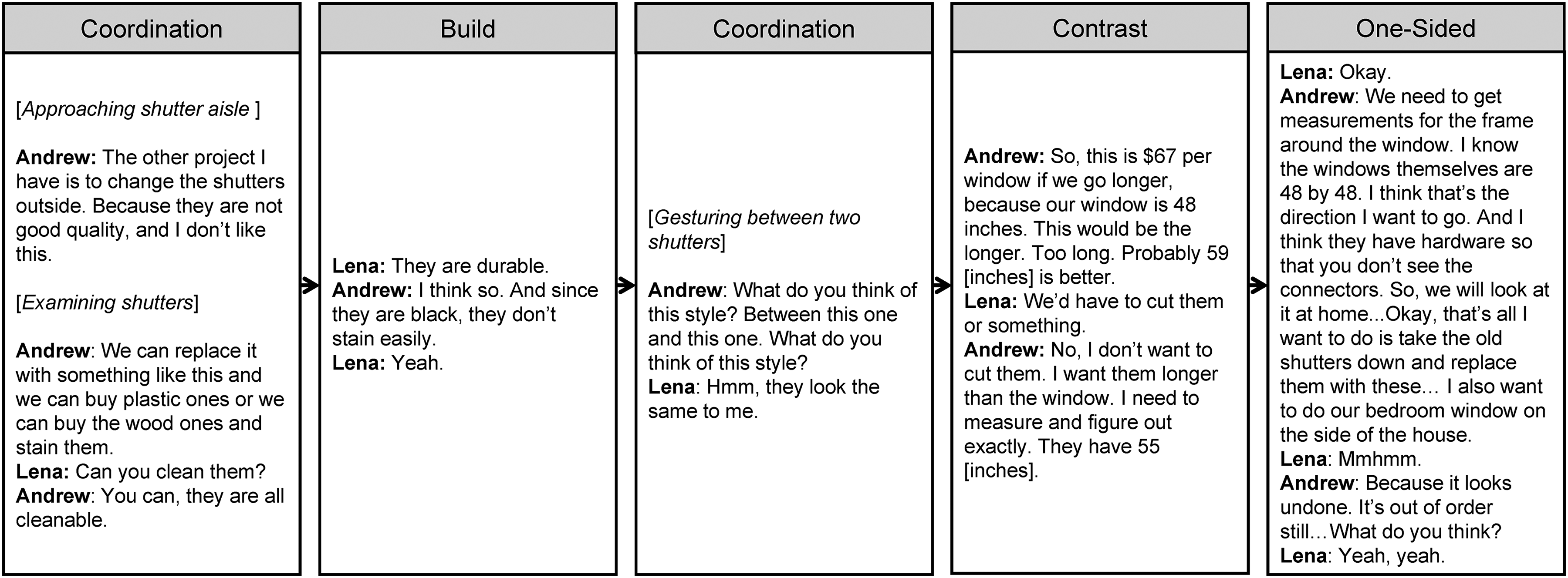
Illustration of Communication Pattern Transitions During a Joint Decision.
A Taxonomy of Communication Patterns in Joint Decision-Making
Our novel phenomenological understanding of each communication pattern, focused on the structure of partners’ responses to each other, enabled us to draw connections across the splintered literatures on dyadic communication. To unify these literatures, we developed a taxonomy of communication patterns that offers umbrella terminology reflecting a balance between the structure of the characterizing language and the terminology of related constructs in prior work. See Table 4.
Taxonomy of Joint Decision-Making Communication Patterns.

Some coordination-related constructs could be considered inquiry or disclosure and are therefore listed in both.
Notes: An extended version of this table is available in Web Appendix E.
Next, we discuss how our findings extend and connect prior related work. We first consider coordination communication. While prior work in joint decision-making has theorized that decision partners coordinate with each other to facilitate joint decision-making conversations (with terminology such as “agreement on rejection inducing dimensions,” “communication talk,” “summarize self,” “summarize other,” “information exchange”), the role of such coordination has never been the focus of an empirical investigation. Instead, it has remained on the periphery. By identifying how coordination is communicated in joint decision-making, we found parallels to the disclosure literature (Collins 2022; Cooney et al. 2020; Huang et al. 2017), which, until now, was siloed from the joint decision literature. Soliciting disclosures (i.e., question asking) and self-disclosing have implications for conversations, such as signaling listening (Huang et al. 2017; Maisel, Gable, and Strachman 2008) and increasing feelings of closeness (Fehr 2004), respectively, suggesting that coordination communication may similarly influence outcomes of joint decision conversations.
In terms of contrast communication, prior research on persuasion has primarily adopted a retrospective approach that was suitable for examining questions of how specific product attributes (e.g., objective, subjective) and partner characteristics (e.g., gender, expertise) may predict persuasion likelihood and outcomes (Corfman and Lehmann 1987; Davis, Hoch, and Ragsdale 1986; Munsinger, Weber, and Hansen 1975; Park 1982). We offer a novel perspective of persuasion by observing how it naturally occurs in joint decision conversations. We find that decision partners use persuasion regarding more than just product attributes, which has been the prevailing focus of the prior literature. Decision partners in our data also persuaded about other aspects of the decision, such as whether a need exists, whether more information needs to be gathered, and the timing of a possible purchase. We further note a lack of persuasion tactics in our data that were previously reported in research that used retrospective self-report methods, such as bargaining, offering rewards, or pouting (Falbo and Peplau 1980; Spiro 1983). We suspect that in prior studies, participants recalled extreme or very salient examples of past persuasion attempts for decisions they felt particularly strongly about, which may not represent everyday persuasion attempts.
Further, our characterization of contrast language enabled us to draw parallels between persuasion and devil's advocate, which have previously been treated as separate phenomena by the marketing and management literatures. By recognizing the similarities in the structure of their language, we uncover the possibility of jingle and jangle fallacies (Albert and Thomson 2024). That is, there is a tendency in each literature to refer to dissenting communication—which is characterized by patterns of contrasting responses—monolithically (i.e., as “devil's advocate” in management and as “persuasion” in marketing) regardless of whether the dissenter intends to sway toward their preference (i.e., true persuasion) or to ensure a well-considered decision (i.e., true devil's advocate). For example, in the management literature, dissent in joint decision-making is often interpreted as coming from a motivation to optimize decision-making (e.g., with terminology such as “devil's advocate,” “constructive controversy,” and “productive conflict”) even when decision partners are paired based on their genuine differing preferences or views (Alper, Tjosvold, and Law 1998; Schulz-Hardt, Jochims, and Frey 2002). Similarly, in the marketing literature, dissent in joint decision-making is often interpreted as coming from a motivation to influence one's partner (e.g., with terminology such as “persuasion,” “influence,” “coercion,” “power strategies,” and “concession”) even when preexisting preferences are not known or may be an artifact of asking about initial preferences postchoice (Falbo and Peplau 1980; Filiatrault and Ritchie 1980; Lowe et al. 2019; Simpson, Griskevicius, and Rothman 2012).
In terms of build communication, the joint decision-making literature has previously conceptualized agreement as the counterfactual to the focal phenomena of disagreement and persuasion (Davis 1976; Spiro 1983), resulting in very little direct study. However, by observing joint decision conversations directly, we found that when communicated by building, agreement plays an integral role in joint decision-making. This insight enabled us to make connections to disciplines that were heretofore treated as unrelated to joint decision-making. For example, the capitalization literature suggests that responding actively and constructively to one's conversation partner when they share a positive event leads to more sharing and more positivity (Gable et al. 2004; Peters, Reis, and Gable 2018), an effect that is mirrored in couples psychology (termed “turning toward”; Gottman 1998). Similarly, the literature on negotiation suggests that adding affirming perspectives (i.e., saying “yes, and …”) demonstrates listening and understanding while revealing opportunities for mutual gain (Harding 2020). Relatedly, the consumer culture theory literature suggests that these opportunities for mutual gain may result in the creation of a new, shared preference. When partners hold separate but compatible cultures, for example, they can use a process of building to create a new, shared tradition (e.g., American brown rice cooked the Persian way; Cross and Gilly 2014).
Finally, while the notion of one partner playing a passive role and the other an active role in joint decision-making is not new, one-sided communication is still a relatively nascent and splintered area of study. In early studies of joint decision-making, researchers examined the types of choices (e.g., aesthetics vs. function) in which either the husband or wife in heterosexual marriages had an outsized influence on the choice outcome (Davis 1976; Davis and Rigaux 1974; Filiatrault and Ritchie 1980; Munsinger, Weber, and Hansen 1975; Shuptrine and Samuelson 1976). This was often tied to their gender role and/or their assumed expertise and examined through the lens of influence and persuasion, with terminology such as “husband/wife dominant,” “influence dominance,” “task specialization,” and “role specialization” (Corfman and Lehmann 1987; Davis 1976; Davis and Rigaux 1974; Filiatrault and Ritchie 1980; Munsinger, Weber, and Hansen 1975; Shuptrine and Samuelson 1976). However, this prior work did not examine the ways in which partners communicated passivity. Instead, it relied on survey methods in which partners indicated who had more influence on decisions in various product categories (e.g., cars, insurance, kitchenware), and passivity was inferred by the researchers (Davis and Rigaux 1974). Separately, recent work has begun to examine instances in which a decision partner opts into a passive role by not expressing preferences (termed “no preference indications” and “unexpressed preferences”; Kim et al. 2023; Liu and Min 2020), focusing on the social motivations and social consequences of this voluntary passivity. In this prior work, the intention for passivity is explicitly communicated in the experimental conditions (e.g., “You decide” or “I don’t care”; Kim et al. 2023). While we do observe instances in our data in which intention for passivity is explicitly communicated, we also commonly observe instances in which it was not (e.g., one-word responses) and the active partner continued to attempt to engage their partner. With this insight, we bridge joint decision-making with the body of work in clinical psychology on passive responses to bids for connection, which are “initiation[s] for interaction … [ranging] from information exchange to sharing emotional support” (Driver and Gottman 2004, p. 304).
Discussion
Study 1 aimed to investigate the primary communication patterns using joint decision-making conversations (RQ1). Using inductive analysis of joint decision conversations during a shopping trip, we identified and characterized the language of four primary patterns: coordination, contrast, build, and one-sided. In doing so, we developed a novel phenomenologically based taxonomy of communication patterns that connects the splintered dyadic communication literatures. We also identified how the communication patterns manifested across decision life-cycle stages and offered initial evidence of their dynamic nature. Notably, we found evidence of each communication pattern at all stages of the decision life cycle. As previously discussed, prior research has largely examined persuasion at later stages of joint decision-making (Curry and Menasco 1979; Park 1982), modeled agreement as occurring at the end of joint decision-making, and implied coordination as occurring at the beginning stages of joint decision-making. Against this backdrop, we present the first naturalistic evidence that each of the four primary communication patterns can occur at every decision life-cycle stage. We will further explore their prevalence across stages in Study 2.
A strength of Study 1 is that the naturalistic observational approach resulted in data that are rich in the number of joint decisions and varied in the types of relationships, gender mix, and end users. As a result, the primary communication patterns that we identified are unlikely to be artificially characterized by potential idiosyncrasies of a particular relationship type (Wight et al. 2022), gender dynamic, or joint decision type (Gorlin and Dhar 2012). However, Study 1 is limited by both the context (as it is possible that decision partners communicate differently in-store than they do at home) and the number of dyads (as our sample was too small and heterogeneous to examine dyad-level or joint decision-type outcomes). We conducted Study 2 to strengthen and extend our findings.
Study 2: Modeling the Flow and Outcomes of Communication Pattern Usage in Couples’ Joint-Use Decision Conversations
The purpose of Study 2 was threefold. First, we sought to replicate the findings of Study 1 in a different decision context (shopping online at home) using a larger, more homogeneous sample (cohabitating couples making one joint-use decision). Given that a majority of the participants in Study 1 (65%) chose to bring a romantic partner to shop with, we focused on romantic couples in Study 2. Second, we aimed to observe the entire decision life cycle for joint-use decisions. Third, using the four primary communication patterns as building blocks, we aimed to model the dynamic flow of joint decision conversations and examine how communication pattern usage affects immediate satisfaction outcomes for both the purchase and interactions with one's partner (RQ2).
Participants and Data Collection Methods
We recruited cohabiting romantic couples in the United States and Canada. We used convenience sampling initially, beginning with inviting eligible couples from our own personal networks to participate and then extending to snowball sampling. This form of sampling is used in qualitative research on decision-making (Davis 1976), particularly when it is necessary to establish trust between the researcher and the participant. We needed to trust that our participants would make a real choice, not just purchase something with the intent to return it for cash. Ultimately, we recruited 78 couples (N = 156 individuals; 44.9% female, 39.7% male, 15.4% missing; Mage = 36.44 years, SD = 11.27; 55.8% Caucasian, 20.5% Asian or Pacific Islander, 9.0% other race or ethnicity, 14.7% missing; 76.3% heterosexual, 3.2% homosexual, 4.5% bisexual, 16.0% missing; MrelationshipLength = 10.33 years, SD = 11.29; McohabitatationLength = 8.33 years, SD = 10.93; 66.7% married, 11.5% dating, 6.4% engaged to be married, 1.3% civil union or domestic partnership, 3.8% no match, 10.3% missing). 5
After completing an eligibility form (Web Appendix F), participants scheduled a time to meet with a researcher on Zoom, during which both members of the couple were to be on the same computer. Participants were told ahead of time that the study was about how couples make online purchases together and that they would be given a gift card to pay for their purchase, up to $100 USD or $135 CAD, depending on the country. Importantly, they were not told the online retailer at which they would shop during the study so that they could not plan their purchase beforehand, enabling us to observe conversations at all stages of the decision life cycle (from need recognition to choice).
At the start of the Zoom meeting, the research assistant read a script that detailed the procedure (Web Appendix G). In brief, they had to make only one purchase, had to shop online at Ikea, had to make a purchase for joint use, and could spend as much as they like but had to use their own money to pay the difference if they exceeded the gift card amount. 6 We recorded participants’ audio and their shared screen 7 as they shopped. To be as unobtrusive as possible, the research assistant turned their camera off and muted their audio while the participants shopped, only interjecting when necessary (e.g., to answer a question). At the end, participants shared the URL of their chosen item, and the research assistant gave them a gift card code to pay for their purchase. The research assistant confirmed that the purchase was made. Thus, all couples in the data made only one choice. Purchases across couples spanned Ikea's product offerings, from AA batteries to customized closet systems.
Finally, participants who did not opt out of receiving emails were automatically sent a Qualtrics survey within one hour of their shopping session (Web Appendix H). In the follow-up survey, participants first confirmed that they were in separate rooms. They indicated their satisfaction with what they chose to purchase (1 = “not at all satisfied,” and 7 = “very satisfied”), their satisfaction with Ikea (1 = “not at all satisfied,” and 7 = “very satisfied”), how well they thought the decision-making conversation went (1 = “not well at all,” and 7 = “very well”), and how they felt about their relationship after shopping online together at Ikea (1 = “not at all satisfied,” and 7 = “very satisfied”). Based on a factor analysis, we combined the product and store satisfaction items into one metric (called “purchase satisfaction”; α = .59) and the conversation and relationship satisfaction items into another metric (called “partner interaction satisfaction”; α = .69). For simplicity, we report the results of the composite measures in the main text and the results of each item separately in the Web Appendix. As a robustness check, participants also indicated how important it was to them that they picked “the right” thing when shopping (1 = “very low importance,” and 7 = “very high importance”). As a realism check, participants indicated how similar the study was to how they typically shop online together (1 = “not at all similar,” and 7 = “very similar”). Finally, they completed demographic measures.
Four of the transcripts were excluded from the analysis because of inaudible audio recordings (n = 3) or prior knowledge of Ikea being the retailer (n = 1), leaving a final sample of 74 couples (N = 148). The final dataset contained over 14,000 conversational turns (i.e., one person's speech ends when another person speaks). We trained research assistants to code the data for stages of the decision life cycle (Web Appendix I). Then, we used deductive content analysis to code for communication patterns, using the taxonomy developed in Study 1 (Web Appendix J). During this process, we were vigilant for the possibility of any new emerging themes or communication patterns in the data that might add to or differ from Study 1. None emerged. For the purpose of our quantitative analysis, we removed inaudible lines (.01% of the data) and conversational turns taken by the researcher or someone outside the couple (e.g., a child; .01% of the data).
Affirming the Four Primary Patterns
The deductive content analysis affirmed the four primary communication patterns that we uncovered in Study 1. That is, while the topics of the conversations necessarily differed from those in Study 1 due to the differences in setting (e.g., a different set of product offerings; navigating an online store vs. a physical store), the structures in which partners talked to each other generalized to a different context. As an example, Figure 2 illustrates the communication patterns used by a couple as they discussed home decor options.

Communication Patterns Recur in a Different Joint Decision Context.
In support of the primacy of the patterns, and consistent with Study 1, the four communication patterns accounted for a majority of the total decision-related conversational turns (M = 93.5%, SD = 5.4%, Min = 75.8%, Max = 100%). Additionally, 90.5% (n = 67) of couples used at least three of the four communication patterns (M = 3.30, SD = .68, Min = 1, Max = 4), and 40.5% (n = 30) of couples used all four of the communication patterns. Coordination was the most prevalent, with inquiry accounting for an average of 46.4% (SD = 22.8%, Min = 0%, Max = 100%) of each couple's decision-related conversation and disclosure accounting for 17.6% (SD = 19.3%, Min = 0%, Max = 73.3%). This was followed by contrast (devil's advocate: M = 10.3%, SD = 6.2%, Min = 0%, Max = 27.2%; persuade: M = 5.9%, SD = 6.6%, Min = 0%, Max = 31.5%), build (M = 9.9%, SD = 9.2%, Min = 0%, Max = 45.0%), and one-sided (M = 3.3%, SD = 4.8%, Min = 0%, Max = 20.5%).
Modeling the Usage and Flow of Communication Patterns
Communication patterns across the conversation
We observed dynamic usage of the communication patterns throughout the joint decision conversations. On average, couples engaged in 38.62 communication pattern transitions (SD = 24.28, Min = 6, Max = 121). We modeled the flow of communication patterns (i.e., transitioning to a different pattern) at both the beginning and end (first and last five transitions, respectively) of the decision conversation. Couples frequently returned to coordination throughout the conversation, seemingly as an intermediary between the patterns. This is illustrated by the high frequency of coordination communication at the odd transition numbers in the Sankey diagrams in Figure 3. There was otherwise not a systematic order to the flow of communication patterns throughout the conversation.
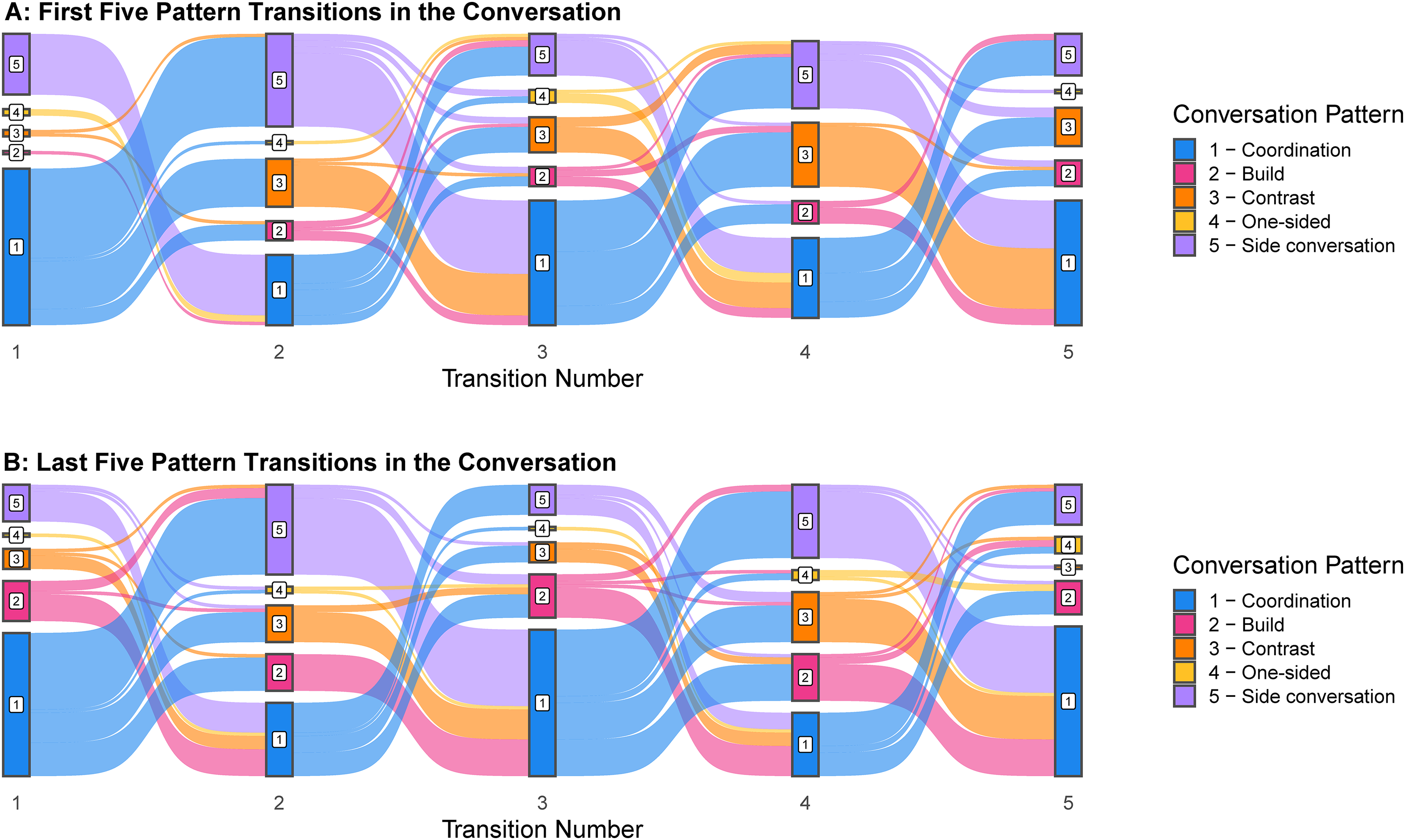
Flow of Communication Patterns During Joint Decision Conversations.
Communication patterns across the decision life cycle
To examine communication pattern usage across the decision life cycle, we first modeled how couples navigated the decision life cycle together. Consistent with our observation in Study 1, we found that couples navigated the decision life cycle nonlinearly (Figure 4). Early stages of the decision life cycle (e.g., need recognition) did not necessarily occur only at the beginning of the conversation, and late stages (e.g., choice) did not necessarily occur only at the end of the conversation. Thus, analyzing communication pattern usage across decision life-cycle stages differs from analyzing chronological usage of communication patterns throughout the conversation (i.e., Figure 3).
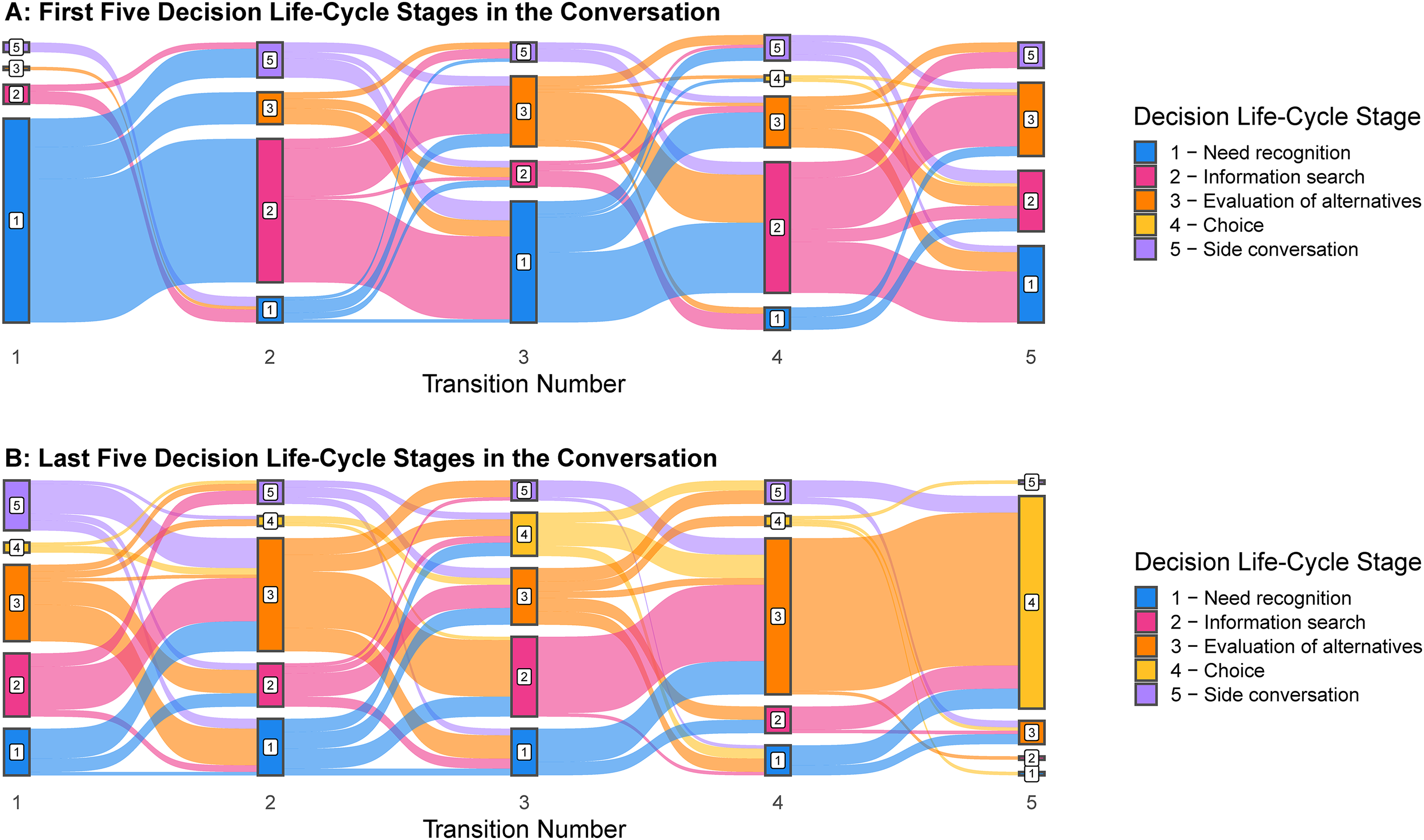
Joint Decision-Makers Navigated the Decision Life Cycle Nonlinearly.
To examine how couples used the communication patterns at each stage of the decision life cycle, we conducted a chi-squared analysis. While we observed each communication pattern at every stage of the decision life cycle in our data, some communication patterns were significantly more (or less) likely than chance to occur at certain stages (χ2(15) = 406.69, p < .001). Details of usage likelihood for each communication pattern are reported in Table 5 and visualized in Figure 5. We discuss each pattern next.
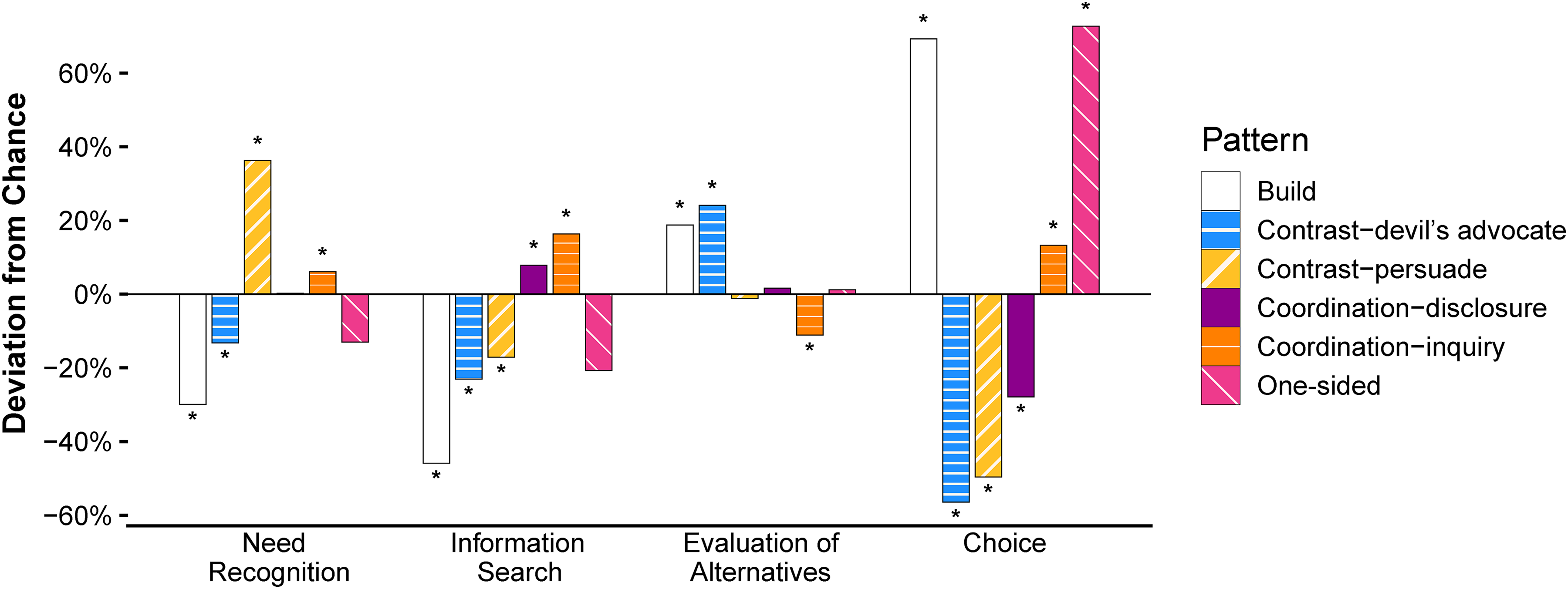
Percentage Deviation from Expected Frequency of Each Communication Pattern Occurring at Each Stage of the Decision Life Cycle.
Likelihood (Compared to Chance) of Each Communication Pattern Occurring at Each Stage of the Decision Life Cycle.

Notes: Standard residuals of ±2 (bolded) indicate that the pattern is significantly (at p < .05) more or less likely than chance to occur at a given stage of the decision life cycle.
Focusing first on coordination communication patterns, inquiry coordination was significantly more likely than chance to occur in early stages (need recognition, information search) and choice and significantly less likely than chance to occur in the evaluation of alternatives stage. In comparison, disclosure coordination was less likely than chance to occur during choice and more likely during information search. An implicit assumption in prior models of joint decision-making was that coordination occurred primarily at the beginning of joint decision-making (Davis, Hoch, and Ragsdale 1986; Park 1982). The current findings only partially support this assumption, as coordination occurs frequently at both the early and late stages of joint decision-making.
In terms of contrast communication patterns, couples were more likely than chance to play the devil's advocate during evaluation of alternatives and less likely than chance to display this pattern at any other stage. These findings are consistent with prior research that has conceptualized devil's advocate as occurring in later stages (Aribarg, Arora, and Bodur 2002) and add nuance to findings showing that playing the devil's advocate is particularly effective for preventing biased information search (Schulz-Hardt, Jochims, and Frey 2002), as we find that decision partners are less likely than chance to naturally engage in devil's advocate at this stage. Persuading was more likely than chance to occur in the need recognition stage and less likely to occur in the information search and choice stages. These findings are counter to how prior research has primarily focused on persuasion during choice (Corfman and Lehmann 1987; Munsinger, Weber, and Hansen 1975; Spiro 1983).
Build communication was more likely than chance to occur in the late stages (evaluation of alternatives, choice) than the early stages (need recognition, information search), supporting how prior research has modeled agreement (Davis 1976; Stevanovic 2012). Finally, couples were more likely than chance to use one-sided communication during choice, supporting how it has been conceptualized in prior research (Filiatrault and Ritchie 1980; Kim et al. 2023; Liu and Min 2020; Steffel and Williams 2018; Su, Fern, and Ye 2003).
Satisfaction Outcomes of Communication Pattern Usage
We merged the conversation data with the follow-up survey data to evaluate immediate satisfaction outcomes of communication pattern usage. The follow-up survey had a retention rate of 89.2% (N = 132 individuals), representing 62 couples (N = 124 individuals) with both members responding and eight couples with only one member responding. To capture dyadic effects, the subsequent analyses included only those couples who had both members respond to the follow-up.
To examine how usage of each communication pattern affected immediate satisfaction with both their interactions with their partner and their purchase, we conducted separate multilevel regressions on each dependent measure, with individuals nested within couples. Specifically, we conducted actor-partner interdependence models (APIM; Kenny, Kashy, and Cook 2006) with the number of times Partner A and Partner B initiated each communication pattern entered simultaneously as predictors of Partner A's satisfaction. We operationalized communication pattern initiation based on our findings from Study 1 about the structure of each communication pattern. Because contrast, build, and one-sided patterns are characterized by one partner's response to the other partner's comment, we considered the initiator to be the second speaker of any given instantiation of those patterns in our data. Because coordination patterns are characterized by one partner initiating disclosure or inquiry, we considered the initiator as the first speaker of any given instantiation of those patterns in our data. Web Appendix K contains full reporting of the APIM analyses, including results of each individual item in the composite measures and robustness checks that control for decision importance and gender. Here, we highlight key findings for each composite measure.
APIM results for satisfaction with partner interactions
The communication patterns that affected satisfaction with partner interactions were build, contrast‒persuade, coordination‒inquiry, and coordination‒disclosure. In terms of build, the more either Partner A (b = .09, SE = .03, p = .007) or Partner B (b = .09, SE = .03, p = .007) initiated a build pattern, the more satisfied Partner A was with their partner interactions. By showing that usage of the build communication pattern has positive outcomes for the immediate conversation, this finding extends prior work related to build communication patterns. For example, research on capitalization has found that active constructive responses to one's partner talking about their positive life event enhance the partner's perception of the initial positive life event (Gable and Reis 2010; Gottman 1998).
Partner A initiating a contrast‒persuade pattern decreased Partner A's satisfaction with the partner interactions (b = −.28, SE = .05, p < .001). This finding that initiating a persuasion attempt decreases satisfaction with the partner interactions extends prior work showing that realizing differences between one's partner and oneself can weaken the relationship (Montoya, Horton, and Kirchner 2008).
Finally, in terms of coordination, Partner A's satisfaction with partner interactions decreased marginally when Partner B initiated a coordination‒inquiry pattern (b = −.04, SE = .02, p = .091) and significantly when Partner B initiated a coordination‒disclosure pattern (b = −.06, SE = .03, p = .025). We speculate that when one's partner initiates coordination, it may signal a lack of knowledge or understanding of each other’s preferences. These findings are contrary to the growing body of work showing relational benefits of question asking (Huang et al. 2017; Maisel, Gable, and Strachman 2008). One possibility is that prior research has been conducted among strangers (Huang et al. 2017) and in contexts where new information is being shared (i.e., about a recent life event; Maisel, Gable, and Strachman 2008). As such, participants in the prior research could not realistically expect their partner to already know the solicited information, whereas participants in the current research may have expected their partner to know or infer the solicited information. Given consumers’ desire to feel known and understood (Huang et al. 2017; Maisel, Gable, and Strachman 2008; Reis, Clark, and Holmes 2004), it is possible that such signals of one's partner's lack of knowledge could have a negative impact on the relationship. We return to this possibility in the “General Discussion” section.
APIM results for satisfaction with the purchase
Build increased satisfaction with the purchase, while contrast‒persuade decreased it. Specifically, the more Partner A initiated a build pattern, the more satisfied Partner A was with the purchase (b = .09, SE = .04, p = .043). The more Partner B initiated a contrast‒persuade pattern, the marginally less satisfied Partner A was with the purchase (b = −.12, SE = .06, p = .051). We speculate that initiating a build pattern may signal that the purchase is jointly preferred (Cross and Gilly 2014), whereas being on the receiving end of a persuasion attempt may serve as the opposite signal.
Discussion
In Study 2, we affirmed the communication patterns identified in Study 1 using deductive analysis (RQ1) and modeled how the communication patterns dynamically flow throughout joint decision conversations while shopping online (RQ2). Key findings about the flow of joint decision conversations include that decision partners do not navigate the decision life cycle linearly and coordination communication often serves as an intermediary between other communication patterns. By examining the likelihood (relative to chance) of each communication pattern naturally being used at each stage of the decision life cycle, these findings support some implicit assumptions in the literature and challenge others. Specifically, our findings support prior conceptualizations that coordination occurs at early stages of the decision life cycle and that build, devil's advocate, and one-sided occur at late stages. Counter to prior thinking, we find that coordination is also likely to occur during choice (i.e., a late stage) and that persuasion is likely to occur during need recognition (i.e., an early stage) and is less likely to occur at choice (i.e., a late stage). Further, while prior work has shown the benefits of engaging in devil's advocate at early stages of the decision life cycle, we find that decision partners are less likely than chance to naturally do so.
We also used dyadic analyses to examine how communication pattern usage affected satisfaction outcomes after shopping (RQ2). Key findings include the positive effects of build and the negative effects of persuasion on satisfaction outcomes related to both partner interactions and the purchase, whereas coordination has negative effects on satisfaction with partner interactions.
We note a limitation of Study 2's findings in that some aspects of communication pattern usage and outcomes may not be generalizable beyond romantic partners making a joint-use decision. It is probable that decision partners with a different relationship type (e.g., friends; Wight et al. 2022) or making a different type of joint decision (e.g., single use; Gorlin and Dhar 2012) may exhibit differences. We return to this idea in the “General Discussion” section.
General Discussion
Across two observational studies that capture decision partners’ conversations during in-store and online shopping trips, we identified the primary communication patterns used in joint decision-making, offering insights into how decision partners jointly navigate the decision life cycle and the role of conversation in joint decision satisfaction outcomes. An iterative mix of inductive, abductive, and deductive analyses revealed that joint decision conversations are composed of four primary communication patterns: coordination (subsuming inquiry and disclosure), contrast (subsuming persuade and devil's advocate), build, and one-sided. We characterized the prototypical language of each pattern and found how each manifests across decision life-cycle stages. We further modeled the flow of the communication patterns during couples’ joint decision conversations and found that the usage of the patterns predicts immediate satisfaction outcomes. By focusing on our findings about the language structure of the patterns, rather than anchoring on preexisting terminology, we connected the splintered dyadic communication literatures with the joint decision-making literature (including prior work on disclosure, negotiation, capitalization, improvisation, family identity, and bids for engagement) and developed a taxonomy of communication patterns.
Our approach to studying the process of joint decision-making by examining joint decision conversations as they naturally unfold—without imposing structure or using retrospective methods—revealed nuances to the joint decision-making process, some of which challenge long-held assumptions in the joint decision-making literature. For example, the retrospective methods typically employed to study joint decision-making implicitly assumed that decision partners travel the decision life cycle linearly. However, we find that decision partners frequently skip stages and return to previous ones. Additionally, our identification of four primary communication patterns represents a dramatic shift from the prior joint decision-making literature, which largely focused on persuasion as the primary mechanism of joint decision-making (Davis 1976; Davis and Rigaux 1974; Filiatrault and Ritchie 1980; Munsinger, Weber, and Hansen 1975; Spiro 1983) and implicitly assumed that agreement and coordination occur in the periphery. Our findings can put persuasion in context, showing that understudied patterns like coordination are used more often than persuasion and that understudied patterns like build are predictive of more satisfaction outcomes than persuasion.
Theoretical Contributions
This research makes several important contributions. First, we contribute to the joint decision-making literature, answering a call by Hamilton et al. (2021) to explore “joint journeys” through the decision life cycle. Hamilton et al. (2021) note that most of the research on joint decisions focuses on the evaluation of alternatives and choice stages of the decision life cycle and that there is a relative lack of research on joint decisions at the other stages. We build on this prior work by examining all decision life-cycle stages that occur during a shopping trip and modeling the flow of communication during joint decision conversations at each stage. Our findings that certain communication patterns are more common at certain stages of the decision life cycle suggest that the process of joint decision-making may meaningfully differ across decision life-cycle stages. Relatedly, we contribute to the joint decision satisfaction literature (i.e., postchoice evaluation, the final stage of the decision life cycle). Prior work has shown that the degree to which partners make shared (vs. self- or partner-made) decisions influences satisfaction outcomes (Brick et al. 2022), as do characteristics of the choice itself (e.g., the choice to co-indulge or co-abstain; Lowe and Haws 2014). We build on this work by identifying communication during joint decision-making as a novel antecedent to satisfaction outcomes related to the joint decision.
Second, by examining the process of joint decision-making through the lens of dyadic conversations, we answer calls for more research on conversation during joint decision-making (Cross and Gilly 2014; Epp and Price 2008; Qualls 1987; Queen, Berg, and Lowrance 2015) and contribute to the communication pattern literature (Bischoff 2008; Daire et al. 2012; Heavey et al. 1996). We diverge from the traditional approach of examining just one communication pattern in isolation of others (Falbo and Peplau 1980; Harding 2020; Kim et al. 2023; Liu and Min 2020) or using retrospective survey methods in which participants report their usage frequency of specific communication patterns in conversation but do not specify their flow (Heavey et al. 1996). This approach enables us to examine how communication patterns dynamically flow in conversation. To our knowledge, this is the first empirical examination of how spoken communication patterns naturally flow together in the consumption arena. Our finding that decision partners transition back and forth between communication patterns over the course of a conversation—and often use coordination communication as an intermediary—suggests that communication patterns may interplay more than the literature has implicitly assumed.
Third, we developed an ordering theory of communication during joint decision-making (Sandberg and Alvesson 2021). Using an approach based in grounded theory to identify communication patterns enabled us to identify linkages between communication phenomena in other disciplines and provide structure to a highly splintered literature. For example, we connect work on capitalization responses (social psychology; Gable et al. 2004), turning toward (clinical psychology; Gottman 1998), and family identity building (consumer culture theory; Cross and Gilly 2014) as falling under the umbrella of the build communication pattern. Connecting communication phenomena by their shared language structures enables us to identify potential jingle and jangle fallacies (as with devil's advocate and persuasion) and provide unifying terminology to facilitate future cross-disciplinary work.
Fourth, we answer calls for more research on spoken language (Packard and Berger 2024; Yeomans et al. 2023). Despite the prevalence and importance of conversation in consumers’ everyday lives (Yeomans et al. 2023), fewer than 10% of papers studying consumer language look at spoken language (Packard and Berger 2024). Spoken language may offer insights that could not be gleaned from written language (Oba and Berger 2024). Our focus on spoken conversation enables us to develop theoretical insights into how real-time conversation unfolds and shapes satisfaction outcomes.
Practical Implications
Our research has practical implications for both practitioners and consumers. Consumers can apply the current findings to improve joint decision-making conversations in their personal and professional lives. Being able to consciously recognize communication patterns as they occur can help decision partners maximize the potential benefits of build by intentionally affirming each other's statements and minimize the potential harm of persuasion by judiciously initiating persuasion attempts.
Relatedly, many industries and professions (e.g., salespeople, financial planners, realtors, interior designers) regularly facilitate the joint decision-making process with clients (Evans et al. 2000). Prior research in salesperson–customer interactions for individual decision-makers has found that a salesperson's ability to understand the customer and, accordingly, modify and adapt how they interact with the customer is critical to achieving good sales outcomes (Ahearne et al. 2022; Williams, Spiro, and Fine 1990). However, given the relative lack of prior work detailing communication during joint decision-making, practitioners have largely been left without guidance when facilitating joint decisions. Our ordering theory simplifies the complex research on dyadic communication (consolidating over 30 terms found across the literatures) into a manageable framework for marketing managers and sales associates. The guide presented in Table 2 can help practitioners facilitate a positive and productive joint decision process, namely by guiding decision partners toward communication patterns that can help balance relationship and decision outcomes. For example, salespeople can be trained to recognize each communication pattern in natural conversation (e.g., countering language such as “well” or “but” statements tend to be contrast patterns) and to prompt communication patterns as needed (e.g., “yes, and …” to prompt build).
Moreover, practitioners can leverage the current findings to infer the stage of the decision life cycle in joint decision-making, which is critical in salesperson–customer interactions (Ahearne et al. 2022; Williams, Spiro, and Fine 1990). Table 2 can also serve as a guide to interpret the content of the decision partners’ conversation (e.g., if they are expanding on the reasons an attribute is important, then they are at the evaluation of alternatives stage while using a build pattern). Furthermore, the knowledge that the joint decision life cycle is not linear may help salespeople identify joint decision partners who are “doubling back” and can instead nudge them “forward” toward choice.
Limitations and Future Directions
At its core, this work is meant to be generative. We have noted many possible launching points for future research throughout, such as the need for future research to take an interdisciplinary approach to discover more about each communication pattern and its role in joint decision conversations. Additionally, we note opportunities for future research to expand the scope of the current findings, which are limited to joint decision conversations during a single shopping trip at home-related stores; future research should examine communication before and after shopping and in other decision contexts. Next, we highlight three major areas for future research.
Future research area 1: antecedents to communication pattern usage and flow
Future research should consider conditions—such as individual, relational, and contextual factors—under which the flow and frequency of the patterns may change. First, individual characteristics may shape a decision partner's propensity to initiate any given communication pattern. For example, high-power individuals show less concern about their partner's preferences (Brick et al. 2022; Fisher, Grégoire, and Murray 2011) and therefore may be less likely to engage in inquiry coordination and more likely to contrast to persuade (vs. devil's advocate) to get what they want. In comparison, consumers who are higher in communal traits (Trapnell and Paulhus 2012) may be more likely to build or, to avoid conflict, engage in one-sided instead of persuasion.
Second, relational factors may also matter. While we observed the communication patterns emerge among varied relationship types (Study 1), one limitation of the current research is that our findings about the usage and flow of the communication patterns may not be generalizable beyond cohabitating romantic couples (Study 2). Prior work has shown that characteristics of decision partners, such as relationship length, closeness, and gender composition of the partners, can shape joint decision outcomes (Commuri and Gentry 2005; Nikolova and Lamberton 2016; Nikolova, Lamberton, and Coleman 2018). It is therefore likely that characteristics of the relationship between the decision partners may influence the process of arriving at a joint decision. Indeed, people's communication in newer relationships (e.g., colleagues, friends, romantic) tends to differ from their communication in more established relationships (Kline Rhoades and Stocker 2006). For example, new relationship partners are unlikely to assume knowledge about each other's preferences (Lerouge and Warlop 2006), whereas partners in more established relationships tend to (inaccurately) assume that they know each other's preferences (Eggleston et al. 2015; Lerouge and Warlop 2006). Thus, relationship stage may affect the frequency with which coordination communication is used. Relationship stage may also affect whether using coordination violates expectations that partners already know each other’s preferences, potentially moderating its negative effect on satisfaction with partner interactions (as found among established relationships in Study 2).
Finally, contextual factors, such as salient relationship goals or a shared joint decision history, may also matter. In this article, we are limited by observing joint decision conversations during just one shopping trip. However, changing relationship goals and prior joint decision journeys might also influence how dyads approach a given joint decision conversation. When decision partners want to feel closer to each other—whether to form or maintain a relationship (Hasford, Kidwell, and Lopez-Kidwell 2018)—they may be more likely to engage in build communication. By expanding on each other's statements, finding similarities, and creating a shared experience, build communication patterns may naturally foster closeness, liking, and trust (Condon and Crano 1988; Fehr 2004; Harding 2020; Huang et al. 2017; McAdams, Healy, and Krause 1984). The outcomes of prior decisions are often considered by the decision partners in otherwise unrelated joint decisions (e.g., if one partner got their way in a previous decision, they may be more likely to concede their preference in a later decision; Corfman and Lehmann 1987; Su, Fern, and Ye 2003). Extending this to communication pattern usage, it is possible that the outcomes or communication patterns in prior decisions may influence communication tendencies in subsequent decisions (Nikolova and Nenkov 2022). For example, if one partner has a history of poor decision-making, the other partner may play devil's advocate more in subsequent decisions to ensure more thorough consideration.
Future research area 2: outcomes of communication pattern usage and flow
Future research could examine optimal strategies for communication pattern usage. As highlighted by the opening Ikea example, couples are faced with balancing satisfaction with their purchase (e.g., jointly deciding on a “comfy sofa”) and satisfaction with their partner interactions (e.g., conflict from the process of jointly choosing the sofa). Optimal strategies could enable partners to maximize both dimensions of satisfaction. Given our findings that build and contrast‒persuade are relatively strong predictors of both purchase and partner interaction satisfactions, it is possible that the intentional usage (or avoidance) of these patterns could enable decision partners to better navigate joint decision conversations. Exploratory analyses in Study 2 revealed that decision importance is not a significant moderator of the composite satisfaction outcomes; for example, build (all ps ≥ .498) and contrast‒persuade (all ps ≥ .177) similarly influenced satisfaction regardless of decision importance. Thus, decision importance may be a particularly relevant characteristic to consider when optimizing communication strategies, as decisions of low importance might not be worth the risks of communication patterns that have negative outcomes (e.g., persuasion), whereas all decisions, regardless of importance, may benefit from communication patterns that have positive outcomes (e.g., build). Supporting this notion, prior work has shown that, in some cases, minimizing relational conflict is prioritized over getting one's preferred outcome (Epp and Price 2008; Liu and Min 2020).
Characteristics of the decision conversation, such as the type of joint decision and the sequencing of communication patterns, may shape satisfaction outcomes for communication pattern usage. Our findings about satisfaction outcomes may not generalize to other types of joint decisions (e.g., single consumption; Gorlin and Dhar 2012) because Study 2 focused only on joint consumption decisions. Might the negative satisfaction effects of coordination and contrast‒persuade patterns be mitigated among joint decisions for single consumption? Additionally, because we observed conversations as they naturally unfolded, our results cannot speak to the optimal sequencing of communication patterns. For example, does build communication exert a stronger influence on satisfaction outcomes if it occurs at the beginning or end of a joint decision conversation? One possible way for future research to examine optimal communication strategies could be to use purposive sampling to recruit decision partners who have had more versus less successful joint decision outcomes to infer successful strategies. Another approach would be to use experimental methods to manipulate characteristics of the joint decision (e.g., type of joint decision, sequence of communication pattern usage) and evaluate their effect on joint decision outcomes.
Future research area 3: conversation as a methodological approach
The current research highlights the value of examining joint consumption as it naturally occurs through the lens of conversation, as opposed to imposing a structure with experimental designs or retrospective models, to shed light on the dynamic and complex processes of joint consumption. Namely, we see two benefits of adopting conversation as a methodological approach. First, conversations serve as a means to examine how the process of joint consumption affects outcomes. For example, in our data we find that how a consumer agrees with their decision partner matters: Build (“yes, and …”) improves satisfaction with the purchase, while one-sided (“whatever you want”) has no effect on satisfaction with the purchase. These important differences in the form of agreement would likely have been masked in survey research. Second, consumers’ memories of their experiences are likely biased toward salient and memorable conversations. For example, we do not see consumers often pouting or bargaining during persuasion despite the prevalence of these strategies in the literature (Falbo and Peplau 1980; Spiro 1983). When asked to recall persuasion attempts, particularly contentious decisions may be most salient, potentially biasing results. Given that conversation likely plays a central role in many joint consumption phenomena, such as joint experiences (e.g., travel, eating, arts), meaning-making, and shared identity creation, there is a need for more joint consumption research to adopt a conversation-based methodological approach.
Supplemental Material
sj-pdf-1-mrj-10.1177_00222437261439058 - Supplemental material for Communication Patterns in Joint Decision-Making
Supplemental material, sj-pdf-1-mrj-10.1177_00222437261439058 for Communication Patterns in Joint Decision-Making by Kelley Gullo Wight, Holly S. Howe, Danielle J. Brick and Gavan J. Fitzsimons in Journal of Marketing Research
Footnotes
Acknowledgments
The authors would like to thank the Duke-Ipsos Research Center and its board members for their support of and input to this research. Additionally, the authors would like to thank Maria Smith, Nanette Zhang, Thomas Young, Sixuan Ye, Gabrielle Fortin, Jessie Chan, Alice Louis Victor, Samantha Davey, Allison Sparks, and Elinora Pentcheva for their tireless work as research assistants on this research.
Coeditor
Rebecca Hamilton
Associate Editor
Eileen Fischer
Author Contributions
The first two authors contributed equally to this work and reserve the right to list themselves first on their respective CVs.
Declaration of Conflicting Interests
The authors declared no potential conflicts of interest with respect to the research, authorship, and/or publication of this article.
Funding
The authors received no financial support for the research, authorship, and/or publication of this article.

Data Availability Statement
The data and code required to replicate numeric analyses for Study 2 are publicly available on the JMR Dataverse. Qualitative analyses in both studies rely on transcribed conversational observations. If made publicly available in its entirety, this dataset could identify participants. Therefore, transcribed conversations are not made publicly available for either study. All data, including transcribed conversations, are available to the JMR team for replication purposes.
Notes
References
Supplementary Material
Please find the following supplemental material available below.
For Open Access articles published under a Creative Commons License, all supplemental material carries the same license as the article it is associated with.
For non-Open Access articles published, all supplemental material carries a non-exclusive license, and permission requests for re-use of supplemental material or any part of supplemental material shall be sent directly to the copyright owner as specified in the copyright notice associated with the article.
