



Abstract
This article investigates the relationship between international election observation, election fraud, and post-election violence. While international electoral missions could in principle mitigate the potential for violence by deterring election fraud, the ability of international observers to detect manipulation may in fact induce violent uprisings. Serious irregularities documented by international observers provide credible information on election quality, which draws attention to election outcomes and alleviates coordination problems faced by opposition parties and society. When elections are manipulated to deny citizens an opportunity for peaceful contestation and international observers publicize such manipulation, violent interactions between incumbents, opposition parties, and citizens can ensue. Consequently, the author expects that fraudulent elections monitored by international organizations will have an increased potential for subsequent violence. This expectation is evaluated empirically in an analysis of post-election conflict events for African elections in the 1997–2009 period. Using original data on electoral manipulation and reputable international election observation missions, findings show that the presence of election fraud and international observers increases the likelihood of post-election violence. Matching methods are employed to account for the possibility that international observers’ decisions to monitor elections are endogenous to the occurrence of violence in the electoral process. Results for matched samples confirm the findings in the unmatched sample. A variety of robustness tests show that the results are not influenced by the operationalization of independent variables and influential observations.
Keywords
Introduction
Elections are considered a crucial element of democracy. However, increasing international pressure for democratic reforms and contagion effects have contributed to the adoption of elections in countries considered less than fully democratic. In unconsolidated regimes, leaders may manipulate the electoral process or rig election results when concerned about their chances of winning. Incumbents in these countries hold elections to please domestic and international audiences and reap international benefits such as aid or investments, but are willing to game the system in an effort to hold on to power. 1 Yet, since elections are held to transfer the right to govern, the failure to perform that function could lead to possibly serious and conflictual outcomes. Blunt manipulation of the electoral process by political authorities could conceivably lead to protests and riots by supporters of the opposition, or even all-out civil war between incumbents and their challengers.
This rise in the adoption of electoral processes has coincided with an increase in the international monitoring of electoral processes in unconsolidated regimes. While there may be beneficial effects of international monitoring, the assessment of election quality by international organizations has the potential to exacerbate problems associated with manipulated elections mentioned above. Research has documented election observers’ ability to detect election fraud (Hyde, 2008; Kelley, 2008). Yet, when elections are not only suspected of being manipulated but such manipulation is documented by international organizations considered credible in their assessment, the risk of violence mentioned above may increase even more. The monitoring of fraudulent elections by international organizations draws attention to unfair electoral processes, reduces uncertainty over whether fraud was committed, and alleviates coordination problems among groups concerned about manipulation. Jointly, these factors could contribute to violent contestation after manipulated elections.
The main argument developed in this article, therefore, expects that fraudulent elections observed by international observers are more likely to be followed by post-election violence. When international monitors observe irregularities that likely affected the outcome of elections, their assessments provide credible information on the extent of manipulation. This information can function as a focal point for action and facilitate coordination among citizens and opposition parties (Tucker, 2007). Evidence on extensive fraud provided by international observers can thus increase the likelihood of anti-regime protests and unrest. Therefore, the argument anticipates that the effect of international election monitoring on post-election violence is conditional on the presence of serious electoral manipulation. The argument is evaluated in an analysis of all African elections held in the 1997–2009 period. The analysis combines original data on the presence of international election observer missions and assessments of election fraud with disaggregated data on the number of violent post-election events presented in Raleigh, Linke & Hegre (2010). Results indicate that fraudulent elections are more likely to result in post-election violence when international observers are present, thus supporting the main expectation. Additionally, matching techniques are used to address potential endogeneity and model how decisions to observe elections may be influenced by expectations of violence. A variety of additional robustness tests confirm the consistency of results across a number of model specifications.
The article makes two significant contributions to the literature. First, it adds to work on the influence of international actors on domestic politics (Gourevitch, 1978). The analysis shows how international organizations can exacerbate contentious processes by providing credible information on the presence of electoral manipulation. Second, the article adds to the small but growing literature on the relationship between elections and violence (Rapoport & Weinberg, 2001; Wilkinson, 2004; Collier, 2009).
The article proceeds as follows. I first describe the key purpose of international election observation, which is to assess the quality of the electoral process. The next section develops the theoretical argument, which describes how the detection of blatant electoral manipulation by international observers can lead to post-election unrest and violence. I then illustrate the theoretical dynamics by discussing violence following the 2005 legislative elections in Ethiopia. The subsequent section tests the argument on a dataset including all African elections held from 1997 to 2009.
International election observation and electoral manipulation
As a result of greater international emphasis on democratization, international organizations increasingly play a role in democracy promotion. Among democratic institutions emphasized by organizations active in international democracy promotion, elections have been a key focus. Because they are seen as high-stakes events providing opportunities for political change, international attention to elections has increased markedly over the last decades. As part of this attention, international observation of elections has become a prominent practice. The practice was first established by the Organization of American States (OAS), which started observing elections on a small scale in the 1960s, but election monitoring experienced remarkable growth in the 1990s (Kelley, 2008; Hyde, 2011). Since the mid-1990s, more than half of all elections in unconsolidated democracies have been observed by international organizations such as the Carter Center, the European Union, the Organization for Security and Cooperation in Europe (OSCE), and many others (Kelley, 2008: 223).
Yet what exactly is the purpose of international election observation, and how successful are election observers in achieving this purpose? A basic function of international election observation is to assess the quality of elections (Carothers, 1997; Bjornlund, 2004; Hyde, 2008, 2011; Kelley, 2008; Hartlyn & McCoy, 2006). Determining the quality of elections, however, requires the establishment of a set of standards against which elections are evaluated. While it is often believed that elections can easily be judged according to whether they were ‘free and fair’, there are a variety of processes that could be considered to arrive at such conclusions (Hartlyn & McCoy, 2006: 44). Electoral manipulation can occur in the pre-election and campaign period, on election day, or during the tabulation and announcement of results. Moreover, a variety of fraudulent acts can take place in each of the phases of the electoral process. 2 While early election observation was legitimately criticized for placing too much emphasis on fraud occurring on election day, many international observer groups have significantly improved their methodologies and now monitor the entire electoral process (Carothers, 1997). Since 1989, many observer groups focus on the quality of the electoral process preceding election day by many months and deploy long-term observers who develop judgments on the quality of the pre-election period. These judgments are complemented by reports from short-term observers collected by visiting multiple polling stations on election day. During the tabulation of results, international observers monitor the vote tabulation process and conduct parallel-vote tabulation (PVT). Observers usually remain in the country until official results are announced and certified (Hyde, 2008).
How does the presence of international election organizations affect electoral quality and the likelihood of electoral manipulation? First, international monitoring can increase the likelihood that cheaters are exposed and that electoral fraud is detected. The record of electoral observation indicates that fraud occurs, and reports published by monitoring organizations have helped draw attention to fraudulent elections in many countries (Hyde, 2007; Carothers, 1997). In an analysis of all international electoral missions for the 1975–2004 period, Kelley (2009) finds that international observers are more likely to endorse elections as free and fair when the level of irregularities is low. 3
In addition to fraud detection, international election observation can also deter electoral manipulation. Carothers (1997) argues that the presence of election observers may prevent election fraud because political authorities fear being caught cheating. Yet as Hyde (2008) points out, it is difficult to establish such an effect in the aggregate since one cannot know whether an election would have been transparent regardless of whether international observers were present. Hyde (2007) takes advantage of an experimental design in the 2003 Armenian elections in which international observers were randomly assigned to polling stations. She finds that the presence of observers significantly reduced the incumbent’s vote share. Since the incumbent has preponderant ability to engage in election fraud, these findings indicate that observers can deter election fraud. Taken together, theoretical and empirical research suggests that election monitoring can deter and detect manipulation.
International monitoring, fraud, and post-election violence in Africa
As outlined in the previous section, assessment of election quality is a basic function of international election observation. The effect of observers on manipulation plays a key role in developing the theoretical argument linking international monitoring to the occurrence of post-election violence. What possible linkages between international election observation, election fraud, and post-election violence exist? First, and perhaps most intuitively, the presence of election observers could reduce the potential for violence by making it more likely that the electoral process is respected by all parties. While difficult to test empirically, research by Hyde (2007) suggests that the presence of observers reduces election-day fraud. Although not focused on monitors’ ability to deter fraud, work by McCoy, Garber & Pastor (1991) also suggests that international election observers can reduce the potential for violent unrest by playing an important mediating role between domestic actors.
Second, international election monitoring might have no systematic effect on post-election violence if the effect of observers on manipulation varies across elections. International observers may deter fraud in some cases, detect manipulation in others, or simply happen to observe elections where incumbents are committed to free and fair elections, resulting in the absence of a systematic relationship between monitoring and post-electoral unrest. In addition, arguments emphasizing strategic manipulation would suggest that there is no relationship between the presence of monitors and post-election violence, because fraud would not be exposed when political actors engage in unverifiable forms of manipulation (Simpser, 2008).
A third possible linkage – emphasized in this article – suggests that international election observation can increase the potential for post-election violence. This scenario is likely to occur if international election observers, as suggested in research by Hyde (2008) and Kelley (2008), are successful in detecting electoral manipulation. When international monitors declare elections as fraudulent, opposition parties and citizens are expected to protest electoral outcomes. I expect that elections considered rigged by international organizations result in anti-regime contestation because credible information on election fraud provided by international observers facilitates coordination among citizens and opposition parties. This contestation of electoral outcomes can subsequently turn violent because incumbents or non-state actors resort to the use of force. The following sections outline how information provided by international monitors benefits coordination among citizens and opposition parties, respectively, and evaluate why anti-regime protests turn violent. 4
First, evaluations of elections by international observers can facilitate popular coordination among citizens by providing crucial information on the conduct of elections (Fearon, 2006; Tucker, 2007). Declarations of fraud by international organizations reduce uncertainty on the actual conduct of elections by leaving little doubt on whether the regime engaged in manipulation. If neutral and reputable observers declare elections as having suffered from serious manipulation, citizens have reliable information on actions committed by the government since observers’ statements on the election are publicized to domestic and international audiences (Bjornlund, 2004; Hyde & Marinov, 2008). While collective action problems commonly inhibit popular mobilization, blatant fraud publicized by international observer missions can alleviate the coordination problems faced by society by sending clear and public signals. As Tucker (2007: 541) points out, exposure of major electoral fraud can provide focal points for action by providing information on the likelihood that people will join in the protest. 5 For citizens, signals by monitoring organizations on the presence of fraud can increase confidence that opportunities for staging an uprising have been created. Individuals in unconsolidated regimes are frequently exposed to corruption and usually face potentially high costs when trying to resist demands for bribes, but this calculus changes when society experiences the ‘same act of abuse simultaneously’ (Tucker, 2007: 541). Moreover, electoral manipulation can generate or exacerbate grievances in society and contribute to rebellion against regimes that openly deprive citizens of their ability to bring about political change through elections (Kuntz & Thompson, 2009). A voter in Ethiopia’s 2000 legislative election, for example, is quoted in Tronvoll (2009: 449) as expressing his discontent over government manipulation by stating ‘they cannot only let us smell democracy, now they have to allow us to eat it too!’ The presence of international monitors adds to this dynamic by publicizing the regime’s illegitimate tactics and leaving no doubt about incumbents’ willingness to deny citizens their vote. International observer groups frequently release one or more post-election statements in the days and weeks after an election, and these assessments of election quality are usually reported on local television and news media (Carothers, 1997). If prominent international actors draw attention to illegitimate practices, the government has greater difficulty dismissing concerns over fraud as unfounded than in situations where domestic observers or opposition parties alone accuse elites of committing fraud. Consequently, credible information on election fraud provided by international organizations and reported in local media channels can affect individuals’ decisions to engage in anti-regime protests and unrest.
Similar dynamics are at work for opposition groups. Information on fraud presented by international observers can reduce divisions among opposition parties and facilitate coordination between groups. While opposition parties are probably more likely to suspect or observe blatant manipulation than society as a whole, regardless of whether international monitors are present, declarations of fraud by international monitors enhance the credibility of opposition parties’ claims with regard to electoral outcomes. As Hyde & Marinov (2008: 14) point out, absent credible information on election quality, allegations of fraud by opposition parties ‘are easily dismissed as those of sore losers’. Yet when neutral parties invited to observe elections by the incumbent draw attention to major irregularities in the electoral process, it will be more difficult to dismiss such concerns as unfounded or self-interested assertions by losing parties. This enhances the credibility of claims by opposition parties vis-à-vis the government, which can subsequently also impact citizens’ decisions to join opposition parties in anti-regime collective action. Moreover, electoral manipulation confirmed by international observers confirms the opposition parties’ pre-existing suspicions about the regime’s commitment to democracy and thus can function as a trigger for uprisings.
Consequently, I expect that credible information on the presence of election fraud produces incentives to engage in anti-regime protests for both the general citizenry and opposition parties. 6 Clearly, the dynamics outlined for citizens and opposition parties are not mutually exclusive and likely reinforce each other.
While the above discussion suggests why fraudulent elections monitored by international observers contribute to post-election unrest, it is necessary to specify more clearly why and how anti-regime protests turn violent. One possibility is that non-state actors resort to violence because they anticipate that the government is unlikely to respond to peaceful protest alone. Incumbents who manipulate electoral outcomes in front of international observers quite clearly demonstrate their unwillingness to allow for peaceful means of contestation, which may lead non-state actors to choose violent forms of contestation. Yet it is equally feasible that incumbents faced with dissent may try to crush protests with violence in an attempt to hold on to power. Incumbents who are faced with dissent over electoral manipulation may feel threatened in their positions and see the use of violent repression as their only means to stay in power. In consequence, it is theoretically feasible that incumbents, non-state actors, or both resort to violence when international observers detect election fraud. 7
The main expectation developed in this article is that manipulated elections observed by international organizations have an increased potential for post-election violence. Elections are high-stakes events that are held to allow for the transfer of political authority. Yet when elections are manipulated to deny citizens an opportunity for peaceful contestation and such fraud is exposed by international organizations, violent interactions can be triggered between the regime, opposition groups, and citizens in unconsolidated regimes. The main hypothesis thus claims that the effect of international election observers is conditional on the presence of serious election fraud. The presence of international election observers combined with observers’ assessment of elections as manipulated is expected to create the potential for violent unrest, resulting in the following hypothesis.
Hypothesis: When international election monitors observe fraudulent elections, the likelihood of post-election violence increases.
The 2005 legislative elections in Ethiopia
Before subjecting the theoretical argument to a more systematic empirical test with data on all African elections, it is helpful to illustrate the expected dynamics in a specific case. I selected the 2005 legislative elections in Ethiopia because they were observed by international election monitors and suffered from serious electoral manipulation by the incumbent regime. As the argument would predict, substantial post-election violence occurred. I will now address in more detail how information provided by international observers contributed to coordination and collective action among non-state actors and subsequent violence.
The 2005 parliamentary elections were observed by three international organizations with a reputation for credible monitoring, namely the Carter Center, the European Parliament (EP), and the European Union (EU), with the latter two working jointly in the European Union Electoral Observation Missions (EUEOM). 8 Major parties competing in the 15 May elections were the governing Ethiopian People’s Revolutionary Democratic Front (EPRDF), the Coalition for Unity and Democracy (CUD), and the Union of Ethiopian Democratic Forces (UEDF). The campaign process and election day were judged as largely open, competitive, and peaceful by international observers.
However, international observer organizations started to notice serious irregularities with regard to the counting, aggregation, and publication of votes. The EUEOM, for example, publicly noted irregularities with counting in 50% of observed polling stations, observed constituency-level results that contradicted those from polling stations, and pointed out the failure to publish results at polling stations as required by electoral law. 9 Opposition parties relied on information provided by international observers when filing complaints at the government-appointed National Electoral Board of Ethiopia (NEBE) and appealed for re-votes in many constituencies, thus showing the importance of information provided by international monitors for opposition parties (Abbink, 2006; Smidt, 2005). However, only 39 of over 299 disputed constituencies were given a rerun, leading opposition parties to increasingly question the neutrality of NEBE (Abbink, 2006: 184). International observers also publicly documented their increasingly critical assessment of the election, as can be seen in a 24 May statement by the EUEOM stating that it ‘regrets the way in which the counting of votes is being conducted’. 10 Moreover, an internal report by the EUEOM was leaked to the media at the end of May and received a lot of publicity. 11 The report cited exit polls that contradicted early election results released by NEBE and asserted that NEBE was losing control of the election process.
Around this time, the first incidents of anti-regime protests and electoral violence occurred. From June 5 to June 8, several events involving the use of force against civilians and opposition actors protesting election irregularities occurred. On 6 June, police arrested hundreds of students protesting the manipulation of election results and killed at least one woman (Smidt, 2005: 327). Following these events, an increasing number of reports on intimidation of opposition candidates were described to international observer organizations, and observers drew attention to these occurrences in public statements that were reported in local media outlets. An EUEOM statement printed in the Reporter, a private Ethiopian newspaper, emphasized ‘serious concern regarding threats and intimidation against supporters of opposition parties including isolated instances of murder’. 12 In addition to traditional media outlets, the internet contributed to the dissemination of information on electoral conduct provided by international organizations. As Smidt (2005: 328–329) points out, the internet ensured that information on electoral conduct became public quickly and could not be easily manipulated by the government. 13
Mass protests and violence (primarily carried out by the government in response to these protests) followed this increasing evidence of the government’s manipulation. Taken together, post-election events in Ethiopia illustrate how information provided by international organizations was disseminated in media outlets and contributed to the contestation of electoral manipulation by non-state actors.
Research design
Why Africa?
While the theoretical argument outlined above could in principle apply to all elections in unconsolidated regimes, I limit the evaluation to African elections for several reasons. First, African countries made transitions toward more competitive regimes starting in the 1990s, thus going through a historically similar transition period (Lindberg, 2006; Straus & Taylor, 2009). Competitive elections are now held in all but a few African countries, yet given the recent liberalization of these regimes, they are clearly not considered consolidated (Lindberg, 2006). African elections thus present a set of cases in which the quality of elections is often contested, which is important for the evaluation of the theoretical argument. The recent introduction of electoral processes also makes African elections a prominent destination for international election observers. Focusing on elections in Africa, therefore, provides a degree of control over the sample. Second, African elections present significant variation in electoral violence, with notable cases of substantial electoral violence (such as Kenya, Zimbabwe, or Nigeria), yet other countries experiencing little to no violence surrounding elections (such as Central African Republic, Mali, or Mauritania). Finally, the availability of highly disaggregated data on conflict events in African countries (described in more detail below) allows for testing of the theoretical expectations. Detailed information on the incidence and timing of electoral violence is crucial to establish causal connections between the holding of elections and subsequent incidents of violence.
Data
The data include all elections held in African countries in the 1997–2009 period. Data on elections for the time period under analysis come from the National Elections Across Democracy and Autocracy (NELDA) dataset collected by Hyde & Marinov (2009). 14 The NELDA data include elections for national executive, legislature, or other representative bodies in unconsolidated regimes. 15 For elections to be included in the data, voting must be direct, or by the people. All rounds of an election are coded separately, meaning that subsequent rounds of the same election are coded as separate units of observation. The unit of analysis in this article, therefore, is the election round. 16 The dataset includes 189 election rounds, covering all African countries that held elections from 1997 to 2009 in accordance with the criteria outlined in NELDA.
A negative binomial model is used to estimate the relationship between dependent and independent variables. Since the dependent variable measures the number of conflict events occurring in the three months after an election round, a count model is an appropriate statistical technique. Because of over-dispersion in the dependent variable (meaning that the variance is larger than the mean), a negative binomial model rather than the Poisson model is used. 17
Dependent variable
This article argues that elections declared fraudulent by international monitors are more likely to experience post-election violence. Serious difficulties in collecting data at a sufficient level of disaggregation for a meaningful operationalization of electoral violence arise. Detailed event data on conflict events after elections in unconsolidated democracies would be ideal for the coding of the dependent variable. A large number of data sources on political violence, armed conflict, non-state conflict, and civil war exist. However, most sources, such as the Uppsala Conflict Data Program, aggregate data by year or only indicate start and end dates of a conflict, making it impossible to distinguish whether violence increased immediately after an election. 18 Fortunately, new data on the precise location, date, actors, and additional characteristics of individual battle events in unstable states are provided in the Armed Conflict Location and Event Data (ACLED) collected by Raleigh, Linke & Hegre (2010). 19 These data report information on civil and communal conflicts, violence against civilians, and rioting in a set of developing countries. The data are highly disaggregated, and in addition to providing the location and dates of individual battle events, give information on the actors involved, fatality numbers for each event, and a brief description of the conflict event. The ACLED dataset currently includes 53 countries, mainly located in Africa, and covers the 1997–2009 period. The data were used to code the dependent variable for all African elections in the dataset. Elections in three countries for which data were not provided in ACLED were coded by the author. 20 The dependent variable measures the number of conflict events in the three months following an election. 21 In these data, 68.8% of cases experience one or more conflict event following an election, with empirical values ranging from 0 to 481.
Independent variables
The theoretical section outlines how international election observers and their assessment of elections as fraudulent are expected to increase the probability of violence after elections. To investigate this relationship, I first collected original data on the presence of credible election observation missions that monitored elections in Africa for the time period under analysis. 22 Elections are coded as hosting a credible mission if one or more of the following organizations were present: the Carter Center, Commonwealth, Electoral Institute of Southern Africa (EISA), European Parliament (EP), European Union (EU), International Republican Institute (IRI), National Democratic Institute (NDI), and the United Nations (UN). 23 I focus on credible missions for two reasons. First, reports issued by these organizations are widely accepted as credible and professional. Second, and more importantly, these organizations have criticized elections with irregularities in the past. Other organizations active in election monitoring in Africa, such as the African Union (AU) or the Economic Organization of West African States (ECOWAS), are considered less willing or able to criticize elections and may be invited precisely because elites hope that manipulation will not be detected or condemned (Bjornlund, 2004; Carothers, 1997). Since this article argues that election monitors’ ability to detect election fraud is crucial for the expected effect on post-election violence, including such missions would be problematic. Empirically, 37% of all elections in the data were monitored by one or more reputable missions.
Election fraud is measured based on judgments in the US State Department’s Human Rights reports. 24 These reports provide assessments of the quality of elections for all elections in the dataset and were used to collect data on the presence of fraud. For elections where international observers were present, the US State Department assessment frequently uses and cites international monitors’ reports to form a judgment. For elections in which no international observers were present, the reports combine information from US State Department country experts with assessments provided by domestic monitoring organizations and political parties. This measure has the advantage of including assessments of elections in which international organizations were present and elections in which they were not, allowing me to contrast the effects of fraud on post-election violence for monitored and unmonitored elections. 25 Only instances of serious fraud – those resulting in election outcomes that did not reflect the will of the population – are coded as cases of electoral manipulation in this variable. More specifically, the variable is coded 1 if the report includes statements such as that elections did not represent the will of the people, or that elections were highly fraudulent, or were judged not free and fair, were considered as falling short of international standards, or if the report stated that the elections were marred by grave or blatant violations or manipulation. The variable is coded 0 if the US State Department report characterized elections as generally free and fair, elections are seen as reflecting the general will of the people, or the overall election assessment noted minor problems but stated that the elections were generally adequate. 26
Separate interaction terms for the election observation variable and the fraud variable are created by multiplying the respective variables. In line with the main hypothesis, the interaction term is expected to be positive and significant.
The analyses include a series of control variables likely to affect post-election violence. Pre-Election Violence addresses the possibility that post-election violence may be more common in countries experiencing violence before elections are held. 27 Conflict events coded in ACLED for six months preceding elections are included to create this variable. 28 The pre-election violence variable is coded 1 for elections with one or more pre-election conflict events, and coded 0 when pre-election violence is absent. 29 Democracy indicates the level of democracy and ranges from –10 (least democratic) to +10 (most democratic). 30 Stability measures the number of years since the last substantive change in a regime’s authority characteristics. 31 Government Effectiveness is an indicator available in the World Bank Governance Indicators and captures the quality of public services, independence of the civil service from political interference, and quality of public policy formulation and implementation. The variable identifies the percentile rank for each country per year, ranging empirically from 1 (lowest) to 77 (highest). Both the Stability and Government Effectiveness indicators are included to account for the possibility that weaker, less stable regimes may be more vulnerable to challenges from non-state actors. Economic development is widely seen as a key contributor to the occurrence of political violence, and I thus include a variable measuring GDP per capita for each election-year. 32 Ethnic fractionalization controls for the effect of greater ethnic diversity. 33 Population Size is the final control variable and simply indicates the size of a country’s population. 34 All independent variables except for the pre-election violence and ethnic fractionalization measures are lagged by one year.
Matching and the effect of international election observation
The results of the negative binomial models will only provide valid estimates if the decision to observe elections is not endogenous to the occurrence of violence after elections. Yet international observers may be more likely to observe elections that they anticipate to have a greater risk of violence, such as elections in unstable or weak regimes. 35 To account for the possibility that monitors’ decisions to observe an election are endogenous to the likelihood of violence in the electoral process, I use matching analysis to reduce concerns on endogeneity bias. 36 In the absence of an instrumental variable that is correlated with election observation but not post-election violence, conditioning on observed variables that induce endogeneity between election observation and electoral violence can help minimize the risk of endogeneity. It should be emphasized, however, that matching cannot account for the possibility that unobserved variables induce bias, which is why I am careful to condition on variables most likely to influence observer expectations.
Matching thus attempts to modify observational data so that they resemble experimental data. Elections observed by international monitors may differ fundamentally from elections that are not observed, and it is possible that these differences, not fraud detected by international observers, are the cause of correlations between fraud, international observers, and post-election violence. Matching reduces this problem by pre-processing the data and pruning observations from the sample that are drastically different. Matching creates a matched sample from the original data that contains covariates with similar values in the treatment group (i.e. observed elections) and control group (i.e. unobserved elections), making elections similarly likely to experience post-election violence in the absence of election observers. Matching thus reduces the risk that covariates are correlated with the presence of monitors.
Many different matching methods are available, and I use coarsened exact matching (CEM), described in Iacus, King & Porro (2012), to pre-process the data. CEM is a member of Monotic Imbalance Bounding, which allows controlling for covariate imbalance using a non-parametric estimate. Unlike other matching methods, CEM does not require the analyst to determine a particular matching algorithm, but coarsens observations into values of the treatment variable (election observation) on the basis of covariates. After coarsening the data, I apply exact matching by sorting the data into strata, and only strata containing observations from both treatment and control groups are retained. Post-matching analysis includes weights that adjust observations in the control group within each stratum, which are weighted to equal the number of treated units in that stratum. CEM thus restricts the matched data to a common empirical support region, eliminates observations with extreme values, and improves overall balance between the treatment and control groups.
I include a number of covariates that likely drive observer expectations of violence for pre-processing of the data. 37 First, observers may anticipate that countries having experienced violence in earlier elections may be more likely to see violence in subsequent elections and make their decisions to observe elections on that basis. I create a variable coded 1 if previous elections experienced more than one conflict events, 0 otherwise. 38 Second, observers may be more concerned about potential violence in countries holding first elections. I use a variable available in NELDA, which indicates whether elections were the first after elections had been suspended earlier. The variable is coded 0 for regular elections and 1 for first elections after a previous suspension (nine percent of cases consist of first elections). Third, elections that experienced fraud in the past may be more likely to be observed and increase observers’ anticipation of violence in such elections. I create a variable coded 1 if previous elections experienced serious fraud, 0 otherwise. 39 Fourth, elections in states with political instability may be more prone to violence, and international observers may thus be more likely to observe such elections. Finally, a country’s level of democracy and economic development could influence both the potential of post-election violence and observers’ decisions to monitor elections. I use cutpoints to coarsen the variables used for matching analysis, with dichotomous variables coarsened into two categories, the democracy and stability variables into three categories, and the GPD measure into five categories. 40 The CEM procedure identified 24 matched strata for 135 observations remaining in the matched sample. For each observation, the proportion of treated observations to controls in the strata is used to create a CEM weight, and these weights are included in post-matching analyses.
Results
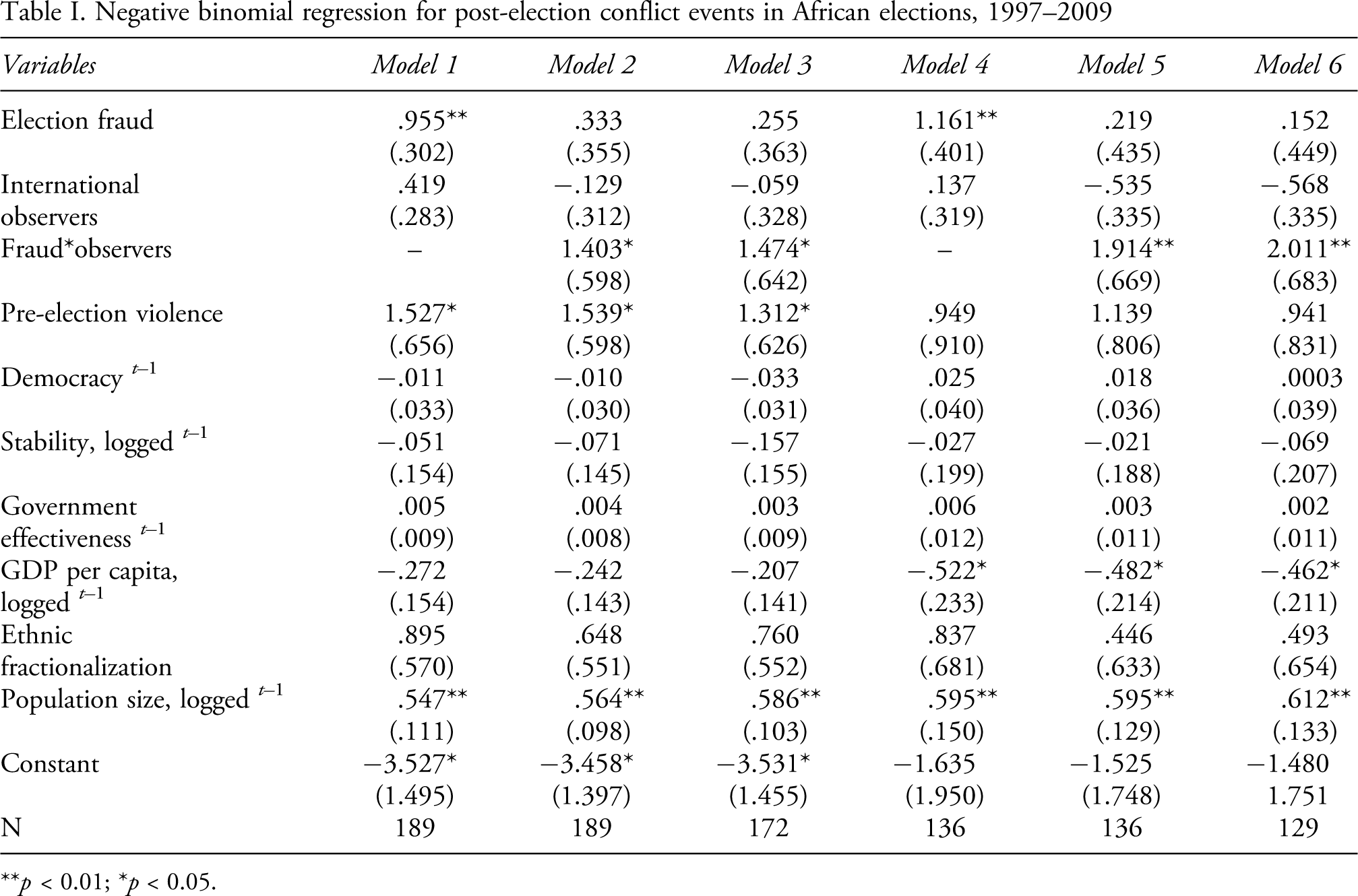
Negative binomial regression for post-election conflict events in African elections, 1997–2009
**p < 0.01; *p < 0.05.
Predicted number of conflict events, Model 2 in Table I

The second model presented in Table I includes the product term. The interaction term is positive and significant (p < .05), confirming that the presence of both international observers and election fraud increases the risk of post-election violence as hypothesized. Substantively, the expected number of conflict events increases from 4.4 to 23.4 if the constitutive terms and the interaction are varied from 0 to 1 (substantive effects for all values of interest for key independent variables and significant control variables are presented in Tables II and III). The result confirms the main hypothesis, which expected that the presence of international observers in fraudulent elections increases the potential of post-election violence. Results for control variables are similar to the first model. The coefficient for pre-election violence is again positive and significant (p < .05), and varying this variable from 0 to 1 increases the expected number of conflict events from 1.8 to 7.3. The positive and significant coefficient for population size (p < .01) shows how elections in countries with large populations produce a greater risk of post-election violence. When the population size variable is varied from one standard deviation below the mean to one standard deviation above, the number of expected conflict events increases from 2.5 to 11.8.
Predicted number of post-election conflict events, 1997–2009

Columns show the expected increase/decrease in the number of post-election conflict events when significant variables presented in Table I are varied ±1 SD from the mean (0 to 1 for dichotomous variables). Interaction and constitutive terms are varied jointly from 0 to 1.
Models 4–6 include the same variables as the first three models but are conducted on the matched sample only. Results for key independent variables are very similar to the first two models. In the model without the interaction (Model 4), the presence of major election fraud increases the number of post-election conflict events (p < .01). The fifth model includes the product term and shows a positive and significant coefficient (p < .01), suggesting that the presence of international observers and fraud increases the number of post-election violent events. Results also hold when first elections are excluded from the model, with the positive and significant coefficient (p < .01) showing that internationally observed elections with serious manipulation experience greater numbers of conflict events. Interestingly, the constitutive term for international observers is negative and significant at the 90% confidence level in Model 6, and very close to significant in Model 5. Since the constitutive term represents the effect of international observers when the fraud variable is zero, the finding shows that the presence of observers reduces the risk of post-election violence in the absence of fraud. The logical implication of the argument would suggest that observed elections without fraud represent a credible signal of clean elections, and this expectation is supported in Model 5. It is possible that this finding is not consistent across different model specifications because the threshold for mobilizing violence in the absence of clear indications of fraud is sufficiently low, meaning that the presence of international observers would not have a statistically discernible effect on post-election violence.
Some differences emerge with regard to control variables. The pre-election violence variable is not significant in models with matching, indicating that when observers’ expectations of violence are taken into account, pre-election violence no longer affects the potential for violent unrest after elections. In addition, GDP per capita (p < .05) significantly reduces post-election violence in the matched sample.
Robustness tests
I conduct a variety of additional robustness tests to ensure that the above results are not driven by the variables used to measure pre-election violence, influential observations, elections in North African countries, and the inclusion of international observer groups whose credibility might be debatable. Robustness tests are conducted on unmatched and matched samples and show that in all but one of ten models, the coefficient for the product term is significant at the 95% or 90% confidence level. Results are available in the online appendix (OA1). Additional robustness tests remove the control variables one by one to ensure that the inclusion or exclusion of controls does not influence results. These tests show that the coefficient for the product term remains significant at the 95% confidence level when control variables are removed. Results are available in the online appendix (OA2). Finally, the online appendix also presents summary statistics for the variables used in the analyses (OA3).
While the above results strongly support the theoretical argument and main hypothesis, a caveat is necessary. The analysis only presents evidence for the effect of fraud and election monitoring in a set of African elections. It is possible that these elections are biased toward more violent outcomes, especially since a large number of conflict zones have been identified on the African continent (Gleditsch et al., 2002). In addition, elections in Africa may on average be more fraudulent than elections in other unconsolidated regimes. Kelley (2011), for example, finds that election boycotts – generally considered a good indicator of expectations of fraud – are predominantly an African phenomenon. Lacking disaggregated data for other regions, it is thus not clear whether these findings extend to other elections in unconsolidated regimes.
Conclusion
Over the last few decades, the international community has put increasing emphasis on democracy promotion and elections as instruments of democracy. Yet this emphasis has resulted in the holding of elections in states in which democratic principles are not consolidated and elections are subject to manipulation by political authorities. Since opportunities for political change in such elections are limited, they can contribute to protests and violent unrest. International relations scholars have only recently started to evaluate the relationship between elections and the onset of violence. This article joins the emerging literature by investigating the influence of international actors, election fraud, and violence after elections in unconsolidated regimes. The article argues that fraudulent elections monitored by international election observers have a greater risk of post-election violence. International monitors provide credible information on whether the electoral process was manipulated, draw attention to such fraudulent outcomes, and thus reduce coordination problems among citizens and opposition parties in society. Protests over electoral outcomes can turn violent because incumbents violently repress dissent or non-state actors use violent means to express their discontent. The article investigates these expectations empirically in an analysis of post-election conflict events in all African elections in the 1997–2009 period. Findings show that fraudulent elections monitored by international organizations are more frequently followed by violence, thus confirming the main theoretical expectations. I use matching to reduce endogeneity bias stemming from potential endogeneity between the international election monitors’ decision to monitor elections and the probability of electoral violence. Results remain consistent for a matched sample. In addition, findings are robust to a number of additional model specifications.
As this article shows, blatant election fraud documented by international election monitors increases the probability of violent unrest after elections. The goal of this article, however, is not to discredit the work of international organizations active in democracy promotion or to recommend that international observers approve fraudulent elections. Rather, it draws attention to potential underlying tensions between a commitment to democratic norms and an interest in political stability, at least in the short term. As mentioned earlier, the effects of electoral violence on the long-term potential for democracy are uncertain and should be investigated empirically in the future. Hopefully, the findings presented here will draw attention to the domestic consequences of blatant fraud exposed by international election monitors and consequently allow international organizations to be better prepared for such difficult outcomes.
Footnotes
Replication data
The dataset, codebook, and do-files for the empirical analysis in this article can be found at http://www.prio.no/jpr/datasets. An online appendix containing supplemental analyses is available at  .
.
Acknowledgements
I would like to thank Robert Bohrer, Gamze Cavdar, Caroline Payne, Gerald Schneider, three anonymous referees, and Henrik Urdal for helpful comments. Remaining errors or omissions are my own.
Notes
References
Supplementary Material
Please find the following supplemental material available below.
For Open Access articles published under a Creative Commons License, all supplemental material carries the same license as the article it is associated with.
For non-Open Access articles published, all supplemental material carries a non-exclusive license, and permission requests for re-use of supplemental material or any part of supplemental material shall be sent directly to the copyright owner as specified in the copyright notice associated with the article.
