




Abstract
Do international election observers deter or spur violence after election day? This article argues that only when conceptually and empirically distinguishing between violence by governments and opposition groups, can we assess the impact of international election observation. Disaggregating post-electoral violence uncovers that observers can deter governments from using force, but they have the opposite effect on opposition groups. When expecting criticism from observers, opposition leaders can easily deny their responsibility for violence by individual party militants, while weaponry and official insignia betray police and military involvement in violence and force the government to bear command responsibility. Governments also anticipate higher international costs for engaging in post-electoral violence than opposition groups, which are not usually targets of international punishment. On the other hand, international election observers unintentionally incite opposition groups to organize violence, as opposition groups seek to benefit from international attention and support that come with the presence of observers. Observers’ exposure of fraud reverses this differential effect: because governments expect international costs for election rigging anyway, observers cannot deter repression after highly fraudulent elections. But their alertness to electoral malpractice alleviates opposition groups’ incentives for post-electoral violence. Using data on 230 state-wide elections in Africa from 1990 to 2009, the analysis supports the observable implications of this argument. The findings of this article imply that international election observation missions make the post-electoral environment more peaceful when it comes to government repression after non-fraudulent elections. But observers ought to develop greater local expertise to identify opposition grievances before these groups resort to violence and be attentive to the possibility of increased repression after exposing cheating.
Keywords
Introduction
In many unconsolidated democracies elections spark violent contests between governments and opposition groups. Recent post-electoral violence in Kenya, Côte d’Ivoire and Nigeria caused thousands of deaths and hundreds of thousands of people were forced out of their homes (Bekoe, 2012). Preventing post-electoral violence is high on the international agenda and election monitoring is envisioned to be a solution (Anglin, 1998: 486; European Commission, 2014; National Democratic Institute, 2015). Although international election monitoring should deter all actors involved in elections from using violence, the 2002 election in Congo-Brazzaville illustrates that government and opposition react very differently to the presence of international election observers. Despite massive anti-government protests, president-elect Denis Sassou Nguesso refrained from using forceful repression, actively portrayed himself as a peacemaker (Radio France International, 2002) and sought credit for his peaceful organization of elections from international election observers sent by the European Union and the Organisation Internationale de la Francophonie (European Parliament, 2002; Organisation Internationale de la Francophonie, 2002). In contrast, opposition parties denounced the election as fraudulent and opposition-affiliated militias started attacking government forces shortly after election results were announced (United Kingdom Home Office, 2002; IRIN, 2002; Kolelas, 2002).
This article investigates how the presence of international election observers affects governments and opposition groups’ decisions to engage in post-electoral violence. 1 It shows that observers deter governments from using repression after non-fraudulent elections, but unintentionally incentivize opposition groups to employ post-electoral violence. There is a growing body of literature on how international election observers influence government and opposition behaviour differently (Hyde, 2007; Hyde & O’Mahoney, 2010; Hyde & Marinov, 2014; Kelley, 2011; Simpser & Donno, 2012). However, this distinction has been neglected in research on observers’ impact on violence and, especially, violence after elections (Daxecker, 2012; Kelley, 2012). What has gone unnoticed is an important differential effect of election monitoring on post-electoral violence.
This article argues that governments eschew violence in the presence of international observers, as they face a higher risk of exposure and higher international costs for their involvement in post-electoral violence compared to opposition groups. Governments bear command responsibility and their agents of violence – police and military forces – wear identifying insignia and carry particular weapons. Leadership is less clear when it comes to opposition-sponsored violence. Thus, observers can more easily attribute blame to governments than to opposition leaders. Governments also expect to bear higher international costs upon exposure. Aid cuts and most other tools of international punishment are targeted at governments, not opposition groups. In fact, international election observers may incite opposition-sponsored violence, because their presence reduces the risk of repression, increases domestic media attention and opens an opportunity to catch international observers’ attention and receive international support. Observers’ exposure of fraud reverses this differential effect: because fraudulent governments already expect to lose their international reputation, observers cannot deter repression. But their alertness to electoral malpractice can alleviate opposition groups’ incentives for post-electoral violence. Based on a statistical analysis of the impact of international election observation missions on government and opposition-sponsored violence in 230 post-electoral periods in 43 African countries from 1990 to 2009, I find that when elections were not marred by fraud, international election observers deter post-electoral violence by governments, but have a violence-inducing effect on opposition groups. After highly fraudulent elections, however, observers increase repression.
The article proceeds as follows. After reviewing what we know about the domestic and international determinants of electoral violence, I develop the theoretical argument. I then detail the research design and solutions to endogeneity concerns, followed by the empirical analysis. I conclude by discussing implications for theory and policy.
Explaining variation in electoral violence
Existing research demonstrates that government and opposition have different motives for using post-electoral violence, but studies of international election observers’ impact after elections have so far neglected this distinction. Tests using aggregated measures of post-electoral violence show that observers increase violent conflict after elections. This is a surprising finding, as case studies and large-N analyses of pre-electoral violence reveal that international election observers deter government misbehaviour before elections.
Studies of the domestic determinants of post-electoral conflict show that post-electoral violence by both governments and opposition groups is more likely in autocratic and transitioning regimes (Schedler, 2002, 2006; Bhasin & Gandhi, 2013; Davenport, 1997; Anderson & Mendes, 2006; Tucker, 2007; Kuntz & Thompson, 2009); when the opposition is fragmented (Daxecker, 2009); and when growing environmental, demographic and economic pressures weaken government legitimacy (Kahl, 2006: 181 ff.) and reinforce opposition groups’ mobilization efforts (Boone, 2011; Dercon & Gutiérrez-Romero, 2011). But research also points out that governments organize violence to deter and supress dissent after election day (Hafner-Burton, Hyde & Jablonski, 2014: 8–9; Bhasin & Gandhi, 2013: 626–627), whereas opposition groups employ violence as a form of protest against fraud, repression, unfavourable outcomes and socio-economic grievances (Anderson & Mendes, 2006; Kuntz & Thompson, 2009; Hafner-Burton, Hyde & Jablonski, 2014). This difference in motives hints at the possibility that governments evade and opposition groups seek the scrutiny of international election observers and international attention.
Still, research on international election observers’ impact does not distinguish between governments and opposition groups. Daxecker (2012) finds that the presence of international election observers increases aggregated post-electoral violence after highly fraudulent elections. She argues that observers’ credible information about fraud strengthens losing parties’ capacity to mobilize for collective action, which then turns violent. What is missing in her analysis is whether governments, opposition groups or both sets of actors are responsible for violent escalation after election day (Daxecker, 2012: 507). This violence-inducing effect of international election observers after elections is puzzling in the light of other research that yields evidence of monitors’ capacity to de-escalate post-electoral conflict and to deter wrongdoings by governments before elections. Case studies demonstrate that observers can successfully prevent post-electoral conflict from spiralling into violence, as they perform an important mediating function and build trust among participants (McCoy, Garbar & Pastor, 1991; Bjornlund, 2005: 74; Kumar, 1998; Turner, Nelson & Mahling-Clark, 1998). Furthermore, research on observers’ impact before elections shows that election monitoring deters violations of democratic norms and, by extension, reduces electoral conflict (Kelley, 2011, 2012). The presence of international election observers can expose and signal international costs for violations of democratic rules, thereby incentivizing governments to avoid cheating at monitored polling stations (Hyde, 2007) or to choose less detectable forms of manipulation, such as rigging courts (Simpser & Donno, 2012). Another study by Daxecker (2014) shows that governments in monitored elections temporally shift violence to the pre-electoral period when few observers are present in order to avoid international exposure on election day, when more observers are present.
Existing research provides evidence in line with the intuition of this article: governments avoid attention and international election observers can deter their most blatant misbehaviour. Observers’ effect on opposition groups is likely to be different. Opposition groups sponsor post-electoral violence to maximize attention. Owing to the aggregation of government- and opposition-sponsored violence into one measure, previous research on observers’ impact after elections was not able to capture this differential effect. This article provides new insights into the influence of international election monitoring on post-electoral violence by conceptually and empirically distinguishing between its perpetrators.
How international election observation missions can deter violence
International election observers’ main mechanisms for reducing electoral conflict are increasing international visibility of wrongdoings and facilitating international punishment (Hyde, 2007; Kelley, 2012: 101–103). While violence usually attracts international attention, election observers can clarify its source, extent and effect and, most importantly, attribute blame to specific perpetrators (Kelley, 2012: 103–105). Election observers make detailed information on the conduct of elections domestically and internationally known through their reports and their official statements. Beyond these formal channels, international election observers can expose violence through informal channels. They talk to diplomats, foreign ministry officials and politicians from donor countries, disseminating first-hand information about the monitored elections to international policymakers (McCoy, Garbar & Pastor, 1991: 107; Carothers, 1997: 19; Anglin, 1998: 486). While observers’ attention is focused on the electoral preparation and election day proceedings, they usually stay until official results are announced and certified (Daxecker, 2012: 505). For instance, European Union election observation missions are required to collect complaints made by candidates and voters in the post-election phase (Eriksson, 2002). The final reports of international election observers are released several months after elections (Carothers, 1997: 18). This delayed publication date guarantees that their reports contain violations of democratic rules after election day, including post-electoral violence.
Actors involved in elections care about the presence of international election observers. Observers’ reports on electoral violations and violence can serve as a credible evidence base for international policymaking towards the monitored country (Hyde, 2007; Kelley, 2012). Election observation missions are sent by or have close contacts to resource-strong states and international organizations (Carothers, 1997: 20; Kelley, 2011: 7), and their deployment demonstrates that the monitored country and its elections are of great interest to the international community (Kelley, 2012: 101). Indeed, research finds that intergovernmental organizations are more likely to adopt appropriate sanctions when international observers clarify the nature and scope of democratic norm violations (Donno, 2010). Negative reports by election observers put countries at a higher risk of diplomatic isolation, trigger the reduction of aid flows or, at least, threats thereof, and might lead to the suspension of trade partnerships (Brown, 2005: 193). Through increasing the risk of international costs for the perpetrators of post-electoral violence, exposure by international election observers becomes a powerful deterrent.
Why observers deter governments but encourage opposition violence
Although international election observers aim to deter post-electoral violence by all actors involved in elections, their leverage on governments and opposition groups differs. Governments are at high risk of being blamed for using post-electoral violence and face severe international punishment. Opposition groups, in contrast, can hide their responsibility for violence when expecting international condemnation and they have less to lose – and something to gain – from exposure of their involvement in post-electoral violence.
Governments are at high risk of international exposure when organizing violence. International election observers ‘are unlikely to see beyond the obvious’ (Carothers, 1997: 19), but disproportionate force by governments’ security forces can hardly be overlooked. Whereas governments sometimes use proxy forces to hide their involvement in violence (Carey, Mitchell & Lowe, 2013), state security forces usually wear uniforms and other identifying insignia. They also have greater access to weapons, and more severe injuries are often attributable to government agents. For example, the Post-Electoral Investigation Commission in Kenya (Waki Commission) identified all incidents in which people died because of gunshot wounds as perpetrated by the police. In contrast, opposition groups’ agents of violence, party militants and affiliated militias, do not necessarily adhere to any dress code. International election observers may, therefore, find it harder to prove that leaders of opposition groups commanded post-electoral violence (Dercon & Gutiérrez-Romero, 2011: 735). Observers also criticize governments if post-electoral violence is not attributable to their preference for coercion, but their failure to control police and military forces. Observers can hold governments accountable for letting their agents breach the limits of the laws, as governments bear command responsibility and should guarantee the electoral security of citizens (Hyde & O’Mahoney, 2010; for examples, see International Republican Institute, 2003: 3; European Union, 2011: 30, 44). In contrast, opposition leaders are less clearly liable for actions by party militants. When anticipating negative international consequences for being involved in post-electoral violence, they can portray violence as an act of individuals instead of a systematic and organized campaign. Therefore, governments face a higher risk of being internationally exposed and blamed for organizing post-electoral violence compared to opposition groups.
Upon international exposure of their involvement in post-electoral violence, governments anticipate high costs. They may lose international legitimacy and material benefits when states and international organizations suspend foreign aid, reduce economic exchange, cancel preferential trade agreements, exclude them from membership in international organizations or withdraw military support (Kelley, 2012: 29; Brown, 2005; Donno, 2010). International punishment can result in high domestic costs. Economic sanctions reduce state revenue and, thus, resources available to the government to maintain political support (Marinov, 2005). Anticipating these costs, governments should react to international election observers’ capacity to expose their involvement in post-electoral violence. Existing research shows that international attention and shaming of governments can improve their human rights practice (Murdie & Davis, 2012; Krain, 2012) and record of democratic governance (Marinov & Goemans, 2014; Aronow, Carnegie & Marinov, 2014). Governments also improve overall election quality under the scrutiny of international election observers (Kelley, 2012: 101–103). Therefore, through the combination of international exposure and signals of international punishment, election observers are expected to make governments refrain from sponsoring post-electoral violence.
2
Hypothesis 1: If international election observers are present, government-sponsored post-electoral violence decreases.
In contrast to governments, opposition leaders have less to lose from sponsoring post-electoral violence in front of international election observers, as international leverage on domestic politics often hinges on government-to-government relations (Hoeffler, 2014; Keck & Sikkink, 1998). Opposition groups do not participate in intergovernmental meetings and are not members of international organizations. Thus, the threat of diplomatic isolation is rendered ineffective, as opposition groups are excluded from most international forums anyway. Opposition groups also do not receive international development aid and are not direct beneficiaries of trade partnerships. They are, therefore, less dependent on maintaining a good international reputation. As Daxecker (2014: 9) puts it ‘incumbents may be more concerned about international punishment for using violence in front of international observers than nonstate actors, who are not usually targets of international sanctions’. Compared to governments, opposition groups are, therefore, less likely to refrain from violence due to observers’ signals of international costs.
In effect, opposition groups may perceive that there is something to gain from organizing post-electoral violence in the presence of international election observers. First, observers increase domestic opportunities for mobilization (Murdie & Bhasin, 2011: 170–172; Haines, 2006; Bartley, 2007). Observers’ deterrent effect on repression makes collective action against the government less risky (Murdie & Bhasin, 2011: 167). International election observers also attract local media attention to election-related events and increase opposition groups’ opportunities to disseminate their grievances (Donno, 2010). Research shows that both opportunities – protection from repression and greater domestic attention – do not only increase mobilization for nonviolent protest (Myers, 2000; Koopmans & Olzak, 2004), but also violent activities (Murdie & Bhasin, 2011: 170–172; Haines, 2006; Bartley, 2007). Finally, international election observers can increase exposure of violent protest and, thereby, trigger international awareness of opposition groups’ grievances. This awareness potentially provides them with access to powerful allies, diplomatic and material support and greater leverage on the government (Keck & Sikkink, 1998: 12–13). But observers are selective in what is published in their reports and transmitted to international policymakers. In particular, observers have been criticized for their disproportionate focus on threats to post-electoral stability, while neglecting subtle forms of government manipulation (Laakso, 2002; Carothers, 1997: 25; Kelley, 2011, 2012: 63 ff.; Hyde & O’Mahony, 2010). As a consequence, opposition groups may find that violence is the most effective communicative tool to catch observers’ attention and to target an international audience (Schmid & De Graaf, 1982; Bob, 2001).
3
Due to increased opportunities for receiving protection from government repression, local media coverage, and international attention and support, international election observation can unintentionally lead to higher levels of post-electoral violence by opposition groups.
Hypothesis 2: If international election observers are present, opposition-sponsored violence after elections increases.
Why major fraud reverses observers’ differential effect
Previous research finds that observers’ ability to provide credible information on fraud shapes post-electoral conflict. It increases opposition mobilization and post-electoral violence in the aggregate (Daxecker, 2012; Hyde & Marinov, 2014). These findings suggest that the occurrence of fraud also influences observers’ differential effect in important ways: whereas observers can deter repression and incite opposition-sponsored violence after non-fraudulent elections, the reverse scenario is plausible when massive fraud occurs.
Pressured by the international norm of inviting election observers, many pseudo-democratic governments accept international scrutiny of elections (Hyde, 2011). While wanting to deflect international criticism, governments are equally concerned about prevailing in power. Election rigging in the presence of international election observers is an indicator of this dual incentive structure (Kelley, 2012: 29–31). When governments blatantly rig elections, observers’ threat of exposure and international sanctions may turn out to be an empty threat for deterring repression. Using blatant fraud in front of international observers already discredits governments. Consequently, governments have not much more to lose from using force after elections. Thus, after highly fraudulent elections, observers are less likely to deter government-sponsored violence. International exposure of fraud may even increase repression: massive fraud and its exposure by observers can mobilize opposition groups to engage in post-electoral protest (Hyde & Marinov, 2014; Fearon, 2011). In order to quell heightened opposition mobilization, governments may resort to more frequent and severe acts of repression (Hafner-Burton, Hyde & Jablonski, 2014). These arguments suggest that the effect on international election monitoring is conditional on fraud. While deterring repression after non-fraudulent elections, observers may increase post-electoral violence by governments when major fraud occurs (Daxecker, 2012).
Hypothesis 3: If there is no major fraud, international election observers decrease government-sponsored post-electoral violence. If major fraud occurs, international election observers increase government-sponsored post-electoral violence.
As a consequence, the presence of international election observers may not provide opposition groups with protection from repression after highly fraudulent elections. Mobilization remains risky despite the presence of international watchdogs. Opposition groups may, therefore, avoid violent activities that can exacerbate government repression. But they may also have positive incentives to refrain from post-electoral violence when observers are present in highly fraudulent elections. By publicizing information about governments’ electoral malpractice, international election observers acknowledge grievances held by opposition groups (Fearon, 2011; Hyde & Marinov, 2014). The exposure of fraud, subsequently, alleviates opposition groups’ need to engage in violent protest to catch observers’ attention for their cause. Furthermore, when observers render claims of election rigging legitimate, citizens become more likely to back opposition leaders. Political support from citizens and international observers helps opposition leaders to successfully contest fraudulent election results in nonviolent and legal ways. While credible information on fraud facilitates coordination and mobilization, the exposure of fraud may decrease incentives of opposition groups to engage in post-electoral violence (Fearon, 2011; Hafner-Burton, Hyde & Jablonski, 2014: 2; Hyde & Marinov, 2014; Tucker, 2007). In contrast, opposition groups may be more inclined to use violence in observed elections without obvious fraud. Under these conditions opposition groups may hope that their violent activities will prevent observers from quickly rubber-stamping elections. Thus, whereas observers may incite opposition-sponsored violence after non-fraudulent elections, their presence may decrease opposition-sponsored violence when governments use massive fraud.
Hypothesis 4: If there is no major fraud, international election observers increase opposition-sponsored violence. If major fraud occurs, international election observers decrease opposition-sponsored post-electoral violence.
Research design
The theoretical argument is evaluated in an analysis of 230 state-wide elections held in 43 African states between 1990 and 2009. 4 Data on election dates come from Daxecker (2014). To be included in the sample, elections must be for a national executive figure, for example the president, or for a national legislative body. I include only elections in which voting is direct or ‘by the people’, in the sense that mass voting takes place. The unit of analysis is the post-election period. 5
Although testing the hypotheses in a worldwide sample would add to the generalizability of findings, selecting cases from Africa has several advantages. First, many African countries introduced multiparty elections in the 1990s. Most democratic regimes on the continent are not yet consolidated and political elites are less constrained to manipulate elections to maintain power (Lindberg, 2006: 140). Therefore, selecting elections in African countries provides some control over factors that could bias the effect of observers. Second, there is substantial variation in the levels of post-electoral violence in African countries, which demands explanation. Of the 230 elections in the sample, more than four violent events occurred in six post-electoral periods and between one and four violent events occurred in 42 post-electoral periods. But the majority of elections (182 of 230) on the continent did not suffer from post-electoral violence (Straus & Taylor, 2012, find similar patterns). 6
Dependent variable: Government and opposition-sponsored violence after elections
Key to my argument is that there are two dependent variables. The first counts the number of events of repression organized by the government after election day; the second dependent variable measures the number of events of post-electoral violence by opposition groups. The Social Conflict in Africa Database (SCAD) provides sufficiently disaggregated data on social conflict events for all African countries in the sample. It contains information on actors, targets, issues and event types, as well as start and end dates of the event (Salehyan et al., 2012). Scholars have begun to use these data to measure electoral violence (Daxecker, 2014). To measure post-electoral violence by the government, only events of repression after election day are taken into account. To measure post-electoral violence sponsored by opposition groups, only events classified as riots or anti-government violence that take place after election day and target the central government are included. For opposition-sponsored violence, I exclude political violence that is not related to elections by pruning events for which the issue of conflict is not categorized as election or democracy-related. 7 I read all event descriptions to exclude remaining events which are not related to these issues. I also read the descriptions for events of repression to exclude events that are not aimed at domestic opposition. 8 Descriptions of events of post-electoral violence include ‘police raid MDC office and journalist headquarters’ in Zimbabwe in 2008 and ‘opposition supporters vandalize polling stations, claiming election was rigged’ after the 1990 election in Côte d’Ivoire (Salehyan et al., 2012).
The post-electoral period is restricted to 90 days after election day (Straus & Taylor, 2012: 19–20). Figure 1 shows the number of events of election-related violence on each day over a period of 180 days after polling took place. Of the overall post-electoral violence, 79% occurs within 90 days of election day and events of post-electoral violence steadily decline afterwards.
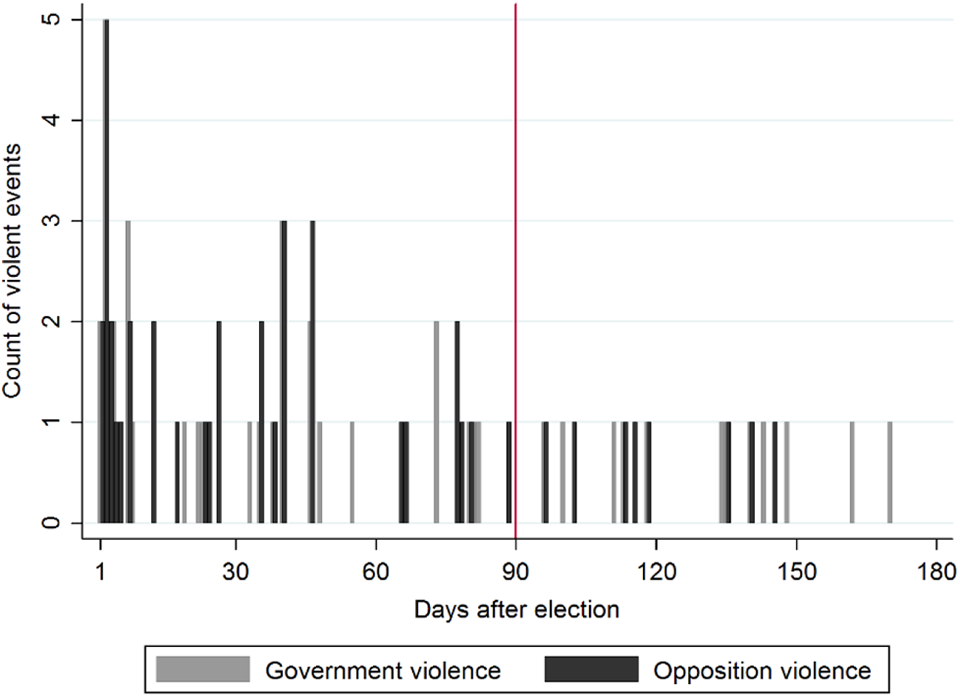
Distribution of events of violence across 180 days after polling
Models are estimated for event counts of government repression and opposition-sponsored violence separately. Both measures range from zero to four events. A count model is, thus, most appropriate. 9
Independent variables
I code elections as monitored if one or more of the following organizations send observers: the Carter Center, the Commonwealth Secretariat, the European Parliament, the European Union, the International Republican Institute, the National Democratic Institute and the United Nations. To exclude those missions that lack monitoring and enforcement capacity, monitored elections only include those where at least 15 observers are present. Moreover, missions that rubber-stamp any election despite gross violations of electoral standards are excluded from the analysis, as they should not possess the theorized deterring effects on government-sponsored violence (Kelley, 2009a, 2012: 45). Data on election observation missions come from Daxecker (2014), who consulted reports by the above-listed reputable organizations to establish whether they had deployed a mission to a given election. More than one-quarter (26.52%) of the sampled 230 elections are monitored by at least one large and reputable international election observation mission. Of 169 non-monitored elections, nine suffer from both post-electoral repression and opposition-sponsored violence, 14 experience only repression and six experience only violence by opposition groups. Of 61 monitored elections, seven suffer from one or more events of repression and opposition-sponsored violence, six see only repression and another six see only opposition-sponsored violence after election day.
I expect that observers’ effects are conditional on whether elections were highly fraudulent (Hypotheses 3 and 4), so I include in all models the occurrence of major fraud and its interaction with international election observation. The binary variable for fraud is coded 0 for no or minor fraud and 1 for major fraud, using information from US State Department Reports (Daxecker, 2012: 510). The sample includes 37% of highly fraudulent elections. Monitors are present in more than one-fifth (20 of 86).
Control variables
Many domestic factors, especially the nature of the state, shape the behaviour of government and opposition groups. Thus, I expect international election monitoring to have an effect at the margins. To that end, the analysis controls for domestic factors that may confound the relationship between observers and post-electoral violence. First, democratic countries with more institutional channels for participation and executive constraints should experience less post-electoral violence (Anderson & Mendes, 2006; Hegre et al., 2001). Hence, I include the one-year lagged regime index Polity IV, which ranges from –10 to 10 (Marshall & Jaggers, 2014). But since high levels of repression in autocracies could also reduce violence (Gleditsch & Ruggeri, 2010), I add the squared term of the Polity IV index, expecting little violence in full democracies and autocracies and most violence in hybrid regimes. Second, countries with lower levels of state capacity are expected to be more prone to post-electoral violence. State capacity is measured as PPP-adjusted GDP per capita. Low state revenue may be associated with underpaid, underequipped and consequently unprofessional state security agents. Moreover, more populous countries likely suffer from higher levels of violence (Fearon & Laitin, 2003; Kahl, 2006: 44, 55). Data on GDP and population originate from the Penn World Tables (Heston, Summers & Aten, 2012). Both variables are logged due to high skewness. I also control for the escalating dynamics between repression and protest (Hafner-Burton, Hyde & Jablonski, 2014; Carey, 2006). The occurrence of post-electoral opposition-sponsored violence is included in the models for post-electoral repression and vice versa. Likewise, I include repression and opposition-sponsored violence three months before election day. These variables are constructed using information from SCAD (Salehyan et al., 2012). Incumbent victory enters the models as a binary variable, expecting less government-sponsored and more opposition-sponsored violence when elections results are favourable for the incumbent (Hyde & Marinov, 2012). Net development aid (in US dollars) one year prior to elections is included (Tierney et al., 2011). When governments rely more heavily on international aid, they should be more inclined to refrain from violent infringement of democratic norms (Brown, 2005: 193; Bratton & Van de Walle, 1997: 136). As a robustness test, I examine whether opposition fragmentation increases post-electoral violence by increasing intra-opposition competition (Cunningham, Bakke & Seymour, 2012; Pearlman, 2009) and government-sponsored repression in response to greater numbers of challengers (Daxecker, 2009; Warren & Troy, 2015). Fragmentation is measured with the effective number of opposition parties before elections (Barberá, 2013). Because factors influencing the risk of post-electoral violence also drive international organizations’ decision to deploy an international election observation mission, not controlling for these variables may lead to omitted variable bias in the estimated effect of observers. 10
Accounting for media bias and endogeneity
Before presenting the results of the analysis of post-electoral violence, two potential concerns about inferring causality from the estimated effects of international election observers need to be addressed. First, information for measuring post-electoral violence is retrieved from media reports. Because observers attract media attention (Donno, 2010), overreporting may make monitored elections appear more violent than they actually are. Thus, all models control for the total number of reported events in the SCAD data for a given electoral period to isolate observers’ effect (Murdie & Davis, 2012: endnote 7).
Second, the deployment of observers might be endogenous to levels of post-electoral violence. On the one hand, observers may avoid violent elections and governments may refuse to invite election observers if they intend to engage in forceful repression. If so, the reason that we observe a reduction in government-sponsored violence would be due to observers’ deployment bias, not their deterrent capacity. Existing research alleviates this endogeneity concern: first, even those incumbents who plan to breach democratic rules choose to mimic true democrats and host international election observers (Hyde, 2011; Kelley, 2012: 27, 29). Second, there is evidence that observers deliberately choose the most problematic elections, where the risk of violence is high (Kelley, 2009b: 15; Daxecker, 2014: 7). Furthermore, the distribution of government-sponsored violence in the sample speaks against endogenous deployment. Figure 2 (left side) illustrates that there is more, not less, forceful repression in monitored elections compared to regularly non-monitored elections. There are identical levels of repression in monitored elections and elections in which monitoring was refused. 11 Consequently, observers’ deployment choice in favour of more violent elections makes it harder to find an effect in line with the theoretical expectations that observers deter government-sponsored violence.
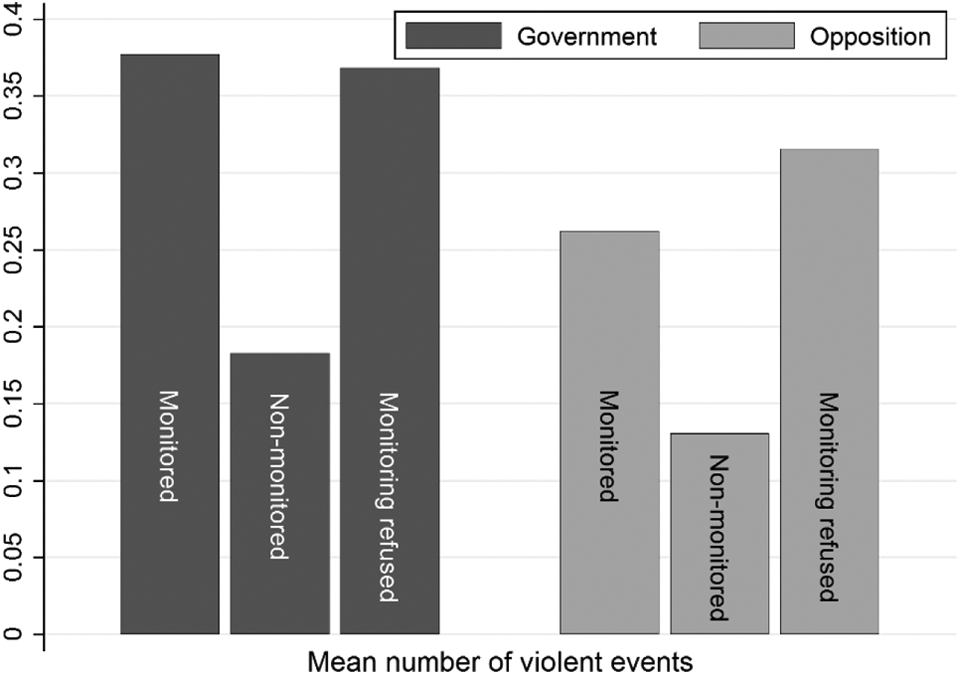
Mean level of post-electoral violence conditional on deployment of observers
On the other hand, observers may go to elections in which the opposition is likely to resort to violence. If that is the case, observers’ deployment decision, rather than new mobilization opportunities, would explain higher levels of opposition-sponsored violence. Figure 2 (right side) provides some evidence against this concern: levels of opposition-sponsored violence are lower in monitored elections compared to elections in which monitoring was refused. But endogeneity concerns persist as monitored elections also suffer from more opposition-sponsored violence than regularly non-monitored elections. One explanation is that monitors go to hybrid regimes that also exhibit the highest levels of opposition-sponsored violence. Observers tend to eschew full democracies that may not require monitoring and full autocracies that may not merit monitoring efforts (see Tables VIII and IX in the Online appendix). If observers go to the most violence-prone regimes, it becomes more difficult to test whether observers cause opposition-sponsored violence (Daxecker, 2012, 2014).
Recent research proposes matching as a solution to potentially endogenous deployment (Daxecker, 2012, 2014). Matching creates a quasi-experimental sample, in which the baseline risk of post-electoral violence in monitored elections (treatment group) and non-monitored elections (control group) is similar. Thus, the ‘treatment effect’, for example the effect of deploying observers, on post-electoral violence can be correctly estimated (Iacus, King & Porro, 2011). Motivated by the concern about endogenous deployment to elections with high levels of opposition-sponsored post-electoral violence, I include regime type in the matching algorithm. I also include election fraud, fraud in previous elections, foreign aid and experience with multiparty elections, which influence both observers’ deployment choice and post-electoral violence (Daxecker, 2012: 512). I prune 45 non-monitored and six monitored elections from the sample that are too drastically different in their baseline risk of violence. The post-matching analysis includes weights to adjust remaining differences. 12 After reporting the results of the regression analysis in the full sample I show that the results remain robust when using the matched sample.
Results
The results of Model 1 presented in Table I support the argument that international election observers deter governments from using post-electoral violence after non-fraudulent elections. The coefficient for international election observers is negative and the coefficient for the interaction between observers and fraud is positive. Both are significant at the 95% confidence level. 13 Thus, there is no unconditional deterrent effect, as proposed in Hypothesis 1. Instead the effect of international election observation is conditional on whether the government manipulates elections, as suggested in Hypothesis 3.
Negative binomial models of government and opposition post-electoral violence

Robust standard errors clustered by country in parentheses; **p < 0.01, *p < 0.05, † p < 0.1.
Therefore, I inspect government-sponsored violence predicted from Model 1 when observers and fraud vary jointly, holding all other variables at their means. Figure 3 (left side) shows the point estimates of the effects of observers conditional on fraud and their 95% confidence intervals. In line with the theoretical expectation, government repression significantly decreases by 0.08 events when observers are present in elections without massive fraud. In contrast, monitors’ presence is positively associated with repression in severely rigged elections. But the average increase of 0.06 repression events in highly fraudulent elections slightly fails to reach the 95% confidence level. These results support the first part of Hypothesis 3: international monitoring can deter government-sponsored violence if elections are not marred by massive fraud. However, in contrast to the expectation of the second part of Hypothesis 3, the results from the unmatched sample indicate that observers have no significant violence-inducing effect on governments after highly fraudulent elections.
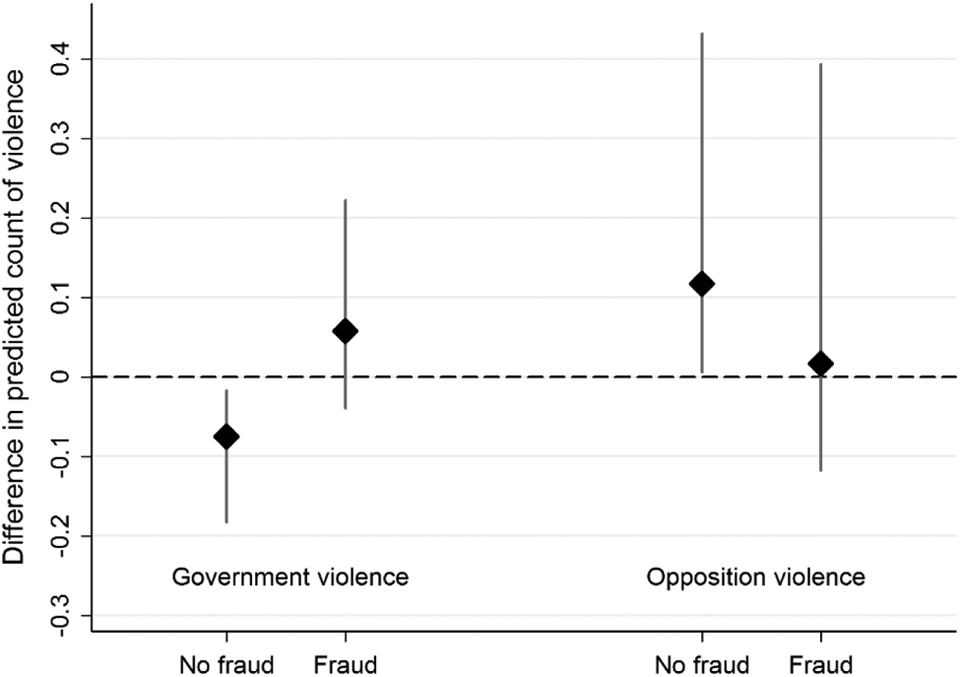
Effect of observers in events of post-electoral violence conditional on fraud
Model 2 for opposition-sponsored violence provides evidence for the argument that international election observers incentivize opposition groups to employ violence after non-fraudulent elections. The coefficient for international election observers is positive and significant at the 95% confidence level. The coefficient for the interaction between observers and fraud is positive though not significant. To further explore whether the effect of observers is unconditional, as proposed by Hypothesis 2, or conditional on the occurrence of fraud, as proposed by Hypothesis 4, I plot the effect of observers conditional on the occurrence of massive fraud in Figure 3 (right side). In line with the first part of Hypothesis 4, the presence of observers significantly increases opposition-sponsored violence by 0.10 events, when elections were not severely manipulated and all other variables are held at their means. This result corroborates the argument that opposition groups are incited to engage in violence, since they perceive more opportunities for making their grievances heard in the presence of international election observers. In contrast to governments, the opposition has less to lose and something to gain from international exposure of their violent activities. But this violence-inducing effect of international election observers on opposition groups drops to an increase of 0.02 events and is no longer significant after highly fraudulent elections. I conclude that the violence-inducing effect of observers is indeed conditional on the absence of fraud, in line with the first part of Hypothesis 4. Contrary to the proposition in the second part of Hypothesis 4, though, observers do not decrease opposition-sponsored violence after highly fraudulent elections. A plausible explanation for this insignificant effect in fraudulent elections is that although observers’ criticism of electoral malpractice alleviates opposition groups’ need to engage in violence to catch international attention, it does not mitigate domestic incentives for violence in response to fraud. In sum, observers do incite opposition-sponsored violence after elections with no or only minor fraud, but this effect disappears when severe election rigging occurs.
Since observers tend to go to more violence-prone regimes and this deployment choice may lead us to overestimate their effect on opposition-sponsored violence (and underestimate their deterrent effect on government-sponsored violence), I re-estimate Models 1 and 2 with a matched sample. The results of Models 3 and 4 presented in Table I provide ample evidence that the main findings are robust against potential endogeneity concerns: election monitors’ differential effects on both government-sponsored and opposition-sponsored violence remain significant at the 95% confidence level. The presence of international election observers reduces repression by 0.13 events, while it increases opposition-sponsored violence by 0.10 events after elections that were clean or suffered only minor fraud. As in Model 2, observers have no effect on opposition-sponsored violence when massive fraud occurred. However, the results of the post-matching analysis now support the second part of Hypothesis 3: government-sponsored post-electoral repression significantly increases by 0.13 events when monitors are present in highly fraudulent elections. The results from the matched sample are in line with previous research, showing that observers’ exposure of fraud leads to more post-electoral violence (Daxecker, 2012).
Overall, the analysis clearly reveals what is missed by the inattention to the actors involved in post-electoral violence and overaggregated measures: the estimated effects of international election monitoring on government and opposition-sponsored post-electoral violence point in opposite directions. Whereas governments refrain from using force in the presence of international election observers, opposition groups become more likely to engage in post-electoral violence, at least in 63% of the sampled elections without massive fraud. If blatant fraud occurs, its exposure by observers can spark repression, but the violence-inducing effect of monitoring on opposition groups disappears. Empirically disaggregating violence by its perpetrators contributes to existing knowledge on the international dimension of post-electoral conflict and it is important, when we want to assess the contribution of international election observers to electoral security.
This differential effect of international election monitoring is supported by case study evidence on the 2007 elections in Kenya. The EU and other international election monitoring organizations ‘initially released a positive statement about elections’ (Kelley, 2012: 245). Opposition groups immediately resorted to violent protest. My findings provide evidence that election observers’ presence encouraged this violent mobilization, since it allowed opposition groups to communicate the severity of their grievances to potential international allies (Department for International Development, 2010: 20; Brown, 2009: 390; Harneit-Sievers & Peters, 2008: 142). Setting the control variables to the characteristics of Kenya shows that observers increase predicted opposition-sponsored violence by 0.54 events in non-fraudulent and by 0.22 events in fraudulent elections. EU, NDI and Commonwealth observers increased international attention to the government’s role and responsibility in the ensuing electoral conflict. Donor pressure made the incumbent restrain the security forces and work towards ending the violence. As electoral conflict deteriorated into large-scale ethnic violence, observers revised their initially positive assessment of elections (Kelley, 2012: 245). Due to observers, predicted repression for the Kenyan post-electoral period drops by 0.79 events after non-fraudulent elections, but increases by 0.51 events when massive fraud occurs – an increase plausibly related to observers’ revised assessment of elections.
The estimated effects for the control variables strengthen confidence in the data and the choice of the model. Table II summarizes the significant predicted changes in events of post-electoral violence when variables of Models 1 and 2 change by one standard deviation from the mean or from 0 to 1 for dichotomous variables, and all other variables are held at their means. A unit increase in pre-electoral and post-electoral opposition violence augments the number of government-sponsored repressions by 0.45 and 0.02 events, respectively. An increase in repression after elections is associated with 0.13 more events of opposition-sponsored violence. A one standard deviation increase in the democracy score significantly decreases repression by 0.11 events and opposition-sponsored violence by 0.05 events. But the negative effect of its squared term indicates an inverted U-shaped relationship, where neither fully autocratic nor fully democratic regimes are most prone to harbour violence. Both net ODA and GDP decrease repression by 0.11 events. Governments with greater economic resources, for example more state capacity, are less reliant on coercion. Finally, when countries receive more media attention and are more populous, government-sponsored violence increases by 0.11 and 0.13 events, respectively.
Predicted counts of events for significant predictors in Table I

Columns show the expected change in events of government and opposition-sponsored violence after election day when significant variables from Models 1 and 2 are varied one standard deviation from the mean or from 0 to 1 for dichotomous variables. Interactions are varied jointly.
Robustness tests in Table III in the Online appendix show that observers’ differential effects on governments and opposition groups do not change if post-electoral violence is measured in event-days, that is, the number of the events multiplied by their duration in days (Models 5 and 6), and if the sample excludes influential cases (Models 7 and 8). Observers’ effects also remain robust when controlling for opposition fragmentation (Models 9 and 10). Table IV in the Online appendix presents the results of testing alternative explanations for observers’ differential effect, namely whether monitoring increases competition among opposition groups (Bloom, 2004; Horowitz, 1985) and leads governments to avoid repression but to incite intra-opposition violence (Kahl, 2006). I find no evidence for these alternatives. Finally, Tables V and VI in the Online appendix show that when removing the control variables one by one, observers’ differential effects remain robust. Only when failing to account for regime type and reciprocal and past violence does omitted variable bias distort observers’ effect. This is explained in more detail in the Online appendix.
Conclusion
Conceptually and empirically distinguishing between perpetrators of post-electoral violence proves to be important, as the estimated effects of international election observers on government and opposition-sponsored violence point in different directions. The intuitively plausible idea that there are different losses and gains for governments and opposition groups from international monitoring is supported by the analysis of 230 post-electoral periods in 43 African countries between 1990 and 2009. This article finds that international election monitoring can contribute to keeping electoral peace by reducing government-sponsored violence after elections which were not marred by massive fraud. Observers can easily identify and blame governments when their uniformed security forces are engaged in violent abuse and governments anticipate high costs upon international exposure. In contrast, international election observation incentivizes opposition-sponsored violence. Opposition leaders can avoid blame for violent deeds of their militants and standard international punishment tools do not usually target the opposition. Instead opposition groups benefit from new mobilization opportunities, for example protection from repression and increased media coverage, and seek to gain observers’ attention and international support for their cause. However, the occurrence of massive fraud reverses observers’ differential effect. When observers expose fraud, governments may face more internal dissent. Because governments already expect international observers’ criticism for fraud, they do not have much more to lose from employing repression in response. The good news is that election monitoring in highly fraudulent elections no longer incites opposition-sponsored violence. Major fraud makes observers alert opposition to groups’ grievances, which in turn alleviates opposition groups’ need for violence to catch international attention.
The findings imply that international election observation missions should strengthen their capacity to identify opposition groups’ grievances before these groups resort to violence. Deploying observers for a longer period of time, recruiting more experts with country-specific knowledge and language skills, and enhancing collaboration with domestic election monitoring organizations can work in this direction (Autesserre, 2014). Observers also need to be aware that publicizing fraud can increase government-sponsored repression. However, they should not hush up fraudulent outcomes for the sake of keeping electoral peace. The results of this article suggest that that strategy would incite opposition-sponsored violence and, as Fearon (2011) finds, be detrimental to democratic development in the long run. Finally, policymakers ought to think about mechanisms to put pressure on opposition groups that disregard democratic principles and human rights after elections. Promises of diplomatic support, leadership positions in international organizations, visits abroad or even material resources may incentivize peaceful behaviour, whereas threats of targeted sanctions may deter instigators of violence.
While the disaggregated analysis provides robust evidence that observers can reduce government-sponsored repression, governments may also try to evade exposure by hiring militias and other unofficial agents of violence, who are less identifiable as government-sponsored than police and military forces (Carey, Mitchell & Lowe, 2013). Examining whether the reduction in government-sponsored post-electoral violence is restricted to official security forces is an interesting question for further research. 14 It would be also interesting to investigate whether there are long-term effects of international election observers on post-electoral behaviour, for example whether repeated monitoring can increase trust in and respect for electoral mechanisms and, thereby, reduce opposition-sponsored violence, as well. When addressing these questions, the distinction between principal perpetrators of electoral violence – governments and opposition groups – is crucial as this article shows.
Footnotes
Replication data

Acknowledgements
I would like to thank Kristin Bakke, Janina Beiser, Philipp Broniecki, Sabine Carey, Niheer Dasandi, Ursula Daxecker, Anita Gohdes, Neil Mitchell, Mascha Rauschenbach, Ezra Schricker, Julian Wucherpfennig, Max Zalewski, three anonymous reviewers and Henrik Urdal for their helpful comments. Remaining errors or omissions are my own.
Notes
References
Supplementary Material
Please find the following supplemental material available below.
For Open Access articles published under a Creative Commons License, all supplemental material carries the same license as the article it is associated with.
For non-Open Access articles published, all supplemental material carries a non-exclusive license, and permission requests for re-use of supplemental material or any part of supplemental material shall be sent directly to the copyright owner as specified in the copyright notice associated with the article.
