




Abstract
While transitional justice interventions are common in current post-conflict transitions, recent surveys in such settings suggest that public opinions often vary in their levels of support for such policies. Understanding such opinions is crucial for designing post-conflict policies that properly reflect public interests. This study uses original survey data from Burundi to interpret public opinions toward transitional justice policies in a post-civil war context. The data reveal a great deal of wariness among Burundians toward punishing human rights offenders or seeking the truth about the past. Why would large numbers of those entitled to accountability and truth express a preference to ‘forgive and forget’? This question is addressed by focusing on two important features of post-conflict settings – namely (1) uncertainty about the potential for renewed violence and (2) intense competition over how the postwar balance of power should be institutionalized. Findings suggest that the latter feature is indeed crucial: deep partisan motivations associated primarily with ethnicity, and to a lesser extent region, are key determinants of expressed desires to forgive and forget. A reasonable interpretation is that a sense of political gain may compensate for debts owed due to past abuses and induce a preference to avoid the pursuit of truth or punishment lest the political gains somehow be threatened. The conclusion draws out implications for policy and further research.
Introduction
This article uses original survey data from Burundi to study public opinion toward transitional justice policies in a post-civil war context. In the aftermath of decades of human rights violations and a transition to a substantially more democratic political system, the survey nonetheless finds a great deal of wariness among Burundians, both victims and non-victims alike, toward punishing human rights offenders or seeking the truth about the past. This leads one to ask, why would large numbers of those entitled to accountability and truth express a preference to ‘forgive and forget’? Rather than attempting to construct a catch-all theory of transitional justice preferences, I address this question by focusing on two important features of post-conflict settings – namely (1) uncertainty about the potential for renewed violence and (2) intense competition over how the postwar balance of power should be institutionalized. Given the salience of these two features in the immediate aftermath of war, it is reasonable to believe that fear and political-strategic motivations will shape expressed opinions on transitional justice. To what extent might this be true, and what does this suggest about whether expressed opinions reflect the precariousness of the context rather than ideals?
I address these questions using micro-level data from a survey undertaken in Burundi in 2007, after the 2005 elections that punctuated the end of over a decade of civil war but prior to the formal launch of transitional justice processes. I study opinions on the punishment of human rights abusers and the pursuit of truth about past abuses. The survey data include data on ethnic and regional identity, important determinants of partisanship and political orientations in the Burundi context, and data on conditions of insecurity and political behavior. A persuasion experiment embedded in the survey allows me to test for the possibility that expressed opinions mask beliefs that can only be elicited in a more deliberative manner. My findings suggest that deep partisan motivations associated primarily with ethnicity, and to a lesser extent region, are key determinants of an expressed desire to forgive and forget. Specifically, the tendency to forgive and forget is concentrated among those who identify as Hutu and come from regions outside of the South of Burundi. The group characterized by these identity markers consists of those who had been subject to considerable abuse and deprivation prior to the war, but gained substantially in political status after the war. Thus, a reasonable interpretation of the evidence is that a sense of political gain may compensate for debts owed due to past abuses and induce a preference to avoid the pursuit of truth or punishment lest the political gains be threatened by processes that scrutinize how they were brought about.
Why is it important to understand the nature of public opinion toward transitional justice in post-conflict settings? There are at least three reasons. First, post-conflict reconstruction in this day and age is often governed by democratic processes with heavy oversight by international donors and agencies (Newman, Richmond & Paris, 2009). Mass opinion is one of the chief conditions shaping the context in which political leaders negotiate among themselves, constituencies, and international actors in setting transitional justice policy (Bass, 2001; Kaminski, Nalepa & O’Neill, 2006; Lie, Binningsbø & Gates, 2007; Pankhurst, 1999; Rotberg & Thompson, 2000; Snyder & Vinjamuri, 2003; Thoms, Ron & Paris, 2008). Expressed public opinion, despite its imperfections, provides a critical basis through which external and internal onlookers can judge the responsiveness of national policymakers and the quality of democratic accountability (Odugbemi & Lee, 2011). Second, expressed opinion can provide a crucial measure of the worthiness of a given approach to transitional justice, sometimes much more so than the nature or extent of human rights abuses that have occurred (Hayner, 2011: 207; Mallinder, 2008). Third, surveys of public opinion can provide important information on the types of grievances that transitional justice policies need to manage, whether to provide redress generally or, more instrumentally, to prevent scores being settled outside the law through ‘wild justice’ (Backer & Kulkarni, 2008; Elster, 2004). For these reasons, public opinion research can be very valuable, so long as it is interpreted properly.
The Burundi context also offers two important benefits for this study. First, the timing of the survey (in summer 2007) was immediately prior to the onset of formal processes toward establishing transitional justice mechanisms, and thus unadulterated by such processes, but nonetheless at a time when such processes and associated campaigns were set to begin. Second, Burundi is an important case for students of transitions from war to peace. Structurally, Burundi’s Hutu–Tutsi ethnic structure is part of the class of ‘ranked ethnic systems’ that have provided the setting for especially difficult violent conflicts (Horowitz, 1985, 1991; Wimmer, 2006). Lessons from this case may be applicable to other cases that feature similar structural conditions (e.g. Côte d’Ivoire or Iraq).
Below, I start with theoretical arguments for how the shadow of renewed violence and political fluidity in the aftermath of civil war may affect opinions on transitional justice. I explain how the hypotheses might apply to the context of Burundi in the aftermath of the 1993–2005 civil war. I discuss the methods and original data that I use to test these hypotheses. The next section presents the findings. The conclusion summarizes and provides suggestions for further research.
Theory and hypotheses
Transitional justice mechanisms are common after civil wars today though not ubiquitous (Thoms, Ron & Paris, 2008). Calls for such mechanisms by human rights nongovernmental organizations (NGOs) and international organizations like the United Nations accompany most current peace processes. Transitional justice mechanisms may seek to establish a formally recognized truth about abuses, punish human rights abusers, or provide reparation for victims (Elster, 2004). Such mechanisms find theoretical justification in the United Nations (2004) document on The Rule of Law and Transitional Justice in Conflict and Post-Conflict Societies, which proposes that (1) punishment of abusers contributes to accountability and the rule of law, (2) holding perpetrators accountable helps to separate them from larger groups (e.g. ethnic groups) to which they belong, helping to end intergroup conflict, (3) establishment of a formal truth makes legal recourse possible, and (4) establishment of truth may promote reconciliation. However, pursuing transitional justice may involve normative trade-offs. In the democratic contexts that govern internationally assisted post-conflict transitions today, citizens who hold some claim to justice should expect to have their voices taken into account in managing these dilemmas. Among this section of the public, though, there are likely to be constituencies for and against punishment or truth-seeking (Thoms, Ron & Paris, 2008).
Why, among members of a population entitled to accountability and truth after mass abuses, might we see widespread reluctance toward the pursuit of punishment or truth? Current theory suggests that expressed preferences over transitional justice alternatives are affected by the precarious security and political context that lingers after civil war. Such a context may result in heightened fears of negative consequences of transitional justice mechanisms, which Hayner (2011: 196) cites as a crucial reason for expressed reluctance to initiate transitional justice processes.
1
Uncertainty about the potential for renewed violence may be quite rational given the rates of recurrence of civil wars (estimated at about one in three
2
) as well as localized disputes that may escalate to violence despite an end to major fighting (e.g. Autesserre, 2010). Under these circumstances, a victim of human rights abuses may resign his or her right to pursue punishment or truth due to a sense of duress. The fear may be that by voicing demands for justice against those who have committed abuses, one may mark oneself out as a target for punishment by those very same forces. Such fears may be pronounced in situations where a weak state provides few guarantees against victimization. Then, an expressed lack of demand for transitional justice measures will reflect a ‘spiral of silence’ (Noelle-Neumann, 1984) or ‘preference falsification’ (Kuran, 1998). Based on these arguments, an ‘insecurity hypothesis’ proposes that,
H1 (insecurity): Ongoing exposure to insecurity is likely to suppress an individual’s rightful demands for punishment and truth via a chilling effect.
Under such conditions, transitional justice ideals may be worthy, but to be workable they need to be married to a strategy for increasing security. As Hayner (2011: 208) writes, such fear ‘may be an indication of real danger, and the national assessment of how serious these risks are should be respected’.
Fear-related skepticism toward transitional justice measures may also arise in response to improvements in security conditions, a desire to maintain such improvements, and concerns about how the pursuit of punishment or truth might undermine such improvements (Snyder & Vinjamuri, 2003). Individuals also may prefer to avoid disrupting now-peaceful relationships in communities by having to choose a side on contentious interpretations of the past (Hayner, 2011: 196, 199–200). There may be skepticism about the possible contributions of transitional justice mechanisms to durable peace (e.g. Mendeloff, 2009), or there may be a desire to bury memories to reinforce a sense that a new reality has emerged (Herman, 1997). These mechanisms suggest a ‘security maintenance’ hypothesis.
H2 (security maintenance): Improvements in security are likely to induce individuals to forgo demands for punishment or truth in favor of preventing the possibility of reigniting conflict.
The postwar context couples security precariousness with precariousness in political institutions. In witnessing the civil war, members of society have become familiar with the use of extralegal means to accumulate power and force institutional change. Policymakers and those they represent are likely to be on heightened guard to protect political gains. In this setting, two mechanisms are likely to relate partisan affiliations to transitional justice preferences. First, political partisanship will affect expressed preferences over transitional justice mechanisms based on whether such mechanisms are deemed helpful or harmful in consolidating political gains. The ostensible objectivity of transitional justice processes does not imply that they are politically neutral in their effects. Just as partisans may view war as politics by other means, so may they view transitional justice interventions. An indictment from a tribunal or truth commission may undermine a leader’s moral standing. A tribunal conviction would incapacitate a leader and therefore disfavor the group represented by that leader. Support for punishment or truth-seeking mechanisms may be based on agendas to undermine the political standing of those that are likely to be targeted. Second, political gains brought about by the war may also endow former victims with a sense of empowerment and transcendence beyond past victimization. Those who were abused in the past may feel that political gains brought on by the war more than compensate for the debt owed as a result of past victimization (Theidon, 2006). These logics of partisanship and political redress lead to a ‘partisan motivations’ hypothesis.
H3 (partisan motivations): Members of groups who have gained appreciably from changes brought on by war will tend to express a preference against the pursuit of punishment or truth for the sake of either preserving such gains or because such gains have provided adequate reparation.
The hypotheses relate to opinions on both truth seeking and punishment. I propose that any differences will be in terms of intensity, and not in direction. A conventional belief is that truth commissions are a ‘compromise’ solution that allows for the pursuit of justice without carrying the presumed destabilization risks of more punitive measures (Grodsky, 2009; Hayner, 2011: 92). We might expect that the hypothesized effects should be stronger when it comes to punishment relative to truth seeking, but that the directions of the effects should be the same.
Current mass opinion research on transitional justice provides suggestive evidence on these hypotheses. With respect to the security maintenance hypothesis, a repeated cross-section by Pham et al. (2005, 2007) found that in Northern Uganda, support for trying and punishing rights offenders from the Lord’s Resistance Army dropped from 66% in 2005 to 32% in 2007, which Pham et al. propose was likely due to citizens’ interest in preserving gains in ongoing peace talks. With respect to the partisan motivations hypothesis, Pham et al. also found that in 2005 respondents from non-Acholi war-affected districts were considerably more likely to prefer ‘peace with trials’ over ‘peace with amnesty’ as compared to those from war-affected Acholi districts (56% versus 39%, respectively). Along similar lines, the United Nations Development Programme (2007) found that in Kosovo, Kosovar Albanians were twice as likely to support the international tribunal over Kosovar Serbs. In both cases, ethnic markers defined major political cleavages.
More thorough tests of these hypotheses would provide a stronger foundation with which to interpret mass opinion in these settings. Such tests require analysis of more fine-grained micro-data. I pursue such analysis below.
Context
I test the three hypotheses above using original survey data that I collected in Burundi in 2007. Here, I describe key features of the Burundi conflict and the precise setting in which the data were collected. Burundi is a small, impoverished, and land-locked country of approximately eight million people (ca. 2007) in central Africa. Like Rwanda to the north, Burundian society is marked by a caste-like stratification that has historically privileged a Tutsi minority relative to majority Hutu and a very small third group, the Twa. As in Rwanda, Burundians have struggled to escape a conflict pitting custodians of this ‘ranked ethnic system’ (Horowitz, 1985, 1991; Lemarchand, 1970) against those ostensibly seeking to remove barriers to Hutu mobility. The country’s history is marked by bouts of genocidal violence and barbarous repression. Most notable are the events of 1972, when a Hutu insurrection escalated to involve massacres of Tutsis followed by a massive crackdown by the Tutsi-dominated army. The estimated number killed in that violence – mostly Hutu, it is thought – is 150,000–200,000, with huge outflows of Hutus into neighboring Rwanda and Tanzania (United Nations, 1996). The ensuing decades involved increasing concentration of authority in hands of the southern-Tutsi military elite and bouts of insurrectionist violence.
A period of liberalization in the early 1990s led to elections in 1993. These resulted in the electoral triumph of the Front pour la démocratie au Burundi (FRODEBU), which represented the aspirations of a long-oppressed Hutu majority. But under still-mysterious circumstances, members of the southern- and Tutsi-dominated army led a bungled coup attempt in October 1993, assassinating the recently-elected Hutu president. The event triggered violence throughout the country, and the ensuing ferment gave rise to a formidable rebellion that included factions who split from FRODEBU as well as other factions that had their origins in the 1970s and 1980s (Lemarchand, 1996; Ngaruko & Nkurunziza, 2000; Reyntjens, 1993). The fighting between the government and rebel forces was episodic over the ensuing decade. It touched most of the country, resulting in an estimated 300,000 deaths. Major hostilities ended when the largest rebel group, the Conseil national pour la défense de la démocratie–Forces pour la défense de la démocratie (CNDD-FDD), signed up to the peace process in Pretoria in 2003. In the 2005 elections, the CNDD-FDD won an outright majority of national assembly seats (59% of 118 seats) and communal councilor posts (55% of 3,225 posts) in the 2005 elections. The CNDD-FDD’s political head, Pierre Nkurunziza, was elected president. This outcome marked a near revolution in the institutionalized political context relative to the prewar status quo. A small splinter from another rebel faction, the Hutu ‘liberationist’, Front national de liberation–Parti pour la Libèration du Peuple Hutu (FNL-PALIPEHUTU), remained at large (and does so to this day) in pockets around the capital of Bujumbura and near the Congolese border (International Crisis Group, 2004, 2007).
The survey interviews were conducted in Burundi in June–August 2007, two years after the elections. At the time of the field work, no formal transitional justice processes had been initiated. The United Nations had put forward considerations for transitional justice in Burundi as early as 1996 in a special commission report on the 1993 violence (United Nations, 1996). The commission recognized that this episode was part of a long cycle of violence, and that any measures should take this into account. Transitional justice measures entered the discourse again during the talks that led to the 2000 Arusha Accords, which were the first major step toward the ultimate ceasefire in 2003. The Accords called for establishing a truth commission and a ‘special chamber’ to try those accused of genocide, although the CNDD-FDD were not party to the 2000 Accords. When the CNDD-FDD signed up to the peace process in 2003, its leadership suggested that questions of truth commissions and special chambers would have to be revisited after elections. United Nations representatives, nongovernmental organizations, and representatives of minority-Tutsi-led opposition parties debated vigorously with the CNDD-FDD over these mechanisms. The latter insisted that a public ‘pardoning’ process precede any tribunal, with amnesty from the tribunal being offered to those who confess and receive pardon. Those favoring tribunals suggested that the CNDD-FDD was self-serving in taking this position. The CNDD-FDD rebutted such claims, suggesting that those in the international community who sought to establish the tribunal were being manipulated by displaced elites. As of 2007, these debates were confined to elites.
Operationalizing the hypotheses
For all three hypotheses, the outcomes of interest are expressed opinions on the value of pursuing punishment or truth with respect to wartime human rights abuses. The first and second hypotheses require appropriate measures of exposure to ongoing insecurity and improvements in security, respectively. I measure security conditions using incidents of violence as reported by media and human rights agencies in respondents’ prewar home communes. The sources for these incident data include (1) violent events captured in the Peace Research Institute Oslo’s Armed Conflict Events Dataset (ACLED) as well as (2) incidents of violence that I extracted from Burundian newspaper reports for 1993–2007. 3 Annual rates of violence are aggregated at the commune level. Communes are Burundi’s third-tier administrative unit, and there are 132 of them in the country (including municipal quarters). They consist of clusters of villages and towns. I use prewar home commune, rather than commune of residence at the time of the fieldwork, to avoid endogeneity problems related to migration. For those living in their home commune (about 77% in the survey), this measure captures the possibility that one has faced local insecurity but has either returned after being displaced or has been means-constrained in the ability to relocate. For those who have relocated, this measure captures the fact that one may not have returned home because of insecurity. To use a measure based on insecurity in one’s current commune of residence would greatly understate exposure to insecurity, based on the reasonable assumption that people flee to relative safety. Ongoing insecurity is measured as an indicator variable, taking the value of 1 if there were any violent events recorded in the postwar period (2004–07) and 0 otherwise. 4 The insecurity hypothesis suggests that this should be negatively associated with demands for punishment or truth-seeking. Improvements in insecurity are measured as the difference in annual commune-level rates of violent incidents during wartime (1993–2003) and after the ceasefire (2004–07). The security maintenance hypothesis suggests that such improvements should be negatively correlated with demands for punishment or truth-seeking.
The third hypothesis requires an appropriate measure of partisan motivation. Here, I distinguish between ‘deep’ and ‘proximate’ notions of partisanship, which correspond to two types of highly salient sources of political cleavage in Burundi: (i) ethno-regional identity and (ii) party affiliation. Ethnicity, region of origin, and the interaction of the two form the basis of a deep cleavage that dominates Burundian politics. Before the war, elites allocated resources and opportunities on the basis of ethnic and regional identity. The Southern provinces were historically privileged through ties to the ruling elite (Ngaruko & Nkurunziza, 2000: 381–384; Jackson, 2000: 3; International Crisis Group, 2000). Generally speaking, Southern Tutsis were the most privileged. Southern Hutus received some externality benefits, but they were nonetheless subject to the discrimination that Hutus throughout the country suffered. After the war, the ascendant CNDD-FDD has sought to unravel Tutsi and Southern privilege. The outcome of the war thus assigns a status of political ‘losers’ to non-Hutus and to those originating from the Southern provinces. Thus, to measure this form of deep partisan affiliation, I use an indicator for whether the respondent identified him- or herself as Hutu and an indicator for whether the respondent’s home commune is outside one of the formerly privileged Southern provinces (Bururi, Makamba, or Rutana). Based on the partisan motivations hypothesis, these variables should be negatively associated with support for punishment and truth-seeking. Contemporary political dynamics in Burundi also operate in terms of party competition that cuts across ethno-regional lines. Party affiliation is often based on personal linkages to elites via clan or economic ties, and to a lesser extent ideological differences. Because these cleavages tend only to become salient in times when the deeper, ethno-regional cleavages are dormant (that is, in times of relative peace), I refer to these as proximate sources of partisan affiliation. I measure such affiliation in terms of vote choice in the 2005 elections using an indicator variable that takes the value 1 if the individual votes for the CNDD-FDD and 0 otherwise. The partisan motivations hypothesis suggests that CNDD-FDD supporters would oppose punishment and truth-seeking. 5
An important factor that these hypotheses do not account for is the wartime victimization status of the respondent. On the one hand, the fact that wartime violence and displacement touched all parts of the country means that rights to punishment and truth apply generally. At the same time, it is clear that certain individuals and families bore these costs more intensely. To account for this likely source of variation, I also include indicator variables for whether the respondent was from a family that suffered a death due to either army- or rebel-perpetrated violence.
Methods and data
Questions and wording
Questions about transitional justice topics are normatively loaded, and thus they may be subject to social desirability biases unless careful attention is paid to minimizing them. To reduce the potential for such bias, I designed questions and a question-delivery approach that would create a perception of equal social legitimacy to alternative viewpoints. The method has two elements: wording of the choices and gestures that accompany the verbal delivery. The punishment question presented respondents with the following:
(1) Some people say that former combatants who killed civilians or raped women should not be accepted in their home communities in any case and they should be punished. (2) Some other people say that they should be accepted and what happened should be forgotten. (3) A third group says that they could be accepted if they beg for forgiveness. Which one of the three groups do you support?
Each choice is read as being favored by ‘some people’, cuing the respondent to appreciate that he or she would not be alone in taking any of the options. To enhance the cue, enumerators were trained to use physical gestures (holding up a hand to the right, left, and then middle) that allowed the respondent to visualize the different groups.
The truth-seeking question is slightly different in its phrasing. Because truth-seeking in the Burundi context typically refers to the events of massive violence in 1993 and 1972, the question asks about ‘what happened before the war’, which would be a clear yet tactful way to reference these episodes. The respondent is asked to express a preference as follows: Of the following options, which is closest to your point of view? (1) In order to achieve peace and reconciliation, it is necessary to know the truth about what happened before the war. (2) In order to achieve peace and reconciliation, it is good to forget about the past.
Both of the choices have the same preamble, ‘In order to achieve peace and reconciliation…’, cuing the Persuasion experiment design and treatment group sizes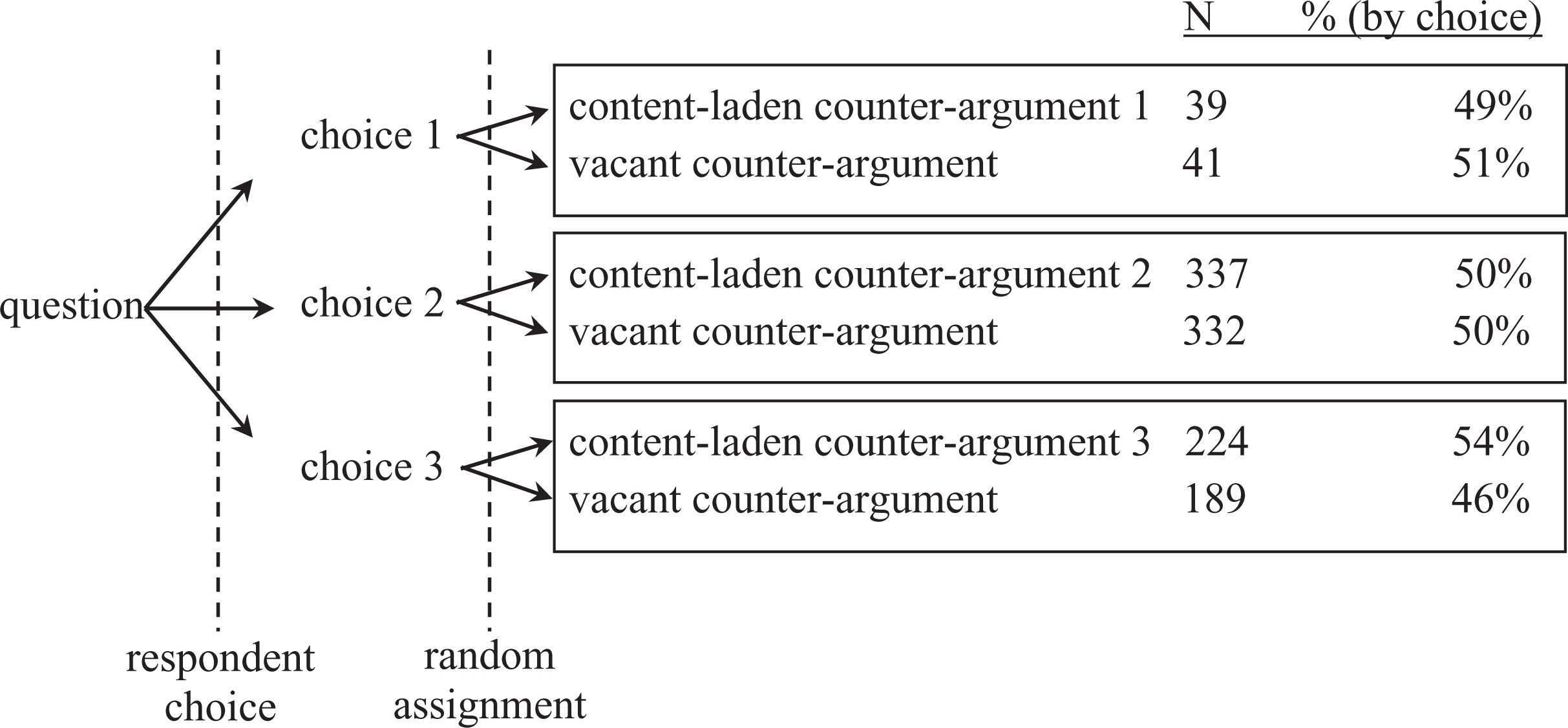
Even with careful wording, the sensitive nature of transitional justice preference may cause respondents to continue to hide behind a veil of social desirability, with ‘true’ opinions being revealed only if the respondent receives a signal that his or her hidden view is acceptable. Alternatively, we might worry about whether one-shot question–answer exchanges would produce mostly noisy, ‘top of the head’ results (Zaller, 1992). I use a persuasion experiment methodology to investigate these concerns.
7
The design of the experiment is displayed in Figure 1. Each respondent was asked the punishment question, as described above. Then, depending on the answer that was given, each respondent was randomly assigned to receive either a ‘vacant’ or a ‘content-laden’ counter-argument, issued by the enumerator. The goal was to provide a signal indicating that another response was acceptable.
8
The purpose was to assess whether respondents had issued a deeply held opinion, or one that could be altered by signaling the social acceptability of an alternative. Once the counter-argument was delivered, the respondent was asked again about what choice he or she preferred. The vacant counter-argument was the same for all choices:
Vacant counter-argument. However this can lead to some difficulties. Then I would like to ask you again. Do you think it is good to (1) punish them, (2) accept them when they come back, (3) ask them to beg for forgiveness?
The content-laden counter-arguments were specific to the choices that the respondent made initially. If the respondent chose option 1, to ‘punish’, then the enumerator would say:
Content-laden counter-argument 1. But there are people who say that both sides have committed many crimes during the war, thus it is the time for people to forgive so that we can progress. So I would like to ask you again. Do you think it is good to: (1) punish them, (2) accept them when they come back, (3) ask them to beg for forgiveness?
If the respondent chose option 2, to ‘forgive’ unconditionally, then the enumerator would say:
Content-laden counter-argument 2: But if we ignore what happened people could be angry and take revenge. So I would like to ask you again. Do you think it is good to: (1) punish them, (2) accept them when they come back, (3) ask them to beg for forgiveness?
And finally, if the respondent chose option 3, to ‘forgive’ only conditionally, then the enumerator would say:
Content-laden counter-argument 3: But there are some people who think that justice is not necessary, while others assert that both sides have committed many crimes and that it is time for reconciliation. So I would like to ask you again. Do you think it is good to: (1) punish them, (2) accept them when they come back, (3) ask them to beg for forgiveness?
The different counter-arguments allow us to test the extent to which subjects might be induced to taking a more or less aggressive position, which would indicate whether social desirability concerns induce respondents to hide either more or less aggressive opinions. The vacant counter-arguments provide a control condition, to ensure that we do not confound persuasion with intimidation from merely receiving a counter-argument. Figure 1 shows that distributions are mostly even across the treatment conditions. An asymmetry emerged in the shuffling of questionnaires for the counter-argument conditions for choice 3. Because this was due to an implementation error that is independent of response behavior, no bias should arise. 9
Sample and post-stratification
Demographic characteristics of sample
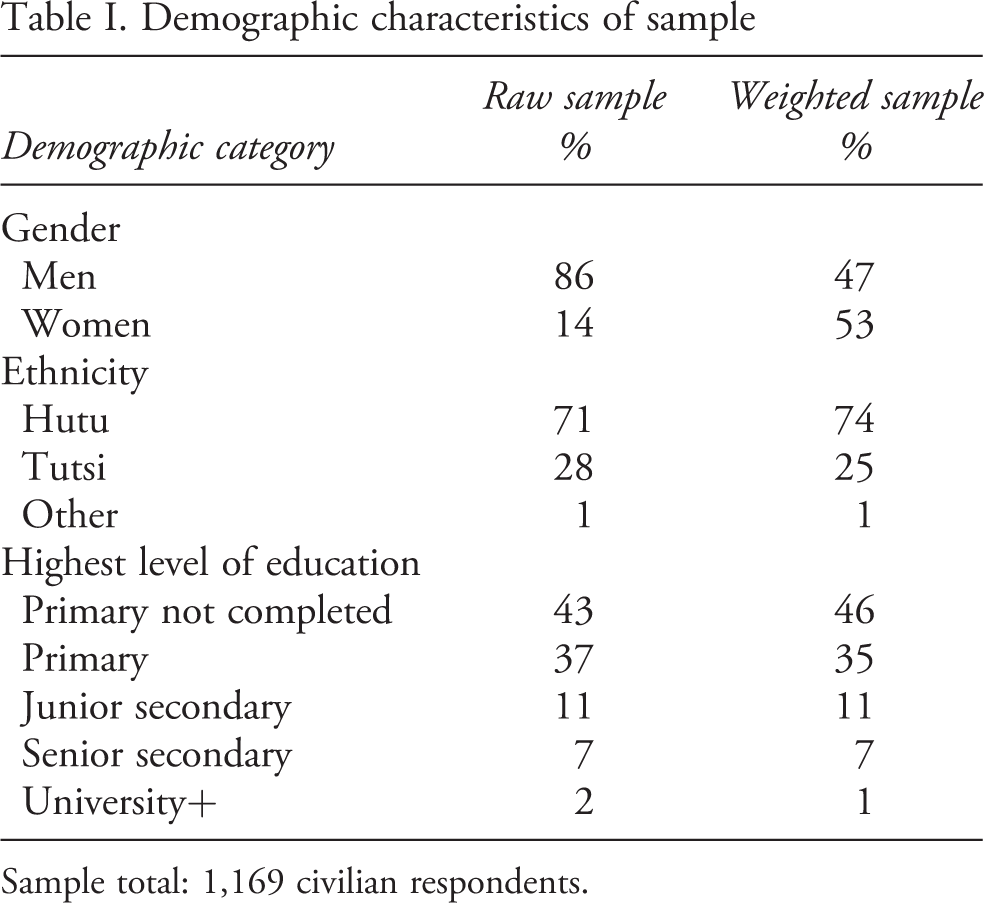
Sample total: 1,169 civilian respondents.
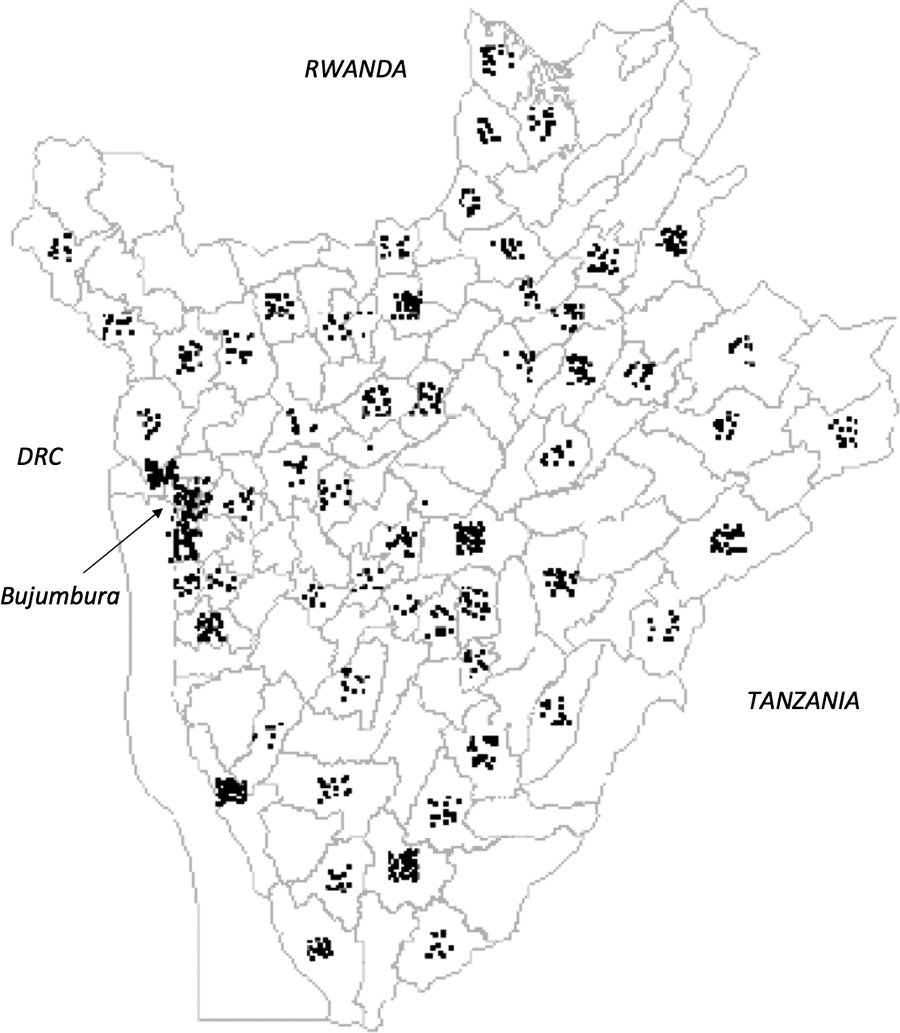
Geographic locations of survey respondents
Figure 2 shows the geographic distribution of the sample. Geographically, the sample was chosen through a multistage process. Within each of Burundi’s 17 provinces, half of the province’s communes were randomly selected. Communes contain between 15,000 and 100,000 individuals (about 3,000 to 20,000 households). Sample sizes within each of the communes were based on population size (given in the Institut Statistique et des Etudes Economiques du Burundi’s 2006 statistical yearbook) as well as considerations of whether that commune offered special analytical leverage for one or another of the impact studies undertaken as part of the survey. Each commune in Burundi is further divided into somewhere between 5 and 30 collines (‘hills’) of approximately equal population size and containing a few hundred households each. Within each of the selected communes, we chose as sampling sites the commune’s central colline plus seven other randomly selected collines. Then, enumerators were guided to position themselves in the middle of the colline, face a randomly pre-selected compass direction, and to approach households nearest to the line of sight on that compass direction.
The manner in which commune sample targets were set is a kind of ‘selecting on independent variables’. This poses no special problems with respect to bias when the goal is to test hypotheses based on these independent variables (King, Keohane & Verba, 1994). However, it does complicate the calculation of population-level descriptive statistics. Some kind of adjustment is needed to correct for the departures from equal probability sampling. Weighting is a straightforward way to do this. One may derive adjustment weights from the sampling design or by adjusting to known population distributions (Gelman, 2007). Because I was able to obtain good information on demographic distributions down to the commune level, direct adjustment to population distributions via post-stratification is most reliable. The post-strata interact commune with ethnicity (Hutu or not) and gender. 12 The last column in Table 1 shows the effects of the weighting. Effectively, each woman in the sample is up-weighted by a factor of about 3.8, while men are down-weighted by a factor of about 0.54. We see no substantial consequences for the other demographic features, which is what we should see if women were indeed sampled randomly.
Estimation and specification
All estimates are computed using the post-stratification weights described above. All standard error estimates and hypothesis tests account for stratification at the province level, clustering at the commune level, and post-stratification weighting. 13 Hypothesis tests for the survey experiment use a standard survey-adjusted F test based on Rao & Scott (1984).
Regression specifications account for the causal ordering of explanatory factors. For example, since ethnicity in this context is due to parental lineage and therefore essentially determined at birth, one should measure the ‘effect’ of ethnicity with a specification that excludes post-birth variables to avoid ‘post-treatment bias’ (King & Zeng, 2006). 14 Ethnicity is then included in specifications that measure the effects of post-birth variables to reduce possible spuriousness. A similar logic is applied in specifying and interpreting all of the regression models. The appropriate coefficient to interpret substantively for each variable is the first one that appears as one goes from left to right in the regression tables. I also include the sex of the respondent as a control variable. All of the variables used in the analysis are dummy variables except for ‘Reduction in violence’, which is measured as a difference in annualized rates of violent incidents. Raw- and weighted-sample summary statistics are shown in Table IV.
I use ordered logistic regression for the punishment question, with outcomes ordered from (1) unconditional forgiveness to (3) unconditional punishment. I use a binary logistic regression for the truth-seeking question, with ‘seeking the truth’ coded as 1 and ‘forgetting’ as 0. In discussing the estimates in the text, I convert the coefficients to odds ratios (by exponentiating them) for ease of interpretation.
A caveat on interpreting the regression results is in order. These are observational data and some of the variables are endogenous to unmeasured conditions. Therefore, the results can only suggest causal interpretations.
Empirical findings
Overall opinion distribution
Overall preference distribution
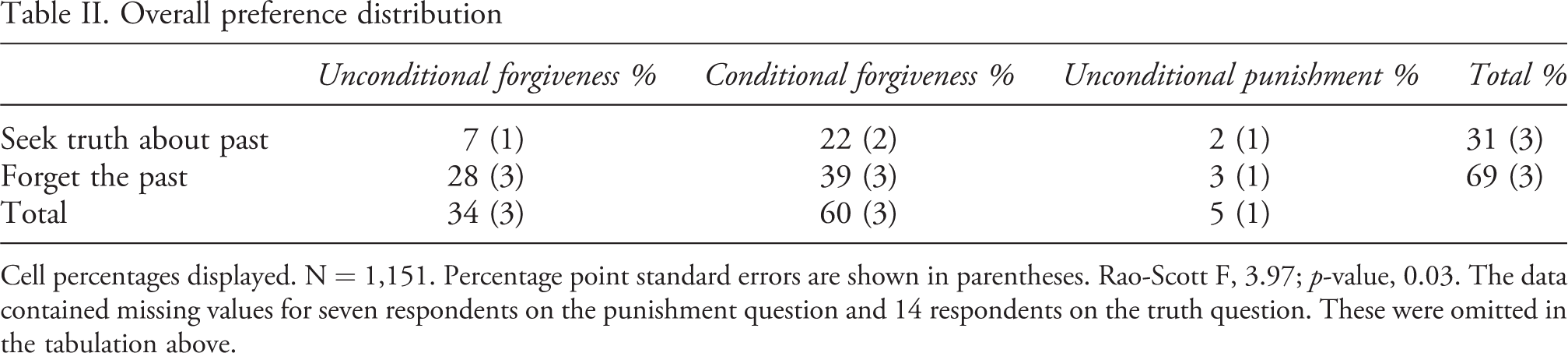
Cell percentages displayed. N = 1,151. Percentage point standard errors are shown in parentheses. Rao-Scott F, 3.97; p-value, 0.03. The data contained missing values for seven respondents on the punishment question and 14 respondents on the truth question. These were omitted in the tabulation above.
Persuasion experiment results
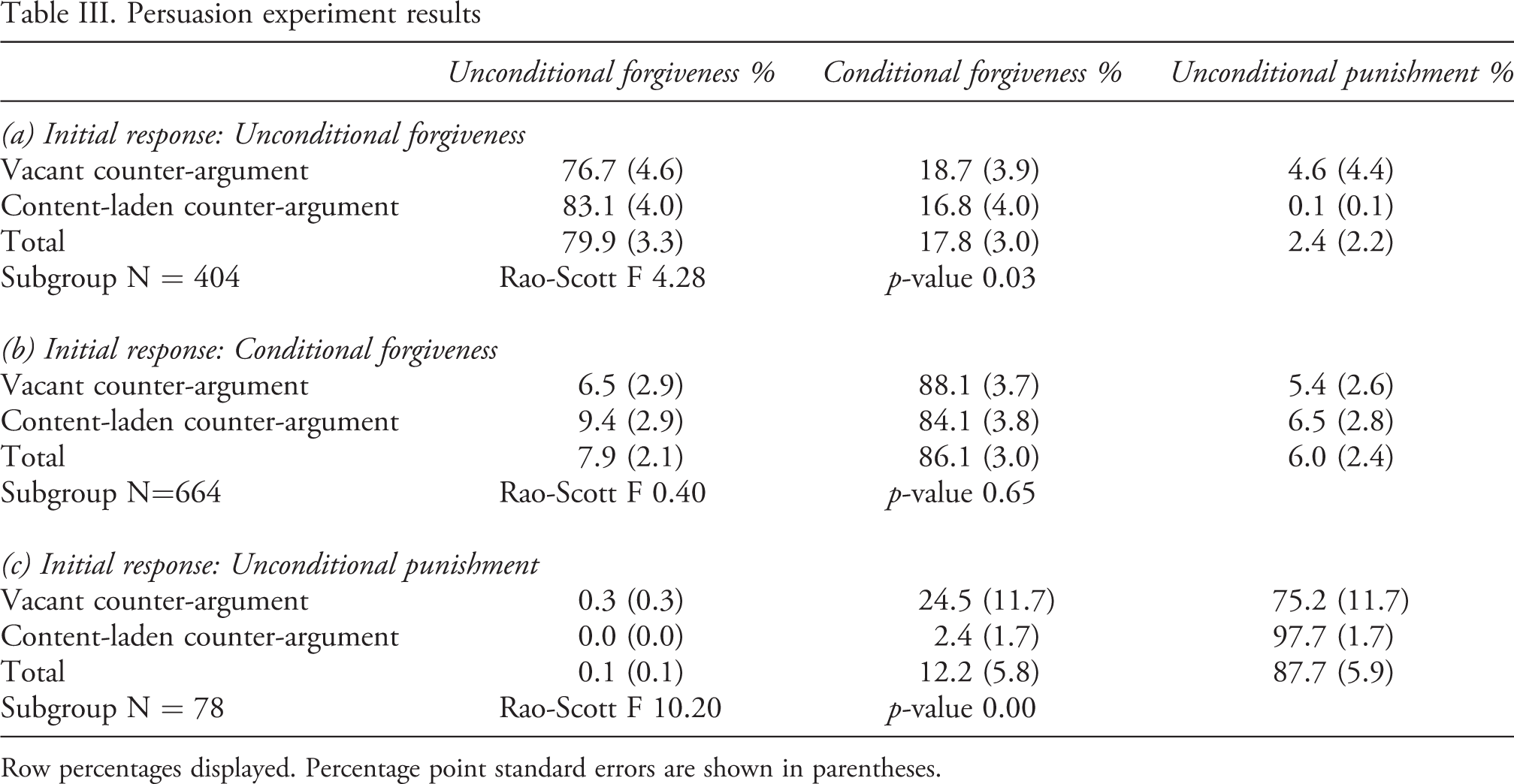
Row percentages displayed. Percentage point standard errors are shown in parentheses.
For the Burundi case, the findings here are consistent with those of Ingelaere (2009) and Uvin (2008, ch. 7). At the same time, a survey by the BBC World Services Trust/Search for Common Ground (2008) conducted less than a year after our survey showed that 68% of respondents expressed a preference for bringing wrongdoers to trial, and 81% expressed an opinion that a truth and reconciliation commission would be entirely or mostly good. The difference may be due to the BBC World Services Trust/Search for Common Ground survey’s (2007) questioning format, which did not present a set of contrasting but equally ‘legitimate’ options from which to choose. This is speculative, pointing to the need to investigate the consequences of different questioning styles within new surveys that are fielded.
Persuasion experiment, hidden beliefs, and commitment to expressed opinions
Summary statistics for regressors
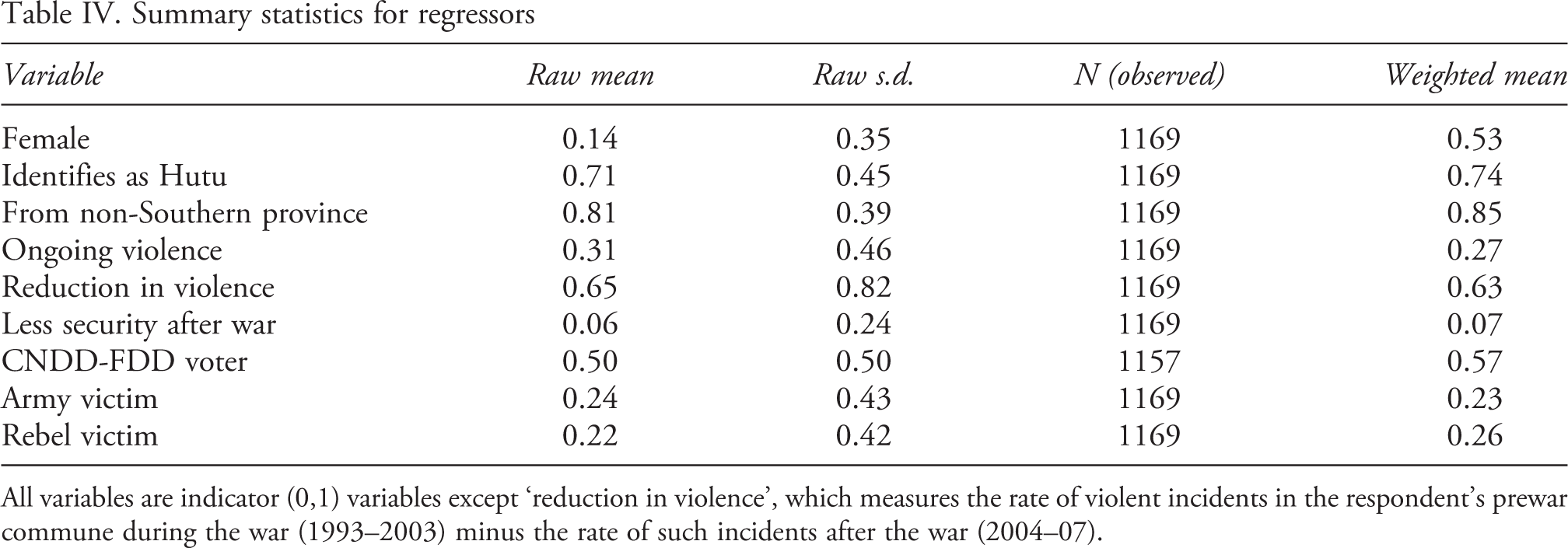
All variables are indicator (0,1) variables except ‘reduction in violence’, which measures the rate of violent incidents in the respondent’s prewar commune during the war (1993–2003) minus the rate of such incidents after the war (2004–07).
Determinants of opinions
Table IV shows summary statistics for the regressors used for testing the hypotheses developed above, and Tables V and VI display the results of the regression analysis. Because the specifications are based on the causal ordering of the variables, the way to read the results is to focus only on the variables that appear anew in each column, moving from left to right. Except for the Army victim and Rebel victim variables, the hypotheses lead us to expect negative coefficients for all of the variables. For the punishment opinions, I use responses given prior to receiving the persuasion treatment; the overall stability of responses before and after the treatment show that the first responses are reliable indicators of firmly held opinions. 15
The first columns in Tables V and VI test the ‘deep partisanship’ version of H3. For punishment preferences (Table V), identification as Hutu is associated with about 37% lower odds of being in a more aggressive relative to a less aggressive punishment category, although this association is significant only at the 0.10 level. 16 The deep partisanship hypothesis receives much stronger support with respect to truth-seeking (Table VI): identification as Hutu lowers the odds of favoring truth-seeking by 48%, while being from a non-Southern province lowers the odds of favoring truth-seeking by 35%. These are substantial effects.
The second column in Tables V and VI tests the insecurity hypothesis (H1) with an indicator variable for ‘ongoing violence’ and the security maintenance hypothesis (H2) with the measure of reduction in violent incidence rates in a respondent’s home commune (‘reduction in violence’). Violent incident rates actually rose in the postwar period for 6% of respondents (see Table IV, ‘Less security after war’). The security maintenance hypothesis does not account for such circumstances. Thus, the approach that I have taken is to partial out the effects for these individuals by truncating the ‘Reduction in violence’ variable at 0 and then including an indicator variable that takes a value of 1 for those in the 6% that experienced more violence in the postwar period. This approach greatly eases the interpretation. 17 The insecurity and security maintenance hypotheses receive no support: the coefficients on both ‘ongoing violence’ and ‘reduction in violence’ are essentially 0 for both punishment and truth-seeking.
Ordered logistic regression of preference to pursue punishment
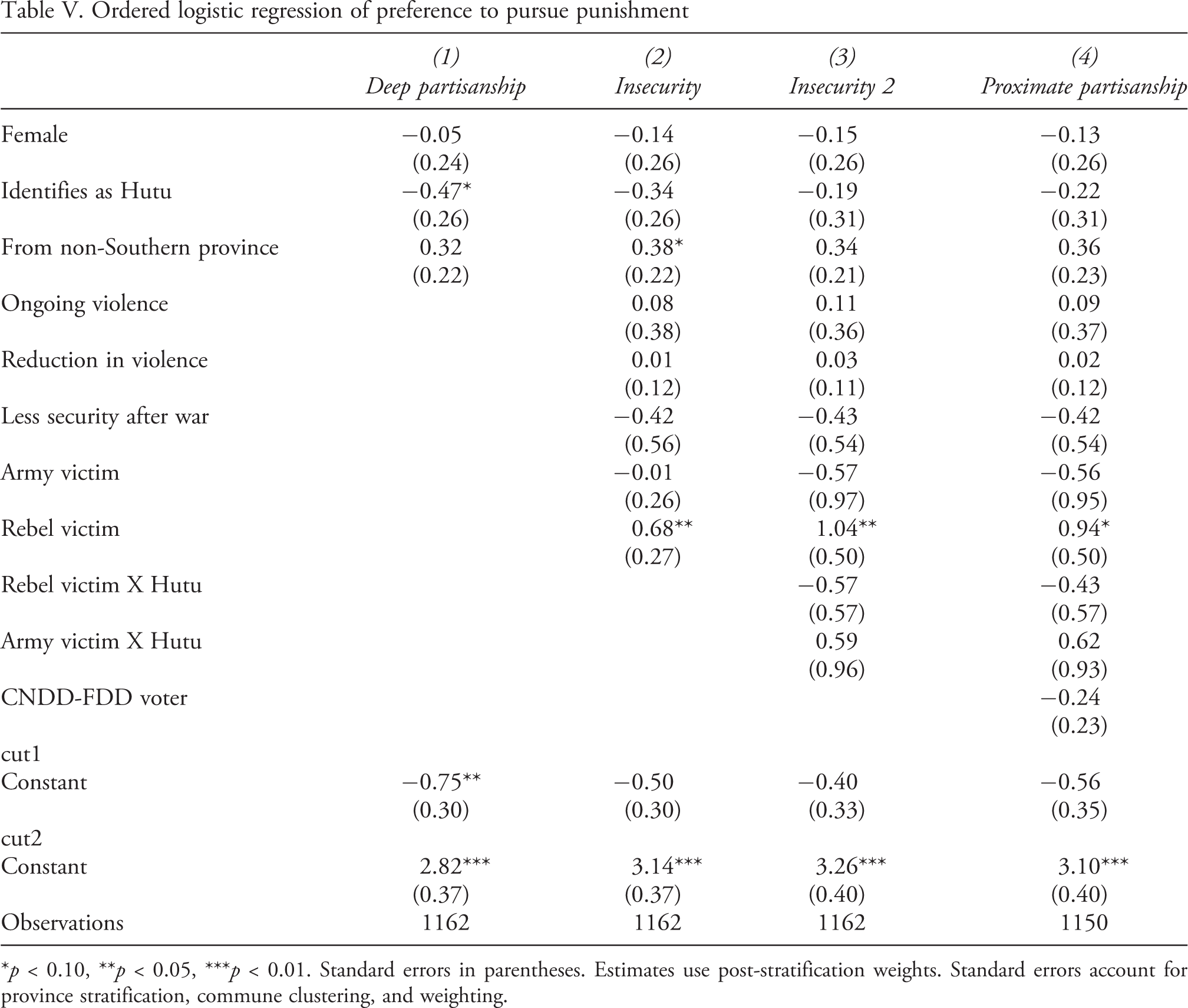
*p < 0.10, **p < 0.05, ***p < 0.01. Standard errors in parentheses. Estimates use post-stratification weights. Standard errors account for province stratification, commune clustering, and weighting.
In general, the regression analysis suggests that there may be something to a ‘deep partisanship’ version of the partisan motivations hypothesis, but that the hypotheses associated with insecurity or security gains do not provide insight on why majorities in Burundi express a preference to forgive and forget.
Discussion and conclusion
Logistic regression of preference to pursue truth-seeking
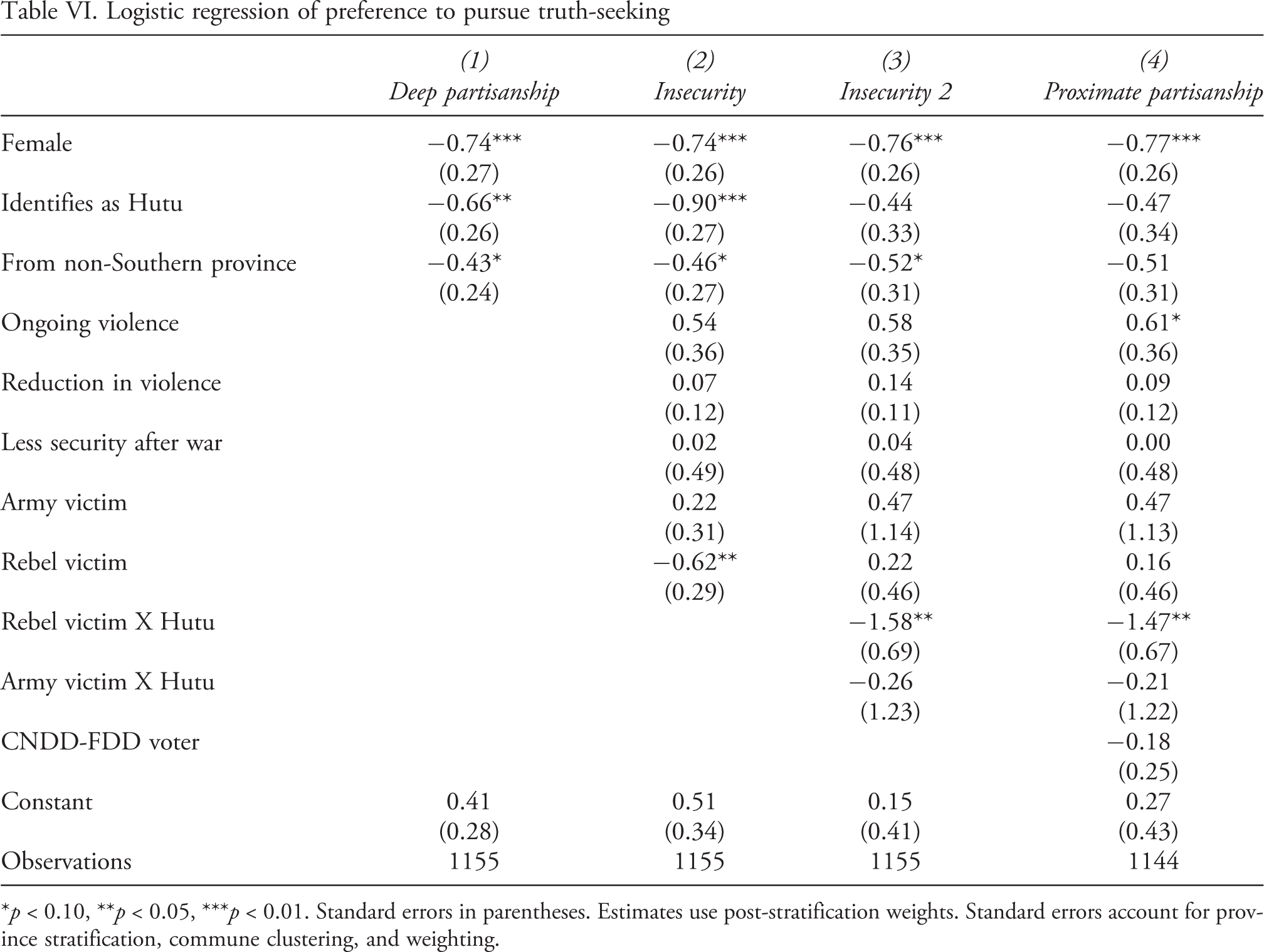
*p < 0.10, **p < 0.05, ***p < 0.01. Standard errors in parentheses. Estimates use post-stratification weights. Standard errors account for province stratification, commune clustering, and weighting.
These findings suggest that those pursuing the establishment of transitional justice mechanisms, including either truth commissions or tribunals, ought to be sensitive to how such processes interact with political competition and whether or not they satisfy a genuine demand among the population. Those advocating for transitional justice mechanisms will have to make a more compelling case for why such measures are desirable at all. Having done that, a further task would be to find ways to tailor the mechanisms to minimize the risk for political consequences and convince members of the public, victims and non-victims alike, that potential gains outweigh political risks. In cases like Burundi where large majorities of the population may feel as if political changes have adequately compensated for past injustice, this will be a formidable task. In addition, the persuasion experiment suggests that changing people’s minds on these points is not easy and has the potential to backfire.
Shortcomings from this study also suggest the need for further research. First, with respect to the persuasion experiment, the fact that content-laden argumentation caused respondents to ‘hold fast’ was unexpected and suggests that the ways people form opinions on sensitive topics is more complex than what was presumed when this study was designed. Researchers would do well to devise more subtle experiments using findings from current research in political persuasion and deliberation (Delli Carpini, Cook & Jacobs, 2004; Thompson, 2008). Second, this study measured opinions in a setting where little had been done to inform the public about transitional justice processes. Further work ought to study how opinions change as individuals learn more about the actual, rather than the presumed, consequences of various transitional justice processes. It is possible that the wariness recorded here was due in part to worst-case projections by respondents. Finally, this study is based on a cross-section at a single point in time. As suggested by the studies carried out by Pham et al. (2005, 2007) in Northern Uganda, opinions toward transitional justice processes may react quite strongly to events. The nature of these reactions may provide considerable traction in testing the robustness of the findings here.
Footnotes
Replication data
Acknowledgements
This study is part of the multipurpose survey on Wartime and Post-Conflict Experiences in Burundi, supported by the Folke Bernadotte Academy (Sweden) and the United States Institute of Peace. Valuable comments came from the author’s research partners, Eric Mvukiyehe and Gwendolyn Taylor, implementation partner, Iteka – Ligue Burundaise des Droits de l’Homme ( ), participants at seminars at Bujumbura-ISTEEBU and Uppsala University, and Macartan Humphreys, Monika Nalepa, and Jack Snyder. This research comes under Columbia IRB protocol AAAB8249 and New York University IRB protocol HS-5279.
Notes
References
Supplementary Material
Please find the following supplemental material available below.
For Open Access articles published under a Creative Commons License, all supplemental material carries the same license as the article it is associated with.
For non-Open Access articles published, all supplemental material carries a non-exclusive license, and permission requests for re-use of supplemental material or any part of supplemental material shall be sent directly to the copyright owner as specified in the copyright notice associated with the article.
