



Abstract
Can local organizations give civilians the capacity to protect themselves from civil war violence? Civilians have traditionally been considered powerless when facing armed groups but new research suggests organized communities may promote security through nonviolent strategies such as resolving disputes between neighbors and managing relations with macro-armed actors. This article analyzes whether and how these ‘mechanisms’ designed to retain community autonomy functioned in the community-case of the Peasant Worker Association of the Carare River (ATCC) in Colombia. The Carare civilians developed a local institutional process to investigate threats against suspected armed group collaborators to clarify the ‘fog of war’ and reform civilian preferences to participate in the conflict. This process is evaluated in reference to existing hypotheses about violence in civil wars such as the balance of territorial control using qualitative evidence from original field research. A unique within-case database created through focus group sessions with community ‘conciliators’ is used to analyze not only acts of violence, but also threats that were defused. Despite the prevalence of conditions that would predict persistent violence against civilians, the local institution itself proved to be a critical factor for both explaining and limiting levels of violence. The results suggest civilian choices and their consequences did not merely result from the capabilities or choices of armed actors.
Thank God for the Association. If it weren’t for their mediation on my behalf, I’d be dead now. Many accused owe their lives to the Association. (Interviewee ATCC#2, La India, Colombia, November 2007)
In 1998 in the village of San Tropel in Santander, Colombia, paramilitary forces brutally executed 12 woodcutters and dumped their bodies in the Carare River ( El Tiempo, 2009). 1 A short time later, in 2001, this same paramilitary group was preparing to kill 11 residents of the village of La India, just over some low hills to the east, but did not. A community organization that had been formed there to deal with the problems created by the conflict, the Peasant Workers’ Association (ATCC by its Spanish initials 2 ), came to their defense and advocated on their behalf. The 11 people lived. 3
This episode, emblematic of other events in this region, raises a puzzle: given similar pressures, why were residents of La India able to act but not those of San Tropel? And why were the people killed in San Tropel, but not in La India? How do organizations like the ATCC affect armed groups and how can one tell whether they affect levels of violence? It is not obvious that unarmed civilians in civil wars can protect themselves against heavily armed combatants. While there have been many victims of civil conflicts, few accounts examine how the people that are not victims survive. Many people have been displaced from the countryside in Colombia, but many have been able to remain as well.
Cases such as the ATCC demonstrate that even in hostile conflict settings civilians’ social processes can help them protect themselves and reduce violence perpetrated against them. Cohesion and to a greater extent organizations permit institutionalsolutions to avoid participation in the conflict, manage internal community order to limit armed groups’ inroads, and demand accountability from these groups. These collective strategies can be especially helpful for situations facing multiple armed actors or even a single abusive group, since compliance and alliance with these groups do not guarantee protection. In these situations, cooperation can help communities achieve autonomy, or maintain democratic decisionmaking power over outcomes forthe community withinthe community, without influence from outside armed groups. In sum, civilian centrists, facing the opposite collective action problem to that of insurgent recruitment, rely on their unity to impede and isolate violent ‘extremists’.
This study of the particular case of the ATCC illustrates some of the nonviolentmechanisms through which local organizations function to protect civilians. Existing explanations for violence tend to omit civilians as autonomous actors and discount their organizational processes to avoid conflicts or as explanations for violence. The field has primarily examined why civilians are victimized – either for coercion (Kalyvas, 2006) or from abuse (Weinstein, 2007) – or why they join armed groups (e.g. Humphreys & Weinstein, 2008) and support them with resources or information (Wood, 2003; Kalyvas, 2006). However, an alternative and growing ‘peace movement’ literature has primarily studied cases of civilian responses to violence (Hernández Delgado, 2004; García Durán, 2006; Hancock & Mitchell, 2007). Philosophical and anthropological work has identified organizational forms such as ‘peace communities’ as a local collective strategy to stay out of or end conflicts in various communities in Colombia and other countries, from the Philippines, to Mozambique, to Russia, and beyond (Kaplan, 2010). But these reports have tended to be either normative or descriptive.
Despite anecdotes of effectiveness and the buoyancy of activists, this literature on civilian movements remains under-theorized, without specifying causal mechanisms, or processes by which organized civilian resistance might affect substantively interesting outcomes. The causal ‘force’ of civilians has not been made falsifiable or comparatively evaluated against the positivist, macro-political explanations of violence. As a result we have been unable to discern whether the effects of civilian social cohesion and organization in wartime are epiphenomenal to – derivative of – armed groups’ interests (as Kalyvas suggests they are). It is for good reason then that in Kalyvas’s (2006: 110) passing discussion of local committees in conflict zones he observes, ‘We know little about how they actually operate.’
The ATCC region is a good setting for studying how local organizations can function to deal with violence in the cross-fire because of the remarkable apparent effect its institutions had on violence. Approximately 10% of its population was killed over a 12-year period leading up to its formation. It was then able to sign accords with armed groups to ostensibly create physical and political space to deal with the uncertainty and continuing risks of civil war. The subsequent period from 1991 to 2000 saw an absence of violence during which time there were reportedly no civilian victims. What specifically did the accords do to reduce violence so drastically?
Three claims about the features of locally based institutions such as those enacted by the ATCC’s accords explain how they can manage the ‘identification’ problem common in civil wars, where even upstanding, innocent civilians may be implicated as collaborating with armed actors. First, a civilian institution that is larger than any one person and persists over time can act as an investigatory body to evaluate denunciations by armed actors and send a signal that ‘separates’ (exonerates) pacifist civilians from belligerents. Since individuals may have incentives to misrepresent their private preferences and actions in the fog of war (e.g. Fearon, 1994), these signals help resolve uncertainty and should make killing more difficult or even costly and reduce mistakes in targeting and costs of governance. Second, civilian norms of nonviolence and nonparticipation in the conflict and of conflict resolution help minimize the participation of individual civilians in the conflict. Third, as a dose of realism to avoid postulating civilian success as inevitable, armed actors must share a minimal joint-ness of interests to not harm civilians so they will abide by civilian institutional arrangements. They may not be Guevara’s purely revolutionary ‘guiding angels’ but are mostly concerned about limiting civilians’ defections rather than winning their full-fledged support. ‘Hybrid’ groups that may partially depend on civilians for their resources or reputations may fit this description better than groups that are highly resolute in killing or winning, such as cases of genocide or ‘draining the sea’.
This study seeks to explain variation in violence and the stability of the ATCC agreement and probes whether the reduction in violence really resulted from civilian procedures. The ATCC exhibits variation over time and space in the prevalence of violence as well as the presence and functioning of its institutional procedures. It also contrasts with similar but unorganized neighbor regions, such as San Tropel. I consider counterfactual case scenarios of what would have happened, what the armed groups would have done, had civilians not taken a given action or used a given strategy.
Evidence for the theoretical argument is based on qualitative and quantitative data collected through field research in 2007 and 2008. I conducted approximately 45 interviews of ATCC residents in both Bogotá and the ATCC zone, including founders, presidents, conciliators, and residents who were currently or formerly involved in the coca economy, recently migrated to the area from neighboring zones (or traveled the region widely), and had personally been threatened by armed groups. Access to community archives provided verbatim meeting minutes of discussions between the ATCC and paramilitaries, guerrillas, and army officials, and among the ATCC’s governing council; diary entries; and documentation of the ATCC’s institutional rules. I compiled a unique within-case database from focus-group sessions with community conciliators and the archival documents to analyze not only acts of violence, but also threats against individuals that were defused. Lastly, to serve as a check for the interview data and expand data coverage I also accessed existing quantitative data from secondary sources for the ATCC and neighbor regions.
The evidence suggests it is hard to deny some independent impact of civilian institutions on levels of violence. Neither (the acceptance of) the accords nor the cessation of violence in the case of the ATCC can be completely explained as resulting from permissive armed actor preferences. Most crucially, suspected collaborators found to be innocent in ATCC investigations were less likely to be killed than suspects believed to have collaborated.
The article proceeds as follows. First, the ATCC case is contextualized with a description of its setting and history. Second, alternative explanations for patterns in violence are analyzed with qualitative and quantitative data and found to be incomplete. Third, the ATCC conciliation process is analyzed as an explanation for violence using the original dataset of threat conciliations and the conditions for the effective protection of civilians under this process are identified. I conclude with an epilogue and implications for further research and policies for the protection of civilians.
The ATCC in context and the periodization of violence
The ATCC’s ‘area of influence’, where its members reside and it exercises decisionmaking and protective authority, extends across 100,000 hectares of territory (about 400 square miles) and encompasses 32 villages. The area is in the Middle Magdalena region north of the capital of Bogotá, nestled along the banks of the Carare River in a steamy, forested valley criss-crossed by tributaries. Although about 15 miles from the county seat of Cimitarra, the area cuts across the neglected rural peripheries of six municipalities. Today, the ATCC area is home to about 5,000 people, with about 2,000 people (300 families) residing in the village center of La India. A frontier region, it has historically had minimal state presence.
Since armed actors first entered the region over 30 years ago, the region’s history can be separated into three distinct eras. Across these eras and even within them there is variation in conflict dynamics, levels of violence, and the presence and functioning of the ATCC institution. The first period began in 1975 when the FARC (Revolutionary Armed Forces of Colombia) and ELN (National Liberation Army) guerrilla groups first entered the region and continued through the rise of the paramilitaries and the founding of the ATCC in 1987. In this cross-fire, providing aid to one side often met retaliation from the other. This bloodiest period saw an estimated 530 to 585 civilians killed through 1987 (over 10% of the population), 60% by paramilitary groups and 40% by the guerrillas (Restrepo, 2005). 4 To counter the insurgency, the army implemented carnetización, an ID-card monitoring program that required residents to report to a local base every 15 days. 5
In 1987, a small group of leaders from various village councils along the Carare River met in secrecy late one February night in the back room of a house. 6 They discussed the pressing topic of how to respond to an ultimatum from multiple armed groups for the residents to displace, join one of them in the conflict, or be killed. If they threw their lot in with the army or paramilitaries, the guerrillas would surely find out and kill them. And yet if they joined the guerrillas in hopes of protection, the paramilitaries would have no mercy.
To manage this problem of stigmatization, the discussion came around to a fifth option. Rather than pursuing the risky course of arming themselves for protection, they would manage their own affairs. They sought armed actors out in canoes to declare they would neither leave nor take any part in the conflict. Surprisingly, after several rounds of discussions the various armed groups acceded to the civilians’ policies (some of the debates and motivations are discussed below; see García (1996) for a longer treatment). 7
A second period of consolidation started as the ATCC’s institutions and norms were put in place and armed actors became accustomed to dealing with the civilians. There was virtually no conflict-related violence from 1987 until the next millennium. The perception of the ATCC’s effectiveness is reflected in a 1989 journal entry from a former association president: ‘Today we have passed two years of living better. There’s no war, no thirst, no hunger. Long live the Association’ (ATCC Archives). Nevertheless, from around 2000 through the present, violence returned and began a third era for the region. I analyze this third era in the epilogue as new data for the hypothesized mediation explanation for violence.
My findings confirm there were death threats in the 1990s, but few if any conflict-related deaths. 8 Impressive as it seems, only a structured analysis can indicate to what extent this result is related to civilian processes versus causes that lay elsewhere.
Evaluating explanations for violence: Military contestation and control
This section assesses how extant explanations account for the trends in violence over time with special attention to the surprising era of the absence of violence during the 1990s. These explanations include: general (national-level) trends in violence and peace negotiations; shifts in territorial control; changing rebel organization, resource bases, and discipline; and increased international human rights advocacy. I assess these hypotheses with various real and counterfactual ‘cases’ within the ATCC meta-case. While these alternative explanations are found to incompletely account for violence, I only discuss the territorial control hypothesis below. The alternative explanations are discussed in the Appendix.
Stathis Kalyvas (2006) argues that much of the violence against individual civilians in civil wars stems from battles for territorial control among armed actors. Violence is selectively used against suspected enemy collaborators to coerce support among the civilian population. Violence also results from the dynamics of territorial control as civilian informants denounce enemy collaborators to armed actors when they feel protected from retaliation. Such denunciations may be for valid reasons of war, but may also be false and involve local disputes among neighbors.
Denunciations and therefore selective violence are thought to be most common by the stronger armed actor in zones of dominant but incomplete control. 9 By implication, neutrality strategies – fence-sitting and double-dealing according to Kalyvas – are permitted by armed actors for individuals and local committees in completely contested areas, but nowhere else. Neutral civilian organizations might therefore be epiphenomenal, or exist only because they reflect a stalemated balance of power, and thus have little independent impact. Local institutions that might clarify the ‘fog of war’ are thought to disappear or be useless where they might be most effective.
Can the ATCC’s apparent mitigation of violence merely be attributed to existing in zones of either complete control or evenly contested control? To answer this question, I compare the military balance of the ATCC area over time with that of other regions. The ATCC’s antecedents should be a text-book case for Kalyvas’s theory. The FARC maintained initial dominance in the region through the early 1980s and little violence occurred (they had an estimated 500 men in 1978; García, 1996). Guerrilla control began to erode and they retreated as the army and paramilitaries moved into the department of Santander. 10 As the guerrillas ceded control, they made a last-ditch attempt to coerce the population (García, 1996). With the rise of the paramilitaries and army going into the mid-1980s, all the elements predicted in a zone of dominant control were present – denunciations, varying degrees of contestation, and selective violence. As one resident recalled, ‘People were seriously implicated by the sapos (frogs, or informants)…. The dark waters of this river are a silent witness to the numerous dead they [armed groups] dumped in there’ (Hernández Delgado, 2004: 325).
My interviews and secondary sources indicate that in the next period from 1987 through 2000, the army (and paramilitaries) had increasingly dominant yet still incomplete control (hence the ultimatum). 11 This should have predicted intense, continued selective violence by the army and paramilitaries, yet in reality violence dropped off dramatically. Although the guerrillas largely withdrew their forces, they remained active in the area (García, 1996) and threatened civilians from camps in the nearby mountains. In almost every interview when inquiring about whether the guerrillas had left the zone, time and again, people responded, ‘Always, there has always been guerrilla presence here.’ 12 Quantitative data from press reports compiled by the Jesuit think-tank CINEP (Centro de Investigación y Educación Popular) tend to corroborate these characterizations (see Appendix). In most years of the 1990s, the paramilitaries were more active but guerrilla groups registered at least some armed activities and human rights violations in or near the ATCC zone.
My interview instrument helped further cast doubt on armed actor control as a determinant of ATCC autonomy and impact. Some residents naturally responded that the ‘actor’ who had control was not any armed group but in fact the civilian ATCC. 13 More than once during the 1990s the dominant paramilitaries attempted to install a base in the hub of La India, but the ATCC civilian leaders brushed them off by arguing it would only cause them more problems with the guerrillas. 14 Furthermore, respondents noted that they did not pay protection taxes to anyone since the ATCC was able to negotiate an end to this practice. 15
Perhaps the most important count against the explanation of territorial control for patterns in ATCC violence is that its causal mechanism persisted, but did not lead to violence. If the balance of control theory were right – that the ATCC could only have thrived under contested or complete control – denunciations, threats and violence allshould have ceased. It is incongruous with the theory that denunciations and threats continued to occur, but did not lead to the killing of (innocent) civilians (see interviews; García, 1996; Hernández Delgado, 2004). The ATCC therefore either persisted in a dangerous zone of dominant control or in other conditions that were nevertheless quite dangerous. Without prompting, one respondent characterized the conditions of the 1990s as ‘selective violence’, 16 while another reported that armed actors’ strategies were ‘psychological’ and designed to control through ‘threats and fear’. 17
In sum, the theory of territorial control appears to explain some but not all periods of violence and its absence in the ATCC region. The patterns of control would have predicted higher selective violence than actually occurred. I next explore how the ATCC dealt with the denunciation mechanism so that it would not lead to violence.
Civilian institutions as an explanation: The process of the ATCC
Levels of violence or favorable balances of control may indeed contribute to the establishment and persistence of institutions such as the ATCC, but they provide an incomplete picture of the decline in violence observed after the founding of the ATCC. The ATCC has fulfilled many roles and functions for the citizens of the region, including economic development planning, operating a community store, lobbying government officials, and giving civilians early warning of pending battles. However, the function that most directly affects violence is the institutional procedures the civilians developed to deal with threats from armed actors and resolve disputes over civilian allegiances. This provision of ‘order without law’ (Ellickson, 1991) goes to the heart of the mechanisms of other explanations of violence and short-circuits them.
The procedures are activated when a civilian member of the ATCC has been accused of aiding one armed group or another, becoming ‘comprobado’, or implicated, and is threatened with execution. Rather than being killed outright as s/he normally would be absent the institutional rules, the procedures call for turning them over to the ATCC’s governing council, the Junta Directiva (the conditions where armed actors would agree to this are analyzed below). 18 In a region where government authority is distant, the Junta acts like a court and conducts investigations of the implicated person, using its advantage over armed groups in local information. ATCC leaders meet about the case and interview acquaintances of the accused, including family, friends, and neighbors. They further draw on village committees that monitor compliance with agreements and inform on violators of neutrality. 19 If the person is an ATCC ‘associate’ and has signed a membership contract letter, they will present this letter to the accusing group as a form of character witness. 20 They may also leverage their bilateral relationships with each of the armed groups to confirm the accusation with the rival of the accusing group. All the information is then compiled and discussed with the accuser. If the person is found to be innocent, by the agreement s/he is absolved of wrong-doing by the accuser.
If the implicated is found guilty, s/he has two options depending on the response of the accuser. Conditional on good behavior and ‘correcting’, s/he can stay in the area (if s/he is found guilty again, the armed actor might mete out punishment). Alternatively s/he might be given funds from the ATCC (and sometimes even the armed actor) to leave the region (if s/he still decides to stay, the ATCC acknowledges it can no longer provide protection). 21 This procedure effectively sorts innocent civilians from ‘guilty’ people who participated in the conflict. It reduces both the potential for false accusations and the incentive for residents to participate in the conflict since it becomes more costly to do so (and gain whatever selective benefits they may) in secrecy.
There is substantial evidence that this procedure has been effective. The impression among the civilians of the ATCC (and academic analysts) is that dialogues have helped save many lives. According to one resident: There have not been deaths but people have been threatened by armed groups.… We have had to remove some people from the zone or turn them over to the competent authorities. But that has been a big achievement, rescuing many lives. (Hernández Delgado, 2004: 356)
Analysis of threats and conciliations, 1987–2007
To better understand the severity of the threats and the ATCC’s ability to protect residents, I collected and compiled a new dataset on threats as well as deaths from the region. The main purposes of this effort were twofold: first, to assess whether differences in violence outcomes depend on whether or not the civilians’ investigations confirmed the reasons for threats, and second, to describe the information flows of the region and how civilians generate credible information.
Since the conciliation of threats has been an oral, day-to-day process with almost no written records available, the dataset – this oral history – was primarily recovered based on in-depth interviews with ten ‘conciliators’ with specific knowledge of and participation in conciliations. 22 I also spoke with several people who were actual victims of threats and who expressed their gratitude to the ATCC for saving their lives. These interviews yielded detailed information on 67 threat episodes involving 98 people between 1987 (the founding of the ATCC) and 2007, with the majority of recorded cases from 1998 onwards. 23 Based on conciliator estimates, these figures likely represent only about one-third to one-half of the conciliation episodes in the ATCC’s history. Although many episodes are certainly missing, the cases that were recalled for the dataset are likely the most representative and important cases (i.e. extreme cases of either saving lives or killings). The rich details of these stories allows for a deep analysis of behaviors. 24
Conciliators also provided their estimates of the validity of the accusations, yielding examples of both ‘neutral’, ‘pacifist’ people being ‘vouched for’ and saved, and collaborators being identified and turned over. Indeed, in the analysis of the 36 threat cases where the reason for the threat was determined to be ‘false’ (in some cases ex post), 55 people were saved and only seven were killed and three were forced to displace. With only approximately 15% of the threat victims killed, the difference between these cases and those where the reasons Outcomes of threats according to whether victim was believed to have collaborated
Narrations of actual cases illustrate more clearly the danger the victims face and how cases are resolved. In one example from 1995, a man who was marked for death was protected by intervention from the ATCC: Don Diego, a middle-aged wood-cutter, was accused by the guerrillas of providing aid and information to the paramilitaries and went to the ATCC for help. The ATCC (and guerrillas) investigated him with neighbors and monitored his actions and found the accusation to be false. They determined another wood-cutter had lied to the guerrillas to kill Diego and take his lumber. The guerrillas relented and Diego remained safely in the zone. Instead, they punished his accuser. (ATCC#1, 4, La India, 10/2007)
In another instance, a man who was identified as aiding the paramilitaries was exposed and sentenced. He did not ‘correct himself’ or end up complying with the finding against him that he leave the region, essentially renouncing his protection from the ATCC: Señor George was implicated by the guerrillas for aiding the paramilitaries and giving them food around 1999. The FARC readied to kill him, but notified ATCC leaders. Testimony of George’s neighbors gathered by the ATCC confirmed the FARC’s contentions and that he had a revolver (an armed civilian). The ATCC also asked the paramilitaries if they had received help from him. Ignoring the ATCC’s pleas to leave the region, before long George was killed by a guerrilla assassin. (ATCC#4, La India, 10/2007)
26
The dataset of threat conciliations also provides descriptive insights about how the armed conflict and concomitant threats unfolded and were dealt with. First, there were threats from many actors and the conciliations demonstrate how the ATCC was able to adapt to dynamic conditions over time and across space. Second, hinting at the blend of armed group motives, there were diverse reasons for threats, including providing aid and information to the enemy, coca cultivation, eliminating demobilized fighters, against delinquency, and coercing leaders (see Figure 2). Third, the ATCC Reasons for threats (and killings) by armed groups Information channels: How the ATCC learned of threats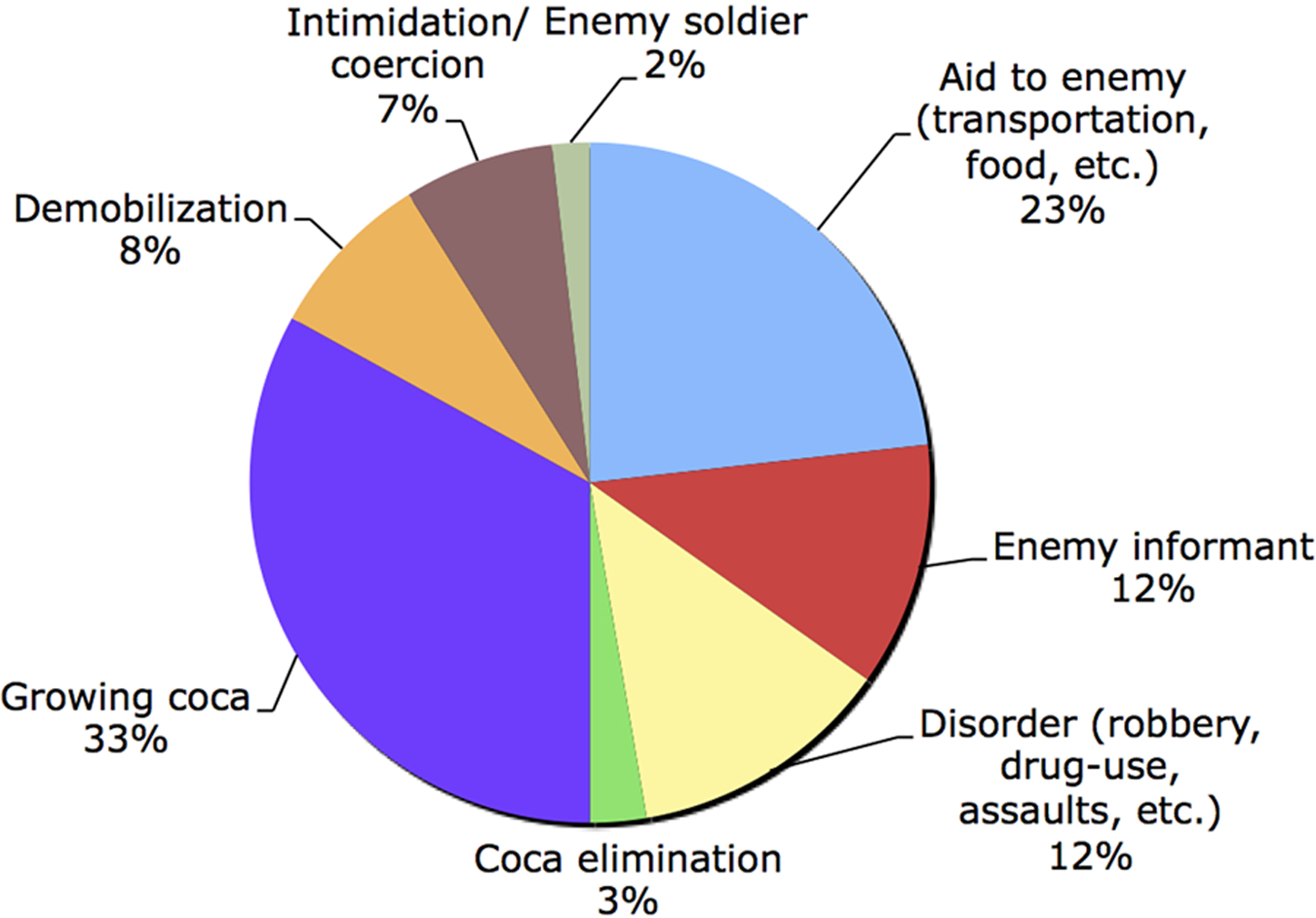

The data on threats and the presence of informants also provide insight on the geographic variation in the balance of armed group control by villages in the region. For instance, as shown in the map in Figure 5, the villages with the most threats by the guerrillas were La Ceiba, Information and appeals used by the ATCC to investigate threats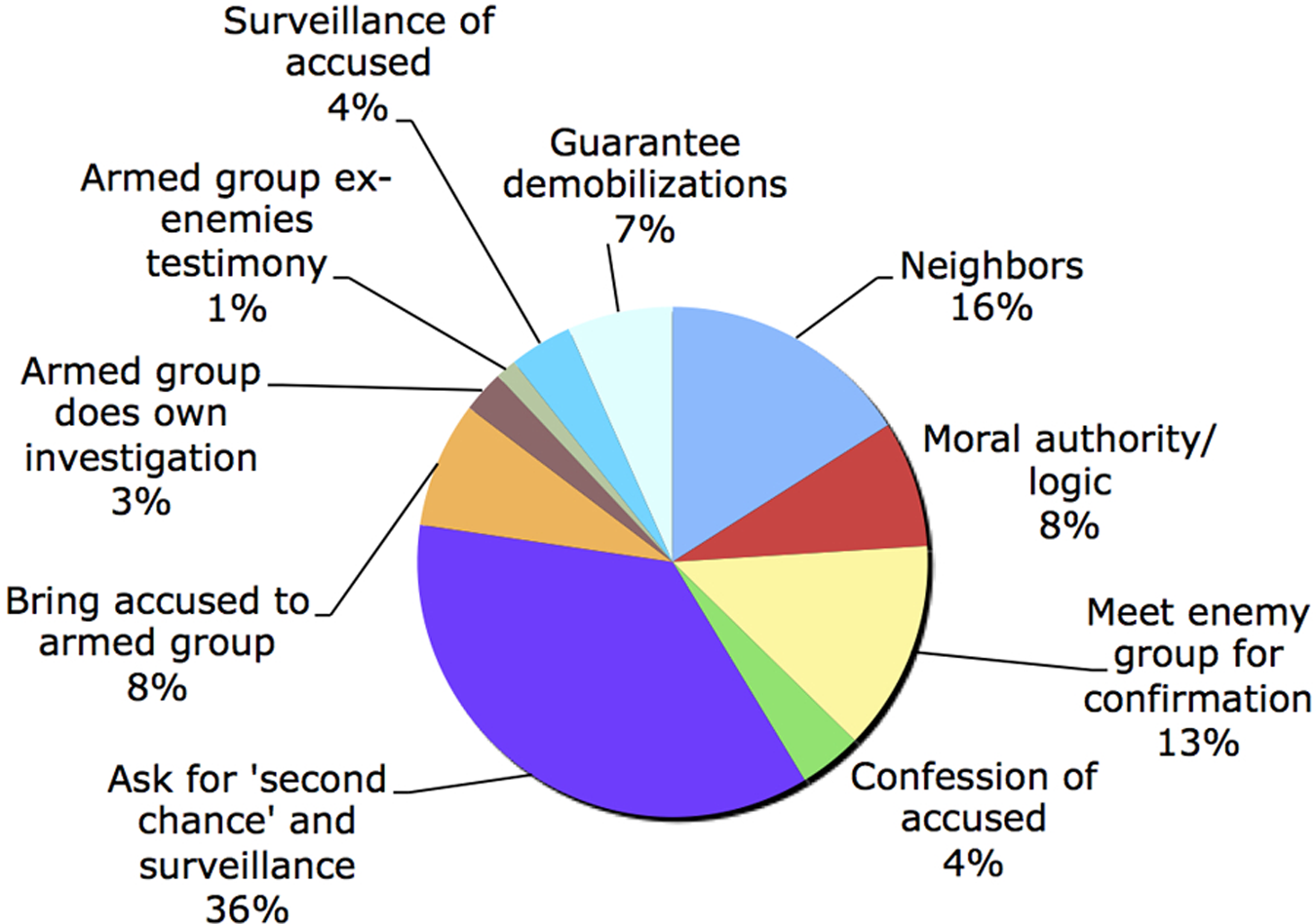
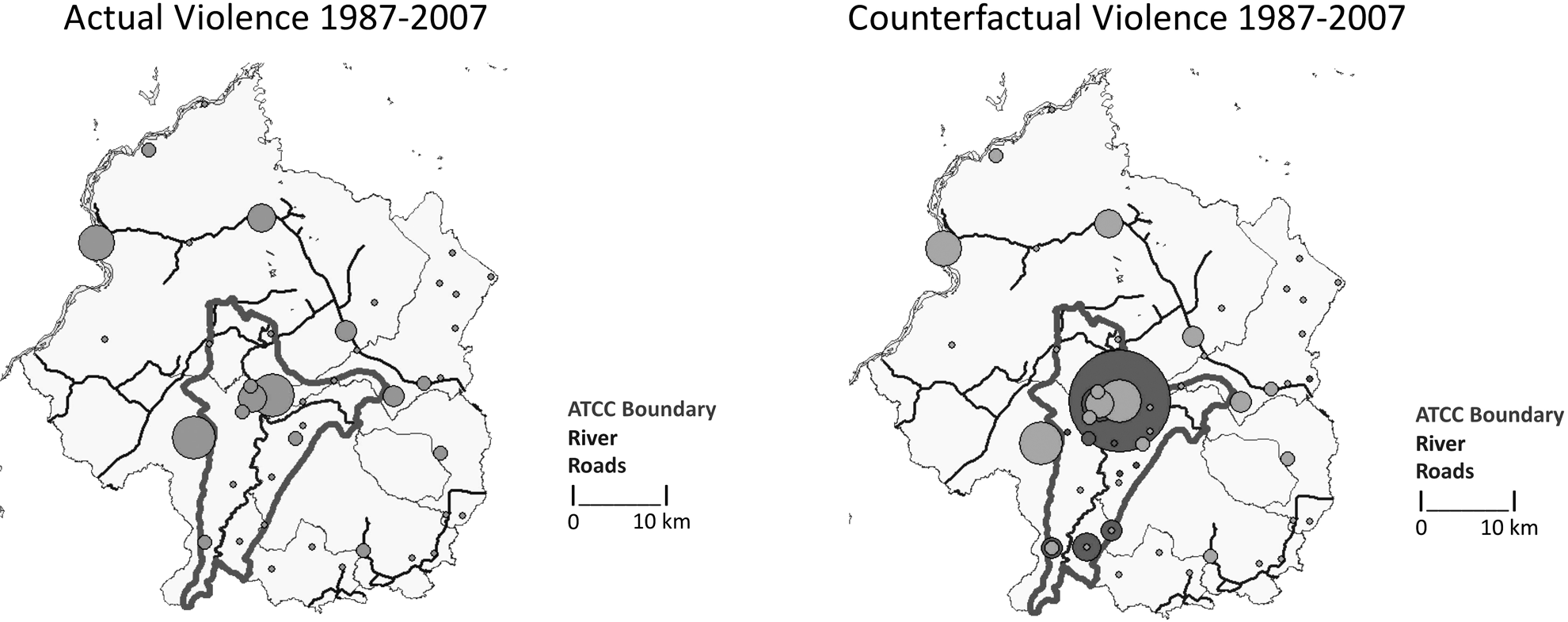
Lastly, the threat conciliation data enable comparisons between violence in the ATCC ‘area of influence’ and the immediately surrounding areas. This comparison suggests the ATCC experienced similar levels of armed conflict danger to its neighbors but suffered fewer actual killings. I pooled data on events from CINEP, Grupo Nizkor (2001; from press and police reports), Zamora (1983), and Vargas (1992) at the village level to code killings by whether they occurred within the ATCC area of influence or in (rural) neighboring areas within the six municipalities in which the ATCC is located (see Appendix for notes on these data). These data were then matched with the interview data I collected on (successful) threat conciliations within the ATCC region to gauge the number of killings that might have occurred absent the ATCC (conciliations plus the actual killings). I was able to code for a 32-year period from 1975, 12 years prior to the founding of the ATCC, through 2007. These series are displayed in Figure 6 and mapped in Figure 7.
The ATCC zone suffered much higher conflict homicide rates (per 100,000 residents) prior to the founding of the organization in 1987 than did neighboring villages. Because this greater repression should have made social organization even less likely, the trends argue against the ATCC forming solely because of mild conflict conditions. By contrast, in the post-1987 period after the ATCC was founded, the homicide rate in the ATCC region over time trends slightly lower than in the neighboring areas. However, the dashed line, which represents the number of killings and threats that were resolved in the ATCC region – the counterfactual scenario – rises to somewhat approximate the actual killings that occurred in the neighboring areas. Consistent with the ATCC becoming more effective by strengthening its conciliation institutions with a delegation of conciliators after increasing threats in the late 1990s, the number of successful conciliations is also shown to increase over time (the gap between the dashed total ATCC victims line and the solid line representing number of ATCC victims killed). These trends corroborate that the ATCC suffered less violence than its neighbors despite experiencing similar or greater levels of danger from armed groups.
Conditions for the maintenance of local order in wartime
The ATCC functioned in a context of continued threat, danger, and denunciations, yet little or no violence occurred against its members. The success of the The balance of control among armed groups across ATCC villages, 1987–2007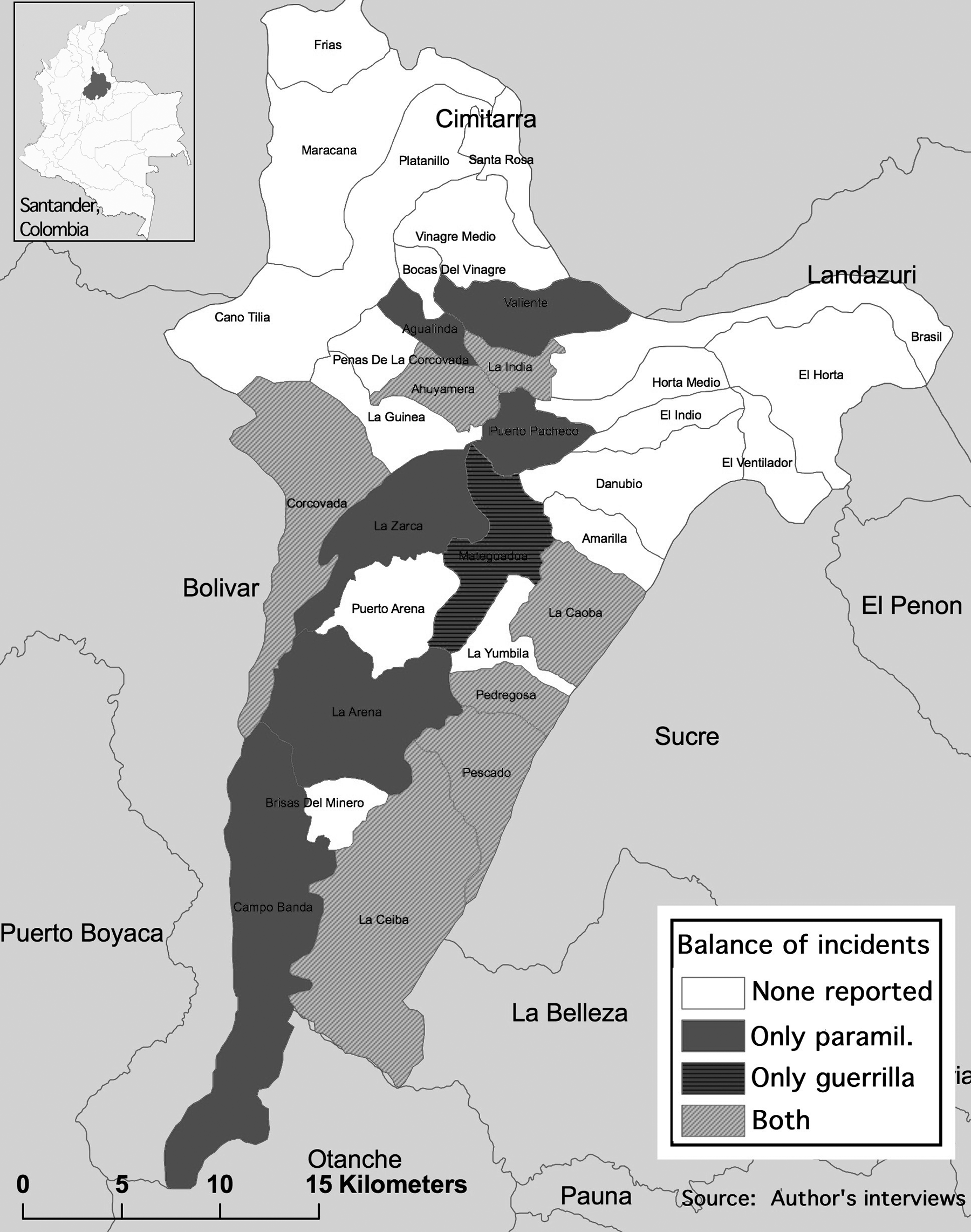
Condition 1: Institutional investigatory capacity
A civilian organization can mediate the flow of information and provide credible, balanced signals to armed actors about the participation of residents in the conflict (e.g. active fighting but also giving information, food, Threat and killing rates in the ATCC zone vs. neighboring areas Maps of actual and counterfactual violence in ATCC and neighbor regions, 1987–2007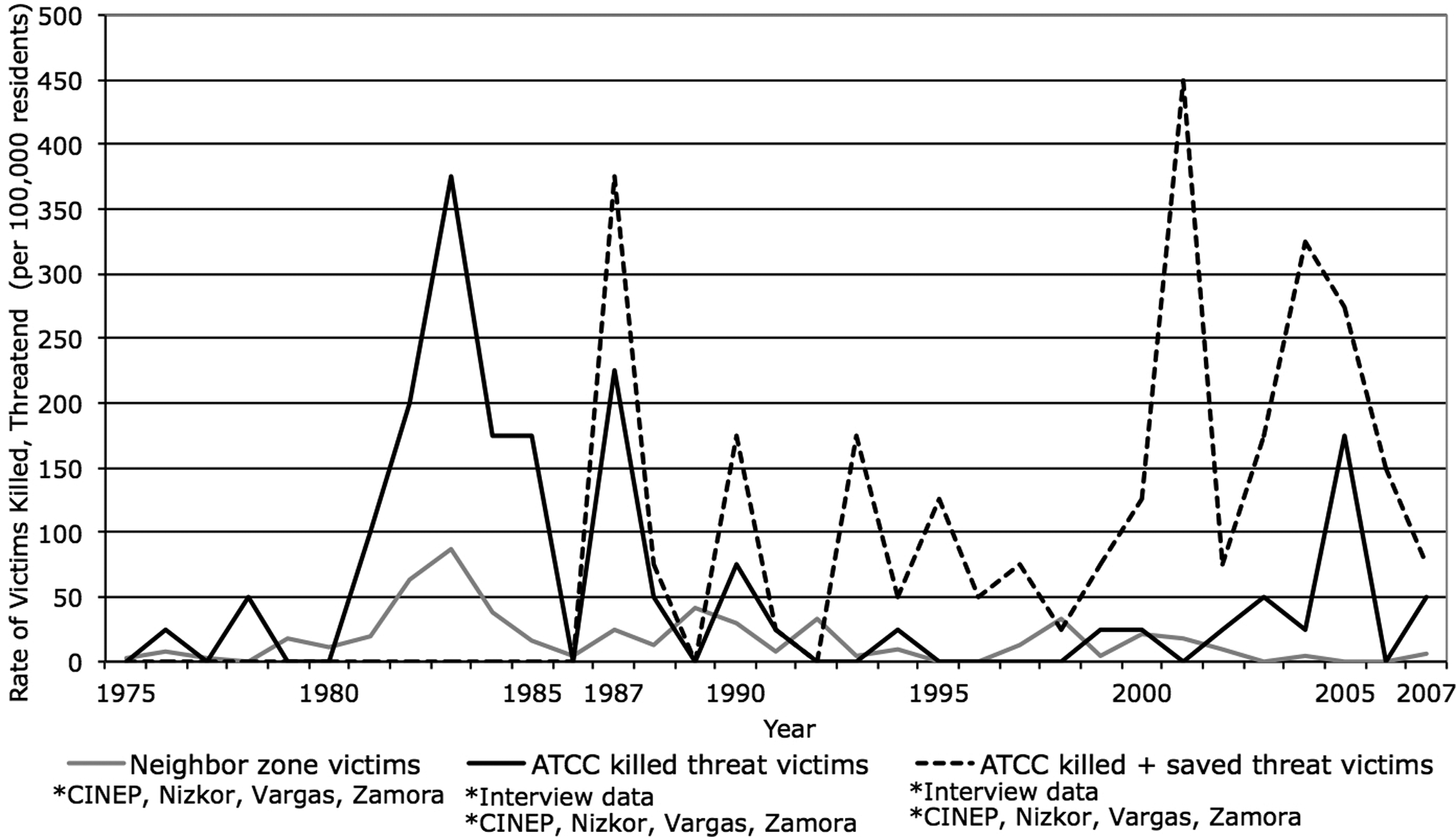
The institution need only provide information, as it can rely on ‘out-group policing’ by the armed actors to enforce punishments when necessary (a variant of Fearon & Laitin’s [1996] ‘in-group policing’). Similar to the Law Merchant institution (Milgrom, North & Weingast, 1990), the onus is on the individual in the community to stay out of trouble with armed actors. Since the institution only provides information, it cannot restrict residents (whether few or many) from participating in the conflict and thereby running the risk of being denounced and killed if they are ‘outed’. In other words, it stays an execution, but only until a verdict is reached. The institution alone cannot broadly eliminate violence against civilians, only against ‘virtuous’ ones.
Investigations by the ATCC, or clarifications (aclaraciones), as the residents refer to them, actually unfold in several ways. While it is most common for armed actors to bring suspects before the ATCC for inquiry, they do not always defer to this procedure – the ATCC does not always learn about threats and gather information strictly ‘by the book’ as I first expected. In these circumstances, ATCC civilian informants with knowledge of threats may leak them to the Junta. Alternatively, some combatants in the armed groups with affinities for the civilians (referred to as ‘angels’ or ‘friends of peace’) may be against a particular ‘cleansing’ and surreptitiously alert the ATCC. 28 Usually, once the ATCC is made aware of threats it is able to intervene – even when the armed groups were originally quite determined to eliminate suspected collaborators.
Condition 2: Civilian pacifist preferences
To eliminate violence against civilians, the civilians must also confront the ‘preference problem’, or the problem that some civilians prefer to participate in the war more than others (or alternatively, are less ‘deterable’ from collaborating with an armed group). Preferences over participating in the conflict can be influenced by various sources. There may be substantial ‘selective benefits’ to aiding or joining an armed group (Lichbach, 1994). Examples from the ATCC region include payments for aid, threats for not providing aid, payments for coca cultivation from which cocaine is made, or gaining an advantage against one’s neighbor. These rationalist/materialist benefits may be counterbalanced by other factors that work to keep civilians out of conflicts. For one, economic development and economic opportunities can reduce the desperation poor civilians may face to grow coca or receive other selective payments from armed groups.
Norms of nonviolence, or the philosophical and ideational belief that peace and nonviolence are morally superior to war and killing, are another way to keep civilians from getting entangled with an armed group. The pervasiveness of religion and spirituality can shape these moral antiviolence beliefs, as some ATCC residents asserted the Seventh Day Adventist theology did in their region. 29 For instance, civilians that obey strong norms of nonviolence may be less inclined to participate in coca cultivation, even if they are economically disadvantaged. Nonviolence norms and a ‘culture of peace’ are often the focus of peacebuilding strategies.
Various events and circumstances surrounding the founding of the ATCC likely contributed to building norms for neutrality and non-participation in the conflict. First, the ultimatum to displace led to a sorting process where less resolute residents left the region or joined their armed actor patrons (Hernández Delgado, 2004: 329). Second, once the ATCC was founded, solidarity was strengthened by the persisting threat environment (García, 1996: 251). Third, there was some social indoctrination and awareness-raising by the ATCC in its early years. Large meetings were held in the plazas and the recordings of meetings with armed actors would be played on loudspeakers as a form of ideational coordination. There were also educational programs to explain the purpose and functioning of the ATCC and educate about human rights. Fourth, the institutional investigation process gave further motivation to civilians who were considering aiding armed groups to straighten up or leave the organization or the region for fear of being targeted (as did the protection of upstanding residents). Fifth, a ‘Group of Conciliators’ was established to mediate interpersonal disputes so they would not be resolved through outside actors. Sixth, the accords also won commitments from the armed actors to not impose on civilians by asking for support, making non-participation in the conflict more permissible.
Norms can be a powerful force for nonviolence but alone are not sufficient to protect civilians from violence since the politics of civil war show that many upstanding people can be falsely implicated as enemy supporters. For instance, although many ATCC-zone residents were very spiritual and pacifist before 1987, violence was rampant and many exemplary residents were killed by false accusations. 30 There was no way to ‘vouch’ for pacifist citizens who had been implicated, so pacifist and opportunistic citizens alike were killed. While norms were strengthened after 1987, it unlikely that the degree of faith and spiritual purity of residents alone brought the extreme reduction in violence.
Condition 3: Armed actor incentives for compliance
Civilian information systems and pacifist norms can be helpful but will not eliminate violence if armed actors have no incentives to abide by (agree to) the civilians’ institutional procedures in the first place. Why should not armed actors simply kill a civilian implicated with helping their enemy? Some amount of joint interest among the armed actors to preserve or not directly target the civilian community must exist (i.e. non-genocidal situations). However, this does not mean that an armed actor alone has no interests in committing violence against civilians (this might depend on the choices of their rivals). For instance, all armed actors may seek to coerce the support of the population through violence, though they may also all prefer accuracy to avoid angry backlashes. 31
The ATCC civilians pursued a cooperative strategy through negotiations and dialogues to get armed actors to buy in to their process. They negotiated symmetrical, transparent agreements so armed groups could be confident they were not losing civilian support to other groups (and they tape-recorded meetings with armed actors for added transparency). The investigation process reduces the burden on armed actors to carefully select their victims to deter enemy collaboration, since the ATCC bears these costs. The ATCC also discarded strategies and policies that might run against armed actor preferences and upset the institutional equilibrium. For instance, since the armed groups wanted to be seen as the legitimate law of the land and were sensitive to bad publicity, the ATCC more conciliatorily opted not to publicly denounce by name suspected culprits of acts of violence. 32 The ATCC also did not prohibit the armed groups from passing through their territory since it belongs to ‘all Colombians’ (but insists they do not bring arms into communities), which may allow for independent verification of the fair implementation of its institutional procedures. 33
Civilians may also even provide some benefits to armed actors by acting as neutral arbiters and serving as a channel of communication. First, the ATCC helped the armed actors negotiate various prisoner of war exchanges. 34 Second, the ATCC has facilitated negotiations for demobilizations by guaranteeing the security of combatants as they reintegrate into civilian society. In the mid-1990s, some members of the local FARC fronts, including a commander, took advantage of the ATCC’s arbitration and laid down their arms. 35 Third, the ATCC peace overtures also reportedly facilitated ceasefires. As one resident eloquently described the armed groups’ desire to avoid unnecessarily antagonizing their enemies, ‘When passing a beehive, don’t throw stones.’ 36 This jibes with accounts from World War I where troops from opposite trenches tacitly colluded to not fight (Axelrod, 1984). Although not directly related to the armed actors’ accession to the ATCC’s investigation procedures, these benefits can allow for bargaining leverage across issues, including civilian security.
In the ATCC’s experience, armed actors have generally fought through the civilian population, being loath to have direct confrontations with the enemy. 37 Limiting civilian defections by limiting casualties appears to have become a second-best option to paying the costs of winning the civilians’ full allegiance. The perception of fairness of this civilian arrangement turns out to be central to its stability and compliance. By implication, the process depends on the armed actors’ access to high quality, transparent information to independently verify the workings of the ATCC. Ironically, sapoarmed actor informants embedded within civilian society are a central source of confidence in the institution. 38
Accounts from the combatants (from archives, interviews, and secondary reports) support this view of their preferences and strategies toward civilians. Evidence that largely draws on the experience of the AUC paramilitaries (United Self-defense Forces; since with relatively greater control and capability they had greater incentives and opportunities to commit violence than the guerrillas) highlights how they can be persuaded by community processes, although similar motives can be found from guerrilla accounts. Consistent with the paramilitary bloc apparently committing more abuses outside the ATCC zone than within it (as illustrated by the San Tropel killings and the data in Figure 6), the narratives indicate that the armed groups of the region were not simply especially respectful or generally preferred to avoid killing civilians.
The accounts instead suggest that the use of violence is conditional on community organization and collective action. This insight is borne out in a verbatim transcript of a meeting between the ATCC leader, the representatives of the relatively poorly organized villages of San Tropel and Santa Rosa on the border of the ATCC, and a paramilitary subcommander held in 2001 in Santa Rosa, Cimitarra (from the ATCC archive). When Santa Rosa residents voiced concerns about being stigmatized by the guerrillas, they probed whether the paramilitaries would leave and allow them the kind of autonomy enjoyed by the ATCC. The paramilitary subcommander present tellingly responded, ‘The entire community would have to decide…. But if only two or three people don’t want our presence, then we’ll continue to be here.’ Freedom from armed group incursions would depend on the level of cohesion, indicating the guarantees of the ATCC process itself were pivotal in affecting the group’s calculus and diminishing violence, rather than some inherent characteristics of or changes within the armed group.
Another ex-paramilitary subcommander from the bloc provides additional confirmation. 39 He noted that violence was more frequently employed prior to 2000 because they had not yet learned how to interact with civilians. Worried about losing support and seeking less costly strategies, they became increasingly willing to delegate the maintenance of order, but mainly to well functioning village councils.
The AUC paramilitary would be expected to have relatively fewer incentives to commit violence in the neighboring zones where their control was even more dominant. However, as noted by a village representative from neighboring San Tropel, there was both greater control and greater repression: ‘For us it hasn’t gone very well, since we’re 100 percent dominated by the Autodefensas’ (2001 meeting in Santa Rosa, ATCC Archives). A similar pattern can be seen with the guerrillas. One resident who moved to the ATCC region from another part of Sucre municipality under heavier guerrilla control said that the guerrillas would not investigate gossip there, but would simply kill ‘at once’. 40
Greater background on the motivations behind the paramilitary’s stances toward communities and their ambivalence is found in additional archival minutes from a meeting with a different AUC subcommander in an ATCC village from September 2003.
41
In the verbatim exchange, Comandante Montoya, true to his group’s counter-insurgent, ‘self-defense’ mission, initially proclaims his solidarity with the campesinos, ‘We truly believe our work should go hand in hand with the community… to free this zone from the guerrilla. We’re here because there are campesinos.’ He later derides the guerrillas, professes his own group’s humaneness, and also acknowledges the weight of the accords signed with the ATCC: It’s the guerrillas that attack you. In our ideological principles we respect life and come from the communities – we aren’t ordered to kill campesinos. Commander Botalón talked to me about the accords and we believe we are complying with them. We accept your claim to the right of neutrality. But … since the conflict is intensifying, the population should choose a side.
Montoya goes on to more clearly express his main concern of civilians’ defection to the guerrillas. Acknowledging that the AUC does not depend much on the population for material support, he wants to assure the accords are being reciprocally upheld: We don’t need things [drugs, food, and arms] from you the way the guerrillas do. I recommend you don’t compromise yourselves [with the guerrillas]. That’s not a threat, it’s a suggestion…. The campesino that dedicates himself just to his family doesn’t have any problem; if he acts to the contrary, he will see.
The Jekyll-and-Hyde balancing act of these paramilitaries is confirmed by Colombian scholars Gutiérrez Sanín & Barón (2005: 20). They concur that the paramilitaries have been willing to allow civilians space for autonomy within certain constraints, ‘[Commander] Botalón tolerates trade unionism and collective action … as long as it clearly distances itself from the guerrilla’. The authors observe the group’s interest in maintaining order on the cheap, though also suggest it is tenuous, as the possibility of the breakdown of that order is never far away: ‘Botalón … has learnt to calculate keeping in mind long-term horizons, which involves higher levels of self-control [and] replacement of pure repression by less expensive mechanisms…. Naturally, this does not prevent occasional outbursts of murderous violence’ (2005: 22). With the theory developed here, these outbursts are now better accounted for.
Epilogue: The investigations mechanism amid a resurgence of violence
Starting in 2000, violence returned to the ATCC region after having few if any civilian victims for nearly a decade. The ATCC’s residents were again put at greater risk as the guerrillas increased their presence in the region and contestation increased between the guerrillas and the then-dominant paramilitaries. With the contestation, violence increased as well. Conciliator estimates suggest around 35 civilians were killed in all. Although the new violence could reflect some amount of institutional breakdown of the ATCC, institutions were actually strengthened, with a tribunal, village committees, and teams of conciliators to investigate, formalized by-laws, and a membership drive. 42 I find that the critical change that correlates with the increase in killings was the distribution of the population who were normatively committed to neutrality and non-involvement in the armed conflict. 43
In the post-2000 period, two new populations emerged that were not committed to the norms inculcated at the ATCC’s founding – from memories and experiences of suffering great violence and overcoming it. First, new migrants came to the region attracted by its tranquility but then grew coca. The immigrants were either by nature (or experience) more opportunistic than the ATCC population, or simply less morally committed to neutrality and so enticed by armed actors into the coca economy. When these individuals inevitably became endangered, there was little the ATCC could do despite its commitment to protect all civilians. In a sense, the ATCC was a victim of its own success. The ‘peace’ and growth the ATCC fostered during the 1990s created the moral hazard of attracting these new migrants to the region to share in the prosperity (for instance, a resident moved to the ATCC sanctuary from elsewhere because of the danger of gossip he faced there). 44 This reflects a partially ‘endogenous’ source of change in the equilibrium of violence, as the institution itself, while beneficial, can also produce instability and be ‘self-undermining’ (Greif & Laitin, 2004). Residents said the ATCC was unable to counteract this trend: as an informal organization, it does not have the governing powers to set boundaries and keep migrants out. 45
Second, a growing population of youths who were born around the time of the founding of the ATCC came of age around 2000. These youths were not old enough to remember the formation of the community and so were less influenced by the community’s neutrality norms (recall the plight of Señor George). These youths ‘created disorder’ and were often paid by armed actors to be informants (often using the money to buy small prizes for status, such as soft drinks or shoes). 46 Again, once a youth is involved in the conflict, there is little the ATCC can do.
Conclusions
This study profiled some of the unarmed, nonviolent strategies that are used against heavily armed combatants in civil war settings to protect human rights. The ATCC experience as a single but important community suggests that civilians are not powerless and can effectively organize against repression to make life in lawless wartime settings a little more predictable and ordered. The ATCC civilians did not wait for intervention or focus on national-level peace negotiations or military strategies. Instead, they took matters into their own hands. I explored how and whether their efforts – the mediation, production of credible information, and behavioral norms – functioned as an explanation for violence.
An empirical framework and methods for measurement were developed to study this form of ‘peacebuilding’ in the midst of conflict. The dataset of threat conciliations helped trace the ATCC process and even provided quantification of how the armed conflict and concomitant threats unfolded and were dealt with. Under the ATCC investigations mechanism, suspected collaborators found to be innocent were less likely to be killed than those found to have collaborated. The ATCC’s cooperation and institutions set it apart in the eyes of armed groups from its violence-suffering neighbors. These findings suggest existing theories of violence such as the balance of control have limitations since they do not completely explain violence: denunciations against individuals were short-circuited and the production of violence did not lie solely with armed groups. The findings have broad implications for civilian agency, community resilience and autonomy, and peacebuilding in civil wars.
Perhaps one sobering implication is that peace is not simply or easily ‘created’. The absence of violence emerged through a subtle interaction between mediation, nonviolent civilian norms, and armed actor preferences. There are also limitations on where civilian organizational processes succeed – they are not a panacea. Along with successes, communities face challenges and failures. The ATCC suffered continued pressure and, at times, outbursts of violence. As the ATCC and other communities have realized, stability requires continuing collective action and active management to counteract the self-undermining processes triggered by their successes. These may include strengthened mediation procedures, community processes to maintain norms, or even alternative development programs that limit civilians’ participation in the conflict out of opportunism or desperation. The ATCC has continued working to keep residents from growing coca and to provide opportunities for youths. 47
Organizations such as the ATCC exemplify what could be, what is possible. These kinds of communities brave great risks and costs in resisting pressures from armed groups and yet are crucial inspirational models. To the extent that local peace institutions take hold across many communities, grassroots movements may have broader effects on belligerents’ behavior at the macro level, including resolving uncertainty, the reduction of violence, and supporting national peace negotiations to bring conflicts to a close. The replicability of experiences such as the ATCC should certainly be studied further, yet there is reason to believe they can generalize to other communities. 48 The ATCC’s context of a frontier area with shifting conflict dynamics and little state presence or rule of law resembles other conflict-ridden parts of the world. Some of the ATCC’s features may be distinct, but within Colombia, similar investigation procedures have been implemented by certain village councils and indigenous groups in the cross-fire, including the Nasa Indians in the Cauca department. Many communities may be hoping to mimic these processes, though less organized or highly endangered communities may consider less institutionalized protective strategies. By having unpacked the details of how local, nonviolent protection institutions work beyond the mantra of ‘resistance’, new communities and NGOs will hopefully be better able to understand and apply these models when and where they are needed.
Footnotes
Replication data

Acknowledgements
I am grateful for feedback from Ken Schultz, David Laitin, Jacob Shapiro, Jeremy Weinstein, Terry Karl, Elisabeth Wood, colleagues at Stanford and Princeton, and the three anonymous reviewers. I thank Daniela Uribe, Marie Claire Vásquez, and Juan Jurado for their valuable research assistance.
Notes
References
Supplementary Material
Please find the following supplemental material available below.
For Open Access articles published under a Creative Commons License, all supplemental material carries the same license as the article it is associated with.
For non-Open Access articles published, all supplemental material carries a non-exclusive license, and permission requests for re-use of supplemental material or any part of supplemental material shall be sent directly to the copyright owner as specified in the copyright notice associated with the article.
