




Abstract
Many studies have examined the formation of interstate rivalries, but few provide a theoretical mechanism capable of explaining why some neighboring states experience protracted conflict while others do not. To address this question, we theoretically link bargaining theories of conflict with issue-based explanations of conflict to offer a novel application of the commitment problem mechanism. We argue that when neighboring states disagree over border territory endowed with a potential source of power (i.e. strategic or economic value), it is difficult for either side to commit credibly in the future to comply with agreements made today. Consequently, neighboring states may be reluctant to make concessions that could enhance their adversary’s future bargaining power. This reluctance, in turn, increases the likelihood of bargaining failure, thereby also increasing the likelihood that the dispute festers and the relationship evolves into a rivalry. Using recently reported data on border settlement and three measures of rivalry, we find systematic evidence for our theoretical expectations. Unsettled borders increase the likelihood of rivalry onset. This relationship, however, seems driven by border territory containing strategic and economic endowments – the exact type of territory that theoretically drives commitment problems. We therefore conclude that not all territory matters for the onset of contiguous rivalries.
Keywords
Introduction
Since independence, the relationships between India and its neighbors have varied substantially. Relatively peaceful relations were formed with three neighbors – Nepal, Myanmar, and Bhutan. In contrast, India developed rivalries (i.e. feelings of threat, enmity, and competition accompanied by militarized conflict) with its remaining three neighbors – Pakistan, China, and Bangladesh. What caused the formation of friendly or hostile relations with each neighbor? More generally, why do some neighboring states become rivals, but not others? Although scholars have attempted to answer this question, they have yet to articulate a clear, generalizable causal mechanism complete with the micro-foundations necessary to understand why some neighboring states become rivals while others do not.
We confront this lacuna directly and propose that a key factor fostering rivalry onset is the presence of a commitment problem generated by disagreement over border territory. States with unsettled borders – that is, borders that are not delimited in entirety by an international agreement – not only face a salient external threat, but also can experience greater difficulty in peacefully resolving that threat if the border territory contains a potential source of power. When potential sources of power are disputed, any concession may increase the future bargaining power of an adversary. This does two things. First, it increases the incentives of the state gaining power to renege on the original agreement and subsequently renegotiate it from a stronger bargaining position. Second, the state losing power has little incentive to offer concessions to reach an agreement because these concessions undermine the agreement’s durability. In both cases, border territory – particularly that endowed with characteristics capable of affecting the distribution of power – can undermine border settlement by increasing the likelihood of a commitment problem.
Scholars generally use commitment problems to explain why states cannot achieve prewar bargains that allow them to avert war. We, however, offer a novel extension of this argument by proposing that a commitment problem may also increase the likelihood that disagreements over sources of power (i.e. unsettled borders) will facilitate rivalry development. This argument dovetails with recent research on the territorial peace (Gibler, 2012) – although we extend this too in a novel way. The territorial peace maintains that an external threat (specifically, unsettled borders) encourages an aggressive foreign policy toward the source of the threat (see Gibler, 2012). Since border threats arise (by definition) between contiguous states, neighboring states will be the target of these aggressive foreign policies. We adopt this foundation, but argue that not all territory is alike. When the unsettled border territory contains endowments capable of shifting the distribution of power between disputants, a commitment problem arises that prevents disputants from easily negotiating their border’s settlement. Thus, we expect such disputes to fester, aggressive foreign policies to become routine, and, therefore, feelings of threat and enmity associated with rivalry to emerge. In short, unsettled borders should significantly contribute to rivalry onset between neighboring states, especially when border territory contains power endowments.
The territorial theory of rivalry formation we develop contributes to our understanding of rivalries in many ways. First, we advance a theory of rivalry formation motivated by a novel application of the commitment problem mechanism. Existing research on rivalry generally either ignores the initiation of rivalries (e.g. using rivalry to select cases) or presents a loose framework that describes rivalry formation, rather than a causal mechanism that explains its emergence in some cases and not in others. We offer such a mechanism, and one that has not been discussed before as a source of rivalry. Furthermore, few studies empirically test the commitment problem logic in interstate conflict, and we offer such a test (for an exception, see Carter, 2010).
Second, our theory and findings suggest that not all territory matters for rivalry onset. This stands in stark contrast to studies that merely link territory generally to rivalry. Absent power endowments, which can trigger commitment problems, borders are more likely to settle and less likely to generate protracted conflict. When these endowments are present, the probability of a commitment problem increases, decreasing the incentives for peaceful settlement and increasing the likelihood of rivalry. One key implication is that researchers need to systematically account for variations in the types of territorial border endowments when theoretically and empirically evaluating the relationship between territory, protracted conflict, and war. Third, because existing research lacks a clear causal mechanism, studies on rivalry initiation, maintenance, and termination remain disconnected. By identifying one such mechanism, we set the foundation for creating a unified theory of at least one type of rivalry – that between contiguous states – from formation to termination.
Fourth, our argument and findings propose two paths to rivalry: one for contiguous dyads and another for non-contiguous dyads. Although our focus in this work remains on contiguous dyads, the theoretical promise of two paths to rivalry may guide future work. 1 Fifth, we suggest that previous attempts to associate rivalry with territory (broadly defined) have suffered from a number of important methodological limitations – in particular, post hoc assessments of the issues dominating rivalries and the use of indicators endogenous to the rivalry definition. We correct this by using newly reported data on border settlement and a research design that both allows us to minimize concerns about the endogeneity of indicators and permits an a priori assessment of the factors causing rivalry. Finally, our findings lend support to several prominent strands of research, including the steps-to-war and territorial peace research programs.
In the end, a theory of rivalry focusing on borders receives robust empirical support. As we expect, unsettled borders increase the likelihood of rivalry onset between neighboring states. This seems to occur largely because of commitment problems. When border territory possesses potential sources of bargaining power (e.g. strategic or economic power endowments), states are significantly less likely to settle their borders and to fight militarily over it. Furthermore, this endowed territory increases the likelihood of rivalry onset. Each of these findings holds regardless of how we operationalize rivalry or power endowments and supports our argument that it is this type of territory that drives the danger inherent in unsettled borders. Our study thereby indicates a clear need to differentiate between types of territory within theoretical arguments.
How rivalries form
The interstate rivalry concept has received considerable attention, as scholars seek to understand why this subset of states is particularly conflict-prone. Unfortunately, our understanding of the mechanism triggering rivalry formation remains limited for two reasons. First, researchers often use rivalry as a case selection device, rather than an outcome demanding explanation (e.g. see Greig, 2005). Because these studies take rivalry as given, they cannot study the origins of rivalry. Second, those interested in the ‘causes’ of rivalry typically create a conceptual framework, as opposed to identifying a causal mechanism by which rivalries emerge. These frameworks take three primary forms: process-oriented, punctuated equilibrium, and statistical correlates.
Vasquez (2009), Valeriano (2012), and Hensel (1999) typify the process-oriented framework. Each characterizes rivalry development as an ‘evolutionary’ process, whereby two states disagreeing over the status quo use bellicose rhetoric, in conjunction with power-politics practices (e.g. military mobilization, alliance seeking, and arms races), as primary bargaining tools to address that disagreement. The repeated use of such rhetoric and tactics, coupled with recurrent militarized disputes over unresolved issues, create and reinforce feelings of threat and enmity as the involved states expect one another to behave aggressively for the foreseeable future.
Although informative and, we believe, probably a descriptively accurate conceptualization of rivalry development, these efforts lack the micro-foundations necessary to explain why the first negative interaction occurs or why it festers – as opposed to remaining an isolated event, as many disputes do. Similar to war (Fearon, 1995) and arms races (Rider, 2009), rivalry is a costly and inefficient means of achieving one’s preferred distribution of goods. Thus, we would expect states to prefer settling disagreements without resorting to protracted, costly, and inefficient rivalries. The question therefore remains: why do rivalries form?
As an alternative to the process-oriented framework, Goertz & Diehl (1995) offer a punctuated equilibrium model, in which shifts between non-rivalry (peaceful) and rivalry (conflictual) occur as an abrupt by-product of domestic or international political shocks. Unfortunately, these shocks (and, therefore, the framework) provide little guidance when trying to predict rivalry onset or the factors that policymakers might manipulate to avoid it. Because political shocks are necessary but not sufficient conditions of rivalry formation, many shocks will not produce a rivalry within a given dyad (on this point, see also Morey, 2011: 264). This may explain why the punctuated equilibrium model receives limited empirical support (Stinnett & Diehl, 2001; Bennett, 1998).
Finally, Colaresi, Rasler & Thompson (2007) offer a framework for rivalry based upon identifying the statistical ‘correlates’ of rivalry. To achieve this, they re-examine Bremer’s (1992) canonical ‘dangerous dyads’. Bremer (1992) identifies six variables associated with war-prone pairs of states: contiguity, alliances, economic development, democracy, the distribution of power, and major-power status. Using this variable list, Colaresi, Rasler & Thompson (2007) explore the causes of two different types of rivalry – positional (i.e. struggles over status or influence) and spatial (i.e. struggles over territory). In general, they find that Bremer’s propositions poorly inform our understanding of the causes of rivalry (Colaresi, Rasler & Thompson, 2007: 190), which demonstrates a clear need for further theorizing.
Rivalry, territory, and borders
The main difficulty with the conceptual frameworks of rivalry discussed above is that they lack a causal mechanism by which we can predict rivalry formation. What, for example, starts the evolutionary process in motion? What distinguishes the shocks that produce rivalry from those that do not? The answer to these questions may lie in the issues that produce interstate disagreements.
A review of research that investigates the issues over which states fight yields two noteworthy conclusions. First, states use power-politics practices more frequently when handling territorial disputes as opposed to disputes over other issues. Because such practices increase the likelihood of MIDs and wars, territorial issues underlie a great deal of international conflict (for a review, see Vasquez, 2009). Second, territorial disputes (if unresolved) are more likely to fester, thereby increasing the likelihood that militarized disputes over territory recur (Hensel, 2001; Vasquez & Leskiw, 2001). Both findings provide potential links to interstate rivalry: because territorial disputes fester and produce a disproportionate number of militarized encounters, they should theoretically generate the characteristics found in rivalry (i.e. threat, enmity, and competition). Indeed, empirical evidence confirms such a connection between rivalry and territorial disputes (broadly defined); depending on the operationalization of rivalry used, 52–69% of rivalries contain a territorial element (Tir & Diehl, 2002; Dreyer, 2010). 2
Descriptively at least, territorial conflict therefore seems strongly associated with rivalry. Yet the research linking territorial conflict and rivalry suffers from some significant limitations. First, few studies offer a systematic test of the territory–rivalry link. Instead, most research is merely suggestive; because territorial disputes are difficult to resolve, tend to persist, and escalate to war at a higher rate than disputes over other issues, scholarship often implicitly assumes a rivalry–territorial issue linkage. For example, a connection between territory and rivalry is certainly an implicit conclusion from the steps-to-war program (Vasquez, 2009), but scholars rarely test this link. Second, studies that attempt to establish this link are plagued by a number of problems. Most, for example, rely on ad hoc assessments of which issues dominate the ongoing rivalry (Vasquez & Leskiw, 2001), rather than a priori assessments of the issues that exist prior to rivalry onset. Furthermore, studies that include such a priori assessments rely heavily on data about the issues involved in militarized disputes (Tir & Diehl, 2002; Valeriano, 2012). Given that rivalry populations are often identified using militarized disputes, using issue data from these same disputes to predict rivalry is highly problematic.
Finally, most (if not all) of these studies focus broadly on territorial conflict, which we believe is theoretically and empirically questionable. Territorial disputes exhibit great variety, and perhaps no subset of territorial disputes is more important than that which involves international borders. Disagreements over the placement of international borders constitute a clear, external threat to state sovereignty and, therefore, to state survival as well (Kahler, 2006). This makes them more salient than other types of territorial disputes (Hensel, 2001). Furthermore, as we argue below, border territory varies as well – between that which does and does not contain endowments that can shift power between states in ways that make rivalry more likely.
Empirical research strongly supports our claim that the connection between territorial issues and rivalry rests significantly on border disagreements in particular. Bennett (1996), for example, notes that 79% of his rivalries involve contestation over control of a mutual border area. A similar conclusion follows from the work of Colaresi, Rasler & Thompson (2007), who find that rivalries containing a territorial element are significantly more likely among contiguous states. Although they do not examine whether border disagreements are specifically involved, their findings confirm that contiguous rival states fight frequently about territorial issues, thereby implying that border territory may drive such rivalries. Indeed, a review of the strategic rivalry narratives confirms this is true (Thompson & Dreyer, 2012).
Based on these theoretical and empirical considerations, we believe a strong foundation exists to argue that border disputes (a subset of territorial disputes) facilitate the formation of rivalries among contiguous states more often than disputes over other issues. This does not imply – and we do not claim – that all rivalries can be explained by unsettled borders. Rivalries can form over other (or multiple) issues, and these issues can evolve over the course of a rivalry (Dreyer, 2010). Nonetheless, we argue that unsettled borders can explain the emergence and persistence of a significant number of rivalries – particularly when border territory contains specific power endowments.
A territorial theory of rivalry
Why do border disagreements emerge and persist, producing violence-prone, militaristic rivalries? To answer this question, we rely on insights from research on interstate bargaining. We propose that one prominent type of rivalry forms as the result of a commitment problem, which occurs when states cannot credibly agree to honor tomorrow an agreement reached today. According to Powell (2006), commitment problems usually result from anticipated, substantial, future shifts in relative power for disputing states. Numerous factors might produce such a power shift, but the clearest case exists when actors bargain directly over a good that is itself a source of power. In such cases, a change in the division of the good necessarily creates anticipated changes in the distribution of relative power between disputants.
When anticipated, substantial future shifts in relative power arise, they create incentives that can undermine negotiation. A state whose power would increase through a proposed agreement – because the distribution of power is altered in its favor by the potential agreement – will have greater motivation to renege on that agreement in the future. Doing so allows it to renegotiate the agreement after gaining power, thereby securing better terms. A state made weaker by an agreement understands the gaining power’s interests; armed with the expectation that its counterpart has incentives to void any agreement reached, the weakening power may withhold concessions (which can produce an unstable agreement) or refuse to conclude an agreement at all. Furthermore, if the weakening state believes its counterpart may grow in power, it may prefer a military confrontation to negotiation – to consolidate the best terms of agreement for itself – before a power shift would later put it at a disadvantage (Werner, 1999). Either way, disputants postpone a final settlement of their dispute. Conflict persists, then, not because of imperfect information about one another’s capabilities and resolve, but because the involved states cannot escape the conflict via a credible, negotiated agreement.
Although scholars generally speak of commitment problems in relation to war, we propose that commitment problems can also explain why some states engage in long-term, inefficient competitions with one another – that is, rivalries. For this to be true, however, the rivals must be competing over an issue that is itself a source of power (as argued above), which would in turn complicate bargaining. Border territories frequently possess this characteristic, with potential power derived from three particular sources. First, border territory may possess strategic value (e.g. the Golan Heights or the Sinai Peninsula to Israel); such territory allows the occupier to extract (further) concessions from an opponent by increasing the probability of winning future military battles. Second, it can contain a population that can be employed in economic production, drafted into military service, or taxed to generate additional revenue (e.g. well-populated sections of Kashmir). 3 Third, border territory may contain economic resources needed to fulfill the basic human needs of a state’s population or to produce revenue for the government through trade. Such resources may include access to fresh water (e.g. the Burkina Faso–Mali border), navigation rights (e.g. Iran–Iraq), or oil (e.g. Argentina–Uruguay).
If border territory contains potential sources of power, then neighboring states will consider how acquiring or losing disputed border territory will affect the future distribution of power (i.e. capabilities) between them. Mindful of a borderland’s value, states will be unable to resolve their border disagreement via negotiation. A state potentially made stronger by a settlement cannot credibly promise not to exploit its better bargaining position in the future to renegotiate any agreement reached. Similarly, a state potentially weakened by an agreement may choose not to offer concessions for fear that they lead to further concessions. The salient disagreement therefore festers, and border settlement eludes the leaders. Furthermore, because losing territory by definition threatens state security, leaders rely more heavily upon power politics practices to defend themselves (Vasquez, 2009). These two factors combine to create perceptions of threat, enmity, and competition, as well as military encounters (i.e. rivalries) among neighboring states. They also suggest that a neighboring state’s repeated short-term preferences not to sign a border agreement have the long-term consequence of increasingly souring their relations. Through such a process, border territory triggers rivalries – a trigger overlooked by existing frameworks of rivalry formation.
Based on this logic, we expect that:
Hypothesis 1: A rivalry is more likely to form (ceteris paribus) when contiguous states have mutually unsettled borders than when they have mutually settled borders.
The above hypothesis predicts that unsettled borders lead to rivalry onset. If our theoretical logic is correct, however, we would expect certain types of border territory to drive the commitment problem logic and, thus, rivalry development. In particular, the above argument suggests that the commitment problem between neighboring states is triggered when the border territory itself is a source of bargaining power. We therefore expect that border territory endowed with certain characteristics – such as a key strategic location or economic resources – will be more likely to generate a commitment problem than those without such endowments.
Given the opportunity costs (i.e. lost trade, cross-border movements) associated with conflict between neighbors, states have strong incentives to settle their borders. Indeed, leaders regularly convey this sentiment. Such settlements may be comparatively easy when border territory does not possess characteristics capable of affecting relative power. States that are largely unaffected by fears of future revision more willingly make concessions, thereby moving toward the realization of cooperative joint gains. Bargaining theory suggests that such agreements derive largely from the current distribution of power (Werner, 1999; Fearon, 1995), and unless that distribution dramatically changes in the future, we can expect the agreement to endure, allowing the dyad to reduce the likelihood that it experiences rivalry onset. In contrast, when border territory contains strategic or economic endowments, territorial concessions can shift future bargaining power, thereby creating incentives for future revision and, consequently, conflict. Thus, disputes about border territory that possesses these endowments will be more likely to remain unsettled, fester, and lead to the perceptions (threat, enmity, and competition) and behavior (militarized conflict and aggressive foreign policies) that constitute rivalries.
4
In other words, we expect that:
Hypothesis 2: Dyad-years in which neighboring states’ borders are unsettled are more likely to have a territorial claim endowed with a source of future bargaining power than dyad-years in which borders are settled.
Hypothesis 3: A rivalry is more likely to form (ceteris paribus) when contiguous states have an outstanding territorial claim endowed with a source of future bargaining power.
Before testing the above hypotheses, we must establish the domain of our theory clearly. Our theory applies only to rivalries between contiguous states. Because non-contiguous dyads do not share land borders, unsettled borders clearly cannot be the (or even a) mechanism that drives the development of rivalries among such dyads (e.g. the Cold War rivalry between the United States and the Soviet Union). This accords well with the work of Colaresi, Rasler & Thompson (2007), who find two types of rivalries: spatial rivalries (concerning territorial issues and generally involving contiguous states) and positional rivalries (concerning non-territorial issues and primarily involving major, non-contiguous states). Our theory speaks to the former. Because spatial rivalries constitute a significant majority of rivalries, we believe that our theory therefore addresses an important subset of the rivalries that exist (see Colaresi, Rasler & Thompson, 2007; Dreyer, 2010). Nonetheless, we recognize that positional rivalries also exist. The development of these rivalries, however, requires a separate theoretical argument from the one we outline above, and we leave this task for future work.
Research design
To address our hypotheses, we employ Cox proportional hazard models. These models allow us to assess the effect of our variables of interest on rivalry onset without making an a priori assumption about the distributional form of the underlying duration time (Box-Steffensmeirer & Jones, 2004: 47). Furthermore, we rely upon hazard models generally because we test our expectations using cross-sectional time-series data and survival analysis explicitly models the time dynamics associated with these data.
The unit of analysis for all models is the land-contiguous dyad-year. Using EUGene (Bennett & Stam, 2000), we create one observation for each year that any unique pair of states are both members of the international system during the period 1816–2001. Our study therefore spans the period 1816–2001, although data limitations on territorial claims force us to restrict the temporal domain to the period 1919–95 when analyzing our second and third hypotheses. Once we create these dyad-years, we then limit the analysis to contiguous dyads. This is required for testing our theory’s expectations. Only contiguous states can share borders, so only these states can, by definition, settle borders. We use the Correlates of War (COW) Project’s Direct Contiguity data to identify the contiguous dyads that are included in the study (Stinnett et al., 2002). 5
For our purposes, contiguous states include only those neighbors whose homelands share an inland or river boundary. 6 This is the closest level of contiguity recorded in the COW dataset. Any dyads that are separated by either gulfs or seas are considered noncontiguous; their land borders are determined by the water which separates them, thereby obviating the need for an international land border agreement. There are 19,164 contiguous dyad-years. Missing data across our variables subsequently reduce the number of observations included in each of our models.
Dependent variable
Our hypothesis concerns rivalry onset, necessitating the identification of a rivalry population. There are two widely used rivalry datasets: Klein, Goertz & Diehl (2006) and Colaresi, Rasler & Thompson (2007). Klein, Goertz & Diehl (2006) define a rivalry (hereinafter, KGD rivalry) as a dyadic, interstate relationship in which the two states confront one another in at least three militarized interstate disputes (MIDs; see Ghosn, Palmer & Bremer, 2004) over a similar set of issues. Once a dyad satisfies these criteria, the start year of the rivalry coincides with the year of the first MID. In addition to the KGD rivalry measure, we also use the Diehl & Goertz (2000) enduring rivalry population. Enduring rivals experience a minimum of six MIDs and last at least 20 years, making these a more severe subset of the KGD rivals.
Alternatively, the Colaresi, Rasler & Thompson (2007) dataset uses perceptions of threat, enmity, and competition – rather than dispute participation – to identify strategic rivalries. These threats must contain some possibility of becoming militarized at any time during the rivalry, although they need not lead to actual MIDs (Colaresi, Rasler & Thompson, 2007: 25). For this measure, rivalry dates depend entirely on leader perceptions, with onset occurring when both sides clearly perceive each other as threats, enemies, and competitors.
We use all three rivalry measures in our analyses to guard against any possible biases produced by the rules governing how rivals are identified. For each measure of rivalry, we construct a dichotomous variable noting whether a rivalry began between the contiguous states in a dyad during a given year. Of course, some dyads experience multiple unique episodes of rivalry. We suspect that multiple rivalries that occur within the same dyad are not independent events. Consequently, we estimate and present models below for the first rivalry that develops in a dyad. Dyads then exit the analysis when (and if) a rivalry develops. 7
Key independent variable
We are primarily interested in the effects of settled borders on rivalry onset. Settled borders occur when neighboring states sign an international agreement that delimits the entirety of their mutual (in)land border. A dichotomous variable therefore codes whether a contiguous dyad’s mutual border was settled prior to the dyad-year in question. We take this variable from Owsiak (2012), who provides both a detailed description of its coding and examples. A brief discussion of Owsiak’s four coding rules appears in our online appendix.
When testing our first hypothesis with a straightforward measure of border settlement, we are assuming that (in general) border territory has a propensity to produce a commitment problem, which causes unsettled borders to yield rivalry onset. Although we think this is a reasonable test of the broad implications of our theoretical argument, the second and third hypotheses aim to test the mechanism of the commitment problem more directly. If we are correct, border territory endowed with characteristics that are a potential source of power should produce a commitment problem, be more difficult to settle, and, thus, increase the likelihood of rivalry initiation.
To test the latter two hypotheses, we need to measure characteristics associated with border territory that might produce a potential power shift. We identify two such characteristics – precisely those mentioned by Fearon (1995: 408) and Powell (2006: 185–186). First, strategically valuable territory might alter the military advantage between neighboring states, thereby affecting future bargaining power. Second, the presence of economic resources can alter future negotiating power, as access to greater sources of wealth and income might subsequently be translated into military power. States may therefore be concerned that granting concessions over economically valuable territory will place them at a disadvantage in the future.
We use two dichotomous variables from Huth & Allee (2002) to capture whether a given territorial claim has resource endowments that are either strategically or economically valuable. 8 Because our theoretical argument does not differ based on the type of endowment potentially received from contested border territory, we combine these two measures into one dichotomous measure, called power endowment, that notes whether a territorial claim possesses either strategic or economic value (1) or neither (0). 9
Control variables
We include a number of control variables to account for other factors thought to influence rivalry onset: major-power status, joint democracy, a joint alliance, and relative military capabilities. Dichotomous variables indicate whether (coded 1) at least one of the two states is a major power (Correlates of War Project, 2008), both states in the dyad are democracies (Marshall & Jaggers, 2009), and the two states share a military alliance (Leeds et al., 2002). The presence of a major power should increase the likelihood of rivalry, whereas joint democracy and the presence of an alliance should decrease that likelihood. Greater equality in capabilities among members of a dyad should also increase the likelihood of rivalry onset. Relative military capabilities (or power parity) is a continuous variable ranging from 0 to 1; it measures the ratio of the weaker to the stronger state’s capabilities (Singer, Bremer & Stuckey, 1972). Movement toward 1 represents a situation in which the two states are approaching perfect parity (i.e. equality in capabilities).
Finally, we include a series of ‘shock’ variables. Goertz & Diehl (1995) suggest that certain domestic and international political events can cause rapid, dramatic changes in dyadic, interstate relationships. From their perspective, domestic shocks include civil wars and the independence/creation of new states. We therefore include two distinct variables that indicate whether one or both states (a) experience a civil war, or (b) are newly independent. In addition to these domestic shocks, Goertz & Diehl (1995) also identify three major types of systemic (or international) shocks. We account for these through three variables that capture the effects of (a) world wars, (b) systemic changes in the power distribution among major states, 10 and (c) the end of the Cold War. All shock indicators are dichotomous variables coded 1 if there was a shock in a given dyad-year (or within the last ten years) and 0 otherwise. 11
Border settlement at rivalry onset and termination
Empirical findings
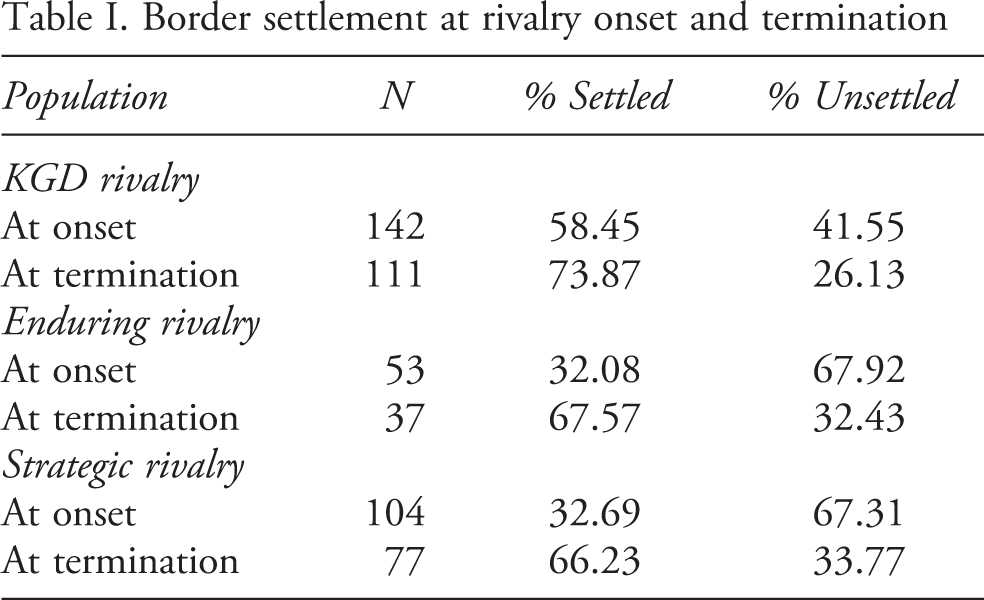
We begin the empirical analysis by examining the bivariate relationship between settled borders and rivalry, using each of the operational measures of rivalry. Towards this end, Table I uses the rivalry as the unit-of-analysis and takes a snapshot of each rivalry during its onset and termination years. According to our analysis, roughly 42% of the KGD rivalries (Klein, Goertz & Diehl, 2006) and almost 70% of both the contiguous enduring (Diehl & Goertz, 2000) and strategic rivalries (Colaresi, Rasler, & Thompson, 2007) begin their rivalry with unsettled borders. At rivalry termination, however, only 26% of KGD and approximately 33% of both the enduring and strategic rivals have unsettled borders. These data yield two conclusions. First, many rivalries – though certainly not all – begin when neighboring states have unsettled borders. Second, almost half of all contiguous rivals that begin their rivalry with unsettled borders find a way to settle the status of these borders before the rivalry ends. Both conclusions provide prima facie evidence that unsettled borders, and not just territory generally, may contribute to the onset and maintenance of a significant subset of interstate rivalries (Hypothesis 1).
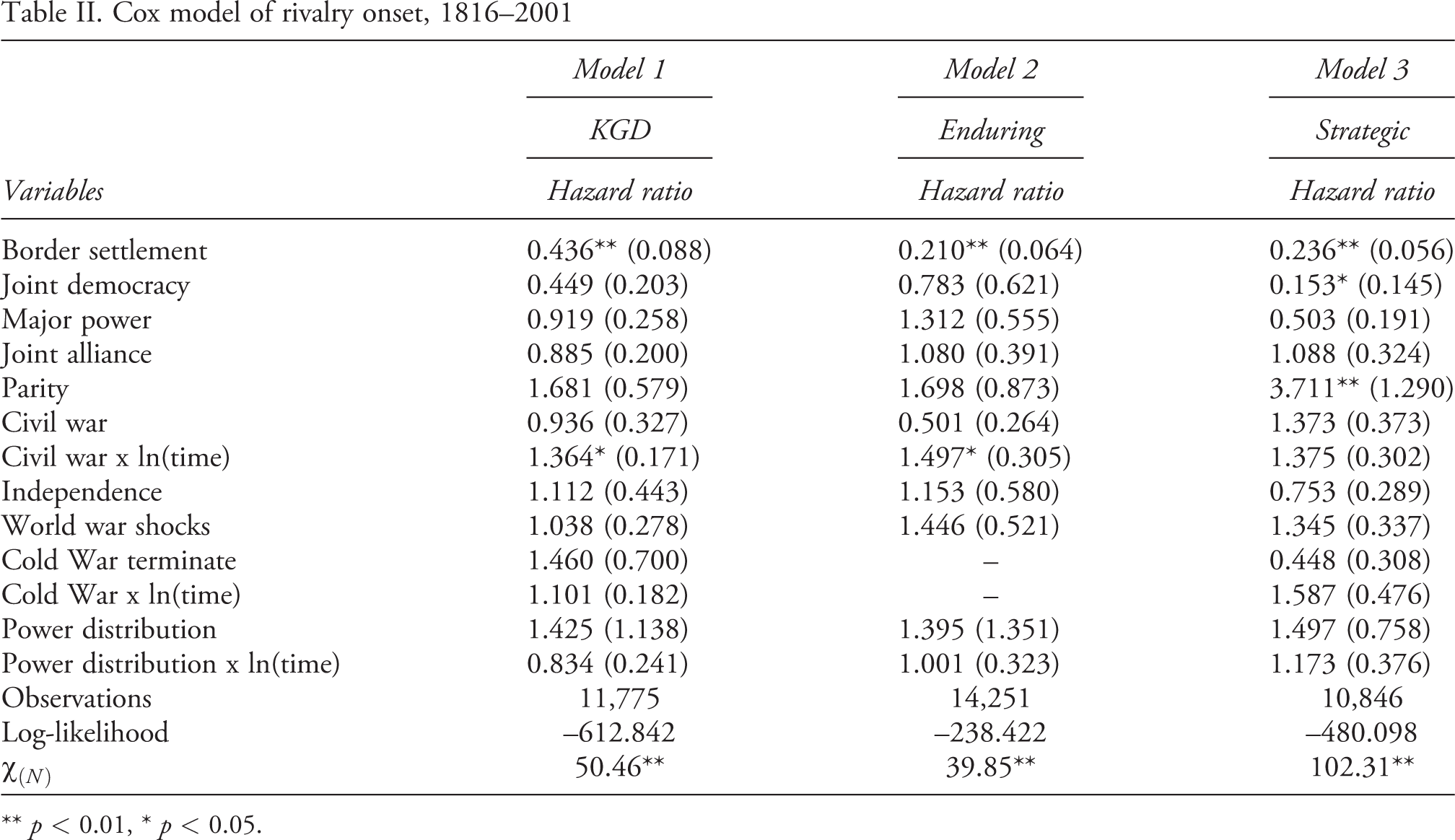
To build further support for our argument, we next estimate a Cox proportional hazard model of rivalry onset using each measure of rivalry (see Box-Steffensmeier & Jones, 2004). These results appear in Table II. In estimating the models presented, we use the Efron method for dealing with tied failures, and report both the exponentiated coefficients (or hazard ratios) and robust standard errors.
Cox model of rivalry onset, 1816–2001
** p < 0.01, * p < 0.05.
Border settlement status, power endowments, and territorial claims (KGD non-rival dyad-years)
** p < 0.01.
Cox model of rivalry onset, 1919–95

** p < 0.01, * p < 0.05.
Admittedly, other factors may affect rivalry onset as well. A handful of the control variables in Table II have statistically significant hazard ratios, although the effects are inconsistent across models. In accordance with democratic peace theory, joint democracy reduces the hazard rate of rivalry onset, but is only statistically significant for the strategic rivalry population (85% less likely; Model 3). Power parity increases the likelihood of rivalry formation as one might expect, but this effect is only significant for strategic rivalries (a 270% increase in the rate of rivalry onset; Model 3). And neither a common alliance nor major-power involvement significantly affects rivalry onset.
The results mentioned so far are less consistent than in traditional studies of rivalry. Yet we might expect this to occur, as we are focused entirely on contiguous states. Excluding non-contiguous states has repercussions for the behavior of control variables. Major states, for example, are more likely to develop rivalries than minor states because they can project their power abroad. When we remove this power projection capability, however (by limiting the scope to contiguous states), we might expect major states to behave more like their minor state counterparts. Similarly, joint alliances may decrease the likelihood of rivalry formation among all dyads, but do not affect it when we focus only upon contiguous dyads.
Of the shock variables, only the civil war–time interaction ever reaches conventional levels of statistical significance, and even then only for the KGD and enduring rivalries. The significant civil war–time interaction variable suggests that civil war generates rivalry late in the life of the dyad (35–50% increase in the likelihood of rivalry onset; Models 1 and 2). None of the other domestic or systemic shock variables exert a statically significant effect on the hazard of rivalry formation. This confirms other works’ findings that the shock variables perform poorly when studying rivalry onset (see Stinnett & Diehl, 2001; Colaresi, Rasler & Thompson, 2007).
The power endowments of border territory
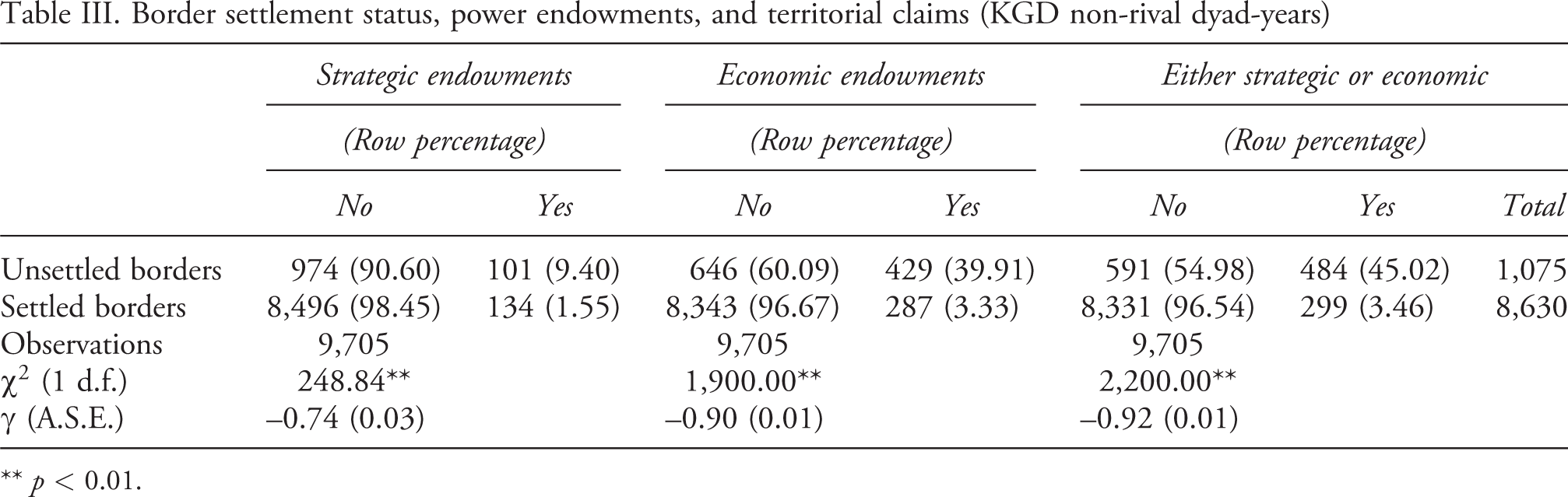
We proposed earlier that unsettled borders produce commitment problems that challenge neighboring states’ ability to escape border disagreements via negotiation. More specifically, we argued that border territory is often endowed with characteristics that can facilitate power shifts between disputants, thereby threatening to undermine the credibility of actor promises to abide by any border agreements reached (Hypothesis 2). This causes border disputes to fester, thereby producing rivalries (Hypothesis 3). To ascertain the plausibility of this argument, Table III therefore considers the relationship between unsettled borders and border territory with power endowments. As with the hazard models, we use the contiguous dyad-year as the unit-of-analysis. Because we are interested in claims that occur outside the context of rivalries (i.e. those that might affect rivalry onset), we then limit the observations in Table III to non-rival dyad-years only (as defined by the KGD operationalization). 12
The first two columns of the table report the bivariate relationship between border settlement and the strategic endowments of territorial claims. Of non-rival, dyad-year observations with unsettled borders, 9.40% contain strategically important territorial claims. In contrast, only 1.55% of non-rivalry, dyad-years observations with settled borders contain strategically important territorial claims. We observe a similar pattern when examining territory with economic endowments (the second two data columns of Table III). In cases of non-rival, dyad-year observations with unsettled borders, 39.91% contain territory with economic endowments. Only 3.33% of the non-rivalry dyad-years with settled borders represent territory with these endowments. The percentage decreases in each case are statistically significant (χ2 = 248.84, p < 0.00; and χ2 = 1,900.00, p < 0.00, respectively) and negative (γ = − 0.74 and −0.90, respectively).
The final three data columns of Table III combine the strategic and economic indicators into a single measure of salience (or power endowments). As we might expect, the combined measure also reveals a strong, significantly negative relationship between border settlement and the presence of power endowments. Of the contiguous, non-rival dyad-years without settled borders, 45.02% have either a strategically or economically endowed territorial claim. This percentage drops to 3.46% among similar dyad-years in which dyads have settled their borders. Once again, this relationship is statistically significant (χ2 = 2,200.00, p < 0.000) and negative (γ = −0.92). Because our theoretical argument does not differ based on type of power endowment of the contested border territory, we rely on this aggregate measure in the analyses that follow.
The above results support our overall theoretical argument, as well as our second hypothesis in particular. The status of borders (i.e. settled or unsettled) is significantly related to the presence of (strategically or economically) valuable territorial claims – as we argue and assume above. We propose that this occurs because border areas that contain power endowments trigger commitment problems, thereby increasing the likelihood of rivalry onset. Indeed, Table III provides indirect evidence of our argument. The percentage of contiguous, non-rival dyad-years containing a strategically or economically endowed claim is significantly higher when borders are unsettled than when they are settled, implying that border territory with power endowments is more difficult to settle. 13 This affirms our theoretical argument; states should find it more challenging to negotiate over border territory when power endowments are present because their neighbor might receive a benefit from the new distribution of the territory, thereby permitting that neighbor to demand further territorial concessions in the future.
To investigate our argument more directly, Table IV examines the relationship advanced by our third hypothesis in greater detail. Models 4–6 use the KGD, enduring, and strategic rivalry populations, respectively. As Table IV demonstrates, the likelihood of rivalry onset increases significantly when states contest border territory with power endowments; the coefficient on the power endowment variable is positive and statistically significant across each of the models. Substantively, the presence of characteristics that could potentially trigger a power shift (i.e. endowments) increases the hazard rate of KGD, enduring, and strategic rivalry formation by 283%, 682%, and 208%, respectively. These findings provide strong evidence in support of our third hypothesis. Border territory that possesses either strategic or economic endowments is theoretically capable of producing a potential power shift that drives a commitment problem, and it is precisely this endowed territory that contributes significantly to rivalry onset.
In addition to the above, we also highlight three findings related to our control variables. 14 First, democracy decreases the likelihood of rivalry formation in each model; however, it only reaches statistical significance in the strategic rivalry model. Second, power parity and major-state involvement significantly increase and decrease the likelihood of strategic rivalry formation, respectively (Model 3). Third, the effect of our shock variables on rivalry formation changes slightly from what we observed earlier in Table II. Here, civil wars significantly affect only the likelihood of strategic rivalry formation, while state independence (Models 1 and 3) and world wars (Model 1) occasionally decrease it. More than likely, these changes result from a slightly different temporal domain. Table II examines the entire 1816–2001 period, while limitations on territorial claim data restrict Table IV to the period 1919–95.
Robustness of results
A number of additional models (not reported in the text) control for the most likely alternative theoretical explanations to ours. First, some dyads enter the system as rivals with unsettled borders, making it difficult to determine whether unsettled borders lead to rivalry onset. We therefore run alternative model specifications in which we (a) control for ethnicity, the most likely factor to produce both rivalry and unsettled borders at a dyad’s entry into the system, and (b) drop all such cases from the analysis. Second, border disagreements might simply make disputes more likely, yielding rivalry as a by-product of that process. Two steps address this concern. First and foremost, we estimate all analyses using the strategic rivalry population – a measure not defined by dispute behavior. Additionally, we re-estimate models controlling for both dispute (MID) onset and first-dispute onset, respectively. Third, pure economic motivations might drive state behavior. We therefore control for interstate trade to separate such motivations from our commitment problem logic. Finally, we run alternative model specifications that rely upon measures of strategic and economic endowments taken from the Issue Correlates of War (ICOW) project. 15 Our results remain robust to each of these alternative specifications (see the online appendix).
Cumulatively, the results provide strong, systematic evidence in support of our theoretical argument. Territorial claims that appear during times of unsettled (as opposed to settled) borders are more likely to involve land with strategic or economic endowments (Table III). Much as our argument predicts, this suggests that border territory may contain significant value, which produces commitment problems that place a dyad at increased risk of rivalry formation. Indeed, we find that territory with power endowments significantly increases the likelihood of rivalry onset, regardless of how we operationalize rivalry. Thus, not only are unsettled borders generally associated with an increased likelihood of rivalry onset (Tables I and II), but the presence of characteristics that could potentially increase a bargainer’s negotiating position (i.e. strategic or economic endowments) seem to drive this aggregate relationship (Table IV). It therefore seems that not all territory matters for the onset of contiguous rivalries.
Discussion and conclusion
At the outset of this study, we asked why a state develops rivalries with some neighbors and not others. We propose that one prominent answer involves (un)settled borders. Border territory often contains resources that serve as a source of bargaining power. When such characteristics are present, the likelihood increases that border territory triggers a commitment problem, as any concessions might shift future bargaining power. The incentive structure that accompanies commitment problems then undermines states’ ability to reach a negotiated agreement that settles their borders (Powell, 2006). In such cases, borders therefore remain unsettled, the border dispute festers, and states develop the perceptions (i.e. threat, enmity, and competition) and behaviors (i.e. militaristic, aggressive foreign policies) that characterize rivalries.
Our analysis provides three key pieces of evidence that overwhelmingly support this argument. First, unsettled borders place a dyad at increased risk of rivalry formation. When we unpack this relationship, we learn that territory endowed with strategic or economic importance drives our finding. Territorial claims that appear during times of unsettled (as opposed to settled) borders are more likely to involve land containing a potential source of bargaining power. This suggests that unsettled borders often involve territorial claims endowed with strategic or economic importance. Furthermore, bargaining over a potential source of power increases the likelihood of rivalry formation. These findings hold across numerous operational definitions of rivalry, numerous measures of strategic and economic value, and alternative model specifications (see online appendix). Cumulatively, such results suggest the need to theoretically disaggregate the general relationship between territory and conflict moving forward, for not all territorial claims matter for rivalry onset.
In addition to demonstrating that territorial claims are not all alike, our study offers numerous additional contributions. First, we offer a causal mechanism – unsettled borders that produce a commitment problem – that explains rivalry formation in a substantial number of dyads. Existing studies overlook this mechanism. Furthermore, the frameworks that exist either identify causal shocks that serve as necessary (but not sufficient) conditions for rivalry onset or propose that rivalry results from disputes that fester. The former has trouble predicting when shocks will produce rivalries, while the latter struggles to explain why (eventual) rivals fight in the first place. In contrast, we identify a clear mechanism that explains not only why the first dispute between rivals occurs, but also why it persists. A new state’s independence, for example, may lead to rivalry if its borders with neighboring states remain unsettled – particularly if the border contains territory endowed with strategic or economic importance.
Second, our study offers an empirical test of commitment problem logic. Such tests are rare in interstate conflict research (for an exception, see Carter, 2010). Third, our argument presupposes at least two paths to rivalry. Non-contiguous states do not share borders, but do experience rivalries. By uncovering a path for contiguous rivals rooted in unsettled borders, we hope to redirect scholarly attention towards uncovering the mechanism(s) that drives non-contiguous rivals. Fourth, we advance theory in two directions. Our argument first and foremost extends commitment problem logic beyond explaining war; we propose and demonstrate that the same logic might explain the inefficient competitions inherent in rivalry as well. Furthermore, we extend the territorial peace argument into the realm of rivalries too. In the process, we provide additional evidence in support of both the territorial peace (Gibler, 2012) and steps-to-war (Vasquez, 2009) research agendas.
Finally, our territorial theory of rivalry unifies research on rivalry and conflict processes in two ways. On the one hand, it ties together a number of variables that researchers believe influence the rivalry formation. Territorial contiguity and state independence, for example, often seem to contribute to rivalry onset; our theory explains why. To the extent that unsettled borders occur largely within non-democratic dyads (as Gibler, 2012, argues), the theory may also explain why non-democratic (democratic) dyads are more (less) likely to develop rivalries as well. The end result is a more parsimonious theory that reduces the number of variables under consideration, thereby allowing more precise policy recommendations (see below). Furthermore, our argument provides the foundation for a more comprehensive theory of rivalry. We propose that unsettled borders contribute to rivalry onset, maintenance, and termination through the triggering, sustainment, and surmounting of a commitment problem.
The results of the latter two phases need to be tested further in future work. Nonetheless, preliminary analysis offers three findings confirming that rivals face a difficult time settling border territory involving power endowments. First, rival dyad-years are more likely to contain territorial claims with power endowments as opposed to those without it. This suggests that rivals are unable to settle borders when power endowments are present. Second, power-endowed territory significantly reduces the likelihood of border settlement (see online appendix). And finally, much as commitment problem logic predicts, rivals rely heavily on third-party assistance. This position derives not only from existing rivalry work (Diehl & Goertz, 2000; Greig, 2005), but also from our own preliminary data on the border settlement process – which shows that one-third to one-half of all dyads experience third-party assistance at some point during their settlement process. Combined with the results presented above, we therefore conclude that our argument receives strong empirical support and merits further study.
Footnotes

References
Supplementary Material
Please find the following supplemental material available below.
For Open Access articles published under a Creative Commons License, all supplemental material carries the same license as the article it is associated with.
For non-Open Access articles published, all supplemental material carries a non-exclusive license, and permission requests for re-use of supplemental material or any part of supplemental material shall be sent directly to the copyright owner as specified in the copyright notice associated with the article.
