



Abstract
This article assesses the impact of a new form of defense cooperation – formal weapons cooperation agreements, or WCAs – on the global arms trade. WCAs are bilateral framework agreements that establish comprehensive guidelines on the development, production, and exchange of conventional arms. Substantively, WCAs regulate such core areas as procurement and contracting, defense-based research and development, and defense industrial cooperation. These agreements have proliferated dramatically since the mid-1990s. They now number nearly 700, with 30–40 new WCAs signed each year. Newly collected data are used to analyze the effect of WCAs on import and export of conventional weapons. To control for interdependencies in the formation of WCAs, and to account for the mutually endogenous relationship between WCAs and weapons flows, WCAs are modeled as an interdependent network that coevolves with the individual-level arms trade activity of states. The analysis shows that, over the 1995–2010 period, WCAs have significantly increased weapons flows.
Introduction
As Cold War tensions waned in the 1980s, trade in conventional arms declined correspondingly (Brzoska, 2004; Garcia-Alonso & Levine, 2007). Yet, arms transfers have remained a persistent feature of the international system and are once again coming under scrutiny, particularly as an area for legal regulation. Unlike nuclear, chemical, and biological weapons, conventional weapons lack a coherent legal framework regulating their transfer. Treaties such as Hague IV (1907) and the Convention on Certain Conventional Weapons (1981) regulate the use of particular classes of conventional weapons, but they say virtually nothing about transfers. The highly publicized Arms Trade Treaty introduces export and import regulations, as well as monitoring provisions, but its efficacy has yet to be determined. 1 The bulk of the scholarly and popular attention devoted to weapons proliferation, specifically with regard to legal frameworks, focuses on these multilateral efforts. An important contemporaneous, countervailing trend in bilateral treaty cooperation has been entirely ignored. Over the last three decades, states have dramatically increased their participation in bilateral weapons cooperation agreements (WCAs). These agreements establish long-term cooperative legal frameworks in the areas of procurement and acquisition, defense industrial cooperation, and research and development. WCAs are not simply one-shot arms deals; they instead create general standards for bilateral cooperation on the design, production, and exchange of conventional weapons.
The left-hand panel of Figure 1 illustrates the 30-year trend in annual arms trade, expressed as country-level averages of total imports and exports. Unsurprisingly, arms transfers declined sharply during the last decade of the Cold War – a consequence of reduced tension on the European Continent, waning support for distant protégés, and shifting domestic priorities. Nonetheless, while current arms trade activity remains below Cold War levels, the world has seen a relatively steady increase in weapons flows since the early 2000s (Garcia-Alonso & Levine, 2007; Holtom et al., 2013). Given current global instability, this trend is likely to continue. The right-hand panel of Figure 1 illustrates trends in WCA accession over the same 30-year period, expressed as the number of new agreements created in a given calendar year. The graph shows that, although a handful of WCAs were signed in the 1980s, they are largely a post-Cold War phenomenon, having grown in popularity particularly during the mid-1990s.

Conventional weapons transfers and bilateral weapons agreements, 1980–2010
Comparing the two figures does not reveal obvious macro-level correlations between arms trade activity and WCA treaty-making. Indeed, the bulk of WCAs were created in a period of depressed weapons flows. Yet, increased arms trade activity is an explicitly stated goal of the treaties themselves. As I detail later, the texts of these treaties emphasize procurement of weapons, equipment, spare parts, and all varieties of defense materiel. Also, by promoting bilateral research, development, and defense industrial cooperation, WCAs encourage improvements in member states’ domestic defense industries, which, in turn, lead to cost reductions, higher quality, and an overall increase in export competitiveness. Importantly, while formal military alliances have traditionally played a role in proliferation, and while the study of alliances continues to be a flourishing area of research – as exemplified in this special issue by Haim (2016), Lupu & Poast (2016), Maoz & Joyce (2016), and Warren (2016) – WCAs are a novel form of defense cooperation, with goals and provisions that are more uniquely tailored to weapons acquisition than most alliances. In short, by establishing basic standards for procurement, contracting, and industrial cooperation, WCAs should increase weapons flows.
To empirically navigate the relationship between WCAs and weapons flows, I conceptualize WCAs as constitutive of a global network, where states comprise the nodes in the network and WCAs comprise the edges. I further conceptualize states’ arms trade activity as an individual-level attribute, where states vary according to the extent of their involvement in the global arms trade. I then model the relationship between these two phenomena as a coevolutionary process, where a state’s position or ‘centrality’ in the WCA network influences that state’s arms trade activity, and, in turn, arms trade activity influences WCA membership. 2 The coevolutionary framework, which is also employed in this special issue by Chyzh (2016) and Warren (2016), offers at least two benefits. First, it allows us to explicitly model the mutually endogenous relationship between WCAs and arms trade. While I hypothesize that WCA membership increases weapons flows, states may in fact choose WCA partners on the basis of established defense relationships. The coevolutionary approach thus directly confronts the larger social-scientific dilemma of influence versus selection, where individual actors may either be influenced by their social relations, or instead select their social relations on the basis of individual attributes. Second, as with inferential network models in general, this approach allows us to model the myriad interdependencies that plague international relations data, thus ensuring more accurate estimates of key relationships.
The main conclusion of the analysis is that the influence of WCAs on arms trade activity is persistent and strong. Beginning in the mid-1990s and continuing through 2010, WCAs substantially increase both imports and exports of conventional weapons. Further, isolation in this network, reflected by a complete dearth of WCA ties, exerts an additional negative impact on weapons flows, suggesting that WCAs have become increasingly essential for arms trade. At the same time, the effect of arms trade on WCA membership is largely limited to the late 2000s. Finally, while the bulk of the analysis employs models for dynamic network-behavior coevolution, I also confirm these results with traditional regression methods. In short, despite the post-Cold War decline in arms trade, WCAs have steadily increased weapons flows.
The article proceeds in five parts. First, I discuss the historical background on weapons cooperation agreements. Second, I develop hypotheses on the relationship between WCAs and arms trade. Third, I discuss research design. Fourth, I present the results of the empirical analysis. The fifth section concludes.
Background on weapons cooperation agreements
The impact of bilateral treaty cooperation on the global arms trade has, to my knowledge, never been examined. Of course, weapons agreements themselves are not new. Traditionally, these agreements have been heavily asymmetric, often involving military aid extended by a powerful state or former colonizer to a much weaker protégé. 3 Other weapons agreements resemble contracts, where specific quantities of a specific weapon type are produced or delivered over a predefined period of years or months. 4 Though these contracts may involve no aid, they are still asymmetric in that the parties adopt differing obligations. More importantly, these agreements are explicitly limited to the transaction detailed in the treaty instrument and typically hold no further implications for defense cooperation. 5
In contrast, WCAs represent a deliberate effort to establish long-term cooperation on a broad range of weapons-related issues. They are typically symmetric in that they create equivalent obligations for both parties. For example, the texts of WCAs avoid proper nouns (‘Canada’, ‘France’, etc.) in favor of common nouns (‘the parties’, ‘the members’, etc.), thus emphasizing the mutuality of the provisions therein. Also, WCAs are not limited to one-time weapons transfers; in fact, specific weapons types are rarely mentioned in the treaty instruments themselves. Instead, the goal is to establish a more generalized legal framework. Typically, these frameworks involve some combination of: (1) weapons procurement and contracting; (2) defense-related research and development; and (3) defense-industrial cooperation. The following excerpt from the Italy–Ukraine WCA, signed in 2007, provides an illustration: The purpose of this Agreement shall be the establishment of a more effective cooperation between the Parties in the fields of the research, development, and production of defence goods and services, procurement of equipment, and corresponding logistic support in the technical field, as well as in other directions of cooperation in the field of defence industry, by strengthening the defence and industrial potential of both Countries.
6

Weapons agreement network at three observation moments

Number of weapons agreements signed per country, 1980–2010
Theorizing the impact of weapons agreements on arms trade
The issue areas in which WCAs could potentially have an impact are diverse. Here, I focus on country-level arms trade (imports plus exports), as defined by the Stockholm International Peace Research Institute (SIPRI). 7 The most obvious reason to expect WCAs to affect arms trade is that increased weapons flows are an explicitly stated goal of the treaties themselves. For example, the 2006 WCA between Czech Republic and Colombia lists ‘defense materiel deliveries’ as the first area of cooperation. 8 The WCA between Indonesia and Italy refers to ‘fostering mutual cooperation with particular reference to […] procurement and production of defence equipment’. 9 The 2005 WCA between Ukraine and Kazakhstan details cooperation in ‘the supply of weapons, equipment, spare parts, technical documentation, and military technical equipment’. 10 Virtually all WCAs prominently feature analogous statements – typically within the preamble and/or the first article of the treaty.
WCAs influence arms trade through at least three separate mechanisms. First, they directly increase weapons flows by establishing standards, procedures, and rules that govern arms transactions – often by mandating subsequent ‘implementing arrangements’. Contracting is a notoriously complex process, even at a purely domestic level (Laffont & Tirole, 1993). Variations in contract structures – from the fixed-price contracts favored by governments and procurement agencies to the cost-plus contracts commonly preferred by defense firms – yield differing incentive structures, which in turn directly affect the outcome of contract negotiations (Bos, 1996; Hartley, 2007). At the international level, where multiple procurement agencies and suppliers may be involved, contracting costs can rapidly multiply. While specific contract details are beyond the scope of most WCAs, by outlining the basic contours of cooperation, and by mandating implementing arrangements, WCAs create a framework for contract standardization that otherwise wouldn’t exist. More generally, WCAs establish contacts and promote interaction between procurement agencies, militaries, policymakers, and defense firms. Indeed, many WCAs institutionalize these interactions by regularly convening joint committees and working groups. 11 Additionally, WCAs address a host of related contracting issues, including restrictions on classified information, designation of relevant authorities and procurement agents, policy guidance on procurement processes, legal status of transferred equipment and property, third-party sales, export licenses, and tax and customs obligations – all of which directly influence arms trade.
Second, WCAs indirectly influence weapons flows by increasing both the quality and quantity of domestic production (cf. Brzoska, 2004; Smith & Tasiran, 2005; Anderton, 1995). In pursuing weapons development, states face a well-known trade-off between, at the extremes, import reliance and indigenous production, with the latter strategy requiring extensive industrial capacity and commitments to research and development (Kinsella, 2000). In turn, investments in industry and R&D allow for production of increasingly sophisticated systems, which translates into ‘higher levels of potential quality that could be exported’ (Garcia-Alonso & Levine, 2007: 954). In short, by improving domestic industry, states increase their competitiveness in the global arms market. Both R&D and defense industrial cooperation are central elements of weapons agreements. WCAs achieve R&D goals through a variety of mechanisms, including exchange of information, educational exchanges, and joint research programmes. 12 Defense industrial cooperation complements these R&D commitments. In promoting interindustry cooperation, WCAs emphasize technology transfers, information sharing, joint research and coproduction, and exchange of highly trained personnel, while also providing safeguards for intellectual property and military secrets. These forms of cooperation improve existing industries and allow states to pursue otherwise unattainable high-risk, high-cost ventures. The economic impacts of an improved defense industrial base include reduced per-unit costs and increased production levels, which in turn enhance global competitiveness. Of course, export of sophisticated weaponry introduces non-trivial negative security externalities, especially in the context of arms races (Garcia-Alonso & Levine, 2007; Levine & Smith, 1995). Yet, despite these potential risks, states continue to export weapons. There exists a mutually reinforcing relationship between domestic industry and exports: improvements in domestic industry increase demand for a country’s exports, and, in turn, states use revenues from exports to fund increasingly sophisticated weapons programs (Garcia-Alonso & Levine, 2007). WCAs intervene in this relationship by further improving domestic capacity.
Third, WCAs improve conditions for arms trade by reducing strategic uncertainty. Purchasing governments are often uncertain about the extent of their need for a particular weapon, or of that weapon’s reliability, performance, and long-term costs, especially with regard to maintenance and provision of spare parts (Hartley, 2007). At the same time, a substantial information asymmetry exists between defense firms and the various actors with whom those firms interact, including procurement agencies, militaries, and policymakers. Specifically, firms possess higher quality information about production timelines, per-unit costs, and project feasibility than any other actor – which, in monopolistic and oligopolistic markets, creates risks of opportunism (Hartley, 2007; Garcia-Alonso & Levine, 2007). Finally, at a more fundamental level, states maintain reservations about the long-term consequences of arms exports, due largely to concerns about illicit proliferation, state failure, and overall trustworthiness of defense partners. WCAs improve the information environment across these levels. For example, they facilitate interagency and interfirm contacts, often via the above-mentioned committees and routine visits, which in turn introduces greater transparency into procurement processes. Further, the long-term commitments established by WCA ties, which often take the form of more specialized formal agreements, reduce concerns about servicing, training, access to replacement parts, and other sources of hidden costs.
From a network perspective, each WCA signed by a given i focal state represents a network tie between i and some partner j. In assessing these ties, I focus on centrality, which refers to the relative importance of nodes within a network and is closely related to prestige, status, and embeddedness. As a core network feature, centrality is a frequent target of interest in network theory and analysis – as exemplified in this special issue by Gallop (2016), Haim (2016), Ward & Dorussen (2016), and Wilson, Davis & Murdie (2016). Centrality can be measured in a wide variety of ways. I employ the simplest measure, degree centrality, defined as the sum of a given i’s network ties, for two reasons. First, degree is a fundamental network characteristic – perhaps the most fundamental characteristic – and is a component of nearly all other centrality measures. At the same time, there is no theoretical reason to believe that the influence of WCAs is better captured by more complex measures. Second, and most importantly, degree centrality allows us to most directly model the endogenous, interactive relationship between WCA network ties and arms trade, as detailed further below. Thus:
Hypothesis 1: The greater a state’s degree centrality, as defined by the number of weapons agreements it signs, the greater its total arms trade.
Note that Hypothesis 1 is agnostic about exports versus imports. In practice, of course, some states are net exporters while others are net importers. 13 However, as symmetric treaties, WCAs make no distinction between exporters and importers. There are thus no empirical criteria for determining which states are most likely to be affected via exports and which are most likely to be affected via imports. In the aggregate, WCAs should increase both imports and exports; if one state’s imports increase, then, ceteris paribus, the exports of one or more other states also increase. The bulk of the analysis thus focuses on aggregate arms trade, defined as the sum of a country’s total arms imports and exports. (Nonetheless, I later show that the effects of WCAs are borne out separately in both exports and imports.)
Perhaps the most important counter-argument to Hypothesis 1 is that, insofar as WCAs increase domestic production, signing them may effectively reduce import reliance (cf. Smith & Tasiran, 2010). Certainly, expanding and enhancing the defense industrial base is a common goal of WCAs. And the notion of a trade-off between indigenous production and import dependence is longstanding in the arms trade literature (e.g. Kinsella, 1998, 2000). Yet, at the same time, domestic production is strongly correlated with exports (Kinsella, 2000; Garcia-Alonso & Levine, 2007). Ceteris paribus, the stronger a domestic industry, the greater its global competitiveness (Hartley, 2007). Rather than adjudicate these possibilities theoretically, I leave the question to empirical analysis. If improved domestic industry does in fact reduce reliance on global markets, then, contrary to Hypothesis 1, we should see little to no effect for WCAs.
As a corollary to Hypothesis 1, I also consider the unique position of network isolates – that is, countries of degree centrality 0 (CD
= 0). In network theory, the difference between CD
= 0 and CD
= 1 is often much starker than, say, the difference between CD
= 1 and CD
= 2. This is because even a single network tie enables access to the network’s broader resources. Thus, a country that cooperates with Ukraine will not only benefit from Ukraine’s defense goods and services, but will also have indirect access to the resources – Soviet-era spare parts, equipment, weapons, and training, for example – exchanged between Ukraine and its myriad partners. Isolates are deprived of these indirect benefits. At the same time, many WCAs contain strict provisions on sharing of information, technology, and equipment with third parties. For example, a country that imports weapons from Ukraine but lacks a WCA with that country may find its weapons flows diminished as Ukraine’s accumulating WCA partnerships impact its third-party relationships. In short, the more that states rely upon WCAs as a precondition for arms trade, the more that isolates are disadvantaged. Thus:
Hypothesis 2: States with no WCA ties – that is, network isolates – are especially unlikely to engage in arms trade.
Hypotheses 1 and 2 focus on the impact of WCAs on monadic weapons flows. One of the great benefits of the network perspective, however, is its capacity to model the ways in which network ties and individual behaviors mutually influence one another. WCA ties and arms trade are not separable outcomes but are instead coevolving phenomena. Network-behavior coevolution is a microcosm of the much larger social-scientific problem of influence versus selection. 14 Do individuals adopt particular attributes and behaviors because they are influenced by their peers, or do they instead select peers who exhibit particular attributes and behaviors? Note that this puzzle explicitly integrates influences across levels of analysis, as it asks how relational or social ties interact with individual-level actions and characteristics.
Figure 4 illustrates this dynamic. In panel (a), the focal node, i, has numerous network ties but, at the unit level, engages in the relevant behavior only at low levels. Over time, however, these ties lead to an increase in the behavior. This process reflects social influence in that, ceteris paribus, i’s behavior is determined by i’s social relations. Panel (b) illustrates the contrary process. Here, the focal i node engages in high levels of the behavior – as reflected by i’s large node size – but initially lacks extensive network ties. Over time, however, i’s behavior attracts additional ties. This process reflects social selection in that, ceteris paribus, nodes that engage in higher levels of the behavior are more active in selecting network partners (and in being selected as partners by others). Importantly, both processes lead to the same outcome.
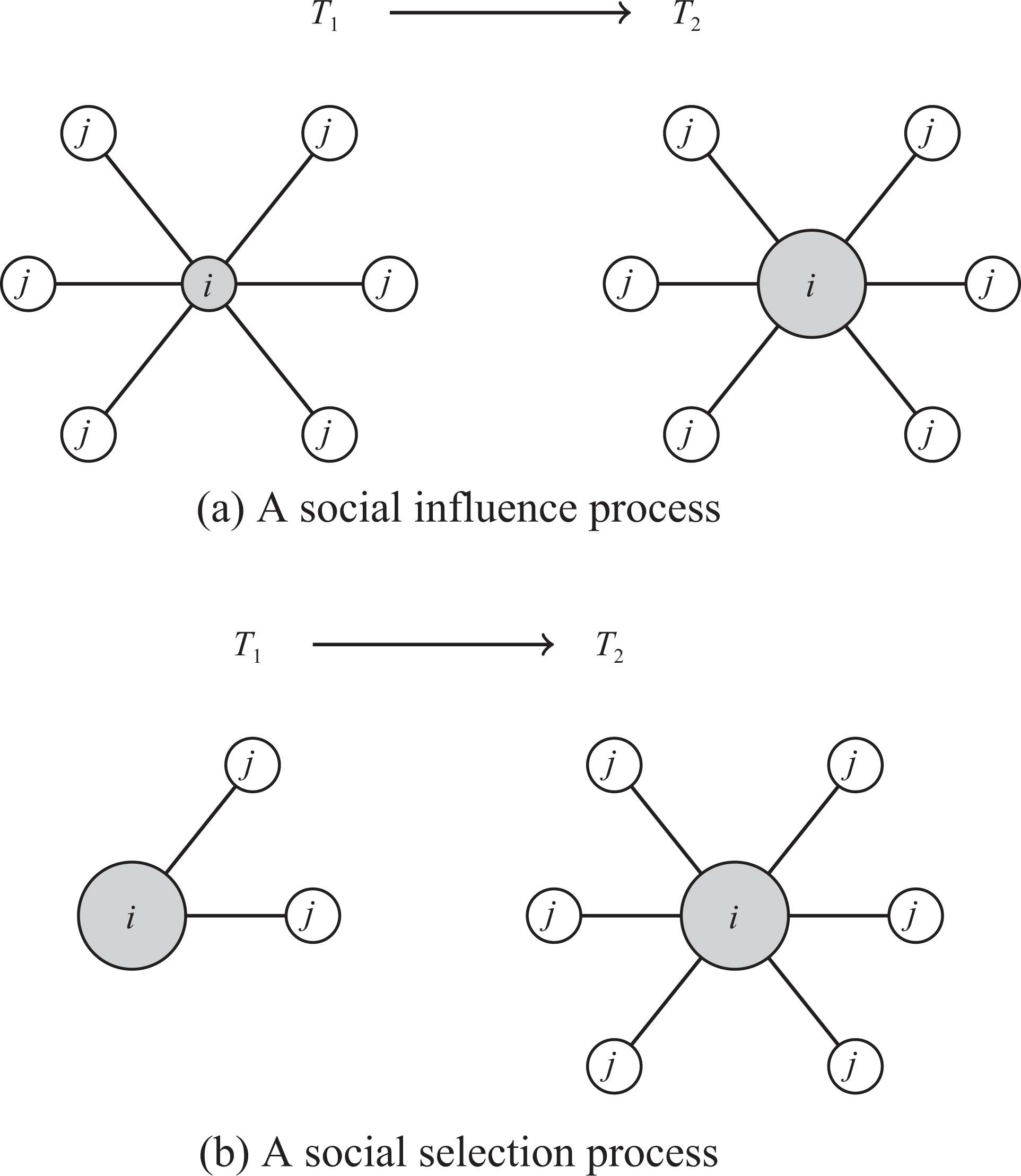
Coevolutionary network-behavior dynamics
In the current context, the selection-influence puzzle requires us to ask whether WCA network ties in fact influence weapons flows, or whether WCA partners are instead chosen on the basis of their arms trade activity, where the former possibility reflects social influence and the latter reflects selection. Both Hypothesis 1 and Hypothesis 2 are motivated by the logic of social influence. But the mechanisms behind both are at least partially consistent with a selection process. For example, if states sign WCAs in order to improve their defense industrial base, they are better off, ceteris paribus, selecting partners with flourishing defense industries over partners with fledgling industries; and states with established industries are themselves more likely to be active in arms trade. Additionally, states may perceive that WCAs signed with states highly active in arms trade are more likely to yield weapons contracts. Or, finally, WCAs may simply reflect a need for increased standardization between states with already established arms relationships. I do not here argue for the accuracy of either social influence or social selection. Rather, I focus primarily on the question of whether WCAs increase weapons flows (i.e. social influence) while explicitly acknowledging – and, later, empirically modeling – the possibility of a social selection effect. Thus:
Hypothesis 3: The greater a state’s total arms trade, the more likely it is to sign WCAs.
Hypotheses 1 and 3 are clearly opposed to one another and suggest competing empirical processes. This mutually endogenous relationship raises unique challenges for statistical inference, to which I now turn.
WCA data and research design
Data on weapons cooperation agreements come from three sources: (1) the United Nations Treaty Series (United Nations Treaty Collection, 2012) and the World Treaty Index (Bommarito, Katz & Poast, 2012); (2) individual country publications, including gazettes, defense ministry reports, and national treaty series; and (3) Reuters/Factiva global news archives. Altogether, I recorded 678 treaties. Due to limited availability of full treaty texts, I have only partial information on treaty duration. Thus, in the analyses that follow, I define a network tie as existing if a WCA was signed in the past five years. 15
The primary dependent variable of interest, arms trade, is an annual measure of a given i country’s total arms exports and imports, as measured by the Stockholm Institute’s trend-in-value (TIV) indicators. 16 I focus on the sum of imports and exports because, as discussed above, WCAs make no distinction between exporters and importers, and should have an effect on both aspects of arms trade. In the network model, described below, I ordinalize arms trade into a five-category measure, using the values $0, $50m $500m, $2b, and $20b USD as thresholds. Although ordinality is a requirement of the inferential network model, the main results are highly robust to differing threshold values and number of categories. 17
The temporal domain of the analysis is 1995 to 2010. I choose this period for both substantive and methodological reasons. Substantively, while WCAs existed in the 1980s (see Figure 1), they were relatively uncommon until the mid-1990s. Methodologically, the dearth of WCAs until the mid-1990s means that, until that time, the WCA network is extremely sparse, which leads to degeneracy in inferential network models (Cranmer & Desmarais, 2011). However, as discussed below, estimates from multiple regression show that the dynamic between WCAs and arms trade in 1980–94 largely matches the post-1995 period.
The model
Although there exist regression models for endogenous regressors, such as simultaneous equations models, these are typically not well suited to data at multiple levels of analysis. Further, as discussed by Minhas, Hoff & Ward (2016) in this special issue, regression approaches typically assume conditional independence of data observations, which is problematic with network data (also see Hoff &Ward, 2004; Cranmer & Desmarais, 2011). The interaction of network relationships and individual behavior poses a unique estimation problem (Hays, Kachi & Franzese, 2010). The most widely used methodological framework for testing such relationships is the stochastic actor-oriented model (SAOM), developed specifically for the purpose of modeling network-behavior coevolution. The SAOM begins from the assumption that actors – that is, the nodes in the network – are rational utility maximizers. When actors create, maintain, or terminate network ties, and/or when they engage in a particular behavior, they do so in order to maximize their subjective utility. These models are thoroughly detailed in Snijders, Steglich & Schweinberger (2007), Snijders (1996, 2001, 2005), and Burk, Steglich & Snijders (2007). Here, I draw upon these and other sources to outline the basic contours of the model. In this special issue, both Chyzh (2016) and Warren (2016) employ functionally equivalent SAOMs – though Warren’s specification includes multiple endogenous networks.
Define

Distribution of arms trade activity, 1995–2010
Reflecting the assumption of individual utility maximization, I specify an evaluation function, defined as,

which is an actor-level utility function that, for all i nodes in the
I also specify a behavioral function, defined as,

which is a utility function specifically with regard to individual arms trade activity and is thus the main focus of the analysis. As with the evaluation function, the behavioral function is a linear combination of specified effects, here designated
Both the specification and estimation of the SAOM assume that actors form, maintain, and terminate xij
network ties – and increase, decrease, or maintain levels of the zi
behavior – in such a way as to maximize the payoff from the
I simultaneously estimate the above two equations using simulated method of moments, as detailed in Snijders (2005). The 1, … , T observed
Convergence of the simulation-based estimation algorithm depends on target values, which are generated from the observed real-world networks by calculating each of the specified
Network and behavioral effects
In order to test Hypotheses 1 and 2, I incorporate a series of statistics into the behavioral function. 18 The first statistic, defined as,

captures the interaction between a given i’s degree centrality in the WCA network and its individual level of arms trade activity. Note that as i’s number of xij
network ties and overall zi
arms trade activity increase, the value of this
The second monadic statistic is defined as,

where I{A} is an ‘indicator function’ that equals 1 if condition A is fulfilled and equals 0 otherwise. This statistic tests Hypothesis 2.
Assessing Hypothesis 3 requires us to specify effects within the

where xij
is an individual ij tie in the WCA network and zj
is the partner state j‘s arms trade activity. A significantly positive

which effectively models an interaction between i and j’s overall arms trade activity. While Equation 5 captures the extent to which states are attracted to j partners that are highly active in arms trade, Equation 6 captures the extent to which an i and j that are both highly active in arms trade are more (or less) likely to sign a WCA with one another.
Each of the evaluation and behavioral functions incorporates additional statistics to control for important endogenous and exogenous influences. The arms trade equation (i.e. Equation 2) includes a linear shape effect, defined simply as
The WCA equation (i.e. Equation 1) incorporates a series of dyadic controls, including geographic distance (Weidmann, Kuse & Gleditsch, 2010), military alliances (Gibler, 2009), and bilateral trade flows (Barbieri & Keshk, 2012). I also include three monadic controls and their ij interactions: per-capita gross domestic product (Feenstra, Inklaar & Timmer, 2015), democracy (Marshall & Jaggers, 2002), and overall military power (Singer, 1987). Finally, the WCA equation also incorporates endogenous network statistics to account for first-order and third-order dependencies. 20 These include a transitivity term, which captures the tendency for states in the WCA network to form xij ties with ‘friends of friends’, and a degree centrality term, which captures the tendency for states to preferentially attach to popular nodes. 21
Stochastic actor-oriented model of arms trade and WCAs

† p < 0.1, *p < 0.05, **p < 0.01. Standard errors in parentheses. Simulated method of moments estimation. Iterations β = 4, 501. Iterations s.e.(β) =5, 000. N = 170.
Empirical analysis
I first estimate the SAOM for the entire 1995–2010 period. Table I summarizes the results. The estimates for WCA degree and WCA isolate are consistent with both Hypothesis 1 and Hypothesis 2. An increase in WCA network degree centrality increases a state’s arms trade activity, while isolation in the WCA network reduces arms trade activity. The estimates themselves are log odds ratios. Thus, exponentiating the estimate for WCA degree indicates that a one-unit increase in degree centrality – or, more substantively, accession to one additional weapons agreement – increases the probability of a one-unit increase in arms trade activity (i.e. from one category to the next) by about 6%, ceteris paribus. While this effect is substantively quite small, it is compounded by membership in multiple WCAs. For example, a ten-unit increase in degree centrality raises the probability of an increase in arms trade activity by 84%, ceteris paribus. In contrast, isolates are nearly 30% less likely to increase their weapons flows.
Turning to Hypothesis 3, the results for the WCA equation show that, as anticipated, Arms trade increases the probability of WCA ratification. Specifically, a one-unit increase in Arms trade (on the previously defined five-point scale) increases the probability of WCA ratification by about 23%, ceteris paribus. To interpret this effect more concretely, consider a stylized scenario in which a given i must choose between two prospective WCA partners, j1 and j2 . All else equal, if j2 scores one unit higher on the ordinal arms trade measure than j1 , then the probability of i selecting j2 as a WCA partner is 23% greater than the probability of i selecting j1 . Note that, as with the effect of arms on WCAs, this effect increases non-linearly with arms trade activity. For example, if j2 scores three units higher on the arms trade measure than j1 , then the corresponding probability of i selecting j2 over j1 is nearly 90% greater. Overall, the more active a country is in global arms trade, the more likely it is to be chosen as a WCA partner – clear evidence in support of a social selection effect. Note, however, that the estimate for the Arms trade interaction term reveals that mutual arms trade activity – that is, between a pair of ij prospective cooperators – has no effect.
These results are thus far consistent with expectations. However, the identifying assumptions of the SAOM itself must be given close consideration. I first consider the problem of temporal heterogeneity. The SAOM assumes homogeneity of parameters over time, such that the estimated coevolutionary relationship between arms trade and WCAs is the same in 2010 as it was in 1995. Given the trends illustrated in Figure 1, this assumption may be untenable. I assess temporal robustness by estimating a series of five-year ‘moving window’ models. I begin with the 1995–99 period and then move successively to each subsequent five-year period (e.g. 1996–2000, 1997–2001, and so on), estimating a separate model for each period. Figure 6 illustrates the results.
A number of insights emerge from this analysis. First, the effect of WCA degree is generally strong over time. With the exception of a short period in the early 2000s, WCA membership significantly increases arms trade activity. Second, the effect of network isolation is less consistent; in the 1990s, the estimate for WCA isolate is statistically insignificant. However, over time the effect of isolation grows stronger, such that, by the mid-2000s, network isolates are 40–50% less likely to increase their arms trade activity. This effect, which is additional to any effect associated with low degree centrality, is consistent with the logic behind Hypothesis 2 – that WCAs have grown increasingly essential to the global arms trade, and that isolates are especially disadvantaged. Third, the reciprocal impact of arms trade on WCA accession is limited to the late 2000s, which suggests that, in terms of network-behavior coevolution, WCA ties influence arms trade activity more consistently than vice versa.

Five-year moving window SAOM estimates

Stochastic actor-oriented model goodness of fit
Regression models of WCA network and arms trade

Standard errors in parentheses; *p < 0.05, **p < 0.01.
I next consider the SAOM’s goodness of fit. Because regression-based approaches, such as R 2, are not available, SAOM goodness-of-fit is typically evaluated by comparing the topological features of observed networks – such as degree distributions, geodesic distances, and triad censuses – with the same topological features of simulated networks randomly drawn from the specified model. 22 The more closely the simulated topologies resemble the topology of the real-world network, the better the model fits the data. In the case of the coevolution model, we are specifically interested in goodness of fit with regard to individual arms trade activity. I thus focus on the simulated z behavioral matrices generated by the SAOM in the five-year moving window models. Figure 7 illustrates the comparison of observed real-world arms trade activity to the levels of activity apparent in the SAOM simulations. The more closely the red lines intersect the boxplots near their respective centers, the better the fit. I also calculate p-values, based on the distance between the observed arms trade distribution and the simulated distributions, where p-values larger than 0.05 indicate that the observed and simulated networks are not significantly different. The larger the p-value, the better the fit. As Figure 7 illustrates, the p-values are generally much larger than 0.05, especially post-2000. The observed distribution of arms trade activity is not statistically significantly different from the simulated distribution, indicating a strong fit.
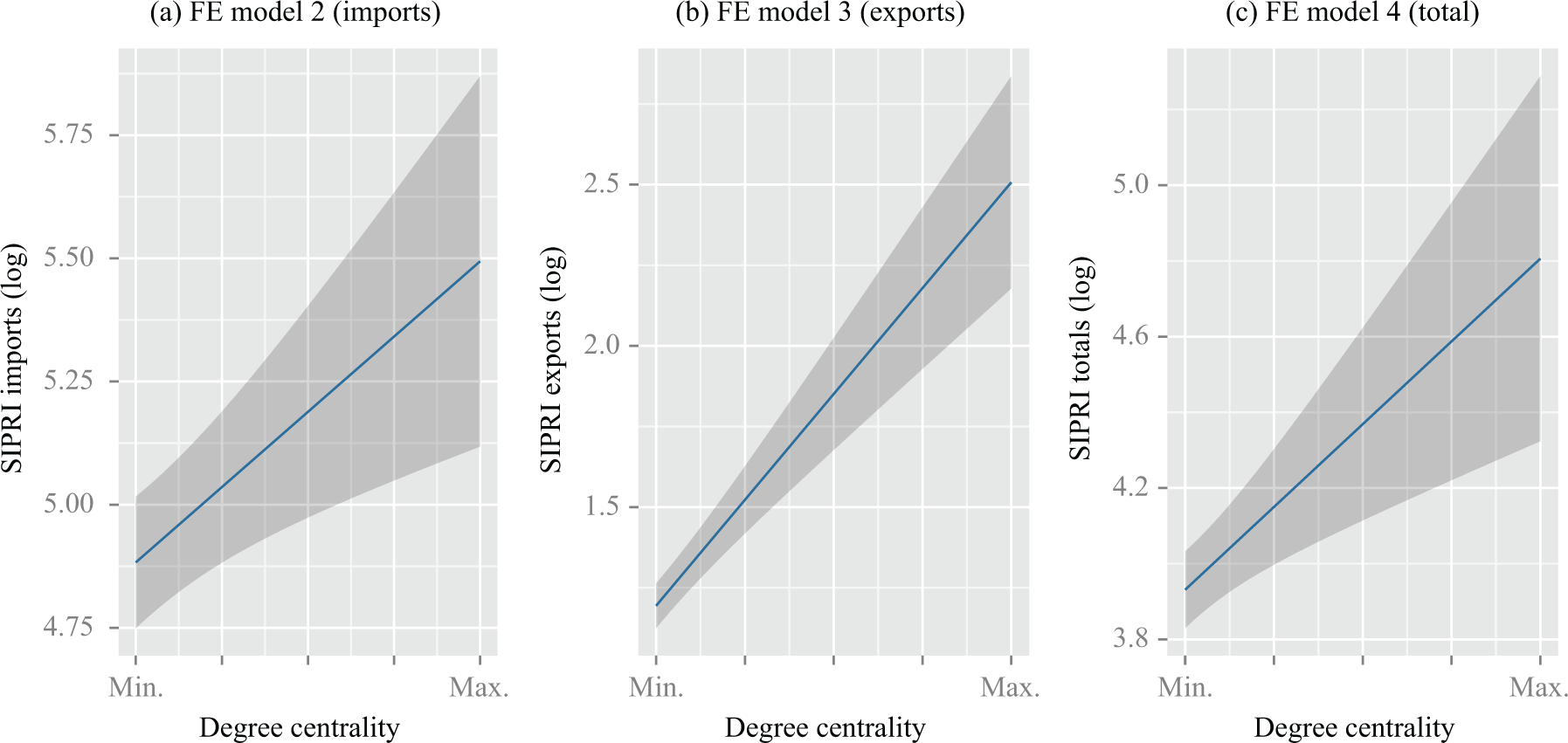
Substantive effect of WCA degree centrality on arms trade, 1980–2010
As a final consideration, I assess the robustness of these results to traditional linear regression. To account for both spatial and temporal heterogeneity, I incorporate country-level fixed effects (FEs) and time-period dummies (cf. Kinsella, 2000). While this model cannot incorporate coevolution, it offers important benefits. First, it does not require an ordinal dependent variable. Second, the country-level fixed effects allow us to control for all manner of unobserved heterogeneity, including systematic differences between net arms exporters and net importers. Third, and perhaps most importantly, we can separately assess export and import activity with less fear of bias. In the SAOM, restricting the model to only imports or exports will yield inaccurate results. If, say, a country i ratifies a WCA but sees little change in imports, that information will bias parameter estimates downward, even if i experiences an increase in exports. Because the FE model focuses exclusively on within-unit variation over time, we eliminate cross-sectional comparisons between fundamentally different types of states (i.e. exporters and importers).
I construct the FE models using continuous, log-transformed measures of imports, exports, and total arms trade. The covariates are identical to those used in the SAOM arms trade equation. The results of the analysis are summarized in Table II. For imports, the estimated effect of WCA degree is positive but statistically insignificant. However, restricting the sample only to arms-importing states (FE Model 2) yields a positive and highly significant estimate. 23 That is, for those states that actively import weapons, WCAs increase import volumes over time. Further, for both exports and total arms trade, the estimated effect of WCA degree is positive and highly significant. Figure 8 plots the marginal effect of WCA degree for columns 2–4 of Table II. Increasing WCA degree from its minimum to its maximum leads to a doubling in arms imports, from about $125 m USD to $250 m USD – though the confidence interval for this estimate is quite large. In contrast, exports increase from about $3.5m USD to $12m USD – in absolute terms, a smaller change than for imports, but in relative terms, a nearly fourfold increase. The export effect is also more precise than the import effect and applies to all states, not just arms exporters. Overall, the benefits of WCAs appear to accumulate more reliably for exports than imports.

Comparison of in-sample predictions
Given that the simpler FE model yields results similar to the SAOM, what is the value-added of the network approach? In principle, because the FE model ignores coevolution, the parameter estimates may be biased. Direct comparison of the two models is not straightforward, as they employ fundamentally different estimation techniques. One approach, employed by Desmarais & Cranmer (2012) and others, is to evaluate predictive accuracy. To facilitate this test, I estimated an ordinal logit model using the same five-category ordinal measure used in the SAOM (see Table II, column 5), and I then generated in-sample categorical predictions. Comparing these predictions to observed data, I find that the ordinal logit model predicts the correct arms trade category in about 56% of cases. For the SAOM, I calculated predicted arms trade categories by taking mean values of the simulated z matrices, and I found that the SAOM correctly categorizes arms trade levels in about 66% of cases. Figure 9 compares predictions by category. In all but one category, the SAOM noticeably outperforms ordinal logit.
Conclusion
To my knowledge, weapons cooperation agreements have never been subjected to systematic analysis. This article is thus the first attempt at exploring this important new trend in international defense cooperation. I emphasize three conclusions. First, not only have WCAs proliferated in recent years, but they are also substantively important. As treaties, WCAs are subject to the same realist criticisms often levied against other types of international institutions – that is, that they are costless, inconsequential to state behavior, and epiphenomenal to the interests of powerful countries (Mearsheimer, 1995). Indeed, the recent rapid growth in WCAs would seem to reinforce perceptions of triviality. Yet, this analysis shows that WCAs have real consequences. This finding raises expansive new questions about the effects of WCAs on everything from military capabilities and defense spending to economic, diplomatic, and political relations – all of which remain possibilities for further research.
Second, despite a brief post-Cold War decline, the arms trade continues apace. The world is growing more weaponized. And, based on the analysis conducted here, WCAs have contributed to this trend. We lack a global counterfactual to assess how the arms trade would have fared in the absence of WCAs. Nonetheless, the evidence clearly shows that, for those countries that sign these treaties, weapons flows increase correspondingly. Further, exporters appear to benefit most reliably, as WCAs improve access to previously unavailable export markets and reduce barriers for existing partners. For those who care about global peace and stability, this outcome is troubling, not least because it implies that, ceteris paribus, if growth in WCAs continues unabated, growth in arms trade will follow. And while nascent multilateral frameworks, such as the Arms Trade Treaty, endeavor to staunch these weapons flows, it’s not yet clear how these frameworks will interact, if at all, with the increasingly dense network of bilateral weapons agreements.
Third, and more abstractly, networks matter in international relations. This analysis refrains from developing more complex measures – based, for example, on transitivity, structural equivalence, and other higher-order dependencies – in order to specifically model the coevolving relationship between states and the networks in which they are embedded. This approach allows us to capture important characteristics of nodes, such as degree centrality, while also addressing the selection-influence problem. Importantly, a comparison of the predictive accuracy of the network model and a traditional logit model strongly suggests that ignoring selection-influence dynamics will lead IR scholars to erroneous inferences. More fundamentally, this analysis raises difficult questions about how we conceptualize relations between states. To what extent are the individual attributes, characteristics, and actions of states reflective of the global social networks in which they are embedded? To what extent are the international relations of states driven by individual attributes, characteristics, and actions? The relationship between bilateral weapons agreements and arms trade is just one small facet of this much larger issue.
Footnotes
Replication data
An Online appendix and replication files can be found at http://www.prio.org/jpr/datasets and at  . The analysis was conducted in R 3.1.2 and Stata MP 14.0 on a Unix platform.
Acknowledgements
For their outstanding comments, I thank participants at the workshop on Networked International Politics: Complex Interdependence and the Diffusion of Conflict and Peace, University of St Gallen, Switzerland, 20–22 November 2014. I am especially indebted to Aya Kachi for her insightful critical feedback; to three anonymous reviewers for helpful comments; and to the JPR special issue editors for their invaluable guidance in revising the manuscript. Mayu Takeda, Calin Scoggins, Engin Kapti, Kuo-Chu Yang, Fiona Ogunkoya, Evan Sandlin, and Jasper Kaplan provided research assistance. Any errors or oversights are mine alone.