



Abstract
Research on the relationship between political institutions and civil war has paid insufficient attention to the role of traditional institutions in developing countries. This study presents large-N evidence showing that traditional ethnic institutions with origins prior to Western colonization are associated with the prevalence of civil wars in Africa after independence. Matching ethnographic data on the pre-colonial political organization of African indigenous groups to contemporary data on ethnic groups in conflict, I investigate the relationship between the traditional organization of ethnic groups and ethnic civil wars in Africa after decolonization. Specifically, I argue that excluded groups with centralized traditional institutions can rely on these institutions to more credibly bargain with the state, and that this reduces their risk of conflict. Accordingly, I find that excluded groups with centralized pre-colonial institutions are less likely to be involved in civil wars.
Introduction
An enduring question in political science is how to build institutions to overcome the problem of political violence. Systematic research on this question suffers from a restrictive focus on contemporary national-level institutions, to the neglect of traditional ethno-specific institutions existing locally in developing countries. This overlooks a plethora of traditional institutions that are the surviving remnants of pre-colonial states. This study focuses on pre-colonial political institutions at the level of ethnic groups within states in Africa, and their effect on the conflict propensity of groups today. It is motivated by the observation that some ethnic groups in Africa have a history of strong centralized institutions, while other groups have no such tradition. These patterns remain: some groups, such as Buganda of Uganda, the Ashanti in Ghana, and the Zulu of South Africa, still have kings, legislatures, customary courts, and bureaucrats, while many groups have no such structures. I claim that groups with historically centralized institutions will be less involved in conflicts with central governments, because these groups can draw on state-like institutions to more credibly bargain with the state.
The motivation for focusing on pre-colonial institutions in Africa is twofold. First, the link between these institutions and conflict has not been studied systematically, and Africa is where they are most salient. Second, pre-colonial institutions constitute an important omitted variable in studies of development, and especially so in weak states (Michalopoulos & Papaioannou, 2014).
Using large-N evidence from Africa, the article shows how these institutions can be studied in a comparative framework, demonstrating that they play a significant role in shaping contemporary conflict patterns. Crucially, building on emerging research on the continued importance of traditional institutions in Africa (e.g. Acemoglu, Reed & Robinson, 2014), I argue that ethnic groups with strong pre-colonial institutions that do not control governments can use these institutions as frameworks for making credible commitments to nonviolent bargains with states. This makes these groups less likely to be involved in civil conflicts, assuming that violent conflicts erupt due to an inability to credibly commit to settlements (see e.g. Fearon, 1995). This yields the expectation that groups with centralized traditional institutions should be more capable of bargaining with post-colonial African states than other groups, and have a reduced propensity for armed confrontations.
To investigate this I match comparative anthropological data on pre-colonial political structures in Africa to a contemporary dataset on ethnic groups and civil war. Using this dataset, the argument is tested in a large-N analysis of ethnic conflict in Africa from 1946 to 2009. I find evidence that a history of centralized pre-colonial institutions pacifies excluded groups. This is robust to controlling for a number of alternative causal mechanisms, and it also holds when instrumenting for pre-colonial centralization, using natural variation in ecological diversity as an instrument, drawing on Fenske (2014). This contributes to our understanding of the contemporary role of traditional state-structures in Africa, and studies of ethnic conflict (e.g. Cederman, Wimmer & Min, 2010; Cederman, Gleditsch & Buhaug, 2013), while introducing a fresh perspective on the institutions–conflict link (for an overview, see e.g. Hegre, 2014).
The article is structured as follows. The next section places this contribution in context, and motivates the focus on pre-colonial institutions. Then follows the theoretical argument of the article, while the subsequent sections present the research design and results, respectively.
Background
When investigating the institutions–conflict link, scholars usually consider the attributes of national institutions such as democracy (e.g. Hegre et al., 2001), or power-sharing constitutions (e.g. Hartzell & Hoddie, 2007). Although this research covers important ground, an increased focus on subnational traditional institutions in developing countries is warranted. First, this redirects attention to the importance of historical institutions (e.g. Acemoglu, Johnson & Robinson, 2001), a topic that is neglected by conflict scholars. Second, traditional institutions at the local level are of great importance in states with weak central governments, which is the case for most conflict-prone countries. As Herbst (2000) argues, African states in particular have been unable to ‘broadcast’ power over large parts of their territories due to geographies that are inhospitable to political centralization, opening up for local rule by traditional authorities with pre-colonial roots. Recent evidence suggests that the importance of national institutions for development declines outside of African capitals (Michalopoulos & Papaioannou, 2014).
Africa is an ideal continent for studying the role of these institutions, since a number of traditional political structures persist (in some form) at the local level despite decades of colonial rule and post-independence civil wars. These institutions are instantiated in customary legislatures, traditional courts, houses of chiefs, and similar structures. Although it is held by some that colonial institutions is key in explaining contemporary development (e.g. Acemoglu, Johnson & Robinson, 2001, 2002), this is nuanced by studies demonstrating the impact of pre-colonial indigenous political structures on development. They have been shown to matter nationally (Hariri, 2012; Gennaioli & Rainer, 2007), and locally (Michalopoulos & Papaioannou, 2013, 2014; Acemoglu, Reed & Robinson, 2014). I argue and demonstrate that these structures also matter for contemporary civil wars. Crucially, I show that it matters whether these traditional institutions have a history of political centralization.
Classifying traditional institutions: The centralized–decentralized dimension
Prior to colonization, Africa was populated by a myriad of polities. One of the most common ways of classifying these polities is according to their level of political centralization. This distinction is crucial in early ethnographic work on African pre-colonial polities, and commonly refers to whether pre-colonial polities had central governments that looked like states or not (Fortes & Evans-Pritchard, 1940; Vansina, 1962; Murdock, 1959, 1967). Historically, African polities ranged from centralized states with armies, courts, and diplomats, to bands of hunter-gatherers with no formal centralized political authority.
Decentralized systems often take the form of nomadic hunter-gatherers, clans, or stationary autonomous village systems, while centralized polities are systems where ‘a political authority controls a centralized state that can uniformly apply policies throughout a given territory’ (Schraeder, 2004: 29, 30). Seminal studies of African development, such as Englebert (2000) and Herbst (2000), attribute an important role to the centralized–decentralized distinction.
A number of examples display the fruitfulness of this scheme. The Buganda kingdom of Uganda is a classic case of a centralized kingdom. Prior to colonization it had an intricate institutional edifice which the British policy of ‘indirect rule’ left intact. This included a complex system of government with an appointed hereditary monarch, the Kabaka, as the supreme authority at the top, and local county chiefs and princes administering counties at lower levels. It maintained a complex legal system, public courts, and a bureaucracy (Southwold, 1965: 88–101). Another example was Azande, which functioned as an empire, with a king in the center and local governors answering to him. Azande had a sophisticated system of governors, nobles, commoners, vassals, and soldiers, giving it a strong resemblance to a state (e.g. Evans-Pritchard, 1960, 1963, 1971).
At the decentralized end of the spectrum, one finds groups like the San of Namibia and Botswana, who, prior to colonization, were decentralized hunter-gatherers (Schraeder, 2004: 24–25). Another example is the Igbo in Nigeria. Prior to colonization, according to Colson (1969) cited in Herbst (2000: 45), they organized in ‘small autonomous village communities’, recognizing ‘no common political leaders’. Their political organization manifested itself in different ways across a network of tribes (Ottenberg, 1965). As Anber notes, ‘traditional Ibo society was acephalous, egalitarian, and individualistic, united more by culture than by power or authority’ (1967: 169).
The persistence of pre-colonial institutions
Many considerations discount the idea that pre-colonial institutions in Africa can be described as historically persistent. The footprint of colonialism on African colonial and post-colonial development was immense (e.g. Nunn, 2008), and directly affected the status of pre-colonial institutions. For example, colonial authorities selectively empowered different pre-colonial rulers, and in some cases, traditional rulers with (alleged) pre-colonial roots were even ‘invented’ to serve colonial interests (see e.g. Mamdani, 1996). This continued after decolonization, and the status of pre-colonial institutions has been partly shaped by the priorities of post-colonial governments (e.g. Mamdani, 1996; Boone, 2003).
These processes notwithstanding, pre-colonial institutions can broadly be characterized as persistent, and are observable in the customary courts, legislatures, and chieftaincies that dot the continent. I here highlight five considerations in favor of such persistence. First, persistence is indicated by recent data. In a survey of country experts, Kromrey (2014) reports that more than 90% of politically relevant ethnic groups, in a sample of 145, still organize in a traditional political system. In a recent round of the Afrobarometer surveys (Afrobarometer, 2008), more than half of respondents report that traditional rulers wield considerable influence in their communities (Logan, 2013).
Second, numerous qualitative studies emphasize persistence (e.g. Englebert, 2000; Herbst, 2000). Pre-colonial institutions are described as ‘competitors to the centralized African state’ (Herbst, 2000: 173). Some even claim that Africa is a case of ‘mixed government’, referring to power-sharing between states and traditional rulers (Sklar, 1993: 86).
Third, the contemporary situation of a number of groups indicates persistence. In Uganda, the historical institutions of the Buganda kingdom have served as the primary framework within which the Buganda ethnic group has bargained with colonial authorities (Apter, 1960) and the various rulers of Uganda since independence (e.g. Englebert, 2002: 349). The Zulu in South Africa also exemplify continuity. A number of traditional Zulu institutions still remain and play important roles in South African politics (Beall, Mkhize & Vawda, 2005). In Ghana, an example can be found in the Ashanti kingdom, whose institutions have persevered and received several delegated authorities in Ashantiland (see e.g. Ubink, 2008).
Many of the historically decentralized groups of Africa have also persisted. However, many of them have not relied on pre-existing political structures for their political organization, but have created new platforms for mobilization. The Igbo of Nigeria, for example, have not appealed to their traditional political structures in their quest for autonomy, but to notions of cultural unity and modern forms of organization (Anber, 1967).
Fourth, recent studies show the role and importance of institutions with pre-colonial roots for a range of outcomes, such as economic growth (Gennaioli & Rainer, 2007; Michalopoulos & Papaioannou, 2013, 2014) and cultural development (Fenske, 2013). Traditional chiefs play important roles in local political issues such as the implementation of public-goods projects and the selection of local and national political representatives (Baldwin, 2013), conflict resolution (Zartman, 2000), and land management(Boone, 2003, 2014).
Finally, the persistence of pre-colonial institutions aligns with theory. One such theory highlights stable (but multiple) equilibria, applied to institutions in Africa by Nunn (2007). Another is found in the theory of historical path dependence, formalized by Page (2006). In this framework, path dependence is defined as a process in which the outcome at any point in time depends on the history of previous outcomes (‘outcome-dependence’) and their order (‘order-dependence’). This description accommodates persistent pre-colonial institutions in Africa, since their contemporary status depends on both their salience for long swathes of history (outcome-dependence), and the fact that they were there (in most cases) before the colonizers (order-dependence).
A mechanism that can account for persistence in this framework is the logic of negative externalities. Because most traditional institutions in Africa ground their authority in claims to tradition and historical legitimacy, their authority grows the more credibly they can claim to have deep historical roots, which are strengthened with each passing year of history. Hence, since authority is partly legitimized by historical persistence, this creates negative externalities for other institutions, notably those of the modern state whose authority is circumscribed (Page, 2006).
Pre-colonial institutions and civil war
How is a history of centralized pre-colonial institutions linked to ethnic civil war? In line with Cederman, Girardin & Gleditsch (2009) I take a dyadic pespective of ethnic civil war as a starting point, focusing on the interaction between an ethnic group that is excluded from power and the ethnic group (or coalition of groups) that is in power. This dyadic framework is appropriate insofar as ethnic civil wars are most likely to occur between excluded groups and governments (Cederman, Wimmer & Min, 2010; Cederman, Gleditsch & Buhaug, 2013). Against this background, I draw on bargaining theory (Fearon, 1995), and assume that there is some agreement within the bargaining range of each actor in the dyad that will be preferred to conflict. Since conflict is a costly and inefficient way of settling disputes, both parties would prefer to settle an issue peacefully. Such settlements may concern territorial autonomy, land-allocation rights, or rights to vital local resources. Indeed, one of the most common issues that ethnic groups and governments bargain over in Africa is land (e.g. Boone, 2003, 2014).
In bargaining theory, the obstacles to an agreement arise when parties to a conflict are unable to make credible commitments (Fearon, 1995). If the government does not trust the excluded group to uphold an agreement, and if this distrust is mutual, there will be no incentives to reach an agreement since there is a high probability of defection.
Building on this, I argue that excluded groups with centralized traditional institutions should have a high ability to strike more credible bargains. First, because these institutions reduce uncertainty about the future behavior of the group. When an excluded group has centralized institutions it is easier for the state to expect continuity, since strong centralized institutions set limits to the composition of the governing coalition in that group, the range of behaviors this coalition can engage in, and the set of preferences that shape group demands. For example, having centralized institutions will reduce the probability of spoiler dynamics, whereby factions of the group violate the agreement. It will thus be easier for the state to expect continuity when there is one centralized source of authority with clearly specified institutional constraints, than when such institutions are lacking. For example, a traditional governing body, such as a house of chiefs, can make more credible promises about future behavior than a shifting and contingent coalition representing a decentralized group with few permanent and centralized sources of authority.
Second, centralized traditional institutions impose constraints on the leadership of the group, which in turn can make promises more credible. Most traditional kingdoms, such as the Zulu, Ashanti or Buganda, have formalized institutional structures – like houses of chiefs, courts, and formal laws – that can be used to codify agreements that will increase violation costs. For example, a commitment that is formally ratified by an institution such as a customary court is more credible, since a violation of this commitment would impose a cost by lowering the credibility of the ratifying institution. Centralized institutions thus create mechanisms for what Fearon (1997) calls ‘hand-tying’ in the face of commitment problems, whereby an actor herself increases the intrinsic cost of reneging on a bargain. Because of such institutional contraints, an agreement made by someone representing an institution, such as the Bugandan Lukiiko (legislature), will be more trustworthy.
On this level, centralized institutions reduce uncertainties and impose constraints that make actors with these institutions more credible. In this sense, bargaining with groups with centralized institutions is more like bargaining with other states than bargaining with rebel groups without such institutions. Related arguments in the civil war literature resonate with this picture. For example, Cunningham (2013) argues that opposition movements that are divided and factionalized (i.e. less centralized) face greater commitment problems when bargaining with central governments, making them more likely to experience civil wars. 1 This is also in keeping with recent literature on the role of customary authorities in contemporary African politics. For example, recent work by Baldwin (2014) and Boone (2003) highlights that African governments cede control of land management to customary authorities with centralized institutions, because these command the loyalty of local populations and can more credibly commit to returning the favor of ceded sovereignty.
An illustration of the mechanism can be seen in a comparison of the conflict histories of the Acholi and Buganda ethnic groups in Uganda. The Buganda have relied on their traditional centralized pre-colonial structures to bargain with the state, and have largely avoided full-scale war. During colonialism, Buganda successfully made agreements for a privileged status within the colonial apparatus, and it often operated in an alliance with British rulers. Bargaining for restoration of the kingdom continued after independence. Although Buganda was suppressed by the Obote government after his auto-coup in 1966, and while it partly supported Musevenis’s NRA rebellion, Buganda–Uganda conflict has commonly found political solutions relating to the status of the kingdom, and has never erupted into full-scale war (e.g. Johannesen, 2006). Buganda was officially restored in 1993, soothing Bugandan nationalist sentiments (Englebert, 2002).
The Acholi, a group with decentralized and fragmented political institutions, arguably represent a contrast. The group has dominated the Ugandan army, and been on the sending and receiving end of numerous coups and rebellions, most recently seen in the rebellion of the Acholi-dominated Lord’s Resistance Army (LRA). A bloody civil war has raged in Acholiland since the 1980s. The fact that the Acholi are without centralized traditional authority has led to fragmentation, with some factions supporting rebel groups such as the LRA and the Uganda People’s Democratic Army (UPDA), and other factions finding more peaceful political outlets (Doom & Vlassenroot, 1999). Such fragmentation is a plausible reason for the failure to find a comprehensive solution to the conflict in Acholiland. For example, in 1994, peace talks between the LRA and the government broke down due to internal Acholi disagreements between traditional leaders and the LRA, whereupon the Museveni government withdrew its offer of an agreement (Doom & Vlassenroot, 1999). For Buganda, centralized traditional institutions enabled a unified authority structure with clear political aims that could bargain with the state, while in the case of Acholi, decentralized authority led to fragmentation and war. This illustrates how centralized pre-colonial political structures can facilitate bargaining in the shadow of conflict. The argument presented here leads to the following expectation: Excluded ethnic groups with centralized traditional institutions will have a lower probability of experiencing conflict than other excluded groups.
A potential threat to inference regarding this expectation is the possibility that there is systematic selection into the category of excluded groups with historically centralized institutions and that this selection is correlated with conflict. This occurs if centralized groups are more likely to survive colonization and post-independence state-building if they do not pose a military threat to the government – for example, if they have been defeated militarily, or if they have been allowed to persist because they are satisfied with their distribution of power vis-à-vis the state. Related threats to inference stem from reverse causality or more general omitted variable bias. Such bias will arise if underlying historical factors affect both conflict involvement and state-building, or if conflict affects historical institutions, such that conflict-prone groups are less or more likely to centralize (see e.g. Osafo-Kwaako & Robinson, 2013). In all of these cases – historical selection into the category of persistent centralized groups, omitted variables, or reverse causality – we risk biased inferences, highlighting the need for a clear strategy for causal inference.
Research design
Following recent studies on pre-colonial institutions and development (e.g. Michalopoulos & Papaioannou, 2013, 2014; Gennaioli & Rainer, 2007; Fenske, 2013; Wimmer, forthcoming; Alesina, Giuliano & Nunn, 2013), I use George Peter Murdock’s Ethnographic Atlas (Murdock, 1967), later revised and corrected by Gray (1999). This contains over 60 variables capturing socio-economic, political, and religious characteristics of 1,270 indigenous ethnic groups around the world. The data for each group are aggregated from ethnographic field studies done before 1950, and each group is coded based on the earliest studies available with sufficient information. In most cases this means that the ethnic groups have been studied immediately after their contact with European colonizers.
The information in the atlas for the African continent has been geo-referenced in a map created by Murdock, later digitized by Nunn (2008), which has been used in the construction of the dataset presented here. This map, displayed in Figure 1, shows the large number of pre-colonial states in Africa. 2
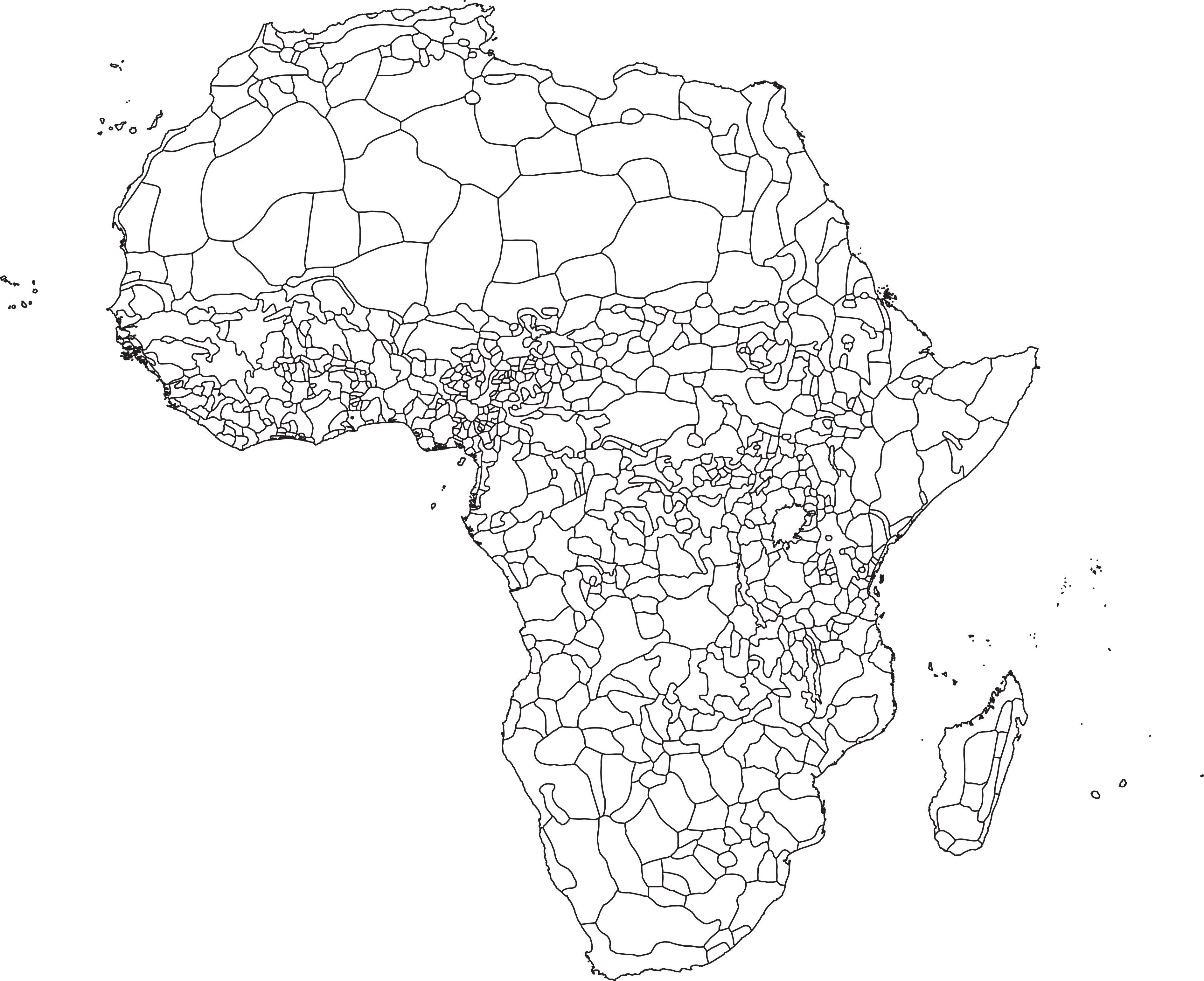
Murdock’s map of pre-colonial ethnic groups
It is not relevant to consider all the groups in the Ethnographic Atlas. Some will have vanished from Africa’s sociopolitical map through assimilation, persecution or other processes, while some remain politically relevant in the post-colonial period. As Posner argues, one should focus on the groups ‘that are actually doing the competition over policy, not the ones that an ethnographer happens to identify as representing distinct cultural units’ (2004: 853, emphasis in original). To ensure this, and to combine it with data on ethnic civil war, I link the information in the Ethnographic Atlas (EA henceforth) to a dataset containing information on the politically relevant ethnic make-up of Africa: the Ethnic Power Relations dataset (EPR henceforth) (Cederman, Wimmer & Min, 2010; Wimmer, Cederman & Min, 2009) version 1.1, for all groups in Africa. EPR codes all ‘politically relevant’ ethnic groups globally in the period 1946–2009, using an expert survey. 3 This utilizes information on the political inclusion/exclusion of ethnic groups, and their conflict activity.
Drawing on qualitative sources, I match African groups in EPR to the groups in the EA (described in greater detail in the Online appendix). Out of a total of 255 EPR groups in Africa in the time period, 243 (95%) EPR groups are matched to one or more corresponding EA groups. The exceptions are the non-indigenous colonizer groups, and some ethnicities that did not exist prior to colonization. While 73% of EPR groups were matched to one EA group, 27% were matched to more than one. In these cases I scored the variables for the given EPR group by taking the mean of the scores of the EA groups matched to it (and rounding). I have also done this by using the median, maximum, and minimum value, with no difference in results (see Online appendix, section 2.2). Out of these 243 groups, 152 have at some point been excluded.
Unit of analysis
Since the argument presented above does not make direct predictions about the conflict activity of included groups, I restrict my baseline analyses to looking at excluded groups as units of analysis. In this setup a group is coded as excluded if it is not represented in government. 4 In spite of the lack of predictions about the behavior of included groups, one could argue that a dyadic setup, analyzing pairs of excluded groups and groups in government (such as in Cederman, Girardin & Gleditsch, 2009) would be more appropriate, given the dyadic focus on two bargaining actors. I therefore conduct robustness tests on such a dyadic setup in the Online appendix (section 9).
Ethnic armed conflict
As the dependent variable I use the Ethnic Armed Conflict (EAC) dataset (Cederman, Wimmer & Min, 2010), which codes ethnic armed conflicts at the group level. The list of included conflicts is taken from the UCDP-PRIO ACD data (Gleditsch et al., 2002). In the EAC dataset, each conflict is linked to a group in the EPR dataset, and defined as ethnic conflict if conflict actors ‘explicitly pursue ethno-nationalist aims and recruit fighters and forge alliances on the basis of ethnic affiliations’ (Cederman, Wimmer & Min, 2010). The dataset spans the period 1946–2009.
Pre-colonial centralization
To measure pre-colonial political centralization, I employ a variable from the EA titled ‘jurisdictional hierarchy’ (Pre-colonial centralization henceforth). This captures the degree to which an ethnic group exhibited a high level of political centralization prior to colonization. According to Murdock’s atlas (Murdock, 1967: 160), the indicator is ‘a measure of political complexity, ranging from 0 for stateless societies, through 1 or 2 for petty and larger paramount chiefdoms or their equivalent, to 3 or 4 for large states’. A comparison of scores on this variable and historical sources shows that this has substantial face validity. The Zulu kingdom, for example, is given a score of 3, and was also highly politically centralized. The same is the case for the institutionally complex kingdoms of Azande (score of 2), Buganda kingdom (score of 3), and the Ashanti (score of 2). Face validity is also high for groups that were less centralized, such as the San people (score of 0), or the Igbo (score of 1). Further discussions and validity tests of this measure can be found in the Online appendix (section 2.3).
Controls
I include a number of potential confounders as controls. First, I include a measure of Group size. This is because Pre-colonial centralization partly taps how large the polity of the given group is (e.g ‘large state’). It is also because political centralization is plausibly correlated with size, and probably also with military power. For example, very small groups will simply be too small to challenge the state, and their non-involvement in violent conflict might be a function of their size rather than their decentralized institutions. Furthermore, very large groups might be so threatening to the government that they are more often accommodated in power. The group size variable is taken from the EPR dataset. Since the relative, rather than absolute, size of a group is expected to matter more for whether there will be a conflict, I make Group size relative to the population size.
Additionally, I control for a number of pre-colonial group traits from the EA. Most importantly, I include resource-related characteristics that might predispose groups to adopt complex institutions. Since many conflicts in Africa are fought over agricultural resources (e.g. Boone, 2014), and since agricultural potential influences state-formation (e.g. Osafo-Kwaako & Robinson, 2013), the agricultural profile of ethnic groups is a potential confounder. I therefore include a variable for the adoption of complex agriculture, measured as an ordinal variable (Agriculture), ranging from 0 to 4, where 0 is ‘no agriculture’ and 4 is if the group practiced ‘intensive irrigated agriculture’. I also include a variable tapping a group’s degree of agricultural dependence (Agridependence). This is an ordinal variable from 0 to 9 where 0 is 0–5% dependence on agriculture, while 9 is 100%. I also include reliance on gathering (Gathering), where 0 is coded as 0–5% reliance on gathering, while 1 is coded as more than 5%. 5 Additionally, I control for the presence of animal husbandry (Animal husbandry) to proxy for pastoralist groups, since conflicts between pastoralists and farmers are common (e.g. Hussein, Sumberg & Seddon, 1999).
I also include a measure of the pre-colonial settlement pattern of a given group, to make sure that the relationship between institutions and conflict is not simply a function of non-institutionalized groups being more mobile. This is done with a binary variable (Nomadic), based on Murdock’s atlas, where 1 is ‘nomadic or fully migratory’ or ‘seminomadic’, and zero otherwise.
Finally, it could be that a potential alternative mechanism at work is one relating to balances of power and military threat potential rather than a capacity to bargain credibly. For example if groups with centralized institutions constitute greater threats to the government than other groups, making them more likely to be accommodated, this would yield similar observable implications as my argument but support a different interpretation. Although balances of power are partly picked up by the size variables, since power is plausibly correlated with size, it is not exhausted by this control. One could easily imagine that centralized groups present states with greater threats and are therefore (for example) more likely to be included in power-sharing deals (i.e. getting positions as junior partners in governments, etc.), which in turn might reduce their conflict propensity. To account for this, I include controls for Political power status, as coded in EPR. This is a seven-point ordinal scale, with the categories (in descending order); ‘monopoly’, ‘dominant’, ‘senior partner’, ‘junior partner’, ‘autonomy’, ‘powerless’, and ‘discriminated’. Since excluded groups are coded as not included in government, they only have scores in the three last categories. In the cross-sectional models I control for an ordinal version of this index (since using cross-sectional data means that I have to aggregate yearly scores), while in the models with a temporal dimension, I include these categories as dummy variables (as in Cederman, Wimmer & Min, 2010).
Models
To investigate the main expectation. I estimate three categories of models. First, I present baseline cross-sectional models, investigating the association between Pre-colonial centralization and the average risk of a group having at least one conflict onset. This considers all ethnic groups that have been excluded from power at some point. To address the great concern of country-specific omitted variables, these models include conditional country fixed effects in addition to the controls described above. I also include the log of years the ethnic group has been excluded, since groups that are in the dataset for longer periods of time will be exposed to risk for a longer period. When using listwise deletion to exclude missing data, this includes 123 groups, 39 of which have had at least one EAC.
I then proceed to a more complex modeling strategy, in order to more closely investigate the average treatment effect of Pre-colonial centralization for excluded groups (in any given year) across time. This is done by estimating time-series cross-section (TSCS) logit models with EAC onset as the dependent variable, and conditional country fixed effects. These models take the form:

Finally, I estimate instrumental variable (IV) models, to address the concerns relating to omitted variable bias, selection bias, and reverse causality described above (see e.g. Angrist & Pischke, 2009). To investigate this, I use an IV strategy where Pre-colonial centralization is instrumented by ecological diversity, following Fenske (2014), who argues that the ability to trade across ecological boundaries promoted the emergence of centralized states in pre-colonial Africa. Data on ecological diversity in the settlement areas of groups is taken from the replication data in Fenske (2014). In this setup, I estimate IV probit and two-stage least squares (2SLS) models.
Results
Cross-sectional models of ethnic conflict for excluded groups (group-aggregated data)
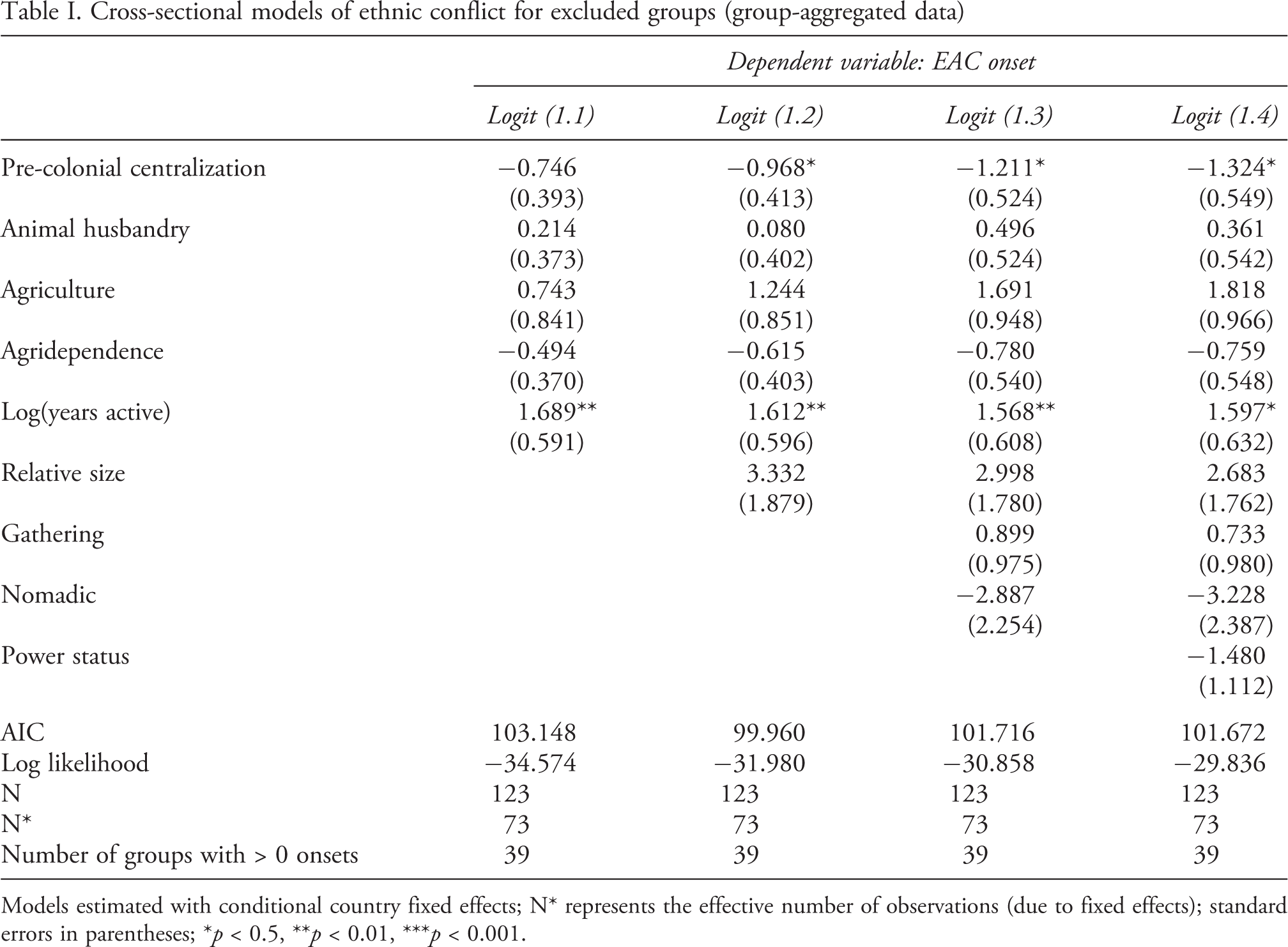
Models estimated with conditional country fixed effects; N* represents the effective number of observations (due to fixed effects); standard errors in parentheses; *p < 0.5, **p < 0.01, ***p < 0.001.
Table II shows the TSCS models. Models 2.1–2.5 are logit models treating Pre-colonial centralization as exogenous, while the next two columns estimate IV probit (2.6) and 2SLS (2.7) models endogenizing Pre-colonial centralization using ecological diversity. Model 2.1 includes Pre-colonial centralization peace-year terms (excluded from Table II), calendar year, and conditional country fixed effects. Here Pre-colonial centralization is significant and in the expected direction (–.442, SE = .162). Model 2.2 introduces the controls for agricultural profile. The estimate for Pre-colonial centralization expectedly becomes stronger and more precise when these variables are included (–.564, SE = .176). Model 2.3 adds the relative size variable, Model 2.4 includes the proxies for hunter-gatherer groups and nomadism, and Model 2.5 introduces dummies for the different categories of power status. The inclusion of these controls only serves to strengthen the Pre-colonial centralization coefficient, which is strongest in Model 2.5, with an estimated coefficient of −.914 (SE = .235).
Logit, IV probit, and 2SLS models of the risk of EAC onset for excluded groups

Models estimated with conditional country fixed effects; standard errors clustered on groups in parentheses; *p < 0.5, **p < 0.01, ***p < 0.001; peace years, peace years2, and peace years3 excluded from table; N* represents the effective number of observations (due to fixed effects).
It is important to note that the treatment effects estimated in Models 2.6 and 2.7 are different from the coefficients estimated in Models 2.1–2.5. First, it is more plausible to interpret the estimates for Pre-colonial centralization in Models 2.6 and 2.7 as causal effects, since these models endogenize Pre-colonial centralization using a plausible instrument. Hence, the estimates in Models 2.6 and 2.7 have higher internal validity than the estimates obtained in Models 2.1–2.5. Second, the estimates give the local average treatment effect (LATE) (Angrist & Pischke, 2009: 173), that essentially describes the causal effect of Pre-colonial centralization for ‘compliers’ (i.e. groups whose pre-colonial institutions are predicted by ecological diversity). To illustrate, this means that the 2SLS coefficient (Model 2.7) of −.036 should be interpreted as follows. A one-unit increase in Pre-colonial centralization on average yields a 3.6% decrease in conflict risk for groups complying with the instrument. Although there is no immediate reason to believe so, these LATEs might not be generalizable to all forms of Pre-colonial centralization in the relevant population. Hence, the IV-estimates buy us some internal validity at the price of some loss in generalizability. These caveats notwithstanding, the overall pattern identified in Tables I and II lends empirical support to the claim that excluded groups with higher levels of pre-colonial political centralization are less likely to be involved in conflict.
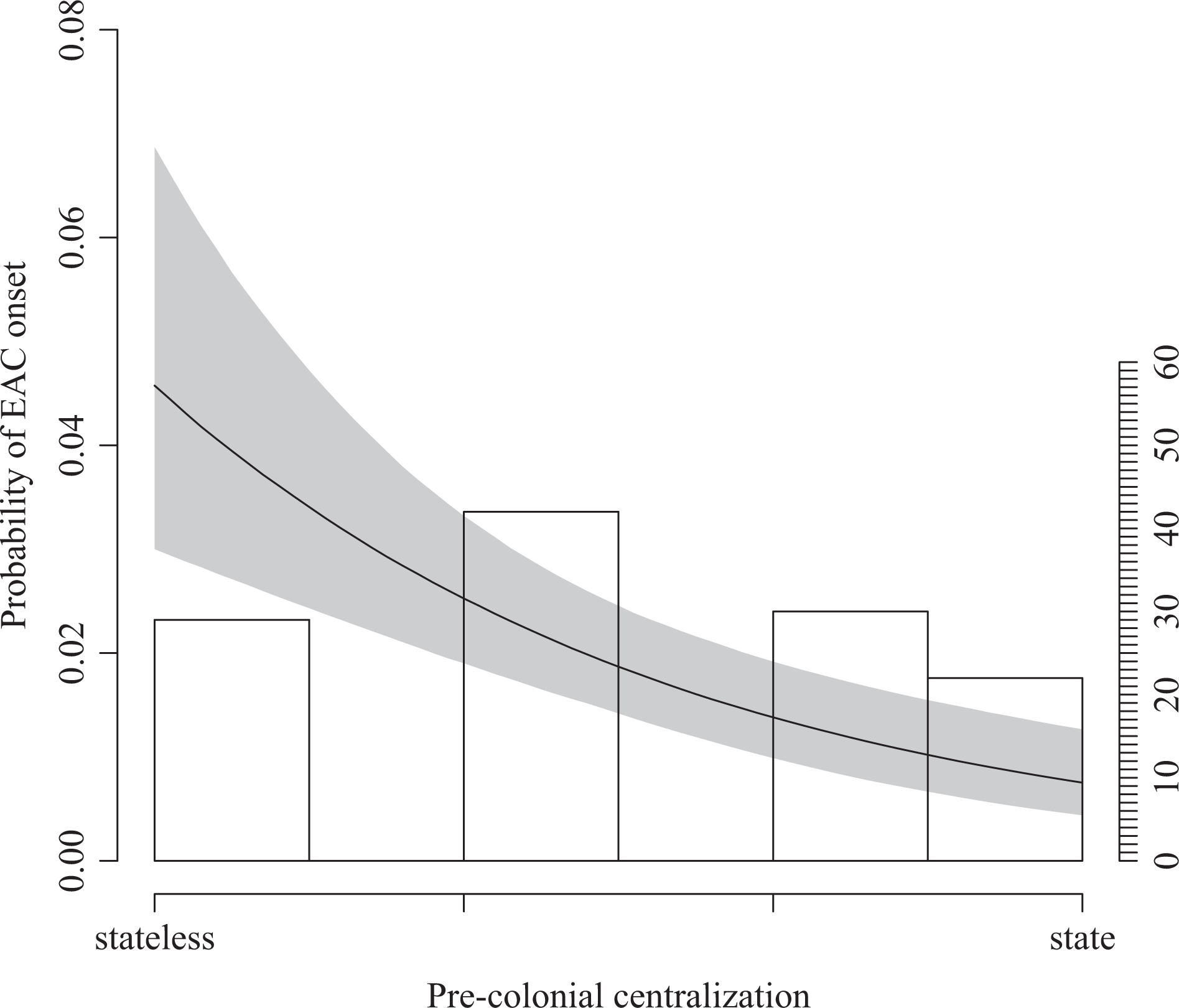
Predicted probabilities of EAC onset when pre-colonial centralization increases
The effect of Pre-colonial centralization is substantial. Figure 2 shows the result obtained when simulating predicted probabilities based on Model 2.5 in Table II. Here, an increase in Pre-colonial centralization for an excluded group from the ‘stateless’ to the ‘state’ category, when all other variables are kept at median values, decreases the risk of an EAC onset from roughly 5% to 1%. This means that an excluded group with high levels of Pre-colonial centralization is much less likely to experience an ethnic civil war than a group that was stateless prior to colonization, ceteris paribus. This pattern is generally retained throughout the various specifications in the analysis and robustness tests, and is similar across models assuming exogeneity and the IV models.
Although the risk of ethnic civil war for an excluded group in any given year is miniscule, the differences in cumulative risk over a series of years are substantial. Doing a simple calculation we find that over a period of ten years, an excluded group with pre-colonial institutions from the ‘state’ category has a cumulative risk of roughly 4% of experiencing at least one conflict in that period, while a formerly stateless excluded group has a cumulative risk of roughly 40%.
Alternative explanations, predictive power, and robustness
I here address a number of concerns about the inferences drawn from the analysis presented above and about the general robustness of the main finding. Crucially, I highlight plausible alternative explanations that could represent both threats of omitted variable bias, and threats to the exclusion restriction (in the IV models).
First, one alternative explanation is that centralized groups experience less conflict not because of their historical institutions, but because of the physical environments in which pre-colonial states originated. For example, Fenske (2013) presents persuasive evidence that high land quality is conducive to higher historical population density, commonly associated with the presence of state-like institutions (see also Osafo-Kwaako & Robinson, 2013). Furthermore, as is central to the IV strategy, Fenske (2014) finds that ecological diversity has contributed to pre-colonial state formation in Africa. If these climatic and ecological niches are conducive to pre-colonial state formation, and have an independent causal effect on the conflict propensities of ethnic groups, they will cast doubt on the argument presented here. This explanation both constitutes a threat of omitted variable bias, and represents a threat to the exclusion restriction in the IV models, since it implies that ecological diversity is causally linked to conflict through some other channel than pre-colonial centralization. This is possible if, for example, poor land quality is associated with ecological diversity, and this increases conflict risk because of conflicts over land (e.g. Raleigh & Urdal, 2007).
Also related to physical environment, some suggest that mountainous terrain is detrimental to the emergence of states (e.g. Scott, 2009), while also presenting favorable conditions for rebellion (e.g. Fearon & Laitin, 2003). Furthermore, since historically densely populated areas often are where urban centers are located today, historically decentralized groups are often found in conflict-prone national peripheries (Buhaug & Rød, 2006). These considerations suggest that the findings above could reflect geography and climate.
An additional explanation for the findings is that more centralized groups are wealthier, and thus have weaker incentives to fight. As, for example, Cederman, Gleditsch & Buhaug (2013) demonstrate, economic grievances can be an important cause of ethnic conflict. This becomes problematic when, as Michalopoulos & Papaioannou (2013) persuasively show, areas inhabited by historically centralized groups are wealthier than others. This can also be framed as a threat to the exclusion restriction insofar as ecological diversity in a group’s settlement area promotes economic development for that group. Hence, these considerations highlight group-specific economic development as an alternative explanation.
To investigate both of these alternatives, I match the EPR groups used in my analysis to geo-referenced data on spatial and geographic features of ethnic group settlement areas, using the PRIO-GRID database (Tollefsen, Strand & Buhaug, 2012) and the spatialized version of EPR (Wucherpfennig et al., 2011). To capture national peripheries, I include information on the distance from the capital city to the area inhabited by the group, and distance to the national border. In both cases I take the log of the area-weighted average. To measure mountainous terrain I include the log of the percentage of the area of the group’s settlement area that is covered by mountains. To capture ecological features related to land quality and ecology I include the average value on the SPI6 drought index in the group’s settlement area. Additionally, I include the log of the rainfall range for the settlement area of the group as described and operationalized in Fenske (2014). In the non-IV models, I also include ecological diversity as a control in the reduced form, to investigate whether it attains statistical significance once Pre-colonial centralization is included in the model, which would indicate a potential violation of the exclusion restriction.
To control for the economic-development mechanism I use the average night-time light density (measured by satellite) for the settlement area of each group. This is a proxy for economic activity, common in the literature (e.g. Michalopoulos & Papaioannou, 2013; Cederman, Weidmann & Bormann, 2015). All of these variables are described in greater detail in the Online appendix (sections 3 and 4).
To investigate whether my main result is explained by these alternative mechanisms, I include the controls proxying for them in one of the baseline models, to investigate whether the coefficient for Pre-colonial centralization is shaken by their inclusion. With the exception of ecological diversity (which is the instrument), I also include them as controls in the IV probit models, to investigate whether they present a threat to the exclusion restriction. Below, I only show the results for the baseline non-IV logit models, while results from the IV probit models are shown in the Online appendix (section 8). In addition to these tests, I perform an additional test looking at whether the results found above are similar for included groups. According to the main argument, Pre-colonial centralization should only affect the bargaining credibility of excluded groups, since groups that are in government cannot rely on customary institutions, but on the formal institutions of the state. Hence, there should be no discernible effect of Pre-colonial centralization for included groups.
Table III presents the results from Model 2.3 in Table II when I introduce the mentioned controls into this specification. Model 3.1 controls for mountainous terrain, while Models 3.2 and 3.3 include the log of the distance to capital and border, respectively. Model 3.4 includes the drought index, while Model 3.5 controls for group-level economic activity using the night-time lights measure. Models 3.6 and 3.7 include Log(Rainfall range) and Ecological diversity, respectively. This exercise shows that the results are robust to controls tapping alternative causal channels. None of these additional variables substantially affect the estimate for Pre-colonial centralization, and Ecological diversity is not statistically significant in the model with Pre-colonial centralization. The pattern in Models 3.1–3.6 is similar when these tests for alternative explanations are performed using the IV probit models (Online appendix, section 8), yielding qualitatively similar coefficients. Finally, column 3.8 investigates whether the results travel to included groups (which they should not), and as expected there is no discernible effect of Pre-colonial centralization for these groups.
In addition to investigating these alternative explanations, and performing the test on included groups, I undertake a number of robustness checks described in detail in the Online appendix, none of which alter the main result. I also evaluate the in- and out-of-sample predictive power of the Pre-colonial centralization variable, investigating the latter using cross-validation (Online appendix, section 6). I find that the centralization variable yields added predictive power, as captured by the area under the ROC curve (see e.g. Ward, Greenhill & Bakke, 2010) both in and out of sample. The overall picture emerging from these and further tests is that historically centralized pre-colonial institutions pacify excluded ethnic groups.
Conclusion
Logit models of the risk of EAC onset for excluded groups

Models estimated with conditional country fixed effects; standard errors clustered on groups in parentheses; *p < 0.5, **p < 0.01, ***p < 0.001; peace years, peace years2, and peace years3 excluded from table; N* represents the effective number of observations (due to fixed effects).
These findings have important implications. First, they provide additional support for the bargaining theory of conflict and the claim that strong institutions can enable credible bargaining (e.g. Walter, 2009). This support is made all the more impressive as this pattern is found for institutions arising in a completely different context than the modern national-level institutions most often studied in the civil war literature. Second, they demonstrate that the importance of institutional history for development outcomes in the African context should be recognized beyond the fields of development economics and history. Finally, the findings have policy relevance – not by yielding a clearcut variable that can be manipulated by aid agencies or governments, but by providing policymakers with knowledge of the role of traditional institutions as structural features that will have to be reckoned with, also, in discussions about conflict management. If strong traditional institutions are conducive to peaceful settlements between ethnic groups and states in Africa, these institutions should be nurtured and accommodated in the framework of the modern state.
Footnotes

References
Supplementary Material
Please find the following supplemental material available below.
For Open Access articles published under a Creative Commons License, all supplemental material carries the same license as the article it is associated with.
For non-Open Access articles published, all supplemental material carries a non-exclusive license, and permission requests for re-use of supplemental material or any part of supplemental material shall be sent directly to the copyright owner as specified in the copyright notice associated with the article.
