



Abstract
The literature on civil wars has recently turned towards their international context but lacks an account for how conflict beyond a state’s borders contributes to civil war onset. I argue that interstate rivalries can increase the risk of civil war in other states when rivals come to associate the foreign-policy orientation of other states with their own security. I present three pathways through which rivals increase the risk of civil war in other states. First, competition between rivals creates a ratchet effect by which the prospect of one’s involvement in a conflict makes it more likely that the other becomes involved. This dynamic makes support easier to secure and lowers the expected costs of war for governments and opposition groups. Second, rivals encourage domestic polarization as parties attempt to capture their influence, making domestic conflicts more intractable. Third, uncertainty over the potential for intervention by rivals increases the risk of miscalculation. I test the implications of the theory with novel spatial measures of interstate conflict and rivalry. Using logistic regressions and random forests, I find that being in the neighborhood of interstate rivals can increase a state’s risk of civil war.
How do international politics influence the outbreak of civil wars? This is a connection that seems intuitive to many – that we ‘might make progress by […] thinking about civil wars as international politics by other means’ – though theories developed to address this question have largely adopted a flat, non-strategic conception of international politics (Fearon & Laitin, 2008: 20, emphasis in original). The literature on the causes of civil war lacks a systematic account of how the same politics that play out over the course of civil wars contribute to their onset (Poast, 2015). If governments and opposition groups are even minimally strategic, then the preferences and strategic relationships between third parties should factor into their decisions to escalate or compromise in their internal conflicts. Assuming that these actors are strategic, we would then like to know whether those states whose geopolitical context places them in a higher risk category for intervention are also at greater risk of civil war in the first place (Gleditsch, 2007: 296). In other words, how does conflict between third parties shape the incentives and strategies of governments and opposition groups, and how does variation in a state’s geopolitical environment shape its risk of civil war?
This article develops and tests a theory of how strategic competition between interstate rivals contributes to the onset of civil war in other states. While we lack an account of how interstate conflict contributes to the onset of civil wars, recent work suggests that the international system should matter for understanding civil war onset. The superpower rivalry in the Cold War mattered for how civil wars were fought (Kalyvas & Balcells, 2010). If there is such a strong relationship between conflict in the international system and how wars are fought, it is no great leap to suspect that interstate competition influences when and where civil wars occur. That is, conflict between states can contribute to conflict within states.
I argue that rivals increase the risk of civil war in other states by serving as a source of foreign support. Rivals are more likely targets for securing support because they respond to opportunities to further their own interests and stymie those of their rivals. Rivals increase the risk of civil war in other states through three pathways. First, competition between rivals creates a ratchet effect by which the prospect of one’s involvement in a conflict makes it more likely that the other becomes involved. This dynamic makes support easier to secure and lowers the expected costs of war for domestic groups. Second, rivals encourage domestic polarization as parties attempt to capture their influence, making domestic conflicts more intractable. Third, uncertainty over the potential for intervention by rivals creates risks of miscalculation. I argue that states in geographic proximity to rivals, especially rivals closer in power, are most likely to experience the destabilizing effects of third-party competition. Rivalries characterized by extreme power asymmetry, such as the USA–Cuba rivalry, are less likely to promote instability abroad, while rivals should exercise a stronger influence on nearby conflicts. Actors in these conflicts are more likely to try to engage them for support and rivals are likely to take more interest in nearby conflicts.
I test the relationship between interstate competition and civil war risk using novel spatial measures of rivalry. I use logistic regressions as a baseline and further demonstrate the predictive importance of rivals using random forests, an ensemble method that uses many classification trees to generate predictions. Both methods reveal a strong association between a state’s risk of war and the density of nearby interstate rivalries. While this argument reflects the intuition of many scholars, the finding that strategic competition between third parties influences civil war onset in other states is new to the literature on the origins of civil war (see e.g. Blattman & Miguel, 2010: 43).
Rivalries and civil war
The empirical patterns of intervention in civil war suggest interstate rivalry as an entry point for thinking about the effect of interstate competition on civil war: states tend to support rebel groups when incumbents are also receiving foreign support and rivals, unsurprisingly, often intervene on opposite sides in civil wars (Salehyan, Gleditsch & Cunningham, 2011). However, the focus of most studies of intervention is on state support for rebel organizations, with foreign support for governments overlooked as a theoretical or empirical quantity of interest. As a consequence, the interdependence of foreign state strategies is missed almost entirely in studies of the causes of civil war (exceptions include e.g. Findley & Teo, 2006; Aydin & Regan, 2011). States also tend to support opposition groups within their rivals (see e.g. Maoz & San-Akca, 2012; Bapat, 2011), but this article focuses on how conflict between rivals plays out in other states.
A small literature links civil wars to forces operative at the macro level – e.g. the Cold War rivalry and empire dissolution (Kalyvas & Balcells, 2010; Wimmer & Min, 2006) – while a much larger literature looks to regional sources of conflict contagion and diffusion that are not at base political, such as refugee and arms flows, and rebel basing (Salehyan & Gleditsch, 2006; Gleditsch, 2007; Buhaug & Gleditsch, 2008).
The study of international political competition and civil wars requires an approach located somewhere between these two. It is important to understand broad trends in the types and incidence of civil war, just as it is important to understand the mechanisms by which conflict spreads across borders and regions. We are left with a wide gulf between macro-oriented approaches, which appreciate the political aspects of the international dimension of civil wars, and studies of conflict contagion, which, while adopting a regional focus, mostly overlook the strategic and political cross-border aspects of civil wars.
The connection between rivalry and security within nearby states has been noted before: buffer states between rivals are more likely to experience state death (Fazal, 2004). 1 Tensions between rivals create a security dilemma in which buffer states are more likely to ‘die’ even though it is in the interest of both to maintain the buffer’s integrity. States may instead adopt a client group within the buffer state to constrain their rivals. The decision to sponsor a proxy is informed by qualities of that group and slowly varying or time-invariant qualities of the state in question, such as location, natural resources, and trade links (Kathman, 2011); but state strategies are importantly informed by the actions of other states and how supporting a client might cause rival states to shift their own strategies. For example, the level of support that the United States chooses to provide the Ukrainian government in its conflict with Russian-backed separatists is conditioned on Russia’s anticipated response.
The literature on proxy war captures the logic of why interstate rivals are relevant for civil war onset. States intervene in conflicts to gain influence over their rivals and in pursuit of international standing (Byman et al., 2001: 123, 31–32). 2 More recent work asks how proxy competition influences the type, duration, and termination of wars (Salehyan, 2010; Kalyvas & Balcells, 2010). 3 However, work on proxy wars has yet to address how the interstate conflicts giving rise to proxy interventions might also contribute to civil war onset.
The decision to escalate depends on belligerents’ estimation of how external actors will respond: will escalation attract or deter support, and how will the strategies of third parties alter the course of a conflict? 4 Two recent studies are distinctive in taking seriously how the preferences of foreign states contribute or forestall conflict onset. Poast argues that British support for the Confederacy was an important factor in the escalation of the American Civil War even in the absence of intervention. The prospect of British support for the Confederates incentivized the Union government to strike preventively (Poast, 2015). Cunningham finds that when actors expect overwhelming intervention on behalf of governments, civil war is foreclosed as a possibility (Cunningham, 2016). Both studies reveal the risk of understating the importance of foreign actors for the onset of civil conflict if we only focus on observed patterns of intervention. Rivals, and foreign actors more generally, can affect the probability of conflict absent material intervention. They also highlight intervention on behalf of states, in contrast to much of the literature on intervention. The lens of interstate rivalry naturally leads us to consider intervention on behalf of states and rebels in the same framework, because rivals so often become involved on different sides in civil wars.
I argue in the next section that interstate rivals have a direct effect on the probability of civil war occurrence in nearby states. They also have indirect effects on the varieties of conflicts that occur. During the Cold War, Marxism and communism presented themselves as a ‘credible counter-hegemonic model of political and social organization [that] captured the imagination of millions’ and, along with significant foreign support from the superpowers and the spread of the military doctrine of robust insurgency, they led to the rise of a particular form of internal warfare (Kalyvas & Balcells, 2010: 420). This case suggests three indirect mechanisms by which rivalries influence the types of civil war that occur: by influencing patterns of state repression and exclusion; by serving as a focal point for rebellion at the substate level; and by influencing expectations of support from abroad.
US- and Soviet-aligned states targeted greater repression on groups accused or suspected of connections to the rival superpower. Partly as a consequence, substate groups had a focal point around which to organize and through which to frame grievances against the state. Comparative politics research on civil wars has stressed the importance of resources in getting insurgencies off the ground (see Staniland, 2012a). The superpower rivalry held out the prospect of (potentially massive) funding for states and insurgents. Taken together, these factors influenced the salience and shape of different conflicts around the world. I do not directly test these here but rather present them to further build the case that rivalry is a productive lens through which to study the influence of the international system on patterns of civil war and to present potential avenues of research.
At any point in time, the set of groups that could plausibly organize and rebel against the state is non-random: groups vary in the degree to which they recognize common interests; are able to mobilize resources; are likely targets of repression by the state; and which issues groups perceive as worthy of rebellion. International rivalries play a role in this selection process. Rivalries provide states with a justification for cracking down on opposition groups, potentially increasing the supply of rebels. We saw this at work in Yemen where the regime excluded the Houthis, citing the group’s links to Iran as justification. By repressing or excluding certain groups, states increase the salience of the cleavage that divides rivals (in this case the Saudi–Iranian rivalry). 5 In certain rivalries leaders come to associate the spread and standing of governing ideology with their internal and external security (Owen, 2010). Because rivalries often form between states with different regime types, they bring the qualities and composition of regimes into question. Rivalries have been associated with stalled political development, by increasing the centralization of state power and organizing the state apparatus around military mobilization (Gleditsch & Ward, 2006: 919–920). The effects of rivalry on state exclusion and repression may be an important variable that is connected to both stalled democratization and conflict.
Mobilizing against the state requires resources, and external support can be a crucial element in growing and sustaining an effective organization (Staniland, 2012a). The supply of external support is a factor in determining the set of conflicts that could plausibly escalate into civil war. For instance, a tax revolt in a 17th-century European state would be less likely to grow into a civil war than a religious revolt; the latter would attract the support of outside groups as it fell along the central cleavage dividing sovereigns at the time. From a government’s perspective, the potential involvement of outside actors confers a level of salience to a conflict that may otherwise be lacking. This mechanism is connected to the first two: because conflicts involving issues of importance to rivals are more likely to attract international support should they occur, governments are more likely to repress these groups.
Theory
In this section I present a theory of how rivals can increase the risk of civil war in other states. If we assume that civil war actors are minimally forward-looking, the preferences of outside actors will influence strategies of challenging, escalating, or conceding. Strategic interactions between third parties should then affect civil war risk. The theory responds to the call to ‘explore how local armed actors try to capture and use international influences as tools in their domestic struggles’ by arguing that interstate rivals act as a supply of support to civil war actors (Staniland, 2012b: 254). Unlike other states, rivals are easier targets for governments and oppositions seeking support because rivals’ sense of security is more responsive to the foreign policy orientation of other states than non-rivals (Fazal, 2004). I present three pathways through which rivals increase other states’ risk of civil war. First, competition between rivals creates a ratchet effect by which the prospect of one’s involvement in a conflict makes it more likely that the other becomes involved. This dynamic makes support easier to secure and lowers the expected costs of war for domestic groups. Second, rivals encourage domestic polarization as parties attempt to capture their influence, making domestic conflicts more intractable. Third, uncertainty over the potential for intervention creates risks of miscalculation.
Rivalry is characterized by distrust between states and a perception that one’s gain is the other’s loss. While no interstate rivalry is strictly zero-sum, competition is at the core of rivalry. Rivals are wary of the spread of their adversaries’ influence, especially in nearby states. This dynamic allows actors in civil conflicts to exploit foreign influences by signaling their alignment with a state’s foreign policy or ideology. In the Cold War, participants in low-stakes conflicts found leverage in the widespread belief that the superpowers would intervene to defend their interests (Jervis, 1998). For example, as Lyndon Johnson contemplated sending marines to the Dominican Republic in 1965, an adviser warned ‘that to suggest Cuban involvement might in fact provoke that very involvement’ (McPherson, 2003: 142). Behind this dynamic are concerns of ‘demonstration effects’: what the success or failure of aligned groups signals to others. A war’s outcome shifts beliefs about the costs and benefits of neutrality between rivals (Buhaug & Gleditsch, 2008: 220). These effects are heightened the more that rivals associate their security with the progress of their ideology or foreign policy (Owen, 2010: 36, 38–42; Haas, 2005). For example, Saudi Arabia’s sensitivity to shifts in power that favor Shi’ites and their state supporters is linked to internal security concerns. In sum, this strategic dynamic between rivals makes them targets for groups seeking intervention.
The first mechanism by which rivals increase the risk of civil war abroad is by creating a ‘ratchet effect’. As discussed above, both favorable and unfavorable alignments can motivate intervention, so one actor’s reaching for support makes it easier for its adversary to follow suit. Rivalry in effect lowers the concessions that groups have to offer in exchange for support. The desire to counter a rival’s influence motivates their intervention. External support acts as a subsidy to warring groups, which can decrease the expected costs of war. If groups face lower expected costs, they should be more likely to take greater risks and drive harder bargains. For example, expectations of subsidies from rivals may have helped spark the recent war in Ukraine (Sambanis, Skaperdas & Wohlforth, 2017: 34). Alternatively, this ‘ratchet effect’ could decrease the immediate costs of arming while potentially increasing the odds of a costly drawn-out war, 6 as the beginning of Syria’s civil war serves to illustrate. Even in this case, if actors have sufficiently short time horizons or if arming sets off an escalatory dynamic, the overall effect of rivals could be to make war more likely.
Rivals can also increase the risk of war abroad by encouraging polarization. Governments and oppositions have the incentive to link their conflicts to external rivalries to attract support. The mapping of internal cleavages onto external conflicts drives social polarization and makes compromise more difficult. Former Yemeni president Ali Abdullah Saleh framed the conflict with the Houthis in terms of the ‘Global War on Terror’ and as against Iranian influence to attract external support (Loidolt, Salmoni & Wells, 2010: 131). Similarly, prior to the 1958 civil war the Lebanese government played up Egyptian interference to secure support from pro-Western Arab regimes and the USA, while the opposition appealed to Egypt to secure both foreign and domestic support. While these strategies drew support from abroad, they fueled social polarization and tethered a constitutional crisis to increasingly bitter external rivalries. 7
Finally, the potential for intervention by rivals can introduce uncertainty about the resources on which actors can draw and hence the likely outcome of a civil war. 8 It is important to note that third parties can have this destabilizing effect even if they do not ultimately intervene (Wagner, 2007: 229). When actors hold divergent beliefs about their balance of power, they may not agree on the range of mutually acceptable bargains that could avoid war. The addition of potential interveners to a bargaining situation generates uncertainty over the leverage each group can bring to bear over the terms of a deal (Wagner, 2005: 243). This mechanism, like the others, is probabilistic. Not all rivalries will destabilize expectations about the balance of power, just as not all rivalries will spur social polarization. The expectation is that the presence of interstate rivals generates conditions where internal conflicts are more likely to become civil wars.
Not all rivalries are equally relevant to the internal politics of other states. I expect proximity and the balance of power to mediate the effect of the mechanisms above. When rivals have very different capabilities, there should be less uncertainty regarding future interventions in a conflict. This should lower the chances of miscalculation and relax the ratchet effect discussed above. For example, the USA–Cuba rivalry is characterized by extreme power asymmetry. The theory expects this rivalry to exercise relatively little influence over episodes of instability in states that might draw the interest of both rivals, such as the Dominican Republic in the 1960s and Haiti in the 1990s and 2000s. In 1965 Dominican rebels were in part motivated by communist ideas and tactics. However, there was little evidence of calls for Cuban support even though by then Cuba had displayed a willingness to support sympathetic movements abroad (McPherson, 2003). The power imbalance made clear that the United States could intervene at substantially lower cost to itself relative to Cuba. In contrast, Iran and Saudi Arabia are much more closely matched, making their rivalry more salient to actors in nearby civil conflicts. 9 To the extent that opposing interventions are contests over the ability of interveners to bear costs, actors should have clearer expectations over the likelihood and extent of interventions when rivals have very different capabilities.
Second, rivals are more likely to supply aid and take an interest in geographically proximate conflicts. This expectation is intuitive; states are limited by their ability to project power, and events in nearby states engage their interests more than events in states farther abroad. 10 Rivals in particular are more concerned with the orientation of nearby states where demonstration effects are more relevant. Characteristics of states such as religion, language, and ethnic identities tend to cluster in space (Danneman & Ritter, 2014: 257), so nearby conflicts serve as stronger signals about shifts in power or status between rivals. For example, instability in Yemen and Bahrain carries greater weight for both Iran and Saudi Arabia than in South Sudan. Characteristics of the former make them potential sources of adverse demonstration effects. Finally, there are greater opportunities for both conflict and cooperation in nearby states (Gleditsch, 2007).
For these reasons, and following other literature on spatial relationships in conflict, the empirical section focuses on a subset of rivalries that are within commonly used distance thresholds. It is important to note that major power rivals have broader interests and power projection capabilities, so their relevance should be less constrained by distance. Rebel groups and governments may turn to distant major power rivals for support, and conflict between major power rivals can have spillover effects that are not limited by relatively restrictive distance thresholds. Especially in the post-WWII period, rivalry and the technological ability to project power suggest that the influence of major-power rivals should be less restricted by distance.
The discussion above suggests the hypothesis that states located near rivals with similar capabilities will tend to experience a greater risk of civil war. When states are near rivals with very different capabilities, those rivalries should be less relevant to the expectations and incentives of domestic actors. When states are located near more evenly matched rivals, actors should have greater incentives to seek their assistance. These rivalries should be more prone to destabilizing expectations and spurring polarization, while most distant rivalries should have little relevance to the internal conflict processes of most states.
Data and empirical strategy
The main innovation of the empirical tests is to explicitly account for the spatial prevalence of interstate rivalries and their relationship to the risk of civil war in other states. These measures are distinct from more common measures that capture the prevalence of civil conflict in a state’s region (e.g. Gleditsch, 2007; Buhaug & Gleditsch, 2008; Kathman, 2011; Danneman & Ritter, 2014). The focus here is on the spatial distribution of interstate conflict in the form of rivalry. The unit of observation is the country-year and the domain is all states in the international system from 1946 to 2007.
Spatial measures
For each state I construct a measure of the density of interstate rivalries in which nearby states are involved. I sum that count and weight it by the total number of states within the distance threshold. The strategy is to build for each state
Distance data are from the Cshapes dataset of minimum distances between states from 1946 to 2008 (Weidmann, Kuse & Gleditsch, 2010). I penalize distance from the unit of observation heavily at first and then more lightly as distance increases, so contiguous states are weighted most heavily while states near the distance threshold are hardly weighted at all. 11 Distance-weighted measures have greater theoretical motivation. The security dilemma between rivals is more acutely activated by states proximate to both rivals. In the limit, a state contiguous to two rivals serves as a buffer between them; civil conflict in a buffer state exacerbates the security dilemma between the rivals to a greater degree than a more distant conflict because the strategic threat of a buffer state under a rival’s sway is much greater. For example, the rivalries between Austria, Prussia, and Russia eventually led to the partition of Poland, located between all three (Fazal, 2004). 12 I construct separate measures for major-power rivalries that use a higher distance threshold and a lighter distance penalty. 13
I use data on ‘strategic rivals’, states whose leaders and decisionmakers perceive ‘each other as (a) competitors, (b) the source of actual or latent threats that pose some possibility of becoming militarized, and (c) enemies’ (Thompson, 2001: 560; data from Thompson, 2012). Other measures define rivals based on the frequency of militarized disputes over a period of time. Since the theory makes predictions about the effect of latent conflict between rivals, a measure that captures threat perceptions is more appropriate. Rivalries that do not produce militarized disputes are still capable of altering the strategic calculus of actors.
Summary statistics
dw = distance weighted.
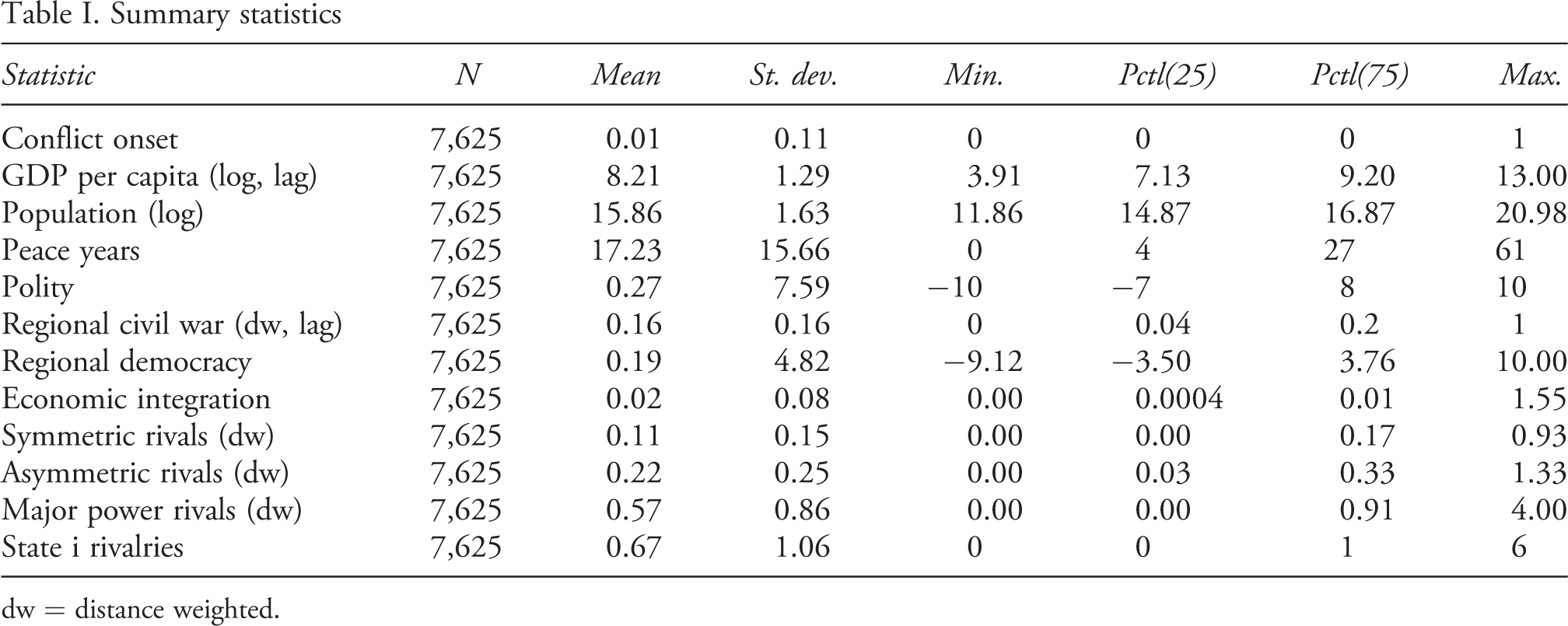
I account for other spatial confounders, including Regional civil war, a lagged count of the number of connected states experiencing a civil war divided by the number of connected states; Economic integration, a measure of state i's trade with its neighbors as a share of GDP, which potentially mitigates the ill effects of interstate competition; and Regional democracy, measured as the mean polity score of connected states. States in more democratic and economically integrated regions may be less likely to experience civil conflict because leaders abroad face greater constraints on supporting or fomenting insurgencies in their neighbors’ territories (Gleditsch, 2007).
Dependent variable
I use conflict data from the Armed Conflict Dataset (Gleditsch et al., 2002). Country-years are coded as having a conflict onset if that is the first year of a conflict in which all dyads involved generate 1,000 battle-related deaths in at least one year. Because some conflicts involve multiple dyads, I sum the casualties across all dyads party to the same conflict for each year. Different incompatibilities – e.g. conflicts over territory and the government – are coded as separate conflicts. If there is no fighting within a conflict for more than two years, a renewal of fighting is coded as a new onset. In any given country-year, an onset is coded for the conflict that generates the highest casualty count. In the case where a conflict over a different incompatibility begins while another conflict is ongoing, that is also coded as an onset.
Control variables
The analysis includes other correlates of civil war risk. I include the natural log of GDP per capita, 15 and a measure of domestic regime type, Polity, ranging from –10 to 10 (Marshall, 2010). Both GDP per capita and regime type exhibit spatial clustering. I also include the natural log of a state’s Population. 16 Larger states have been found to be more likely to experience civil war; they also have a greater number of neighbors and transnational groups in nearby states that may influence their risk of civil conflict (Buhaug & Gleditsch, 2008: 225). Because rebels fighting states involved in rivalries are more likely to receive foreign support (Salehyan, Gleditsch & Cunningham, 2011), I include a count of the number of rivalries that the unit of observation is involved in, State i rivals. To account for duration dependence, I include a count of Peace years. This is a count of the years elapsed since a country last experienced any episode of conflict. Summary statistics are shown in Table I.
Empirical results
Civil war onsets, 1946–2007, penalized logistic regressions

†p < 0.1; *p < 0.05; **p < 0.01.

Predicted probability of war across range of Symmetric and Asymmetric rivals
Figure 1 displays predicted probabilities with simulated confidence intervals from Model 3 for Symmetric and Asymmetric rivals. Holding other variables at their mean, moving from the minimum to maximum of Symmetric rivals is associated with a 650% increase in war risk, while Asymmetric rivals shows an insignificant and much smaller substantive effect. 19 Neither Major power rivals nor State i rivals is consistently associated with civil war risk.
There likely exist complicated interactions between region-level factors – e.g. between economic integration, regional democracy, and rivalry – that logistic regressions do not capture. I use random forests, a classification algorithm that uses an ensemble of decision trees, to account for these interactions. Random forests can capture such relationships and may perform better in predicting rare events (Siroky, 2009; Muchlinski, Siroky & Kocher, 2015).
20
The algorithm builds decision trees by randomly choosing a variable at each node. To split the tree, it chooses the value of a variable that bins like cases together (e.g. with GDP per capita, wealthy states that experience fewer wars are on one side of the split while poorer, more conflict prone states are on the other). The algorithm continues to do this within each tree, randomly selecting variables to produce ever more homogeneous groupings of outcomes (e.g. the next node might randomly split the tree based on a state’s Polity score, creating yet more homogeneous groupings). By Variable importance and partial dependence plots for random forest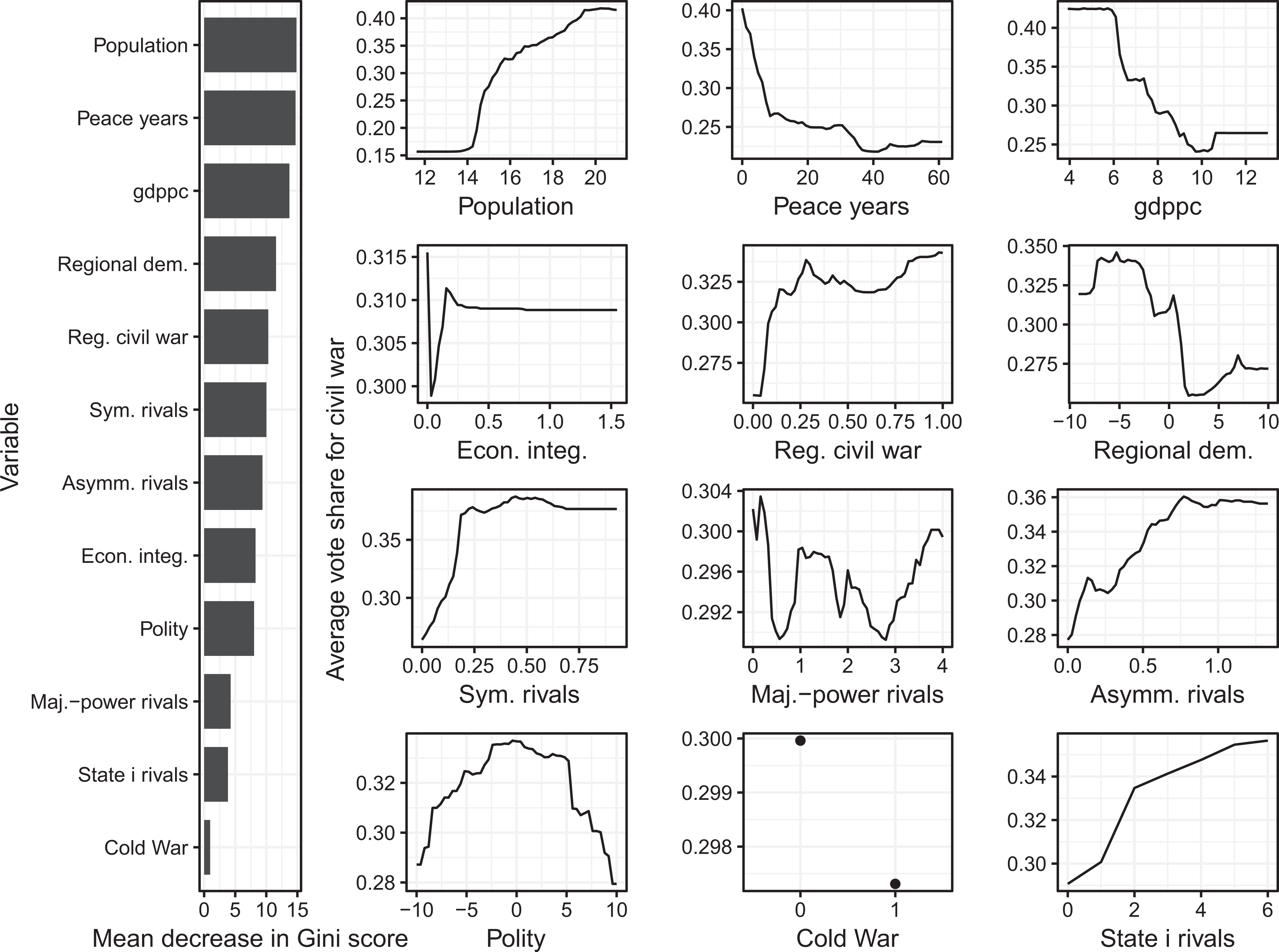
The random forest does not perform significantly better than the penalized logistic regression in classifying civil war onsets. 21 While the algorithm does not improve upon the predictive efficiency of logistic regression, it allows us to compare variable importance for classifying cases of war and peace. The importance scores on the left of Figure 2 give a sense of how much the inclusion of a variable helps the algorithm classify cases of war and peace. Specifically, the score indicates how much worse the model performs when a given variable is randomly permuted. 22 The right side of the figure displays partial dependence plots, which approximate the marginal effect of covariates. The partial dependence function averages out the effects of all other covariates to calculate the marginal effect of each variable across its range in the data. The y axis displays the average vote share for civil war across all observations. The plot is largely consistent with the results from the logistic regressions. Domestic variables are selected as the three most important, while Regional democracy, Regional civil war, and Symmetric rivals are selected as the most important regional covariates. Asymmetric rivals receives slightly less importance than Symmetric rivals but has a smaller substantive impact across its range. Consistent with the theory, the importance and estimated substantive effect of Symmetric rivals increases when it is constructed to include even more evenly matched states and decreases when it includes fewer. 23 Increasing Symmetric rivals sharply increases the vote share for war, with the effect leveling off in the middle of its range. Substantively, its effect is on the order of moving from the minimum to the maximum of Regional civil war. The rivalry variables have similar variable importance and substantive effects using alternative approaches to capture conflict contagion or ‘bad neighborhood’ effects. 24
As in Table II, the random forest assigns Major power rivals and State i rivals little importance. Because major power rivals have far-flung interests and power projection capabilities, they may be sufficiently unconstrained by distance to make the spatial variables inadequate for systematically capturing their relevance. 25 Neighboring regime type is a strong predictor of civil war. Predictions of onset reach a peak near the lowest end of the Polity scale and then drop precipitously between –3 and 2, above which there is little change. The random forest assigns Polity and Economic integration greater importance than the logistic regressions suggest. Both exhibit non-linear relationships that are poorly captured in the logistic regressions, though Economic integration only moves votes for war by little more than .1 across its range. Polity displays a greater substantive effect, generating the highest predictions of war at precisely the middle of the scale. 26
Figure 3 displays how the random forest’s predictions change using alternative distance thresholds for the construction of spatial variables and without modeling temporal dependence. 27 I focus on the Middle East in 1958 as an example case (discussed further below). It contains maps using 950 (baseline), 850, and 650 km distance thresholds and one map using the baseline threshold that omits peace years. Each map displays vote shares for onset for each country. The proportion of onset votes is quite similar for the three additional specifications. The mean absolute change in vote shares is .055 between the baseline and the alternative specifications. The mean vote share for onset across all countries is .03 and .002 higher using 650 and 800 km thresholds, respectively, and .023 lower when omitting peace years. The rivalry variables have similar levels of importance and estimated marginal effects when using these alternative thresholds. 28
In sum, along with the results in Table II, the random forests lend support to the theory’s expectation that external competition can fuel civil wars in other states. The random forests consistently find external rivalry to be an important predictor of civil war occurrence, and further suggest that this effect is more pronounced when rivals are closer in power. Taken together, these results show that international risk factors for civil war are not limited to conflict contagion or spatially clustered characteristics such as regime type. While recent work has demonstrated the relevance of interstate competition for civil war dynamics, these results show that modeling a state’s strategic environment can help better understand the occurrence of civil wars.
To illustrate the mechanisms that the theory highlights, I briefly discuss the Lebanese civil war in 1958. This case demonstrates how temporal variation in interstate rivalry contributed to the onset of civil war through the mechanisms that the theory proposes: by spurring polarization, creating a ratchet effect of foreign involvement, and by injecting uncertainty over intervention. Lebanon experienced two similar crises in 1952 and 1958. Presidents Bechara El-Khoury and Camille Chamoun had both manipulated elections to extend their Maps of the Middle East in 1958, vote shares for war
A key difference between the two periods was the growth of bitter interstate rivalries starting in the middle of the decade. After the formation of the Baghdad Pact, the Egyptian–Czech arms deal in 1955, and the Suez crisis, Egyptian President Nasser’s stock soared in the region. He became leader of an Arab nationalist movement that set itself in opposition to Western aligned states in the region. In 1952, there was greater agreement between regional powers and comparatively little internal polarization over the question of Lebanon’s neutral foreign policy orientation relative to later in the decade (El Khazen, 1991: 37–40, 45–51). By the middle of the decade, regional rivals had come to see the stakes of Lebanon’s orientation in dire terms. Egypt and Syria, which formed the United Arab Republic (UAR) in early 1958, competed for influence in Lebanon with Iraq and Jordan, the latter forming a rival bloc in response to the UAR (Kalawoun, 2000: 43).
In response to heightened polarization between rivals, Chamoun’s government and the opposition increasingly and strenuously tied the internal conflict over Chamoun’s bid for a second term to the external rivalries. Muslim leaders, especially from the Sunni community, outbid one another to receive ‘Egyptian blessing’ (Kalawoun, 2000: 16). 29 Before war broke out in May, leaders of the opposition United National Front ‘implored [Nasser] to involve himself directly in the internal affairs of Lebanon’ (Khalaf, 2002: 114). Closer ties to Egypt and Syria then became an open campaign issue for the opposition. In February Rashid Karami, who would later lead the rebellion in Tripoli, proclaimed during Nasser’s visit that ‘You can rest assured, oh President, that when the hour strikes we will all leap up as one man to hoist the banner to which all of the Arabs will rally’ (Kalawoun, 2000: 64).
Like the opposition, the government internationalized the conflict by playing up the prospect of Lebanon falling under the sway of pro-Soviet Arab nationalism. 30 Chamoun’s foreign minister depicted the situation to the US State Department as one ‘in which massive outside forces were engaged, including those of UAR and such supporters as Nasser had internationally’. 31 The army’s reluctance to support Chamoun’s goal of a second term gave him reason to seek intervention, but it was unclear whether he would receive the level of support necessary to overcome a determined opposition that had the support of the UAR. 32
After Chamoun refused to resign even under pressure, the opposition used the assassination of an anti-government journalist as a pretext to mount an armed rebellion (Qubain, 1961: 72–73). The intransigence of the government to massive opposition and the opposition’s swift decision to mount a rebellion differ starkly from the resolution of the earlier crisis. The theory’s mechanisms are reflected in how this crisis escalated to war. Nasser’s regional rivals saw his involvement in Lebanon as vindication for – indeed even requiring – their intervention. Leaders of the pro-Western bloc of Arab states ‘were desperate for Chamoun to prevail, convinced that the political security of their own regimes depended on Lebanon’s anti-Nasserist orientation’ (Yaqub, 2004: 216). 33 Leaders in Lebanon understood this broader dynamic and used it to their advantage (Kalawoun, 2000: 59). Stoking polarization at home served elites’ purposes of drawing external support, but also made compromise more difficult as the crisis escalated.
Beyond illustrating the theory’s mechanisms, this conflict demonstrates a dynamic that existing accounts of civil war onset overlook: temporal variation in interstate conflict can help explain why some internal conflicts are resolved peacefully while others escalate to war. While this case takes place against the backdrop of the Cold War, leaders have actively courted the intervention of rivals in more recent cases such as Syria. A leader of the Syrian Revolutionary Council stated in August 2011 that ‘there is a large section of countries that supports and will support the National Council and other gatherings […] because they have wide ambitions in the region’. When asked about where the arms would come from, he claimed the opposition would ‘follow the Afghan example’. 34 The strategic environment in which leaders escalate or compromise does not end at a state’s borders, which suggests that scholars can profit from broadening the set of actors they consider relevant for understanding the origins of civil war.
Conclusion
Scholars have noted how conflict between third parties shapes the dynamics and duration of violence in ongoing civil wars, while they have so far neglected how interstate conflict influences the risk that civil wars occur in the first place. I approach this question through the lens of interstate rivalry: strategic conflict between rivals makes them more likely targets for securing foreign support because they respond to opportunities to further their own interests and stymie those of their rivals. The ability of governments and opposition groups to counter interventions on behalf of their adversaries by turning to the intervener’s rivals may lower the expected costs of war. This creates a ratchet effect, making it easier for domestic groups to secure intervention on their behalf. Rivals also make civil war more likely by encouraging polarization, as groups attempt to capture their influence, and by injecting uncertainty over the outcome of war. As the theory anticipates, this effect is most pronounced in states near more closely matched rivals.
By focusing on how strategic competition between rivals shapes the incentives and strategies of governments and opposition groups, I demonstrate that conflict in the international system and the incidence of civil war are linked. Scholars have noted that theories of civil war onset are limited by their focus on the strategies of internal groups, and the connection between international conflict and civil war onset is intuitive to many (Blattman & Miguel, 2010: 43; Kalyvas & Kenny, 2009: 8). This article is the first to demonstrate that such a link exists, and also represents another step towards incorporating the study of civil and interstate conflict in the same framework (e.g. Cunningham & Lemke, 2013).
The purpose of this article is not to supplant existing work on international aspects of civil war onset but to establish that conflict and cooperation in the international system merit consideration from scholars seeking to explain civil wars. The frequency of foreign involvement in civil wars suggests that, if domestic groups are even minimally strategic, factors at the international level that make it easier to secure foreign support should be meaningfully related to the risk that wars occur in the first instance. While I have considered how conflict between third parties compounds the ill effects of other spatially clustered risk factors, future work could consider other factors at the international level that mitigate the effects of interstate competition on civil war. Apart from rivalries, different constellations of third-party interests and interactions may constrain or mitigate the ability of groups to capture foreign support and help reduce the risk of war.
The argument here has implications for the literature on intervention and moral hazard, and suggests how this work may resolve the puzzle of why the potential for intervention can either drive or curb escalation (Grigoryan, 2010: 1143). 35 Almost all theories in this area consider how a single potential intervener, usually on behalf of rebels or a minority group, shifts the chances of war. However, these models apply to situations in which the potential of one state’s intervention does not substantially change the odds of another state’s countervailing intervention, or where one group’s seeking support does not shift the odds or the ability for its adversary to do the same. By modeling multiple interveners and the strategic relationships between them, scholars can shed further light on how intervention regimes can best be structured to prevent civil wars. 36 The argument here suggests that credible threats to intervene in civil conflicts may not succeed in preventing escalation to war. If the dynamics of a rivalry are such that conflict actors believe they can manipulate the stakes of their conflict to attract countervailing support, threats to intervene may fuel escalation. Intervention regimes that activate fissures between interstate rivals (as the Eisenhower Doctrine explicitly did) may thus encourage civil wars. This suggests that international efforts to prevent civil wars should attend to managing conflicts between third parties. By diminishing the ability of groups to leverage conflicts between states, policymakers can help remove potential catalysts for war.
Footnotes
Replication data

Acknowledgments
The author thanks Andy Kydd, Jon Pevehouse, Ryan Powers, Nicholas Sambanis, Scott Straus, Jessica Weeks, seminar participants at the University of Pennsylvania and the University of Wisconsin-Madison, three anonymous reviewers, and JPR Associate Editor Allan Dafoe for excellent feedback.
Notes
References
Supplementary Material
Please find the following supplemental material available below.
For Open Access articles published under a Creative Commons License, all supplemental material carries the same license as the article it is associated with.
For non-Open Access articles published, all supplemental material carries a non-exclusive license, and permission requests for re-use of supplemental material or any part of supplemental material shall be sent directly to the copyright owner as specified in the copyright notice associated with the article.
