



Abstract
Reactions to acts of state-sponsored election violence and other forms of repression vary greatly across individuals. This article develops a theory that the psychological characteristic of self-efficacy moderates opposition supporters’ reactions to state-sponsored election violence. I use data from an original survey and in-depth qualitative interviews with opposition supporters in Zimbabwe to illustrate and test this theory. Self-efficacy is a strong predictor of intention to take action in support of the opposition after episodes of state-sponsored election violence and is related to the emotional reactions that opposition supporters have after violent events. Specifically, people who are higher in self-efficacy report that they would feel more anger relative to fear after episodes of state-sponsored election violence. The relationship between self-efficacy and persistence in pro-opposition action after violence is similar in magnitude to variables that the existing literature argues are the most important predictors of dissent in repressive environments, including strength of identification with the opposition and gender. These results provide empirical support for the assumption in many collective action theories that psychological characteristics create variation in dissent in repressive environments. Understanding how individual psychological differences can shape reactions to coercive violence may help explain why forms of repression like state-sponsored election violence have such unpredictable effects on subsequent pro-opposition mobilization.
Introduction
In March 2008, Zimbabweans went to the polls. Economic mismanagement had given many reason to vote against the incumbent regime despite a large police presence at the polling stations and a history of intimidation and violence during elections. In the days after the election, the results were not announced and police were deployed, leading opposition voters to fear that the government was rigging the results. During this period, voters sent messages to the BBC (BBC News, 31 March 2008): ‘Police have already been deployed on the streets in Harare and are telling people not to assemble, to keep quiet. I have never been this afraid before.’ ‘People talked freely – even in the voting queues – of their discontent at Mugabe rule. They openly said they would vote for change […]’ ‘[…] people will burst with anger and probably demonstrate or become violent.’
Election-related state repression is an important and understudied form of election violence. Governments are the most common perpetrators of pre- and post-election violence (Hafner-Burton, Hyde & Jablonski, 2014; Taylor, Pevehouse & Straus, 2017). Hafner-Burton, Hyde & Jablonski (2014: 150) define government-sponsored election violence as ‘events in which incumbent leaders and ruling party agents employ or threaten violence against the political opposition or potential voters before, during or after elections’. State-sponsored election violence can be considered as a type of repression wielded with the specific goal of influencing the outcome of an election in favor of the incumbent regime. Given the state’s disproportionate coercive power, this form of election violence may have particularly negative effects on the quality of democracy.
There is little existing research on the consequences of election violence – state-sponsored or otherwise. Much of the theoretical and empirical research in the field has sought to assess when and where election violence will occur, rather than what effects it has, with several important exceptions. Recent studies analyze correlations between pre-election violence and subsequent turnout (Bekoe & Burchard, 2017), ruling party vote share (Young, 2016), and political attitudes, beliefs, and knowledge (Linke, 2013; Söderström, 2017). Yet, little of this research is based on methodologies that enable estimates of causal relationships between violence and subsequent behavior. One exception is a vignette experiment by Gutiérrez-Romero & LeBas (2020) in this volume. In addition, past research has typically sought to estimate the average effect of election violence, rather than identifying the conditions in which violence has different effects.
The existing literature on election violence has theorized that the strength of party affiliation should shape how easily voters can be swayed by violence. Several influential models have argued that election violence should have the largest effect on the behavior of swing voters (Robinson & Torvik, 2009; Collier & Vicente, 2012), although there seems to be little empirical support for this prediction (Mares & Young, 2016). Other recent work has shown that pre-election violence has a bigger effect on electoral outcomes in poorer constituencies of Zimbabwe (Young, 2016).
On the other hand, a rich literature on high-risk mobilization suggests that individual psychological differences or processes can explain why some people mobilize in repressive environments while others do not. Recent research has explored the construction of grievances (Aspinall, 2007), perceptions of threat (Shesterinina, 2016), and the identity costs of abstention (Pearlman, 2016). Much of this work has focused on the role of political entrepreneurs embedded in social networks as shaping potential participants’ beliefs and preferences. By contrast, this research explores the personal characteristics of potential participants using a research design that shuts down the potential for political entrepreneurs to influence how new information is received or interpreted. It builds on a growing literature on the psychological determinants of political participation in repressive environments, linking individual psychological characteristics to the emotional reactions of opposition supporters to repressive events (Aytaç, Schiumerini & Stokes, 2017; Young, 2019). This article also builds on a few recent attempts to incorporate individual psychological characteristics into theories of election violence, including Gonzalez-Ocantos et al. (2020) in this volume.
Specifically, this article explores the role of the psychological characteristic of self-efficacy in shaping opposition supporters’ reactions to state-sponsored election violence. General self-efficacy represents confidence in one’s ability to control one’s environment, particularly in difficult situations. It is generally formed early in life and subsequently shapes emotional and behavioral reactions to threats. Qualitative interviews with 41 opposition supporters and activists in Zimbabwe illustrate how citizens with positive views of their own capacity to cope in violent situations react less fearfully and more proactively to state election violence. The quantitative analysis draws on a vignette experiment carried out with opposition supporters in Zimbabwe to test how self-efficacy conditions reactions to scenarios that vary in how severe, credible, and relevant state-sponsored election violence is. The results show that opposition supporters who are higher in self-efficacy say they would react with more anger relative to fear after state-sponsored violence, and are more likely to continue demonstrating support for the opposition party. The results cannot be explained by a number of other plausible factors, including strength of party affiliation, network embeddedness, or response bias.
Ultimately, this article makes an early contribution to our understanding of the role of individual psychological characteristics in explaining political behavior in repressive regimes. Following calls by Davenport & Moore (2012) and Lawrence (2017) to disaggregate actors in the study of repression and dissent, it focuses on the key group of opposition activists and supporters and seeks to identify variation in willingness to take action within this group of individuals with anti-regime preferences. This article begins to fill a gap in our understanding of the psychological characteristics that create individual thresholds for participation in high-risk collective action. Such variation across individuals is crucial for explaining collective action and is typically conceptualized as psychological differences such as need for expression or social approval (Marwell & Oliver, 1993; Kuran, 1995). However, there has been surprisingly little work that empirically explores the psychological characteristics that create these thresholds for action. The results presented here suggest that individual self-efficacy is one psychological characteristic that explains heterogeneity in action across individuals with anti-regime preferences in a repressive environment.
Theoretical framework
Why might reactions to repressive threats vary across individuals? Most of the literature on election violence has so far focused on two explanations: strength of party identification and demographic characteristics like socio-economic status and gender. In this section I outline these existing explanations and argue that self-efficacy may also condition reactions to state-sponsored election violence.
Existing explanations: Strength of party identification and demographics
The existing literature on election violence has argued that strength of party identification should condition the effects of election violence on voter choice or turnout. Influential formal models incorporate the assumption that violence is more effective against swing voters. Collier & Vicente (2012), for example, present a model that differentiates between ‘hard-core’ and ‘soft-base’ supporters. By assumption, soft-base supporters have a weaker partisan preference such that they can be dissuaded from voting by the threat of violence and also choose not to turn out when the party they support uses violence. Building on the political economy literature on clientelism, Robinson & Torvik (2009) conceptualize strength of party identification as shaping the potential benefit to casting a vote for the opposition that must be outweighed by an equally large negative threat. 1
The empirical literature on election violence has tended to focus on identifying which voters experience violence, rather than the effect of violence on different types of voters. Many of these studies assume that if violence is targeted on certain groups of voters, it is because it is more effective in changing the behavior of those voters. Most have found that violence is actually not targeted on swing voters, as the theoretical literature suggests, but on core supporters of the opposing party (Bhasin & Gandhi, 2013; Gutiérrez-Romero, 2014; Mares & Young, 2016). Nevertheless, the expectation of many theories remains that voters who are more closely affiliated with the opposition should be less likely to stop supporting the opposition in the face of election violence (Alternative 1).
Second, several scholars have argued that demographic characteristics, including gender, income, and education, make voters more likely to respond to election violence with submission rather than resistance. For example, Bratton (2008: 5) argues that ‘people with limited education may be unaware of individual political rights and therefore possess weak defenses against intimidation’. Mares & Young (2016) find that poorer voters are significantly more likely to be afraid of election violence in seven out of the ten countries with the highest incidence of fear of election violence in the Afrobarometer. Young (2016) uses data from Zimbabwe to show that the poor are more likely to stop voting for the opposition after state-sponsored election violence. These studies suggest that people with lower socio-economic status should be more likely to stop supporting the opposition after election violence (Alternative 2).
Finally, the broader literature on high-risk mobilization has argued that there is a negative association between gender and participation in contentious politics (Barnes et al., 1979; Inglehart & Norris, 2003). This literature implies that women should be more likely to stop supporting the opposition after election violence (Alternative 3).
Self-efficacy and variation in reactions to violent threats
I argue that in addition to these demographic and ideological factors, opposition supporters’ psychological characteristics create important variation in how they respond to the threat of election violence. Specifically, I focus on the characteristic of general self-efficacy, a persistent, global personal trait defined as ‘the belief about one’s ability to achieve goals and overcome obstacles in daily living’ (Sherer et al., 1982). Empirical work has found that general self-efficacy is closely related to personality traits like neuroticism and locus of control (Judge et al., 2002). General self-efficacy is thought to form early in life (Gecas, 1989), and panel studies have shown high levels of persistence in adults over the course of several years or decades (Gurin & Brim, 1984; Mortimer, Lorence & Kumka, 1986). 2
Past research has argued that self-efficacy should be causally related to political participation, and that it should lead to different types of participation in responsive and non-responsive systems. Bandura (1997: 20–21) argues that in responsive environments, self-efficacy should be linked to ‘productive engagement’. In non-responsive environments, low self-efficacy individuals should quickly give up, while high self-efficacy individuals ‘intensify their efforts and, if necessary, try to change inequitable social practices’. This implies that in democratic systems, high self-efficacy individuals should be more likely to participate in electoral politics, while in repressive systems, they should be pushed towards protest and social activism.
Concepts related to self-efficacy have played a role in several theories of high-risk political participation. Perceptions of personal efficacy, for instance, underpin McAdam’s (1982) concept of cognitive liberation. Similarly, Piven & Cloward (1977: 3) argue that the emergence of protest movements is precipitated by three changes in consciousness, including ‘a new sense of efficacy: people who ordinarily consider themselves helpless come to believe that they have some capacity to alter their lot’. Elisabeth Wood’s concept of ‘pleasure in agency’ suggests that high-risk mobilization gives participants a sense of self-efficacy: she writes that ‘to refute condescending elite perceptions of one’s incapacities, and thereby to undercut lingering fears of one’s inferiority was a source of participants’ collective pride, and indeed pleasure’ (Wood, 2003: xvi). Others have conceptualized self-efficacy as a fixed trait that differentiates citizens who take action from those who do not. Several previous studies have found that self-efficacy is correlated with lower levels of participation in regime-sanctioned political acts like rubber-stamp elections (Bahry & Silver, 1990; Chen & Zhong, 2002), and higher levels of participation in protest (Van Zomeren, Postmes & Spears, 2008; Tausch et al., 2011). There is also a fairly robust literature that links self-efficacy to political participation in democratic contexts (Valentino, Gregorowicz & Groenendyk, 2009; Rudolph, Gangl & Stevens, 2000).
Self-efficacy may drive higher participation in anti-regime politics in repressive environments through emotional reactions to threats. Individuals who have low evaluations of their own coping abilities should be more likely to view adverse events as threats that they should fear, rather than as challenges that they can overcome. People who perceive themselves as less efficacious are more likely to react fearfully to threatening stimuli (Bandura, Reese & Adams, 1982; Bandura, 1988). Observational studies show that pre-violence measures of (low) self-efficacy and related traits like negativity are correlated with PTSD in samples of soldiers in Vietnam, peacekeepers in the former Yugoslavia, or settlers in Israel exposed to bombing attacks (Schnurr, Friedman & Rosenberg, 1993; Bramsen, Dirkzwager & der Ploeg, 2000; Hobfoll et al., 2007).
To summarize, theory from psychology suggests that individuals with higher self-efficacy should be more likely to engage in pro-opposition action after state-sponsored election violence (Prediction 1). If self-efficacy shapes the emotional responses that individuals have to threats, high self-efficacy individuals should be more likely to respond to state-sponsored violence with more anger relative to fear (Prediction 2).
In addition, the effects of self-efficacy might depend on the characteristics of the violence itself. First, if self-efficacy influences behavior more when the gap between the negative situation and personal capacity is largest, then the effects of self-efficacy might be strongest for more severe forms of violence (Prediction 3a). Second, to the extent that self-efficacy enables individuals to make more well-reasoned decisions in threatening situations, people high in self-efficacy might be more responsive to informational signals of personal risk. People high in self-efficacy may be more responsive to the credibility of information about repression events (Prediction 3b). They may also be more likely to interpret events that signal a higher personal risk by targeting victims that are in their own province (Prediction 3c) or are involved in lower-level forms of activism (Prediction 3d), or events that are more temporally proximate to an election (Prediction 3e). 3
Repression and activism in Zimbabwe
I test these predictions in the case of Zimbabwe, a case where the state has a long history of using violence to win elections. Since gaining independence in 1980, Zimbabwe has held regular, contested elections but these have not resulted in a peaceful transition of power between parties, in part because of the ruling party’s use of election violence.
The ruling party ZANU-PF grew out of the independence struggle and enjoyed popular support in the 1980s that diminished in the 1990s in part due to a severe structural adjustment program (LeBas, 2011). ZANU-PF has relied on repression to suppress electoral challengers at multiple points in Zimbabwe’s history. Shortly after independence in the 1980s, ZANU-PF deployed its armed forces into the Matabeleland region. According to independent observers affiliated with the Catholic church, as many as 20,000 citizens were killed by the government during this period (CCJPZ, 1997). One consequence of this repression, known as Gukurahundi after an early storm that destroys crops, was that ZANU-PF’s main electoral rival, PF-ZAPU, signed a ‘Unity Accord’ to stop competing with ZANU-PF in 1987.
Although electoral competition dropped from 1980 to the late 1990s (Sithole & Makumbe, 1997), in 1999 an opposition party called the Movement for Democratic Change (MDC) grew out of the country’s major trade union and began to threaten the ruling party’s easy electoral wins. After a constitution proposed by ZANU-PF was defeated in a referendum in 2000, a new wave of violence against opposition supporters and organizers began. In addition, the government began encouraging independence war veterans to invade white commercial farms and stopped protecting the farmers, who had been an important source of opposition funding and mobilization during the referendum (LeBas, 2006).
Since 2000, state-sponsored election violence has taken a variety of forms. Party agents, youth wing members, members of the association of independence war veterans, soldiers, and traditional leaders have all played a role in organizing intimidation campaigns around recent elections (Bratton & Masunungure, 2008). While violence was often targeted on activists and candidates, observers viewed it as primarily trying to send a signal to other dissatisfied citizens that supporting opposition parties was costly. Interviewees described one early act of violence as ‘aimed at sending a message to all’, ‘a warning to others’, and ‘a lesson that authorities can humiliate anybody’ (Sachikonye, 2011: 89). One civil society leader explained that this type of violence was designed to affect election outcomes by intimidating opposition supporters. In his words, violence ‘is a tool of intimidation. By beating up people like Tsvangirai they are sending the message that no one is safe. And when word gets out into the rural areas that you are not safe, this will have enormous impact’ (OSISA, 2007: 8). Violence was used to disincentivize a wide range of pro-opposition activities, from saying or sharing negative views of the president to attending opposition rallies (or not attending ruling party rallies) to casting a vote for the opposition.
The ruling party’s use of violence to influence elections peaked in 2008. In the mid-2000s, the economy began to severely decline, and the government’s response led to hyperinflation. After the first round of the 2008 election, it was clear that ZANU-PF had lost its parliamentary majority and the office of the presidency. At this point, ‘the party-state launched a terror campaign of a scope and intensity never before seen in Zimbabwe’ (Bratton & Masunungure, 2008: 51). This campaign was centrally controlled under the leadership of then Defense Minister, now president, Emmerson Mnangagwa (Human Rights Watch, 2008). Violence during this period was marked by public assault and killings, and the use of graphic torture intended to ‘punish the opposition and cause fear amongst its ranks’ (Sachikonye, 2011: 88).
In response, opposition leader Morgan Tsvangirai pulled out of the run-off election scheduled for July 2008. Negotiations brokered by the international community between the government and the MDC led to the formation of a coalition government, with Robert Mugabe remaining as president and Tsvangirai as prime minister. Although economic conditions in the country improved under the coalition, entry into government in February 2009 was the beginning of the MDC’s loss of popular support (Bratton & Masunungure, 2012; Booysen, 2012). The MDC ran a weak campaign in 2013 (Zamchiya, 2013). By contrast, the ZANU-PF 2013 campaign was ‘slick, well-funded, united and peaceful’ (Tendi, 2013). ZANU-PF won by large margins at the presidential and parliamentary levels.
Post-2013, both ZANU-PF and the MDC fell into succession battles. As elites defected or were expelled from both parties, splinter parties formed and voter enthusiasm sagged. Low-level violence occurred sporadically and was primarily intraparty as part of factional struggles (Zimbabwe Peace Project, June 2015). It is in this context of a long history of repressive violence and political activism, as well as growing dissatisfaction with both the ruling party and the opposition, that this study took place.
Qualitative evidence of self-efficacy and variation in reactions to repression
How might self-efficacy actually operate in real political decisions in Zimbabwe? Before I present a quantitative test of whether self-efficacy is related to variation in how opposition supporters react to repression events, I will draw on the political experiences of opposition supporters and activists in Zimbabwe, in their own words. Between 2015 and 2016, I conducted semi-structured qualitative interviews with 41 opposition sympathizers, supporters, activists, and leaders in Zimbabwe. The full list of anonymized interviews is included in Online appendix A.
These interviews were conducted by two researchers whom I trained on a semi-structured interview protocol and focus group discussion guide. They were given training and on-the-job guidance on how to administer the questionnaire and use probes to elicit additional details and concrete examples. Participants for these interviews were primarily recruited through the researchers’ networks and referrals. Both interviewers had pre-existing personal ties to opposition organizers through their own political activism or research. For lower-level supporters, the recruitment process was more formal, with several constituencies in Harare and nearby rural areas selected to recruit a few opposition supporters into small group discussions. The sample involves opposition politicians, activists, organizers, and supporters.
The interviews suggest that higher self-efficacy helps activists maintain a cool decisionmaking process, even in situations that many find frightening. Several activists described confidence in their abilities to deal with violent situations in ways that touch on elements of domain-specific self-efficacy. One opposition candidate argued that one element in risk is ‘how you deal with violent situations’, and particularly one’s ‘defensive instincts’, including ‘being reasonable and mature and adult and doing all those things, and also having those qualities of being able to talk to aggressive people, police or all that sort of thing, and knowing how far you can push’. Overall, this candidate assessed that ‘if you’re reasonably confident that you’re good at that, well, you’ve got to deal with risks better’ (Interview, opposition candidate, 6 July 2016). Another described his approach to dealing with violence in his community as a kind of standard operating procedure that ‘people of [his] caliber’ could successfully implement (Interview, opposition organizer, 23 May 2015). These quotes illustrate how general self-efficacy can translate into domain-specific beliefs about the ability to handle violent situations in ways that result in lower fear.
The interviews also suggest that opposition supporters and activists vary greatly in their emotional reactions to repression, and in how repression shapes their perceptions of personal risk. Opposition supporters tended to speak of high-level, particularly gruesome repression events, including the recent abduction of a social movement activist named Itai Dzamara but also violence such as forced amputations that have rarely if ever occurred in Zimbabwe according to most human rights monitors (Interview, opposition mobilizer, 23 May 2015; Interview, opposition youth activist, 7 July 2016; Interview, opposition party organizer, 11 July 2016; Interview, opposition party mobilizer, 3 August 2016). Activists were sometimes even disdainful of opposition supporters’ fearful reactions. One activist argued that people are afflicted by ‘a base level of fear’ that is ‘vague’ and not always founded in an accurate assessment of the state’s capacity to repress (Interview, social movement activist, 10 July 2016). These comments suggest that activists are aware of the effects of fear on perceptions of risk. A number of activists described opposition supporters as ‘cowards’ (Interview, opposition youth activist, 7 July 2016), who ‘run away unnecessarily […in] most cases’ (Interview, opposition youth organizer, 27 July 2016).
Opposition activists, by contrast, described feeling anger after violence and subsequently using that anger to spur political action. One opposition youth activist described how the anger that he feels over political violence ‘sort of activates something [so] that I say go and send some angels, whatever is going to happen, whatever action that has to be taken, at least if the person has to die let him die enjoying. I mean something has to happen. People have suffered for quite some time and looking at all those sufferings, it just activates that desire because you are no longer doing it for yourself but for everybody’ (Interview, youth activist, 7 July 2016). Another opposition organizer described how the 2008 violence was actually what made her get involved in opposition politics: ‘[before 2008] I was just inactive but in Zimbabwe, not concerned about the politics of Zimbabwe. So when I heard about 2008 election results. I learned that there was a lot of rigging, torture, intimidations, harassments, then I realized that I had to take action in support [of the opposition]’ (Interview, party organizer, 11 July 2016).
In short, qualitative interviews with opposition activists and supporters illustrate the range of emotional reactions that people have to repressive violence, and suggest that activists may be more prone to react with more anger relative to fear and continued or redoubled action due to their confidence in their abilities to cope in violent situations. The next section draws on a larger sample to test these predictions using correlational and experimental evidence.
Research design
This article uses a factorial vignette to test whether self-efficacy predicts how opposition supporters react to repression scenarios. A survey experiment is a useful methodology for testing the causal relationships outlined in the previous section for several reasons. First, it enables me to measure self-efficacy before citizens have been exposed to the particular cases of election violence that I am studying. This is important because exposure to violence and participation in activism are likely to also affect self-efficacy beliefs, so a simple correlation between self-efficacy, activism, and violence exposure could be capturing any number of effects. Similarly, by randomly assigning participants into repression scenarios, I can shut down the potential for respondents to be selectively exposed to repression because of their past activism or membership in activist networks, another key confounder in a correlational analysis. Finally, it enables me to carefully measure not only the behavioral responses to violence but some of the psychological processes such as emotional responses that might underlie them. A discussion of the ethical principles that guided this research, and the practices that were put in place to protect research participants and staff, is included as Online appendix C.
Factorial vignette experiment
In the survey, I randomly assigned each participant to react to two scenarios that describe state-sponsored election violence. In each scenario, the participant was given information about the proximity in time of the next election, the level of activism of the victim, the location, the severity of violence, and the source of information on the state-sponsored election violence event. The scenario script read as follows, with the randomized components in italics:
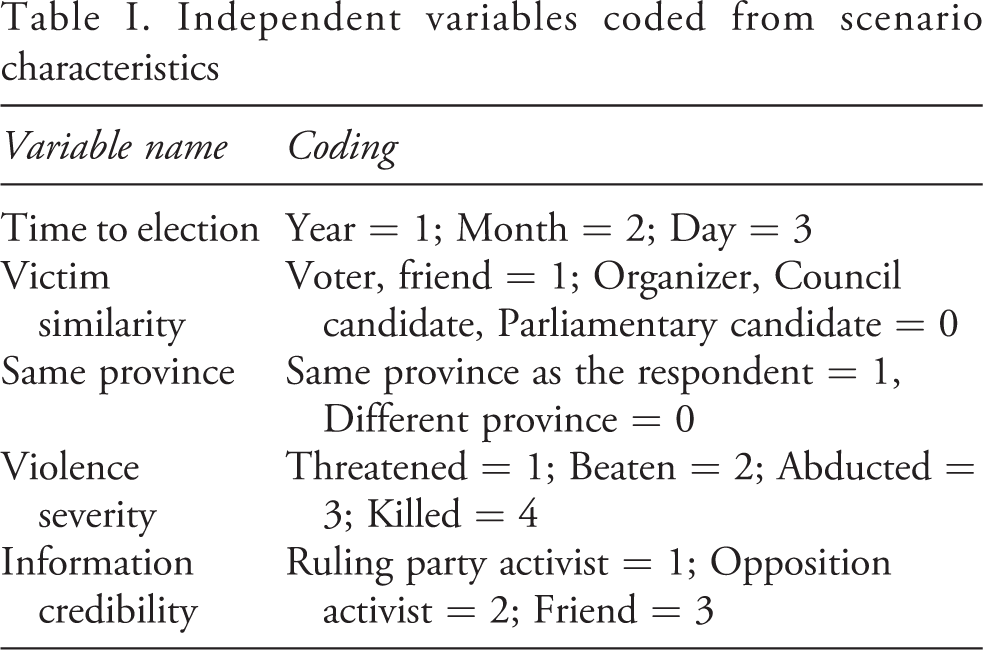
Imagine that it is one day/month/year before the next election. You have just heard that an opposition parliamentary candidate/council candidate/organizer/voter/voter that you know in a community in Mashonaland/Harare/Matabeleland has been threatened/beaten/abducted/killed by government forces. You received this news from a friend/an opposition activist/a ZANU-PF activist in your area.
Table I presents descriptions of five variables that I coded out of the scenario characteristics.
Measurement
Independent variables coded from scenario characteristics
I measured self-efficacy with a ten-question scale developed by Jerusalem & Schwarzer (1995). The questions ask respondents to estimate their general ability to cope in adverse situations using questions such as ‘I can remain calm when facing difficulties because I can rely on my coping abilities’ and ‘Thanks to my resourcefulness, I can handle unforeseen situations’. Cronbach’s alpha is 0.9. This scale has been validated in cross-cultural studies spanning 14 (Schwarzer, 1999) or 25 different contexts (Scholz et al., 2002). 4 The ten individual measures are combined into an index using principal components analysis. Online appendix E.1 presents the full set of measures and tests of the validity of the scale.
Each participant evaluated two different state-sponsored election violence scenarios. This analysis is performed on stacked data that include each scenario separately, for a total of two observations for each of the participants, with standard errors clustered by participant.
Implementation and sample characteristics
To carry out this study, I recruited and trained a team of Zimbabwean researchers in 2015 through the NGO Voice for Democracy (VfD), which conducts research on human rights abuses and organizes communities to prevent and respond to political violence. VfD’s existing networks and local knowledge were crucial for this study to be carried out safely as the research team could leverage existing social ties to recruit participants and establish trust. VfD recruited from six communities in Zimbabwe where they had a network of mobilizers and informants, and which had historically been affected by state-sponsored election violence. Half of the participants were recruited in the southern suburbs of the capital city Harare, and half from rural areas in Masvingo and Manicaland provinces in southern and eastern Zimbabwe.
This recruitment strategy produced a mix of opposition activists and sympathizers. The surveyors started by interviewing the VfD mobilizers so that they understood the sensitive content of the study, and then asked them to recruit opposition supporters, including those who were afraid to openly participate in opposition politics.
This sample is not representative of opposition supporters in Zimbabwe, but it can be compared to representative samples to get a sense of how the results might generalize. Online appendix D presents a comparison of the demographic, political, and psychological characteristics of this sample to opposition supporters in two nationally representative samples: the November 2014 Afrobarometer and a November 2018 national survey carried out by the World Bank. This comparison suggests that this sample is quite similar to opposition supporters in those nationally representative surveys in terms of age, level of education, and gender. Importantly, there is also a very similar distribution in how close this sample feels to the opposition as in the World Bank sample, suggesting that this group is not a particularly fervent subset of opposition supporters. They are, however, substantially poorer and somewhat lower in self-efficacy than the representative samples.
Two additional notes about the data are in order. First, an additional experiment was carried out during the course of this survey, the results of which are written up in Young (2019). Assignment to that treatment, an emotion induction exercise, was independent of assignment to the repression scenarios. However, in all of the analyses that follow, I include a control for treatment assignment in the emotion induction experiment, and in Online appendix Table I.5 I show that there are no significant interactions between the scenario characteristics and the emotion treatment. Second, after data collection I discovered that one surveyor administered the demographics battery, including the self-efficacy measures, later in the survey, making them post-treatment. Results presented here exclude that surveyor’s data. Data were collected using handheld tablets with a survey that was programmed using Open Data Kit (ODK). All interviews were carried out in Shona.
Analysis
In this analysis, I focus primarily on how self-efficacy is correlated with citizens’ reactions to all of the scenarios to test Predictions 1 and 2. In addition, I look at the interactive effect of self-efficacy and the scenario characteristics to test whether high self-efficacy individuals react differently depending on the characteristics of the violence.
Ultimately, although this analysis is based on an experiment, self-efficacy is endogenously formed. Social cognitive theory argues that self-efficacy beliefs develop primarily from ‘enactive mastery experiences’ (Bandura, 1997: 79). As a result, self-efficacy could be positively related to socio-economic status and other personal characteristics that enable someone to experience mastery, particularly early in life. It is also possible that positive experiences with political activism would increase self-efficacy, and that past exposure to violence could increase or decrease it. Table F.1 in the Online appendix shows that, in line with the literature on self-efficacy in other contexts, self-efficacy is positively correlated with education in this sample. In addition, self-efficacy is positively correlated with closeness to party and past exposure to violence. To separate out the effect of self-efficacy from the effect of these potential confounding factors, I include them in the analysis as controls. All continuous variables are standardized. Analyses are conducted using OLS regression.
Self-efficacy and reactions to repression
Main results
This section presents the results of the analysis of whether self-efficacy is related to citizens’ reactions to repression. Table II presents the results of an analysis of whether opposition supporters who are high in self-efficacy are angrier and more likely to say they would attend an opposition rally after repression events (Prediction 1), particularly after more severe events (Prediction 3a). It also analyzes whether they interpret the timing, targeting, and credibility of information about repression events differently from individuals low in self-efficacy (Predictions 3b–e).
The first specification in Column 1 only includes fixed effects for the respondent’s community, the surveyor that conducted the survey, and assignment into the emotion treatment conducted as part of a separate experiment earlier in the survey. The second specification adds the interactions of self-efficacy with the scenario characteristics, and controls for other individual demographic and political characteristics, including closeness to the opposition, gender, age, education, and two assets indices. The third specification adds two additional measures of past political experiences: past participation in pro-opposition activism, and past exposure to state-sponsored election violence.
The Respondent characteristics section of Table II shows that a one standard deviation increase in self-efficacy is associated with a 0.12 to 0.14 standard deviation increase in the propensity to attend an opposition rally after the violent event – a clear act of defiance that state-sponsored election violence is designed to prevent. This provides clear support for Prediction 1, which predicted that self-efficacy would be positively related to participation. This effect holds even after conditioning on demographic and political characteristics, including gender, education, closeness to the opposition, past participation in pro-opposition activism, and past exposure to political violence. Importantly, controlling for past experience with activism or past exposure to state-sponsored election violence – both of which could plausibly be part of the mechanism linking self-efficacy to higher political participation or angrier emotional reactions – does not reduce the magnitude or significance of self-efficacy. Substantively, the effect of a one standard deviation increase in self-efficacy is slightly smaller in magnitude than the difference between genders. It is as large or larger than the effect of a one standard deviation increase in how close the respondent feels to an opposition party, the main explanatory variable in much of the literature on electoral violence.
There is also support for the predictions from the existing literature that closeness to party and gender should condition opposition behavior after election violence. A one standard deviation increase in how close the respondent feels to the opposition is associated with a 0.09 to 0.12 standard deviation increase in the propensity of continued pro-opposition action (Alternative 1). Women are 0.22 to 0.25 standard deviations lower on the likelihood scale of continued pro-opposition action (Alternative 3). Socio-economic status, however, measured based on assets or education, is not associated with any statistically significant differences in post-violence participation (Alternative 2). This null result should be taken with some caution because this sample is considerably poorer than nationally representative samples, so this test is based on a fairly constrained range of variation in socio-economic status.
There is also support for the expectation that people who are higher in self-efficacy are more likely to react with more anger relative to fear (Prediction 2). Columns 4–6 of Table II show that a one standard deviation increase in self-efficacy is associated with a 0.12 to 0.14 standard deviation increase in how angry relative to afraid the respondents say they would feel in response to the scenarios overall. Online appendix G.1 shows that these results are primarily driven by people who are high in self-efficacy saying that they would feel significantly less fear.
Although existing theories do not explicitly address emotions as a mechanism linking closeness to party and demographic characteristics to variation in reactions to election violence, Table II also shows that voters who are more closely aligned with the opposition, more educated, and male are also more likely to say they would be more angry relative to afraid after election violence. Again, the results are driven more by lower levels of fear than higher levels of anger.
Next, I turn to the moderating effect of individual characteristics on reactions to more severe forms of violence. I expected that if self-efficacy is moderating reactions to state election violence, then its effects would be even larger for more severe violence. However, there is little empirical support for this prediction. While respondents are sensitive to the severity of the violence, as shown by the significantly lower propensity to attend a rally after more severe forms of violence, this effect is not moderated by self-efficacy. The coefficients plotted in Figure 1 represent the effect of a one unit increase in the severity of violence on the propensity to dissent across individuals with different characteristics from the third column in Table II.
Propensity to dissent and emotions after repression events

Standard errors clustered by respondent in parentheses. *p < 0.05; **p < 0.01.
Coefficients are estimated using OLS. The unit of analysis is the scenario, such that each respondent appears twice in the dataset. The outcome is the respondent’s propensity to attend an opposition rally after a given scenario on a standardized five-point likelihood scale (Columns 1–3) or the amount of anger minus the amount of fear that they say they would feel, where both emotions are measured on four-point scales (Columns 4–6). All continuous independent variables are also standardized.
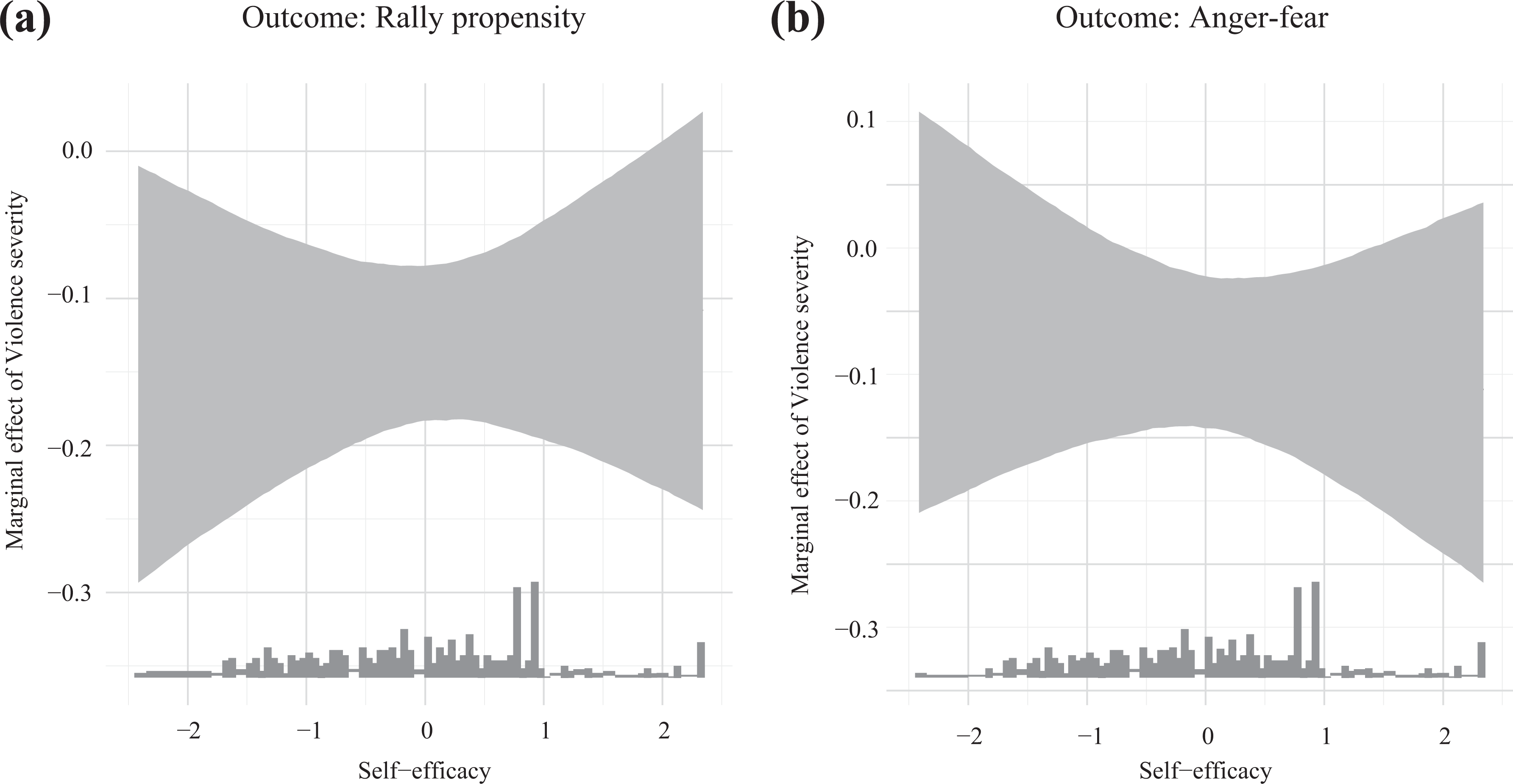
Marginal effects of violence severity
Taken as a whole, this analysis supports the predictions outlined earlier in the article: people who are high in self-efficacy are more likely to engage in political activism after state-sponsored election violence (Prediction 1), and more likely to respond to state-sponsored election violence with anger rather than fear (Prediction 2). There is little systematic evidence that efficacious individuals interpret the informational signals of violence events differently (Prediction 3a–e).
I also find evidence for the prevailing explanations in the literature focused on strength of party identification and gender. Voters who are more closely aligned with the opposition are angrier and more likely to attend a rally after violence. Men are similarly more likely to react with more anger relative to fear, and to say they would still take action after state-sponsored election violence. Socio-economic status has little consistent relationship with post-violence action or emotional reactions to violence. However, the effect of self-efficacy cannot be explained by the most likely confounding factors, including education, past activism, past exposure to violence, or strength of affiliation with the opposition.
A few other explanations are harder to dismiss, but ultimately are unlikely to drive the observed relationships. One concern might be that self-efficacy is confounded by membership in politically active social networks. The literature points to two main channels for social networks: information diffusion or coordination (McCarthy & Zald, 1977; Scacco, 2010), and social benefits to action (or costs to inaction) (Chong, 1991; Pearlman, 2016). This research design, by providing respondents with information about a repression event and asking them to immediately provide their reaction, shuts down the potential for the first channel to operate. Participants have equal propensity to receive information about repression and activists have no opportunity to frame the event before opposition supporters react to it. The second channel of social benefits is more plausible. For this to be driving the results, membership in groups that provide social benefits to participants would have to be correlated with both self-efficacy and post-violence participation. I believe that this is unlikely to be operating in this case for two reasons. First, data from the 2018 World Bank survey suggest that membership in seven different contextually relevant social groups, including some that are strongly associated with the opposition, such as residents’ associations and unions, is not correlated with self-efficacy (results in Online appendix F). Second, the relationship between self-efficacy and the outcomes of interest is robust to the inclusion of past political activism as a control, which is likely picking up membership in activist networks.
A second possible explanation for the observed results is that they are driven by correlated response bias. If some respondents want to appear brave or committed to the opposition in front of their interviewer, they may answer the self-efficacy questions more positively and report a higher likelihood to participate and feel angry after repression. To assess whether this explanation is plausible, I compared the hypothetical measure of propensity to act used in the scenarios to a behavioral measure of propensity to dissent that I also included in the study as part of a separate experiment. For this behavioral measure, participants were offered a choice between a wristband with a non-partisan, pro-democracy political slogan on it that they were told would ‘show their political beliefs’, and a plain, otherwise similar wristband. Using this behavioral measure, I create an indicator for respondents who refuse this wristband but say that they would be likely to attend an opposition rally after state-sponsored violence – essentially, a proxy for exaggeration. I then analyze whether people who report being high in self-efficacy are more likely to exaggerate their political activism. Self-efficacy does not predict whether respondents exaggerate on the hypothetical measures compared to the behavioral action. These results are presented in Online appendix G.2.
Conclusion
Early movers, what Marwell & Oliver (1993) call ‘large contributors’ or Petersen (2002) calls ‘low threshold actors’, are critical for theories of collective action. These early movers are defined by their psychological characteristics. For Kuran (1995), they are defined by a high need for expression and concern for their reputation in addition to having a strong interest in policy change. Yet there has been little empirical work attempting to identify the psychological characteristics that actually identify the citizens with anti-regime preferences who will take action when the risks are high.
This article tests whether the psychological trait of general self-efficacy might explain variation in the expression of anti-regime preferences in a repressive environment. It draws on the literature on emotions and dissent to argue that self-efficacy shapes behavior at least in part via individuals’ emotional reactions to violent events. It presents evidence from qualitative interviews and a vignette experiment with opposition supporters and activists that largely supports this view. Opposition supporters who are higher in self-efficacy are more likely to say that they would attend an opposition rally after an episode of state-sponsored election violence, and that they would experience more anger relative to fear after the violent event. These effects are consistent across variations in the characteristics of the violent events. Self-efficacy is endogenous, and most likely shaped by a range of life experiences including education and past participation in high-risk activism. However, the effect of self-efficacy cannot be explained by alternative arguments including the strength of partisanship, demographic factors, network embeddedness, and correlated social desirability bias.
These findings also raise a number of follow-up questions. First, these findings raise questions about self-efficacy and coercion more generally. While in this article I have focused on state-sponsored election violence as an important subtype of state repression, coercion takes a wide range of forms. Nothing in this theory implies that self-efficacy should be important only in electoral autocracies with ruling parties who are willing to use repression like Zimbabwe. Future research should explore whether this theory might extend to a wide range of cases of coercion. This might include other cases of election violence where violence is employed by competing ethnic groups, as well as cases of economic coercion such as threats to take away welfare benefits on which voters rely (see, for example, Mares & Young, 2019).
Second, these findings raise questions about the endogenous formation – and strategic manipulation – of self-efficacy. While longitudinal evidence suggests that self-efficacy is ‘sticky’, or persistent over time, early experiences with activism or state-sponsored violence may be important in shaping self-efficacy over a longer period (Jarstad & Höglund, 2015). The quotidian displays of obedience involved in ‘acting “as if”’ in classic accounts of autocratic control like Wedeen (1998) or Havel (1985) emphasize how many authoritarian rituals seem designed to remind citizens that they are powerless and atomized. Similarly, activists may try to influence the way that citizens interpret experiences with repression as episodes that prove their resilience rather than helplessness. Understanding whether and how autocrats and activists try to shape self-efficacy over the longer term is a key question that deserves more empirical work.
Footnotes
Replication data
The dataset, survey instrument, and R code for the empirical analysis in this article, as well as the Online appendix, can be found at http://www.prio.org/jpr/datasets and  .
.
Acknowledgments
Thanks to Ipek Bahceci, Alex Coppock, Jane Esberg, Arturas Rozenas, Susan Stokes, Thomas Zeitzoff, and seminar participants at APSA, 31 August–3 September 2017, and the Stanford University Center for Democracy, Development and the Rule of Law (CDDRL) workshop in March 2019 for helpful feedback.
Funding
The author thanks the US Institute for Peace, the Columbia University Graduate School of Arts and Sciences and the Department of Political Science, the International Peace Research Association Foundation, and the National Science Foundation for support for this project. This research was approved by the Columbia University Institutional Review Board under protocol IRB-AAAP2200.
Notes
References
Supplementary Material
Please find the following supplemental material available below.
For Open Access articles published under a Creative Commons License, all supplemental material carries the same license as the article it is associated with.
For non-Open Access articles published, all supplemental material carries a non-exclusive license, and permission requests for re-use of supplemental material or any part of supplemental material shall be sent directly to the copyright owner as specified in the copyright notice associated with the article.
