



Abstract
Peacekeeping operations are integral to multilateral strategies to help establish stable, self-sustaining peace and development in countries coming out of civil war. While we know, from macro-level empirical studies, that these operations contribute to the durability of peace, the evidence on their effectiveness at the micro level remains scant. Using surveys and administrative data from postwar Liberia, we test the hypothesis that peacekeeping deployments build peace ‘from the bottom up’ through contributions to local security and local economic and social vitality. The hypothesis reflects official thinking about how peacekeeping works via ‘peacebuilding’. We create a quasi-experiment by applying coarsened exact matching to administrative data used in mission planning, identifying sets of communities that were similarly likely to receive bases. We do not find effects on local security measured in terms of physical victimization, fear of victimization, or migration patterns. We find only modest effects on socio-economic vitality. NGOs tend to work in areas where deployments are not present, contrary to the hypothesis. Thus, we are less inclined to believe that peacekeepers build peace from the bottom up, leaving macro-level mechanisms such as signaling and deterrence at the level of leaders as worthy of more attention. In terms of policy, peacekeeping missions should re-evaluate their methods for providing local security.
Introduction
Peacekeeping operations are integral to multilateral efforts to stabilize and consolidate peace in countries affected by fragility, conflict and violence, the vast majority of which also face daunting development challenges (Sambanis, 2007). Traditionally, these operations, particularly those carried out under the United Nations (UN) banner, have focused on helping belligerents to implement ceasefires and peace agreements through monitoring, supervising disarmament, demobilization and reintegration, and other processes designed to alleviate commitment problems between parties to the conflict (Fortna, 2008).
Since the 1990s, however, UN peacekeeping operations have seen a dramatic expansion of their mandate to include non-military objectives. This includes revitalizing the economy, rebuilding infrastructure, fostering democracy, and promoting human rights, among others (Cousens, Kumar & Wermester, 2001; Kumar, 1998; Boutros-Ghalis, 1995). These so-called ‘peacebuilding’ activities resemble traditional development interventions (Tschirgi, 2004; Woodward, 2002) and aim to lower the potential for renewed conflict through economic and social transformation (Paris, 2004; Boutros-Ghali, 1995). Another feature of contemporary peacekeeping operations is that they often penetrate societies in recipient countries with unprecedented levels of breath and depth, directly influencing the social, economic, and political aspects of people’s lives (Autesserre, 2017, 2014; Pouligny, 2000; Risley & Sisk, 2005; Talentino, 2007). By providing local-level security and assistance that facilitates economic and social revitalization, peacekeeping operations are presumed to raise the opportunity costs of war and empower those seeking peace (Doyle & Sambanis, 2006; Stedman, Rothchild & Cousens, 2002).
While macro-level empirical studies have established that UN peacekeeping operations tend to reduce large-scale violence and thereby prolong the durability of peace agreements (Fortna, 2008; Gilligan & Sergenti, 2008; Doyle & Sambanis, 2006), evidence of peacekeeping effectiveness at the local level is more limited (Fortna & Howard, 2008). To be sure, the last decade has seen a surge in micro-level empirical studies of local effects of UN peacekeeping operations, leveraging variation in subnational deployment of peacekeeping deployments within recipient countries and newly available data on Armed Conflict Location & Event Data Project (ACLED). 1 Findings from these studies are broadly consistent with the evidence from the macro-level literature and suggest that UN peacekeeping deployments at the local level tend to reduce battlefield violence and the risk of deliberate targeting civilians in the context of ongoing conflict (Fjelde, Hultman & Nilsson, 2019; Ruggeri, Dorussen & Gizelis, 2016, 2017; Costalli, 2014; Powers, Reeder & Townsen, 2015; Melander, 2009).
However, the existing literature on local-level effects has two shortcomings. First, it tends to focus on outcomes of ‘negative’ peace typically measured in terms of violence reduction between armed factions and against civilians. By contrast, with the exception of Di Salvatore (2019) and Kathman & Wood (2016), very few empirical studies investigate crime and anti-civilian violence outcomes likely to prevail in postwar contexts (Muggah, 2008; Tschirgi, 2004; Orr, 2002). Furthermore, several studies (e.g. Call & Cousens, 2008; Jarstad & Sisk, 2008) have pointed out potential tensions between positive peace and negative peace, while others (e.g. Autesserre, 2017, 2014, 2010; Kalyvas, 2006) have suggested conflict and peacebuilding dynamics may operate under different logics at the macro level and at the micro level. For these reasons, we feel it important to extend research to consider local security perceptions and criminal victimization.
Second, existing studies have given less attention to socio-economic welfare of the local population. This neglect is surprising, especially because these outcomes are presumed to constitute the micro-foundations of durable and ‘positive’ peace (Call & Cousens, 2008; Doyle & Sambanis, 2006, 2000). Local-level security and socio-economic outcomes could be more under the control of peacekeeping missions insofar as they are direct effects of specific programs and activities than is the end outcome of macro-level peace. The latter is likely to be overdetermined by factors outside the control of peacekeeping missions. From a policy perspective, examining local-level outcomes may make it possible to determine what about peacekeeping works and what does not. On the other hand, as researchers like Autesserre (2010) have noted, local-level security dynamics may be more complex than macro-level political conflicts and ongoing local conflicts may impede political consolidation. Then, ineffectiveness at the local level could compromise a peacekeeping mission’s ability to usher in macro-peace. Either possibility motivates a need to understand peacekeeping’s local effects.
This article extends the micro-level literature of UN peacekeeping effectiveness, addressing the shortcomings laid out above. We use matching methods, original survey data, and administrative data to measure local effects of the United Nations Mission in Liberia (UNMIL) on security and socio-economic outcomes. We exploit the fact that when establishing deployment locations in the Liberian countryside, UNMIL peacekeepers had limited information with which to work. Using coarsened exact matching on administrative data used in UNMIL planning, we identify sets of communities that, presumably, were similarly likely to receive a peacekeeping base.
The evidence from our study suggests very limited effects at the local level. We do not find effects on local security measured in terms of physical victimization, fear of victimization, or migration patterns. We find modest effects of deployments on socio-economic vitality. Interestingly, we find that NGOs tend to work in areas where UNMIL deployments are not present. We are less inclined to believe that peacekeeping, on its own, contributes to positive peace from the bottom up, at least in the case of UNMIL, leaving macro-level mechanisms such as signaling and deterrence among faction leaders as explanations worthy of more attention for the positive association between peacekeeping and macro-level peace.
The article proceeds as follows. The next section discusses two hypotheses implicit in arguments linking peacekeeping interventions to security and socio-economic outcomes. We follow with a brief background to the Liberian civil war and UNMIL’s intervention. The next sections describe our methods for identifying micro-level peacekeeping effects. Then, we present empirical findings followed by a discussion of key results. The final section provides a conclusion that discusses the implications of our findings.
Hypotheses
The objective of this article is to investigate the effects of UNMIL deployments on local security and socio-economic revitalization. We focus on positive peace, which goes beyond concerns with the immediate cessation of hostilities or absence of violence (i.e. ‘negative peace’) and encompasses other socio-economic and political goods that can be sustained even in the absence of an international peace operation (Call & Cousens, 2008). The academic literature theorizes about how multidimensional UN peacekeeping operations can contribute to positive peace at the macro level (e.g. Doyle & Sambanis, 2006, 2000). However, there are no comparable positive theories of how exactly these operations affect local outcomes, despite normative proposals that they should do so (Boutros-Ghali, 1995). Below we discuss two possible channels through which peacekeeping might promote change from the bottom up.
The ‘security bubble’ hypothesis
The first is what we call the security bubble hypothesis, which proposes that peacekeeping deployments create security bubbles in their immediate vicinity that stimulate local economic and social revitalization. That postwar environments are prone to pervasive insecurity and criminal violence after large-scale fighting has subsided is well documented in the literature (Muggah, 2008; Doyle & Sambanis, 2006; Tschirgi, 2004).
Scholars point to several sources, including the presence of small arms and excombatants who might be lured into criminal enterprises due to limited economic opportunities (Di Salvatore, 2019; Humphreys & Weinstein, 2007), as well as persistent security dilemmas between belligerent factions attempting to gain the upper hand in the postwar order (Kathman & Wood, 2016; Stedman, Rothchild & Cousens, 2002). The result is that such insecurity and violence can prevent local communities from realizing socio-economic and political revitalization, even if they have the potential to do so (Del Castillo, 2008; Orr, 2002). For instance, few people are willing to invest in a context of instability for fear that they may suffer harm or have to flee prior to enjoying the fruits of any such investments. This goes for both economic investment and investment in social and political institutions (Mvukiyehe, 2018; Mvukiyehe & Samii, 2009).
UN peacekeeping forces can alter local security conditions, thus making it possible for people to undertake meaningful investments. For instance, improved security (actual or perceived) could incentivize entrepreneurs and laborers to invest in economic activity, which could in turn revitalize the local labor market and increase incomes (Bove & Elia, 2017; Caruso et al., 2017). The visible presence of capable external security providers is especially important given that postwar governments may be either too weak to provide adequate security (Fortna, 2008; Wantchekon, 2004) or lacking in legitimacy. As Deglow (2016) argues, civil war erodes state legitimacy, undermining the ability of local law enforcement agencies to function effectively.
The few existing micro-level studies of peacekeeping focus on local violence reduction in cases where conflict is still active and find evidence that UN peacekeeping does in fact positively influence many dimensions of local security. This includes reducing the amount of battlefield violence (Ruggeri, Dorussen & Gizelis, 2016; Melander, 2009), the duration of local conflict and violence (Ruggeri, Dorussen & Gizelis, 2017), and one-sided violence against civilians, especially from rebel forces (Fjelde, Hultman & Nilsson, 2019) or when ethnic polarization is higher (Di Salvatore, 2016). However, the evidence on impact in the postwar period is somewhat murky. For instance, Di Salvatore (2019) finds that UN peacekeeping troops tend to exacerbate criminal violence operationalized in terms of homicides, while missions with substantial UN police appear to correlate with reduction in criminal violence.
In contrast, Kathman & Wood (2016) find the opposite, with higher numbers of UN peacekeeping troops being associated with reduced violence against civilians, while larger deployments of UN observers seem to be correlated with increased violence against civilians. We suspect these contradictory findings are likely, at least in part, attributable to different research designs (for example, Di Salvatore’s (2016) study focuses on conflict and post-conflict periods, whereas Kathman & Wood’s (2016) focuses only on the post-conflict period) and potential measurement issues related to different data sources being used. It is also worth noting that both studies rely on secondary data to measure key outcomes. Mvukiyehe & Samii (2009), the only study (to our knowledge) that uses original survey data in the context of the UN operation in Côte d’Ivoire (ONUCI), finds that ONUCI’s direct impact on security outcomes and violence-induced displacement was negligible, as local security conditions had already improved tremendously prior to UNOCI’s arrival. Ultimately, the question of whether and how UN peacekeeping impacts local security outcomes is an empirical one in the quest for more evidence from different contexts.
The ‘direct assistance’ hypothesis
The second hypothesis is what we call the direct assistance hypothesis, which suggests that the socio-economic and political improvements are a result of direct assistance (e.g. material assistance, social interventions) provided by peacekeeping operations or NGO partners in and around their deployment sites. This hypothesis starts with the premise that postwar societies are not only prone to pervasive insecurities, but they may also have higher prevalence of risk factors such as ethnic polarization, political exclusion or information asymmetries that are rooted in the structures of these societies and which make them more vulnerable to conflict recurrence (Collier, Hoeffler & Söderbom, 2008). 2 The availability of resources to cut deals across these lines of conflict may be crucial, but damage caused by civil war may limit the availability of such resources (Doyle & Sambanis, 2006). Thus, unlike the security bubble hypothesis that presumed the existence of local capacity to foster recovery endogenously, a central presumption in the direct assistance hypothesis is that such capacity may be limited and that the resources and mediation of outside actors are needed to restructure domestic social and political order. 3
To this end, contemporary UN peacekeeping operations have a mandate to undertake extensive and targeted interventions in the social and economic realms, with the goal to address specific capacity gaps as well as local roots of conflict and violence (United Nations, 2013; Cousens, Kumar & Wermester, 2001). These peacebuilding activities are typically spearheaded by the civilian sections of a UN peacekeeping operation and usually in coordination with affiliated nongovernmental organizations (NGOs) (Ramarajan et al., 2002). NGOs generally play a complementary role to that of a peacekeeping mission and are often better suited for civilian activities due to their comparative advantage in the particular sector – Theorized causal paths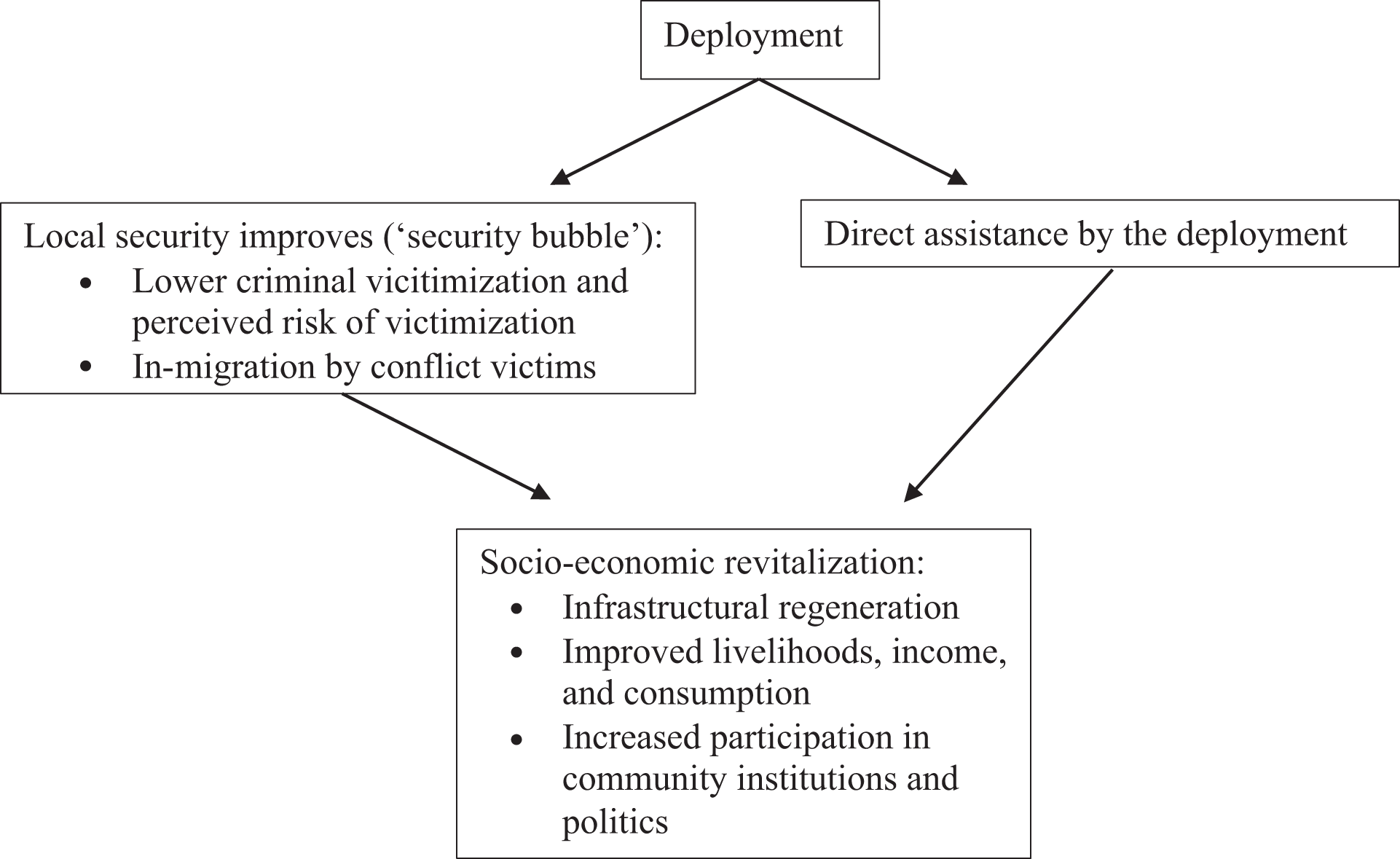
Figure 1 displays these potential causal paths through which deployments may contribute to socio-economic revitalization. Deployments may generate a local security bubble, as would be apparent in reduced criminal victimization and return of displacees. They may also offer direct assistance programs. These can combine to allow for socio-economic revitalization, as apparent in infrastructural regeneration, improved livelihoods, and participation in local institutions and politics. Evidence from the few existing micro-level empirical studies suggest UN peacekeeping operations do have positive impacts on outcomes captured at various stages shown in Figure 1. For instance, Caruso et al. (2017) find that the UN mission in South Sudan (UNMIS) had a positive impact on agricultural production, while Beber et al. (2016) find that UNMIL spending created demand for low-skill employment in the service sector and temporarily improved the economic lives of ordinary Liberians.
In a similar vein, Mironova & Whitt’s (2017) study of local peacekeeping effects in postwar Kosovo find that communities where peacekeepers actively engaged and enforced the peace displayed greater altruism toward former enemies than in communities where peacekeepers only played a monitoring role or were absent altogether, while a similar investigation by Page & Whitt (2020) in the context of postwar Bosnia finds that regions with peacekeepers exhibit lower levels of ethnocentrism, compared to regions without peacekeepers, and this effect persisted even after the departure of peacekeepers from the country.
Our primary aim in this empirical investigation is to focus on identifying the effects of UNMIL deployments on security and socio-economic outcomes at the local level, the presumption being that any such effects might occur through either one of the two afore-discussed mechanisms.
Context
Liberia, a small coastal country in Western Africa of about 4.5 million people (circa 2016), was embroiled in a devastating 14-year civil war (1989–2003) that claimed the lives of 250,000 people and displaced more than a million others. The conflict was also the focus of numerous peace operations. The Economic Community of West African States (ECOWAS) undertook several mediation initiatives and established a Military Observer Group (ECOMOG) to support these efforts (Adebajo, 2002; Sawyer, 2005). This civil war saw many twists and turns as several ceasefires were signed and violated by the warring parties. With the support of the newly established United Nations Observers’ mission in Liberia (UNOMIL), ECOMOG brokered several peace agreements, which resulted in the 1997 presidential elections that brought Charles Taylor to power. The window of peace, however, was short-lived, as two new armed factions, the Liberians United for Reconciliation and Democracy (LURD) and the Movement for Democracy and Elections in Liberia (MODEL), emerged in 1999, vowing to overthrow the government purportedly due to the endemic corruption and the inadequacy of promised political and DDR reforms.
The situation came to a head in 2003 when Charles Taylor was forced to step down under pressure from the United States. Meanwhile, several political actors and members of civil society were involved in peace talks in Accra, Ghana, in an attempt to put together a transitional government that would be tasked with completing the peace process and organizing elections. These new developments paved the way for the United Nations Security Council to establish the United Nations Missions in Liberia (UNMIL), mandated at 15,000 international peacekeepers and hundreds of international and local civilian personnel. When it achieved its maximum force strength of about 11,000 troops in 2009, given a Liberian population of 3.8 million at that time, UNMIL would become (and remains) the largest ever peacekeeping deployment in per capita terms. Within the country, local deployment sizes were scaled to local population sizes.
As a multidimensional peacekeeping operation, UNMIL was tasked with supporting the implementation of the comprehensive peace agreements and helping rebuild the country’s social, economic, and political structures left in ruin by the conflict. Aside from promoting security provision, UNMIL conducted a multitude of economic and social revitalization activities. Economic programs included national recovery, reconstruction, and development such as rehabilitation of roads and bridges. Humanitarian activities included rehabilitation and building of schools, the construction of parks, and the provision of free medical services. Other social activities included HIV/AIDS awareness training and sensitization, as well as radio programs covering topics such as education, psycho-social counseling, and so on.
In addition, UNMIL was an integrated mission, which means that at the operational level, its activities were carried out in close coordination with other UN agencies. The political transition culminated in successful legislative and presidential elections in 2005. This led to a phased drawdown of troops and gradual handover of security responsibilities to the government of Liberia beginning in 2008 and accelerating after the peaceful 2011 elections. In 2016, the government of Liberia assumed full security responsibilities and in March 2018, UNMIL concluded its mission and withdrew militarily. 4 Though, as we discuss below, this study uses military deployments as the main proxy of UNMIL security and non-security contributions. We do not attempt to measure other types of UN assistance directly. So the results here should not be taken to speak to the importance of these other types of assistance.
For reasons that are unfortunate for residents of the country, the Liberia case provides a good setting for isolating and evaluating local impacts of peacekeeping missions on ‘positive peace’ outcomes. First, the erosion of state capacity and institutional vacuum that resulted from decades of conflict meant that UNMIL deployments were the only credible security provider for large swathes of the country. Second, the poor coverage of roads and communications infrastructure means that there was little to connect areas where peacekeepers were deployed to places where they were not. This limits the extent to which outcomes some moderate distance away from a given deployment might be affected by the presence of that deployment.
Causal identification
Motivated by the hypotheses discussed above, our aim is to estimate local-level causal effects of peacekeeping deployments on local security and socio-economic outcomes. In order to do so, we need to attend to two sources of potential bias. The first source of potential bias is confounding due to unmeasured determinants of deployments that may cause omitted variable bias. To reduce the potential for such confounding, we matched communities that hosted deployments with communities that did not using covariates that would have been available to UNMIL planners in determining deployment locations. This includes covariate information on local infrastructure, population size, geographic location, ethnicity, and conflict affectedness. Our covariates account for factors that Ruggeri, Dorussen & Gizelis (2016) find as the important factors affecting subnational deployment locations – whether a locality was a site of civil war violence, how accessible is the locality, urban concentration, and levels of local development. Finally, we use regressions on the matched data that control for the matching strata and covariates when estimating effects. A detailed assessment of covariate balance is given in section A (Supporting information) of the Online appendix.
The second source of potential bias is spillover effects beyond the immediate vicinity of deployments. To address this concern, we ensured that the control communities (those without deployments) were located at least 15 km away from any deployment. Given the extremely poor road network and other constraints on mobility, we felt that this would serve as a good buffer against spillovers. In actuality, the control communities were on average about 22 km away (standard deviation of about 5 km). For more details on study design, including the matching and sampling procedures, see the Online supporting information.
Outcomes
The unit of treatment assignment is the community, and so some care needs to be taken in constructing outcome measures. The reason is that while the communities that we have sampled are fixed relative to their proximity to deployments, individuals and households are not. People relocate, being pushed by insecurity and pulled by opportunity. To focus on outcomes that adhere to individuals or households rather than communities may be fallacious. For example, suppose we wanted to study whether peacekeeping base proximity affects the likelihood of violent victimization. Suppose then that we simply ask individuals whether they had been victimized in recent years, and then compare the responses of those residing in deployment base versus non-base communities at the time of fieldwork. We may find that respondents in deployment base communities report victimization in recent years at a higher rate than in non-base communities. But this may be because they relocated to the base communities from elsewhere due to the security of the base community relative to their home community. Higher rates of victimization responses in deployment communities may reflect the fact that these places are more secure, not less. If one failed to take such mobility into account, one might draw the wrong conclusion.
Keeping these issues in mind, we use a set of indicators that attempt to capture community-level security conditions as reflected in people’s behavior. In Figure 1, these are summarized in the box labeled ‘Local security improves’. We designed these indicators to provide ostensibly objective reflections of risks and behavioral responses to perceived risks. They are (with data sources shown in parentheses), Victimization by looting or physical attack, or fear of such victimization, occurring in the current community in which one is residing at the time of interview (household survey).
5
Security from PKO deployments should result in lower rates of victimization occurring in those communities. In-migration by conflict victims (household survey). We view this as a behavioral indicator of perceived security, which should be associated with higher rates of in-migration of such vulnerable households as they leave areas of higher risk and enter areas of lower risk.
Outcomes and data sources

Infrastructural regeneration in terms of number of schools, health posts, and wells built either by the community itself or by NGOs (chief survey).
Having a productive livelihood (household survey), measured in terms of the share of households having business, skilled labor, or professional occupations relative to unskilled, agricultural, or no occupation.
Personal monthly income (household survey).
Levels of alimentary consumption in terms of meals eaten in the previous day (household survey).
Higher order consumption in terms of investment in household repairs (household survey).
Participation in community organizations including rotating credit groups (Susu), farmers self-help groups (Koo), producers’ cooperatives, or social clubs (household survey).
Participation in politics, through attending rallies, calling in to radio programs, attending peace festivals, and indicating that one feels that one can speak freely about politics (household survey).
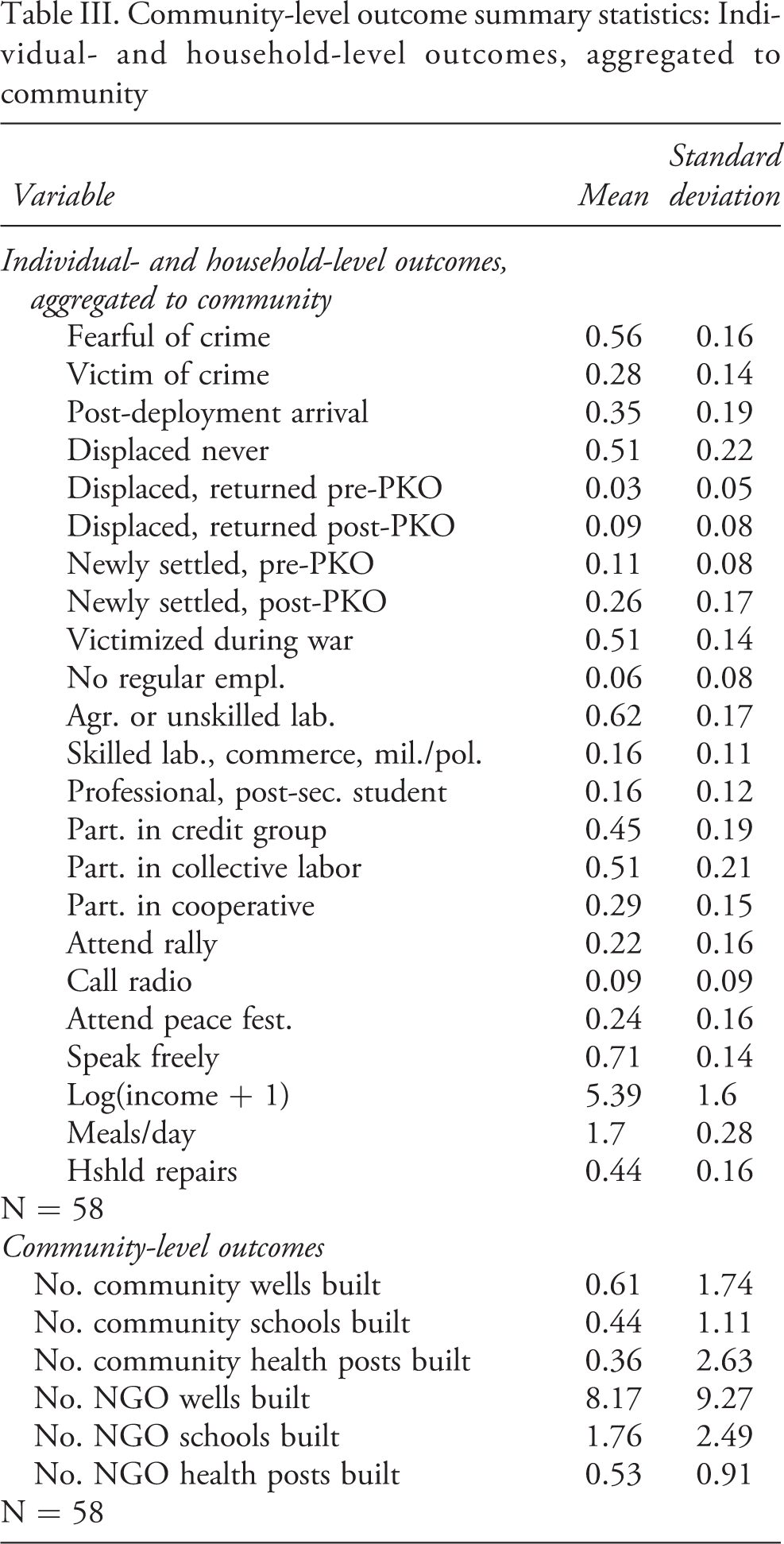
Table I summarizes our outcomes and data sources. Summary statistics for covariates and outcome variables used in the analysis are displayed at the household and community level in Tables II and III, respectively.
Individual- and household-level outcome summary statistics
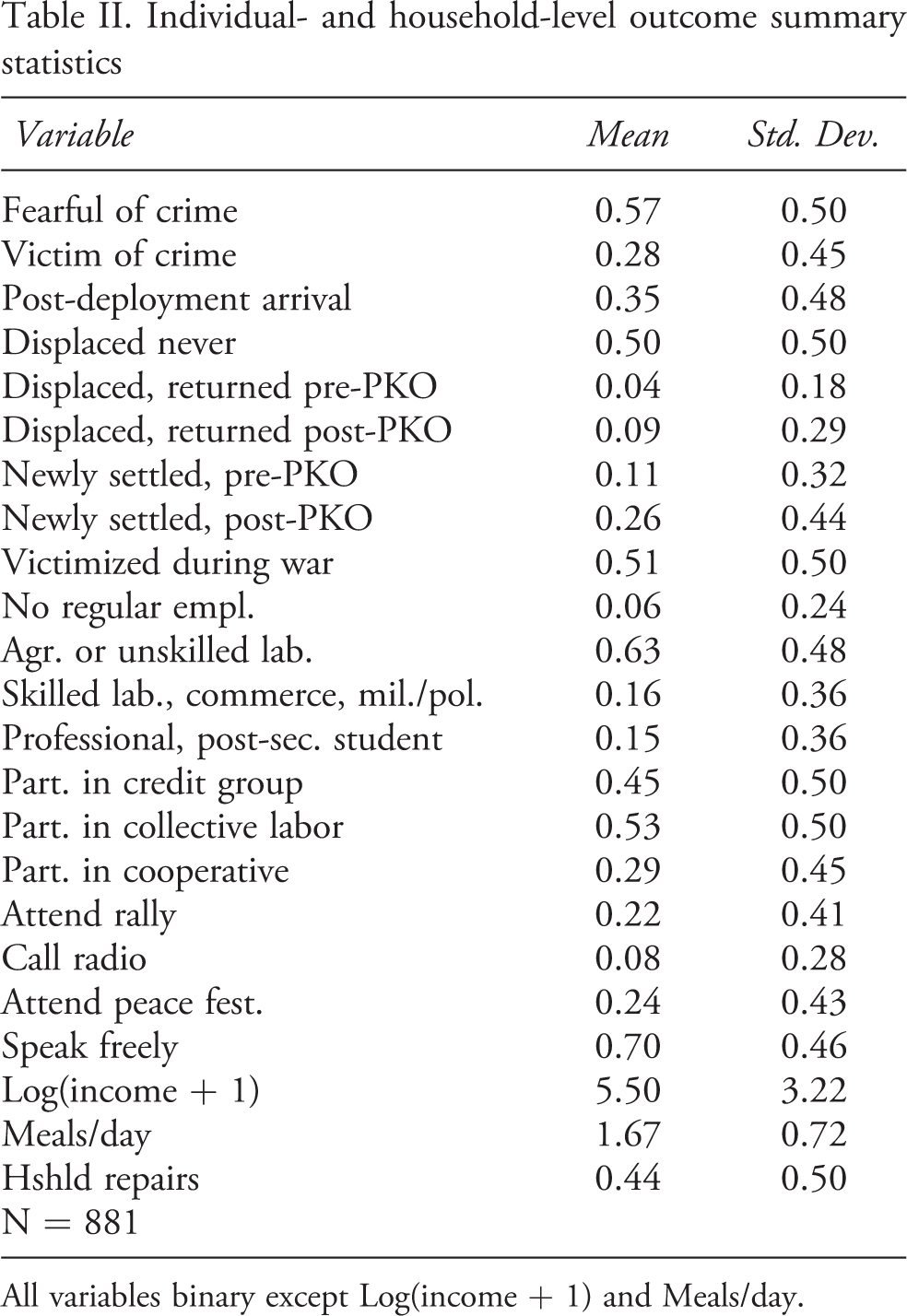
All variables binary except Log(income + 1) and Meals/day.
Community-level outcome summary statistics: Individual- and household-level outcomes, aggregated to community
Estimation and inference
Estimates below are covariate-adjusted differences-in-means estimated via ordinary least squares (OLS) fixed-effects regressions. For household level outcomes, the specification used for all estimates is,

where
We divide our outcomes and associated analyses into four families, as displayed in Table I. For each family, we perform a single omnibus test for a family-level effect. Our omnibus test is simply to run regression (1) with the outcome being the standardized inverse-covariance weighted average of the outcomes in that family. See Anderson (2008) for details on this approach.
In the regression tables presented here, we economize on space by only reporting the estimates for β. All estimates use weights to balance the number of control units with the number of treated units within each matching stratum. Standard errors account for stratification by the matching cells as well as community-level clustering.
Finally, section B in the Online supporting information re-estimates all of the effects using distance from a deployment as the treatment, rather than the binary variable that distinguishes between deployment and non-deployment communities. Using distance helps to address the possibility that the estimates from the binary contrasts are attenuated due to positive spillover effects that extend beyond 15 km. The results are totally consistent across the two specifications, and so we report the simpler binary contrasts in the main text.
Results
This section presents our estimated local security and socio-economic effects of the PKO base deployments. Generally speaking we do not find evidence consistent with the idea that deployments increase local security, nor do we find consistent evidence that local socio-economic conditions are improved. In the discussion section below, we consider these null and weak effects in light of the timing of the peacekeeping deployment relative to the stages of Liberia’s civil conflict, UNMIL’s credibility as a blanket deterrent force, and more subtle considerations about the potential economic impact of peacekeeping deployments. First, however, we present our basic effect estimates.
Local security
Effects on local security
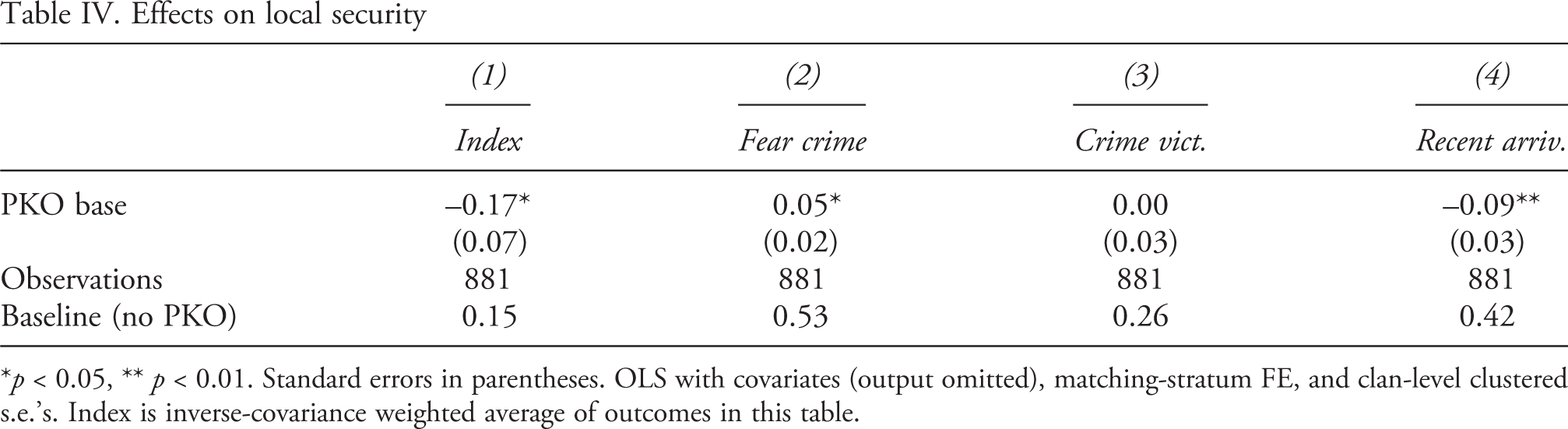
*p < 0.05, ** p < 0.01. Standard errors in parentheses. OLS with covariates (output omitted), matching-stratum FE, and clan-level clustered s.e.’s. Index is inverse-covariance weighted average of outcomes in this table.
Effects on number of community- and NGO-initiated infrastructure projects

Standard errors in parentheses. *p < 0.05, **p < 0.01. OLS with covariates (output omitted), matching-stratum FE, and clan-level clustered s.e.’s. Index is inverse-covariance weighted average of outcomes in this table. ‘Health’ refers to health posts.
Economic and social vitality
The security bubble hypothesis proposes that by creating zones where risks are perceived as lower, individuals should be more willing to invest in economic activities and social institutions. The direct assistance hypothesis proposes that the provision of resources and mediation should enable more cooperative exchange. The results from the previous section raise some concerns about whether PKO deployments provide the security or assistance necessary to activate this causal chain. Nonetheless, we present our estimates of effects on economic and social outcomes. If we find that positive effects are manifest, it may be that the manner in which security and assistance were measured was inadequate, and that the hypothesized effects are indeed active. Or, it may be that PKO deployments provide benefits to social and economic well-being through other channels, which in itself would be useful to document.
The results are presented in Tables IV to VIII. Altogether, we do not find clear evidence of any beneficial effects, as the index effects are insignificant in Tables VI and VIII. Table V shows effects of PKO deployments on the number of community- and NGO-initiated reconstruction projects. The hypotheses discussed above would lead us to expect each of these to be higher in PKO communities, whether because of security or direct assistance by the deployments. In this case, the results are mixed, which is why the index-level effect is relatively close to zero. Looking at the specific outcomes, we find positive effects for community-initiated rebuilding of wells and schools. About one more well or school project is undertaken in PKO communities relative to non-PKO communities, although non-PKO communities typically have no such projects. 7
Effects on economic outcomes
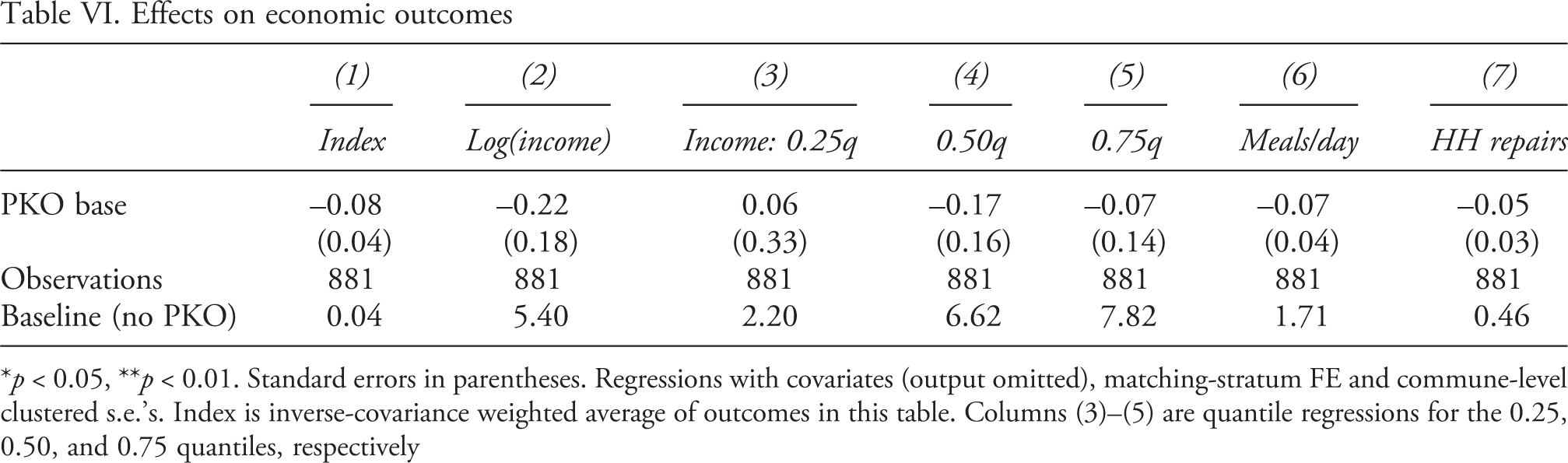
*p < 0.05, **p < 0.01. Standard errors in parentheses. Regressions with covariates (output omitted), matching-stratum FE and commune-level clustered s.e.’s. Index is inverse-covariance weighted average of outcomes in this table. Columns (3)–(5) are quantile regressions for the 0.25, 0.50, and 0.75 quantiles, respectively
Effects on occupations
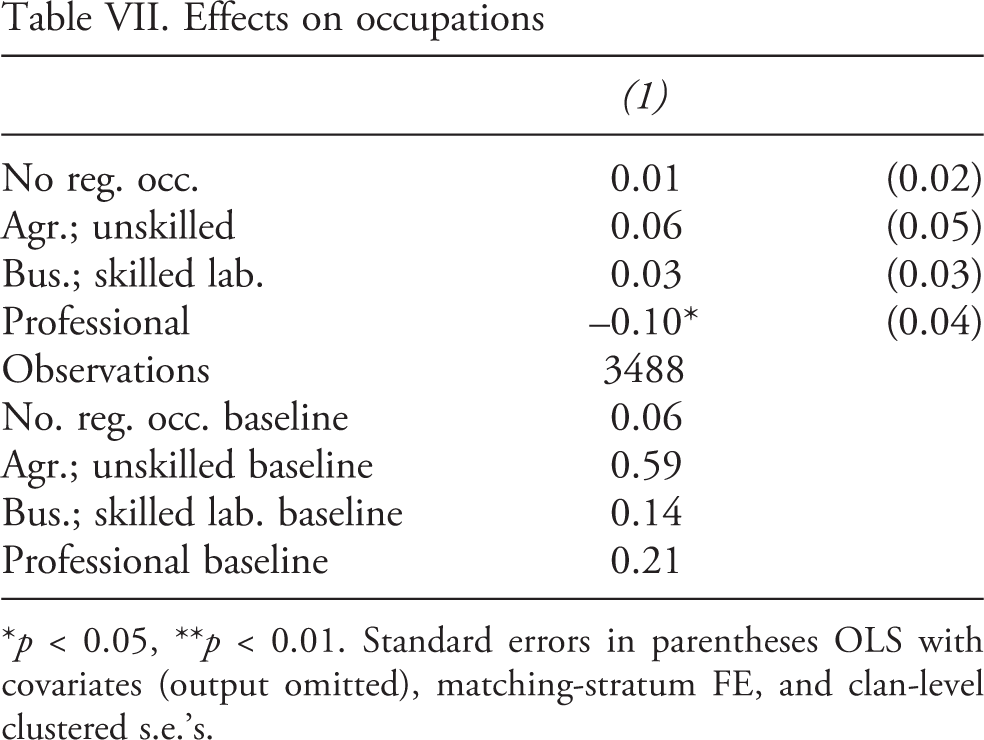
*p < 0.05, **p < 0.01. Standard errors in parentheses OLS with covariates (output omitted), matching-stratum FE, and clan-level clustered s.e.’s.
The effect for health posts is negative. More interesting are the effects for NGOs, which are negative for two out of the three project types (schools and health posts). A possible story is that PKO deployments do not provide a security bubble or zone of direct assistance within which NGOs can go about their work, but rather that deployments lead NGOs to want to work elsewhere. Such a ‘displacement effect’ could arise if NGOs felt that they could do the most good in working in areas where PKO deployments are not located. This would reflect a division-of-labor logic on the part of NGOs. If so, that would run exactly contrary to either the security bubble or direct assistance hypothesis. 8
Table VI presents estimates of effects on personal monthly income (on the log scale), both in terms of mean effects and quantile effects. 9 In all cases, the effect estimates are statistically indistinguishable from zero, and the point estimate for the mean effect (the OLS estimate) suggests that incomes are about 20% lower in PKO communities on average. In Table VII the only substantial effect is a decrease in levels of professional occupations. We looked more carefully at this result, and found that it was driven almost entirely by differences in the share of adults that indicated that they were students, a category that we coded as professional, as studenthood for adults in Liberia typically means post-secondary education in pursuit of a professional occupation. The index-level effect for the social outcomes does mask some heterogeneity. In Table VIII, we note indication of positive effects participation in credit groups, rallies, and calling in to radio programs, but other effects are null or negative, in terms of point estimates, and insignificant. Taking all of the evidence together, we see nothing that confirms the hypothesis of socio-economic revitalization at the local level.
Discussion
Effects on social and political vitality
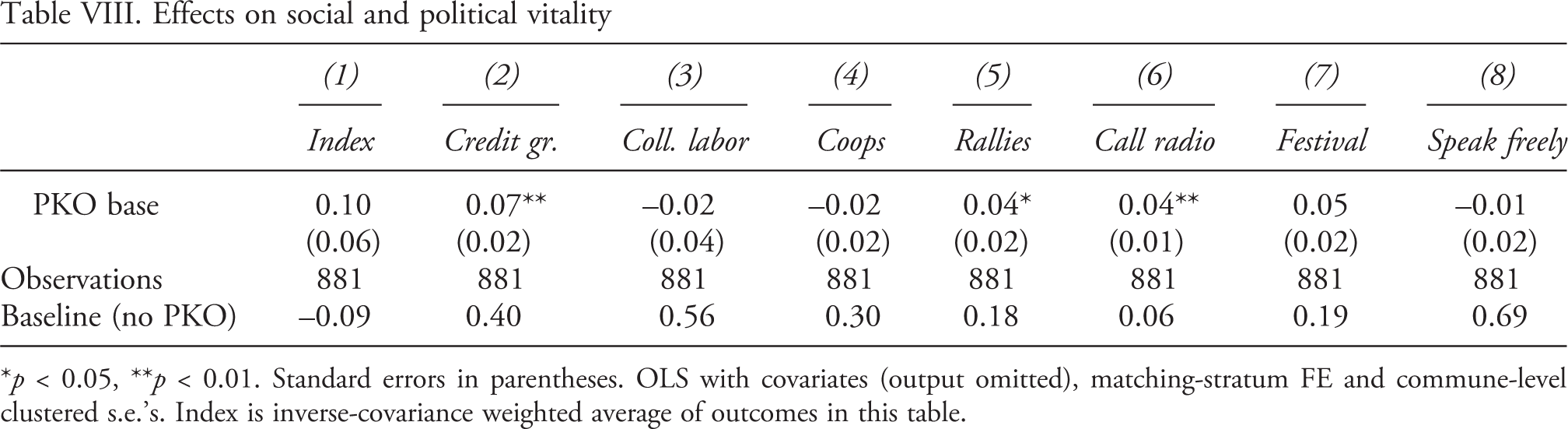
*p < 0.05, **p < 0.01. Standard errors in parentheses. OLS with covariates (output omitted), matching-stratum FE and commune-level clustered s.e.’s. Index is inverse-covariance weighted average of outcomes in this table.
At first glance, the finding that the assignment of UNMIL bases to communities did little to affect the security situation and levels of victimization within those communities is puzzling. But upon close investigation of the data, the finding can be explained, at least in part, by a convergence of two factors: (i) UNMIL’s deployment on the ground coincided with the effective end in the fighting between armed groups and major reduction in victimization rates; and (ii) UNMIL quickly established itself in the eyes of former combatants and civilians as a credible country-wide deterrent force. With regards to the former, areas more or less proximate to UNMIL’s deployments may not have differed. In other words, while UNMIL had little active role to play in dealing with major aggression by armed groups, it is quite possible that UNMIL’s presence was a blanket deterrent for the entire country.
Other parts of the survey data allow us to assess these possibilities, as the survey included questions on events associated with the risk of conflict recurrence. We asked respondents a set of seven retrospective questions about whether they had witnessed activities that were indicative of the possibility of renewed conflict. We added the ‘yes’ responses to create a ‘civilian insecurity index’. We then studied whether changes in the index over time are associated with proximity to peacekeeping deployments – coded as distant or deployment, corresponding to our no-PKO and PKO deployment community codings above. 10 The time period corresponds to the periods just prior to any deployment in 2003, during the early deployment period up to fall 2005, through the late deployment period following winter 2006 to the time of interview in 2007–08.
Table IX reports the results of the analysis. There is a very large jump between the first, pre-accords period and the period immediately following the signature of the peace accords. The index captures the dramatic improvement in security following the accords but prior to any PKO deployments. When we move the early deployment period, we find that the dip in insecurity in the early deployment communities is not as great (a 60% dip) as in the other communities that did not host deployments as of early 2005 (64–85% dips). Moving to the late period (winter 2006 through to late 2007/early 2008), insecurity levels in deployment communities are equal to those of non-PKO communities; indeed there were almost no reports of conflict-related incidents in this last period. This evidence does not suggest that deployments were associated with significant differences in insecurity at the local level. Security gains seemed to occur in a blanket manner across the country following the signature of the accords in 2003, and the largest gains occurred immediately following the signature of the accords and prior to UNMIL’s deployment, although conditions improved steadily over time after UNMIL’s deployment.
Civilian insecurity index over time

* Late deployment communities refer to those that did not host any deployments until mid-2005. Early deployment communities are those that hosted a deployment before early 2005.
The table shows mean values of a civilian insecurity index, constructed by adding the number of ‘yes’ responses to questions about whether the respondent witnessed any of seven types of conflict-related activities (see text for details). ‘SE’ stands for the standard error of the sample mean. A higher score indicates greater insecurity. Measures were taken for the four time periods indicated in the column headings. We see that on the whole, insecurity levels declined greatly since the signing of the peace accords, but that deployment communities did not enjoy more of a decline than comparable distant or proximate communities.
Given these results, we have a bit of a contradiction. On the one hand, it is clear that PKO deployments are appreciated by the public, and they appreciated specifically the security role that UNMIL plays. On the other hand, there is no indication that individuals react locally to PKOs as security providers. Rather, the function of the PKOs seems to be appreciated by local communities as a distant guarantor rather than an immediate provider of security. Another issue for further discussion concerns the seeming inconsistent socio-economic effects of UNMIL, which often run counter to our hypotheses. We hypothesized positive socio-economic effects from improved security conditions as well as from direct socio-economic programming undertaking by the peacekeeping mission. Yet a closer look at the results, in relation to the existing empirical literature, provides a way to reconcile these seeming contradictions. It appears that peacekeeping operations have some positive effects, but also important distortionary effects in the socio-economic sector. In other words, peacekeeping missions can contribute to a short-term increase in demands for certain types of goods and services (e.g. demand for unskilled labor or selling goods to peacekeepers in their local deployment locations), which may not necessarily be conducive to long-term economic development (Jennings & Boas, 2015).
For instance, in the case of UNMIL, Beber et al. (2016) note that the mission led to increased demands for low and unskilled labor in certain deployment locations. This is consistent with the estimates in Table VII, although it is unusual to see this heightened concentration in unskilled occupations coming in exchange for the share of professionals. Given that this decline in the professional share is coming primarily from the share of adults indicating that they are students, this could be indicative of such types of individuals deciding to take up non-professional occupations.
These effects on occupational composition could also reflect other differences between PKO and non-PKO communities that are associated with our finding concerning NGOs. Carnahan, Durch & Gilmore (2006) argue that the broader development footprint is invariably much larger than the UN mission alone in any post-conflict situation where peacekeepers are deployed. Thus the role of non-UN actors cannot be discounted in any attempts to understand the socio-economic impacts of UN peacekeeping operations on the local people in war-torn countries. NGOs and other actors are often more specialized in development activities and therefore in a better position to achieve the desired socio-economic outcomes (Fearon, Humphreys & Weinstein, 2009; Fowler, 1991).
NGOs played an important role in rebuilding postwar Liberia. They invested a great deal of resources in both humanitarian emergencies and longer-term development projects in a wide-range of sectors including health, economic and social development, water and sanitation, and government. UN data show an average of about three development projects per community and lasting about 3.5 years (some communities had as many as six development projects and lasting for as long as seven years). 11 Furthermore, our data reveal a negative correlation between UNMIL base and presence of international NGOs (r = –.08), which helps to explain the earlier finding that PKO base communities had on average fewer NGO-initiated socio-economic development projects. It is possible that NGOs in non-PKO base communities provided employment opportunities as well. This suggests an important relationship between peacekeeping and other development actors, such as international NGOs, that is yet to be fully explored.
Conclusion
In this article, we have articulated hypotheses about ‘local peacekeeping effects’ that are implicit in both the design and policymakers’ interpretation of current multidimensional peacekeeping operations. We have tested these hypotheses using a matched micro-level dataset on security, economic, and social outcomes in Liberia, and found no evidence that peacekeeping deployments transform local circumstances in the manner presumed. This is an important finding, as it helps to narrow the range of plausible mechanisms that explain the positive macro-level effect of peacekeeping. The finding also highlights an area in which organizations like the UN Department of Peacekeeping Operations should reassess its efforts.
With respect to external validity, Liberia was a setting in which we would expect pronounced micro-effects of peacekeeping on security, economic, and social outcomes. 12 Even in other peacekeeping intervention contexts where levels of development are similar, such as in Burundi or Côte d’Ivoire, there is much more local capacity and infrastructure. In Liberia, UNMIL intervened in a context of near complete institutional and infrastructural vacuum, as the Liberian state and institutions had long collapsed (Sawyer, 2005). Moreover, the army and police forces had to be rebuilt from scratch and by the time the survey was conducted, the local security apparatus had not achieved operational capacity to deploy independently in rural areas. Thus, UNMIL was providing essential law and order functions almost exclusively. Yet, empirical results do not offer strong evidence for any micro-effects of UNMIL.
Nonetheless, our findings have a number of implications about the positive relationship measured between peacekeeping deployments and the durability of peace, as well as socio-economic development cross-nationally. One conclusion is that there is less reason to give credence to micro-level mechanisms that link peacekeeping with ‘peacebuilding’ via local-level security that enables economic and social revitalization at the local level. Among explanations that have been proposed in the literature, these results would suggest that more emphasis should go into researching macro-level mechanisms based on signaling or deterrence at the level of leaders (Fortna, 2008).
At the same time the findings with respect to NGO activities suggest other possibilities that have not been explored in the current literature and deserve more systematic attention. That is, there may be a micro-level process that is relevant, but both peacekeepers and NGOs contribute to lifting up the different areas that they are covering at more-or-less equal rates. In that way, the fact that we do not detect any differences could mask significant improvements resulting from each of the peacekeeper and NGO contributions. To the extent that this is true, then we are less inclined to believe that the nature of peacekeepers’ contribution is in providing the local security necessary for economic and social reconstruction to occur, but there may be other channels through which peacekeepers contribute to such reconstruction in a way that is complementary to NGOs. This opens up interesting questions about whether interpretations of the cross-national findings attribute too much to peacekeeping operations per se and too little to NGOs that are almost always present alongside peacekeeping operations.
Do these findings mean that local security provision is simply unimportant in the context of peacekeeping? We do not think this conclusion is warranted. Post-conflict contexts are often marked by considerable amounts of insecurity short of the resumption of war (e.g. Autesserre, 2010). Such low-intensity insecurity can nonetheless limit economic activity or result in sociopolitical disruptions that can undermine the macro-peace. Therefore, we feel that it is appropriate that local security provision is part of most current UN peacekeeping mandates. However, the results presented here suggest that more thought should go into how the UN pursues this mandate. More generally, for the sake of improving peacekeeping operations, these results suggest that further research is needed on the macro- and micro-level mechanisms driving the well-documented link between peacekeeping operations and durable peace.
In the same vein, further research is needed into the kind of cooperation and coordination that exists among international actors that participate in the reconstruction and development of communities reeling from civil war. Our results suggest potential division of labor – and perhaps substitutions and complementaries – between peacekeeping operations and internal NGOs, which have not been fully explored in the current literature. Understanding these relationships and how they influence the results on the ground is critical to ascertaining the role and impact of peacekeeping operations on security restoration and development outcomes in fragile states staggering from the devastation of civil war. This should be a key priority for future research.
Footnotes
Notes
Replication data

Acknowledgements
This research was developed in the context of an evaluation commissioned by the Inspections and Evaluations Division of the United Nations Office for Internal Oversight. The research was completed while Mvukiyehe and Samii were PhD candidates at Columbia University, and comes under Columbia IRB protocol number AAAD2979. We thank Peter Aronow, Page Fortna, Birger Heldt, Macartan Humphreys, Jack Snyder, Chris Blattman, and Nikolay Marinov for comments and suggestions. We are also indebted to our Liberian research team as well as to Elizabeth Edelstein, Sarah Bieber, Madeleine Parish, Sarah Elven, and Nausheen Khan for outstanding research assistance. This work does not in any way represent the views of any of the above-named institutions.
Funding
This research was supported by the Folke Bernadotte Academy, Sweden.