



Abstract
Recent research has focused on the legacies of civil war violence on political preferences, finding that wartime victimization decreases support for the perpetrator or its political identity in the long run. However, we know little about the conditions under which this effect takes place. Historical accounts from civil wars suggest that the long-term effect of violence is not homogenous, nor consistent across areas within a single conflict. Addressing this gap, this article explores the effects of wartime victimization on long-term political preferences at the local level, looking at the conditioning effect of the local social context. In particular, I argue that the effect of wartime violence depends on the existence of local networks that create and maintain memories of the violence and capitalize on them for future mobilization. This argument is tested in the context of the Spanish Civil War. I build a novel dataset using archival data, historical secondary sources, and already existing datasets, covering 2,100 municipalities across Spain. In line with the argument, it is found that Francoist wartime victimization during the civil war is linked to an increase in leftist vote share after democracy was restored four decades later, but mainly in those municipalities where clandestine, left-leaning political networks were active after the conflict.
Introduction
Recent research has explored the long-term effects of civil war violence on political preferences, and has found that civilian victimization can lead to a long-term rejection of the perpetrator or its political identity (Balcells, 2012; Lupu & Peisakhin, 2017; Fontana, Nannicini & Tabellini, 2017; Rozenas, Schutte & Zhukov, 2017). However, we know little about why and when violence has such effect. Moreover, historical accounts suggest a more complex story.
In the mining valleys of Asturias, in the north of Spain, the Spanish Civil War (1936–39) involved intensive victimization of the civilian population. Years later, during the Francoist regime, when the clandestine labor movement developed in these same mining and industrial towns, the memories of the civil war played an important role in the mobilization of the next generation. Despite the paralyzing effect of repression, strong social networks helped to create collective memories and perpetuate the labor culture that had been harshly repressed during the civil war. It might not be surprising that this area is still a stronghold of communist and socialist ideology.
These valleys, however, are not the norm in Spain. In many other parts of the country, networks of opposition to the Francoist regime were much weaker, or did not exist at all. There, violent repression during the civil war and its aftermath had been much more successful in rooting out pockets of leftist support and demobilizing the entire population. Memories of victimization became a social taboo and people would quickly brush over the reasons why a relative had been killed during the war, even in private family conversations. Contrary to the Asturian valleys, these areas lacked a favorable environment in which collective memories could be kept alive and resonate within the community. In this context, there was no leftist mobilization in response to violence. If the seed of revolution is repression, not all soils are equally fertile.
The importance of the social context for the transmission of wartime memories and its subsequent impact on political attitudes is the focus of this article. In particular, I study the local-level legacies of wartime violence against civilians, and argue that a backfiring effect against the perpetrator’s political identity as a result of victimization is dependent on the presence of relevant political networks that create, maintain, and mobilize on memories of the violence.
To test this argument, I create a novel dataset covering 2,100 municipalities in 13 provinces of Spain, including information on many political phenomena at the local level across several decades. In particular, I analyze the long-term effect of Francoist violence against civilians during and immediately after the Spanish Civil War (1936–39), and test whether this effect varies depending on the existence of clandestine left-wing networks during the Francoist regime (1939–77). Results support the argument. Using a difference-in-differences setup, I find that wartime victimization during the civil war is linked to an increase in leftist vote share when democracy was restored four decades later, but mainly in those municipalities where clandestine political networks were active during the dictatorship. Moreover, I rule out that either wartime violence is causing both postwar clandestine activity and leftist vote increase or that it is just a story about organizational persistence.
Even though the empirical evidence comes from a single case, exploiting internal variation within Spain helps us to understand how single-case findings on the effect of victimization might travel to other countries. In particular, the results suggest that the survival of wartime memories and its translation into preferences hinges upon the action by political actors or networks. While in the case of Spain I point to the role of underground left-leaning political networks, other type of actors – such as victims associations or local political brokers – could have the same effect in other countries.
This article contributes to the literature on the consequences of political violence. Despite burgeoning recent research on the legacies of violence, we still know little about their social determinants and how they vary within a conflict. Here I argue that such an effect is not homogenous, but conditional on the work done by political actors and organizations in turning wartime events into collective memories and, thus, influencing political behavior in the long run. Moreover, this article also speaks to previous research on the relationship between local organizations and networks and electoral persistence, particularly during periods of authoritarian rule.
The legacies of political violence
In recent years, an emerging research agenda has focused on the effect of exposure to violence on individuals’ social and political attitudes. The main finding is that violence increases pro-social behavior towards members of the same social group, which often translates into increased capacity for collective action (Bellows & Miguel, 2009; Blattman, 2009; Voors et al., 2012; Gilligan, Pasquale & Samii, 2014; González & Miguel, 2015; Bauer et al., 2016). Related to this, similar studies suggest that, also at the individual level, exposure to violence is related to less potential for ethnic reconciliation (Bakke, O’Loughlin & Ward, 2009; Beber, Roessler & Scacco, 2014) and less political trust (Grosjean, 2014; De Juan & Pierskalla, 2016).
These findings are limited to the analyses of relatively short-term effects and, in most cases, do not offer explicit insights about the effects of violence on preferences vis-a-vis the perpetrator or other political forces. The long-term legacy of violence on political preferences is still an understudied topic. Balcells (2012) and Lupu & Peisakhin (2017) try to fill this gap, tracking changes on individual attitudes across generations in Spain and Ukraine and find that exposure to violence leads to a rejection of the perpetrator’s political identity. Despite their importance in providing new evidence, one of their limitations is that comparing individuals who were exposed to violence with those who were not omits those processes that take place at the level of communities. Particularly when looking at longer time periods, the effect of social networks or organizations at the local level is likely to play a big role in the transmission of wartime memories and their translation into political ideologies. Moreover, an exclusive focus on individuals sidelines the way violence can radicalize entire communities and turn them into ideological strongholds.
The few works that investigate local legacies of conflict support the idea that local-level processes are important. Daly (2012) shows how Colombian communities that suffered conflict in the past are more likely to be current hotspots of insurgency. Osorio, Schubiger & Weintraub (2016) show that in Mexico, current forms of self-defense mobilization against criminal violence can also be traced back to historical popular rebellions. Moreover, a few works highlight the importance of the ‘supply-side’ legacies of civil wars, in other words, how conflicts alter the constellation of local political actors and organizations. This approach complements studies focusing on the direct effect on civilians’ preferences, or the ‘demand-side’ of the political market, adding a new dimension to the debate on the long-term impact of civil wars on political preferences. Bateson (2013) explains how self-defense militias set up during the Guatemalan civil war are still active as vigilante organizations, shaping the way local communities behave politically and cope with the recent rise in criminal activity. Costalli & Ruggeri (2015) find that local armed bands that mobilized to fight against the Nazis in the Italian Civil War managed to become nonviolent political entrepreneurs and increase electoral support for them in the postwar period. Costalli & Ruggeri (2019) offer further support for the supply-side argument, showing that political parties connected to armed actors enjoy a long-term organizational advantage that can be translated into electoral success. Rizkallah (2016) shows how the process of consolidating territorial control during the Lebanese Civil War developed the resources that would later be used to mobilize postwar electoral support.
A few recent studies do focus on the long-term, community-level effects of political violence on preferences. Balcells (2010a) analyzes the effects of civilian victimization in Spain, looking at the difference in violence between leftist and rightist forces and its effect in Catalonian municipalities. However, she does not find conclusive results. Fontana, Nannicini & Tabellini (2017) find that the violent Nazi occupation of Italy during World War II increased the vote share to communist parties. Rozenas, Schutte & Zhukov (2017) explore the effect of Stalin’s forced deportations in Ukraine in the 1940s and show that exposed communities are less likely to vote for pro-Russian parties many decades later.
However, these works assume an average individual effect which is aggregated up to the level of communities, without accounting for how the effect of violence varies depending on the social context. The role of local organizations and relevant actors is ignored in these accounts. As highlighted above, civil wars have an impact on the supply-side of politics, and these new organizational structures also have a long-term effect on electoral behavior, as can be observed in countries such as Italy (Costalli & Ruggeri, 2015) or Lebanon (Rizkallah, 2016). These ideas resonate with those studies on electoral persistence during authoritarian regimes that point to the role of organizations and social networks in explaining persistence, as in the case of Hungary (Wittenberg, 2006).
Therefore, a missing piece in the literature is the interaction between the supply-side and the demand-side in the postwar period and the way they both shape the electoral legacies of civil wars. Addressing this gap could explain why exposure to victimization has a different impact across countries or areas within the same conflict, helping to interpret null or mixed findings and to generalize beyond specific contexts. The next section offers an argument about how the long-term legacies of violence are mediated by the local social environment, speaking both to the literature on the legacies of violence and to previous studies on the role of local organizations in explaining electoral persistence.
Theory
Previous research suggests that violence against civilians causes victimized communities to feel aggrieved, producing a long-term rejection of the perpetrator’s political identity (Balcells, 2012; Lupu & Peisakhin, 2017; Fontana, Nannicini & Tabellini, 2017; Rozenas, Schutte & Zhukov, 2017). However, evidence for this ‘backfiring’ effect is still limited, and we do not know how it varies, or why it would be present in some places but not in others. This argument explores the conditions under which it takes place.
I argue that such an effect does not take place directly, by merely changing attitudes of individuals exposed to violence, but is heavily mediated by the social context surrounding the individual. The creation of collective memories of the violence and its translation into political preferences is the product of political work done by social actors, helping to give a meaning to violent events, creating and maintaining memories over time, and using them to mobilize support. Without a social environment in which is it possible to discuss and develop the political meaning of violence, there would not be long-term consequences on political preferences.
This argument suggests that we have to pay attention to both the supply-side and the demand-side of the political market (Costalli & Ruggeri, 2019) to understand the legacies of civil wars. Although violent events have a direct impact on civilians’ preferences, political networks play a crucial role in activating the political dimension of wartime memories and translating them into political behavior. This idea resonates with previous research on how party organization and local structures are crucial when mobilizing voters (Tavits, 2013). Moreover, this idea goes in line with previous research on political persistence, which has highlighted this type of institutional explanation, suggesting that local organizations or institutions are the vectors of transmission of political attachments over time (Wittenberg, 2006).
By political networks, I do not necessarily refer to formal organizations, but to the presence of local individuals who are politically active and provide local communities with an ideologically based social capital that allows political discussion and basic mobilization. In the case of Francoist Spain, I refer to underground networks of left-wing activists, but the specific nature of these networks can vary depending on the context. Thus, they can stem from traditional forms of political organization, such as the working-class movement or student organizations, but they could also be found within neighbor or religious groups with a shared political ideology.
In the case of wartime memories and their effect on political preferences, my claim is that the existence of political networks plays a fundamental role in at least three aspects. These are not mutually exclusive dimensions, nor are they all necessary. Rather, they are three steps in the process between violent events and changes in political behavior where the role of political networks and actors is relevant.
First, local political networks frame wartime events and provide a political account of victimization, helping to form collective memories. Even during wartime or immediately after it, when a direct effect of violence on attitudes would be more likely, the interpretation and framing of violent events is highly dependent on the social context surrounding the individual. For instance, Shesterinina (2016: 411) shows how, during the first moments of the Georgian–Abkhaz war of 1992–93, information about war-related threats spread in Abkhazia through local community leaders, and was ‘reinforced and acted on within the quotidian networks of relatives and friends’.
Civilians rely heavily on close networks and already existing frames to understand the violence and engage in blaming processes, particularly considering that people usually cope with the risk and trauma of violence collectively (Lyons et al., 1998). Social-psychological research suggests that self-perceived victimhood is usually a collective phenomenon in which social identities play a crucial role defining wartime memories (Bar-Tal, 1997, 2007). These memories are likely to vary across and even within localities, and do not always correspond to an objective portrait of the conflict. For instance, Burrell (2013) explains how villagers in some municipalities of Guatemala cared more about which of their neighbors was responsible for the denunciation that led to their relatives’ deaths than whether it was actually carried out by the guerrilla or the army. Thus, local political networks carry out an important mobilization task by providing a collective story of victimization and pointing to those who were responsible for the violence.
Second, the existence of networks also provides a social space in which it is possible for like-minded individual to discuss politics. By engaging in constant interaction with those who share political experiences and identities, individuals develop a common understanding of past experiences of victimization and come to understand them in the language of political cleavages. Along these lines, Wittenberg (2006: 51) explains that the persistence of rightist ideology during the communist period in Hungary was due to local church institutions, noting that ‘being nominally Roman Catholic (or Calvinist) mattered less for the transmission of rightist attachments than being around other Catholics (or Calvinists) in a church community’. In the context of Eastern European new democracies, Tavits (2013) argues the existence of local party branches motivates interaction between party members and supporters, increasing electoral support. Moreover, case evidence from previous research points to the importance of the social context in explaining the persistence of attitudes in the long term. For instance, Voigtländer & Voth (2012: 1341) find that anti-Semitic attitudes persisted in Germany over many centuries, but mainly in small towns with tight networks and low mobility, where collective rituals such as ‘symbolic practices and festivals may have helped perpetuate hostile beliefs’.
Third, for victimization to increase electoral support for certain political parties, collective memories need to be translated into actual political behavior. Violence could have long-term effects on general political preferences, but ultimately, it is the role of actors and networks that makes people more likely to act based on wartime memories than on other social or economic issues. As with any other form of mobilization, this is far from being an individual-based process. Previous research again suggests that mobilization is necessary for memories of victimization to be translated into specific forms of political behavior. In Greece, Fouka & Voth (2016: 4–5) link massacres by Nazi forces during the Second World War with boycotts of German car sales during the 2010–14 Euro crisis, and find that the effect is bigger in ‘areas with a history of political radicalization in the past […] [and] in areas with numerous Facebook groups dedicated to boycotting German products’.
To sum up, I argue that in those communities where political networks are active, they provide individuals with a political interpretation of wartime victimization, create collective memories based upon it, provide a social context in which it is possible to discuss and share experiences, and mobilize electoral support in the long run.
Following this discussion, I outline the two main hypotheses, which point to the base effect of rightist victimization on leftist electoral support and to the main contribution of this article, the conditional effect of local political networks.
H1: Wartime violence against civilians increases long-term local support for political groups in opposition to the perpetrator’s political identity.
H2: The long-term effect of wartime violence against civilians is stronger where political networks or organizations are present at the local level.
The Spanish Civil War and its aftermath
The Spanish Civil War began after a failed coup against the Spanish Republic in July 1936, and was fought for almost three years, until 1 April 1939. The conflict mainly developed along the left-right cleavage, pitting the Nationalist rebels commanded by General Francisco Franco against the Republican forces, formed by army officers who remained loyal to the Republic, as well as left-wing militias. The outbreak of the war was preceded by one of the most politically intense periods in the contemporary history of Spain, as social and political struggles along this division were already very present in the previous years.
Victimization during the war
Victimization was commonly used during the civil war, in an attempt to wipe out potential enemies within the controlled territories. Following current research, more than 150,000 people died as a result of rearguard one-sided violence, of which around 100,000 took place in the territory controlled by the military rebels (Casanova, 2010). Both sides resorted to violence against civilians, but the rebels did so with the explicit goal of dismantling the Republican regime and controlling the population. When urged by foreign diplomats to bring the war to a quick end, Francisco Franco affirmed that he was ‘not interested in territory but in inhabitants’, and expressed worry about ending the war too soon, before he had ‘the certainty of being able to found a regime’ (cited in Anderson, 2016: 10). On both sides, opportunistic or more intimate reasons played a role in shaping the violence, as when people denounced neighbors based on previous family quarrels. However, the main factor explaining victimization was political identities (Balcells, 2017).
Victimization took several forms. There was indirect violence in the form of bombardments, mainly by the Rebel forces against Republican areas. And there was direct violence, in which local militias would track down the local opposition, using previous political affiliations or membership in trade unions (on the Nationalist side) or religious organizations (on the Republican side). A common form of violent repression was the paseos (strolls), when the local militia would go to the victim’s home, take him or her for a walk, and kill the victim extrajudicially. Finally, a relevant part of the victimization took place in the form of summary executions as a result of court-martial trials (Consejos de Guerra).
Francoist regime
The rebel’s victory in the civil war meant the establishment of an authoritarian regime in Spain that would last almost 40 years. Franco continued with the task he had already started in the conquered territories since 1936, setting up a reactionary regime and repressing any residual opposition that still existed within the country. The first few years of the postwar period were especially harsh. García Piñeiro (2001: 104) tells how ‘leftist people did not ignore that they were always suspects, not only of political crimes, but of any other offense that someone had committed’.
In the late-1950s, internal dissent to the regime stepped up again, initially led by the student movement in Madrid and the northern miners. During these years, Spain witnessed profound social transformations and intense economic development, which partly explain the renewed internal opposition. A historical mining strike in 1962 gave rise to a new period of contentious activity, and dissent spread to many other areas of the country. In response, Francoist authorities set up in 1963 the Tribunal de Orden Público, a special court that prosecuted political offenses against the state or the values it represented (Del Aguila, 2001). This court would be active until 1977, when it was abolished after processing more than 30,000 cases mainly related to membership in left-wing groups or participation in political activities.
Transition to democracy
In November 1975 General Franco died. Amid strong social pressures, the most progressive sector within the regime put the country on track towards democracy. Socialist and communist parties were legalized and the first multiparty democratic elections were celebrated in 1977, more than 40 years after the outbreak of the civil war. Electoral politics after 1977 played out along the same divisions that had defined politics during the Second Republic (1931–36) and, although some of the prewar political organizations no longer existed, political Provinces included in the sample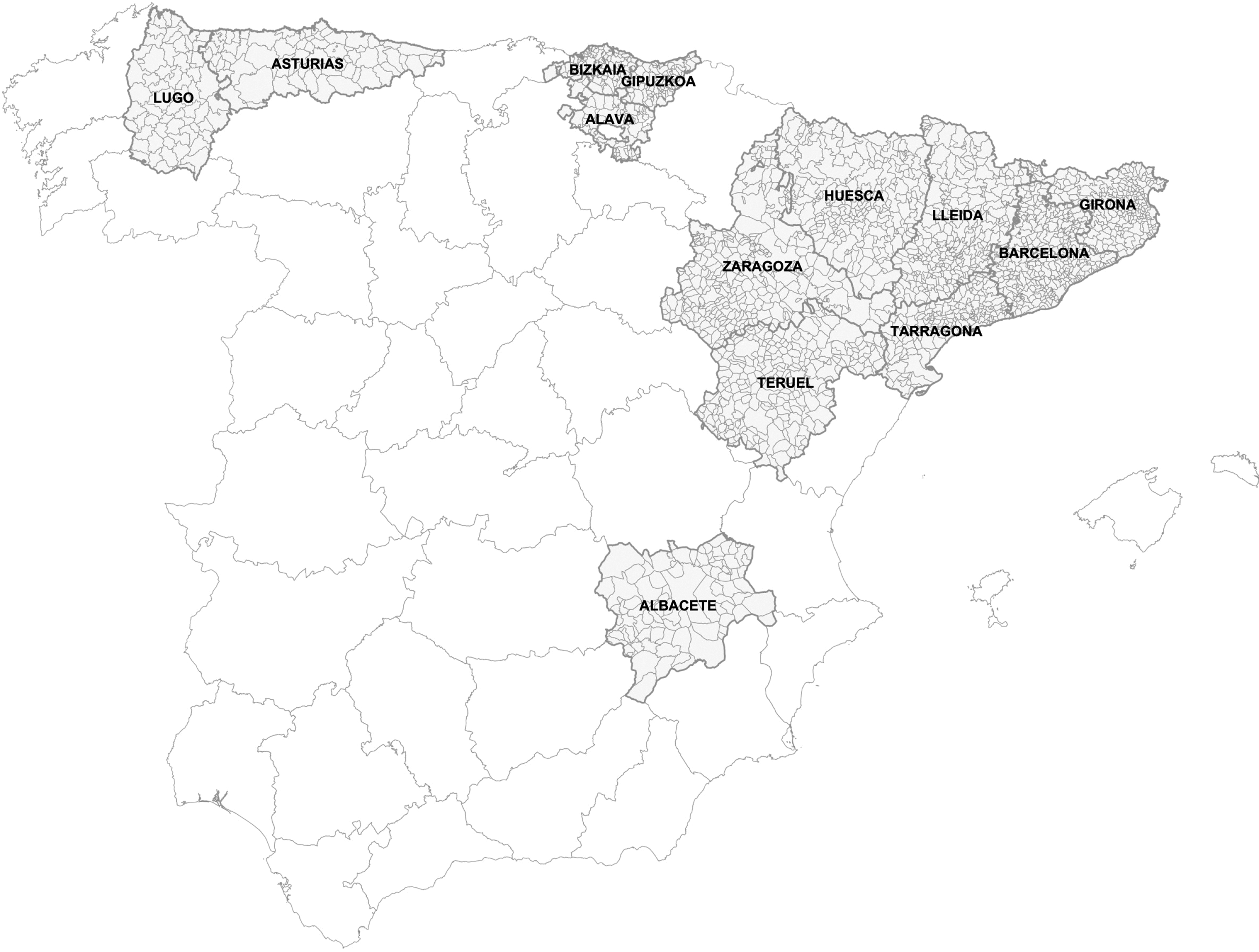
Empirics
I test the argument using data from Spain. In particular, I estimate the difference-in-differences (DiD) in leftist vote share between the prewar elections of 1936 and all the 13 democratic elections since 1977, analyzing the long-term effect of Francoist violence against civilians and how this effect varies depending on the existence of underground political networks during the late dictatorship. I also include analyses to provide evidence against two potential alternative explanations for the main results.
I build a dataset that covers 2,100 municipalities – around a quarter of all municipalities in Spain – from 13 provinces in the regions of Galicia (Lugo), Asturias, the Basque Country (Bizkaia, Gipuzkoa, and Alava), Aragon (Huesca, Zaragoza, and Teruel), Catalonia (Lleida, Girona, Tarragona, and Barcelona) and Castilla-La Mancha (Albacete). 1 Figure 1 shows the geographical coverage of the data.
Some of these areas were quickly conquered by the Francoist rebels, such as Lugo and western Asturias, and the war effectively ended during the first weeks without significant battles. Some other provinces were the scenario of military campaigns throughout the conflict, hosting some of the most stable battlefronts of the war, such as central Asturias, Bizkaia, or the Aragon region. Finally, other regions included in the sample remained under Republican control until the last few months, which is the case in Catalonia and Albacete.
In terms of socio-economic backgrounds, the sample also covers a wide array of variation. Lugo, western Asturias, Albacete and some parts of Aragon were deeply agrarian regions before the war and experienced a loss of population during the economic boom of the 1960s due to rural-urban migration. Central Asturias, the Basque Country, and Catalonia were already industrial centers before the war, and during the Francoist regime they continued to develop economically and were net recipients of internal migration. Relatedly, the political context also varies largely across these regions. Agrarian provinces like Lugo were more supportive of right-wing parties before the war, and they continue to be conservative strongholds to this day. In the contrary, left-wing parties enjoyed wide support in industrial centers like Asturias and Catalonia. Although not all data are available for every province, in the Online appendix I show that municipalities included in the sample are very similar to those not included, at least in terms of population and post-1977 electoral results.
Wartime victimization
Data on civilian victimization come from different sources depending on the province. They include regional research projects for Lugo (Fernández et al., 2018), Asturias (García et al., 2011), and Albacete (Ortiz Heras, 2015), replication datasets for Catalonia and Aragon (Balcells, 2010b), and government data for the Basque Country (Eusko Jaurlaritza, 2018). All these databases have a high degree of internal validity, and some were created from pairing death records in the local civil registries with historical documents and testimonies. They thus constitute a comprehensive data source of victims and their personal stories during the civil war and its aftermath. 2
Using these datasets, I link municipalities to the place of residence of the victim and restrict the list to those killed in irregular killings or executions, excluding those who died in combat. The main independent variable is a binary indicator of civilian victimization by Francoist forces – including the army, police forces, or local militias linked to the rebels – from the beginning of the civil war in 1936 until 1942, when most of the violence had already ended and which often marks the end of wartime repression (see e.g. Payne, 2012: 109–110). I use a binary measure of killings in order to avoid inconsistencies between different regions, where the data sources are different, and because there is less reliability in terms of the actual number of people killed. Moreover, given that repression not only included violent killings but also other forms of non-fatal repression (García Piñeiro, 2001), using a binary indicator can work as a proxy for those municipalities that suffered other reprisals from the Francoist government. In any case, I also run a version of the models with a continuous measure of violence, namely, the log number of killings by 1,000 inhabitants. Figure 2 shows the geographical variation of this variable in its continuous version. The fact that violence was in many cases a local phenomenon and partly driven by the endogenous dynamics of the war (Balcells, 2017) explains why sometimes violent areas border municipalities without violence.
Political networks after the war
The argument states that violence will only leave long-term legacies if there are active political networks that play a role in keeping those memories alive and capitalizing on them for mobilization. In the case of Spain, I argue that the relevant networks were part of the underground left-wing opposition to the dictatorship. Theoretically, these networks could also be the product of civil war violence, which would complicate empirical analyses. However, in Spain, the location of dissent during the late dictatorship was independent enough from wartime dynamics, which ensures enough variation to test the argument. I provide evidence for this claim as part of the alternative explanations.
To measure the presence of underground networks of opposition, I rely on the archives of the Tribunal de Orden Público (TOP), a special court that prosecuted political offenses from 1963 to 1977. The sentences of this court, compiled by Del Aguila (2001) from the national archives, are thus a measure of opposition activity during the dictatorship. 3 In particular, I code a binary indicator of underground activity that measures whether there were offenses classified as ‘illegal association’ or ‘illegal propaganda’ in a given municipality or in any of its neighbors within 10 km. 4 There are two main reasons for including this buffer area. First, it is natural to assume spillovers of organizational activity, in the sense that political actors sentenced by the TOP would have engaged in activities beyond their municipality of residence. And second, by extending the indicator to neighboring municipalities as well, I attempt to capture latent political networks and not only political activity, trying to mitigate the bias against those networks that did not engage in more visible activities. Figure 3 shows the geographical variation of this variable.
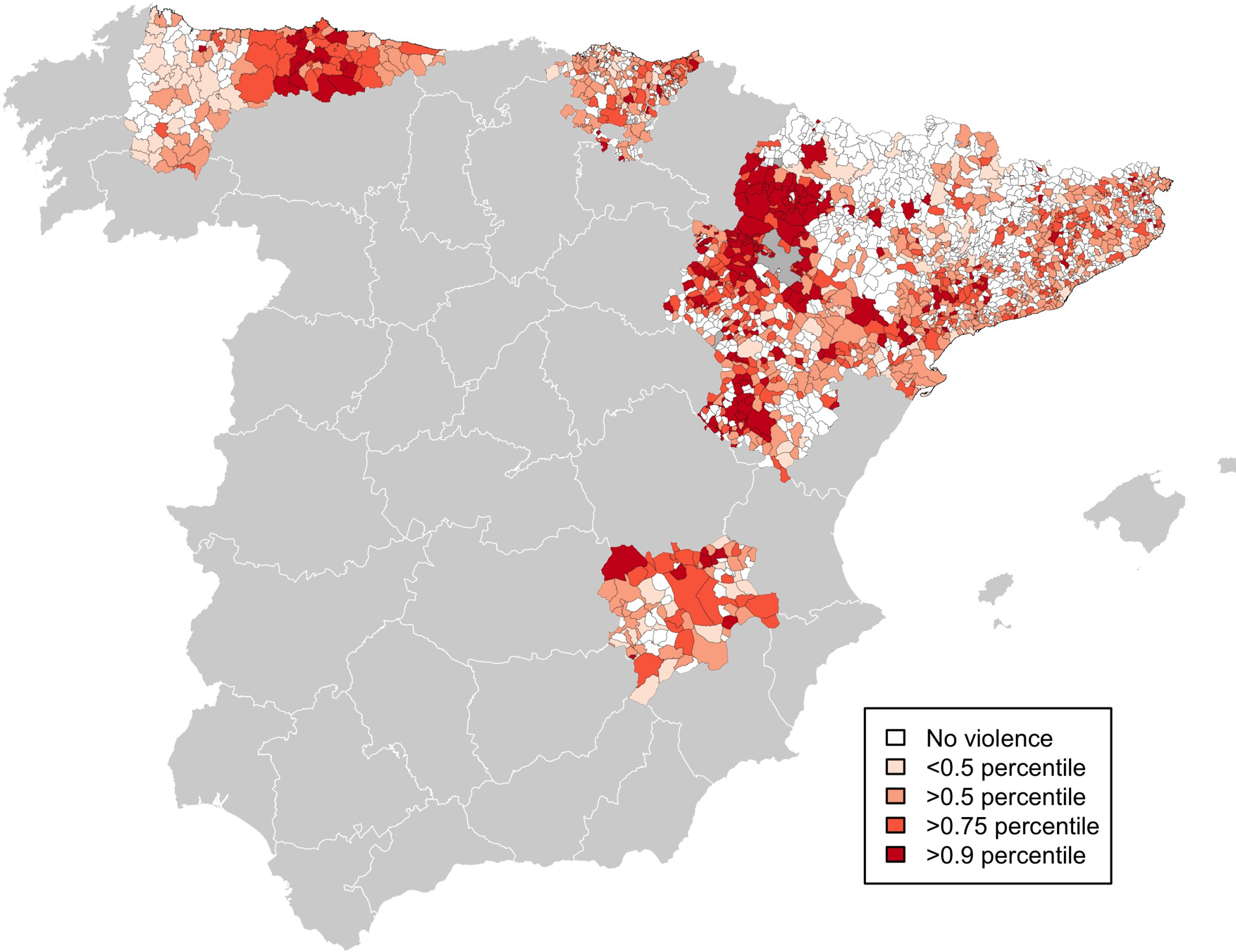
Wartime victimization by Francoist forces
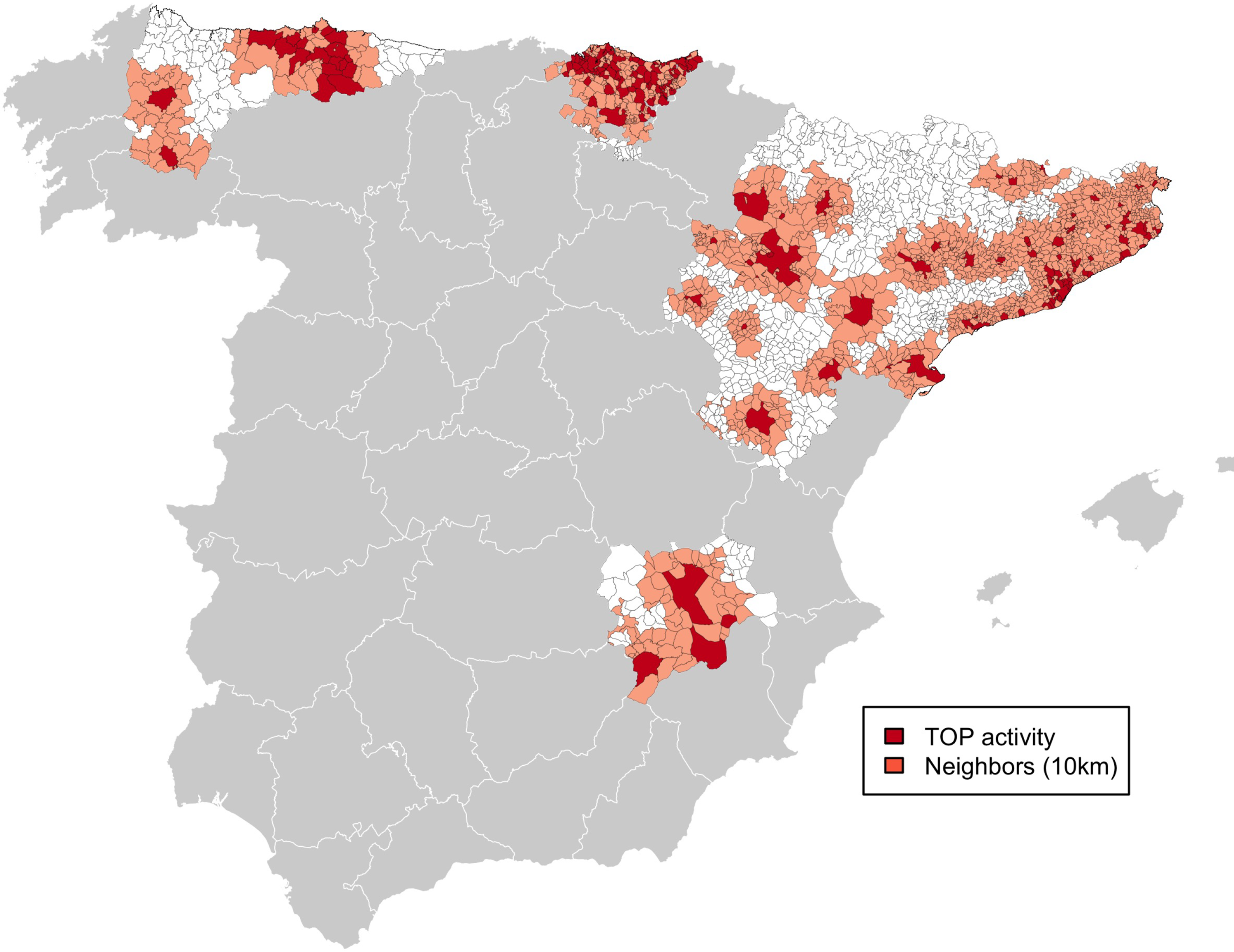
Underground (TOP) activity between 1963 and 1977
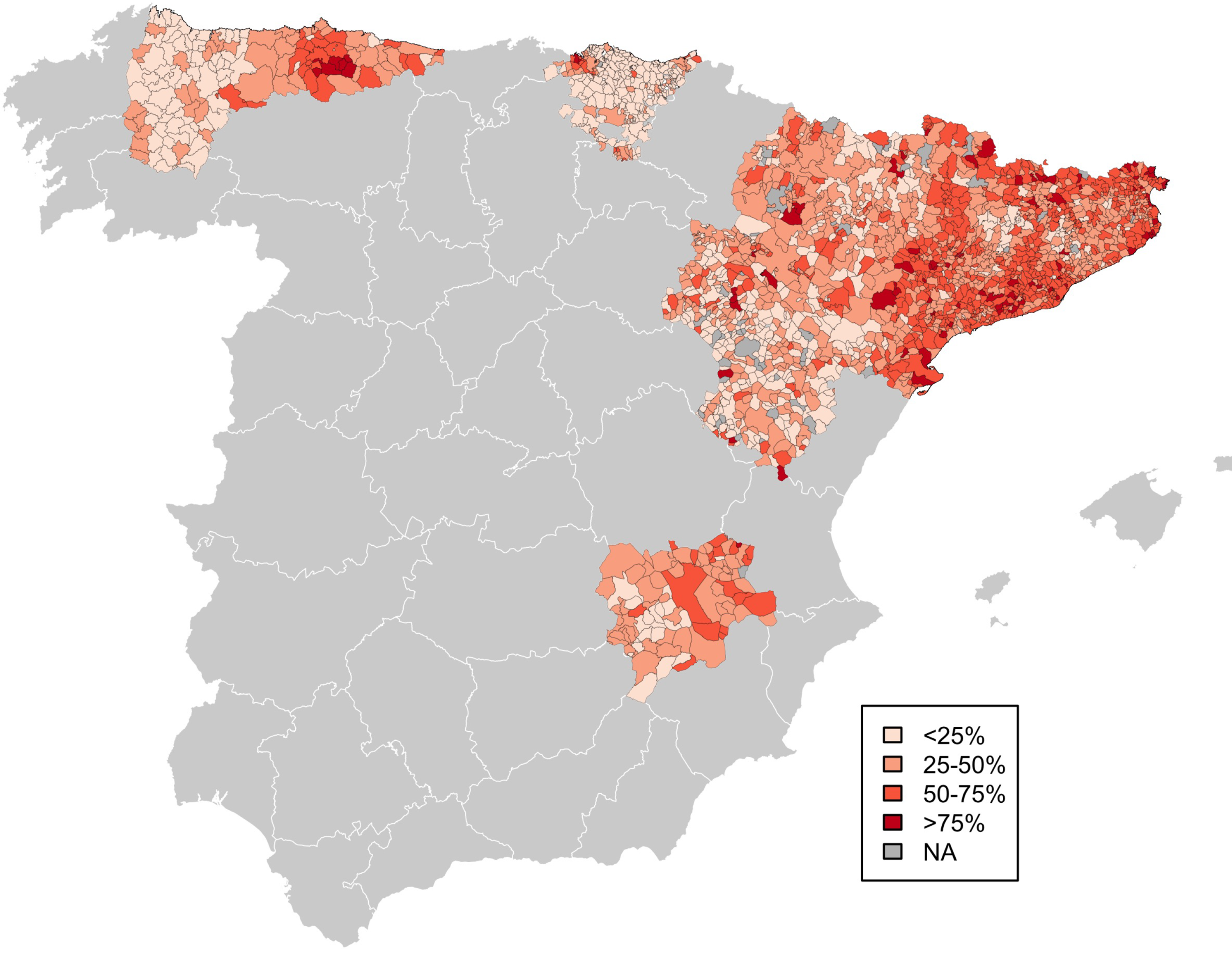
Leftist support in 1936
Although this data source is not perfect, it offers a good indicator of the existence of anti-regime networks during the Francoist dictatorship. The data cover the years when political opposition took off in Spain and, given the zeal with which the regime persecuted internal dissent and the capacity of the state during those years, it should capture fairly well the overall pattern of leftist dissent.
Electoral support
Data from the February 1936 elections come from archival sources for Lugo (the Boletín Oficial de la Provincia, or Official Provincial Gazette), secondary sources for Asturias (SADEI, 1996), Albacete (Requena Gallego, 1982), and Catalonia (Vilanova, 1986), replication datasets for Aragon (Balcells, 2010b), and government data for the Basque Country (Eusko Jaurlaritza, 2016). In all cases, I code the vote share of the leftist coalition Frente Popular (Popular Front) in each municipality. Figure 4 maps prewar leftist support.
Data on electoral results between 1977 and 2016 are available online (Ministerio del Interior, 2013). To measure the leftist vote, I coded the share of votes in each municipality for all the leftist parties, including both the major, country-wide parties and the leftist Nationalist parties in the Basque Country, Catalonia, and Galicia. I detail in the Online appendix which parties were included.
Other variables
I include in every model a number of additional variables to control for both the determinants of civilian victimization and the evolution of leftist vote between the civil war and the post-1977 democratic period.
First, using census data (INE, 2018), I include the logged population in 1970 and the change in population between 1940 and 1970, to control for economic changes and rural-urban migration patterns.
Second, I include a dummy variable indicating the presence of prewar local affiliates to the two major labor unions, the anarchist Confederacion Nacional del Trabajo (CNT) and the socialist Unión General de Trabajadores (UGT), using data from Cuco-Giner (1970), Calero (2009), and the UGT archives (UGT, 1931).
Third, I control for rugged terrain and inaccessibility, which influences both patterns of victimization and subsequent sociopolitical dynamics, using the standard deviation of elevation within each municipality (Mapzen, 2018).
Finally, following Balcells (2017), I also calculate a measure of electoral competition in 1936, using the same sources described above. I also include a variable indicating the leftist vote in 1936, to control for different baselines.
Models
I estimate difference-in-differences models of the effect of wartime victimization on the leftist vote between 1936 and all the 13 elections that took place between 1977 and 2016. I first estimate a base model that only indicates the effect of Francoist victimization on the increase of leftist support relative to 1936. To test the main argument, I include an interaction with the network variable in all subsequent models and show how the effect of victimization varies depending on the presence of these networks.
A first concern with these analyses is that the binary nature of the victimization variable could hide important variation explaining why certain municipalities, which suffered harsher violence, show a bigger increase in leftist vote. Therefore, I also run the same model using the log number of killings per 1,000 inhabitants. Second, rural-urban migration, which was an important phenomenon after the 1950s, could mean that people more likely to vote to the left moved to cities, such as the emerging left-leaning working class. Moreover, economic repression, that took place particularly during the first years of the Francoist regime, meant that the losers of the civil war were more likely to experience economic hardship (García Piñeiro, 2001; Cazorla-Sánchez, 2009). If these cities experienced more victimization during the civil war because of strategic reasons, results could be confounded. Thus, I also run a model excluding all municipalities that had 10,000 inhabitants or more in 1970 (around 7% of the total).
Every model includes province-level fixed effects, accounting for possible inconsistencies across different regional datasets. In addition, I include a series of robustness tests in the Online appendix, showing that the results do not change significantly when controlling for spatial dependency, using different specifications of the underground activity variable, or excluding the Basque provinces. 5
Endogeneity and alternative explanations
Here I try to show that there are strong reasons to think that wartime victimization caused a long-term increase in the leftist vote, and that this effect is stronger in those areas where underground opposition organizations were active during the late dictatorship. However, this research design still leaves room for an obvious concern for endogeneity. In particular, two other potential explanations for the results arise.
First, when interacting wartime victimization with postwar underground activity to predict long-term leftist support, the analyses could just be capturing the effect of victimization on postwar underground activity. To account for this, I show that underground activity does not correlate with victimization patterns during the civil war.
Second, organizational persistence is another explanation for the results. In other words, areas of leftist support before the war could have been more likely to experience Francoist victimization, develop networks of opposition during the dictatorship, and support leftist parties after 1977. Obviously, organizational persistence existed to some degree, as Francoist repression was not able to wipe out leftist support completely and some areas remained leftist strongholds during the whole period. However, if this pattern is strong enough it could confound the results and invalidate my argument. My claim is that the presence of political networks during the late dictatorship was in part a consequence of the socio-economic dynamics of the 1950s and 1960s, and that there is enough variation with respect to patterns of prewar leftist support to provide evidence for the main argument. To test this assumption, I run a model substituting postwar clandestine activity for the presence of trade unions before the war, to rule out the possibility that the existence of prewar organizations is determining subsequent dynamics.
The key question in this article is about the conditions under which violence had long-term effects on electoral behavior and the role of underground networks in that process. This is an intrinsically endogenous process and, theoretically, both victimization and the existence of networks could take place in the same municipalities. However, without enough spatial variation, an empirical test of the argument would be very difficult. Ideally, the mechanism could be tested by linking the mobilization activities of these networks and over-time variation in both the way civilians remembered wartime violence and their political preferences. Unfortunately, such analyses would require data that are not currently available. By showing that there is enough variation and ruling out Wartime victimization and leftist vote increase depending on the presence of political networks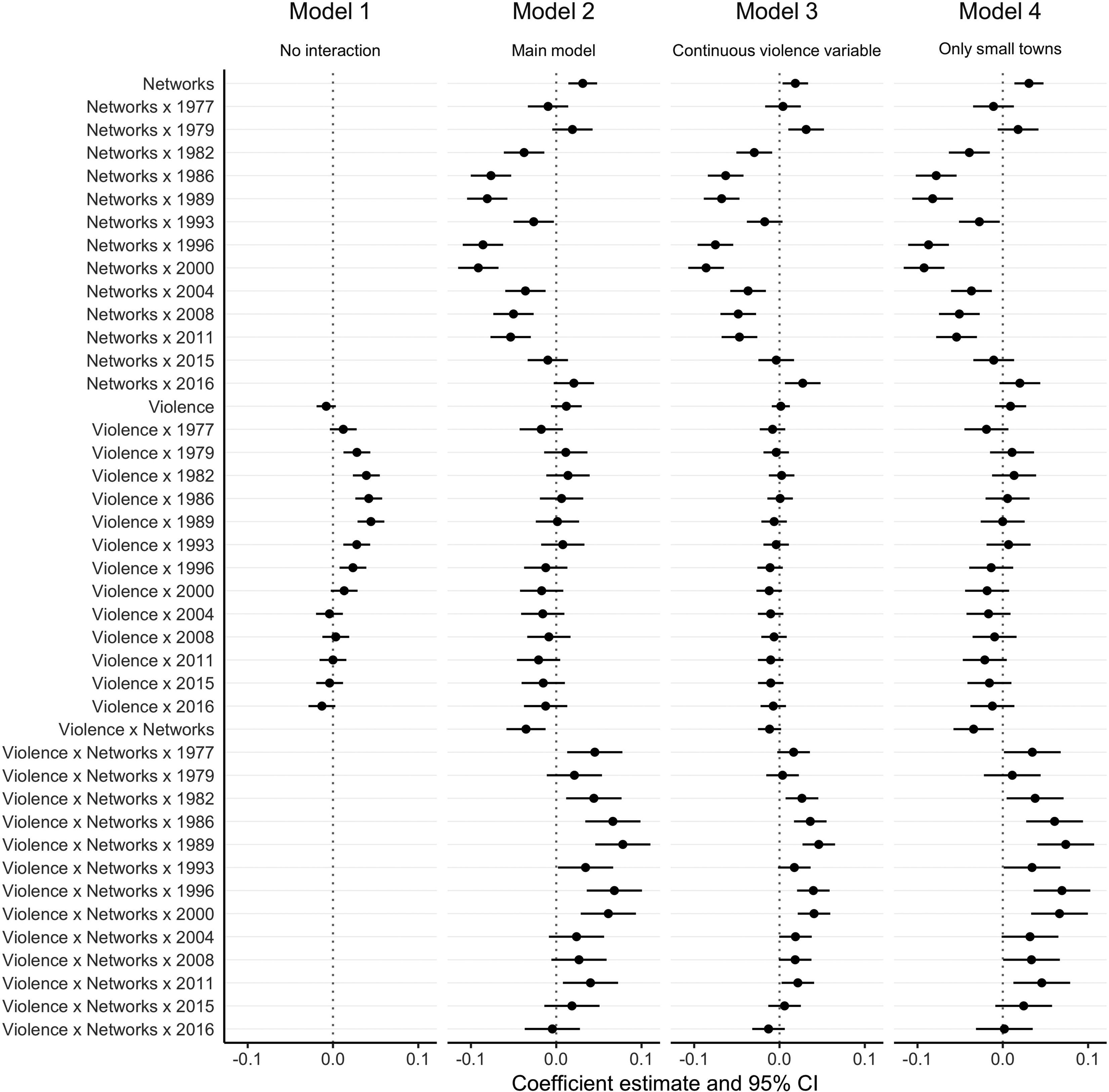
Results and discussion
Main results
Figure 5 presents the results from the DiD models on the increase in the leftist vote respective to the 1936 elections. 6 Model 1 tests Hypothesis H1, giving a simple DiD estimate of wartime rightist victimization on the subsequent increase in the leftist vote. The coefficients indicate the increase in the leftist vote for each election, relative to the 1936 share, that is due to wartime Francoist violence against civilians. Supporting H1, the effect of victimization is positive and significant during the first half of the democratic period, peaking around the mid-1980s and decreasing thereafter. 7
Turning now to Hypothesis H2, Model 2 includes an interaction of the victimization variable with the existence of political networks during the late dictatorship. Results support the main argument. In particular, the DiD estimate of wartime victimization on the leftist vote depending on the presence of political networks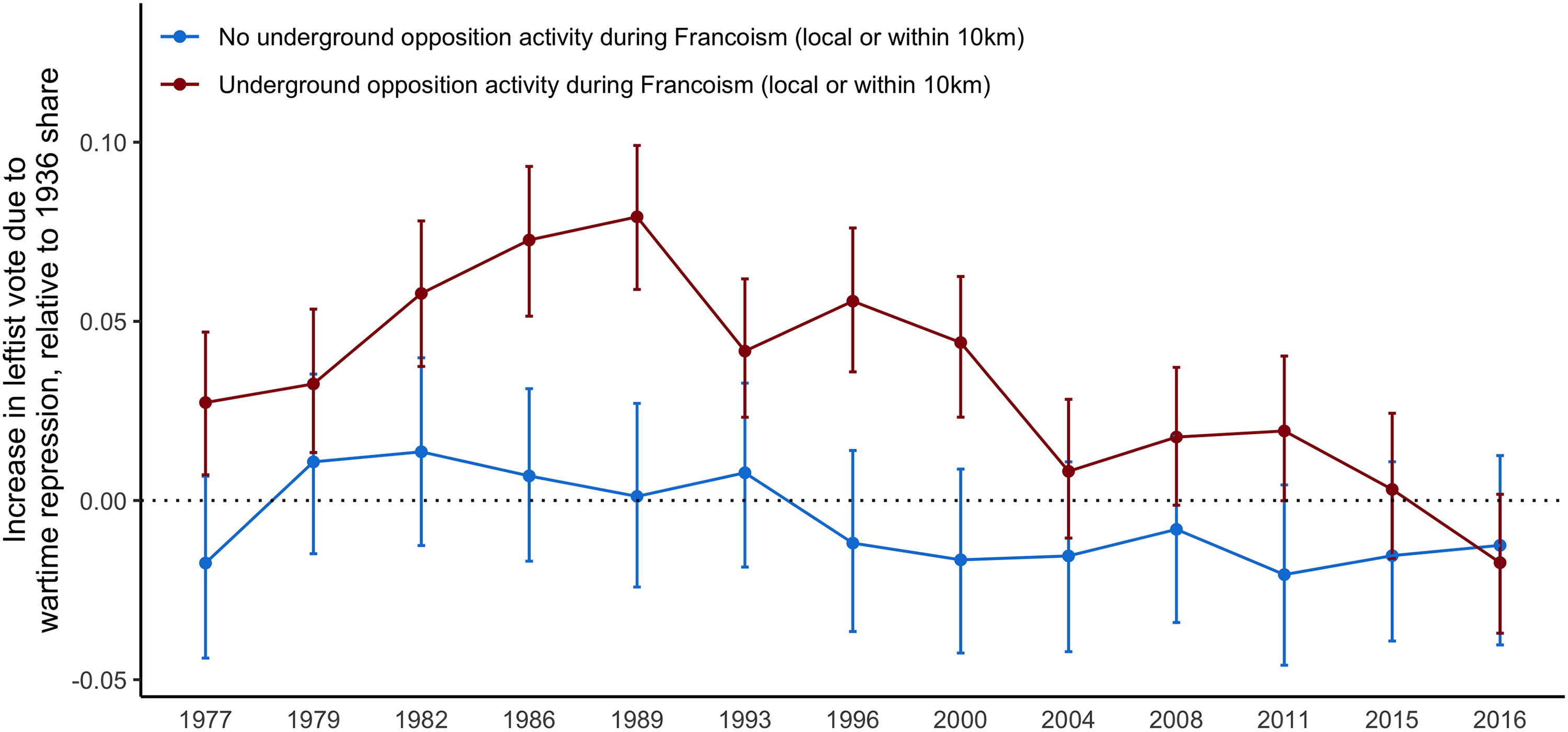
Following the points raised in the previous section, Models 3 and 4 in Figure 5 show that the results do not change when using a continuous measure of violence or when limiting the sample to small towns. In addition, I include in the Online appendix further robustness tests, showing that the results hold when including spatial lags to control for potential spillover effects, when excluding the three Basque provinces from the sample or when using different specifications of the network variable. Moreover, I show that the results do not change when taking into account wartime leftist victimization, in those provinces where these data are available.
In brief, results suggest that wartime victimization produced an increase in leftist sympathies, particularly in those places where anti-regime networks had been active during the dictatorship, and presumably helped to develop collective memories and mobilize support based on them. Once Spain transitioned to democracy, these sympathies translated into votes for leftist parties. The analyses show that the effect of wartime victimization is no longer statistically significant after 2000, which in principle is coherent with the argument. Once democracy settled in, leftist parties became more institutionalized, new generations that had not known Franco’s regime reached voting age, and other issues different from wartime memories gained in importance, which should explain why the local effect of violence became less relevant.
Networks as a consequence of victimization
An alternative explanation to the results presented above is that both the leftist vote increase and the presence of clandestine political activity during Francoism are the consequence of wartime victimization. Although delving into the specific causes of anti-regime network presence is outside the scope of this article, for the empirical results to be valid the presence of networks at the local level should be independent enough from wartime dynamics explaining victimization. To test this, I regress the presence of networks on wartime victimization and leftist vote in 1936, including a set of control variables similar to those included in the main analyses. Figure 7 shows the results using different specifications, including or not the interaction between victimization and leftist support in 1936 and with and without province fixed effects.
In every model, wartime victimization does not show any relationship with the presence of political networks during the Francoist regime. The absence of a clear link suggests that postwar political activity against the regime was the consequence of a different process, possibly related more to the social and economic dynamics of Wartime victimization and postwar clandestine activity
Persistence of prewar organizations
Another alternative explanation is organizational persistence. In other words, in those municipalities where the labor movement was present before the civil war, leftist organizations might have survived the conflict and influenced the emergence of an anti-regime movement after the war.
This explanation is not at odds with the theory. If political organizations are resilient enough to survive violent repression during a civil war, they might be the ones that carry out the mobilization against the perpetrator in the postwar period. Some degree of persistence surely existed, but again, this empirical design requires enough spatial variation. To tease this out, I test here whether the increase in leftist vote is related to the presence of trade unions before the war. I run a version of the main models (Models 2–4) but interacting wartime victimization with the presence of prewar trade unions. Figure 8 shows the results. In this case, the estimates of the effect of victimization in the presence of trade unions before the war are not statistically significant in any of the different specifications and, in some cases, they even have a negative impact. This suggests that the location of dissent during the late dictatorship is at least partly exogenous with respect to patterns of leftist organizational activity during or before the civil war.
Discussion and case evidence
The results above suggest that wartime victimization is linked to a long-term rejection of the perpetrator’s political identity, an effect that is conditional on the existence of a facilitating social environment. In the case of Spain, victimization increased support for leftist parties mainly in those municipalities where anti-regime networks had been active during Francoism. These networks, I argue, were responsible for creating collective memories and mobilizing political support based on them. Although the analyses do not offer a direct test of the mechanism, evidence from recent historical research supports the argument on the importance and role of these political networks.
Sevillano (1999: 155) shows how Franco’s regime managed to control internal dissent through the use of traditional methods of social control and the threat of repression, which made people retreat from public life, afraid to ‘give certain opinions that did not have enough public and official support’. This atmosphere led to widespread demobilization, which also extended to the way the conflict was remembered: Convinced Republicans who would have insisted that the violence had been instrumental in crushing lower-class demands for reform were repressively silenced. For many of the uncommitted it made sense to explain violent conflict as the result of private vendetta or quarrels which could be seen plausibly in personal terms. (Richards, 2013: 98) Effect of wartime victimization conditional on the presence of prewar trade unions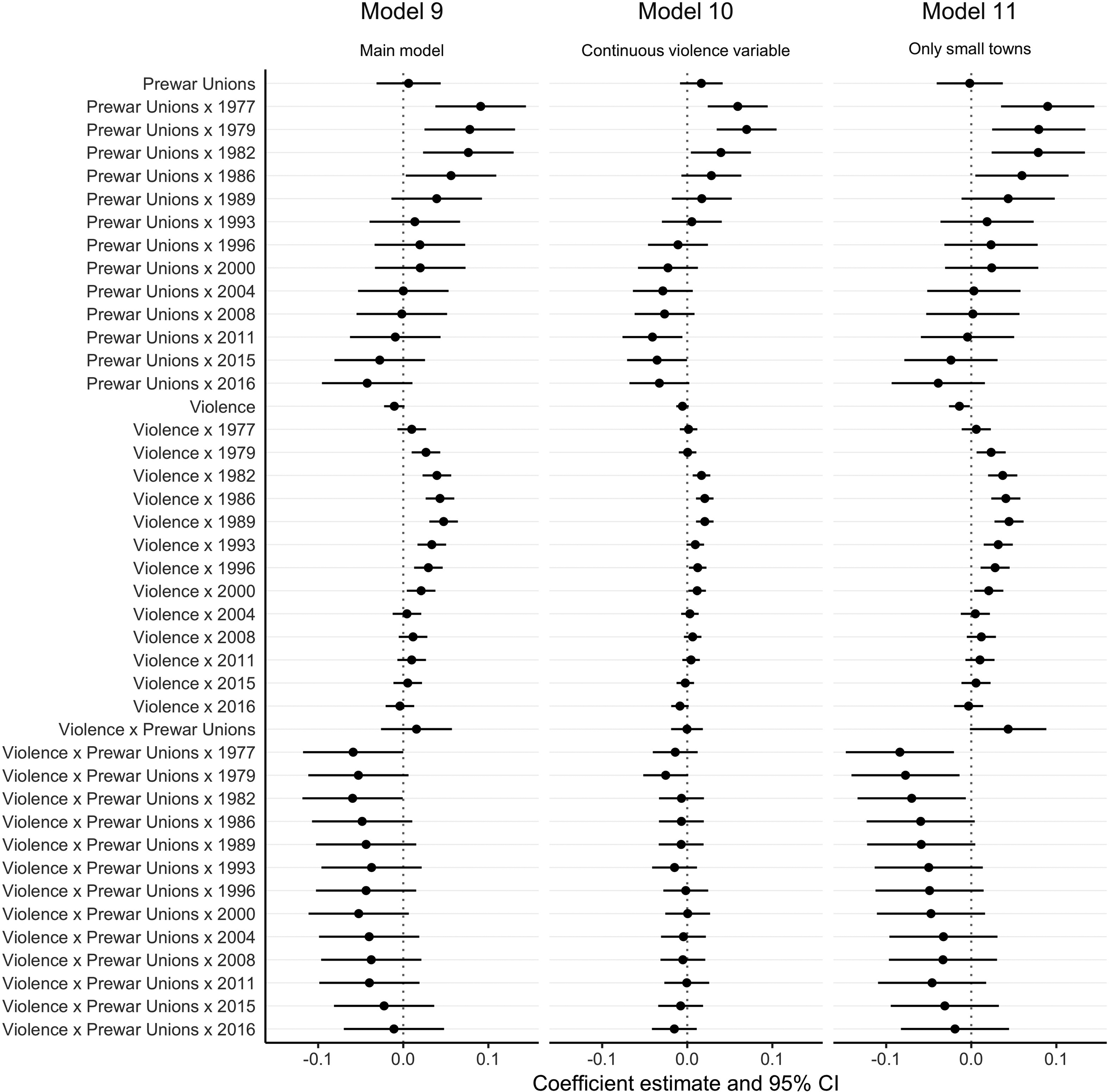
A good example of how these anti-Francoist networks could work in a politized area is Asturias, where industrial workers and their families lived within dense networks of neighbor groups, labor unions, and leftist cultural associations. Although wartime victimization had been very intense in these areas, leftist codes of behavior remained active and enforced, and years later, ‘any form of collaboration with the dictatorship, even if they did not involve harm to anyone, meant losing the respect of colleagues and neighbors’ (Vega, 2014: 230). In this context, many young socialists and communists discovered and were inspired by the political activism of their parents. Memories of the civil war could only be activated because there was a climate of left-leaning political activism, where experiences of prewar or wartime militancy were something to be proud of, rather than a personal secret that could mean social rejection.
As an opposite account, Cazorla-Sánchez (2009) writes about different regions in Spain where there was not a critical mass of leftist survivors. He describes how in certain regions former Republican families preferred not to talk about what happened during the war, and the victims of wartime repression ‘even thought that Franco was a good man who knew nothing of the crimes, injustices, and miseries committed against people like themselves’ (Cazorla-Sánchez, 2009: 3). Thus, in conservative areas without left-leaning networks of support, wartime memories contrary to the Francoist regime were deeply repressed by the social environment: For example, the agrarian region of Santander had a reputation for being conservative and staunchly Catholic. Here, as in the rest of Spain, defeated republicans living under Franco could expect official prosecution and social rejection for having fought on the wrong side in the war, even from their own families. […] Even in the early 1990s, when democracy was on a safe footing, they preferred not to talk too much. (Cazorla-Sánchez, 2009: 32–33)
How do these findings travel beyond Spain? Although the importance of clandestine anti-regime networks might be specific to Spain, the main idea revolves around the need of a facilitating social environment that allows the whole process from violent events to political preferences to materialize. In other contexts, therefore, it might be important to pay attention to the role of victims’ organizations, political actors, or even communication technologies, to understand how collective tales of the violence are being developed and how they are being used to mold political preferences. The heated debate about memory in Guatemala and the differences in how past exposure to violence is linked to patterns of political support (Ball, Kobrak & Spirer, 1999; Burrell, 2013) is an example of this. Moreover, approaching the problem of the legacies of violence from this point of view might also explain how certain contexts, such as ethnic civil wars, where there is often a sense of collectivity and clearly defined ideological boundaries, might be more prone to repeated cycles of violence and radicalization. My contribution here is highlighting the importance of the social environment, and pointing out that it might not be ideal to think of a homogenous effect of victimization across different contexts.
Conclusion
Using extensive local-level data from Spain, I showed that rightist violence against civilians during the Spanish Civil War increased long-term support for leftist parties, but mainly in those municipalities where political networks were active after the war. Results are thus consistent with the idea that the long-term legacies of political violence for political preferences are not homogeneous across social contexts, but rather depend on the existence of a facilitating environment.
A few questions remain open. First, civil wars themselves have an impact on local social networks (Wood, 2008). Violence usually targets networks of political support for the opposition, and the militarization of local life creates and empowers new social structures (Bateson, 2013). Although one of the proposed alternative explanations deals with the persistence of organizational structures, it might be worth exploring to what extent postwar political networks are linked to their predecessors before or during the war, and how this interacts with their actions after the war. Second, for the case of Spain in particular, it is still unclear which political forces benefited more from wartime memories and, particularly in the case of the Basque Country, Catalonia, and Galicia, how this affected support for regional Nationalist parties. The problem of cross-cutting cleavages is important as collective memories are malleable, and political networks might have the capacity to capitalize on violence-induced grievances to increase support along a different political dimension. Other contexts, such as the postwar period in Guatemala where different actors compete locally over different accounts of the conflict, suggest the importance of this struggle over memory. Future research should explore these issues.
Previous studies have identified the long-term effect of victimization on political preferences, but they have failed to provide evidence on the way this process takes place and the reasons why it should be present in some cases but not in others. Although this article uses empirical data from a single conflict, its findings clearly point to the need to understand the social context in which this long-term effect plays out, and the actors involved in the process. A more explicit focus on this would advance the literature on the consequences of political violence and improve our capacity to deal with postwar societies. Beyond pure scholarly interest, further research on this problem could inform postwar reconciliation or anti-radicalization programs worldwide.
Footnotes
Replication data
The dataset, R-code, and Online appendix can be found at http://www.prio.org/jpr/datasets and at  .
.
Acknowedgements
I am grateful to Lars-Erik Cederman, Laia Balcells, Carl Müller-Crepon, Yael Zeira, and Ben Mishkin, as well as participants at the 2018 APSA Annual Meeting and the 2018 Jan Tinbergen European Peace Science Conference for their feedback. I also thank the editor and two anonymous reviewers who provided very helpful comments.