




Abstract
Around the world, following civil wars, rebel and government belligerents contest and win the founding postwar elections. Despite the prevalence of these elections and their importance in setting post-conflict environments on specific political trajectories, their outcomes have been understudied. Existing scholarship centers on the timing and institutions of the postwar elections, but not on their party and voter participants. This article introduces a dataset which traces the postwar political trajectories of civil war belligerents, identifies their successor parties, charts their electoral performance, and documents their decision to remilitarize or demilitarize. The Civil War Successor Party (CWSP) dataset covers all belligerents that have transitioned from civil conflict in the period 1970–2015. The article describes the contours of the dataset, reveals patterns of political life after wars, and outlines the potential uses of the dataset for future research. In particular, it suggests how the data may be leveraged by scholars and practitioners to understand dynamics of political behavior, patterns of governance and public goods provision, quality of democracy, and recurrence of low- and high-intensity war in the aftermath of mass violence.
Introduction
Civil war successor parties emerge out of almost every conflict termination and remain important figures in the politics of countries transitioning from war to peace. To understand the politics of countries recovering from conflict, it is critical to understand the electoral fates of civil war belligerents. How do parties derived from rebel and government belligerents perform in founding post-war elections? Why does their performance vary? And what are the implications of these electoral results for peace, democracy, governance, and justice?
In this article, I present the Civil War Successor Party dataset (CWSP), which traces the political legacies of armed conflict and the contours of electoral politics after mass violence in the period 1970–2015. More specifically, my goal is to place civil war successor parties on the map as key actors in the transition from war to peace. The dataset documents 205 civil war belligerents’ political postwar trajectories. It builds on the important work of scholars who study the timing of postwar elections (Brancati & Snyder, 2012; Flores & Nooruddin, 2012; Reilly, 2002), the institutions structuring the elections (Hartzell & Hoddie, 2007; Mattes & Savun, 2009; Walter, 1999), and the provisions allowing for rebels to participate in the elections (Marshall & Ishiyama, 2016; Matanock, 2017). CWSP adds to this body of scholarship how the parties perform in the elections. While the existing literature focuses exclusively on rebel parties, CWSP covers successor parties derived from the government belligerent, rendering our understanding of postwar politics more complete. It further contributes to data on conflict termination and resumption. It carefully examines each case of conflict termination to verify that a meaningful cessation of hostilities took place. Rather than code war recurrence at the country or conflict level, CWSP codes remilitarization at the organizational level, enabling scholars to disentangle which former belligerent reinitiated the return to armed conflict.
To proceed, I first survey the existing literature and datasets. I demonstrate the importance of the CWSP project. In the second section, I introduce the structure of the dataset. The third describes potential applications of the data. In the fourth section, I analyze problems associated with the dataset, and conclude by identifying directions for future research.
The need for a new dataset
Civil war researchers have significantly advanced knowledge of the political legacies of war. Scholars have explained why civil wars engender democratization in their aftermath in some cases, but not in others (Bermeo, 2003; Fortna & Huang, 2012; Hartzell & Hoddie, 2015; Huang, 2016; Wantchekon, 2004). Researchers have studied the timing of elections: why, at times, they happen in the immediate aftermath of war and, at other times, are delayed for years or even decades (Brancati & Snyder, 2011). Scholars have debated the advantages and disadvantages of holding elections for the sustainability of peace. Some argue in favor of elections (Lyons, 2002) whereas others show how postwar elections may be a ‘revolving door’ back to war because ‘losers will refuse to accept the results peacefully’ (Brancati & Snyder, 2012; Flores & Nooruddin, 2012; Reilly, 2002). In the study of postwar elections, many have focused on the nature of the institutions structuring the postwar environment in general, and the elections and translation of votes into political power in particular (Hartzell & Hoddie, 2007; Paris, 2004). Most advocate for inclusive structures that enable rebel groups to become political parties and contest power nonviolently (Manning & Smith, 2016; Marshall & Ishiyama, 2016; Matanock, 2017). And a large body of scholarship advocates for arrangements to share power between belligerents as an internal guarantee to prevent the other side from reneging and to ensure that electoral losers do not become victims of the electoral winners’ policies (Hartzell & Hoddie, 2007; Walter, 1999). 1
Receiving less attention in the discussions of postwar democratization, political institutions, and elections have been the political parties that are running in the elections and the outcomes of those elections. 2 There exist no comprehensive data identifying the successor parties of all civil war belligerents and how they perform in the postwar elections. Critical recent data advances have facilitated our knowledge of if rebels participated in elections (Manning & Smith, 2016; Söderberg & Hatz, 2016) and how they performed from 1990 to 2016 (Manning & Smith, 2018), but have left the other key belligerent – the government 3 – and non-belligerent parties missing from our study of postwar politics. Given that voters choose between these different parties and parties compete against each other, examining only one political actor in the arena truncates our understanding of postwar politics. Additionally, existing datasets cover only the post-Cold War period, leaving decades of post-conflict politics underexplored. Finally, there exist few organizational-level indicators of remilitarization to enable an understanding of the relationship between electoral outcomes and the decision to rearm. The CWSP dataset builds on the work of Nilsson (2008) and Kreutz (2018) to facilitate the study of war recurrence at the meso unit of analysis.
A worthwhile gap to fill
Given the strong assumption that postwar elections have a relationship with the recurrence of war and consolidation of peace, they merit further study. What happens in those elections is a lynchpin of theories of peace that link institutions and elections (Brancati & Snyder, 2012; Flores & Nooruddin, 2012; Reilly, 2002). In particular, these frameworks rely on incentivizing electoral losers not to return to war and electoral winners not to govern in such a fashion that fertilizes grievances and engenders further violence. To fully assess these established theories, we have to understand who wins and who loses the elections and why.
In addition, our knowledge of political behavior – how parties campaign, how voters vote, and with what electoral outcomes – tends to cover with great depth ‘normal’, nonviolent times, 4 and, to a lesser extent, ‘violent’ times, 5 but misses the transition between the two. To advance the study of political parties, we need to reveal the nature of the electoral organizations emerging out of conflict, how they develop their platforms, choose their candidates, run their campaigns, and appeal to voters and to advance the study of political behavior, we need to understand how voters respond to successor parties’ appeals in the aftermath of mass violence (Curtis & Sindre, 2019; Daly, 2019).
The CWSP dataset: Universe, definitions and sources
This article presents a dataset that fills these gaps. The CWSP data set the belligerent in a specific conflict episode as the unit of observation. The dataset is built upon the foundation provided by the UCDP Armed Conflicts Dataset, which defines civil war as ‘a contested incompatibility that concerns government or territory where the use of armed force between two parties, of which at least one is the government of a state, results in at least 25 battle-related deaths’. 6 I restrict the dataset to conflicts which, since their onset, exceeded 1,000 battle-related deaths, according to the UCDP cumulative intensity variable. I do so in order to study the episodes of violence that would have impacted the population and generated political legacies, and for which our study of ‘normal’ nonviolent politics therefore may prove inadequate.
For inclusion in the universe of cases, it is important that the conflict experience a meaningful termination such that the study of postwar politics and a return to war is merited. To ensure that each case fulfills this criterion, I first consult the UCDP Conflict Termination Dataset v.2-2015 (Kreutz, 2010), which defines termination as an active year ‘followed by a year in which there are fewer than 25 battle-related deaths’. However, many of these cases did not even briefly demilitarize; the groups just did not cross the reported death threshold in the given year. Fifty-six percent of the cases ‘ended’ neither in victory nor with a peace agreement. Of these, 43% are coded as ending in ‘low activity’. Examining these cases to assess which should be characterized as termination and which as mere lulls in active fighting is itself a contribution. That the latter are subject to resumption is not that surprising whereas, for the former, a change in strategy from peace back to war must be explained. Moreover, the factors leading active conflicts to shift from lower to higher intensity likely diverge from those that cause a terminated conflict to resume. And, the factors explaining party success for active fighting groups likely differ from those that account for party success after conflict. This project is interested in politics following episodes of mass violence and therefore takes great care to verify, with extensive qualitative sources, that each belligerent has transitioned from violence. The universe of cases are belligerents meeting these criteria that terminated their conflicts between 1970 and 2015. The coding decisions and sources are discussed for each case in the codebook. The codebook also includes justifications for the UCDP cases excluded from this universe.
Successor parties
The dataset then identifies the successor parties of all wartime belligerents. Civil war successor parties are defined as the postwar parties representing the ideological and organizational characteristics of the wartime belligerents. 7 The incumbent belligerent is defined as the political party, group, or organization that possessed authoritative control over the state’s coercive apparatus during the conflict. In cases where the state meaningfully ceased to function during hostilities, the government belligerent refers to the party, group, or organization that controlled the forces most closely associated with the previously constituted state’s coercive apparatus. 8 An incumbent successor party is the political party derived from this belligerent. In some cases, this is a conflict-era party. In other cases, it is the party that formally adopts the name, program, or mantle of the government belligerent, or is the party most closely associated with the government belligerent due to its platform or membership.
The rebel is defined as the armed opposition organization. A rebel successor party is the political party derived from this rebel belligerent. It may be a previously existing party representing the rebels during the conflict. If no conflict-era rebel party exists or it disbands before the founding election, the rebel successor is the party that formally adopts the name, program, or mantle of the rebels, or is the party most closely associated with the rebels due to its platform or membership.
Elections
The dataset determines the founding elections following the termination of armed struggle. It records the dates of the founding legislative, presidential, and regional elections. The first postwar election for a national legislature excludes constituent assemblies except where they governed in excess of a year as a de facto legislative body (e.g. Nepal and East Timor). The first postwar election for a regional legislature is coded for cases in which the local legislature exercised the majority of political control within a region with a formally established degree of legislative autonomy (for example, Papua New Guinea’s Autonomous Bougainville Government).
Election results
The dataset traces the successor parties’ electoral fates in the founding postwar elections. It also summarizes the electoral outcomes for parties without a violent past. It collects the total valid votes for each successor party based on information collected from various print and electronic sources. These include Birch (2003), Grotz, Hartmann & Nohlen (2001), Nohlen (2005a,b), Nohlen, Krennerich & Thibaut (1999), Nohlen & Stöver (2010), Lansford (1999), African Elections Database, Political Database of the Americas, and Parties and Elections in Europe. I also consulted Keesing’s Record of World Events, Lexis-Nexis Academic, Pro-Quest Historical Newspaper Databases, CIA World Factbook, US State Department Reports, Library of Congress Country Reports, BBC Country Profiles (Latin American Election Statistics), and Economist Intelligence Unit Country Profiles. I code whether the party was banned from participation or boycotted the elections using information from the National Elections across Democracy and Autocracy (NELDA) dataset (Hyde & Marinov, 2012). I use qualitative sources to verify and add nuance to the nature of non-participation in the elections, which I record in the codebook.
Remilitarization
CWSP presents data on whether the belligerents returned to war. Unlike most existing data on war recurrence, it not only presents conflict-level data on whether a conflict resumed, but also identifies who reinitiated the fighting. This belligerent-level coding of remilitarization is important because existing theories posit that losers of the founding postwar elections are likely to return to war absent certain safeguards. Without knowledge of which actors remilitarized and which did not, we cannot test this important logic. Data are collected both for resumed violence that crosses the threshold of 1,000 battle-related deaths and also for violence which remains low intensity. To distinguish remilitarization from violence caused by new belligerents and conflicts, I carefully trace the actors after termination. Drawing on the definition of Daly (2016: 113), Civil war successor party success
Descriptive statistics
This section presents descriptive statistics of the electoral performance of rebel and incumbent successor parties from the CWSP. The dataset traces the postwar trajectories of 205 civil war belligerents across 57 different states. Successor parties emerged out of all conflicts. The dataset suggests that incumbent successor parties tend to outperform rebel successor parties. On average, incumbent parties gained 41.8% of the vote while rebel parties won, on average, 25.6% of the vote (Figure 1). Meanwhile, non-belligerent parties without a violent past gained, on average, a combined 43.6% of the vote share, suggesting that parties with violent pasts tended to dominate the elections, with an average combined vote share of 56.4%.
The electoral results on all sides ranged dramatically, with some successor parties sweeping the elections and others performing dismally. Patterns were relatively uniform across the world. Figure 2 shows the vote shares across different regions. On average, successor parties gained 25% of the vote across Europe, 31% in Asia, and 33% in the Middle East. This rose to 36% for belligerent parties in Africa and the Americas.
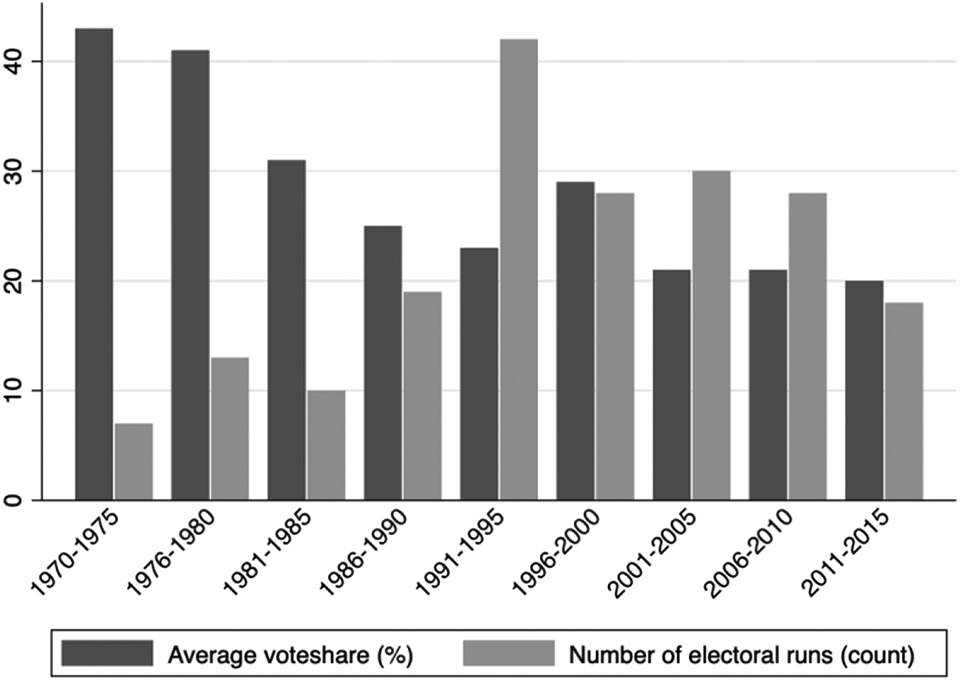
Only seven of the 205 incumbent and rebel cases were banned from running. Rebels and incumbent successor party runs were common both during and after the Cold War (17% of cases ran before the end of the Cold War). While runs became more common after 1989, successor Average vote share for civil war successor parties across world regions Civil war successor party runs and success over time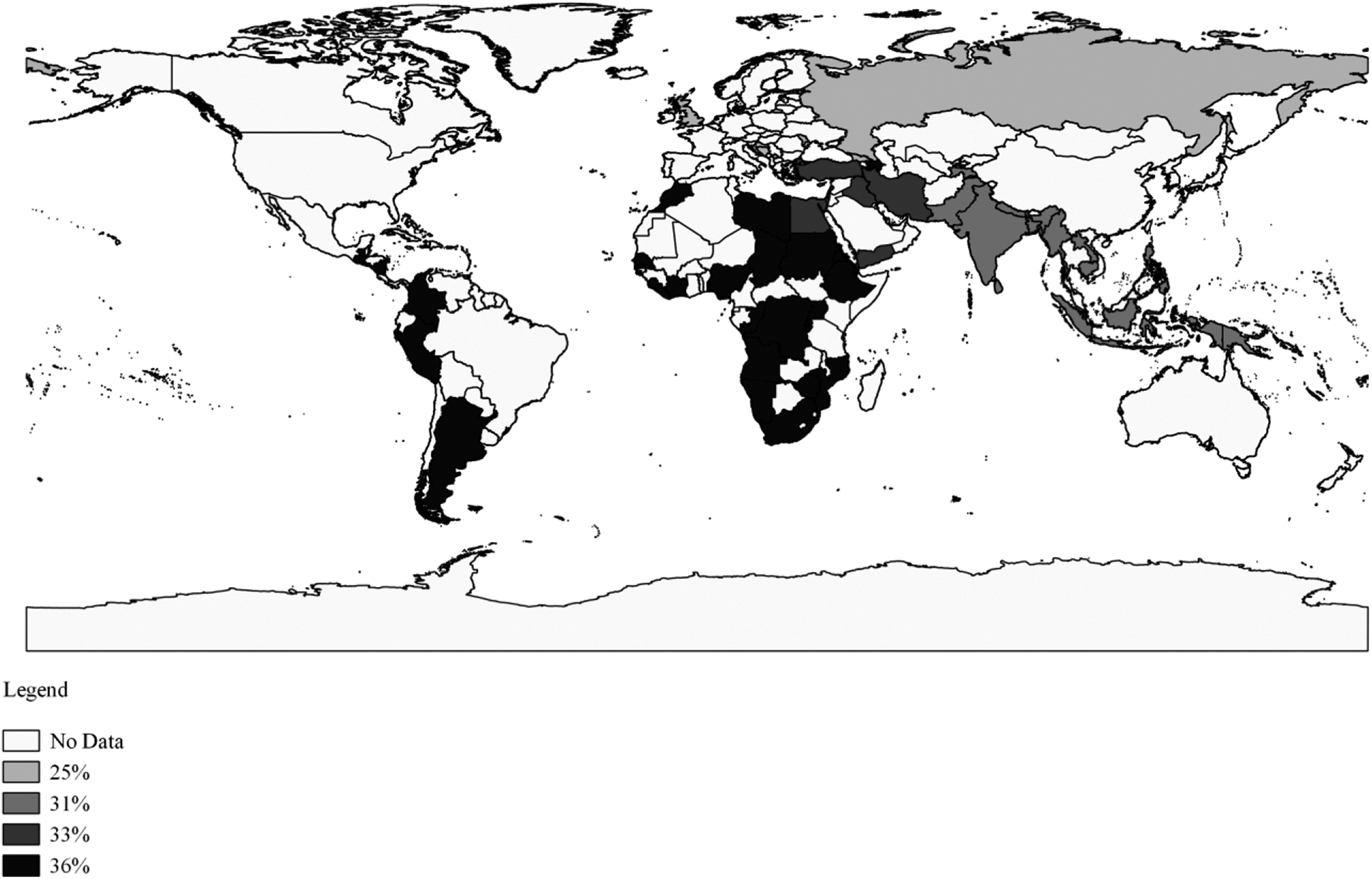
Postwar politics exhibited significant path dependency: the correlation between the first and second election results was 0.7. This underscores the extent to which the first postwar elections help set the political trajectory of post-conflict countries, and highlights the merit of studying these founding elections.
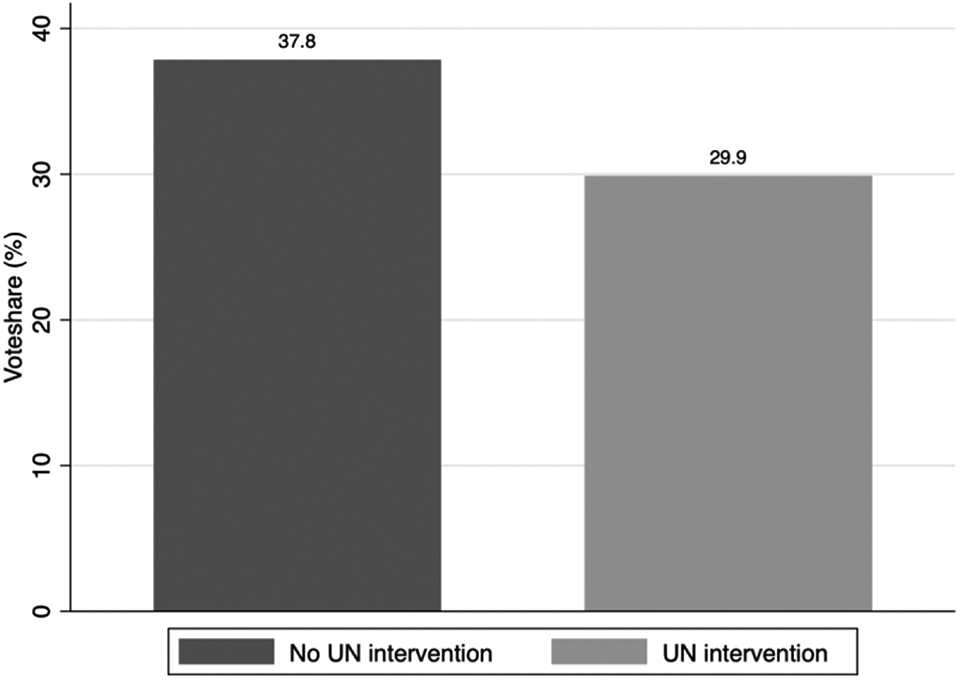
The transformation of armed groups into political parties has become part of the international community’s standard operating procedures for fostering peace in war-torn regions, 9 largely as a result of normative diffusion (Matanock, 2017). De Zeeuw (2008) argues that the presence of the UN renders rebels’ successful transformation from bullets to ballots more likely by reconfiguring the electoral system, providing technical assistance, and helping parties develop their platforms. However, while UN intervention might render political participation by belligerents more likely, it actually seems to dampen their vote shares. Successor parties achieved, on average, 37.8% of the vote where the UN did not engage in any intervention and 29.9% where it did (Figure 4). This result may reflect selection in where the UN deploys, and the fact that the UN can also foster parties without roots in the violent organizations, an outcome that merits greater attention.
United Nations intervention and civil war successor party success
The data also present interesting patterns related to electoral violence that deserve further study. For example, 21% of postwar elections involving civil war successor parties exhibited government harassment of the opposition and 47% witnessed violence during the elections, suggesting variation in the electoral tactics of belligerents as they transitioned from war.
Of the belligerents in the sample, 30% experienced a return to war between the same combatants. Of these cases, 60% constituted a return to high-intensity war, passing the 1,000 battle-death threshold over their course; 40% manifested as lower-intensity hostilities below this fatality threshold, but between the same combatants. An additional 18% of cases witnessed new conflicts in which the participants diverged from the prior conflicts’ fighting parties. In nearly all cases of war recurrence, it was possible to identify which actor reinitiated the conflict.
CWSP data applications
The CWSP can help advance research agendas in the study of conflict, peace, democratization, governance, and electoral politics. Both scholars and policymakers can make use of these data to evaluate existing theories, and to develop new ideas grounded in empirically validated research.
The CWSP is built upon the strong foundation of the UCDP infrastructure. With identifying codes at the conflict, dyadic, and actor levels, all CWSP cases may easily be merged with existing and widely used conflict data (Gleditsch et al., 2002). This facilitates, for example, analysis of the correlates of electoral success based on (1) organizational attributes available, for example, in the Non-State Actor Dataset (Cunningham, Gleditsch & Salehyan, 2013), Ethnic Power-Relations Dataset (Cederman, Wimmer & Min, 2010), Rebel Governance Dataset (Huang, 2016), Rebel Contraband Dataset (Walsh et al., 2018), and Religion and Armed Conflict Dataset (Svensson & Nilsson, 2018); (2) attributes of the violence including those available from the One-Sided Violence Dataset (Eck & Hultman, 2007; Themnér & Wallensteen, 2012); and (3) attributes of the peace environment including those deriving from the Conflict Termination Dataset v.2-2015 (Kreutz, 2010), Hartzell & Hoddie’s (2015) comprehensive power-sharing data, and Gromes & Ranft’s (2016) Post-Civil War Order dataset.
Including CWSP data in their analyses would allow scholars to ask questions about the legacies of violence for political life. Many argue that fragmentated versus cohesive groups have divergent postwar trajectories (Manning, 2008; Rudloff & Findley, 2016) as do resource-rich versus resource-poor organizations (Huang, 2016; Weinstein, 2007). Additionally, how groups treat civilians during war – whether with public goods, rebel governance, or indiscriminate violence – is posited to matter for violent actors’ postwar relations with the citizenry (Huang, 2016; Stewart, 2018). The CWSP allows scholars to further explore these hypotheses.
CWSP may also be used to help generalize from a rich case study literature on rebel to party transformations (see, for example, Allison, 2010; Curtis & Sindre, 2019; Manning, 2008), to expand datasets on rebel parties to also include incumbent belligerent parties, and to extend our knowledge of rebel parties post-Cold War back in time to preceding decades. Doing so can help reveal how postwar politics is influenced by the nature of the incompatibility, the existence or absence of electoral democracy before the war, and the extent of electoral experience of the warring parties.
Charting the electoral success and political roles played by former belligerents during the often-stormy seas of transitions from civil war can also be of help to policymakers seeking to gain traction on the question of how to marginalize and curb the political influence of certain violent groups, while potentially enhancing that of others. For example, analysts might ask whether access to the legal political arena and elections would increase or decrease the political leverage of groups such as the Taliban and Islamic State. Or they might assess who is likely to rule the postwar environments and with what implications for peace and democracy.
With standard country codes and election years, CWSP also may be merged with existing data on the nature and quality of elections. For example, all cases are compatible with the NELDA dataset (Hyde & Marinov, 2012) and the Varieties of Democracy Project (Lindberg et al., 2014). It is therefore possible to study the extent to which elections contested and won by actors with violent pasts are free and fair, how media are used and harnessed in these elections, and when and why election violence accompanies postwar voting.
The CWSP data are further compatible with datasets tracking economic conditions and reconstruction, such as the World Bank Indicators and those studying governance outcomes including the Quality of Government Standard Dataset (Teorell et al., 2018). Elections are pervasive in postwar societies and are thus among the key mechanisms by which postwar rule is decided. Studies of how postwar societies are governed, reconstructed, and stabilized could include CWSP indicators to test whether it matters what type of party – rebel, incumbent, or non-belligerent – is elected to rule the country. This would augment the possibilities for studies to take into consideration who is in charge of the post-conflict governments, and how their character influences how they govern. How do ex-violent actors in office after wars affect reconstruction, aid effectiveness, and human development?
For an important subset of cases, it is further possible to merge the CWSP dataset with the Democratic Accountability and Linkages Project (Kitschelt, 2013) to understand how postwar political parties are organized, what exchange mechanisms they rely on to seek votes, how they monitor and enforce their members, on what policy positions they run, and if and how they differ fundamentally from parties campaigning during ‘normal’ times. The CWSP further presents the election years over time allowing analyses of how postwar politics changes as the environment extends away from the violent period and transitions to peaceful politics.
CWSP data are compatible with data on authoritarian parties (Loxton & Mainwaring, 2018), permitting the study of the broader phenomena of successor politics during transitions (Grzymala-Busse, 2002; Ishiyama, 1997). The CWSP dataset focuses on voting in contexts emerging from civil war. However, it can be used to reach beyond these contexts to examine post-violence settings more generally and to help us understand why people vote for actors with unsavory pasts across multiple environments.
The CWSP dataset may complement existing data on provisions for rebels to participate politically including the Militant Group Electoral Participation dataset (Matanock, 2016), Acosta’s (2014) data on militant political party formation, and NELDA’s data on political bans and boycotts. Incorporating CWSP outcomes into these existing datasets may allow analyses of the selection process by which certain postwar regimes emerge, and specifically enable understanding of when demilitarized groups reinvent themselves as political parties, co-opt existing parties, or form nongovernmental associations and govern informally. It would permit scholars to further explore why belligerents are allowed to run for office, why violent actors retain an organizational structure enabling them to run for office, and why they gain the endorsement of a sufficient segment of the population so as to win office (Daly, 2011, 2016).
Finally, including successor party election results in our analyses can shed light on questions of how political participation inoculates societies against a return to war. As noted earlier, scholars disagree as to whether it matters for peace only that belligerents be included or instead that they perform well in the elections (Brancati & Snyder, 2012; Hartzell & Hoddie, 2007). Interacting institutional arrangements and timing of elections with the election results would enable further testing of these predictions.
Limitations and future extensions
CWSP enables scholars to gain traction on important questions of political life, democratic elections, and governance after conflict. As any dataset, CWSP exhibits limitations. The project relies on battle-related death reporting, which may be uneven, introducing bias. It also restricts the universe of cases to those that, since their onset, exceeded 1,000 battle-related deaths. It may be worth extending the analysis to the universe of conflicts that do not cumulatively reach this threshold over their course. These cases may exhibit divergent postwar trajectories. For example, they may constitute lower-capacity rebel groups that choose to participate in politics informally through sociopolitical associations, or to co-opt parties and run their candidates hidden on existing party tickets. The Militant Group Electoral Participation dataset provides a list of such groups. Coding their electoral success and collecting information on incumbent actors would be a worthwhile extension. Small militant groups may be powerful only at a regional or local level (Lewis, 2017). CWSP includes regional elections where these determined governance in autonomous zones. Coding the electoral success of belligerent parties in local elections in non-secessionist cases would be a valuable addition to the CWSP dataset. In certain elections, such as those in Pakistan (1985) and Yemen (1971), all candidates ran as independents despite public association with specific parties. Research on the individual candidates could reveal their party affiliations to complement the coding of these important cases. Establishing the vote share for other belligerents who ran on multiple party tickets (e.g. the Colombian paramilitaries) similarly requires in-depth qualitative research to trace the violent ties and electoral fates of each individual politician. Such research would enhance the CWSP dataset. Determining the postwar trajectories of civil war belligerents presents coding challenges that different scholars may dispute. By being as transparent as possible about the decisions in the accompanying online materials, the CWSP dataset enables future scholars to replicate the coding, and re-assess the coding process.
Conclusion
The lack of inclusive data has hindered the comprehensive analysis of postwar politics and stabilization. In this article, I introduce a new dataset on civil war successor parties of all armed actors following all recent civil conflicts since 1970. The data demonstrate significant variation in the electoral fates of civil war belligerents, as well as variation over time and by belligerent type.
The CWSP dataset can help advance knowledge of the causes and consequences of postwar elections. The data suggest that actors with violent pasts do not always win the elections, a source of governance that policymakers may be interested in harnessing to win meaningful peace for populations plagued by violence.
Footnotes
Replication data

Acknowledgments
I thank Jonathan Panter for invaluable research assistance and appreciate the research of Ashley Litwin, Minju Kwon, and Camilo Nieto Matiz. For very helpful discussions, I am grateful to seminar participants at Harvard University, Princeton University, University of Chicago, MIT, UNC, George Washington University, Rutgers University, and annual meetings of APSA and ISA.
Funding
I acknowledge funding from the Carnegie Corporation of New York and United States Institute of Peace.