



Abstract
Does the regime type of a foreign intervener influence the duration of civil wars? Existing research has shown that third-party support affects the outcome of a conflict. Moreover, studies show that the type of support offered to conflict actors can determine how a war ends. While this research has offered significant implications on conflict dynamics, extant works have overlooked the importance of characteristics of foreign supporters and how their attributes can impact conflict outcomes. Focusing on foreign troop support and quantities, this article examines the relationship between the regime type of a foreign supporter and the outcome of an armed conflict. We argue that regime type of an external troop sponsor can influence war duration based on two dynamics: selection effects and signaling effects. Specifically, troop assistance provided to warring parties by democracies decreases the length of civil wars and increases the likelihood for a one-sided victory for the supported faction. The empirical findings for all intrastate conflicts during the period 1975–2012 provide evidence for our claims that the regime type of an external intervener influences the outcome of a conflict.
Keywords
With the permission of the Malian government, France launched Operation Serval on 11 January 2013 to respond to growing threats by Islamist rebel groups in northern Mali. Committing nearly 4000 troops on behalf of the host government, the mission aided in restoring stability in the conflict-affected areas in less than a month (Francis, 2013). While international and regional organizations made efforts to defuse the crisis, troop support by France was key in helping Mali’s government quickly regain control over rebel-held territories. The decision to send troops was accompanied with public debates and a supportive media environment that spread the ‘narrative’ of the operation to the French public (Henke, 2017).
A few years prior, however, France took a different approach to Mali. While the government of Mali faced a Tuareg rebellion in the northern region of the state from 2006 to 2009, France did not provide any troop support to either party involved in the conflict. Neither did the United States, despite Mali being ‘a very important partner in the war on terrorism’ according to the US Embassy in Mali (Emerson, 2011). The rebellion was terminated with a negotiated settlement helped by the African Union’s Chairman, Libya’s President Gadaffi. 1 In the absence of third-party troop support to either side, the uprising lasted three years. This is in contrast to the 2013 conflict which lasted less than a year, and only a month after the launch of Operation Serval. This leads to the question: Was it solely the provision of troop support that explains why the 2013 crisis in Mali ended in such a short period of time, or do we need to take into account whom the intervener is?
Existing studies show that external support matters for conflict outcomes and duration of civil war. While literature has found an association between third-party support and longer civil wars, the argument of parity between warring factions leading to longer wars does not explain why stronger combatants tend to have shorter conflicts (Cunningham et al., 2009). In this study, we bridge these findings by parsing out the motivations for third-party involvement in civil war based on the type of involvement and regime type of the sending state. By focusing on troop support to parties of civil war separately from foreign assistance in general – which can include financial support, diplomatic assistance, and arms transfers – this article seeks to address the question of how providers of observable support to civil war actors influence conflict duration by regime type. Direct troop support is costly both economically and politically. We argue that the political costs are higher in democracies where foreign military involvements typically require transparency, public debates, and often approval by a legislative body. In the case of our opening example of Operation Serval, an explicit goal was to ‘avoid a solely and long-lasting national military involvement’ according to French Admiral Edouard Guillaud (Delaporte, 2013). The higher political costs in democracies lead to selection effects, where democracies choose to support conflict actors that have realistic chances of being victorious and are likely to fight shorter wars, if troop support is provided.
In addition to selection effects, the transparency surrounding foreign troop support in democracies generates signaling effects that are perceived by both the supported side and their opponents. Open and transparent government communication, media coverage, public debates and political approval of troop support are part of costly signals from democracies – they are costly due to a high level of ‘tying hands’ by the intervener (Thyne, 2006: 939; Fearon, 1997). These signals work to strengthen the fighting spirit among the supported side, and furthermore, may draw support from other interveners who are willing to join the bandwagon thus increasing the military capability of the supported side. For the opponents, costly signals may deter potential interveners from engaging in troop support since they are aware of the higher level of commitment that comes with support from democracies. This alters the bargaining dynamic of warring parties and ultimately, conflict duration.
Based on these two simultaneous dynamics – selection effects and signaling effects – we expect the political institutions of third-party troop interveners to have an impact on civil war outcomes. Specifically, we claim that domestic constraints faced by democratic troop supporters lead to shorter civil wars and increase the likelihood of one-sided victory for the combatant receiving foreign assistance. In this article, we discuss external support from a policy perspective and subsequently consider the evidence on third-party support to warring factions and duration of civil war. For our theory on how the regime type of interveners shapes conflict outcomes, we draw on the foreign support and conflict literature which is discussed in the next section. We then outline research strategy, methodology and data for the study. Using data on troop support from the UCDP/PRIO database, we test the effects of the regime type of foreign interveners on conflict outcomes for the period 1975–2012. Following the presentation of our empirical findings, we conclude our study with suggestions for future research.
Third-party involvement and duration of civil war
Studies of foreign assistance and external intervention in civil war have found that third-party intervention can influence war outcomes (Elbadawi & Sambanis, 2000; Regan, 2000, 2002; Balch-Lindsay & Enterline, 2000; Collier, Hoeffler & Söderbom, 2004; Cunningham, 2010; Sawyer, Cunningham & Reed, 2017). While some find that foreign involvement can increase conflict duration (Balch-Lindsay & Enterline, 2000; Cunningham, 2006), others show a reduced effect for interventions that are biased to one side rather than being neutral (Regan, 2002: 69; Balch-Lindsay, Enterline & Joyce, 2008: 359). The argument is that interventions shift the balance of capabilities between actors and increase the relative strength of the party receiving external support (Licklider, 1993; Balch-Lindsay & Enterline, 2000: 632–633; Balch-Lindsay, Enterline & Joyce, 2008: 349; Regan, 2000; 2002) or weaken the capabilities of the adversary (Pape, 1996). In a similar reasoning, more actors involved in a conflict also increase the likelihood for longer conflicts when they function as veto players to approve a settlement (Cunningham, 2006: 886–887).
In contrast to these accounts, others have found that conflict actors with high levels of military capability or in parity with the adversary are more likely to experience shorter conflicts (Cunningham, Gleditsch & Salehyan, 2009: 586). This is puzzling, because following aforementioned studies, foreign support can increase the duration of civil war as it balances capabilities between the warring factions and makes it more difficult to negotiate a settlement (Balch-Lindsay, Enterline & Joyce, 2008). To explain this counter-intuitive finding, the authors point out that the imbalance of capabilities in civil wars is different from imbalances in inter-state wars, as rebels use insurgent warfare and non-conventional fighting to their advantage (Cunningham, Gleditsch & Salehyan, 2009: 575). Thus, weakened rebels continue to fight insurgent warfare for a long time, making civil war duration longer. Strengthened rebels, however, may trigger a negotiated settlement to end the conflict, as the government and rebels alike face the risk of an intensified all-out war unless they find a way to terminate the conflict (Cunningham, Gleditsch & Salehyan, 2009).
In addition to examining the effects of third-party interventions on conflict duration, research has explored the impact of external support on civil war outcomes. Mason, Weingarten & Fett (1999) find that interventions can reduce the likelihood of achieving a negotiated settlement, but note that the element of time must be accounted for. Balch-Lindsay & Enterline (2000) and Balch-Lindsay, Enterline & Joyce, (2008) argue that interventions in favor of state forces or rebels can decrease the length of time until a military victory for the supported actor. The latter study also shows that while one-sided interventions increase the likelihood of negotiated settlements, balanced interventions can prolong the time until a negotiated settlement. Sullivan & Karreth (2015) demonstrate that while an intervention launched on behalf of rebels heightens their chances of victory, the likelihood of a government, sponsored by a third party, achieving victory is influenced by the relative strength of their opponent.
Some scholars note that selection effects should be considered when studying the consequences of foreign intervention. Gent (2008) points out that third parties intervene to shape conflict outcomes as opposed to duration. For instance, when it comes to supporting governments, foreign actors intervene on their behalf only when they face a stronger rebel group. Rebels, on the other hand, do not receive an intervention as a result of their military disadvantage relative to the government. Rather, third parties intervene when rebel groups are likely to achieve victory. Third-party states that consider providing support to a conflict actor may have other motivations than a quick termination of conflict – to gain regional leverage, weaken an enemy, and/or gain access to natural resources. When the support brings a ‘positive flow of benefits’ back to the third party, they will prefer longer fights (Powell, 2017: 224).
This selective behavior of third parties may explain why there are differences in findings across studies on armed interventions and conflict duration (Gent, 2008: 721; Linebarger & Enterline, 2016: 101; Jones, 2017: 53). However, these mixed findings may also result from differences in the selective behavior of interveners. As noted by Maekawa (2018), the preferences of a foreign supporter shape how much assistance it provides to a conflict actor and in effect, influence the bargaining power of warring factions over conflict termination outcomes. Building on Fearon’s (1995) bargaining model to capture the effects of regime type of external interveners on the inclusion of political reform provisions in peace agreements, Maekawa (2018) shows that external interveners impact the demands and concessions made by warring parties.
In agreement that the regime type of third-party supporters plays an important role in shaping conflict termination, we suggest that domestic institutions of a foreign intervener matter for the bargaining dynamics of conflict parties. In the next section, we outline how interveners’ regime type matters for their selective and signaling behavior, and in turn for the duration of civil war.
Regime type of foreign intervener and civil war duration
Inspired by literature on externally supported interstate conflict, we study how the regime type of foreign troop supporters impact war outcomes. While studies have focused on the effects of foreign sponsors on conflict duration, research has also indicated that the identity of the intervener and what their preferences are, matters in shaping conflict (Bremer, 1982,1992; Corbetta & Dixon, 2005; Pickering & Peceny, 2006; Bueno de Mesquita & Downs, 2006; Cunningham, 2010; Aydin & Regan, 2012; Maekawa, 2018). Literature shows that democracies often engage in troop support when it is deemed effective to leverage a warring party against its opponent, while still remaining committed to human rights (Salehyan, Siroky & Wood, 2014: 640–643). Interventions that pose high costs and little to no return, such as a loss of war, are not viewed favorably by the public and could result in electoral backlash (Beardsley & Lo, 2013: 79–80).
We concur with these findings and argue that democracies are less likely to approve troop support designed to encourage continuous fighting and attrition in war rather than triggering a negotiated settlement due to its constraining institutions, transparency and public accountability. The logic for our argument rests on the idea that democracies have decision-making processes which lead to specific objectives in their decisions to send troop support to parties of civil war. Two dynamics work simultaneously to explain the impact of democracies’ troop support on conflict duration and outcomes: selection effects and signaling effects.
Differences in military options between democracies and non-democracies result from distinct policy-making processes and institutional features. It is more common that democracies require legislative approval of military engagement abroad compared to autocracies. 2 For example, military deployment by Germany requires approval by the Bundestag and such decisions always face ‘intense public scrutiny’ (Steinmeier, 2016: 110). With a higher political threshold for sending troops, democracies are more reluctant to do so when it risks exacerbating the conflict, compared to countries that have a non-transparent decision-making process. Institutional hurdles and the risk for the incumbent party of being replaced in an upcoming election makes democratic regimes more responsive to the public opinion, and generally, more cautious to engage in military involvement abroad. If, however, troop support seems necessary to end the conflict and bring peace, democracies would be more willing to do so because of public pressure, political debates, and media attention. This leads to selection effects where democracies are more likely to intervene in conflicts they believe can be terminated, given help of the intervener(s).
Furthermore, the signaling effects of decisions made by democracies to send troops to a conflict are ‘costly’ as opposed to ‘cheap’ since the lengthy political process involved to exercise this policy option can be considered a sunk cost (Fearon, 1997). Having to overcome the political decision to send troops, democratic governments improve the credibility of signals that are sent to the warring factions. 3 Costly, credible signals of troop support, spread with the help of media and public debates, do not go unnoticed by the parties of the civil war. The supported side will benefit from an increased resolve and fighting spirit, while opponents take into account improved fighting capabilities and the signal of commitment to their enemy, which reduces their predicted outcome, and they adjust their bargaining position to end the war (Thyne, 2006). Such signaling effects work in tandem with selection effects to shorten conflicts when democracies send troop support.
Furthermore, the ability of conflict groups to engage in bargaining over conflict outcomes heavily depends on the level of uncertainty that exists regarding each combatant’s capabilities, resolve, and commitment. While governments may hold a power advantage over rebel groups as a result of their access to state military forces, the uncertainty surrounding an armed group’s utility to continue conflict can affect how negotiations take place (Sawyer, Cunningham & Reed, 2017: 1178). As shown by Sawyer, Cunningham & Reed (2017), interventions foster uncertainty regarding fighting costs and strength of conflict parties, conditional on the type of support provided. Democratic troop supporters, however, can minimize this uncertainty and address commitment problems.
Institutions in democratic states, including the media, are committed to providing transparent information to domestic and international audiences. As a result, the public is made aware of any decision to deploy troops on behalf of a conflict actor. Once an intervention is launched, democracies are unable to keep hidden any information about their supported sides’ fighting capabilities and costs. This makes it difficult for supported factions to mislead their opponent about their bargaining position. Furthermore, armed combatants can use the information shared by democratic troop interveners to identify items that they can negotiate on.
Kathman & Benson (2009) raise similar points in their discussion on the effects of UN peacekeeping operations on negotiated resolutions. With the ability to share information, send credible signals of commitment to ending the conflict, and increase war costs for combatants, they argue that peacekeepers can shorten the time for combatants to reach a negotiated agreement. While their study has multilateral peacekeeping operations as its focus, the transparent and legitimate features of international organizations are comparable to those of democracies.
Moreover, we suggest that the parties aided by democracies are aware of institutional and public constraints of their supporter and the electoral consequences of an unsuccessful and/or prolonged intervention. Since it is difficult to receive support from democracies because of the internal pressures political leaders face, conflict actors recognize that their democratic interveners prefer short wars. The longer a conflict goes on, the more likely democracies will halt their military efforts as a result of concerns raised by the public, media, and other domestic actors (Bennett & Stam, 1998). With the risk of losing support if they fail to satisfy the expectations of their democratic supporter, supported factions are motivated to increase their battlefield efforts. This can pressure the opponent to negotiate with the supported faction and reach a settlement; thus shortening the conflict period. Based on these claims, we predict the following: Hypothesis 1: As troop support from a democratic sender state(s) to a warring party increases, the duration of the civil war decreases.
Based on the claims raised earlier regarding the selection and signaling effects of troop support from democracies, we also posit that such support contributes to victory for the party receiving support. Research has shown that democratic leaders are selective when choosing wars in which to participate (Lake, 1992; Reiter & Stam, 1998, 2002; Bueno de Mesquita et al., 1999; Clark & Reed, 2003; Reed & Clark, 2000). One line of reasoning for this outcome is that public and parliamentary scrutiny filter out potential support to warring parties who do not stand a chance of winning. Such constraints make it harder for politicians to make an argument to support parties in a war that is unlikely be won. Koga (2011) points out that democracies intervene in cases where their supported side is likely to achieve victory. Democratic leaders are accountable to a large winning coalition (Bueno de Mesquita et al., 2003) and to remain in power, they are incentivized to pursue policy objectives that yield public goods. Such goods include foreign policy successes such as improving security and military victory (Linebarger, Enterline & Liebel, 2018; Koga, 2011).
4
For these reasons, we hypothesize: Hypothesis 2: As troop support from a democratic sender state(s) to a warring party increases, the likelihood that the supported party will achieve one-sided victory also increases.
Data and methods
This study establishes the argument that the regime type of a foreign intervener influences the duration of a civil conflict. 5 We contend that support from democratic external interveners for state and/or rebel forces yields a shorter conflict lifetime. Focusing on civil conflicts during the period 1975–2012, our unit of analysis is dyad-year. To determine the civil conflict dyads to use in our analyses we rely on data from the Non-State Actors in Armed Conflict Dataset (NSA), which is based on the Uppsala Conflict Data Program (UCDP) Dyadic Dataset and updated with information on non-state actors (Cunningham, Gleditsch & Salehyan, 2013). The concluding dataset covers 365 state-rebel group dyads in 92 countries.
Dependent variables
We capture conflict outcome in three ways. First, we examine conflict duration which is based on the date for when violence ended from Cunningham, Gleditsch & Salehyan, (2009: 583). When conflicts recur after having ended, it is coded as a new conflict if at least two years have passed between the end date and the new conflict. Measuring duration in years, the duration of intrastate conflicts included in the study spans from 1 year to 43 years, with a mean of 11 years. 6 Approximately, 21.1% of conflict dyads result in conflict termination. Next, we assess whether the conflict ended in Government victory or rebel victory using data from the UCDP Conflict Termination Dataset v.2. Our sample includes 66 government victories and 33 rebel victories.
Independent variables
Our key predictor variable is the regime type of the sender states of troop support to conflict actors. We use the UCDP database to determine (1) the specific foreign states that contribute troops to governments and rebels and (2) the number of troops each intervener deploys to each conflict actor. We use political regime data from the Polity IV dataset to determine if a sender state(s) is democratic (Marshall & Jaggers, 2014). Data on regime type ranges on a 21-point scale from 10 to -10, with a score of 10 being ‘strongly democratic and -10 being ‘strongly autocratic’. If a foreign supporter receives a polity score of 6 or higher, the foreign supporter is identified as democratic. We use this information to create the following variables: Government democratic troop support and rebel democratic troop support. These variables capture the natural log of the number of troops provided by democratic interveners to warring parties. 7 In total, 3.3% of our observations receive external troop support from a democratic government(s). 8
Confounding factors
A number of confounding variables are also included in the analyses. Firstly, we create the variables Government non-democratic troop support and rebel non-democratic troop support to account for interventions by non-democratic states. These variables are coded using the natural log of the number of troops sent by non-democracies to governments and rebels, respectively. To maintain their approval, non-democratic leaders engage in interventions that return private goods for members of their winning coalition (Bueno de Mesquita & Downs, 2006; Koga, 2011; Linebarger, Enterline & Liebel, 2018). Even in the event that their military involvement does not result in a win for the actor they favor, the private gains produced from the conflict will help secure their political survival (Koga, 2011: 1146). For these reasons, we expect that troop support by non-democracies will not increase the chances of one-sided victory for their supported side or reduce conflict duration. 9
Next, we take into consideration the conflict-specific factors that affect conflict duration and external support. Extant literature shows that Relative rebel strength may influence both conflict duration (Cunningham, Gleditsch & Salehyan, 2009) and the likelihood of foreign intervention (Fortna, 2004; Salehyan, Gleditsch & Cunningham, 2011). To measure this variable, we adopt Wood’s (2010) coding approach and calculate the logged ratio of rebel troops to government troop size in a given year using data from the Uppsala Conflict Data Program. The effect of Territorial control by rebels is also accounted for (Cunningham, Gleditsch & Salehyan, 2009). Data from the Non-State Actors in Armed Conflict Dataset (NSA) are used to create a dummy variable for this feature. We also take into consideration Government military expenditure and measure this indicator using data on military expenditure per military personnel (logged) from the National Material Capabilities dataset. It is expected that governments that spend more on their military are likely to face shorter conflicts and attract less foreign support. Studies have identified Conflict severity as another predictor of external intervention (Lacina, 2006; Rasler, 1983) and conflict outcomes (Zartman, 1993; Regan, 1998; Walter, 2002). Potential interveners may avoid getting entangled in highly intense conflicts where warring factions are able to withstand the physical costs of conflict (Aydin, 2010: 58). To measure the intensity of conflict, we use yearly battlefield deaths data from Lacina & Gleditsch (2005). Lastly, we account for the presence of Multiple rebel groups which may reduce the likelihood of peace settlements (Cunningham, 2006; Jones, 2017: 57).
Another set of correlates included in our analyses focus on the domestic features of the host country experiencing conflict. First, we operationalize the Economic strength of the government using data on the country’s GDP per capita from the Expanded Trade and GDP data (version 6.0) (Gleditsch, 2002). States with higher economic capacity often experience shorter conflicts (Balcells & Kalyvas, 2012) and signal to foreign actors their ability to fund their own military and weapons supply without outside intervention. Literature also points out that Rough terrain can lengthen conflict duration by shaping the balance of power between competing factions (Buhaug, Gates & Lujala, 2009) and posing a challenge to foreign actors to provide military assistance. For these reasons, we include a binary variable capturing whether the terrain of the conflict-affected state is at least 60% mountainous and/or forested (Collier, Hoeffler & Söderbom, 2004; Fearon & Laitin, 2003; Thyne, 2012). Access to Lootable resources has shown to have a positive effect on conflict duration and foreign involvement (Collier & Hoeffler, 2004; Fearon & Laitin, 2003; Fearon, 2005; Buhaug, Gates & Lujala, 2009; Lujala, Ketil Rød & Thieme, 2007; Gilmore et al., 2005). Natural resources provide rebels an opportunity to generate revenue that can be used to attract and maintain supporters and engage in longer conflicts (Collier & Hoeffler, 2004; Fearon & Laitin, 2003; Fearon, 2005). While this may deter outside intervention, foreign actors with economic motivations may support combatants in order to gain access to resources (Koga, 2011). Using data from DIADATA (Gilmore et al., 2005), PETRODATA (Lujala, Ketil Rød & Thieme, 2007), DRUGDATA (Buhaug & Lujala, 2005), and GEMDATA (Lujala, 2009), we add a dichotomous variable in our empirical analyses that accounts for the presence of diamonds, petroleum deposits, drugs, and gems in the conflict area. We also expect Population size of the conflict country to influence the variables of interest. Countries with larger populations are at increased risk of severe conflicts and longer wars (Collier & Hoeffler, 1998, 2004). This variable is measured using logged population data from the World Bank (n.d.). Lastly, the Regime type of the government involved in war is factored in (Hegre et al., 2001; Henderson & Singer, 2000; Krain & Myers, 1997). Research argues that the regime type of the host country of a conflict can influence conflict dynamics and the government’s negotiating capacity with its challengers (Elbadawi & Sambanis, 2000, 2002; Gleditsch et al., 2009; Wood & Kathman, 2014: 697). Furthermore, some research shows that democracies are likely to receive external interventions. For example, Aydin (2010: 57) points out that democracies may intervene in conflicts faced by democratic governments to ensure the continuation of democratic institutions. To account for the regime type of the country facing conflict, a continuous variable is created using the Polity IV scoring scale of -10 to 10 (Marshall & Jaggers, 2014). This variable is squared in our analyses to remain consistent with literature suggesting a curvilinear relationship between regime type and civil conflict (Hegre et al., 2001; Fearon & Laitin, 2003).
Finally, we include a Cold war variable to account for the possible effect of more troop support during this time when more proxy wars took place relative to the post-Cold War period (Regan, 1998, 2000).
Statistical models
To estimate the effects of troop support by democracies on conflict outcomes without making assumptions about the distribution of time until the event of interest, we rely on a Cox proportional hazards model to conduct our analyses. 10
Empirical results
Before testing our hypotheses, we first evaluate whether external military support influences conflict duration and one-sided victory. While studies have shown that foreign interventions can shape conflict outcomes (Snyder, 1959; Pape, 1996; Regan, 2002; Lemke & Regan, 2004; Collier, Hoeffler & Söderbom, 2004; Gent, 2008; Balch-Lindsay, Enterline & Joyce, 2008; Cunningham, 2010; Sullivan & Karreth, 2015; Sawyer, Cunningham & Reed, 2017; Jones, 2017), we test this relationship using the natural log of the total troop size provided to each conflict actor as opposed to the traditional dichotomous measure capturing military intervention.
The effect of troop support on conflict outcomes

Hazard ratios are reported. Robust standard errors in parentheses.
* p < 0.5, ** p < 0.01, *** p < 0.001.
Table II displays the estimated effects of troop support from democratic states on conflict duration and one-sided victory by governments and rebels. Focusing first on military support to states forces, the findings yield support for Hypothesis 1. As indicated by the hazard ratios in Model 1 in Table II, the more troop support received by democratic sponsors by governments, the shorter the time until conflict termination. Similar results are shown in Model 3 (Table II). Higher numbers of troops given to governments by democracies can lessen the time until a government win. To illustrate these findings, Figures 1 and 2 present survival curves of civil war termination and government victory at varying levels of troop support by democracies. 12 The survival curves for conflict termination (Figure 1) suggest that at 11 years after conflict onset, the survival rate of conflicts where the government receives 10,000 troops from democracies is approximately 0.3. For those without democratic support, the survival rate is approximately 0.79. 13 Similar findings are shown for the survival curves for government victory (Figure 2). At 11 years of conflict duration, the survival rate of conflict is approximately 0.78 for cases in which the government is provided with 10,000 troops by democratic states and approximately 0.98 when such support is absent. Thus, increases in troop provision by democratic states to governments result in quicker war termination and government victory. This evidence provides support for our expectations outlined in Hypothesis 2. 14
The effect of democratic troop support on conflict outcomes

Hazard ratios are reported. Robust standard errors in parentheses.
* p < 0.5, ** p < 0.01, *** p < 0.001.
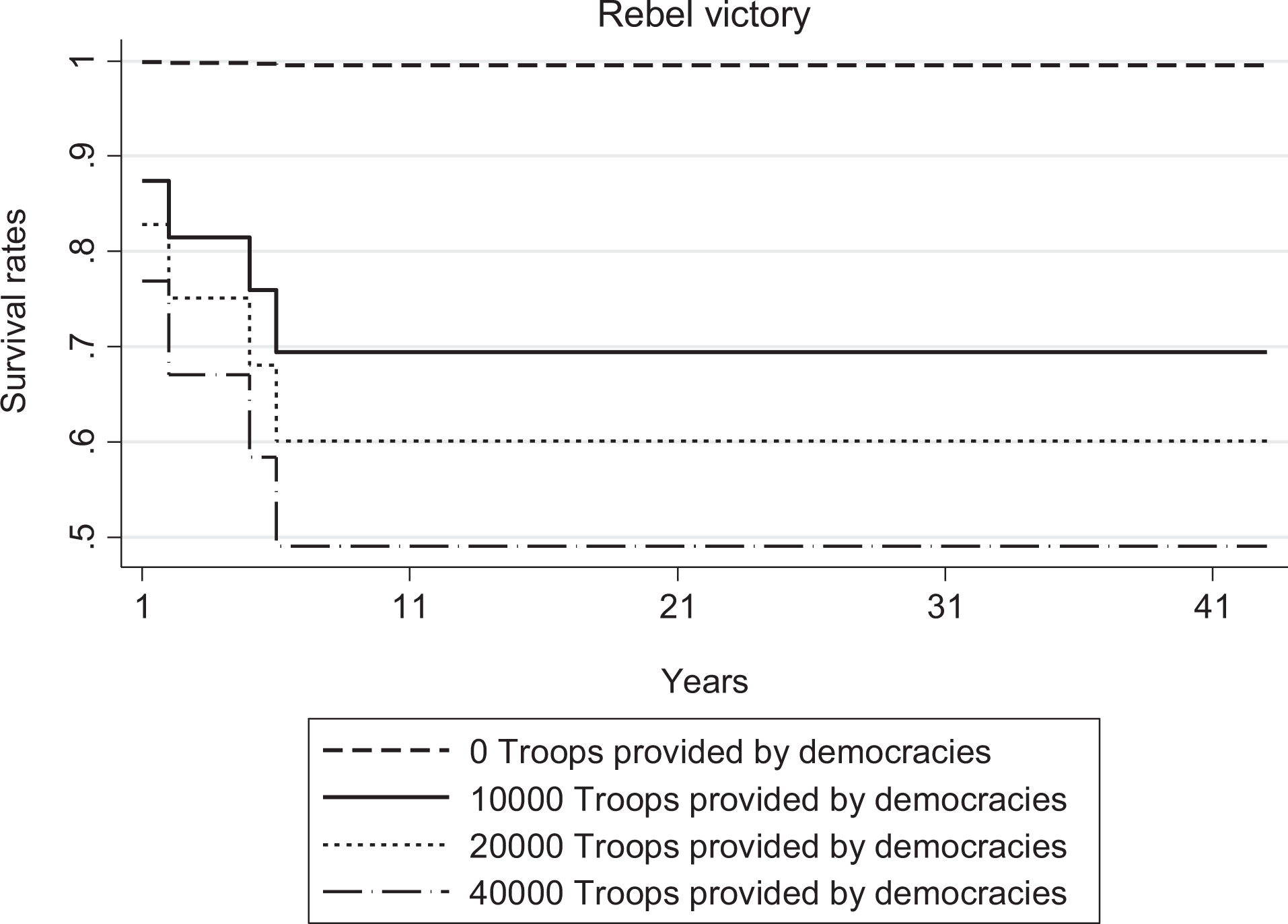
Turning to the impact of military provision to rebels on conflict outcomes, the results in Table II provide partial support for our expectations. Although Model 2 reports that more democratic support to rebels does not return shorter conflicts, Model 4 does suggest that interventions launched by democracies on behalf of rebels decrease the period of time until a rebel victory. This is further supported by the substantive effects of troop support by democratic states on rebel victory presented in Figure 3. Looking at similar scenarios discussed for our government analyses, the survival rate of cases where rebels receive 10,000 troops at the 11th year mark is 0.69.
15
For rebels that do not receive support from democracies, the survival rate is approximately 1 and Conditional survival rates for conflict termination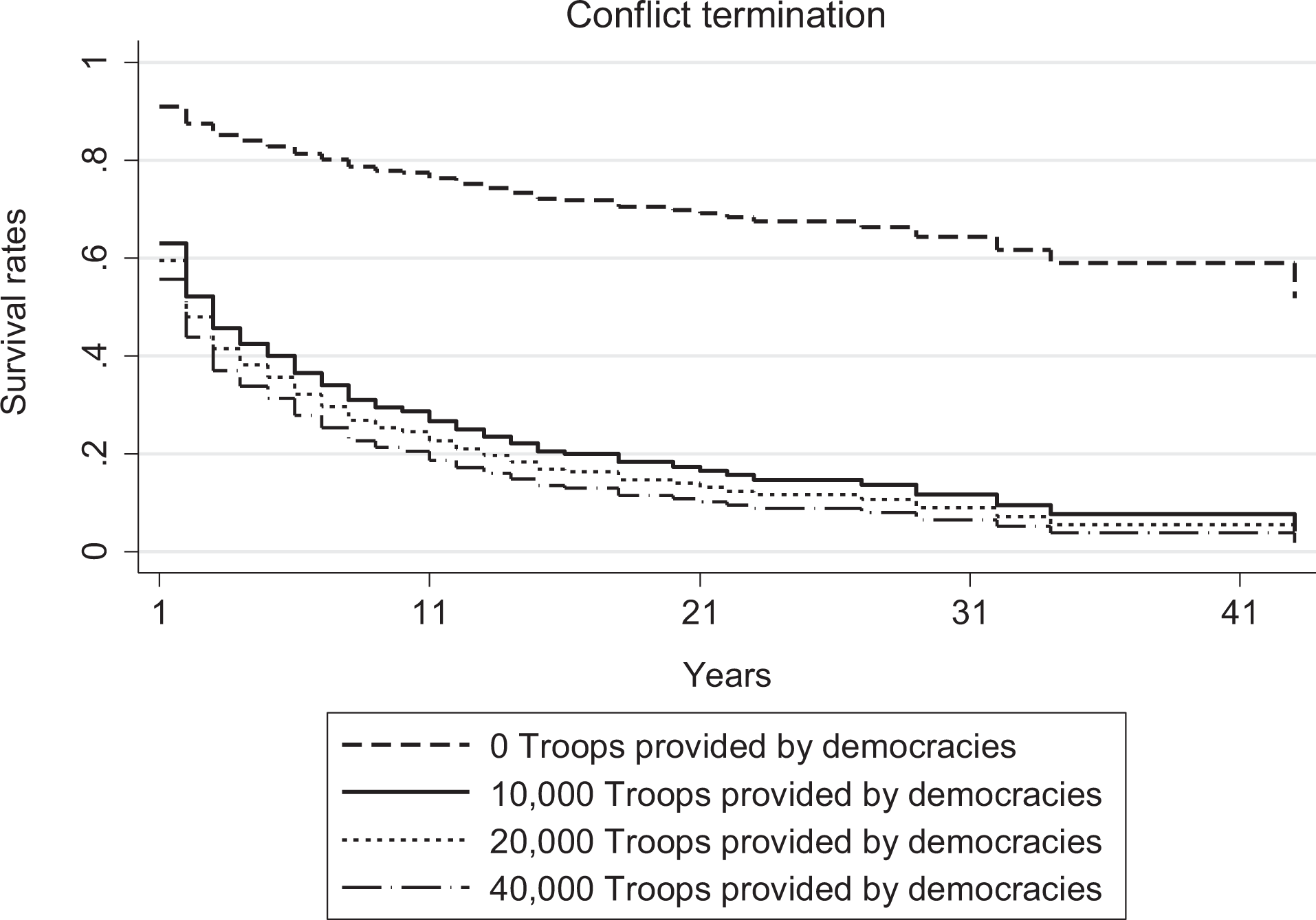
Interestingly, Figures 1, 2, and 3 show a hurdle effect of foreign troop support on conflict termination: while the initial deployment of troops has a clear effect on Conditional survival rates for government victory Conditional survival rates for rebel victory
With respect to our confounding variables, Population size is significant and holds an expected hazard ratio for all the government and rebel analyses examining conflict termination. This indicates that conflict zones with larger populations face longer conflicts. Analysis on rebel victory (Table II, Model 4) also shows that Relative rebel strength is significant and presents an expected hazard ratio of over 1. Consistent with existing literature, the results indicate that rebels that are militarily superior compared to the government side experience victory sooner than rebels that have a military disadvantage. 16
Alternative measures of foreign support: Arms support
Sawyer, Cunningham & Reed (2017) show that conflict termination is less likely when rebels receive fungible assistance (i.e. financial and arms support) due to uncertainty faced by state forces about their fighting abilities. They argue that non-fungible support (i.e. troop provision) can motivate conflict actors to reach a peace agreement as such forms of support reveal the costs of fighting and the military capabilities of the supported party. To evaluate whether our findings hold exclusively for observable forms of support, or if both fungible and non-fungible support show similar effects, we explore the relationship between arms transfers and conflict outcomes. Data on arms transfers are available in the Stockholm International Peace Research Institute (SIPRI) arms transfer database. We determine the regime type of arms supporters using Polity IV data and take the natural log of the number of arms provided to states and rebels to create the following variables: Government democratic arms support and Rebel democratic arms support. Based on our sample, 63% of observations receive arms support from at least one democratic state.
The effect of democratic arms support on conflict outcomes

Hazard ratios are reported. Robust standard errors in parentheses.
* p < 0.5, ** p < 0.01, *** p < 0.001.
Discussion and conclusion
We estimate effects of external troop support on civil war outcomes and the role of democratic sender states contributing troops to civil war. The broader theoretical puzzle for our research is how third-party support affects conflict outcomes, and how the regime type of a foreign supporter can have contrasting effects. This is the first empirical study to analyze the impact of democratic foreign support on conflict duration. Furthermore, our study considers the effects of external troop support to rebels involved in civil wars, as have previous studies, as well as support to governments in civil wars. We argue that democratic interveners, with higher levels of transparency, accountability, and signaling effects as military supporters, can influence expectations and bargaining dynamics between the warring parties.
The empirical results we obtain provide support for our claims. Domestic political institutions of troop supporters can influence the fate of a conflict. We find that governments and rebels that receive more military assistance from democracies are likely to achieve military victory. Moreover, troop assistance given by democratic states to government forces result in shorter wars. When testing if troop support from democracies to rebels yield shorter wars, our results do not reach statistical significance. While this is in contrast to our expectation, data are very limited for democratic support to rebel groups; only three instances of democratic troop support to rebels is recorded in our data. It is possible that democracies are reluctant to give support to rebels compared to supporting government forces, because of risks involved with possible legitimization of non-state actors. In general, rebels are militarily disadvantaged vis-à-vis governments. However, the small n for democratic troop support to rebel forces does not take away our empirical finding that democratic troop support to government forces reduces duration of conflict. While extant research has focused on the effects of military interventions on conflict outcomes, studies often do not consider whom the interveners are and how different sponsors may shape a conflict. By exploring the regime type of troop supporters, our findings indicate that the domestic characteristics of a foreign military supporter matter in determining how and when conflicts end.
Our theoretical claims and findings are policy relevant; decision-makers in democracies can take into account the political process associated with sending troop support to foreign wars. Democracies are often required to have a certain level of transparency because of constitutional arrangements. Our study shows that the democratic process has advantages in providing costly signaling effects to the warring parties. While long and tiresome decision-making processes in democracies are portrayed as a disadvantage, these signaling effects have real consequences on the battlefield.
Additionally, by focusing on the effects of the domestic political characteristics of military interveners on conflict, our research speaks to the democratic peace literature. Known to face higher levels of accountability, transparent institutions, and a larger winning coalition, democracies engage in wars they are likely to win (Lake, 1992; Bueno de Mesquita et al., 1999; Reiter & Stam, 2002; Bueno de Mesquita et al., 2003; Koga, 2011). Our study adds to this research by showing that when democracies intervene in conflict and provide non-fungible support to a conflict actor, their involvement increases the likelihood of military success for the supported party.
While our study shows that the regime type of troop supporters matters for civil war outcome, it remains to be investigated whether other types of external support, such as financial assistance, diplomatic support, intelligence offering, and their quantity are conditioned by regime type as well. We expect alternative types of fungible support to show similar effects on conflict duration and one-sided victory as our findings on arms provisions. Our emphasis on the role of foreign supporter’s regime type could also be tested using alternative conflict outcomes such as combatant casualties, ceasefires and negotiated settlements. If researchers are able to collect data on government decisions to send troops and actual troop deployment on a monthly basis, it is also worth exploring a possible association between early signaling of troop support by democracies and civil war duration.
Lastly, future research can explore the specific type of intervention launched by democratic interveners. Based on claims raised by Salehyan, Siroky & Wood (2014) and Jones (2017), democracies are more prone than other forms of government to launch conventional military interventions. Future works can study whether the political institutions of third parties influence the type of intervention that a government pursues – conventional or unconventional – and what effects intervention types launched by democracies have on conflict outcomes.
Footnotes
Replication data

Acknowledgements
We thank the three anonymous referees and the editor of JPR for helpful comments that have improved our article.
Funding
The authors received no financial support for the research, authorship, and/or publication of this article.