




Abstract
What is the impact of foreign troop support on combatant-perpetrated sexual violence against civilians? We hypothesize that biased troop support increases the risk of sexual violence by the subordinate party both as a consequence of strategic considerations and as a product of a situation increasingly conducive to opportunistic behavior. Time-series cross-section analyses of all civil wars during 1989–2012 are largely supportive of our expectation. Rebel groups are more likely to perpetrate sexual violence the more troop support the state receives. Likewise, state forces are more prone to commit sexual violence the more they are challenged by troops supporting the rebel group(s).
Keywords
Introduction
When Chadian President Idriss Deby deployed military troops to Darfur in 2003 on behalf of the government, there were no reports of sexual violence perpetrated by Sudanese rebel groups in the area (Cohen and Nordås, 2014). Less than a year after the launching of the intervention, Human Rights Watch received reports of rebels perpetrating sexual violence against Beni Mansour women and children in South Darfur (Human Rights Watch, 2004, footnote 74, 2005, footnote 6). Should we treat this as a coincidence or is it possible that such major shifts in military power can influence the prevalence of combatant-perpetrated sexual violence?
Previous literature on sexual violence has suggested a number of factors that increase the risk of sexual violence in war, focusing on aspects relating to conflict types (e.g. Skjelsbaek, 2001), actor characteristics (e.g. Cohen, 2013; Hoover Green, 2011; Muvumba Sellström, 2015; Wood, 2006), and individual incentives (e.g. Weinstein, 2007). However, as portrayed in the case of Darfur, factors that impact the strategic-military relationship between the warring parties, such as external troop support, may also lead to a change in the level of sexual violence by warring parties. Moreover, looking at literature on the impact of military interventions on deadly violence against civilians, we find additional reason to believe that external forces indeed may change the incentives for warring parties to commit sexual violence. Not only are wars involving foreign troops often more severe (Lacina, 2006), civilians, in particular, tend to be more at risk as foreign troops enter a conflict and influence the power balance between the warring parties (Wood et al., 2012). An in-depth study of the Guatemalan civil war indicates that shifts in power balance appear to influence not only the number of civilian killings, but also the prevalence of sexual violence (Leiby, 2009). Although this would suggest that interventions influencing the power relationship between warring parties should have a similar impact on sexual violence as on lethal violence, there are still several aspects of sexual violence that would make this less likely. Aside from being comparatively time-consuming, sexual violence is associated with both high reputation costs and health risks—in other words, very non-strategic (Cohen, 2010). Having said that, there is evidence that sexual violence can serve specific purposes in war, including promoting cohesion among abducted fighters (Cohen, 2013) and coercing compliance among civilians (Eriksson Baaz and Stern, 2013). Additionally, rates of sexual violence can rise in degrading environments increasingly prone to opportunistic behavior (Eriksson Baaz and Stern, 2009).
In this study, we investigate how the tradeoff between the potential costs and gains of sexual violence plays out in the context of external troop support provided by a third-party state to a conflict actor, also known as biased military interventions. We ask: What is the impact of biased military interventions on the prevalence of sexual violence against civilians? We argue that a warring party challenged by an intervention may shift focus from larger military goals to short-term gains aiming at continuous survival of the group. This may lead to increasingly forceful recruitment methods and overall more abusive interactions with civilians. In addition, we posit that large interventions can heighten commanders’ tolerance level for sexual violence and contribute to an environment that is more prone to opportunistic behavior by individual combatants. Together these factors heighten the risk of sexual violence by the party challenged by the intervention.
To test our expectation, we investigate the relationship between biased military interventions and combatant-perpetrated sexual violence against civilians in all civil wars between 1989 and 2012. While states on average receive considerably more troop support than rebel groups, there is still a variation in support whose overall pattern is in line with our expectation: rebel groups are more likely to perpetrate sexual violence as troop support for the government increases. Likewise, state forces are more prone to commit sexual violence when their superiority in a conflict is challenged by support in favor of the rebel group(s)—even when the shift may seem marginal. The relationship holds in multiple regression analyses where we take into account the relative strength of each party independent of the intervention as well as other factors such as conflict intensity and previous records of sexual violence. Our results suggest that external troops carry with them specific challenges that have an impact on the probability that warring parties perpetrate sexual violence.
What implications does this finding have for our understanding of wartime sexual violence? Recent studies have sought to broaden the understanding of sexual violence by arguing against the conception of rape as solely a strategic weapon of war (e.g. Eriksson Baaz and Stern, 2013). Without going back to a reductionist understanding of rape and sexual violence in war, we highlight how changes in war dynamics, such as biased military interventions, still are likely to impact the prevalence of sexual violence by impacting factors ranging from top military policies to individual combatant opportunities.
The paper proceeds in the following manner. Starting with previous research, we discuss existing explanations for why armed actors engage in sexual violence. We then build a theoretical argument where we outline how biased troop support could impact the likelihood of sexual violence. In the third section, we introduce the additional factors we take into account in our analysis as well as the models we use to test our theoretical expectation. We then provide our results and conclude with a discussion of the empirical evidence found and offer suggestions for future research.
Armed conflict and sexual violence
Explanations vary as to why certain rebel groups and state forces perpetrate sexual violence 2 while the majority of armed groups do not. Some focus on the opportunism 3 of the crime and seek explanations for widespread sexual violence in the extreme conditions of war, including what war does to combatants and the opportunities that it creates. In the words of fighters in the Democratic Republic of Congo (DRC), rape by combatants is a consequence of both societal brutalization and sexual deprivation at a personal level (Eriksson Baaz and Stern, 2009). While this explanation provides limited understanding for the wide variation in rape across comparable conflict settings, other scholars (e.g. Koo, 2002) have pointed to a relationship between gender inequality and wartime sexual violence. According to this argument, societies with lower levels of gender equality are more likely to witness higher levels of wartime sexual violence owing to prevailing gender norms (Davies and True, 2015; Enloe, 1983; Skjelsbaek, 2001: 81; Wartenberg, 2012). The extent of gender equality also impacts the reporting patterns of sexual violence (Davies and True, 2015).
Whereas these claims highlight the importance of considering the societal context in analyses of sexual violence, they hold only partial leverage to our understanding of why the prevalence of sexual violence can differ widely between actors to the same civil conflict with presumably similar levels of gender equality. To address such concerns, a series of studies have focused on identifying key features of the armed groups themselves and how their unique characteristics might shape their decision to resort to acts of sexual violence. Weinstein (2007), for instance, argues that there is a pre-selection process in that individuals join different armed groups depending on what kind of endowment each group offers. Individuals who are attracted to groups that offer material benefits are expectedly more prone to abusive behavior towards civilians in general. 4 This way, some groups consist of recruits that are more inclined to perpetrate sexual violence against civilians than others at the outset. Providing a different explanation for variation across armed groups, Wood (2009) and Hoover Green (2011) find the prevalence of sexual violence to be associated with the ability and political will of the leadership to constrain the extent to which war enables combatants to commit sexual violence. In the absence of strong leadership regulations or training, the use of violence will be shaped by the norms at the unit or individual levels (Wood, 2009: 142). Hence, as warring parties in a conflict exhibit unique leadership styles that may differ one another, such variation can account for why conflict actors show differences in their sexual violence behavior.
An alternative explanation for why armed groups vary in their use of sexual violence tactics when compared with each other is the extent to which they are reliant on local populations for assistance. According to Wood (2006: 329), those that depend on civilians for resources and support (e.g. information, shelter, supplies) are less likely to harm them (see also Muvumba Sellström, 2015). These types of explanations are more strategic in the sense that they imply that the military leadership holds control over the use of sexual violence (Leiby, 2009).
Although these studies have been crucial in furthering our understanding of group-level variation in the use of sexual violence, they pay scarce attention to varying levels of sexual violence perpetrated by groups during the ongoing war and how this may affect the prevalence of sexual violence. Cohen (2013) indirectly addresses this question. Finding a correlation between extreme forms of coerced recruitment and higher prevalence levels of perpetrated rape, Cohen (2013) theorizes that rape is used among abducted fighters in order to cultivate internal group cohesion. While the explanatory variable is limited to whether or not rebel groups or government forces reportedly ever used coercive recruitment methods such as abduction or pressganging, 5 Cohen’s theoretical argument holds potential for better understanding variation in rape, and arguably sexual violence in general, over time. 6 The extent to which it enables us to predict when sexual violence will be more or less likely, however, depends on our ability to identify conditions under which abduction and pressganging are more or less likely to occur.
In sum, while research of recent years sheds important light on variation across armed groups, very few studies consider changes in the conflict environment. To better understand how the dynamics of conflict potentially can impact the probability that armed groups engage in sexual violence, it is essential to consider both how dramatic changes such as biased military interventions impact armed groups’ stance on sexual violence as well as how it influences individual opportunities to commit the crime. How external troop support can influence these aspects and thereby have an effect on the probability of sexual violence is the focus of the next section in which we develop our theoretical argument.
Biased military interventions and sexual violence
In the following, we explore the developments in a civil conflict when a foreign power intervenes with troops and how this could affect the prevalence of sexual violence perpetrated by the primary warring parties. We begin by positioning our study in relation to existing scholarly perspectives on wartime sexual violence.
Like most recent research, we understand sexual violence as multifaceted and thus not readily explained by any single mono-causal theory (e.g. Hoover Green, 2011; Leiby, 2009). Empirical examples demonstrate that the initiation of sexual violence can be traced to various levels of operational command. In the Balkan wars in the 1990s, for instance, rape appeared to be part of a broader strategy of ethnic cleansing (Skjelsbaek, 2001). During the civil war in Sierra Leone, in-group dynamics at unit level seems to have been the best determinant for gang rape (Cohen, 2013). Beyond these different levels of initiation, it is also important to acknowledge that rape and other sexual offences at times are best understood as acts of opportunism, primarily serving the individual perpetrator (Agirre Aranburu, 2012). With this in mind, we ought also to be interested in how biased military interventions impact individual combatants’ opportunities to perpetrate sexual violence. Below, we focus on how the various conditions of conflict can change when external forces enter and how this influences the risk of combatant-perpetrated sexual violence, either as a strategic choice at any level of operational command or as a consequence of individual opportunism.
The impact of biased military interventions on the power balance in civil conflicts
There is a wealth of literature invested in the topic of external party involvement into civil wars. Generally, conflicts involving foreign parties last longer (Regan, 1996 and 2010) and are more difficult to solve diplomatically (Cunningham, 2010). In and of themselves, military interventions can intensify violence (Rasler, 1983) and on average make conflicts deadlier (Lacina, 2006). External troops that support either of the warring parties impact a conflict at its core as the support has a direct effect on the military capacity of each belligerent in relation to its adversaries. This impact is likely to be much more dramatic and rapid than either of the parties would be able to evoke on its own. This imminent power, in combination with the uncertainties, and sometimes unexpectedness, of additional support to the adversary, makes military interventions real potential game-changers. For instance, additional troops to the rebels have shown to be effective in halting ongoing state-perpetrated genocides by overpowering the state militarily (Krain, 2005). It is however rare for foreign troops to alter an asymmetric power balance completely. Rather, it is common that an intervention in support of one side often invites intervention support to its adversary (Findely and Teo 2006). Nonetheless, external military involvement may constitute a stressor to the opponent in that it signals international support and attention to the adversary’s cause. This can be perceived as particularly severe given that the extent of the potential support is unknown.
The impact of biased military interventions on wartime sexual violence
In addition to the crude impact in numbers, research shows that military interventions have an impact on what type of violence states and rebel groups engage in, i.e. armed groups’ repertoire of violence. While the choice of violent tactic can be a consequence of several considerations, including group ideology and local topology, there is one category of violence that in general terms appears to be particularly sensitive to the impact of external troops and how this changes the relative power between armed groups: violence against civilians. Rebel groups as well as state forces are more likely to target civilians when their belligerent strengthens its position by receiving additional foreign troops (Wood et al., 2012). 7 While this research addresses civilian killings, qualitative case studies suggest that sexual violence potentially is similarly affected by shifts in relative power. One example is the internal war in Guatemala. As the strength levels of the government forces improved in comparison to that of the rebel group Unidad Revolucionaria Nacional Guatemalteca (URNG), the state reduced its use of sexual violence against civilians. Similarly, Peruvian state forces committed fewer acts of sexual violence after 1992, as the armed group Sendero Luminoso (PCP-SL) became the weaker actor in the conflict (Leiby, 2009: 460–463).
Intuitively, this correlation is puzzling. Targeting unarmed civilians creates resentment among the domestic population whose support is crucial for both states and rebel groups that seek long-term governance (Kalyvas, 2006; Wood, 2006). Regardless of ideology, it is therefore in military leaders’ strategic interest to control troops’ use of this kind of violence, let alone abstain from ordering it. Arguably, this should be particularly critical in times of military subordination.
While this is true for all forms of violence against civilians, there are additional reasons why leaders would want to keep rape and sexual abuse at a minimum. First, sexual violence is one of the most “widely condemned forms of wartime violence” (Cohen and Nordås, 2015: 2). States and rebel groups that perpetrate sexual violence can therefore expect negative consequences not only in terms of declining domestic support but also in terms of deteriorated international relations. 8 Second, even for groups that would be willing to accept these additional costs, sexual violence may appear suboptimal. As Cohen (2010) points out, rape is less effective compared with killing in that it takes more time to perpetrate than, for instance, execution by a firing squad. Finally, rape poses severe health risks to the military forces that eventually may decrease, rather than increase, their overall fighting capacity (Cohen, 2013: 465).
Given these factors that point to the strategic costs and consequences of violence in general, and sexual violence in particular, we can discern reasons why military leaderships have an interest in keeping the prevalence of sexual violence against civilians low. Why then, do we hypothesize an increase in sexual violence when warring parties are weakened? We argue that biased military interventions can impact both strategic considerations regarding sexual violence at command level and opportunity structures for individual combatants.
Our reasoning about strategy draws on Hanna Arendt (1957: 54), who stated that the “loss of power becomes a temptation to substitute violence for power”. Put differently, and in line with previous research on violence against civilians, we posit that warring parties perceive certain conditions of conflict to simply not allow for longer-term strategic considerations (e.g. Downes, 2006; Hultman, 2007; Metelits, 2009). One example of this is Fuerzas Armadas Revolucionarias de Colombia (FARC). As the challenge from opposing paramilitary groups increased in the 1990s and 2000s, FARC shifted its focus from previous military objectives to pure operational sustenance of the group. The consequence was an increasingly abusive relationship with civilians (Metelits, 2009: 112–113). When foreign powers intervene on behalf of the adversary, both rebel group and state leaderships adjust their standards of undesired violence and become more inclined to allow, or order, sexual violence in order to adjust to the new conditions of conflict. To exemplify how an armed group may experience that sexual violence benefits their warfare in the short-term, we focus on recruitment. When the power balance between conflicting parties is affected by external troop support, the weakened side needs to match it. The more urgent the situation is, the more probable it is that the less supported state or rebel group will use forceful means to fill its ranks (Eck, 2014). This, in turn, increases the risk of sexual violence during and immediately after the recruitment procedure. We identify three characteristics that make various forms of sexual violence particularly likely to increase following forceful recruitment. First, across different cultures sexual violence remains one of the most morally condemned categories of crimes. By forcing new members of an armed group to perpetrate stigmatized acts of sexual violence, the act desensitizes the individual to the use of violence. From an operational point of view, this makes the day-to-day work in the unit more functional and effective. Many examples of this process are found in interviews with state combatants in the DRC (Eriksson Baaz and Stern, 2013: 82–83). Second, and as a consequence of the shame associated with the perpetration of sexual violence, it eliminates individual exit options. By forcing combatants to commit violence against civilians, especially against people they know, the risk of escaping is strongly reduced. This diminishes the need for more costly in-group policing (Eck, 2014: 381). Third, precisely given the immorality as well as the health risks embedded in sexual violence, performative acts such as gang rape can serve as bonding glue between fighters. Combatants may “opt” to take part in gang rape as the preferred option to continued estrangement from other unit members (Cohen, 2013: 463–465). This can be understood as part of hazing procedures where engaging in risky and morally unacceptable behavior can enhance group cohesion and establish social hierarchies (Cohen, 2013).
Strategic reconsiderations to use sexual violence can also stem from higher levels within military organizations. Military leaderships can order their ranks to start using rape and other forms of sexual violence in order to terrorize populations and challenge the belligerent’s dominance. This happened during the civil war in Guatemala where Mayan women were raped on a large scale as part of a counter-insurgency strategy in areas where the state was inferior to the rebel group (Leiby, 2009: 460–461).
Moving on to how an intervention can change the opportunities for sexual violence, we consider how foreign troop support can harden tensions between combatants of the less supported party and local populations and how a mounting military challenge can make military leaderships less concerned with the enforcement of rules and prohibitions. In part, it can of course be a conscious decision for military leaders to lessen control and allow for more sexual abuse against civilians. Research based on interviews with ex-combatants in Burundi suggests that the leadership of Palipehutu-Forces National de Libération (Palipehutu-FNL) softened its internal punishment practices for sexual violence as its position in relation to its war rival Conseil National Pour la Défense de la Démocratie–Forces pour la Défense de la Démocratie (CNDD-FDD) weakened (Muvumba Sellström, 2015: 208–209). This suggests ascribing rising sexual violence rates to a fear of (further) defection and subordination. However, a shift to more sexual violence is likely also driven by factors much closer to the individual combatant. When a military leadership suddenly has to deal with a considerably strengthened opponent, there may be fewer instructions and less regular controls, as well as less resources trickling down to local units on the ground. This worsens the ability of the local units to uphold established relationships with civilians. If the armed group to some extent previously provided protection for the local populations, this capacity may now be strained. In consequence, the situation can turn into spiraling, deteriorating relationships between the military and the civilian population. This happened, for instance, in the DRC: the inability of the state forces to meet the needs of the people spurred civilian disrespect which, in turn, led to sexual and other types of violence from combatants against civilians (Eriksson Baaz and Stern, 2013: 81–82). Absence of instructions or pay can also exacerbate looting behavior (Eriksson Baaz and Stern, 2009), which, in turn, opens new opportunities for civilian abuse in general, and rape in particular.
Through these mechanisms we expect biased intervention support to increase the risk for sexual violence, both as a direct consequence of strategic considerations and, intertwined, as an indirect product of a situation increasingly conducive to opportunistic behavior. 9 This expectation is illustrated in Figure 1.

Expectation of biased intervention support on sexual violence.
Accordingly, we derive the following hypothesis.
In the following sections, we introduce our research design and test our hypothesized relationship.
Research design
The theoretical argument put forth in this study suggests that there is a relationship between biased military interventions and the use of sexual violence by warring parties. Using the Uppsala Conflict Data Program (UCDP) Dyadic dataset (Harbom et al., 2008; Themnér and Wallensteen, 2013), this paper examines all civil conflict dyads during the period of 1989–2012. This amounts to 262 conflict dyads in 77 countries. The sexual violence committed by state forces and rebel groups is estimated in separate analyses given their different units of analysis: when estimating sexual violence by rebel groups, we use data for each individual rebel group in relation to the state; when estimating sexual violence by state forces, we aggregate all rebel groups into one actor in order to account for the overall challenge facing the state. In total, there are 1257 dyad-year observations accounted for our analysis of rebel groups and 733 country-year observations for government forces. In the following, we present and discuss the primary independent and dependent variables examined in our empirical analyses and the additional confounding factors that may influence both the likelihood of interventions and sexual violence. Additionally, we introduce the statistical models employed in the study.
Dependent variables
To analyze wartime sexual violence by government forces and rebel groups, we use data from the Sexual Violence in Armed Conflict (SVAC) dataset (Cohen and Nordås, 2014) to create the variables, Government Sexual Violence and Rebel Sexual Violence. These variables are ordinal variables (ranging from 0 to 3) that capture the level of reported sexual violence perpetrated by individual rebel groups and government forces. A value of 0 represents “no reports” of sexual violence; 1 represents “reports” of sexual violence; 2 represents reports of “widespread” sexual violence; and 3 represents reports of sexual violence as “massive”. 10 Using ordinal measures rather than count data helps alleviate some of the challenging issues of reporting biases associated with rape and other types of sexual offenses during war. 11 To deal with the risk of inconsistent documentation, we run additional analyses where we dichotomize the ordinal variables into whether or not there were reports of widespread or systematic sexual violence (level 2 or 3 sexual violence) by the warring parties. This binary sexual violence variable is coded as a 1 if a conflict actor perpetrates widespread or systematic sexual violence during a given year, 0 otherwise. 12
Independent variables
The main independent variable is the balance of external military interventions. Since the impact on the power dynamics between the primary parties is essential to our argument, we use a ratio measurement to create the variable, Military Intervention Balancet–1 . We rely on data from the UCDP database to find the number of troops committed by (a) foreign state(s) to assist the rebel side and the number of troops contributed by (an) external state(s) to support the government (Uppsala Conflict Data Program, n.d.). Using the approach adopted by Wood et al. (2012), we calculate the intervention variable as follows: ln[(a+1)/(b+1)] where a is the number of external troops that intervene on behalf of the rebels and b is the number of external troops that support the government. This leaves us with a scale ranging from superior support to the government (negative numbers) to superior support of the rebel group(s) (positive numbers). Comparing troop support in favor of governments in relation to individual rebel groups, 90% of our observations score between the lowest score of −12 and 0. 13 This reflects that external support generally benefits governments to a much larger extent than rebel groups. When the number of troops contributed to both parties is equal or there is no biased intervention, the intervention variable is coded as 0. 14
Confounding factors
To reduce omitted variable bias, we include a number of factors that previous research has found to influence both levels of sexual violence against civilians and military interventions during war. The first set of factors captures characteristics of the conflict itself. Previous literature suggests that high conflict lethality correlates with both military interventions (Lacina, 2006; Rasler, 1983) and sexual violence (Cohen, 2013: 471–472). 15 To measure the variable Conflict Intensity, we use data from the UCDP Battle-Related Deaths Dataset v.5 2015 to find the natural log of the total number of battlefield deaths for all warring parties in the conflict (Uppsala Conflict Data Program, 2015). 16 To account for the Relative Rebel Strength of the warring parties which may affect both warfare strategy (Hultman, 2007; Wood et al., 2012) and the inclination of an external party to intervene (Fortna, 2004; Salehyan et al., 2011), we create an ordinal variable (ranging from 0 to 5) using data on relative rebel strength from the Non-State Actors in Armed Conflict Dataset (NSA). 17 Further using the NSA dataset, the dummy variable Central Command is created to capture whether a rebel group has a clear command structure. As pointed out by Wood (2006, 2009), groups that rely on civilians for support are more likely to be ordered by their leaders to not engage in sexual violence so that they may further strengthen ties with the civilian population. Compliance with such orders is tied with the command structure of the rebel group. Organizations with a clear command system are likely to have more disciplined participants who will abide by the demands of their leaders. It is therefore anticipated that rebels that participate in such organizations are less likely to perpetrate sexual violence. Additionally, we take into account the duration of war. As suggested by Kalyvas (2006), any use of violence against civilians should decline over time as armed groups improve their knowledge of the area and begin to find their current war strategies ineffective. In addition, some scholars (e.g. Regan 1996) have suggested that there is a correlation between military interventions and long-lasting conflicts. Therefore, the variable Age of Conflict is measured as the number of years since the first battlefield death committed by an individual armed faction (Wood et al., 2012). Data from the UCDP Dyadic dataset (Harbom et al., 2008; Themnér and Wallensteen, 2013) are used to measure this variable. We also include a dummy variable, Multiple Rebel Groups, to capture whether there are multiple rebel groups participating in the conflict. It is expected that the more rebel groups a government has to compete with for resources and territory, the more likely it is that the government will resort to violence in order to ensure its survival in the conflict zone. 18
The domestic characteristics of the state experiencing conflict may also influence both the likelihood of an intervention and the prevalence of sexual violence. For instance, it is expected that democratic governments are less likely to engage in violence against civilians as a result of audience costs, values, and institutional constraints (Valentino et al., 2004; Harff, 2003; Eck and Hultman, 2007; Li, 2005). Such factors, however, can provide rebel groups an incentive to target civilians (Hultman, 2012). Democratic governments are held accountable by their domestic audience for their policy decisions and therefore are subject to electoral punishment if they employ violence, even in cases of retaliation. Rebel groups can use such constraints placed on democratic governments to their advantage and engage in violence owing to its low costs (Hultman, 2012). To measure the variable Political Regime, data from the Polity IV dataset are used (Marshall and Jaggers, 2012). The data range from −10 to 10, with −10 being ‘strongly autocratic’ and 10 being ‘strongly democratic’. 19 We also include a measurement of gender equality, the percentage of Women in Parliament, to address the fact that both sexual violence prevalence and reporting patterns may vary according to a society’s gender structures (Davies and True, 2015). 20
In addition to the variables mentioned, we control for temporal dependency by including the dummy variable Previous Sexual Violence, which captures whether or not an armed group engaged in wartime sexual violence the year before. The variables Government Sexual Violence and Rebel Sexual Violence are created to take into consideration the level of sexual violence committed by the opposing warring party. It is expected that higher levels of sexual violence employed by an armed group will result in an increase in the use of sexual violence by the other party. 21
Model
To test the proposed hypothesis, we use an ordinal logistic regression model given that the dependent variable of the study, sexual violence, is an ordinal variable. 22
Empirical results
This section provides the results retrieved from the statistical analyses explained above. To begin, we estimate whether the presence of an intervention per se influences the probability of the overall level of sexual violence in a conflict. After all, it is plausible that sexual violence could increase following a general, intervention-induced spike in conflict intensity. To examine this is therefore an important starting point for our further analysis of individual parties’ behavior, as a consequence of biased military interventions.
As Table 1 23 indicates, there is no statistically significant relationship between the presence of a foreign intervention and the level of combatant-perpetrated sexual violence against civilians by any warring party. While this tells us that there is no general pattern of more sexual violence in internationalized conflicts compared with other conflicts, this test does not disprove our hypothesis as our expectation lies at actor-level and does not stipulate an increase in the overall prevalence of sexual violence. Rather, it calls for further examination of the actual impact of external troops on the warring parties’ power relation and how this impact influences each armed group’s probability to commit sexual violence.
The effect of foreign interventions on wartime sexual violence

Standard errors in parentheses.
p < 0.1, **p < 0.05, ***p < 0.01.
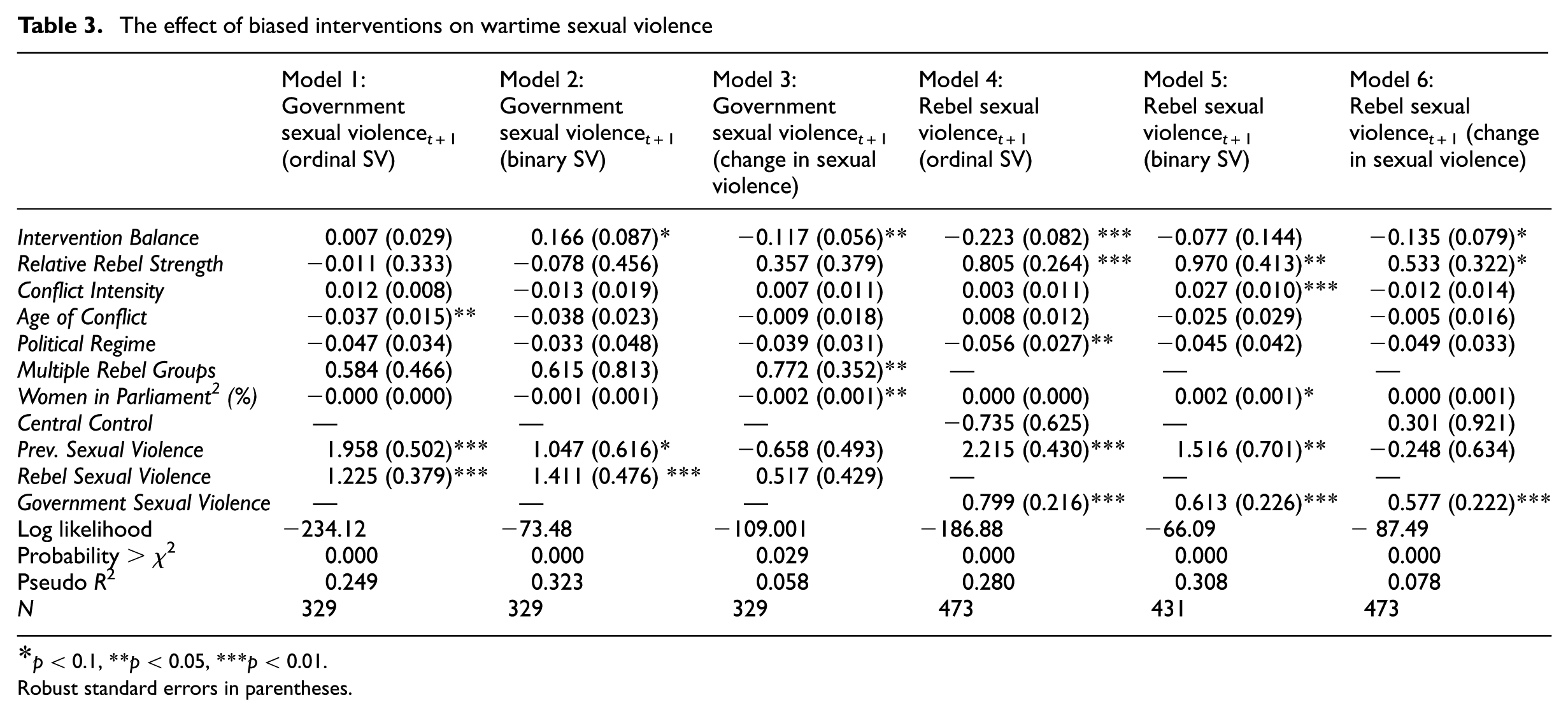
Tables 2 and 3 present the estimated impact of external troops on the prevalence of sexual violence against civilians during the period 1989–2012. 24 Since the data for rebel groups and state forces are studied at different units of analysis (conflict dyad vs country), we discuss the results separately. Starting with sexual violence perpetrated by government forces, the analyses lend support for our hypothesis. 25 As shown in Model 1 in Table 2, sexual violence is positive and significant. 26 This is an indication that the more foreign military support rebels receive in relation to what the government receives, the more likely it is that the government will commit higher degrees of sexual violence against civilians. These findings hold also when we limit our dependent variable to whether or not high levels of sexual violence (widespread or massive) were perpetrated, as presented in Model 2 in Tables 2 and 3. The more external support the rebel group receives compared with the government, the higher the probability is that government forces perpetrate large-scale sexual violence. Turning to Model 3, which examines the impact of biased military interventions on whether or not an actor reportedly has increased its level of sexual violence since the previous year, the results divert in the two tables. Whereas Model 3 in Table 2 follows our expectation, the result turns in the opposite direction when estimating the variables one year apart in Table 3. This suggests some sensitivity with regards to the expected time lapse between an intervention and its impact on state-perpetrated sexual violence. It is plausible that the immediate effect of rebel-support indeed does stir up the conditions on the ground to an extent that makes state combatants more likely to commit sexual violence and military leadership less likely to punish it. However, it appears that states generally are fairly quick to reinstate order to an extent that at least prevents further increases in sexual violence by their combatants rather soon after an intervention in support of their adversary.
The effect of biased interventions on wartime sexual violence

p < 0.1, **p < 0.05, ***p < 0.01.
Robust standard errors in parentheses. SV, Sexual violence.
The effect of biased interventions on wartime sexual violence
p < 0.1, **p < 0.05, ***p < 0.01.
Robust standard errors in parentheses.
Overall, however, our findings indicate that biased military interventions do have a dynamic impact on state forces’ repertoires of violence with regards to sexual victimization of civilians. Even though civil wars in general are characterized by superior support to states, the extent to which a government’s relative strength is challenged has a discernable impact on its use of sexual violence. The more troop support there is to the rebels, the more probable it is that we will observe increasing prevalence levels of sexual violence by state forces. By implication, the results suggest that the more external troops favor the government than the rebel groups, the less likely the government is to employ sexual violence. 27
The findings for rebel behavior are similar to those obtained in our government-focused analyses. As reported in Model 4 in both Tables 2 and 3, the results show that there is a negative and significant relationship between biased military interventions and combatant-perpetrated sexual violence. Because of the way the intervention variable is coded, the negative coefficient indicates that the less support rebel groups receive compared witho the government, the more probable it is that the rebel group will use sexual violence. Turning to Model 5, while the results are insignificant, the effect is in the expected direction in both tables. The less support rebel groups receive relative to the government, the more likely it is that they will engage in widespread or massive amounts of sexual violence. Model 6 in Tables 2 and 3 reports there is a negative and significant relationship between biased military interventions and if there are positive changes in the use of sexual violence by rebel groups since the previous year. The more superior the state-supportive intervention is, accordingly, the higher risk there is for an increase in rebel-committed sexual violence. By implication, Models 4–6 indicate that rebel groups are less likely to commit sexual violence as their relative amount of support increases compared with the government. 28
Turning to our significant control variable, Previous Use of Sexual Violence by an armed group, the findings show in Models 1–5 in Table 2 and Models 1, 2, 4, and 5 in Table 3 that an actor that has resorted to sexual violence in the past is more likely to employ sexual violence again. 29 As for the impact of the use of sexual violence by the opposing faction on a warring party’s probability to commit sexual violence, the findings indicate in both tables that the use of sexual violence by a rebel group has a positive and significant impact on the government’s use of sexual violence. This logic also applies to the use of sexual violence by rebel groups as shown in Models 4–6. While our test is not satisfactory to prove a general mimicry effect of sexual violence across actors, it does provide intriguing, preliminary evidence that, if the government employs sexual violence, this has an impact on how rebel groups regard the tradeoff between risks and benefits of sexual violence committed by their own troops and vice versa. Age of Conflict has a negative and significant effect on the use of sexual violence by state forces, which suggests that, in longer wars, government forces are less likely to engage in sexual violence. In both Tables 2 and 3, Multiple Rebel Groups is in the expected positive direction. Relative Rebel Strength and Political Regime are significant only for rebel behavior. As all these covariates are largely unexplored both theoretically and empirically, these findings could serve as an interesting point of departure for further research.
To illustrate the findings discussed, we calculate the predicted probabilities for reports of widespread sexual violence (level 2) by state or rebel forces across the span of relative power balance fostered by external state supporters and present them in Figures 2 and 3. 30 The lower the number along the intervention scale is, the more superior support is to the government. The higher the number is, the more superior support is to the rebel group(s). A value of 0 represents a state of parity.
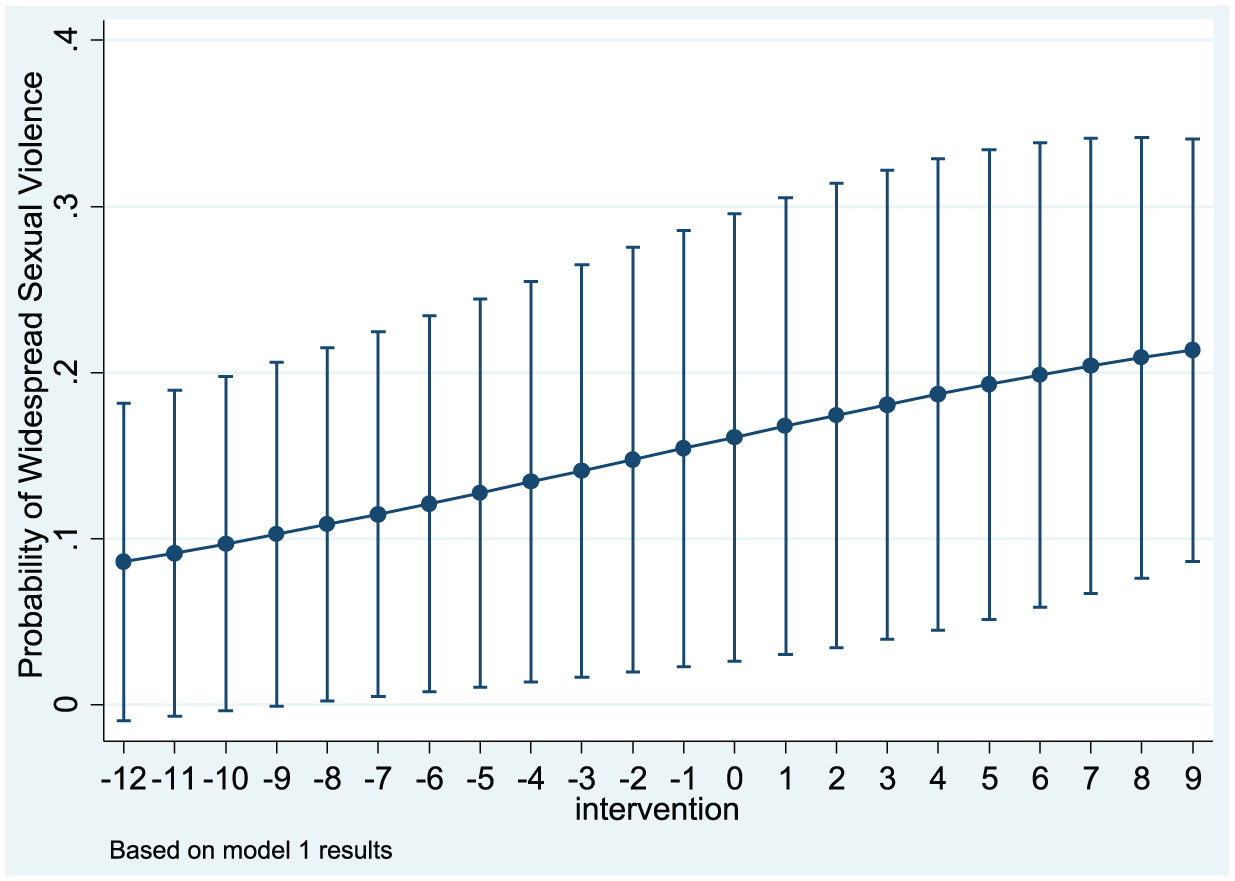
Predicted probabilities: biased interventions and sexual violence by state forces.
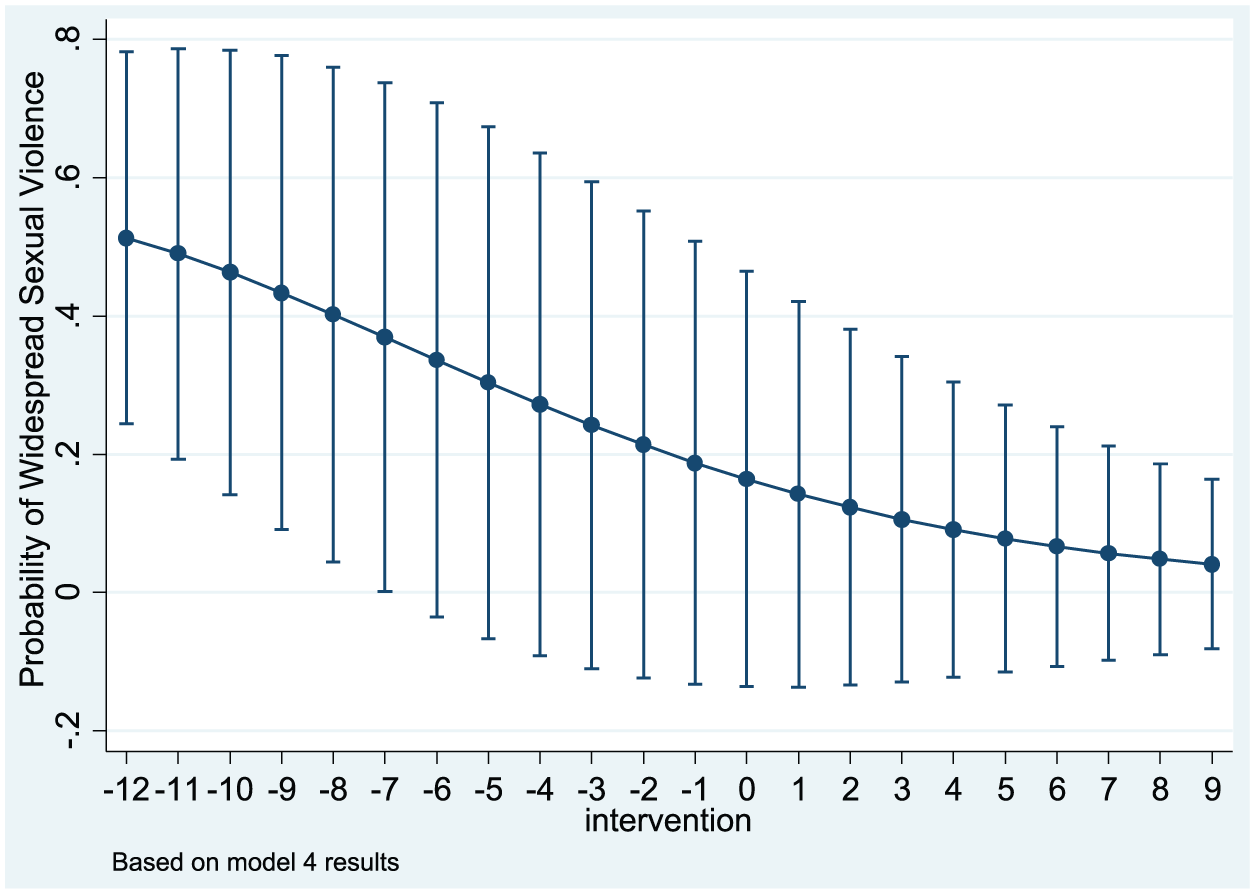
Predicted probabilities: biased interventions and sexual violence by rebel groups.
The predicted probabilities illustrated above are based on a presumably high-risk scenario with a conflict intensity of more than 12,000 battle-related deaths per year (equivalent to the upper quartile in our population of cases) and previous reports of sexual violence. Remaining variables are held at their mean value. Since it is exceptionally rare to have superior support to rebel groups, we are most interested in changes across the negative values, i.e. different degrees of state superiority. We compare an intervention where the state receives 500 external troops more than the rebel group(s) (a disparity equivalent to 5% above the lowest intervention value) with a situation where the state and the rebel groups receive equal or no intervention support, i.e. parity. The results show that the probability of state forces engaging in widespread sexual violence changes from 0.12 to 0.16, roughly a 33% increase as the challenge to the government increases. 31 Similarly, the probability for rebel groups committing widespread sexual violence decreases from 0.34 to 0.16, representing an approximately 53% decrease. The change in probabilities for rebel-perpetrated sexual violence is significant for any intervention support in favor of the government compared to parity. The difference in probability for state-perpetrated sexual violence is only significant within the 95% confidence interval in cases of larger shifts in intervention balance, for instance, when there is parity of external support, compared with when the state receives more than 10,500 external troops more than the rebel side. In this case, the probability of state-perpetrated sexual violence increases from 0.10 to 0.16, approximately a 60% significant increase as the superiority of the government support decreases.
Next, we scrutinize the identified relationship between biased interventions and sexual violence further.
Alternative measures of biased interventions
In this section, we discuss additional empirical analyses that we have conducted to demonstrate the impact of biased interventions on the sexual violence behavior of conflict actors. First, we explore the impact of foreign interventions further using actual troop sizes of the intervening troops, rather than relative strength. Second, we discuss the plausibility that the impact of interventions is rather a consequence of direct pressure from the intervener than through indirect reconsiderations within the warring parties. 32 The output table with all analyses is available in the Online Appendix.
We begin by examining the former. Instead of measuring the impact of the intervention balance between the warring parties, we insert absolute troop numbers for forces supporting the government and forces supporting the rebel group(s). With respect to government behavior, absolute troop support in favor of the government appears to be an insignificant determinant for the prevalence of government sexual violence. Similar results are found for rebel groups concerning the impact of absolute troop support in their favor on their use of sexual violence. This provides further support that it is the external shock of an intervention in support of the belligerent that impacts the extent to which an armed group perpetrates sexual violence, rather than the size of an armed group’s own military support. If state forces’ or rebel groups’ conduciveness to perpetrating sexual violence primarily was a product of their own and their allies’ absolute strength, regardless of the opponent, we would expect these analyses to be significant. 33
In line with a similar logic, we consider the alternative argument that external interventions impact the prevalence of sexual violence through diplomatic pressure of restraint on the supported party. If this would be the case, we would expect a stronger impact on sexual violence by supported parties in cases where the troop supporting state subscribes to democratic values and can be held accountable to a domestic audience. Although the previous test of absolute troop numbers already indicates that it is the support in favor of the adversary rather than the forces supporting one’s own group that matters, we conduct a robustness check to test the impact of the regime type of the external supporter(s) on the level of sexual violence committed by government forces. Because there are no observations in which an external supporter(s) of a rebel group is a democratic regime in our sample, an empirical analysis on the impact of regime type on rebel sexual violence behavior could not be conducted. Using a dummy variable to capture whether or not the troop-supporting state is a democracy, the results show no significant relationship between a democratic external supporter and the use of sexual violence by the government it supports. 34 These results confirm that a biased intervention’s primary impact lies in its ability to influences a state’s power position militarily, rather than through softer forms of influence. 35
Discussion and conclusion
At the outset of this paper we ask: What is the impact of biased military interventions on the probability of sexual violence against civilians? Based on previous research on sexual violence, civilian victimization and coercive recruitment, we lay out a theoretical argument for how external support can impact factors ranging from top military policies to individual combatant opportunities and how this, alone or in tandem, could be expected to impact the likelihood of sexual violence. In part we argue that warring parties become more inclined to forcefully rely on involuntary means of recruitment the less support they receive in comparison to their adversary. We also argue that large interventions can heighten commanders’ tolerance level for sexual violence and contribute to an environment that is more prone to opportunistic behavior by individual combatants.
Our empirical analyses are overall able to provide justification for our claims. While states on average receive considerably more troop support than rebel groups, there is still a variation whose overall pattern is in line with our expectation. Rebel groups are more likely to perpetrate sexual violence the more challenged they are by additional state-supporting troops, and state forces are more prone to committing sexual violence the more their superiority is challenged by support in favor of the rebel group(s). On the flip side, both rebel groups and state forces are less likely to commit sexual violence the larger share of external troop support they receive compared with the opponent. These findings are consistent with the relationship previous research has established between biased interventions and lethal violence against civilians.
We do not find that the probability of sexual violence follows as a direct consequence of restraints imposed by possibly more democratic external supporters. Instead, we suggest that external troops impact the conflict dynamics to the extent that they influence warring parties’ repertoires of violence, including how they regard the tradeoff between potential costs and gains of using/tolerating sexual violence. While the gradual change in behavior for government forces is significant across the full span of more or less support in favor of the government, 36 it takes more to change rebel group behavior. As the predicted probabilities show, rebels do not resort to sexual violence when interventions only cause minor shifts in conflict dynamics. Rather, sexual violence occurs when external troops cause challenges to the warring parties that are out of the ordinary, i.e. when government forces have at least 1500 more external troop support than rebels.
Going back to previous research on sexual violence, our finding does not necessarily challenge recent findings. Rather, we have posed a different question whose answer may complement previous research. While the political will and ideology of military leaderships, as well as the strength of organizations’ hierarchies, may well be important to the prevalence of sexual violence by combatants, our finding rather speaks to the boundaries of this power. Even for a hierarchical organization with potentially strict policies against sexual violence, external troops can pose severe challenges. Similarly, it may well be that most armed groups see the long-term benefits of treating the civilian populations well. However, again, our finding highlights the boundaries of this intuition. When exceptionally challenged, warring parties seem forced to reconsider their preferences. This can lead to either higher tolerance levels or outright reconsidered war strategies.
Taken together, our theoretical argument and empirical findings offer a number of contributions to the conflict processes literature. One major contribution of this study is that it highlights how an unequal distribution of capabilities across conflict actors as a result of military interventions can influence warring parties’ attitude to sexual violence against civilians. In doing so, it provides support for the idea that sexual violence is neither a random act nor an ‘inevitable consequence of war’, but rather, is a crime that occurs under certain conditions (Cohen, 2010, 2013; Eriksson Baaz and Stern, 2013; Wood, 2006, 2008). In exploring these conditions, our study highlights the potential theoretical contributions from related research fields interested in civilian victimization to the study of sexual violence.
Furthermore, this study adds to the growing literature on biased interventions that evinces that external parties play an interesting role in the conflict environment in that they can influence the behavior of combatants during conflict (Balch-Lindsay and Enterline, 2000; Gent, 2008; Regan, 2000, 2002). While foreign actors can help reduce the level of sexual violence perpetrated by the group that they are in favor of, they can also trigger the opposing side to resort to sexual violence to strengthen its position in the conflict. Thus, while it is not uncommon for states to carry out military interventions in response to gross violations committed against civilians, military interventions can exacerbate crimes of civilian victimization. In effect, while states’ motivation to launch a military intervention may be humanitarian in nature, their presence can have detrimental consequences for local populations. While this study focuses on the role of military interventions by individual states in shifting the capability balance between warring groups and shaping the practices of warring actors in relation to sexual violence, it would be interesting for future research to explore if other forms of intervention, including the role of biased peacekeeping operations organized by international organizations and diplomatic interventions, would have a similar impact on the use of sexual violence by conflict actors against civilians
Footnotes
Acknowledgements
We would like to thank everyone who along the way has contributed with constructive feedback to this study. In particular, we wish to thank Lisa Hultman, Jacob Kathman and Erika Forsberg for valuable advice. We also thank Angela Muvumba Sellström and others who provided input to an earlier draft of this paper at the Research Paper Seminar on 19 November 2015 at the Department of Peace and Conflict Research, Uppsala University. Lastly, we acknowledge the helpful comments received from anonymous reviewers as well as the editor of CMPS, Caroline Hartzell.
Declaration of conflicting interests
The authors declare that there is no conflict of interest.
Funding
This research received no specific grant from any funding agency in the public, commercial, or private sectors.
1.
Authors are listed alphabetically. Equal authorship applies. The data, Online Appendix and all other supporting materials can be accessed via a supplementary data file hosted on SAGE’s CMPS website.
Notes
References
Supplementary Material
Please find the following supplemental material available below.
For Open Access articles published under a Creative Commons License, all supplemental material carries the same license as the article it is associated with.
For non-Open Access articles published, all supplemental material carries a non-exclusive license, and permission requests for re-use of supplemental material or any part of supplemental material shall be sent directly to the copyright owner as specified in the copyright notice associated with the article.
