



Abstract
How does the public respond to nonviolent resistance tactics? This survey experiment examines both approval and perceptions of legitimacy for five nonviolent tactics using a sample of American adults. We include two variations in our treatment – first examining responses to different protest tactics, then adding in the factor of co-partisanship, which we argue is a relevant identity in the US political context. In the non-partisan treatments, we find a stark dichotomy between our measures of approval and legitimacy. All nonviolent treatment tactics decrease approval for the neutral activist group using them, but three of four tactic treatments increase the probability that respondents will support our legitimacy indicators (congressional hearing invitation and media attention). We find that partisanship conditions how respondents evaluate nonviolent tactics of resistance, but not in ways we would expect based on the conventional wisdom that liberals favor ‘nonviolent resistance' while conservatives do not. Partisan alignment has a consistent effect on respondent approval of tactics in that the partisan treatment leads to disapproval of out-partisan groups across the nonviolent tactics (compared to no mention of tactic or partisanship). Surprisingly, however, this finding on co-partisanship does not extend to our measures of legitimacy. Partisanship clearly conditions the way that respondents evaluate nonviolent tactics of resistance, but not necessarily in predictable ways.
The United States is facing unprecedented levels of activist mobilization, from Black Lives Matter supporters and student-led gun control marches on the left to anti-mask/anti-quarantine protests on the right. While scholars of contentious politics have examined the use and efficacy of opposition tactics (cf. Chenoweth & Stephan, 2011; Abrams, 2006; Thomas, 2014), relatively little work has focused on how Americans view different types of nonviolent tactics (Branton et al., 2015; Flynn & Stewart, 2018; Arves et al., 2019; Gutting, 2020). What tactics of contention do US citizens support? This question is especially relevant today when 90% of voters in the 2020 election say recent protests against police violence played a role in their electoral choices. 1
It is essential to understand which tactics citizens see as valid and which they view as illegitimate. Citizen mobilization typically has the goal of persuading others, in addition to activating a base of supporters (Gamson, 1992; Klandermans, 1997; Benford & Snow, 2000; Wasow, 2020; Feinberg, Willer & Kovacheff, 2020), and social movements employing nonviolence play a critical role in instigating social change (Lee, 2002; Mazumder, 2018). We examine public opinion about nonviolent tactics in America and emphasize how tactics, moderated by their associated political ideology, drive public opinion.
Moving beyond a general focus on ‘protest’ behavior, which typically has meant many people in the street demonstrating (Beissinger, 2002), we center on several forms of nonviolent direct action. The tactics we examine here are informed by the literature on nonviolent tactics (Sharp, 1973) and current events in the United States including occupations, hunger strikes, strategic arrests, and blockades. The Occupy Wall Street movement is well known in recent US politics; however, this tactic was also employed in the events of 6 January 2021, as pro-Trump activists occupied Congress. 2 Hunger strikes have also been used recently to protest treatment of asylum-seekers by ICE. 3 Strategic arrest, where activists plan to be arrested, was used in 2019 by actress Jane Fonda to protest climate change. 4 Additionally, an anonymous group employed a blockade in 2021 protesting environmental degradation caused by the oil industry. 5
Nonviolent resistance tactics have historically been seen as aligned with left-wing causes around the globe (Kostelka & Rovny, 2019). The past few decades, however, have also seen an increasing use of nonviolent tactics across the US political spectrum and by organizations and people on the right worldwide (Torcal, Rodon & Hierro, 2016). In the United States, a number of groups on the political right convened for the ‘Unite the Right’ rally in 2016, and there were several land occupations in Nevada and Oregon by self-identified right-wing activists. Similarly, the far-right Pegida movement in Germany began with nonviolent protests as a key strategy, and the British Union of Fascists engaged in anti-lockdown protests (CARR, 2020). 6
Building on existing insights on tactical choice and public opinion, our survey examines a set of nonviolent tactics. We employ novel metrics that move beyond approval for assessing the degree to which citizens support them, assessing both outright approval and indicators of the legitimacy of activist groups and the tactics they use. In addition, we argue that US partisanship is now a core identity for many people, and that it is likely to affect views about nonviolent resistance.
We present several key findings. First, employing a five-point Likert scale measure of approval, our examination of US public opinion shows that Americans generally do not approve of the nonviolent tactics we explore, but they approve of some more than others. Second, when we introduce partisanship of respondents and activists, approval of tactics falls sharply along partisan lines. These findings challenge the idea that specific tactics are the purview of one political ideology (i.e. of the ‘left’). 7 We uncover trends in support of tactical choice that run counter to conventional wisdom about partisanship and contention, instead identifying a central role of political polarization among Americans. Third, using new measures of legitimacy related to public Congressional hearings and media attention, we find a disconnect between approval of a tactic and positive response on the legitimacy indicators.
Existing studies of tactics
Existing studies of violent and nonviolent tactics focus on a number of dynamics. An expansive literature on violence has focused on social revolutions (cf. Goldstone, 1991; Skocpol, 1994), civil wars (cf. Gleditsch, 2007; Walter, 2009), and terrorism (cf. Young & Findley, 2011). A large body of work on nonviolent resistance addresses when a variety of protests are likely to occur (cf. DeNardo (1985) and Francisco (1995) on protest generally, Beaulieu (2014) on electoral protests, Brancati (2016) on democracy protests, Costello et al. (2015) on human rights protests, and Murdie & Dursen (2015) on women’s rights protests). Case-specific works address the inner workings and trajectory of movements that include nonviolent tactics, such as Gandhi’s anti-colonial movement (cf. Nepstad, 2015) and the colored revolutions in Eastern Europe (Hale, 2005). Moving beyond individual campaigns and movements that use nonviolence, studies have looked at the spread of nonviolent tactics globally. Recent work has shown that nonviolent campaigns are contagious across countries (Gleditsch & Rivera, 2017), likely in places that have previously experienced protest (Braithwaite et al., 2015), and where there are robust flows of remittances to potential dissenters (Escribà-Folch et al., 2018).
Recent work has challenged the assumption that nonviolent campaigns are a broadly available tactic. Thurber (2018), for example, shows that demographically small populations are less likely to engage in nonviolent campaigns and argues that such groups do not believe they can attract enough support to make nonviolence effective. This logic is also supported by Pischedda’s (2020) finding that nonviolence is less likely to succeed when the movement is ethnically distinct from the group in power at the center of the state.
Other work on tactical choice centers on the efficacy of different tactics, which may affect their use. Chenoweth & Stephan (2011) argue that nonviolence will be most effective when a high number of participants are mobilized. Others suggest that the ability of nonviolence to generate defections in the regime (Nepstad, 2013) or elicit international condemnation from outsiders (Hess & Martin, 2006; Sutton & Butcher, 2014) are keys to success.
At present, few studies disaggregate nonviolent tactics in much detail. Manekin & Mitts (2021) examine levels of disruption of nonviolence. In their recent special issue on nonviolence, Braithwaite & Braithwaite (2018: 252) highlight the increasing disaggregation in the study of nonviolence focused on ‘actors, tactics, time, and space’. Yet we see little attention to public perception of different types of nonviolence tactics.
The growing literature on public opinion related to tactics that this article contributes to centers on responses to violence. Using a survey experiment in Poland, Huff & Kruszewska (2016) find that support for negotiating with a group that uses extreme tactics (such as bombings) is lower than for a group that uses occupation. Muñoz & Anduiza (2019) examine how violent episodes affect public opinion, finding that violence decreases support, but the effect is strongest among those not already sympathetic to the cause. Likewise, Arves et al. (2019) examine foreign public opinion of rebel tactics, finding a negative effect of terrorism and a positive effect of hunger strikes.
Simpson et al. (2018) find that the use of violent protests by otherwise popular groups (anti-racist protests against white nationalists) reduces their public support and increases support for their opponents. Feinberg, Willer & Kovacheff (2020) look at ‘extreme’ protest behavior and public perceptions, and find reduced support when activists use more extreme methods (including property destruction and violence). Lupu & Wallace (2019) examine support for human rights abuses based on tactical variation, finding that support for such policies is lower when nonviolence is used rather than violence.
In the context of civil war, a number of studies have examined how tactics affect support for actors in a broader sense. Lyall et al. (2013), for example, use an endorsement experiment to assess the impact of targeting of out-group civilians on support for an armed actor. They find increased support for the Taliban when the opposing International Security Assistance Force killed civilians, but not the reverse (i.e. an asymmetric effect). Similarly, Condra & Shapiro (2012) also see lower support for Coalition forces in Iraq in response to collateral civilian killing. Consistent with this logic, Stanton (2016) finds that civilian approval of an armed group is higher when the group exercises restraint in its treatment of civilians. Beyond restraint, rebel actors’ use of international law (Jo, 2015; Fazal, 2018) and provision of local governance (Flynn & Stewart, 2018) have also been associated with greater popular support. These works offer insights into wartime support for violent actors, but do not address public opinion directly. There also remains a gap in our understanding of responses to and perceptions of nonviolent resistance in these civil war contexts, despite the fact that ‘violent’ actors also engage in nonviolence.
Our contribution
This article advances the study of tactics in three ways. First, it offers a novel look at American perceptions of several different nonviolent resistance tactics, which is an understudied case of tactical choice and contention. 8 Other studies have examined perceptions about protesters, levels of disruption, and violence, or they combine protest with more general evaluations of participation. 9 We go further by disaggregating nonviolent actions. We examine occupations, hunger strikes, strategic arrests, and blockades specifically because these are all tactics that have recently been used in the United States by activists seeking political and social change. Previous studies have looked at support for resistance in different ways (particularly those focused on violence), but we as a discipline lack information about nonviolent efforts as discrete tactics and about responses by the public writ large. Examining nonviolent tactics in a disaggregated manner is important because not all nonviolence is equivalent. Different tactics require different resources and can be implemented by different numbers of people and in different contexts (Cunningham et al., 2020). Some tactics are riskier for activists (such as events with low numbers of participants) and some tactics are more vulnerable to policing or other hostility. Nonviolent tactics also have different capacities to escalate to violence and/or trigger violent repression. All of these factors intersect with the dynamics of how threatening the nonviolent behaviors appear to outsiders and this is a key part of public opinion about nonviolence (Davenport, Soule & Armstrong, 2011).
Second, our study brings partisanship to the fore as a critical identity in contemporary US politics. We build on the insights of both studies of race and contentious politics and studies of partisan polarization in the USA. We have seen nonviolent tactics used by both the right and left in recent years in the United States. As such, the study addresses the use of nonviolent tactics through the partisan lens, an identity of increasing salience in the US context.
Third, the study provides a multifaceted look at public response to nonviolent tactics. In addition to examining approval directly, we assess perceptions of legitimacy through two measures related to government recognition of the group (Congressional hearings) and popular attention to the activists’ claims (media attention). In doing so, we suggest that public responses can be nuanced in ways that delink outright favorability from acceptance of the use of a tactic as reasonable and valid.
Perception, nonviolence, and partisan identity
We begin with a basic model of how the public interacts with activists in forming public opinion. Consistent with existing work, we assume that the ‘public’ are civilian actors that are not directly participating in the contentious events. They observe the action of mobilized individuals and take in information about the claims being made, identities of activists, and tactics activists are using. They may observe this directly, via traditional media or social media. 10
Perceptions of tactics matter in several ways. First, activists risk decreasing support for their cause when a tactic is seen as unreasonable or illegitimate. This assessment can be from the perspective of current supporters or persuadable outsiders. A number of studies have linked the use of violence or other extreme behavior to decreased public support (cf. Huff & Kruszewska, 2016; Simpson et al., 2018). These effects can be long-term, either shaping the narratives that emerge around contention and tactical choice (Davenport, McDermott & Armstrong, 2018), or affecting public attitudes about the cause into the future (Mazumder, 2018).
Second, they can critically inform how security forces and other actors respond to activism. Perceptions of activists (especially regarding how threatening they appear) affect public tolerance for policing of nonviolent behavior (Davenport, Soule & Armstrong, 2011). Aggressive policing of nonviolence can result, in part, from public tolerance of these actions (Earl et al., 2003). Public tolerance for action against activists may also matter for escalation of nonviolent events. Dorff & Braithwaite (2018), for instance, show that fears over personal safety can be a major concern for possible participants in nonviolence.
Work on nonviolence has shown in a number of ways and contexts that violence can decrease public opinion for actors. The presumption is that nonviolence as a tactic is preferred, especially compared to violence (which Manekin & Mitt (2021) find support for). Wasow (2020) also shows lower support from Whites in place with more violent protests during the civil rights movement. Studies of public opinion have shown us that nonviolence in general is preferred to violence, but not that nonviolence alone increases approval. As such, we explore the following hypothesis:
H1: The use of nonviolent tactics will increase approval of a group seeking social change.
Delegitimizing established power structures is a key pathway for nonviolence to influence social change (Sharp, 1973).
11
Further, several studies suggest the use of violence decreases perceptions of legitimacy of actors (Wang & Piazza, 2016; Simpson et al., 2018; Arves et al., 2019). While a key assumption about nonviolence is that it is viewed as more legitimate (Chenoweth & Stephan, 2011), studies have not generally tested this link experimentally.
H2: The use of nonviolent tactics will increase perceptions of legitimacy of a group seeking social change.
Activist identity and partisanship as identity in the United States
In addition to these hypotheses about the effects of nonviolent tactics, we argue that the identity of activists will play a role in public opinion of nonviolence, and that partisanship is an important lens through which the public views activism. The identity of activists has been recognized as a key feature conditioning people’s response to contentious and other behavior. A large literature in US politics and political psychology has linked racial identification (especially skin color) to bias. Hurwitz & Peffley (1997), for instance, show that negative stereotypes affect Whites’ attitudes toward punishment of Black individuals for violent crimes.
Minority identity has also been linked to voter assessment of competence for politicians (Sigelman et al., 1995), attitudes about welfare (Peffley et al., 1997), and immigration policy (Hajnal, 2002).
However, in a survey experiment related to the Black Lives Matter movement, Wouters (2019) finds that respondents are more favorable to protesters if they appear to be mobilizing a diverse set of people.
A number of studies that focus on identity and tactics of contention examine the race of activists as a confounding factor. For example, Manekin & Mitts (2021) show through several survey experiments that race affects perceptions of violence when respondents are presented with different information about activist identity. In the United States, specifically, White protesters are associated with lower perceptions of violence than Black protesters. Davenport, Soule & Armstrong (2011) show that policing of protest is more common and aggressive when protesters are Black. D’Orazio & Salehyan (2018) show that Americans label the use of violence in different ways based on perpetrator identity, finding that Arab American are likely to be identified as terrorists while White Americans are not, even given the same use of violence.
These robust findings on the role of identity show that protests composed of individuals from minority groups are perceived differently than majority racial groups. Davenport, Soule & Armstrong (2011) link this explicitly to the idea that publics often view protest behavior of groups they see as ‘threatening’ more negatively. We extend this logic to the hyper-partisan US context, arguing that perceptions of nonviolence by activists on the other side of the political spectrum will also trigger this mechanism of out-group threat. Consequently, protesters from a different party will be viewed less favorably than co-partisans or non-partisan activists.
This expectation is driven by the polarized political environment that defines current US politics (Jacobson 2016). As several scholars have documented, party identification has increasingly become a part of Americans’ personal identities (Kinder & Kalmoe, 2016; Mason, 2018). No longer just a political label, people now define their in-group (and out-group) along partisan lines. The Pew Research Center (2019) reports increases in this extreme partisanship over time. In 2019, Pew reports ‘55% of Republicans say Democrats are “more immoral” when compared with other Americans; 47% of Democrats say the same about Republicans,’ up from 45% and 35% respectively in 2016.
In an even more grim take, Kalmoe & Mason (2019: 22) find that ‘15 percent of Republicans and 20 percent of Democrats agreed that the country would be better off if large numbers of opposing partisans in the public today “just died”’. The authors rightfully identify this as ‘a shockingly brutal sentiment’, which underscores just how deep and salient the partisan divide is in the US public. Moreover, self-identified Republicans are shown to associate protests with violence when the activists are not aligned with their political ideals (Hsiao & Radnitz, 2020), showing that partisanship can color perceptions of activists as well. Given the increasing salience of partisan identification, we expect partisan identification will condition how Americans view the use of nonviolent tactics. This suggests the following hypotheses about approval and nonviolence:
H3: Partisan identification will have a positive effect on evaluations of nonviolence used by co-partisans.
H4: Partisan identification will have a negative effect on evaluations of nonviolence used by activists identified as the opposite party.
In addition to approval, we expect that the degree to which nonviolent tactics are considered legitimate will also be conditioned by partisan identification.
H5: Partisan identification will have a positive effect on perceptions of legitimacy of groups using nonviolence when used by co-partisans.
H6: Partisan identification will have a negative effect on perceptions of legitimacy of groups using nonviolence when used by activists identified as the opposite party.
Examining preferences over tactics
We conducted a survey experiment to assess how Americans view the use of different nonviolent tactics of contention. Our survey was administered as part of a larger poll conducted by Nielsen for the Washington Post.
12
It was in the field from 12 to 20 March 2020 and had 2,395 respondents. Our experiment featured a fully crossed design of partisanship of the group engaged in contention and the tactic employed by that group. There were three group ideology types (left-wing, right-wing, and no ideology mentioned) and five tactics (occupation, hunger strike, strategic arrest, blockade, and no tactic mentioned) which resulted in 15 treatment groups. These specific tactics were chosen because they are common in the literature or have been recently used in the United States. Including treatments that did not mention ideology and/or tactics allowed us to have multiple ‘baseline’ groups to isolate the effect of partisanship and choice of tactic. Treatments followed the following format – text that was manipulated across treatment groups is italicized. Earlier this week a federal appeals court ruled that the right-wing activist group Citizens for a Free America did not have legal standing to continue to challenge the government’s new policies regarding federal land use in Western states like Arizona, New Mexico, and Texas. This ruling came as a blow to the group, whose leadership vowed to continue their struggle to express their opposition to the situation. Indeed, some of the group’s members have already engaged in resistance on the federal land in question. In the last few days, hundreds of people who identify with the group have been engaging in a public hunger strike.
Findings
We begin with the effects of the treatment on approval, starting with the full sample and then introduce subsets based on partisanship. We then examine the effects of the treatments on our measures of tactic legitimacy, where we proceed in a similar way. In each section, we provide a baseline of how Americans assess different tactics of nonviolence. We have not offered a theory for why specific types of nonviolence will be viewed differently, but we expect a positive effect of nonviolent tactics (H1 and H2). This provides a look at how Americans view nonviolent resistance beyond mass protest. This has been understudied, and our analysis fills a gap in our understanding of the nuance of perceptions of nonviolence that we see in a diversity of contexts in US politics – including hunger strikes to protest the killing of Breonna Taylor, occupations to remove Confederate monuments, walkouts, pickets, vigils against reproductive rights, and strikes for better working conditions during the global pandemic. 14
Approval
Effect of tactics on approval

*p < 0.05, **p < 0.01, ***p < 0.001.
For the purposes of this first set of ordinary least squares (OLS) regression models, we pool based on the tactic used. The baseline treatment, which we use as a comparison to ascertain the effects of the other treatments, is a simple control in which no tactic or ideology was mentioned.
In Model 1, Table I, we see that all of the tactics, with the exception of hunger strikes, led to lower approval in the full sample. We obtained the same result when we included a battery of controls, such as party ID, gender (female), and being of older age (coded as 1 for anyone 55 or older) (Model 2). 15 These results suggest that strategic arrest, blockades, and occupation are not popular tactics among respondents (contrary to H1 and studies that compare nonviolence to violence). The sizes of the effects are similar across the significant findings as well, though occupation draws the strongest negative response. The lack of a significant effect on hunger strikes suggests that this tactic is not necessarily viewed the same way as the others. This might be due to the fact that hunger strikes are a form of self-harm, while the other tactics are rooted more firmly in mechanisms of disruption.
While the sizes of the treatment effects are relatively modest, it is important to remember two things. First, these effects are the result of a single treatment that involved changing only a few words from the control condition. The fact that the mere mention of a particular tactic can trigger a reaction suggests that people harbor strong opinions about these methods of protest. Second, the issue-area – federal land use – is not salient to most Americans. While it has been the subject of some protests in the recent past, it is not an issue that affects the majority of Americans. Taken together, these aspects make for a harder test for our treatments. But, as the results demonstrate, they are still capable of generating effects.
This first set of analyses gives us a sense of what tactics respondents prefer, but it ignores the interaction between a respondent’s own political leanings and those of the group in question. We now introduce partisanship of activists and break the respondents into subgroups based on party identification to evaluate H3 and H4 (Table II). In these models, the baseline comparison group is one in which neither tactic nor ideology is mentioned.
Starting with Republicans, in Table II, Model 1, we see that they are uniformly disapproving of any group employing any nonviolent tactic that is labeled as having a liberal ideology. Unsurprisingly, they also disapprove of the liberal group where no tactic is mentioned. Republican respondents do not have a correspondingly positive view of conservatives using these tactics – the coefficients on conservative use of tactics are negative, but none are statistically significant. They also, curiously, disapprove of the use of a blockade by a non-partisan group.
Effect of tactics and partisanship on approval

*p < 0.05, **p < 0.01, ***p < 0.001.
Figure 1 indicates that Republican respondents are, on the whole, negatively disposed to nonviolence and Democratic respondents are more neutral. More important, though, is the fact that the confidence intervals for Democratic and Republican are relatively close together. While there is no overlap in terms of the respondent approval of the blockade tactic, the two subsets of respondents are very close in terms of approval when it comes to occupation and overlap by significant margins in the strategic arrest and hunger strike treatment groups.
Figure 2, which shows the effect of the conservative tactic treatments, tells a very different story. Unlike Figure 1, where there was overlap between the groups, here we see that none of the confidence intervals overlap. Democratic respondents are much more negative than Republican respondents to all tactics used by conservative groups. Republican respondents, by contrast, are only negative for occupation, and neutral on the other tactics.
Figure 3 shows a parallel effect. Republican respondents rate all tactics used by liberals (and no tactics) by liberal groups negatively. Democratic respondents are neutral toward all of the nonviolent tactics. And, as with Figure 2, there is no overlap in the confidence intervals for Democratic and Republican respondents indicating a strong difference of opinion.
A comparison of Figures 2 and 3 makes the effect of one’s partisan identity clear: Democrats disapprove of conservative groups and Republicans disapprove of liberal groups. 17 We know that the ideology of the group is the driving factor because that is literally the only thing that changes across the treatment groups for a given tactic. It is not the case that Democrats, for instance, have strong feelings against blockades or that Republicans hate occupations, but rather that their opinion of a tactic is strongly influenced by the ideology of the group using it. Estimating the approval model on the respondents who identified as Independents underscores this point: there is no significant difference between any of the partisan groups and the baseline (non-partisan) group (see Model 1 in Table A1 in the Online appendix). These results contribute to a growing body of work suggesting a heightened role of polarization in American preferences.
Legitimacy measures: Congressional hearings and media attention
We now turn to a second set of dependent variables that aim to capture the legitimacy respondents assign to
Effect of tactics on approval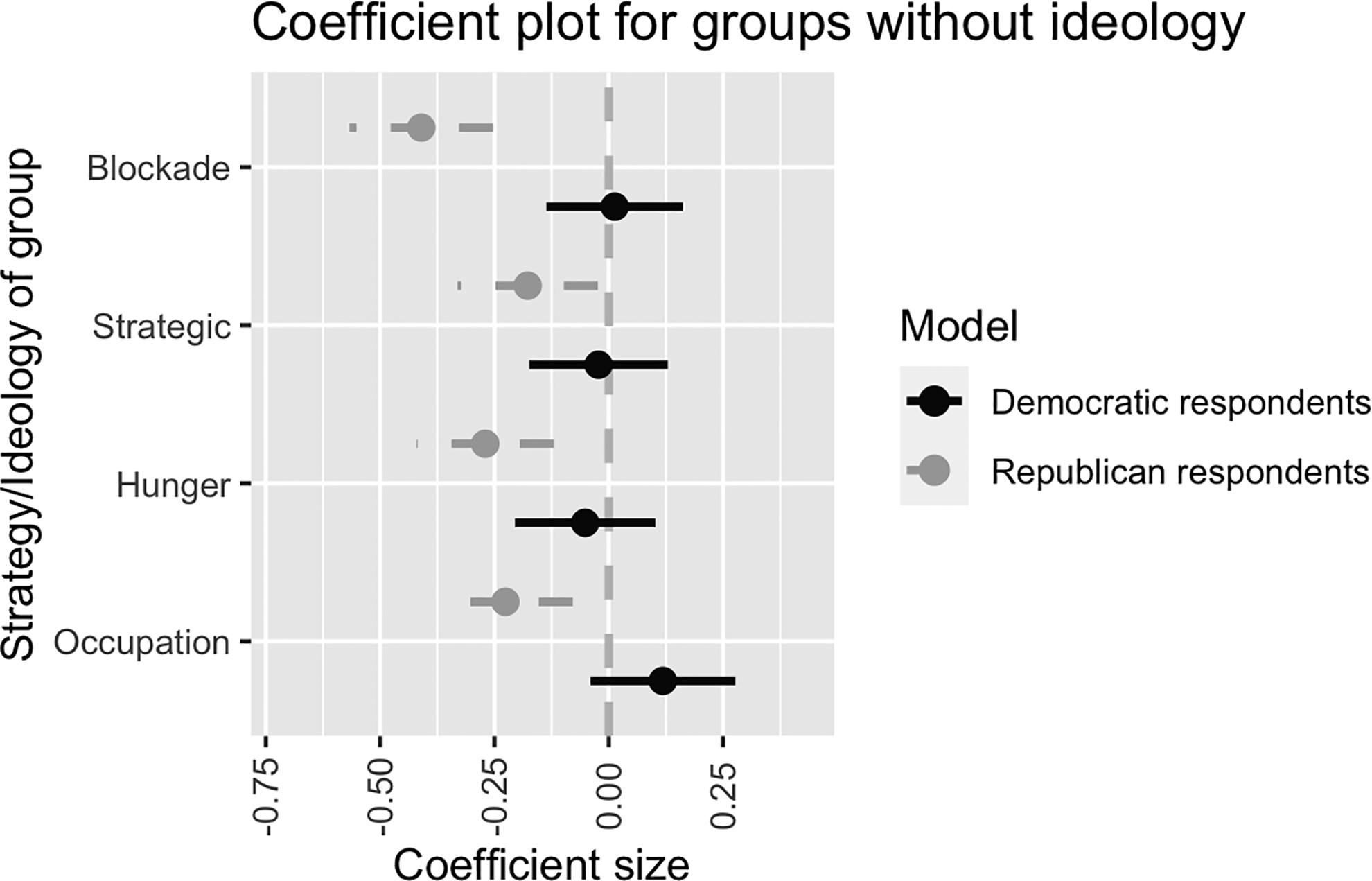
We gauge legitimacy by asking respondents if they think the group should be invited to testify at a Congressional hearing that pertains to the group’s demands and whether the media should be covering groups like this. King et al. (2007) argue that Congressional hearings reflect a perception of legitimacy in their analysis of which issues get more hearings. Increased media attention has also been associated with greater success in enacting policy changes (Rogers-Dillon et al., 1999) and has long been considered critical for the success of social movements (Lipsky, 1968).
The dependent variable has a value of 1 if the respondent thinks the group should be invited to a hearing/be covered by the media and 0 if they are unsure or think the group should not be invited/covered by the media.
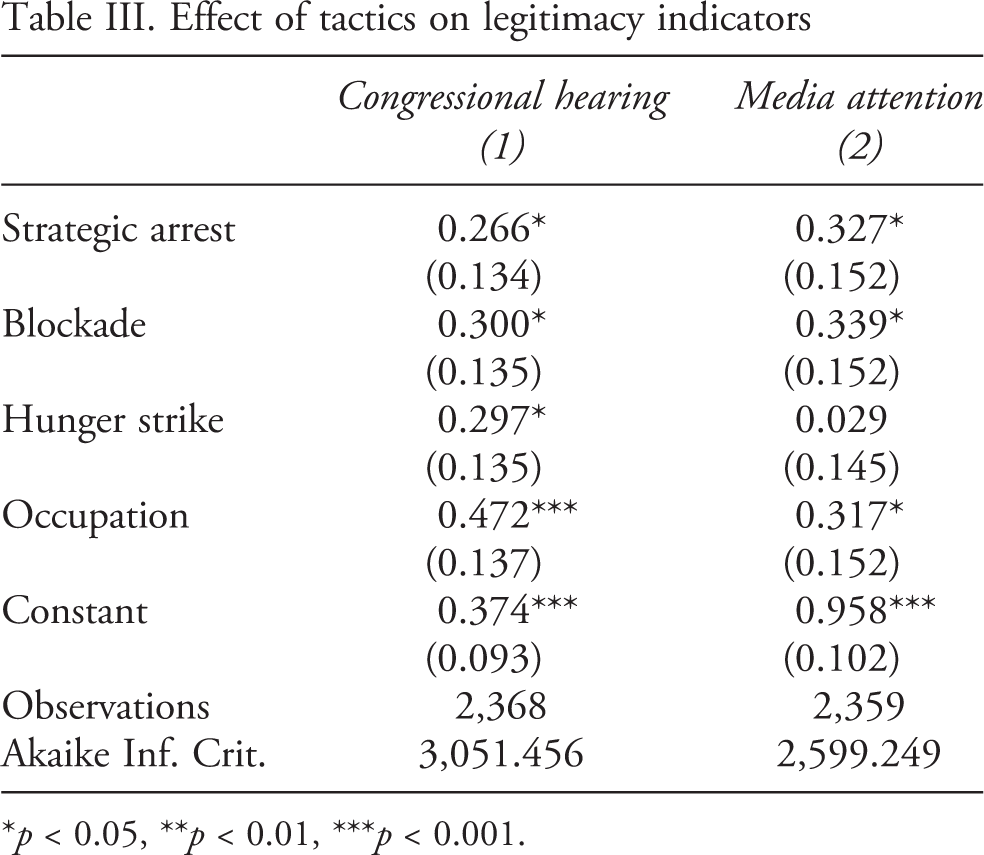
We begin with the effects of the treatment on hearings and media attention, starting with the full sample (evaluating H2) and then introduce variables that speak to partisanship (H5 and H6). Table III presented the pooled respondents’ results of whether the group should be invited for Congressional hearing (Model 1) and receive media attention (Model 2). Each of these models is a logistic regression.
Somewhat surprisingly (considering the results on approval), we see broad support for both measures of legitimacy with the different tactic treatments. As above, the baseline comparison category is a group in which no ideology or tactic was mentioned. All tactic treatments return positive and significant coefficients for the group being invited to Congressional hearings (in support of H2). The baseline probability (no ideology or tactic
Effect of tactics on approval, conservative treatment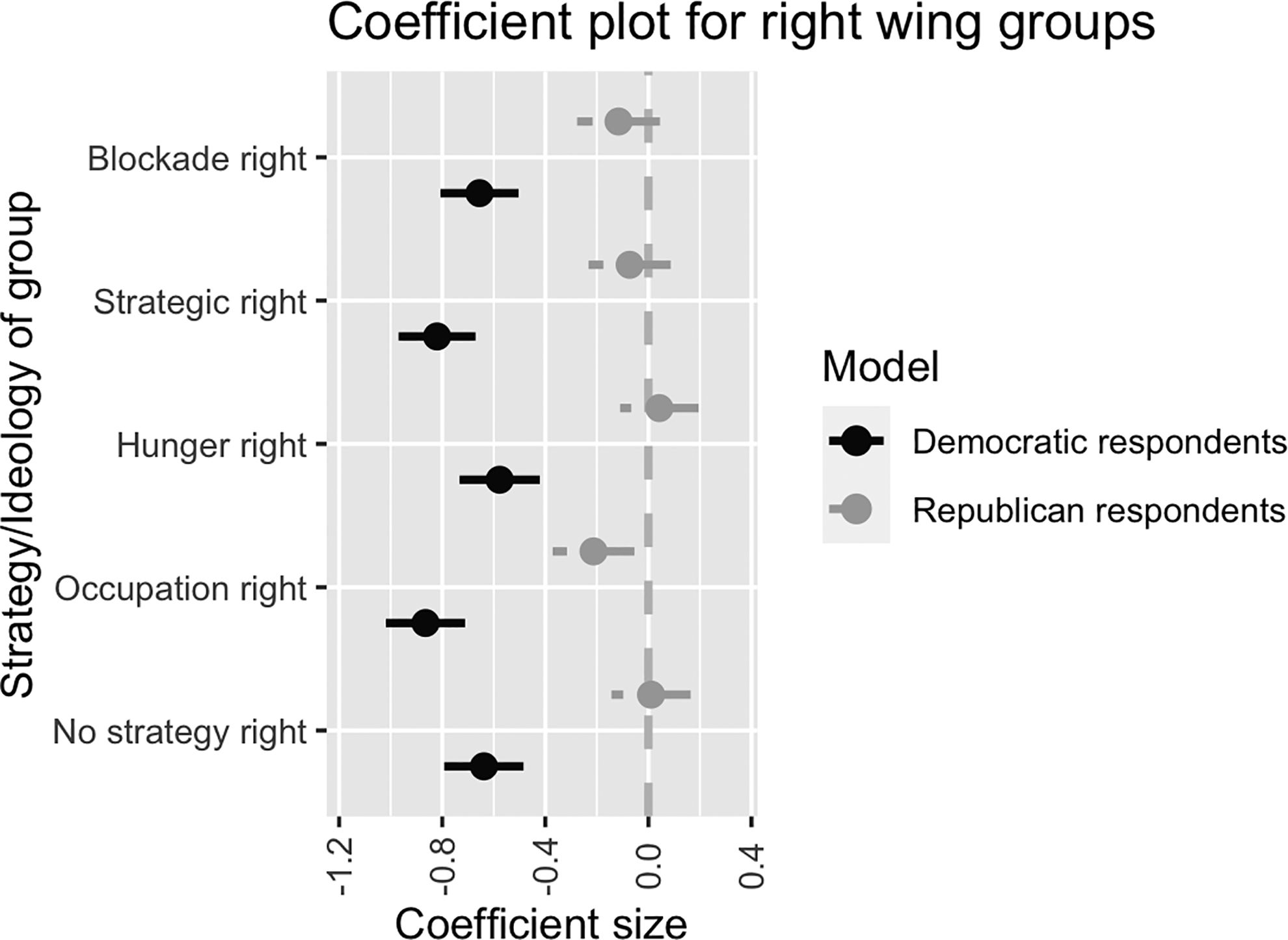
Similarly, we see positive and significant coefficients on three of the tactic treatments for media attention – strategic arrests, blockades, and occupation. The baseline probability (no treatment) on media attention is about a 70% chance of saying the group deserves media attention. Introducing the tactic treatments, we see an increase of about 12% with strategic arrests, an 11% increase with blockade, and a 12% increase with occupation. Only the hunger strike treatment is not creating support for greater media attention. This is notably in contrast to the measure of approval, where hunger strike is the only tactic that does not draw a negative approval response. 20
Table IV shows these results for Republicans in Models 1 and 2 and Democrats in Models 3 and 4 (assessing H4 and H5). Beginning with Republicans, we see a varied impact of tactics and partisanship on the legitimacy indicators. For the Congressional testimony question (using Model 1), the baseline probability (no treatment) is a 64% chance of supporting the group being invited for a hearing. Model 1 shows that the non-partisan group using occupation tactics is the only one where we see positive and significant effects (leading to a 17% increase). Unlike the findings on approval,
Effects of tactics on approval, liberal treatment Effect of tactics on legitimacy indicators *p < 0.05, **p < 0.01, ***p < 0.001.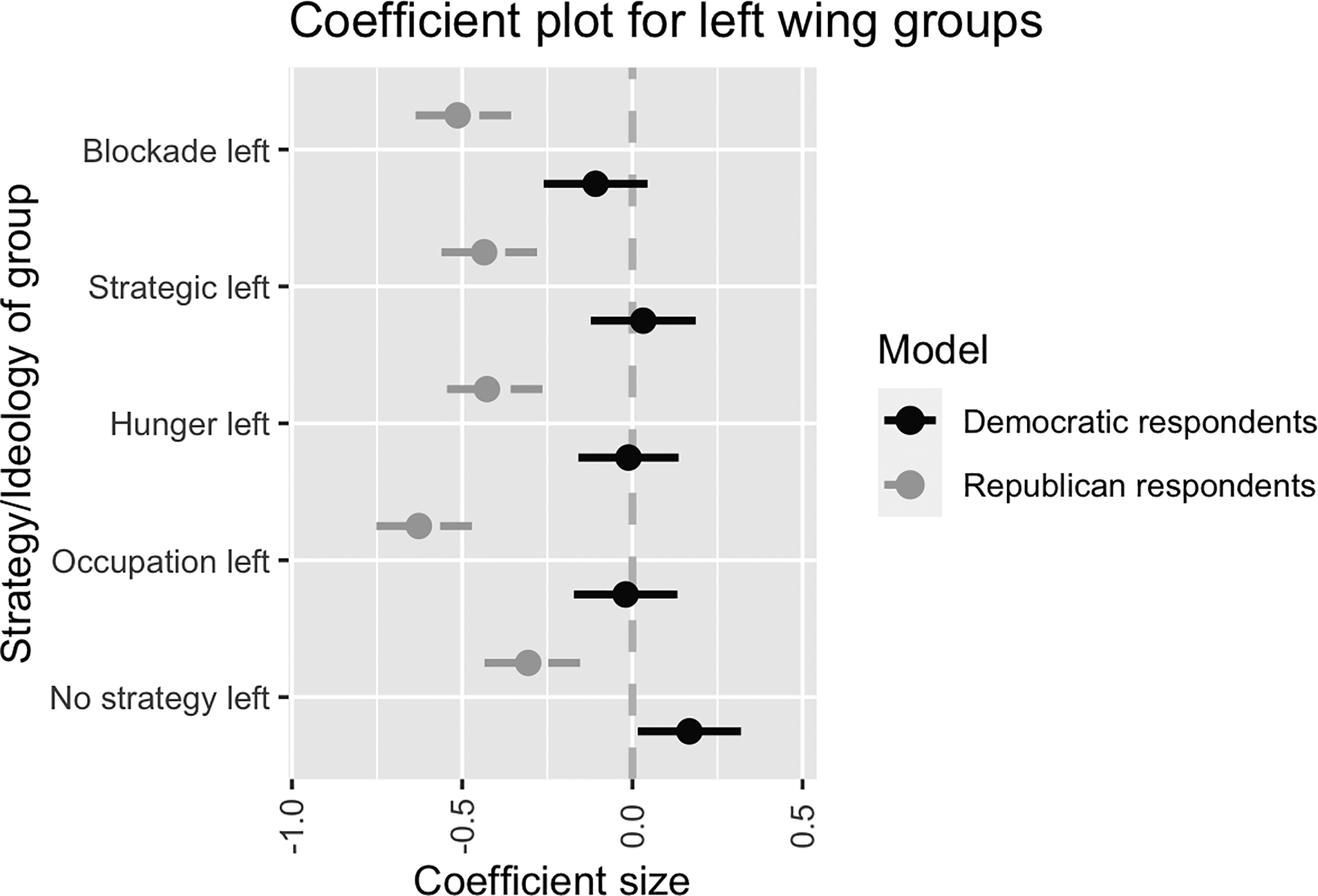
Effect of tactics and partisanship on legitimacy indicators
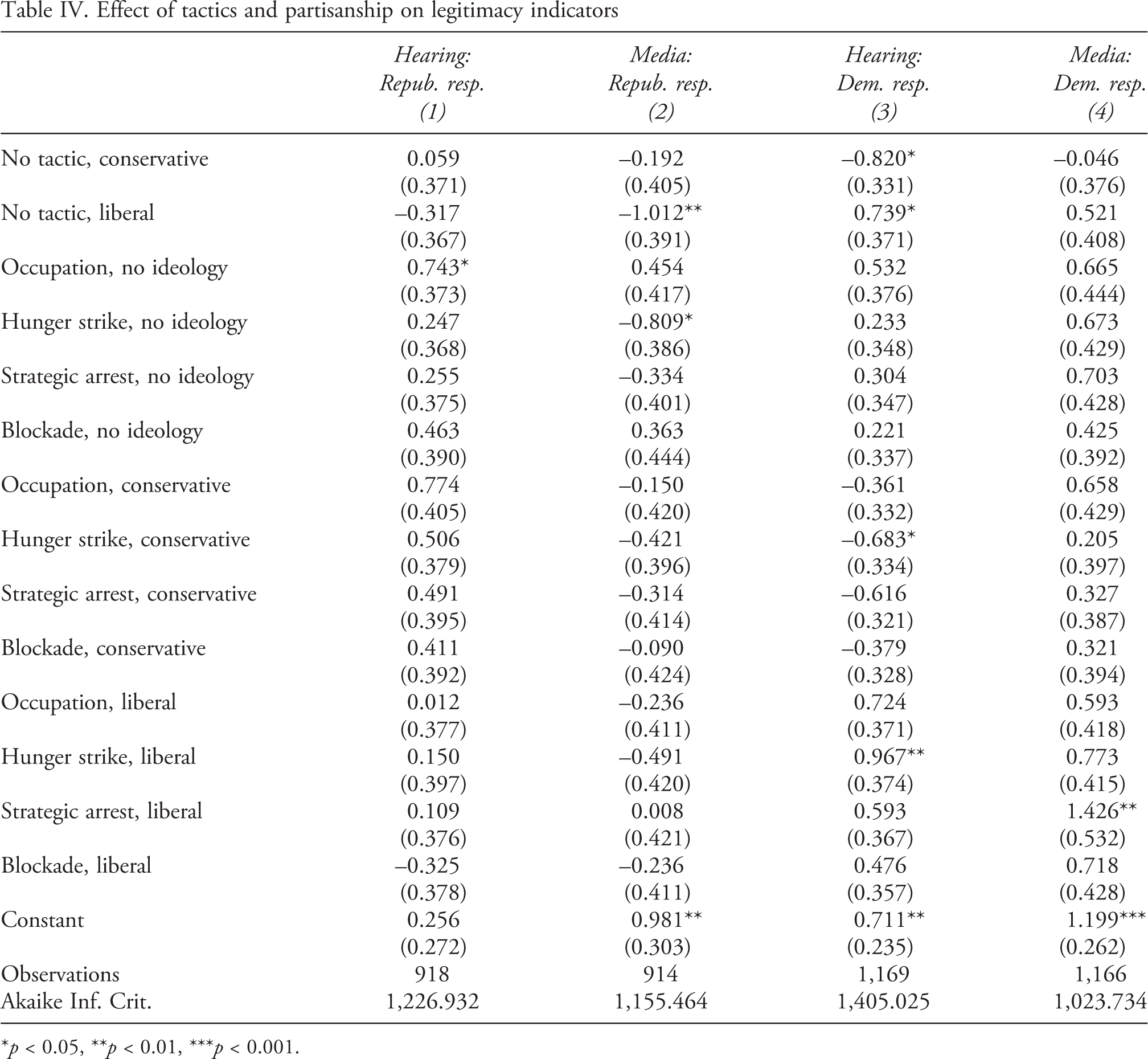
*p < 0.05, **p < 0.01, ***p < 0.001.
Conclusions
Several conclusions can be drawn from the survey experiment. First, contrary to the conventional wisdom, Americans do not tend to approve of nonviolent resistance in general. The pooled sample of respondents shows a negative response to three of out of four nonviolent tactics. These negative reactions are heightened when the group is from the opposite political party, especially when Democrats are evaluating conservative protestors. This was surprising given the assumption in the literature on nonviolence that suggests peaceful protests should engender a more sympathetic or at least accepting response. Moreover, it also raises questions about the link between tactics and public opinion in studies that compare violence and nonviolence directly. Is the positive effect of nonviolence seen in other studies driven by a disdain for violence or by support for nonviolence?
However, our additional question related to legitimacy of tactics does not mirror this pattern. Instead, we see that all four nonviolent tactics lead to a positive response to the question about whether the group deserves a Congressional hearing, and three of our four tactics lead to a positive significant response on the media attention questions. Thus, our tactic treatments induce disapproval of groups using them but an increased perception of the group’s legitimacy (with the exception of hunger strikes).
Second, partisanship conditions the way that respondents evaluate nonviolent tactics of resistance, but not necessarily in ways we expect based on conventional wisdom that liberals favor civil resistance while conservatives eschew such protests. Instead, the disapproval of nonviolent tactics based on opposing partisan identification is reflected strongly in the findings. The variation we see in the legitimacy indicators is also notable. With the Democratic respondents, we see a negative effect of partisanship for some tactics, but this is not the case for Republican respondents.
Several questions emerge from this study. How can we reconcile a rise in nonviolent activism with the finding that the overall effect of nonviolent tactics is a decrease in approval? This is especially relevant when we view activism as a means to persuade others, rather than just activating a cause’s base. All of the tactics we feature in the treatments can be used with varying numbers of participants. Future experimental work could vary this factor, as well as including tactics with higher numbers (like rallies), to examine how size affects approval and assessment of tactical legitimacy. Future work could also explore whether recent nonviolent protests, especially those that arose in reaction to the COVID-19 restrictions in the summer of 2020, perhaps soured citizens’ attitudes about nonviolent means of dissent. Both of these lines of research could speak to the role that mass participation has (or not) in generating legitimacy for activists.
Footnotes
Replication data

Acknowledgements
We have profited from helpful comments provided by anonymous referees, the editor of JPR, and our colleagues. Special thanks to Shibley Telhami, Stella Rouse, Erica Chenoweth, and BBMAC.