




Abstract
This article introduces the Most Important Problem Dataset (MIPD). The MIPD provides individual-level responses by Americans to “most important problem” questions from 1939 to 2015 coded into 58 different problem categories. The MIPD also contains individual-level information on demographics, economic evaluations, partisan preferences, approval and party competencies. This dataset can help answer questions about how the public prioritizes all problems, domestic and foreign, and we demonstrate how these data can shed light on how circumstances influence foreign policy attentiveness. Our exploratory analysis of foreign policy issue attention reveals some notable patterns about foreign policy public opinion. First, foreign policy issues rarely eclipse economic issues on the public’s problem agenda, so efforts to shift attention from poor economic performance to foreign policy via diversionary maneuvers are unlikely to be successful in the long term. Second, we find no evidence that partisan preferences—whether characterized as partisan identification or ideology—motivate partisans to prioritize different problems owing to perceptions of issue ownership. Instead, Republicans and Democrats, conservatives and liberals, respond in similar fashions to shifting domestic and international conditions.
Introduction
The American public’s attentiveness to issues of foreign policy and world affairs can be characterized as both fickle and predictable. 1 Since the beginning of the Second World War, the US has been involved in a host of international crises that have captured the public’s attention to varying degrees. In recent years, the US has been the target of deadly transnational terrorist attacks and the initiator of a controversial and globally divisive war. These dramatic events have at times captivated the US public, yet the public’s attentiveness remains inconsistent. We demonstrate this duality by introducing the Most Important Problem Dataset (MIPD) and examining broad trends in foreign policy issue importance using a wide-ranging collection of survey data from 1939 until 2015.
Since the Second World War, polling companies have consistently asked American respondents to identify the “most important problem” (MIP) facing the country. Although some scholars have clearly delineated these responses from issue salience (Wlezien, 2005) or cautioned against using them as a proxy for relative spending preferences (Jennings and Wlezien, 2015), the responses are useful for showing the importance of an issue and the degree to which it is a problem (Jennings and Wlezien, 2015). In this sense, it measures individuals’ attentiveness to an issue—and priorities for government action—relative to all other issues (Bartle and Laycock, 2012; Jennings and Wlezien, 2015; Jones and Baumgartner, 2005; Soroka, 2003).
When viewed over time or across contexts, the MIP responses paint a picture of public concern for government action, which can be viewed as a public agenda of sorts (Hobolt and Klemmensen, 2008; McDonald et al., 2005; Pennings, 2005). Our motivation in gathering these data is driven by the view that responses to the MIP question are a reflection of relative issue priorities as well as attentiveness. While some might wonder whether questions about important “problems” are reflective of issue importance, Jennings and Wlezien (2011) demonstrate that a variation of the question wording that asks about the “most important issue” produces strikingly similar responses to the typical MIP question.
The problems that voters identify as the most important play a key role in forming preferences and structuring political behavior. Krosnick (1988) shows that important attitudes are more cognitively accessible to voters and thus more influential in forming opinion statements (see also Lau, 1989; Zaller, 1992), and empower voters to clearly differentiate between the positions of competing candidates. The result is that issues identified as “important” provide a stronger connection between evaluations of policy performance and incumbent support (Belanger and Meguid, 2008; Fournier et al., 2003; Lavine et al., 1996; Rabinowitz et al., 1982; Singer, 2011), especially if the issue is personally important to the voter through direct experiences (Krosnick, 1988). Indeed, we can view attentiveness toward issues as a key link between the public and leaders. As Jones and Baumgartner (2005) argue, the American public may be lacking in technical expertise on the nation’s issues, but they know what they want Washington to focus on. Representation cannot be achieved if leaders ignore the public’s agenda or if the government’s priorities drastically differ from those of the public.
In the aggregate, American presidents are typically responsive to changes in the public’s issue priorities in terms of both rhetoric and budgetary outlays (Hobolt and Klemmensen, 2008), and this responsiveness increases with the salience of the issue (Monroe, 1998; Page and Shapiro, 1983). For example, the relationship between defense spending and the public’s preferences is strongest when public attentiveness toward defense spending is high (Jones, 1994; Soroka, 2003). Responses to the MIP question can therefore be revealing at both the individual and aggregate levels.
The MIPD represents—to the best of our knowledge—the most extensive data collection available of American responses to the “most important problem” question. In addition to being able to shed light on fundamental questions of electoral accountability, democratic representation, and the foreign policy/domestic politics nexus (see above), the MIPD has several novel features that promise to be useful for empirical analysis. The collection includes all available responses from 1939 to 2015 coded into 58 problem codes, meaning that the MIPD can illuminate dynamic representation in a number of domestic policy areas as well, including crime, civil rights, social security, and macroeconomics. Moreover, the MIPD also includes sociodemographic characteristics (i.e. gender, age, marital status, etc.), economic evaluations (i.e. national and personal, retrospective and prospective), partisan predispositions (i.e. ideology, partisan identification), presidential approval, and valence assessments (i.e. best party at dealing with most important problem). The extensive data collection can thus be used for individual analyses of the origins of issue importance, explorations of variations across subgroups (to assess whether the notion of “parallel publics” extends to issue importance; see Page and Shapiro (1992)), and aggregate-level trends in the public’s issue agenda. These data are available in a variety of formats from the Roper Center for Public Opinion Research (goo.gl/GG9d87).
Our exploratory analysis sheds light on when the American public views foreign affairs as important. We find that, on average, about 23% of Americans view some foreign policy issue as the most important problem facing the country, although the overall level of attention varies widely. We demonstrate that in the aggregate, the economy usually dominates foreign policy as an important issue. We find that recessions attract a great deal of attention to the economy, and even dramatic international crises may not weaken that relationship. Thus, our preliminary analysis suggests that diversionary foreign policy is unlikely to actually divert the public’s attention. Although foreign policy may not consistently rival the issue dominance of the economy, we find that unique configurations of events (a strong economy combined with salient foreign affairs events) elevate foreign policy in the public’s consciousness. Finally, we examine whether Republicans are more likely to view foreign policy as important relative to Democratic partisans and find only limited evidence in favor of a possible partisan or ideological gap (although this is potentially contingent on both the president’s partisanship and controversial foreign policies). The clearest pattern is that partisans of all types—Democrats or Republicans, liberals or conservatives—tend to prioritize the same problems in the aggregate, and their responses reflect shifting domestic conditions (such as elite agenda-setting and media coverage) and international events (such as terrorist attacks or conflicts) rather than perceptions of issue ownership.
The MIPD potentially plays a central role in answering fundamental questions of international relations. For example, a significant strain of the coercive bargaining literature examines whether democratic leaders can issue more credible threats because they will be punished by voters if they fail to live up to their word or because visible punishment mechanisms endow democratic threats with credibility (Downes and Sechser, 2012; Fearon, 1994; Moon and Souva, 2016; Schultz, 1998, 2001; Snyder and Borghard, 2011; Uzonyi et al., 2012). The extent to which foreign policy accountability—and thus democratic credibility in coercive bargaining—exists might be contingent on whether the public views foreign policy as important. By analyzing who cares about foreign policy and when they are likely to care, users of the MIPD can further explore the domestic audience cost foundations of prominent theories. Moreover, this dataset can also illuminate the potential consequences of diversionary conflict in the US (e.g. DeRouen, 1995). By allowing users to compare the relative importance of domestic issues that leaders may be trying to divert from (social problems, a weak economy) to the importance of foreign policy, users can better understand when foreign policy is likely to surpass these other issues as the MIP. These are just two research agendas that the MIPD could contribute to, and we envision a number of other potential research uses.
In the remainder of the manuscript, we first describe our data collection efforts and highlight the novel features of the MIPD. Next, we offer some simple exploratory analysis of general trends in foreign policy issue importance. We then explore the interplay between the economy and foreign policy in an attempt to understand when foreign affairs can trump the national economy as the most important problem. Finally, we analyze how partisan and ideological gaps in foreign policy issue attention have evolved over time.
Data collection
The MIPD contains individual-level data on the issues identified by Americans as the “most important problem” facing the country. We collected all available surveys from the Roper Center for Public Opinion Research and the American National Election Survey (ANES) from 1939 to 2015 that met each of the following three criteria. First, the survey must be conducted on a nationally representative sample, which excluded surveys limited to specific states (i.e. California polls) or for specific purposes (i.e. Iowa caucuses). Second, the survey must ask some variation of the following question: “what do you think is the most important problem facing the country today?” 2 We also include variations of this question that ask respondents about the “most important issue” (MII). As Jennings and Wlezien (2011) have noted, these MII questions produce very similar responses to the standard MIP question. 3 Other versions of the question ask for the “most important problem for the President and Congress to address at this time” or “the most important problem for the government to address”, but the typical question wording (“facing the country today”) is by far the most common. Finally, the survey must provide open-ended responses. Several surveys ask the respondent to identify the “most important problem” from a list of salient problems (i.e. the economy, crime, social issues). Since these questions do not allow an open-ended response, they do not provide the level of disaggregation that we desire. We also code the fieldwork dates (to assist in fine-grained time series analysis) and the polling company for each survey (to control for possible house effects).
Based on these three criteria, we identify over 670 separate surveys that total more than 816,000 unique responses to the “most important problem” question. Figure 1 shows the number of surveys (top panel) and survey respondents (bottom panel) available annually from 1939 to 2015. Surveys that meet our three criteria for inclusion are rather sparse in the first couple of decades of the time series, with 1943 failing to have any surveys. During this time, we see a slight uptick in surveys during presidential election years (most notably 1960). Nevertheless, the lack of breadth in surveys in the late 1950s and early 1960s is slightly offset by the larger samples taken. Starting in the 1980s, there are at least six surveys available annually (with the exceptions of 1988 which only has five and 2015 which only has data available to June). With these exceptions in mind, one can produce a meaningfully long annual time series of issue importance from 1939 to 2015, and even more fine-grained time series (possibly monthly) from 1980 to 2015. Population weights are included if available.
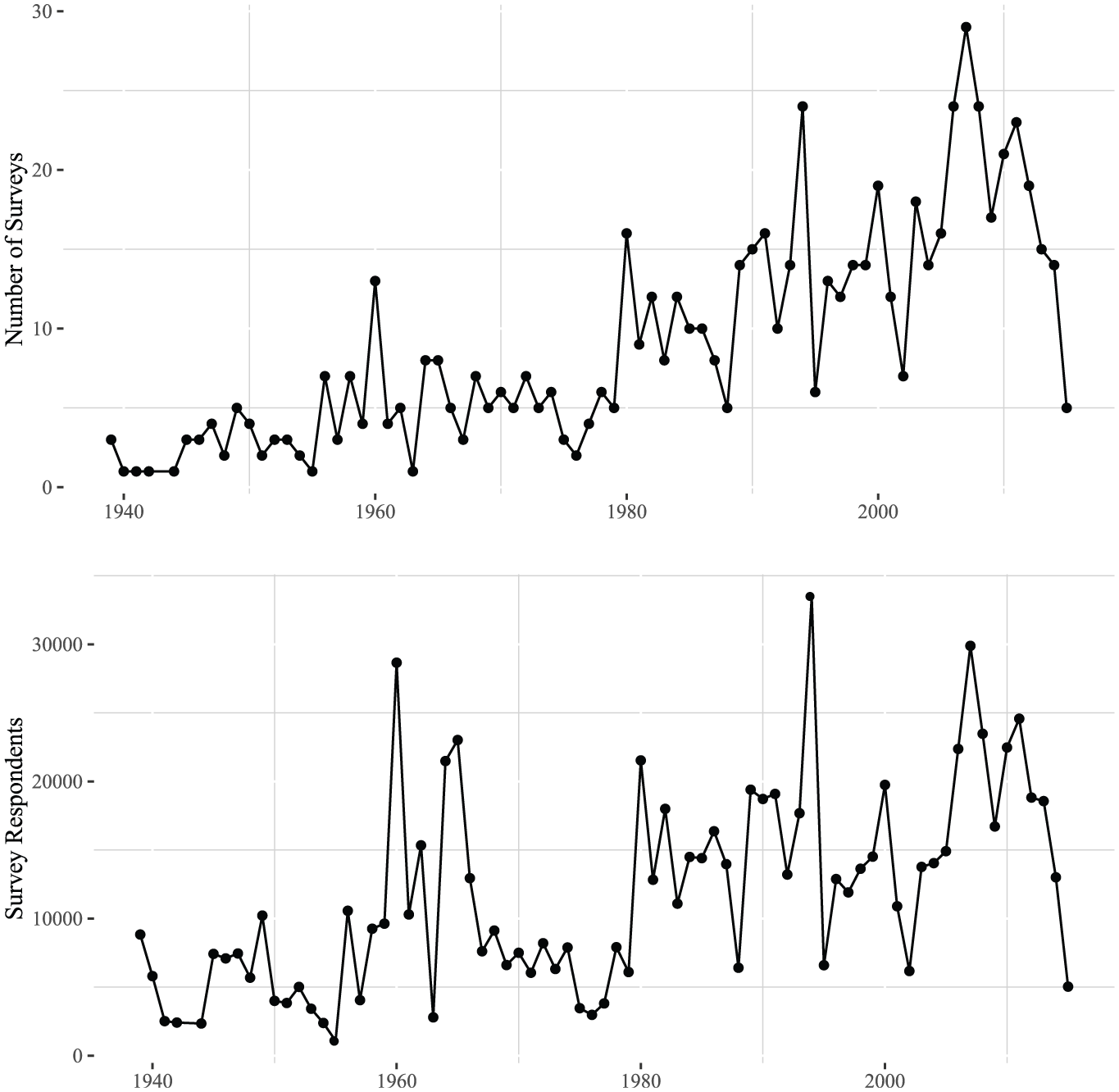
Number of surveys and survey respondents by year, 1939–2015.
Gallup polls make up almost 50% of the total respondents, and the data are almost solely composed of Gallup and ANES respondents until the late 1970s (at which point CBS surveys become available) and the early 1980s (at which point Los Angeles Times surveys become available). The last several decades of the dataset feature a substantial number of respondents from a few firms (in order of contribution, Gallup, CBS, Los Angeles Times, ABC and Pew), and sporadic surveys from other firms (Associated Press, New York Times, Times Mirror and Washington Post). More information on interview modes, samples, and response rates is available in the Codebook.
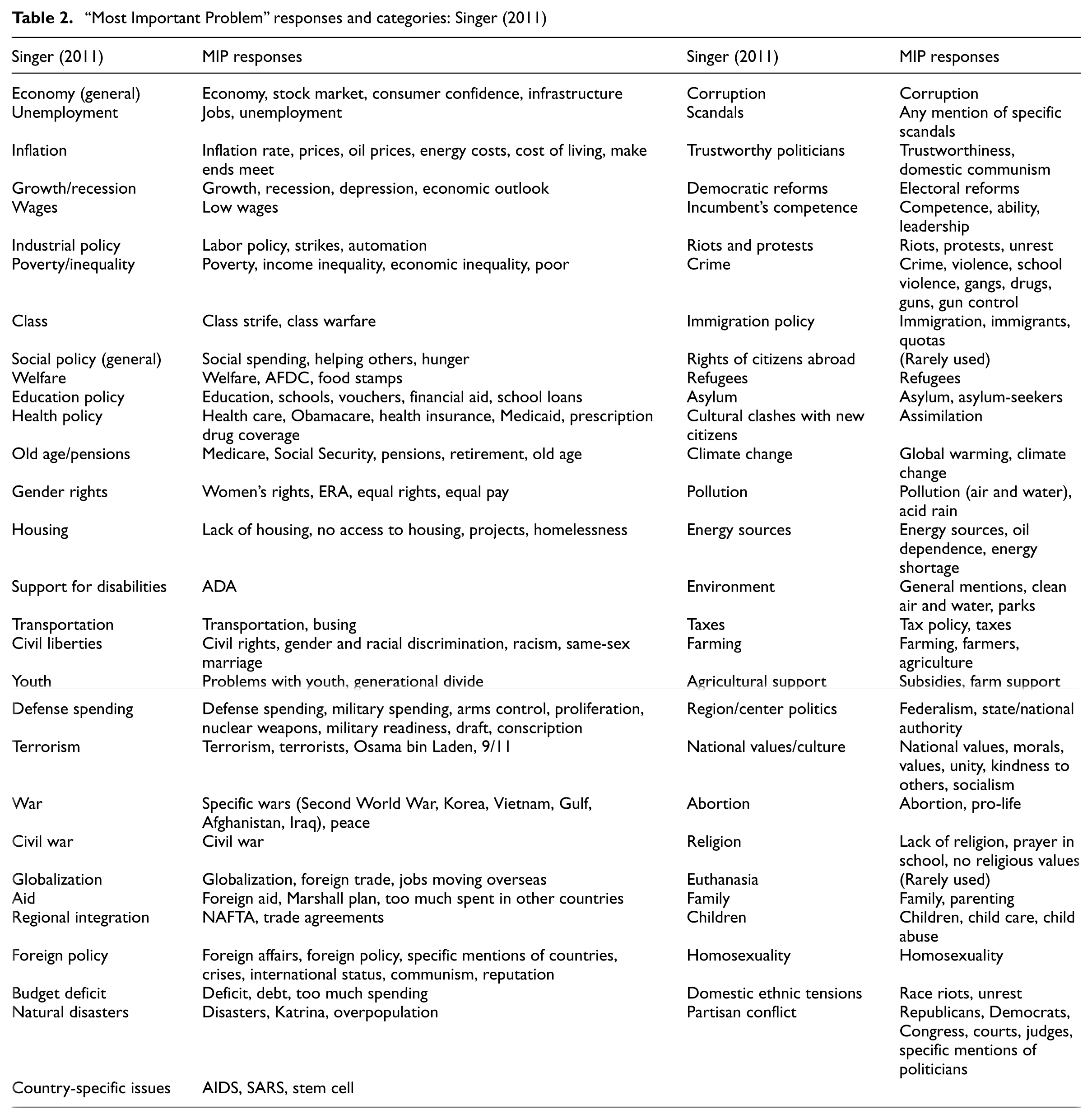
Open-ended questions result in voters identifying thousands of distinct problems. In an effort to produce broad problem categories while still producing data suitable for fine-grained analysis, we employed the coding scheme introduced by Singer (2011). The 58 problem codes perform quite well in effectively categorizing the vast majority of problems over the 70+ years examined; only about 4.6% of the responses were coded as “other country-specific issues”. If the survey asked respondents to identify the second and third most important problems these are assigned using the same coding scheme. The problem codes are purposely quite specific so that they can easily be aggregated up to more meaningful larger categories such as the eight issue domains used by the Manifesto Research on Political Representation (MARPOR) project to code party manifestos (Volkens et al., 2014) and the scheme used by the Comparative Agendas Project (CAP) (Baumgartner and Jones, 2002).
In Tables 1–3 we show how issues were categorized and coded using the MARPOR, Singer and CAP schemes, respectively. These tables show every issue category that we coded in the dataset and clarify what users can expect each coding category to encompass. For example, MIP responses referencing health care, Obamacare, health insurance, Medicaid or prescription drug coverage are coded as “health policy” in the Singer coding scheme. These same issues are coded into the “welfare and quality of life” category in the MARPOR scheme and “health” in the CAP scheme.
“Most Important Problem” responses and categories: MARPOR (Volkens et al., 2014)

Notes: ERA, Equal Rights Amendment; ADA, Americans with Disabilities Act. †Volkens et al. (2014).
“Most Important Problem” responses and categories: Singer (2011)
“Most Important Problem” responses and categories: CAP (Baumgartner and Jones, 2002)
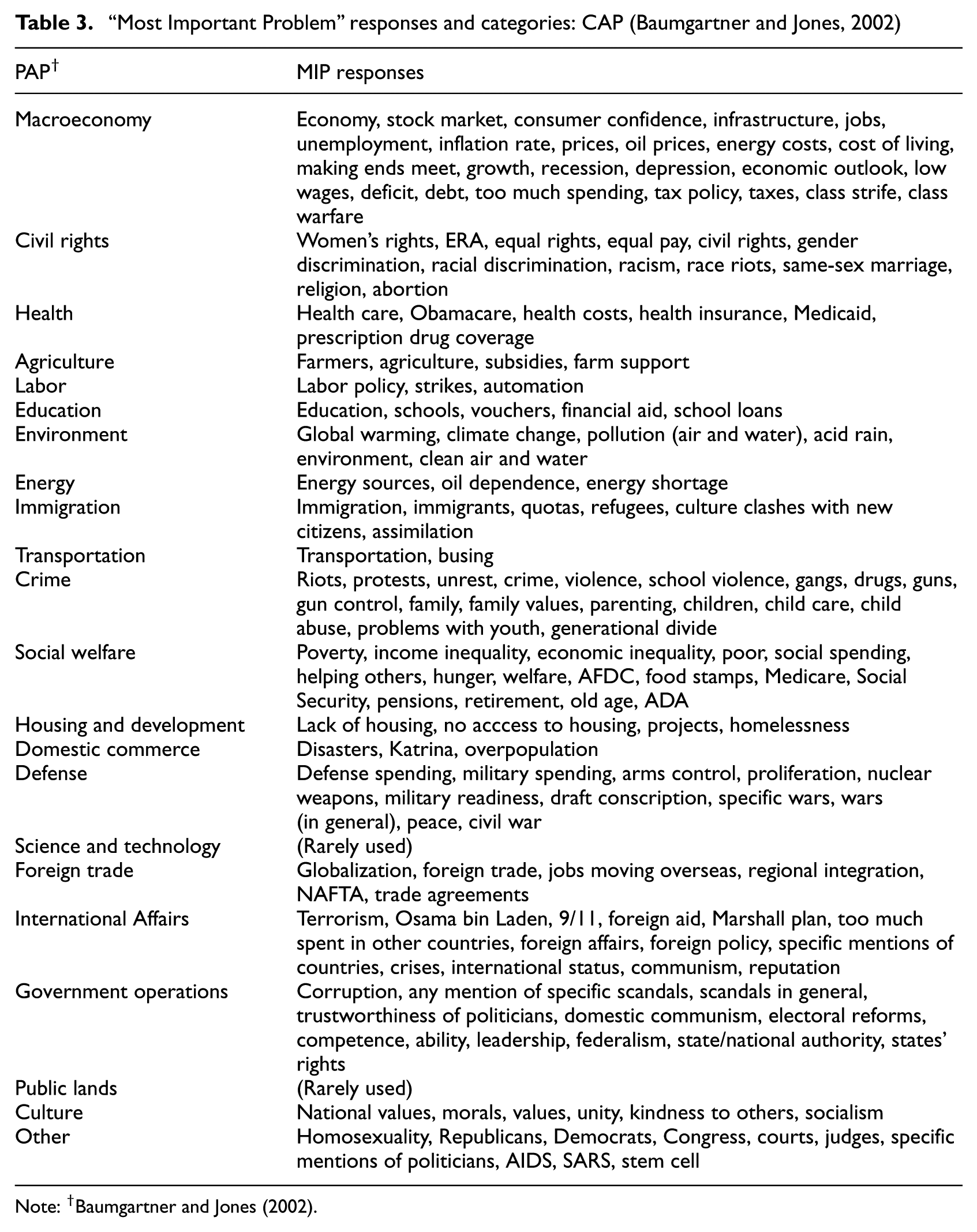
Note: †Baumgartner and Jones (2002).
A novel contribution of the MIPD that paves the way for deeper exploration of the origins of issue importance is the availability of other individual-level variables grouped into four broad categories. The first category contains political variables measuring vote choice variables (including previous vote and vote intention for both Congress and President), interest in politics (coded as “not at all”, “not particularly”, or “yes”), ideology (coded as “liberal”, “moderate/neither”, or “conservative”), and partisan identification (coded on a seven-point scale from “strong Democrat” to “strong Republican”).
The second group includes evaluations of the status quo. Most notably this includes the typical presidential approval response (“do you approve or disapprove of the way [president] is handling his job as president?”), as well as evaluations of handling specific crises (e.g. North Korea), wars (e.g. Korea and Vietnam), natural disasters (e.g. Katrina), and policies (e.g. deficit, disarmament, etc.). The presidential approval question is widely available (nearly 700,000 responses spread across 581 surveys), with a few specific approval questions also being consistently asked (such as the economy and foreign policy, with more than 324,000 and 268,000 responses, respectively). Economic evaluations are also included in the MIPD so that scholars can observe how issue importance covaries with assessments of the economy. This includes both retrospective and prospective evaluations of the national economy, inflation, unemployment, and personal financial situation. All of these variables are coded on a three-point scale (“worse”, “stay the same”, or “better”).
The third group of variables includes valence variables (Clarke et al., 2009; Stokes, 1963). Since 1944 polling agencies have consistently asked respondents to identify the party that is best at handling the most important problem. Almost 277,000 responses are available from 230 surveys during this time period. Additionally, polling companies often inquire about the best party at handling specific issues that are salient at that time. The MIPD includes 46 different problem-specific questions that are asked multiple times, including questions on issues like economic prosperity, peace, terrorism, low taxes, inflation, and others. While specific questions are asked less consistently than the general question, there are a few that are useful for time-series analysis of issue importance in shorter periods (such as the surveys asking about Iraq or Vietnam).
The final category includes sociodemographic variables such as gender, age, class, education, income quartiles (calculated for each survey), marital status, race, church attendance, religiosity, geographic region, employment status, union membership, and home ownership. These four broad categories can be used in conjunction with an analysis of issue importance at the individual level or can be aggregated for time-series analysis outside the context of issue importance, such as an analysis of the relationship between assessments of the economy and identification of the best economic manager.
At this point it may be helpful to compare the MIPD to an alternative data source of issue importance. As part of their cross-national data collection, the CAP provides quarterly and annual data containing the percentage of the population identifying 23 major topics as the “most important problem” in Gallup surveys from 1947 to 2012 (Baumgartner and Jones, 2002). At first glance, there appears to be considerable overlap between these two sources, yet the MIPD offers several notable differences. The most notable difference is that the MIPD contains individual-level responses rather than aggregated percentages. Scholars can test any number of individual-level hypotheses regarding issue importance with the MIPD, or they can aggregate those responses to annual data (or even more fine-grained temporal sequences, such as monthly).
The MIPD improves aggregate analyses of issue importance by including data from a variety of polling companies (rather than solely Gallup data), offering specific dates of the fieldwork (thus allowing studies that measure responses to events within the year), and by allowing responses to be aggregated by subgroups based on political preferences (Democrats vs Republicans, conservatives vs liberals, etc.), evaluations (those who approve of the president vs disapprove), or sociodemographics (men vs women, poorest quartile vs richest quartile, etc.). Finally, the open-ended responses are coded into 58 problem codes, which allows more detailed analysis than the 23 major topics in the CAP coding scheme. To increase the dataset’s compatibility with other sources, we have also coded the individual-level responses into the CAP coding scheme. 4
Altogether, this means that users can explore a number of research questions with the MIPD—either at the individual level or in the aggregate—that they cannot with the CAP data. For example, an analysis of how elite framing influences the relative issue importance of prices versus unemployment would be impossible with the CAP (because they are both coded as “macroeconomics”), but possible with the more disaggregated coding scheme of the MIPD. Users can take this one step further and ask whether Republicans and Democrats react differently to elite framing of issues while controlling for key factors (e.g. income, age) at the individual level. At the same time, uniformity across coding schemes means that the MIPD can complement empirical analyses based on data from the CAP (such as media coverage, budget outlays or Congressional bills) or from other CAP countries. For these reasons, the MIPD has many strengths that make it a valuable complement to the CAP.
Foreign policy issue importance over time
Here we demonstrate the usefulness of the MIPD via an exploratory analysis of foreign policy issue importance over time. For at least the last 94 years there has been an important debate surrounding the extent to which Americans hold strong, consistent foreign policy preferences (e.g. Aldrich et al., 1989; Almond, 1950; Holsti, 1992; Lippmann, 1922, 1925). The question of whether voters in the US possess weak or strong attitudes about foreign policy is inextricably related to the importance of foreign policy. Individuals who believe that foreign policy is important are potentially more likely to possess consistent foreign policy preferences. More broadly, the MIPD contributes to this ongoing conversation about the public’s relationship with foreign affairs by explaining when people view foreign policy as a problem. Of course we do not presume that preferences and salience exist in a vacuum. Increased media coverage of crises (Soroka, 2003), as well as prominent statements in support or opposition by political elites from both parties, exposes individuals to the issue and increases its accessibility, and ultimately increases the chance that the issue will be used in crafting a political preference (Zaller, 1992).
To introduce readers to the aggregate time series trends in foreign policy issue importance, we start with a descriptive analysis ranging from 1939 to 2015. Figure 2 presents the percentage of respondents in surveys identifying a foreign policy issue (“External Relations” in Table 1) as the most important problem facing the country. 5 The line (and shaded intervals) depict the smoothed relationship created by natural cubic splines based on nine knots (with 95% confidence intervals). Vertical shaded regions depict the presence of inter- or extra-states wars: the Korean War (1950–1953), the Vietnam War (1965–1973), the Gulf War (1991), the War in Kosovo (1999), the Afghanistan War (2001), the Iraq War (2003) and the ensuing insurgencies in Iraq and Afghanistan (through 2010). Text annotations identify prominent international events that correspond to changes in foreign policy issue importance.

Foreign policy issue importance, 1939–2015.
Foreign policy issue importance has fluctuated greatly over time. In fact, over 70% of respondents identified a foreign policy issue as the most important problem in several surveys taken during the early 1960s, whereas a much smaller percentage indicated that foreign policy was the nation’s top priority from the 1980s on. Across the entire time period of analysis, we see that attentiveness to foreign policy as the most important problem sharply increased after the end of the Second World War, and increased further with the onset of the Cold War (1947).
It is clear from Figure 2 that foreign policy issue salience ebbs and flows following major wars, and we see this particularly with the Korean and Vietnam wars. One key difference between the Korean and Vietnam wars is that foreign policy issue importance increased during the Korean War and decreased during the Vietnam War despite both periods featuring active foreign policies. That is, foreign policy was a prominent topic in Americans’ minds at the onset of the Vietnam War (1965), but this interest diminished as the war continued. The post-Vietnam period demonstrates a rapid drop in the percentage of respondents identifying foreign policy as the country’s most pressing issue, suggesting that respondents turned toward other issues as the war ended.
Those international crises that do not escalate to war also seem to be important during the early years of the Cold War, as many listed foreign policy as the MIP in the period between the Korean and Vietnam wars. One particular high point worth noting is the Cuban Missile Crisis in 1962. When the public found out that the Soviet Union had deployed nuclear-capable missiles to Cuba, over 50% of respondents viewed foreign policy as the nation’s top problem. In fact, this event signifies the peak of foreign policy issue importance across all time periods examined in the study (with the exception of a Gallup survey occurring during the Second World War in November 1941). So while wars do seem to grab the public’s attention, significant crises short of war can be equally captivating, although over much shorter periods of time.
The public’s attention to foreign policy issues eventually rebounded from the post-Vietnam lull in the late 1970s and the early 1980s. Indeed, after the Soviet Union invasion of Afghanistan in December 1979 and Reagan’s abandonment of detente, tensions between the West and the Soviet Union steadily escalated. This phase of deteriorating relations between the two blocs reinvigorated American attention toward issues related to foreign policy. Furthermore, other significant foreign policy events such as the Iran Hostage Crisis (1979–1981), the Invasion of Grenada (1983), and the Iran-Contra Affair (1986) further elevated the issue prominence of foreign policy. Again, we see that events short of war can drive the public’s prioritization of foreign policy.
However, the collapse of the Berlin Wall in 1989 and the end of the Cold War in 1991 led to plummeting numbers for the issue salience of foreign policy. Less than 10% of respondents indicated that foreign policy was the nation’s top issue during the mid-1990s in most surveys. Not surprisingly, the 9/11 terrorist attacks, the subsequent invasion of Afghanistan, and the invasion of Iraq resuscitated foreign policy issue importance for the American public. More than one-quarter of respondents chose foreign policy as the country’s most important problem from 2001 through to the middle part of the decade. Attentiveness to foreign policy reached levels unseen since the Cuban Missile Crisis around the time of the troop surge in Iraq, which was announced by Bush in October of 2007. Owing possibly to war fatigue and the burgeoning financial crisis of 2008, Americans began to worry less about foreign policy during the latter part of the decade. Since Obama declared the end of combat operations in Iraq in August of 2010, the percentage of respondents identifying a foreign policy issue as the MIP has consistently hovered around 10%. These patterns of salience suggest that major foreign policy crises and wars have driven the US’s attentiveness toward foreign affairs.
Issue competition: foreign policy vs the economy
The MIPD reveals interesting patterns concerning tradeoffs between foreign policy and other issues as well. By analyzing the relative importance of foreign policy, users can make new inferences in fundamental questions of international conflict. For example, research on the domestic determinants of conflict has argued that leaders divert from a flagging domestic economy by provoking some sort of international crisis (Brule and Hwang, 2010; DeRouen, 1995; Jung, 2014; Mitchell and Thyne, 2010; Morgan and Anderson, 1999; Pickering and Kisangani, 2005). Yet there is little systematic evidence about whether the public’s attention can be diverted during bad economic times outside of Singer (2013: 406), who highlights the competition between the economy and foreign affairs in his analysis of issue importance during the recent economic slowdown (2000–2011). As the economy worsened, Singer finds that the public’s attention shifted toward the economy, crime and corruption and away from social policy, the environment and foreign policy. With the use of the MIPD, we can adjudicate between theories of diversionary war (which assume an increase in foreign policy issue attention) and theories of relative issue importance (which explain issue attention in terms of tradeoffs). Our data can help analyze this issue in more detail by looking outside of periods of economic recession and by examining a longer time period in general.
Figure 3 details the importance of foreign policy and the economy 6 relative to all other problems from 1939 to 2015, where vertical shaded bars indicate economic recessions. These findings largely echo what Jones and Baumgartner (2005) demonstrate, which is that economic and security-related issues are the most important issues for the public in the aggregate. We can infer from this figure that foreign policy has not been consistently more important than the economy by a large margin in the minds of voters since roughly the end of the Vietnam War. Although foreign policy does barely edge out the economy as the most important problem directly following 9/11 and throughout the early part of the 2000s, the difference is slight and vanishes by 2008. However, when comparing foreign policy and economic issues with all other issues combined, we see that the 1990s is the only time period where all other issues combined consistently edged out both of foreign policy and the economy.
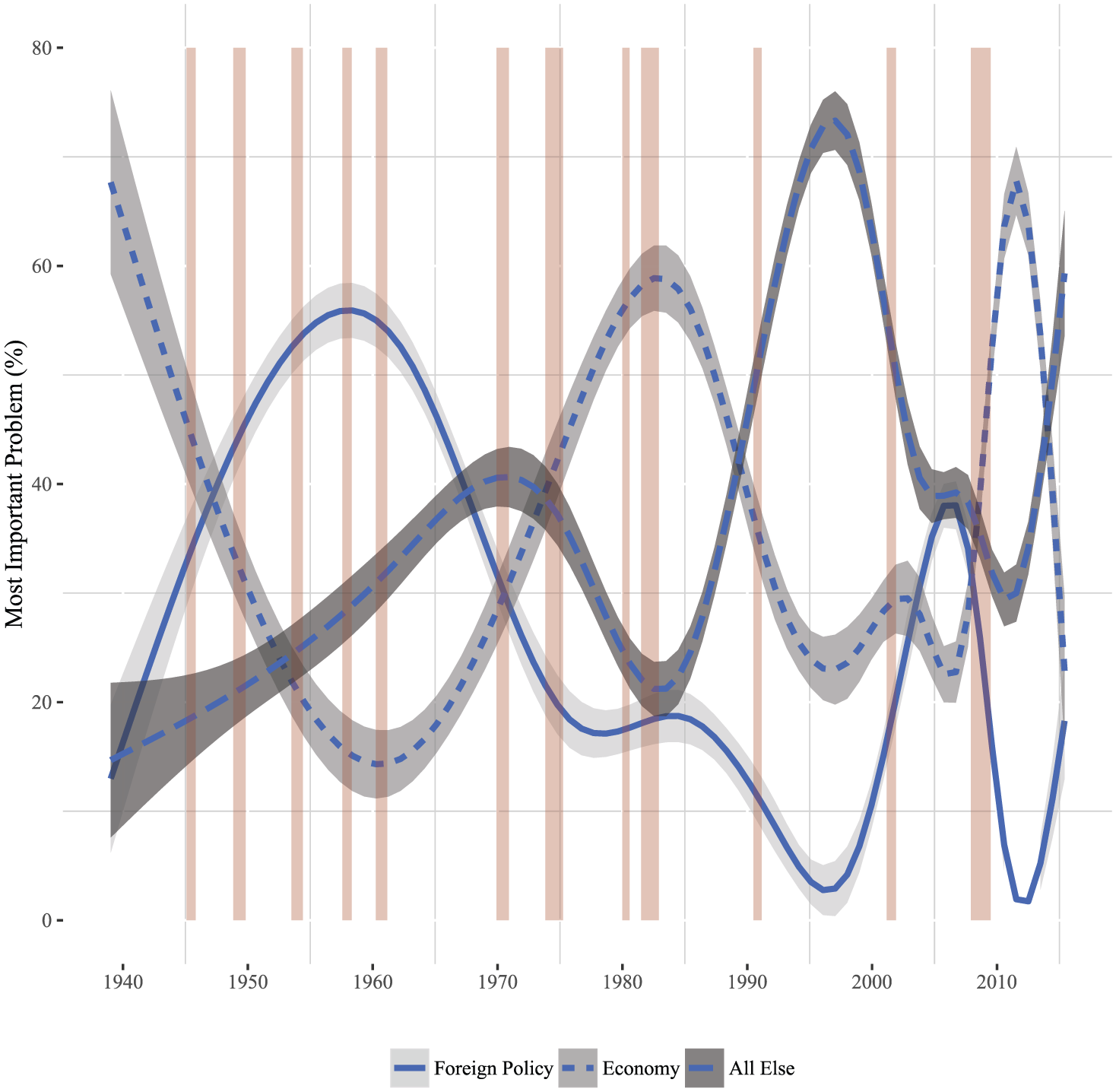
Issue importance of the economy and foreign policy relative to all other problems, 1939–2015.
More generally we see that the economy is unsurprisingly viewed as the most pressing issue during periods following economic recession, especially when multiple recessions occur within a short period of time or when a recession is particularly prolonged (e.g. the Great Recession and the early 1980s). However, one decade stands in sharp contrast to this generalization: the 1950s. Despite a series of short episodic recessions during this time period, foreign policy was still perceived as the most important issue, probably owing in part to the Korean War and general Cold War tensions between the US and the Soviet Union.
The 1960s provide a clear example of when we can expect foreign policy to outpace the economy as the most salient national issue. Only one short recession occurred (1960–1961), and the Vietnam War dominated the nation’s attention for obvious reasons. Although it is not surprising that foreign policy was widely seen as an important problem during this period, its dominance is as much due to a relatively healthy economy as the controversial war itself. The 1970s clearly run counter to the 1960s, as a series of recessions and significant economic problems sent the economy to the top of most respondents’ minds. Interestingly, the OPEC oil embargo (1973–1974) seems to have increased the importance of the economy relative to foreign policy, probably because it affected prices for most Americans. This implies that events that are inherently both international and economic seem to draw attention to the economy as opposed to foreign affairs.
The economy maintained a relatively moderate edge over foreign policy through the 1980s and 1990s, with the gap narrowing but not closing during the Persian Gulf War. Although Reagan, Bush, and Clinton all pursued active foreign policies, only the Persian Gulf War threatened the importance of the economy, and attentiveness to foreign policy reached a clear nadir through the 1990s in tandem with a relatively healthy economy. It was during the 1990s that issues outside the scope of foreign policy and the economy—driven by problems dealing with crime, national values and partisan conflict—tended to dominate the public’s agenda. Attention spiked following the 9/11 attacks, but as noted above, the Great Recession sent foreign policy tumbling once again in 2008. The overall point that we can glean from this data is that the economy has tended to dominate foreign policy as a salient problem in the minds of the US public outside of the 1960s and a brief time period following the 9/11 attacks and subsequent US-led invasions of Afghanistan and Iraq.
This exploratory analysis suggests that leaders’ attempts to divert from a bad economy is unlikely to work. The public’s attention is sharply focused on the economy during recessions, and even dramatic international crises may not increase the relative importance of foreign policy from the public’s point of view. Furthermore, unless foreign policy issues are deemed as important, they are not cognitively accessible to voters (Aldrich et al., 1989), and will not influence either candidate assessments or vote choice (e.g. Belanger and Meguid, 2008; Fournier et al., 2003). By analyzing the public’s attentiveness toward these issues, we can gain a clearer understanding about the logic and strategic usefulness of diversion. By recontextualizing diversionary theory from the public’s perspective, the MIPD addresses whether public opinion responds to crises in the manner that theories of international relations assume that it does.
Partisan and ideological gaps
The partisan gap
Much of the extant literature on the domestic determinants of foreign policy has examined the relationship between partisanship and military conflict. Many of these studies take a broad cross-national perspective, arguing that democratic leaders of one partisan or ideological disposition or another are likely to use force under specific circumstances in order to please voters (e.g. Fordham, 1998; Gowa, 1998; Koch, 2009; Palmer et al., 2004; Arena and Palmer, 2009). For example, Palmer et al. (2004) argue that conservative leaders have a freer hand in using military force because the public is less likely to vote against right-wing/conservative parties for using force. However, this analysis and many others rest on notions about partisan and ideological gaps (or non-gaps) in the foreign policy attentiveness of the public. If, for example, Republicans are only liable to care about foreign policy during Democratic presidencies, then our assumptions, theories, and overall understanding of partisanship and foreign policy would change drastically. The MIPD reveals whether these theories are on solid ground.
Other recent analyses have examined how partisanship and ideology affect public opinion attitudes about foreign policy (e.g. Gries, 2014; Milner and Tingley, 2015; Urbatsch, 2010), while others have looked at how the perceived salience of foreign policy crises and perceptions of issue ownership drive political candidates to emphasize foreign policy during campaigns (Petrocik, 1996) or during parliamentary debates (Williams, 2014). Indeed, it is reasonable to expect that partisan loyalties—whose preferences are shaped by different personal experiences, attention to elite messages, and use of varying media sources—would have different levels of foreign policy issue attentiveness; the question is whether the groups respond similarly (i.e. as “parallel publics”) to changing domestic and international conditions (Page and Shapiro, 1992: 286–287). To demonstrate how the MIPD informs these debates we provide an initial exploration of partisan and ideological gaps in foreign policy attentiveness over time.
In Figure 4 we present the percentage of Republicans and Democrats over time identifying foreign policy issues as the most important problem.
7
Several interesting patterns emerge as we search for possible partisan and/or ideological gaps in perception of foreign policy issue importance. The conventional wisdom is that Republicans are more concerned about foreign policy issues than Democrats. If this were true, then we would expect to see the dots and line for Democratic respondents (left panel) be consistently lower than those of Republicans (right panel). What we see runs counter to this intuition though. So while Republicans are perceived to view foreign policy issues as important relative to Democrats, this difference is neither overwhelming nor temporally consistent. The difference is not merely a function of the president’s partisanship either; it is not the case that Democrats are automatically more skeptical of war-time Republican presidents, and Republicans do not appear to be unconditionally more concerned about foreign policy issues when a Democratic president presides over a conflict either. Moreover, the two percentages are highly positively correlated
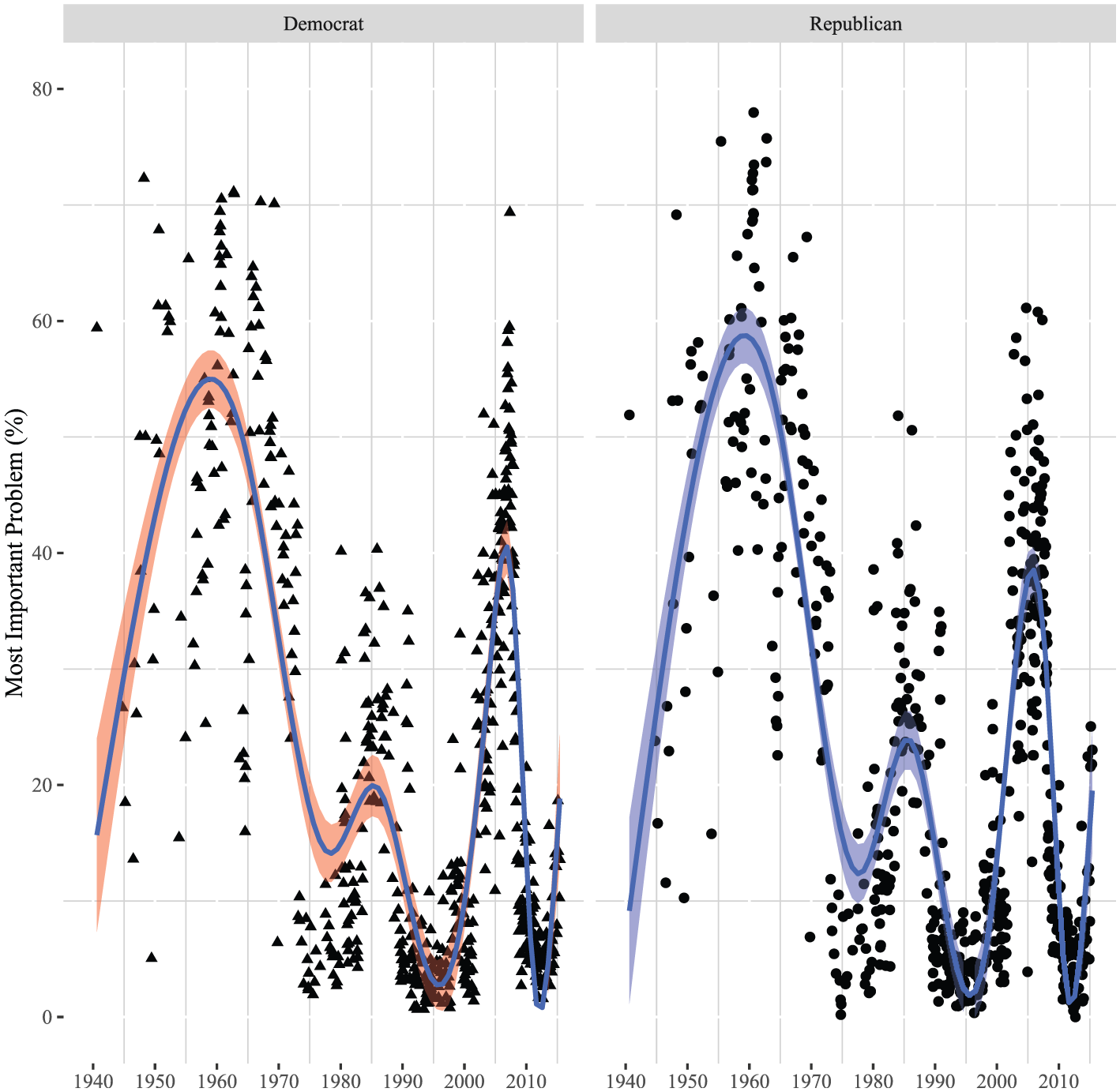
Foreign policy issue importance among Republicans and Democrats, 1939–2015.
The number of polls providing information on respondents’ party identification is low prior to 1950, but it appears as though Democrats were more concerned about foreign policy as the Second World War began to wind down and the Cold War began. However, this partisan gap closed quickly near the onset of the Korean War, and Republicans continued to be more concerned than Democrats both throughout the war and throughout the 1950s, with the net difference peaking at about 6% in the latter part of the decade. So while Republicans did seem to become more concerned about foreign policy as Truman navigated the Korean War, this gap held and even increased during Eisenhower’s presidency.
Interestingly, this difference between Republicans and Democrats shrank during the Vietnam War. As we saw in Figure 2, the public was highly concerned about foreign policy during the Vietnam War, but this sharp increase in importance at the onset of war was even across Republicans and Democrats. There was a moderate shift as Democrats seemed to become more concerned about foreign policy relative to their Republican counterparts when Nixon took office, but this difference evaporated during the latter part of Nixon’s presidency and Ford’s time in office.
During Carter’s presidency, the difference between partisans was mostly indistinguishable, and this held leading into the 1980 election. This is intriguing, partly because foreign policy is frequently assumed to have been a key issue in the 1980 election. Reagan may have used Republican ownership of security issues to campaign against Carter (e.g. Petrocik, 1996), but the public, regardless of partisan allegiance, was equally disinterested in foreign policy at the time. Republicans were slightly more concerned about foreign policy than Democrats throughout Reagan’s presidency, although this difference waned once George H.W. Bush took office.
The end of the Cold War and the ensuing foreign policy crises (Somalia, NATO intervention in Bosnia, the War for Kosovo) appear to have triggered a steady increase in Republican concern about foreign policy during the Clinton administration. Although Clinton did not preside over a US war in the same sense as Truman, Johnson, or Nixon, Republicans became increasingly concerned about foreign policy throughout the 1990s until George W. Bush’s election in 2000.
The partisan gap began shrinking after 9/11 and the subsequent invasion of Afghanistan. As the issues of transnational terrorism stemming from the Middle East and the so-called Global War on Terror dominated headlines, the difference between partisans decreased and Democrats and Republicans found themselves equally concerned about these broad foreign policy issues. This convergence continued through the invasion of Iraq in 2003, and as Bush’s presidency came to a close, Democrats were moderately more concerned about foreign affairs than GOP supporters (about 5%). This difference began fading shortly after Obama took the White House in 2008, implying that Democrats were less concerned about the management of foreign affairs with a co-partisan in office. This appears to be true of Democratic identifiers across time after 1950 in general.
As with Truman and Republicans, it seems that partisans opposite of the president tend to view foreign policy as important when a war is perceived as going badly, although we did not really observe this with Johnson and Republicans. In general though, the differences between partisans over time look idiosyncratic. Reagan campaigned on foreign policy, and Republican identifiers tended to view it as an important issue throughout his presidency. Clinton said relatively less about foreign affairs, and Democrats in the 1990s were less inclined to view these issues as important. The extent to which presidential candidates can even leverage this difference in elections is also probably contingent on actual events beyond their control and the overall level of attentiveness of the US public to these events (see Figure 2). Although foreign policy is sometimes framed as a Republican-owned issue, the gap in concern between Republicans and Democrats has remained slight over time and appears to be partially related to both the president’s partisanship and ongoing large-scale foreign policy crises.
The ideological gap
Figure 5 examines the possibility of an ideological gap in foreign policy issue importance by depicting the percentages of those who identify as liberal (left panel) vs those who identify as conservative (right panel).
8
This question did not appear with much regularity until the 1980s, so we can only make limited inferences prior to the Reagan administration. However, some differences have emerged over the last several decades. The periods where one shaded area is bigger than the other would be evidence of an ideological gap in foreign policy issue attention. Much like the evidence of a partisan gap, there is positive correlation between the subgroups’ issue priorities over time
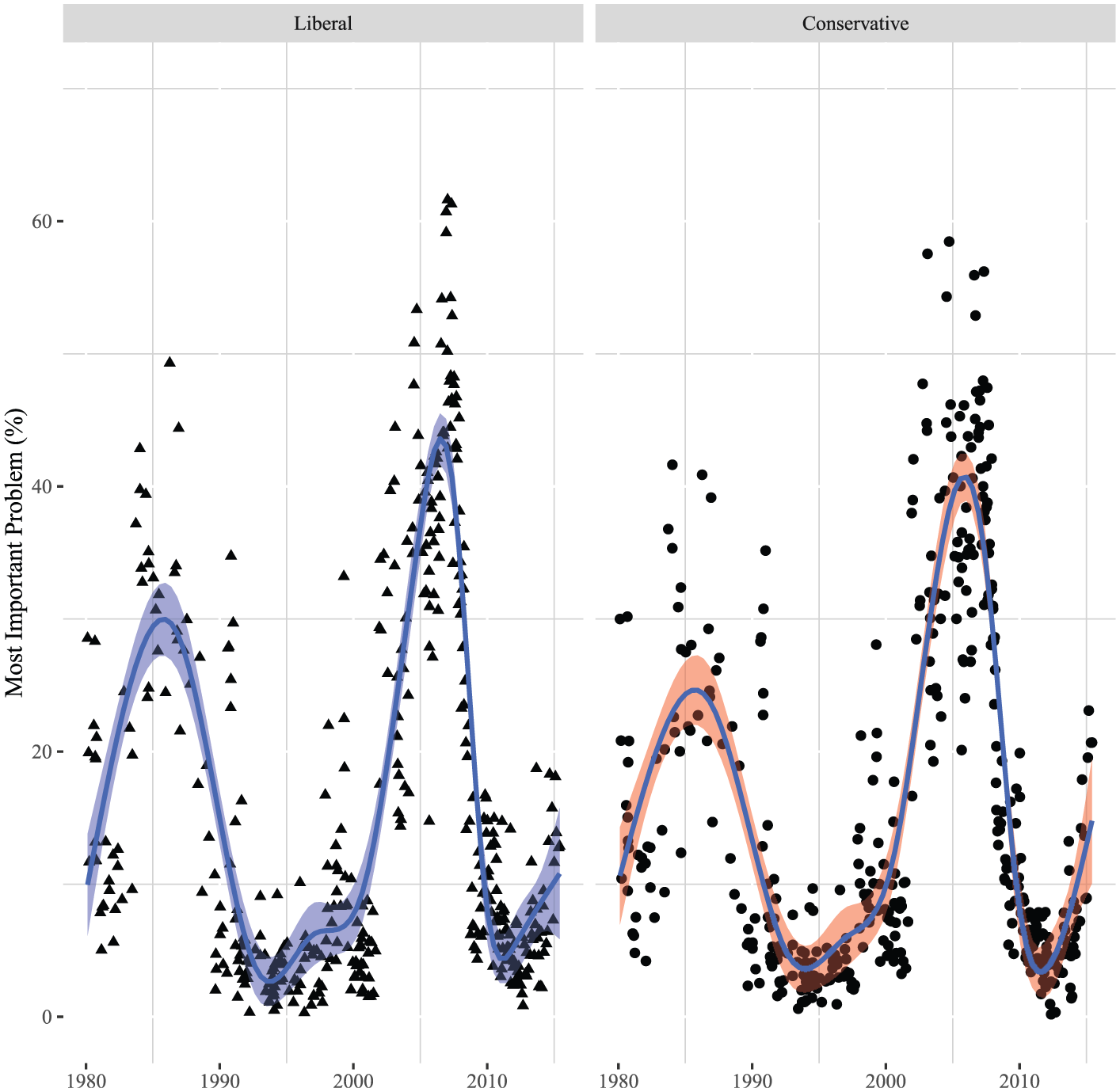
Foreign policy issue importance among conservatives and liberals, 1980–2015.
First, we see that liberals were slightly more concerned about foreign policy than conservatives during the Reagan administration and the final portion of the Cold War. This contrasts with a finding noted above, which was that Republicans were more concerned about foreign policy during the 1980s. Although these facts may seem contradictory, they ultimately imply that there was a segment of liberal Republicans that paid close attention to foreign policy throughout the 1980s. However, this difference evaporated in the 1990s, as neither ideological group was more or less concerned about foreign affairs until the very end of Clinton’s presidency, when conservatives began to take more interest in foreign affairs. This is potentially a function of NATO’s intervention in Kosovo, but the gap continues to widen through the first four years of George W. Bush’s presidency, which obviously includes 9/11 and the invasions of both Afghanistan and Iraq.
During the initial phases of these wars, conservatives, who were more likely to have supported the wars to begin with, were more attentive. Over the long term, liberals began to view foreign policy as increasingly important though. This may be because the general perception of the wars deteriorated toward the end of Bush’s second term. In other words, as enthusiasm for these conflicts waned, liberals—who were less likely to have supported Bush in the first place—increasingly saw foreign policy as important relative to conservatives. In fact, this mirrors the trend observed in Figure 4 looking at party identification and foreign policy attentiveness. Following Obama’s election though, the difference between ideological groups returned to zero. This is unsurprising given the low aggregate attention levels toward foreign policy amongst the public as the 2008 recession took hold (see Figure 3). In other words, no group was likely to hold an edge because so few Americans viewed foreign policy as an important problem at that point.
The clear point of this analysis across ideological groups is that differences between conservatives and liberals in attentiveness to foreign policy have been muted. Only a small difference emerged during Reagan’s presidency in favor of liberals. George W. Bush’s presidency was more divisive in terms of attracting different groups’ attention, but Obama’s (initial) victory and the 2008 recession erased that difference. The more general point about both partisanship and ideology is that attentiveness to foreign policy across political groups in the US is slight, inconsistent, and characterized by the absence of sizeable gaps in attentiveness. When differences do emerge, they tend to be minimal and reflect controversial foreign policies.
Conclusion
This project introduces the MIPD, which provides a collection of individual-level responses to the MIP question from 1939 to 2015. In addition to having potential to address the origins of relative issue importance at the individual level, these data can be used in aggregate analyses at the subgroup level (i.e. Democrats vs Republicans or Liberals vs Conservatives) or across the entire electorate. These data have multiple uses beyond an examination of foreign policy issue importance, and can be used to explore larger issues at the core of representative democracy such as the formation of issue preferences, government responsiveness to public preferences, and how public opinion responds to policy change. The large number of specific problem categories in the three coding schemes allows analysis of a wide variety of domestic problems as well, such as civil rights, crime, health care, inflation, and others. As such, this study represents the longest time series exploration of aggregate measures of issue importance derived from individual level data to our knowledge.
Exploratory data analysis reveals that foreign policy is rarely the most important problem in American public opinion. While foreign policy dominated issue importance for a couple of decades in the early post-Second World War era, since the Vietnam War foreign policy issues have only rarely been considered the most important problem. Indeed, the relative importance of foreign policy and world affairs has fluctuated significantly in the post-Second World War era. While the patterns seem to suggest that other issues typically are more important than foreign policy, substantial spikes in attention to foreign policy issues result from key events. When these salient, often hostile, international crises are coupled with times of low economic relevance, foreign policy issues temporarily eclipse all other issues in terms of importance. In this way, the American public appears to respond to foreign policy events in a predictable manner.
Our findings show that public attentiveness to foreign policy and economic issues are inversely related, with increases in one area usually offset by decreases in another. Those periods where the public is preoccupied with economic concerns are also those where few are identifying foreign policy issues as the most important problem. We believe that this has significant implications for foreign policy accountability. Because the vast majority of Americans do not usually view foreign policy as the most important problem—even during periods of war—it is unlikely that voters incorporate evaluations of foreign policy performance into their voting decisions (Belanger and Meguid, 2008; Fournier et al., 2003). This leaves leaders with few incentives to formulate a responsive foreign policy. Based on the systematic analysis of these trends, it is therefore unsurprising that scholars have clearly demonstrated the link between economic performance and electoral accountability (Duch and Stevenson, 2008), while the corresponding link for foreign policy performance remains somewhat elusive (Williams and Brule, 2014). However, this does not mean that the American public is blind to foreign affairs. Significant events can stimulate Americans’ attention, meaning that some connection between foreign policy and the public clearly exists.
Our exploratory analysis casts doubt on the presence of a partisan or ideological gap in foreign policy attentiveness, which is surprising given claims that Republicans (and right-wing parties more generally) claim ownership of foreign policy (Petrocik, 1996). Instead of partisans prioritizing issues that reflect their parties’ perceived strengths, they rationally respond to conditions at the moment. If anything, there appears to be more evidence that presidents set the agendas and partisans of both parties respond to those cues by mirroring those priorities (Page and Shapiro, 1992). On the whole, we would suggest that this is good news for representative governance. Consider the following. If partisan attention toward foreign policy is uneven, we would expect foreign policy accountability and responsiveness to vary by party as well. Since we find quite even degrees of foreign policy attention, then we can safely rule out partisan-directed prioritization as a possible cause of uneven electoral accountability for foreign policy performance (Williams and Brule, 2014).
Footnotes
Acknowledgements
We would like to thank Ted Masthay, Stella-Leonie Wancke and Murat Yildirim for their extremely capable research support and the editor and three anonymous reviewers for their comments on earlier drafts.
Funding
This research received no specific grant from any funding agency in the public, commercial, or not-for-profit sectors.
Supplementary Material
The dataset and any other supporting materials employed for the analysis can be accessed via a supplementary data file hosted on SAGE’s CMPS website.
Notes
References
Supplementary Material
Please find the following supplemental material available below.
For Open Access articles published under a Creative Commons License, all supplemental material carries the same license as the article it is associated with.
For non-Open Access articles published, all supplemental material carries a non-exclusive license, and permission requests for re-use of supplemental material or any part of supplemental material shall be sent directly to the copyright owner as specified in the copyright notice associated with the article.
