




Abstract
Objectives:
This study aimed to test situational theories of victimization by answering three research questions, namely to what extent victims are actually victimized while being exposed to risky situations, whether the relation between victimization and situational elements is causal, and which elements of a situation are risky. We distinguished the type of activity, the company that individuals keep, the place of the activity, and the time of the activity.
Methods:
Data were collected among adolescents in The Hague, the Netherlands, using space–time budgets. These provided detailed information on situational elements for each hour across a period of four days. Multivariate fixed effects logit analyses were used to ensure that the results were not due to stable differences between individuals.
Results:
A total of 55 individuals reported 63 incidents of victimization. Results confirmed most hypotheses. Especially, the relation between delinquency and victimization was extraordinarily strong. Alcohol consumption, presence of peers, absence of authority figures, and being in a public place also increased the risk of victimization.
Conclusions:
Confirming major victimization theories, victimization was shown to occur during and because of exposure to risky situations. The hypothesized elements of risky situations were shown to have independent effects on victimization.
Introduction
At their core, the classic victimization theories are situational. They postulate that certain routine activities (Cohen and Felson 1979) and lifestyles (Hindelang, Gottfredson, and Garofalo 1978) bring individuals into situations in which the risk of victimization is relatively high. These situations are characterized by the exposure to motivated potential offenders and the absence of capable guardianship. Many prior empirical studies have claimed to support these theories by demonstrating that individuals who are frequently exposed to such situations have an increased victimization risk relative to individuals who are less frequently exposed. For example, individuals who spend a lot of time in public places, who frequently drink alcohol or use drugs, or who are involved in delinquent activities are more likely to become victims of crime than others (e.g., Felson and Burchfield 2004; Felson et al. 2013; Lauritsen, Sampson, and Laub 1991). These findings, however, fail to answer three important questions.
First, the claim that these findings confirm the routine activity and lifestyle theories is based on the assumption that individuals who are frequently exposed to risky situations are victimized while being exposed to these situations. To our knowledge, this assumption has seldom been tested. An exception is the recent work by Lemieux and Felson (2012).
Second, even if it were true that individuals are victimized while being exposed to high-risk situations, it remains unclear whether victimization is merely correlated with exposure to risky situations or whether it is really caused by exposure to the situations in which it takes place. Alternatively, it is possible that victims possess certain stable characteristics (such as a low level of self-control; see Schreck 1999) that not only expose them to risky situations but also to victimization. In that case, routine activities and lifestyles would merely be confounders of the relation between victimization and stable personal characteristics.
Third, the situational causes of victimization have not been studied in a multivariate analytical setting in which the effects of multiple causes can be separated from each other. Previous work has either explored situational causes in isolation from each other or has combined them into categories that prevent making relevant distinctions.
The data and analyses presented here aimed to answer all three questions. Regarding the first question, we assessed the extent to which the victimization risk of crimes against the person and personal belongings is higher in risky situations than in nonrisky situations.
We answered the second question, which is whether the relation between personal victimization risk and situational elements is causal, by utilizing a rigorous method. Specifically, we analyzed detailed accounts of the time use of victims during four days and used within-persons regression to contrast the situations in which individuals were victimized with the situations in which they were not. The same strategy was used by Bernasco et al. (2013), who investigated the situational causes of offending. This study used the same data as Bernasco et al. on adolescents in The Hague, the Netherlands, employing an especially designed space–time budget instrument originally developed by Wikström et al. (2012).
Regarding the third question, we assessed which specific elements of a particular situation are risky. We distinguished four elements of situations that determine the risk of personal victimization: (1) The type of activity that the individual is involved in, (2) the type of people with whom the individual interacts during the activity, (3) the function of the location where the activity takes place, and (4) the time of day at which the activity takes place.
Assessing the Situational Determinants of Victimization
As mentioned earlier, many studies show that individuals who engage in risky activities have a high victimization risk. However, whether or not victimization takes place in these specific situations remains unclear. It could be the case that individuals are victimized while engaged in other activities that are not considered risky at all. Investigating the situational determinants of victimization is complex both theoretically and methodologically (e.g., Meier and Miethe 1993). Theoretically, the concept of the situation is difficult to define, yet necessary for operationalization. According to Pervin (1978:79-80), a situation is defined by the organization of several components, and changes in these components mean a change in the situation. The relevant components are as follows: “who is involved ( … ), where the action is taking place, and the nature of the action or activities occurring.” To these, we add the time of activities, which (as we explain below) may also determine the riskiness of a situation.
Methodologically, the analysis of situations is complex because detailed information about the elements of situations is difficult to obtain. One way of assessing the riskiness of situations is by investigating the specific circumstances under which crimes happened. For example, one of the crime circumstances that is tapped by the U.S. National Crime Victimization Survey (NCVS) is the type of activity the victim was involved in when the crime was committed. Among nine broad activity categories, the least crimes occurred while victims were in transit to or from school, while the most crimes occurred when victims were involved in “other” activities at home (as opposed to sleeping; Lemieux and Felson 2012). This finding might lead to the quick conclusion that being in transit to or from school is the safest of the nine activities and being at home while awake was the most dangerous activity. However, this information is only collected among those who were victimized and only for those time points at which victimization took place. We cannot conclude that these are high-risk situations, because we do not know whether nonvictims encountered these situations at the same rate as victims or whether victims encountered these situations at the same rate when they were victimized as when they were not. In fact, Lemieux and Felson (2012) demonstrated that it is critical to take into account the amount of time that individuals spent in each activity. They combined national-level data from the NCVS and the American Time Use Survey. After accounting for the amount of time that individuals spent in each activity, they found that home activities (both sleeping and while awake) were the safest. In contrast, going to and from school was associated with the highest victimization risk. These results are opposite to the conclusions when time use was not taken into account.
Although prior studies of victimization that took into account time use (Cohen and Felson 1979; Lemieux and Felson 2012) provide important insights, they are limited in two ways. First, the victimization and the time use data did not come from the same individuals and thus could only inform about the relations at the macro level. This is problematic because individuals may differ in many (unmeasured) ways that influence both their victimization risk and their time use, potentially making the relation spurious.
Second, standard victimization surveys distinguish very broad categories of activities, thereby allowing only rudimentary situational analyses. For example, categories such as “in transit” and “at home” confound several different elements of situations, including the company that individuals keep (e.g., activities at home are more likely to take place in the company of family members than when individuals are traveling) and the place (e.g., home vs. a [semi-] public place). Thus, it may not so much be the type of activity, but the context in which these activities are executed that make these situations risky. These elements are confounded and cannot be separated due to the limited nature of the data.
Both of these limitations can be overcome by collecting detailed data about situations and victimization among the same individuals. Precisely such primary data were collected in the space–time budget interview that was designed after Wikström et al. (2012). Time use research is a thriving area of scientific research (Harvey and Pentland 2002) but has only recently been introduced in criminology. So far, detailed time use data have only been used in the Peterborough Adolescent and Young Adult Development Study (PADS+) study (Wikström et al. 2010, 2012) and its Dutch replication (Bernasco et al. 2013). They have never been used to analyze victimization. We now proceed by discussing four elements of situational contexts that should determine their riskiness: (1) the type of activity, (2) the company that individuals keep, (3) the place of the activity, and (4) the time of the activity.
Elements of Risky Situations
The Type of Activity
Several types of activities are likely to increase victimization risk. One of the most risky activities to increase an individual’s victimization risk may be his or her own involvement in delinquency. Theoretically, victimization and offending are linked in several ways. Often times, the explanations focus on characteristics of the individual or his or her environment (e.g., low self-control and association with delinquent friends) that put him or her at risk for both delinquency and victimization, making the link between the two spurious. Another explanation focuses on the direct effects of offending and victimization on one another. Committing a crime against another person increases the likelihood that victims respond violently (Felson and Steadman 1983). Thus, both actors in the occurrence of a crime (victim and offender) are subject to role reversal: When one person attacks another and the other strikes back, both become offender and victim. In addition, delinquents are especially attractive targets because they are less likely to report victimization to the police than nonoffenders (Berg, Slocum, and Loeber 2013; Lauritsen et al. 1991; Sparks 1981).
A large body of research has confirmed that delinquents have a higher risk of victimization than nondelinquents (see Jennings, Piquero, and Reingle 2012 for a review), and longitudinal studies suggest that the link between victimization and delinquency may be causal and reciprocal (Berg and Loeber 2011; Chen 2009a, 2009b; Lauritsen et al. 1991; Ousey, Wilcox, and Brummel 2008; Shaffer and Ruback 2002; Spano, Freilich, and Bolland 2008). In fact, studies indicate that delinquency is so important in predicting victimization risk that the influence of conventional lifestyles becomes almost irrelevant (Lauritsen, Laub, and Sampson 1992). Although the link between victimization and delinquency has been established time and again at the individual level, no prior studies have assessed whether victimization and delinquency also go hand in hand at the level of the situation: Are individuals victimized while they are engaged in delinquent acts?
Consuming drugs and alcohol is also related to victimization risk. In this article, we separate these acts from the delinquent acts mentioned in the previous paragraph, because whether or not drinking and using drugs are illegal depends on the age of the user and the law in the relevant country. There are several potential situational explanations for the link between substance use and victimization. First, substance use often takes place in risky social settings (e.g., with friends, in bars, etc.) and away from parents and other guardians who could prevent crime (Gover 2004; Spano and Freilich 2009). Thus, the company that individuals keep and the place that they visit partly explain the relation. Three other explanations focus more explicitly on the risk of substance use itself: All else equal, when individuals are under the influence of alcohol or drugs, (1) they have less control over their body functions and are thus less able to defend themselves than when they are sober, making them attractive targets; (2) they are more likely to lose their self-control and provoke others, potentially leading to a violent attack; and (3) their cognitive functions are impaired which deteriorates their recognition of victimization risks and loosens their use of precautionary measures.
Some studies found that smoking marijuana, using other drugs, and drinking alcohol are associated with an increased risk of victimization (Gover 2004; Lauritsen et al. 1992; Malik, Sorenson, and Aneshensel 1997; Mustaine and Tewksbury 1998; Pedersen 2001; Sampson and Lauritsen 1990; Shaffer and Ruback 2002; Vogel and Himelein 1995), but there are also studies that did not find a significant relation (Spano and Nagy 2005; Tillyer et al. 2011) or only for drugs but not alcohol consumption (Fisher et al. 1998). These studies are limited because none of them assessed the causal, situational link between victimization and substance use. Felson and Burchfield (2004) tried to do this. They used the National Violence Against Women Survey among adults and contrasted victims who were victimized while drinking with victims who were victimized while sober. The results showed that alcohol consumption affected victimization risk while drinking, but not while sober, suggesting a causal and situational link.
But not only deviant activities are related to victimization risk: In fact, it has been posited that crime feeds upon everyday legal activities (Cohen and Felson 1979). To investigate this claim, researchers have used a wide variety of measures to link nondeviant activities to victimization risk. Such activities include, for example, shopping, spending evenings away from home, eating out, playing sports, working, school attendance, being in transit, going to bars or nightclubs, visiting public places where teenagers hang out, and taking public transport (e.g., Averdijk 2011; Lemieux and Felson 2012; Miethe and McDowall 1993; Mustaine and Tewksbury 1998; Sampson and Lauritsen 1990; Spano et al. 2008). Rather than the type of activities, it is their specific circumstances that are critical to determining the risk of victimization. For example, for many people, working takes place in a very different environment compared to eating out. Thus, it is important to consider the circumstances under which these activities take place, including the company that individuals keep, the place of the activities, and the time of the activities, which we do in this article.
More recently, the notion of “unstructured activities” as a type of risky activity has gained attention. Although primarily studied in their link with delinquency (Osgood and Anderson 2004; Osgood et al. 1996), there have also been studies that investigated their link with victimization (Chen 2009a, 2009b; Henson et al. 2010; Pedersen 2001; Schreck, Wright, and Miller 2002; Taylor et al. 2007; Tillyer et al. 2011). In the original formulation of this approach, activities are risky when they are (1) unstructured (i.e., not executed in the context of an agenda), (2) executed in the company of peers, and (3) in the absence of authority figures (Osgood et al. 1996). These elements, and especially the first, need some reinterpretation when applied to victimization research. In the original formulation, unstructured activities are considered risky because they leave time available for deviant activities. Thus, the link between unstructured time and victimization is indirect and explained through delinquent activities or substance use of the individual, which we already discussed earlier. The link between the other two elements (peers and authority figures) is more direct, but for our purpose, they refer to an individual’s company, and are not so much types of activities. In this article, we therefore did not investigate the link between unstructured activities and victimization per se but rather investigated how company, as well as the place and time of activities, affects victimization risk. We focus on these elements next.
Company
People spend substantial parts of their time in the company of others and the extent to which they do so matters for their risk of victimization. By simply being around, third parties can prevent crimes against others (Felson 1995). But not everyone is likely to prevent crimes against those in their company to the same extent. More precisely, the extent to which individuals are likely to discourage crime is determined by the extent to which they are responsible to do so (Eck and Weisburd 1995; Felson 1995): Having personal responsibility (owners, family, and friends) is associated with the highest level of discouragement, while having general responsibility (strangers and other citizens) is associated with the lowest level of discouragement. Note here that researchers differ in their assessment of the guardianship potential of those with personal ties to the potential victim, especially concerning friends: Although some mention friends explicitly as potential guardians against crime (see above), others argue that youths’ friends are not so likely to act as guardians. In particular, Osgood et al. (1996) argued that peers are less likely to exert social control than “authority figures” because they have no role obligation that requires them to do so. In fact, being in the company of peers may increase the risk of victimization. Since adolescents are at or near the peak of the age–crime curve, exposure to peers also means exposure to potential offenders. Not only may peers provoke outsiders, thereby putting those in their company at risk for victimization, they may actually commit crimes against those in their company.
Although there is some evidence that spending much time with peers is related to increased levels of victimization (Lauritsen et al. 1992), prior research has restricted itself mostly to the role of delinquent peers. This research has shown that having delinquent or deviant friends indeed increases the likelihood of victimization (Chen 2009a; Lauritsen et al. 1992; Miller 2012; Ousey et al. 2008; Schreck and Fisher 2004; Schreck et al. 2002; Tillyer et al. 2011; Wilcox, Tillyer, and Fisher 2009), but there have also been studies that did not find such evidence (Chen 2009b; Jennings et al. 2010; Pedersen 2001). Furthermore, research has found that being part of a delinquent peer group—a gang—increases the risk of victimization (Melde, Taylor, and Esbensen 2009; Ousey et al. 2008; Peterson, Taylor, and Esbensen 2004), but Jennings et al. (2010) did not find that gang membership was related to trajectories of victimization. Overall, the findings on the effect of delinquent peers on victimization are not unequivocal. One of the reasons for this may be that this research has not taken into account how much time youths actually spend in the company of their peers and whether they are victimized during this time.
In contrast to peers, Osgood et al. (1996:640) proposed that social control is most likely to be exerted by an authority figure or “someone whose role in a situation carries a responsibility for attempting to exert social control in response to deviance.” Such authority figures include parents, teachers, and supervisors (Osgood et al. 1996), and in general anyone who takes care of a particular environment and those in them (i.e., place managers such as janitors, apartment managers, lifeguards, etc.; Eck and Weisburd 1995). As one type of authority figure, guardianship by parents is often operationalized in one of the two ways, namely as attachment to parents or parental control, the latter being the more direct measure. In terms of attachment to parents and family, the results are mixed, with some studies finding that adolescents’ attachment to their parents reduces their risk of violent victimization (Lauritsen et al. 1992; Schreck, Fisher, and Miller 2004; Tillyer et al. 2011), another one finding that admiration for and intimacy with parents was not multivariately related to violent victimization (Schreck et al. 2002), and still another finding only evidence for girls but not for boys (Wilcox et al. 2009). Less research exists on the link between parental control and victimization. The three studies that we retrieved are conflicting, with one finding that higher levels of parental monitoring were associated with a lower risk of violent victimization (Spano and Nagy 2005), another finding the opposite (Tillyer et al. 2011), and still another finding no relation (Miller 2012). Research on the effects of guardianship by other authority figures than parents on personal victimization is even less available. All in all, more research on the relation between the presence of authority figures and victimization is needed. The most direct way of assessing the relation is by investigating whether authority figures were present at a certain point in time and whether or not youths in their company were the victim of a crime during this time. The time use data collected in the space–time budget interview allowed us to do this.
Place of the Activity
The criminal opportunity structure of locations affects the risk that individuals are victimized at those locations. All else equal, the risk that an individual is victimized should be higher at a high-crime location than at a low-crime location. Some places are much more vulnerable to becoming high-crime locations than others, either because many people gather in these places, thus creating pools of attractive targets and potential offenders, or because they are known to provide opportunities for crime and therefore attract offenders (Brantingham and Brantingham 1995). Examples of such places are shopping precincts, entertainment or bar districts, high schools, office concentrations, sports stadiums, public transport stations, prostitution areas, and drug markets (Brantingham and Brantingham 1995), and in general places that harbor cash economies (Bernasco and Block 2011; St. Jean 2007). What these places have in common is that they have a certain degree of public activity. Public spaces are monitored only by strangers and other citizens who have little responsibility to discourage crime in these places (Felson 1995), making them attractive working areas for offenders. In contrast, private places, most notably the home, are monitored by individuals who are highly motivated to discourage crime (e.g., owners and the potential victims themselves; Felson 1995). Thus, they are generally considered “safe places” and activities that take place away from the home in semiprivate, semipublic, or public places are considered here to be more risky than activities that occur at home. This is with the notable exception of crimes committed by family members and intimate partners.
There is indeed some evidence that places with public activity are vulnerable to crime. Survey data from the United States and Venezuela showed that most assaults, robberies, and pickpocketings were committed in the public domain (LaFree and Birkbeck 1991). Survey data from Seattle showed that a high number of nearby places available for public activity (including schools, convenience stores, bars, fast-food restaurants, office buildings, parks or playgrounds, shopping malls, hotels, and bus stops) increased individuals’ likelihood of violent victimization in the vicinity of their home (Miethe and McDowall 1993). In the United Kingdom, Nelson, Bromley, and Thomas (2001) found that most police-recorded violent crimes in the city center occurred on the streets, followed by the semiprivate spaces of nightclubs, public houses, and other licensed premises and by shops. Although different types of public places vary in their extent to which they attract crime, our analysis focuses on the single factor they have in common, namely that their use is not restricted as they are accessible to everybody at all times. In a study among Finnish adolescents, Felson et al. (2013) found that the effect of spending unstructured time in public settings (on the street, square, park, café, around a train station, or some equivalent public space) on victimization in public settings (in a public building, such as a shopping mall or a mass transit station, street or a park, inside a bus, tram, or metro or mass event, such as a concert or a sporting event) critically depended on the time of the activity: Spending time in public settings in the afternoon did not predict victimization, but after 6:00 p.m. did. In sum, being present in public places should increase the risk of victimization, while being in private places should not. In addition, the effect of spending time in public places may depend on the time of the activity, which we turn to next.
Time of the Activity
The final element of situations that we consider is the time of the activity. Temporal variation in crime rates is intimately linked to the temporal variation in everyday legitimate activities (Cohen and Felson 1979). Many people spend large parts of the day at school or at work. Leisure time starts late in the afternoon and in the early evening and is often spent with family or friends, in private places or in places of entertainment, possibly in the presence of alcohol. Leisure time typically continues until nighttime, when people go to sleep. Of course, micro-level temporal patterns for individuals can deviate substantially from this typical macro-level pattern. The temporal variation in everyday activities is reflected in data on reported personal contact crimes in Sweden, the United Kingdom, Switzerland, and the United States, which show that crime peaks during the evening and the night, dropping steeply after about 2:00 a.m. (Eisner 1997; Nelson et al. 2001; Pyle 1976; Ratcliffe 2010; Wikström 1985). Data from victimization surveys show that nighttime activities away from the home increase the risk of violent victimization (Hindelang et al. 1978; Lauritsen 2001; Van Wilsem, De Graaf, and Wittebrood 2002). While instrumental crimes like robbery and snatchings also often occur when it is dark (Tompson and Bowers 2013), they are more likely than noninstrumental crimes to profit from the confluence of large amounts of people, which may also occur by day and thus peak somewhat earlier (between 4:00 p.m. and 8:00 p.m.; Eisner 1997) than assault and sexual crimes (around midnight; Eisner 1997). It should be noted that, because most of us are asleep at night, the period “at risk” in most countries is of shorter duration during the night than during the day, especially in summer. Thus, in order to establish whether the number of crimes is higher at night than during the day, one needs to correct for the time at risk, which studies typically do not do.
In sum, the effect that the time of an activity has on an individual’s risk of victimization is intimately related to the type of activity, the company that one keeps, and the place of the activity, which we already considered earlier. Holding all of these elements constant, however, time does have one unique characteristic that none of these other elements captures, namely the extent to which there is daylight. Darkness provides greater cover for offenders than daylight, so one would expect that, all else equal, offenders prefer darkness to commit crime. This argument is applicable primarily to public places. To our knowledge, the effect of darkness on the risk of victimization while controlling for the type of activity, the company during an activity, and the place of an activity has not yet been investigated.
Co-occurring Elements of Situations
So far, we have discussed the four elements of situations separately. However, according to routine activities theory, the presence of only one of these elements is not enough to make a situation risky: It is the convergence of three minimal elements that is necessary for a crime to occur, namely the presence of a motivated offender, the presence of a suitable target, and the absence of capable guardians (Cohen and Felson 1979). In our situational model, the presence of a motivated offender is approximated by the presence of peers (see our discussion on the role of peers as potential offenders). A target is suitable when he or she is delinquent or intoxicated. And guardians are absent when no authority figures are present or when the potential victim is in a public place at night. Thus, the convergence of these elements should increase the risk of victimization up and above the sum of their separate effects. We now proceed by testing these claims using unique space–time budget data from The Hague, the Netherlands. To our knowledge, this is the first article that tests these claims with adequate data.
Data
Participants
Using a dedicated instrument, the data were collected as part of the longitudinal Study of Peers, Activities, and Neighborhoods (Bernasco et al. 2013). A random sample of 40 secondary schools in The Hague was drawn. Ten schools (25 percent) agreed to participate. The most common reason for refusal was the (perceived) overload of research participation requests. School response rates did not display any bias regarding school size or geographical location, but there was a tendency for some school types to be somewhat overrepresented. 1
The target sample for wave 1 consisted of all 943 first (ages mostly 12–13) and fourth graders (ages 15–16). Parents were asked to provide passive consent. The response rate at wave 1 was 93 percent (N = 878). Among the nonrespondents, 27 adolescents (2.9 percent) could not be reached because their school was too busy during the data collection, 15 (1.6 percent) did not participate because their parents did not consent to their participation, 13 (1.4 percent) did not show up at the appointment, 6 (0.6 percent) had moved to another home address or school or had left school, and 3 (0.3 percent) were ill during the data collection.
Half (49.6 percent) of the participants were first graders and 54.9 percent were boys. At wave 1, ages ranged from 11 to 18 (median age 14). Most were of native Dutch descent (55.1 percent). The largest non-Dutch categories were Turkish (9.6 percent), Moroccan (8.0 percent), and Surinam (7.4 percent).
Participants were asked to participate in two data collections: A space–time budget interview and a self-report questionnaire. Based on random assignment, approximately 50 percent completed the questionnaire before the space–time budget interview. For the others, the order was reversed. Both instruments were based on the PADS+ study (Wikström et al. 2010, 2012) and slightly adjusted to the Dutch situation. The instruments were administered in the schools during school hours by trained research assistants.
Wave 1 took place between October 2008 and April 2009. The space–time budget interview was completed by 868 respondents, the self-report questionnaire by 853; 843 respondents completed both. Wave 2 took place between September 2010 and May 2011; 616 adolescents (70 percent retention) again participated.
Regarding response rates, girls were more likely to respond (77 percent) than boys (67 percent), χ2(1) = 5.52, p = .019. Those who were in the first grade at wave 1 were more likely (84 percent) to respond than those who were in the fourth grade (62 percent), χ2(1) = 50.05, p = .000, and pupils in the higher level 5- to 6-year tracks were more likely to respond (89 percent) than those in the lower level 3- to 4-year tracks (67 percent), χ2(1) = 43.16, p = .000. Chi-square tests and Mann–Whitney U tests did not demonstrate any significant effects of ethnic background, self-control, delinquency, or victimization (as measured at wave 1) on response. Multivariate logit analyses demonstrated that only two variables significantly influenced a higher response rate: enrollment in a long (5–6 years) school track and being in the first (rather than fourth) grade at wave 1. Consistent with observations during fieldwork, this shows that response in wave 2 mostly depended on whether the respondent was still a pupil in the same school at this time.
Space–time Budget
This article made use of the space–time budget data. These were collected in an individual face-to-face structured personal interview requiring approximately 50 minutes. Detailed hour-by-hour information was collected about the youths’ activities during four recent days, which included the previous Friday and Saturday and the two most recent weekdays. Interviewers recorded the type of activity, the function of the place where it took place, the geographic location, and the persons present in the setting. The respondents were specifically asked whether they had been victimized, involved in offending, or had used alcohol or drugs. The total number of hours available for analysis was 83,328 for wave 1 and 59,136 for wave 2; subjects were awake in 63 percent of the hours. Within each wave, 96 hours were available per person with no missing hours.
Although the one-hour slots of the space–time budget may underrepresent short activities, the data provide an enormous amount of detailed information on the adolescents’ activities. In support of the external validity of the measures, Wikström et al. (2012:325-27) showed that the spatial and temporal patterns of offences reported in the space–time budget data corresponded very closely with police-recorded crimes for young offenders in Peterborough, and Bernasco et al. (2013) provided support for the validity of the space–time budget data in The Hague by showing that answers to space–time budget items on the use of alcohol and the use of cannabis corresponded closely with comparable items in the self-report questionnaire.
Situational Variables
All variables in the analysis were situational variables: They applied not to the person but to the person-hour. Victimization measured crimes against the person and personal belongings. In the wave 1 space–time budget, 38 youths (4 percent of individuals) were the victim of 43 crimes (5 percent of hours). In wave 2, 17 youths (3 percent of individuals) were the victim of 20 crimes (4 percent of hours). Per wave, 48 persons were victimized once, 6 persons were victimized twice, and 1 person was victimized three times. No persons reported being victimized in the space–time budget of both waves. The types of victimization asked about in the interview were theft (n = 10 crimes), vandalism (n = 3), assault (n = 39), and threat (n = 11). There was no restriction as to the type of offender or victim–offender relationship. The maximum number of victimization incidents per hour reported by respondents was two. No restrictions were made as to where victimization took place, whether the offender was known to the respondent, who the offender was, or whether the respondent provoked the offender.
Types of delinquency asked about in the interview included assault (n = 53 crimes), vandalism (n = 41), theft (n = 6), and traffic or other offences (n = 4). The maximum number of offences per hour reported by respondents was two. The respondent was considered to have consumed alcohol when he or she used any alcohol including beer, wine, and liquor during the focal hour.
The respondent was considered to have consumed cannabis when he or she used “hash” or “marijuana”during the focal hour. Other types of drugs (cocaine and ecstasy) were almost never reported and were therefore excluded from the analysis. An hour was coded as “peers present” when peers (only personally known to the respondent), partners (girlfriend or boyfriend), or siblings (below age 18) were physically present.
Authority figures were considered absent when none of the following persons (who were personally known to the respondents) was physically present: Adult family members (parents, stepparents, siblings, nephews, nieces, cousins, aunts, uncles, and grandparents; all of age 18 or higher), teachers, sports trainers, supervisors, peers’ parents, adult neighbors, employers, adults colleagues, janitors, religious leader, doctors, dentists, psychiatrists, barbers, professional caretakers, homework counselors, and supervisors. The presence of these authority figures was coded only if the respondent had a personal interaction with them.
Respondents were considered to have been in a public place when they were not in a home and not in a type of place where normally membership is required or access is restricted to paying customers (including schools, offices, and shops). Public places included streets, squares, public parking places, bus stations, train stations, airports, parks, beaches, dunes, woodlands, public sports and recreation facilities, malls, and shopping strips. Except perhaps for airports, public places are generally not closely and continuously supervised by place managers.
Data on the timing of sunrise and sunset in The Hague for the years 2008–2011 were obtained from the website www.timeanddate.com. If more than 30 minutes of an hour fell after sunset and before sunrise, the hour was considered to be dark.
Method
The space–time budget interview provided panel data with repeated measures (96 hours per wave) for each individual. In order to isolate the effects of the situational elements, we eliminated all stable differences between individuals (heterogeneity) by using fixed effects logit models, which allowed us to focus on differences between time points (hours) within individuals. Thus, the effects of situational elements on victimization can be attributed to the situational elements themselves and not to unobserved preexisting differences between the adolescents such as gender, family background, or self-control, and so on (Bjerk 2009; Bushway, Brame, and Paternoster 1999; Halaby 2004). Fixed effects logit models only utilize those individuals who varied on the dependent variable; that is, they only include those 55 individuals who were victimized, but for each, they include all awake hours during the four days recorded. Because the strong relation between victimization and offending created quasi-complete separation in the data, penalized maximum likelihood estimation (Firth 1993; Heinze and Puhr 2010) was used, as implemented in the “coxphf” package for the “R” statistical software. This issue is further addressed in the Results section.
The data from the two waves were pooled. Because none of the respondents was the victim of a crime in both waves of the space–time budget, there was little reason to perform a more complicated and less parsimonious analysis by nesting the respondents within waves.
Results
As a first step, Table 1 provides a tabular analysis of all situational elements that were included in our theory review and their relation to victimization. The column labeled “v” lists the absolute numbers of victimization incidents that took place in a specific situation, the columns labeled “#” present the total numbers of hours awake spent in that specific situation, and the columns λ express the numbers of victimization incidents per 1,000 hours awake in the situation (1,000v/#). The three columns (labeled #, %, and λ) in the middle apply to all respondents (868 in wave 1 and 616 in wave 2); the rightmost three columns apply only to the 55 respondents who reported victimization.
Bivariate Relations between Victimization and Situational Elements.
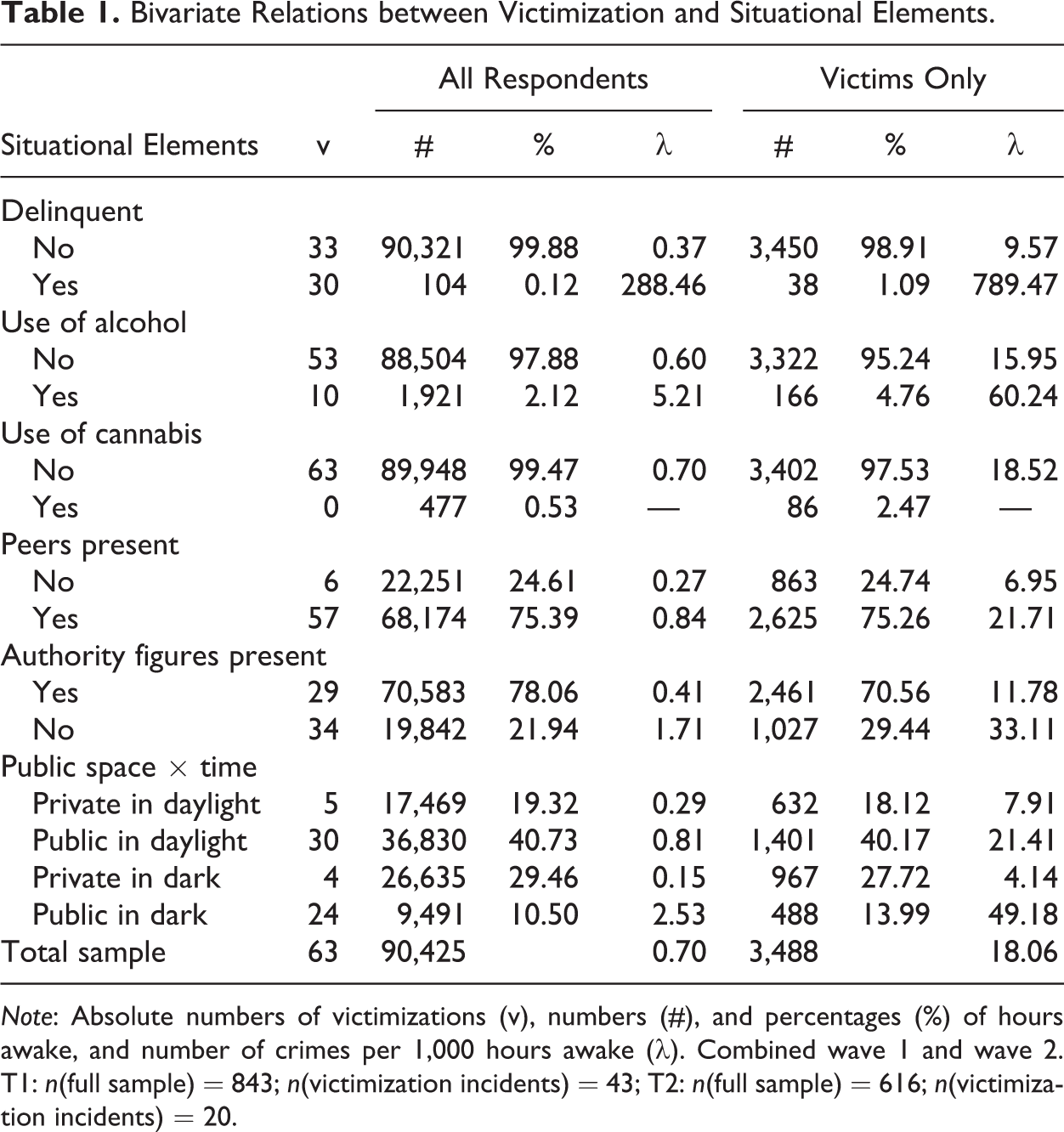
Note: Absolute numbers of victimizations (v), numbers (#), and percentages (%) of hours awake, and number of crimes per 1,000 hours awake (λ). Combined wave 1 and wave 2. T1: n(full sample) = 843; n(victimization incidents) = 43; T2: n(full sample) = 616; n(victimization incidents) = 20.
As a guide on how to read Table 1, consider the rows that apply to the use of alcohol. The ‘v’ column shows that 53 crimes took place when the respondents were not drinking alcohol, while 10 took place when they were drinking. In the same rows, we see that 88,504 hours were spent sober, whereas 1,921 hours were spent drinking. The result of dividing 53 by 88,504 and multiplying the result by 1,000 equals .60, which implies that on average .60 offenses are to be expected per 1,000 nondrinking hours. Per 1,000 hours in which alcohol was used, however, there were on average 5.21 victimization incidents. Thus, the risk of victimization is 5.21/.6 = 8.7 times larger when drinking than when staying sober. In the rightmost columns that apply to victims only, note that victims spent more time drinking (4.76 percent of awake hours) than the average respondent (2.12 percent of awake hours) and that for this group, the risk of victimization in drinking hours is almost four times larger during drinking hours than during sober hours.
Table 1 shows that all hypotheses are tentatively supported, except for the hypothesis on the use of cannabis: No crimes were experienced while the respondents were using cannabis. This effect could thus not be estimated in our analyses and we did not further consider it. Note that these are descriptive results only.
The λ statistic was especially high for situations in which the respondent was involved in a delinquent act. For all respondents, it was 778 times larger than the λ during nondelinquent hours; and for victims only, it was 82 times larger. In fact, of the 38 hours in which victims committed an offense, they were victimized in 30 hours; while in the 3,450 other hours, they were victimized in only 33 hours. Of the 63 cases of victimization, 30 were suffered by persons who reported committing an offense during the same hour. These were overwhelmingly (28 cases) situations in which both the offense and the victimization were violent offenses. It is likely that these were fights involving mutual violence, although we cannot be sure. In the other 30 cases of victimization, violence was also the most frequent offense but somewhat less prominent (11 violence, 10 threat, 9 theft, and 3 vandalism).
To tease out the situational effects on victimization, we subsequently performed bivariate and multivariate fixed effects logit analyses on the 55 victims in the sample. The very strong relation between delinquent behavior and victimization demonstrated in Table 1 created quasi-complete separation in all models of victimization that included delinquent behavior as a predictor (including a model in which it was the only predictor). This situation forced us to use penalized maximum likelihood estimation techniques instead of regular maximum likelihood estimation. Complete separation is a situation in which a linear function of covariates perfectly predicts and thus completely determines the dependent variable. Quasi-complete separation occurs when one predictor or a linear combination of predictors almost completely (but not completely) determines the response variable. Quasi-complete separation is frequently encountered in logit analysis (Albert and Anderson 1984; Allison 2004; Heinze and Schemper 2002), in particular, when the predictors are binary or nominal and in data sets that are either small (low number of observations) or sparse (low proportions of either successes of failures). In case of quasi-complete separation, regular maximum likelihood estimates and their standard errors are infinite and cannot be estimated. The strong advice in case of quasi-complete separation is to replace standard maximum likelihood estimation with penalized maximum likelihood estimation techniques. Firth (1993) developed penalized maximum likelihood estimation with the purpose of reducing small sample bias in maximum likelihood estimates in general linear models. These estimates are biased away from zero, and Heinze and Schemper (2002) note that the infinite parameter estimates in case of quasi-complete separation can be seen as an extreme consequence of this property. The penalized likelihood method corrects this bias by adding a term (known as “Jeffreys prior”) to the likelihood function. In a series of articles that used both simulation and secondary analysis of data from clinical trials, it was demonstrated that penalized likelihood estimation outperformed alternative methods and is therefore the preferred method of handling quasi-complete separation in logit, conditional logit, and Cox proportional hazard models (Heinze 2006; Heinze and Ploner 2003; Heinze and Puhr 2010; Heinze and Schemper 2001, 2002).
Because the likelihood function of the fixed effects logit model is equivalent to the likelihood function of the conditional logit model (McFadden 1973) and the Cox proportional hazard model (Cox 1972), we used the coxphf package (Ploner and Heinze 2013) developed for the R statistical package (R Core Team 2014) to estimate the penalized maximum likelihood estimates of fixed effects logit models. 2
The results of the bivariate models presented in Table 2 indicate strong to very strong relations between the situational elements and victimization, all of which were in the hypothesized direction and statistically significant at p < .01. We interpreted all effects, including interaction terms, in terms of odds ratios (Buis 2010).
Bivariate Fixed Effects (Firth-type Penalized Likelihood) Estimates of Relation between Victimization and Situational Elements.

*p < .05, **p < .01 (two-tailed).
The most spectacular finding is without any doubt the relation between delinquent behavior and victimization. Delinquent behavior lets the odds of victimization skyrocket by a factor 980, demonstrating an astonishingly strong relation between offending and victimization at the situational level. Alcohol use increased the odds of victimization by 5.69, the presence of peers increased the odds of victimization by 3.50, and the absence of authority figures increased the odds of victimization by 3.45. Furthermore, being in a public place during daylight inflated the odds of victimization by a factor of 3.81 compared to nonpublic places, and being in a public place during dark inflated the odds of victimization by 10.82 compared to nonpublic places. The effect of being in a public place in the dark was significantly stronger than being in a public place in daylight: χ2(1) = 12.20, p < .01.
The models in Table 3 examine the multivariate effects of situational elements. The very strong and potentially reciprocal causal relation between delinquency and victimization provided the rationale for presenting two models, one model without delinquency included as a covariate and one model with delinquency included as a covariate.
Multivariate Fixed Effects (Firth-type Penalized Likelihood) Estimates of Relation between Victimization and Situational Elements (Odds Ratios).
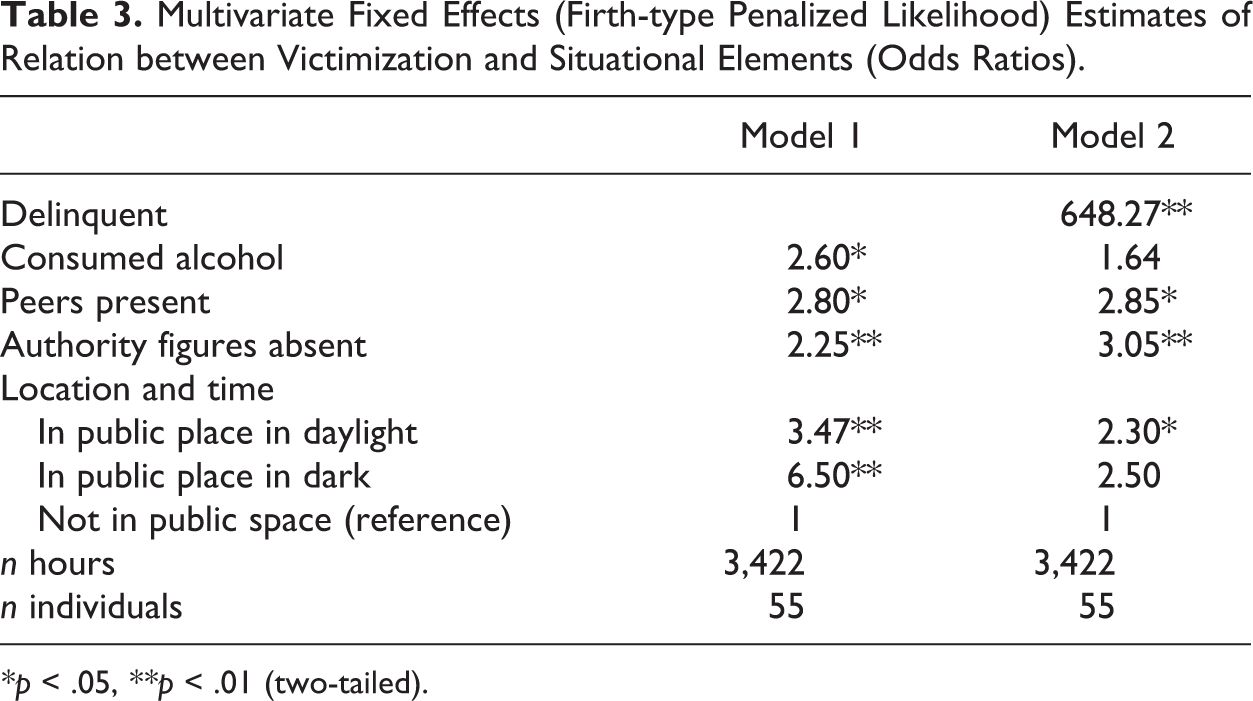
*p < .05, **p < .01 (two-tailed).
In model 1, the model without delinquency, all situational variables were positively and significantly related to victimization. The effect sizes ranged from 2.25 (absence of authority figures) to 6.50 (activity taking place in public space in the dark). The effect of being in a public place in the dark was not significantly stronger than being in a public place in daylight: χ2(1) = 3.41, p > .05.
In model 2, delinquency was included. Again, the effect of delinquency itself on victimization was extraordinary strong (odds ratio 648). Because delinquency was also related to the other situational elements, its inclusion resulted in two of the other effects becoming nonsignificant. Both being in a public place during dark and alcohol use were not significant when delinquency was included in the model which seems to suggest that delinquency may mediate the effects of these two situational elements: Adolescents are not victimized because they use alcohol in public places at night, but primarily because they commit delinquent acts when drinking in public places at night. Notwithstanding the dominant effect of delinquency, the effects of the presence of peers, the absence of authority figures, and being in a public place during daylight were positive and significant, apparently because these factors come into play in situations where the subject is not delinquent himself or herself.
Although our logistic model already implied that the effects of situational elements on the probability of victimization depend on the presence of other situational elements, we also explored the significance of additional interdependence by testing multiplicative interaction terms. The first interaction term had a value of 1 if an hour was spent in public space, in the absence of authority figures, in the presence of peers, and involved alcohol consumption as well as delinquency, and had a value of 0 otherwise. The second term excluded the delinquency condition. The first term was added to model 1 and the second to model 2. Both were not significant. Thus, there is little evidence that the combination of situational causes provides a better explanation than the sum of the separate effects of being in public space, being unsupervised, being with peers, using alcohol and being involved in delinquency.
Discussion
Routine activities (Cohen and Felson 1979) and lifestyle theory (Hindelang et al. 1978) explain criminal victimization as a function of the types of settings that potential victims are exposed to in their daily routines (Maxfield 1987). However, both theories had always been tested indirectly, by linking the victimization of individuals to aggregated (and often proxy) measures of their involvement in risky activities at risky places at risky times. We conducted a more direct test by using data at the micro level that contained information about both personal victimization and involvement in risky situations in the same hour using space–time budgets (Wikström et al. 2012). In addition, we used a multivariate fixed effects logit model for panel data to control for potential confounders and to demonstrate the situational nature of the hypothesized causes. By using this technique, we ruled out the possibility that the findings can be explained by stable differences between individuals, such as self-control (Schreck 1999). To our knowledge, no earlier study provides as much methodological rigor to test the situational explanation of personal victimization.
The findings provide strong support for the theories and confirmed that the hypothesized situational causes are indeed often present when personal victimization takes place. The most remarkable finding is without doubt the extraordinarily strong link between offending and personal victimization. Although many others had already pointed out this relation at the level of the individual (see Jennings et al. 2012), it had thus far not been established at the level of the situation. Almost half of the personal victimization incidents (30 of the 63) took place during the same hour that the respondent was involved in offending. Almost all of these were violent incidents, typically among peers. Given that the data were collected on the 3,488 nonsleeping hours of the 55 victims in the sample, the strength of the relation between personal victimization and offending is beyond compare. The finding strongly suggests that the relation between offending and personal victimization is direct and possibly reciprocal. Offending may induce revenge or protective behaviors on the part of the victim or bystanders, leading to the initial offender becoming a victim. From the reverse perspective, a person who is victimized may easily become an offender if he or she commits a crime against the initial perpetrator. This is, in fact, another way of saying that most likely the strong relation between offending and victimization observed in our data is a consequence of both events being part of the same conflict or incident of reciprocal violence. This possibility does not definitely rule out, however, more complex event sequences in which the subject assaulted a person and was later during the same hour assaulted himself or herself by another individual.
We also found strong evidence for the other hypothesized situational causes, including the use of alcohol, the presence of peers, the absence of authority figures, and the action taking place in public places, in particular during dark. The effects were substantive and significant despite the relatively small victim sample.
All in all, these findings provide strong support for routine activities and lifestyle theory. However, they also yield several questions for further analysis that we have not been able to cover here. First, the finding that offending and victimization are so intimately related at the situational level calls for more research. Although our analysis was fine-grained on the temporal level, it was not fine-grained enough to clarify the causal sequence of offending and personal victimization. We could not disentangle whether personal victimization and offending in the same hour referred to the same incident. We used self-report data and thus the interpretation of the incident was left to the respondent. The questions that were posed to the respondent did not use the terms “offender” or “victim” and respondents could have taken both roles in the same incident. It is doubtful whether space–time budgets can reach an even more fine-grained temporal structure since individuals will probably not remember their situational circumstances on the level of minutes or seconds. Thus, alternative research strategies need to be employed to answer this question, such as observations or interviews.
Second, our literature review suggested that the extent to which an individual’s company discourages crime depends on their personal responsibility in the situation as well as their own involvement in delinquency. Our measure did not account for this. Future measures that do include these aspects are encouraged.
Third, our study was restricted to adolescents and should be replicated among other ages. Because adults usually have lower victimization rates, a very large sample would be needed to conduct the same analysis as presented here among adults. It might be useful to restrict such an analysis to a high-risk sample. It would also require adjustments to the research instruments, as some concepts (e.g., “peers”) are more difficult to clearly define for adults.
Finally, it would be useful to theorize and test a person-by-situation model in which one would assess whether certain situations are especially conducive to victimization for certain types of individuals. Although such models have been theorized for offenders (Wikström et al. 2012), much work remains to be done in the study of victims.
Notwithstanding these additional research questions, this study shows for the first time that personal victimization indeed often happens while victims are exposed to risky situations, that this relation cannot be explained by stable personal characteristics of the victims, and that these findings hold in a multivariate context controlling for other elements of risky situations. These findings are in support of the current major victimization theories. Work that extends these findings to other types of samples and further specifies them for different types of victims and for situations in which victims are delinquent themselves has the potential to further advance the study of victimization.
Footnotes
Acknowledgments
We thank Per-Olof Wikström for sharing the space–time budget instrument, Beth Hardie, Caroline Moul, and Neema Trivedi for helping train the interviewers, and Kirsten Grandia, Evelien Hoeben, and Lieneke Spel for managing the fieldwork.
Declaration of Conflicting Interests
The author(s) declared no potential conflicts of interest with respect to the research, authorship, and/or publication of this article.
Funding
The author(s) received no financial support for the research, authorship, and/or publication of this article.