




Abstract
The purpose of this ethnographic study was to explore the perceived values and benefits associated with participation in a highly successful community-based girls’ choral ensemble. The benefits of membership in the Seattle Girls’ Choir organization were explored, with particular attention to the expressed values and observed behaviors of choristers. Regular choir rehearsals, musicianship classes, festival and summer camp experiences, concert performances, faculty, staff and board meetings, and other community events were documented carefully and examined during a yearlong period of fieldwork. Semistructured interviews with choristers, faculty members, parents, and staff members were used to elicit participant perspectives on the girls’ choir experience and the perceived values and benefits of participation. Emergent themes included music, personal, social, and external benefits, which were examined in an effort to augment an ever-growing understanding of modern music-making and the value of music engagement in the lives of participants.
It is a quiet, overcast afternoon as I turn into the parking lot of the Volunteer Park Seventh Day Adventist Church. Downstairs, deep in the belly of the church, the fellowship hall is gray. Everything is imbued with the absence of color, and it smells vaguely of old coffee and slightly stale air. The black baby grand piano gleams untouched in a bath of fluorescent light, awaiting an accompanist, as a stream of high school–age girls begins to flow into the space. What was once gray and dreary suddenly is infused with a renewed sense of life, energy, and color, as the bubbly young women chatter and laugh. Snippets of conversation bubble up as the girls regale each other with tales of their teenage trials and tribulations. The conductor enters the room and says quietly, “Ladies, I think it’s time . . . .” It is exactly 4:30. The girls are transformed from run-of-the-mill high schoolers into the focused young ladies of the Seattle Girls’ Choir’s Prime Voci choir as they immediately and quietly scurry into position, like so many squirrels on a mission. Rehearsal has begun.
High on Capitol Hill in Seattle, Washington, this ritual plays itself out twice a week as the young women of the Seattle Girls’ Choir (SGC) come together to sing, learn, socialize, and belong. Across the country, millions of Americans participate in similar music-making communities, making their own pilgrimages to schools, rehearsal halls, community centers, stages, and churches for weekly choir rehearsals. In the United States, choral singing has emerged as the “most popular form of participation in the performing arts” (Chorus America, 2009, p. 4), and nearly 270,000 choruses across the country serve children and adults wishing to pursue music artistry within a community of singers. Of the estimated 42.6 million Americans participating in choral singing, 10.1 million are children. In addition to the 41,000 school choruses that exist in America’s K–12 educational institutions, virtually every major city in the country has one or more community-based choirs offering music experiences to children and youth (Chorus America, 2009).
The SGC is one such community of youth singers, a music society of girls supported by a dedicated network of music faculty and parent volunteers intent on facilitating the choristers’ evolution into musicians and young women. When I first joined the SGC faculty, it struck me as a rich, multifaceted culture, replete with a distinct social system and an attendant collection of shared beliefs, values, and practices. Over time, I began to see it as an example of a modern music-making enterprise, one that provides girls with an opportunity to engage in meaningful choral music experiences embedded within a rich social and cultural context. Such a remarkable community of musicians led me to the same questions that have inspired ethnomusicologists and music educators for decades: “Why make music?” (Pitts, 2005, p. 1) and “What is really going on here?” (Small, 1998, p. 10).
Literature Review
The rapid growth of the children’s choir movement in America during the 1970s and 1980s saw the rise of many choral organizations serving young singers. Doreen Rao (1993) called the children’s choir movement a “cultural phenomenon” instigated by “the demise of choral singing in elementary school music programs” (p. 4). In and around Seattle, no fewer than seven community-based choirs for children and youth were founded between 1971 and 1991. The continued popularity of community-based youth choir programs illustrates a desire for choral music participation outside of traditional school music programs (Chorus America, 2009). Despite the widespread proliferation of children’s choirs in America, relatively few researchers have focused their research efforts on the choral cultures of children and youth.
A handful of researchers have investigated features of children’s choir cultures, including teaching and learning paradigms (Simpson, 2001), the emergence of “multicultural human subjectivity” among choristers (Bradley, 2006), and the voice change process at the American Boychoir School (Kennedy, 2004). The musical meanings associated with choir membership among youth also have inspired the research efforts of music education scholars. Hylton (1981) identified six dimensions of meaning related to choir membership: achievement, spiritualistic, musical-artistic, communicative, psychological, and integrative. In her case study of the Alabama Boychoir, Bridges (1996) highlighted ownership of successes, a heightened sense of self-worth and competence, and a greater appreciation and enjoyment of singing as salient themes.
Kennedy (2002) explored the perspectives of middle school boys enrolled in a public school choir. She identified four main themes: motivation to join and remain involved; skill, knowledge, and attitude acquisition; issues of repertoire; and participant perceptions of the choral culture. Similarly, as a result of investigating the culture of public high school performing ensembles, Adderley, Kennedy, and Berz (2003) suggested that participants were “intellectually, psychologically, emotionally, socially, and musically nurtured by membership in performing ensembles” (p. 204). Authors of the Chorus Impact Study (Chorus America, 2009) found that parents and educators believed that choir membership contributed positively to children’s academic performance, creativity, self-esteem, memory, accountability in terms of practice and homework, self-confidence, self-discipline, focus, problem solving, and punctuality. Additionally, parents and teachers indicated that choir membership fostered the development of cooperative and other social skills and aided in the management and expression of emotion.
Another related strand of research deals with the perceived values and benefits of music participation, regardless of age. The value of participation in barbershop singing culture was investigated by Stebbins (1996), who identified personal enrichment, enjoyment, and self-actualization as the most powerful benefits or rewards associated with their participation in barbershop singing. Pitts (2005) drew together the results of four ethnographic case studies in an attempt to uncover the “values and experiences of the musical participants . . . and so to theorise more widely about the contribution of music to personal and social fulfilment” (p. 1). Music participation was perceived by participants as a source of self-esteem and confidence, a chance to acquire or exhibit skills, a means of disseminating and/or preserving a repertoire, an opportunity to engage in performance with others, an opportunity to interact socially and forge friendships, a way to enhance their daily lives, an opportunity to escape from their everyday lives, and a source of enjoyment and spiritual fulfillment. At present, no researchers have sought to uncover the perceived valued and benefits of participation in a girls’ choir.
To extend the existing literature on children’s choir culture and the perceived values and benefits of music participation, in the present study, I used standard ethnographic procedures to examine the value of choir membership as expressed by members of the choir’s community of practice. Regular choir rehearsals, musicianship classes, festival and summer camp experiences, concert performances, faculty, staff and board meetings, and other community events were carefully documented and examined with the following questions in mind: (1) What do various participants consider to be the values and benefits of their participation in the SGC community? (2) How do the values of the organization manifest themselves in action during rehearsals, performances, classes, meetings, and other SGC events?
The SGC Program
As noted in the organization’s mission statement, the SGC is an educational organization committed to providing young women with access to
a comprehensive program of advanced choral training, including music, vocal and ensemble education, performances, and touring opportunities. . . . It serves as a junior conservatory where musically talented girls from the Puget Sound region can obtain a superior music education. (Bartolome, 2010, p.258)
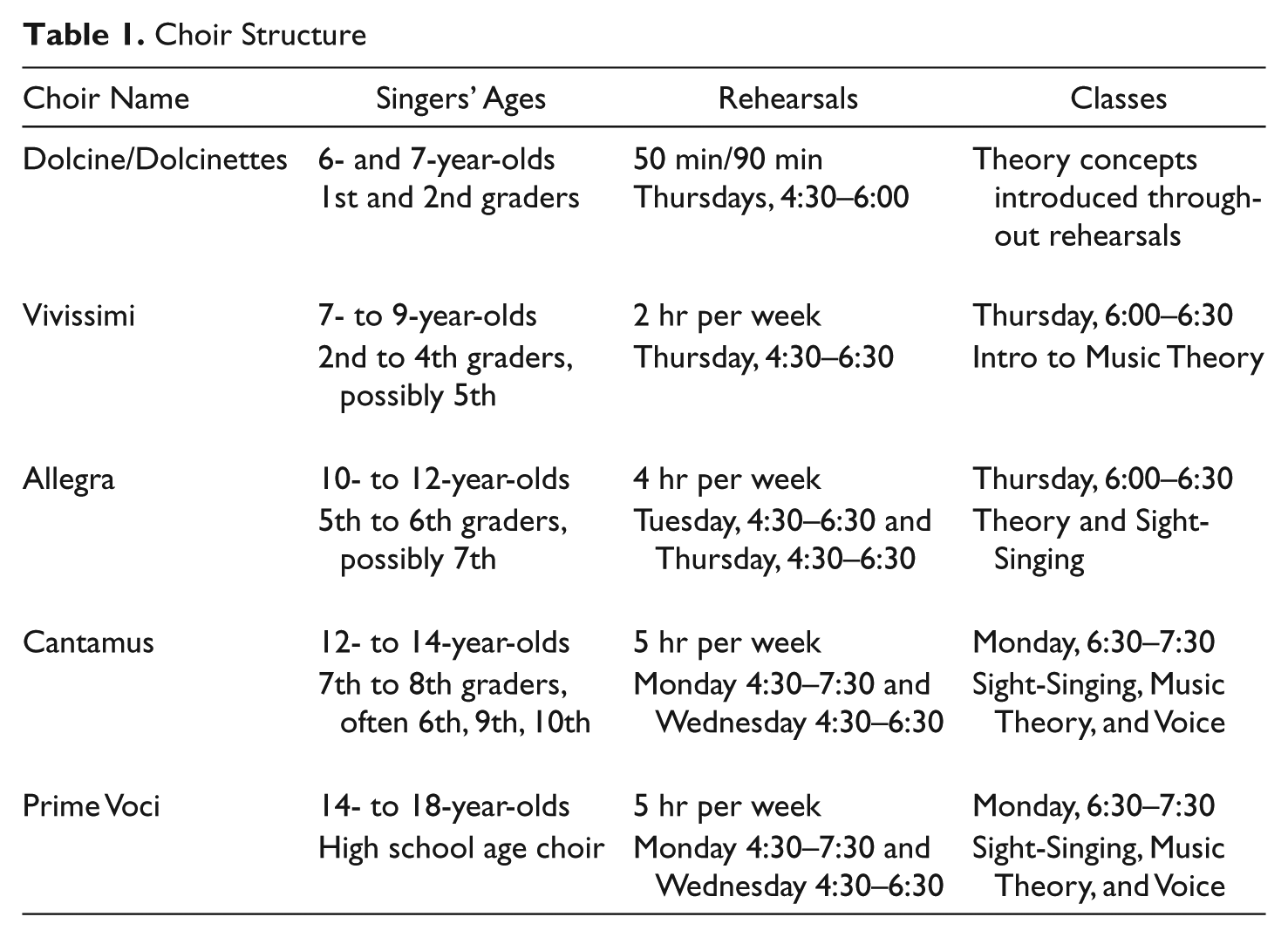
The SGC, founded in 1982, is one of 22 community-based choirs serving children and youth within the Seattle-Tacoma metropolitan area. Although the region boasts an active community of both children and adult choral musicians participating in more than 125 community-based choirs, the public schools do not consistently offer choral programs. It is notable that within the Seattle Public School system, there were 30 elementary schools, four K–8 schools, three middle schools, and three high schools that were completely devoid of choral music opportunities at the time of this study. Serving girls ages 6 to 18 (grades 1 to 12), the SGC offers quality choral music education to girls and young women who may not have access to such programs in their compulsory schooling or who seek to study music more deeply and intensely. There are six levels of choir offered, each with a different conductor and each more advanced in music than the one before (age-related and skill-based cohorts). Separate theory and sight-singing classes are part of the weekly rehearsal of the top four choirs, and choristers in the top two choirs also take biweekly voice classes to learn about and improve their basic vocal technique. For an overview of the choir structure, including the names of the choirs, the ages of the choristers, and the rehearsal and class schedules for each choir level, see Table 1. During the research period, there was a total of 119 girls enrolled in SGC choirs representing 110 families from communities across the Puget Sound Region.
Choir Structure
Although the choir did not collect information related to race, ethnicity, or socioeconomic status, my own anecdotal experiences with the girls and a review of the choir portraits indicate that the choir mostly is composed mostly of upper-middle-class Caucasian families. Slightly more than 10% of the choristers represented ethnic minorities, including girls of Asian American (approximately 8%) and African American (approximately 2%) heritage. Although no detailed information regarding the socioeconomic status of SGC families was available, the financial obligations associated with SGC membership (detailed in the following) indicate that the majority of the participants were from an upper-middle-class background.
The SGC is a tuition-based choir and requires a significant financial commitment by families wishing to enroll their girls in the program. At the time of this study, yearly tuition ranged from $900 for the Dolcinettes choir to $1,500 for the Prime Voci (PV) choir. An examination of the advertised tuition prices of other Seattle-area community-based youth choirs revealed that the hourly rate of instruction associated with SGC’s PV ensemble was comparable to, if not slightly lower than, that of three of the most widely known competing youth choir organizations. In addition to tuition requirements, there were several other financial obligations associated with SGC membership, including required ticket sales, uniform fees, summer camp costs, and tour expenses.
It is evident, on the basis of this brief financial overview, that there are costs associated with SGC membership that may be prohibitive to participation, particularly at the upper levels of the choir. In an effort to increase access to the program for families that may have difficulty meeting the financial obligations tied to SGC membership, the organization is committed to providing scholarships to girls in need. During the 2007–2008 season, the choir awarded a total of $3,695 in scholarship money to 10 choristers. The organization was able to expand the scholarship offerings for the 2008–2009 season, distributing a total of $4,255 to seven girls. The upward trend continued in the fall of 2009, as 10 girls received scholarship monies totaling $6,112. The administration hoped to continue to expand its scholarship offerings through continued growth, grant procurement, and increased financial viability in the coming years.
Method
This exploration of the perceived values and benefits of participation in an American girls’ choir entailed the integration of standard ethnographic data collection strategies employed during the course of a yearlong period of fieldwork. The data that inform this research report were derived from a larger ethnography involving the investigation of the culture and social system of the choir (Bartolome, 2010). The study was approved by the university institutional review board, and all required permissions were obtained and guidelines followed. Weekly rehearsals of the most advanced choir, PV (a group of 25 singers, primarily ages 15 to 18), were observed. As fieldworker, I attended all 3-hr Monday evening rehearsals and 1 hr of each Wednesday evening rehearsal, resulting in more than 150 hr of formal observations. I also spent more than 200 hr as a participant observer (Spradley, 1980), interacting with younger choristers as the conductor of the Allegra choir (a group of 24, primarily ages 10 to 13) and as a teacher of beginning-level theory and sight-singing classes. Although many of my observations were conducted during weekly rehearsals, I also was present at other SGC events, including performances, board meetings, summer camps, and faculty meetings.
In addition to observing and taking field notes in rehearsals (Emerson, Fretz, & Shaw, 1995), I conducted semistructured interviews (Fontana & Frey, 1994) with the members of the SGC community, including 42 SGC singers, the founder and artistic director, each of the faculty members (three conductors and five accompanists), parents and board members (14), and the choir office manager. (See Table 2 for semistructured interview protocols.) Of the 42 choristers interviewed, 13 were from the PV choir, 13 were from the Allegra choir (my own choir), 6 were from the Cantamus choir, and 10 were from the Vivissimi choir. All older choristers (Allegra, Cantamus, and PV singers) were given the option of being interviewed singly or in small groups. With the exception of one pair of Cantamus singers, all girls chose to be interviewed individually. The younger girls from the Vivissimi choir were interviewed much more informally in small groups of 3 or 4. Because of their age and newness to the choir, I chose not to interview the youngest choristers in the Dolcine and Dolcinettes choirs. Those participants interviewed participated voluntarily, and all interviews were conducted at the Choir Center before, during, and after rehearsals. I recorded all interviews and subsequently transcribed each in full, producing more than 200 single-spaced pages of text data. I distributed open-ended parent surveys based on the interview protocol (Creswell, 2005) both in hard copy and via email to allow a broader range of chorister parents to contribute their perspectives on the SGC experience. Twenty surveys were returned, bringing the number of parents represented to 34 (14 interviews and 20 surveys) and contributing to a cross-section of voices across choir levels.
Semistructured Interview Protocols

Note: SGC = Seattle Girls’ Choir.
I also examined existing documents and artifacts related to the SGC experience (Hodder, 2008), including 26 years’ worth of past concert programs, the organization’s website, past and present mission statements, chorister expectation statements, recruiting materials, evaluative report cards, and audition packets. I repeatedly read and reread the data set for emergent patterns and themes related to participant values and benefits. Further analysis took the form of closed coding (Creswell, 2005). Triangulation (Denzin & Lincoln, 2008) was achieved through comparisons of observed phenomena, interview transcriptions, survey responses, and summaries of material culture. Through an extensive process of member checking, it was possible for me to clarify and validate the multiple data sources. I pieced together the full extent of the data to create a picture of the SGC experience as perceived by various members, with a focus on the values and benefits associated with participation.
At the request of the SGC organization, I have elected to portray this choir using its real name. The linking of this document with the SGC ensures that the organization might make use of its findings in recruitment, grant seeking, and other endeavors in which it might be beneficial to have a scholarly description of the benefits associated with membership. In an effort to protect those who generously contributed their thoughts and opinions, I have chosen to use pseudonyms to represent the choristers and their parents. Choristers have been assigned a first name and last initial, and parents are designated by both first and last names.
Musical Benefits
Invariably, when asked about the benefits of choir participation, choristers and parents alike extolled the virtues of the remarkable music education SGC girls receive. Many participants described this formal music educational component as a major part of the motivation to join and continue with SGC, particularly in a time when school music programs lacked funding, were getting cut entirely, or were just not of good quality. PV chorister Natalie H. spoke to this point: “This is really the best option because school music can be kinda sketchy, especially now with music being cut from public schools and a deemphasis [sic] on music in a lot of schools.” The PV accompanist, who was also a choir member’s mother, expressed deep gratitude for the SGC program and the impact it had made on her daughter’s musicianship: “It’s such a wonderful organization that has changed my daughter’s life. She composes choral music, she sings nonstop, she loves music, and she knows it at a depth she would never have gotten to otherwise.”
Regarding music education, the founding director emphasized its importance in the lives of young people, stating, “I wish that every young person in the country could have musical training. That would be the best of all possible worlds.” This commitment to educational excellence was evident in the caliber of faculty employed, the difficulty and quality of repertoire selected for annual concerts, and the rigor of the classes required of the choristers. Given the mission and philosophy of the SGC organization, it is not surprising that music benefits emerged as a highly valued component of the SGC experience. In fact, this finding correlates with several previous studies in which music knowledge and skill acquisition were found to be highly valued facets of music participation (Adderley et al., 2003; Chorus America, 2009; Hylton, 1981; Kennedy, 2002; Pitts, 2005; Stebbins, 1996).
Personal Benefits
Choir as a Worthwhile Endeavor
Participants recognized the SGC as a worthwhile endeavor, adding meaning and direction to the girls’ leisure time. Senior chorister Grace B. elaborated: “Choir is not always fun, but it’s always rewarding. So, you know, I don’t come away from every rehearsal full of giggles, but I do come away feeling like I’ve done something productive with the rest of my day.” Concert manager Eleanor Hall made similar remarks from her perspective as a parent, emphasizing the fact that choir participation, in addition to being fun, added meaning to the girls’ adolescent lives. She noted, “They’re amused, they have something they love to do, they go and do it. They’re not sitting at home playing on the computer or watching TV all the time, wondering what the point is of their life.”
Many girls decided to join choir because they (or their parents) felt they were talented singers but wanted some structure around the activity. They wanted education and instruction in their chosen leisure activity and looked for a way to make their hobby more worthwhile. There was also a certain understanding that the SGC is a prestigious, respected choir and that membership transfers to members some level of prestige or “specialness.” Monica K., a singer in the Allegra choir, remarked, “All my relatives are excited about SGC, like ‘Oh yes, my granddaughter’s in the SGC!’” Another chorister smiled as she said, “It’s also just a fun choir to be in because nobody else in my school does it. It’s really fun for me to brag about it a little.” This finding is consistent with previous research that highlighted respect from peers (Adderley et al., 2003) as a significant benefit of music participation.
Because the choir is an auditioned music society, members recognized and took pride in the fact that they have been accepted for membership. In a sense, the SGC entrance audition became a sort of litmus test for talent, with girls walking away from successful auditions feeling that their talent has been acknowledged as substantial and worthy of further training. In his discussion of the concept of talent, Kingsbury (1988) suggested that “the presence or absence of musicality or talent is established on the basis of some sort of performance or audition” (p. 67). The experiences of these SGC choristers confirmed this notion. Pitts (2005) also recognized music participation as a source of confirmation of music skill, a finding that is supported here.
Choir as a Source of Accomplishment and Self-Confidence
Many participants asserted that membership in SGC increased their self-confidence and sense of accomplishment. Laura P., a junior in high school, stated, “I can really accomplish something great through music. I’m at such a high level and I have this great pride for what I’ve done. I guess that’s what it means to me: self-accomplishment.” Younger choir members identified PV as a major goal and an incredible accomplishment, looking at the older girls as role models who were exceptionally high-achieving singers. According to the girls and their parents, participation in the SGC was a source of pride for its members, and participants derived satisfaction and self-confidence from membership in what was perceived as a prestigious choral music society.
The finding that the SGC was a source of self-confidence and accomplishment combats a disturbing trend of lowered confidence and self-esteem among girls during their adolescent years (Gilligan, 1990; Pipher, 1994). It has been suggested that success within a self-identified area of importance can contribute positively to high levels of self-esteem and that “encouraging adolescent girls to explore, to develop, and to take pride in their talents may be an appropriate means of increasing their self-esteem” (Denmark, 1999, p. 393). It would appear, on the basis of the comments of participants, that the SGC was accomplishing just that—providing girls with meaningful experiences that fostered heightened self-confidence and self-esteem. Several other studies similarly highlighted confidence and achievement as significant benefits of music participation (Adderley et al., 2003; Chorus America, 2009; Hylton, 1981; Kennedy, 2002; Pitts, 2005).
Choir as Empowerment
In conversations with various participants as well as in observations, it became clear that the SGC experience fostered leadership and empowerment in its members. When asked about his philosophy, the founding director replied succinctly: “The bottom line is the empowerment of young people to maximize their potential.” This sense of empowered ownership was evident in each rehearsal, as control of the process was handed over to the girls and their musical senses. Choristers were invited to lead the physical warm-ups, comments and suggestions were welcomed with respect and consideration, and musical decisions often were thrown back to the girls for discussion. PV chorister Laura P. noted, “After a long day, if I don’t understand something at school, I can come to choir and I know that ‘Yes, I can do this. I can sing this difficult piece.’ And that’s really empowered me.”
Girls also were empowered through their training in theory and sight-singing to be independent, self-sustaining musicians who could, as one conductor noted, “take the art right off the page, rather than have someone plunk it out for them.” The girls gained a sense of music empowerment through music self-efficacy. The choristers were given much responsibility for their choir and their music, and as a result of this shared experience, each became a more empowered young woman, musician, and leader. It is important to note that this finding was unique to the present study, suggesting perhaps that the culture of this particular community, rather than the nature of music participation at large, shaped its experiences to encourage the development of these qualities in girls.
Choir as Discipline
Discipline emerged as a major personal benefit of choir membership. Virtually all of the participants referenced the importance of discipline and focus, and within the rehearsal setting, it was clear that the girls had mastered a high level of self-discipline that is rare in high school–age students. Parent and office manager Camille Schmidt described the choir as “a place where the girls can practice a real commitment and a discipline that you don’t see a lot anymore in our society.” This opinion was echoed by parents and choristers alike, who considered the kind of discipline cultivated by the SGC experience as personally valuable and also highly unique to this context. Every parent and most girls older than 10 years of age identified discipline as a highly valued advantage, a finding that supports previous research in this area (Adderley et al., 2003; Chorus America, 2009).
Choir as a Collective Experience
During the rehearsal period, the girls maintained an intricate balance between addressing the needs of self and the needs of the group, often subordinating personal impulse and desire for the betterment of the choir as an ensemble. PV chorister Rachel G. mentioned that she had developed the ability “to not always think of myself first and think about the group around me and what’s coming out as a group instead of what’s coming out as a single person.” It is apparent that learning to work with a group in a coordinated way to foster collectivity versus individuality was considered by these participants to be a valuable facet of choir membership. This emphasis on music as a collective endeavor was noted in many previous studies related to the value of music participation (Adderley et al., 2003; Hylton, 1981; Kennedy, 2002; Pitts, 2005; Stebbins, 1996), suggesting it is a primary feature of modern music-making.
Choir as Commitment
When asked about the challenges of choir membership, most of the girls mentioned scheduling difficulties and balancing their school lives, their choir lives, and a desire to be involved in varied activities. Although many complained about the amount of time associated with SGC membership, girls invariably followed up these gripes with remarks about how glad they were to have “stuck with it” and that in the end, “it is worth it.” On a related note, many participants felt that their SGC experience taught them something about perseverance and commitment in the face of hardship. Janet Menard, mother of an adolescent chorister, felt that the SGC fostered this sense of perseverance in her daughter, motivating her in ways that other activities did not: “The ‘carrot’ of PV has caused her to hang in through tough times. I look at it as the thing she wants so badly to achieve that she will work in ways that even school can’t get her to work.” In light of their considerable commitment, it is easy to understand how the SGC experience fostered in these young women a sense of perseverance and an understanding of what it means to fulfill obligations despite outside pressures and personal desires to do other things. This idea of choir as commitment came forward time and again as a significant benefit of participation, supporting the findings of Adderley et al. (2003) and Chorus America (2009), who also identified commitment and perseverance as significant benefits associated with band, orchestra, and choir participation.
Choir as School
Although in many instances participants differentiated between their school and choir experiences, on several points, choir was likened to formal school institutions in favorable ways. PV singer Julie S. considered choir as an alternative educational environment that trains young women in more than just music: “School teaches you so much, but choir is a totally different type of school and it teaches you how to act.” High school sophomore Alyssa P. called the SGC “school outside of school,” and 10-year-old Lily W. joyfully exclaimed, “It’s like a whole different school with a whole different set of friends!” It is clear that these choirs were not just about learning songs. Girls came to choir each week to grow as musicians, hone their technical skills, and develop as confident and self-possessed young women.
Many participants noted that the skills fostered by choir were transferable to their daily lives and enabled them to be more successful in different areas of their academic training, including improved ability to focus, better analytical skills, increased academic achievement, application of skills to other music activities, and enhanced public speaking proficiency. Despite the debate over whether “music makes you smarter” (see Demorest & Morrison, 2000), this finding correlates with previous research (Adderley et al., 2003; Chorus America, 2009). Youth musicians and their parents seemed convinced that music-making activities helped them to succeed in a wide range of other academic arenas.
Choir as Emotional Outlet
Adolescence can be an emotionally turbulent time for many young people, and a number of girls suggested that their choir experiences taught them how to express their emotions more readily. One PV chorister noted, “I personally have learned how to express myself better. In choir I’ve learned that through music I can let those emotions out.” It appears that participation in choir provided many young women with an important emotional outlet, a safe place to emote without fear of judgment or ridicule. Virtually every previous investigation into the values of music participation identified self-expression as a significant benefit (Adderley et al., 2003; Chorus America, 2009; Hylton, 1981; Kennedy, 2002; Stebbins, 1996), supporting the present findings related to choir participation.
Choir as a Special Place
Several of the participants interviewed mentioned the notion of choir as a special place or safe haven in the world where one can escape the daily grind and focus solely on the music. The founding director spoke eloquently of the choir as a haven: “Even for a few minutes a week, we make the rehearsal room a haven from the assaults of the world. It becomes a safe place in which to create beauty.” PV chorister Laura P. described choir as
a safe place to be where, unlike school, you can be smart and not have to worry about being judged and there’s a real freedom to make mistakes and learn from your mistakes. It’s a really safe place to learn and grow.
It seems that singers, parents, and faculty valued both the safe environment that is the rehearsal hall and the opportunity to escape from the stresses of daily life and focus on an artistic endeavor. This idea of the music rehearsal as a safe place or an escape has been documented in several previous studies (Adderley et al., 2003; Pitts, 2005).
Social Benefits
Choir as a Constant
Many of the participants also made comments relating to the idea of choir as a constant in their lives. Although the teenage years often are characterized by physical changes, social turbulence, educational transitions, and emotional growth (Csikszentmihalyi & Larson, 1984; Nichols & Good, 2004), participation in the SGC ensures that something remains the same. Choir buddies, weekly rehearsals, and music passions persist as buoys in a sea of change. Even at 14 years old, Rachel G. recognized the value of this consistency in her life:
Everything else had changed, like I had just moved up to PV, I had changed schools. So much had changed right then and if it wasn’t for those girls I would have like, cracked. But they stayed with me and they were something constant in my life. I think choir is like that in general, something consistent that goes through all parts of your life.
Board president Karen Baker commented on the value of a “group of friends who stay constant as the girls move through adolescence, switch from elementary school to middle school to high school and go through a lot of other stress and change in their lives.” SGC community members frequently alluded to the choir as a constant, reassuring presence in an otherwise turbulent adolescent existence, an unchanging social support system and highly structured program of study that remained the same even as choristers struggled through the significant transitions from elementary to middle to high school. This finding was unique to the present investigation, perhaps owing to the fact that most of the previous studies of adolescent music values were conducted within the context of the school setting, which requires transition into and out of ensembles at the primary, middle, and secondary levels. Because the SGC is a community-based ensemble, it remained a constant feature in the lives of the girls, representing stability over time and growing with the girls as they evolved from children into young women.
Choir as Interpersonal Development
Many of the girls commented on the effect choir participation had on their interpersonal skills, specifically in learning how to work cooperatively with a range of diverse personalities. As a result of long hours of rehearsals and extended periods of intense interaction at camp and on tour, these girls learned to work together as a team and to develop the ability to be professional and productive even when working with those with whom they may not always get along. Vanessa N. recognized that the interpersonal skills related to tolerance and cooperation transfer directly to a lifetime of working with others: “I’ve learned to deal with people that might kind of irritate me sometimes. Because you’re never going to like everyone that you work with.” At the tender age of 10, Lily W. already had acknowledged the diversity of relationships that exist and how one must be sensitive, shaping one’s interactions accordingly:
I learned that the friendships I have with people, everyone’s different, so I have different relationships with different people. Like with Rosie, we are pretty fun and we like to chase each other, but sometimes with other friends I’m a little bit annoying so I have to tone it down a bit.
In observing the girls’ interactions, I did note occasional instances of minor interpersonal conflict. The girls typically confronted and discussed their problems in a mature way, most often arriving at a resolution without adult intervention. Fourth grader Eliza T. discussed her ability to deal with gossip swiftly in the choir environment:
At school it’s a little more pressured, I think, because sometimes people can get the total wrong idea and then go off and tell a lot of people. But in here it’s just us and so if gossip gets around I can just say, “No, that wasn’t it.” Instead of having millions of people coming to me and saying, “What?” one person might just come over and say, “What happened?”
It seems that through choir, the girls felt more connected to the entire community and were free to confront each other in an open and honest way.
Many girls also mentioned their enhanced ability to communicate effectively with authority figures. The climate of collaboration that was fostered in the rehearsal setting required that girls voice their opinions to directors in a thoughtful and respectful way, and questions and comments were encouraged during all phases of the rehearsal process. These chorister-director interactions appeared to foster appropriate communication with elders and raised the girls’ comfort level when communicating with other adults in their lives. Always polite and considerate, these girls were truly remarkable in their ability to communicate effectively, skills they themselves attribute to continued participation in the SGC culture. Similar social benefits related to interpersonal relations also emerged in several previous studies (Adderley et al., 2003; Chorus America, 2009; Hylton, 1981).
Choir as a Place to Belong
Parents and choristers alike commented on the choir as a place where they really fit in, a place where they could “hang out” and do music with other like-minded individuals who shared their passion for music. Parent and board member Jennifer Olsen recalled when her daughter, Silvia K. (17 years old and in PV at the time of this study), came home from one of her first rehearsals as an SGC chorister at 6 years old and exclaimed, “Mom, it’s like a whole bunch of me!” Girls who choose to pursue choir in such a serious way appear to value music as their “thing” and enjoy interacting with other girls who are equally as committed to the music. Senior Grace B. explained that choir was a place where she really fit in:
It is cool to have friends who care about that stuff to the same degree as me, who hear a iv-9 chord and go, “Oh my gosh, that’s so gorgeous! That iv-9 chord!” And then I don’t feel like a total dork, which is what I feel like everywhere else.
Choristers often commented on choir as an open and accepting community, free of the vicious gossip that frequently characterized their social circles at school. Fourth grader Ellie F. asserted, “Sometimes at school everybody’s gossipy and a lot of kids at our school are kind of like that and here there’s none of that and I really like that.” Research has shown that for girls in particular, the adolescent social experience may be wrought with increased “relational aggression” (Grotpeter & Crick, 1996), characterized by rumor spreading and gossip mongering (Bjorkvist, 1994). The SGC was a welcome respite from such day-to-day difficulties and was highly valued as such, particularly by the middle schoolers. SGC community members frequently emphasized the fact that although there were groups of more closely knit girls (typically age and section cohorts, as noted in Adderley et al., 2003), in general, the choir was characterized by a climate of acceptance in which “everybody is friends with everybody else.”
For most of the girls interviewed, choir was a place for them to do something they enjoyed within a supportive community of like-minded individuals. Csikszentmihalyi and Larson (1984) commented on the ability of adolescent engagement within the context of an organized activity to foster a sense of belonging that contributes to more meaningful, “less self-conscious” experience (p. 249). Participants frequently alluded to a certain self-consciousness associated with their school experiences (dressing or acting a certain way because of social pressures, not fitting in at school, an inability to “just be myself”), an issue that was absent in the SGC environment. It is possible that the sense of belonging that is derived from music engagement with like-minded girls allows participants to focus their attention on the collective endeavor, rather than focusing on the self and perceived shortcomings, creating what is experienced as an accepting and welcoming climate of belonging.
Choir as a Diverse Environment
At first glance, an outsider might not characterize the SGC as “diverse.” The girls primarily came from upper-middle-class Caucasian families with the means to remit tuition, provide transportation, pay for uniforms, and contribute to fund-raising efforts. Although the group was not very ethnically or socioeconomically diverse, the people that composed the SGC community represented some alternate modes of diversity. Parent and board member Carol Hart explained,
Betsy has really good friends with two moms, girlfriends that are Indian-American. Some girls have parents that are very liberal and we come from a more conservative background. I value what she’ll take away with her and how that will affect what she knows of the world.
The faculty of the SGC represented several types of diversity as well. The men and women who conducted, taught, and accompanied the girls (four men and six women total) ranged in age from 24 to 75, came from diverse ethnic backgrounds, including Romanian and Filipino, and represented both heterosexual and homosexual orientations. One of the female accompanists commented eloquently on the different female images presented by the faculty and the way it silently affirmed a wide range of personal and sexual identities for the girls. She referred to the other female faculty members, highlighting their images as distinguished by their attire and choices regarding personal style:
I do sometimes think about what it means to the girls to see me as somebody differently gendered. I don’t necessarily look like the stereotypical woman. Whether or not they know I’m gay, I don’t know, but that’s really a nonissue. The diversity of presentations of “woman” by SGC faculty, from unremarkable and fitting cultural expectations, to the fairies-and-witches-live-among-us look, to queer, implicitly encourages the girls’ own individuality, and validates in a silent but important way the confusing feelings questioning youth experience in the coming-out process. It simultaneously counters the extreme conformist pressure all of the girls experience from mass culture and their peers.
In their exploration of gender influences on adolescent development, Basow and Rubin (1999) noted that
Adolescence is a period in which girls are increasingly confronted with expectations to conform to female gender role prescriptions. . . . Research has noted the risks girls face as they are suddenly confronted with the conflicting expectations that embody our society’s current female gender role, and has emphasized the negative outcomes that often result as girls attempt to fulfill these expectations. (p. 25)
Similarly, Holloway and LeCompte (2001) asserted that girls in contemporary society “are in subtle ways restricted to traditional female roles in their community, as well as in families and the occupational structure” (p. 392). Within the SGC community, the girls could see that success and professionalism take many forms, and regardless of personal style, sexual orientation, or ethnicity, it was possible for women to achieve in a chosen field. Their own emerging senses of identity were affirmed regardless of their location on the spectrum. Diversity did not emerge as a significant benefit in any other previous investigation, but it was mentioned briefly by Adderley et al. (2003) as a peripheral benefit of music participation.
External and Community Benefits
Choir as Community Enrichment
The SGC leadership viewed the choir as making an important contribution to the musical fabric of the Puget Sound region, as evidenced in the mission statement and as noted by conductors and board members in interviews. Through annual concerts and collaborations with other area arts organizations, the SGC provides Seattle-area residents with regular opportunities to hear high-quality choral music performances. In addition to annual winter and spring concerts (requiring purchase of tickets), the choir also performs several free concerts each year in local public venues, providing a broader range of Seattleites with access to music performances. The SGC also has contributed to collaborative benefit concerts, adding its voices to music events designed to raise money for local charities. In these ways, the external community benefited from the choir’s efforts.
Choir as Ambassadorship
The SGC has performed across the country at professional conferences and conventions, serving as a model for other American youth choirs and spreading the philosophy and pedagogies of the SGC organization. In addition, the choir often hosts other youth choirs from the Pacific Northwest and beyond, allowing for further exchanges of ideas and the opportunity for choristers to connect with other student musicians. Periodic international tours and frequent musical and cultural exchanges with international choirs adds a cross-cultural component to the chorister experience. These young singers serve as ambassadors through song, sharing their talent with audiences both around the Puget Sound and around the world, representing American youth in a positive light.
Choir as Advocacy
The founding director mentioned the idea of the choir as an advocate for music and music education, noting in an interview, “It’s important for all music people to support their professional organization, [and] challenge not only the community but the wider world to show what can be done with young voices.” In this sense, strong choral performances provide high-quality music entertainment for the community and the world and advocate on behalf of music education as a profession. The appearance of the choir in various venues in and around Seattle showcases what can be accomplished with young people through music. This contributes positively to music education advocacy efforts, promoting an image of professionalism and music accomplishment that endorses music education practice among youth. Although this idea of music participation as a vehicle for advocacy and ambassadorship was a feature of only one previous study (Pitts, 2005), the SGC organization is committed to promoting music-making through education and performance.
Exploring the Perceived Values and Benefits of the SGC Experience
It is clear from the number and range of perceived values and benefits attributed to participation that SGC membership is a complex and multifaceted experience that encourages girls to develop in a number of different capacities. The identification and exploration of the benefits of membership in the SGC community contributes to a small but growing body of literature that presents participant perspectives on music-making as a valued component of the human experience. Although many of the present findings confirm those of the extant literature, interestingly, two of the benefits and values found in previous research did not emerge in this investigation of the SGC.
Pitts’s (2005) respondents emphasized the value of “music as an opportunity to perform with others” and implied that “performance was central to the musical enjoyment of many” (p. 143), a finding that was consistent with those of several earlier studies (Adderley et al., 2003; Hylton, 1981; Kennedy, 2002). The members of the SGC community, however, more frequently placed value on the social, personal, and educational benefits associated with choir membership and less often professed music performance as a highly valued facet of their experience. In fact, when asked about the most important part of their SGC experience, many informants expressly noted that the performances themselves were not central to their continued enjoyment. Parents and girls were more likely to identify friendships and educational components as significant benefits of SGC membership, overshadowing the performance aspect of the experience.
This is particularly striking since the organization and its faculty strived for high-quality performances. The choir has a reputation of excellence, winning several international choral competitions, performing at national conferences, and collaborating with local professional music groups through the years. Although it is difficult to say why participants in this context professed a deeper investment in nonperformance outcomes, I cannot imagine them being as committed to an organization that was not known for excellence. Many compared the SGC to dismal school music experiences, and the majority clearly value the standards of music excellence associated with the SGC. At the same time, performance did not emerge as the most important part of the experience. This perhaps may be attributed to the philosophy of the faculty or the way that music excellence was experienced as a “given” in the SGC community. Further investigation into this particular finding is warranted, especially in light of the fact that in previous research (Adderley et al., 2003; Hylton, 1981; Kennedy, 2002; Pitts, 2005), performance was a much more highly valued facet of participation than was evident in this ethnographic study.
Two scholars also noted participants’ emphasis of spiritual benefits associated with their music participation: Pitts (2005) identified “musical participation as a source of spiritual fulfillment and pleasure” (p. 144), and Hylton (1981) suggested that high school choir members found spiritualistic meaning through choir membership. These spiritualistic references most often were linked to religion. Interestingly, an emphasis of spiritual benefits was absent from the present findings, despite the spiritual component of the philosophy alluded to by some of the faculty. Kennedy (2002) also noted this absence of spiritualistic references among adolescent participants, suggesting this might be “due to the age of the informants or perhaps due to the secular age in which we live” (p. 35).
Given the religious nature of much traditional choral repertoire, the SGC does sing a great deal of sacred music. There were virtually no references to religious themes in all of my conversations with SGC community members. One survey respondent did note that she felt it was part of her role to “help the choir broaden their artistic parameters by asking for less religious and more modern/secular music.” Given that the only comment related to issues of religion was a request for a deemphasis of sacred repertoire, it is clear that SGC participants did not see religious spiritualism as a component of their experience. Interestingly, although the founding director emphasized a certain degree of spirituality through what he considered a holistic, girl-centered approach to empowerment through music education, the girls and their parents did not refer to spiritual benefits of participation. The effects of the approach manifested rather as a sense of self-confidence and empowerment but did not seem to transcend to the realm of the spiritual.
There were two emergent themes that were unique to the present investigation, choir as empowerment and choir as a constant. With regard to choir as empowerment, the specific philosophical tenets of the founding director and the organization at large may explain the emergence of this theme. As noted earlier, it is possible that choir did not emerge as a constant in previous studies, as the majority of that research focused on school-based ensembles through which students pass as a part of their compulsory schooling.
It is also interesting to note that although there was considerable overlap with Pitts’s (2005) and Stebbins’s (1996) studies of older students and adults, a wider range of benefits from the present study correlated with the findings of previous studies of adolescent musicians (Adderley et al., 2003; Chorus America, 2009; Hylton, 1981; Kennedy, 2002). This may suggest that music-making activities serve different purposes in the lives of adolescents (as opposed to adults) or that the kinds of programs offered to adolescents are predicated on similar value systems. Perhaps the types of instruction and pedagogical strategies that typify music education settings with adolescents rely on structure, discipline, and focus as a means of maintaining control and managing behavior. The commitment and self-discipline these strategies foster may manifest as by-products that happen to be highly valued personal skills according to members.
The collection of perceived values and benefits that emerged from this ethnography led to the development of an integrated model of the chorister experience (see Figure 1). The sphere of the chorister experience overall is centered on the trio of interconnected musical, personal, and social benefits. The external benefits of choir participation, although still central to the SGC community of practice overall, remain outside the realm of the chorister herself. This model serves to forward a notion of the choir experience as a multifaceted and multidimensional educational endeavor that provides encouragement to young women to develop in a plethora of ways in and outside of music.

The Seattle Girls’ Choir: a global model
Implications
This ethnographic research report provides the music education community with evidence of the rich and varied values and benefits associated with participation in a community-based girls’ choir. The more music educators understand the values and benefits related to music participation and the function of such music activities in the lives of participants, the better they can tailor relevant and meaningful experiences for their students. Although the results of this case study are not generalizable, choral music educators may wish to consider the range of benefits identified by the participants in the SGC choir as they assess the philosophy and goals of their own programs.
Given the predominance of social values that emerged from this and other studies, the integration of socially derived activities into the fabric of the school music program may aid teachers in fostering a sense of community and in recruiting and retaining students to whom these social experiences are critical. The high value of music education in the accounts of participants and the de-emphasis of performance opportunities are notable themes. SGC choristers often lamented their school music experiences as “never going beyond just singing a song.” The “conductor-as-educator” orientation adopted by the SGC faculty ensures that choristers evolve as musicians, receiving extensive theoretical as well as applied choral training. According to participants, it appears that the strong emphasis on music educational components allowed choristers to reach remarkably high levels of music and performance achievement. Choir directors might consider adopting a more education-driven approach to performance-based curricula, moving away from a product-oriented process toward a more process-oriented approach.
One of the unique benefits identified by participants in the SGC community was that of empowerment. SGC choristers were encouraged to develop as independent musicians and thinkers, leaders, and active participants in the creative process. This student-centered approach to choral music lay at the heart of the SGC philosophy and was a highly valued facet of choir membership, according to participants. Choral music educators might consider the ways a more democratic approach to directing might foster these leadership skills and help inspire lifelong music-making activities.
In the future, researchers should continue to investigate perceived values and benefits of music participation in a variety of contexts, striving to represent the perceptions of the participants in their own words. Even in today’s modern society, despite easily accessible media forms of entertainment, people continue to participate in live music activities in a variety of ways. The constantly changing nature of today’s global society indicates that studies such as these should continue, tracking how the role of music in the lives of participants changes over time, such that we as music educators might adapt as well. Although this study was limited to a girls’ choir in the Pacific Northwest, researchers might take a similar approach in exploring choirs around the world. Such a thread of research would provide a more global perspective on the roles and functions of choirs in many different cultures. Similarly, ethnographic explorations of boy choirs and mixed children’s choirs might allow for interesting comparisons between single- and mixed-gender choral experiences.
Although in this study I sought to examine the perceived values and benefits associated with an existing choir culture, admittedly there are those that leave the choir community for a variety of reasons. Following the 2008–2009 season, for example, four girls quit the PV choir after returning from their international tour. The SGC office manager noted, “In the year following tour we will have the rare PV withdrawal because they’ve gotten that tour they’ve dreamed of.” Additionally, the end of that season marked the retirement of the founding director and a significant transition for the SGC organization. Although it was not my intention in this study to examine reasons for students’ leaving the choir community, music educators might learn a great deal from studying attrition in such an organization, paying particular attention to the factors that motivated girls to quit the choir. By eliciting the perceptions of those who have chosen to discontinue their membership, researchers might identify undesirable features or potential barriers that discourage participation. Such a study would do much to illuminate factors related to retention in music programs and would serve music educators seeking to recruit and retain students.
With this ethnographic study, I intended to investigate and expose perceived values and benefits of a community-based girls’ choir. It is my hope that the findings of this considerable research effort might aid practicing music educators in implementing rewarding and relevant music programs for their students as well as spur further investigations into the complex and multifaceted phenomenon that is modern music participation. I am also optimistic that the stories of these young women, their families, and their teachers will inspire in music educators a renewed sense of the impact their teachings and their programs have on the lives of young musicians. Music participation is a complex, multifaceted, and highly valued component of the human experience, and our continued faith in and support of music education practices ensure that generations of youth will have access to the life-altering music experiences that contribute so positively to their development in such myriad ways.
Footnotes
Author’s Note
This article is based on the author’s doctoral dissertation, “Girl Choir Culture: An Ethnography of the Seattle Girls’ Choir,” completed at the University of Washington in 2010.
Declaration of Conflicting Interests
The author declared no potential conflicts of interest with respect to the research, authorship, and/or publication of this article.
Funding
The author received no financial support for the research, authorship, and/or publication of this article.
Bio
References
Supplementary Material
Please find the following supplemental material available below.
For Open Access articles published under a Creative Commons License, all supplemental material carries the same license as the article it is associated with.
For non-Open Access articles published, all supplemental material carries a non-exclusive license, and permission requests for re-use of supplemental material or any part of supplemental material shall be sent directly to the copyright owner as specified in the copyright notice associated with the article.
