



Abstract
Despite historic and ongoing support for the inclusion of improvisation in the elementary general music curriculum, music educators consistently report challenges with implementation of improvisational activities in their classes. This study was designed to examine (a) the extent to which improvisational activities were occurring in the participants’ elementary general music classrooms, (b) the nature of these improvisational activities, and (c) participants’ perceptions of the quality of their students’ improvisations. The most common improvisational activities reported by these teachers were question-and-answer singing, improvising on unpitched and pitched percussion instruments, and improvising rhythmic patterns using instruments. Analysis of their reflections on these activities revealed three broad themes: (a) process, practice, and experience, (b) sequencing, scaffolding, and modeling in instruction; and (c) collaboration, reflection, and creation. These teachers stated they were most interested in the quality of the improvisational process rather than with the product and indicated that sequencing was crucial in the instruction of improvisation. While some put less importance and priority on improvisation, the majority perceived it as necessary to the development of students’ musical skills, as an important way for students to show musical understanding, and as an empowering creative process that produces independent thinkers and musicians.
Improvisational activities are considered a vital part of a comprehensive elementary general music education. Spontaneous musical endeavors allow children to express their own unique musical ideas and foster the simultaneous development of singing, playing instruments, and listening to and analyzing music. Historically, the music education profession has shown support for the implementation of improvisation. Publications about Pond’s work at the Pillsbury Foundation School from 1937 to 1944 (Moorhead & Pond, 1941, 1942, 1944; Moorhead, Sandvik, & Wight, 1951) described in detail the spontaneous musical activities of young children. Improvisation was included in endeavors such as the Contemporary Music Project for Creativity in Music Education in 1957 and the Manhattanville Music Curriculum Project in 1965 (Mark & Gary, 1992). Initiatives like these led to the inclusion of improvisation in the National Standards for Music Education (Consortium of National Arts Education Associations, 1994). In spite of ongoing support for the inclusion of improvisation within the profession, the research community only recently has begun to investigate the status of improvisational activities and techniques occurring in music classrooms throughout the country. An understanding and sharing of common practices regarding improvisation in elementary general music classrooms may continue a constructive dialogue about how best to proceed in providing meaningful improvisational activities for children in a variety of musical settings.
Regarding the extent to which improvisation is occurring in instruction, collective research results are mixed. Koutsoupidou (2005) found that a large majority of teachers in her study (81%) reported using improvisation while teaching. In these classrooms, improvisation was implemented most in response to visual, verbal, or audio stimuli (44%) and as a way to show emotions, themes, moods, and ideas (35%). Of those teachers who reported using improvisation, 56% used vocal improvisation, 59% used movement/dance improvisation, and all used instrumental improvisation. Group improvisation (94%) was more common than individual improvisation (84%). Whitcomb (2005) also found that a majority of teachers (87%) included improvisation in instruction. The most commonly reported improvisational activity was improvising on unpitched percussion instruments (92%), followed by improvising rhythmic patterns using instruments (88%) and call-and-response/question-and-answer singing (87%). Teachers included instrumental improvisation (86%) slightly more than vocal improvisation (82%) or other types of improvisation (80%).
While improvisation has been increasingly included in classrooms since the publication of the National Standards, research shows it is not yet part of everyday instruction. Orman (2002) studied the use of class time in 30 elementary general music classrooms in relation to the National Standards. She stated, “All the standards that required creative and/or artistic skills received the lowest proportion of class time” (Orman, 2002, p. 162). Similarly, results of a study by Wang and Sogin (1997) on self-reported versus observed elementary general music classroom activities indicated that “improvisation or other forms of creativity occurred only sporadically” (p. 453).
When considering the improvisational tendencies and abilities of children at various ages, research has been conducted on the individual improvisational efforts of children (Azzara, 1992; Brophy, 1999, 2005; Flohr, 1979; Laczo, 1981; Paananen, 2006; Reinhardt, 1990). Collectively, results indicated that children of varying ages are capable of improvising melodically and rhythmically under a variety of circumstances. Studies of more relevance to the current investigation involved findings focused on improvisational endeavors of children in classrooms and group settings. Researchers have discussed the importance of learners collaboratively developing shared understandings through performance and reflective practices (Burnard, 2002; Gruenhagen, 2009) and have described how improvisation was affected by these understandings and the presence of fellow students in the creative process (Davies, 1986; Hamilton, 1998; Kanellopoulos, 2007; Wiggins, 1999/2000). This research indicated that children worked with and utilized the musical ideas of others, thus reflecting shared musical understanding. In one such study, Burnard (2002) observed the nature of group improvisation with eighteen 12-year-old children who volunteered to participate in weekly music-making sessions designed to allow children to create music spontaneously without a formal teacher or a focus on curricular goals or assessment. While focusing on child-directed improvisation and student-to-student discussion and interaction, Burnard found that children took on roles of leaders or followers, provided communicative gestures during improvisational efforts, and allowed shifts in leadership when the music called for a different instrument to become the focus. Burnard suggested that teachers can provide opportunities for group improvisation best by embracing musical interaction among students, allowing children to make choices (such as what instruments to play and when to play them), creating an environment of trust and empathy, and allowing children time to talk about their improvisational endeavors. Although the somewhat unstructured setting within Burnard’s study is not always possible in elementary general music classrooms, it is important for music educators to become familiar with the natural tendencies of children in improvisational situations, including group dynamics, to provide the most meaningful opportunities for them to spontaneously create unique musical ideas.
Beegle (2010) studied the small-group improvisational endeavors of fifth-grade children in her music classes to gain an understanding of the social interactions of children during improvisation, students’ improvisational responses to different prompts (a poem, a painting, and a musical composition), and the strategies and value considerations children utilized when improvising and evaluating improvisational products. Working in groups of four, students “were instructed to improvise a 1-minute piece of music that related to the prompt and included repetition and contrast” (Beegle, 2010, p. 223). After the first group improvisation, Beegle instructed the students to play the piece a different way, using the same prompt, allowing the groups to refine their musical creation. Peers within the class were invited to share feedback on both performances. Regarding the social interactions of the children as they related to musical processes and products, all groups’ planning processes included role assignments, exploration, run-throughs, and discussion and negotiation, regardless of prompt. Findings also revealed that social roles and relationships among students correlated with musical roles and relationships during creation. For example, friends played in unison, while socially conflicted students could not agree on musical decisions. The improvisational products of these fifth-grade students varied based on the prompts provided. Children “viewed prompts along a continuum of providing freedom of musical expression, with the music prompt providing the least freedom and the art prompt the most” (Beegle, 2010, p. 228). Beegle stated, “Finding a balance between freedom of choice and useful constraints is key to inspiring and maintaining children’s creative musical growth” (2010, p. 235). These findings are particularly relevant to the current study when considering how teachers make decisions regarding specified guidelines within improvisational activities. Beegle also conducted interviews with the students to investigate their perspective regarding improvisational processes and products. These students reported imitation, memorization, and motivic development as three strategies for developing and performing musical ideas. They also shared that planning and organization, ensemble cohesion, and instrumentation and texture choice were considered when evaluating improvised products. Because Beegle’s study occurred in a public school setting with class sizes similar to those in many classrooms throughout the United States, her descriptions of the improvisational processes and products of children are particularly relevant to teachers in similar situations.
Regarding the nature of improvisational activities within classrooms from the perspective of music educators, Bitz (1998) conducted interviews with eight experienced music educators to determine how improvisation was incorporated into instruction. He found that teachers taught improvised music differently than nonimprovised music, used the same teaching techniques to teach different styles of improvisation, provided more structure in improvisational lessons for beginning improvisers than for advanced improvisers, and utilized musical knowledge of advanced musicians who were learning to improvise for the first time. Interviews indicated that past or current research regarding improvisation pedagogy did not affect teaching strategies employed by teachers.
Because the music education profession has shown support for improvisation both through the inclusion of improvisational activities in the National Standards and in the recent research efforts described earlier, it is important to gain an understanding of the current status of improvisation in elementary general music classrooms in the United States. Investigations focusing on practicing teachers’ perceptions of their own classroom improvisational endeavors, including perceived student achievement in spontaneous musical creation, are needed to plan future offerings within professional conferences and music education methods curricula. Knowledge of current practices as well as challenges faced by educators in the field is necessary.
The purpose of this study was to investigate the nature and extent to which improvisation was occurring in elementary general music classrooms and participants’ perceptions of the quality of their students’ improvisational achievements. We designed a survey that was sent electronically to elementary general music teachers throughout the United States to gain a better understanding of the status of improvisation in these teachers’ music classrooms. The research questions that guided this study included the following: (1) What is the nature of improvisational activities (vocal, instrumental, other) in the participants’ elementary general music classrooms? and (2) To what extent are improvisational activities taking place in the participants’ elementary general music classrooms?
Method
Development of the Survey
The questionnaire for the current study was based on a survey developed and used in a previous study (Whitcomb, 2005). For that study, the questionnaire underwent three revisions based on feedback from practicing elementary general music teachers, experts in the fields of both music education and survey research, and pilot study respondents. The questionnaire also was used in a replication study (Whitcomb, 2007). Because these two previous studies were more quantitative in nature than the current investigation, questionnaire items were revised, added, and in some cases deleted to focus the study specifically on the research questions that guided this study. Open-ended questions were developed to gather descriptive, narrative responses. Section 1 of this survey focused on the background of the participants, including geographic location, teaching experience, professional memberships, and prior improvisational experience. Section 2 included questions regarding the improvisational activities occurring within these teachers’ classrooms, their instructional objectives and outcomes, and how they described the quality of these experiences. Section 3 included questions regarding how often the participants included improvisation in music instruction and whether improvisation was included in their district music curriculum documents.
Sampling and Data Collection Procedures
The participants in this study included elementary general music teachers (grades K–6) throughout the United States. Previous studies on improvisation in elementary general music have focused on teachers from specific states, so we determined that surveying teachers from a variety of states might further contribute to the research literature on this topic and shed light on the status of these types of endeavors in additional geographic locations. This study was completed with assistance from NAfME: The National Association for Music Education to be able to communicate with elementary general music teachers via e-mail. The database of NAfME members was sorted by teaching area and grade level. Once the list was sorted, systematic sampling with a random start was used and the list was decreased randomly to 1,174 teachers. The e-mail, with a link to the Survey Monkey questionnaire, was sent in November 2010 to those 1,174 prospective participants.
One hundred forty-eight participants began taking the survey, with a total of 103 completed surveys. At the time of this study, NAfME policy did not allow reminder e-mail messages to be sent to participants out of respect for their privacy. This may be responsible in part for the low response rate, as may be the timing of the questionnaire e-mailing, which was sent just prior to the winter holidays. We believe the responses we received provided sufficient data with which to meet the purposes of our study, however.
Participants in this study were primarily veteran teachers, with 83 teachers (71% of 117) reporting 11 or more years of experience as certified music teachers. Similarly, 76 teachers (66% of 116) indicated that elementary general music was part of their teaching load for 11 or more years. Teachers from all six geographic divisions of NAfME participated in the study (N = 145), as follows: Eastern, 26%; Southern, 23%; North Central, 21%; Southwestern, 15%; Western, 8%, and Northwest, 6%.
Because participants were permitted to skip questions within the survey, the number of participants for each question varied. For accuracy when reporting data, we have indicated the number of teachers responding in specific ways to questions, along with the corresponding percentage of total responses and the number of total responses for each question. Each percentage has been rounded to the nearest whole number.
We analyzed data focusing on the nature and extent to which improvisation was occurring in these teachers’ classrooms using descriptive statistics, including frequency counts and percentages. Narrative responses were reviewed, coded, and analyzed using qualitative methods that supported a systematic search for and categorization of emerging patterns and themes to determine trends related to these teachers’ reporting of the nature and extent of their improvisational activities and their perceptions of the quality of their students’ improvisational achievements.
Results
Training in Improvisation: Teaching and Personal Musicianship
Participants were asked to indicate whether they had previously received training to teach improvisation in various situations. One hundred and two of these teachers (90% of 114) indicated that they had received training to teach improvisation at professional workshops or conferences. These professional development opportunities included Orff-Schulwerk, Dalcroze, and Kodály teacher education courses and workshops; Gordon Institute for Music Learning (GIML) teacher certification courses; International Piano Teaching Foundation workshops; gospel music workshops; summer jazz camps; local school district classroom visits and teacher in-service offerings; and networking with local colleagues. Forty-nine teachers (46% of 107) received training to teach improvisation in graduate music education courses, 41 teachers (37% of 110) received training in undergraduate methods classes, 26 teachers (35% of 74) received training in other situations, and 25 teachers (24% of 105) received training during student teaching experiences. Participants’ narrative responses regarding training in other situations provided insight into teacher participation in diverse forms of informal learning environments (as opposed to formal instruction in schools or degree programs). These other situations included professional experience as a musician; teaching oneself how to improvise when performing solo and with others; playing in a high school jazz program, playing lead guitar in a classic rock band, and playing in community ensembles; taking private lessons; and researching print materials including books, websites, recordings, and instructional materials (e.g., NAfME books, Jamey Aebersold CDs).
Regarding personal musicianship, 86 teachers (75% of 114) reported improvising on a major instrument or voice for enjoyment, 56 teachers (51% of 111) reported improvising as part of ensemble performance practice (e.g., gospel group, madrigals, new music ensemble), 61 teachers (54% of 113) reported membership in a jazz ensemble, 40 teachers (36% of 110) reported improvising as part of applied study, and 18 teachers (28% of 65) reported improvising in other situations. Narrative descriptions of those situations revealed participation in a variety of professional development and performance opportunities, both formal and informal. These opportunities included personal professional development opportunities (e.g., Orff Schulwerk, Kodály, and World Music Drumming workshops and courses), collaborative professional development opportunities (e.g., weekly gatherings with music colleagues to improvise from Orff volumes or for “audiation jams”), and playing as a member of church worship teams, bands, and community drum circles.
Improvisation in Participants’ Music Classrooms
To determine the extent to which improvisation was occurring in participants’ elementary music classrooms, they were asked to indicate the percentage of their teaching that includes improvisation. Fifty-three of these teachers (58% of 92) indicated that they included improvisation between 0% and 10% of their instructional time, while 24 teachers (26% of 92) indicated that they included improvisation between 11% and 20% of instructional time, and 15 teachers (16% of 92) included improvisation 21% or more of instructional time with students. Sixty-six teachers (73% of 91) reported that improvisational activities were included in the music curriculum documents of their school districts.
Nature of Improvisational Activities in Participants’ Music Classrooms
Participants were provided with lists of instrumental, vocal, and other improvisational activities and were asked to indicate the activities they had included in their own classrooms. The most common improvisational activity reported by these teachers was call-and-response/question-and-answer singing (90 teachers; 97% of 93), followed by improvising on unpitched percussion instruments (89 teachers; 96% of 93), improvising on pitched percussion instruments (87 teachers; 94% of 93), improvising rhythmic patterns using instruments (85 teachers; 92% of 93), and individual students improvising (82 teachers; 90% of 91). Table 1 displays these teachers’ responses regarding their inclusion of instrumental, vocal, and other improvisational activities in music instruction.
Percentage of Teachers Reporting Implementation of Improvisational Activities.
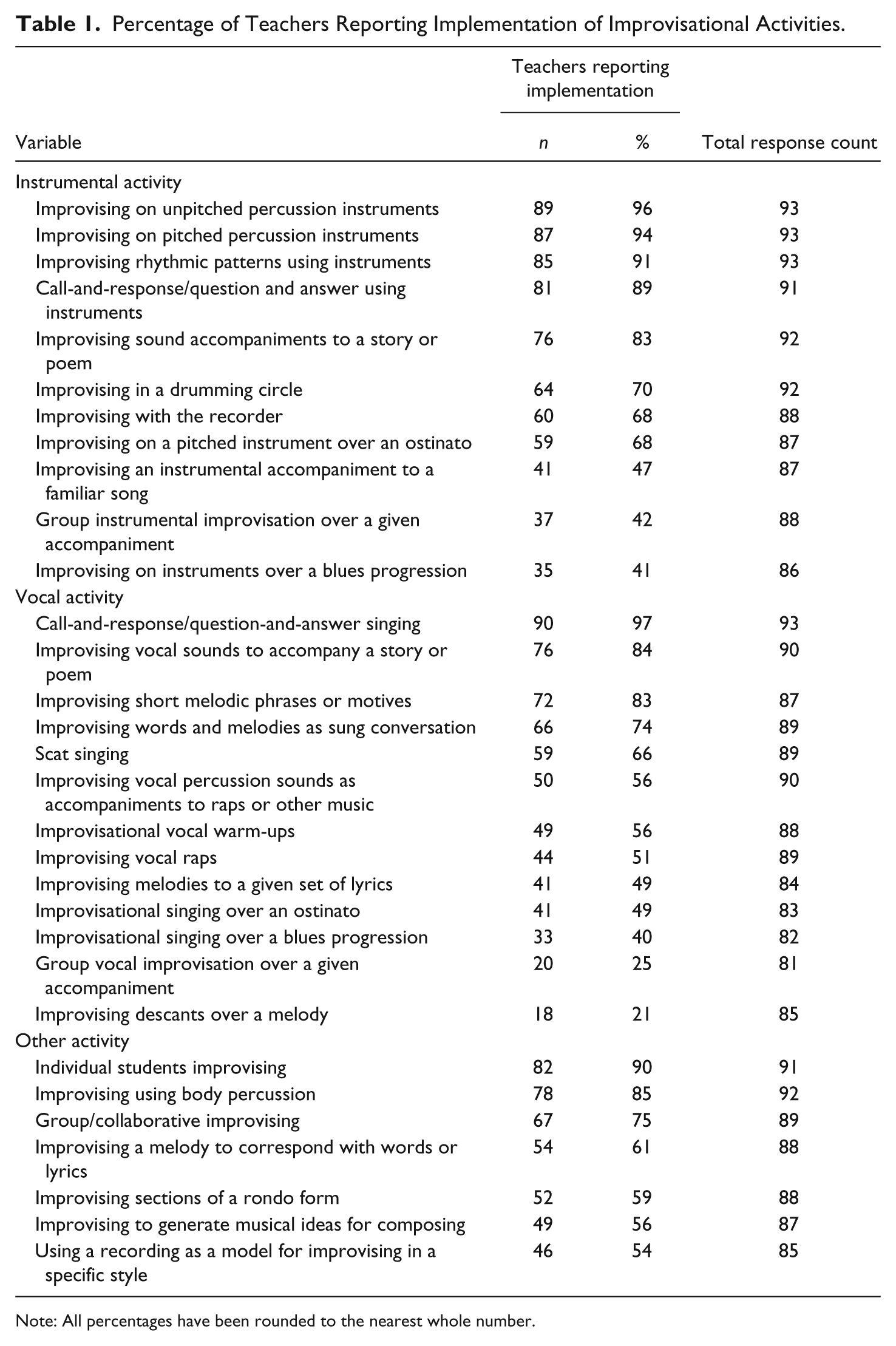
Note: All percentages have been rounded to the nearest whole number.
Participants were provided with opportunities to describe in more detail the nature of improvisational activities occurring in their classrooms. A summary of instructional concepts and topics reported by these teachers with descriptions of the types of improvisational activities implemented in each grade level may be found in the Appendix (available online at http://jrme.sagepub.com/supplemental). It is important to note that those activities listed as beginning in the lower grades continue throughout the elementary years.
Analysis of participants’ detailed accounts of improvisational activities revealed that call-and-response/question-and-answer conversational experiences were reported at every grade level, with students improvising vocally, with body percussion, through movement, and on unpitched and pitched instruments. One teacher reported,
I improvise on the piano (my major instrument) for creative dance activities (in PK–1, my teaching assignment). The children improvise their movements to the sound of whatever music I play. My objectives are related to self-expression and following what the music “tells” them to do. Sometimes I put additional parameters on the action, such as how many may dance together, dancing like a fairy, elephant, giant, bride/groom, old man/lady, penguin, hen, etc. and play appropriate music.
Another teacher indicated that his or her first-grade students chose from a list of words that corresponded to rhythmic values they had learned and then performed those words in an original pattern of their choice for the class. An example of a second- and third-grade improvisation activity used in this same classroom required that students listen to the teacher speak a simple rhythmic or melodic pattern and then change one rhythm or pitch and respond in question-and-answer form. In another classroom, the younger students listened to their teacher improvise a melody and then improvised a phrase or ending to the song, while third- and fourth-grade students improvised melodies over I–V chords.
Most participants reported that in the middle- to upper-level elementary grades, they began to introduce scat singing, drumming circles, recorder, guitar, and piano. Others reported that in the upper grades, they introduced students to blues and jazz through listening, and students learn to improvise melodies over specified scales and chord progressions. Some teachers indicated that they integrated improvisation using the World Music Drumming curriculum (Schmid, 1998) in fifth and sixth grade. Their students participated in call-and-response, question-and-answer, and “create grooves and riffs.” These teachers also used supplemental materials, such as the Jazz for Young People Curriculum (Marsalis, 2002), to support students’ developing understanding about the culture of jazz.
One teacher reported that his or her students improvised in a variety of ways, including playing Orff barred instruments to create “a B section of a song using the pentatonic scale in the key of the song, reflecting upon the style/rhythmic characteristics of that song.” These students also played the 12-bar blues chord progression on the barred instruments with one solo xylophone playing over that progression, allowing them to get “a feel for the chord changes.” This teacher also invited his or her students to improvise call-and-response in pairs by first simply talking as in conversation, then transferring that conversation to instruments. The students in this classroom also participated in vocal improvisation where the teacher began by modeling through call-and-response and students took turns as the lead while others supplied “basic vamping underneath.” In each of the above activities, all students were allowed time for exploration and soloing.
Another teacher described the “jazz xylophone experiences” he or she designed for fourth- and fifth-grade students:
Outcome: students played the 12-bar blues progressions as a group, and like a jazz performance, different instruments took turns and performed a solo 12-bar set. Before the lesson: [students] listened to a 12-bar blues song. [They] learned to sing the song [then] did vocal improvisation of lyrics or created new lyrics in the same style using the chords as a ground. [I] taught the 12-bar progression on the barred instruments [and] set up the instruments to play the jazz scale with blue notes and demonstrated an improvised solo. Then students took turns improvising or playing the 12-bar progression. Some added other accompaniments such as triangle or cymbal in a dotted rhythm [or] other percussion such as drums, etc. One group composed original lyrics for the new class song. Another group of students improvised movement patterns in a “slide” pattern, such as group dances like the electric slide.
Guidelines and Structure for Student Improvisation
One generative open-ended question asked, “Do the improvisational activities that you have implemented include free improvisation, improvising within specified guidelines, or a combination of both?” Of the 83 teachers who responded to the question, 65 reported using specified guidelines, and 18 reported using both specified guidelines and free improvisation. Some teachers reported they used specified guidelines because “too much freedom gives horrible results. . . . They don’t know what to think,” or “It is easy to feel like you have lost the situation if kids are given free time for improvisation,” and while admitting “that free improvisation can be more difficult because most students need specific guidelines about what to do,” these teachers realized that “guidelines provide a sense of security for students who may be apprehensive at first.”
Most teachers reported using specified guidelines because they believed structure was important in building a strong foundation for improvisation. These teachers wrote about modeling for their students: “When I start working with improvisation, I often provide examples of what might work. Then I will provide guidelines (let’s only use the pitches D–M–S, for example), and eventually encourage the kids as they find their own way.” Some teachers also wrote about providing developmentally appropriate guidelines because “students are more comfortable improvising on barred instruments and recorder when they are given guidelines or a pathway to follow. Without that, they often feel lost.” These teachers believed that providing support for students by establishing guidelines, while still offering exploratory opportunities, created a safe environment in which students could participate at their personal level of comfort and development and then move beyond. One teacher reported, “The children need the specified guidelines to start with and some will stay within them but others will break out of the box and freely improvise their own unique improvisations,” while another wrote, “Generally, I have found that students need a framework before they feel comfortable stepping out of the box into improvisation.”
Planning, Instruction, and Student Response
After participants described the most common improvisational activities implemented in their music classrooms, they were asked to reflect on those activities and to discuss student achievement in relation to their instructional objectives. During analysis of these responses (n = 84), three broad themes emerged: (a) process, practice, and experience; (b) sequencing, scaffolding, and modeling in instruction; and (c) collaboration, reflection, and creation. These teachers’ descriptions of their instructional objectives and the accompanying activities often embedded more than one of these themes or even all three themes within a given response. For the purpose of this article, representative quotes have been selected to illustrate the nature of these teachers’ responses.
Process, practice, and experience
Participants’ descriptions of student response to participation in improvisation activities revealed their personal beliefs about the importance of process in learning and details of their planning and instructional processes. Many teachers indicated that at the elementary level, they were most interested in the quality of improvisational process rather than with the product: “There is always a wide range of ‘success.’ I feel that if a student is making an attempt to improvise, they have succeeded. Some students produce a more interesting or melodic improvisation than others.” Although descriptions of student improvisations varied, and not all teachers offered a specific assessment of quality, many described the nature of the student improvisations as appropriate for the student’s developmental skill level, indicating that the improvisations varied according to experience, and while sometimes they were creative and complex, often they were “simple, but meaningful.” For example, one participant wrote,
Generally they met the objectives. The quality of the students’ improvisations are pretty much dependent upon the skill level of the students. In other words if they are grounded in steady beat, understand meter, [and] can sing solfège, generally their improvisations tend to be better.
These teachers indicated that allowing numerous opportunities for students to explore and internalize fundamental skills, such as phrase length and steady beat, prior to performance affected the nature of the student improvisations, as did the materials initially used in instruction: “The higher the quality is of the particular musical material that I pair the improvisation with, then the better their products turn out to be.”
Sequencing, scaffolding, and modeling in instruction
Discussion about the importance of sequencing in preparing students for improvisation was prevalent throughout these teachers’ responses, indicating their perception that structure, parameters, and a step-by-step process is necessary support at any developmental level. For example, one teacher said,
If you do a specific step-by-step task analysis of the process of improvisation, take the time to teach the vocabulary and the skills defined in the rubric, all students are able to perform at a satisfactory level and are always engaged in the learning. They will listen to each student in the class, take their turn, and they learn from each other.
The importance of scaffolding, modeling, and timing was discussed frequently in relation to planning, instruction, and student response:
Students are very creative in their body movement, especially when prepared by activities that expand their repertoire (locomotor and nonlocomotor movement, dynamic qualities, body parts). Sometimes I come up against inhibition in older elementary, but with the right timing and such, even this group can be free and creative. Starting with a fixed range of notes seems very important for students to have success with recorder or other tonal improvisation, in other words, starting with one note and improvising rhythms, then adding two notes, etc. Lots of modeling is helpful. When I ask them to improvise without this scaffolding, they are very confused and overwhelmed with the task.
Collaboration, reflection, and creation
Describing the collaborative process implemented in his or her instruction, one teacher wrote, “We record and reflect upon the improvisations with the students and teacher working together to create criteria and a basic rubric to measure success.” Others indicated that students “did well if they were prepared well” and that the more students were involved in the creation of their own music “the better they understand all music.”
As changes and improvement in the student improvisations occurred through repetition and practice, these teachers reported altering their instruction to support these new understandings. As they continued to provide authentic experiences in creating and improvising, these teachers noticed better understanding that led to more complex and creative improvisations from the students:
Initially, the responses are quite basic, but as students have more and more opportunities to play in improvisation, I find that their improvisations become more complex and creative. I’m not sure if it’s due to their comfort level (taking risks in front of others), or the actual process of having opportunities to practice improvisational skills or a combination of both.
Participants often reported that although some students may become stressed when asked to improvise, and their improvisations result in varying levels of success, the majority of students truly “enjoy it” or “love it” because it allows them to create original music that is their own. One teacher wrote, “Students’ improvisations are emotionally expressive and within developmental range. Sometimes quite creative. Always fun.” Another reported, “Many continue the improvisations in hallways or on the playground, turning the exercises into games.”
These teachers also discussed the development in progression of students’ skill levels over time due to practice and experience, believing too that structure and parameters along with this newfound experience brought a sense of comfort, confidence, and empowerment to the students. One participant reported,
The product varied from student to student. There will usually be the student that just doesn’t perform a pattern with a clear beat and then there will be the student that can probably go and perform with STOMP. But in the end I want to see the students understand what it means to create their own patterns and hopefully see a progression of skill through out the year as they explore more patterns and become more confident.
As noted by the majority of these teachers, students were deeply engaged in the improvisation activities. One teacher’s reflection was particularly poignant in regard to the impact participation in improvisation activities had on his or her students:
Yes, it was really successful. Kids were really quiet when others were doing their solos. I encouraged kids to try out other kid’s ideas. Since I told them as long as they kept their three-finger C position and played C, D, and E, they couldn’t make a mistake, they felt free to explore. There was a reverence in the room during this activity that really empowered the class.
Discussion
The purpose of this study was to determine the nature and extent to which improvisation was occurring in participants’ elementary general music classrooms and these teachers’ perceptions of the quality of their students’ improvisational achievements. While these data provide a valuable lens into the nature of improvisational activities in these teachers’ classrooms, future studies with larger samples are warranted. Based on the low return rate, for reasons described previously, generalization of the current findings should be made with caution. Recipients of the questionnaire link who were already interested in improvisation may have been more inclined to participate, while those teachers not as interested or who did not include improvisation in their instruction simply may have deleted the e-mail or chosen not to participate. However, the large amount of data gleaned from the narrative responses provided rich findings, and because they were similar to findings from previous studies, such as the majority of respondents reporting they include improvisation in instruction (Koutsoupidou, 2005; Whitcomb, 2005) and that children of varying ages are capable of improvising under a variety of circumstances (Azzara, 1992; Brophy, 1999, 2005; Flohr, 1979; Paananen, 2006), we believe that this sample may provide a good representation of elementary general music teachers’ use of improvisation.
Other similar findings that particularly relate to the improvisational endeavors of children in music classrooms include emerging collaborative behaviors; a desire to improve quality of performances, and the development of shared understandings about music, musicianship skills, and the nature of improvisation through group work, practice, performance, and ongoing reflective practices (Burnard, 2002; Gruenhagen, 2009; Kanellopoulos, 2007; Wiggins, 1999/2000). Teachers who participated in this study reported that they incorporated specified guidelines into student improvisational activities because such guidelines provided security for those learning to improvise. This finding echoes that of Beegle (2010), who argued that a balance between structure and freedom provided inspiration and a foundation for maintaining “creative musical growth” (p. 235), as well as of findings of Bitz (1998). Additionally, the number of these similar comments and overlapping themes found among our participants’ responses to the narrative questions suggests a saturation of information that was sufficient to develop themes and meaningful interpretations and to understand these teachers’ perceptions and experiences (Guest, Bunce, & Johnson, 2006).
Including generative open-ended questions allowed us to gather narrative information from a sampling of elementary music teachers across the six geographic divisions of NAfME. It was of interest to us in this particular study to obtain a general picture of these practices across the United States. Although our numbers were not large enough to analyze by divisions, we noticed varying degrees of participation across these divisions that further sparked our curiosity. While participation could be based on a number of factors, including those already mentioned, we began to wonder about teacher practices in relation to each of these divisions. Are there particular factors that influenced participation within these divisions? If so, what were they? Do those geographic divisions with higher levels of participation have regional or state improvisation chairs that perhaps provide awareness, support, and professional development opportunities related to incorporating improvisation into teaching practice? Moreover, what is happening at local levels? Many of the teachers in our study reported implementing strategies and techniques gleaned from workshops and training in World Music Drumming, Orff Schulwerk, Kodály, Dalcroze, and Music Learning Theory. Are there specific approaches to teaching music that encourage improvisation more so than others? Are any of these approaches to teaching more common in certain regions, states, or districts than in others? Do local school districts embrace any of these approaches or require their teachers to become certified in one of more of them? If so, could this affect implementation of improvisational practices in elementary general music in these districts and their schools? Future qualitative investigations could be designed to examine these questions at any level but perhaps would be carried out more readily at the regional, state, or district level.
Because themes from the narrative data indicate these teachers would welcome more training and professional development related to the inclusion of improvisation in elementary music instruction, qualitative studies that address such questions as those listed above could inform teacher educators, providers of professional development, and teacher leaders in schools about the current state of training and understanding around the use of improvisation in elementary general music classrooms. Findings could inform the design of appropriate and more extensive experiences and training that support teachers in the development of their own improvisational skills; that model best practices for teaching, sequencing, and planning curricula rooted in improvisation; and that support teachers in developing sound pedagogical skills for teaching improvisation from the beginning to the more advanced stages of skill development. Several teachers in this study reported the creation of their own personal networking opportunities, such as gathering with colleagues to share, practice, and participate in improvisational activities. Examining these kinds of gatherings, which allow multiple opportunities for social learning in musical context, through qualitative and ethnographic research methods could provide rich vignettes to illustrate valuable and desired types of formal and informal collaborative professional development for elementary music teachers.
Although some teachers in this study put less importance and priority on improvisation than on other musical activities, the majority of these teachers perceived improvisation as necessary to the development of students’ musical skills, as an important way for students to show their musical understanding, and as an empowering and creative process that produced more independent thinkers and musicians. To better understand the impact improvisation has on children’s musical development and understanding, future qualitative research similar to the studies of Beegle (2010), Burnard (2002), and Gruenhagen (2009) could be designed to examine children’s improvisational practices and perceptions of these practices, both inside and outside the music classroom. Conducting studies similar to this study as well as individual and collective case studies of music teachers to determine the nature of their teaching practices and their perceptions of the impact that participation in improvisation has on student learning would contribute to the small but growing collection of literature in this area.
We undertook the present study to investigate the extent and nature of improvisation in the participants’ elementary general music classrooms and the teachers’ perceptions of the impact that these kinds of creative learning opportunities may have on children’s musical development and understanding. We hope that all constituencies within our profession will seek opportunities to further understand and collaborate on the incorporation and instruction of improvisation in teacher training, professional development, and elementary music programs to provide the best possible educational experiences for elementary general music teachers and their students.
Footnotes
Declaration of Conflicting Interests
The authors declared no potential conflicts of interest with respect to the research, authorship, and/or publication of this article.
Funding
The authors received no financial support for the research, authorship, and/or publication of this article.
Author Biographies
References
Supplementary Material
Please find the following supplemental material available below.
For Open Access articles published under a Creative Commons License, all supplemental material carries the same license as the article it is associated with.
For non-Open Access articles published, all supplemental material carries a non-exclusive license, and permission requests for re-use of supplemental material or any part of supplemental material shall be sent directly to the copyright owner as specified in the copyright notice associated with the article.
