




Abstract
Before our current notation system was widely adopted by musicians, improvisation was a key component of music throughout the Western world. One of the fundamental elements of the baroque style, namely, using improvised embellishment, offered musicians great artist liberty. During the baroque period, improvisation spread across Europe and beyond. To achieve a thorough understanding of the art of improvisation, it is important to be familiar with several improvisation techniques commonly used in the baroque period. This article focuses on some of these characteristic techniques, such as harmonic improvisation from figured-bass symbols, expressive ornamentation on an existing melodic line, and variation forms. The article also offers educators ways to apply these improvisation techniques to teaching improvisation in elementary music classrooms.
Keywords
Discover how elements of baroque-era music can inspire your students to become more creative improvisers.
When most people hear the word improvisation, jazz is likely the first thing that comes to mind. This assumption stems from the fact that most people associate improvisation solely with jazz, a genre that is understood to rely often on improvisational virtuosity. However, improvisation was commonly used in both Western art music and non-Western music long before jazz improvisation existed. From the perspective of Western art music, improvisation can be traced back to the medieval period where singers would add melodies to preexisting melodies (e.g., organum, discant, and motet). 1 Even though it is unclear when improvisation first developed, the well-organized improvisation on a plainsong can be found in the Johannes Tinctoris treatise Liber de arte contrapuncti published in 1477, 2 suggesting the practice had already well been established by that time. In the fifteenth century, faburden allowed singers to improvise over a preexisting melody, adding a new part above or below the melody. In faburden style, the thirds and sixths above the bass were the preferred intervals excerpt at the beginnings and endings of phrases, where octaves and fifths were preferred. 3
The baroque period was well known for its improvisatory performance practices that developed from three sources: the development of the basso continuo style that required harmonic improvisation from figured-bass symbols, the interest of performers in conveying certain emotions in expressive ways using ornamentations, and the increase of variations on popular or folk songs. 4 The composers in this era often only roughly sketched (“outlined”) the musical score, expecting the performer to improvise the music “in accordance with certain rules (e.g., cadential trills, appoggiaturas, passing tones, etc.) and the performer’s own interpretation.” 5 Consequently, in the baroque period, performers’ virtuosity became the prevailing characteristics of music, and improvisation became a vital skill for proficient musicians. 6 These improvisations in the baroque period are now written out (e.g., cadenzas in published songs). Later on, during the classical period, improvised cadenzas by the solo performance of concertos were frequently performed. Nonetheless, compared to the previous periods, improvisation declined in the late nineteenth and early twentieth centuries as musicians began to adhere to literal performances of the written notation. 7
Fortunately, the value of improvisation has been reemphasized in all of the well-known music education methodologies developed by twentieth-century music educators such as Dalcroze, Kodály, Orff, and Gordon. Each method encourages children to be engaged in improvisational activities as a means to “express their own musical ideas in aural patterns and in creative ways.” 8 In addition, improvisation has been supported by the National Standards for Music Education (1994) in order to help students develop skills in creative and critical thinking in music. Standard 3, “Improvising melodies, variations, and accompaniments,” provides music educators with some specific and practical suggestions for including improvisation activities. In the revised standards (nafme.org/standards), which were implemented in 2014, improvisation is presented in Common Anchor Standards 1 and 2 (generate, conceptualize, organize, and develop artistic ideas and work) under the banner of the Artistic Process of “Creating” (the first of three Artistic Processes that also include “Performing” and “Responding”). The suggested activities include improvising ideas and patterns as well as rhythmic, melodic, and harmonic improvisation. Students are asked to describe the relevance of these activities to their personal experience, specific interests, or purpose. It is interesting to note that these suggested activities (e.g., rhythmic, melodic, and harmonic improvisations) were widely used as improvisation techniques during the baroque period. Although some improvisation techniques of the baroque era have already been adopted in contemporary music classrooms, it would be valuable to dig into the even richer sources of the improvisation practices that were predominant during the baroque period. This in-depth exploration would lead to a better understanding of the art of improvisation and appropriately allow instructors to utilize these techniques to today’s music classes.
This article presents improvisation techniques prevalent among baroque musicians and suggests ways these techniques can be used in today’s elementary music classrooms. Focus is on three primary improvisational techniques: (1) harmonic improvisation from figured-bass symbols, (2) ornamentation on an existing melodic line, and (3) variation forms.
Figured Bass
One of the most important features of baroque music is the art of the basso continuo (also called “thoroughbass” or “figured bass”). 9 Its onset corresponds with the expressive ideals of the Florentine Camerata at the end of the sixteenth century. Gradually, providing the rhythmic and harmonic support for voices and ensembles became a crucial feature. 10 Composers of this period used a shortened system with figures (numbers) written below or above the bass line to indicate which additional notes might be appropriately added in the harmony. 11 With this base line, the players of “chordal instruments improvised an accompaniment, called a realization, in accordance with certain rules and the performer’s own interpretation.” 12 In the same way that modern musicians are expected to sight-read, during the baroque period, the ability to improvise accompaniments and read figured bass were expected of a competent musician. The choice of continuo instruments and the practices of continuo realization in this period depended largely on period, national style, performers, and size of the ensemble. 13
Ornamentation
Applying ornamentation was a conspicuous skill of improvisation for baroque musicians. 14 These ornamentations were often not notated in the music; “baroque artists valued the affections and promoted their free expression,” 15 and performers simply adopted ornamentations as an expressive vehicle. 16 The “appoggiatura” and the “trill” are essential ornaments in baroque music. 17 The word appoggiatura is derived from the Italian verb appoggiare, meaning “to lean.” 18 Appoggiatura must come on the beat by moving up or down either by step or leap. Even though the length of appoggiaturas (long and short) varies with the date and context, the standard eighteenth-century rule of long appoggiatura is that the appoggiatura receives half the length of the main note and two-thirds of the value of a dotted main note.
The trill is defined as “a rapid alternation between two adjacent tones,” and the symbol t, +, or tr is placed over a note to indicate the trill at that point. With a few exceptions, the standard style of executing a baroque trill is to start a note a half step above the written note. Trills are commonly used at half cadences or ending cadences, and the performers should recognize these cadential trills regardless of whether these are indicated in the score. 19 In Italy after 1660, performers were also allowed to add free ornamentation, particularly to a returning melody in a da capo aria. 20
Ornaments were indicated to different degrees with a variety of symbols depending on where the baroque composers were from. For example, Italian composers rarely used symbols of ornamentation except for a few trills with the indication of the signs or appoggiaturas written with a small note slurred to the main note. Unlike the Italians, French composers highly relied on symbols; for example, they used the symbol + to indicate numerous kinds of ornamentation. The Germans developed an extremely organized system of ornamental notation that remains the most widely known of these systems today. 21
Variations
The principal types of variation forms developed during the baroque period were strophic variations, couple dances, and grounded bass forms. 22 First, strophic variation commonly appeared in vocal music, especially in the leading aria form (da capo aria) of early baroque opera. In the da capo aria, a returning melody is varied (e.g., ornamentations, adding passing tones, altering intervallic relationships, changing rhythms, etc.) while the bass retains the same harmonic patterns. Second, varied couple dances such as passamezzo, pavane, and galliard were prevalent, and these dances had the same melody line in duple and triple, respectfully; the rhythm of the melody was varied in the second of the two dances according to the conventions of its meter and pattern. Another type of the baroque variation form was ground bass (basso ostinato in Italian). Ground bass had a short motif in bass that repeated continually with variation of the upper parts (listen to Johann Pachelbel’s “Canon in D” for an example of this).
Teaching Improvisation with Baroque Techniques
Contemporary music educators can incorporate the teaching of improvisation from figured-bass symbols, ornamentations, and variation forms into their lesson plans as a way to teach improvisation skills. As part of this exercise, the teacher can use teacher-guided listening activities to engage students by having them listen to examples of music from the baroque era as they learn to improvise these harmonic styles. The following exercises serve as a starting point for music teachers who would like to teach some improvisational skills in upper-elementary music classes (fourth and fifth grades). These exercises are designed to be implemented over several class periods. In addition, the exercises suggested in the following could be sung or played using classroom instruments (e.g., recorders, xylophones, iPads, etc.).
Exercises with Figured Bass
Step 1: One Note against One Note Exercise
In this exercise (see Figure 1), students first learn to distinguish consonant from dissonant sounds by playing one note in the bass against one note in the treble on available classroom instruments (e.g., recorder, xylophones, iPad, etc.) with a teacher. The teacher plays the notes in the bass clef, and students find their notes by counting the intervallic distance of notes indicated by numbers underneath the bass. For instance, when the number 2 appears below the note C in the bass clef, students should play a D. The number 2 indicates the interval from the bass note marked. From C to D = an interval of a second; 3 means up to the third interval, and so on. After playing the notes, the teacher asks students to discuss their feelings and responses when hearing consonances and dissonances (How does this interval sound to you? Does it seem pleasant, angry, etc.?).

Consonant and Dissonant Sounds
Second, students learn to improvise by using only the third and sixth intervals from the bass notes (see Figure 2). While the teacher is playing a C-major descending scale, students should improvise by fitting either a third or a sixth. Afterward, in pairs, students should write figures (third or sixth) under the bass note before improvising. One person should play the C-major descending scale, and the other improvises by fitting either a third or a sixth intervallic distance from the bass notes. In fact, even though the intervals between a third and a tenth are different, a tenth in this exercise is considered a third for a novice to learn the concept of figures.

Improvising Using the Third and Sixth Intervals
Step 2: Improvisation from Figured-Bass Symbols
This exercise (see Figure 3) is a simplified version of a figured bass, but instead of asking students to fill in the notes in harmony, students improvise the melody based on given figures. For example, the bass note C in C major with the number 2 represents maximum intervallic distance of two notes (e.g., with 2, students can choose from either C or D). When 3 is indicated below the note C, students can use up to the major third interval from C, which is E, and improvise by using three notes (C, D, and E). The teacher provides students with a limited number of rhythms, such as quarter notes, rests, and pairs of eighth notes, in order to have students focus on melodic improvisation. While the teacher plays the notes in bass, the students simultaneously play their improvised notes on the classroom instruments. In addition, students can play in pairs: One person plays the bottom note, and the other plays the improvised notes.

Melodic Improvisation with Figured Bass
Step 3: Improvisation from Figured-Bass Symbols
The students practice improvising based on harmonic progressions (see Figure 4). To begin, the teacher explains the fundamental triadic chords (I and V); the Roman numerals consists of three notes (I: C, E, and G; V: B, D, and G), each a third apart. Then, the teacher presents an I–V–I chord progression with a time signature and simple rhythmic patterns (e.g., eighth notes, quarter notes, and rests) so the students can concentrate on improvising on the melodies based on the given harmonic progressions. Before going on to improvise, students vocalize the rhythmic patterns by voicing the notes without pitch, and then the teacher invites students to improvise based on the given chord progression. Next, students are asked to improvise both rhythms and notes based on the given harmonic patterns. Also, these exercises are intended to be implemented over several class periods (lessons).

Harmonic Improvisation with Figured Bass
Exercise Using Baroque Ornamentation: Trills
The teacher uses visual presentation (rhythm cards) and vocalizes the rhythms using ornamentation, such as a trill (see Figure 5). The students identify a pattern of notes that are different from the others. After discussing the different note, the teacher places a star on the note that was played with trills. The teacher shows the rhythm card marked with a star on the note and vocalizes the rhythmic patterns with trills. A quarter note is indicated by ta, and the note with trills is indicated by the sounds ti, ri, ri, ri.

The Notes with Trills Using Ti, Ri, Ri, Ri
Next, the students respond to the same rhythmic patterns of the trills but in different places: (a) trill on the first beat, (b) trill on the second beat, (c) trill on the third beat, and (d) trill on the fourth note (see Figure 6). Even though a trill is a variation of pitch, students first exercise trills without pitches to understand that a trill should be played within the given note value in the meter. For instance, if a quarter note has a trill in 4/4, the trill should be played within one beat. The evenness of the notes is important. Therefore, the teacher should have students practice trill notes slowly.

The Trills in Different Places
After voicing the rhythmic patterns, students sing or play the pattern on available classroom instruments. When a soprano recorder is used, it is advisable to have students play ti to la in a C major (see Figure 7). This exercise is the easiest because students only need to use the third finger of their left hand to make trills.

The Trills on Pitches
After students get sufficient practice with trill notes, the teacher selects a simple song (e.g., “Twinkle, Twinkle, Little Star,” “Music, Music, Music,” or “All Night, All Day” in Music Connection; Needham, MA: Silver Burdett Ginn, 1999) composed of three sections; the first section ends in the tonic key, the second section contrasts with the first in melody or mood, and the third section is the same as the first section. Initially, the teacher sings or plays the entire song without trills and asks students to find the structure of this song. Then, the teacher runs through it again; the first and the second sections should be sung or played the same as the first time, and a retuning melody (the third section) should be sung or played with trills. Afterward, the teacher asks students the difference between the first and the second performances. After discussing it, the teacher explains da capo, in which a returning melody should be different, adding some ornamentations like trills. Students should be first asked to sing or play trills at the ending cadence during the third section. Then, the teacher asks students to add trills of their own on a returning melodic line (e.g., free ornamentation used in Italy after 1660). Several volunteer students will be asked to play the song with trills on a recorder. In addition, the teacher asks students what they think might be the reason for using trills in particular notes.
Exercise Using Appoggiatura
The procedures of teaching appoggiatura are similar to ones of teaching trills. Initially, the teacher uses visual rhythm cards (see Figure 8), voices the rhythmic patterns using appoggiatura, then asks the students to identify a paten of notes that are different from the others. After the students identify the different note, the teacher attaches a heart to the note that was played differently (appoggiatura). The note with appoggiatura is indicated by ti-ah, and the appoggiatura is played on the beat and takes half the length of the following note and two-thirds of the value of a dotted main note. Students imitate the teacher’s rhythm several times until they become comfortable enough to play it themselves.

The Appoggiatura in Different Places
Afterward, students can either play the designated melody on their classroom instruments or sing them using solfège syllables (see Figure 9).

Long Appoggiatura on Pitches
Finally, the teacher presents a simple song and has students perform the entire piece without appoggiatura for the first time; during the second time through, the teacher asks them to apply appoggiatura to the original melodic line. After the students sing or play the melodies with and without appoggiatura, they are encouraged to discuss how different the sounds are between the original melodies and the melodies with appoggiatura.
Exercises by Using Baroque Variations
The most frequently used improvisation exercise in elementary general music classes are normally rhythmic and melodic variations. In the rhythmic variation exercise, only the rhythm of the song can be varied on the existing song while the students are maintaining the same pitches. In the melodic variation exercise, the teacher selects a simple and short song in ABA form (i.e., “Twinkle, Twinkle, Little Star”). Then, the students are asked to sing or play the song as written the first time and to vary a returning melody that is different from the initial melodies. This variation exercise is modeled on the variation technique used in da capo aria.
Get outside Your Comfort Zone!
In spite of the importance of the inclusion of improvisation instruction in class, teachers often fear teaching improvisation because of their own lack of practical experience improvising as a musician, lack of training to teach improvisation, lack of theoretical knowledge of improvisation, and lack of necessary resources to help implement improvisation in music programs. Considering these challenges, this article provides commonly used improvisation techniques from the baroque period as well as some practical teaching procedures and helps to apply these techniques to today’s elementary music classroom. It is especially important to provide students with the opportunity to listen to and discuss several examples of baroque music, including these improvisation techniques (see the YouTube links in Figure 10) so that students can hear the actual sound of baroque improvisation. A close look at baroque improvisation techniques allows instructors to examine the source of improvisation techniques; furthermore, such an examination creates a space for music teachers to either emphasize or incorporate methods to teach improvisation to their students. Thus, this type of instruction allows both students and teachers to continue to develop existing skills as well as adding new ones in order to elevate their musical understanding; this, in turn, will improve their overall levels of musicianship across various styles and genres (e.g., jazz, rock, etc.).
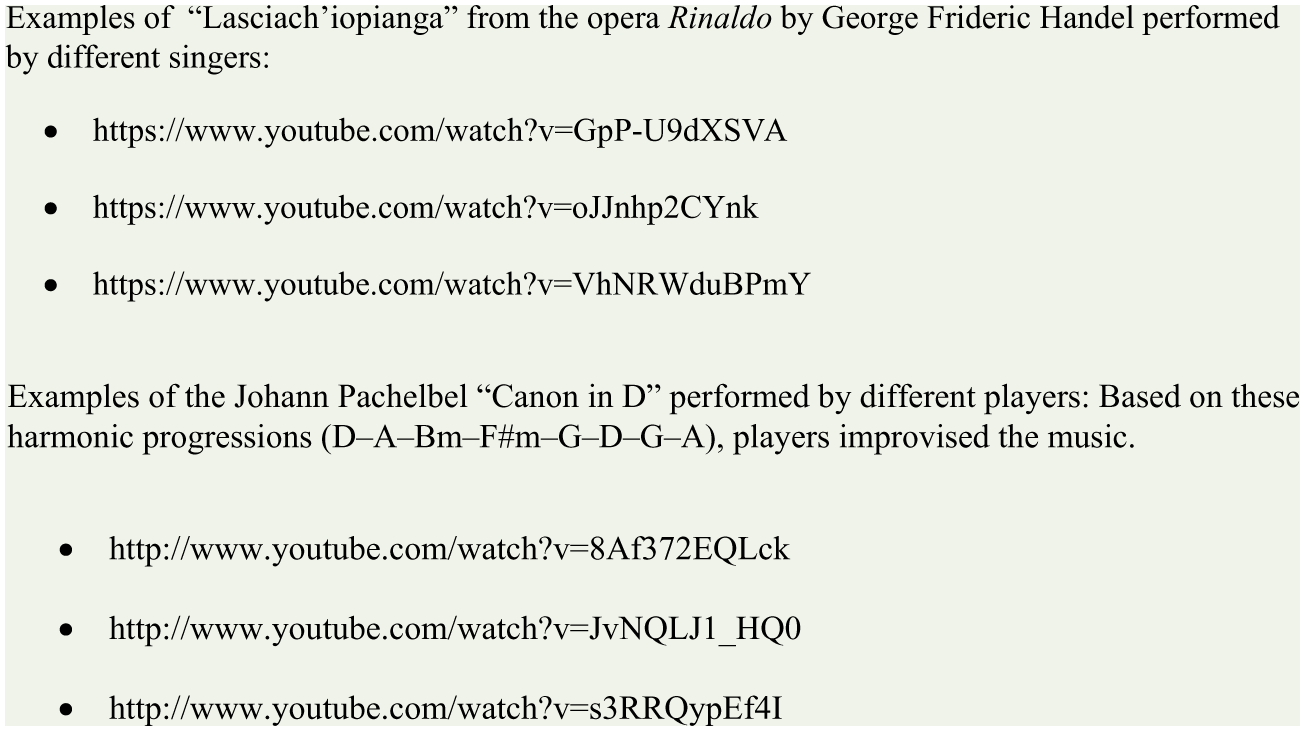
Links to Resources for Improvised Music